
Francoise J.-P., Naber G.L., Tsun T.S. (editors) Encyclopedia of Mathematical Physics
Подождите немного. Документ загружается.


formulation for the Newtonian theory of space,
time, gravitation, and hydrodynamics.
The possibility to split the connection into a flat
part which is independent of matter and a tensorial
part depending on matter and given by the vector
field g
= s
,
(with from eqn [11]), arises only
from supplementing the local laws [7] by the global,
resp. asymptotic, conditions (1)–(2), [14], [17]
stated above. The introduction of inertial coordi-
nates is then convenient, but not necessary. In
noninertial, rigid frames of referenc e,
gives
rise to inertial forces.
It should be possible to define spatial asymptotic
flatness in the CFF, but that has not been done.
Remarks on Newtonian Cosmology
In cosmology, the conditions (2) and [17] of the
last subsection are not appropriate. Instead one
keeps the laws [7] and adds to the m eqn [9],so
that with respect to nonrotating coordinates the
laws [8] with w = 0andeqn [10] remain valid.
Then, there are no longer inertial coordinate
systems, and the potential U is not a 4-scalar.
For a slightly different approach, see Ru¨ede and
Straumann (1997).
For the purpose of this article, the term
‘‘cosmological model’’ w ill be applied to those
solutions of the laws [7] and [9] which satisfy >0
and which have a symmetry group which acts
transitively on the set of world lines representing
the motion of the fluid. This strong symmetry
assumption determ ines the time-evolution even in
the ‘‘Newtonian’’ case = 0 in spite of the absence
of an evolution equation for the gravitational
field g.
Newtonian Limits of Families
of GR Solutions
The disc ussion in the sections ‘‘The Car tan–
Fried richs form alism’’ an d ‘‘N ewton’s theory in
spacetime form’’ suggests the following:
Definition 1 Let a family F() = (t
(), ...)of
basic fields parametrized by , obeying the laws [7]
of the CFF, be given for 0 <a. We assume the
underlying mani folds M() to be open submanifolds
of a fixed manifold M such that M(
1
) M(
2
)if
1
<
2
and
S
M() = M. Then we write
lim
!0
FðÞ¼Fð0Þ½19
if the fields of F() and their first derivatives
converge pointwise to those of F(0).
F(0) is then said to be a CF limit of the sequence of
(-rescaled) solutions F() of GRT. If the fields of a
-family of GR solutions (>0) and their first
derivatives converge for ! 0 locally uniformly,
then the limit fields satisfy eqns [7].IfF(0) has the
additional property [9], the limit is locally Newtonian.
On the basis of the section ‘‘The Car tan–
Fried richs formalism ’’ one may con jecture that if
eqn [19] holds and the F() for >0 are spatially
asymptotically flat, F(0) will represent an asympto-
tically flat Newtonian spacetime. Examples such as
Example 1 below are in agreement with this
conjecture, but a general proof is not known.
Example 1 The interior solution for a static,
spherically symmetric fluid ball of constant energy
density (Schwarzschild 1916) is given by
ds
2
¼
dr
2
a
2
þ r
2
ðd#
2
þ sin
2
# d’
2
Þ
1
4
ð3a
0
aÞ
2
c
2
dt
2
¼ const:>0; p ¼ c
2
a a
0
3a
0
a
U ¼
2
3a
0
a
@
t
; aðrÞ¼ 1
8
3
kc
2
r
2
1=2
a
0
¼aðr
0
Þ
Inserting into these expressions the parameter
= c
2
and treating and r
0
as -independent
constants results in a -family with 0 <
((8=3)kr
3
0
)
1
. The limit solution represents a
Newtonian fluid ball of constant mass density .
The Schwarzschild vacuum fields belonging to these
fluid balls also have the appropriate Newtonian
limits. The resulting complete spacetimes are asymp-
totically flat. A dimensionless small parameter
which could be used instead of to measure the
deviation of the GR solut ion from its Newtonian
limit is the ratio of Schwarzschil d radius and the
geometric radius:
2kM
c
2
r
0
¼
8
3
kr
2
0
c
2
Example 2 A Friedmann–Lemaitre cosmological
model of GR containing dust and radiation is given by
ds
2
¼ R
2
ðtÞ
ab
d
a
d
b
1 ð1=4ÞðE=c
2
Þ
ab
a
b
ðÞ
2
c
2
dt
2
where R(t) obeys
_
R
2
8
3
k
M
R
þ
S
c
2
R
2
¼ E
Newtonian Limit of General Relativity 507

M is a mass constant, = M=R
3
is the mass densi ty
of ‘‘dust,’’ S is an entropy constant, = S=R
4
the
energy density a nd p = (1=3) the pressure of
radiation; and E is a constant of dimension
(speed)
2
. The world lines of the fluid elements
are given by
a
= const. (Lagrangian comoving
coordinates).
Taking E, M, S constant and = c
2
as a parameter
provides a -family of GR models with Newtonian
limit. In the limit, t is the Newtonian time, and the
spatial metric R
2
ab
d
a
d
b
describes an expanding
Euclidian space R
3
(if E 0) or an open ball of
radius 2R(t)init(ifE > 0). In the coordinates (
a
, t)
the connection does not have the ‘‘Newtonian’’
components [8a], instead its nonvanishing compo-
nents are
0
a
b
= (
_
R=R)
a
b
. In local inertial coordinates
x
a
= R
a
centered on the particle with
a
= 0(which
could be any particle because of the homogeneity of
the model), the spatial metric is dx
2
,andthe
connection components are Newtonian, with
U = (2=3)kx
2
and U = 4k . In the limit, the
radiation no longer influences the expansion; one gets
the Newtonian dust models (eqn [9] is satisfied). The
connection is, of course, not asymptotically flat. The
curvature tensor R
= (4=3) kt
s
exhibits
homogeneity and isotropy. The Gaussian sectional
curvature of the 3-space at time t is K = E=R
2
.As
a dimensionless smallness parameter one can take
E=c
2
. In the ‘‘open’’ models, with E 0, the
coordinates
a
cover the whole 3-manifold of fluid
particles, while in the ‘‘closed’’ case, E < 0, one
particle, the antipode of
a
= 0 on the 3-sphere, is not
covered. That particle is missing in the Newtonian
limit model. In the Newtonian case the expanding
Euclidian space R
3
can be replaced by a torus; in the
GR cases this is possible only for E = 0.
Many examples of GR fam ilies with Newtonian
limits are known (see, e.g., Ehlers (1997) and
references therein). An example of a -family
which has an almost Newtonian limit which does
not satisfy eqn [9] is pr ovided by NUT spacetimes
(see Ehlers 1997), interpreted as due t o a
gravitomagnetic monopole (Lynden-Bell and
Nouri-Zonez 1998).
Applications and Problems
Can one construct, for a given Newtonian solution
N,a-family of GR solutions which converges to
N? Some answers are known and listed below.
U Heilig (1995) has shown: given a solution t o
the Euler–Poisson equations representing a station-
ary, rigidly rotating, self-gravitating fluid body
with its surrounding gravitational field, there exists
a -family of corresponding solutions to the
Einstein–Euler system having the given solutions
as its limit.
The proof is based on the fact that one can
reformulate eqns [1], [2] in terms of harmonic
coordinates and new dependent gravitational vari-
ables instead of g
such that the new equations
given in Lottermoser (1992) are analytic in and
reduce, for = 0, to the Euler–Poisson system. In the
stationary case these equations are elliptic for 0.
Using appropriate function spaces, Heilig shows, via
the implicit function theorem, that a solution for
= 0 can be extended to small, positive values of .
Since L Lichtenstein has constructed solutions as
assumed in the theorem, the existence of GR
solutions follows.
The gravitational part of the system of equations
referred to above is hyperbolic for >0, but
becomes elliptic for = 0, whereas the fluid equa-
tions remain hyperbolic. In spite of this difficulty
Rendall (199 4) has shown that -families of time-
dependent, asymptotically flat solutions to the
Einstein–Vlasov system representing gravitating
systems of collisionless particles have Poisson–
Vlasov limits, and that any Poisson–Vlasov solution
can be so obtained.
Lottermoser (1992) succeeded in proving the exis-
tence of -families of solutions to the Einstein constraint
equations which have Newtonian initial data as limits.
Nothing seems to be known about solutions evolving
from such data. Lottermoser has given an interesting
discussion concerning possible extension of his work
which apparently has gone unnoticed.
Rendall (1992) has defined and analyzed post-
Newtonian expansions to Einstein’s equations and
their solvability, assuming -families whose t
, s
are a few times differentiable in =
ffiffiffi
p
at = 0. He
found that for low orders the equations have
asymptotically flat solutions, but that at order
8
divergences occur for general Newtonian seed
solutions. Modifications of the method to overcome
these difficulties have been considered by Rendall
and others; the problem is open.
In cosmology, one uses homogeneous back-
ground models and studies their perturbations.
The latter are frequently based on Newtonian
equations. This can perhaps be justified as follows.
According to Example 2 the fields of Friedmann–
Lemaitre models differ fr om their Newtonian limits
by arbitrarily small amounts uniformly in
spacetime regions where the terms involving are
small, that is,
S
Mc
2
RðtÞ;
ffiffiffiffiffiffi
jEj
p
c
jxjRðtÞ
508 Newtonian Limit of General Relativity

Additional conditions will be needed to ensure that
Newtonian perturbations approximate relativistic
ones and that gravitational wave perturbations can
be neglected.
See also: Cosmology: Mathematical Aspects; Einstein
Equations: Exact Solutions; General Relativity: Overview;
Gravitational Lensing; Shock Wave Refinement of the
Friedman–Robertson–Walker Metric.
Further Reading
Cartan E (1923) Sur les varie´te´s a` connexion affine et la the´orie de
la relativite´ge´ne´ralis
´
ee. Annales Scientifiques de l’Ecole
Normale Supe´rieure XL: 325–412.
Cartan E (1924) Sur les varie´te´s a` connexion affine et la the´orie de
la relativite´ge´ne´ralis
´
ee. Annales Scientifiques de l’Ecole
Normale Supe´rieure XLI: 1–25.
Ehlers J (1981) U
¨
ber den Newtonschen Grenzwert der Ein-
steinschen Gravitationstheorie. In: Nitsch J et al. (eds.)
Grundlagenprobleme der modernen Physik, pp. 65–84.
Mannheim: Bibliografisches Insitut Wissenschaftsverlag.
Ehlers J (1997) Examples of Newtonian limits of relativistic
spacetimes. Classical and Quantum Gravity 14: A119–A126.
Friedrichs KO (1927) Eine invariante Formulierung des New-
tonschen Gravitationsgesetzes und des Grenzu¨ berganges vom
Einsteinschen zum Newtonschen Gesetz. Mathematische
Annalen 98: 566–575.
Heilig U (1995) On the existence of rotating stars in general
relativity. Communications in Mathematical Physics 166:
457–493.
Ku¨ nzle HP (1972) Galilei and Lorentz structures on space-time:
comparison of the corresponding geometry and physics.
Annales de l’Institut Henri Poincare´ XVII: 337–362.
Lottermoser M (1992) A convergent post-Newtonian approxima-
tion for the constraint equations in general relativity. Annales
de l’Institut Henri Poincare´ 57: 279–317.
Lynden-Bell D and Nouri-Zonoz M (1998) Classical monopoles:
Newton, NUT space, gravomagnetic lensing, and atomic
spectra. Reviews of Modern Physics 70: 427–445.
Rendall AD (1992) On the definition of post-Newtonian
approximations. Proceedings of the Royal Society of London
Series A 438: 341–360.
Rendall AD (1994) The Newtonian limit for asymptotically flat
solutions of the Vlasov–Einstein system. Communications in
Mathematical Physics 163: 89–112.
Ru¨ ede Ch and Straumann N (1997) On Newton–Cartan
cosmology. Helvetica Physica Acta 318–335.
Noncommutative Geometry and the Standard Model
T Schu¨ cker, Universite
´
de Marseille, Marseille,
France
ª 2006 Elsevier Ltd. All rights reserved.
Introduction
The aim of this contribution is to explain how
Connes derives the standard model of electromag-
netic, weak, and strong forces from noncommuta-
tive geometry. The reader is supposed to be aware of
two other derivations in fundamental physics: the
derivation of the Balmer–Rydberg formula for the
spectrum of the hydrogen atom from quantum
mechanics and Einstein’s derivation of gravity from
Riemannian geometry.
At the end of the nineteenth century, new physics
was discovered in atoms, namely their discrete
spectra. Balmer and Rydberg succeeded to put
order into the fast-growing set of experimental
results with the help of a phenomenological ansatz
for the frequencies of the spectral rays of, for
example, the hydrogen atom,
¼ gðn
q
2
n
q
1
Þ; n
j
2 N; q 2 Z; g 2 R ½1
The integer variables n
1
and n
2
reflect the
discreteness of the spectrum. On the other hand,
the discr ete parame ter q and the continuous
parameter g were fitted by experiment: q = 2
and g = 3.289 10
15
Hz, the famous Rydberg
constant. Later quantum me chanics was discov-
ered and allowed to derive the Balmer–Rydberg
ansatz and to constrain its parameters:
q ¼ 2 and g ¼
m
e
4h
3
e
4
ð4
0
Þ
2
½2
in beautiful agreement with the anterior experi-
mental fit.
The Standard Model
We propose to introduce the standard model (see
Standard Model of Particle Physics) in analogy with
the Balmer–Rydberg formula (Table 1).
Table 1 An analogy between atomic and particle physics elements
Atomic physics Particle physics
New physics Discrete spectra Forces mediated by
gauge bosons
Ansatz = g(n
q
2
n
q
1
) Yang–Mills–Higgs
models
Experimental
fit
q = 2, g = 3.289 10
15
Hz Standard model
Underlying
theory
Quantum mechanics Noncommutative
geometry
Noncommutative Geometry and the Standard Model 509
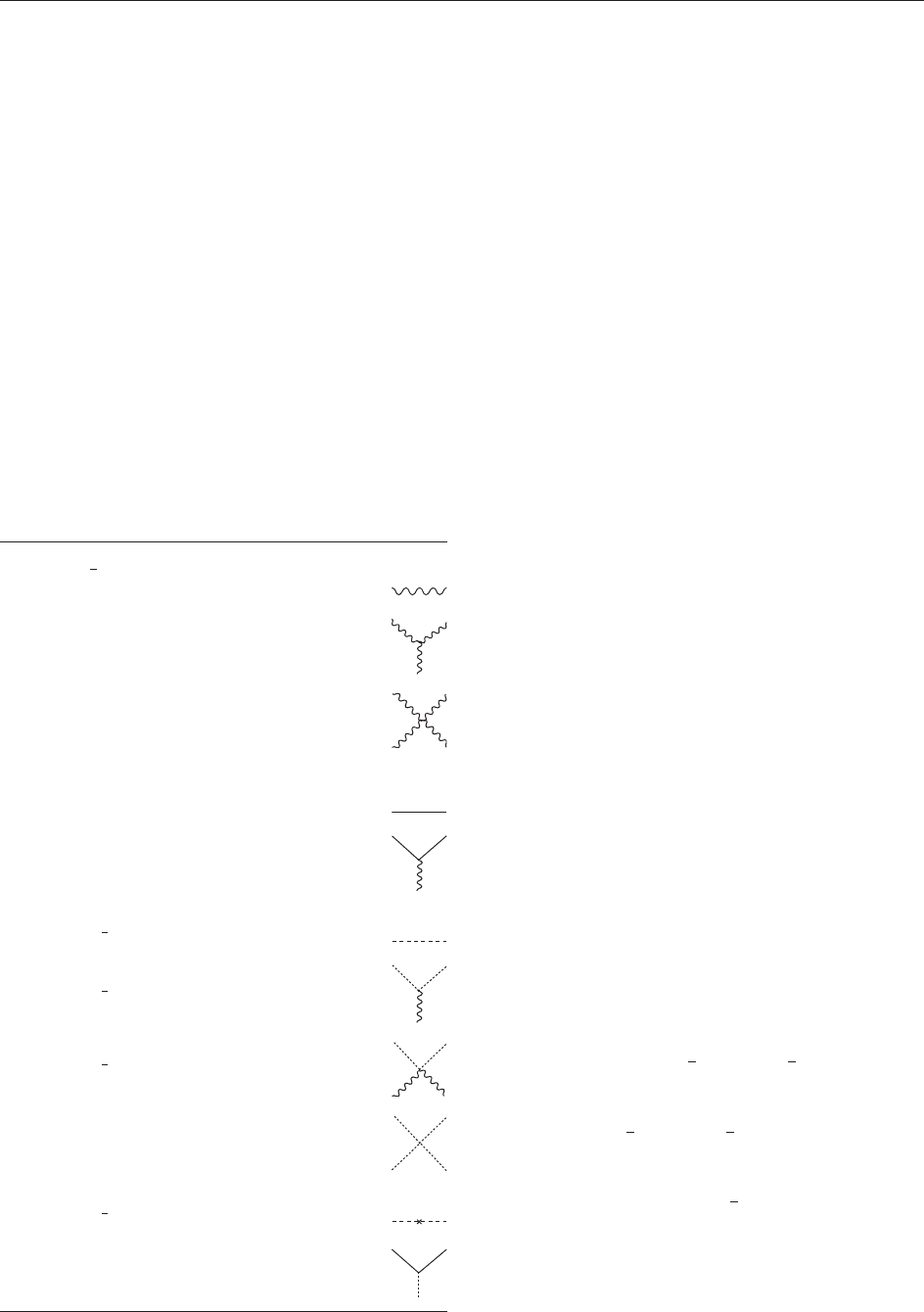
The Yang–Mills–Higgs Ansatz
The variables of this Lagrangian ansatz are spin-1
particles A, spin-(1/2) particles decomposed into left-
and right-handed components = (
L
,
R
) and spin-
0 particles ’. There are four discrete parameters, a
compact real Lie group G, the ‘‘gauge group,’’ and
three unitary representations on complex Hilbert
spaces H
L
, H
R
,andH
S
. The spin-1 particles come in a
multiplet living in the complexified of the Lie algebra
of G, A 2 Lie(G )
C
. The left- and right-handed spinors
come in multiplets living in the Hilbert spaces,
L
2
H
L
,
R
2H
R
, respectively. The (Higgs) scalar is
another multiplet, ’ 2H
S
. The Yang–Mills–Higgs
Lagrangian, together with its Feynman diagrams, is
spelled out in Table 2.
There are several continuous parameters: the
gauge coupling g 2 R
þ
, the Higgs self-couplings
, 2 R
þ
, and several Yukawa couplings g
Y
2 C.
Let us choose G = U(1) 3 e
i
. Its irreducible unitary
representations are all one-dimensional, H= C 3
characterized by the charge q 2 Z: (e
i
) = e
iq
.
Then with q
L
= q
R
and H
S
= {0}, we get Maxwell’s
theory with the photon (or gauge boson or 4-potential)
A coupled to the Dirac theory of a massless spinor of
electric charge q
L
whose (relativistic) wave function is
. The gauge coupling is given by g = e=
ffiffiffiffi
0
p
.Gauge
invariance of the Yang–Mills–Higgs Lagrangian
implies, via Noether’s theorem, electric charge con-
servation in this case (see Symmetries and Conserva-
tion Laws).
Yang–Millsmodelsaretherefore simply nonabelian
generalizations of electromagnetism where the abelian
gauge group U(1) is replaced by any compact real Lie
group. We insist on a compact group because all
irreducible unitary representations of compact groups
are finite dimensional. Finally, the Higgs scalar is
added to give masses to spinors and gauge bosons via
spontaneous symmetry breaking (see Symmetry
Breaking in Field Theory).
We use compact groups and unitary representations
as (discrete) parameters. One motivation is Noether’s
theorem and conserved quantities. The other comes
from Wigner’s theorem: the irreducible unitary
representations of the Poincare´ group are classified
by mass and spin. Its orthonormal basis vectors
are classified by energy–momentum and by the
z-component of angular momentum. This theorem
leads to the widely accepted definition of a particle as
an orthonormal basis vector in a Hilbert space
H carrying a unitary representation of a group G.
A precious property of the Yang–Mills–Higgs
ansatz is its perturbative renormalizability necessary
for fine-structure calculations like the anomalous
magnetic moment of the muon.
The Experimental Fit
Physicists have spent some 30 years and some 10
9
Swiss
Francs to distill the fit (Particle Data Group 2004):
G ¼ SUð2ÞUð1ÞSUð 3Þ=ðZ
2
Z
3
Þ½3
H
L
¼
M
1
ð2;
1
6
; 3Þð2;
1
2
; 1Þ
½4
H
R
¼
M
3
1
ð1;
2
3
; 3Þð1;
1
3
; 3Þð1; 1; 1Þ
½5
H
S
¼ð2;
1
2
; 1Þ½6
Here (n
2
, y, n
3
) denotes the tensor product of an
n
2
-dimensional representation of SU(2), ‘‘(weak) iso-
spin,’’ an n
3
-dimensional representation of SU(3),
‘‘color,’’ and the one-dimensional representation of
Table 2 The Yang–Mills–Higgs Lagrangian and its Feynman
diagrams
L[A; ;’] =
1
2
tr(@
A
@
A
@
A
@
A
)
þg tr(@
A
[A
; A
])
þg
2
tr([A
; A
][A
; A
])
þ
6@
þig
(
˜
L
˜
R
)(A
)
þ
1
2
@
’
@
’
þ
1
2
gf(
˜
S
(A
)’)
@
’ þ @
’
˜
S
(A
)’g
þ
1
2
g
2
(
˜
S
(A
)’)
˜
S
(A
)’
þ’
’’
’
1
2
2
’
’
þg
Y
’ þ
g
Y
’
510 Noncommutative Geometry and the Standard Model

U(1) with ‘‘hyper charge’’ y. For historical reasons, the
hypercharge is an integer multiple of 1/6. This is
irrelevant: in the abelian case, only the product of the
hypercharge with its gauge coupling is measurable, and
we do not need multivalued representations, which are
characterized by noninteger, rational hypercharges. In
the direct sum, we recognize the three generations of
fermions,thequarks,‘‘up,down,charm,strange,top,
bottom,’’ are SU(3) triplets, the leptons, ‘‘electron,
, ’’ and their neutrinos, are color singlets. The basis
of the fermion representation space is
u
d
L
;
c
s
L
;
t
b
L
e
e
L
;
L
;
L
u
R
; c
R
; t
R
; e
R
;
R
;
R
d
R
; s
R
; b
R
;
The parentheses indicate isospin doublets.
The eight gauge bosons associated with su(3) are
called gluons. Warning: the U(1) is not the one of electric
charge; it is called hypercharge, the electric charge is a
linear combination of hypercharge and weak isospin.
This mixing is necessary to give electric charges to the W
bosons. The W
þ
and W
are pure isospin states, while
the Z
0
and the photon are (orthogonal) mixtures of the
third isospin generator and hypercharge.
As the group G contains three simple factors,
there are three gauge couplings,
g
2
¼ 0:6518 0:0003
g
1
¼ 0:3574 0:0001
g
3
¼ 1:218 0:01
½7
The Higgs couplings are usually expressed in terms
of the W and Higgs masses:
m
W
¼
1
2
g
2
v ¼ 80:419 0:056 GeV ½8
m
’
¼ 2
ffiffiffi
2
p
ffiffiffi
p
v > 98 GeV ½9
with the vacuum expectation value v := (1=2)=
ffiffiffi
p
.
Because of the high degree of reducibility of the spin-
(1/2) representations there are 27 complex Yukawa
couplings. They constitute the fermionic mass matrix
which contains the fermion masses and mixings:
m
e
¼ 0:510998902 0:000000021 MeV
m
u
¼ 3 2 MeV; m
d
¼ 6 3 MeV
m
¼ 0:105658357 0:000000005 GeV
m
c
¼ 1:25 0:1 GeV; m
s
¼ 0:125 0:05 GeV
m
¼ 1:77703 0:00003 GeV
m
t
¼ 174:3 5:1 GeV; m
b
¼ 4:2 0:2 GeV
For simplicity, we have taken massless neutrinos.
Then mixing only occurs for quarks and is given by
a unitary matrix, the Cabibbo–Kobayashi–Maskawa
matrix
C
KM
:¼
V
ud
V
us
V
ub
V
cd
V
cs
V
cb
V
td
V
ts
V
tb
0
@
1
A
½10
whose matrix elements in terms of absolute values are:
0:9750 0:0008 0:223 0:004 0:0040:002
0:222 0:003 0:9742 0:0008 0:040 0:003
0:009 0:005 0:039 0:004 0:9992 0:0003
0
@
1
A
½11
Mathematically, the Cabibbo–Kobayashi–Maskawa
matrix comes from a polar decomposition of the
mass matrix. The physical meaning of the quark
mixings is the following: when a sufficiently
energetic W
þ
decays into a u quark, this u quark
is produced together with a
d quark with prob-
ability jV
ud
j
2
,an
s quark with probability jV
us
j
2
,
and a
b quark with probability jV
ub
j
2
.
The phenomenological success of the standard
model is phenomenal: with only a handful of
parameters, it reproduces correctly some millions
of experimental numbers: cross sections, lifetimes,
branching ratios.
Noncommutative Geometry
Noncommutative geometry is an analytic geometry
generalizing three other geometries that also had
important impact on our understanding of forces
and time. Let us start by briefly recalling the three
forerunners (Table 3). Euclidean geometry underlies
Newton’s mechanics as a geometry in the space of
positions. Forces are described by vectors living in
the same space and the Euclidean scalar product is
needed to define work and potential energy. Time
is not part of geometry – it is absolute. This point
of view is abandoned in special relativity unifying
space and time into Minkowskian geometry. This
new point of view allows to derive the magnetic
Table 3 Four nested analytic geometries
Geometry Force Time
Euclidean E =
R
~
F d
~
x Absolute
Minkowskian
~
E,
0
)
~
B,
0
=
1
0
c
2
Universal
Riemannian Coriolis $ gravity Proper,
Noncommutative Gravity ) YMH, =
1
3
g
2
2
10
40
s
Noncommutative Geometry and the Standard Model 511
field from the electric field as a pseudoforce
associated with a Lorentz boost. Although time
becomes relative, one can still imagine a grid of
synchronized clocks, that is, a universal time. The
next generalization is ‘‘Riemannian geome-
try = curved spacetime.’’ Here gravity can be
viewed as the pseudoforce associated with a
uniformly accelerated coordinate transformation.
At the same time, universal time loses all meaning
and we must content ourselves with proper time.
With today’s precision in time measurement, this
complication of life becomes a bare necessity, for
example, the global positioning system (GPS).
Our last generalization is ‘‘noncommutative
geometry = curved space(time) with an uncertainty
principle.’’ As in quantum mechanics, this uncertainty
principle is introduced via noncommutativity.
Quantum Mechanics
Consider the classical harmonic oscillator. Its phase
space is R
2
with points labeled by position x and
momentum p. A classical observable is a differenti-
able function on phase space such as the total energy
p
2
=(2m) þ kx
2
. Observables can be added and multi-
plied, and they form the algebra C
1
(R
2
), which is
associative and commutative. To pass to quantum
mechanics, this algebra is rendered noncommutative
by means of a noncommutation relation for the
generators x and p:[x, p] = ih1. Let us call A the
resulting algebra ‘‘of quantum observables.’’ It is still
associative, and has an involution
(the adjoint or
Hermitian conjugation) and a unit 1.
Of course, there is no space anymore of which A is
the algebra of functions. Nevertheless, we talk about
such a ‘‘quantum phase space’’ as a space that has no
points or a space with an uncertainty relation. Indeed,
the noncommutation relation implies Heisenberg’s
uncertainty relation xp h=2andtellsusthat
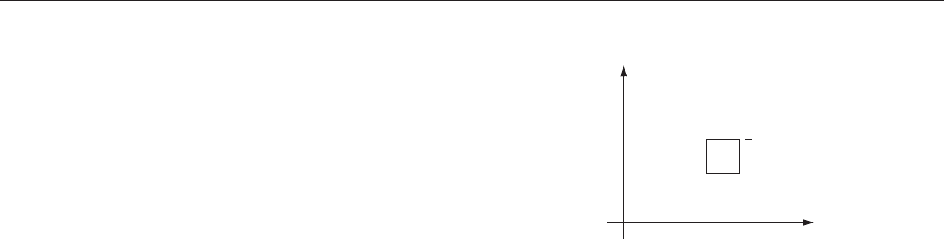
points in phase space lose all meaning; we can only
resolve cells in phase space of volume h=2, see Figure 1.
To define the uncertainty a for an observable a 2A,
we need a faithful representation of the algebra on a
Hilbert space, that is, an injective homomorphism
from A into the algebra of operators on H. For the
harmonic oscillator, this Hilbert space is H= L
2
(R).
Its elements are the wave functions (x), square-
integrable functions on configuration space. Finally,
the dynamics is defined by the Hamiltonian, a self-
adjoint observable H = H
2A via Schro¨dinger’s
equation (ih@=@t (H)) (t, x) = 0. Here time is an
external parameter; in particular, time is not an
observable. This is different in the special-relativistic
setting, where Schro¨ dinger’s equation is replaced by
Dirac’s equation 6@ = 0. Now the wave function is
the four-component spinor consisting of left- and right-
handed, particle and antiparticle wave functions.
Unlike the Hamiltonian, the Dirac operator does not
lie in A, but it is still an operator on H.InEuclidean
spacetime, the Dirac operator is also self-adjoint,
6@
= 6@.
Spectral Triples
Noncommutative geometry (Connes 1994, 1995)
does to a compact Riemannian spin manifold M
what quantum mechanics does to phase space. A
noncommutative geometry is defined by the three
purely algebraic items (A, H, 6@), called a spectral
triple. A is a real, associative, and possibly non-
commutative involution algebra with unit, faithfully
represented on a complex Hilbert space H,and6@ is
a self-adjoint operator on H. As the spectral triple,
also the axioms linking its three items are motivated
by relativistic quantum mechanics.
When A= C
1
(M), the functions on a Riemannian
spin manifold M, represented on spinors ,and6@ is
the gravitational Dirac operator, one has a spectral
triple. The converse is also true when A is a
suitable commutative algebra (Connes 1996), but
the axioms make sense even when A is not
commutative. As for quantum phase space, Connes
defines a noncommutative geometry by a spectral
triple whose algebra is allowed to be noncommu-
tative and he shows how important properties like
dimensions, distances, differentiation, integration,
general coordinate transformations, and direct
products generalize to the noncommutative setting.
As a bonus, the algebraic axioms of a spectral
triple, commutative or not, include discrete, that is,
zero-dimensional spaces that now are naturally
equipped with a differential calculus. These spaces
have finite-dimensional algebras and Hilbert
spaces, meaning that their algebras are just matrix
algebras.
An ‘‘almost commutative geometry’’ is defined as a
direct product of a four-dimensional commutative
geometry, ‘‘ordinary spacetime,’’ by a zero-dimensional
noncommutative geometry, the ‘‘internal space.’’ If the
p
x
•
h/2
Figure 1 The first example of noncommutative geometry.
512 Noncommutative Geometry and the Standard Model

latter is also commutative, for example, the ordinary
two-point space, then the direct product describes a
two-sheeted universe or a Kaluza–Klein space whose
fifth dimension is discrete, (Madone 1995). In general,
the axioms of spectral triples imply that the Dirac
operator of the internal space is precisely the fermionic
mass matrix.
As a generic example, here is the internal spectral
triple underlying the standard model with one
generation of quarks and leptons. The algebra
A= H C M
3
(C) 3 (a, b, c) contains quaternions,
that is, 2 2 matrices of the form
a ¼
x
y
y
x
; x; y 2 C
complex numbers b and complex 3 3matricesc.
The Hilbert space is 30-dimensional, where we
count particles and antiparticles (
c
) separately:
H= H
L
H
R
H
c
L
H
c
R
= C
8
C
7
C
8
C
7
.The
representation is block-diagonal, with the four
blocks
L
ðaÞ : ¼
a 1
3
0
0 a
!
R
ðbÞ :¼
b1
3
00
0
b1
3
0
00
b
0
B
B
B
@
1
C
C
C
A
½12
c
L
ðb; cÞ :¼
1
2
c 0
0
b1
2
c
R
ðb; cÞ :¼
c 00
0 c 0
00
b
0
B
@
1
C
A
½13
The internal Dirac operator (= fermionic mass
matrix) contains two quark masses m
u
, m
d
and one
lepton mass m
e
, and no mixing:
D¼
0 M 00
M
000
000
M
00
M
0
0
B
B
B
@
1
C
C
C
A
M¼
m
u
0
0 m
d
1
3
0
0
0
m
e
0
B
B
B
@
1
C
C
C
A
½14
These matrices look rather ad hoc; they are not.
They define an irreducible spectral triple and, for a
given algebra, there is only a finite number of such
triples.
The Spectral Action
Chamseddine and Connes (1997) generalize general
relativity to noncommutative spacetimes in two
strokes, kinematics and dynamics. They explicitly
compute this generalization for almost commutative
geometries.
Kinematics In noncommutative geometry, gen-
eral coordinate transformations are algebra auto-
morphisms lifted to the Hilbert space of spinors.
For almost commutative geometries, these transfor-
mations are precisely general coordinate trans-
formations of ordinary spacetime and gauge
transformations. Now remember how Einstein uses
the equivalence principle to produce ‘‘gravity =
curvature’’ starting from the flat metric, which in
Connes’ language is the ordinary flat Dirac opera-
tor. When applied to an almost commutative
geometry (Connes 1996), the equivalence principle
produces again a curved metric via the ordinary
coordinate transformations on M, while the gauge
transformations applied to the fermionic mass
matrix produce a new field, the Higgs scalar ’. For
the example above, this field is precisely the isospin
doublet, color singlet with hypercharge 1=2 of eqn
[6]. Gauge transformations also apply to the
ordinary Dirac operator, thereby producing the
gauge fields A.
Dynamics The group of generalized coordinate
transformations allowed us to construct the con-
figuration space. In the almost commutative case it
consists of Riemannian metrics, gauge fields, and
Higgs scalars. We now want a dynamics on this
configuration space. Of course, we want this
dynamics to be invariant under the group of
generalized coordinate transformations. Note that
the spectrum of the Dirac operator is invariant
under this group and Chamseddine and Connes
(1997) define the spectral action as a regularized
partition function of these eigenvalues.
On almost commutative geometries, the spectral
action is equal to the Einstein–Hilbert action plus
the Yang–Mills–Higgs ansatz (Figure 2). In other
words, almost commutative geometry explains the
forces mediated by gauge bosons and Higgs scalars
as pseudoforces accompanying the gravitational
force in the same way that Minkowskian geometry
(i.e., special relativity) explains the magnetic force as
a pseudoforce accompanying the electric force.
Noncommutative Geometry and the Standard Model 513
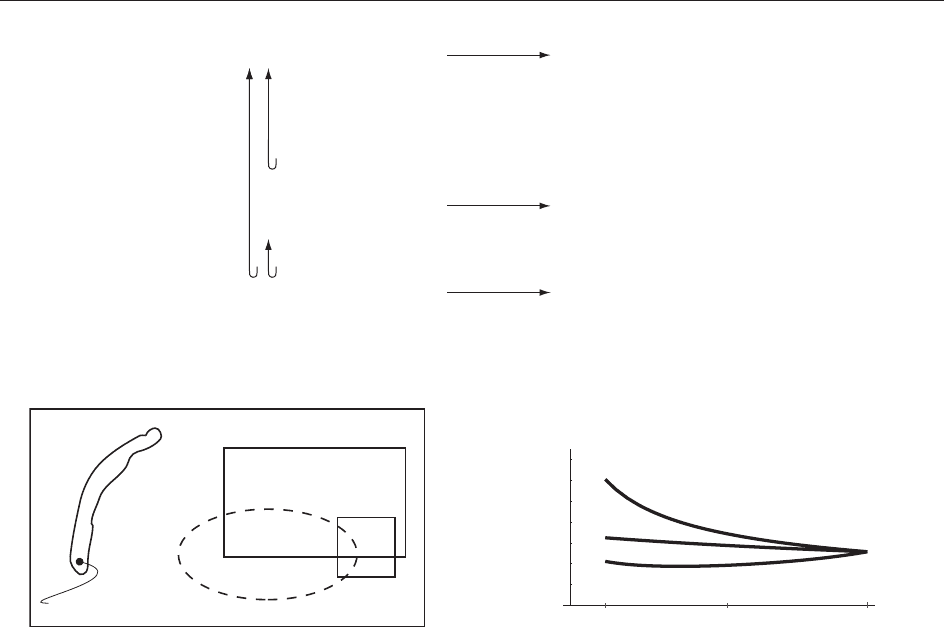
There are constraints on the discrete and contin-
uous parameters in the Yang–Mills–Higgs ansatz
deriving from the spectral action Figure 3.
In particular, if we consider only irreducible spectral
triples and among them only those which produce
nondegenerate fermion masses compatible with renor-
malization, then we only get the standard model with
one generation of quarks and leptons, with a massless
neutrino and with an arbitrary number of colors, and a
few submodels thereof. More than one generation and
neutrino masses are possible but imply reducible
triples. However, in at least one generation, the
neutrino must remain purely left and massless.
For the standard model with N generations
and N
c
colors, we have the constraints
g
2
N
c
= g
2
2
= (9=N) on the continuous parameters. If
we put N = N
c
= 3 and if we believe in the popular
‘‘big desert’’ then these constraints yield a ‘‘unifica-
tion scale’’ =10
17
GeV at which the uncertainty
relation in spacetime should become manifest,
=h=, and a Higgs mass of m
’
= 171.6
5 GeV for m
t
= 174.3 5.1 GeV (see Figure 4).
It is clear that almost commutative geometries
only scratch the surface of a gold mine. May we
hope that a genuinely noncommutative geometry
will solve our present problems with quantum field
theory and quantum gravity?
See also: Compact Groups and Their Representations;
Dirac Fields in Gravitation and Nonabelian Gauge
Theory; Effective Field Theories; General Relativity:
Overview; Hopf Algebras and q-Deformation Quantum
Groups; Positive Maps on C
-Algebras; Quantum Hall
Effect; Standard Model of Particle Physics; Symmetries
and Conservation Laws; Symmetry Breaking in Field
Theory; von Neumann Algebras: Introduction, Modular
Theory, and Classification Theory.
Further Reading
Chamseddine A and Connes A (1997) The spectral action
principle. Communications in Mathematical Physics 186:
731 (hep-th/9606001).
Connes A (1994) Noncommutative Geometry. San Diego:
Academic Press.
Connes A (1995) Noncommutative geometry and reality. Journal
of Mathematical Physics 36: 6194.
Connes A (1996) Gravity coupled with matter and the foundation
of noncommutative geometry. Communications in Mathema-
tical Physics 155: 109 (hep-th/9603053).
Gracia-Bondı´a JM, Va´rilly JC, and Figueroa H (2000) Elements
of Noncommutative Geometry. Boston: Birkha¨ user.
Kastler D (2000) Noncommutative geometry and fundamental
physical interactions: the Lagrangian level. Journal of Math-
ematical Physics 41: 3867.
Landi G (1997) An Introduction to Noncommutative Spaces and
Their Geometry, hep-th/9701078. Berlin: Springer.
Riemannian geometry Gravity
Almost commutative
geometry
Einstein
Connes
Gravity
+ Yang–Mills–Higgs
ansatz
+ constraints
Connes
Noncommutative geometry
??
Figure 2 Deriving the Yang–Mills–Higgs ansatz from gravity.
Yang–Mills–Higgs
Left–right symmetry
GUT
Supersymmetry
NCG
Standard model
Figure 3 Constraints inside the ansatz.
0.2
0.4
0.6
0.8
1
1.2
1.4
g
3
m
z
10
9
GeV
E
g
2
Λ
(3
λ)
1/2
Figure 4 Running coupling constants.
514 Noncommutative Geometry and the Standard Model

Madore J (1995) An Introduction to Noncommutative Differ-
ential Geometry and Its Physical Applications. Cambridge:
Cambridge University Press.
Martı´n CP, Gracia-Bondı´a JM, and Va´rilly JC (1998) The
standard model as a noncommutative geometry: the low
mass regime. Physics Reports 294: 363 (hep-th/9605001).
O’Raifeartaigh L (1986) Group Structure of Gauge Theories.
Cambridge: Cambridge University Press.
Scheck F, Werner W, and Upmeier H (eds.) (2002) Noncommutative
Geometry and the Standard Model of Elementary Particle
Physics, Lecture Notes in Physics, vol. 596. Berlin: Springer.
Schu¨ cker T (2005) Forces from Connes’ geometry. In: Bick E and
Steffen F (eds.) Topology and Geometry in Physics, Lecture
Notes in Physics, vol. 659, hep-th/0111236. Berlin: Springer.
The Particle Data Group, Particle Physics Booklet and http://
pdg.lbl.gov
Noncommutative Geometry from Strings
Chong-Sun Chu, University of Durham, Durham, UK
ª 2006 Elsevier Ltd. All rights reserved.
Noncommutative Geometry from
String Theory
The first use of noncommutative geometry in string
theory appears in the work of Witten on open-string
field theory where the noncommutativity is asso-
ciated with the product of open-string fields.
Noncommutative geometry appears in the recent
development of string theory in the seminal work of
Connes, Douglas, and Schwarz where they con-
structed and identified the compactification of
Matrix theory on a noncommutative torus.
Matrix Theory Compactification and
Noncommutative Geometry
The matrix theory (M-theory) is an 11-dimensional
quantum theory of gravity which is believed to
underlie all superstring theories. Banks, Fischler,
Shenker, and Susskind proposed that the large N
limit of the supersymmetric matrix quantum
mechanics of N D0-branes should describe the
M-theory compactified on a lightlike circle.
Compactification of the M-theory on a torus can be
easily achieved by considering the torus as the quotient
space R
d
=Z
d
with the quotient conditions
U
1
i
X
j
U
i
¼ X
j
þ
j
i
2R
i
; i ¼ 1; ...; d ½1
Here R
i
are the radii of the torus. The unitary
translation generators U
i
generate the torus. They
satisfy U
i
U
j
= U
j
U
i
. T-dualizing the D0 brane
system, eqn [1] leads to the dual description as a
(d þ 1)-dimensional supersymmetric gauge theory
on the dual toroidal D-brane. A noncommutative
torus T
d
is defined by the modified relations
U
i
U
j
¼ e
i
ij
U
j
U
i
½2
where
ij
specify the noncommutativity. Compacti-
fication on a noncommutative torus can be easily
accommodated and leads to noncommutative gauge
theory on the dual D-brane. The parameters
ij
can
be identified with the components C
ij
of the 3-form
potential in M-theory.
Since M-theory compactified on a circle leads to
IIA string theory, the components C
ij
correspond to
the Neveu–Schwarz (NS) B-field B
ij
in IIA string
theory. The physics of the D0 brane system in the
presence of an NS B-field can also be studied from
the viewpoint of IIA string theory. This led Douglas
and Hull to obtain the same result that a non-
commutative field theory lives on the D-brane.
Toroidally compactified IIA string theory has a
T-duality group SO(d, d ; Z). The T-duality symmetry
gets translated into an equivalence relation between
gauge theories on the noncommutative torus: a gauge
theory on the noncommutative torus T
d
is equivalent
to that on the noncommutative torus T
d
0
if their
noncommutativity parameters and metrics are related
by a T-duality transformation. For example,
0
¼ðA þ BÞðC þ DÞ
1
;
AB
CD
2 SOðd; d; ZÞ½3
It is remarkable that the T-duality acts within the
field theory level, rather than mixing up the field
theory modes with the string winding states and
other stringy excitations. Mathematically, eqn [3] is
precisely the condition for the noncommutative tori
T
d
and T
d
0
to be Morita equivalent.
Open-String in B-Field
It was soon realized that the D-brane does not
necessarily need to be toroidal in order to be
noncommutative. A direct canonical quantization
of the open-string system shows that a constant
B-field on a D-brane leads to noncommutative
geometry on the D-brane world volume. Consider
an open string moving in a flat space with metric g
ij
and a constant NS B-field. In the presence of a Dp
brane, the components of the B-field not along the
brane can be gauged away; thus, the B-field can
Noncommutative Geometry from Strings 515
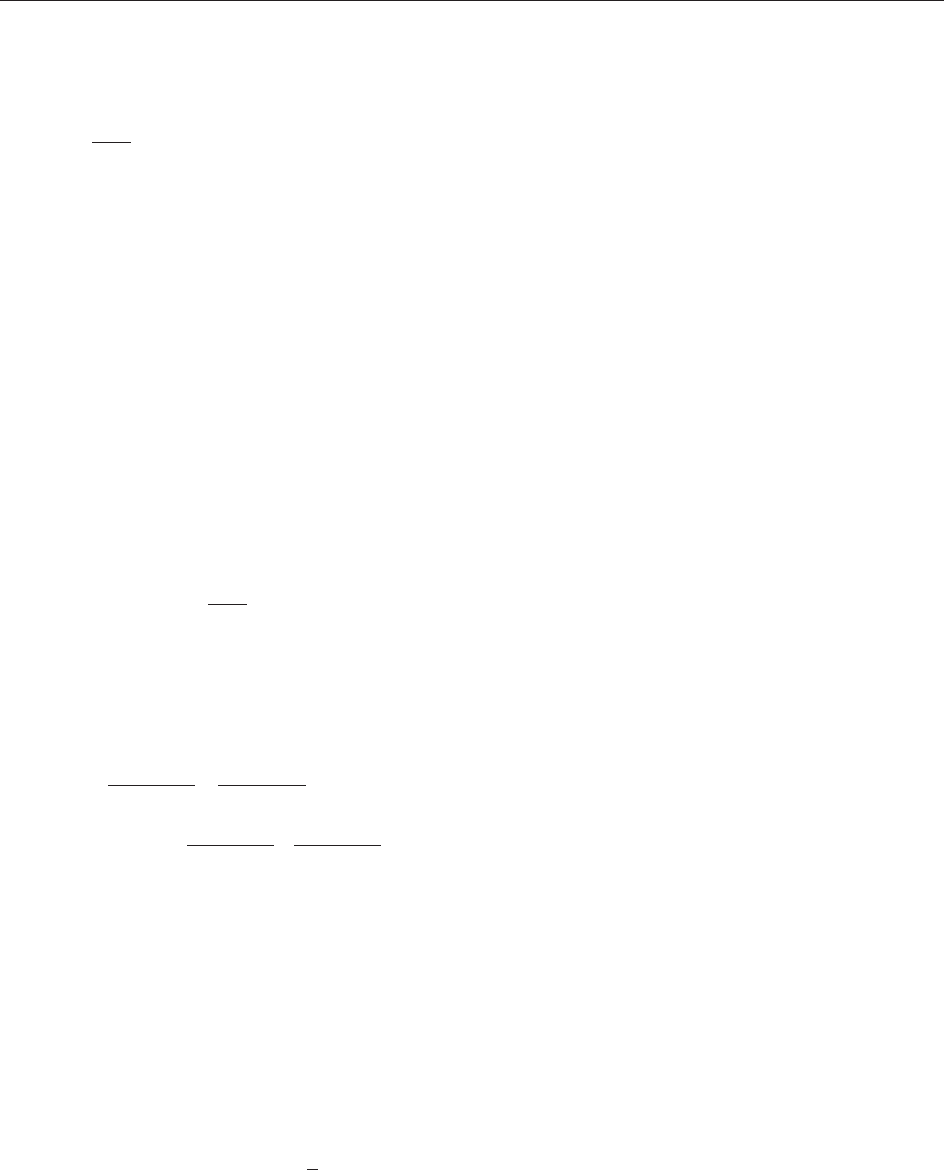
have effects only in the longitudinal directions along
the brane. The world-sheet (bosonic) action for this
part is
S ¼
1
4
0
Z
d
2
g
ij
@
a
x
i
@
a
x
j
2
0
B
ij
ab
@
a
x
i
@
b
x
j
½4
where i, j = 0, 1, ..., p is along the brane. It is easy
to see that the boundary condition g
ij
@
x
j
þ
2i
0
B
ij
@
x
j
= 0at = 0, is not compatible with
the standard canonical quantization [x
i
(, ),
x
j
(,
0
)] = 0 at the boundary. Taking t he boundary
condition as constraints and performing canonical
quantization, one obtains the commutation
relations
½a
i
m
; a
j
n
¼mG
ij
mþn
; ½x
i
0
; p
j
0
¼iG
ij
;
½x
i
0
; x
j
0
¼i
ij
½5
Here, the open-string mode expansion is
x
i
ð; Þ¼x
i
0
þ 2
0
ðp
i
0
2
0
ðg
1
BÞ
i
j
p
j
0
Þ
þ
ffiffiffiffiffiffiffi
2
0
p
X
n6¼0
e
in
n
ia
i
n
cos n 2
0
ðg
1
BÞ
i
j
a
j
n
sin n
G
ij
and
ij
are the symmetric and antisymmetric
parts of the matrix (g þ 2
0
B)
1ij
:
G
ij
¼
1
g þ 2
0
B
g
1
g 2
0
B
ij
ij
¼ð2
0
Þ
2
1
g þ 2
0
B
B
1
g 2
0
B
ij
½6
It follows from [5] that the boundary coordinates
x
i
x
i
(, 0) obey the commutation relation
½x
i
; x
j
¼i
ij
½7
Relation [7] implies that the D-brane world volume,
where the open-string endpoints live, is a noncom-
mutative manifold. One may also start with the
closed-string Green function and let its arguments to
approach the boundary to obtain the open-string
Green function
hx
i
ðÞx
j
ð
0
Þi ¼
0
G
ij
lnð
0
Þ
2
þ
i
2
ij
ð
0
Þ½8
where ()isthesignof.From[8], one can
again extract the commutator [7]. G
ij
= g
ij
(2
0
)
2
(Bg
1
B)
ij
is called the open-string metric since it controls
the short-distance behavior of open strings. In contrast,
the short-distance behavior for closed strings is con-
trolled by the closed-string metric g
ij
.Onemayalsotreat
the boundary B-term in [4] asaperturbationtothe
open-str ing conforma l field theory and from which one
may extract [8] from the modified operator product
expansion of the open-string vertex operators.
D-branes in the Wess–Zumino–Witten model
provide another example of noncommutative geo-
metry. In this case, the background is not flat since
there is a nonzero H = dB k
1=2
, where k is the
level. Examining the vertex operator algebra, one
obtains that D-branes are described by nonassocia-
tive deformations of fuzzy spheres with nonassocia-
tivity controlled by 1=k.
String Amplitudes and Effective Action
The effect of the B-field on the open-string ampli-
tudes is simple to determine since only the x
i
0
commutation relation is affected nontrivially. For
example, the noncommutative gauge theory can be
obtained from the tree-level string amplitudes read-
ily. For tree a nd one loop, the vertex operator
formalism can be used. Generally, the vertex
operator can be inserted at either the = 0or =
boundary, where the string has zero mode parts x
i
0
and y
i
0
x
i
0
(2
0
)
2
(g
1
B)
i
j
p
j
0
, respectively. The
commutation relations are
½x
i
0
; x
j
0
¼i
ij
; ½x
i
0
; y
j
0
¼0;
½y
i
0
; y
j
0
¼i
ij
½9
The difference in the commutation relation for x
0
and y
0
implies that the two boundaries of the open
string have opposite commutativity. This fact is not
so important for tree-level calculations since one can
always choose to put all the interactions at, for
example, the = 0 boundary. Collecting all these
zero mode parts of the vertex operators, one obtains
a phase factor
e
ip
1
x
0
e
ip
2
x
0
e
ip
N
x
0
¼ e
i
P
p
a
x
0
e
ði=2Þ
P
N
I<J
p
I
p
J
½10
where the ex ternal momenta p
a
are ordered cycli-
cally on the circle, and momentum conservation has
been used. The computation of the osci llator part of
the amplitude is the same as in the B = 0 case, except
that the metric G is employed in the contractions.
As a result, the effect of the B-field on the tree-level
string amplitude is simply to multiply the amplitude
at B = 0 by the phase factor and to replace the
metric by the metric G. A generic term in the tree-
level effective action simply becomes
Z
d
pþ1
x
ffiffiffiffiffiffiffiffiffiffiffiffiffiffiffi
det g
p
tr @
n
1
1
@
n
k
k
!
Z
d
pþ1
x
ffiffiffiffiffiffiffiffiffiffiffiffiffiffiffiffi
det G
p
tr @
n
1
1
@
n
k
k
½11
516 Noncommutative Geometry from Strings