
Francoise J.-P., Naber G.L., Tsun T.S. (editors) Encyclopedia of Mathematical Physics
Подождите немного. Документ загружается.

Adjoint System
The leading left eigenmode complex conjugate
supplies the response field of the base state to the
most destabilizing punctual disturbances.
The S state and L eigenspace analytical determi-
nations are often impossible. One must resort to
specifically designed numerical tools. A numerical
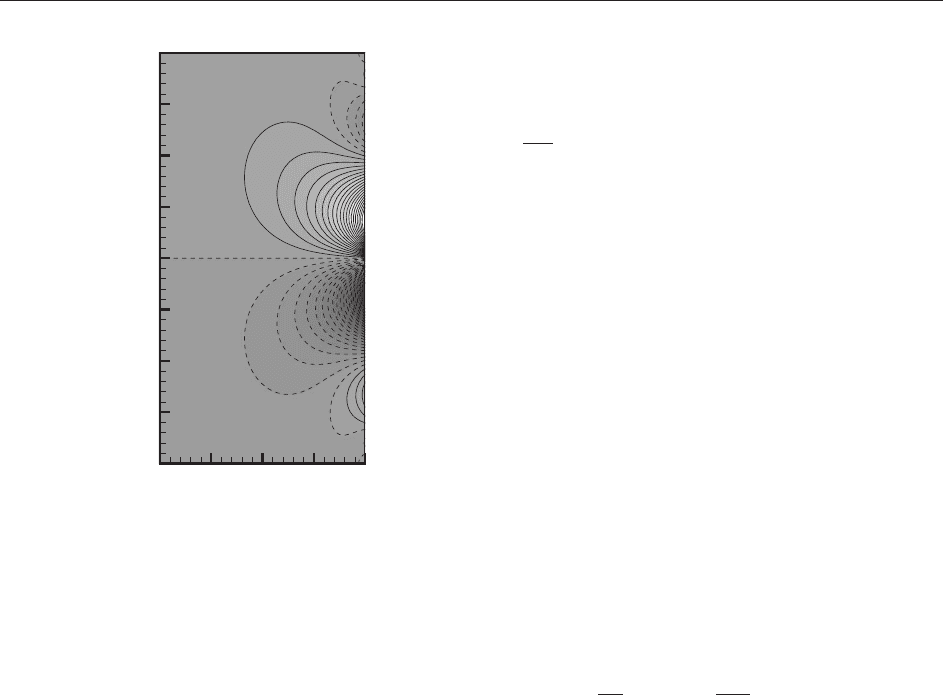
adjoint eigenvector is presented in Figure 2 for a
(Ma = 106, Pr = 10
2
) side-heated cylindrical liquid
bridge, with a free surface on the right and the axis
on the left.
Nonlinear Stability
When
max
> 0, the associated disturbance exponen-
tially grows with time, until nonlinearities become
essential. The flow progressively evolves from S
towards a new state, S
0
, which is a solution of [8],
[16]–[18]. How can one proceed analytically to
know how the nonlinearities control the bifurca-
tion? A large number of S!S
0
bifurcations exist,
with either both S, S
0
, steady or unsteady but with
different flow structure, or one is steady and the
other is not. Bifurcations can also be reversible or
hysteretic, with respect to Ra. The symmetries of S
play an important role and non-Boussinesq effects
change the thresholds and the nature of bifurcation.
Landau’s works have opened up the way to the
theory of nonlinear hydrodynamic stability. The
ruling equations are reduce d, using an appropriate
expansion met hod, to a set of ordinary differential
equations describing the temporal evolution of
amplitudes, A
i
, i = 1, 2, ..., I, character izing the per-
turbation eigenmodes,
dA
i
dt
¼
i
A
i
þ N
i
ðA
j
Þ for i; j ¼ 1; 2; ...; I ½27
where N accounts for the nonlinear action of the I
modes on A
i
, and the
i
’s are the temporal growth
rates coming from the linear theory. The stability of
the steady solutions, dA
i
=dt = 0, is determined by
local analysis. With one destabilizing mode, the
simplest model is dA=dt = A AjAj,with>0,
constant, specific of the bifurcation. Symmetry con-
siderations (some of them directly originate from the
Boussinesq framework) may impose = 0, whereby
the simplest model becomes dA=dt = A þ A
3
,with
another constant.
When the flow is weakly confined in one or two
space directions, bounda ry effects can play a subtle
dynamical role, allowing, for instance, the existence
of multiple solutions, each one made of many
interacting modes. A large variety of flow regimes
is then observed, as steady/traveling, extended/
localized wave packets, particularly in binary mix-
tures. Spacetime models, close to [27], such as the
Ginzburg–Landau equatio n,
@A
@t
¼ A þ
@
2
A
@x
2
þ jAj
2
A
are derived for describing the dynamics of the wave
packet envelop (of complex amplitude A).
Hydrostatic State Stability
The static-state stability is analytically tractable in
unbounded volume. Transverse wave (by [21 ])
solutions are the potentially destabilizing perturba-
tions, with wave vector
~
k and complex frequency !.
The system [22]–[23] gets simplified, and L becomes
algebraic upon substituting (i
~
k, i!) for (
~
, @=@t).
Intuitively, the quiescent state loses its stability when
~
(p, T, C)
~
exceeds a threshold value (positive,
by the dissipative effects). This analysis supplies it,
together with the data of the oscillatory motions
emerging at onset from the rest-state instability.
In reality, the fluid is confined to three dimen-
sions, possibly with free surfaces, and wave solu-
tions are no longer usable. The first approach
consists in defining a simplified model confined to
one dimension. The perturbations must satisfy
homogeneous boundary conditions, and/or [24],
and they are waves in both other space directions.
The resulting problem may be analytically tractable.
The stability of many quiescent-state configurations
was studied, for fluid layers of infinite or very large
r
0 0.25 0.5 0.75 1
–1
–0.5
–0.25
–0.75
0
0.25
0.5
0.75
1
N
Figure 2 Leading axisymmetric thermal adjoint eigenvector
(Courtesy of O Bouizi and C Delcarte).
Newtonian Fluids and Thermohydraulics 497
extension, of pure-fluid/mixtures, with/without free
surface. Nonetheless, many other configurations are
not yet analyzed. Two- and three-dimensional cases
must be numerically treated.
Gravitational Buoyancy Convection
Among the numberless thermal situations to ana-
lyze, research mainly favored the case where the
fluid is confined in simple geometries and submitted
to two distinct heating directions,
~
T being either
aligned or normal to
~
G, that is vertical or horizontal
in the gravity field. Each case leads to specific
thermohydraulics. The rest-state stability is the first
analysis step of the former case, the first to be
experimentally studied by Be´nard in 1900, with a
horizontal liquid layer. The latter is of more recent
interest, with Batchelor’s theoretical work on the
parallel convective regimes of pure fluid confined in
tall slot. Since then, a large amount of work has
been published on those cases, tackling various
confinement geometries, and involving high Ra
values. This problem became the paradigm of the
rich spa tiotemporal behaviors arising in nonlinear
systems driven away from equilibrium. In binary
mixtures the complexity of the dynamics increases
considerably. The literature is so far practically
devoid of any three-dimensional results in mixtures.
Ternary mixtures have so far been only scarcely
considered.
Steady Parallel-Flow Model
This analytical approach comes from an interesting
Batchelor’s remark made about the vorticity but
here applied to the velocity of a confi ned flow. ‘‘A
number of flow fields are characterized by values of
the magnitude of the’’ velocity ‘‘in the neighborhood
of a certain line in the fluid which are much larger
than those elsewhere,’’ and (by
~
~
v = 0) ‘‘this line
of necessity’’ is parallel to
~
v and to the container
walls.
Buoyant forces may contradict this assertion,
particularly in Rayleigh–Be´nard configuration with
imposed temperatures. There, no parallel solution
exists. Nevertheless, steady parallel flows do exist in
containers. The thermally active walls (whatever
they be – the largest or smallest) are either
maintained at constant temperatures, or subjected
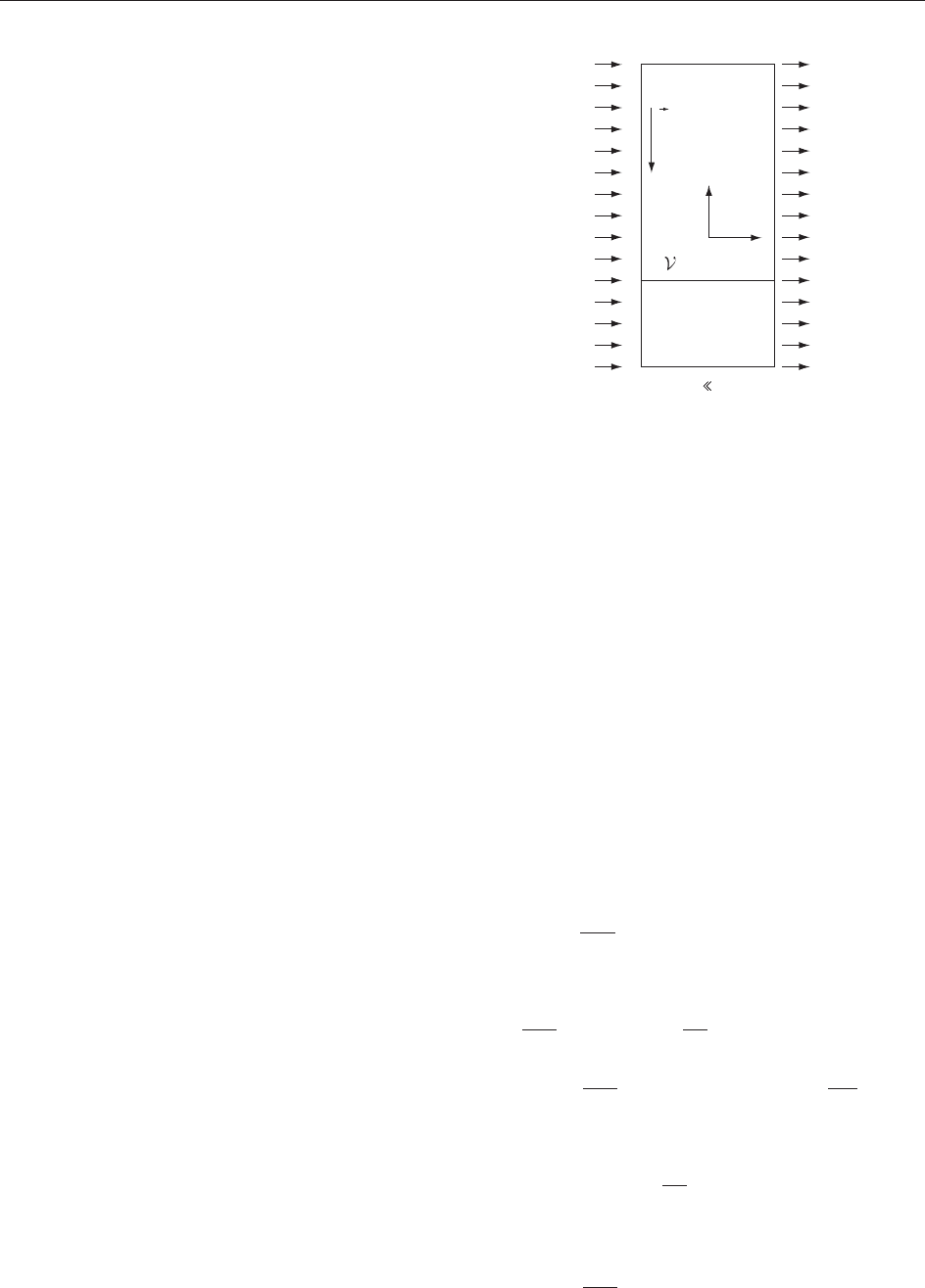
to a constant heat flux. Figure 3 sketches a cross
section (hereafter referred to as the vertical mid-
plane) of such a configuration, with active (uniform
heating q) vertical walls. The other sides are
adiabatic. No rest state is allowed here. Although
intrinsically three dimensional, the steady regime in
this cavity can be fairly well approximated as
two dimensional (in the vertical midplane), and
moreover mainly parallel to the active walls, in an
Ra range which increases with the aspect ratio, H/L.
The influence of the horizontal sides is of limited
range compared to the flow extension, H. The
parallel flow is then the one-dimensional approx-
imation of what occurs in the major part of the
cavity. This configuration is taken with a binary
mixture for illustrating an approach applicable with
minor variations in other situations.
The problem becomes linear. Indeed,
~
v = w(x)
^
e
z
by
~
~
v = 0. Taking T = qL=
T
as temperature
scale, [16]–[18] imply
ðx; z Þ¼G
T
z þ
^
ðxÞ; Cðx; zÞ¼G
C
z þ
^
CðxÞ
with G
T
, G
C
as constants. The impulse balance is
d
2
w
dx
2
¼Ra
^
ðxÞþ
B
^
CðxÞ
hi
½28
and the ruling equations
d
4
w
dx
4
¼Ra G
T
þ
B
Le
G
T
þ G
C
ðÞ
w
wG
T
¼
d
2
^
dx
2
; wG
T
þ G
C
ðÞ¼Le
d
2
^
C
dx
2
½29
An internal length scale is predicted, of thickness
Ra G
T
þ
B
Le
G
T
þ G
C
ðÞ
1=4
By [28] and [19], the thermal flux condition yields
d
3
w
dx
3
x¼1=2
¼Ra 1 þ
B
ðÞ
qq
g
e
z
ˆ
e
x
ˆ
(
)
H
L
H
Figure 3 Sketch of the cross section of a slender vertical
container.
498 Newtonian Fluids and Thermohydraulics
A last operation allows to determine G
T
and G
C
.
The overall heat and mass fraction balances are
performed in the cavity part (V), which is bounded
by an horizontal plane located within the parallel-
flow region. Since the walls are impervious, the
solute is transported only across the lower boundary
of (V), through which the net vertical convective
supply must be balanced, in steady regime, by
vertical diffusion. The heat balance works similarly,
since the walls are adiabat ic or submitted to equal
fluxes. Whence the relations,
Z
1=2
1=2
wðxÞ
^
ðxÞdx ¼G
T
Z
1=2
1=2
wðxÞ
^
CðxÞdx ¼G
T
þ G
C
The steady parallel flow is determined. Its stability
can be an alyzed as indi cated in the section ‘‘Linear
stability .’’
Some cauti on must be taken for the Boussinesq
approximations to be valid here, with the tempera-
ture and mass fraction increasing constantly (by
G
T
, G
C
) along the direction of largest cavity exten-
sion. These gradients are at the origin of the
‘‘thermogravitational column’’ separation power, a
device designed for the isotope separation. Extre-
mely long columns can provide almost complete
separations, with
C
jCj no longer 1, and then
the non-Boussinesq effect s occur.
As an illustration of aforementioned notions, let
us consider the (Pr = 1, Le = 0.1) Rayleigh–Be´nard–
Soret (RBS) problem where horizontal solid plates of
infinite extension are uniformly heated from above
(Ra < 0) or below (Ra > 0). This configuration is
simply obtained by rotating the cavity in Figure 3 by
=2 with respect to
~
g and to (
^
e
x
,
^
e
z
). The steady
parallel-flow model can lead to the right-hand side
of an equation like [27] governing the time evolu-
tion of A, the parallel-flow amplitude,
dA
dt
/ALe
2
A
4
þ 1 þ
1 r
Le
2
A
2
þ
2
1
r
r
c
½30
where
¼
315
218
; r ¼
Ra
720
; r
c
¼ 1 þ
B
ð1 þ Le
1
Þ
1
Here r
c
is the critical value or r where the rest state
loses its stability towards a steady parallel flow. The
roots of dA=dt = 0 are A = A
0
= 0, A = A
k
(r, Le,
B
),
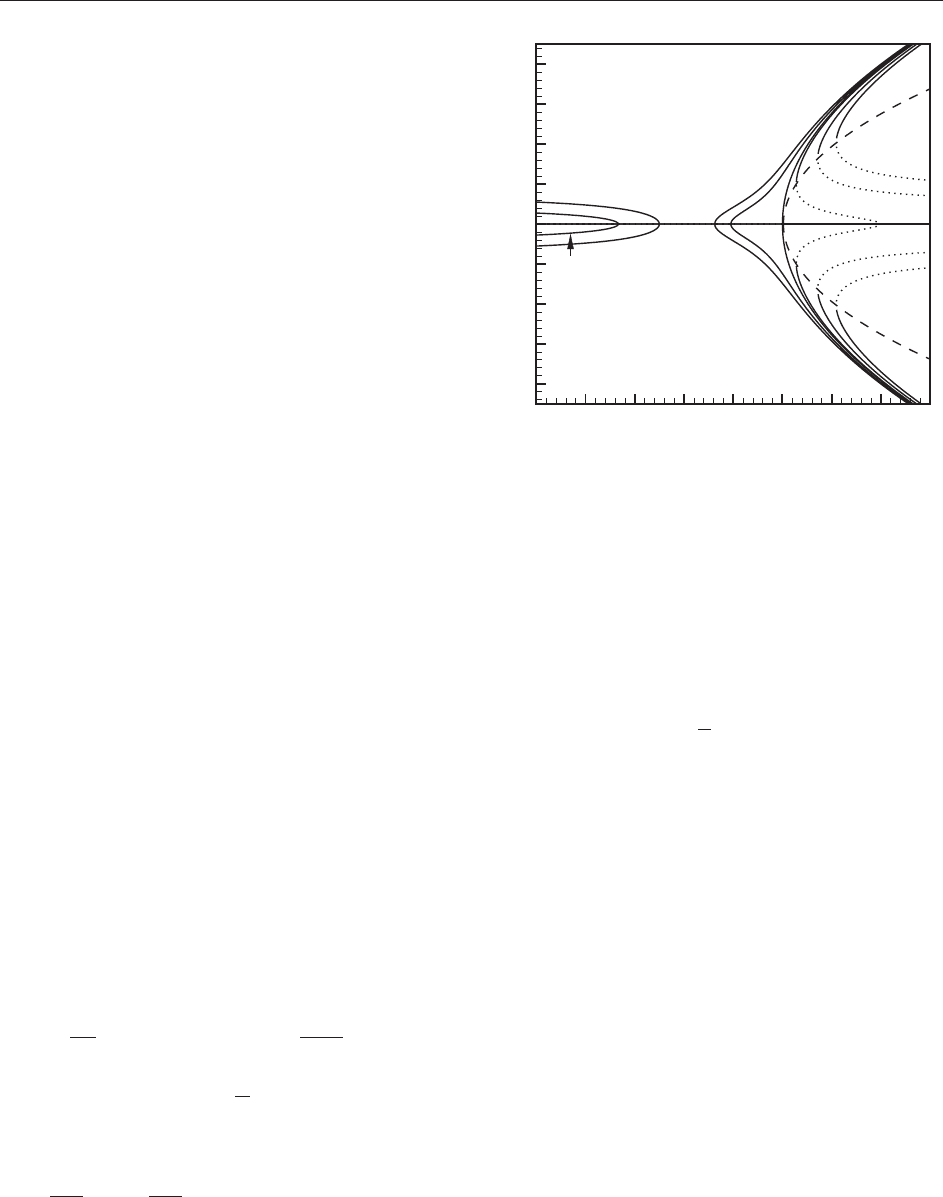
for the quiescent, convective states. Figure 4 shows
that A
0
= 0 and the curves A
k
(r) for several
B
(Le), ’
1
= (1 þ Le
1
)
1
being the r
c
pole. The
solid (dotted) parts correspond to the stable
(unstable) steady states, emerging from direct (back-
ward) pitchfork bifurcations of the rest state at r
c
.
Saddle–node bifurcations from unstabl e to stable
steady states are also predicted, on the dashed curve
of the equation
c
A
k
ðrÞ¼
ffiffiffiffi
2
r
ffiffiffiffiffiffiffiffiffiffiffiffiffiffiffiffiffiffiffiffiffiffiffiffiffiffiffiffi
r 1 þ Le
2
ðÞ
q
Fully Nonlinear Problem
Numerical tools are required for solving the system
[8], [16]–[18] and analyzing the stability of the
flows obtained.
The RBS Case Let us illustrate how the rest-state
loss of stability occurs in the two-dimensional RBS
case, with a (Pr = 1, Le = 0.1,
B
= 0.2) mixture.
The flow lies in the meridian plane of an axisym-
metric container with the radius/height ratio equal
to 2. No-slip conditions are imposed on impervious
walls; the temperature on the bottom plate is higher
than on top, and the peripheral wall is adiabatic. At
t = 0, the quiescent state is given a small random
perturbation. The system evolves (Figure 5) towards
a stable periodic solution via a transient regime of
exponentially amplified amplitude (eqn [26]). One
speaks of a Hopf bifurcation for a steady (here
quiescent) state destabilization by oscillatory
disturbances.
The ‘‘instantaneous’’ frequency (from the time
running between two successive identical passes of
1.2
0.8
0.4
0
–0.4
–0.8
–1.2
–1.6
–1.5 –0.5 0.5 1.5–1 0 1 2.52
1.6
0
Le2Le
–5
ϕ
1
–5 ϕ
1
–5/2 ϕ
1
–5/2 ϕ
1
–1/2 ϕ
1
r
A
Figure 4 Bifurcation diagram of A
0
(r) and A
k
(r) for various
separation ratios
B
(Le):
Newtonian Fluids and Thermohydraulics 499
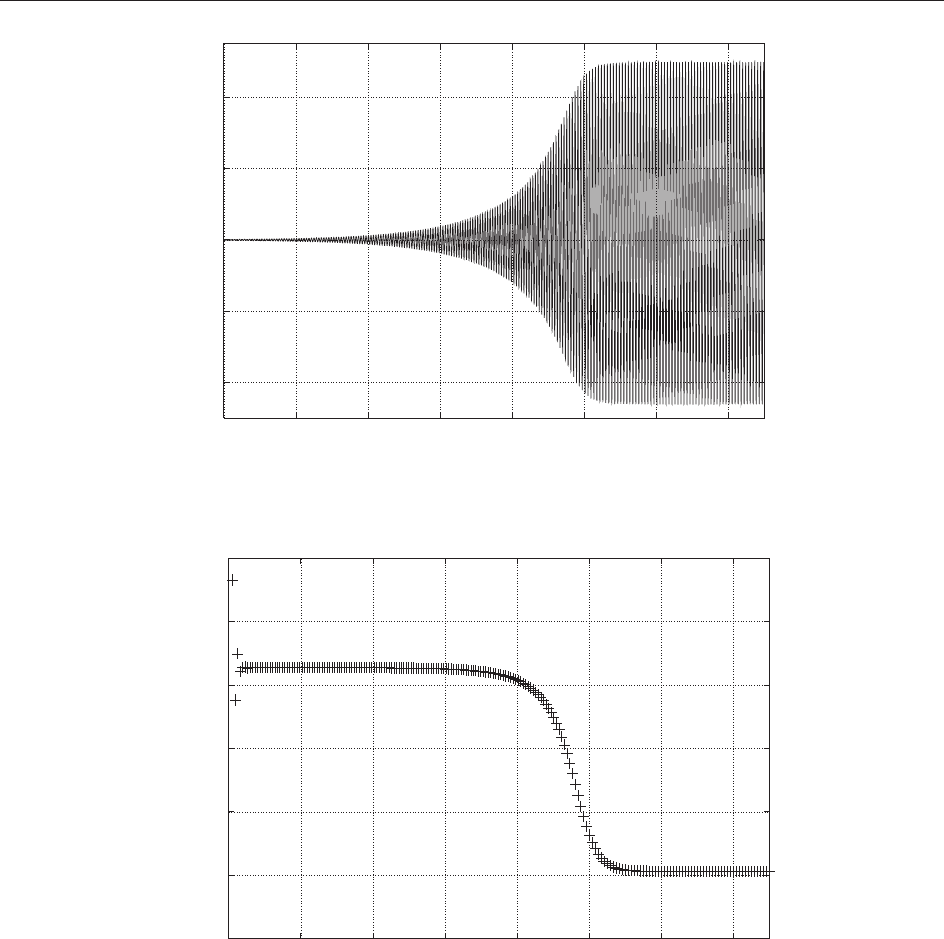
the signal) evolves with time (Figure 6) from its
threshold value to its nonlinearly saturated one.
Accurate determination the thresholds and identi-
fication of the associated bifurcation is possible by
fitting the argument of
max
(Ra) from the
exponential growth of Figure 5, in the Ra
c
vicinity.
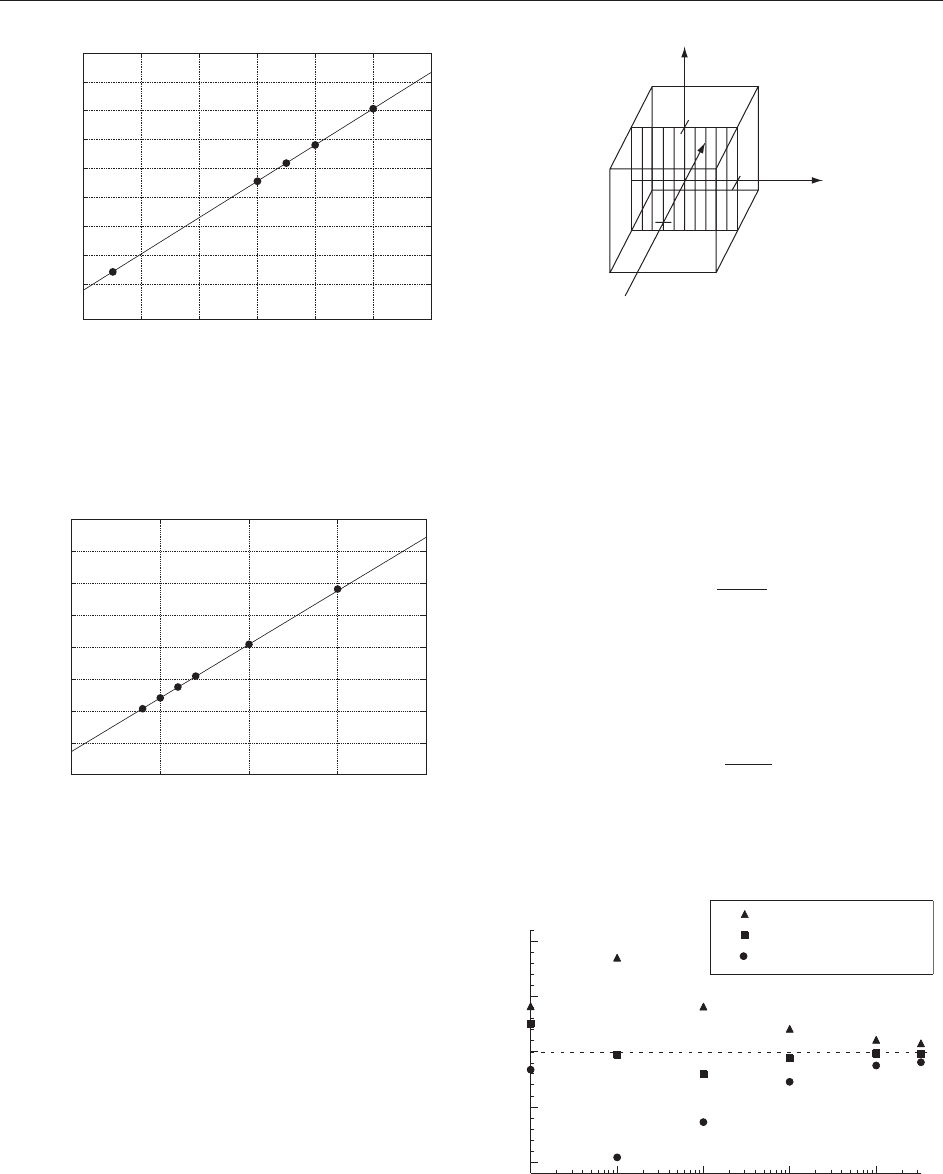
Figure 7 shows (solid dots) (Ra) measurements,
and the solid line (in Figure 8 also) is the linear law
given by the two points closest to the vanishing
growth rate. The local law announced in the
subsec tion ‘‘Direct syst em’’ is con firmed , with
an exponent = 1 for the Hopf bifurcation, and
= 1=2 for saddle–node (Figure 8) and pitchfork
bifurcations.
The Thermally Driven Cubic Cavity All flows are
obviously three dimensional. When do they possess
a two-dimensional approximation? How to qualify
it? Clearl y, the flow that develops in the container of
Figure 3 might enjoy (in a given parameter domain,
D) the mirror-reflection symmetry property about
the vertical midplane. Is there a two-dimensional
–2
–1
0
1
2
0
20 40 60
80
100 120 140
u
t
Figure 5 Time evolution of a radial velocity nodal value for Ra = 2600: Reproduced from Millour, Labrosse, and Tric (2003) Physics
of Fluids 15(10): 2791–2802, with permission from American Institute of Physics.
7.5
8.5
8
9
9.5
10
0 20 40 60 80 100 120 140
ω
n
t
Figure 6 Instantaneous angular frequency !
n
corresponding to Figure 5. Reproduced from Millour, Labrosse, and Tric (2003)
Physics of Fluids 15(10): 2791–2802, with permission from American Institute of Physics.
500 Newtonian Fluids and Thermohydraulics
approximation of the flow in this midplane? Is it
able to give a corre ct estimate of the two-dimen-
sional flow stability within D, and to predict the D
frontiers, where the mirror-reflection symmetry
property ceases to be valid? Only partial answers
are available so far, coming from the thermally
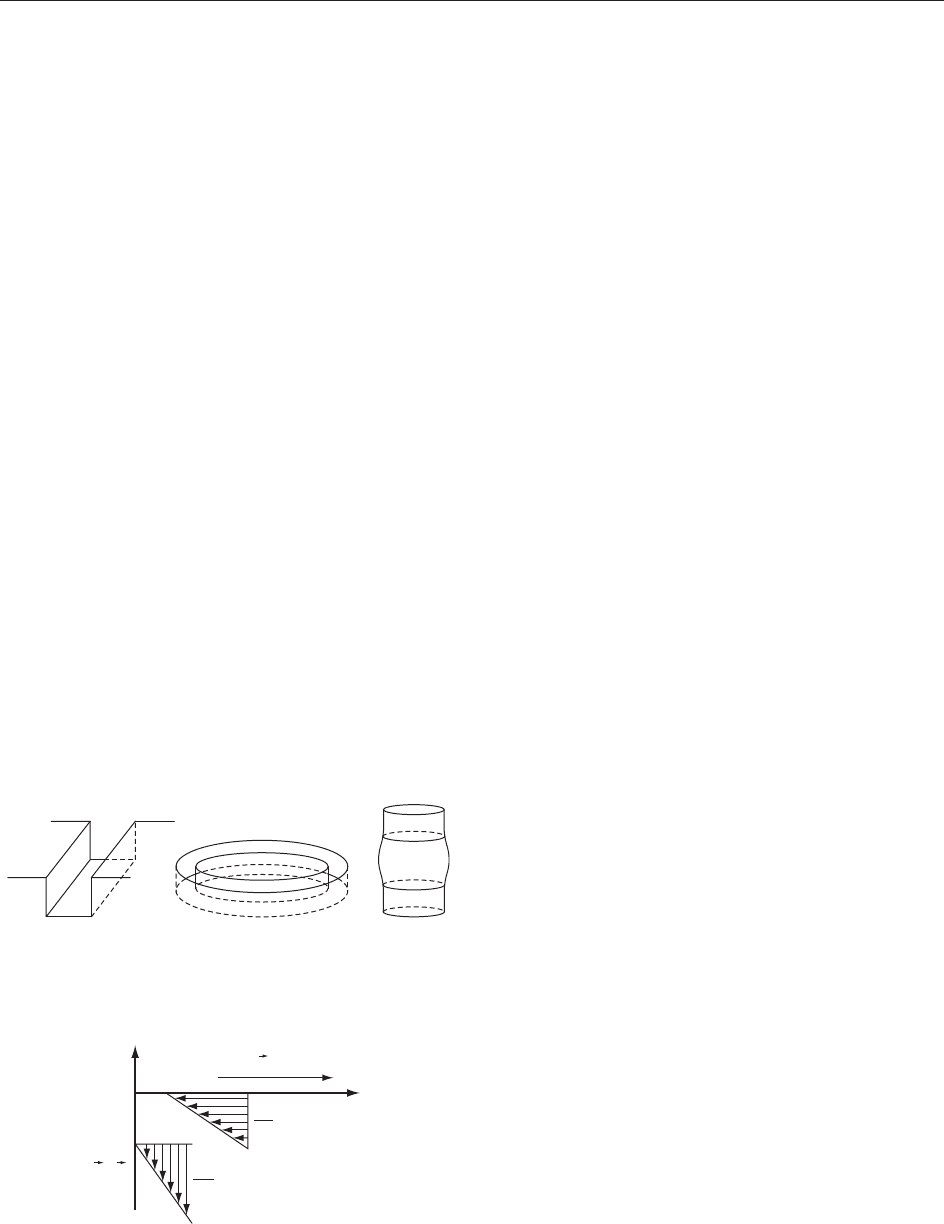
driven cubic cavity (Figure 9).
Filled with a pure fluid, its left and right vertical
plates have fixed temperatures, T
0
(=0atx = 0)
and T
0
þ T (=1atx = 1), while the others are
adiabatic. Any T 6¼ 0 generates a flow, possibly
mirror-symmetric about the vertical (hatched)
midplane, and also centrosymmetric about
^
e
y
.The
two-dimensional approximation was extensively ana-
lyzed, numerically, with air as a fluid. A steady flow
is obtained for Ra < Ra
2D, c
= (1.82 0.01) 10
8
,
where an oscillatory regime appears. The numerical
three-dimensional flow is steady until Ra
3D, c
=
3.2 10
7
, where it hysteretically bifurcates towards
an oscillatory regime breaking the mirror symmetry
about the midplane. Let us assess the validity of the
two-dimensional approximate solutions. We define
dimensionless heat fluxes (Nusselt numbers) which
penetrate in one of the active walls,
NuðyÞ¼
Z
1
0
@
3D
@x
x¼0
dz
Three fluxes are interesting to compare: (1) in the
midplane, Nu
mp
= Nu(y = 1=2), (2) globally Nu
3D,W
=
R
1
0
Nu(y)dy, and (3) the two-dimensional
approximation
Nu
2D;W
¼
Z
1
0
@
2D
@x
x¼0
dz
Figure 10 shows how they compare themselves,
as a function of Ra. Quantitatively, the two-
– 0.03
– 0.025
– 0.02
– 0.015
–0.01
– 0.005
0
0.005
0.01
0.015
2574 2576 2578 2580 2582 2584 2586
Ra
λ
Figure 7 Temporal growth rate, , of infinitesimal perturba-
tions, in the vicinity of the Hopf bifurcation of the quiescent state.
Reproduced from Millour, Labrosse, and Tric (2003) Physics of
Fluids 15(10): 2791–2802, with permission from American
Institute of Physics.
–0.2
–0.1
0
0.3
0.2
0.1
0.4
0.5
0.6
2625 2630 2635 2640 2645
Ra
λ
2
Figure 8 Squared temporal growth rate,
2
, of transient
relaxation towards the stationary state close to the saddle–
node bifurcation. Reproduced from Millour, Labrosse, and Tric
(2003) Physics of Fluids 15(10): 2791–2802, with permission
from American Institute of Physics.
e
y
ˆ
e
x
ˆ
e
z
ˆ
T
0
T
0
+
ΔT
Figure 9 Sketch of the thermally driven cubic cavity.
–10
–5
0
5
10
10
3
10
4
10
5
10
6
10
7
100 × (Nu
2D,W
–
Nu
mp
)/Nu
2D,W
100 × (Nu
3D,W
–
Nu
mp
)/Nu
3D,W
100 × (Nu
2D,W
–
Nu
3D,W
)/Nu
2D,W
Ra
Figure 10 Relative 2D–3D Nusselt numbers. Reproduced with
permission from Tric E, Labrosse G, and Betrouni M (2000) A
first incursion into the 3D structure of natural convection of air in
a differentially heated cubic cavity from accurate numerical
solutions. International Journal of Heat and Mass Transfer 43:
4043–4056. ª Elsevier Ltd.
Newtonian Fluids and Thermohydraulics 501
dimensional approximation is not too bad, but not
qualitatively, with a nonmonotonic e volution of the
discrepancies. These latter become quite negligible
when the three-dimensional flow gets unsteady and
paradoxically loses the symmetry property on
which its two-dimensional approximation is
founded.
Thermocapillary Convection
Two immiscible liquids, or a liquid and a gas, are
separated by a free surface, a region of small
thickness (some ten molecular sizes). From a
macroscopic viewpoint, it is considered as a singular
entity. Its location and geometry are part of the
solutions of the governing equations, themselves
supposed to satisfy [20] on the free surface. As a
first iteration, the free-surface shape can be imposed,
fixed, and straight often.
Numerous industrial processes involve thermoca-
pillarity wherein thermohydraulics involves complex
phenomena, such as phase-change kinetics. A rele-
vant modeling of these situations is a research
subject by itself. For thermohydraulics, some aca-
demic configurations (Figure 11) have retained the
attention of the scientific comm unity.
Any thermohydraulic flow transfers heat
between hot and cold solid boundaries wherein
heat penetrates by conduction. Consequently, the
term (
!
^
t) of [20] never cancels at the solid
boundary/free surface junction, as in Figure 12.
A nonzero vorticity is thus generated by thermo-
capillarity on the free surface until the wall, while
flow adherence on the wall gives vorticity values of
opposite sign. The problem presents therefore a
vorticity singularity at the triple point. This is a deep
physical and modeling problem.
See also: Bifurcations in Fluid Dynamics; Capillary
Surfaces; Compressible Flows: Mathematical Theory;
Dynamical Systems and Thermodynamics; Dynamical
Systems in Mathematical Physics: An Illustration from
Water Waves; Fluid Mechanics: Numerical Methods;
Magnetohydrodynamics; Non-Newtonian Fluids; Partial
Differential Equations: Some Examples; Stability of
Flows; Vortex Dynamics.
Further Reading
Batchelor GK (1987) An Introduction to Fluid Dynamics.
Cambridge: Cambridge University Press.
Bender CM and Orszag SA (1999) Advanced Mathematical
Methods for Scientists and Engineers I. New York: Springer.
Bird RB, Stewart WE, and Lightfoot EN (1960) Transport
Phenomena. New York: Wiley.
Chandrasekhar S (1961) Hydrodynamic and Hydromagnetic
Stability. Oxford: Clarendon.
Colinet P, Legros JC, and Velarde M (2001) Nonlinear Dynamics
of Surface-Tension-Driven Instabilities. Berlin: Wiley.
Drazin PG and Reid WH Hydrodynamic Stability, Cambridge
Monographs on Mechanics and Applied Mathematics.
Cambridge: Cambridge University Press.
Johns LE and Narayanan R (2002) Interfacial Instability.
New York: Springer.
Koschmieder EL (1993) Be´nard Cells and Taylor Vortices,
Cambridge Monographs on Mechanics and Applied Mathe-
matics. Cambridge: Cambridge University Press.
Kuhlmann HC (1999) Thermocapillary Convection in Models of
Crystal Growth. Springer Tracts in Modern Physics, vol. 152.
Berlin: Springer.
Labrosse G (2003) Free convection of binary liquid with variable
Soret coefficient in thermogravitational column: the steady
parallel base states. Physics of Fluids 15(9): 2694–2727.
Lu¨ cke M, Barten W, Bu¨ chel P, et al. (1998) Pattern formation in
binary fluid convection and in systems with throughflow. In:
Busse FH and Mu¨ ller SC (eds.) Evolution of Structures in
Dissipative Continuous Systems, Lecture Notes in Physics.
New York: Springer.
Manneville P (1990) Structures Dissipatives, Chaos and Turbu-
lence. Gif-sur-Yvette (France): Collection Ale´a Saclay.
Narayanan R and Schwabe D (eds.) (2003) Interfacial Fluid
Dynamics and Transport Processes, Lecture Notes in Physics,
vol. 628. Berlin: Springer.
Platten JK and Legros JC (1984) Convection in Liquids. Berlin:
Springer.
Turner JS (1973) Buoyancy Effects in Fluids, Cambridge Mono-
graphs on Mechanics and Applied Mathematics. Cambridge:
Cambridge University Press.
(c)(a) (b)
Figure 11 Open boat ((a) straight and (b) circular) and liquid
bridge (c) configurations.
Liquid
Solid
Gas
∂w
∂x
∂u
∂z
v = 0
e
z
ˆ
e
x
ˆ
∇T
Figure 12 Thermocapillary origin of vorticity singularity (cold
wall configuration).
502 Newtonian Fluids and Thermohydraulics

Newtonian Limit of General Relativity
J Ehlers, Max Planck Institut fu
¨
r Gravitationsphysik
(Albert-Einstein Institut), Golm, Germany
ª 2006 Elsevier Ltd. All rights reserved.
Introduction
The general theory of relati vity (GRT) unifies special
relativity theory (SR T) and Newton’s theory of
gravitation (NGT). SRT and NGT describe success-
fully large domains of physical phenomena; there-
fore, one would like to understand how they survive
as approximations in GRT.
In GRT, spacetime is idealized as a four-dimen-
sional Lorentz manifold whose curvature is related
to the distribution of energy and momentum. In
such a spacetime, the existence of the exponential
map implies that the metric near any event (space-
time point) x deviates from a flat metric only by
terms given by the curvature there. Thus, if the
gravitational tidal field, represented by the curvature
tensor, is small near x, one may approximate the GR
metric there by a flat Minkowski metric. This
explains that SRT is a general local approximation
to GRT. Apart from a remark at the end of the
subsec tion ‘‘Local laws’’ the relation GRT ! SRT
will not be discussed further.
In its traditional formulation, Newton’s theory
differs drastically from Einstein’s theory both in its
spacetime structure and in its description of gravita-
tion. The main purpose of this report is to show
how NGT can nevertheless be understood as a kind
of ‘‘limit’’ of GRT. More precisely, the structure of
NGT can be viewed as a degenerate version of that
of GRT, in parallel to the fact that the Galilei group
can be obtained by contracting the Lorentz group.
In the next section we state the laws of GRT.
We then reformulate these laws with slightly
different field variables such that, besides the
gravitational constant k, the speed of light appears
via = c
2
. The resulting laws remain meaningful
if and/or k are replaced by zero. They turn out
to give a common basis for GRT, SRT, and
NGT. The possibility of such a framework was
indicated independently by Cartan (1923, 1924) and
Friedrichs (1927) and extended by several authors;
the complete formulation reviewed here was given
by Ehlers (1981).
The section ‘‘Newton’s theory in spacetime form’’
shows that the laws of NGT and SRT are obtained,
with some additional restrictions, from the rescaled
laws of GRT by putting, respectively, = 0ork = 0.
It is emphasized that Newton’s theory proper is a
theory only of isolated systems. Its intrinsic, four-
dimensional formulation explains how the distinc-
tion between a vectorial gravitational field and
inertial forces, as well as the existence of inertial
frames, emerge as consequences of asymptotic
flatness. These structures are lost in the so-called
‘‘Newtonian’’ cosmology whose dynamics is due to
symmetry assumptions, whereas GR cosmology is a
proper part of GRT.
The penultimate section is concerned wi th rela-
tions between solutions of GRT and NGT, and in
the final section some results related to solutions are
reported. They illustrate that the limit relation
GRT ! NGT may sometimes be inverted to get
exact or approximate GR results from NGT.
Approximations are related to unifor m convergence
in , as is indicated at the end of the final section.
The limit relations described here may be con-
sidered as a model for other theory relations in
physics such as quantization or dequantization.
Notation Indices will be considered in general as
‘‘abstract’’ ones, characterizing the kind of objects
independent of coordinate systems. Greek indices
refer to spacetime, Latin ones to 3-space. Fields on
spacetime will generally be taken to be smooth.
Basic Concepts and Laws of GRT
According to GRT, spacetime is a four-dimensional
manifold M endowed with a Lorentzian metric g
,
here taken to have signature (þþþ). Any kind
of matter including nong ravitational fields is sup-
posed to determine an energy tensor T
. Metric
and matter are interrelated by Einstein’s gravita-
tional field equation
R
¼
8k
c
4
T
1
2
g
T
½1
In this equation, T := T
denotes the trace of the
energy tensor, k and c stand for Newton’s constant
of gravity and the speed of light, respectively, and
the Ricci tensor R
is obtained from Riemann’s
curvature tensor by contraction
R
:¼ R
The curvature tensor is constructed from the
symmetric, lin ear connection
determined by
the metric.
Equation [1] implies the vanishing of the covar-
iant divergence of the energy tensor
T
;
¼ 0 ½2
Newtonian Limit of General Relativity 503

the GRT analog of the laws of local conservation of
energy and momentum.
The energy tensor depends on the kind of matter
to be taken into account. In this article, only
vacuum fields (T
= 0) an d perfect fluids will be
considered. For such a fluid,
T
¼ð þ c
2
pÞU
U
þ pg
½3a
and p denote the mass density and the pressure,
respectively, and the 4-velocity U
is a timelike
vector obeying
g
U
U
¼c
2
½3b
If thermodynamical relations are added to specify
the kind of fluid – the simplest cases are barotropic
equations p = f ( ) – then eqns [1]–[3] admit a
well-posed initial value problem for the fields
g
, U
, .
Different matter models which could be treated in
the context of this report are elastic bodies and ideal
gases, but not point particles. Point particles fit into
GRT even less than into electrodynamics.
The Cartan–Friedrichs Formalism
To obtain a spacetime formulation of NGT and a
limit relation ART ! NGT, we recall that the
metric structure of Newton’s spacetime consists of a
scalar t, absolute time, which foliates M into
instantaneous 3-spaces S
t
, and Euclidean metrics
ab
(t) on these spaces. If the inverses
ab
(t) are
pushed forward onto M via the embeddings S
t
!M,
a field s
on M results which is assumed to be
smooth. By construction,
s
t
;
¼ 0 ½4
The pair (t, s
) defines the ‘‘metric,’’ that is, times
and distances, in NGT.
Such a structure can arise from a Lorentzian
metric, for example, the Minkowski metric
,by
taking, component-wise, the limits
c
2
dx
dx
dt
2
c
2
dx
2
!
c !1
dt
2
;
!
c !1
s
½5
which can be interpreted geometrically as ‘‘opening
up the light cones’’ until they degenerate into
doubly covere d, spacelike hyperplanes, the New-
tonian S
t
’s.
The relations [5] suggest to write the GRT laws in
terms of the rescaled temporal metric ( c
2
)
t
:¼g
½6
and to write – presently only as a change of
notation – s
instead of g
. Then the fields
t
, s
,
, T
, , p, U
, called the basic fields
below, and constants k > 0, >0 satisfy the
following laws:
t
s
¼
½7a
t
;
¼ 0; s
;
¼ 0 ½7b
R
¼ R
½7c
R
¼ 8kt
t
1
2
t
t
T
½7d
T
;
¼ 0 ½7e
T
¼ð þ pÞU
U
þ ps
½7f
t
U
U
¼ 1 ½7g
The Lorentz signature of g
can be reexpressed
thus: at each event (ffi spacetime point), there exists
a ‘‘timelike’’ vector V
, that is,
t
V
V
> 0 ½7h
and V
X
= 0 for X
6¼ 0 implies s
X
X
> 0.
The indices in eqn [7c] are raised, here and later,
by s
.
Given a set of basic fields on M as listed below
eqn [6], the laws [7] remain meaningful for all 0
and k 0. If = 0, the ‘‘metrics’’ t
and s
degenerate (and the pair (t
, s
) is then called a
Galilei metric). Nevertheless, the definition of ‘‘time-
like’’ will also be used in that case. Also, X
will be
said to be ‘‘spacelike’’ if and only if it can be written
X
= s
with s
> 0. While for >0, some
of the relations [7] are redundant, this is not so for
= 0. For example, if = 0, the two eqns [7b] are
independent and do not determine the connection
uniquely, in contrast to the case >0. The
connection will always be assumed to be symmetric.
As will be discussed below, these formulas define
a framework which serves to relate GRT to NGT
and special relativity (SRT). First steps to formulate
such a framework have been taken independently by
E Cartan and KO Friedrichs. Therefore we call the
structure defined by [7] the Cartan–Friedrichs
formalism (CFF). We call it a ‘‘formalism’’ and not
a ‘‘theory’’ since it is of interest sole ly as a tool to
study relations between theories.
Equations [7] remain unchanged if the basic fields
and constants are rescaled according to a change of
units for time, length, and mass. Here, two sets of
basic fields related by such a rescaling will be
considered as physically equivalent; they provide the
504 Newtonian Limit of General Relativity

same relations between observables. Thus, and k
have no physical meanings, but only their signs:
>0; k > 0 : GRT
¼ 0; k > 0: NGT
>0; k ¼ 0 : SRT
(The last two lines are not sufficient to specify the
theories within CFF; in connection with eqn [9] and
in Theorem 2 they will be completed.) For discuss-
ing limit relations between theories, it is nevertheless
useful to represent physical models in different
scales.
The physical interpretation of t
, s
in terms of
time and distance and that of
through its
geodesics as world lines of freely falling test
particles, respectively, is the same in the three
theories and can be stated in terms of the common
framework CFF.
For an obvious reason, may be called causality
constant. Note that and k each occur in only one of
the general laws of the theory, apart from the in [7f].
The laws [7] are invariant under diffeomorphisms
of the spacetime manifold. Those diffeomorphisms
which map the basic fields of a solution into
themselves form the symmetry group of that solution.
Newton’s Theory in Spacetime Form
Local Laws
Remarkably, for = 0 and k > 0 the formulas [7]
reproduce almost all the laws on which Newton’s
theory of spacetime coupled to Euler’s fluid theory is
based. This is summarized in the following:
Theorem 1 Let eqn [7] hold on M with = 0.
Then there exists, for any event of M, a neighbor-
hood U with coordinates (x
a
, t) such that, on U, t
coincides with the absolute time, t
= t
,
t
,
, and on
the local slices U \ S
t
, s
defines Euclidean metrics
ab
with orthonormal coordinates x
a
,
ab
=
ab
.
Vectors are spacelike iff they are tangent to S
t
,
otherwise they are timelike. Moreover, the slices
are locally geodesic with respect to the connection
, and the induced connection on the slices is the
flat connection associated naturally to
ab
. In
addition, in the coordinate chart given by (x
a
, t),
the connection components vanish except
0
a
0
and
0
b
a
( =
0
a
b
). Therefore, t is an affine parameter
on timelike geodesics. Further, U
0
= 1, and U
a
= v
a
is the 3-velocity of the fluid. If one writes
0
a
0
¼: g
a
;
0
a
b
¼: !
a
b
½8a
and uses 3-vector notation with (g
a
) = g,
(!
23
, !
31
, !
12
) = w, the timelike geodesics of
are given by
€
x ¼ g þ 2
_
x w ½8b
g and w satisfy
Ñ w ¼ 0; Ñ g þ 2
_
w ¼ 0 ½8c
Ñ w ¼ 0; Ñ g 2w
2
¼4k ½8d
and the fluid’s equations of motion are
_
þ Ñ ðvÞ¼0 ½8e
ð
_
v þ v Ñv g 2v wÞþÑp ¼ 0 ½8f
A solution (g, w, , p, v) of eqns [8] on a local
chart (x
a
, t) wi th t
= diag(0 , 0, 0, 1) and s
=
diag(1, 1, 1, 0) provides, via eqn [8a], the general
local solution to eqns [7] for = 0.
The proof consists of many, mostly ele mentary
steps which can be gathered from Ku¨ nzle (197 2) and
Ehlers (1981).
Given a solution to eqns (7) with = 0andk > 0,
the coordinates x
= (x
a
, t)referredtointhetheorem
are determined by the basic fields up to time-
dependent Euclidean motions, time translations, and
time reflections. Such a coordinate system corresponds
to a rigid reference frame. As the equation of motion
for freely falling particles, eqn [8b], shows, g and w
are to be interpreted as the acceleration and rotation
fields which determine, relative to a rigid frame, the
combined influence of inertia and gravity on particles
encoded in the spacetime connection
.(Thisrole
of a connection in NGT was recognized by E Cartan.)
This interpretation is supported by the (generalized)
Euler equation [8f].
As claimed above already, eqns [7] almost
reproduce the local laws of the Newton–Euler
theory. Indeed, eqns [8] are those of the Newton–
Euler theory, provided w depends on time only.
Then an d only then can the coordinate freedom be
used to get nonrotating rigid coordinates with
respect to which w = 0. The existence of such
coordinates is indispensable for NGT since only
with respect to them g is the gradi ent of a
potential U which obeys Poisson’s equation, as
shown by eqns [8c] and [8d].
The preceding argument shows that the CFF,
specialized to = 0, has to be restricted by a
condition which implies w = w(t) in order to give
the local laws of NGT. One such condition is
R
¼ 0 ½9
Newtonian Limit of General Relativity 505

as can be verified by computing the curvature tensor
via eqn [8a].
Equation [9] for = 0 expresses that parallel
transport of spacelike vectors along arbitrary spacetime
curves is integrable, which corresponds to the behavior
of free gyroscopes in NGT (in contrast to GRT).
Of course, eqn [9] cannot be added to the CFF since it
is incompatible with GRT. If, however, the CFF with
>0, k = 0 is restricted by the condition [9],the
spacetime and hydrodynamics of special relativity result.
Global Laws for Isolated Systems
The laws [8] and [9] do not determine the time
evolution of the basic fields. Using nonrotating
coordinates we put g = ÑU and replace eqns [8c],
[8d] by Poisson’s equation
U ¼ 4k ½10
In Newtonian dynamics, the potential only serves
to compute forces depending instantaneously on the
mass distribution. Traditionally, this is achieved by
assuming to have spatially compact support at
each time and to solve eqn [10] by
ðx; tÞ¼k
Z
ðx þ y; tÞ
jyj
d
3
y ½11
which implies the fall-off
lim
jxj!1;
t¼const:
ðx; tÞ¼0 ½12
( will always be used for this solution of eqn [10]).
To relate the foregoing isolation assumptions
to corresponding assumptions in GRT as far as
presently possible, it seems necessary to go back
to the laws [7] restricted to = 0 or the equivalent
(3 þ 1) version [8] without the restriction [9].
If some global assumptions are added to eqns [8],
eqns [10]–[12] can be deduced from the four-
dimensional form ulation. One first intro duces the
following two assumptions:
(1) The hypersurfaces S
t
of M (which, for = 0, are
the only spacelike hypersurfaces) are simply
connected, complete Euclidean spaces.
(2) On each S
t
, the support of is compact.
Using coordinates (x
a
, t) as in the last subsection,
with x
a
now ranging on R
3
, eqns [8a] imply
R
R
¼2
X
a;b
ð!
a;b
Þ
2
t
½13
Hence the sum is a 4-scalar, and since t
is
covariantly constant, it is possible to require
R
R
!0 at spatial infinity ½14
which expresses covariantly that !
a, b
!0. Since w is
harmonic on S
t
(by eqns [8c], [8d]), this in turn
implies !
a, b
= 0; thus, w depends on t only; the
asymptotic condition [14] and the local laws imply
eqn [9].
We may therefore employ rigid, nonrotating
coordinates, w = 0. Then, by eqns [8a], [8c], [8d]
the connection coefficie nts take the form
¼ t
;
t
;
s
U
;
½15
and
R
R
¼ t
;
t
;
t
;
t
;
X
a;b
X
a;b
ðU
;ab
Þ
2
½16
As before, we require
R
R
!0 ½17
and conclude U
, ab
!0. Since the Newtonian poten-
tial of also has this fall-off and U is
harmonic on S
t
ffi R
3
, the following conclusion can
be obtained:
Lemma 1 The laws [8] and the global conditions
(1)–(2), [14], [17] imply: in rigid, nonrotating
coordinates, the connection
t
;
t
;
s
;
¼
½18
is flat ( according to eqn [11] is a scalar, and the
-term in eqn [18] is a tensor). In other words,
is asymptotically flat since the -term falls of
as jxj
2
.
Because of this lemma, one can further restrict the
coordinates (x
a
, t) by demanding
= 0. In physi-
cal terms this means: by switching to a new,
‘‘unaccelerated’’ frame of reference, one removes
from the equations of motion a spatially homo-
geneous gravitational field which, in contrast to the
-term in eqn [16], is not due to matter.
The resulting coordinates are defined, up to
Galilean transformations,
t
0
¼t þ c
0
0
x
a
0
¼D
a
0
b
x
b
þ u
a
0
t þ c
a
0
where c
a
0
, u
a
0
are constants and D is a constant
orthogonal 3 3 matrix. These coordinates are
called inertial ones; with respect to them the usual
laws of Newtonian mechanics hold; see [8] with
w = 0 and U = [].
Theorem 2 (Ehlers 1981). The laws [7] of the
CFF restricted to = 0 and augmented by the global
and asymptotic conditions (1)–(2), [14], [17],
provide a generally covariant, four-dimensional
506 Newtonian Limit of General Relativity