
Francoise J.-P., Naber G.L., Tsun T.S. (editors) Encyclopedia of Mathematical Physics
Подождите немного. Документ загружается.


Negative Refractive Index Media
Interleaving the structures for a negative "
eff
and
eff
can create a composite with "
eff
< 0and
eff
< 0ata
common frequency (!) (Smith et al., Shelby et al.
2001), which as predicted by Veselago (1968) should
give rise to a material with negative refractive index.
Although this appears intuitively correct, it is actually
nontrivial that the electromagnetic fields of the two
composites do not interfere with each other’s function
(Pokrovsky and Efros 2002) and this could depend
crucially on the relative placement of the two
structures (Marques and Smith 2004). However,
there is now overwhelming experimental and numer-
ical evidence that such composite structures possess
negative refractive index (see Ramakrishna (2005,
section 6)). Now consider a medium with predomi-
nantly real " and .For">0and>0, we have
our usual optical materials. Only one of " or lesser
than zero with the other positive would imply a
medium which cannot support any propagating
modes. This is a consequence of Maxwell’s equations:
k k ¼ "ð!Þð !Þ
!
2
c
2
0
½19
which implies that only evanescently decaying waves
with an imagina ry component of k are possible.
Common examples are ordinary metals with "<0
and >0. Now consider a medium with both "<0
and <0, or a negative refractive index medium.
The M axwell’s equations for a plane time-harmonic
wave exp[i (k r !t)] are:
k E ¼
!
c
ð!ÞH ½20
k H ¼
!
c
"ð!ÞE ½21
The ‘‘left-handedness’’ of the triad (E, H, k)isclear
from these equations for "(!), (!) < 0. A real
refractive index means that waves propagate with the
direction of energy flow given by the Poynting vector,
S ¼ E H ½22
opposite to the direction of the wave vector. Since
the group velocity is in the direction of the energy
flow, we conclude that in these left-handed materials
(LHMs) the group velocity and the phase velocity
are oppositely directed. The phase accumulated in
propagating a distance x is =
ffiffiffiffiffiffi
"
p
!=c
0
x. Thus,
the refractive index can be taken to be n =
ffiffiffiffiffiffi
"
p
,
that is, a negative quantity. Mathematically, it is
more reasonable to ask for the sign of the square-
root to determine the wave vector given by eqn [19].
It can be shown by arguments of analytic continuity
in the complex plane that the negative sign has to be
chosen for propagating waves when Re(") < 0 and
Re() < 0(Ramakrishna 2005).
The negative refractive index has real effects on
the behavior of radiation even in basic processes
such as refraction. Consider an interface between
vacuum and a negative refractive index medium
with n < 0 shown in Figure 4. Continuity conditions
on the electromagnetic fields at the interface require
for a plane wave incident from the vacuum side at
an oblique angle that the parallel wave vector k
k
is
conserved for the transmitted and reflected wave.
This is the origin of Snell’s law:
sinð
i
Þ¼sinð
r
Þ¼n
sinð
t
Þ½23
where
i
,
r
and
t
are the angles of incidence,
reflection, and transmission, respectively. The flow
of energy across the interface determines the direc-
tion of the group velocity in the material medium as
being away from the interface. Therefore, the
component of the phase velocity vector normal to
the interface must change sign as we pass from
vacuum into the material medium. We are then
forced to conclude that the ray is bent toward the
same side of the su rface normal as the incident
wave. This picture is consistent with Snell’s law with
the interpretation that n< 0 )
t
<0. Figure 4 illus-
trates this point which has been experimentally
verified by several groups (Shelby et al. 2001,
Parazzoli et al. 2003, Eleftheriades et al. 2002).
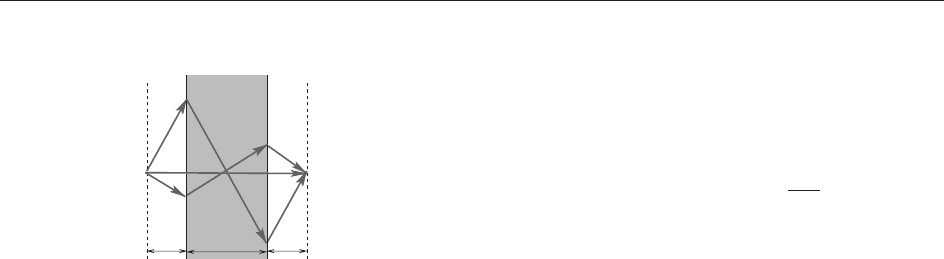
As a direct consequence of this, it is seen that a
flat slab of negative refractive medium can act as a
lens as shown in Figure 5. Provided that the slab is
of sufficient thickness, the refracted rays from a
point source come to a focus inside the slab and
upon exiting the slab the rays are redirected again
such that they come to a focus on the opposite side
of the slab (Veselago 1968). Veselago also predicted
a negative Doppler shift in such media and an
obtuse angle cone for Cerenkov radiation.
(a) (b)
k
r
k
i
k
t
k
r
k
i
k
t
VAC LHM
θ
t
θ
t
θ
r
θ
r
k
||
k
||
VAC RHM
Figure 4 Illustration of Snell’s law at an interface between
two media with (a) positive refractive index (VAC/RHM) and
(b) negative refractive index (VAC/LHM). The arrows indicate the
wave vectors and the energy flow is opposite to the wave vector
in the negative index medium.
Negative Refraction and Subdiffraction Imaging 487
Perfect Lens: Subwavelength Imaging
A wave analysis of the Veselago lens revealed an
extremely novel aspect: it did not suffer from the
diffraction limit and the image resol ution could be
infinite (Pendry 2000),ifthenegativeindex
material were perfectly nondispersive and nonab-
sorbing. Before we analyze this, let us first brief ly
review the p roblem of imaging and the diffraction
limit.
Any object is visibl e because it emits or scatters
light. The problem of imaging is then concerned
with reproducing the electromagnetic field distribu-
tion on a 2D object plane in the 2D image plane. If
E(x, y, 0) be the electric field on the object (z = 0)
plane, the fields in free space can be decomposed
into the Fourier components k
x
and k
y
,and
polarization defined by :
Eðx; y; z; tÞ¼
X
;k
x
;k
y
E
k
x
; k
y
exp i k
x
x þ k
y
y þ k
z
z !t
½24
where
E
ðk
x
; k
y
Þ¼
Z
x;y
E
ðx; y; 0Þe
iðk
x
xþk
y
yÞ
dx dy ½25
In the above expression, the source is assumed to be
monochromatic of frequency !, k
2
x
þ k
2
y
þ k
2
z
=
!
2
=c
2
0
, c
0
is the speed of light in free space, and
z is the optical axis. A conventional lens acts by
applying a phase correction to each of the propaga-
ting components so that they reassemble to a focus
at a point beyond the lens. For these compone nts k
z
is real, thus a phase change is all that is required to
form an image containing these components. The
higher spatial details in an object, however, are
described by the nonpr opagating near-field compo-
nents with an imaginary k
z
where k
2
x
þ k
2
y
>!
2
=c
2
.
A conventional lens cannot restore these
components in the image plane as they decay
exponentially in amplitude as one moves away
from the source. Hence the resolution, , provided
by a conventional lens is limited to those compo-
nents with
k
2
x
þ k
2
y
<!
2
=c
2
)
2c
!
¼ ½26
Now consider the slab of medium with " = 1
and = 1 and of thickness d
s
. It can be shown
(Pendry 2000) that the transmission and reflection
coefficients are
lim
"!1
!1
~
t ¼ exp ik
z
d
s
½ ½27
lim
"!1
!1
~
r ¼ 0 ½28
respectively, where k
z
is the component of the wave
vector normal to the interface. Thus, the slab
reverses the phase advance for the propagating
waves as revealed by the ray picture. Analytic
continuation to imaginary wave vectors k
z
= i
z
implies that the transmittance
~
t ! exp(þ
z
d), that
is, the slab also increases the amplitude of the
evanescent waves in transmission at exactly the
same rate as the rate of the decay in free space
outside. Thus, each wave, propagating or evanes-
cent, arrives at the image plane with its phase or
amplitude restored exactly to the values at the object
plane so as to perfectly reconstruct the image. The
lens is also perfectly impedance matched and has
zero reflection. These incredible properties have led
the phenomenon to be called ‘‘perfect lensing.’’
Note that there is no energy flux associated with
purely evanescent waves, and hence the amplifica-
tion obtained in the steady state corresponds to local
field enhancements which would imply the presence
of localized resonances. In fact, the entire mechan-
ism of the focusing of the near-field components is
due to surface modes that reside on the surfaces of
these negative index materials (Ramakrishna 2005).
" = 1and = 1 are precisely the conditions for
these surface modes of electric and magnetic nature,
respectively. These surface plasmon resonanc es
which are excited resonantly by the evanescent
modes and the secret to the perfect lens is that all
the surface modes are completely degenerate.
Although the conditions for realizing a perfect lens
are easy to specify, in practice these are very difficult to
meet. The requirement of negative values for " and
implies that these quantities must disperse necessarily
with frequency and be dissipative. Thus, the perfect-
lens condition can only be met approximately at a
single frequency. Any deviation from the ideal
d/ 2
Object
plane
Image
plane
d/
2
n
= –1
d
Figure 5 Steady-state passage of rays (representing the energy
flow) of light from vacuum through a slab made of a LHM with
n = 1. The slab acts as a lens mapping a point on the image plane
to a point on the object plane.
488 Negative Refraction and Subdiffraction Imaging

conditions can then result in the excitation of slab
polariton resonances which can swamp the image. The
effects of absorption, which are always present, can
also seriously degrade the lens performance by damp-
ing out the surface plasmon resonances (Ramakrishna
2005). Consider the transmission for the P-polarized
radiation through a negative index slab:
~
tðk
x
Þ¼
4ðk
z1
="
þ
Þðk
z2
="
Þe
ik
z2
d
s
D
½29
where
D¼ðk
z1
="
þ
þ k
z2
="
Þ
2
ðk
z1
="
þ
k
z2
="
Þ
2
e
2ik
z2
d
s
Under the perfect-lens conditions, the first term in
the denominator goes to zero for evanescent waves
and the exponential in the second term decays faster
than the exponential in the numerator. However, if
there was a mismatch in the conditions, ("
þ
= 1 and
"
= 1 þ , say) then the first term in the denomi-
nator no longer vanishes. In the large wave vector
limit (k
x
!=c
0
), the two terms in the den ominator
become approximately equal when
k
x
¼
1
d
s
ln
2
½30
thus yielding a criterion for the largest wave vector
for which there is effective amplification. The
dependence through the logarithm on the deviations
(whether real or imaginary) from the resonant
conditions underlines the fact that the perfect lens
effect is indeed very sensitive. In practice, the
periodicity, d, of the strucuture of the meta-
materials comprising the negative index slab itself
imposes an upper wave vector cutoff k
c
= 2=d. The
material will become spatially dispersive for wave
vectors k !k
c
, and for k >k
c
the very description as
a homogeneous material will break down.
An important simplification of the perfect-lens
conditions results when we consider a situation in
which all length scales in the problem are much less
than the wavelength of the light (the quasistatic
approximation). Under these conditions, the electric
and magnetic fields effectively decouple. If we
consider the case of P-polarized fields, it can be
shown (Pendry 2000) that in the quasistatic limit
only the value of the permittivity is important, and
there are essentially no conditions on the value of
the permeability. This brings metals such as silver
into the picture as the permittivity of silver becomes
equal to 1 in the optical region of the spectrum
and with relati vely small losses (Pendry 2000). To
overcome the loss es, a series of refinements of the
simple thin-slab picture have been proposed includ-
ing dividing the lens into a series of layers and using
optical amplification to act against the deleterious
effects of absorption (Ramakrishna 2005).
The Generalized Perfect-Lens Theorem
The negative refractive slab can be considered as
‘ ‘o ptical antimatter’ ’ in the sense that it cancels out the
effects on radiation of the traversal through an equal
amount of positive refractive index medium. This
cancelation is applicable to the phase changes for the
propagating modes and the amplitude changes to the
evanescent modes. In fact, the focussing action can
happen for more general situations where the require-
ment of homogeneity of the slab material can be
relaxed. Now consider the more general situation
where the dielectric permittivity and the magnetic
permeability are arbitrary functions of the spatial
coordinates:
"
þ
¼ "ðx; yÞ;
þ
¼ ðx; yÞ½31
"
¼"ðx; yÞ;
¼ðx; yÞ½32
corresponding to the Figure 6. We will consider the
imaging axis to be the z-axis. Thus, we see that the
system is antisymmetric with respect to the z = d
plane. It turns out (Pendry and Ramakrishna 2003 )
that such a system also transfers the image of a
source placed at the z = 0 to the z = 2d plane in the
same exact sense that it includes both the propagat-
ing and evanescent components. In general, the rays
in spatially varying media will not be straight lines
as shown in Figure 6, but the effect of propagating
through the positive medium is nullified by the
negative medium. Thus, to an observer on the right-
hand side, it would appear as if the region between
z = 0 and z = 2d did not exist. We will call such
media with the same sense of transverse spatial
variation but with opposite signs as optical com-
plementary media, and the effect of any such pairs
of complementary media on radiation is null.
d ddd
Figure 6 A pair of complementary optical media nullify the
effect of each other for the passage of light. Spatially varying
positive and negative refractive indices are schematically depicted
by the white or shaded regions.
Negative Refraction and Subdiffraction Imaging 489

The most general conditions on the permittivity
and permeability tensors for such complementary
behavior are:
~
"
þ
¼
"
xx
"
xy
"
xz
"
yx
"
yy
"
yz
"
zx
"
zy
"
zz
0
B
@
1
C
A
~
þ
¼
xx
xy
xz
yx
yy
yz
zx
zy
zz
0
B
@
1
C
A
½33
and
~
"
¼
"
xx
"
xy
þ"
xz
"
yx
"
yy
þ"
yz
þ"
zx
þ"
zy
"
zz
0
B
@
1
C
A
~
¼
xx
xy
þ
xz
yx
yy
þ
yz
þ
zx
þ
zy
zz
0
B
@
1
C
A
½34
and a perfect focus results whenever the two slabs of
positive and negative media hav e such a behavior (see
Pendry and Ramakrishna (2003) and Ramakrishna
(2005) for the proof). This theorem clearly shows that
the dependence along the x- and y-directions trans-
verse to the imaging axis z is completely irrelevant as
long as the two slabs are optically complementary. As
an extension, it can be shown that any system of
optically complementary media will also have a
perfect focus as long as the system has a plane of
antisymmetry normal to the optical axis. The above
effects have also been numerically verified for several
such spatially varying complementary media (Pendry
and Ramakrishna 2003).
Perfect Lens in Other Geometries
The above generalized perfect-lens theorem along with
a method of coordinate transformations can enable us
to now generate a variety of superlenses in different
geometries. In general, if we can find a geometric
transformation that maps a given configuration into
the geometry for the generalized slab lens, then we
would have generated one more arrangement that will
exhibit the property of transferring images of sources
in a perfect sense. If we define the new coordinates
q
1
(x, y, z), q
2
(x, y, z), and q
3
(x, y, z) (assumed ortho-
gonal), then in the new frame, the material parameters
and fields are given by (Ward and Pendry 1996)
~
"
i
¼ "
i
Q
1
Q
2
Q
3
Q
2
i
;
~
i
¼
i
Q
1
Q
2
Q
3
Q
2
i
½35
~
E
i
¼ Q
i
E
i
;
~
H
i
¼ Q
i
H
i
½36
where
Q
2
i
¼
@x
@q
i
2
þ
@y
@q
i
2
þ
@z
@q
i
2
½37
Note that a distortion of space results in the change
of " and tensor s in general. Thus, in many cases,
the transformed geometry would involve spatially
varying (inhomogeneous) and anisotropic medium
parameters.
The change in geometry can also make it possible
forustorealizelenseswithcurvedsurfaces.The
original slab lens maps every point on the object plane
to another point on the image plane. But the size of
the image is identical to that of the source. This is due
to the invariance in the transverse direction and the
transverse wave vector (k
x
, k
y
) is preserved. In
general, to change the size of the images, the
translational symmetry would have to be broken and
curved surfaces will necessarily be needed. The
focussing action for the evanescent waves is crucially
dependent on the near degeneracy of the surface
plasmons in the case of the slab, and curved surfaces,
in general, have a completely different dispersion for
the surface plasmons. Thus, one should expect that
inhomogeneous materials will be required for such
curved lenses of negative refractive index. It can be
shown (Ramakrishna 2005) that mapping the slab
lens into cylindrical coordinates
x ¼ r
0
e
‘=‘
0
cos ; y ¼ r
0
e
‘=‘
0
sin ; z ¼ Z
½38
where ‘
0
is some scale factor(= 1) generates a
cylindrical annulus of inner and outer radii a
1
and a
2
, respectively, with the material parameters
given by
"
r
¼
r
¼1
"
¼
¼1
"
z
¼
z
¼1=r
2
½39
for the annular region. The positive material outside
the annular region should vary as
"
r
¼
r
¼þ1
"
¼
¼þ1
"
z
¼
z
¼þ1=r
2
½40
where r = r
0
exp(‘=‘
0
). This system transfers images
in and out of the cylindrical annulus and the image
of a source inside at r = a
0
will be formed on the
surface a
3
= a
0
(a
2
=a
1
)
2
. Thus, there will be a
magnification of the image by the factor
M¼
a
2
a
1
2
½41
490 Negative Refraction and Subdiffraction Imaging

Note that these cylindrical lenses are also short-
sighted in the same manner as the slab lens. They
can only focus sources from inside to the outside
only when a
2
1
=a
2
< r < a
1
, and the other way
around from outside to the inner world when the
source is located in a
2
< r < a
2
2
=a
1
.
Similarly the transformation into spherical coor-
dinates (r = r
0
e
‘=‘
0
, , ) can be used to generate a
spherical perfect lens wherein a spherical shell of
negative refractive material with "(r) 1=r and
(r) 1=r with arbitrary dependence along and
(which could be constant too!) have the property of
perfectly transferring images of sources in and out of
the shell (Pendry and Ramakrishna 2003). This
spherical lens also has exactly the same magnifica-
tion factor given by eqn [41]. In fact, the solutions in
these two cases of a cylinder and sphere can also be
obtained by a more conventional electromagnetic
calculation in terms of the scattering modes
(Ramakrishna 2005). One can obtain even more
esoteric configurations such as one or two intersect-
ing corners of negative refracting materials that
behave as perfect lenses (Pendry and Ramakrishna
2003).
Other Approaches to Negative Refraction
There is also an approach to negative refractive
materials based on loaded transmission lines
(Eleftheriades et al. 2002), which has been imple-
mented at radio- and microwave frequencies using
lumped circuit elements. These show all the hall-
marks of a negative refractive material within an
effective medium approach.
Effects which can be interpreted as negative
refraction have been observed in certain periodic
photonic crystals (PCs) (Luo et al. 2003). An
incident propagating plane wave from vacuum
appears to undergo negative refraction inside the
PC, and a slab of the PC can even work as a
Veselago lens. The negative refraction in this case is
a result of the curvature of the equifrequency surface
and is present in spite of the right-handed nature of
the propagation. In these instances, an effective
permittivity and permeability cannot be easily
ascribed to the crystal as the long wavelength
condition is not met. It is difficult to homogenize
the PC in the sense of meta-materials, and the
energy transport in these PCs is very sensitive to the
periodicity and the structural arrangements. Thus, it
would be an over-simplification to characterize these
effects in PC as merely due to an effective refractive
index.
Further Reading
Eleftheriades GV, Iyer AK, and Kremer PC (2002) Planar negative
refractive index media using periodically L–C loaded transmis-
sion lines. IEEE Transactions on Microwave Theory and
Techniques 50: 2702–2712.
Garland JC and Tanner DB (eds.) (1978) Electrical Transport and
Optical Properties of Inhomogeneous Media. New York:
American Institute of Physics.
Landau LD, Lifschitz EM, and Pitaevskii LP (1984) Electro-
dynamics of Continuous Media, 2nd edn. Oxford: Pergamon.
Luo C, Johnson SG, Joannopoulos JD, and Pendry JB (2003)
Subwavelength imaging in photonic crystals. Physical Review
B 68: 045115.
Marques R and Smith DR (2004) Comment on ‘‘Electrodynamics
of Metallic Photonic Crystals and the Problem of Left-Handed
Materials’’. Physical Review Letters 92: 059401.
O’Brien S and Pendry JB (2002a) Photonic band-gap effects and
magnetic activity in dielectric composites. Journal of Physics:
Condensed Matter 14: 4035–4044.
O’Brien S and Pendry JB (2002b) Magnetic activity at infrared
frequencies in structured metallic photonic crystals. Journal of
Physics: Condensed Matter 14: 6383–6394.
Parazzoli CG, Greegor RB, Li K, Koltenbah BEC, and Tanelian M
(2003) Experimental verification and simulation of negative
index of refraction using Snell’s law. Physical Review Letters
90: 107401.
Pendry JB (2000) Negative refraction makes a perfect lens.
Physical Review Letters 85: 3966–3969.
Pendry JB (2004) Contemporary Physics 45: 191–202.
Pendry JB, Holden AJ, Robbins DJ, and Stewart WJ (1998) Low
frequency plasmons in thin-wire structures. Journal of Physics:
Condensed Matter 10: 4785–4809.
Pendry JB, Holden AJ, Robbins DJ, and Stewart WJ (1999)
Magnetism from conductors and enhanced nonlinear phenom-
ena. IEEE Transactions on Microwave Theory and Techni-
ques 47: 2075–2084.
Pendry JB and Ramakrishna SA (2003) Focusing light using
negative refraction. Journal of Physics: Condensed Matter 15:
6345–6364.
Pokrovsky AL and Efros AL (2002) Electrodynamics of metallic
photonic crystals and the problem of left-handed materials.
Physical Review Letters 89: 093901.
Ramakrishna SA (2005) Physics of negative refractive index
materials. Reports on Progress in Physics 68: 449–521.
Shelby RA, Smith DR, and Schultz S (2001) Experimental
verification of a negative index of refraction. Science 292:
77–79.
Smith DR, Padilla WJ, Vier DC, Nemat-Nasser SC, and Schultz S
(2000) Composite medium with simultaneously negative
permeability and permittivity. Physical Review Letters 84:
4184–4187.
Veselago VG (1968) The electrodynamics of substances with
simultaneously negative values of var " and . Soviet Physics–
Uspekhi 10: 509–514.
Ward AJ and Pendry JB (1996) Refraction and geometry in
Maxwells equations. Journal of Modern Optics 43: 773–793.
Negative Refraction and Subdiffraction Imaging 491

Newtonian Fluids and Thermohydraulics
GLabrosseandGKasperski, Universite
´
Paris-Sud XI,
Orsay, France
ª 2006 Elsevier Ltd. All rights reserved.
Introduction
Thermohydraulics is based on the hypothesis of
continuous medium. This hypothesis is easily satis-
fied since, for instance, a one-thousandth of 1 mm
3
of a perfect gas at normal temperature and pressure
conditions (300 K, 1 atm) contains about 2.5 10
13
molecules. Instantaneous balances are made inside a
control volume fixed in the system of axes and
crossed by the flows. The limit where this volume
vanishes leads to the local formulation of the laws
governing the flows. The flow is described by
velocity
~
v (
~
r, t), pressure p(
~
r, t), temperature T(
~
r, t),
and other fields,
~
r being the position vector of a
point M,andt the time. The material derivative of
q(
~
r, t)is
Dq
Dt
@
@t
þð
~
v :
~
Þ
q
Let Q (
~
Q) be one of the scalar (vectorial) extensive
quantities whose balance participates in the flow
dynamics. It can be a quantity of matter, heat,
impulse, or something else. Let Q be the amount of
Q contained in the volume V localized around M,
and q(
~
r, t) its local representative defined by
ð
~
r; tÞqð
~
r; tÞ¼ lim
V!0
Q
V
dQ
dV
½1
where is the density, similarly defined considering
the case where [Q] is taken as the mass m:
ð
~
r; tÞ¼
dm
dV
½2
Table 1 gives examples of q quantities.
The instantaneous local balance of Q reads
@
@t
ðqÞþ
~
~
j
Q
þ q
~
v
¼ S
Q
½3
where S
Q
stands for any possible local source of Q,
and
~
j
Q
is the Q conduction flux density. Figure 1
illustrates how these quantities allow us to evaluate the
flux d
Q
=
~
j
Q
.d
~
S of Q that instantaneously crosses
a surface d
~
S. Table 2 gathers the physical dimension
of these notions for various Q’s.
For
~
Q, the flux densities are second-order tensors,
since d
~
F
~
Q
= j
)
~
Q
d
~
S is vectorial (Figure 1). Its
balance reads
@
@t
ð
~
qÞþ
~
j
)
t
~
Q
þ
~
v
~
q
¼
~
S
~
Q
½4
where
t
indicates the transposition and a dyadic
product.
~
j
Q
and j
)
~
Q
are given later.
The governing equations of thermohydraulics are
like [3] and [4]. They are completed by compatible
initial and boundary conditions. The most general
linear expression of the latter ones is of mixed type,
for a scalar field,
q þ
~
^
n
q ¼ on the boundary ½5
, , and being prescribed data, and
^
n the outward
normal to the boundary. For a vectorial field,
~
q and
~
, respectively, replace q and . The simplest cases
are Dirichlet and Neumann boundary conditions
with, respectively, = 0or = 0.
Governing Equations
We consider nonisothermal flows of fluids in thermo-
dynamic conditions far from the critical point where
acoustic effects are involved. The fluid is possibly a
binary mixture, the simplest non-pure-fluid case where
modeling does not raise conceptual difficulties. The
Table 1 Some quantities q. T is the absolute temperature, C
p
the specific heat at constant pressure, and C the solute mass
fraction
Mass Impulse Kinetic energy Heat Mass fraction
1
~
v
~
v
2
2
C
p
T 0 < C < 1
M
j
Q
dS
dΦ
Q
M
dΦ
Q
dS
Figure 1 Q flux density and
~
Q flux.
Table 2 Physical dimension of fluxes, flux densities, and
~
=(flux density) for some q quantities
Q q Flux Flux density
~
=(flux density)
Volume undefined m
3
s
1
[velocity] s
1
Mass 1 kgs
1
kgs
1
m
2
kgs
1
m
3
Energy,
heat
[velocity]
2
WWm
2
Wm
3
Electrical
charge
Coulomb kg
1
AAm
2
Am
3
Impulse [velocity] [force] [pressure] [pressure] m
1
492 Newtonian Fluids and Thermohydraulics

local composition is described by the solute (say) mass
fraction,
CðM; tÞ¼ lim
V!0
m
solute
m
¼
solute
with 0 C 1. Only thermodiffusion is treated,
and the influence the solutal gradient has on the heat
flux is not considered, being negligible in liquid
mixtures. The coupling between the heat and species
molecular transports then comes only in the solutal
flux density relation
~
j
solute
¼
C
ðT; CÞ
~
C þ Cð1 CÞS
T
~
T
hi
½6
with
C
> 0, and S
T
(T, C), the solute Soret
coefficient, which is positive or negative. The
order of magnitude of the Soret coefficient in the
molecular solutions does not exceed few 10
2
K
1
,
while for colloidal solutions (ferrofluids) jS
T
j can
be in the range 0.03–0.5 K
1
. Even if small, the
induced mass fraction separation, C ’ S
T
T,
generates a solutal buoyancy of significant dyna-
mical influence.
Equation of State for the Density
One must first describe the sensitivity of the density,
(p, T, C), upon pressure, temperature, and mass
fraction in static conditions. The pressure and
temperature effective ranges, p and T, are
assumed small enough compared to their respective
mean values, p
0
and T
0
, for the local (at
0
(p
0
, T
0
, C
0
)) tangent to (p, T, C)tobea
good approximation in most cases,
0
0
¼ ðp p
0
Þ
T
ðT T
0
Þþ
C
ðC C
0
Þ½7
where
¼
1
0
@
@p
0
and
T
¼
1
0
@
@T
0
;
C
¼
1
0
@
@C
0
are the compressibility, thermal, and solutal
expansion positive c oefficients, and C
0
is the solute
mean mass fraction. Thermodynamic properties of
some fluids are given in Table 3. Equation [7] is
valid if p,
T
T,and
C
jCj are 1. More-
over, in laboratory experiments and industrial
processes, one generally has p=p
0
T=T
0
.The
pressure term i n [7] can thus be neglected in
thermohydraulics.
Notice that water density exhibits a maximum
around 4
C. A quadratic term in T must then be
added to [7].
The Boussinesq Approximations
The parameter
T
T 1 is the primary source of
thermohydraulics. Therefore, the
~
v, p, T and C fields
can be expanded in series of terms of increasing
power in
T
T. The leading term of each series
contains an important part of the interesting
dynamics. The forthcoming equations are given in
the corresponding approximation framework. They
contain many simplifications, due to Boussinesq. For
instance, the conductivities and diffusivities are
taken as constant, as well as C(1 C)S
T
in eqn [6].
The next approximation step, the low-Ma ch model,
keeps the leading compressibility and expansion
effects, while discarding the associated acoustic
waves. This gives access to thermo-soluto-acoustic
phenomena. Expansion oscillations are indeed able
to trigger, and sustain, acoustic waves provided
phase agreements are fulfilled. This second-order
model is not presented here.
The compl iance with the criteria
T
T 1 and
C
j Cj1 must be checke d case by case. The
section ‘‘Steady paral lel-flow model’’ brie fly illus-
trates this point with an example of thermally driven
flow. Furthermore, the T- and C-sensitivity of S
T
is
an experimental fact that requires a generic
approach of the problem. The C-sensitivity of the
physical propert ies is generally more pronounced,
nonmonotonic, for instance, over C 2 [0, 1], than
their T-sensitivity.
Boussinesq Local Balances
Mass It reads @=@t þ
~
(
~
v) = 0, or equivalently
(1=)(D=Dt) =
~
~
v. The fluid particle density
varies along its trajectory by compressibility and
thermo-solutal expansion. At the leading order in
T
T and
C
jCj, the latter is negligible, whereas
the former is associated with acoustics effects, also
negligible when the fluid velocity is much smaller
Table 3 Some values of density, thermal expansion and
compressibility coefficients, specific heat at constant pressure,
and sound speed at p = 1 atm and T = 293 K; in SI units
Fluid T pC
p
c
Air 1.205 1 1 1005 344
Helium 0.167 1 1 5227 1010
CO
2
1.841 1 1 832 269
Water 1000 0.0607 4:91 10
5
4182 1461
Glycerol 1250 0.148 2:2 10
6
2333 2044
Mercury 13579 0.0533 3:76 10
6
1391 1409
Newtonian Fluids and Thermohydraulics 493

than the sound speed. The mass balance equati on
then reduces to
~
~
v ¼ 0 ½8
Only transverse velocity waves (or shear waves) are
allowed by this equation,
~
v ’ e
i(
~
k
~
rþ!t)
with
~
k
~
v = 0,
since acoustics contributions are discarded.
Impulse The impulse molecular flux density is
j
)
~
v
¼ p 1
)
~
v
~
~
v þð
~
~
vÞ
t
hi
where
~
v
is the impulse conductivity and 1
)
the
Kronecker tensor. A Newtonian fluid is defined as
having
~
v
constant with respect to the rate-of-
strain tensor
~
~
v. The impu lse b alance then
reads
@
@t
ð
~
vÞþ
~
ð
~
v
~
vÞþ
~
j
)
~
v
¼
~
G
In the source term
~
G,
~
G =
~
g for gravity-driven
buoyant flows.
With the aforementioned approximations, the
impulse balance becomes
D
~
v
Dt
¼
1
0
~
P þ
0
0
~
g þ
~
2
~
v ½9
with
0
0
¼
T
ðT T
0
Þþ
C
ðC C
0
Þ
¼
~
v
0
the impulse diffusivity, and the pressure P = p p
0, h
,
p
0, h
satisfying the hydrostatic relation
~
p
0;h
¼
0
~
g
In the rotating frame of vector
~
W(t),
0
0
~
W ^ð
~
W ^
~
rÞþ2
~
W ^
~
v þ
d
~
W
dt
^
~
r
must be subtracted from the right-hand side of [9]
and p
0, h
redefined by
~
p
0; h
¼
0
~
g
~
W ^ð
~
W ^
~
rÞ
On a free surface, a particular velocity bounda ry
condition is to be established. Let d
~
S = dS
^
n be a
surface element located around M. The tangential
component (
^
t
^
n = 0) of the impulse flux across d
~
S,
^
t d
~
f ¼
^
t j
)
~
v
d
~
S ¼
~
v
^
t
~
~
v þð
~
~
vÞ
t
hi
d
~
S
must be continuous. Surface tension (T, C) inho-
mogeneities make the free surface a source of
impulse which diffuses in the fluid core. A flow
occurs even with
~
G = 0. For the fluid located where
d
~
S points to, the velocity boundary condition on the
free surface then reads
~
v
^
t
~
~
v þð
~
~
vÞ
t
hi
^
n ¼ð
~
^
tÞ ½10
with
ð
~
^
tÞ ¼
@
@T
ð
~
^
tÞT þ
@
@C
ð
~
^
tÞC
For most fluids, @=@T < 0. In the Boussinesq
framework @=@T and @=@C are constant. Equa-
tion [10] cou ples the impulse balance with the heat
and composition ones.
Heat Local thermodynamic equilibrium is
assumed. The molecular heat flux density is
~
j
heat
=
T
~
T,with
T
the thermal conductivity.
The approximate heat balance reads
DT
Dt
¼
T
~
2
T þ S
heat
½11
where
T
=
T
=(
0
C
p
) is the heat diffusivity and
S
heat
a possible local (Joule, radioactive, ...) heat
source. Thermohydraulics can simply be driven by
nonuniform thermal conditions imposed along the
fluid boundary, and in this article we henceforth
take S
heat
= 0.
Mass fraction Approximating [6] yields the mass
fraction balance,
DC
Dt
¼
C
~
2
C þ C
0
ð1 C
0
ÞS
T
~
2
T ½12
where
C
and S
T
are evaluated at T
0
and C
0
. The
normal flux condition
~
C
^
n
¼C
0
ð1 C
0
ÞS
T
~
T
^
n
is imposed on impervious boundaries.
The Hydrostatic State
Knowing whether the fluid can be in static state
with respect to its presupposed rigid container helps
for a first understanding of thermohydraulic
dynamics. This raises two problems: (1) the exis-
tence of this state and (2) its stability, discussed
494 Newtonian Fluids and Thermohydraulics

later. Point (1) requires the fulfilment of three
relations,
~
p ¼ ðp; T; CÞ
~
G ½13
@T
@t
¼
T
~
2
T
@C
@t
¼
C
~
2
C þ C
0
ð1 C
0
ÞS
T
~
2
T
½14
The curl of [13] yields
~
ðp; T; CÞ^
~
G þ ð p; T; CÞ
~
^
~
G ¼ 0
which has no reason to be generical ly satisfied since
(p, T, C) and
~
G are totally uncorrelated. The
hydrostatic state cannot exist if
~
G does not derive
from a scalar potential, as with
~
G ¼
~
g
~
W ^ð
~
W ^
~
rÞ
d
~
W
dt
^
~
r if
d
~
W
dt
6¼ 0
The Earth’s rotation axis is known to precess with a
period of about 26 000 years. This generates a
component of 26 000 years timescale in the atmo-
spheric, oceanic, and internal flows.
Considering now that
~
G ¼
~
the existence of a hydrostatic state only depends on
the simultaneous verification of [14] and
~
ðp; T; CÞ^
~
¼ 0 ½15
Iso- surfaces must therefore coincide with iso-
pycnal, isobaric, iso-T, and iso-C surfaces since the
p, T,andC sensitivities of are uncorrelated. The
compatibility of this condition with [14] is the key
for concluding about the existence of the hydro-
static state. Considering again our planet as an
example (forgetting about precession), the iso-
surfaces are almost ellipsoidal. Such T and C
distributions cannot satisfy [14]. Thus, the atmo-
spheric and oceanic dynamics, and thermohydrau-
lics as well, are due to a nonvanishing thermal
torque,
~
T ^
~
.
A free surface in hydrostatic state is isothermal
and isocompositional, by eqn [10], whatever
~
G.
Dimensionless Local Balances
In buoyancy-driven thermohydraulics, we consider
four velocity scales – three of molecular origin, and
the fourth is the free-fall velocity in the buoyancy,
V
1
¼
T
L
; V
2
¼
C
L
; V
3
¼
L
V
4
¼
ffiffiffiffiffiffiffiffiffiffiffiffiffiffiffiffiffiffiffi
T
TgL
p
L being a fluid container size scale. Thence come the
Rayleigh, Prandtl and Lewis numbers,
Ra ¼
V
2
4
V
1
V
3
¼
T
T
gL
3
T
Pr ¼
V
3
V
1
¼
T
; Le ¼
V
2
V
1
¼
C
T
Ra being the experimental control parameter, and
Le 1. Table 4 gives Pr orders of magnitude for
usual fluids. Let V be the fluid velocity amplitude.
The importance of the thermal, solutal, and impulse
convections with respect to the corresponding
diffusions is, respectively, estimated by the thermal,
compositional Pe´clet and Reynolds numbers,
Pe
T
¼
V
V
1
¼
VL
T
; Pe
C
¼
V
V
2
¼
VL
C
Re ¼
V
V
3
¼
VL
with
Pr ¼
Pe
T
Re
; Le ¼
Pe
C
Re
; Ra ¼ðPe
T
ReÞ
j
V¼V
4
Capillary thermohydraulics introduces one velo-
city scale and the Marangoni number,
V
5
¼
jj
~
v
; Ma ¼
V
5
V
1
¼ Pe
T
with = (d=dT)T in pure fluid. A small
capillary number, Ca = jj=, indicates a weak
influence of the dynamics upon the free-surface
curvature.
Let V
1
, =
0
V
2
1
, = L=V
1
, T and
C ¼C
0
ð1 C
0
ÞS
T
T
be the velocity, pressure, time, temperature, and
mass fraction scales, with
¼
T T
0
T
and C¼
C C
0
C
the reduced temperature and mass fraction, respec-
tively. The other quantities, coordinates included,
are similarl y reduced and noted identically.
Table 4 Orders of magnitude of the Prandtl number for the
usual fluids. Air and water are in normal conditions
Liquid metals Gases Water Oils
Several 10
3
– 10
2
’1, 0.7 for air 6.7 >10
Newtonian Fluids and Thermohydraulics 495

Equation [8] does not change and [9], [11] and [12]
become, respectively,
D
~
v
Dt
¼
~
P þ Pr Rað þ
B
CÞ
^
e
z
þ
~
2
~
v
hi
½16
D
Dt
¼
~
2
½17
DC
Dt
¼ Le
~
2
C
~
2
½18
where
B
¼
C
C
T
T
is the buoyancy separation ratio and
^
e
z
=
~
g=j
~
gj.
A
B
< 0(> 0) corresponds to opposite (coopera-
tive) thermal and solutal buoyancies. The reduced
mass fraction boundary condition on impervious
walls is
~
C
^
n
¼
~
^
n
½19
In rotating frame, scaling
~
W(t)by
0
,
~
W(t) =
~
W(t)=
0
,
Ra Fr ð þ
B
CÞ
~
W ^ð
~
W ^
~
rÞ
1
Ek
2
~
W ^
~
v þ
d
~
W
dt
^
~
r
!
must be added inside the square-bracket term of
[16]. The Froude and Ekman number s appear as
Fr ¼
2
0
L
g
; Ek ¼
0
L
2
The dimensionless capillarity stress condition [10]
reads
^
t
~
~
v þð
~
~
vÞ
t
hi
^
n
¼Ma ð
~
^
tÞ þ
C
ð
~
^
tÞC
½20
with
C
¼
@=@C
@=@T
C
T
the capillarity separation ratio, and
Ma ¼
@
@T
T
~
v
V
1
These equations show that, in the Boussinesq
framework, the flow physics does not depend on
p
0
, T
0
,andC
0
, except through the material proper-
ties which enter the numbers.
Linear Stability
Given a base state S= (
~
v, , C), a solution of [8],
[16]–[18], how does it behave in presence of an
infinitesimal disturbance (
~
v, , C)? Applying [8],
[16]–[18] to (
~
v þ
~
v, þ , CþC) and discarding
the quadratic terms in perturbation provide the
disturbance temporal evolution,
~
: ð
~
vÞ¼0 ½21
@
@t
~
v
C
0
@
1
A
¼Fþ
~
v
~
~
v
C
0
@
1
A
þA
~
v
C
0
@
1
A
½22
where F = (
~
(P), 0, 0)
t
, and
A¼
B
Pr
Ra Pr
^
e
z
Ra Pr
B
^
e
z
0 B
1
0
0
~
2
B
Le
0
@
1
A
½23
with B
a
= (
~
v
~
) þ a
~
2
. The perturbations (
~
v, ,
C) have the (
~
v, , C) bounda ry conditions, but
homogeneous. On a free surface, the perturbation
capillary stress condition is
^
t
~
~
v þð
~
~
vÞ
t
hi
^
n
¼Ma ð
~
^
tÞ þ
C
ð
~
^
tÞC
½24
Recasting [21]–[23] provides
@
@t
~
v
C
0
@
1
A
¼ LðSÞ
~
v
C
0
@
1
A
½25
whose solution is
~
vðtÞ
ðtÞ
Cðt Þ
0
@
1
A
¼ e
LðSÞt
~
vðt ¼ 0Þ
ðt ¼ 0Þ
Cðt ¼ 0Þ
0
@
1
A
½26
Direct System
L(S) is made of
~
acting on the initial pertur bation.
Conclusions about S stability depend on the sign of
max
, the real part of the leading eigenvalue of L
found with all the possible perturbations. There is
stability if
max
< 0. At
max
= 0, the marginal
stability, the bifurcation threshold is located at
Ra (Pr, Le,
B
,
C
, X) = Ra
c
, Ra
c
-being the critical
value of the control parameter, X containing all
the other parameters of the problem (container
aspect ratios, etc.). The nonlinear-stability analysis
in the vicinity of Ra
c
supplies in
max
/
(Ra Ra
c
)
, which is character istic of the
bifurcation.
496 Newtonian Fluids and Thermohydraulics