
Francoise J.-P., Naber G.L., Tsun T.S. (editors) Encyclopedia of Mathematical Physics
Подождите немного. Документ загружается.


and frequency scales: k 2=, ! 2=)soasto
take advantage of the physical cancellation of
mathematical divergences. In any case, it turns the
bare parameters of the original singular expansion
into renormalized parameters and yields a renorma-
lized regular expansion. Writing that the resulting
large-scale behavior does not depend on the chosen
cutoff (, ) yields renormalization equations,
expressing quantitatively the very consistency of
the procedure (‘‘renormalizability’’ of the expan-
sion). Renormalization provides alternative technical
tools in instances treated above with the multiple-
scale method. Its main advantage is its recursive
structure: introducing a sequence (
n
,
n
)
n
of cutoffs
(what is called momentum-shell RG), the whole
procedure can be iterated to integrate recursively the
influence of small-scale features on the asymptotic
behavior, allowing as to handle situations exhibiting
a hierarchy or even a continuum of scales.
Renormalization also refers to an asymptotic
analysis allowing as to classify critical behaviors, to
determine quantitatively the critical exponents and to
handle the associated divergences. Indeed, the above-
mentioned multiscale approaches fail near bifurcation
points or critical points. In this case, scale separation is
replaced by scale invariance. The key idea, underlying
RG techniques is to shift the focus on the scaling
procedure itself. The basic point is to construct a
renormalization transformation, consisting in joint
coarse-grainings and rescalings, thus relating the two
models describing the same phenomenon at different
scales (Lesne 1998); it puts forward their self-similar
properties and associated scaling laws, while eliminat-
ing specific small-scale details having no consequences
on the asymptotic, large-scale behavior. The set of
renormalization transformations has a semigroup
structure with respect to the rescaling factor (or plainly
with respect to iteration) justifying to speak of RG. It
generates a flow in the space of models, whose fixed
points correspond either to trivial or to critical
situations according to their stability. It can be shown
that the linear analysis of the renormalization trans-
formation around a critical fixed point gives access to
the critical exponents. Moreover, this analysis allows
us to split the space of models into universality classes,
each associated to the basin of attraction of a critical
fixed point. Let us emphasize that scale invariance
leads to a deep change in the modeling and investiga-
tions, shifting from a ‘‘physics focusing on the
prediction of amplitudes’’ to a ‘‘physics of the
exponents,’’ focusing on less specific, but more
universal and above all, more intrinsic features.
Far more generally, RG is associated with a
qualitative change in the questioning, since the
study takes place in a space of models. Generalized
renormalization transformation can be designed to
extract not only self-similarity properties but any
large-scale feature from a more microscopic model.
In particular, RG can be specially designed to
discriminate between essential and inessential terms
in a model: the latter do not modify the asymptotics
of the RG flow, meaning that they are of no
consequence at large scales. In other words, generic
properties of the renormalization flow in this space of
models yield universal large-scale scaling properties.
RG is thus essentially a multiscale approach, insofar
as it only retains the relations between the different
levels of descriptions, somehow ignoring the details at
each given scale. It is actually designed to capture
universal features of the multiscale organization.
Summary: The Exemplary Case
of Diffusion
Bridging the Scales
Our aim in this section is to present the whole range
of multiscale approaches in use, allowing both to
bridge models devised at different scales and to
predict the large-scale features of the phenomenon
they account for. We choose the context of diffu-
sion, Brownian motion, and transport phenomena,
where such a bridge is essential and has been much
investigated. Indeed, transport coefficients are
defined through phenomenological equations; it is
thus necessary to relate such macroscopic equations
with smaller-scale theories, so as to get an expres-
sion of the coefficients in terms of the microscopic
ingredients and to justify the validity of the
phenomenological description.
The exposition in the various subsections below,
following increasing scales, will mark out the path-
way from reversible molecular dynamics to macro-
scopic diffusion equations. We shall thus come
across the multiple-scale analysis of the Liouville
equation describing at microscopic scales a Brown-
ian grain suspended in a thermal bath of water
molecules (see the next subsection) leading to the
mesoscopic Kramers equation for the grain distribu-
tion function P(r, v, t). Next, involving higher but
still mesoscopic scales, we see that another multiple-
scale analysis leads to the reduced Smoluchowski
equation for its spatial distribution P(r, t). Random
walks offer alternative mesoscopic models, involving
effective diffusion coefficients in order to take into
account underlying features like persistence length
or other short-range correlations. Scaling limits or
more systematic renormalization methods in real
space allow to bridge discrete random-walk models
with continuous descriptions. Another RG, based on
Multiscale Approaches 477
a path-integral formulation in the framework of
field theory, allows to handle the case of self-
avoiding walks with infinite memory. Homogeni-
zation is illustrated on the case of diffusion in a
regular porous medium, whereas diffusion pro-
cesses in fractal substrates provide a counterexam-
ple, singular enough to exhibit anomalous scaling
behavior. The issue of reducing the dynamics of the
diffusion process to a simpler effective one is
encountered in many other macroscopic instances,
among which we shall mention diffusion in a
periodic medium, lending to space averaging, and
advection of a passive scalar field in a two-scale
velocity field, where a multiple-scale analysis yields
the effective diffusivity at large scale. We shall give
further technical guidelines for constructing these
steps climbing from molecular up to large macro-
scopic scales, thus providing additional illustrations
of the multiscale approaches introduced in the
previous sections on more general and abstract
grounds.
Microscopic Theory of Brownian Motion
The first theoretical account of Brownian motion,
namely the erratic movement of a micron-sized
pollen grain suspended in a thermal bath, for
example, water, dates back to 1905 and the famous
paper by Einstein. It took almost 60 years before a
microscopic theory was achieved; this theory has
been further worked out using multiple-scale
techniques (Cukier and Deutsch 1969). The chal-
lenge is to start from the complete deterministic
reversible dynamics of the system, described within
a probabilistic framework by the Liouville equation
@p=@t = Lp for the distribution of probability p in
the whole phase space (position and velocities of
the grain, of mass M, and all water molecules, of
mass m M). The small parameter is the mass
ratio =
ffiffiffiffiffiffiffiffiffiffiffi
m=M
p
measuring the efficiency of the
energy transfer upon collisions between the grain
and the bath particles, assuming a binary interac-
tion potential U =
P
i
u(jr
i
rj). The Liouville
operator is decomposed into L = L
0
þ L
1
,and
one introduces rescaled time variables
n
=
n
t,
where
0
= t is the timescale of the fluid particle
dynamics. Multiple-scale method is carried out
according to the general scheme, leading to the
so-called Kramers equation,
@
@t
þ v:
@
@r
Pðr; v; tÞ
¼
@
@v
v þ
kT
M
@
@v
Pðr; v; tÞ½25
where the friction coefficient is explicitly given as
¼
1
3MkT
Z
1
0
hF
t
:F
0
idt
where F
t
¼ e
iL
0
t
F
0
and F
0
¼r
r
U ½26
We refer to the original, although very pedagogical,
paper by Cukier and Deutsch (1969) for a thorough
exposition and discussion of this derivation.
Mesoscopic Theory of Brownian Motion
Multiple-scale method is also of relevance to
determine the high-friction limit of the above
Kramers equation. Standard perturbation technique
with respect to the inverse of friction, 1=, fails to
describe the asymptotic regime: there is not enough
freedom to fulfill all the solubility conditions
required to avoid the appearance of secular diver-
gences (Bocquet 1997). By contrast, multiple-scale
technique yields a uniform expansion of the evolu-
tion equation still valid at long times, thus allowing
to bridge two mesoscopic levels of description,
namely the Kramers equation and the Smoluchowski
equation for the spatial density (r, t) of the
Brownian particle:
@
@t
ðr; tÞ¼
1
M
@
@r
kT
@
@r
ðr; tÞ½27
Introducing dimensionless variables = tv
th
=l, R =
r=l, V = v=v
th
,wherel is the size and v
th
=
ffiffiffiffiffiffiffiffiffiffiffiffiffiffi
kT=M
p
the thermal velocity of the grain, the relevant small
parameter appears to be the dimensionless inverse of
the friction coefficient, = v
th
=l; hence,
@
@
þ V:
@
@R
PðR; V;Þ
¼
@
@V
V þ
@
@V
PðR; V;Þ½28
If the friction is high (i.e., 1), the velocity
relaxes very rapidly towards the equilibrium Max-
well distribution, and it is then enough to describe
the (slow) evolution of the spatial distribution
(r, t). Nevertheless, the relaxation stage is essential
and accordingly the -dependence is singular, as a
rule when the small perturbation parameter multi-
plies the time derivative.
According to the general procedure exposed in the
section ‘‘Multiple-scale method: principles,’’ we intro-
duce rescaled variables
0
= ,
1
= ,
2
=
2
, ...
considered as independent variables and look for a
solution of the Kramers equation of the form
P = P
(0)
þ P
(1)
þ
2
P
(2)
þ, where the arguments
of all the components P
(i)
are (R, V,
0
,
1
,
2
, ...).
Identifying term-wise the successive powers of yields
478 Multiscale Approaches

a hierarchy of equations. At order 0, we obtain
P
(0)
=(R,
0
,
1
,
2
, ...)e
V
2
=2
. The following equa-
tions, for the [P
(i)
]
i1
, involve the linearized operator
L= @
V
(V þ @
V
). For each of them, there appears a
solubility condition, requiring that none of the additive
contributions in the equation is an eigenvector of L;
involving the components P
(j)
with j < i,itpreventsthe
appearance of a secular divergence in P
(i)
.Atorder
1
,
the solubility condition is @=@
0
= 0, thus determin-
ing the (trivial)
0
-dependence of P
(0)
. In a similar way,
the solubility condition at order 2 allows to determine
the
1
-dependence of P
(0)
. This bridges the Kramers
and Smoluchowski equations in the high-friction limit,
when retaining only the first-order term in .Werefer
to Bocquet (1997) for a pedagogical account of the
derivation and discussion of its relation with the time-
derivative expansion involved in the so-called Chap-
man–Enskog solution of the Boltzmann equation.
Random-Walk Model and Weakly
Correlated Diffusion
Random walks are discrete-time mesoscopic models,
accounting for the diffusing motion of a particle
through the statistical properties of its successive
steps, when observed at a given timescale .The
basic model (ideal random walk) assumes isotropic,
independent and identically distributed steps of var-
iance a
2
. Central-limit theorem straightforwardly
gives the time dependence of the mean-square dis-
placement R
2
(t) hjr(t) r(0)j
2
i= a
2
t =,showing
that the motion is a normal diffusion, with diffusion
coefficient D = a
2
=2d in dimension d.Itistonote(see
also the next subsection) that D depends and a, but in
a joint manner. Actually, the diffusion coefficient
associated with a diffusive motion observed at scale a
andmodeledbyarandomwalkonalatticeof
parameter a canbewrittenasD = a
2
,wheretherate
depends on a (effective rate at spatial resolution a):
this is a sort of renormalization that accounts for the
rate (a) of all microsteps backward and forward of
length far smaller than a.
In case of short-range correlations between the
successive steps (namely if
P
1
1
jC(t)j < 1, where
C(t) is the statistical correlation function between
elementary steps separated by a time length t), direct
computations support a time-average-like result:
the asymptotic behavior is still described by a
normal diffusion law R
2
(t) 2dD
eff
t, with D
eff
=
D
P
1
1
C(t). When C(t) = e
t=
D
eff
¼
Dð1 þ e
1=
Þ
1 e
1=
hence D
eff
2D if 1.
Renormalization Analysis in Case
of Markovian Diffusion
Trying to bridge lattice random walks with a
continuous description brings out the following
difficulty: as the step size a goes to 0, one has to
obviously decrease the duration accordingly, but
by what amount is not so obvious, since the walker
velocity is ill-defined (it depends on the observation
scale). Determination of the proper joint rescaling
can be guessed from the knowledge obtained by
another mean about the system; rather, it can also
be obtained in a systematic way, thanks to RG
methods. Let us explain the basic principle.
Let us denote by P
a,
(x, y, t) the transition prob-
ability governing the random walk, namely the
density of probability to jump from x to y in time
t, where x, y are restricted to the lattice (aZ)
d
and
time to N. The renormalization transformation
k,
should express the consequence for P
a,
of a
joint rescaling of space (by a factor of k) and time
(by a factor of k
). Taking into account the Markov
character of the walks, we are thus led to define
½
k;
P
a;
ðx; y; tÞk
d
P
a;
ðkx; ky; k
tÞ
in dimension d ½29
The proper value of is to be determined self-
consistently in order that the limit lim
k!1
k,
P
a,
exists (it is then a continuous transition probability
P
(x, y, t) defined on R
d
R
d
R). The root-
mean-square displacement
RðP; tÞ
X
x; y
x y
jj
2
Pðx; y; tÞ
"#
1=2
is transformed according to
Rð
k;
P
a;
; tÞ¼k
1
RðP
a;
; k
tÞ½30
Accordingly, it yields the diffusion law associated
with the fixed point P
:
for any k; RðP
; tÞ¼k
1
RðP
; k
tÞ;
hence RðP
; tÞt
1=
½31
It is anomalous except if = 2. In the case of ideal
random walks, the proper exponent leading to a
nontrivial limit is = 2; this limit P
2
is the transition
probability of a Wiener process:
W
D
ðx; y; tÞ¼½4dDt
d=2
e
ðxyÞ
2
=4dDt
with D ¼ a
2
=2d ½ 32
This shows that all ideal lattice random walks
belong to the same universality class, that of the
Wiener process. This approach has been fruitfully
Multiscale Approaches 479

applied to diffusion in disordered systems, the issue
being to determine whether or not the disorder,
accounted for as a noise term in the transition
probabilities, modifies the normal diffusion law
obtained in the unperturbed situation. Similar
reasoning can also be implemented for self-similar
anomalous diffusion processes, like fractional Brow-
nian motions and Levy flights (Lesne 1998).
Renormalization Analysis for Self-Avoiding Walks
Let us only mention, for the sake of completeness, the
renormalization techniques developed for determining
the conformational statistics of linear polymer chains,
whose three-dimensional shape can be represented as
the trajectory of a self-avoiding random walk. These
techniques belong to the RG corpus developed in
statistical mechanics for critical phase transitions,
within a field-theoretic framework. A formal but
exact analogy can actually be worked out between
self-avoiding walks and a spin lattice system with
n ! 0, where n is the number of spin components.
The multiscale nature of the system is so marked
here that it should rather be qualified as an absence of
characteristic scale. In this respect, standard RG
methods developed for critical phenomena lie at the
very boundary of multiscale approaches. Scale decoup-
ling is replaced by scale invariance, which is somehow
the conjugate situation: homogeneity in real space is
replaced by homogeneity in the conjugate space (space
of characteristic scales). Scale invariance here reflects
in the self-similar property, R(N) N
, relating the
end-to-end distance R of the chain to the number N of
elementary steps (the monomers), with an anomalous
exponent (the Flory exponent 3=5indimension
d = 3) originating from the infinite memory of the
nonoverlapping chain. We refer to Lesne (1998) and
references therein for a more detailed exposition of the
concepts and techniques only alluded here.
Effective Diffusion in a Porous Medium
(Homogenization)
Describing the diffusion in a porous medium appears
as a formidable task at the pore level: it would
require us to account for all the boundary conditions
at the border of the hollow domain V2V
0
actually
accessible to diffusion. When the pores have a finite
characteristic size a, a homogenization approach can
be developed at scales far larger than a.Itallowsto
account for the slowing down of the motion due to
obstacles in an effective diffusion coefficient (in plain
words, the black and white medium made of matter
and holes of size a appears as a grey homogeneous
medium at larger scales). More specifically, a diffus-
ing tracer of random trajectory r(t) experiences a
varying coefficient D[r(t)] (it equals D inside the
pores, whereas it vanishes in the nonaccessible region
V
0
V). The idea is to replace this fluctuating
realization of the transport coefficient by its spatial
average (independent of the trajectory), in what
concerns macroscopic properties:
D
eff
¼
Z
V
0
Dn
0
ðrÞd
d
r ¼
Z
V
D½rd
d
r
ðwhere n
0
ðrÞ¼1 iff r 2VÞ ½33
Rigorous mathematical theorems ensure that the
large-scale motion can actually be described by a
Fick law and associated plain diffusion equation
(Bensoussan et al. 1978).
Anomalous Diffusion in a Fractal Medium
The above homogenization for diffusion in a porous
medium works well only if the pores have a finite
characteristic size; by contrast, diffusion in a fractal
substrate (e.g., a porous medium with pores of all
sizes) generically leads to anomalous diffusion, asso-
ciated with a time dependence of the mean-square
displacement R
2
(t) t
with <1. In a fractal
substrate, the existence of obstacles and pores of all
sizes introduces spatial fluctuations at all scales and
long-range correlations in the spatial dependence of D.
This case corresponds to a critical situation and
homogenization fails to give a relevant description of
the macroscopic behavior, in the same way as mean-
field methods fail to account for critical phase transi-
tions. It reflects in the anomalous exponent <1ofthe
diffusion law, that can be related to the fractal
characteristics of the substrate ( = d
s
=d
f
,whered
s
is
the spectral dimension and d
f
the fractal dimension).
Effective Diffusion in a Periodic Potential
(Averaging Method)
In case of a periodic medium, where D[r(t)] oscillates
with a small spatial period, an averaging procedure
can be developed as in the subsection ‘‘Effective
diffusion in a porous medium (homogenization),’’ to
determine an effective diffusion equation accounting
for the large-scale motion. Explicit computations
within a multiple-scale approach yield
D
eff
¼
1
hDi
½34
where hDi denotes a space average over the
elementary cell (Givon et al. 2004).
Let us rather detail the case of diffusion of a
Brownian particle in a periodic potential U, with
U(x þ L) = U(x) for any x (restricting to dimension
1 for simplicity), at equilibrium at temperature T.
Let D be the coefficient of this particle in the
480 Multiscale Approaches

absence of the potential. At large scales dx L,
the substrate appears to be spatially uniform. The
influence of the periodic bias exerted by the
potential on the diffusive motion (superimposition
of a modulated deterministic drift) can be described
in an average way. The result is a normal diffusion
with a reduced effective diffusion coefficient
D
eff
ðUÞ¼D inf
f 2C
1
ðLS
1
Þ
Z
L
0
j1 f
0
ðxÞj
2
dm
U
ðxÞ
with dm
U
ðxÞ¼
e
UðxÞ=kT
dx
R
L
0
e
Uðx
0
Þ=kT
dx
0
½35
where the infimum is taken over the set of smooth
periodic functions of period L and the average involves
the equilibrium distribution m
U
of the particle in the
potential landscape U( . ). So doing, one sees in
particular that no oriented motion can arise at
equilibrium, even if U is asymmetric. The procedure
extends to dimension d with only technical differences.
Effective Diffusivity for a Passively
Advected Scalar
Still another fruitful implementation of multiple-
scale method is encountered in the context of
diffusion and transport phenomena, in the study of
the advection by a given incompressible velocity
field v (r, t) of a passive scalar field (r, t ), for
example, the density of small inert ‘‘tracer’’ particles
advected by the fluid flow without modifying it
back. We consider the case when the fluid motion
can be decomposed into a large-scale, slowly varying
component and a small-scale, rapidly varying fluc-
tuation: v(r, t) = U(r, t) þ u(r, t). The parameter
controls the relative strength of these components.
Another small parameter is involved in this
problem: the ratio = l=L 1 of the typical length
scales L and l of U and u, respectively. Here the
issue is to bridge two macroscopic descriptions: the
full hydrodynamic equation describing the evolution
of the scalar field (r, t)
@
@t
ðr; tÞþvðr; tÞ:rðr; tÞ¼Dðr; tÞ½36
and a large-scale effective transport equation for an
average scalar field
L
(r, t),
@
@t
L
ðr; tÞþUðr; tÞ:r
L
ðr; tÞ
¼
@
@r
i
D
eff
ij
@
@r
j
ðr; tÞ
L
ðr; tÞ
½37
This procedure, amounting to account in an average
way for the small-scale contributions to the
complete hydrodynamic description, relies on a
spatio-temporal generalization of the multiple-scale
method: it involves rescaled space and time vari-
ables, X = x, = t, T =
2
t The different charac-
teristic scales of the velocity components are directly
reflected in their arguments: u(x, t ) and U(X, T). The
passive scalar field now expresses (x, t, X, , T) and
it is expanded as =
0
þ
1
þ
2
2
. The standard
multiple-scale procedure leads to introduce an
auxiliary field :
@
t
j
þ½ðu þ UÞ:@
j
D @
2
j
¼u
j
½38
yielding the effective diffusivity tensor (where hiis a
space average)
D
E
ij
D
eff
ij
D
eff
ji
2
¼ D
X
p
h@
p
i
@
p
j
i½39
Advection enhances transport, and eddy diffusivity
is larger than molecular diffusivity. In realistic cases,
there is a continuum of scales u =
P
N
n = 0
u
n
, where
u
n
has a characteristic scale l
n
2
n
l
0
. Multiple-
scale method is to be iterated into an RG analysis,
achieving a recursive integration of the small and
fast scales into D
E
starting from the smallest and
fastest ones.
Conclusions
Multiscale approaches allow to predict large-scale
behavior generated by a given model; even more,
they offer constructive tools to bridge models at
different scales for the same phenomenon. They
provide systematic and mathematically well-
controlled tools to turn faithful but intractable
models into effective reduced ones, thus lying at
the core of statistical mechanics, many-body dyna-
mical systems, and, more generally, at all issues of
the still-in-progress complex systems science. Indeed,
in a complex system (that might be their very
definition), levels are so interrelated that it is
essential to investigate jointly all the scales, from
elementary units up to the whole system, and its
emergent properties; neither theoretical nor numer-
ical approaches can alone consider all the levels
together, showing the relevance, if not the necessity,
of multiscale approaches.
Basic preliminary issues are to determine the
proper elementary level, the proper collective vari-
ables, and the relevant small parameters. Let us
remark that the implementation of a multiscale
technique rapidly faces the fundamental issue of
defining a macroscopic variable; it offers some clues,
indicating that a macroscopic variable might be a
Multiscale Approaches 481

phenomenological quantity observable at our scale,
a slow mode, or collective variable.
Multiscale approaches take benefit of the separa-
tion of scales involved in the different mechanisms
at work in the phenomenon under consideration.
The basic idea, seen above at work in various
instances and different ways, is to somehow decou-
ple the different scales and to solve several simpler
single-scale problems. Any multiscale implementa-
tion actually involves, at some stage and more or
less explicitly, a limiting process in which the scale
separation ratio 1= tends to 1: this limiting process
has to be carefully controlled in order that the
method can be applied to real situation. Finally, to
be successful, multiscale approaches should achieve
a trade-off between:
accuracy (minimizing the loss of information
involved in the reduction or projection technique),
efficiency and tractability (this is, e.g., one of the
major successes of hydrodynamics)
robustness of the resulting reduced model (to be
checked a posteriori),
flexibility (extending to heterogeneous systems
involving different components), and
scope (bridging many different levels in order to
capture the whole hierarchical structure).
Let us conclude by emphasizing a much fruitful
benefit of multiscale approaches: they allow to
investigate structural stability of a model, in parti-
cular to evidence relevant parameters and essential
mechanisms controlling large-scale features. In this
respect, they lead beyond the (necessarily restricted)
scope of a specific model and give an explicit account
of the observer biased view, related to its scale of
observation. They hence contribute to capture a more
complete and controlled understanding of the real
physical systems.
Finally, a note on bibliographic guide to multi-
scale approaches may be useful. Technical details
and several applications of multiscale perturba-
tive expansions, in particular multiple-timescale
method, with references to the original papers,
can be found in Nayfeh (1973). Applications of
multiple-scale method, fully worked out in a very
pedagogical way, can be found in the work of
Cukier and Deutsch (1969), Piasecki (1993),
Bocquet (1997),andMazzino et al. (2004).An
acknowledged reference on homogenization tech-
niques and multiscale analysis in periodic media
is Bensoussan et al. (1978); see also the mono-
graphs by Lochak and Meunier (1988) and
Berdichersky et al. (1999). Two recent review
papers on multiscale approaches and reduction
techniques are Givon et al. (2004) and Gorban et al.
(2004). Basic principles and technical aspects of
scaling theories and RG approaches from a multiscale
viewpoint can be found in Lesne (1998).
See also: Adiabatic Piston; Averaging Methods;
Bifurcations in Fluid Dynamics; Boltzmann Equation
(Classical and Quantum); Central Manifolds, Normal
Forms; Interacting Particle Systems and Hydrodynamic
Equations; Korteweg–de Vries Equation and Other
Modulation Equations; Localization for Quasiperiodic
Potentials; Singularity and Bifurcation Theory; Stability
Problems in Celestial Mechanics; Stationary Phase
Approximation; Universality and Renormalization.
Further Reading
Auger P and Bravo de la Parra R (2000) Methods of
aggregation of variables in population dynamics. Comptes
Rendus de l’Acade´mie des Sciences, Pari s, Lif e Sc iences
323: 665–674.
Bensoussan A, Lions JL, and Papanicolaou G (1978) Asymptotic
Analysis for Periodic Structures. Amsterdam: North-Holland.
Berdichersky V, Jikov V, and Paparieolasu G (1999) Homo-
genization. Singapore: World Scientific.
Bocquet L (1997) High-friction limit of the Kramers equation:
the multiple time-scale approach. American Journal of Physics
65: 140–144.
Chen LY, Goldenfeld N, and Oono Y (1996) Renormalization
group and singular perturbations: multiple scales, boundary
layers, and reductive perturbation theory. Physical Review E
54: 376–394.
Cukier RI and Deutch JM (1969) Microscopic theory of
Brownian motion: the multiple-time-scale point of view.
Physical Review 177: 240–244.
Gaveau B, Lesne A, and Schulman LS (1999) Spectral signatures
of hierarchical relaxation. Physics Letters A 258: 222–228.
Givon D, Kupferman R, and Stuart A (2004) Extracting
macroscopic dynamics: model problems and algorithms.
Nonlinearity 17: R55–R127.
Gorban A, Karlin I, and Zinovyev A (2004) Constructive methods
of invariant manifolds for kinetic problems. Physics Reports
396: 197–403.
Haken H (1996) Slaving principle revisited. Physica D 97:
95–103.
Lesne A (1998) Renormalization Methods. New York: Wiley.
Lochak P and Meunier C (1988) Multiphase Averaging for
Classical Systems. Berlin: Springer.
Mazzino A, Musacchio S, and Vulpiani A (2004) Multiple-scale
analysis and renormalization for preasymptotic scalar trans-
port. Physical Review E 71: 011113.
Murray JD (2002) Mathematical Biology, 3rd edn. Berlin:
Springer.
Nayfeh AH (1973) Perturbation Methods. New York: Wiley.
Piasecki J (1993) Time scales in the dynamics of the Lorentz
electron gas. American Journal of Physics 61: 718–722.
482 Multiscale Approaches

N
Negative Refraction and Subdiffraction Imaging
S O’Brien, Tyndall National Institute, Cork,
Republic of Ireland
S A Ramakrishna, Indian Institute of Technology,
Kanpur, India
ª 2006 Elsevier Ltd. All rights reserved.
Introduction
The concept of negative refraction has caused a
revolution in classical optics and electromagnetic
theory in the past few years (Pendry 2004,
Ramakrishna 2005). If a material has negative
dielectric permittivity (") and negati ve magnetic
permeability () simultaneously at a given frequency
!, then it can be said to have a negative refractive
index defined as
n ¼
ffiffiffiffiffiffi
"
p
½1
Several peculiar consequences of Maxwell’s equations
for the propagation of radiation in such a material
were originally pointed out by Veselago (1968).But
the lack of such natural materials failed to create much
enthusiasm until recently when composite structured
photonic materials have been shown to have negative
refractive index (Smith et al. 2000, Shelby et al. 2001).
The question then boils down to what constitutes
materials with negative " and ? Where the structure
varies spatially on a scale much less than the
wavelength of the incident radiation, composite
electromagnetic materials can be regarded effectively
as homogene ous media. A set of effective response
functions: the effective permittivity, "
eff
, and the
effective permeability,
eff
, can then be ascribed to
these materials. To develop a homogeneous view of
the electromagnetic properties of a mediu m com-
posed of discrete atoms and molecules was the
motivation for defining a permittivity " and permea-
bility . The simplicity provided by such a descrip-
tion cannot be understated. Provided the radiation
cannot resolve the underlying structure, replicating
the atoms of a material with structure on a larger
scale therefore represents a straightforward exten-
sion of the original concept.
If we consider arrays of structures defined by a
unit cell of dimensions, d, then our effective
description of the response of the medium to
electromagnetic radiation of angular frequency !
will be valid provided that
d ¼ 2c=! ½2
This restriction ensures that the underlying structure
of the medium will merely refract and not scatter the
incident radiation, in which case an effective
permittivity and permeability for the medium
become valid. The above inequality defines
the long wavelength or effective medium limit
(Garland and Tanner 1978). Maxwell’s equations,
written in the absence of free charges and external
currents,
D ¼ 0; E ¼
@B
@t
½3
B ¼ 0; H ¼
@D
@t
½4
together with the constitutive relations:
Bð!Þ¼
0
eff
ð!ÞHð!Þ½5
Dð!Þ¼"
0
"
eff
ð!ÞEð!Þ½6
then provide us with a complete description of the
electromagnetic properties of the material over the
frequency range of interest. Note that the effective-
medium parameters are a function of the frequency
as the material polarization response depends on the
time history of the applied fields (Landau et al.
1984). These effective parameters were then general-
ized to analytic complex functions to account for
absorption, and to second-ranked tensors to describe
anisotropic responses.
The real parts of these effective material para-
meters can always be negative; there is nothing
fundamentally wrong about that. Provided that they
are dispersive, that is, they vary as a function of
frequency, and dissipative as a consequence of the
famous Kramers–Kronig relations (Landau et al.
1984), such materials are causally possible. Simulta-
neously negative values of "
eff
and
eff
change the
nature of electromagnetic radiation in these media.
For example, the wave vector in such isotropic
media points opposite to the Poynting vector and
gives rise to many new interesting effects such as
modified refraction, negative Doppler shifts, etc.
Such materials can support a variety of surface
electromagnetic modes, which can have dramatic
effects such as the possibility of a perfect lens which
has unlimited image resolution (Pendry 2000) and is
not subject to the traditional diffrac tion limit.
New artificial electromagnetic composite struc-
tures, often referred to a s ‘‘meta-materials,’’ allow
us to access values of these material parameters
which are not found in naturally occurring materi-
als. We will show here how to obtain negative
values of "
eff
and
eff
in meta-materials using a
variety of resonance phenomena. Then we will
look at the problem of imaging with subdiffraction
resolution using negative refractive index
materials.
Artificial Plasmas
From the electromagnetic viewpoint, a plasma can
be represented as a medium with dielectric permit-
tivity whose real part is negative. The Coulomb
force an d the finite mass of the electrons combine to
give an ideal plasma a dispersion in the relative
permittivity,
˜
"(!), given by
~
"ð!Þ¼1
!
2
p
!
2
½7
where the plasma frequency is defined by !
2
p
=
(e
2
)=("
0
m
e
), is the number density of electrons,
e is the electronic charge, and m
e
is the electron
mass. The permittivity of the plasma is negative at
frequencies below the plasma frequency.
A plasma-like behavior characterizes the electron
gas in the noble and alkali metals, with a plasma
frequency typically at ultraviolet frequencies.
Because of the presence of dissipation, at lower
frequencies resist ive effects dominate and the plas-
mons cannot be excited. To obtain materials with
negative dielectric permittivity at low frequencies, a
lower plasma frequency is required corresponding to
more massive particles and a lower particle density
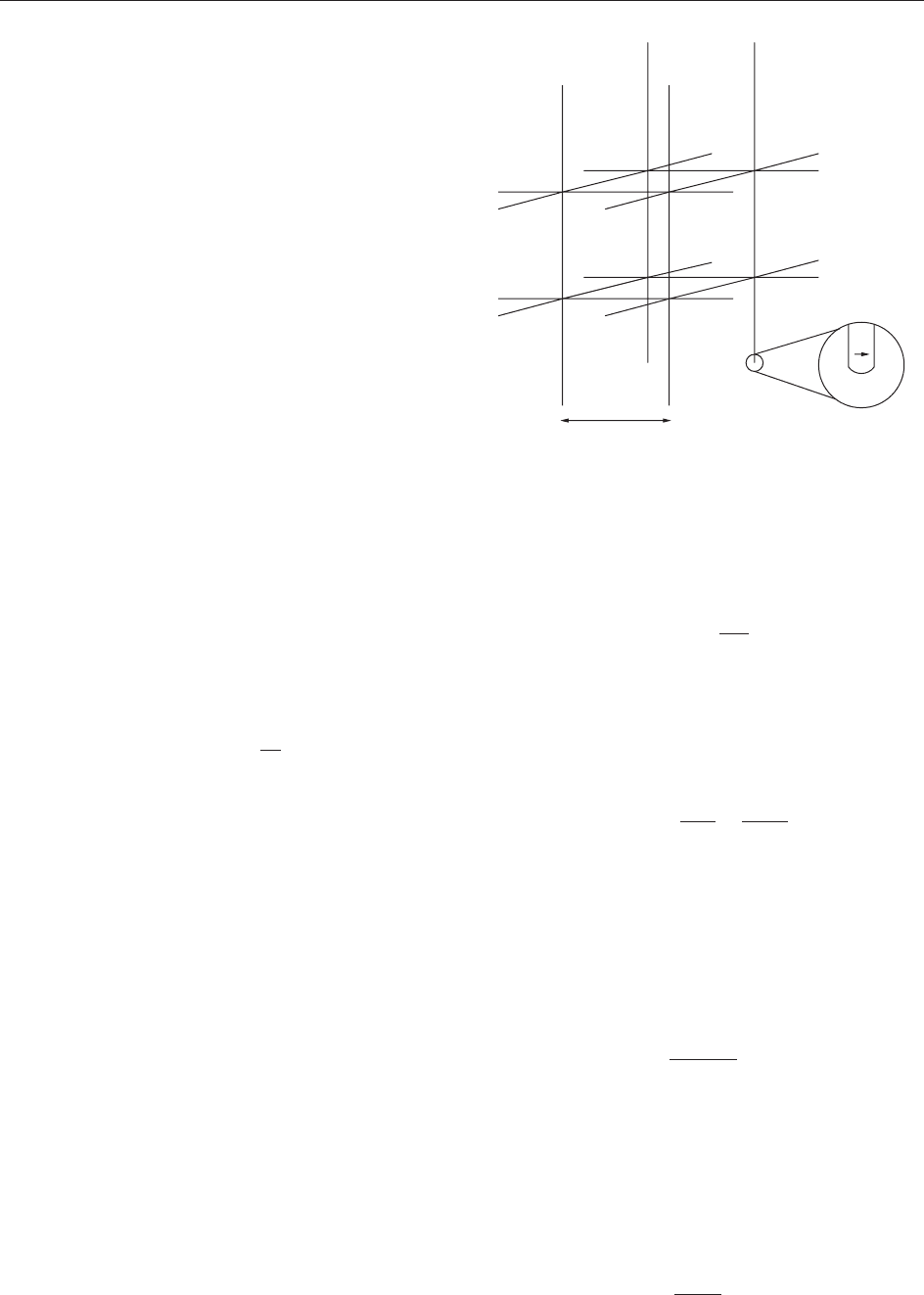
. A structure consisting of a three-dimensional
lattice of very thin wires simulates a low-density
plasma of very heavy charged particles and is shown
in Figure 1 ( Pendry et al. 1998). A simple model
allows us to describe the desired reduction in !
p
in
such a structure.
First consid er a displacement of the electrons in
the wires along one of the cubic axes. Only the wires
directed along that axis are active and thus provide a
lowered effective density of electrons,
eff
, given by
the area occupied by the active wires. Thus,
eff
¼
a
2
d
2
½8
An even more profound effect of constraining the
electrons to run along thin wires is a result of the
induced magnetic field which wraps the wires as
the electrons are in motion. Suppose a current I
flows in the wires. The magnetic field is
HðrÞ¼
I
2R
¼
a
2
ve
2R
½9
where R is the distance from the wire center, v is the
electron drift velocity, and e is the charge density in
the wire. In terms of the magnetic vector potential,
the magnetic field is
HðRÞ¼
1
0
AðRÞ½10
where
AðRÞ¼
0
a
2
ve
2
lnðd=aÞ½11
and d is the lattice spacing. The importance of the
divergence of the magnetic field with the wire radius
as seen in eqn [9] is the contribution to the canonical
electronic momentum given by eA. If we neglect the
variation of the fields with distance from the wire
center, we can view this contribution as defining a
new effective mass for the electr ons given by
m
eff
¼
0
e
2
2
lnðd=aÞ½12
d
a
Figure 1 A periodic structure composed of infinite conducting
wires arranged in a simple cubic lattice. Provided the factor a /d
is small enough, the structure responds to incident electromag-
netic waves as a plasma of very heavy charged particles.
484 Negative Refraction and Subdiffraction Imaging
Now the effective plasma frequency for the system
!
2
p
¼
eff
e
2
"
0
m
eff
¼
2c
2
0
d
2
lnðd=aÞ
½13
is seen to be much reduced. As a n example, the
plasma frequency of 1 mm aluminum wires paced
by 10 mm is about 2 GHz, and the corresponding
electronic effective mass is almost 15 times that of
a proton! The factors of effective mass and charge
density cancel leaving an expression comprising
only the macroscopic system parameters. This is to
be expected as a circuit analysis in terms of a
capacitance and inductance c an also be used to
formulate the problem. However, such an
approach can obscure the true nature of the
problem which is encapsulated as a low-frequency
plasma oscillation. Inclusion of the finite resistivity
of the metal yields a finite lifetime for the plasmon
excitation. Experiments have shown that a reduc-
tion in the plasma frequency of six orders of
magnitude from the ultraviolet t o the micro wave
regioncanbeachievedinthesethin-wirecompo-
sites (Pendry et al. 1998).
Artificial Magnetism
Although the Maxwell equations [2]–[4] are sym-
metric in the electric and magnetic fields, we are yet
to discover a free magnetic pole. The magnetism we
find in natural materials is limited to spin systems
and restricts the values of
eff
. Up to microwave
frequencies, magnetic activity is common and
certain insulating ferromagnets and antiferro-
magnetic compounds such as MgF
2
and FeF
2
can
even exhibit a negative permeability at some
frequencies. However, large losses can accompany
the magnetic activity in these materials.
Recently, it has become clear that a wide variety
of composite structures comprising resonant inclu-
sions can display magnetic activity in the effective
medium limit (Pendry et al. 1999). Efficient screen-
ing of A C magnetic fields can be achieved using a
thin cylindrical shell of metal or superconductor. In
order t o obtain a large magnetic response such that
the modulus of the magnetic susceptibility, j
m
j> 1,
what we require is a r esonant over-screening
material response. A collection of subwavelength-
sized structures that exhibits such an over-screening
response can constitute a negative
eff
material.
One such resonant subwavelength structure is the
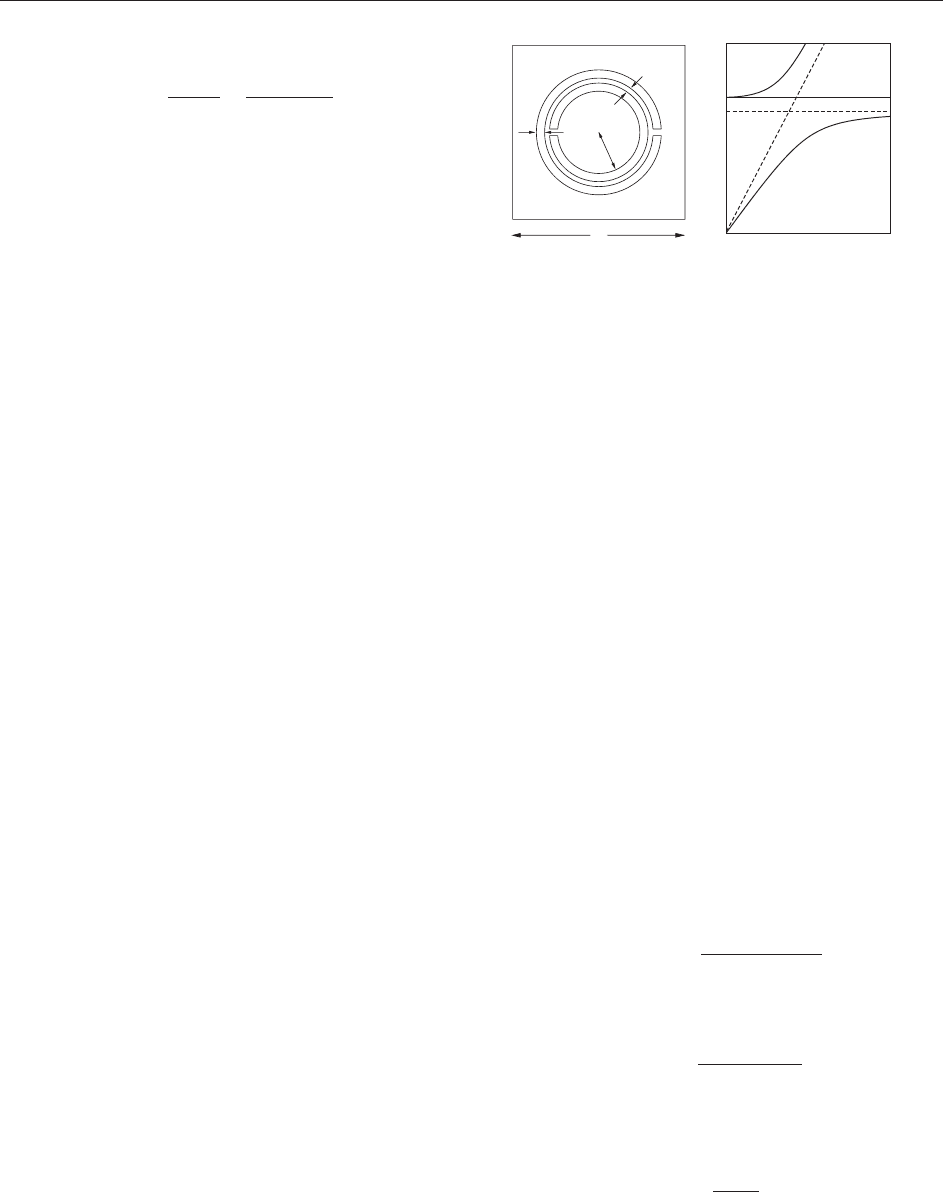
so-called split-ring resonator (SRR), which can be
scaled to form magnetic meta-materials from
microwave to optical frequencies (Pendry et al.
1999, O’Brien and Pendry 2002b). An SRR
structure which has been demonstrated experimen-
tally to have a resonant magnetic response at
microwave and THz frequencies is depicted in
Figure 2a (Smith et al .). It comprises of two planar
rings of metal on an insulating backing. The rings
couple inductively to the magnetic field normal to
the plane of the rings. Because of the large
capacitance between the rings, the structure r eso-
nates at some frequency. Driven by the back
electromotive force (emf), a large response is
expected in the vicinity of the resonance frequency
which is also antiphased in a small frequency range
above the resonant frequency. If the SRRs are much
smaller than the free-space wavelength, a collection
of such SRRs would behave as a negative
eff
material at these frequencies.
Theoretical calculations (Pendry et al. 1999)
assuming a nondispersive metal show that a periodic
lattice of such structures is characterized by a
magnetic permeability given by
~
eff
¼ 1
f !
2
!
2
!
2
0
þ i!
½14
where f = R
2
=d
2
is the filling factor,
!
0
¼
ffiffiffiffiffiffiffiffiffiffiffiffiffiffiffiffiffiffiffiffiffiffiffiffiffiffi
3lc
2
R
3
ln 2w=g
s
½15
is the resonant frequency, an d the damping of the
resonance is determined by the factor
¼
2l
0
R
½16
Here d is the lattice spacing, R is the inner radius of
the ring, w is the width of the rings, l is the distance
between adjacent planes of SRRs, and is the
conductance per unit length of the rings measured
along the circumference. Orientation of planar SRRs
g
Frequency
Wavevector
ω
mp
ω
0
d
(a)
R
w
(b)
Figure 2 (a) The split-ring resonator structure. The structure is
planar with an internal radius R. The metal rings are of width w
and are separated by a spacing g. (b) Generic dispersion
relationship, ! vs. k, for a resonant structure with an isotropic
effective permeability as in eqn [15].
Negative Refraction and Subdiffraction Imaging 485
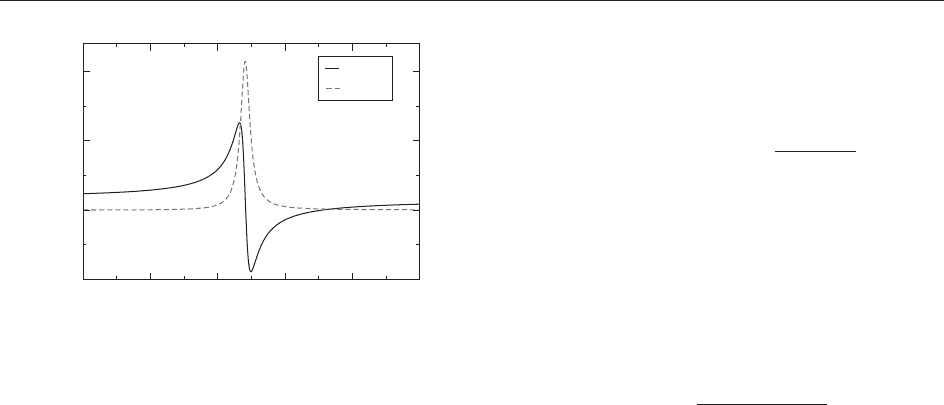
along all three Cartesian axes allows for the creation
of an isotropic material. Figure 3 shows the generic
dispersion of the (!) given by eqn [14]. A higher
resistivity for the material of the SRR would
broaden the resonance and the freque ncy region
with Re() < 0 might vanish altogether for large
resistivity.
For isotropic homogeneous materials with a
resonant effective permeability as in eqn [14] we
can illustrate a generic di spersion relationship, ! vs.
k, shown in Figure 2b. The solid lines represent
twofold degenerate transverse modes and the
dispersionless longitudinal magnetic plasmon
mode at the magnetic plasmon frequency (!
mp
).
The dashed lines are a band of propagating states
with a linear dispersion determined by the
polarizability of the SRRs and a flat band of
resonant states at the magnetic resonance fre-
quency !
0
. The gap in the dispersion can be
regarded as arising from the hybridization and
avoided crossing of these bands. The important
points to note are:
1. Wherever
eff
is negative there is a gap in the
dispersion relationship. This is the case for !
0
<
!<!
mp
, the frequency where
eff
= 0. Only
evanescent modes with imaginary wave vector
exist in this region.
2. A longitudinal magnetic plasma mode, which
shows no dispersion, appears at ! = !
mp
.
An alternative approach to obtaining a nonzero
magnetic susceptibility in composite media is pro-
vided by the zeroth-order transverse electric (TE)
Mie resonance in dielectric particles. Ferroelectric
and phonon polaritonic materials are promising
candidates for providing the necessary large dielec-
tric constants up to infrared frequencies (O’Brien
and Pendry 2002a).
The high-frequency scaling properties of the SRR
offer an interesting insight. The plasma-like dielec-
tric permittivity of noble metals
~
"ð!Þ¼ð"
1
;"
2
Þ¼"
1
!
2
p
!ð! þ iÞ
½17
is essentially a large negative real number for !
p
! . For a 2D array of simplified SRRs consisting
of a single conducting ring with symmetrically
placed small capacitive gaps, the quasistatic effective
magnetic permeability for a magnetic field applied
normal to the plane of the SRR is (O’Brien and
Pendry 2002b)
~
eff
¼ 1
f
0
!
2
!
2
!
0
2
þ i!
½18
where f
0
=L
g
f (L
g
þL
i
)
1
, =L
i
(L
g
þL
i
)
1
, and
!
0
2
=(L
g
þL
i
)
1
C
1
. In the above expressions,
L
g
=
0
R
2
is the geometrical inductance per unit
length of the structure and C="
0
~
"
s
=n
c
d
c
is the
capacitance per unit length of the structure for series
connection. Here it has been assumed that the
thickness of the SRR () is small compared to the
skin depth ’c
0
=!
p
.
An additional inductive impedance in the struc-
ture, the kinetic or inertial inductance, L
i
=
2R="
0
!
2
p
= 2
0
R
2
=, determines the effective
filling fraction and damping of the resonance through
the ratio of the two contributions to the total
inductance. This contribution to the inductance arises
from the finite electron mass and implies that simply
decreasing the size of the resonators indefinitely will
not result in our being able to realize a strong
magnetic response at near-infrared or optical fre-
quencies. As the dimensions of the structure are
reduced that fraction of the energy of the displace-
ment current associated with the inertial mass of the
electrons increases. A finite then means that
dissipative losses increase. Thus, strong damping of
the resonance will be avoided if the quantity R=2
2
is large. We note here that with equal to the
London penetration depth, this ratio also determines
the screening efficiency of low-frequency magnetic
fields by a thin layer of superconductor. This result
points to a broader similarity between the low-
frequency electromagnetic properties of the super-
conducting condensate and those of a perfect plasma.
Other nanocomposites in addition to the SRR
have been proposed which may lead to a magnetic
response at optical frequencies. These include pairs
of nanometer-sized metallic sticks where simulta-
neous electric and magnetic dipole resonances lead
to a strongly dispersive effective permittivity and
permeability.
47
Frequency (a.u.)
–5
0
5
10
μ
Re(μ)
Im(μ)
6589
Figure 3 (a) The generic magnetic response of the SRR
structure. Re() < 0 in a frequency band above the resonance
frequency.
486 Negative Refraction and Subdiffraction Imaging