
Francoise J.-P., Naber G.L., Tsun T.S. (editors) Encyclopedia of Mathematical Physics
Подождите немного. Документ загружается.

The Gauge Potential
The ‘‘Poincare´ lemma’’ tells us that dF = 0 implies
F = dA, with the 4-potential A:
A ¼ dt þ A ½61
and the vector potential A = A
x
dx þ A
y
dy þ A
z
dz.
From
F ¼E^dt þB¼ d þ dt ^
@
@t
A
¼ d ^dt þ dA þ dt ^
@A
@t
½62
it follows by comparing coefficie nts that
E¼d
@A
@t
; B¼dA ½63
In vector notation this is
E ¼ grad
@A
@t
; B ¼ curl A ½64
The 4-potential is determined up to a gauge function :
A
0
¼ A þ d ½65
This gauge freedom has no influence on the
observable quantities E and B:
F
0
¼ dA
0
¼ dA þ d
2
¼ dA ¼ F ½66
The Laplace operator is 4= (d
þ d)
2
= dd
þ
d
d, so when the 4-potential A fulfills the condition
d
A = 0, we have
4A ¼ d
dA ¼ d
F ¼j ½67
the ‘‘classical wave equation.’’ The condition
d
A = 0 is called the ‘‘Lorentz gauge condition.’’
This condition can always be fulfilled by using the
gauge free dom: d
(A þ d ) = 0 is fulfilled when
d
d=4= d
A, where we have used the fact
that d
=0 for functions. That is to say, d
A = 0is
fulfilled when is a solution of the inhomogeneous
wave equation.
Gauge Invariance
In quantum mechanics, the electron is described by a
wave function which is determined up to a free
phase. Indeed, at every point in space this phase can
be chosen arbitrarily:
ðxÞ!
0
ðxÞ¼expfiðxÞg ðxÞ
ðxÞ!
0
ðxÞ¼
ðxÞexpfiðxÞg
½68
with the only condition being that (x)isa
continuous function. The gauge transformation is
of the form g = exp {i(x)}, with g an element of the
abelian gauge group G = U(1). The free action is
S
0
¼
Z
L
0
d
4
x ½69
with
L
0
¼
i
@
m
½70
the ‘‘Lagrange density.’’ This action is not invariant
under gauge transformations:
L
0
!L
0
0
¼
i
@
m
ð@
Þ
½71
The undesired term can be compensated by the
introduction of a gauge potential ! in a covariant
derivative of ,
D ¼ðd þ !Þ ½72
which has the desired transformation property
D ! exp {i}D when besides the transformation
(x) ! exp {i(x)} (x) of the matter field the gauge
potential simultaneously transforms according to the
gauge transformation ! !! id. The new Lagrange
density is
L¼
i
D
m
¼L
0
þ i!
ðxÞ
ðxÞ½73
The substitution @
! D
is known to physicists;
with ! = iqA it is the ansatz of minimal coupling
for taking into account electromagnetic effects:
@
!@
iqA
. The Lagrange density becomes in
this notation L= L
0
A
J
, where J
= q
.
The Lagrange density must now be completed by
a kinetic term for the gauge potential and we get the
complete electromagnetic Lagrange density
L¼L
0
A
J
1
4
F
F
½74
with F
= @
A
@
A
. In the action this corre-
sponds to
S ¼ S
0
Z
M
A
J
vol
4
1
4
Z
M
F
F
vol
4
½75
We g et the field equations for the potential A by
demanding that the variation of the action vanishes:
S½A¼
Z
M
A
J
vol
4
1
4
Z
M
F
F
vol
4
½76
We write now
Z
M
A
J
vol
4
¼ðA; jÞ½77
Abelian and Nonabelian Gauge Theories Using Differential Forms 145
and
1
4
Z
M
F
F
vol
4
¼
1
2
Z
M
F ^F ¼
1
2
ð F; FÞ
¼ðdA; FÞ¼ðdA; FÞ¼ðA; d
FÞ½78
where we have exchanged the action of and d.
Since this holds for arbitrary variations A we find
d
F ¼j ½79
the inhomogeneous Maxwell equation.
Nonabelian Gauge Theories
In SU(N) gauge theory the elementary particles are
taken to be members of symmetry multiplets. For
example, in electroweak theory the left-handed
electron and the neutrino are members of an SU(2)
doublet:
¼
e
½80
A gauge transformation is
0
ðxÞ¼g
1
ðxÞ ðxÞ;
0
ðxÞ¼
ðxÞgðxÞ½81
with
gðxÞ¼exp fð xÞg ½82
where g(x) is an element of the Lie group SU(2) and
is an element of the Lie algebra su(2). The Lie
algebra is a vector space, and its elements may be
expanded in terms of a basis:
ðxÞ¼
a
ðxÞT
a
½83
For su(2) the basis elements are traceless and anti-
Hermitian (see below), they are conventionally
expressed in terms of the Pauli matrices,
T
a
¼
a
2i
½84
with
1
¼
01
10
;
2
¼
0 i
i0
3
¼
10
0 1
½85
They are conventionally normalized according to
trðT
a
T
b
Þ¼
1
2
ab
½86
The Dirac Lagrangian is not invariant with
respect to local gauge transformations:
L
0
¼
i
@
m
!L
0
0
¼L
0
þ i
g@
g
1
½87
We introduce the gauge potential
!
ðxÞ¼!
a
ðxÞT
a
½88
with a gauge transformation
!
!!
0
¼ g
1
!
g þ g
1
@
g ½89
The Lagrange density is modified through a covar-
iant derivative:
@
!D
¼ @
þ !
½90
The covariant derivative D
transforms according to
D
!D
0
¼ g
1
D
g ½91
and thus the modified Lagrange density
L¼
i
D
m
¼L
0
þ i
!
½92
is invariant with respect to local gauge transformations.
The extra term in the Langrange density is
conventionally written
J
a
A
a
½93
with
A
a
¼iq!
a
½94
and
J
a
¼
T
a
½95
In mathematical terminology ! is called a connec-
tion. The quantity A is the physicist’s gauge
potential. The connection is anti-Hermitian and the
gauge potential Hermitian . The gauge potential also
includes the coupling constant q. We will refer to
both ! and A as the gauge potential, where the
relation between them is given by eqn [94].
We can write the gauge potential as A = A
a
dx
T
a
or, in the SU(2) case, as
A
¼ A
1
T
1
þ A
2
T
2
þ A
3
T
3
½96
where we see explicitly that it involves three vector
fields, which couple to the electroweak currents [95]
with the single coupling constant q, and which will
become after symmetry breaking the three vector
bosons W
þ
, W
, Z
0
of the electroweak gauge theory.
Actually, a mix of the neutral gauge boson and the
photon will combine to yield the Z
0
boson, while the
orthogonal mixture gives rise to the electromagnetic
interaction, in an SU(2) U(1) theory. At this stage,
146 Abelian and Nonabelian Gauge Theories Using Differential Forms

the gauge bosons are all massless, their masses are
generated by the ‘‘Higgs’ mechanism.’’
Lie-Algebra-Valued p-Forms
To describe nonabelian fields, we need Lie-algebra-
valued p-forms:
¼ T
a
a
½97
where T
a
is a generator of the Lie algebra, the index
a runs over the number of generators of the Lie
algebra, and the
a
are the usual scalar-valued
p-forms. The composition in a Lie algebra is a Lie
bracket, which is defined for two Lie-algebra-valued
p-forms by
½; :¼½T
a
; T
b
a
^
b
½98
The Lie bracket in the algebra is
½T
a
; T
b
¼f
c
ab
T
c
½99
where f
a
bc
are the structure constants. It follows from
this that
½ ;¼½T
a
; T
b
a
^
b
¼½T
b
; T
a
a
^
b
½100
or
½ ;¼ð1Þ
pqþ1
½; ½101
when is a p-form and is a q-form. In the special
case that T
a
is a matrix, also the product T
a
T
b
is
defined, and from this the product of two Lie-
algebra-valued p-forms
^ ¼ T
a
a
^T
b
b
¼ T
a
T
b
a
^
b
½102
Now the Lie bracket is a commutator:
½T
a
; T
b
¼T
a
T
b
T
b
T
a
½103
and
½; ¼½T
a
; T
b
a
^
b
¼ T
a
a
^T
b
b
ð1Þ
pq
T
b
b
^T
a
a
¼ ^ ð1Þ
pq
^ ½104
From this relation it follows that for and odd
p-forms
½; ¼ ^ þ ^ ½105
For an odd p-form
½; ¼ ^ þ ^ ¼ 2ð ^Þ½106
The Gauge Potential and the
Field Strength
The generalization of the abelian relationship
between the gauge potential and the field strength,
F = dA,is
¼ d! þ
1
2
½!; !¼d þ ! ^! ½107
where because ! is a 1-form we can use eqn [106].
The mathematician refers to as the curvature. The
physicist writes, in analogy to eqn [94],
F ¼i q ¼
1
2
F
a
dx
^dx
T
a
½108
One obtains for the components
F
a
¼ @
A
a
@
A
a
iqf
a
bc
A
b
A
c
½109
A generalization of the gauge transformation of
A, that is, A
0
= A þ d,iseqn [89]:
!
0
¼ g
1
!g þ g
1
dg ½110
A quantity with the transformatio n property
0
¼ g
1
g ½111
is called a ‘‘tensorial’’ quantity. The gauge potential
! is according to this definition nontensorial.
Nevertheless the field stre ngth is tensorial. Indeed
0
¼ dðg
1
!gÞþðdg
1
Þ^dg
þ
1
2
½g
1
!g þ g
1
dg; g
1
!g þ g
1
dg
¼ðdg
1
Þ^!g þ g
1
d!g g
1
! ^dg þðdg
1
Þ^dg
þ
1
2
g
1
½!; !g þ
1
2
½g
1
!g; g
1
dg
þ
1
2
½g
1
dg; g
1
!gþ
1
2
½g
1
dg; g
1
dg
¼ g
1
g þðdg
1
Þ^!g g
1
! ^dg þðdg
1
Þ^dg
þ g
1
! ^dg þ g
1
dg ^g
1
!g þ g
1
dg ^g
1
dg
¼ g
1
g ½112
where we have used the derivation of the relation
g
1
g = Id to get
dg
1
¼g
1
dg g
1
½113
In the abelian case, we had dF = 0. The non-
abelian analog is
d ¼ d! ^! ! ^d!
¼ð ! ^!Þ^! ! ^ð ! ^!Þ
¼ ^! ! ^ ½114
or
d þ ! ^ ^! ¼ 0 ½115
Abelian and Nonabelian Gauge Theories Using Differential Forms 147
the Bianchi identity. It can also be writt en as
d þ ! ^ ^! ¼ d þ½!; ¼0 ½116
because from eqn [104]
! ^ þð1Þ
21
^! ¼½!; ½117
The covariant derivative D is defin ed as
D:¼ d þ½!; ½118
for a tensorial quantity. The covariant derivative
takes tensorial p-forms into tensorial (p þ 1)-forms:
D
0
0
¼ dðg
1
gÞþ½g
1
!g þ g
1
dg; g
1
g
¼ dg
1
^g þ g
1
dg þð1Þ
p
g
1
^dg
þ½g
1
!g; g
1
gþ½g
1
dg; g
1
g
¼ g
1
Dg þ dg
1
^g þð1Þ
p
g
1
^dg
þ g
1
dgg
1
^g ð1Þ
p
g
1
^dg
¼ g
1
Dg ½119
We have thereby verified the trans formation prop-
erty of eqn [91].
The Gauge Group
From the gauge transformation
0
= g the require-
ment j
0
j
2
= j j
2
leads to g
y
g = 1. That means that g
belongs to the unitary Lie group G = U(n), whose
elements fulfill g
y
=
g
T
= g
1
. For elements of the Lie
algebra G= u(n) this implies
e
X
y
¼ e
X
T
¼e
X
½120
or
X
y
¼
X
T
¼X ½121
where
X is complex conjugation an d X
T
means
transposition.
For elements of the Lie algebra we can define a
scalar product (the Killing metric)
hX; Yi :¼tr ðXYÞ¼X
X
½122
The scalar product is real:
h
X;
Yi¼
X
Y
¼X
X
¼hX; Yi½123
symmetric:
hX; Yi¼trðX; YÞ¼trðY; XÞ¼hY; Xi½124
and positive definite:
hX; Xi¼X
X
¼ X
X
¼jX
j
2
½125
The scalar product is invariant under the action of
G on G: for g 2 G
hgXg
1
; gYg
1
i¼tr ð gXYg
1
Þ
¼trðX; YÞ¼hX; Yi½126
or for X, Y, Z 2G
he
tX
Y e
tX
; e
tX
Ze
tX
i¼hY; Zi½127
We take the derivative of this equation with respect
to t at the value t = 0 and get:
h½X; Y; ZiþhY; ½X; Zi ¼ 0 ½128
We define an action of the algebra G on itself:
ad(X): G!G
adðXÞY ¼½X; Y½129
We can then formulate our conclusion as follows:
the action of G on itself is anti-Hermitian:
had ðXÞY; Z i¼ hY; adðXÞZi½130
or
½adðXÞ
y
¼adðXÞ½131
From g
y
g = 1 we have jdet (g)j
2
= 1. For the gauge
group G = SU(N) we require in addition det (g) = 1.
Since
detðgÞ¼detðexpðXÞÞ¼expðtrðXÞÞ ½132
the elements X 2 su(N) must be traceless. A basis of
the vector space of traceless, anti-Hermitian (2 2)
matrices is given by the Pauli matrices, eqn [85].
The Yang–Mills Action
The SU(2) Yang–Mills action is, in analogy to the
abelian case,
S ¼
1
4q
2
Z
M
F
a
F
a
vol
4
¼
1
2q
2
Z
M
trðF
F
Þvol
4
¼
1
2q
2
Z
M
trðF ^FÞ½133
We have included the trace in our definition of the
scalar product:
ð; Þ:¼
Z
M
tr <
I
I
> vol
n
¼
Z
M
trð^ Þ½134
We then write eqn [133] as
S½!¼
1
2
ð; Þ½135
taking into account the relation between and the
field strength F, and indicating the dependence on
148 Abelian and Nonabelian Gauge Theories Using Differential Forms
the gauge potential. Since is tensorial the action is
invariant.
Now we calculate the variation von S[!] with
respect to a variation of the gauge potential:
S½!¼
d
dt
S½!ðtÞj
t¼0
¼
1
2
ð ; Þ
¼
1
2
ðð; Þþð; ÞÞ
¼ð; Þ¼ d! þ
1
2
½!; !
;
¼ d! þ
1
2
½!; !þ
1
2
½!; !;
¼ d! þ½!; !;ðÞ ½136
wherewehaveexchangedtheorderof and d.We
remark that although ! is not a tensorial section, ! is:
for !
0
1
= g
1
!
1
g þ g
1
dg and !
0
2
= g
1
!
2
g þ g
1
dg is
! ¼ !
0
1
!
0
2
¼ g
1
ð!
1
!
2
Þg ½137
The quantity is in any case tensorial. Therefore,
the covariant derivative is defined, and we have
D! ¼ d! þ½!; !½138
and
D ¼ d þ½!; ½139
In general, the action of the covariant derivative on
tensorial quantities can be written as D = d þ ad(!),
where ad(X) is the representation of the Lie algebra on
itself introduced in the previous section. We now have
S½!¼ðD!; Þ¼ð!; D
Þ¼0 ½140
for an arbitrary variation !. Therefore, D
= 0.
We have obtained
D
¼ 0 ½141
the ‘‘Yang–Mills equations,’’ and
D ¼ 0 ½142
the ‘‘Bianchi identites.’’ These are the generalizations
of the Maxwell equations d
F = 0 and dF = 0 in the
absence of external sources. For the general case of
interacting fermions, we write out the full action, in
analogy to eqn [74], and obtain, in analogy to eqns
[79] and [58],
D
¼J; D
J ¼ 0 ½143
We shall now derive, again for the pure gauge
sector, coordinate expressions for the Yang–Mills
equations. Consider the expression
S½!¼ðD!; Þ¼ð!; D
Þ
¼ðd! þ½!; !;Þ½144
The first term in the last expression is
ðd!; Þ¼ð!; d
Þ¼tr
Z
M
!
fd
g
vol
4
½145
The second term can be computed using
½!; !
¼f! ^! þ ! ^!gð@
;@
Þ
¼ !
!
!
!
þ !
!
!
!
½146
and hence
½!; !
¼ 2½!
;!
½147
because is antisymmetric,
=
. Thus,
ð½!; !;Þ¼
Z
M
trð½!; !^Þ
¼
1
2
Z
M
trð½!; !
Þvol
4
¼
Z
M
trð½!
;!
Þvol
4
¼
Z
M
h½!
;!
;
ivol
4
½148
where h, i is the scalar product in G. From eqn [128]
this equals
Z
M
h!
; ½!
;
ivol
4
¼
Z
M
trð!
½!
;
Þvol
4
½149
Combining this with eqn [144] gives
ð!; D
Þ¼
Z
M
trð!
fðd
Þ
½!
;
gÞvol
4
¼ð!; fðd
Þ
½!
;
gÞ ½150
We can now insert the coordinate ex pression for
ðdÞ
¼@
½151
Finally, the coordinate expressions of the Yang–
Mills equations D
= 0 are
ðD
Þ
¼f@
þ½!
;
g ¼ 0 ½152
The Analogy with Electromagnetism
The Yang–Mills equation and the Bianchi identity in
the absence of external source s are
@
F
iq½ A
; F
¼0 ½153
and
@
F
þ @
F
þ @
F
iqf½A
; F
þ½A
; F
þ½A
; F
g ¼ 0 ½154
Abelian and Nonabelian Gauge Theories Using Differential Forms 149
We shall write these equations in terms of the fields
F
i0
¼ E
i
; i ¼ 1; 2; 3 ½155
F
12
¼ B
3
; F
31
¼ B
2
; F
12
¼ B
3
½156
where the E and B vectors may be thought of as
‘‘electric’’ and ‘‘magnetic’’ fields, even though they have
Lie-algebra indices, F
i0
= (F
a
)
i0
T
a
, etc. In the context of
the SU(3) theory, they are referred to as the ‘‘chromo-
electric’ ’ and ‘‘chromomagnetic’’ fields, respectively.
The Yang–Mills equations with = 0 are
@
i
F
i0
iq½ A
i
; F
i0
¼0 ½157
with i = 1, 2, 3 a spatial index. In vector notation
this is
div E ¼ iqðA E E AÞ½158
This is the analog of Gauss’s equation. Even though
we started out without external sources, iq(A E
E A) plays the role of a ‘‘charge density.’’ The
Yang–Mills field E and the potential A combine to
act as a source for the Yang–Mills field. This is an
essential feature of nonabelian gauge theories in
which they differ from the abelian case, due to the
fact that the commutator [A, E] is nonvanishing.
Now consider the Yang–Mills equations with a
spatial index = i:
@
0
F
i0
þ @
j
F
ij
iq½ A
0
; F
i0
iq½A
j
F
ij
¼0 ½159
In vector notation this is
curl B ¼
@E
@t
iqðA
0
E EA
0
Þ
þ iqðA B þ B AÞ½160
replacing the Ampere–Maxwell law. Note that there
are two extra contributions to the ‘‘current’’ other
than the displacement curre nt.
The analogs of the laws of Faraday and of the
absence of magnetic monopoles are derived similarly
from the Bianchi identities. The results are
curl E þ
@B
@t
¼ iqfðA E þ E AÞþðA
0
B B A
0
Þg ½161
and
div B ¼ iqðA B B AÞ½162
Further Remarks
The foundations of the mathematics of differential
forms were laid down by Poincare´ (1953). They
were applied to the description of electrodynamics
already by Cartan (1923). A modern presentation of
differential forms and the manifolds on which they
are defined is given in Abraham et al. (1983).A
recent treatment of electrodynamics in this approach
is Hehl and Obukhov (2003). Weyl’s argument is in
his paper of 1929.
Nonabelian gauge theories today explain the
electromagnetic, the strong and weak nuclear
interactions. The original paper is that of Yang
and Mills (1954). Glashow, Salam,andWeinberg
(1980) saw the way t o apply it to the weak
interactions by using spontaneous symmetry
breaking to generate the masses through the use
of the Higgs’ (1964) mechanism. t’Hooft and
Veltman (1972) showed that the resulting quan-
tum field theory was renormali zable. The strong
interactions were recognized as the nonabelian
gauge theory with gauge group SU(3) by Gell-
Mann (1972). For a modern treatment which puts
nonabelian gauge theories in the context of
differential geometry, see Frankel (1987).
See also: Dirac Fields in Gravitation and Nonabelian
Gauge Theory; Electroweak Theory; Measure on Loop
Spaces; Nonperturbative and Topological Aspects of
Gauge Theory; Quantum Electrodynamics and its
Precision Tests.
Further Reading
Abraham A, Marsden J, and Ratiu T (1983) Manifolds, Tensor
Analysis, and Applications. MA: Addison-Wesley.
Cartan E
´
(1923) On manifolds with an Affine Connection and the
Theory of General Relativity. English translation of the French
original 1923/1924 (Bibliopolis, Napoli 1986).
Frankel T (1987) The Geometry of Physics, An Introduction.
Cambridge University Press.
Gell-Mann M (1972) Quarks: developments in the quark theory
of hadrons. Acta Physica Austriaca Suppl. IV: 733.
Glashow SL (1980) Towards a unified theory: threads in a
tapestry. Reviews of Modern Physics 52: 539.
Hehl FW and Obukhov YN (2003) Foundations of Classical
Electrodynamics. Boston: Birkha¨ user.
Higgs PW (1964) Broken symmetries and the masses of gauge
bosons. Physical Review Letters 13: 508.
t’Hooft G and Veltman M (1972) Regularization and renorma-
lization of gauge fields. Nuclear Physics B 44: 189.
Poincare´ H (1953) Oeuvre. Paris: Gauthier-Villars.
Salam A (1980) Gauge unification of fundamental forces. Reviews
of Modern Physics 52: 525.
Weinberg SM (1980) Conceptual foundations of the unified
theory of weak and electromagnetic interactions. Reviews of
Modern Physics 52: 515.
Weyl H (1929) Elektron und gravitation. Zeitschrift fuer Physik
56: 330.
Yang CN and Mills RL (1954) Construction of isotopic spin and
isotopic gauge invariance. Physical Review 96: 191.
150 Abelian and Nonabelian Gauge Theories Using Differential Forms
Abelian Higgs Vortices
J M Speight, University of Leeds, Leeds, UK
ª 2006 Elsevier Ltd. All rights reserved.
Introduction
For the purpose of this article, vortices are topological
solitons arising in field theories in (2 þ 1)-dimensional
spacetime when a complex-valued field is allowed to
acquire winding at infinity, meaning that the phase of
(t, x), as x traverses a large circle in the spatial plane,
changes by 2n, where n is a nonzero integer. Such
winding cannot be removed by any continuous
deformation of (hence ‘‘topological’’) and traps a
considerable amount of energy which tends to coalesce
into smooth, stable lumps with highly particle-like
characteristics (hence ‘‘solitons’’). Clearly, the universe
is (3 þ 1) dimensional. Nonetheless, planar field
theories are of physical interest for two main reasons.
First, the theory may arise by dimensional reduction of
a(3þ 1)-dimensional model under the assumption of
translation invariance in one direction. Vortices are
then transverse slices through straight tube-like objects
variously interpreted as magnetic flux tubes in a
superconductor or cosmic strings. Second, a crucial
ingredient of the standard model of particle physics is
spontaneous breaking of gauge symmetry by a Higgs
field. As well as endowing the fundamental gauge
bosons and chiral fermions with mass, this mechanism
can potentially generate various types of topological
solitons (monopoles, strings, and domain walls) whose
structure and interactions one would like to under-
stand. Vortices in (2 þ 1) dimensions are interesting in
this regard because they arise in the simplest field
theory exhibiting the Higgs mechanism, the abelian
Higgs model (AHM). They are thus a useful theoret-
ical laboratory in which to test ideas which may
ultimately find application in more realistic theories.
This article describes the properties of abelian Higgs
vortices and explains how, using a mixture of
numerical and analytical techniques, a good under-
standing of their dynamical interactions has been
obtained.
The Abelian Higgs Model
Throughout this article spacetime will be R
2þ1
endowed with the Minkowski metric with signature
( þ , , ), and Cartesian coordinates x
, =
0, 1, 2, with x
0
= t (the speed of light c = 1). A
spacetime point will be denoted x, its spatial part by
x = (x
1
, x
2
). Latin indices j, k, ... range over 1, 2, and
repeated indi ces (Latin or Greek) are summed over.
We sometimes use polar coordinates in the spatial
plane, x = r( cos , sin ), and sometimes a complex
coordinate z = x
1
þ ix
2
= re
i
. Occasionally, it is
convenient to think of R
2þ1
as a subspace of R
3þ1
and denote by k the unit vector in the (fictitious)
third spatial direction. The complex scalar Higgs
field is denoted , and the ele ctromagnetic gauge
potential A
, best thought of as the components of a
1-form A = A
dx
. F
= @
A
@
A
is the field
strength tensor which, in R
2þ1
, has only three
independent components, identified with the mag-
netic field B = F
12
and electric field (E
1
, E
2
) =
(F
01
, F
02
). The gauge-covariant derivative is D
=
@
ieA
, e being the electric charge of the Hi ggs.
Under a U(1) gauge transformation,
7!e
i
; A
7!A
þ e
1
@
½1
: R
2þ1
! R being any smooth function, F
and
jj remain invariant, while D
7!e
i
D
. Only
gauge-invariant quantities are physically observable
(classically).
With these conventions, the AHM has Lagrangian
density
L¼
1
4
F
F
þ
2
D
D
8
ð
2
jj
2
Þ
2
½2
which is manifestly gauge invariant. By rescaling
, A
, x and the unit of action, we can (and
henceforth will) assume that e = = = 1. The
only parameter which cannot be scaled away is >0.
Its value greatly influences the model’s behavior.
The field equations, obtained by demanding that
(x), A
(x) be a local extremal of the action
S =
R
Ld
3
x, are
D
D
þ
2
ð1 jj
2
Þ ¼ 0
@
F
þ
i
2
ð
D
D
Þ¼0
½3
This is a coupled set of nonlinear second-order PDEs.
Of particular interest are solutions which have finite
total energy. Energy is not a Lorentz-invariant
quantity. To define it we must choose an inertial
frame and, having broken Lorentz invariance, it is
convenient to work in a temporal gauge, for which
A
0
0 (which may be obtained by a gauge transfor-
mation with (t, x) =
R
t
0
A
0
(t
0
, x)dt
0
, after which only
time-independent gauge transformations are per-
mitted). The potential energy of a field is then
E ¼
1
2
Z
B
2
þ D
i
D
i
þ
4
ð1 jj
2
Þ
2
dx
1
dx
2
¼ E
mag
þ E
grad
þ E
self
½4
Abelian Higgs Vortices 151
while its kinetic energy is
E
kin
¼
1
2
Z
j@
0
Aj
2
þ @
0
@
0
dx
1
dx
2
½5
If , A satisfy the field equations then the total
energy E
tot
= E
kin
þ E is independent of t.By
Derrick’s theorem, static solutions have E
mag
E
self
(Manton and Sutcliffe 2004, pp. 82–87).
Configurations with finite energy have quantized
total magnetic flux. To see this, note that E finite
implies jj!1asr !1,so e
i(r, )
at large r for
some real (in general, multivalued) function . The
winding number of is its winding around a circle of
large radius R, that is, the integer n = ((R,2)
(R, 0)) =2. Although the phase of is clearly gauge
dependent, n is not, because to change this, a gauge
transformation e
i
: R
2
! U(1) would itself need
nonzero winding around the circle, contradicting
smoothness of e
i
. The model is invariant under
spatial reflexions, under which n 7!n, so we will
assume (unless noted otherwise) that n 0. Finite-
ness of E also implies that D = d iA ! 0, so
A id= d as r !1(note 6¼ 0 for large r).
Hence, the total magnetic flux is
Z
R
2
B d
2
x ¼ lim
R!1
I
S
R
A ¼ lim
R!1
Z
2
0
@
d ¼ 2n ½6
where S
R
= {x : jxj= R} and we have used Stokes’s
theorem. The above argument uses only generic
properties of E, namely that finite E
self
requires jj
to assume a nonzero consta nt value as r !1.So
flux quantization is a robust feature of this type of
model. As presented, the argument is somewhat
formal, but it can be made mathematically rigorous
at the cost of gauge-fixing technicalities (Manton
and Sutcliffe 2004, pp. 164–166). Note that if n 6¼ 0
then, by continuity, (x) must vanish at some x 2
R
2
, and one expects a lump of energy density to be
associated with each such x since = 0 maximizes
the integrand of E
self
.
Radially Symmetric Vortices
The model supports static solutions within the
radially symmetric ansatz = (r)e
in
, A = a(r)d,
which reduces the field equations to a coupled pair
of nonlinear ODEs:
d
2
dr
2
þ
1
r
d
dr
1
r
2
ðn aÞ
2
þ
2
ð1
2
Þ ¼ 0
d
2
a
dr
2
1
r
da
dr
þðn aÞ
2
¼ 0
½7
Finite energy requires lim
r!1
(r) = 1, lim
r!1
a(r) = n
while smoothness requires (r) const
1
r
n
, a(r)
const
2
r
2
as r ! 0. It is known that solutions to this
system, which we shall call n-vortices, exist for all
n, , though no explicit formulas for them are
known. They may be found numerically, and are
depicted in Figure 1. Note that and a always rise
monotonically to their vacuum values, and B always
falls monotonically to 0, as r increases. These
solutions have their magnetic flux concentrated in a
single, symmetric lump, a flux tube in the R
3þ1
picture. In contrast, the total energy density (inte-
grand of E in [4]) is nonmonotonic for n 2, being
peaked on a ring whose radius grows with n. This is
a common feature of planar solitons.
The large r asymptotics of n-vortices are well
understood. For 4 one may linearize [7] about
= 1, a = n, yielding
ðrÞ1 þ
q
n
2
K
0
ð
ffiffiffi
p
rÞ½8
aðrÞn þ
m
n
2
rK
1
ðrÞ½9
where q
n
, m
n
are unknown constants and K
denotes the modified Bessel’s function. For >4
linearization is no longer well justified, and the
asymptotic behaviour of (though not a) is quite
different (Manton and Sutcliffe 2004, pp. 174–175).
We shall not consider this rather extreme regime
further. Note that
K
ðrÞ
ffiffiffiffiffi
2r
r
e
r
as r !1 ½10
for all , so both and a approach their vacuum
values exponentially fast, but with different decay
lengths: 1=
ffiffiffi
p
for , 1 for a. This can be seen in
Figure 1a. The constants q
n
and m
n
depend on and
must be inferred by comparing the numerical
solutions with [8], [9]; q = q
1
and m = m
1
will
receive a physical interpretation shortly.
The 1-vortex (henceforth just ‘‘vortex’’) is stable for
all ,butn-vortices with n 2 are unstable to break
up into n separate vortices if >1. We shall say that
the AHM is type I if <1, type II if >1, and
critically coupled if = 1, based on this distinction. Let
E
n
denote the energy of an n-vortex. Figure 2 shows
the energy per vortex E
n
=n plotted against n for
= 0.5, 1, and 2. It decreases with n for = 0.5,
indicating that it is energetically favorable for isolated
vortices to coalesce into higher winding lumps. For
= 2, by contrast, E
n
=n increases with n indicating
that it is energetically favorable for n-vortices to fission
into their constituent vortex parts. The case = 1
balances between these behaviors: E
n
=n is independent
of n. In fact, the energy of a collection of vortices is
independent of their positions in this case.
152 Abelian Higgs Vortices
Interaction Energy
A precise understanding of the type I/II dichotomy
can be obtained using the 2-vortex interaction
energy E
int
(s) introduced by Jacobs and Rebbi. This
is defined to be the minimum of E over all n = 2
configurations for which (x) = 0 at some pair of
points x
1
, x
2
distance s apart. One interprets x
1
, x
2
as the vortex positions. E
int
can only depend on their
separation s = jx
1
x
2
j, by translation and rotation
invariance. Figure 3 presents graphs of E
int
(s)
generated by a lattice minimization algorithm. For
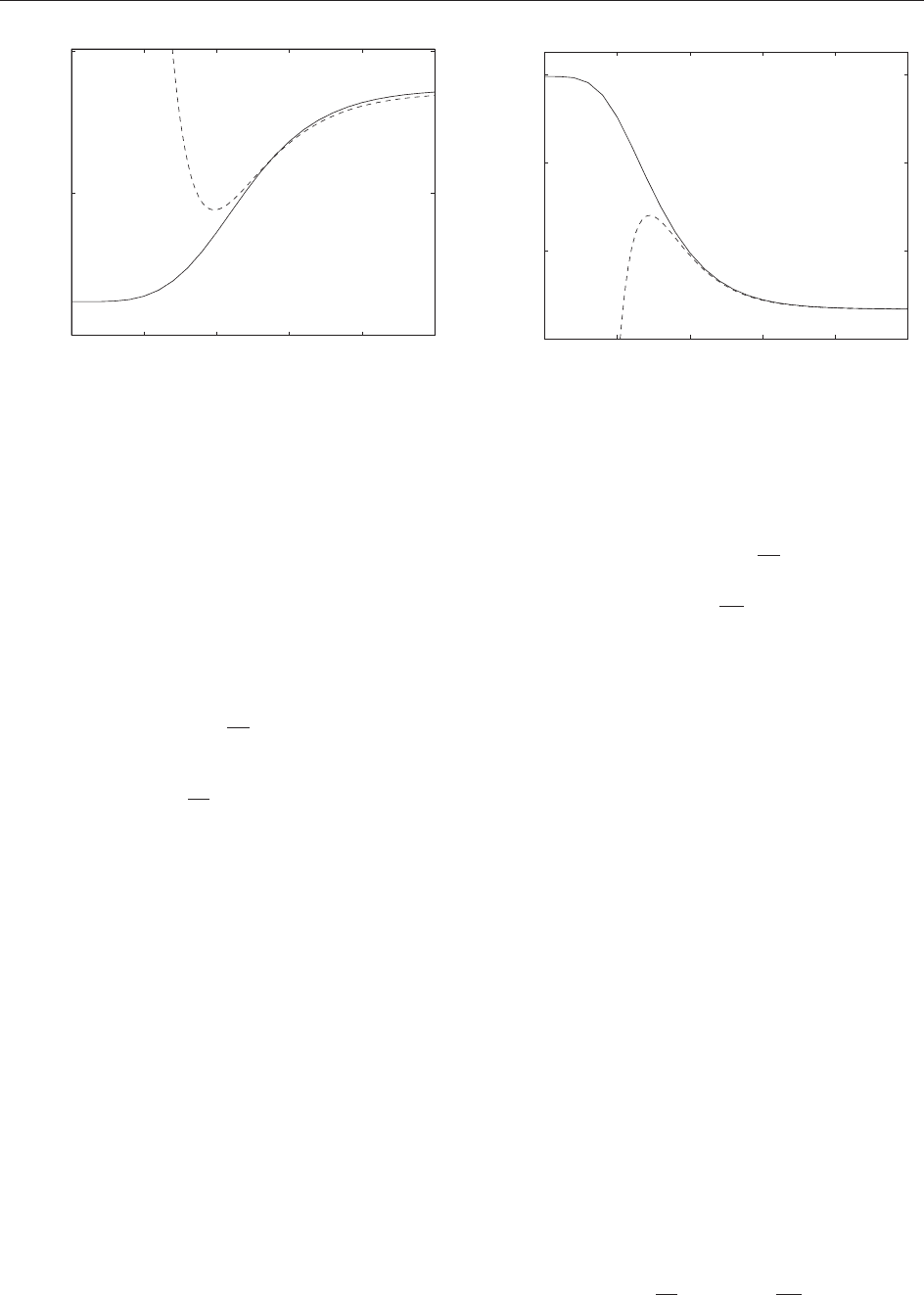
<1, vortices uniformly attract one another, so a
vortex pair has least energy when coincident. For
>1, vortices uniformly repel, always lowering
their energy by moving further apart. The graph for
= 1 would be a horizontal line, E
int
(s) = 2.
1
2 3 4
0.7
0.8
0.9
1
1.1
1.2
1.3
1.4
n
E
n
/nπ
λ
= 2
λ
= 1
λ
=
1
2
Figure 2 The energy per unit winding E
n
=n of radially
symmetric n-vortices for = 1=2, 1, and 2.
02468
0
0.2
0.4
0.6
0.8
1
r
σ, a
(a)
0 2 4 6 8
0
0.1
0.2
0.3
0.4
0.5
0.6
Energy density
r
n
= 1
n = 5
(c)
0 2 4 6 8
0
0.1
0.2
0.3
0.4
0.5
r
B
n = 1
n = 5
(b)
Figure 1 Static, radially symmetric n-vortices: (a) the 1-vortex profile functions (r ) (solid curve) and a(r ) (dashed curve) for = 2, 1,
and 1/2, left to right; (b) the magnetic field B; and (c) the energy density of n-vortices, n = 1 to 5, left to right, for = 1.
Abelian Higgs Vortices 153
The large s behavior of E
int
(s) is known, and can
be understood in two ways ( Manton and Sutcliffe
2004, pp. 177–181). Speight, adapting ideas of
Manton on asymptotic monopole interactions,
observed that, in the real gauge ( 7!e
i
,
A 7!A d), the difference between the vortex and
the vacuum = 1, A = 0 at large r,
¼ 1
q
2
K
0
ð
ffiffiffi
p
rÞ½11
ðA
0
; AÞ
m
2
ð0; k rK
0
ðrÞÞ ½12
is identical to the solution of a linear Klein–
Gordon–Proca theory,
ð@
@
þ Þ ¼ ; ð@
@
þ 1ÞA
¼ j
½13
in the presence of a composite point source,
¼ qðxÞ; ðj
0
; jÞ¼mð0; k rð xÞÞ ½14
located at the vortex position. Viewed from afar,
therefore, a vortex looks like a point particle
carrying both a scalar monopole charge q and a
magnetic dipo le moment m, a ‘‘point vortex,’’
inducing a real scalar field of mass
ffiffiffi
p
(the Higgs
particle) and a vector boson field of mass 1 (the
‘‘photon’’). If physics is to be model independent,
therefore, the interaction energy of a pair of well-
separated vortices should approach that of the
corresponding pair of point vortices as the separa-
tion grows. Computing the latter is an easy exercise
in classical linear field theory, yielding
E
int
ðsÞE
1
int
ðsÞ¼2E
1
q
2
2
K
0
ð
ffiffiffi
p
sÞ
þ
m
2
2
K
0
ðsÞ½15
Bettencourt and Rivers obtained the same formula
by a more direct superposition ansatz approach,
though they did not give the constants q, m a
physical interpretation.
The force between a well-separated vortex pair,
E
int
0
(s), consists of the mutual attraction of
identical scalar monopoles, of range 1=
ffiffiffi
p
, and the
mutual repulsion of identical magnetic dipoles, of
range 1. If <1, scalar attraction dominates at
large s so vortices attract. If >1, magnetic
repulsion dominates and they repel. If = 1 then
q m, as we shall see, so the forces cancel exactly.
Figure 3 shows both E
int
and E
1
int
for = 0.5, 2. The
agreement is good for s large, but breaks down for
s < 4, as one expects. Vortices are not point
particles, as in the linear model, and when they lie
close together the overlap of their cores produces
significant effects.
The same method predicts the interaction energy
between an n
1
-vortex and an n
2
-vortex at large
separation. We just replace 2E
1
by E
n
1
þ E
n
2
, q
2
by
q
n
1
q
n
2
,andm
2
by m
n
1
m
n
2
. In particular, an
antivortex ((1)-vortex) has E
1
= E
1
, q
1
= q
1
= q,
and m
1
= m
1
= m, so the interaction energy for
a vortex–antivortex pair is
E
v
v
int
ðsÞ2E
1
q
2
2
K
0
ð
ffiffiffi
p
rÞ
m
2
2
K
0
ðrÞ½16
0 2 4 6 8 10
1.65
1.7
1.75
s
E
int
(a)
0 2 4 6 8 10
2.3
2.34
2.38
2.42
s
E
int
(b)
Figure 3 The 2-vortex interaction energy E
int
(s) as a function of vortex separation (solid curve), in comparison with its asymptotic
form E
1
int
(s) (dashed curve) for (a) = 1=2 and (b) = 2.
154 Abelian Higgs Vortices