
Francoise J.-P., Naber G.L., Tsun T.S. (editors) Encyclopedia of Mathematical Physics
Подождите немного. Документ загружается.

which is uniformly attractive. It would be pleasing if
q
n
, m
n
could be deduced easily from q, m. One
might guess q
n
= jnjq, m
n
= nm, in analogy with
monopoles. Unfortunately, this is false: q
n
, m
n
grow approximately exponentially with jnj.
Vortex Scattering
The AHM being Lorentz invariant, one can obtain
time-dependent solutions wherein a single n-vortex
travels at constant velocity, with speed 0 < v < 1
and E
tot
= (1 v
2
)
1=2
E
n
, by Lorentz boosting the
static solutions described above. Of more dynamical
interest are solutions in which two or more vortices
undergo relative motion. The simplest problem is
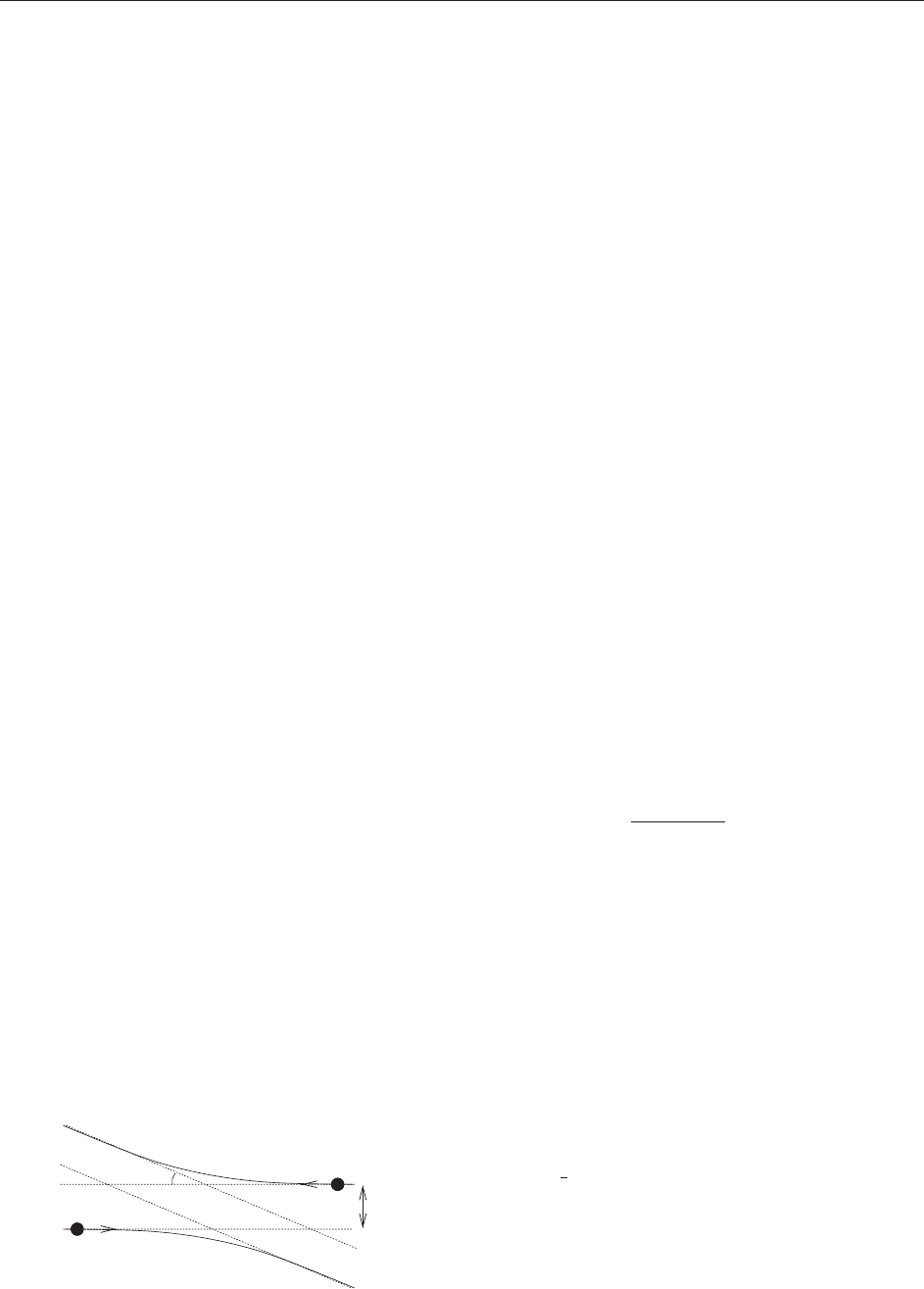
vortex scattering. Two vortices, initially well sepa-
rated, are propelled towards one another. In the
center-of-mass (COM) frame they have, as t !1,
equal speed v, and approach one another along
parallel lines distance b (the impact param eter)
apart, see Figure 4.Ifb = 0, they approach head-
on. Assuming they do not capture one another, they
interact and, as t !1, recede along parallel straight
lines having been deflected through an angle (the
scattering angle). If scattering is elastic, the exit lines
also lie b apart and each vortex travels at speed v as
t !1. The dependence of on v, b, and has
been studied through lattice simulations by several
authors, perhaps most comprehensively by Myers,
Rebbi, and Strilka (1992). We shall now describe
their results.
Note first that vortex scattering is actually
inelastic: vortices recede with speed < v because
some of their initial kinetic energy is dispersed by
the collision as small-amplitud e traveling waves
(‘‘radiation’’). This energy loss can be as high as
80% in very fast collisions at small b. At small v the
energy loss is tiny, but can still have important
consequences for type I vortices: if v is very small,
they start with only just enough energy to escape
their mutual attraction. In undergoing a small b
collision they can lose enough of this energy to
become trapped in an oscillating bound state. In this
case they do not truly scatter and is ill-defined.
Myers et al. find that v 0.2 suffices to avoid
capture when = 1=2. Since type I vortices attract,
one might expect to be always negative, indicating
that the vortices deflect towards one another. In
fact, as Figure 5a shows, this happens only for small
v and large b. Anot her naive expectation is that
=0or=180
when b = 0 (either vortices pass
through one another or ricochet backwards in a
head-on collision). In fact =90
, the only other
possibility allowed by reflexion symmetry of the
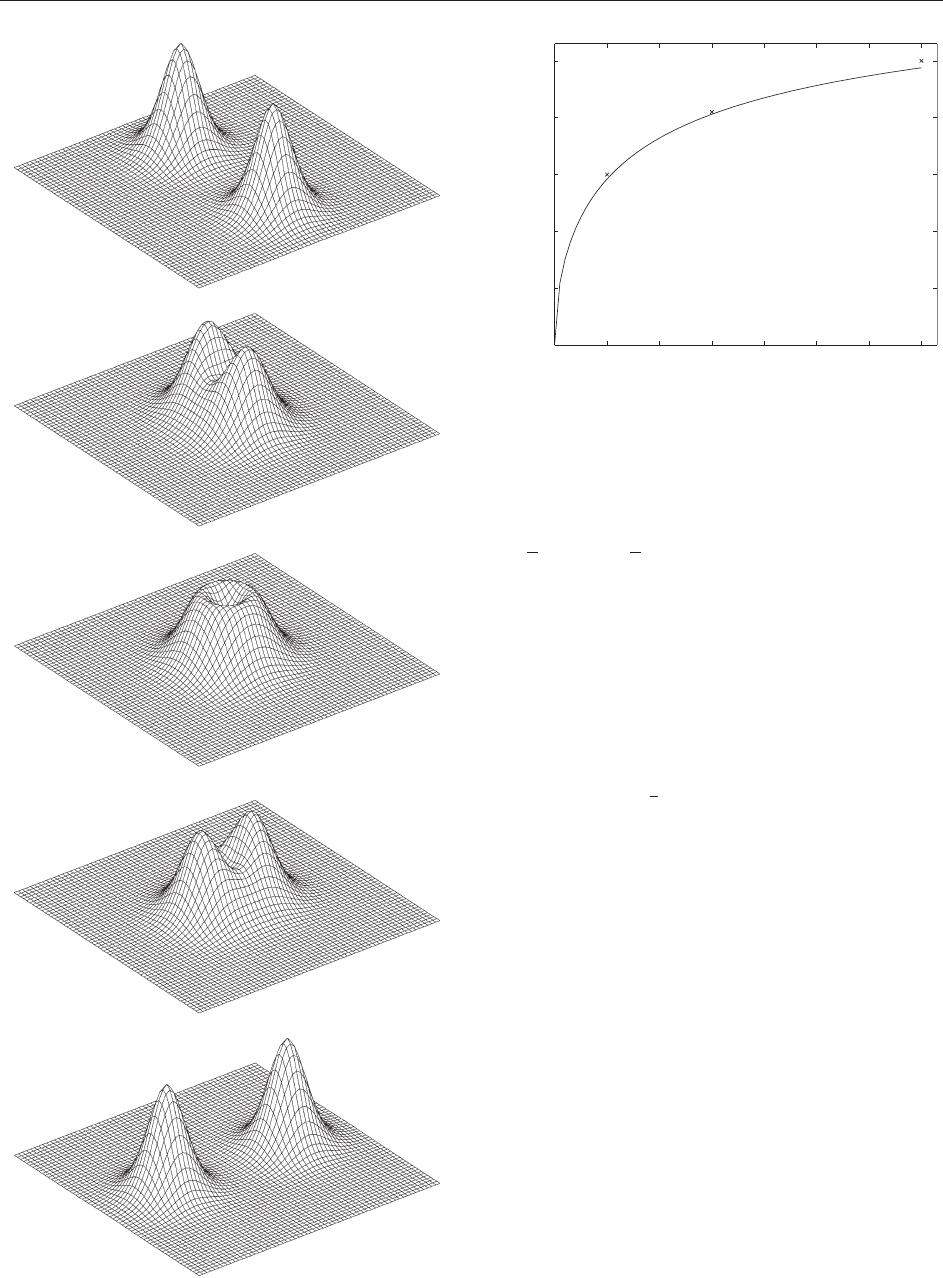
initial data. Figure 6 depicts snapshots of such a
scattering process at modest v. The vortices deform
each other as they get close until, at the moment of
coincidence, they are close to the static 2-vortex
ring. They then break apart along a line perpendi-
cular to their line of approach. One may consider
them to have exchanged half-vortices, so that each
emergent vortex is a mixture of the incoming
vortices. This rather surprising phenomenon was
actually predicted by Ruback in advance of any
numerical simulations and turns out to be a generic
feature of planar topological solitons.
Consider now the type II case ( = 2, Figure 5b).
Here, > 0 for all v, b as one expects of particles
that repel each other. Head-on scattering is more
interesting now since two regimes emerge: for v >
v
crit
0.3, one has the surprising 90
scattering
already described, while for v < v
crit
the vortices
bounce backwards, =180
. This is easily
explained. In order to undergo 90
head-on scatter-
ing, the vortices must become coincident (otherwise
reflexion symmetry is violated), hence must have
initial energy at least E
2
. For v < v
crit
, where
2E
1
ffiffiffiffiffiffiffiffiffiffiffiffiffiffiffiffiffiffiffi
1 v
crit
2
p
¼ E
2
½17
they have too little energy, so come to a halt before
coincidence, then recede from one another. The
solution v
crit
of [17] depends on and is plotted in
Figure 7. For v slightly above v
crit
, we see that, in
contrast to the type I case, (b) is not monotonic:
maximum deflection occurs at nonzero b.
The point vortex formalism yields a simple model
of type II vortex scattering which is remarkably
successful at small v. One writes down the Lagrangian
for two identical (nonrelativistic) point particles of
mass E
1
moving along trajectories x
1
(t), x
2
(t) under
the influence of the repulsive potential E
1
int
,
L ¼
1
2
E
1
ðj
_
x
1
j
2
þj
_
x
2
j
2
ÞE
1
int
ðjx
1
x
2
jÞ ½18
Energy and angular momentum conservation reduce
(v, b) to an integral over one variable (s = jx
1
x
2
j)
which is easily computed numerically. To illustrate,
Figure 5b shows the result for = 2, v = 0.1
in comparison with the lattice simulations of
b
ν
ν
Θ
Figure 4 The geometry of vortex scattering.
Abelian Higgs Vortices 155
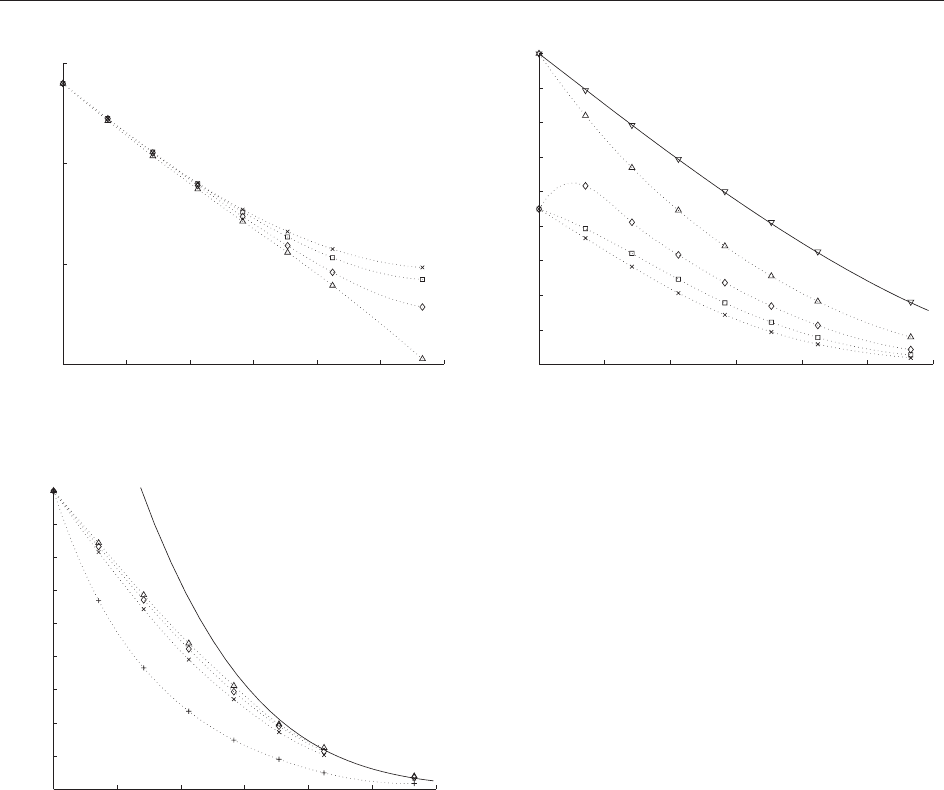
Myers et al. The agreement is almost perfect. For
large v the approximation breaks down not only
because relativistic corrections become significant,
but also because small b collisions then probe the small
jx
1
x
2
j region where vortex core overlap effects
become important. For the same reason, the point
vortex model is less useful for type I scattering.
Here there is no repulsion to keep the vortices well
separated, so its validity is restricted to the small v,
large b regime.
Critical coupling is theoretically the most inter-
esting regime, wher e most analytic progress has been
made. Since E
int
E
1
int
0, one might expect vortex
scattering to be trivial ((v, b) 0), but this is quite
wrong, as shown in Figure 5c. In particular,
(v,0)= 90
for all v, just as in the large v type I
and type II cases. The point is that scalar attraction
and magnetic repulsion of vortices are mediated by
fields with different Lorentz transformation proper-
ties. While they cancel for static vortices, there is no
reason to expect them to cancel for vortices in
relative motion.
Critical Coupling
The AHM with = 1 has many remarkable prop er-
ties, at which we have so far only hinted. These all
stem from Bogomol’nyi’s crucial observa tion
(Manton and Sutcliffe 2004, pp. 197–202) that the
potential energy in this case can be rewritten as
0 1 2 3 4 5 6
–50
0
50
100
b
(a)
0
1 2 3 4 5 6
0
10
20
30
40
50
60
70
80
90
b
(c)
0 1 2 3 4 5 6
0
20
40
60
80
100
120
140
160
180
b
Θ
Θ
Θ
(b)
Figure 5 The 2-vortex scattering angle as a function of impact parameter b for v = 0.1 (5), v = 0.2 (4),
v = 0.3 (}), v = 0.4 (&), v = 0.5 (), and v = 0.9 (þ), as computed by Myers et al. (1992): (a) = 1=2; (b) = 2; (c) = 1. The
dotted curves are merely guides to the eye. The solid curves in (b), (c) were computed using the point vortex model. Note that Myers
et al. use different normalizations, so b =
ffiffiffi
2
p
b
MRS
and =
MRS
=2.
156 Abelian Higgs Vortices
E ¼
1
2
Z
B
1
2
ð1 jj
2
Þ
2
(
þjD
1
þiD
2
j
2
þ B
d
2
x i
Z
R
2
dð
DÞ½19
The last integral vanishes by Stokes’s theorem, so
E n by flux quantization [6], and E = n if and
only if
ðD
1
þ iD
2
Þ ¼ 0 ½20
1
2
ð1 jj
2
Þ¼B ½21
Note that system [20], [21] is first order, in contrast
to the second-order field equations [3]. No explicit
solutions of [20], [21] are known. However, Taubes
has proved that for each unordered list
[z
1
, z
2
, ..., z
n
]ofn points in C, not necessarily
distinct, there exists a solution of [20], [21], unique
up to gauge transformations, with (z
1
) = (z
2
) =
= (z
n
) = 0 and nonvanishing elsewhere, the
zero at z
r
having the same multiplicity as z
r
has in
the list. Note that the list is unordered: a solution is
uniquely determined by the positions and multi-
plicities of the zeroes of , but the order in which we
label these is irrelevant. The solution minimizes E
within the class C
n
of winding n configurations, so is
automatically a stable static solution of the model.
Equation [20] applied to the symmetric n-vortex,
= (r)e
in
, A = a( r)d implies a(r) = n r
0
(r)=(r).
Comparing with [8], [9], it follows that q
n
= m
n
when = 1 as previously claimed, since K
1
= K
0
0
.
Tong has conjectured, based on a string duality
argument, that q
1
= 28
1=4
. This is consistent with
current numerics but has no direct derivation so far.
Figure 6 Snapshots of the energy density during a head-on
collision of vortices. This 90
scattering phenomenon is a
generic feature of planar topological soliton dynamics.
1 2 3 4 5 6 7 8
0
0.1
0.2
0.3
0.4
0.5
λ
υ
crit
Figure 7 The critical velocity for 90
head-on scattering of type
II vortices v
crit
as a function of , as predicted by equation [17]
(solid curve), in comparison with the results of Myers et al.
(1992), (crosses).
Abelian Higgs Vortices 157

Taubes’s theorem shows that this n-vortex is just
one point, correspon ding to the list [0, 0, ..., 0], in a
2n-dimensional space of static multivortex solutions
called the moduli space M
n
. This space may be
visualized as the flat, finite-dimensional valley
bottom in C
n
on which E attains its minimum
value, n. Points in M
n
are in one-to-one correspon-
dence with distinct unordered lists [z
1
, z
2
, ..., z
n
],
which are themselves in one-to-one correspondence
with points in C
n
, as follows. To each list, we assign
the unique monic polynomial whose roots are z
r
,
pðzÞ¼ðz z
1
Þðz z
2
Þðz z
n
Þ
¼ a
0
þ a
1
z þþa
n1
z
n1
þ z
n
½22
This polynomial is uniquely determined by its
coefficients (a
0
, a
1
, ..., a
n1
) 2 C
n
, which give good
global coordinates on M
n
ffi C
n
. The zeros z
r
of
may be used as local coordinates on M
n
, away from
, the subset of M
n
on which two or more of the
zeros z
r
coincide, but are not good global
coordinates.
Let ( , A)
a
denote the static solution correspond-
ing to a 2 C
n
. If the zeros z
r
are all at least s apart,
Taubes showed the solution is just a linear super-
position of 1-vortices located at z
r
, up to corrections
exponentially small in s. Imagine these constituent
vortices are pushed with small initial velocities.
Then ((t), A(t)) must remain close to the valley
bottom M
n
, since departing from it costs kinetic
energy, of which there is little. Manton has
suggested, therefore, that the dynamics is well
approximated by the constrained variational problem
wherein ((t), A(t)) = (, A)
a(t)
2M
n
for all t.Since
the action S =
R
Ld
3
x =
R
(E
kin
E)dt,andE = n,
constant, on M
n
, this constrained problem amounts
to Lagrangian mechanics on configuration space M
n
with Lagrangian L = E
kin
j
M
n
.NowE
kin
is real,
positive, and quadratic in time derivatives of , A,so
L ¼
1
2
rs
ðaÞ
_
a
r
_
a
s
½23
rs
forming the entries of a positive-definite n n
Hermitian matrix (
sr
rs
). Since ( , A)
a
is not
known explicitly, neither are
rs
(a). Observe, how-
ever, that L is the Lagrangian for geodesic motion in
M
n
with respect to the Riemannian metric
¼
rs
ðaÞda
r
d
a
s
½24
Manton originally proposed this geodesic approx-
imation for monopoles, but it is now standard for all
topological solitons of Bogomol’nyi type (where one
has a moduli space of static multisolitons saturating
a topological lower bound on E). Note that
geodesics are independent of initial speed, which
agrees with Myers et al: Figure 5c shows that (v, b)
is approximately independent of v for v 0.5.
Further, Stuart (1994) has proved that, for initial
speeds of order , small, the fields stay (point wise)
2
close to their geodesic approximant for times of
order
1
.
On symmetry grou nds, two vortex dynami cs in
the COM frame reduces to geodesic motion in M
0
2
ffi
C, the subspace of centered 2-vortices (a
1
= 0, so
z
1
= z
2
), with induced metric
0
¼ Gðja
0
jÞda
0
d
a
0
½25
G being some positive function. Note that a
0
= z
1
z
2
,
so the intervortex distance jz
1
z
2
j= 2jz
1
j= 2ja
0
j
1=2
.
The line a
0
= 2 R, traversed with increasing, say,
is geodesic in M
0
2
. The vortex positions (roots of
z
2
þ a
0
)are
ffiffiffiffiffiffi
jj
p
for 0andi
ffiffiffi
p
for >0.
This describes perfectly the 90
scattering phenom-
enon: two vortices approach head-on along the x
1
axis, coincide to form a 2-vortex ring, then break
apart along the x
2
axis, as in Figure 6. This behavior
occurs because a
0
= z
1
z
2
, rather than z
1
z
2
,isthe
correct global coordinate on M
0
2
, since vortices are
classically indistinguishable.
Samols found a useful formula (Manton and
Sutcliffe 2004, pp. 205–215) for in terms of the
behavior of j
a
j close to its zeros, using which he
devised an efficient numerical scheme to evaluate
G(ja
0
j), and computed (b) in detail, finding
excellent agreement with lattice simulations at low
speeds. He also studied the quantum scattering of
vortices, approximating the quantum state by a
wave function on M
n
evolving according to the
natural Schro¨ dinger equation for quantum geodesic
motion,
ih
@
@t
¼
1
2
h
2
½26
where
is the Laplace–Beltrami operator on
(M
n
, ). This technique, introduced for monopoles
by Gibbons and Manton, is now standard for
solitons of Bogomol’nyi type.
By analyzing the forces between moving point
vortices at = 1, Manton and Speight (2003)
showed that, as the vortex separations become
uniformly large, the metric on M
n
approaches
1
¼
X
r
dz
r
d
z
r
q
2
4
X
s6¼r
K
0
ðjz
r
z
s
jÞ
ðdz
r
dz
s
Þðd
z
r
d
z
s
Þ
½27
This formula can also be obtained by a method of
matched asymptotic expansions. We can use [27] to
study 2-vortex scattering for large b, when the
158 Abelian Higgs Vortices

vortices remain well separated. (Note that
1
is not
positive definite if any jz
r
z
s
j becomes too small.)
The results are good, provided v 0.5 and b 3
(see Figure 5c).
Other Developments
The (critically coupled) AHM on a compact physical
space is of considerable theoretical and physical
interest. Bradlow showed that M
n
() is empt y unless
V = Area() 4n, so there is a limit to how many
vortices a space of finite area can accommodate
(Manton and Sutcliffe 2004, pp. 227–230). Manton
has analyzed the thermodynamics of a gas of
vortices by studying the statistical mechanics of
geodesic flow on M
n
(). In this context, spatial
compactness is a technical device to allow nonzero
vortex density n=V for finite n, without confining
the fields to a finite box, which would destroy the
Bogomol’nyi properties. In the limit of interest,
n, V !1 with n/V fixed, the thermodynamical
properties turn out to depend on only through
V,so=S
2
and =T
2
give equivalent results, for
example. The equation of state of the gas is
(P = pressure, T = temperature)
P ¼
nT
V 4n
½28
which is similar, at low density n/V, to that of a gas
of hard disks of area 2. The crucial step in deriving
[28] is to find the volume of M
n
() which, despite
there being no formula for , may be computed
exactly by remarkable indirect arguments (Manton
and Sutcliffe 2004, pp. 231–234).
The static AHM coincides with the Ginzburg–
Landau model of superconductivity, which has
precisely the same type I/II clas sification. Here the
‘‘Higgs’’ field represents the wave function of a
condensate of Cooper pairs, usually (but not always)
electrons. There has been a parallel development of
the static model by condensed matter theorists,
therefore; see Fossheim and Sudbo (2004), for
example. In fact the vortex was actually first
discovered by Abrikosov in the condensed matter
context. One important difference is that type I
superconductors do not support vortex solutions in
an external magnetic field B
ext
because the critical
jB
ext
j required to create a single vortex is greater
than the critical jB
ext
j required to destroy the
condensate completely ( 0). Type II supercon-
ductors do suppo rt vortices, and there are such
superconductors with 1, but the vortex
dynamics we have described is not relevant to these
systems. In this context there is an obvious preferre d
reference frame (the rest frame of the superconduc-
tor) so it is unsurprising that the Lorentz-invariant
AHM is inappropriate. Insofar as vortices move at
all, they seem to obey a first-order (in time)
dynamical system, in contrast to the second-order
AHM. Manton has devised a first-order system
which may have relevance to superconductivity, by
replacing E
kin
with a Chern–Simons–Schro¨ dinger func-
tional (Manton and Sutcliffe 2004, pp. 193–197).
Rather than attracting or repelling, vortices now
tend to orbit one another at constant separation.
There is again a moduli space approximation to
slow vortex dynamics for 1, but it has a
Hamiltonian-mechanical rather than Riemannian-
geometric flavor.
Finally, an interesting simplification of the AHM,
which arises, for example, as a phenomenological
model of liquid helium-4, is obtained if we discard the
gauge field A
, or equivalently set the electric charge of
to e = 0. There is now no type I/II classification, since
may be absorbed by rescaling. The resulting model,
which has only global U(1) phase symmetry, supports
n-vortices = (r)e
in
for all n, but these are not
exponentially spatially localized,
ðrÞ¼1
n
2
r
2
n
2
ð8 þ n
2
Þ
2
2
r
4
þ Oðr
6
Þ½29
and cannot have finite E by Derrick ’s theorem. They
are unstable for jnj > 1, and 1-vortices uniformly
repel one another. They can be given an interesting
first-order dynamics (the Gross–Pitaevski equation).
Abbreviations
A
electromagnetic gauge potential
b impact parameter
D
gauge-covariant derivative
E potential energy
E
kin
kinetic energy
F
electromagnetic field strength tensor
L Lagrangian
L Lagrangian density
S action
Higgs field
scattering angle
See also: Fractional Quantum Hall Effect;
Ginzburg–Landau Equation; High T
c
Superconductor
Theory; Integrable Systems: Overview; Nonperturbative
and Topological Aspects of Gauge Theory; Quantum
Fields with Topological Defects; Solitons and Other
Extended Field Configurations; Symmetry Breaking in
Field Theory; Topological Defects and Their Homotopy
Classification; Variational Techniques for
Ginzburg–Landau Energies.
Abelian Higgs Vortices 159
Further Reading
Atiyah M and Hitchin N (1988) The Geometry and Dynamics of
Magnetic Monopoles. Princeton: Princeton University Press.
Fossheim K and Sudbo A (2004) Superconductivity: Physics and
Applications. Hoboken NJ: Wiley.
Jaffe A and Taubes C (1980) Vortices and Monopoles: Structure
of Static Gauge Theories. Boston: Birkha¨ user.
Nakahara M (1990) Geometry, Topology and Physics. Bristol:
Adam-Hilger.
Manton NS and Speight JM (2003) Asymptotic interactions of
critically coupled vortices. Communications in Mathematical
Physics 236: 535–555.
Manton NS and Sutcliffe PM (2004) Topological Solitons.
Cambridge: Cambridge University Press.
Myers E, Rebbi C, and Strilka R (1992) Study of the interaction
and scattering of vortices in the abelian Higgs (or Ginzburg-
Landau) model. Physical Review 45: 1355–1364.
Rajaraman R (1989) Solitons and Instantons. Amsterdam: North-
Holland.
Stuart D (1994) Dynamics of abelian Higgs vortices in the near
Bogomolny regime. Communications in Mathematical Physics
159: 51–91.
Vilenkin A and Shellard EPS (1994) Cosmic Strings and Other
Topological Defects. Cambridge: Cambridge University Press.
Adiabatic Piston
Ch Gruber, Ecole Polytechnique Fe
´
de
´
rale de
Lausanne, Lausanne, Switzerland
A Lesne, Universite
´
P.-M. Curie, Paris VI, Paris,
France
ª 2006 Elsevier Ltd. All rights reserved.
Introduction
Macroscopic Problem
The ‘‘adiabatic piston’’ is an old problem of
thermodynamics which has had a long and con-
troversial history. It is the simplest example con-
cerning the time evolution of an adiabatic wall, that
is, a wall which does not conduct heat. The system
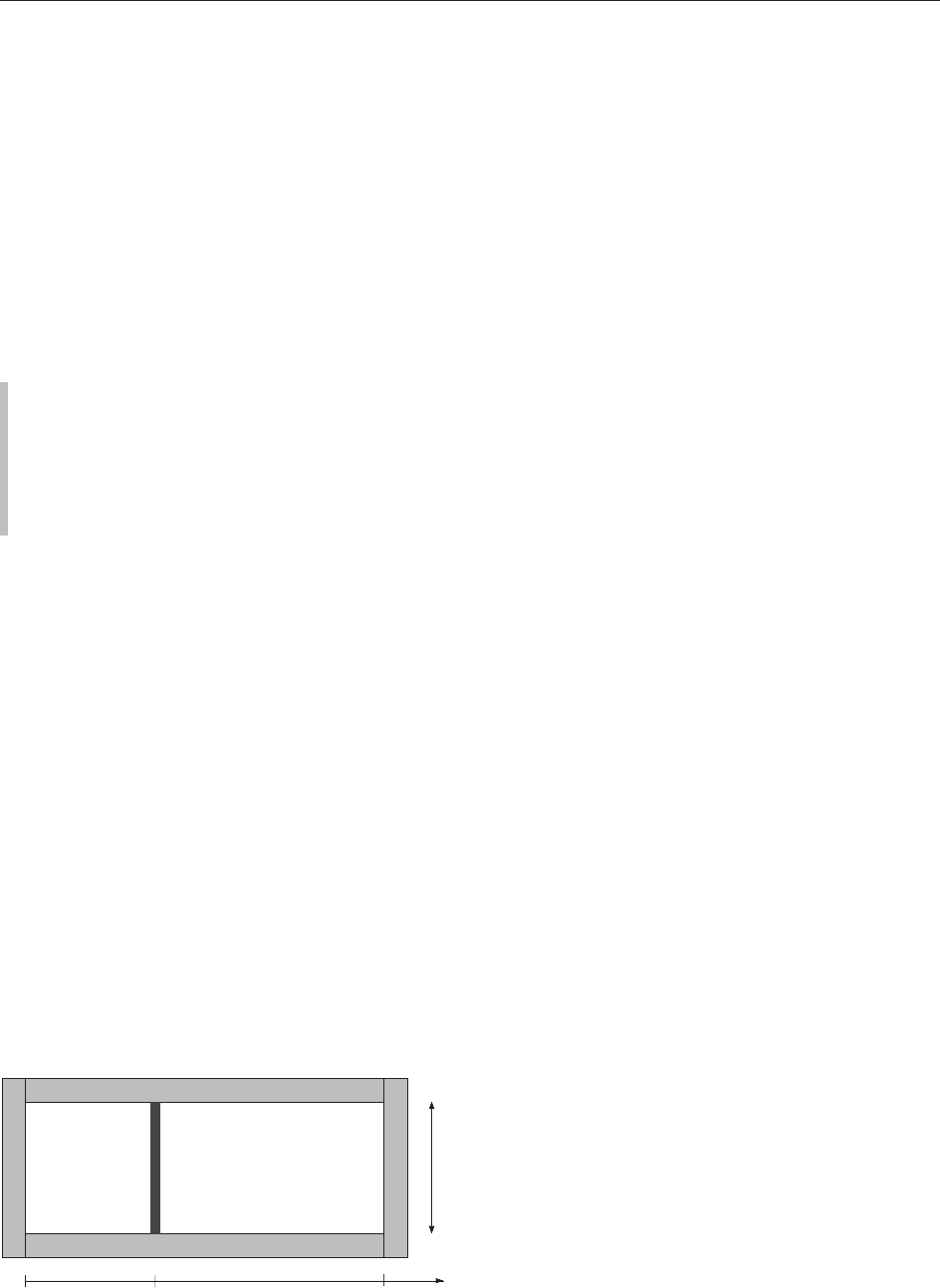
consists of a gas in a cylin der divided by an
adiabatic wall (the piston). Initially, the piston is
held fixed by a clamp and the two gases are in
thermal equilibrium character ized by (p
, T
, N
),
where the index /þ refers to the gas on the left/right
side of the piston and (p, T, N) denote the pressure,
the temperature, and the number of particles
(Figure 1). Since the piston is adiabatic, the whole
system remains in equilibr ium even if T
6¼ T
þ
.At
time t = 0, the clamp is removed and the piston is let
free to move without any friction in the cylinder. The
question is to find the final state, that is, the final
position X
f
of the piston and the parameters (p
f
, T
f
)
of the gases .
In the late 1950s , using the two laws of
equilibrium thermodynamics (i.e., thermostatics),
Landau and Lifshitz concluded that the adiabatic
piston will evolve toward a final state where
p
=T
= p
þ
=T
þ
. Later, Callen (1963) and others
realized that the maximum entropy condition
implies that the system will reach mechanical
equilibrium where the pressures are equal p
f
= p
þ
f
;
however, nothing could be said concerning the final
position X
f
or the final temperatures T
f
which
should depend explicitly on the viscosity of the
fluids. It thus became a controversial problem since
one was forced to accept that the two laws of
thermostatics are not sufficient to predict the final
state as soon as adiabatic movable walls are
involved (see early referenc es in Gruber (1999)).
Experimentally, the adiabatic piston was used
already before 1924 to measure the ratio c
p
=c
v
of
the specific heats of gases. In 2000, new measure-
ments have shown that one ha s to distinguish
between two regimes, corresponding to weak damp-
ing or strong damping, with very different proper-
ties, for example, for weak damping the frequency
of oscillations corresponds to adiabatic oscillations,
whereas for strong damping it corresponds to
isothermal oscillations.
Microscopic Problem
The ‘‘adiabatic piston’’ was first considered from a
microscopic point of view by Lebowitz who intro-
duced in 1959 a simple model to study heat
conduction. In this model, the gas consists of point
particles of mass m making purely elastic collisions
on the wall of the cylinder and on the piston.
Furthermore, the gas is very dilute so that the
0
N
+
T
+
p
+
N
–
T
–
p
–
A
X
L
Figure 1 The adiabatic piston problem.
160 Adiabatic Piston
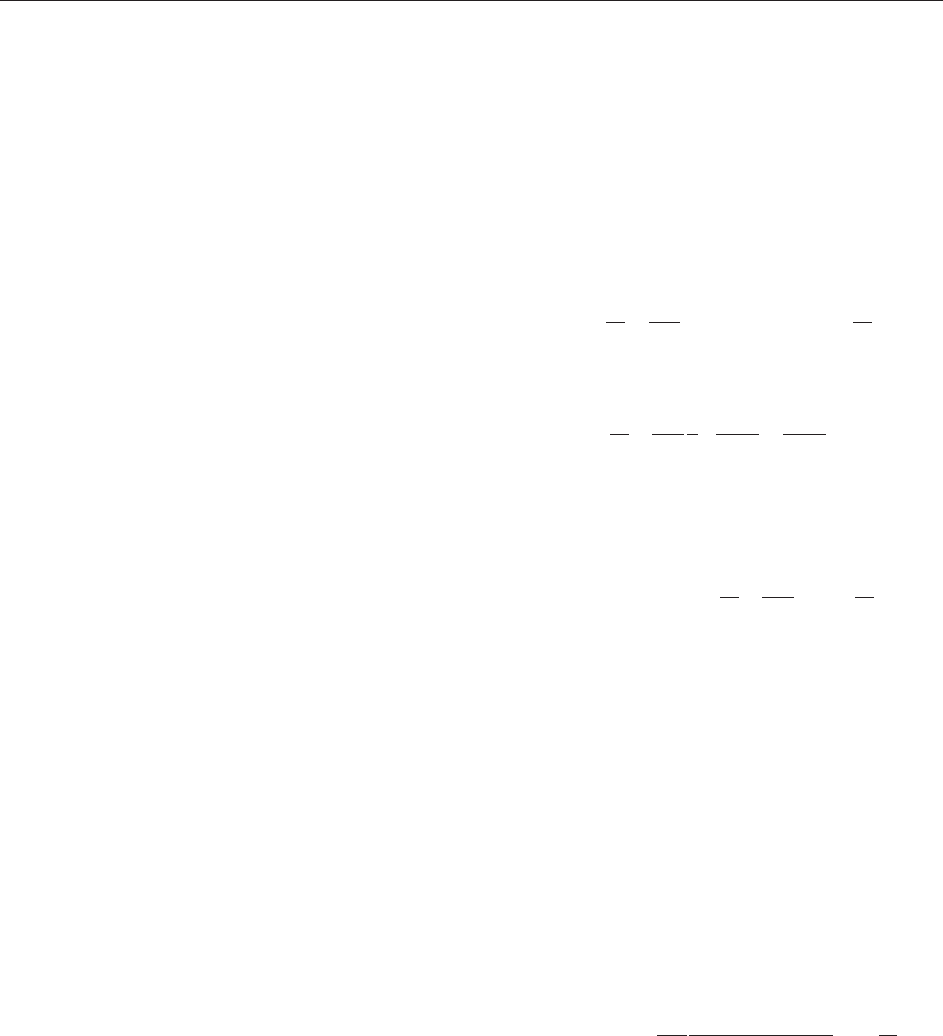
equation of state p = nk
B
T is satisfied at equili-
brium, where n is the density of particles in the gas
and k
B
the Boltzmann constant. The adiabatic piston
is taken as a heavy particle of mass M m without
any internal degree of freedom. Using this same
model Feynman (1965) gave a qualitative analysis in
Lectures in Physics. He argued intuitively but
correctly that the system should converge first
toward a state of mechanical equilibrium where
p
= p
þ
and then very slowly toward thermal
equilibrium. This approach toward thermal equili-
brium is associated with the ‘‘wiggles’’ of the piston
induced by the random collisions with the atoms of
the gas. Of course, this stochastic behavior is not
part of thermodynamics and the evolution beyond
the mechanica l equilibrium cannot appear in the
macroscopical framework assuming that the piston
does not conduct heat.
From a microscopical point of view, one is
confronted with two different problems: the
approach toward mechanical equilibrium in the
absence of any a priori friction (where the entropy
of both gases should increase) and, on a different
timescale, the approach toward thermal equilibrium
(where the entropy of one gas should decrease but
the total entropy increase).
The conceptual difficulties of the problem beyond
mechanical equilibrium come from the following
intuitive reasoning. When the piston moves toward
the hotter gas, the atoms of the hotter gas gain
energy, whereas those of the cooler gas lose energy.
When the piston moves toward the cooler side, it is
the opposite. Since on an average the hotter side
should cool down and the cold side should warm
up, we are led to conclude that on an average the
piston should move toward the colder side. On the
other hand, from p = nk
B
T, the piston should move
toward the warmer side to maintain pressure
balance.
In 1996, Crosignani, Di Porto, and Segev intro-
duced a kinetic model to obtain equations descr ibing
the adiabatic approach toward mechanical eq uili-
brium. Starting with the microsc opical model
introduced by Lebowitz, Gruber, Piasecki, and
Frachebourg, later joined by Lesne and Pache,
initiated in 1998 a systematic investigation of the
adiabatic piston within the framework of statistical
mechanics, together with a large number of numer-
ical simulations. This analysis was based on the fact
that m=M is a very small parameter to investigate
expansions in powers of m=M (see Gruber and
Piasecki (1999) and Gruber et al. (2003) and
reference therein). An approach using dynamical
system methods was then developed by Lebowitz
et al. (2000) and Chernov et al. (2002).An
extension to hard-disk particles was analyzed at
the same time by Kestemont et al. (2000). Recently,
several other authors have contributed to this
subject.
The genera l picture which emerges from all the
investigations is the following. For an infinite
cylinder, starting with mechanical equilibrium
p
= p
þ
= p, the piston evolves to a stationary
stochastic state with nonzero velocity toward the
warmer side
hVi¼
m
M
ffiffiffiffiffiffiffiffi
k
B
8m
r
ð
ffiffiffiffiffiffiffi
T
þ
p
ffiffiffiffiffiffiffi
T
p
Þþo
m
M
½1
with relaxation time
¼
M
A
ffiffiffiffiffiffiffiffi
k
B
8m
r
1
p
1
ffiffiffiffiffiffiffi
T
p
þ
1
ffiffiffiffiffiffiffi
T
þ
p
1
½2
where M=A is the mass per unit area of the piston.
In this state the piston has a temperature
T
P
=
ffiffiffiffiffiffiffiffiffiffiffiffiffi
T
þ
T
p
and there is a heat flux
j
Q
¼ð
ffiffiffiffiffiffiffi
T
p
ffiffiffiffiffiffiffi
T
þ
p
Þ
m
M
ffiffiffiffiffiffiffiffi
8k
B
m
r
p þ o
m
M
ðp
¼ p
þ
¼ pÞ½3
For a finite cylinder and p
þ
6¼ p
, the evolution
proceeds in four different stages. The first two are
deterministic and adiabatic. They correspond to the
thermodynamic evolution of the (ma croscopic)
adiabatic piston. The last two stages, which go
beyond thermodynamics, are stochastic with heat
transfer across the piston. More precisely:
1. In the first stage whose duration is the time
needed for the shock wave to bounce back on the
piston, the evolution corresponds to the case of
the infinite cylinder (with p
6¼ p
þ
). If
R = Nm=M > 10, the piston will be able to
reach and maintain a constant velocity
V ¼ðp
p
þ
Þ
ffiffiffiffiffiffiffiffi
k
B
8m
r
ffiffiffiffiffiffiffiffiffiffiffiffiffi
T
T
þ
p
p
þ
ffiffiffiffiffiffiffi
T
p
þp
ffiffiffiffiffiffiffi
T
þ
p
þO
m
M
for jp
p
þ
j1 ½4
2. In the second stage the evolution toward
mechanical equilibrium is either weakly or
strongly damped depending on R.IfR < 1, the
evolution is very weakly damped, the dynamics
takes place on a timescale t
0
=
ffiffiffiffi
R
p
t, and the effect
of the collisions on the piston is to introduce an
external potential (X) = c
1
=X
2
þ c
2
=(L X)
2
.
On the other hand, if R > 4, the evolution is
strongly damped (with two oscillations only) and
depends neither on M nor on R.
Adiabatic Piston 161
3. After mechanical equilibrium has been reached,
the third stage is a stochastic approach tow ard
thermal equilibrium associated with heat transfer
across the piston. This evolution is very slow and
exhibits a scaling property with respect to
t
0
= mt=M.
4. After thermal equilibrium has been reached
(T
= T
þ
, p
= p
þ
), in a fourth stage the gas
will evolve very slowly toward a state with
Maxwellian distribution of velocities, induced
by the collision with the stochastic piston.
The general conclusion is thus that a wall which is
adiabatic when fixed will become a heat conductor
under a stochastic motion. However, it should be
stressed that the time required to reach thermal
equilibrium will be several orders of magnitude larger
than the age of the universe for a macroscopical piston
and such a wall could not reasonably be called a heat
conductor. However, for mesoscopic systems, the effect
of stochasticity may lead to very interesting properties,
as shown by Van den Broeck et al. (2004) in their
investigations of Brownian (or biological) motors.
Microscopical Model
The system consists of two fluids separated by an
‘‘adiabatic’’ piston inside a cylinder with x-axis,
length L, and area A. The fluids are made of N
identical light particles of mass m. The piston is a
heavy flat disk, without any internal degree of
freedom, of mass M m, orthogonal to the
x-axis, and velocity parallel to this x-axis. If the
piston is fixed at some position X
0
, and if the two
fluids are in thermal equilibrium characterized by
(p
0
, T
0
, N
), then they will remain in equilibrium
forever even if T
þ
0
6¼T
0
: it is thus an ‘‘adiabatic
piston’’ in the sense of thermodynamics. At a certain
time t = 0, the piston is let free to move and the
problem is to study the time evolution. To define the
dynamics, we consider that the system is purely
Hamiltonian, that is, the particles and the piston
move without any friction according to the laws of
mechanics. In particular, the collisions between the
particles and the walls of the cylinder, or the piston,
are purely elastic and the total energy of the system
is conserved. In most studies, one considers that the
particles are point particles making purely elastic
collisions. Since the piston is bound to move only in
the x-direction, the velocity components of the
particles in the transverse directions play no role in
this problem. Moreover, since there is no coupling
between the components in the x- and transverse
directions, one can simplify the model further by
assuming that all probability distributions are
independent of the transverse coordinates. We are
thus led to a formally one-dimensional problem
(except for normalizations). Therefore, in this
review, we con sider that the particles are noninter-
acting and all velocities are parallel to the x-axis.
From the collision law, if v and V denote the
velocities of a particle and the piston before a
collision, then under the collis ion on the piston:
v ! v
0
¼ 2V v þ ðv VÞ
V ! V
0
¼ V þ ðv VÞ
½5
where
¼
2m
M þ m
½6
Similarly, under a collision of a pa rticle with the
boundary at x = 0orx = L:
v ! v
0
¼v ½7
Let us mention that more general models have also
been considered, for example, the case where the
two fluids are made of point particles with different
masses m
, or two-dimensional models where the
particles are hard disks. However, no significant
differences appear in these more general models and
we restrict this article to the simplest case.
One can study different situations: L = 1, L
finite, and L !1. Furthermore, taking first M and
A finite, one can investigate several limits.
1. Thermodynamic limit for the piston only. In
this limit, L is fixed ( finite or infinite) and
A !1, M !1, keeping constant the initial
densities n
of the fluid and the parameter
¼
2mA
M þ m
¼ A 2m
A
M
½8
If L is finite, this means that N
!1 while
keeping constant the parameters
R
¼
mN
M
¼
M
gas
M
½9
2. Thermodynamic limit for the whole system,
where L !1 and A L
2
, N
L
3
. In this
limit, space and time variables are rescaled
according to x
0
= x=L and t
0
= t=L. This limit
can be considered as a limiting case of (1) where
R
ffiffiffiffi
A
p
!1 (and time is scaled).
3. Continuum limit where L and M are fixed and
N
!1, m !0 keeping M
gas
constant, that is,
R
= cte .
The case L infinite and the limit (1) have been
investigated using statistical mechanics (Liouville or
162 Adiabatic Piston

Boltzmann’s equations). On the other hand, the
limit (2) has been studied using dynamical system
methods, reducing first the system to a billiard in an
(N
þ
þ N
þ 1)-dimensional polyhedron. The limit
(3) has been introduced to derive hydrodynamical
equations for the fluids.
In this article, we present the approach based on
statistical mechanics. Although not as rigorous as (2)
on a mathematical level, it yields more informations
on the approach toward mechanical and thermal
equilibrium. Moreover, it indicates what are the
open problems which should be mathematically
solved. In all investigations, advantage is taken of
the fact that m/M is very small and one introduces
the small parameter
¼
ffiffiffiffiffiffiffiffiffiffiffi
m=M
p
1 ½10
Let us note that measures the ratio of thermal
velocities for the piston and a fluid particle, whereas
2
measures the ratio of velocity changes during
a collision.
Starting Point: Exact Equations
Using the statistical point of view, the time evolution
is given by Liouville’s equation for the probability
distribution on the whole phase space for (N
þ
þ
N
þ 1) particles, with L, A, N
, and M finite.
Initially (t 0), the piston is fixed at (X
0
, V
0
= 0)
and the fluids are in thermal equilibrium with
homogeneous densities n
0
, velocity distributions
’
0
(v) = ’
0
(v), and temperatures
T
0
¼ m
Z
1
1
dvn
0
’
0
ðvÞv
2
½11
Integrating out the irrelevant degrees of freedom,
the Liouville’s equation yields the equations for
the distribution
(x, v; t) of the right and left
particles:
@
t
ðx; v; tÞþv@
x
ðx; v ; tÞ¼I
ðx; v ; tÞ½12
The collision term I
(x, v; t) is a functional of
, P
(X, v; X, V; t), the two-point correlation func-
tion for a right (resp. left) particle at (x = X, v) and
the piston at (X, V). Similarly, one obtains for the
velocity distribution of the pisto n:
@
t
ðV; tÞ¼A
Z
1
1
ðV vÞ ðV v Þ
surf
ðv
0
; V
0
; tÞ
þðv VÞ
surf
ðv ; V; tÞ
dv
A
Z
1
1
ðV vÞ ðv VÞ
þ
surf
ðv
0
; V
0
; tÞ
þðV vÞ
þ
surf
ðv ; V ; tÞ
dv ½13
where (v
0
, V
0
) are given by eqn [5] and
surf
ðv; V; tÞ¼
Z
1
1
dX
; P
ðX; v ; X; V; tÞ½14
We thus have to solve eqns [12]–[13] with initial
conditions
ðx; v; t ¼ 0Þ¼n
0
’
0
ðvÞðxÞðX
0
xÞ
þ
ðx; v; t ¼ 0Þ¼n
þ
0
’
þ
0
ðvÞðL xÞðx X
0
Þ
ðV; t ¼ 0Þ¼ðVÞ
½15
Using the fact that = 2m=(M þ m) 1, we can
rewrite eqn [13] as a form al s eries in powers of :
@
t
ðV; tÞ¼
X
1
k¼1
ð1Þ
k
k1
k!
@
@V
k
e
F
kþ1
ðV; tÞ½16
~
F
k
ðV; tÞ¼
Z
1
V
ðv VÞ
k
surf
ðv ; V; tÞdv
Z
V
1
ðv VÞ
k
þ
surf
ðv ; V; tÞdv ½17
from which one obtains the equations for the
moments of the piston velocity:
1
dhV
n
i
dt
¼
X
n
k¼1
k1
n!
k!ðn kÞ!
Z
1
1
dVV
nk
~
F
kþ1
ðV; tÞ½18
However, we do not know the two-point correlation
functions.
If the length of the cylinder is infinite, the
condition M m implies that the probability for
a particle to make more than one collision on the
piston is negligible. Alternatively, one could choose
initial distributions ’
0
(v) which are zero for jv j <
v
min
,wherev
min
is taken such that the probability
of a r ecollision is strictly zero. Therefore, if L = 1,
one can consider that before a collision on the
piston the particles are d istributed with ’
0
(v)for
all t, and the two-point correlation functions
factorize, that is,
surf
ðv; V; tÞ¼
surf
ðv; tÞðV; tÞ; if v > V
þ
surf
ðv; V; tÞ¼
þ
surf
ðv; tÞðV; tÞ; if v < V
½19
where for L = 1,
surf
(v; t) = n
0
’
0
(v) and thus the
conditions to obtain eqn [18] are satisfied.
If L is finite, one can show that the factorization
property (eqn [19]) is an exact relation in the
thermodynamic limit for the piston (A !1,
M=A = cte). For finite L and finite A, we introduce
Adiabatic Piston 163

Assumption 1 (Factorization condition). Before a
collision the two-point correlation functions have the
factorization property (eqn [19]) to first order in .
Under the factorization condition, we have
~
F
k
ðV; tÞ¼F
k
ðV; tÞðV; tÞ½20
with
F
k
ðV; tÞ¼
Z
1
V
dvðv VÞ
k
surf
ðv; tÞ
Z
V
1
dvðv VÞ
k
þ
surf
ðv; tÞ
¼ F
k
ðV; tÞF
þ
k
ðV; tÞ½21
and from eqn [18]
M
A
d
dt
hVi¼MhF
2
ðV; tÞi
½22
M
A
d
dt
hV
2
i¼M hVF
2
ðV;tÞi
þhF
3
ðV;tÞi
½½23
Introducing
V =hV i
then from eqns [12] and [20],
it follows that the (kinetic) energies satisfy
d
dt
hE
i
A
¼M
h
hF
2
ðV; tÞi
V
þhðV
VÞF
2
ðV; tÞi
þ
2
hF
3
ðV; tÞi
i
½24
which implies conservation of energy.
From the first law of thermodynamics,
d
dt
hE
i
A
¼
1
A
P
P !
W
þ P
P !
Q
hi
½25
where P
P !
W
and P
P !
Q
denote the work- and
heat-power transmitted by the piston to the fluid,
we conclude from eqns [22] and [ 25] that the heat
flux is
1
A
P
P!
Q
¼M
h
hðV
VÞF
2
ðV; tÞi
þ
2
hF
3
ðV; tÞi
i
½26
Since 1, it is interesting to introduce the
irreducible moments
r
¼hðV
VÞ
r
i
½27
and the expansion around
V = hVi
t
,
F
n
ðV; tÞ¼
X
1
r¼0
1
r!
F
ðr; Þ
n
ð
VÞðV
VÞ
r
½28
from which one obtains equations for d
r
=dt.In
particular, using the identities
F
ðrþ1; Þ
3
¼3F
ðr; Þ
2
; F
ðrþ2; Þ
2
¼ 2F
ðr; Þ
0
½29
in [22] and [24], we have
F
2
ðV; tÞ
¼F
2
ð
V; tÞ
þ
X
r0
2
ð2 þ rÞ!
F
ðr; Þ
0
2þr
½30
d
dt
hE
i
A
¼M
F
2
ðV; tÞ
V
þ
2
F
3
ð
V; tÞþ
1
2
X
r2
1
r!
ð2r 3Þ
F
ðr1; Þ
2
ð
V; tÞ
r
½31
Depending on the questions or approximations one
wants to study, either the distribution (V; t) or the
moments hV
n
i
t
will be the interesting objects.
Finally, with the condition [19], one can take
eqn [12] for x 6¼ X
t
and impose the boundary
conditions at x = X
t
:
ðX
t
; v; tÞ¼
ðX
t
; v
0
; tÞ; if v < V
t
þ
ðX
t
; v; tÞ¼
þ
ðX
t
; v
0
; tÞ; if v > V
t
½32
and similarly for x = 0 and x = L with v
0
= v.
Let us note that this factorization condition is of
the same nature as the molecular chaos assumption
introduced in kinetic theory, and with this condition
eqn [13] yields the Boltzmann equation for this
model.
In the following, to obtain explicit results as a
function of the initial temperatures T
0
, we take
Maxwellian distributions ’
0
(v) and initial condi-
tions (p
0
, T
0
, n
0
) such that the velocity of the piston
remains small (i.e., jhVi
t
jjhv
i
0
j).
Distribution (V ; t) for the Infinite
Cylinder (L = 1)
To lowest order in =
ffiffiffiffiffiffiffiffiffiffiffi
m=M
p
, and assuming
j1 p
þ
=p
j is of order , one obtains from eqn [16]
the usual Fokker–Planck equation whose solution
gives
0
ðV; tÞ¼
1
ffiffiffiffiffiffi
2
p
1
ðtÞ
exp
ðV
V
ðtÞÞ
2
2
2
ðtÞ
!
½33
164 Adiabatic Piston