
Francoise J.-P., Naber G.L., Tsun T.S. (editors) Encyclopedia of Mathematical Physics
Подождите немного. Документ загружается.


The d-dimensional anti-de Sitter space, AdS
d
, may
be defined by a constraint
ðX
0
Þ
2
þðX
d
Þ
2
X
d1
i¼1
ðX
i
Þ
2
¼ L
2
½2
This constraint shows that the symmetry group of
AdS
d
is SO(2, d 1). AdS
d
is a negatively curved
maximally symmetric space, that is, its curvature
tensor is related to the metric by
R
abcd
¼
1
L
2
½g
ac
g
bd
g
ad
g
bc
½3
Its metric may be written as
ds
2
AdS
¼ L
2
ðy
2
þ 1Þdt
2
þ
dy
2
y
2
þ 1
þ y
2
d
2
d2
½4
where the radial coordinate y 2 [0, 1), and t is
defined on a circle of length 2. This space has
closed timelike curves; to eliminate them, we will
work with the universal covering space where
t 2 (1, 1). The boundary of AdS
d
, which plays
an important role in the AdS/CFT correspondence, is
located at infinite y. There exists a subspace of AdS
d
called the Poincare´ wedge, with the metric
ds
2
¼
L
2
z
2
dz
2
ðdx
0
Þ
2
þ
X
d2
i¼1
ðdx
i
Þ
2
!
½5
where z 2 [0, 1).
A Euclidean continuation of AdS
d
is the
Lobachevsky space (hyper boloid), L
d
. It is obtained
by reversing the sign of (X
d
)
2
,dt
2
, and (dx
0
)
2
in [2],
[4], and [5], respectively. After this Euclidean
continuation, the metrics [4] and [5] become
equivalent; both of them cover the entire L
d
.
Another equivalent way of writin g the metric is
ds
2
L
¼ L
2
d
2
þ sinh
2
d
2
d1
½6
which shows that the boundary at infinite has the
topology of S
d1
. In terms of the Euclideanized
metric [5], the boundary consists of the R
d1
at
z = 0, and a single point at z = 1.
The Geometry of Dirichlet Branes
Our path toward formulating the AdS
5
=CFT
4
correspondence requires introduction of Dirichlet
branes, or D-branes for short. They are soliton-like
‘‘membranes’’ of various internal dimensionalities
contained in type II superstring theories. A Dirichlet
p-brane (or Dp brane) is a (p þ 1)-dimensional
hyperplane in (9 þ 1)-dimensional spacetime where
strings are allowed to end. A D-brane is much like a
topological defect: upon touching a D-brane, a
closed string can open up and turn into an ope n
string whose ends are free to move along the
D-brane. For the endpoints of such a string the p þ 1
longitudinal coordinates satisfy the conventional free
(Neumann) boundary conditions, while the 9 p
coordinates transverse to the Dp brane have the fixed
(Dirichlet) bounda ry conditions, hence the origin of
the term ‘‘Dirichlet brane.’’ The Dp brane preserves
half of the bulk supersymmetries and carries an
elementary unit of charge with respect to the (p þ 1)-
form gauge potential from the Ramond–Ramond
(RR) sector of type II superstring.
For this article, the most important property of
D-branes is that they realize gauge theories on their
world volume. The massless spectrum of open
strings living on a Dp brane is that of a maximall y
supersymmetric U(1) gauge theory in p þ 1 dimen-
sions. The 9 p massless scalar fields present in this
supermultiplet are the expected Goldstone modes
associated with the transverse oscillations of the Dp
brane, while the photons and fermions provide the
unique supersymmetric completion. If we consider
N parallel D-branes, then there are N
2
different
species of open strings because they can begin and
end on any of the D-branes. N
2
is the dimension of
the adjoint representation of U(N), and indeed we
find the maximally supersymmetric U(N) gauge
theory in this setting.
The relative separations of the Dp branes in the
9 p transverse dimensions are determined by
the expectation values of the scalar fields. We will
be interested in the case where all scalar expectation
values vanish, so that the N Dp branes are stacked
on top of each other. If N is large, then this stack is
a heavy object embedded into a theory of closed
strings which contain s gravity. Naturally, this
macroscopic object will curve space: it may be
described by some classical metric and other back-
ground fields including the RR (p þ 2)-form field
strength. Thus, we have two very different descrip-
tions of the stack of Dp branes: one in terms of the
U(N) supersymmetric gauge theory on its world
volume, and the other in terms of the classical RR
charged p-brane background of the type II closed
superstring theory. The relation between these two
descriptions is at the heart of the connections
between gauge fields and strings that are the subject
of this article.
Coincident D3 Branes
Gauge theories in 3 þ 1 dimensions play an impor-
tant role in physics, and as explained above, parallel
D3 branes realize a (3 þ 1)-dimensional U(N) SYM
AdS/CFT Correspondence 175

theory. Let us compare a stack of D3 branes with
the RR-charged black 3-brane classical solution
where the metric assumes the form
ds
2
¼H
1=2
ðrÞf ðrÞðdx
0
Þ
2
þðdx
i
Þ
2
hi
þ H
1=2
ðrÞ f
1
ðrÞdr
2
þ r
2
d
5
2
hi
½7
where i = 1, 2, 3 and
HðrÞ¼1 þ
L
4
r
4
; f ðrÞ¼1
r
0
4
r
4
The solution also contains an RR self-dual 5-form
field strength
F ¼ dx
0
^ dx
1
^ dx
2
^ dx
3
^ dðH
1
Þ
þ 4L
4
volðS
5
Þ½8
so that the Einstein equation of type IIB super-
gravity, R
= F
F
=96, is satisfied.
In the extremal limit r
0
! 0, the 3-brane metric
becomes
ds
2
¼ 1 þ
L
4
r
4
1=2
ðdx
0
Þ
2
þðdx
i
Þ
2
þ 1 þ
L
4
r
4
1=2
dr
2
þ r
2
d
2
5
½9
Just like the stack of parallel, ground-state D3
branes, the extremal solution preserves 16 of the
32 supersymmetries present in the type IIB theory.
Introducing z = L
2
=r, one notes that the limiting
form of [9] as r ! 0 factorizes into the direct
product of two smooth spaces, the Poincare´ wedge
[5] of AdS
5
, and S
5
, with equal radii of curvature L.
The 3-brane geometry may thus be viewed as a
semi-infinite throat of radius L which, for r L,
opens up into flat (9 þ 1)-dimensional space. Thus,
for L much larger than the string length scale,
ffiffiffiffiffi
0
p
,
the entire 3-brane geometry has small curvatures
everywhere and is appropriately described by the
supergravity approximation to type IIB string
theory.
The relation between L and
ffiffiffiffiffi
0
p
may be found by
equating the gravitational tension of the extremal
3-brane classical solution to N times the tension of a
single D3 brane:
2
2
L
4
volðS
5
Þ¼N
ffiffiffi
p
½10
where vol(S
5
) =
3
is the volume of a unit 5-sphere,
and =
ffiffiffiffiffiffiffiffiffiffi
8G
p
is the ten-dimensional gravitational
constant. It follows that
L
4
¼
2
5=2
N ¼ g
2
YM
N
02
½11
where we used the standard relations = 8
7=2
g
st
02
and g
2
YM
= 4 g
st
[10]. Thus, the size of the throat in
string units is
1=4
. This remarkable emergence
of the ‘t Hooft coupling from gravitational con-
siderations is at the heart of the success of the AdS/
CFT correspondence. Moreover, the requirement
L
ffiffiffiffiffi
0
p
translates into 1: the gravitational
approach is valid when the ‘t Hooft coupling is very
strong and the perturbative field-theoretic methods
are not applicable.
Example: Thermal Gauge Theory from
Near-Extremal D3 Branes
An important black hole observable is the Bekenstein–
Hawking (BH) entropy, which is proportional to the
area of the event horizon. For the 3-brane solution
[7], the horizon is located at r = r
0
.Forr
0
> 0the
3-brane carries some excess energy E above its
extremal value, and the BH entropy is also non-
vanishing. The Hawking temperature is then defined
by T
1
= @S
BH
=@E.
Setting r
0
L in [9], we obtain a near-extremal
3-brane geometry, whose Hawking temperature is
found to be T = r
0
=(L
2
). The eight-dimensional
‘‘area’’ of the horizon is
A
h
¼ðr
0
=LÞ
3
V
3
L
5
volðS
5
Þ¼
6
L
8
T
3
V
3
½12
where V
3
is the spatial volume of the D3 brane (i.e.,
the volume of the x
1
, x
2
, x
3
coordinates). Therefore,
the BH entropy is
S
BH
¼
2A
h
2
¼
2
2
N
2
V
3
T
3
½13
This gravitational entropy of a near-extremal
3-brane of Hawking temperature T is to be
identified with the entropy of N = 4supersym-
metric U(N) gauge theory (which lives on N
coincidentD3branes)heateduptothesame
temperature.
The entropy of a free U(N) N = 4 supermultiplet –
which consists of the gauge field, 6N
2
massless
scalars, and 4N
2
Weyl fermions – can be calculated
using the standard statistical mechanics of a
massless gas (the blackbody problem), and the
answer is
S
0
¼
2
2
3
N
2
V
3
T
3
½14
It is remarkable that the 3-brane geometry captures
the T
3
scaling ch aracteristic of a conformal field
theory (CFT) (in a CFT this scaling is guaranteed by
the extensivity of the entropy and the absence of
dimensionful parameters). Also, the N
2
scaling
indicates the presence of O(N
2
) unconfined degrees
176 AdS/CFT Correspondence

of freedom, which is exactly what we expect in the
N = 4 supersymmetric U(N) gauge theory. But what
is the explanation of the relative factor of 3/4
between S
BH
and S
0
? In fact, this factor is not a
contradiction but rather a prediction about the
strongly coupled N = 4 SYM theory at finite
temperature. As we argued above, the supergravity
calculation of the BH entropy, [13], is relevant to
the !1limit of the N = 4 SU( N) gauge theory,
while the free-field calculation, [14], applies to the
! 0 limit. Thus, the relative factor of 3/4 is not a
discrepancy: it relates two different limits of the
theory. Indeed, on general field-theoretic grounds,
we expect that in the ‘t Hooft large-N limit, the
entropy is given by
S ¼
2
2
3
N
2
f ðÞV
3
T
3
½15
The function f is certainly not constant:
perturbative calculations valid for small = g
2
YM
N
give
f ðÞ¼1
3
2
2
þ
3 þ
ffiffiffi
2
p
3
3=2
þ ½16
Thus, the BH entropy in supergravity, [13],is
translated into the prediction that
lim
!1
f ðÞ¼
3
4
½17
The Essentials of the AdS/CFT
Correspondence
The AdS/CF T correspondence asserts a detailed map
between the physics of type IIB string theory in the
throat of the classical 3-brane geometry, that is, the
region r L, and the gauge theory living on a stack
of D3 branes. As already noted, in this limit r L,
the extremal D3 brane geome try factors into a direct
product of AdS
5
S
5
. Moreover, the gauge theory
on this stack of D3 branes is the maximally
supersymmetric N = 4 SYM.
Since the horizon of the near-extremal 3-brane lies
in the region r L, the entropy calculation could
have been carried out directly in the throat limit,
where H(r) is replaced by L
4
=r
4
. Another way to
motivate the identification of the gauge theory with
the throat is to think about the absorption of
massless particles. In the D-brane description, a
particle incident from asymptotic infinity is con-
verted into an excitation of the stack of D-branes,
that is, into an excitation of the gauge theory on the
world volume. In the supergravity description, a
particle incident from the asymptotic (large r) region
tunnels into the r L region and produces an
excitation of the throat. The fact that the two
different descriptions of the absorption process give
identical cross sections supports the identification of
excitations of AdS
5
S
5
with the excited states of
the N = 4 SYM theory.
Maldacena (1998) motivated this correspondence
by thinking about the low-energy (
0
! 0) limit of
the string theory. On the D3 brane side, in this low-
energy limit, the interaction between the D3 branes
and the closed strings propagating in the bulk
vanishes, leaving a pur e N = 4 SYM theory on the
D3 branes decoupled from type IIB superstrings in
flat space. Around the classical 3-brane solutions,
there are two types of low-energy excitations. The
first type propagate in the bulk region, r L, and
have a cross section for absorption by the throat
which vanishes as the cube of their energy. The
second type are localized in the throat, r L, and
find it harder to tunnel into the asymptotically flat
region as their energy is taken smaller. Thus, both
the D3 branes and the classical 3-brane solution
have two decoupled components in the low-energy
limit, and in both cases, one of these compone nts is
type IIB superstrings in flat space. Maldacena
conjectured an equivalence between the other two
components.
Immediate support for this identification comes
from symmetry considerations. The isometry group
of AdS
5
is SO(2, 4), and this is also the conformal
group in 3 þ 1 dimensions. In addition, we have the
isometries of S
5
which form SU(4) SO(6). This
group is identical to the R-symmetry of the N = 4
SYM theory. After including the fermionic genera-
tors required by supersymmetry, the full isometry
supergroup of the AdS
5
S
5
background is
SU(2, 2j4), which is identical to the N = 4 super-
conformal symmetry. We will see that, in theories
with reduced supersymmetry, the S
5
factor is
replaced by other compact Einstein spaces Y
5
, but
AdS
5
is the ‘‘universal’’ factor present in the dual
description of any large-N CFT and makes the
SO(2, 4) conformal symmetry a geometric one.
The correspondence extends beyond the super-
gravity limit, and we must think of AdS
5
Y
5
as a
background of string theory. Indeed, type IIB strings
are dual to the electric flux lines in the gauge theory,
providing a string-theoretic setup for calculating
correlation functions of Wilson loops. Furthermore,
if N !1while g
2
YM
N is held fixed and finite, then
there are string scale corrections to the supergr avity
limit (Maldacena 1998, Gubser et al. 1998, Witten
1998) which proceed in powers of
0
=L
2
= (g
2
YM
N)
1=2
. For finite N, there are also
AdS/CFT Correspondence 177

string loop corrections in powers of
2
=L
8
N
2
.
As expected, with N !1we can take the classical
limit of the string theory on AdS
5
Y
5
. However, in
order to understand the large-N gauge theory with
finite ‘t Hooft coupling, we should think of AdS
5
Y
5
as the target space of a two-dimensional sigma
model describing the classical string physics.
Correlation Functions and the Bulk/Boundary
Correspondence
A basic premise of the AdS/CFT correspondence is
the existence of a one-to-one map between gauge-
invariant operators in the CFT and fields (or
extended objects) in AdS. Gubser et al. (1998) and
Witten (1998) formulated precise methods for
calculating correlation functions of various opera-
tors in a CFT using its dual formulation. A physical
motivation for these methods comes from earlier
calculations of absorption by 3-branes. When a
wave is absorbed, it tunnels from asymptotic infinity
into the throat region, and then continues to
propagate toward smaller r. Let us separate the
3-brane geometry into two regions: r
>
L and r
<
L.
For r
<
L the metric is approximately that of
AdS
5
S
5
, while for r
>
L it becomes very different
and eventually approaches the flat metric. Signals
coming in from large r (small z = L
2
=r) may be
considered as disturbing the ‘‘boundary’’ of AdS
5
at
r L, and then propagating into the bulk of AdS
5
.
Discarding the r
>
L part of the 3-brane metric, the
gauge theory correlation functions are related to the
response of the string theory to boundary conditions
at r L. It is therefore natural to identify the
generating functional of correlation functions in the
gauge theory with the string theory path integral
subject to the boundary conditions that
(x, z) =
0
(x)atz = L (at z = 1 all fluctuations
are required to vanish). In calculating correlation
functions in a CFT, we will carry out the standard
Euclidean continuation; then on the string theory
side, we will work with L
5
, which is the Euclidean
version of AdS
5
.
More explicitly, we identify a gauge theory
quantity W with a string-theory quantity Z
string
:
W½
0
ðxÞ ¼ Z
string
½
0
ðxÞ ½18
W generates the connected Euclidean Green’s func-
tions of a gauge-theory operator O,
W½
0
ðxÞ ¼ exp
Z
d
4
x
0
O
½19
Z
string
is the string theory path integral calculated as
a functional of
0
, the boundary condition on the
field related to O by the AdS/CFT duality. In the
large-N limit, the string theory becomes classical
which implies
Z
string
e
I½
0
ðxÞ
½20
where I[
0
(x)] is the extremum of the classical string
action calculated as a functional of
0
. If we are
further interested in correlation functions at very
large ‘t Hooft coupling, then the problem of
extremizing the classical string action reduces to
solving the equations of motion in type IIB sup er-
gravity whose form is known explicitly. A simple
example of such a calculation is presented in the
next subsection.
Our reasoning suggests that from the point of
view of the metric [5], the boundary conditions are
imposed not quite at z = 0, which is the true
boundary of L
5
, but at some finite value z = .It
does not matter which value it is since the metric [5]
is unchanged by an overall rescaling of the coordi-
nates (z, x); thus, such a rescaling can take z = L into
z = for any . The physical meaning of this cutoff is
that it acts as a UV regulator in the gauge theory.
Indeed, the radial coordinate z is to be considered as
the effective energy scale of the gauge theory, and
decreasing z corresponds to increasing the energy. A
safe method for performing calculations of correla-
tion functions, therefore, is to keep the cutoff on the
z-coordinate at intermediat e stages an d remove it
only at the end.
Two-Point Functions and Operator Dimensions
In the following, we present a brief discussion of
two-point functions of scalar operators in CFT
d
.
The corresponding field in L
dþ1
is a scalar field of
mass m whose Euclidean action is proportional to
1
2
Z
d
d
x dzz
dþ1
ð@
z
Þ
2
þ
X
d
a¼1
ð@
a
Þ
2
þ
m
2
L
2
z
2
2
"#
½21
In calculating correlation functions of vertex
operators from the AdS/CFT correspondence, the
first problem is to reconstruct an on-shell field in
L
dþ1
from its boundary behavior. The near-bound-
ary, that is, small z, behavi or of the classical
solution is
ðz; xÞ!z
d
0
ðxÞþOðz
2
Þ
þ z
AðxÞþOðz
2
Þ
½22
where is one of the roots of
ð dÞ¼m
2
L
2
½23
178 AdS/CFT Correspondence

0
(x) is regarded as a ‘‘source’’ in [19] that couples
to the dual gauge-invariant operator O of dimension
, while A(x) is related to the expect ation value,
AðxÞ¼
1
2 d
hOðxÞi ½24
It is possible to regularize the Euclidean action to
obtain the following value as a functional of the
source:
I½
0
ðxÞ ¼ ð ðd=2ÞÞ
d=2
ðÞ
ð ðd=2ÞÞ
Z
d
d
x
Z
d
d
x
0
0
ðxÞ
0
ðx
0
Þ
jx x
0
j
2
½25
Varying twice with respect to
0
, we find that the
two-point function of the corresponding operator is
hOðxÞOðx
0
Þi ¼
ð2 dÞðÞ
d=2
ð ðd=2ÞÞ
1
jx x
0
j
2
½26
Which of the two roots,
þ
or
,of[23]
¼
d
2
ffiffiffiffiffiffiffiffiffiffiffiffiffiffiffiffiffiffiffiffiffiffiffi
d
2
4
þ m
2
L
2
r
½27
should we choose for the operator dimension? For
positive m
2
,
þ
is certainly the right choice: here the
other root,
, is negative. However, it turns out
that for
d
2
4
< m
2
L
2
<
d
2
4
þ 1 ½28
both roots of [23] may be chosen. Thus, there are
two possible CFTs corresponding to the same
classical AdS action: in one of them the correspond-
ing operator has dimension
þ
, while in the other
the dimension is
. We note that
is bounded
from below by (d 2)=2, which is precisely the
unitarity bound on dimensions of scalar operators in
d-dimensional field theory! Thus, the ability to
choose dimensio n
is crucial for consistency of
the AdS/CFT duality.
Whether string theory on AdS
5
Y
5
contains
fields wi th m
2
in the range [28] depends on Y
5
.
The example discussed in the next section,
Y
5
= T
1, 1
, turns out to contain such fields , and the
possibility of having dimension
, [27], is crucial
for consistency of the AdS/CFT duality in that case.
However, for Y
5
= S
5
, which is dual to the N = 4
large-N SYM theory, there are no such fields and all
scalar dimensions are given by [27].
The operators in the N = 4 large-N SYM theory
naturally break up into two classes: those that
correspond to the Kaluza–Klein states of super-
gravity and those that correspond to massive string
states. Since the radius of the S
5
is L, the masses of
the Kaluza–Klein states are proportional to 1=L.
Thus, the dimensions of the corresponding operators
are independen t of L and therefore also of .Onthe
gauge-theory side, this independence is explained by
the fact that the supersymmetry protects the dimen-
sions of certain operators from being renormalized:
they are completely determined by the representa-
tion under the superconformal symmetry. All
families of the Kaluza–Klein states, which corre-
spond to such protected operators, were classified
long ago. Correlation functions of such operators in
the strong ‘t Hooft coupling limit may be obtained
from the dependence of the supergravity action on
the boundary values of corre sponding Kaluza–Klein
fields, as in [19]. A variety of explicit calculations
have been performed for two-, three-, and even four-
point functions. The four-p oint functions are parti-
cularly interesting because their dependence on
operator positions is not determined by the con-
formal invariance.
On the other hand, the masses of string excita-
tions are m
2
= 4n=
0
, where n is an integer. For the
corresponding operators the formula [27] predicts
that the dimensions do depend on the ‘t Hooft
coupling and, in fact, blow up for large = g
2
YM
N as
2
1=4
ffiffiffi
n
p
.
Calculation of Wilson Loops
The Wilson loop operator of a nonabelian gauge
theory
WðCÞ ¼ tr P exp i
I
C
A
½29
involves the path-ordered integral of the gauge
connection A along a contour C. For N = 4 SYM,
one typically uses a generalization of this loop
operator which incorporates other fields in the
N = 4 multiplet, the adjoint scalars and fermions.
Using a rectangular contour, we can calculate the
quark–antiquark potential from the expectation
value hW(C)i. One thinks of the quarks located a
distance L apart for a time T, yielding
hWie
TVðLÞ
½30
where V(L) is the potential.
According to Maldacena, and Rey and Yee, the
AdS/CFT correspondence relates the Wilson loop
expectation value to a sum over string world sheets
ending on the boundary of L
5
(z = 0) along the
contour C:
hWi
Z
e
S
½31
AdS/CFT Correspondence 179
where S is the action functional of the string world
sheet. In the large ‘t Hooft coupling limit !1,
this path integral may be evaluated using a saddle-
point approximation. The leading answer is e
S
0
,
where S
0
is the action for the classical solution,
which is proportional to the minimal area of the
string world sheet in L
5
subject t o the boundary
conditions. The area as currently defined is
actually divergent, and to regularize it one must
position the contour at z = (this is the same type
of regulator as used in the definition of correlation
functions).
Consider a circular Wilson loop of radius a. The
action of the corresponding classical string world
sheet is
S
0
¼
ffiffiffi
p
a
1
½32
Subtracting the linearly diverg ent term, which is
proportional to the length of the contour, one finds
lnhWi¼
ffiffiffi
p
þ Oðln Þ½33
a result which has been duplicated in field theory by
summing certain classes of rainbow Feynman dia-
grams in N = 4 SYM. From these sums, one finds
hWi
rainbow
¼
2
ffiffiffi
p
I
1
ffiffiffi
p
½34
where I
1
is a Bessel function. This formula is one of
the few available proposals for extrapolation of an
observable from small to large coupling. At larg e ,
hWi
rainbow
ffiffiffi
2
r
e
ffiffi
p
3=4
½35
in agreement with the geometric prediction.
The quark–antiquark potential is extracted from a
rectangular Wilson loop of width L and length T.
After regularizing the divergent contribution to the
energy, one finds the attractive potential
VðLÞ¼
4
2
ffiffiffi
p
1=4ðÞ
4
L
½36
The Coulombic 1/L dependence is required by the
conformal invariance of the theory. The fact that the
potential scales as the square root of the ‘t Hoo ft
coupling indicates some screening of the charges at
large coupling.
Conformal Field Theories and Einstein
Manifolds
Interesting generalizations of the duality between
AdS
5
S
5
and N = 4 SYM with less supersymmetry
and more complicated gauge groups can be
produced by placing D3 branes at the tip of a
Ricci-flat six-dimensional cone X (see Figure 1). The
cone metric may be cast in the form
ds
X
2
¼ dr
2
þ r
2
ds
Y
2
½37
where Y is the level surface of X. In particular, Y is a
positively curved Einstein manifold, that is, one for
which R
ij
= 4g
ij
. In order to preserve the N = 1
supersymmetry, X must be a Calabi–Yau space; then
Y is defined to be Sasaki–Einstein.
The D3 branes appear as a point in X and span the
transverse Minkowski space R
3, 1
. The ten-dimen-
sional metric they produce assumes the form [9],but
with the sphere metric d
5
2
replaced by the metric on
Y,ds
2
Y
. The equality of tensions [10] now requires that
L
4
¼
ffiffiffi
p
N
2volðYÞ
¼ 4g
s
N
02
3
volðYÞ
½38
In the near-horizon limit, r ! 0, the geometry factors
into AdS
5
Y. Because the D3 branes are located at a
singularity, the gauge theory becomes much more
complicated, typically involving a product of several
SU(N) factors coupled to matter in bifundamental
representations, often described using a quiver dia-
gram (see Figure 2 for an example).
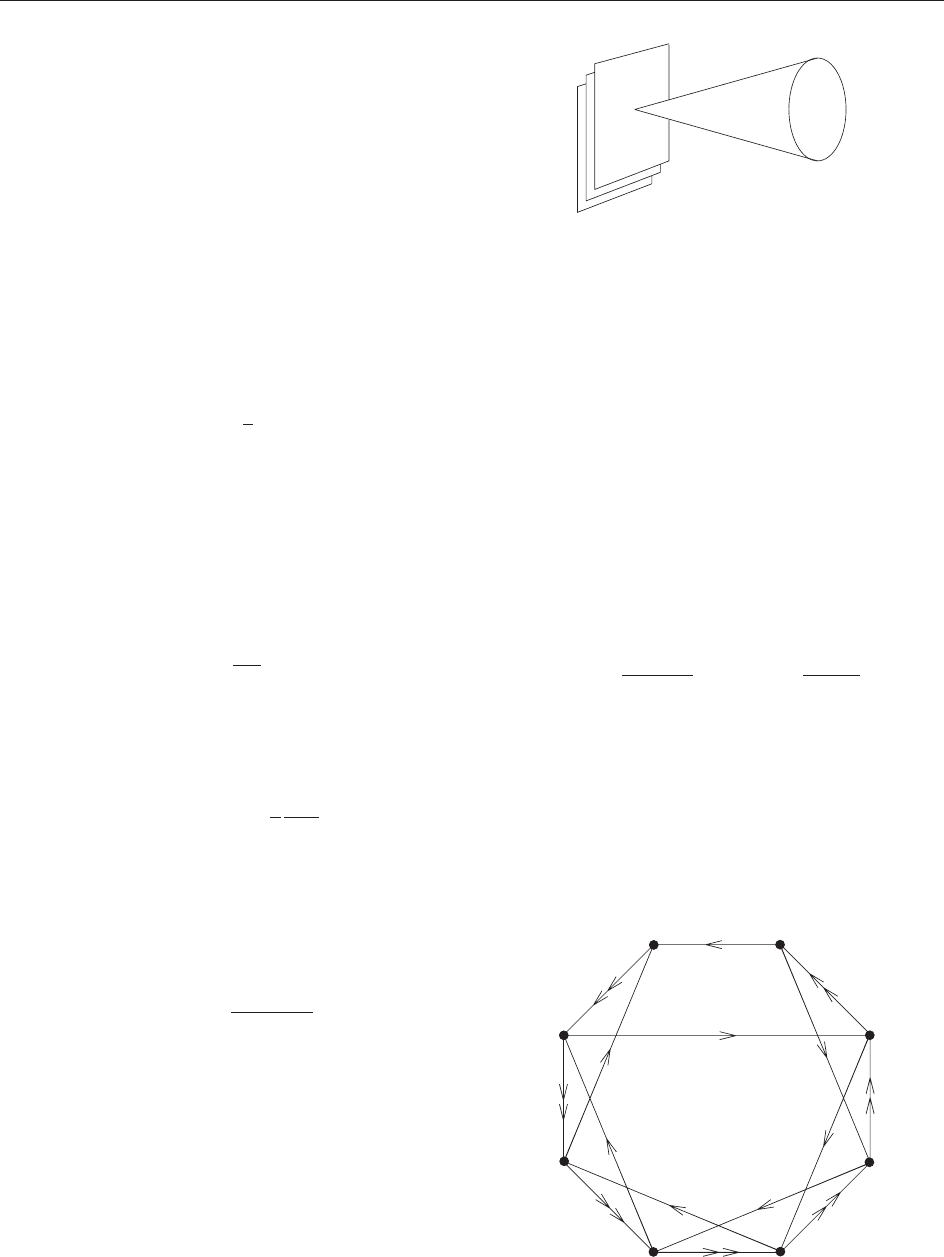
Y
N
X
Figure 1 D3 branes placed at the tip of a Ricci-flat cone X.
Y
Z
U
V
U
V
U
V
U
Y
Y
Y
Y
Y
Y
Figure 2 The quiver for Y
4,3
. Each node corresponds to an
SU(N ) gauge group and each arrow to a bifundamental chiral
superfield.
180 AdS/CFT Correspondence

The simplest examples of X are orbifolds C
3
=,
where is a discrete subgroup of SO(6). Indeed, if
SU(3), then N = 1 supersymmetry is preserved.
The level surface of such an X is Y = S
5
=. In this
case, the product structure of the gauge theory can
be motivated by thinking about image stacks of D3
branes from the action of .
The next simplest example of a Calabi–Yau cone
X is the conifold which may be described by the
following equation in four complex variables:
X
4
a¼1
z
a
2
¼ 0 ½39
Since this equation is symmetric under an overall
rescaling of the coordinates, this space is a cone. The
level surface Y of the conifold is a coset manifold
T
1, 1
= (SU(2) SU(2))=U(1). This space has the
SO(4) SU(2) SU(2) symmetry which rotates the
z’s, and also the U(1) R-symmetry under z
a
! e
i
z
a
.
The metric on T
1, 1
is known explicitly; it assumes
the form of an S
1
bundle over S
2
S
2
.
The supersymmetric field theory on the D3 branes
probing the conifold singularity is SU( N) SU(N)
gauge theory coupled to two chiral superfields, A
i
,
in the (N,
N) representation and two chiral super-
fields, B
j
, in the (N, N) representation. The A’s
transform as a doublet under one of the global
SU(2)’s, while the B’s transform as a doublet under
the other SU(2). Cancelation of the anomaly in the
U(1) R-symmetry requires that the A’s and the B’s
each have R-charge 1=2. For consistency of the
duality, it is necessary that we add an exactly
marginal superpotential which preserves the SU(2)
SU(2) U(1)
R
symmetry of the theory. Since a
marginal superpotential has R-charge equal to 2 it
must be quartic, and the symmetries fix it uniquely
up to overall normalization:
W ¼
ij
kl
tr A
i
B
k
A
j
B
l
½40
There are in fact infinite families of Calabi–Yau
cones X, but there are two problems one faces in
studying these generalized AdS/CFT correspon-
dences. The first is geometric: the cones X are not
all well understood and only for relatively few do
we have explicit metrics. However, it is often
possible to calculate important quantities such as
the vol(Y) without knowing the metric. The second
problem is gauge theoretic: although many techni-
ques exist, there is no completely general procedure
for constructing the gauge theory on a stack of D-
branes at an arbitrary singularity.
Let us mention two important classes of Calabi–
Yau cones X. The first class consists of cones over
the so-called Y
p, q
Sasaki–Einstein spaces. Here, p
and q are integers with p q. Gauntlett et al. (2004)
discovered metrics on all the Y
p, q
, and the quiver
gauge theories that live on the D-branes probing the
singularity are now known. Making contact with
the simpler examples discussed above, the Y
p,0
are
orbifolds of T
1, 1
while the Y
p, p
are orbifolds of S
5
.
In the second class of cones X, a del Pezzo surface
shrinks to zero size at the tip of the cone. A
del Pezzo surface is an algebraic surface of complex
dimension 2 with positive first Chern class. One
simple del Pezzo surface is a complex projective
space of dimension 2, P
2
, which gives rise to the
N = 1 preserving S
5
=Z
3
orbifold. Another simple
case is P
1
P
1
, which leads to T
1, 1
=Z
2
. The
remaining del Pezzos surfaces B
k
are P
2
blown up
at k points, 1 k 8. The cone where B
1
shrinks to
zero size has level surface Y
2, 1
. Gauge theories for
all the del Pezzos have been constructed. Except for
the three del Pezzos just discussed, and possibly also
for B
6
, metrics on the cones over these del Pezzos
are not known. Nevertheless, it is known that for
3 k 8, the volume of the Sasaki–Einstein mani-
fold Y associated with B
k
is
3
(9 k)=27.
The Central Charge
The central charge provides one of the most
amazing ways to check the generalized AdS/CFT
correspondences. The central charge c and confor-
mal anomaly a can be defined as coefficients of
certain curvature invariants in the trace of the stress
energy tensor of the conformal gauge theory:
hT
i¼aE
4
cI
4
½41
(The curvature invariants E
4
and I
4
are quadratic in
the Riemann tensor and vanish for Minkowski
space.) As discussed above, correlators such as hT
i
can be calculated from supergravity, and one finds
a ¼ c ¼
3
N
2
4 volðYÞ
½42
On the gauge-theory side of the correspondence,
anomalies completely determine a and c:
a ¼
3
32
ð3trR
3
tr RÞ
c ¼
1
32
ð9trR
3
5trRÞ½43
The trace notation implies a sum over the R-charges
of all of the fermions in the gauge theory . (From the
geometric knowledge that a = c, we can conclude
that tr R = 0.)
The R-charges can be determined using the
principle of a -maximization. For a superconformal
gauge theory, the R-charges of the fermions
maximize a subject to the constraints that the
AdS/CFT Correspondence 181

Novikov–Shifman–Vainshtein–Zakharov (NSVZ)
beta function of each gauge group vanishes and
the R-charge of each superpotential term is 2.
For the Y
p, q
spaces mentioned above, one finds
that
volðY
p;q
Þ¼
q
2
2p þ
ffiffiffiffiffiffiffiffiffiffiffiffiffiffiffiffiffiffiffiffiffi
4p
2
3q
2
p
3p
2
3q
2
2p
2
þ p
ffiffiffiffiffiffiffiffiffiffiffiffiffiffiffiffiffiffiffiffiffi
4p
2
3q
2
p
3
½44
The gauge theory consists of p q fields Z, p þ q
fields Y,2p fields U, and 2q fields V. These fields all
transform in the bifundamental representation of a
pair of SU(N) gauge groups (the quiver diagram for
Y
4, 3
is given in Figure 2). The NSVZ beta function
and superpotential constraints determine the
R-charges up to two free parameters x and y. Let x
be the R-charge of Z and y the R-charge of Y. Then
the U have R-charge 1 (1=2)(x þ y) and the V
have R-charge 1 þ (1=2)(x y).
The technique of a maximization leads to the result
x ¼
1
3q
2
4p
2
þ 2pq þ 3q
2
þð2p qÞ
ffiffiffiffiffiffiffiffiffiffiffiffiffiffiffiffiffiffiffiffiffi
4p
2
3q
2
p
y ¼
1
3q
2
4p
2
2pq þ 3q
2
þð2p þ qÞ
ffiffiffiffiffiffiffiffiffiffiffiffiffiffiffiffiffiffiffiffiffi
4p
2
3q
2
p
Thus, as calculated by Benvenuti et al. (2004) and
Bertolini et al. (2004)
aðY
p;q
Þ¼
3
N
2
4 volðY
p;q
Þ
½45
in remarkable agreement with the prediction [42] of
the AdS/CFT duality.
A Path to a Confining Theory
There exists an interesting way of breaking the
conformal invariance for spaces Y whose topology
includes an S
2
factor (examples of such spaces
include T
1, 1
and Y
p, q
, which are topologically
S
2
S
3
). At the tip of the cone over Y, one may
add M wrapped D5 branes to the N D3 branes. The
gauge theory on such a combined stack is no longer
conformal; it exhibits a novel pattern of quasiperiodic
renormalization group flow, called a duality cascade.
To date, the most extensive study of a theory of this
type has been carried out for the conifold, where one
finds an N = 1 supersymmetric SU(N ) SU(N þ M)
theory coupled to chiral superfields A
1
, A
2
in the
(N,
N þ M) representation, and B
1
, B
2
in the
(
N, N þ M) representation. D5 branes source RR
3-form flux; hence, the supergravity dual of this
theory has to include M units of this flux. Klebanov
and Strassler (2000) found an exact nonsingular
supergravity solution incorp orating the 3-form and
the 5-form RR field strengths, and their back-reaction
on the geometry. This back-reaction creates a ‘‘geo-
metric transition’’ to the deformed conifold
X
4
a¼1
z
2
a
¼
2
½46
and introduces a ‘‘warp factor’’ so that the full ten-
dimensional geometry has the form
ds
10
2
¼ h
1=2
ðÞððdx
0
Þ
2
þðdx
i
Þ
2
Þþh
1=2
ðÞd
~
s
6
2
½47
where d
~
s
6
2
is the Calabi–Yau metric of the deformed
conifold, which is known explicitly.
The field-theoretic interpretation of this solution is
unconventional. After a finite amount of RG flow, the
SU(N þ M) group undergoes a Seiberg duality trans-
formation. After this transformation, and
an interchange of the two gauge groups, the new
gauge theory is SU(
~
N) SU(
~
N þ M) with the same
matter and superpotential, and with
~
N = N M.The
self-similar structure of the gauge theory under the
Seiberg duality is the crucial fact that allows this
pattern to repeat many times. If N = (k þ 1)M,where
k is an integer, then the duality cascade stops after k
steps, and we find SU(M) SU(2M) gauge theory.
This IR gauge theory exhibits a multitude of interesting
effects visible in the dual supergravity background.
One of them is confinement, which follows from the
fact that the warp factor h is finite and nonvanishing at
the smallest radial coordinate, = 0. The methods
presented in the section ‘‘Calculation of Wilson loops,’’
then imply that the quark–antiquark potential grows
linearly at large distances. Other notable IR effects
are chiral symmet ry breaking and the Goldstone
mechanism. Particularly interesting is the appearance
of an entire ‘‘baryonic branch’’ of the moduli space in
the gauge theory, whose existence has been demon-
strated also in the dual supergravity language.
Conclusions
This article tries to present a logical path from
studying gravitational properties of D-branes to the
formulation of an exact duality between conformal
field theories and string theory in anti-de Sitter
backgrounds, and also sketches some methods for
breaking the conformal symmetry. Due to space
limitations, many aspects and applications of the
AdS/CFT correspondence have been omitted. At
the moment, practical applications of this duality
are limited mainly to very strongly coupled, large-N
gauge theories, where the dual string description is
well approximated by classical supergravity. To
understand the implications of the duality for more
general parameters, it is necessary to find better
182 AdS/CFT Correspondence

methods for attacking the world sheet approach to
string theories in anti-de Sitter backgrounds with RR
background fields turned on. When such methods are
found, it is likely that the material presented here will
have turned out to be just a tiny tip of a monumental
iceberg of dualities between fields and strings.
Acknowledgments
The authors are very grateful to all their colla-
borators on gauge/string duality for their valuable
input over many years. The research of I R Klebanov
is supported in part by the National Science
Foundation (NSF) grant no. PHY-0243680. The
research of C P Herzog is supported in part by the
NSF under grant no. PHY99-07949. Any opinions,
findings, and conclusions or recommendations
expressed in this material are those of the authors
and do not necessarily reflect the views of the NSF.
See also: Brane Construction of Gauge Theories; Branes
and Black Hole Statistical Mechanics; Einstein Equations:
Exact Solutions; Gauge Theories from Strings; Large-N
and Topological Strings; Large-N Dualities; Mirror
Symmetry: A Geometric Survey; Quantum
Chromodynamics; Quantum Field Theory in Curved
Spacetime; Superstring Theories.
Further Reading
Aharony O, Gubser SS, Maldacena JM, Ooguri H, and Oz Y
(2000) Large N field theories, string theory and gravity.
Physics Reports 323: 183 (arXiv:hep-th/9905111).
Benvenuti S, Franco S, Hanany A, Martelli D, and Sparks J (2005)
An infinite family of superconformal quiver gauge theories with
Sasaki–Einstein duals. JHEP 0506: 064 (arXiv:hep-th/0411264).
Bertolini M, Bigazzi F, and Cotrone AL (2004) New checks and
subtleties for AdS/CFT and a-maximization. JHEP 0412: 024
(arXiv:hep-th/0411249).
Bigazzi F, Cotrone AL, Petrini M, and Zaffaroni A (2002) Super-
gravity duals of supersymmetric four dimensional gauge theories.
Rivista del Nuovo Cimento 25N12: 1 (arXiv:hep-th/0303191).
D’Hoker E and Freedman DZ (2002) Supersymmetric gauge
theories and the AdS/CFT correspondence, arXiv:hep-th/
0201253.
Gauntlett J, Martelli D, Sparks J, and Waldram D (2004) Sasaki–
Einstein metrics on S
2
S
3
. Advances in Theoretical
Mathematics in Physics 8: 711 (arXiv:hep-th/0403002).
Gubser SS, Klebanov IR, and Polyakov AM (1998) Gauge theory
correlators from noncritical string theory. Physics Letters B
428: 105 (hep-th/9802109).
Herzog CP, Klebanov IR, and Ouyang P (2002) D-branes on the
conifold and N = 1 gauge/gravity dualities, arXiv:hep-th/
0205100.
Klebanov IR (2000) TASI lectures: introduction to the AdS/CFT
correspondence, arXiv:hep-th/0009139.
Klebanov IR and Strassler MJ (2000) Supergravity and a
confining gauge theory: Duality cascades and -resolution of
naked singularities. JHEP 0008: 052 (arXiv:hep-th/0007191).
Maldacena J (1998) The large N limit of superconformal field
theories and supergravity. Advances in Theoretical and
Mathematical Physics 2: 231 (hep-th/9711200).
Maldacena JM (1998) Wilson loops in large N field theories.
Physics Review Letters 80: 4859 (arXiv:hep-th/9803002).
Polchinski J (1998) String Theory. Cambridge: Cambridge
University Press.
Polyakov AM (1999) The wall of the cave. International Journal
of Modern Physics A 14: 645.
Rey SJ and Yee JT (2001) Macroscopic strings as heavy quarks in
large N gauge theory and anti-de Sitter supergravity.
European Physics Journal C 22: 379 (arXiv:hep-th/9803001).
Semenoff GW and Zarembo K (2002) Wilson loops in SYM
theory: from weak to strong coupling. Nuclear Physics
Proceeding Supplements 108: 106 (arXiv:hep-th/0202156).
Strassler MJ The duality cascade, TASI 2003 lectures, arXiv:hep-
th/0505153.
Witten E (1998) Anti-de Sitter space and holography. Advances in
Theoretical and Mathematical Physics 2: 253 (hep-th/9802150).
Affine Quantum Groups
G W Delius and N MacKay, University of York,
York, UK
ª 2006 G W Delius. Published by Elsevier Ltd.
All rights reserved.
Affine quantum groups are certain pseudoquasitriangu-
lar Hopf algebras that arise in mathematical physics
in the context of integrable quantum field theory,
integrable quantum spin chains, and solvable lattice
models. They provide the algebraic framework behind
the spectral parameter dependent Yang–Baxter equation
R
12
ðuÞR
13
ðu þ vÞR
23
ðvÞ
¼ R
23
ðvÞR
13
ðu þ vÞR
12
ðuÞ½1
One can distinguish three classes of affine quantum
groups, each leading to a different dependence of the
R-matrices on the spectral parameter u: Yangians
lead to rational R-matrices, quantum affine algebras
lead to trigonometric R-matrices, and elliptic quan-
tum groups lead to elliptic R-matrices. We will mostly
concentrate on the quantum affine algebras but many
results hold similarly for the other classes.
After giving mathematical details about quantum
affine algebras and Yangians in the first two sections,
we describe how these algebras arise in different
areas of mathematical physics in the three following
sections. We end with a description of boundary
quantum groups which extend the formalism to the
boundary Yang–Baxter (reflection) equation.
Affine Quantum Groups 183

Quantum Affine Algebras
Definition
A quantum affine algebra U
q
(
^
g) is a quantization of
the enveloping algebra U(
^
g) of an affine Lie algebra
(Kac–Moody algebra)
^
g. So we start by introducing
affine Lie algebras and their enveloping algebras
before proceeding to give their quantizations.
Let g be a semisimple finite-dimensional Lie algebra
over C of rank r with Cartan matrix (a
ij
)
i,j = 1,..., r
,
symmetrizable via positive integers d
i
,sothatd
i
a
ij
is
symmetric. In terms of the simple roots
i
,wehave
a
ij
¼ 2
i
j
j
i
j
2
and d
i
¼
j
i
j
2
2
:
We can introduce an
0
=
P
r
i = 1
n
i
i
in such a way
that the extended Cartan matrix (a
ij
)
i,j = 0,..., r
is of
affine type – that is, it is positive semidefinite of
rank r. The integers n
i
are referred to as Kac indices.
Choosing
0
to be the highest root of g leads to an
untwisted affine Kac–Moody algebra while choosing
0
to be the highest short root of g leads to a twisted
affine Kac–Moody algebra.
One defines the affine Lie algebra
^
g corresponding
to this affine Cartan matrix as the Lie algebra
(over C) with generators H
i
, E
i
for i = 0, 1, ..., r
and D with relations
H
i
; E
j
hi
¼a
ij
E
i
; ½H
i
; H
j
¼0
E
þ
i
; E
j
hi
¼
ij
H
i
½D; H
i
¼0; D; E
i
¼
i;0
E
i
½2
X
1a
ij
k¼0
ð1Þ
k
1 a
ij
k
E
i
k
E
j
E
i
1a
ij
k
¼ 0; i 6¼ j
The E
i
are referred to as Chevalley generators and
the last set of relations are known as Serre relations.
The generator D is known as the canonical deriva-
tion. We will denote the algebra obtained by
dropping the generator D by
^
g
0
.
In applications to physics, the affine Lie algebra
^
g
often occurs in an isomorphic form as the loop Lie
algebra g[z, z
1
] C c with Lie product (for
untwisted
^
g)
½Xz
k
; Yz
l
¼½X; Yz
kþl
þ
k;l
ðX; YÞc;
for X ; Y 2 g; k; l 2 Z ½3
and c being the central element.
The universal enveloping algebra U(
^
g)of
^
g is the
unital algebra over C with generators H
i
, E
i
for
i = 0, 1, ..., r and D and with relations given by [2]
where now [ , ] stands for the commutator instead of
the Lie product.
To define the quantization of U(
^
g), one can either
define U
h
(
^
g)(Drinfeld 1985) as an algebra over the
ring C[[h]] of formal power series over an indeter-
minate h or one can define U
q
(
^
g)(Jimbo 1985)asan
algebra over the field Q(q) of rational functions of q
with coefficients in Q. We will present U
h
(
^
g) first.
The quantum affine algebra U
h
(
^
g) is the unital
algebra over C[[h]] topologically generated by
H
i
, E
i
for i = 0, 1, ..., r and D with relations
H
i
; E
j
hi
¼a
ij
E
i
; ½H
i
; H
j
¼0
E
þ
i
; E
j
hi
¼
ij
q
H
i
i
q
H
i
i
q
i
q
1
i
½D; H
i
¼0; D; E
i
¼
i;0
E
i
½4
X
1a
ij
k¼0
ð1Þ
k
1 a
ij
k
q
i
E
i
k
E
j
E
i
1a
ij
k
¼0; i 6¼ j
where q
i
= q
d
i
and q = e
h
. The q-binomial coeffi-
cients are defined by
½n
q
¼
q
n
q
n
q q
1
½5
½n
q
! ¼½n
q
½n 1
q
...½2
q
½1
q
½6
m
n
q
¼
½m
q
!
½n
q
!½m n
q
!
½7
The quantum affine algebra U
h
(
^
g) is a Hopf
algebra with coproduct
ðDÞ¼D 1 þ 1 D
ðH
i
Þ¼H
i
1 þ 1 H
i
E
i
¼ E
i
q
H
i
=2
i
þ q
H
i
=2
i
E
i
½8
antipode
SðDÞ¼D; SðH
i
Þ¼H
i
SE
i
¼q
1
i
E
i
½9
and co-unit
ðDÞ¼ðH
i
Þ¼ E
i
¼0 ½10
It is easy to see that the classical enveloping
algebra U(
^
g) can be obtained from the above by
setting h = 0, or more formally,
U
h
ð
^
gÞ=hU
h
ð
^
gÞ¼Uð
^
gÞ
We can also define the quantum affine algebra
U
q
(
^
g) as the algebra over Q(q) with generators
K
i
, E
i
, D for i = 0, 1, ..., r and relations that are
184 Affine Quantum Groups