
Francoise J.-P., Naber G.L., Tsun T.S. (editors) Encyclopedia of Mathematical Physics
Подождите немного. Документ загружается.


with
VðtÞ¼ðp
p
þ
Þ
ffiffiffiffiffiffiffiffi
k
B
8m
r
p
þ
ffiffiffiffiffiffiffi
T
þ
p
þ
p
ffiffiffiffiffiffiffi
T
p
1
ð1 e
t
Þ
¼
A
M
ffiffiffiffiffiffiffiffi
8m
k
B
s
p
þ
ffiffiffiffiffiffiffi
T
þ
p
þ
p
ffiffiffiffiffiffiffi
T
p
2
ðtÞ¼
k
B
M
ffiffiffiffiffiffiffiffiffiffiffiffiffi
T
T
þ
p
p
þ
ffiffiffiffiffiffiffi
T
þ
p
þ p
ffiffiffiffiffiffiffi
T
p
p
þ
ffiffiffiffiffiffiffi
T
p
þ p
ffiffiffiffiffiffiffi
T
þ
p
ð1 e
2t
Þ
½34
where we have dropped the index ‘‘ze ro’’ on the
variable T
, n
and used the equation of state
p
= n
k
B
T
.
In conclusion, in the thermodynamic limit for the
piston (M !1, M=A fixed), eqn [33] shows that
the evolution is deterministic, that is, ( V; t) =
(V
V(t), where the velocity
V(t) of the piston
tends exponentially fast toward stationary value
V
stat
=
V(1) with relaxation time =
1
.
Let us note that for p
þ
= p
,wehave
V(t) 0
and the evolution [33] is identical to the
Ornstein–Uhlenbeck process of therm alization of
the Brownian particle starting with zero velocity
and friction coefficient . The analy sis of [16] to
first order in yields then
ðV; tÞ¼ 1 þ
X
3
k¼0
a
k
ðtÞð V
VðtÞÞ
k
"#
0
ðV; tÞ½35
where a
k
(t) can be explicitly calculated and a
0
(t) =
2
(t)a
2
(t) because of the normalization condition.
Moreover, a
2
(t) (p
p
þ
), that is, a
2
(t) = 0if
p
= p
þ
. From [35], one obtains
hVi
t
¼
ffiffiffiffiffiffiffiffi
k
B
8m
r
ffiffiffiffiffiffiffiffiffiffiffiffiffi
T
T
þ
p
p
þ
ffiffiffiffiffiffiffi
T
p
þ p
ffiffiffiffiffiffiffi
T
þ
p
n
ðp
p
þ
Þð1 e
t
Þ
þðp
p
þ
Þ
2
8
ðp
T
þ
p
þ
T
Þ
ðp
þ
ffiffiffiffiffiffiffi
T
p
þ p
ffiffiffiffiffiffiffi
T
þ
p
Þ
2
ð1 2te
t
e
2t
Þ
þ
m
M
1
ffiffiffiffiffiffiffiffiffiffiffiffiffi
T
T
þ
p
ðp
T
þ
p
þ
T
Þ
p
þ
ffiffiffiffiffiffiffi
T
þ
p
þ p
ffiffiffiffiffiffiffi
T
p
p
þ
ffiffiffiffiffiffiffi
T
p
þ p
ffiffiffiffiffiffiffi
T
þ
p
!
ð1 e
t
Þ
2
o
½36
and
hV
2
i
t
hVi
2
t
¼
2
ðtÞ 1 þ
ffiffiffiffiffi
m
M
r
2
2
ðtÞa
2
ðtÞ
½37
From eqn [36], we now conclude that for equal
pressures p
= p
þ
, the piston will evolve stochasti-
cally to a stationary state with nonzero velocity
toward the warmer side
hVi
stat
¼
m
M
ffiffiffiffiffiffiffiffi
k
B
8m
r
ð
ffiffiffiffiffiffiffi
T
þ
p
ffiffiffiffiffiffiffi
T
p
Þ
hV
2
i
stat
hVi
2
stat
¼
k
B
M
ffiffiffiffiffiffiffiffiffiffiffiffiffi
T
T
þ
p
9
>
>
=
>
>
;
if p
¼ p
þ
½38
Let us remark that we have established eqn [35]
under the condition that j1 p
þ
=p
j= O(), but as
we see in the next section, the stationary value V
stat
obtained from eqn [36] remains valid whenever
j(1 p
þ
=p
)(1
ffiffiffiffiffiffiffiffiffiffiffiffiffiffiffiffi
T
þ
=T
p
)j1.
Moments hV
n
i
t
: Thermodynamic Limit
for the Piston
General Equations: Adiabatic Evolution
In the thermodynamic limit M !1, ! 0, = A
is fixed and eqn [16] reduces to
@
t
ðV; tÞ¼
@
@V
~
F
2
ðV; tÞ½39
Integrating [39] with initial condition (V; t = 0) =
(V) yields
ðV;tÞ¼ðV
VðtÞÞ; that is; hV
n
i
t
¼hVi
n
t
½40
where
d
dt
VðtÞ¼F
2
ðVðtÞ; tÞ; Vðt ¼ 0Þ¼0 ½41
Moreover,
~
F
2
ðV; tÞ¼F
2
ðV; tÞðV; tÞ½42
and
; P
ðX; v; X; V; tÞ¼
ðx; v; tÞðX XðtÞÞ
ðV VðtÞÞ ½43
where dX(t)=dt = V(t), X(t = 0) = X
0
.
In conclusion, as already mentioned, in this limit
the factorization condition (eqn [19]) is an exact
relation. Let us note that
surf
(v; t) =
surf
(2V v; t)if
v > V(t) (on the right) or v < V(t) (on the left). Let
us also remark that 2mF
2
(V(t); t) represents the
effective pressure from the right/left exerted on the
piston. Moreover, since for any distribution
surf
(v; t), the functions F
2
(V; t) and F
þ
2
(V; t) are
monotonically decreasing, we can introduce the
decomposition
p
surf
¼ 2mF
2
ðV; tÞ¼
^
p
M
A
ðV; tÞV ½44
where the static pressure at the surface is
^
p
(t) = p
surf
(V = 0; t) and the friction coefficients
Adiabatic Piston 165

(V; t) are strictly positive. The evolution [41] is
thus of the form
d
dt
VðtÞ¼
A
M
ð
^
p
^
p
þ
ÞðVÞV ½45
It involves the difference of static pressure and the
friction coefficient (V) =
(V) þ
þ
(V). Finally,
from eqn [12], we obtain the evolution of the
(kinetic) energy per unit area for the fluids in the left
and right compartments:
d
dt
<E
>
A
¼2mF
2
ðV; tÞV ½46
Therefore, from [40] and [46], and the first law of
thermodynamics, we recove r the conclusions
obtained in the previous section, that is, in the
thermodynamic limit for the piston, the evolution
(eqns [41], [12], and [35]) is deterministic and
adiabatic (i.e., in [46] only work and no heat is
involved).
Infinite Cylinder (L = 1, M = 1)
As already discussed, for L = 1 we can neglect the
recollisions. Therefore, in F
2
the distribution
(v; t)
can be replaced by n
0
’
0
(v) and F
2
(V) is indepen-
dent of t. In this case, the evolution of the piston is
simply given by the ordinary differential equation
d
dt
VðtÞ¼
A
M
2mF
2
ðVÞ; Vðt ¼ 0Þ¼0 ½47
where F
2
(V) is a strictly decreasing function of V.If
p
þ
0
= p
0
, then V(t) = 0, that is, the piston remains at
rest and the two fluids remain in their original
thermal equilibrium. If p
þ
0
6¼ p
0
, that is, n
þ
0
k
B
T
þ
0
6¼
n
0
k
B
T
0
, the piston will evolve monotonically to a
stationary state with constant velocity V
stat
solution
of F
2
(V
stat
) = 0. From [34], it follows that V
stat
is a
function of n
þ
0
=n
0
, T
0
, T
þ
0
but does not depend on
the value M=A. Moreover, the approach to this
stationary state is exponentially fast with relaxation
time
0
= 1=(V = 0). For Maxwellian distributions
’
0
(v), V
stat
is a solution of
k
B
n
0
T
0
n
þ
0
T
þ
0
V
stat
ffiffiffiffiffiffiffiffiffiffiffiffi
8k
B
m
r
n
0
ffiffiffiffiffiffiffi
T
0
q
n
þ
0
ffiffiffiffiffiffiffi
T
þ
0
q
þV
2
stat
mn
0
n
þ
0
þO V
3
stat
¼0 ½48
Moreover,
1
0
¼
A
M
ffiffiffiffiffiffiffiffiffiffiffiffi
8k
B
m
r
n
0
ffiffiffiffiffiffiffi
T
0
q
þ n
þ
0
ffiffiffiffiffiffiffi
T
þ
0
q
½49
which implies that the relaxation time will be very
small either if M=A 1, or if n
0
=
~
n
0
with 1.
In this case, the piston acquires almost immediately
its final velocity V
stat
and one can solve eqn [12] to
obtain the evolution of the fluids.
Finite Cylinder (L < 1, M = 1)
For finite L, introducing the average temperature in
the fluids
T
av
¼
2hE
i
t
k
B
N
½50
we have to solve [41] and [46], that is,
d
dt
VðtÞ¼
A
M
2mF
2
ðV; tÞF
þ
2
ðV; tÞ
k
B
d
dt
T
av
¼4m
A
N
F
2
ðV; tÞV
½51
where F
2
(V; t) is a functional of
surf
(v; t) which we
decompose as
F
2
ðV; tÞ¼
^
n
ðtÞk
B
^
T
ðtÞ
M
A
ðV; tÞV ½52
with
^
n
ðtÞ¼
Z
1
0
dv
surf
ðv; tÞ
^
n
þ
ðtÞ¼
Z
0
1
dv
þ
surf
ðv; tÞ
½53
and
^
n
k
B
^
T
¼
^
p
½54
For a time interval
1
= L
ffiffiffiffiffiffiffiffiffiffiffiffiffiffiffi
m=k
B
T
p
which is the time
for the shock wave to bounce back, the piston will
evolve as already discussed. In particular, if R
is
sufficiently large, then after a time
0
= O((R
)
1
)the
piston will reach the velocity
V given by F
2
(
V, t) = 0
(eqn [47]). For t >
1
, F
2
(V; t) depends explicitly on
time. For R
sufficiently large, we can expect that for
all t the velocity V(t ) will be a functional of
surf
(v; t)
given by F
2
[V(t);
surf
(. ; t)] = 0, and thus the problem
is to solve eqn [12] with the boundary condition (eqn
[32]). Since V(t) so defined is independent of M=A,
the evolution will be independent of M=A if R
is
sufficiently large. This conclusion, which we cannot
prove rigorously, will be confirmed by numerical
simulations.
To give a qualitative discussion of the evolution
for arbitrary values of R
, we shall use the following
assumption already introduced in the experimental
measurement of c
p
=c
v
.
Assumption 2 (Average assumption). The surface
coefficients
^
n
(t) and
^
T
(t)(eqns [52]–[53]) coin-
cide to order 1 in with the average value of the
density and temperature in the fluids, that is,
166 Adiabatic Piston

^
n
¼
N
AXðt Þ
;
^
n
þ
¼
N
þ
AðL XðtÞÞ
^
T
¼ T
av
ðtÞ½55
We still need an expression for the friction
coefficients. From
F
2
ðV; tÞ¼
^
p
ðtÞ4mVF
1
ðV ¼ 0; tÞ
þ mV
2
^
n
ðtÞþOðV
3
Þ½56
then, assuming that to first order in , F
1
(V = 0; t)is
the same function of
^
T
(t) as for Maxwellian
distributions, we have
ðVÞ¼
A
M
m
^
n
ffiffiffiffiffiffiffiffiffiffiffiffiffiffi
8k
B
^
T
m
s
V
2
4
3
5
þOðV
2
Þ½57
Therefore, choosing initial condition such that V(t)
is small for all time, eqn [51] yields
ffiffiffiffiffiffiffi
^
T
p
X
ffiffiffiffiffiffiffi
^
T
þ
p
ðL XÞ
¼C ¼
ffiffiffiffiffiffiffi
^
T
0
q
X
0
ffiffiffiffiffiffiffi
^
T
þ
0
q
ðL X
0
Þ½58
We thus obtain the equilibrium point for the
adiabatic evolution (M=1):
N
A
T
f
¼
2E
0
Ak
B
X
f
L
½59
N
þ
A
T
þ
f
¼
2E
0
Ak
B
1
X
f
L
½60
where
2E
0
Ak
B
¼
N
A
T
0
þ
N
þ
A
T
þ
0
½61
and
ffiffiffiffiffiffiffiffiffiffiffiffiffiffiffiffiffiffiffiffi
A
N
X
3
f
s
ffiffiffiffiffiffiffiffiffiffiffiffiffiffiffiffiffiffiffiffiffiffiffiffiffiffiffiffiffiffiffiffiffiffi
A
N
þ
ðL X
f
Þ
3
s
¼
ffiffiffiffiffiffiffiffiffiffiffiffiffi
AL
2E
0
k
B
s
C ½62
Solving [58]–[62] gives the equilibrium state (X
f
, T
f
),
which is a state of mechanical equilibrium p
f
= p
þ
f
,
but not thermal equilibrium T
f
6¼ T
þ
f
. Moreover, this
equilibrium state does not depend on M. Having
obtained the equilibrium point, we can then investi-
gate the evolution close to the equilibrium point.
Linearizing eqn [51] around (X
f
, T
f
) yields
d
dt
V ¼k
B
N
M
T
f
X
2
f
X
3
N
þ
M
T
þ
f
ðL X
f
Þ
2
ðL XÞ
3
ðV ¼ 0ÞV ½63
In other words, the effect of collisions on the piston
is to induce an external potential of the form
[c
1
jXj
2
þ c
2
(L X)
2
] and a friction force. It is a
damped harmonic oscillator with
!
2
0
¼ 6
E
0
M
1
X
f
ðL X
f
Þ
¼ 4
ffiffiffi
1
r ffiffiffiffiffiffiffiffi
E
0
ML
r
ffiffiffiffiffiffiffi
R
X
f
s
þ
ffiffiffiffiffiffiffiffiffiffiffiffiffiffiffiffiffiffi
R
þ
ðL X
f
Þ
s
"#
½64
(recall that R
= mN
=M). For the case N
= N
þ
to
be considered in the simulations, eqn [64] implies
that the motion is weakly damped if
R < R
max
¼
3
2
ffiffiffiffiffiffi
X
f
L
r
þ
ffiffiffiffiffiffiffiffiffiffiffiffiffiffi
1
X
f
L
r
"#
2
½65
with period
¼
2
!
0
1
ffiffiffiffiffiffiffiffiffiffiffiffiffiffiffiffiffiffiffiffi
R R
max
p
½66
and strongly damped if R > R
max
, in agreement with
experimental observations.
Moments hV
n
i
t
: Piston with Finite Mass
Equation to First Order in = 2m=(M þ m)
If the mass of the piston is finite with M m, then
the irreducible moments
r
are of the order
[(rþ1)=2]
where [(r þ 1)=2] is the integral part of (r þ 1)=2.
If the factorization condition [19] is satisfied, to first
order in we have
hV
n
i
t
¼ V
n
ðtÞþ
nðn 1Þ
2
V
n2
ðtÞ
2
ðtÞ½67
where V(t) = hVi
t
and
2
(t) = hV
2
i
t
hVi
2
t
are
solutions of
1
d
dt
VðtÞ¼F
2
þ
2
F
0
1
d
dt
2
ðtÞ¼4
2
F
1
þ F
3
1
d
dt
hE
i
t
¼ M½F
2
þ
2
F
0
V
þðM=2Þ½4
2
F
1
F
3
½68
and
2
¼
:
k
B
T
P
=M defines the temperature of the
piston.
Infinite Cylinder: Heat Transfer
For the infinite cylinder, the factorization assump-
tion is an exact relation and in this case the
functions F
k
(V; t) are independent of t. The solution
Adiabatic Piston 167

of the autonomous system [68] with F
k
= F
k
(V)
shows that the piston evolves to a stationary state
with velocity
V given by
F
2
ð
VÞþ
4
F
3
ð
VÞF
0
ð
VÞ
F
1
ð
VÞ
¼ 0 ½69
The temperature of the piston is
2
¼
k
B
T
P
M
¼
4
F
3
ð
VÞ
F
1
ð
VÞ
½70
and the heat flux from the piston to the fluid is
1
A
P
P!
Q
¼
m
2
2M
F
þ
3
F
1
F
3
F
þ
1
F
1
F
þ
1
½71
If we choose initial conditions such that jV(t)j1
for all t, and Maxwellian distributions ’
(v), the
solutions V(t),
2
(t) coincide with the solutions
previously obtained (eqns [36] and [37]) and
1
A
P
P!
Q
¼ðT
þ
T
Þ
m
M
ffiffiffiffiffiffiffiffi
8k
B
m
r
p
p
þ
ðp
þ
ffiffiffiffiffiffiffi
T
p
þ p
ffiffiffiffiffiffiffi
T
þ
p
Þ
½72
In conclusion, to first order in m=M, there is a heat
flux from the warm side to the cold one propor-
tional to (T
þ
T
), induced by the stochastic
motion of the piston.
Finite Cylinder (L < 1, M < 1)
Singular character of the perturbation approach
Whereas the leading order is actually the ‘‘thermo-
dynamic behavior’’ M = 1 in the first two stages of
the evolution (fast relaxation toward mechanical
equilibrium), the fluctuations of order O() rule the
slow relaxation toward thermal equilibrium. It is
thus obvious that a naive perturbation approach
cannot give access to ‘‘both’’ regimes. This difficulty
is reminiscent of the boundary-layer problems
encountered in hydrodynamics, and the perturbati on
method to be used here is the exact temporal analog
of the matched perturbative expansion metho d
developed for these boundary layers. The idea is to
implement two different perturbation approaches:
1. one at short times, with time variable t descr ibing
the fast dynamics ruling the fast relaxation
toward mechanical equilibrium; and
2. one for longer times, with a rescaled time
variable = t.
The second perturbation approach above is supple-
mented with a ‘‘slaving principle,’’ expressing that at
each time of the slow evolution, that is, at fixed ,
the still present fast dynamics has reached a local
asymptotic state, slaved to the values of the slow
observables. The initial conditions are set on the
first-stage solution. The initial conditions of the
second regime match the asymptotic behavior of the
first-stage solution (‘‘matching condition’’).
The slav ing principle is implemented by interpret-
ing an evolution equation of the form
da
dt
da
d
¼ Að; aÞ; A ¼Oð1Þ½73
as follows: it indicates that a is in fact a fast quantity
relaxing at short times () toward a stationary
state a
eq
() slaved to the slow evolution and
determined by the condition
A½; a
eq
ðÞ ¼ 0 ½74
(at lowest order in , actually A[, a
eq
()] = O()
which prescribes the leading order of a
eq
()); the
following-order terms can be arbitrarily fixe d as
long as only the first order of perturbation is
implemented. Physically, such a condition arises to
express that an inst antaneous mechanical equili-
brium takes place at each time of the slow
relaxation to thermal equilibrium.
Equations for the fluctuation-induced evolution of
the system Following this procedure, we arrive at
explicit expressions for the rescaled quantities (of order
O(1))
e
V = V=,
e
2
=
2
=,and
e
=(p
p
þ
)=:
e
V ¼
m
3
AL
E
0
F
3
F
þ
1
F
þ
3
F
1
F
1
þOðÞ
e
2m
¼
2m
3
AL
E
0
ðF
3
F
þ
1
F
þ
3
F
1
Þ
F
3
F
1
4F
1
þOðÞ
e
2
¼
F
3
4F
1
þOðÞ
½75
We then introduce a (dimensionless) rescaled posi-
tion for the piston
¼
1
2
X
L
2
1
2
;
1
2
½76
which satisfies
d
d
¼k
B
ðT
T
þ
Þ
2A
3E
0
F
1
F
þ
1
F
1
½77
To discuss eqn [77], a third assumption has to be
introduced.
Assumption 3 (Maxwellian Identities). In the
regime when V = O(), the relations between the
functionals F
1
, F
2
, and F
3
are the same at lowest
order in as if the distributions
surf
(v; V; t ) were
Maxwellian in v:
168 Adiabatic Piston
F
1
ðVÞ
ffiffiffiffiffiffiffiffiffiffiffiffi
k
B
T
2m
r
F
3
ðVÞ
2k
B
T
m
F
1
ðVÞVF
2
ðVÞ
½78
Using these identities and the (dimensionless)
rescaled time
s ¼
2
3L
ffiffiffiffiffiffiffi
k
B
m
r
ffiffiffiffiffiffiffiffiffiffiffiffiffiffiffiffiffiffiffiffiffiffiffiffiffiffiffiffiffiffiffiffiffiffiffiffiffiffiffi
2ðN
T
0
þ N
þ
T
þ
0
Þ
N
r
½79
where N = N
þ
þ N
, we obtain a deterministic
equation describing the piston motion (Gruber et al.
2003):
d
ds
¼
ffiffiffiffiffiffiffiffiffiffiffiffiffiffiffiffiffiffiffiffiffiffiffiffiffiffiffiffi
N
2N
þ
ð1 þ 2Þ
r
ffiffiffiffiffiffiffiffiffiffiffiffiffiffiffiffiffiffiffiffiffiffiffiffiffiffiffiffi
N
2N
ð1 2Þ
r
"#
ð0Þ¼
1
2
X
ad
L
½80
where X
ad
is the piston position at the end of the
adiabatic regime (i.e., X
f
, eqn [62]). The meaningful
observables straightforwardly follow from the solu-
tion (s):
XðsÞ¼L
1
2
ðsÞ
T
ðsÞ¼½1 2ðsÞ
N
T
0
þ N
þ
T
þ
0
2N
½81
The first-order perturbation analysis using a single
rescaled time t
1
= t
0
is valid in the regime when
V = O() and it gives access to the relaxation toward
thermal equilibrium up to a temperature difference
T
þ
T
= O(). For the sake of technical complete-
ness (rather that physical relevance, since the above
first-order analysis is enough to get the observable,
meaningful behavior), let us mention that the pertur-
bation analysis can be carried over at higher orders;
using further rescaled times t
2
=
2
t
0
, ..., t
n
=
n
t
0
,it
would allow us to control the evolution up to a
temperature difference jT
þ
T
j= O(
n
); however,
one could expect that the factorization condition does
not hold at higher orders.
Numerical Simulations
As we have seen, the results were established under
the condition that m/M is a small parameter. More-
over for finite systems (L < 1, M < 1), it was
assumed that before collisions and to first order in
m/M, the factorization and the average assumptions
are satisfied. The numerical simulations are thus
essential to check the validity of these assumptions, to
determine the range of accept able values m/M for the
perturbation expansion, to investigate the thermo-
dynamic limit, and to guide the intuition.
In all simulation, we have taken k
B
= 1, m = 1,
T
= 1andusuallyT
þ
= 10. For L finite, we have
taken L = 60, X
0
= 10, A = 10
5
,andN
þ
= N
= N=2,
that is, p
= R(M=A)(1=10) and p
þ
= 2p
.The
number of particles N was varied from a few hundreds
to one or several millions; the mass M of the piston
from 1 to 10
5
. We give below some of the results
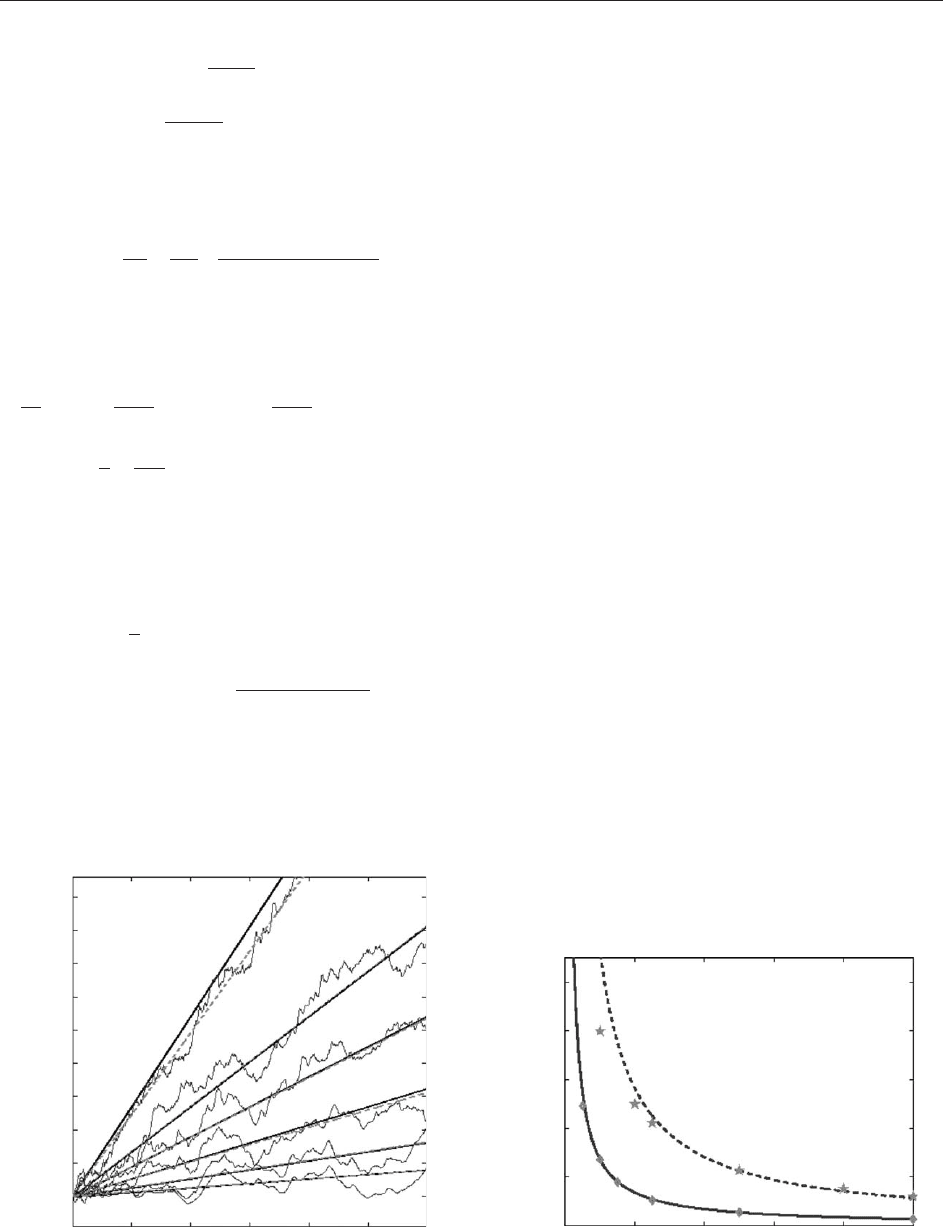
which have been obtained for L = 1 (Figures 2 and 3)
450
400
350
300
250
200
150
100
50
0
0 500 1000 1500 2000 2500 3000
M = 100
M = 50
M = 25
M = 15
M
= 5
M = 10
X(t )
t
(a)
(b)
0.5
0.4
0.3
0.2
0.1
0
0 20 40 60 80 100
M
V
stat
Figure 2 Evolution of the piston for L = 1, and p
= p
þ
= 1 as observed in simulations (stochastic line in (a), dots in (b)) compared
with prediction: (a) position X(t ) for T
þ
= 10; and (b) stationary velocity for T
þ
= 10 (continuous line) and T
þ
= 100 (dotted line), as a
function of M.
Adiabatic Piston 169
0
–2000
–4000
–6000
–8000
–10000
–12000
22.50 0.5 1 1.5 3 3.5
×10
4
t
X(t)
(a)
22.50 0.5 1 1.5 3
×10
4
t
′
0
–2000
–4000
–6000
–8000
–10000
X ′(t ′)
(b)
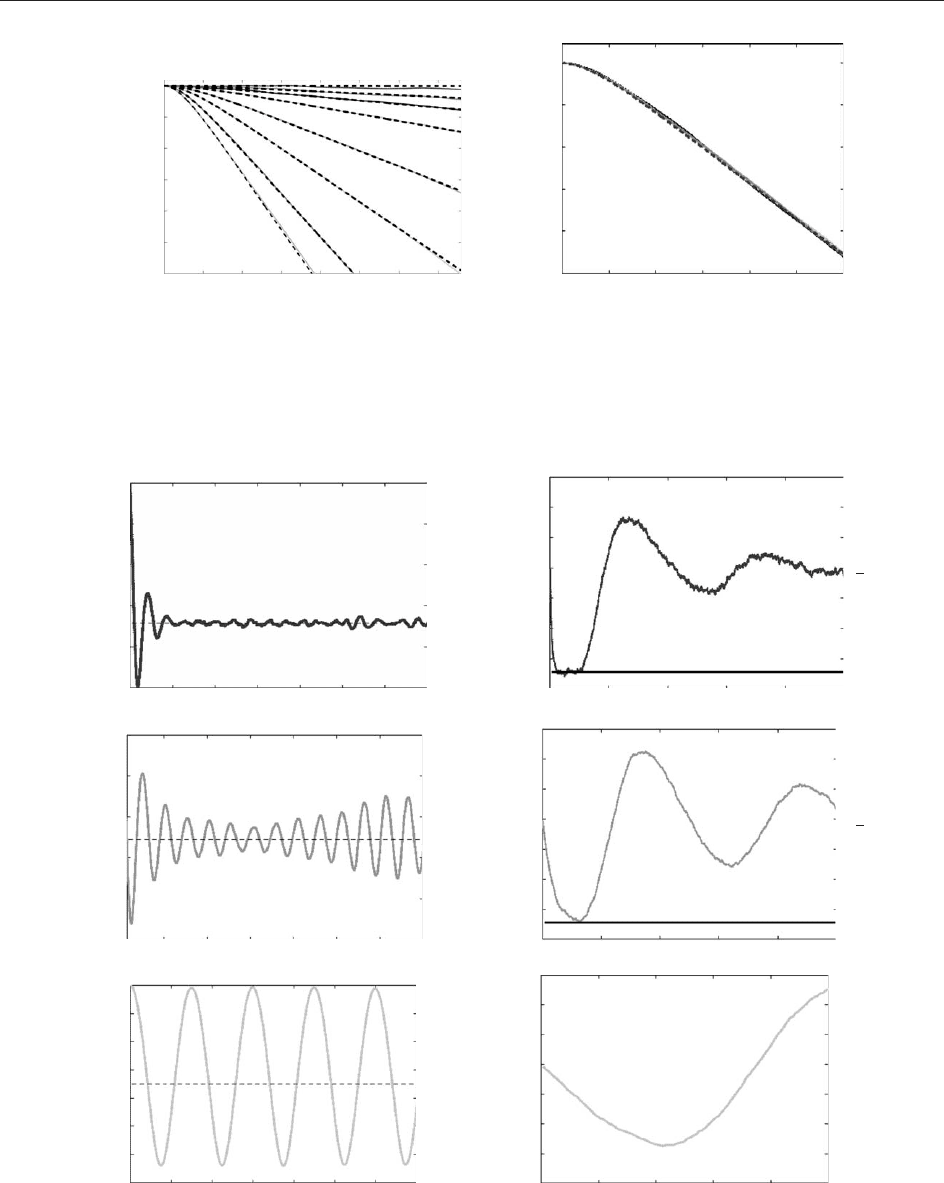
Figure 3 Evolution of the piston for L = 1, M = 10
4
, and p
þ
6¼ p
as observed in simulations (continuous line) compared with
predictions (dotted line): (a) p
= 1, p
þ
= p
þ p, from top to bottom p=p
= 0.05, 0.1, 0.2, 1, 2, 3; and (b) p
= , p
þ
= 2,
p=p
= 1; X
0
= X , t
0
= t, = 10
3
,10
2
,10
1
, 1, 10, 10
2
,10
3
,10
4
.
10
9.5
9
8.5
8
7.5
7
6.5
0 50 100 150 250200 300 350
t
X
ad
50 100 150 250200 300 350
X
ad
9.5
9
8.5
8
7.5
7
10
9.5
9
8.5
8
7.5
0
50
100
150
250
200 300 350
X
ad
100
20
30
40
50
t
– 0.2
–
0.15
– 0.1
–
0.05
0
0.05
0.1
0.15
10
0
20 30 40 50
–
0.4
–
0.3
–
0.2
–
0.1
0
0.1
0.2
0.3
V
10020304050
–
0.4
–
0.3
–
0.2
–
0.1
0
0.1
0.2
0.3
V(t )
X(t
)
(a) (b)
V
Figure 4 ‘‘Deterministic’’ evolution toward mechanical equilibrium for L < 1, M = 10
5
: (a) position X(t); one finds X
sim
ad
= 8.3 whereas
X
th
ad
= 8.42 and (b) velocity V(t); one finds
V
sim
= 0.343 whereas
V
th
= 0.3433. From top to bottom: R = 12: strong damping,
independent of R and M for R > 4 and M > 10
3
. R = 2: critical damping. R = 0.1: weak damping; damping coefficient increases with R
and !
0
ffiffiffiffi
R
p
for R < 1 but is independent of M for M > 10
3
.
170 Adiabatic Piston
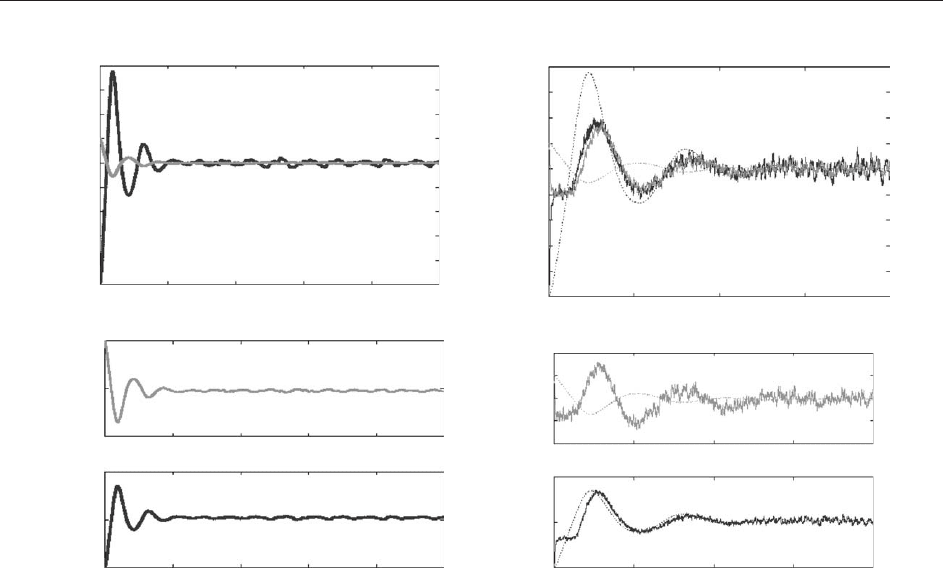
and for L < 1 approach to mechanical equilibrium
(Figures 4–6) and to thermal equilibrium (Figures 7
and 8).
Conclusions and Open Problems
In this article, the adiabatic piston has been
investigated to first order in the small parameter
m/M, but no attempt has been made to control the
remainder terms. For an infinite cylinder, no other
assumptions were necessary and the numerical
simulations (Figures 2 and 3) are in perfect agree-
ment with the theoretical prediction in particular for
the stationary velocity V
stat
, the friction coefficient
(V), and the relaxation time .
For a finite cylinder (L < 1) and in the thermo-
dynamic limit (M = 1), we were forced to introduce
the average assumption to obtain a set of autono-
mous equations. As we have seen when initially p
6¼ p
þ
, this limiting case also describes the evolution
to lowest order during the first two stages character-
ized by a time of the order t
1
= L
ffiffiffiffiffiffiffiffiffiffiffiffiffiffiffi
m=k
B
T
p
, where the
evolution is adiabatic and deterministic. In the first
stage, that is, before the shock wave bounces back on
the piston, the simulations confirm the theoretical
predictions. In particular, they show that if R > 4,
the piston will be able to reach and maintain for
some time the velocity V
stat
, whereas this will not be
the case for R < 1(Figure 4b). In the second stage of
the evolution, the simulations (Figure 4) exhibit
damped oscillations toward mechanical equilibrium
which are in very good agreement with the predic-
tions for the final state (X
ad
, T
ad
), the frequency of
oscillations and the existence of weak and strong
damping depending on R < 1orR > 4. Moreover,
the general behavior of the evolution observed in the
simulations as a function of the parameters was as
predicted. However, the damping coefficient of these
oscillations is wrong by one or several orders of
magnitude. To understand this discrepancy, we note
that using the average assumption we have related
the damping to the friction coefficient. However, the
simulations clearly show that those two dissipative
effects have totally different origins. Indeed, as one
can see with L = 1, friction is associated with the
fact that the density of the gas in front and in the
back of the piston is not the same as in the bulk, and
this generates a shock wave that propagates in the
fluid. For finite L, when R > 4, the stationary
velocity V
stat
is reached and the effect of friction is
10
9.5
9
0
50
100
150
200
250
0
1
2
1.5
50 100 150 200 250
T
+
(t )
av
T
–
(t )
av
t
p
±
av
050
1.2
1.4
1.6
1.8
2
2.2
2.4
2.6
2.8
3
100 150 200 250
× 10
5
020406080
1
0
20
40 60 80
2
1.5
8.5
9.5
10.5
10
9
T
–
(t)
surf
T
+
(t)
surf
t
1.2
1.4
1.6
1.8
2
2.2
2.4
2.6
2.8
3
×
10
5
p
±
surf
0
20
40 60 80
(a) (b)
Figure 5 Same conditions as Figure 4, R = 12: (a) average pressure and temperature in the fluid: p
av
(t) = 2E
n
=N
,
T
av
= E
=N
k
B
and (b) pressure and temperature at the surface of the piston. Prediction: T
ad
= 1.54, T
þ
ad
= 9.46, p
ad
= p
þ
ad
= 2.2.
Simulations: T
ad
= 1.52, T
þ
ad
= 9.48, p
ad
= p
þ
ad
= 2.2.
Adiabatic Piston 171
to transfer in this first stage more and more energy to
the fluid on one side and vice versa on the other side.
However, to stop the piston and reverse its motion,
only a certain amount of the transferred energy is
necessary and the rest remains as dissipated energy in
the fluid leading to a strong damping. On the other
hand, for R < 1, the value V
stat
is never reached and
all the energy transferred is necessary to revert the
motion. In this case very little dissipation is involved
and the damping will be very small. This indicates
that the mechanism responsible for damping is
associated with shock waves bouncing back and
forth and the average assumption, which corresponds
to a homogeneity condition throughout the gas,
cannot describe the situation. In fact, the simulations
(Figure 5b) indicate that the average assumption does
0.3
0.2
0.1
0
–5 0 5
0.3
0.2
0.1
0
–5
0
5
0.3
0.2
0.1
0
–5 0 5
0.3
0.2
0.1
0
–5
0
5
0.3
0.2
0.1
0
–5
0
5
0.3
0.2
0.1
0
–5
0
5
0.3
0.2
0.1
0
–5
0
5
0.3
0.2
0.1
0
–5
0
5
ρ
–
(υ)
υ
(a)
0
–5
0.05
0.1
0.15
0.2
0.25
0.35
0.3
–2.5 0 2.5 5
ρ
–
(υ)
υ
(b)
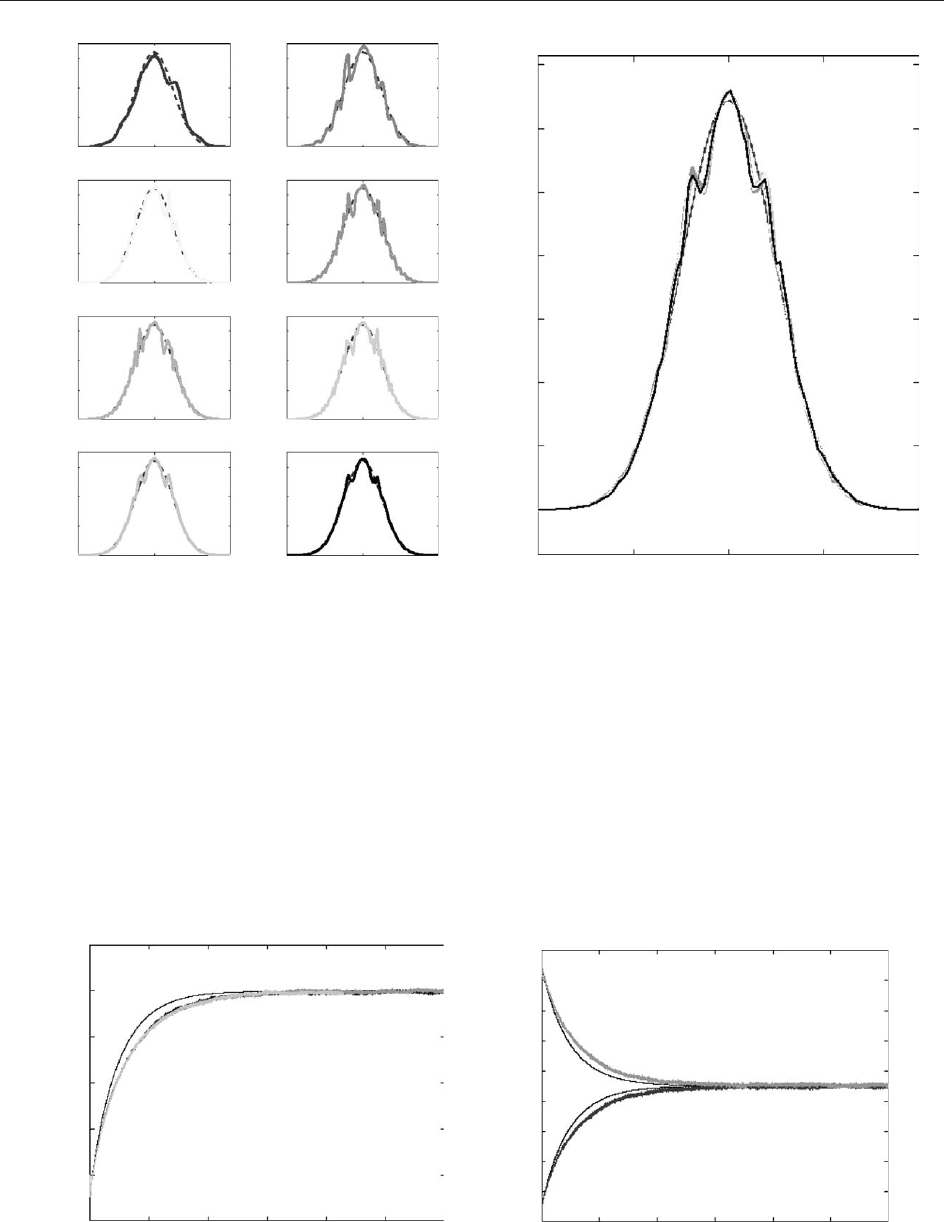
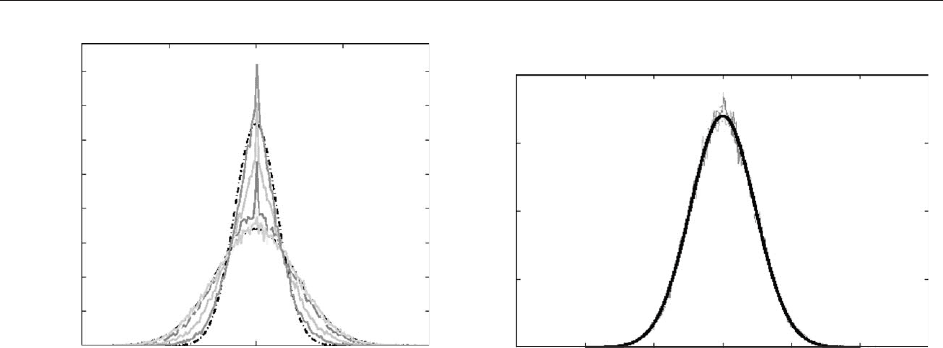
Figure 6 Velocity distribution in the left compartment. Same conditions as Figure 4, R = 12. Dotted line corresponds to Maxwellian
with T
= 1.52: (a) t = 12, 24, 36, 48, 60, 92, 144, 240 from top to bottom and (b) t = 276460.
0
5
10
15
20
25
35
30
50 100 150 200 250 300
X
τ = αt
(a)
1
2
4
5
7
6
8
9
10
3
T
±
0 50 100 150 200 250 300
τ = αt
(b)
Figure 7 Approach to thermal equilibrium, N
= 3 10
4
. The smooth curves correspond to the predictions, the stochastic curves to
simulations: (a) position X (), = t, no visible difference for M = 100, 200, 1000 and (b) average temperatures T
(), = t, M = 200.
172 Adiabatic Piston
not hold in this second stage. In conclusion, one is
forced to admit that to describe correctly the
adiabatic evolution, it is necessary to study the
coupling between the motion of the piston and the
hydrodynamic equations of the gas. Preliminary
investigations have been initiated, but this is still
one of the major open problems. Another problem
would be to study the evolution in the case of
interacting particles. However, investigations with
hard disks suggest that no new effects should appear.
To investigate adiabatic evolution, a simpler version
of the adiabatic piston problem, without any con-
troversy, has been introduced: this is the model of a
standard piston with a constant force acting on it.
In the third stage, that is, the very slow
approach to thermal equilibrium, another assump-
tion was necessary, namely the factorization
condition. The simulations (Figure 7) show a very
good agreement with the prediction, and in
particular the scaling property with t
0
= t=M is
perfectly verified. It appears that the small dis-
crepancy between simulations and theoretical
predictions could be due to the fact that, to
compute explicitly the coefficients in the equations
of motion, we have taken Maxwellian relations for
the velocities of the gas particles, which is clearly
notthecase(Figure 8a).
The fourth stage of the evolution, that is, the
approach to Maxwellian distributions ( Figure 8b), is
still another major open problem. Some preliminary
studies have been conducted, where one investigates
the stability and the evolution of the system when
initially the two gases are in the same equilibrium
state, but characterized by a distribution function
which is not Maxwellian.
Finally, let us mention that the relation between the
piston problem and the second law of thermodynamics
is one more major problem. The question of entropy
production out of equilibrium, and the validity of the
second law, are still highly controversial. Again,
preliminary results can be found in the literature.
Among other things, this question has led to a model of
heat conductivity gases, which reproduces the correct
behavior (Gruber and Lesne 2005).
See also: Billiards in Bounded Convex Domains;
Boltzmann Equation (Classical and Quantum);
Hamiltonian Fluid Dynamics; Multiscale Approaches;
Nonequilibrium Statistical Mechanics (Stationary):
Overview; Nonequilibrium Statistical Mechanics:
Dynamical Systems Approach.
Further Reading
Callen HB (1963) Thermodynamics. New York: Wiley.
(Appendix C. See also Callen HB (1985) Thermodynamics
and Thermostatics, 2nd edn., pp. 51 and 53. New York:
Wiley.)
Chernov N, Sinai YaG, and Lebowitz JL (2002) Scaling dynamic
of a massive piston in a cube filled with ideal gas: exact
results. Journal of Statistical Physics 109: 529–548.
Feynman RP (1965) Lectures in Physics I. New York: Addison-
Wesley.
Gruber Ch (1999) Thermodynamics of systems with internal
adiabatic constraints: time evolution of the adiabatic piston.
European Journal of Physics 20: 259–266.
Gruber Ch and Lesne A (2005) Hamiltonian model of heat
conductivity and Fourier law. Physica A 351: 358.
Gruber Ch, Pache S, and Lesne A (2003) Two-time-scale
relaxation towards thermal equilibrium of the enigmatic
piston. Journal of Statistical Physics 112: 1199–1228.
–10 –5 0
0
5
0.05
0.1
0.15
0.2
0.25
0.3
0.35
0.4
10
υ
–15 –10 –5 50
0
0.05
0.1
0.15
0.2
10 15
υ
(a) (b)
ρ
–
(υ)/n
–
ρ
–
(υ)/n
–
Figure 8 Approach to thermal equilibrium from T
ad
= 1.54 (dotted line in(a)) to T
f
= 5.5 (heavy line in (b)). Velocity distribution
function on the left for M = 200, N
= 5 10
4
. (a) = t = 2, 4, 14, 48, 92, 144 and (b) approach to Maxwellian distribution for >445.
Adiabatic Piston 173

Gruber Ch and Piasecki J (1999) Stationary motion of the
adiabatic piston. Physica A 268: 412–442.
Kestemont E, Van den Broeck C, and MalekMM (2000) The
‘‘adiabatic’’ piston: and yet it moves. Europhysics Letters 49: 143.
Lebowitz JL, Piasecki J, and Sinai YaG (2000) Scaling dynamics
of a massive piston in an ideal gas. In: Sza´sz D (ed.) Hard
Ball Systems and the Lorentz Gas, Encyclopedia of
Mathematical Sciences Series, vol. 101, pp. 217–227. Berlin:
Springer.
Van den Broeck C, Meurs P, and Kawai R (2004) From
Maxwell demon to Brownian motor. New Journal of Physics
7: 10.
AdS/CFT Correspondence
C P Herzog, University of California at Santa Barbara,
Santa Barbara, CA, USA
I R Klebanov, Princeton University, Princeton, NJ,
USA
ª 2006 Elsevier Ltd. All rights reserved.
Introduction
The anti-de Sitter/conformal field theory (AdS/CFT)
correspondence is a conjectured equivalence
between a quantum field theory in d spacetime
dimensions with conformal scaling symmetry and a
quantum theory of gravity in (d þ 1)-dimensional
anti-de Sitter space. The most promising
approaches to quantizing gravity involve super-
string theories, which are most easily defined in
10 spacetime dimensions, or M-theory which is
defined in 11 spacetime dimensions. Hence, the
AdS/CFT correspondences based on superstrings
typically involve backgrounds of the form AdS
dþ1
Y
9d
while those based on M-theory involve back-
grounds of the form AdS
dþ1
Y
10d
, where Y are
compact spaces.
The examples of the AdS/CFT correspondence
discussed in this article are dualities between
(super)conformal nonabelian gauge theories and
superstrings on AdS
5
Y
5
, where Y
5
is a five-
dimensional Einstein space (i.e., a space whose
Ricci tensor is proportional to the metri c,
R
ij
= 4g
ij
). In particular, the most basic (and maxi-
mally supersymmetric) such duality relates
N = 4 SU(N) super Yang–Mills (SYM) and type IIB
superstring in the curved background AdS
5
S
5
.
There exist special limits where this duality is
more tractable than in the general case. If we take
the large-N limit while keeping the ‘t Hooft coupling
= g
2
YM
N fixed (g
YM
is the Yang–Mills coupling
strength), then each Feynman graph of the gauge
theory carries a topological factor N
, wher e is
the Euler characteristic of the graph. The graphs of
spherical topology (often called ‘‘planar’’), to be
identified with string tree diagrams, are weighted by
N
2
; the graphs of toroidal topology, to be identified
with string one-loop diagrams, by N
0
, etc. This
counting corresponds to the closed-string coupling
constant of order N
1
. Thus, in the large-N limit
the gauge theory becomes ‘‘planar,’’ and the dual
string theory becomes classical. For small g
2
YM
N,
the gauge theory can be studied perturbatively; in
this regime the dual string theory has not been very
useful because the background becomes highly
curved. The real power of the AdS/CFT duality,
which already has made it a very useful tool, lies in
the fact that, when the gauge theory becomes
strongly coupled, the curvature in the dual descrip-
tion becomes small; therefore, classical supergravity
provides a systematic starting point for approximat-
ing the string theory.
There is a strong motivation for an improved
understanding of dualities of this type. In one
direction, generalizations of this duality provide the
tantalizing hope of a better understanding of
quantum chromodynamics (QCD); QCD is a non-
abelian gauge theory that describes the strong
interactions of mesons, baryons, and glueballs, and
has a conformal symmetry which is broken by
quantum effects. In the other direction, AdS/CFT
suggests that quantum gravity may be understand-
able as a gauge theory. Understanding the confine-
ment of quarks and gluons that takes place in
low-energy QCD and quantizing gravity are well
acknowledged to be two of the most important
outstanding problems of theoretical physics.
Some Geometrical Preliminaries
The d-dimensional sphere of radius L, S
d
, may be
defined by a constraint
X
dþ1
i¼1
ðX
i
Þ
2
¼ L
2
½1
on d þ 1 real coordinates X
i
. It is a positively curved
maximally symmetric space with symmetry group
SO(d þ 1). We will denote the round metric on S
d
of
unit radius by d
2
d
.
174 AdS/CFT Correspondence