
Francoise J.-P., Naber G.L., Tsun T.S. (editors) Encyclopedia of Mathematical Physics
Подождите немного. Документ загружается.


Speculations on Arithmetical Physics
In a lecture written for the 25th Arbeitstagung in
Bonn, Y Manin presented intriguing connections
between arithmetic geometry (especially Arakelov
geometry) and physics. The theme is also discussed
in Manin (1989). These considerations are based on a
philosophical viewpoint according to which funda-
mental physics might, like adeles, have Archimedean
(real or complex) as well as non-Archimedean
(p-adic) manifestations. Since adelic objects are
more fundamental and often simpler than their
Archimedean components, one can hope to use this
point of view in order to carry over some computa-
tion of physical relevance to the non-Archimedean
side where one can employ number-theoretic methods.
Adelic phy sics? Some of the results mentioned in
the previous sections seem to lend themselves well to
this adelic interpretation. The quantum statistical
mechanics of Q-lattices relies fundamentally on
adeles and it admits generalizations to systems
associated to other algebraic varieties (Shimura
varieties) that have an adelic descript ion and adelic
groups of symmetries. The result on the Polyakov
measure also has an adelic flavor, as it uses
essentially the Archimedean component of the
Faltings height function. The latter is in fact a
product of contributions from all the Archimedean
and non-Archimedean places of the field of defini-
tion of algebraic points in the moduli space, so that
one can expect that there would be an adelic
Polyakov measure, of which one normally sees the
Archimedean side only. The Freund–Witten adelic
product formula for the Veneziano string amplitude
fits in the same context, with p-adic amplitudes
B
p
ð; Þ¼
Z
Q
p
jxj
1
p
j1 xj
1
p
dx
and B
1
(, )
1
=
Q
p
B
p
(, ) (cf. Varadarajan
(2004)).
Adelic physics and motives A similar adelic philo-
sophy was taken up by other authors, who proposed
ways of introducing non-Archimedean and adelic
geometries in quantum physics. A recent survey is
given in Varadarajan (2004). For instance, Volovich
(1995) proposed spacetime model s based on
cohomological realizations of motives, with e´tale
topology ‘‘interpolating’’ between a proposed non-
Archimedean geometry at the Planck scale an d
Euclidean geometry at the macroscopic scale. In
this viewpoint, motivic L-functions appear as parti-
tion funct ions and actions of motivic Galois groups
govern the dynamics.
See also: Hopf Algebra Structure of Renormalizable
Quantum Field Theory; Mirror Symmetry: A Geometric
Survey; Quantum Ergodicity and Mixing of
Eigenfunctions; Random Matrix Theory in Physics;
Regularization for Dynamical Zeta Functions.
Further Reading
Beilinson A and Manin Yu (1986) The Mumford form and the
Polyakov measure in string theory. Communications in
Mathematical Physics 107(3): 359–376.
Bost JB and Connes A (1995) Hecke algebras, type III factors and
phase transitions with spontaneous symmetry breaking in
number theory. Selecta Mathematica (N.S.) 1(3): 411–457.
Broadhurst DJ and Kreimer D (1997) Association of multiple zeta
values with positive knots via Feynman diagrams up to 9
loops. Physics Letters 393(3–4): 403–412.
Cartier P (2002) Fonctions polylogarithmes, nombres polyzetas et
groupes pro-unipotents, Se´minaire Bourbaki, Vol. 2000/2001.
Aste´risque No. 282 (2002), Exp. No. 885, viii, 137–173.
Connes A, Marcolli M, and Ramachandran N (2005) KMS states
and complex multiplication. Preprint (to appear in Selecta
Mathematica), arXiv math.OA/0501424.
Degiovanni P (1994) Moore and Seiberg equations, topological
field theories and Galois theory. In: Leila S (ed.) The
Grothendieck Theory of Dessins D’enfants. Cambridge: Cam-
bridge University Press.
Julia BL, Moussa P, and Vanhove P (eds.) (2005) Frontiers in Number
Theory, Physics and Geometry, vols. I, II, Papers from the Meeting
held in Les Houches, March 9–21, 2003. Berlin: Springer.
Kreimer D (2000) Knots and Fe ynman Diagrams. Cambridge
Lecture Notes in Physics, vol. 13. Cambridge: Cambridge
University Press.
Lang S (1988) Introduction to Arakelov Theory. Berlin: Springer.
Manin Yu (1989) Reflections on arithmetical physics. In: Dita P
and Georgescu V (eds.) Conformal Invariance and String
Theory, pp. 293–303. Boston: Academic Press.
Manin Yu (1991) Three-dimensional hyperbolic geometry as
1-adic Arakelov geometry. Inventiones Mathematicae
104(2): 223–243.
Manin Yu and Marcolli M (2001) Holography principle and
arithmetic of algebraic curves. Advanced Theoretical and
Mathematical Physics 5(3): 617–650.
Moch S, Uwer P, and Weinzierl S (2002) Nested sums, expansion
of transcendental functions, and multiscale multiloop inte-
grals. Journal of Mathematical Physics 43(6): 3363–3386.
Moore G (1998) Arithmetic and attractors, hep-th/9807087.
Nahm W (2005) Conformal field theory and torsion elements of
the bloch group. In: Julia BL, Moussa P, and Vanhove P (eds.)
Frontiers in Number Theory, Physics and Geometry, vol. I.
Berlin: Springer.
Schneps L (ed.) (1994) The Grothendieck Theory of Dessins
d’enfants. Cambridge: Cambridge University Press.
Serre JP (1992) Motifs, in Journe´es Arithme´tiques, 1989 (Luminy,
1989). Aste´risque No. 198–200, (1991), 11, 333–349.
Stevenhagen P (2001) Hilbert’s 12th problem, complex multi-
plication and Shimura reciprocity. In: Class Field Theory – Its
Centenary and Prospect (Tokyo, 1998), 161–176, Adv. Stud.
Pure Math., 30, Math. Soc. Japan, Tokyo, 2001.
Varadarajan VS (2004) Arithmetic quantum physics: why, what
and whether. Proceedings of the Steklov Institute of Mathe-
matics 245: 258–265.
Volovich IV (1995) From p-adic strings to e´tale strings. Proceed-
ings of the Steklov Institute of Mathematics 203(3): 37–42.
Number Theory in Physics 607

O
Operads
J Stasheff, Lansdale, PA, USA
ª 2006 Elsevier Ltd. All rights reserved.
Introduction
An operad is an abstraction of a family of composable
functions of n variables for various n, useful for the
‘‘bookkeeping’’ and applications of such families.
Operads are particularly important and useful in
categories with a good notion of ‘‘homotopy,’’ where
they play a key role in organizing hierarchies of higher
homotopies, reflecting their original use as a tool in
homotopy theory, especially for studying (iterated)
loop spaces. For several years now, operads have
become increasingly important in mathematical
physics, especially in string field theory, where they
organize the terms of higher order in perturbed
actions, and in deformation quantization.
The major focus of this article will be on operads as
they are relevant to mathematical physics, but will also
include some background material from homotopy
theory, where they originated. A borderland where
homotopy theory and cohomological physics overlap is
the world of differential graded vector spaces, including
those of differential forms, ghosts, anti-ghosts, etc.,
sometimes lumped together as BRST theory. Here, as
elsewhere in contemporary mathematical physics, the
flow has been in both directions – sometimes physicists
have discovered or reinvented known mathematics but
finding new applications, at other times physics has
suggested new concepts for mathematicians to develop
further. In the case of operads, they have provided
general structure for varieties of algebras, some of
which are novel types contributed by physicists.
For a reasonably up-to-date introduction and
survey, consider Markl et al. (2002), although there
have been many developments since then. Two
particularly important original works are Boardman
and Vogt (1973) and May (1972).
Definitions and Examples
The term ‘‘operad’’ is due to May, building on work
of Stasheff and of Boardman–Vogt. The most
fundamental example of an operad is the endo-
morphism operad End
X
:= {Map(X
n
, X)}
n1
where,
for a set or topological space X, {Map(X
n
, X)}
means the set or space of functions or continuous
functions from the n-fold product of X with itself to
X, together with the operations
i
: MapðX
n
; XÞMapðX
m
; XÞ!MapðX
nþm1
; XÞ
given, for 1 i n,by
ðf
i
gÞðx
1
; ...; x
mþn1
Þ
¼ f ðx
1
; ...; x
i1
; gðx
i
; ...; x
iþm1
Þ; x
iþm
; ...Þ
In the endomorphism operad End
X
, there are
easily discovered relations involving iterated
i
-
operations and the symmetric group
n
actions on
the X
n
s. For example,
ðf
i
gÞ
j
h ¼ f
j
ðg
jiþ1
hÞ
for i j i þ m 1
if g is a function of m variables, since only the name
of the position for the insertion is changed.
An operad (O,
i
) consists of a collection
{O(n)}
n1
of objects and maps
i
: O(n) O(m) !
O(n þ m 1) for m, n 1andi n satisfying the
relations manifest in the example End
X
.
May’s original definition corre sponds to simulta-
neous insertions into all possible positions of inputs
into f 2 Map(X
n
, X). In most examples, the struc-
tures are ‘‘manifest’’ without appeal to the technical
definitions.
It helps to see graphic examples of operads,
particularly ones relevant for physics. Two kinds
that are particularly important are the tree operads
and the little disks (or cubes) operad s.
Let T (n) be the set of planar trees with one root
and n leaves labeled (arbitrarily) 1 through n. The
collection T = {T (n)}
n1
of sets of trees forms an
operad by grafting the root of g to the leaf of f
labeled i,asinFigure 1, where the leaves are
assumed labeled in order from left to right. Figure 1
can be interpreted as portraying the
4
result of
inserting a 3-linear operation into a 5-linear one.
The little n-disks operad D
n
= {D
n
(j)}
j1
where
D
n
(j) consists of an ordered collection of jn-disks
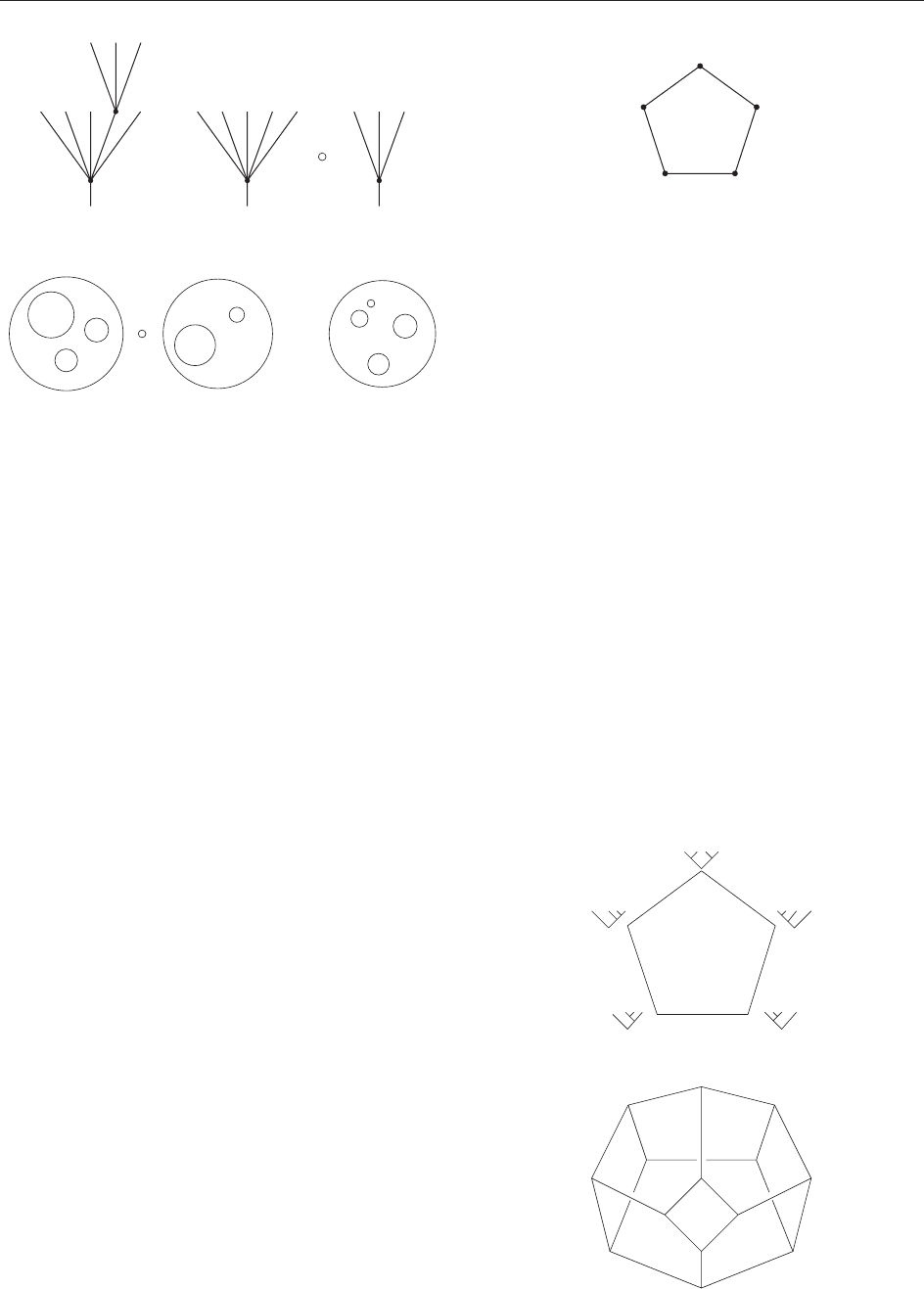
embedded in the standard n-dimensional unit disk
D
n
with disjoint interiors, the embedding being of
the form az þ b with 0 < a 2 R. The operations are
given as indicated in Figure 2.
Just as group theory without representations is
rather sterile, so are operads best appreciated by
their representations known as (varieties of) alge-
bras, especially algebras with higher homotopies.
An algebra A over an operad P ‘‘is’’ a map of
operad P !End
A
. This is just a compact way
of saying that an algebra A has a coherent system
of maps P (n) A
n
!A. Much of this article will
speak in terms of such algebras with the correspond-
ing operad being understood.
Operads in Homotopy Theory
A major motivation for the development of operads
was the desire to have a homotopy-invariant char-
acterization of based loop spaces and iterated loop
spaces. Precisely such coherent systems of higher
homotopies provided the answers. For based loop
spaces, the operad in question K= {K
n
}
n1
consists of
the polytopes known as ‘‘associahedra.’’ The usual
product of based loops is only homotopy associative.
If we fix a specific associating homotopy and
consider the five ways of parenthesizing the product
of four loops, there results a pentagon whose edges
correspond to a path of loops (Figure 3).
From the leftmost vertex to the rightmost, consider
the two paths of loops across the top or around the
bottom. By further adjustment of parameters, the
pentagon can be filled in by a family of such paths.
The associahedron K
n
can be described as a
convex polytope with one vertex for each way of
associating n ordered variables, that is, ways of
inserting parentheses in a meaningful way in a word
of n letters. The edges correspond to a single
application of an associating homotopy. More
generally, the cellular structure of the associahedra
is well described by planar rooted trees, the vertices
corresponding to binary trees and so forth (see
Figure 4).
For K
5
,seeFigure 5 or a rotatable image available at
http://igd.univ-lyon1.fr/chapoton/stasheff.html. The
facets are all products of two associahedra of lower
dimension and specific imbeddings can be given to play
theroleofthe
i
operations as in an operad.
An A
1
-space is a space Y which admits a coherent
family of maps
m
n
: K
n
Y
n
! Y
so that they make Y an algebra over the operad
(without
n
-actions) K= {K
n
}
n1
.
The main result by Stasheff is: A connected space
Y (of the homotopy type of a CW-complex) has the
homotopy type of a based loop space X for some
X if and only if Y is an A
1
-space.
Homotopy characterizat ion of iterated loop
spaces
n
X
n
for some space X
n
required the full
power of the theory of operads with the symmetries.
=
4
Figure 1 Grafting with the leaves numbered from left to right.
2
1
3
1
2
2
1
2
3
4
=
Figure 2 The little 2-disks operad.
(ab)(cd )
((ab)c)d
(a(bc))da((bc)d
)
a(b(cd
))
Figure 3 The associahedron K
4
:
Figure 4 K
4
with vertices labeled by trees.
Figure 5 The associahedron K
5
:
610 Operads

An early motivation for the invention of a theory
of operads was the consideration of infinite loop
spaces, that is, a sequence of spaces X
n
such that
each X
n
is homotopy equivalent to X
nþ1
.
Although introduced originally in the category of
topological spaces, operads were available almost
immediately for differential graded (dg) vector
spaces, also known as chain complexes. In physics,
the differential is often called a BRST operator, a
term that should be reserved for a special kind of dg
algebra, see below.
Operads in Algebra
The
i
notation first appeared in Gerstenhaber’s study
of the algebraic structure of the Hochschild cohomol-
ogy of an associative algebra, about the same time as
the construction of the associahedra where the opera-
tions were given in a less convenient notation. Recall
the Hochschild cohomology of an associative algebra
A is the homology of the complex Hom(A
n
, A)with
the coboundary given as follows (all signs below are
indicated as , any of the standard references will
specify conventions and signs): for f 2 Hom(A
n
, A)
and g 2 Hom(A
m
, A)let
f g ¼
n
1
f
i
g ½1
Gerstenhaber then defines his bracket as [f , g] = f g
g f . With hindsight, he realized that the
Hochschild coboundary can be written as
h ¼½m; h½2
where m : A A !A is the multiplication. More-
over, the associativity of m is equivalent to
½m; m¼0 ½3
A
1
-Algebras
In the setting of graded vector spaces V =
r2Z
V
r
,
there are two conventions for defining A
1
-algebras,
which differ by a shift in grading. We adopt the
physics convention so that A here is the suspension
of that considered in the original papers. The
cellular chains of the associahedra form the A
1
-
operad, providing the following definition.
Definition 1 A
1
-algebra (Strong homotopy asso-
ciative algebra). Let A be a Z-graded vector space
A =
r2Z
A
r
and suppose that there exists a collec-
tion of degree 1 multilinear maps
m :¼fm
k
: A
k
!Ag
k1
(A, m ) is called an A
1
-algebra when the multilinear
maps m
k
satisfy the following relation s:
X
pþq¼nþ1
X
p
i¼1
m
p
i
m
q
¼ 0 ½4
with an appropriate set of signs for n 1.
A weak A
1
-algebra consists of a collection of
degree 1 multilinear maps
m :¼fm
k
: A
k
! Ag
k0
satisfying the above relations, but for n 0 and in
particular with k, l 0.
Remark 1 The ‘‘weak’’ version is fairly new,
inspired by physics, where m
0
: C !A, regarded as
an element m
0
(1) 2 A, is related to what physicists
refer to as a ‘‘background.’’ The augmented relati on
then implies that m
0
(1) is a cycle, but m
1
m
1
need no
longer be 0, rather
m
1
m
1
¼m
2
ðm
0
1Þ m
2
ð1 m
0
Þ½5
Just as associativity was captured by the equation
[m, m] = 0, so the defining relations of the definition
of an A
1
-algebra are captured by
½m ; m ¼0 ½6
Decades later it was realized that consideri ng
T
c
A =A
n
as a coalgebra with
ða
1
a
n
Þ¼
pþq
ða
1
a
p
Þ
ða
pþ1
a
n
Þ
we then have an isomorphism
HomðA
n
; AÞ’CoderðT
c
AÞ
Here Coder is the space of all coderivations of T
c
A.
The Gerstenhaber bracket is indeed the ‘‘intrinsic’’
commutator bracket of coderivations via the above
isomorphism. As such, it satisf ies a graded version of
the Jacobi identity; after a shift in grading from the
original one of Hochschild, the Hochschild cochain
complex forms a dg Lie algebra.
L
1
-Algebras
Since an ordinary Lie algebra g is regarded as
ungraded, the defining bracket is regarded as skew-
symmetric. For dg Lie algebras and L
1
-algebras, we
need graded symmetry, which refers to symmetry with
signs determined by the grading. The basic operation is
: x y 7!ð1Þ
jxjjyj
y x ½7
Also we adopt the convention that tensor products
of graded functions or operators have the signs built
Operads 611

in; for example, (f g)(x y) = (1)
jgjjxj
f (x) g(y).
By decomposing each permutation as a product of
transpositions, there is then defined the sign of a
permutation of n graded elements, for example, for
any c
i
2 V,1 i n, and any 2 S
n
, the permuta-
tion of n graded elements is defined by
ðc
1
; ...; c
n
Þ¼ð1Þ
ðÞ
ðc
ð1Þ
; ...; c
ðnÞ
Þ½8
The sign (1)
()
is often referred to as the Koszul
sign of the permutation.
Definition 2 (Graded symmetry). A graded sym-
metric multilinear map of a graded vector space V to
itself is a linear map f : V
n
!V such that for any
c
i
2 V,1 i n, and any 2 S
n
(the permutation
group of n elements), the relation
f ðc
1
; ...; c
n
Þ¼ð1Þ
ðÞ
f ðc
ð1Þ
; ...; c
ðnÞ
Þ½9
holds.
Definition 3 By a (k, l)-uns huffle of c
1
, ..., c
n
with
n = k þ l is meant a permutation such that for i <
j k, we have (i) <(j) and similarly for k < i <
j k þ l. We denote the subset of (k, l)-uns huffles in
S
kþl
by S
k, l
and by S
kþl = n
, the union of the subsets
S
k, l
with k þ l = n. Similarly, a (k
1
, ..., k
i
)-unshuffle
means a permutation 2 S
n
with n = k
1
þþk
i
such that the order is preserved within each block of
length k
1
, ..., k
i
. The subset of S
n
consisting of all
such unshuffles we denote by S
k
1
,..., k
i
.
Definition 4 L
1
-algebra (Strong homotopy Lie
algebra). Let L be a graded vector space and suppose
that a collection of degree 1 graded symmetric linear
maps l := {l
k
: L
k
!L}
k1
is given. (L, l)iscalledan
L
1
-algebra iff the maps satisfy the following relations:
X
2S
kþl¼n
ð1Þ
ðÞ
l
1þl
ðl
k
ðc
ð1Þ
; ...; c
ðkÞ
Þ;
½c
ðkþ1Þ
; ...; c
ðnÞ
Þ¼0 ½10
for n 1.
A weak L
1
-algebra consists of a collection of
degree 1 graded symmetric linear maps
l:= {l
k
: L
k
!L}
l0
satisfying the above relations,
but for n 0 and with k, l 0.
Remark 2 The alternate definition in which the
summation is over all permutations, rather than just
unshuffles, requires the inclusion of app ropriate
coefficients involving factorials.
Just as an A
1
-algebra can be described as a
coderivation of T
c
A, similarly an L
1
-algebra L can
be described as a coderivation on S
c
L, the symmetric
subcoalgebra of T
c
A.
The operad of Lie algebras was defined rather
late, although it was earlier implicit in the work of
Fred Cohen. It is defined as the homology
H
n1
(Config(R
2
, n)) for n 1, where Config(R
2
, n)
denotes the configuration space of ordered n-tuples
of distinct points in R
2
. Equivalently, the configura-
tions can be thought of as the centers of the little
2-disks. The open disks being contractible to their
centers, this is a suboperad of the full homology
H
(D
2
).
Just as a Lie algebra is obtained from an
associative algebra using the commutator as bracket
and, inversely, a Lie algebra gives rise to its
universal enveloping associative algebra, an
L
1
-algebra can be obtained from an A
1
-algebra
by n-variabl e analogs of commutators and there
is a universal enveloping A
1
-algebra of a given
L
1
-algebra.
Open–Closed Homotopy Algebras
Open–closed string field theory suggests interaction
between an L
1
-algebra H
c
and an A
1
-algebra H
o
including a strong homotopy representation of H
c
on H
o
by strong homotopy derivations. Here is the
formal definition:
Definition 5 Let H= H
o
H
c
be a graded vector
space and (H
c
, l) be a weak L
1
-algebra. Consider a
collection of multilinear maps
n :¼fn
k;l
: ðH
o
Þ
k
ðH
c
Þ
l
!H
o
g
k;l0
each of which is graded symmetric on (H
c
)
l
.We
denote the collection also by n . We call (H, n , l)a
(partial) open-closed homotopy algebra (OCHA)
when n satisfies the following relations (up to some
factorial coefficients):
0 ¼
X
k;l0
X
mk
p¼0
X
2S
n
n
mþ1k;nl
ðo
1
; ...; o
p
;
n
k;l
ðo
pþ1
; ...; o
pþk
; c
ð1Þ
; ...; c
ðlÞ
Þ;
o
pþkþ1
; ...; o
m
; c
ðlþ1Þ
; ...; c
ðnÞ
Þ
þ
X
2S
n
X
n
l¼1
n
m;nþ1l
ðo
1
; ...; o
m
;
l
l
ðc
ð1Þ
; ...; c
ðlÞ
Þ; c
ðlþ1Þ
; ...; c
ðnÞ
Þ½11
Other Algebras of Interest
The Hochschild complex also has a graded product
(without invoking the shift) known as the cup
product. Except for the signs and the grading, the
bracket and the product satisfy the Leibniz rule of a
Poisson algebra on the cohomology; the result is
612 Operads
axiomatized as a ‘‘Gerstenhaber algebra.’’ However,
on the cochain complex, the Lie bracket and the
associative product are compatible only up to
homotopy.
This naturally raises the issue of an operad for
strong homotopy Gerstenhaber algebras. The operad
G for Gerstenhaber algebras is the homology of the
little disks operad, H
(D
2
). But now we have
choices: in addition to relaxing the Leibniz rule up
to homotopy, the bracket could be relaxed to be
part of an L
1
-algebra and/or the product could be
relaxed to be part of an A
1
-algebra. The choice
which is now known as the G
1
-operad is defined in
terms of a procedure which works for what are
known as quadratic operads, indicating they have
generators in O(2) and relations in O(3): the
corresponding O
1
has ‘‘dual’’ relations. For exam-
ple, this gives the classical Koszul duality between
Lie and commutat ive associative algebras. The G
1
-
operad can also be described as the ‘‘minimal
model’’ of G in the sense of Markl.
Another alternative is to consider just the ‘‘brace’’
operations, originally introduced by Kadeishvili and
later independently by Getzler, but described in the
Hochschild complex setting by Gerstenhaber–
Voronov. Together with the cup product, these
determine an operad denoted HG which acts on the
Hochschild complex; there is an operad map from
G
1
to HG, hence G
1
also acts on the Hochschild
complex. Finally, Tamarkin showed that G
1
is
quasi-isomorphic to the dg operad of singular chains
on the little disks operad, thus providing one of
several pr oofs of what had been a conjecture by
Deligne.
Algebras with invariant inner products < , >
are of considerable importance in mathematics and
especially in mathematical physics; invariance means
<a, bc > = < ab, c> or <a,[b, c] > = < [a, b], c> in,
respectively, the associative or the Lie case (with
appropriate signs in the graded case). Using the
inner product, n-ary operations A
n
!A can be
converted to operations A
nþ1
!C of which we can
require cyclic symmetry. To handle such algebras,
there is a notion of ‘‘cyclic operad.’’ In terms of
trees, the transition is to take a rooted tree and then
regard the root edge as just another leaf. This point
of view corresponds to an essential symmetry for
particle interactions.
Operads in Mathematical Physics
One reason for the explosive development of operad
theory in the 1990s was the introducti on of operadic
structures in field theories, for example, conformal
field theories (CFTs) and string field theories (SFTs).
These operadic structures were directly related to
the moduli spaces of Riemann surfaces with punc-
tures or boundaries (or other decorations) in these
physical theories.
Two special ‘‘higher-homotopy algebras’’ have
been emphasized because they are particularly
important in mathematical physics: A
1
for open-
string field theory and L
1
for closed-string field
theory and for deformation quantization. Open–
closed string field theory combines A
1
-algebra and
L
1
-algebra in a particular way known as an OCHA.
The operad for L
1
-algebras is given a very nice
and physically relevant geometric interpretation in
terms of a real compactification of the moduli space
of Riemann spheres with punctures, while for
OCHAs, there is a real compactification of the
moduli space of Riemann disks with punctures on
the boundary or in the interior (bulk). Thus , this
operad can be regarded as obtained from a moduli
space of configurations of points (punctures) in the
disk by compactifying the moduli spaces by adding
boundary strata where two (or more) points
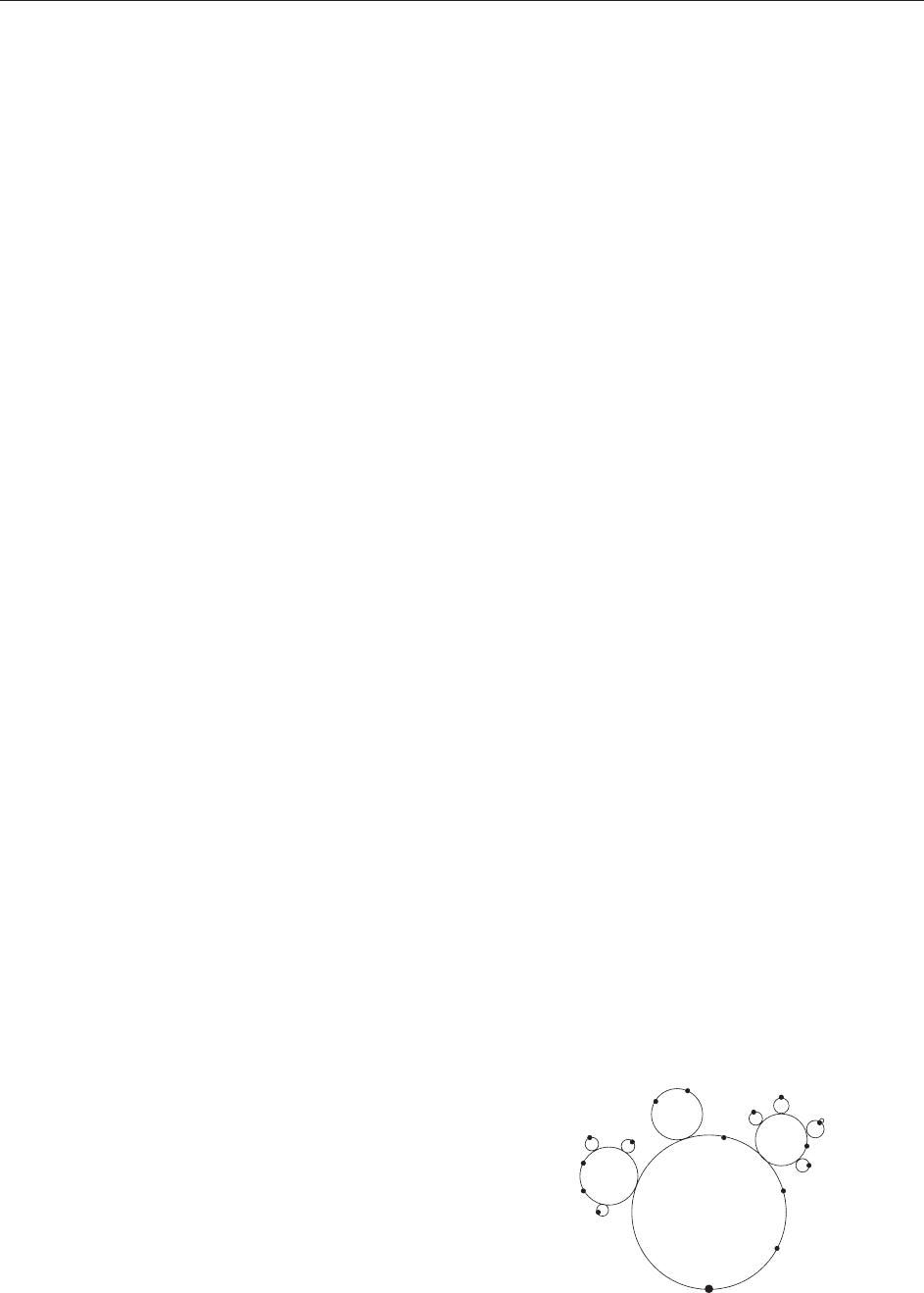
(punctures) collide. Points on the boundary strata
can be visualized as ‘‘bubble trees’’ of disks and/or
spheres, see Figure 6. Alternatively, the little disks
operad can be regarded as being obtained by
‘‘decorating’’ the points with little disks, while for
OCHAs there is also a basic half-disk decorated
with little disks in the bulk and little half-disks for
the boundary points. The corresponding colored
operad is Voronov’s ‘‘Swiss-cheese operad.’’
‘‘Colored’’ refers to the fact that disks can be
inserted into half-disks but not vice versa. Compare
trees with two ‘‘colors’’ of edges with grafts
restricted to ones which match colors.
On-Shell versus Off-Shell
In cohomological physics, the ‘‘on-shell’’ states or
observables are usually given by the cohomology
with respect to an internal differential, which in
physics is called the BRST differential or BRST operator,
though originally this meant the Chevalley–Eilenberg
differential associated to the action of the Lie algebra of
Figure 6 Bubble tree for circle configurations.
Operads 613

gauge symmetries of a physical theory. The generators
of the Chevalley–Eilenberg cochain complex are known
as ‘ ‘ghosts’’. On-shell subspaces of algebras which are
not closed under the product of the larger ‘ ‘off-shell’’
algebra are called ‘ ‘open’’ algebras by physicists. Quite
generally, this situation gives rise to an algebra over an
appropriate operad. A special case involves a differential
graded algebra A and a linear imbedding H(A) A.
The (co)homology is in turn a graded algebra (with 0 as
differential), but inherits a higher-homotopy structure
so that cohomology and original algebra are equivalent.
In the associative case, the inheritance is a result
of Kadeishvili:
Let (A, d) be a differential graded associative or
A
1
-algebra, then the homology H(A) inherits the
structure of an A
1
-algebra.
Even if the original algebra A is strictly associa-
tive, the inherited A
1
-structure generally has non-
trivial operations m
i
.
Analogous results hold for L
1
-algebras and
others. It is the L
1
-version that is relevant for
closed-string field theory (CSFT). Zwiebach showed
the quantum theory of covariant closed strings has
an action defined in terms of an infinite chain of
string field products. The genus-0 (tree level) string
field algebra is an L
1
-algebra inherited from the off-
shell state space modeled by the Batalin–Vilkovisky
(BV) construction. The higher-order brackets pro-
vide higher-order correlation or n-point functions
which play a crucial role in the extended Lagrangian
of the theory.
Batalin–Fradkin–Vilkovisky and Batalin–Vilkovisky
Constructions
The constructions of Batalin–Fradkin–Vilkovisky
(BFV) for constrained Hamiltonian systems and of
Batalin–Vilkovisky (BV) for Lagran gians with sym-
metries are important examples of L
1
-structures
derived from ‘‘open’’ algebra settings, though the
L
1
-structures were recognized quite a while after
the constructions.
The BFV setting is that of a symplectic manifold
W with a family of constraints, that is, a family of
functions
2 C
1
(W). The constraints are called
‘‘first class’’ if the ideal they generate is closed under
the Poisson bracket. The vector space spanned by
the constraints will in general be an open algebra;
the structure of the bracket is give n by structure
functions, rather than structure constants. The zero
locus of all the constraints forms the constr aint
surface V. In the first-class case, the constraints are
in involution and determine a foliation F of V. If the
space of leaves V=F is a manifold, it would be
considered the true physical space and the physical
observables would be functions in C
1
(V=F). BFV
construct a differential graded Poisson algebra such
that the cohomology in degree 0 agrees with
C
1
(V=F) when that makes sense and, in the regular
case, the rest of the cohomology is that of the
differential forms along the leaves of the foliation.
The BFV differential is a deformation of the
Chevalley–Eilenberg/BRST differential and can be
constructed most efficiently by the same techniques
used in proving Kadeishivili’s inheritance theorem.
Crucially, it is an inner derivation with respect to
the Poisson bracket. After the fact, an L
1
-structure
can be observed in the extended algebra.
For a Lagrangian with symmetries, BV develop a
similar construction, the main difference being that
there is no Poisson bracket initially, but one is
constructed by adjoining ‘‘anti-fields’’ as conjugate to
the fields but of ghost degree 1 and the differential of
an anti-field being the Euler–Lagrange expression for
the corresponding field. Then, as in the Hamiltonian
case, ghosts and anti-ghosts, etc. are adjoined and the
construction proceeds in a parallel fashion.
Deformation Quantization
Once algebras over an operad P are considered, it is
natural to consider also morphisms of such algebras
over a fixed P .
From a homotopy point of view, the appropriate
maps need not respect the operad structure strictly
but only up to higher homotopy; indeed, there is a
related operad to define such maps. For L
1
-
algebras, such L
1
-maps play a key role in deforma-
tion quantization. That refers to deformation of the
commutative multiplication of a Poisson algebra in
the direction of the Poisson bracket; that is, to first
order, the deformation is given by the bracket.
More generally, for any associative algebra A with
multiplication m, one considers formal deformations
a ? b ¼ mða; bÞþtm
1
ða; bÞþt
2
m
2
ða; b Þþ ½12
where each m
i
2 Hom( A A, A). The associativity
of ? provides a sequence of con straints on the m
i
.In
particular, m
1
must be a Hochschild cocycle and the
obstruction to the existence of m
2
is a class in the
Hochschild cohomology of degree 3. In fact, the
primary obstruction is represented by [m
1
, m
1
]. If it
is cohomologous to zero, that fact identifies candi-
dates for m
2
, that is,
½m
1
; m
1
¼2½m; m
2
½13
or, using the notation d = [m,],
dm
2
1=2½m
1
; m
1
¼0 ½14
614 Operads
once known as the integrability equation but now,
more frequently, as a Maurer–Cartan equation. For
a Poisson algebra, the Poisson bracket is a Hochs-
child cocycle but in general a full deformation need
not exist. However, for the algebra A of smooth
functions on a Poisson (e.g., symplectic) manifold
M, Kontsevich showed that such a full formal
deformation does exist.
The guiding philosophy is that deformations are
controlled by a dg Lie or L
1
-algebra L,uniqueupto
L
1
-homotopy equivalence. Therefore, the obstruc-
tions can be computed in any of the equivalent dg Lie
algebras. Moreover, the structure of the obstructions
is known sufficiently so that if there is an equivalent
dg Lie algebra with d in fact zero, then all the
obstructions to deformation quantization vanish. The
key to Kontsevich’s proof was the construction of an
L
1
-map, inducing an isomorphism in cohomology,
from the Lie algebra of polyvector fields on R
d
with
the Schouten bracket and d = 0totheLiealgebraof
multidifferential operators on A = C
1
(R
d
)regardedas
a subalgebra of the Hochschild cochain complex for A
with the Gerstenhaber bracket.
BV Algebras
In addition to their construction of a differential
graded Gerstenhaber algebra (a differential graded
commutative algebra with a compatible Poisson
bracket of degree 1), BV introduced a new mathe-
matical structure, adding a second-order differential
operator relating the commutative product and
the bracket. The operator is a derivation of the
bracket and of square zero. Moreove r,
½a; b¼ðabÞðaÞb aðbÞ½15
so that the failure of to be a derivation of the
product is given by the bracket.
The definition of a BV algebra is then a Gerstenhaber
algebra with such an operator, though alternative
definitions exist in which and the product are
primary and the bracket is defined by the above
equation. From the operadic/higher-homotopy point
of view, one can then go on to consider BV
1
algebras.
Recall that A
1
-algebras and L
1
-algebras (among
others) can be characterized by an ‘‘inner’’ coderiva-
tion d = [m, ] of square zero on an appropriate
‘‘standard’’ construction. In the context of BV
algebras, where the bracket is more commonly
written as {,}, the classical action is an element S
0
such that {S
0
, S
0
} = 0 or, equivalently, d = {S
0
, } is of
square zero. The quan tum analog S is a perturbation
of S
0
and satisfies instead
fS; Sg¼S ½16
This was originally called the ‘‘master equation,’’
but now is increasingly referred to as a ‘‘Maurer–
Cartan’’ equation.
Insertion Operads
There is another class of operads illustrated by trees
(and more generally graphs) with a very different
sort of ‘‘composition,’’ namely insertion of one
graph into another. The most directly relevant to
physics is the kind of insertion used by Connes and
Kreimer in their Hopf algebra constructed for
renormalization of Feynman diagrams. For example,
consider all finite graphs with exactly two external
edges and internal numbered edges. Given tw o
graphs
1
,
2
, define
1
i
2
by cutting edge i of
1
and identifying the dangling edges with the two
external edges of
2
.
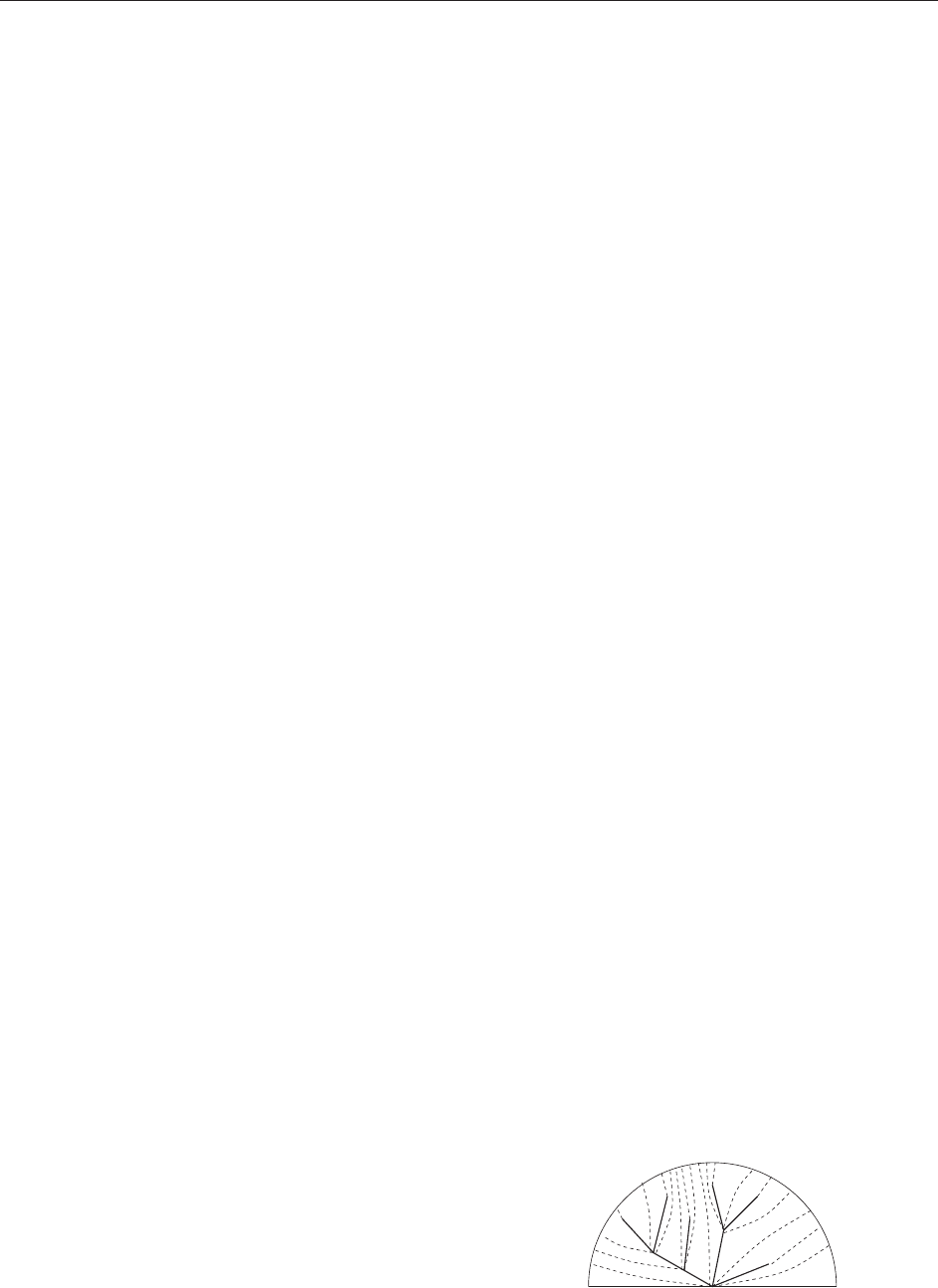
For planar trees, yet another insertion operad is
obtained by Chapoton, isolating a part of a structure
due to Kontsevich, in which a small neighborhood
of a vertex of the second planar tree is removed and
the dangling edges are attached to a vertex of the
first tree by entering through the angles between the
edges at that vertex (Figure 7).
Inside the HG-operad is the operad Brace for an
abstract brace algeb ra (forgetting the cup product),
first described as such by Chapoton using the
insertion operations of Kontsevich and Soibelman.
A
1
-Categories
Also of importance for applications to mathematical
physics is the notion of an A
1
-category, first made
explicit by Fukaya and now playin g a major role in
string D-brane theory and homological mirror
symmetry. The D-branes are the objects of the A
1
-
category and the open strings with boundaries on
two (possibly equal) D-branes B
1
, B
2
are the
morphisms from B
1
to B
2
. The operations m
i
are
defined only on tuples (a
1
, ..., a
i
) of ‘‘composable’’
morphisms (e.g., strings).
PROPs
While an operad is an abstraction of a family of
composable functions of n variables for various n,a
PROP is an abstraction of a family of functions in
Figure 7 Angles determined by edges with leaves extended to
the semicircle.
Operads 615

Hom(A
p
, A
q
)forallp and q. Now the relevant
images are graphs with p input legs and q output
legs with composition being defined by grafting
output legs of one graph to i nputs of another.
Feynman diagrams are the obvious example in
physics or, in conformal field theory, tubular
neighborhoods of such graphs, which is to say,
Riemann surfaces with boundary circles: p as
inputs and q as outputs.
See also: Algebraic Approach to Quantum Field Theory;
Batalin–Vilkovisky Quantization; Constrained Systems;
Deformations of the Poisson Bracket on a Symplectic
Manifold; Deformation Quantization; Deformation Theory;
Hopf Algebra Structure of Renormalizable Quantum Field
Theory; String Field Theory.
Further Reading
Batalin IA and Fradkin ES (1983) A generalized canonical
formalism and quantization of reducible gauge theories.
Physics Letters B 122: 157–164.
Batalin IA and Vilkovisky GS (1981) Gauge algebra and
quantization. Physics Letters B 102: 27–31.
Boardman JM and Vogt RM (1973) Homotopy Invariant
Algebraic Structures on Topological Spaces, Lecture Notes in
Mathematics, vol. 347. Berlin–New York: Springer.
Connes A and Kreimer D (2000) Renormalization in quantum
field theory and the Riemann–Hilbert problem, I: the Hopf
algebra structure of graphs and the main theorem. Commu-
nications in Mathematical Physics 210: 249–273, (hep-th/
9912092).
Fradkin ES and Vilkovisky GS (1975) Quantization of relativistic
systems with constraints. Physics Letters B 55: 224–226.
Fukaya K (1997) Floer homology, A
1
-categories and topological
field theory. In: Andersen J, Dupont J, Pertersen H, and Swan
A (eds.) Geometry and Physics, Lecture Notes in Pure and
Applied Mathematics, Notes by Seidel P, vol. 184, pp. 9–32.
New York: Marcel Dekker, Inc.
Gerstenhaber M (1963) The cohomology structure of an
associative ring. Annals of Mathematics 78: 267–288.
Getzler E (1995) Operads and moduli spaces of genus 0 Riemann
surfaces. In: Dijkgraaf R, Faber C, and van der Geer (eds.) The
Moduli Space of Curves, Progr. Math., vol. 129, pp. 199–230.
Boston: Birkha¨user.
Getzler E and Jones JDS (1993) n-algebras and Batalin–
Vilkovisky algebras. Preprint.
Getzler E and Jones JDS (1994) Operads, homotopy algebra and
iterated integrals for double loop spaces. Preprint, Department
of Mathematics, MIT; Department of Mathematics North-
western University, March 1994, hep-th/9403055.
Getzler E and Kapranov M (1994) Modular operads. Compositio
Mathematica 110: 65–126 (dg-ga/9408003).
Hinich V and Schechtman V (1993) Homotopy Lie algebras.
Advanced Studies in Soviet Mathematics 16: 1–18.
Lada T and Markl M (1995) Strongly homotopy Lie algebras.
Communications in Algebra 2147–2161 (hep-th/9406095).
Lada T and Stasheff JD (1993) Introduction to sh Lie algebras for
physicists. International Journal of Theoretical Physics 32:
1087–1103.
Markl M, Shnider S, and Stasheff J (2002) Operads in Algebra,
Topology and Physics, Mathematical Surveys and Mono-
graphs, vol. 96, MR 2003f: 18011. Providence, RI: American
Mathematical Society.
May JP (1972) The Geometry of Iterated Loop Spaces, Lecture
Notes in Mathematics, vol. 271. Springer.
Stasheff J (1963) Homotopy associativity of H-spaces, I, II.
Transactions of the American Mathematical Society 108:
293–312, 313–327.
Voronov AA (1999) The Swiss Cheese Operad, Contemp. Math.
vol. 239, pp. 365–373. Providence, RI: American Mathema-
tical Society.
Zwiebach B (1993) Closed string field theory: quantum action
and the Batalin–Vilkovisky master equation. Nuclear Physics
B 390: 33–152.
Zwiebach B (1998) Oriented open–closed string theory revisited.
Annals of Physics 267: 193–248 (hep-th/9705241).
Operator Product Expansion in Quantum Field Theory
H Osborn, University of Cambridge, Cambridge, UK
ª 2006 Elsevier Ltd. All rights reserved.
Introduction
The operator product expansion (OPE) provides an
algebraic structure in quantum field theory. In a
sense it supercedes or rather transcends the equal-
time commutation relations, which provide the
traditional starting point for the canonical quantiza-
tion of any quantum field theory. The essential idea
is that for any two local operator quantum fields at
spacetime points x
1
, x
2
their product may be
expressed in terms of a series of other local quantum
fields at a point x, which may be identified with x
1
or x
2
, times c-number coefficient functions which
depend on x
1
x
2
. The set of operators which may
appear depends on the particular quantum field
theory and must of course be in accord with any
requirements of conserved quantum numbers. The
coefficient functions depend on x
1
x
2
in a fashion
which depends on the dimensions of the various
operators involved, at least up to renormalization
group corrections. The most singular contributions
are those for the operators appearing in the OPE
with lowest scale dimension. From a phenomenolo-
gical point of view, only the first few terms in the
OPE are of relevance. However, theoretically,
especially for conformal field theories, it is desirable
to know the full expansion to all orders in powers of
x
1
x
2
in such a way that the operator product may
616 Operator Product Expansion in Quantum Field Theory