
Francoise J.-P., Naber G.L., Tsun T.S. (editors) Encyclopedia of Mathematical Physics
Подождите немного. Документ загружается.


be replaced by the full expansion in appropriate
correlation functions. We first discuss the OPE for
free theories and then the interacting case.
Free Field Theory
The OPE is most straightforward in free field theory
when it almost reduce s to a Taylor series expansion.
For a simple free massless scalar field (x) then in
four dimensions we may write
ðxÞð0Þ¼
C
x
2
þ : ðxÞð0Þ: ½1
where : : denotes normal ordering (moving all
annihilation operators to the right of creation
operators) and C is just a normalization numerical
constant (for canonical normalization C = 1=4
2
).
The 1=x
2
term proportional to the identity operator
reflects the leading singular behavior at short
distances of (x)(0), the power being determined
by having dimension 1. For the normal-ordered
term we may expand in terms of an infinite set of
local operators by using the Taylor expansion
:ðxÞð0Þ: ¼
X
1
n¼0
1
n!
x
1
x
n
:@
1
@
n
ð0Þð0Þ: ½2
where the operator appearing in the nth term has
dimension n þ2. Manifestly at short distances only the
leading terms are relevant. Equation [1] also provides a
point splitting definition of the local composite
operator :
2
(0): in terms of limit of (x)(0) as x !0
after subtraction of the singular C=x
2
term.
The OPE can be easily generalized to composite
operators defined by normal ordering. For :
2
:we
have, by applying Wick’s theorem,
:
2
ðxÞ::
2
ð0Þ: ¼
2C
2
x
4
þ
4C
x
2
:ðxÞ ð0Þ:
þ :
2
ðxÞ
2
ð0Þ: ½3
where Taylor series expansion may be applied to both
:(x)(0): and also :
2
(x)
2
(0): to give an infinite
sequence of local operators of increasing dimensions.
The expansion in terms of local operators may be
reordered. For instance, from [1] we may write,
using @
2
= 0,
ðxÞð0Þ¼
C
x
2
þ 1 þ
1
2
x
@
þ
1
4
x
x
@
@
þ
1
16
x
2
@
2
:
2
ð0Þ:
1
2
x
x
T
þ Oðx
3
Þ ½4
where
T
¼: @
@
:
1
4
:@ @: ½5
is the energy–momentum tensor. In [4], and also in a
similar context subsequently, we define @ :
2
(0): =
@
y
:
2
(y): j
y = 0
. The expansion [4] provides a point
splitting definition of T
and also demonstrates that
many operators appearing in the OPE are expres-
sible in terms of overall derivatives of lower-
dimension operators. We may also note that without
further input there is an ambiguity in the definition
of T
of the form
T
T
þ að@
@
1
4
@
2
Þ:
2
: ½6
In a conformal theory, however, we require
a = 1=6.
Interacting Theories
The OPE becomes an essential tool in the context
of interacting quantum field theories. For renorma-
lizable quantum field theories various results can be
proved to all orders in the standard perturbative
expansion and are naturally assumed to be prop er-
ties of the complete theory. In interacting theories
we may no longer use normal ordering to define
composite operators which, in general, have anom-
alous dimensions. The coefficient functions appear-
ing in the OPE also gain perturbative corrections but
these are constrained by renormalization group
(RG) Callan–Symanzik equations.
Again if we consider the simplest case of a massless
scalar theory as above but now with a renormalized
coupling constant g the leading terms in the expan-
sion of (x)(0) are of the form (here we assume a Z
2
symmetry under !, otherwise the operator
would be expected to appear in the OPE)
ðxÞð0Þ¼
Cðg;
2
x
2
Þ
x
2
þ Dðg;
2
x
2
Þ
2
ð0Þþ ½7
where is an arbitrary renormalization scale. This
arbitrariness is reflected in the RG equation
@
@
þ ðgÞ
@
@g
þ 2
ðgÞ
Cðg;
2
x
2
Þ¼0 ½8
At a fixed point (g
) = 0 this equation may be
solved with an arbitrary choice of normalization to
give C(g
,
2
x
2
) = (
2
x
2
)
(g
)
, which corresp onds
to the fields having a modified scale dimensi on
1 þ
(g
). In a similar fashion the coefficient
D(g,
2
x
2
)in[7] satisfies
@
@
þ ðgÞ
@
@g
þ 2
ðgÞ
2 ðgÞ
Dðg;
2
x
2
Þ¼0 ½9
where it is necessary to introduce a new anomalous
dimension function
2 (g) related to the composite
Operator Product Expansion in Quantum Field Theory 617

operator
2
. Although it is natural to label the
operator as
2
its definition in terms of the
elementary field is essentially only as given in
terms of the OPE [9]. At a fixed point again
D(g
,
2
x
2
) = k(
2
x
2
)
(g
)þ(1=2)
2
(g
)
, where the
coefficient k is determined by the scale of the
three-point function h(x)(y)
2
(0)i. In asymptoti-
cally free theories the RG equations show that at
short distances the coefficient functions tend to
those of free field theory but with calculable
logarithmic corrections. More generally, for a set
of operators {O
i
} the OPE has the form
O
i
ðxÞO
j
ð0Þ
1
ðx
2
Þ
p
X
k
C
ijk
ðg;
2
x
2
ÞO
k
ð0Þ½10
where p is determined by the free scale dimensions
of the O
i
and
@
@
þ ðgÞ
@
@g
C
ijk
ðg;
2
x
2
Þ
¼
X
n
kn
ðgÞC
ijn
ðg;
2
x
2
Þ
in
ðgÞC
njk
ðg;
2
x
2
Þ
jn
ðgÞC
ink
ðg;
2
x
2
Þ
½11
with
in
(g) the anomalous dimension matrix arising
from the mixing of composite operat ors.
An important aspect of the OPE is that the
coefficient functions may be calculated perturbatively,
essentially by applying the OPE in some suitable
correlation function. Essentially the OPE provides a
factorization between short-distance UV singularities
and nonperturbative effects. In a Feynman graph the
short distances in an operator product correspond to
the large-momentum behavior and power-counting
theorems allow a factorization up to calculable
logarithmic corrections. A detailed analysis depends
on the detailed technicalities of the proofs of renorma-
lization to all orders of perturbation theory.
The coefficient functions in the OPE should be
independent of any infrared or nonperturbative long-
distance effects (such as confinement in QCD).
However, the operators which appear in the OPE,
such as
2
above, may have nonzero expectation
values which are absent to all orders in perturbation
theory.
Perturbative Example
The general considerations can be illustrated by
considering a scalar field theory to lowest order in a
perturbative expansion. We consider a four dimen-
sional theory with a single scalar field and a
potential V() =
1
2
m
2
2
þ
1
24
g
4
. Using dimensional
regularization m
2
, as well as g, is treated as a
coupling with an associated -function
2 (g)m
2
.
With a mass term the operator
2
mixes with the
identity operator so that
ðD þ
2 ðgÞÞh
2
ð0Þi ¼
2
I
ðgÞm
2
D¼
@
@
þ ðgÞ
@
@g
þ
2
ðgÞm
2
@
@m
2
½12
where
2
I
reflects the mixing. At one loop order we
have
ðgÞ¼
3g
2
16
2
;
2
ðgÞ¼
g
16
2
;
2
I
ðgÞ¼
1
8
2
½13
and we may also set
(g)=0. In this case in the
operator product expansion (7) the coefficient C
also depends on m
2
x
2
and the RG equa tions [8] and
[9] are now modified to include the effects of mixing
DCðg; m
2
x
2
;
2
x
2
Þ¼m
2
x
2
2
I
ðgÞDðg;
2
x
2
Þ
D
2
ðgÞ
Dðg;
2
x
2
Þ¼0
½14
From lowest order perturbation theory with [13],
and using [14] to inclu de all orders in g ln
2
x
2
,we
have in this approximation
Cðg; m
2
x
2
;
2
x
2
Þ
¼
1
4
2
2m
2
x
2
g
1 þ
3g
32
2
ln
2
x
2
2=3
1 þ
3g
32
2
ln
2
x
2
1=3
1
!
Dðg;
2
x
2
Þ¼ 1 þ
3g
32
2
ln
2
x
2
1=3
½15
The operator product expansion then reproduces the
small x behavior of the two point function h(x) (0)iat
one loop, expanding C, D to first order in g,ifwetake
h
2
ð0Þi ¼
m
2
8
2
ln
m
þ OðgÞ½16
which is in accord with [12].Ifm
2
< 0 the symmetry
$ is broken and it is necessary to shift the field
= þ f ,with
2
= 6m
2
=g and the field f has a
mass m
f
with m
2
f
= 2m
2
. The operator product
expansion [7] with the same coefficient functions as in
[15] remains valid. The two point function h(x)(0)i,
which includes a nonperturbative term
2
,isagain
reproduced for small x at one loop now if
h
2
ð0Þi ¼
6m
2
g
m
2
2
2
ln
m
f
þ OðgÞ½17
but in this case it is necessary to expand D(g,
2
x
2
)
to O(g
2
) as a consequence of the leading 1=g term in
[17]. Note that both [16] and [17] contain the
nonperturbative dependance on ln m and ln m
f
which is present in the two point function.
618 Operator Product Expansion in Quantum Field Theory

Conformal Field Theories
When the -function vanishes and a quantum field
theory enjoys conformal invariance the operator
product expansion is a potentially convergent
expansion. It is natural to restrict to conformal
quasiprimary operators which do not mix with
lower scale dimensions unde r conformal transforma-
tions. If we consider, for instance, two scalar
operators with scale dimension
then the OPE
has the generic form
ðxÞð0Þ¼
1
x
2
þ
X
I
C
O
I
1
ðx
2
Þ
1=2
ð2
I
þ ‘Þ
C
ð‘Þ
I
ðx;@Þ
1
;...;
‘
O
I
1
;...;
‘
ð0Þ½18
where there is a sum over quasiprimary operators
O
I
1
,...,
‘
with scale dimension
I
and spin ‘ , so they
are symmetric traceless tensors of rank ‘. In the first
term in [18] the coefficient is chosen to be 1 by a
choice of normalization. The coefficients C
O
I
,
with a standard normalization for O
I
, are then
determined by the coefficients of the corresponding
three-point functions involving and O
I
.In[18]
C
(‘)
I
are differential operators which sum up the
contributions of all derivatives or descendants of the
quasiprimary operator O
I
. They can be explicitly
given in terms of an integral representation, for any
spacetime dimension, where the scale is fixed by
requiring for the leading term C
(‘)
I
(x,0)
1
,...,
‘
=
x
1
x
‘
– traces. The spectrum of operators
which appear is obviously a property of the
particular conformal field theory .
Ward Identities
If the theory has a symmetry with corresponding
conserved currents then there are Ward identities
which constrain the OPE of fields with the con-
served current. For a current J
a
then we have, in
d dimensions, the singular contribution in the OPE
is given by
J
a
ðxÞOð0Þ
1
S
d
x
ðx
2
Þ
ð1=2Þd
t
a
Oð0Þ½19
where t
a
are a set of matrix generators correspond-
ing to the symmetry acting on the fields O and S
d
is
the volume of the unit (d 1)-dimensional sphere,
S
4
= 2
2
. For a conserved current there are no
anomalous dimensions and the coefficient in [19],
which depends on the normalization for the current
J
a
, is chosen so that [Q
a
, O(0)] = t
a
O(0) with Q
a
the charge formed from J
a
. For the energy–
momentum tensor the operator there is an analo-
gous result. We consider the simpler case of a
conformal theory when the energy–momentum
tensor is both conserved and traceless and
T
ðxÞOð0ÞA
ðxÞOð0Þ
þ B
ðxÞ@
Oð0Þþ ½20
where A
(x) = O(x
d
)andB
(x) = O(x
dþ1
). As a
distribution A
(x) is ambiguous up to terms
proportional to
d
(x). If is the scale dimension
of O and s
are the Lorentz spin generators acting
on O the Ward identities then give
@
A
ðxÞ¼
d
þ C
þ
1
2
s
@
d
ðxÞ
A
ðxÞ¼C
d
ðxÞ
@
B
ðxÞ¼
d
ðxÞ
½21
where C
is a constant tensor reflecting the
arbitrariness in A
, it is immaterial as far as Ward
identities are concerned. We may choose
d
þ C
¼ 0 ½22
(If desired, we might also take A
0
(x) = A
(x) þ
(1=2)s
d
(x) in which case @
A
0
(x) = 0, A
0
[]
(x) =
(1=2)s
d
(x) but such an antisymmetric piece seems
unnatural). In general there is no unique form for
A
(x), as a consequence of the freedom of choice
for C
in [21]. However, for a scalar field O we
must have, for x 6¼ 0,
A
ðxÞ¼
d 1
1
S
d
d
x
x
x
2
1
ðx
2
Þ
ð1=2Þd
¼
ðd 1Þðd 2Þ
1
S
d
@
@
1
ðx
2
Þ
ð1=2Þd1
½23
with the overall scale determined by [21].
For the operator product of the current J
a
with
itself there is an additional term proportional to the
identity operator of the form
J
a
ðxÞJ
b
ð0ÞC
J
ab
2
x
x
x
2
1
x
2ðd1Þ
½24
where the coefficient C
J
, which determines the scale
of the two-point function for J
a
, is well defined
since the normalization of the current is determined
through the Ward identity. A similar result also
holds for the operator product of the energy–
momentum tensor with itself, with an overall
coefficient C
T
. In general, we may also write for
the operator product of two scalar fie lds O:
OðxÞOð0Þ C
O
1
x
2
C
O
C
T
S
d
d
d 1
1
ðx
2
Þ
ð1=2Þdþ1
x
x
T
ð0Þ½25
Operator Product Expansion in Quantum Field Theory 619

neglecting other contributions. The contribution of
the energy–momentum tensor does not therefore
introduce any new coefficient.
Two Dimensions
In two dimensions the OPE plays an essential role in
the discussion of conformal field theories. For a
Euclidean metric it is natural to use complex
variables z and
z. The energy–momentum tensor in
this case reduces to a chiral field T(z) and its
conjugate
T(
z). For the operator product with a
chiral field (z) with scale dimension ,
TðzÞð0Þ
z
2
ð0Þþ
1
z
0
ð0Þ½26
and, for the operator product of T with itself,
TðzÞTð0Þ
c
2z
4
þ
2
z
2
Tð0Þþ
1
z
T
0
ð0Þ½27
Here c is the Virasoro central charge, which plays a
critical role in the discussion of two-dimensional
conformal field theories, it is given by the two-point
function which follows from [27], hT(z)T(0)i=
(1=2)cz
4
.
In simple rational conformal field theories the
operators are organized into conformal blocks by
the infinite-dimensional extended conformal sym-
metry in two dimensions. This allows the full
spectrum of operators and their dimensions to be
determined and in consequence complete results for
the OPE to be found in many cases.
Further Remarks
The OPE reflects the locality properties of quantum
field theories and can be extended without difficulty
to curved space backgrounds. For a product
(x)(0), the separation x
2
may be replaced by a
biscalar at x and 0 but it is necessary to include in
the OPE contributions involving the background
Riemann tensor as well as the operator fields present
in flat space. There is also a generalization of the
OPE for superfields on superspace.
At a fundamental level although the OPE can be
derived to all orders in perturbation theory the
contribution of nonperturbative effects such as
instantons to the coefficients is not entirely clear.
Issues of associativity have yet to be fully analyzed.
There are also important applications to the
phemenonological analysis of QCD when assump-
tions about the OPE and saturation of sum rules can
lead to results for the vacuum expectation value of
gauge-invariant operators such as F
F
.
See also: Boundary Conformal Field Theory; Effective
Field Theories; Quantum Chromodynamics;
Renormalization: General Theory; Renormalization:
Statistical Mechanics and Condensed Matter;
Two-Dimensional Models.
Further Reading
Cardy J (1987) Anisotropic corrections to correlation functions in
finite size systems. Nuclear Physics B 290: 355.
Collins JC (1984) Renormalization: An Introduction to Renor-
malization, The Renormalization Group and the Operator-
Product Expansion. Cambridge: Cambridge University Press.
David F (1984) On the ambiguity of composite operators, I.R.
renormalons and the status of the operator product expansion.
Nuclear Physics B 234: 237.
Di Francesco P, Mathieu P, and Se´ne´chal D (1997) Conformal
Field Theory. New York: Springer.
Erdmenger J and Osborn H (1996) Conserved currents and the
energy–momentum tensor in conformally invariant theories
for general dimensions. Nuclear Physics B 483: 431.
Kadanoff LP (1969) Operator algebra and the determination of
critical indices. Physical Review Letters 23: 1430.
Novikov VA, Shifman MA, Voinshtein AJ, and Zakharov VI
(1985) Wilson’s Operator product expansion: can it fail?
Nuclear Physics B249: 445.
Wilson KG (1961) Non-Lagrangian models of current algebra.
Physical Review 179: 1499.
Wilson KG (1971) Renormalization group and strong interac-
tions. Physical Review D 3: 1818.
Optical Caustics
A Joets, Universite
´
Paris-Sud, Orsay, France
ª 2006 Elsevier Ltd. All rights reserved.
Introduction
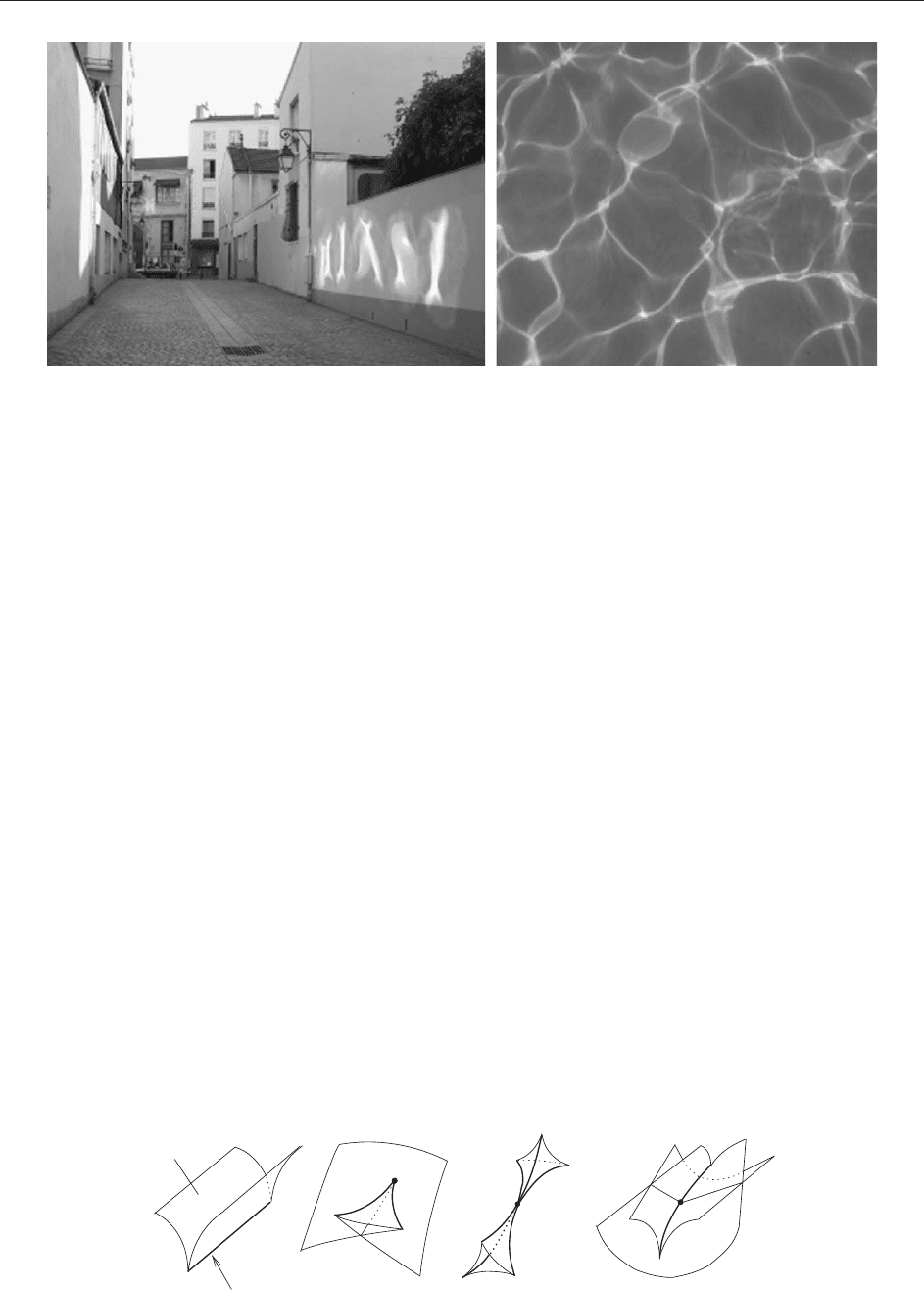
Optical caustics are the bright forms created by the
focalization, natural or artificial, of light (Figure 1).
Special caustic points, called focuses, are produced
by stigmatic optical systems in order to visualize
objects. However, there are no special conditions for
producing usual caustics. Every congruence of rays
always generates a caustic, more or less intricate.
Caustics have been observed and described since a
long time, tracing back to antiquity. The name itself
was coined after the Greek root ‘‘kausticos’’ mean-
ing burning and expressing that a high energy
density is produced by ray focalization at a caustic
point. Conceptually, they appeared in the literature
as ‘‘evolutes,’’ ‘‘envelopes,’’ ‘‘centers of curvature,’’
‘‘focals,’’ etc. However , these different approaches,
often too restricted, were unable to clarify the
620 Optical Caustics
general properties of caustics, for instance, their
classification in generic types. This difficult question
was solved only recently in the framework of the
singularity theory which appeared in the second half
of the twentieth century (Whitney 1955, Thom
1956). Caustics are now understood as physical
realizations of Lagrangian singularities, and they
are often called optical singularities or optical
catastrophes.
The aim of this introductory article is to show in
which sense caustics can be understood as singula-
rities, and to present their main properties.
The Physical Phenomenon
Caustics are usually observed by interposing a screen
on the ray trajectories and their trace in the screen
forms a set of bright curves called ‘‘fold’’ (A
2
).
Across the fold, the number of rays passing through
a given point jumps by 2. Two fold curves may
join at some point forming there a tip called cusp
(A
3
). A simple example is provided by the nephroid
that one sees in a cup of coffee when the light is
reflected off the cylindrical sides. In the three-
dimensional (3D) space, the folds form surfaces
and the cusps form curves (Figure 2). For particular
positions of the screen, three other types of caustics
may be observed: the swallowtail (A
4
), the meeting
point of two cusp lines; the elliptic umbilic (D
4
), the
meeting point of three cusp lines; and the hyperbolic
umbilic (D
þ
4
) where a cusp line tangentially meets a
fold surface (Figure 2). These five caustic types are
generic in the sense that any other type of caustic
point is unstable and decomposes into these generic
caustic points under small perturbations. The perfect
focus is an example of a nongeneric caustic point,
obtained by imposing a special symmetry. The
natural focusing of light, as in gravitational optics,
produces only generic caustics. A caustic point is
then a generalized focus. The caustic surface is a
complex surfa ce in the 3D physical space, generally
self-intersecting and possessing singular lines A
3
ending at singular points A
4
, D
4
,orD
þ
4
.
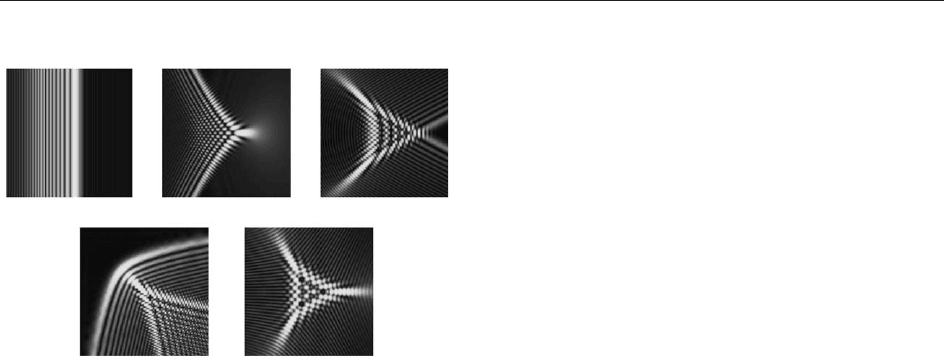
At the scale of the wavelength of the light, the
caustics have a more complex structure. Instead of
well-defined surfaces, lines and points, one observes
a system of interference fringes concentrated in
the vicinity of the geometrical caustic. Each type of
caustic point has its own diffraction pattern (also
called diffraction catastrophe) (Figure 3). These
interference systems are easily produced, for
instance, by focusing a coherent laser beam by a
Figure 1 Optical caustics may be produced by reflection (on window glasses) or by refraction (through the wavy surface of a
swimming pool). Here the light source, the Sun, has some angular extension and the caustic appears somewhat blurred.
_
Elliptic umbilic D
4
+
Hyperbolic umbilic D
4
Swallow tail A
4
Cusp A
3
Fold A
2
Figure 2 The five generic types of caustics of the 3D space.
Optical Caustics 621
corrugated glass or by a water droplet. An impor-
tant feature is revealed by Gouy’s experiment, in
which bright and dark fringes are inverted when the
rays are forced to pass through a focus (Guillemin
and Sternberg 1977). The experiment shows that the
wave undergoes a phase shift of =2 when the
associated ray passes through a caustic point.
So, caustics are fundamental objects of both the
geometrical optics and the wave optics.
Modeling Caustics
Because of the presence of a caustic, a congruence of
rays generally presents intersecting rays. At the
points of intersection, the coordinates q
1
, q
2
, q
3
of
the physical space R
3
are unable to distinguish the
various intersecting rays and they do not constitute a
convenient system of coordinates. It is then interest-
ing to construct an abstr act space in which the rays
are repre sented by nonintersecting curves. The initial
congruence is recovered by projecting the abstract
space into the physical one. All the models use this
type of construction in which the properties of the
caustics are deduced from those of the projection.
Caustics as Envelopes of Rays
In this geometrical modeling, each ray is labeled by
two parameters r
1
, r
2
, for instance, the coordinates on
the initial wave front W. A third coordinate r
3
specifies the points along the ray, for instance,
by assigning their distance to W. Taken together,
these three coordinates represent the congruence of
rays, and define a 3D space, the source space
M = {r
1
, r
2
, r
3
}. By construction, the rays in M do
not intersect. The coordinates (q
1
, q
2
, q
3
) of the
current point P 2 R
3
along each ray depend
differentiably on the coordinates (r
1
, r
2
, r
3
) and define
a ‘‘projection’’ f :(r
1
, r
2
, r
3
) 7!(q
1
, q
2
, q
3
) from the
source space M into the physical space R
3
.
The caustic points correspond to the envelope of
the rays. At a caustic point P, the energy density
flowing along the rays becomes infinite, since the
small volume delimited by neighboring rays is
shrunk into a small surface at P. This behavior
may be simply expressed with the help of the
projection f: the rank rk of the derivative Df is
equal to 2 at the point representing P in M. This
motivates the following definition. Given a map
f : M ! N, a point x 2 M is said to be critical (or
singular) if the rank of the derivative Df is less than
the maximal possible value min(dim M , dim N).
Here, dim M = dim N = 3, and a critical point is a
point where rk < 3. The set M of the critical
points is called the singular set. The caustic C is the
image of the singular set: C = f (). One also says
that the caustic points are the critical values of f.
In practice, the derivative Df is expressed by the
Jacobian matrix J = @(q
1
, q
2
, q
3
)=@(r
1
, r
2
, r
3
) and the
singular set is defined by solving the equation
detðJÞ¼0 ½1
If this equatio n permits one to express explicitly one
coordinate, say r
3
, as a function of the other two,
the caustic surfa ce C is found in parametric form:
q
1
= q
1
(r
1
, r
2
, r
3
(r
1
, r
2
)), etc. For a homogeneous
medium, equation [1] is of second degree in r
3
and
the caustic is composed of two sheets which meet at
the umbilic points D
4
.
Equation [1] gives all caustic points independently
of their nature, that is, it does not distinguish
between A
2
, A
3
, A
4
, D
4
,andD
þ
4
. A refinement
allows one to recognize different types of caustic
points. One defines the Thom–Boardman class
i
as
the points in M where Df has a kernel of dimension
i. Then one defines inductively the class
i, ..., j, k
as
the class
k
of the restriction of f to
i, ... , j
. Thus,
0
represents the regular points (noncaustic points),
1,0
the fold points A
2
,
1,1,0
the cusp points
A
3
,
1,1,1,0
the swallow-tail points A
4
, and
2,0
the
umbilics D
4
(hyperbolic or elliptic). Altogether, the
classes
I
, I 6¼ 0, form the singular set .
The Thom–Boardman classes constitute a simple
and powerful tool for computing the structure of a
caustic. Each class is obtained by canceling some
functional determinants associated with the map f or
with its restriction to some class. However, the
method presents the weakness of ignoring the
special nature of a set of rays: its Lagrangian
character. As a consequence, it is unable, for
instance, to distinguish between D
4
and D
þ
4
.
A
2
A
3
A
4
D
4
+
D
4
–
Figure 3 Interference fringes produced by the five generic
caustics of the 3D space (numerical simulation).
622 Optical Caustics

Caustics as Lagrangian Singularities
As for mechanics, the natural framework for geomet-
rical optics is a phase space: the cotangent space
T
R
3
= {p
i
, q
i
} of the configuration space R
3
= {q
i
}.
The phase space is characterized by its symplectic
structure, that is, the differential 2-form ! =
P
i
dp
i
^
dq
i
, which is nondegenerate and closed (d! = 0).
A set of rays in the phase space is defined by
specifying the wave vector (or momentum) p at
each point q of the congruence. In the simple case
where only one ray passes through each point, one
has p = r S ,whereS is the optical length
R
n ds and
n the refractive index. In other words, p is the
differential of the optical length. The wave vector
p is tangent to the ray and orthogonal to the
(geometrical) wave front S = const. The eikonal
equation shows that its modulus is n.Asadirect
consequence of the relation p = rS, the symplectic
form annihilates identically for these p. However,
in general, because of the presence of the caustics,
one must not expect to have p = rS for some
function S. Nevertheless, it is possible to keep
the more general property to annihilate !.This
motivates the definition of a Lagrangian submani-
fold: a submanifold L T
R
3
of dimension 3
(that is, half of the dimension of the phase space)
on which the symplectic form vanishes: !j
L
= 0.
Every congruence of rays is described by a
Lagrangian submanifold. The Lagrangian subma-
nifold plays the same role as the source space in
the preceding section. The role of the projection f
is played by the natural projection from the
phase space into the configuration space
(p, q) = q, or more precisely to its restriction to
L: f = j
L
. It is called a Lagrangian map (or
Lagrangian projection) and it is again a map
between two spaces of the same dimension (here
3). When L is given by an embedding : L ! T
R
3
,
one has f = . A caustic is then defined as the
setofcriticalvaluesofaLagrangianmap.
There exist two remarkable results showing that a
Lagrangian submanifold may be described in terms
of functions or of families of functions. As a
conseque nce, caustics are not dire ctly related to the
singularities of maps but,
",1,5 ,3,0,0pc,0 pc,0pc,0pc>G enerat ing funct ion of a
more particularly, to the
singularities of functions.
Lagrangian submanifold The 3D Lagrangian sub-
manifold L {p
i
, q
i
} is locally defined by three
coordinates p
( 2 A)andq
( 2 B) depending on
the three other ones p
and
q
: p
= p
(q
, p
), q
= q
(q
, p
). One can show
that this may be done in such a way that each
conjugate pair (q
i
, p
i
) gives exactly one independent
variable and one dependent variable. Formally:
A [ B = {1, 2, 3}, A \ B = ;.
In fact, introducing the function S(q
, p
) =
R
hp,dqihq
, p
i(h,i denotes the scalar product),
the local equation for L takes a more simple form:
q
¼
@S
@p
; p
¼
@S
@q
½2
The function S is well defined, since, by the
definition of a Lagrangian submanifold
R
hp,dqi is
locally path independent: it depends only on its end
points. S is called a (local) generating function.
Formula [2] generalizes p = rS, to which it
reduces when B = ;, that is, for nonintersecting rays.
",1,5,3,0,0pc,0pc,0pc,0pc>Generating family and
optical catastrophes Formula [2] may be rewritten
in an interesting way. Taking the jBj variables p
as
internal param eters x and q = (q
, q
) as external
parameters, we construct a function F of x para-
metrized by q: F(x, q) = S(q
, x) þhq
, x i. Now the
Lagrangian submanifold L is defined by
L ¼ðq; pÞ: 9x:
@F
@x
¼ 0; p ¼
@F
@q
F is called the generating family. The first equation
@F=@x = 0 determines the rays passing through the
fixed external parameter q 2 R
3
. The second one
distinguishes these rays according to their wave
vector p. Each ray corresponds to a critical point
(i.e., an extremum) of F considered as a function of
x. At a caustic point, two infinitely close rays are
converging and F then presents a degenerate critical
point. So the generating-family technique links the
caustics to the theory of singularities of functions
depending on some parameters, that is, to the
catastrophe theory (Thom 1969). Caustics are also
called optical catastrophes.
The generating families are not uniquely defined,
even locally. In optics, one may always take for F
the equivalent family ‘‘optical length’’ d, considered
as a function defined on the initial wave front W
(this is discussed in the following).
Caustics as the Locus of Wave Front Singularities
There exists a remarkable duality linking rays and
wave fronts. As a consequence, the caustic points
(i.e., Lagrangian singularities) are related to singula-
rities of wave fronts (i.e., Legendrian singularities). A
typical wave front W may possess only two types of
singularities: cuspidal curves and swallow-tail points.
During the motion of W, governed by the eikonal
equation, the cuspidal curves generate surfaces, and
Optical Caustics 623

swallow tails generate curves. These surfaces are
exactly the fold surfaces of the caustic C and the
curves are the cusp lines of C. The point singularities
of the caustic, that is, the swallow tails and the
umbilics, correspond to bifurcations of the instanta-
neous wave front, at certain moments of its motion.
Caustics as Short Wave Asymptotic
The fine observation of the optical caustics shows
that they never appear as the well-defined surfaces
given by the geometrical optics, but rather as
diffraction patterns concentrated around these sur-
faces. So wave optics is the natural framework
to account for this fundamental feature. One
exploits the fact that the wave number k = 2=
(: wavelength of the light) is a large parameter.
This short-wave approximation permits the use of
powerful expansion techniques and clarifies the
relation with the geometrical optics viewpoint,
formally obtained for k tending to infinity.
The stationary phase In the most simple model,
the Huygens–Fresnel principle, the amplitude U(P)
of the optical field may be evaluated by adding the
secondary disturbances emitted from the points Q of
some initial wave front W:
UðPÞ¼c
ZZ
W
e
ikd
d
G ds ½3
where d is the distance QP. G is the inclination factor,
a smooth function defined on W and c some
prefactor. For simplicity, G and n (the refractive
index) are assum ed to be constant. Defining
a = cG=d, formula [3] appears as an integral of the
form
R
a(y)e
ik(y)
dy. This type of integral may be
evaluated for large k by the method of stationary
phase. The principal contributions are due to points
where the phase is stationary: r = 0. For wave
optics, is the length PQ, considered as a fun ction of
Q and parametrized by P. The stationary condition
means that PQ is normal to W, that is, it represents a
ray of geometrical optics. The function PQ is a
generating family in the sense of the discussion earlier.
If no stationary points exist, that is, if P is in the
shadow, the integral is O (k
N
) for any N. Other-
wise, and if the critical points are not degenerate,
the phase stationary method gives (Guillemin and
Sternberg 1977):
UðPÞ¼
2
k
X
rays PQ
e
ð1]Þi=2
aðQÞe
ikd
jð1
1
dÞð1
2
dÞj
1=2
þ Oðk
2
Þ½4
where
1
1
and
1
2
are the two principal radii of
curvature at Q 2 W, and ] the number of caustic
points (also called focal points) along the ray PQ.
In the stationary-phase approach, the caustic C,
locus of centers of curvature of W, appears as an
obstacle in constructing asymptotics, since formula [4]
diverges when d
i
! 1, that is, when P tends to C.
It is, nevertheless, remarkable that C also appears
explicitly when [4] is valid, via the
i
’s and ].In
particular, the term e
]i=2
, applied in the case of a
focus (] = 2), accounts for the phase shift of observed
in Gouy’s experiment.
Asymptotics on caustics Uniform asymptotic for-
mulas, valid also on the caustic, need a more complex
theoretical framework, for instance, Maslov’s theory,
presented here in a necessarily simplified version (see
Maslov and Fedoriuk (1981) for more detail).
The starting point is the equation of wave optic s,
that is, the Helmholtz equation
ð þ k
2
n
2
ÞU ¼ 0 ½5
where the refractive index n gen erally varies from
point to point. For k !1, one looks for an
asymptotic solution in the (tentatively) form:
UðPÞ¼e
ikSðq
1
;q
2
;q
3
Þ
X
1
j¼0
ðikÞ
j
’
j
ðq
1
; q
2
; q
3
Þ½6
Inserting this form in eqn [5] one obtains the eikonal
equation (or characteristic equation) for the phase S:
ðrSÞ
2
¼ n
2
and an infinite series of equations for the amplitudes
’
j
, called the transport equations. One knows that
the Cauchy problem for the eikonal equation may be
reduced to the integration of the corresponding
Cauchy problem for the Hamilton system (or
bicharacteristic system):
dq
dt
¼
@H
@p
¼ 2p;
dp
dt
¼
@H
@q
¼rn
2
where H = hp, p in
2
. Its solutions, the bicharac-
teristics q(t, ), p(t, ) are parametrized by the
‘‘time’’ t and the 2D parameter parametrizing the
points on the initial wave front W. The bicharacter-
istics form a 3D Lagrangian submanifold L in the
phase space {p
i
, q
i
} and one recovers the preceding
situation. Assuming L to be simply connected, one
defines a global phase function S on L by formula
S(t, ) =
R
hp,dqi.
In a domain
j
L not containing the singular set
and in which the coordinates t, are in a one-to-one
correspondence with the physical coordinates, S
624 Optical Caustics

becomes a function of q
i
. Using the transport equation,
one finds the leading term of the asymptotic solution
(with accuracy to k
1
) in the following form:
UðPÞ¼ðKð
j
Þ’ÞðqÞ
¼
ffiffiffiffiffiffiffiffiffiffi
d
dq
i
s
e
ikSðq
1
;q
2
;q
3
Þ
’ðq
1
; q
2
; q
3
Þ½7
where d and dq
i
, respectively, represent the
measures on the Lagrangian submanifold and on
the physical space. The amplitude ’ depends on the
initial conditions. Formula [7] defines a precanoni-
cal operator K(
j
). It has the same form as [4], with
the same drawback to diverge near the singular set
, where dq
i
= 0.
In a domain
j
containing the singular set, L is
locally param etrized by mixed coordinates q
, p
.
The basic idea is then, roughly speaking, to carry
out a Fourier transform F
k
with respect to these p
(in fact, a variant of the usual Fourier transform, in
which the parameter k appears in the prefactor and
in the phase term). This leads one to consider,
instead of L=þ k
2
n
2
, the operator
^
L= F
k
LF
1
k
,
and instead of U, the unknown function V = F
k
U.In
this Fourier space, V may be found in the same way
as U was found in the preceding case, with S
replaced here by the local genera ting function
S
j
(q
, p
) = S hq
, p
i. Coming back to the real
space by F
1
k
, one obtains (with the same accuracy):
UðPÞ¼ðKð
j
Þ’ÞðqÞ
¼ F
1
k
ffiffiffiffiffiffiffiffiffiffiffiffiffiffiffiffiffiffiffi
d
dp
dq
s
e
ikS
j
ðq
;p
Þ
’ðq
; p
Þ
"#
½8
There is no divergence in this local solution. So local
short-wave asymptotics may be found everywhere,
even on the caustic where they have a more complex
form than the form [6] or [7].
Global asymptotics and Maslov’s index The global
asymptotic solution is obtained by formally gluing
the local solutions by a partition of unity e
j
= 1
subordinate to a covering {
j
}ofL. However there
is a difficulty. The representations of the same
precanonical operator in different local coordinates
q
, p
, even not containing the singular set, agree
only up to a constant multiplier e
im=2
, where the
integer m is the number of negative eigenvalues of
some matrix. One is led to multiply every precano-
nical operator by a convenient pha se factor e
i=2
,
where 2 Z
4
is called Maslov’s index. The coher-
ency of the phase factor in different domains is
realized by using the important property of to be
co-oriented. Thus, counts the number of passages
of an oriented path on L from the negative side of
to its positive side, minus the number of passages in
the opposite sense. Maslov’s index is locally con-
stant and jumps by 1 only across the singular set
. The global canonical operator is now formally
defined as K =
j
e
i
j
=2
K(
j
)e
j
.
Finally, the canonical operator K is well defined
only if it is independent of the {
j
}ande
j
used for its
definition. This possibility is expressed (in the case of a
simply connected L) by the following property,
intrinsically attached to L: the Maslov index cancels
on every closed loop. So the only obstruction for global
asymptotics is the nontriviality of the characteristic
class defined by Maslov’s index and not the caustic.
The central object of the caustic modeling is then
the projection of the submanifol d representing the
rays ( M or L) into the physical space. The possibility
to reduce this projection to some normal form is the
key result for the local classification of caustics.
Local Classification of Caustics
Equivalence, Stability, and Genericity
In order to distinguish different types of singula-
rities, one has to define an equivalence relation. Two
Lagrangian maps f
i
: T
M
i
L
i
! M
i
(i = 1, 2), are
said to be Lagrange equivalent if there is a
diffeomorphism h : T
M
1
! T
M
2
preserving both
the symplectic and the fiber structures, and sending
L
1
to L
2
. In fact, only the local problem of
classification makes sense, and one considers,
instead of Lagrangian maps, germs of Lagrangian
maps. A map germ is a map locally defined, that is,
defined in an infinitely small neighborhood around a
point (depending on the germ). The notion of
Lagrange equivalence is extended to the germs. A
Lagrangian singularity is then the Lagrange equiva-
lence class of a germ at a critical point. Each
equivalence class represents a type of Lagrangian
singularity, that is, a type of caustic point.
The example of the perfect focus point shows that
there exist singularities which are totally unstable. In
this sense, they correspond to idealized situations not
physically realizable, and they have to be disregarded.
Conversely, stable singularities resist under the action
of small perturbations. They correspond to Lagrangian
germs for which all neighboring germs are Lagrange
equivalent (not necessarily at the same point, but near
the point considered).
Now the important question is: do the stable germs
represent the generality? In the best case, stable germs
form a dense open set. This means that every germ may
be approximated by stable germs. In this case, one says
that the stable germs are generic.
Optical Caustics 625

Stability and genericity are disctinct notions. It
turns out that they coincide for low values of the
dimension n of the ‘‘physical space’’ (n < 6), but
they may disagree at higher dimensi ons.
Classification of Stable Caustics
The fundamental result of the theory is the local
classification of Lagrangian singularities (Arnol’d
1972). With the help of the generating families, the
study of Lagrangian singularities is reduced to the
study of singularities of families of functions. More
precisely, at a singular point, every stable Lagragian
map is equivalent to one of the following maps,
given by their generating function S and by their
generating family F:
A
2
: S ¼ p
3
1
F ¼ x
3
þ q
1
x
A
3
: S ¼p
4
1
þ q
2
p
2
1
F ¼x
4
þ q
1
x
2
þ q
2
x
A
4
: S ¼ p
5
1
þ q
2
p
3
1
þ q
3
p
2
1
F ¼ x
5
þ q
1
x
3
þ q
2
x
2
þ q
3
x
D
4
: S ¼ p
3
1
p
1
p
2
2
þ q
3
p
2
1
F ¼ x
2
1
x
2
x
3
2
þ q
1
x
2
2
þ q
2
x
2
þ q
3
x
1
These polynomial functions are called normal forms.
The stable singularities are generic. In other words,
every other type of singulari ty is destroyed by
infinitely small perturbations and gives a set of
singularities belonging to the list. The five generic
caustics have been observed and experimentally
studied in detail (Berry and Upstill 1980, Nye 1999).
By inserting the normal forms S in a short-wave
asymptotic, one obtains the diffraction patterns
associated with the five caustic types (Figure 3).
They generalize the Airy function which corresponds
to the fold singularity.
The normal forms describe at once the geometry
of the caustics and the interference systems around
them.
Codimension, Corank, Multiplicity, and Index
Lagrangian singularities are also characterized by
some numbers. They have a codimension c equal
to the difference between the dimension of the
physical space and their dimension: c(A
2
) = 1,
c(A
3
) = 2, c(A
4
) = c(D
4
) = 3. They have a corank ck,
equal to the difference between the dimension of the
space and the rank of the Lagrangian map:
ck(A
2
) = ck(A
3
) = ck(A
4
) = 1, ck(D
4
) = 2. The corank
is the number of internal parameters of the generating
family F. They also have a multiplicity , which is the
number of nondegenerate critical points of F, that is,
the number of rays coinciding at the singularity. In
the 3D space, one has = c þ 1: (A
2
) = 2, (A
3
) = 3,
(A
4
) = (D
4
) = 4.
Short-wave asymptotics near the caustic present
remarkable scaling properties (Berry and Upstill
1980). In particular, the amplitude jU(P)j increases
like k
as k !1. The number depends only on the
type of the singularity and it is called the singularity
index. The more ‘‘degenerate’’ the singularities, the
larger the index, and then the brighter the caustic
point: (A
2
) = 1=6 <(A
3
) = 1=4 <(A
4
) = 3=10 <
(D
4
) = 1=3.
Global Organization of Caustics
The global properties of caustics are less under-
stood than the local ones. There is, nevertheless,
an interesting result concerning specifically the
caustics in the 3D space (Chekanov 1986). Given
a Lagrangian map f : L ! R
3
, the Euler character-
istic () of the singular set L and the number
]D
4
(1=2) of umbilics of index 1=2 are related
by the formula
ðÞþ2]D
4
ð1=2Þ¼0 ½9
At an umbilic point T, is locally a cone with
vertex at T. The index is defined according to the
relative positions of the following elements: the 2D
plane =ker f , the cusp lines A
3
passing
through T, and the characteristic line l which
represents the ray at T.Ifl and A
3
are separated
by , the index is equal to þ1=2, and to 1=2 in the
other case. The index of an elliptic umbilic is always
equal to 1=2.
The validity of Chekanov’s formula [9] requires
that L lies on a hypersurface E of the phase space,
convex with respect to the wave vectors. The
characteristics are the orthocomplements of E.In
this framework, the singularities are called optical
singularities, because such an E is always defined in
geometrical optics by the eikonal equation. All
Lagrangian singularities can be realized as optical
singularities. Chekanov’s formula has been experi-
mentally checked (Joets and Ribotta 1996).
The Chekanov relation has an important conse-
quence on the caustic bifurcations (also called
metamorphoses or perestroikas), that is, the generic
transformations modifying the topology of a caustic
depending on one parameter. Am ong the 11 possible
caustic bifurcations, considered as bifurcations of
general Lagrangian singularities, four of them cannot
be realized as bifurcations of optical Lagrangian
singularities. So Chekanov’s relation reduces the
number of optical metamorphoses to seven.
626 Optical Caustics