
Francoise J.-P., Naber G.L., Tsun T.S. (editors) Encyclopedia of Mathematical Physics
Подождите немного. Документ загружается.

The critical probability is defined as
p
c
:¼p
c
ðGÞ¼ supfp: ðpÞ¼0g
By definition, when p < p
c
, the open cluster of the
origin is P
p
-a.s. finite; hence, all the clusters are also
finite. On the other hand, for p > p
c
there is a
strictly positive P
p
-probability that the cluster of the
origin is infinite. Thus, from Kolmogorov’s zero–one
law it follows that
P
p
fjCðvÞj ¼ 1 for some v 2Vg¼1 for p > p
c
Therefore, if the intervals [0, p
c
) and (p
c
, 1] are both
nonempty, there is a phase transition at p
c
.
Using a so-called Peierls argument it is easy to see
that p
c
(G) > 0 for any graph G of bounded degree.
On the other hand, Hammersley proved that
p
c
(Z
d
) < 1 for bond percolation as soon as d 2,
and a similar argument works for site percolation
and various periodic graphs as well. But for some
graphs G, it is not so easy to show that p
c
(G) < 1.
One says that the system is in the subcritical (resp.
supercritical) phase if p < p
c
(resp. p > p
c
).
It was one of the most remarkable moments in the
history of percolation when Kesten (1980) proved,
based on results by Harris, Russo, Seymour and
Welsh, that the critical parameter for bond percolation
on Z
2
is equal to 1/2. Nevertheless, the exact value of
p
c
(G) is known only for a handful of graphs, all of
them periodic and two dimensional – see below.
Percolation in Z
d
The graph on which most of the theory was
originally built is the cubic lattice Z
d
, and it was
not before the late twentieth century that percola-
tion was seriously considered on other kinds of
graphs (such as Cayley graphs), on which specific
phenomena can appear, such as the coexistence of
multiple infinite clusters for some values of the
parameter p. In this section, the underlying graph is
thus assumed to be Z
d
for d 2, although most
of the results still hold in the case of a periodic
d-dimensional lattice.
The Subcritical Regime
When p < p
c
, all open clusters are finite almost
surely. One of the greatest challenges in percolation
theory has been to prove that (p):= E
p
{jC(v)j}is
finite if p < p
c
(E
p
stands for the expectation with
respect to P
p
). For that one can define another critical
probability as the threshold value for the finiteness of
the expected cluster size of a fixed vertex:
p
T
ðGÞ:¼ supfp: ðpÞ< 1g
It was an important step in the development of the
theory to show that p
T
(G) = p
c
(G). The fundamental
estimate in the subcritical regime, which is a much
stronger statement than p
T
(G) = p
c
(G), is the following:
Theorem 1 (Aize nman and Barsky, Menshikov).
Assume that G is periodic. Then for p < p
c
there
exist constants 0 < C
1
, C
2
< 1, such that
P
p
fjCðvÞj ngC
1
e
C
2
n
The last statement can be sharpened to a ‘‘local
limit theorem’’ with the help of a subadditivity
argument: for each p < p
c
, there exists a constant
0 < C
3
(p) < 1, such that
lim
n!1
1
n
log P
p
fjCðvÞj ¼ ng¼C
3
ðpÞ
The Supercritical Regime
Once an infinite open cluster exists, it is natural to
ask how it looks like, and how many infinite open
clusters exist. It was shown by Newman and Schul-
man that for periodic graphs, for each p, exactly one
of the following three situations prevails: if N 2
Z
þ
[ {1} is the number of infinite open clusters, then
P
p
(N = 0) = 1, or P
p
(N = 1) = 1, or P
p
(N = 1) = 1.
Aizenman, Kesten, and Newman showed that the
third case is impossible on Z
d
. By now several
proofs exist, perhaps the most elegant of which is
due to Burton and Keane, who prove that indeed
there cannot be infinitely many infinite open clusters
on an y amenable graph. However, there are some
graphs, such as regular trees, on which coexistence
of several infinite clusters is possible.
The geometry of the infini te open cluster can be
explored in some depth by studying the behavior of
a random walk on it. When d = 2, the random walk
is recurrent, and when d 3 is a.s. transient. In all
dimensions d 2, the walk behaves diffusively, and
the ‘‘central limit theorem’’ and the ‘‘invariance
principle’’ were established in both the annealed and
quenched cases.
Wulff droplets In the supercritical regime, aside
from the infinite open cluster, the configuration
contains finite clusters of arbitrary large sizes. These
large finite open clusters can be thought of as droplets
swimming in the areas surrounded by an infinite open
cluster. The presence at a particular location of a large
finite cluster is an event of low probability, namely, on
Z
d
, d 2, for p > p
c
, there exist positive constants
0 < C
4
(p), C
5
(p) < 1,suchthat
C
4
ðpÞ
1
n
ðd1Þ=d
log P
p
fjCðvÞj ¼ ngC
5
ðpÞ
22 Percolation Theory
for all large n. This estimate is based on the fact that
the occurrence of a large finite cluster is due to a
surface effect. The typical structure of the large
finite cluster is described by the following theorem:
Theorem 2 Let d 2, and p > p
c
. There exists a
bounded, closed, convex subset W of R
d
containing
the origin, called the normalized Wulff crystal of
the Bernoulli percolation model, such that, under the
conditional probability P
p
{jn
d
jC(0)j< 1}, the
random measure
1
n
d
X
x2Cð0Þ
x=n
(where
x
denotes a Dirac mass at x) converges
weakly in probability toward the random measure
(p)1
W
(x M)dx (where M is the rescaled center of
mass of the cluster C(0)). The deviation probabilities
behave as exp{cn
d1
}(i.e., they exhibit large
deviations of surface order; in dimensions 4 and
more it holds up to re-centering).
This result was proved in dimension 2 by Alexander
et al. (1990), and in dimensions 3 and more by Cerf
(2000).
Percolation Near the Critical Point
Percolation in Slabs The main macroscopic obser-
vable in percolation is (p), which is positive above
p
c
, 0 below p
c
, and continuous on [0, 1]n{p
c
}.
Continuity at p
c
is an open question in the general
case; it is known to hold in two dimensions
(cf. below) and in high enough dimension (at the
moment d 19 though the value of the critical
dimension is believed to be 6) using lace expansion
methods. The conjecture that (p
c
) = 0for3d 18
remains one of the major open problems.
Efforts to prove that led to some interesting and
important results. Barsky, Grimmett, and Newman
solved the question in the half-space case, and simulta-
neously showed that the slab percolation and half-space
percolation thresholds coincide. This was complemen-
ted by Grimmett and Marstrand showing that
p
c
ðslabÞ¼p
c
ðZ
d
Þ
Critical exponents In the subcritical regime, expo-
nential decay of the correlation indicates that there
is a finite correlation length (p) associated to the
system, and defined (up to constants) by the relation
P
p
ð0 $ nxÞexp
n’ðxÞ
ðpÞ
where ’ is bounded on the unit sphere (this is known
as Ornstein–Zernike decay). The phase transition can
then also be defined in terms of the divergence of the
correlation length, leading again to the same value for
p
c
; the behavior at or near the critical point then has no
finite characteristic length, and gives rise to scaling
exponents (conjecturally in most cases).
The most usual critical exponents are defined as
follows, if (p) is the percolation probability, C the
cluster of the origin, and (p) the correlation length:
@
3
@p
3
E
p
½jCj
1
jp p
c
j
1
ðpÞðp p
c
Þ
þ
f
ðpÞ:¼E
p
½jCj1
jCj<1
jp p
c
j
P
p
c
½jCj¼nn
11=
P
p
c
½x 2 Cjxj
2d
ðpÞjp p
c
j
P
p
c
½diamðCÞ¼nn
11=
E
p
½jCj
kþ1
1
jCj<1
E
p
½jCj
k
1
jCj<1
jp p
c
j
These exponents are all expected to be universal,
that is, to depend only on the dimension of the
lattice, although this is not well understood at the
mathematical level; the following scaling relations
between the exponents are believed to hold:
2 ¼ þ 2 ¼ ð þ 1Þ; ¼ ; ¼ ð2 Þ
In addition, in dimensions up to d
c
= 6, two
additional hyperscaling relations involving d are
strongly conjectured to hold:
d ¼ þ 1; d ¼ 2
while above d
c
the exponents are believed to take
their mean-field value, that is, the ones they have for
percolation on a regular tree:
¼1;¼ 1 ;¼ 1;¼ 2
¼ 0;¼
1
2
;¼
1
2
; ¼ 2
Not much is known rigorously on critical expo-
nents in the general case. Hara and Slade (1990)
proved that mean field behavior does happen above
dimension 19, and the proof can likely be extended
to treat the case d 7. In the two-dimensional case
on the other hand, Kesten (1987) showed that,
assuming that the exponents and exist, then so
do , , , and , and they satisfy the scaling and
hyperscaling relations where they appear.
The incipient infinite cluster When studying long-
range properties of a critical model, it is useful to
have an object which is infinite at criticality, and
such is not the case for percolation clusters. There
are two ways to condition the cluster of the origin to
Percolation Theory 23
be infinite when p = p
c
: The first one is to condition
it to have diameter at least n (which happens with
positive probability) and take a limit in distribution
as n goes to infinity; the second one is to consider
the model for parameter p > p
c
, condition the
cluster of 0 to be infinite (w hich happens with
positive probability) and take a limit in distribution
as p goes to p
c
. The limit is the same in both cases; it
is known as the incipient infinite cluster.
As in the supercritical regime, the structure of the
cluster can be investigated by studyi ng the behavior
of a random walk on it, as was suggested by de
Gennes; Kesten proved that in two dimensions, the
random walk on the incipient infinite cluster is
subdiffusive, that is, the mean square displacement
after n steps behaves as n
1"
for some ">0.
The construction of the incipient infinite cluster
was done by Kesten (1986) in two dimensions, and a
similar construction was performed recently in high
dimension by van der Hofstad and Jarai (20 04).
Percolation in Two Dimensions
As is the case for several other models of statistical
physics, percolation exhibits many specific properties
when considered on a two-dimensional lattice: duality
arguments allow for the computation of p
c
in some
cases, and for the derivation of a priori bounds for the
probability of crossing events at or near the critical
point, leading to the fact that (p
c
) = 0. On another
front, the scaling limit of critical site percolation on the
two-dimensional triangular lattice can be described in
terms of Stochastic Loewner evolutions (SLE) processes.
Duality, Exact Computations, and RSW Theory
Given a planar latti ce L, define two associated
graphs as follows. The dual lattice L
0
has one vertex
for each face of the original lattice, and an edge
between two vertices if and only if the correspond-
ing faces of L share an edge. The star graph L
is
obtained by adding to L an edge between any two
vertices belonging to the same face (L
is not planar
in general; (L, L
) is commonly known as a
matching pair). Then, a result of Kesten is that,
under suitable technical conditions,
p
bond
c
ðLÞ þ p
bond
c
ðL
0
Þ¼p
site
c
ðLÞ þ p
site
c
ðL
Þ¼1
Two cases are of particular importance: the lattice
Z
2
is isomorphic to its dual; the triangular lattice T
is its own star graph. It follows that
p
bond
c
ðZ
2
Þ¼p
site
c
ðT Þ¼
1
2
The only other critical parameters that are known
exactly are p
bond
c
(T ) = 2 sin (=18) (and hence also
p
bond
c
for T
0
, i.e., the hexagonal lattice) and p
bond
c
for
the bow-tie lattice which is a root of the equation
p
5
6p
3
þ 6p
2
þ p 1 = 0. The value of the critical
parameter for site percolation on Z
2
might, on the
other hand, never be known; it is even possible that
it is ‘‘just a number’’ without any other signification.
Still using duality, one can prove that the
probability, for bond percolation on the square
lattice with parameter p = 1=2, that there is a
connected component crossing an (n þ 1) n rec-
tangle in the longer direction is exact ly equal to 1/2.
This and clever arguments involving the symmetry
of the lattice lead to the following result, proved
independently by Russo and by Seymour and Welsh
and known as the RSW theorem:
Theorem 3 (Russo 1978, Seymour and Welsh 1978).
For every a, b > 0 there exist >0 and n
0
> 0 such
that for every n > n
0
, the probability that there is a
cluster crossing an bnacbnbc rectangle in the first
direction is greater than .
The most direct consequence of this estimate is that
the probability that there is a cluster going around an
annulus of a given modulus is bounded below
independently of the size of the annulus; in particular,
almost surely there is some annulus around 0 in
which this happens, and that is what allows to prove
that (p
c
) = 0 for bond percolation on Z
2
(Figure 2).
The Scaling Limit
RSW-type estimates give positive evidence that a
scaling limit of the model should exist; it is indeed
essentially sufficient to show convergence of the
crossing probabilities to a nontrivial limit as n goes
to infinity. The limit, which should depend only on
the ratio a/b, was predicted by Cardy using con-
formal field theory methods. A celebrated result of
Smirnov is the proof of Cardy’s formula in the case of
site percolation on the triangular lattice T :
Theorem 4 (Smirnov (2001)). Let be a simply
connected domain of the plane with four points a , b ,
c, d (in that order) marked on its boundary. For
every >0, consider a critical site-percolation
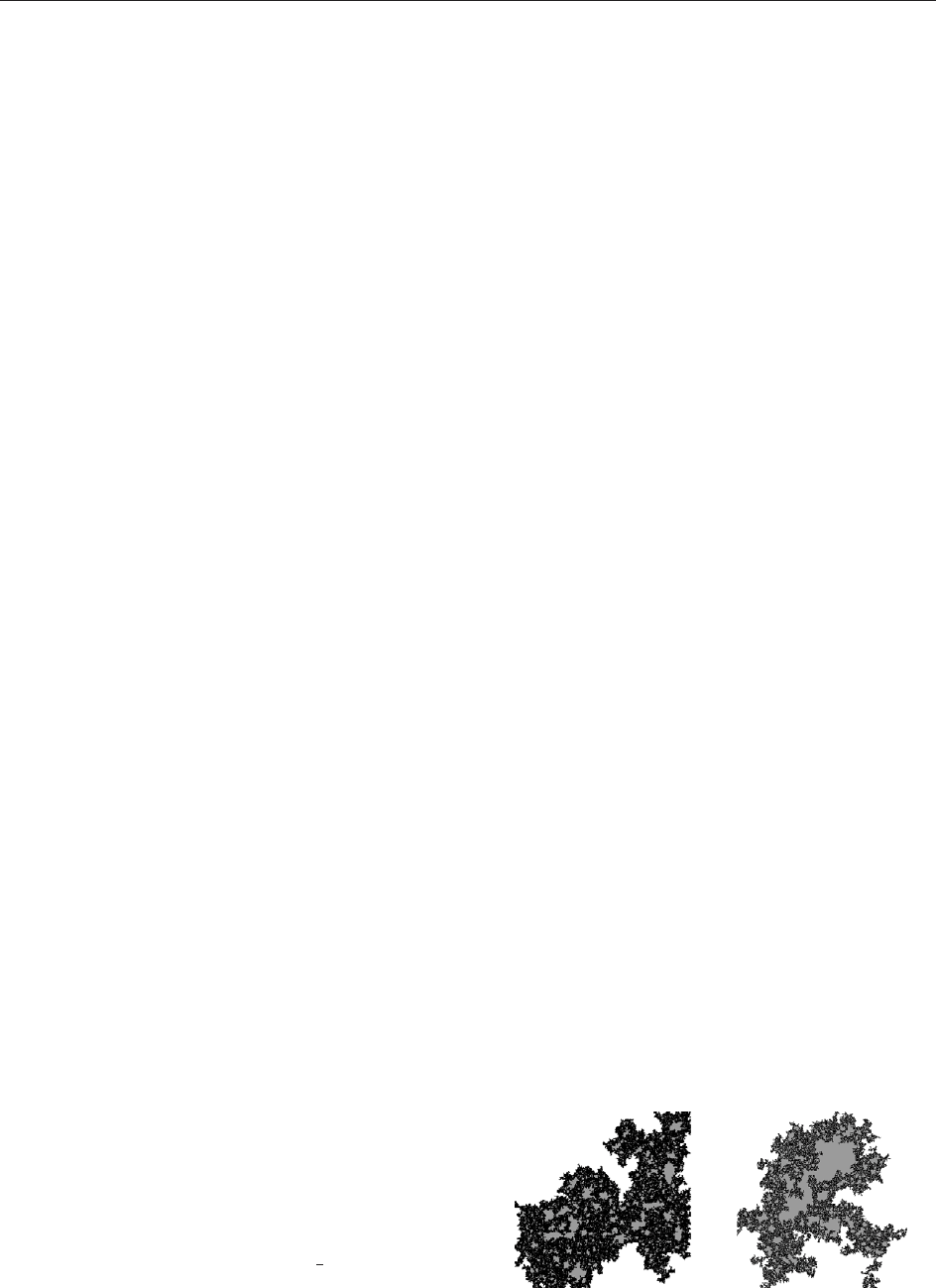
Figure 2 Two large critical percolation clusters in a box of the
square lattice (first: bond percolation, second: site percolation).
24 Percolation Theory
model on the intersection of with T and let
f
(ab, cd; ) be the probability that it contains a
cluster connecting the arcs ab and cd. Then:
(i) f
(ab, cd; ) has a limit f
0
(ab, cd; ) as !0;
(ii) the limit is conformally invariant, in the
following sense: if is a conformal map from
to some other domain
0
=(), and maps
atoa
0
, btob
0
, ctoc
0
and d to d
0
, then
f
0
(ab, cd; ) = f
0
(a
0
b
0
, c
0
d
0
;
0
); and
(iii) in the particular case when is an equilateral
triangle of side length 1 with vertices a, b and c,
and if d is on (ca) at distance x 2 (0, 1) from c,
then f
0
(ab, cd; ) = x.
Point (iii) in particular is essential since it allows
us to compute the limiting crossing probabilities in
any conformal rectangle. In the original work of
Cardy, he made his prediction in the case of a
rectangle, for which the limit involves hypergeo-
metric functions; the rem ark that the equilateral
triangle gives rise to nicer formulae is originally due
to Carleson.
To precisely state the convergence of percolation
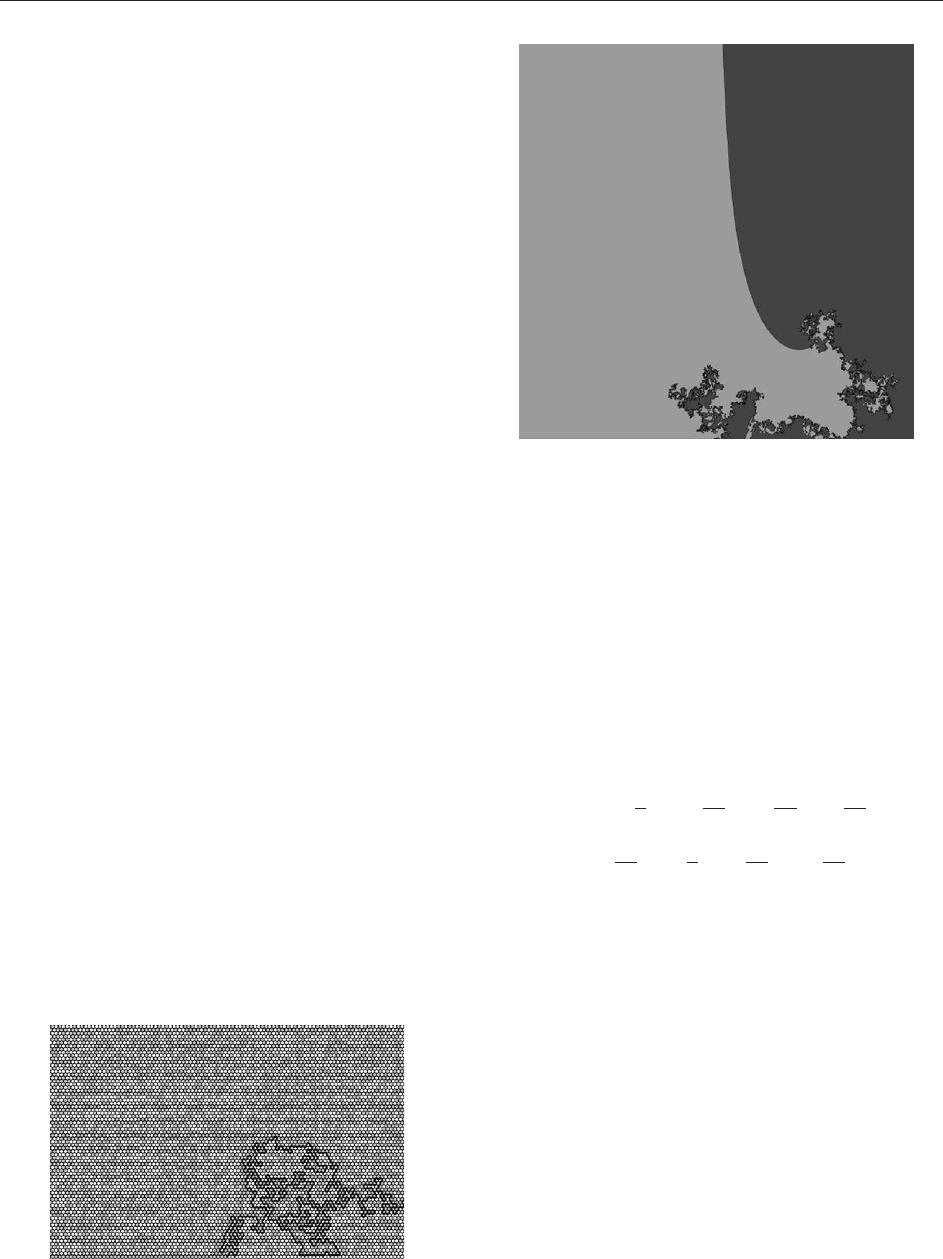
to its scaling limit, define the random curve known
as the percolation exploration path (see Figure 3)as
follows: In the upper half-plane, consider a site-
percolation model on a portion of the triangular
lattice and impose the boundary conditions that on
the negative real half-line all the sites are open,
while on the other half-line the sites are closed. The
exploration curve is then the common boundary of
the open cluster spanning from the negative half-
line, and the closed cluster spanning from the
positive half-line; it is an infinite, self-avoiding
random curve in the upper half-plan e.
As the mesh of the lattice goes to 0, the exploration
curve then converges in distribution to the trace of an
SLE process, as introduced by Schramm, with
parameter = 6 – see Figure 4. The limiting curve is
not simple anymore (which corresponds to the
existence of pivotal sites on large critical percolation
clusters), and it has Hausdorff dimension 7/4. For
more details on SLE processes, see, for example, the
related entry in the present volume.
As an application of this convergence result, one
can prove that the critical exponents described in the
previous section do exist (still in the case of the
triangular lattice), and compute their exact values,
except for , which is still listed here for
completeness:
¼
2
3
; ¼
5
36
; ¼
43
18
; ¼
91
5
¼
5
24
; ¼
4
3
;¼
48
5
; ¼
91
36
These exponents are expected to be universal, in the
sense that they should be the same for percolation
on any two-dimensional lattice; but at the time of
this writing, this phenomenon is far from being
understood on a mathematical level.
The rigorous derivation of the critical exponents
for percolation is due to Smirnov and Werner
(2001); the dimension of the limiting curve was
obtained by Beffara (2004).
Other Lattices and Percolative Systems
Some modifications or generalizations of standard
Bernoulli percolation on Z
d
exhibit an interesting
behavior and as such provide some insight into the
original process as well; there are too many
mathematical objects which can be argued to be
percolative in some sense to give a full account of all
Figure 3 A percolation exploration path. Figure courtesy
Schramm O (2000) Scaling limits of loop-erased random walks
and uniform spanning trees. Israel Journal of Mathematics 118:
221–228.
Figure 4 An SLE process with parameter = 6 (infinite time,
with the driving process stopped at time 1).
Percolation Theory 25
of them, so the following list is somewhat arbitrary
and by no means complete.
Percolation on Nonamenable Graphs
The first modification of the model one can think of
is to modi fy the underlying graph and move away
from the cubic lattice; phase transition still occurs,
and the main difference is the possibility for
infinitely many infinite clusters to coexist. On a
regular tree, such is the case whenever p 2 (p
c
, 1),
the first nontrivial example was produced by
Grimmett and Newman as the product of Z by a
tree: there, for some values of p the infinite cluster is
unique, while for others there is coexistence of
infinitely many of them. The corresponding defini-
tion, due to Benjamini and Schramm, is then the
following: if N is as above the number of infinite
open clusters,
p
u
:¼inf p : P
p
ðN ¼ 1Þ¼1
p
c
The main question is then to characterize graphs on
which 0 < p
c
< p
u
< 1.
A wide class of interesting graphs is that of Cayley
graphs of infinite, finitely generated groups. There,
by a simultaneous result by Ha¨ ggstro¨ m and Peres
and by Schonmann, for every p 2 (p
c
, p
u
) there are
P
p
-a.s. infinitely many infinite cluster, while for
every p 2 (p
u
, 1] there is only one – note that this
does not follow from the definition since new
infinite components could appear when p is
increased. It is conjectured that p
c
< p
u
for any
Cayley graph of a nonamenable group (and more
generally for any quasitransitive graph with positive
Cheeger constant), and a result by Pak and
Smirnova is that every infinite, finitely generated,
nonamenable group has a Cayley graph on which
p
c
< p
u
; this is then expected not to depend on the
choice of generators. In the general case, it was recently
proved by Gaboriau that if the graph G is unimodular,
transitive, locally finite, and supports nonconstant
harmonic Dirichlet functions (i.e., harmonic functions
whose gradient is in ‘
2
), then indeed p
c
(G) < p
u
(G).
For referenc e a nd further r eading on the t opic,
the reader is advised to refer to the review paper by
Benjamini and Schramm (1996), the lecture notes
of Peres (1999), and the more recent article of
Gaboriau (2005).
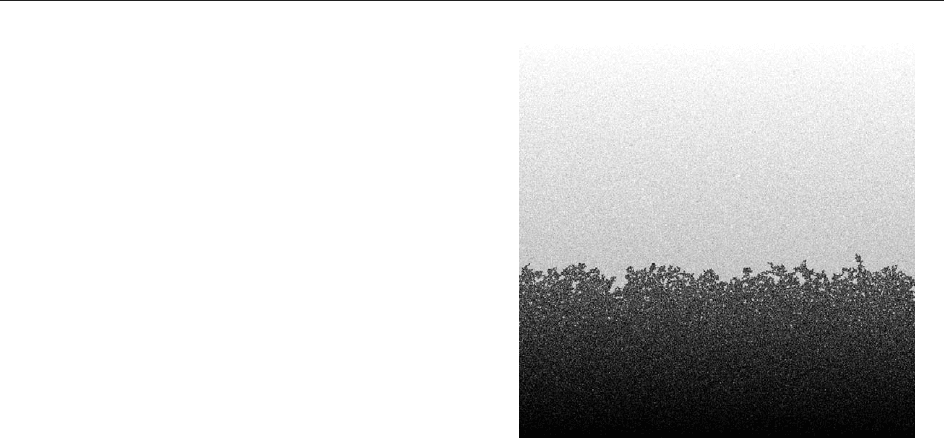
Gradient Percolation
Another possible modification of the original model
is to allow the parameter p to depend on the
location; the porous medium may for instance have
been created by some kind of erosion, so that there
will be more open edges on one side of a given
domain than on the other. If p still varies smoothly,
then one expects some regions to look subcritical
and others to look supercritical, with interesting
behavior in the vicinity of the critical level set
{p = p
c
}. This pa rticular model was introduced by
Sapoval et al. (1978) under the name of gradient
percolation (see Figure 5).
The control of the model away from the critical
zone is essentially the same as for usual Bernoulli
percolation, the main question being how to
estimate the width of the phase transition. The
main idea is then the same as in scaling theory: if the
distance between a point v and the critical level set is
less than the correlation length for parameter p(v),
then v is in the phase transition domain. This of
course makes sense only asymptotically, say in a
large n n square with p(x, y) = 1 y=n as is the
case in the figure: the transition then is expected to
have width of order n
a
for some exponent a > 0.
First-Passage Percolation
First-passage percolation (also known as Eden or
Richardson model) was introduced by Hammersley
and Welsh (1965) as a time-dependent model for the
passage of fluid through a porous medium. To define
the model, with each edge e 2E(Z
d
)isassociateda
random variable T(e), which can be interpreted as
being the time required for fluid to flow along e.The
T(e) are assumed to be independent non-negative
random variables having common distribution F.For
any path we define the passage time T()of as
TðÞ:¼
X
e2
TðeÞ
Figure 5 Gradient percolation in a square. In black is the
cluster spanning from the bottom side of the square.
26 Percolation Theory

The first passage time a(x, y) between vertices x and
y is given by
aðx; yÞ¼inffTðÞ: a path from x to yg
and we can define
WðtÞ:¼fx 2 Z
d
: að0; xÞtg
the set of vertices reached by the liquid by time t.It
turns out that W(t) grows approximately linearly as
time passes, and that there exists a nonrandom limit
set B such that either B is compact and
ð1 "ÞB
1
t
f
WðtÞð1 þ "ÞB; eventually a:s:
for all >0, or B = R
d
, and
fx 2 R
d
: jxjKg
1
t
f
WðtÞ; eventually a:s:
for all K > 0. Here
f
W(t) = {z þ [ 1=2, 1=2]
d
:
z 2 W(t)}.
Studies of first-passage percolation brought
many fascinating discoveries, including Kingman’s
celebrated subadditive ergodic theorem. In recent
years interest has been focused on study of
fluctuations of the set
f
W(t)forlarget. In spite of
huge effort and some partial results achieved, it
still remains a major task to establish rigorously
conjectures predicted by Kardar–Parisi–Zhang the-
ory about shape fluctuations in first passage
percolation.
Contact Processes
Introduced by Harris and conceived with biological
interpretation, the contact process on Z
d
is a
continuous-time process taking value s in the space
of subsets of Z
d
. It is informally described as
follows: particles are distri buted in Z
d
in such a
way that each site is either empty or occupied by
one particle. The evolution is Markovian: each
particle disappea rs after an exponential time of
parameter 1, independently from the others; at any
time, each particle has a possibility to create a new
particle at any of its empty neighboring sites, and
does so with rate >0, independently of everything
else.
The question is then whether, starting from a
finite population, the process will die out in finite
time or whether it will survive forever with positive
probability. The outcome will depend on the value
of , and there is a critical va lue
c
, such that for
c
process dies out, while for >
c
indeed
there is survival, and in this case the shape of the
population obeys a shape theorem similar to that of
first-passage percolatio n.
The analogy with percolation is strong, the
corresponding percolative picture being the follow-
ing: in Z
dþ1
þ
, each edge is open with probability p 2
(0, 1), and the question is whether there exists an
infinite oriented path (i.e., a path along which the
sum of the coordinates is increasing), composed of
open edges. Once again, there is a critical parameter
customarily denoted by p
c
, at which no such path
exists (compare this to the open question of the
continuity of the function at p
c
in dimensions
3 d 18). This variation of percolation lies in a
different universality class than the usual Bernoulli
model.
Invasion Percolation
Let X(e):e 2E be independent random variables
indexed by the edge set E of Z
d
, d 2, each
having uniform distribution in [0, 1]. One con-
structs a sequence C = {C
i
, i 1} of random
connected subgraphs of the lattice in the
following iterative way: the graph C
0
contains
only the origin. Having defined C
i
, one obtains
C
iþ1
by adding to C
i
an edge e
iþ1
(with its outer
lying end-vertex), chosen from the outer edge
boundary of C
i
so as to minimize X(e
iþ1
). Still
very little is known about the behavior of this
process.
An interesting observation, relating (p
c
) of usual
percolation with the invasion dynamics, comes from
CM Newman:
ðp
c
Þ¼0 , Pfx 2 Cg!0asjxj!1
Further Remarks
For a much more in-depth review of percolation on
lattices and the mathematical methods involved in
its study, and for the proofs of most of the results we
could only point at, we refer the reader to the
standard book of Grimmett (1999); another excel-
lent general reference, and the only place to find
some of the technical graph-theoretical details
involved, is the book of Kesten (1982). More
information in the case of graphs that are not
lattices can be found in the lecture notes of Peres
(1999).
For curiosity, the reader can refer to the first
mention of a problem close to percolation, in the
problem section of the first volume of the American
Mathematical Monthly (problem 5, June 1894,
submitted by D V Wood).
See also: Determinantal Random Fields; Stochastic
Loewner Evolutions; Two-Dimensional Ising Model; Wulff
Droplets.
Percolation Theory 27

Further Reading
Alexander K, Chayes JT, and Chayes L (1990) The Wulff
construction and asymptotics of the finite cluster distribution
for two-dimensional Bernoulli percolation. Communications
in Mathematical Physics 131: 1–50.
Beffara V (2004) Hausdorff dimensions for SLE
6
. Annals of
Probability 32: 2606–2629.
Benjamini I and Schramm O (1996) Percolation beyond Z
d
, many
questions and a few answers. Electronic Communications in
Probability 1(8): 71–82 (electronic).
Broadbent SR and Hammersley JM (1957) Percolation processes,
I and II. Mathematical Proceedings of the Cambridge
Mathematical Society 53, pp. 629–645.
Cerf R (2000) Large deviations for three dimensional supercritical
percolation. Aste´risque, SMF vol. 267.
Gaboriau D (2005) Invariant percolation and harmonic Dirichlet
functions. Geometric and Functional Analysis (in print).
Grimmett G (1999) Percolation. Grundlehren der Mathematischen
Wissenschaften, 2nd edn, vol. 321. Berlin: Springer.
Hammersley JM and Welsh DJA (1965) First-passage percolation,
subadditive processes, stochastic networks, and generalized
renewal theory. In: Proc. Internat. Res. Semin,Statist.Lab.,
Univ. California, Berkeley, CA, pp. 61–110. New York: Springer.
Hara T and Slade G (1990) Mean-field critical behaviour for
percolation in high dimensions. Communications in Mathe-
matical Physics 128: 333–391.
Kesten H (1980) The critical probability of bond percolation on
the square lattice equals 1/2. Communications in Mathema-
tical Physics 74: 41–59.
Kesten H (1982) Percolation Theory for Mathematicians, Pro-
gress in Probability and Statistics, vol. 2. Boston, MA:
Birkha¨user.
Kesten H (1986) The incipient infinite cluster in two-dimensional
percolation. Probability Theory and Related Fields 73:
369–394.
Kesten H (1987) Scaling relations for 2D-percolation. Commu-
nications in Mathematical Physics 109: 109–156.
Peres Y (1999) Probability on Trees: An Introductory Climb,
Lectures on Probability Theory and Statistics (Saint-Flour,
1997), Lecture Notes in Math, vol. 1717, pp. 193–280. Berlin:
Springer.
Russo L (1978) A note on percolation. Zeitschift fu¨r Wahrschein-
lichkeitstheorie und Verwandte Gebiete 43: 39–48.
Sapoval B, Rosso M, and Gouyet J (1985) The fractal nature of a
diffusion front and the relation to percolation. Journal de
Physique Lettres 46: L146–L156.
Seymour PD and Welsh DJA (1978) Percolation probabilities on the
square lattice. Annals of Discrete Mathematics 3: 227–245.
Smirnov S (2001) Critical percolation in the plane: conformal
invariance, Cardy’s formula, scaling limits. Comptes-rendus de
l’Acade´mie des Sciences de Paris, Se´rie I Mathe´matiques 333:
239–244.
Smirnov S and Werner W (2001) Critical exponents for two-
dimensional percolation. Mathematical Research Letters 8:
729–744.
van der Hofstad R and Ja´rai AA (2004) The incipient infinite
cluster for high-dimensional unoriented percolation. Journal
of Statistical Physics 114: 625–663.
Perturbation Theory and Its Techniques
R J Szabo, Heriot-Watt University, Edinburgh, UK
ª 2006 Elsevier Ltd. All rights reserved.
Introduction
There are several equivalent formulations of the
problem of quantizing an interacting field theory.
The list includes canonical quantization, path-
integral (or functional) techniques, stochastic
quantization, ‘‘unified’’ methods such as the
Batalin–Vilkovisky formalism, and techniques
based on the realizations of field theories as low-
energy limits of string theory. The problem of
obtaining an exact nonperturbative description of a
given quantum field theory is most often a very
difficult one. Perturbative techniques, on the other
hand, are abundant, and common to all of the
quantization methods mentioned above is that they
admit particle interpretations in this formalism.
The basic physical quantities that one wishes to
calculate in a relativistic (d þ 1)-dimensional quan-
tum field theory are the S-matrix elements
S
ba
¼
out
h
b
ðtÞj
a
ðtÞi
in
½1
between in and out states at large positive time t.
The scattering operator S is then defined by writing
[1] in terms of initial free-particle (descriptor) states as
S
ba
¼: h
b
ð0ÞjSj
a
ð0Þi ½2
Suppose that the Hamiltonian of the given field
theory can be written as H = H
0
þ H
0
, where H
0
is
the free part and H
0
the interaction Hamiltonian.
The time evolutions of the in and out states are
governed by the total Hamiltonian H. They can be
expressed in terms of descriptor states which evolve
in time with H
0
in the interaction picture and
correspond to free-particle states. This leads to the
Dyson formula
S ¼ T exp i
Z
1
1
dtH
I
ðtÞ
½3
where T denotes time ordering and H
I
(t) =
R
d
d
xH
int
(x, t) is the interaction Hamiltonian in the
interaction picture, with H
int
(x, t) the inte raction
Hamiltonian density, which deals with essentially
free fields. This formula expresses S in terms of
interaction-picture operators acting on free-particle
states in [2] and is the first step towards Feynman
perturbation theory.
28 Perturbation Theory and Its Techniques
For many analytic investigations, such as those
which arise in renormalization theory, one is
interested instead in the Green’s functions of the
quantum field theory, which measure the response
of the system to an external perturbation. For
definiteness, let us consider a free real scalar field
theory in d þ 1 dimensions with Lagrangian
density
L¼
1
2
@
@
1
2
m
2
2
þL
int
½4
where L
int
is the interaction Lagrangian density
which we assume has no derivative terms. The
interaction Hamiltonian density is then given by
H
int
= L
int
. Introducing a real scalar source J(x),
we define the normalized ‘‘partition function’’
through the vacuum expectation values,
Z½J¼
h0jS½Jj0i
h0jS½0j0i
½5
where j0i is the normalized perturbative vacuum
state of the quantum field theory given by (4)
(defined to be destroyed by all field annihilation
operators), and
S½J¼T exp i
Z
d
dþ1
xðL
int
þ JðxÞðxÞÞ
½6
from the Dyson formula. This partition function is
the generating functional for all Green’s functions
of the quantum field theory, which are obtained
from [5] by taking functional derivatives with
respect to the source and then setting J(x) = 0.
Explicitly, in a formal Taylor series expansion in J
one has
Z½J¼
X
1
n¼0
i
n
n!
Y
n
i¼1
Z
d
dþ1
x
i
Jðx
i
ÞG
ðnÞ
ðx
1
; ...; x
n
Þ½7
whose coefficients are the Green’s functions
G
ðnÞ
ðx
1
;...;x
n
Þ
:¼
h0jT½exp i
R
d
dþ1
xL
int
ðx
1
Þðx
n
Þj0i
h0jTexp i
R
d
dþ1
xL
int
j0i
½8
It is customary to work in momentum space by
introducing the Fourier transforms
~
JðkÞ¼
Z
d
dþ1
x e
ikx
JðxÞ
~
G
ðnÞ
ðk
1
; ...; k
n
Þ
¼
Y
n
i¼1
Z
d
dþ1
x
i
e
ik
i
x
i
G
ðnÞ
ðx
1
; ...; x
n
Þ
½9
in terms of which the expansion [7] reads
Z½ J ¼
X
1
n¼0
i
n
n!
Y
n
i¼1
Z
d
dþ1
k
i
ð2Þ
dþ1
~
Jðk
i
Þ
~
G
ðnÞ
ðk
1
; ...; k
n
Þ½10
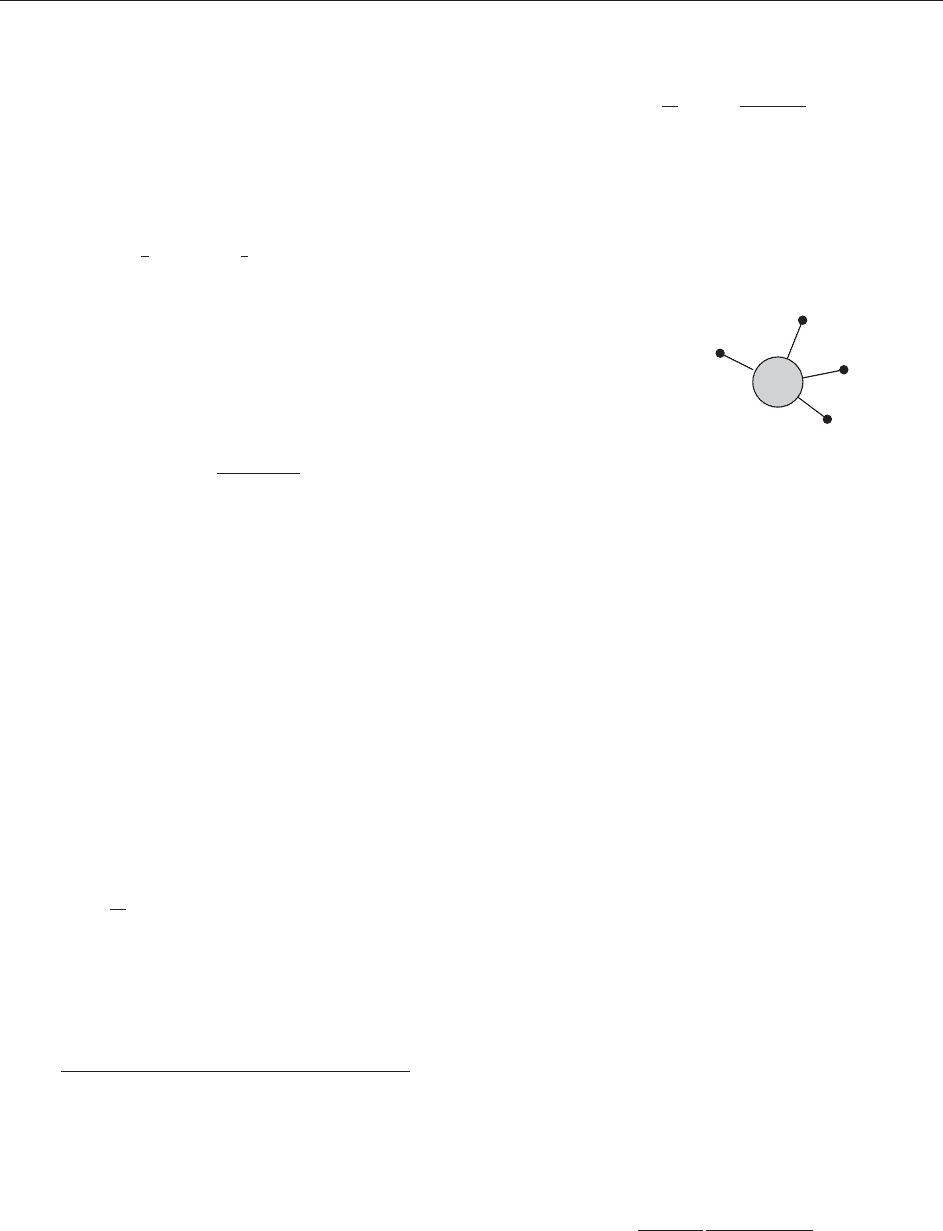
The generating functional [10] can be written as a sum
of Feynman diagrams with source insertions. Dia-
grammatically, the Green’s function is an infinite series
of graphs which can be represented symbolically as
~
G
(n)
(k
1
, . . . ,k
n
) =
k
n
k
2
k
3
k
1
..
.
.
½11
where the n external lines denote the source
insertions of momenta k
i
and the bubble denotes
the sum over all Feynman diagrams constructed
from the interaction vertices of L
int
.
This procedure is, however, rather formal in the way
that we have presented it, for a variety of reasons. First
of all, by Haag’s theorem, it follows that the interaction
representation of a quantum field theory does not exist
unless a cutoff regularization is introduced into the
interaction term in the Lagrangian density (this
regularization is described explicitly below). The
addition of this term breaks translation covariance.
This problem can be remedied via a different definition
of the regularized Green’s functions, as we discuss
below. Furthermore, the perturbation series of a
quantum field theory is typically divergent. The
expansion into graphs is, at best, an asymptotic series
which is Borel summable. These shortcomings will not
be emphasized any further in this article. Some
mathematically rigorous approaches to perturbative
quantum field theory can be found in the bibliography.
The Green’s functions can also be used to describe
scattering amplitudes, but there are two important
differences between the graphs [11] and those which
appear in scattering theory. In the present case,
external lines carry propagators, that is, the free-
field Green’s functions
ðx yÞ¼ 0TðxÞðyÞ½
jj
0
hi
¼ x & þ m
2
1
y
DE
¼
Z
d
dþ1
p
ð2Þ
dþ1
i
p
2
m
2
þ i
e
ipðxyÞ
½12
where !0
þ
regulates the mass shell contributions,
and their momenta k
i
are off-shell in general
(k
2
i
6¼m
2
). By the LSZ theorem, the S-matrix element
Perturbation Theory and Its Techniques 29
is then given by the multiple on-shell residue of the
Green’s function in momentum space as
k
0
1
; ...; k
0
n
S 1
jj
k
1
; ...; k
l
¼ lim
k
0
1
;...;k
0
n
!m
2
k
1
;...;k
l
!m
2
Y
n
i¼1
1
i
ffiffiffiffi
c
0
i
p
k
02
i
m
2
Y
l
j¼1
1
i
ffiffiffiffi
c
j
p
k
2
j
m
2
~
G
ðnþmÞ
k
0
1
; ...; k
0
n
; k
1
; ...; k
l
½13
where ic
0
i
,ic
j
are the residues of the corresponding
particle poles in the exact two-point Green’s
function.
This article deals with the formal development
and computation of perturbative scattering ampli-
tudes in relativistic quantum field theory, along the
lines outlined above. Initially we deal only with real
scalar field theories of the sort [4] in order to
illustrate the concepts and technical tools in as
simple and concise a fashion as possible. These
techniques are common to most quantum field
theories. Fermions and gauge theories are then
separately treated afterwards, focusing on the
methods which are particular to them.
Diagrammatics
The pinnacle of perturbation theory is the technique
of Feynman diagrams. Here we develop the basic
machinery in a quite general setting and use it to
analyze some generic features of the terms compris-
ing the perturbation series.
Wick’s Theorem
The Green’s functions [8] are defined in terms of
vacuum expectation values of time-ordered products
of the scalar field (x) at different spacetime points.
Wick’s theorem expresses such products in terms of
normal-ordered products, defined by placing each
field creation operator to the right of each field
annihilation operator, and in terms of two-point
Green’s functions [12] of the free-field theory
(propagators). The consequence of this theorem is
the Haffnian formula
0Tðx
1
Þðx
n
Þ½
jj
0
hi
¼
0
n ¼ 2k 1
X
2S
2k
Y
k
i¼1
0Tð x
ð2i1Þ
Þðx
ð2iÞ
Þ
0
n ¼ 2k
8
>
>
>
>
>
>
>
>
>
<
>
>
>
>
>
>
>
>
>
:
½14
The formal Taylor series expansion of the
scattering operator S may now be succinctly
summarized into a diagrammatic notation by
using Wick’s theorem. For each spacetime integra-
tion
R
d
dþ1
x
i
we introduce a vertex with label i,
and from each vertex there emanate some lines
corresponding to field insertions at the point x
i
.
If the operators represented by two lines appear in
a two-point function according to [14], that is, they
are contracted, then these two lines are connected
together. The S operator is then represented as a
sum over all such Wick diagrams, bearing in mind
that topologically equivalent diagrams correspond
to the same term in S. Two diagrams are said to
have the same pattern if they differ only by a
permutation of their vertices. For any diagram D
with n(D) vertices, the number of ways of inter-
changing vertices is n(D)!. The number of diagrams
per pattern is always less than this number. The
symmetry number S(D)ofD is the number of
permutations of vertices that give the same dia-
gram. The number of diagrams with the pattern of
D is then n(D)!=S(D).
In a given pattern, we write the contribution to S
of a single diagram D as
1
nðDÞ!
:ðDÞ:
where the combinatorial factor comes from
the Taylor expansion of S, the large colons
denote normal ordering of quantum operators,
and : (D): contains spacetime integrals over nor-
mal-ordered products of the fields. Then all
diagrams with the pattern of D contribute :(D) :
=S(D)toS. Only the connected diagrams D
r
, r 2 N
(those in which every vertex is connected to every
other vertex) contribute and we can write the
scattering operator in a simple form which
eliminates contributions from all disconnected dia-
grams as
S ¼: exp
X
1
r¼1
ðD
r
Þ
SðD
r
Þ
!
: ½15
Feynman Rules
Feynman diagrams in momentum space are
defined from the Wick diagrams above by drop-
ping the labels on vertices (and also the symmetry
factors S(D)
1
), and by labeling the external lines
by the momenta of the initial and final particles
that the corresponding field operators annihilate.
In a spacetime interpretation, external lines
30 Perturbation Theory and Its Techniques
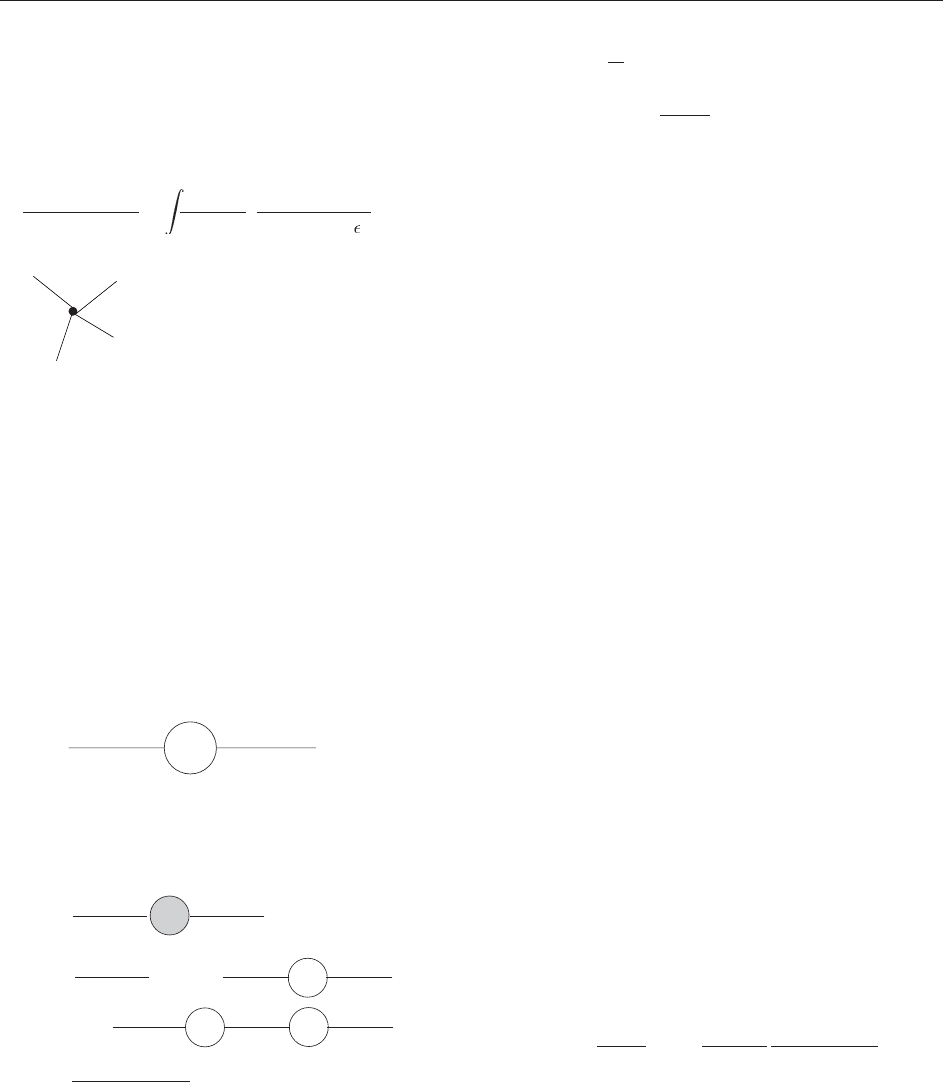
represent on-shell physical particles while internal
lines of the graph represent off-shell virtual
particles (k
2
6¼ m
2
). Physical particles interact
via the exchange of virtual particles. An arbitrary
diagram is then calculated via the Feynman rules:
p
1
=
ig (2π)
d +1
δ
(d +1)
(p
1
+ · · · + p
n
)
=
d
d +1
p
(2π)
d +1
i
.
.
p
2
p
3
.
p
n
p
p
2
–
m
2
+ i
½16
for a monomial interaction L
int
= (g=n!)
n
.
Irreducible Green’s Functions
A one-particle irreducible (1PI) or proper Green’s
function is given by a sum of diagrams in which
each diagram cannot be separated by cutting one
internal line. In momentum space, it is defined
without the overall momentum conservation delta-
function factors and without propagators on exter-
nal lines. For example, the two particle 1PI Green’s
function
kk
1PI
=
: ∑(k)
½17
is called the self-energy. If G(k)isthecomplete
two-point function in momentum space, then one
has
kk
=
i
k
2
–
m
2
–
∑(k)
G(k) :
=
k
k
=
+
1PI
k
k
1PI
1PI
+
kk
+
. . .
½18
and thus it suffices to calculate only 1PI diagrams.
The 1PI effective action, defined by the Legendre
transformation []:= ilnZ[J]
R
d
dþ1
xJ(x)(x)
of [5], is the generating functional for proper vertex
functions and it can be represented as a functional of
only the vacuum expectation value of the field ,
that is, its classical value. In the semiclassical (WKB)
approximation, the one-loop effective action is
given by
½¼S½þ
ih
2
Tr ln 1 þ V
00
½ðÞþOðh
2
Þ
¼ S½þih
X
1
n¼1
ð1Þ
n
2n
Y
n
i¼1
Z
d
dþ1
x
i
ðx
i
x
iþ1
ÞV
00
ðx
iþ1
Þ½
þ Oðh
2
Þ½19
wherewehavedenotedS[] =
R
d
dþ1
xL and
V[] = L
int
, and for each term in the infinite
series we define x
nþ1
:= x
1
. The first term in [19]
is the classical contribution and it can be
represented in terms of connected tree diagrams.
The second term is the sum of contributions of
one-loop diagrams constructed from n propaga-
tors i(x y)andn vertices iV
00
[]. The
expansion may be carried out to all orders in
terms of connected Feynman diagrams, and the
result of the above Legendre transformation is to
select only the one-particle irreducible diagrams
and to replace the classical value of by an
arbitrary argument. All information about the
quantum field theory is encoded in this effective
action.
Parametric Representation
Consider an arbitrary proper Feynman diagram
D with n internal lines and v vertices. The
number, ‘, of independent loops in the diagram
is the number of independent internal momenta in
D when conservation laws at each vertex have
been taken into account, and it is given by ‘ = n þ
1 v. There is an independent momentum inte-
gration variable k
i
for each loop, and a propa-
gator for each internal line as in [16].The
contribution of D to a proper Green’s function
with r incoming external momenta p
i
,with
P
r
i = 1
p
i
= 0, is given by
~
I
D
ðpÞ¼
VðDÞ
SðDÞ
Y
n
i¼1
Z
d
dþ1
k
i
ð2Þ
dþ1
i
k
2
i
m
2
þ i
Y
v
j¼1
ð2Þ
dþ1
ðdþ1Þ
P
j
K
j
½20
where V(D) contains all contributions from the
interaction vertices of L
int
,andP
j
(resp. K
j
)isthe
sum of incoming external momenta p
l
j
(resp.
internal momenta k
l
j
)atvertexj with respect to
a fixed chosen orientation of the lines of the
graph. After resolving the delta-functions in terms
of independent internal loop momenta k
1
, ..., k
‘
and dropping the overall momentum conservation
Perturbation Theory and Its Techniques 31