
Francoise J.-P., Naber G.L., Tsun T.S. (editors) Encyclopedia of Mathematical Physics
Подождите немного. Документ загружается.


with n
0
being a constant number density. This form
has been observed in computer simulations as the
droplet size distribution on the coexistence curve
(h = 0). Figure 3 indicates that n(R, t) tends to a
steady solution n
s
(R) which satisfies
LðRÞ
@
@R
þ
F
0
ðRÞ
k
B
T
n
s
¼I ½44
where I is a constant. Imposing the condition n
s
(R) !0
as R !1, we integrate the above equation as
n
s
ðRÞ¼I
Z
1
R
dR
1
1
LðR
1
Þ
exp
FðR
1
ÞFðR Þ
k
B
T
½45
For R R
c
1 we may replace F(R
1
) F(R)
by F
0
(R)(R
1
R) in the integrand of eqn [45] to
obtain
n
s
ðRÞffiI=vðRÞ½46
which also follows from eqn [41]. Thus
n
s
ðRÞdR ¼I dt ðdR ¼v ðRÞdtÞ½47
This means that I is the nucleation rate of droplets
with radii larger than R
c
emerging per unit volume
and per unit time. Furthermore, as R !0, we
require n
s
(R) !n
0
= const. in eqn [43] so that
n
0
¼ I
Z
1
0
dR
1
1
LðR
1
Þ
exp
FðR
1
Þ
k
B
T
½48
where the integrand becomes maximum
around R
c
. Using the e xpansion F(R) = F
c
þ
F
00
(R
c
)(R R
c
)
2
=2 þ, we obtain the famous
formula for the nucleation rate
I ¼I
0
expðF
c
=k
B
TÞ½49
¼I
0
expðC
0
=
2
Þ½50
where the coefficient I
0
is of order n
0
c
. The second
line holds in the 3D conserved case. Here, C
0
10
3
typically and I
0
is a very large number in units of
cm
3
s
1
,say,10
30
. Then the exponential factor in I
changes abruptly from a very small to a very large
number with only a slight increase of at small
1. Fo r example, i f C
0
=
2
= 50, I is increased
by exp (100=) with a small increase of to
þ . This factor can be of order 10
3
even for
==0.05. Unless very close to criticality, simple
metastable fluids become opaque suddenly with
increasing or T at a rather definite cloud point. In
near-critical fluids, however, I
0
itself becomes small
(/
6
) such that the cloud point considerably depends
on the experimental timescale (observation time).
Remarks
The order parameter can be a scalar, a vector as in
the Heisenberg spin system, a tensor as in liquid
crystals, and a complex number as in superfluids
and superconductors. In phase ordering a crucial
role is played by topological singularities like
interfaces in the scalar case and vortices in the
complex number case. Furthermore, a rich variety of
phase transition dynamics can be explained if the
order parameter is cou pled to other relevant
variables in the free energy and/or in the dynamic
equations. We mention couplings to velocity field in
fluids, electrostatic field in charged systems, and
elastic field in solids. Phase ordering can also be
influenced profoundly by external fields such as
electric field or shear flow.
See also: Reflection Positivity and Phase Transitions;
Renormalization: Statistical Mechanics and Condensed
Matter; Statistical Mechanics of Interfaces; Topological
Defects and Their Homotopy Classification.
Further Reading
Allen SM and Cahn JW (1979) Microscopic theory for antiphase
boundary motion and its application to antiphase domain
coarsening. Acta Metallurgica 27: 1085.
Binder K (1991) Spinodal decomposition. In: Cohen RW, Haasen
P, and Kramer EJ (eds.) Material Sciences and Technology, vol.
5. Weinheim: VCH.
Bray AJ (1994) Theory of phase-ordering kinetics. Advances in
Physics 43: 357.
Cahn JW (1961) On spinodal decomposition. Acta Metallurgica
9: 795.
Debenedetti PG (1996) Metastable Liquids. Princeton: Princeton
University.
Gunton JD, San Miguel M, and Sani PS (1983) The dynamics of
first-order phase transitions. In: Domb C and Lebowitz JL
(eds.) Phase Transition and Critical Phenomena, vol. 8.
London: Academic Press.
Lifshitz IM and Slyozov VV (1961) The kinetics of precipitation
from supersaturated solid solutions. Journal of Physics and
Chemistry of Solids 19: 35.
Ohta T, Jasnow D, and Kawasaki K (1982) Universal scaling in
the motion of random interfaces. Physical Review Letters 49:
1223.
Onuki A (2002) Phase Transition Dynamics. Cambridge: Cambridge
University Press.
52 Phase Transition Dynamics
Phase Transitions in Continuous Systems
E Presutti, Universita
`
di Roma ‘‘Tor Vergata,’’ Rome,
Italy
ª 2006 Elsevier Ltd. All rights reserved.
Introduction
Many aspects of our everyday life, from weather to
boiling water for a cup of coffee, involve heat
exchanges and variations of pressure and, as a
result, a phase transition. The general theory behind
these phenomena is thermodynamics, which studies
fluids and macroscopi c bodies under these and more
general transformations.
In the simple case of a one-component substance,
the behavior under changes of temperature T and
pressure P is described, according to the Gibbs
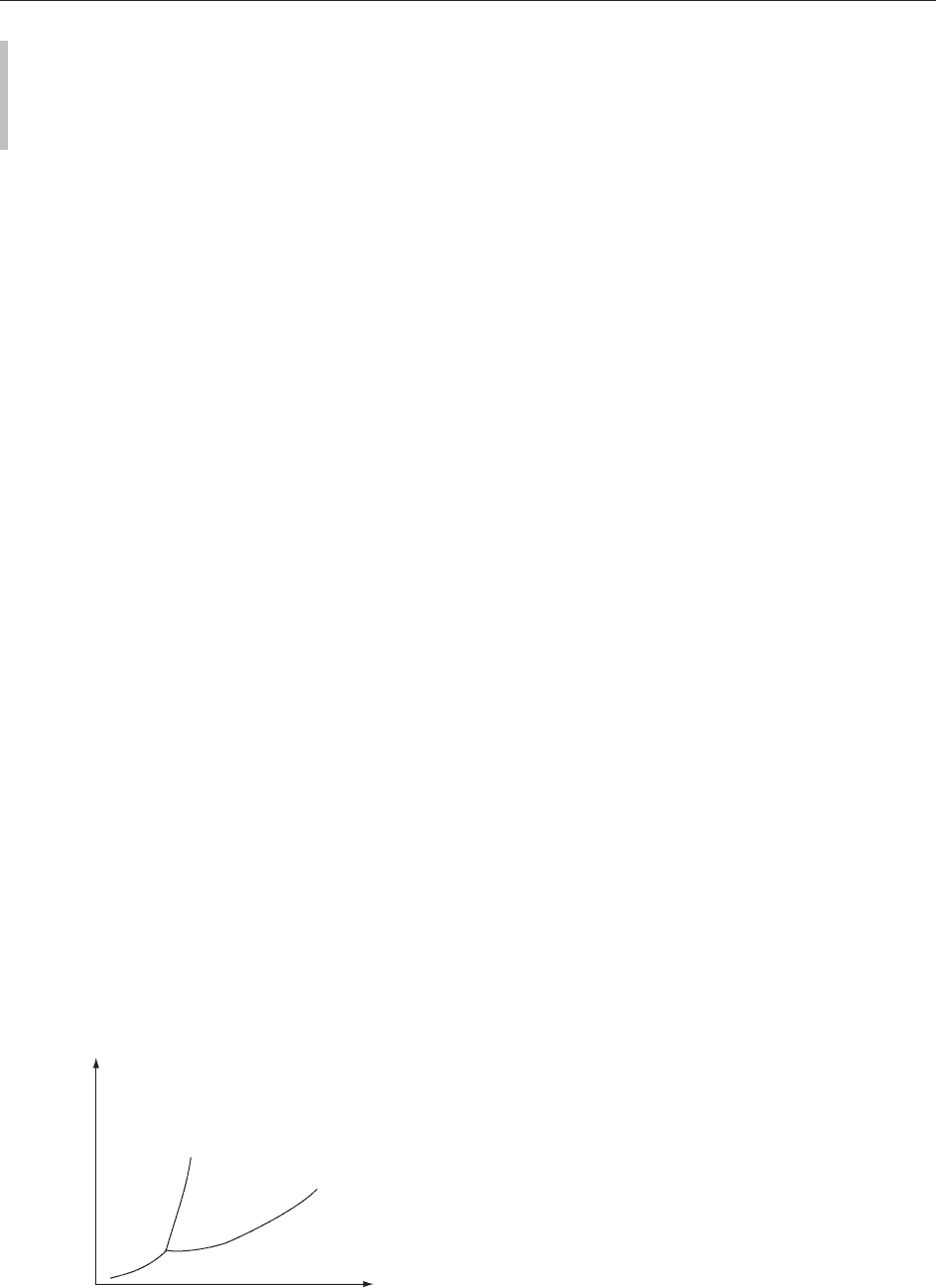
phase rule, by a phase diagram such as the one in
Figure 1. The curves in the (T, P) plane, distinguish
regions where the substance is in its solid, liquid,
and gas phases. Thus, in an experiment where we
vary the pressure and temperature moving along a
line which crosses a transition curve, we observe an
abrupt and dramatic change at the crossing, when
the system changes phase. As already stated, every-
day life is an active source of examples of such
phenomena.
The picture is ‘‘far from innocent’’, it states that air,
liquid, and solid are not different elements of nature, as
for long believed, but just different aspects of the same
thing: substances are able to adapt to different external
conditions in dramatically different ways. What
properties of intermolecular forces are responsible for
such astonishing behavior? The question has been
extensively studied and it is the argument of the
present article, where it will be discussed in the
framework of statistical mechanics for continuous
systems. Before entering into the matter, let us mention
two basic motivations.
As always, there is a ‘‘fundamental theory’’
aspect; in the specific case it is the attempt for an
atomistic theory able to describe also macroscopic
phenomena, thus ranging from the angstro m to the
kilometer scales. From an engineering point of view,
the target is, for instance, to understand why and
when a substance is an insulator, or a conductor or,
maybe, a superconductor, and, more importantly,
how should we change its microscop ic interactions
to produce such effects: this opens the way to
technologies which are indeed enormously affecting
our life.
Phase Transitions and Statistical
Mechanics
The modern theory of statistical mechanics is based
upon the Gibbs hypothesis. In a classical (i.e., not
quantum) framework, the macroscopic states are
described by probability measures on a particle
configuration phase space. The equilibrium states
are then selected by the Gibbs prescription, which
requires that the probability of observing a config-
uration which has energy E should be proportional
to e
E
, where = 1=kT, k is the Boltzmann
constant, and T the absolute temperature. These
are the ‘‘Gibbs measures’’ and the purpose of
statistical mechanics is to study their properties. A
prerequisite for the success of the theory is compat-
ibility with the principles of thermodynamics, the
theory should then be able to explain the origin of
the various phase diagrams and in particular to
determine the circumstances under which phase
transitions appear.
The theory, commonly called DLR, after
Dobrushin, Lanford, and Ruelle, who, in the
1960s, contributed greatly to its foundations, has
solid mathematical basis. Its main success is a
rigorous proof of consistency with thermodynamics,
which is deri ved under the only assumption that
surface effects are negligible, a condition which is
mathematically achieved by studying the system in a
‘‘thermodynamic limit,’’ where the region containing
the system invades the whole space.
In the therm odynamic limit, the equilibrium states
can no longer be defined by the Gibbs prescription,
because the energy of configurations in the whole
space, being extensive, is typically infinite. The
problem has been solved by first proving conver-
gence of the finite-volume Gibbs measures in the
thermodynamic limit. After defining the limit states,
called ‘‘DLR states,’’ as the equilibrium states of the
P
T
Liquid
Solid
Gas
Figure 1 Phase diagram of a one-component substance.
Phase Transitions in Continuous Systems 53
infinite systems, it is proved that the DLR states can
be directly characterized (i.e., without using limit
procedures) as the solutions of a set of equations,
the ‘‘DLR equations,’’ which generalize the finite-
volume Gibbs prescription.
In terms of DLR states, the mathematical meaning
of phase transitions becomes very clear and sharp.
The starting point is the proof that the physical
property that intensive variables in a pure phase
have negligible fluctuations is verified by all the
DLR measures which are in a special class, thus
selected by this property, and which are therefore
interpreted as ‘‘pure phases.’’ All the other DLR
measures are proved to be mixtures, that is, general
convex combinations, of the pure DLR states. Thus,
in the DLR theory, the system is in a single phase
when there is only one DLR state, at the given
values of the thermodynamic parameters (e.g.,
temperature and ch emical potential), while the
system is at a phase transition if there are several
distinct DLR states.
While the theory beautifully clarifies the meaning
of phase transitions, it does not say whether the
phenomenon really occurs! This is maybe the main
open problem in equilibrium statistical mechanics. A
general proof of existence of phase diagrams is
needed, which should at least capture the basic
property behind the Gibbs phase rule, namely that in
most of the space (of thermodynamic parameters)
there is a single phase, with rare exceptions where
several phases coexist. A more refined result should
then indicate that coexistence occurs only on regular
surfaces of positive codimension.
There is, however, a general result of existence of
the gaseous phase, with a proof of uniqueness of
DLR measures when temperature is large and
density low. Coexistence of phases is much less
understood at a general level, but results for
particular classes of models exist, for instance, in
lattice systems at low temperatures. The prototype is
the ferr omagnetic Ising model in two or more
dimensions, where indeed the full diagram has
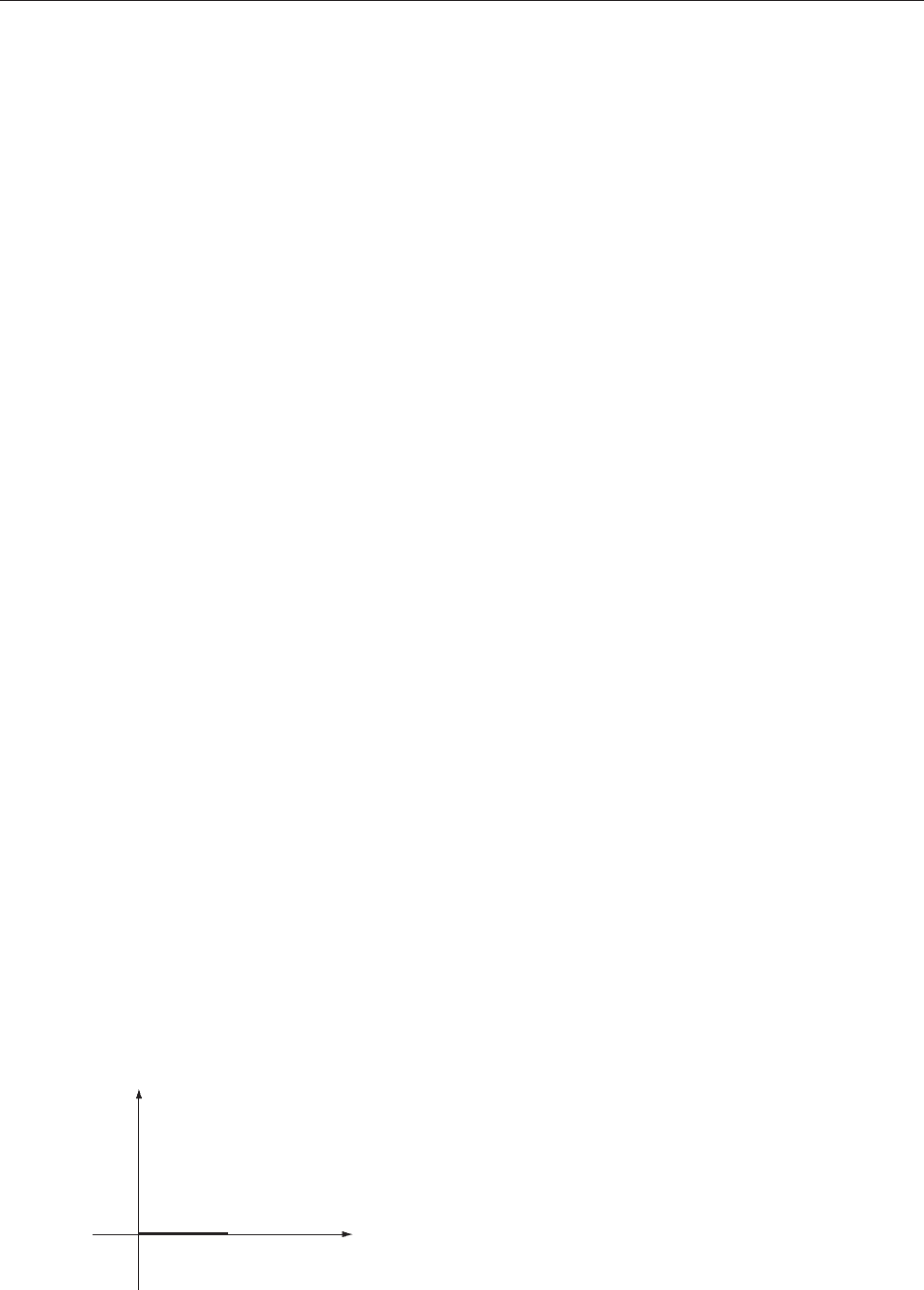
been determined, see Figure 2. The transition curve
is the segment {0 T T
c
, h = 0}, in the (T, h)
plane, h being the magnetic field. In the upper-half
plane, there is a single phase with positive magne-
tization, in the lower one with a negative value; at
h = 0, positive and negative magnetization states can
coexist, if the temperature is lower than the critical
value T
c
. Correspondingly, there are, simulta-
neously, a positive and a distinctly negative DLR
state, which describe the two phases.
An analogous result is missing for syst ems of
particles in the co ntinuum, but there has been recent
progress on the analysis of the liquid–vapor branch
of the phase diagram, and the issue will be the main
focus of this article.
Sensitive Dependence on Boundary
Conditions
Phase transitions describe exceptional regimes where
the system is in a critical state; this is why they are
so interesting and difficult to study. As in chaotic
systems, criticality corresponds to a ‘‘butterfly
effect,’’ which, in a statistical-mechanics setting
means changing far-away boundary conditions.
Such changes affect the neighbors, which in turn
influence their neighbors, and so on. In general, the
effect decays with the distance but, at phase
transition, it provokes an avalanche which propa-
gates throughout the system reaching all its points.
Its occurrence is not at all obvious, if we remember
the stochastic nature of the theory. The domino
effect described above can in fact, at each step, be
subverted by stochastic fluctuations. The latter, in
the end, may completely hide the effect of changing
the boundary conditions. This is an instance of a
competition between energy and entropy which is
the ruling phenomenon behind pha se transitions.
This intuitive picture also explains the relevance
of space dimensionality. In a many-dimensional
space, the influence of the boundary conditions has
clearly many more ways to percolate, in contrast to
the one-dimensional case, where in fact there is a
general result on the uniquene ss of DLR measures
and therefore absence of phase transitions, for short-
range interactions. For pair potentials, ‘‘short’’
means that the interaction energy between two
molecules, respectively at r and r
0
, decays as
jr r
0
j
, >2. The re are results on the converse,
namely on the presence of phase transitions when
the above condition is not satisfied, mainly for
lattice systems, but with partial extensions also to
continuous systems. One-dimensional and long-
range cases are not the mai n focus of this article,
and the issue will not be discussed further here.
h
T
T
c
Figure 2 Phase diagram of the Ising ferromagnet.
54 Phase Transitions in Continuous Systems

Ising Model
In order to make the previous ideas quantitative, let
us first describe the simple case of the Ising model.
Ising spin configurations are collections {(x), x 2
Z
d
}of(x) 2{1} magnetic moments called spins.
In the nearest-neighbor case, the interaction between
two spins is J(x)(y), J > 0, if x and y are nearest
neighbors on Z
d
, or is vanishing otherwise. There
are, therefore, two ground states, one with all spins
equal to þ1 and the other one with all spins equal to
1. Since the Gibbs probability of higher energies
vanishes as the temperature goes to zero, these are
interpreted as the equilibrium states at temperature
T = 0.
If T > 0, configurations with larger energy will
appear, even though depressed by the Gibb s factor,
but their occurren ce is limited if T is small. In fact,
in the ferromagnetic Ising model at zero magnetic
field, dimensions d 2, and low enough tempera-
ture, it has been proved that there are two distinct
DLR measures, one called positive and the other
negative. The typical configurations in the positive
measure are mai nly made by positive spins and, in
such an ‘‘ocean of positive spins’’ there are rare and
small islands of negative spins. The same situation,
but with the positive and negative spins inter-
changed, occurs in the negative DLR state.
The selection of one of these two states can be
made by choosing the positive or the negative
boundary conditions, which shows how a surface
effect, namely putting the boundary spins equal to 1
or 1, has a volume effect, as most of the spins in the
system follow the value indicated by the boundary
values. Again, this is more and more striking as we
note that each spin is random, yet a strong,
cooperative effect takes over and controls the system.
The original proof due to Peierls exploits the spin-
flip symmetry of the Ising interaction, but it has
subsequently been extended to a wider class of
systems on the lattice, in the general framework of
the ‘‘Pirogov–Sinai theory.’’ This theory studies the
low-temperature perturbations of ground states and
it applies to many lattice systems, proving the
existence of a phase transition and determining the
structure of the phase diagram in the low-
temperature region. The theory, however, does not
cover continuous systems, where the low-temperature
regime is essentially not understood, with the notable
exception of the Widom and Row linson model.
Two Competing Species in the Continuum
The simplest version of the Widom and Rowlinson
model has two types of particles, red and black,
which are otherwise identical. Particles are massive
points and the only interaction is a hard-core
interaction among differen t colors, namely a red and
a black particle cannot be closer than 2R
0
, R
0
> 0
being the hard-core radius.
The order parameter for the phase transition is the
particle color. For large values of the chemical
potential, and thus large densities, there are two
states, one essentially red, the other black, while, if
the density is low, the color s ‘‘are not separated’’
and there is a unique state. The proof of the
statement starts by dividing the particles of a
configuration into clusters, each cluster made by a
maximal connected component, where two particles
are called connected when their mutual distance is
<2R
0
. Then, in each cluster, all particles have the
same color (because of the hard-core exclusion
between black and red), and the color is either
black or red, with equal probability.
The question of phase transition is then related to
cluster percolation, namely the existence of clusters
which extend to infinity. If this occurs, then the influence
of fixing the color of a particle may propagate infinitely
far away, hence the characteristic ‘ ‘sensitive dependence
phenomenon’’ of phase transitions. Percolation and
hence phase transitions have been proved to exist in the
positive and negative states, if the density is large and,
respectively, small. The above argument is a more recent
version of the original proof by Ruelle, which goes back
to the 1970s.
The key element for the appearance of the phase
transition is the competition between two different
components, so that the analysis is not useful in
explaining the mechanisms for coexistence in the
case of identical particles, which are considered in
the following.
Coarse Graining Transformations
The Peierls argument in Ising systems does not seem
to extend to the continuum, certainly not in a trivial
way. The ground states, in fact, will not be as simple
as the constant configurations of a lattice system;
they will instead be periodic or quasiperiodic config-
urations with a complicated dependence on the
particle interactions. The typical fluctuations when
we raise the temperature above zero have a much
richer and complex structure and are correspondingly
more difficult to control. Closeness to the ground
states at nonzero temperature, as described in the
Ising model, would prove the spontaneous breaking
of the Euclidean symmetries and the existence of a
crystalline phase. The question is, of course, of great
interest, but it looks far beyond the reach of our
present mathematical techniques.
Phase Transitions in Continuous Systems 55

The simpler Ising picture should instead reappear
at the liquid–vapor coexistence line. Looking at the
fluid on a proper spatial scale, we should in fact see
a density that is essentially constant, except for
small and rare fluctuations. Its value will differ in
the liquid and in the gaseous states,
gas
<
liq
.
Therefore, density is an order parameter for the
transition and plays the role of the spin magnetiza-
tion in the Ising picture.
There are general mathematical techniques devel-
oped to translate these ideas into proofs, they involve
‘‘coarse graining,’’ ‘‘block spin transformations,’’ and
‘‘renormalization group’’ procedures. The star ting
point is to ideally divide the space into cells. Their size
should be chosen to be much larger than the typical
microscopic distance betw een molecules, to depress
fluctuations of the particle density in a cell. To study
the probability distribution of the latter, we integrate
out all the other degrees of freedom. After such a
coarse graining, we are left with a system of spins on a
lattice, the lattice sites labeling the cells (also called
blocks) and each spin (also called block spin) giving
the value of the density of particles in the correspond-
ing cell. Translated into the language of block spins,
the previous physical analysis of the state of the fluid
suggests that most probably, in each block the density
is approximately equal to either
liq
or
gas
, and the
same in different blocks, except in the case of small
and rare fluctuations. If we represent the probability
distribution of the block spins in terms of a Gibbs
measure (as always possible if the system is in a
bounded region), the previous picture is compatible
with a new Hamiltonian with a single spin (one-body)
potential which favors the two values
liq
and
gas
and
an attractive interaction between spins which sup-
presses changes from one to the other. A new effective
low tem perature should finally dampen the
fluctuations.
Thus, after coarse graining, the system should be in
the same universality class as of the low-temperature
Ising model, and we may hope, in this way, to extend
to the liquid–vapor branch of the pha se diagram the
Pirogov–Sinai theory of low-temperature lattice
systems. In particular, as in the Ising model, we will
then be able to select the liquid or the vapor phases by
the introduction of suitable boundary conditions.
The conditional tense arises because the computation
of the coarse graining transformation is in general very
difficult, if not impossible, to carry out, but there is a
class of systems where it has been accomplished. These
are systems of identical point particles in R
d
, d 2,
which interact with ‘ ‘special’’ two- and four-body
potentials, having finite range and which can be chosen
to be rotation and translation invariant; their specific
form will be described later. For such systems, the above
coarse graining picture works and it has been proved
that in a ‘ ‘small’’ region of the temperature–chemical
potential plane, there is a part of the curve where two
distinct phases coexist, while elsewhere in the neighbor-
hood, the phase is unique.
The ideas behind the choice of the Hamiltonian
go back to van der Waals, and the Ginzburg–
Landau theory, which are milestones in the theory
of phase transitions, while the mathematics of
variational problems also enters here in an impor-
tant way. These are briefly discussed in the next
sections.
The van der Waals Liquid–Vapor
Transition
Let us then do a step backwards and recall the
van der Waals theory of the liquid–vapor transition.
As typi cal intermolecular forces have a strong
repulsive core and a rather long attractive tail, in a
continuum, mesoscopic approximation of the system
will be described by a free-energy functional of the
type
FðÞ¼
Z
f
0
;
ððrÞÞdr
1
2
Z
Jðr; r
0
ÞðrÞðr
0
Þdr dr
0
½1
where = {(r), r 2 } is the particles density and
the region where the system is confined, which, for
simplicity, is taken here as a torus in R
d
, consisting
of a cube with periodic boundary conditions. The
term J(r, r
0
)(r)(r
0
), J(r, r
0
) 0, is the energy due to
the attractive tail of the interaction, which is
periodic in ; f
0
,
() = f
0
,0
() is the free-energy
density due to the short, repulsive part of the
interaction, being the chemical potential.
As noted later, [1] can be rigorously derived by a
coarse graining transformation; it will be used to
build a bridge between the van der Waals theory and
the previous block spin analysis of the liquid–vapor
phase transition. Let us take for the moment [1] as a
primitive notion. By invoking the second principle of
thermodynamics, the equilibrium states can be
found by minimizing the free-energy functional.
Supposing J to be translation invariant, that is,
J(r, r
0
) = J(r þ a, r
0
þ a), r, r
0
, a 2 R
d
, and calling
=
R
J(r, r
0
)dr
0
the intensity of J, we can rewrite
F()as
FðÞ¼
Z
f
0
;
ððrÞÞ
ðrÞ
2
2
dr
þ
1
4
Z
Jðr; r
0
Þ½ðrÞðr
0
Þ
2
dr dr
0
½2
56 Phase Transitions in Continuous Systems

This shows that the minimizer must have (r)
constant (so that the second integral is minimized)
and equal to any value which minimizes the function
{f
0
,
()
2
=2}. By thermodynamic principles, the
free energy f
0
,
() is convex in , but, if is large
enough, the above expression is not convex and, by
properly choosing the value of , the minimizers are
no longer unique, hence the van der Waals phase
transition.
Kac Potentials
The analogy between the above analysis of [2] and
the previous heuristic study of the fluid based on
coarse graining is striking. As customary in con-
tinuum theory, each mesoscopic point r should be
regarded as representative of a cell containing many
molecules. Then the functional F() can be inter-
preted as the effective Hamiltonian after coarse
graining. The role of the one-body term is played in
[2] by the curly bracket, which selects two values of
(its minimizers, to be identified with
liq
and
gas
);
the attractive two-body potential is then related to
the last term in [2], as it suppresses the variations of
. The analogy clearly suggests a strategy for a
rigorous proof of phase transitions in the conti-
nuum, an approach which has been and still is
actively pursued. It will be discussed briefly in the
sequel.
The first rigorous derivation of the van der Waals
theory in a statistical-mechanics setting goes back to
the 1960s and to Kac, who proposed a model where
the particle pair interaction is
d
e
jq
i
q
j
j
þ hard core;;>0 ½3
The phase diagram of such systems, after the
thermodynamic limit, can be quite explicitly deter-
mined in the limit ! 0, where it has been proved
to co nverge to the van der Waals phase diagram,
under a proper choice of f
0
,
( )in[1].
The characteristic features of the first term in [3]
are: (1) very long range, which scales as
1
, and (2)
very small intensity, which scales as
d
, so that the
total intensity of the potential, defined as the
integral over the second position, is independent of
. The additional hard-core term (which imposes
that any two particl es cannot get closer than
2R
0
, R
0
> 0 being the hard-core radius) is to ensure
stability of matter, that is, to avoid collapse of the
whole system on an infinitesimally small region, as it
would ha ppen if only the attractive part of the
interaction were present.
Derivation of the van der Waals theory has been
proved for a general class of Kac potent ials, where
the exponential term in [3] is replaced by functions
whose dependence on has the same scaling
properties as mentioned above (in (1) and (2)),
while the hard core can be replaced by suitably
repulsive interactions.
The proof, in the version proposed by Lebowitz
and Penrose, uses coarse graining and shows that the
effective Hamiltonian is well approximated by the
van der Waals functional [1], when is small, while
the effective temperature scales as
d
. The approx-
imation becomes exact in the limit ! 0, where it
reduces the computation of the partition function to
the analysis of the minima and the ground states of
an effective Hamiltonian which, in the limit ! 0,
is exactly the van der Waals functional.
A true proof of phase transitions requires instead
to keep >0 fixed (instead of letting ! 0) and
thus to control the difference of the effect ive
Hamiltonian after coarse graining and the van der
Waals functional, which is the effective Hamilto-
nian, but only in the actual limit ! 0. In general,
there is no symmetry between the two ground states,
unlike in the Ising case where they are related by
spin flip, and the Pirogov –Sinai theory thus enters
into play. The framework in fact is exactly similar,
with the lattice Hamiltonian replaced by the func-
tional and low temperatures by small (recall that
the effective temperatu re scales as
d
). The extension
of the theory to such a setting, however, presents
difficulties and success has so far been only partial.
A Model for Phase Transitions in the
Continuum
The problem is twofold: to have a good control of
(1) the limit theory and (2) the perturbations
induced by a nonzero value of the Kac parameter
. The former falls in the category of variational
problems for integral funct ionals, whose prototype
is the Ginzburg–Landau free energy
F
gl
ðÞ¼
Z
fwðÞþjrj
2
gdr ½4
which can be regarded as an approximation of [2]
with w equal to the curly bracket in [2] an d J
replaced by a -function. Minimization problems for
this and similar functionals have been widely
analyzed in the context of general variational
problems theory and partial differential equations
(PDEs), and the study of the limit theory can benefit
from a vast literature on the subject. The analysis of
the corrections due to small is, however, so far
quite limited. To implement the Pirogov–Sinai
strategy, we need, in the case of the interact ion [3],
Phase Transitions in Continuous Systems 57

a very detailed knowledge of the system without the
Kac pa rt of the interaction and with only hard cores.
This, however, is so far not available when the
particle density is near to close-packing (i.e., the
maximal density allowed by the hard-core poten-
tial). Replacing hard cores by other short-range
repulsive interactions does not help either, and this
seems the biggest obstacle to the program.
The difficulty, however, can be avoided by
replacing the hard-core potential by a repulsive
many-body (more than two) Kac potential, which
ensures stability as well . The class of systems
covered by the approach is characterize d by Hamil-
tonian of the form
H
;
ðqÞ¼
Z
R
d
e
ð
ðrÞÞdr ½5
where e
() is a polynomial of the scalar field
variable , a specific example being
e
ðÞ¼
4
4!
2
2
½6
This form of the Hamiltonian is familiar from
Euclidean field theories. In these theories, the free
distribution of the field is Gaussian; in our case,
however, the field =
(r) is a function of the
particle configurations q = (q
i
, i = 1, ..., n):
ðrÞ¼j
qðrÞ¼
X
n
i¼1
j
ðr; q
i
Þ
j
ðr; r
0
Þ¼
d
jðr;r
0
Þ
½7
where j(r, r
0
) is a translation-invariant, symmetric
transition probability kernel. Thus,
(r) is a non-
negative variable which has the meaning of a local
density at r, weighted by the Kac kernel j
(r, r
0
).
Contours and Phase Indicators
The dependence on yields the scaling properties
characteristic of the Kac potentials and [5] may be
regarded as a generalized Kac Hamiltonian, which,
in the polynomial case of [6], involves up to four-
body Kac potentials. The phase diagram of the
model, after taking first the thermodynamic limit
and then the limit ! 0, is determined by the free-
energy functional
FðÞ¼
Z
e
ðj ðrÞÞ
SððrÞÞ
dr ½8
SðÞ¼ðlog 1Þ½9
where [8] is taken to be defined on a torus (to avoid
convergence problems of the integral), and
j = j
, = 1.
Exploiting the concavity of the entropy S(), it is
proved that the minimizers of F( ) are constant
functions with the constants minimizing
f
;
ðuÞ¼e
ðuÞ
SðuÞ
; u 0 ½10
In the case of [6], to which we restrict in the sequel,
for any >(3=2)
3=2
there is
so that f
,
(u)is
double-well with two minimizers,
gas
<
liq
(depen-
dence on is omitted).
To ‘‘recognize’’ the densities
gas
and
liq
in a
particle configuration, we use coarse graining and
introduce two partitions of R
d
into cubes C
(‘
,
)
. The
cubes C
(‘
,
)
of the first partition have side ‘
,
proportional to
1þ
, >0 suitably small; those of
the second one have length ‘
þ,
proportional to
1
; they are chosen so that each cube C
(‘
þ,
)
is
union of cubes C
(‘
,
)
. Notice that the small cubes
have side much smaller than the interaction range (for
small ), while the opposite is true for the large cubes.
Given a particle configuration q,wesaythat
a point r is in the liquid phase and write
(r; q) = 1, if
jq u C
ð‘
;
Þ
j
‘
d
liq
a
; a > 0 suitably small ½11
for any small cube C
(‘
,
)
contained either in C
(‘
þ,
)
r
or
in the cubes C
(‘
þ,
)
contiguous to C
(‘
þ,
)
r
: jq u C
(‘
,
)
j is
referred to as the number of particles of q in C
(‘
,
)
,
and C
(‘
þ,
)
r
as the large cube which contains r.
Thus, (r; q) = 1 if the local particle density is
constantly close to
liq
in a large region around r.
Defining (r; q) = 1 if the above holds with
gas
instead of
liq
and setting (r; q) = 0 in all the other
cases, we then have a phase indicator (r; q), which
identifies, for all particle configurations, which
spatial regions should be attributed to the liquid
and gas phases. The connected components of the
complementary region are called contours and the
definition of (r; q) has been structured in such a
way that liquid and gas are always separated by a
contour. The liquid phase will then be represented
by a measure which gives large probability to
configurations having mostly =1, while the gas
phase by configurations with mostly = 1.
This is quite similar to the Ising picture and, as in
the Ising model, the existence of a phase transition
follows from a Peierls estimate that contours have
small probability. In fact, if there are few contours,
the phase imposed on the bounda ries of the region
58 Phase Transitions in Continuous Systems

where the system is observed percolates inside,
invading most of the space. Thus, boundary condi-
tions select the phase in the whole volume. The
absence of the short-range potential, which was the
hard-core interaction in [3], and hence the absence
of all the difficulties which originate from it, allow
one to carry through successfully the Pirogov–Sinai
program and prove Peierls estimates on contours
and, hence, the existence of a phase transition. In
particular, the statistical weight of a contour is
estimated by first relating the computation to one
involving the functional [8] and then comput ing its
value on density profiles compatible with the
existence of the given contour. This part of the
problem needs variational analysis for [8], with
constraints and benefits of a vast literature on the
subject.
The phase transition is very sharp, as shown by
the following ideal experiment. Having fixed >
(3=2)
3=2
, let vary in a (suitably) small interval
[
,
þ ], >0, centered around the mean-
field critical value
. We consider the system in a
large region with, for instance, boundary conditions
= 1 (i.e., forcing the gas phase) and fix small
enough. At =
, the system has = 1in
most of the domain, and this persists when we
increase till a critical value,
,
, close to, but not
the same as
. For >
,
, =1 in most of the
domain, except for a small layer around the
boundaries. The analogous picture holds if we
choose boundary conditions =1, and =
,
is
the only value of the chemical potential where the
system is sensitive to the boundary conditions and
both phases can be produced by the right boundary
conditions. The fact that the actual value
,
differs
from
, is characteristic of the Pirogov–Sinai
approach and enlightens the delicate nature of the
proofs.
Some Related Problems
In this concluding section, two important related
problems, which have not been mentioned so far,
are discussed.
A natural question, after proving a phase transi-
tion, is to describe how two phases coexist, once
forced to be simultaneously present in the system.
This can be achieved, for instance, by suitable
boundary conditions (typically positive and negative
on the top and bottom of the spatial domain) or by
imposing a total density (or magnetization in the
case of spins) intermediate between those of the pure
phases. There will then be an interface separating
the two phases with a corresponding surfa ce tension
and the geometry will be determined by the solution
of a variational problem and given by the Wulff
shape.
Can statistical mechanics explain and descr ibe the
phenomenon? Important progress has been made
recently on the subject in the case of lattice systems
at low temperatures. The question has also been
widely studied at the mesoscopic level, in the
context of variational problems for Gin zburg and
Landau and many other functionals. Therefore, all
the ingredients of further development of the theory
in this direction are now present.
We have so far discussed only classical systems;
a few words about extensions to the quantum case
are now in order. In the range of values of
temperatures and densities where the liquid–vapor
transition occurs, the quantum effects are not
expected to be relevant. Referring to the case of
bosons, and away from the Bose condensation
regime (and for system with Boltzmann statistics
as well), the quantum delocalization of particles
caused by the indeterminacy principle should
essentially disappear after macroscopic coarse
graining, and the b lock-spin variables should
again behave classically, even though their under-
lying constituents are quantal. If this argument
proves correct, then progress along these lines may
be expected in near future.
See also: Cluster Expansion; Ergodic Theory; Finite
Group Symmetry Breaking; Pirogov–Sinai Theory;
Reflection Positivity and Phase Transitions; Statistical
Mechanics and Combinatorial Problems; Statistical
Mechanics of Interfaces; Symmetry Breaking in Field
Theory; Two-Dimensional Ising Model.
Further Reading
Dal Maso G (1993) An Introduction to -Convergence.
Birkha¨user.
Lebowitz JL, Mazel A, and Presutti E (1999) Liquid–vapor phase
transitions for systems with finite range interactions. Journal
of Statistical Physics 94: 955–1025.
Ruelle D (1969) Statistical Mechanics. Rigorous Results.
Benjamin.
Sinai YaG (1982) Theory of Phase Transitions: Rigorous
Results. Pergamon Press (co-edition with Akademiai Kiado´,
Budapest).
Phase Transitions in Continuous Systems 59

Pirogov–Sinai Theory
R Kotecky´ , Charles University, Prague, Czech
Republic, and the University of Warwick, UK
ª 2006 Elsevier Ltd. All rights reserved.
Introduction
Pirogov–Sinai theory is a method developed to
study the phase diagrams of lattice models at low
temperatures. The general claim is that, under
appropriate conditions, the phase diagram of a
lattice model is, at low temperatures, a small
perturbation of the zero-temperature phase dia-
gram designed by ground states. The treatment can
be generalized to cover temperature driven transi-
tions with coexistence of ordered and disordered
phases.
Formulation of the Main Result
Setting
Refraining first from full generality, we formulate
the result for a standard class of lattice models with
finite spin state and finite-range interaction. We will
mention different generalizations later.
We consider classical lattice models on the
d-dimensional hypercubic lattice Z
d
with d 2.
A spin configuration = (
x
)
x2Z
d
is an assignment of
a spin with values in a finite set S to each lattice site
x 2 Z
d
; the configuration space is =S
Z
d
.For 2
and Z
d
,weuse
2
= S
to denote the
restriction
= {
x
; x 2 }.
The Hamiltonian is given in terms of a collection of
interaction potentials (
A
), where
A
are real func-
tions on , depending only on
x
with x 2 A,andA
runs over all finite subsets of Z
d
. We assume that the
potential is periodic with finite range of interactions.
Namely,
A
0
(
0
) =
A
()wheneverA and are related
to A
0
and
0
byatranslationfrom(aZ)
d
for some fixed
integer a and there exists R 1suchthat
A
0for
all A with diameter exceeding R.
Without loss of generality (possibly multiplying
the number a by an integer and increasing R), we
may assume that R = a.
The Hamiltonian H
(j)in with boundary
conditions 2 is then given by
H
ðjÞ¼
X
A\6¼;
A
ð
_
c
Þ½1
where
_
c
2 is the configuration
extended
by
c
on
c
. The Gibbs state in under boundary
conditions 2 (and with Hamiltonian H) is the
probability
(j)on
defined by
ðf
gjÞ¼
expfH
ðjÞg
ZðjÞ
½2
with the partition function
ZðjÞ¼
X
expfH
ðjÞg ½3
We use G(H) to denote the set of all periodic Gibbs
states with Hamiltonian H defined on by means of
the Dobrushin–Lanford–Ruelle (DLR) equations.
Ground-State Phase Diagram and the Removal
of Degeneracy
A periodic configuration 2 is called a (periodic)
ground state of a Hamiltonian H = (
A
)if
Hð~; Þ¼
X
A
ð
A
ð~Þ
A
ðÞÞ0 ½4
for every finite perturbation
˜
6¼ of (
˜
differs
from at a finite number of lattice sites). We use
g(H) to denote the set of all periodic ground states
of H. For every configuration 2 g(H ), we define
the specific energy e
(H)by
e
ðHÞ¼lim
n!1
1
jV
n
j
X
A\V
n
6¼;
A
ðÞ½5
(with V
n
denoting a cube consisting of n
d
lattice sites).
To investigate the phase diagram, we will consider
a parametric class of Hamiltonians around a
fixed Hamiltonian H
(0)
with a finite set of periodic
ground states g(H
(0)
) = {
1
, ...,
r
}. Namely, let H
(0)
,
H
(1)
, ...,andH
(r1)
be Hamiltonians determined by
potentials
(0)
,
(1)
, ...,and
(r1)
, respectively, and
consider the (r 1)-parametric set of Hamiltonians
H
t
= H
(0)
þ
P
r1
‘ = 1
t
‘
H
(‘)
with t = (t
1
, ..., t
r1
) 2R
r1
.
Using a shorthand e
m
(H) = e
m
(H), and introducing
the vectors e(H)= (e
1
(H),...,e
r
(H)) and h(t)= e(H
t
)
min
m
e
m
(H
t
), we notice that for each t 2 R
r1
,the
vector h(t) 2@Q
r
, the boundary of the positive octant
in R
r
. A crucial assumption for such a parametriza-
tion H
t
to yield a meaningful phase diagram is the
condition of removal of degeneracy:weassumethat
g(H
(0)
þH
(‘)
)$ g (H
(0)
),‘= 1,...,r 1, and that the
vectors e(H
(‘)
),‘= 1,...,r 1, are linearly independent.
In particular, its immediate consequence is that
the mapping R
r1
3t 7!h(t) 2@Q
r
is a bijection.
This fact has a straightforward interpretation in
terms of ground-state phase diagram. Viewing the
60 Pirogov–Sinai Theory

phase diagram (at zero temperature) as a partition of
the parameter space into regions K
g
with a given set
g g(H
(0)
) of ground states – ‘‘coexistence of zero-
temperature phases from g ’’ – the above bijection
means that the region K
g
is the preimage of the set
Q
g
¼fh 2 @Q
r
jh
m
¼ 0 for
m
2 g and
h
m
> 0 otherwiseg½6
The partition of the set @Q
r
has a natural
hierarchical structure implied by the fact that
Q
g
1
\
Q
g
2
= Q
g
1
[g
2
(Q
g
is the closure of Q
g
). Namely, the
origin {0} = Q
g(H
(0)
)
is the intersection of r positive
coordinate axes
Q
{
m
,
m6¼m}
, m = 1, ..., r;eachof
those half-lines is an intersection of r 1two-
dimensional quarter-planes with boundaries on posi-
tive coordinate axes, etc., up to (r 1)-dimensional
planes
Q
{
m
}
, m = 1, ..., r.Thishierarchicalstructure
is thus inherited by the partition of the parameter
space R
r1
into the regions K
g
. The phase diagrams
with such regular structure are sometimes said to
satisfy the Gibbs phase rule.
We can thus summarize in a rather trivial conclusion
that the condition of removal of degeneracy implies
that the ground-state phase diagram obeys the Gibbs
phase rule. The task of the Pirogov–Sinai theory is to
provide means for proving that this remains true, at
least in a neighborhood of the origin of parameter
space, also for small nonzero temperatures. To achieve
this, we need an effective control of excitation energies.
Peierls Condition
A crucial assumption for the validity of the Pirogov–
Sinai theory is a lower bound on energy of
excitations of ground states – the Peierls condition.
In spite of the fact that for a study of phase diagram
we consider a parametric set of Hamiltonians whose
set of ground states may differ, it is useful to introduce
the Peierls condition with respect to a single fixed
collection G of reference configurations (eventually, it
will be identified with the ground states of the
Hamiltonian H
(0)
). Let thus a fixed set G of periodic
configurations {
1
, ...,
r
} be given. Again, without
loss of generality, we may assume that the periodicity
of all configurations
m
2G is R.
Before formulating the Peierls condition, we have
to introduce the notion of contours. Consider the set
of all sampling cubes C(x) = {y 2 Z
d
ky
i
x
i
jR for
1 i d}, x 2 Z
d
.Abad cube of a configuration
2 isasamplingcubeC for which
C
differs from
m
restricted to C for every
m
2 G. The boundary
B()of is the union of all bad cubes of .If
m
2G
and is its finite perturbation (differing from
m
on a
finite set of lattice sites), then, necessarily, B()is
finite. A contour of is a pair = (,
), where
(the support of the contour ) is a connected
component of B()(and
is the restriction of on
). Here, the connectedness of means that it cannot
be split into two parts whose (Euclidean) distance is
larger than 1. We use @() to denote the set of all
contours of , B() =
S
2@()
.
Consider a configuration
such that is its
unique contour. The set Z
d
n has one infinite
component to be denoted Ext and a finite number
of finite components whose union will be denoted
Int . Observing that the configuration
coincides
with one of the states
m
2G on every component of
Z
d
nB(), each of those components can be labeled
by the corresponding m. Let q be the label of Ext ,
we say that is a q-contour, and let Int
m
be the
union of all components of Int labeled by
m, m = 1, ..., r.
Defining the ‘‘energy’’ ()ofaq-contour by
the equation
ðÞ¼Hð
;
q
Þþe
q
ðHÞjj
X
r
m¼1
ðe
m
ðHÞe
q
ðHÞÞjInt
m
j½7
the Peierls condition with respect to the set G of
reference configurations is an assumption of the
existence of >0 such that
ðÞð þ min
m
e
m
ðHÞÞjj½8
for any contour of any configuration that is a
finite perturbation of
q
2G.
Notice that if G = g(H), the sum on the right-hand
side of [7] vanishes.
Phase Diagram
The main claim of the Pirogov–Sinai theory provides,
for sufficiently large, a construction of regions K
g
()
of the parameter space characterized by the coex-
istence of phases labeled by configurations
m
2 g.
This is done similarly as for the ground-state phase
diagram discussed earlier by constructing a home-
omorphism t 7!a(t) from a neighborhood of the origin
of the parameter space to a neighborhood of the origin
of @Q
r
that provides the phase diagram (actually, the
function a(t) will turn out to be just a perturbation of
h(t)witherrorsofordere
).
Before stating the result, however, we have to
clarify what exactly is meant by existence of phase
m for a given Hamiltonian H. Roughly speaking, it
is the existence of a periodic extremal Gibbs state
m
2G(H), whose typical configurations do not
differ too much from the ground-state configura-
tion
m
. In more technical terms, the existence
of such a state is provided once we prove a
Pirogov–Sinai Theory 61