
Francoise J.-P., Naber G.L., Tsun T.S. (editors) Encyclopedia of Mathematical Physics
Подождите немного. Документ загружается.


problem shows up already in the quantization of the
freegaugefields(seethesection‘‘Quantizationof
freegaugefields’’).Inthefinal(interacting)theorythe
physical quantities should be independent on how the
gauge fixing is done (‘‘gauge independence’’).
Traditionally, the quantization of gauge theories
is mostly analyzed in terms of path integrals (e.g., by
Faddeev and Popov), where some parts of the
arguments are only heuristic. In the original treat-
ment of Becchi, Rouet, and Stora (cf. also Tyutin)
(which is called ‘‘BRST-quantization’’), a restriction
to purely massive theories was necessary; the
generalization to the massless case by Lowenstein’s
method is cumbersome.
The BRST quantization is based on earlier work
of Feynman, Faddeev, and Popov (introduction of
‘‘ghost fields’’), and of Slavnov. The basic idea is
that after adding a term to the Lagrangian which
makes the Cauchy problem well posed but which is
not gauge-invariant one enlarges the number of
fields by infinitesimal gauge transformations
(‘‘ghosts’’) and their duals (‘‘anti-ghosts’’). One
then adds a further term to the Lagrangian which
contains a coupling of the anti-ghosts and ghosts.
The BRST transformation acts as an infinitesimal
gauge transformation on the original fields and on
the gauge transformations themselves and maps the
anti-ghosts to the gauge-fixing terms. This is done
in such a way that the total Lagrangian is invariant
and that the BRST transformation is nilpotent.
The hard problem in the perturbative construction
of gauge theories is to show that BRST symmetry can
be maintained during renormalization (see the section
onperturbativerenormalization).Bymeansofthe
‘‘quantum action principle’’ of Lowenstein (1971)
and Lam (1972, 1973) a cohomological classification
of anomalies was worked out (an overview is given,
e.g., in the book of Piguet and Sorella (1995)). For
more details, see BRST Quantization.
The BRST quantization can be carried out in a
transparent way in the framework of algebraic
quantum field theory (AQFT, see Algebraic
Approach to Quantum Field Theory). The advan-
tage of this formulation is that it allows one to
separate the three main problems of perturbative
gauge theories:
1. the elimination of unphysical degrees of freedom,
2. positivity (or ‘‘unitarity’’), and
3. the problem of infrared divergences.
In AQFT, the procedure is the following: starting
from an algebra of all local fields, including the
unphysical ones, one shows that after perturbative
quantization the algebra admits the BRST transfor-
mation as a graded nilpotent derivation. The
algebra of observables is then defined as the
cohomology of the BRST transformation. To solve
the problem of positivity, one has to show that the
algebra of observables, in contrast to the algebra of
all fields, has a nontrivial representation on a
Hilbert space. Finally, one can attack the infrared
problem by investigating the asymptotic behavior
of states. The latter problem is nontrivial even in
quantum electrodynamics (since an electron is
accompanied by a ‘‘cloud of soft photons’’) and
may be related to confinement in quantum
chromodynamics.
The method of BRST quantization is by no means
restricted to gauge theories, but applies to general
constrained systems. In particular, massive vector
fields, where the masses are usually generated by the
Higgs mechanism, can alternatively be treated
directly by the BRST formalism, in close analogy
tothemasslesscase(cf.thesectiononquantization
offreegaugefields).
Local Operator BRST Formalism
In AQFT, the principal object is the family of
operator algebras O!A(O)(whereO runs, e.g.,
through all double cones in Minkowski space),
which fulfills the Haag–Kastler axioms (cf. Algebraic
Approach to Quantum Field Theory). To construct
these algebras, one considers the algebras F(O)
generated by all local fields including ghosts u and
anti-ghosts
˜
u. Ghosts and anti-ghosts are scalar
fermionic fields. The algebra gets a Z
2
grading with
respect to even and odd ghost numbers, where ghosts
get ghost numbers þ1 and anti-ghosts ghost number 1.
The BRST transformation s acts on these algebras as a
Z
2
-graded derivation with s
2
= 0, s(F(O)) F(O),
and s(F
) = (1)
F
s(F)
,
F
denoting the ghost num-
ber of F.
The observables should be s-invariant and may be
identified if they differ by a field in the range of s.
Since the range A
00
of s is an ideal in the kernel A
0
of s , the algebra of observables is defined as the
quotient
A :¼A
0
=A
00
½1
and the local algebras A(O) Aare the images of
A
0
\F(O) under the quotient map A
0
!A.
To prove that A admits a nontrivial representa-
tion by operators on a Hilbert space, one may use
the BRST operator formalism (Kugo and Ojima
1979, Du¨ tsch and Fredenhagen 1999): one starts
from a representation of F on an inner-product
space (K, h, i) such that hF
, i = h, F i
42 Perturbative Renormalization Theory and BRST

and that s is implemented by an operator Q on K,
that is,
sðFÞ¼½Q; F½2
with [ , ] denoting the graded commutator, such
that Q is symmetric and nilpotent. One may then
construct the space of physical states as the
cohomology of Q, H:= K
0
=K
00
,whereK
0
is the
kernel and K
00
the range of Q. The algebra of
observables now has a natural representation
on H:
ð½AÞ½ :¼½A½3
(where A 2A
0
, 2K
0
,[A]:= A þA
00
,[]:= þ
K
00
). The crucial question is whether the scalar
product on H inherited from K is positive definite.
In free quantum field theories (K, h, i) can be
chosen in such a way that the positivity can directly
be checked by identifying the physical degrees of
freedom (see next section). In interacting theories
(see the section on perturbative construction of
gauge theories), one may argue in terms of scattering
states that the free BRST operator on the asymptotic
fields coincides with the BRST operator of the
interacting theory. This argument, however, is
invalidated by infrared problems in massless gauge
theories. Instead, one may use a stability property of
the construction.
Namely, let
~
F be the algebra of formal power
series with values in F, and let
~
K be the vector space
of formal power series with values in K.
~
K possesses
a natural inner product with values in the ring of
formal power series C[[]], as well as a representa-
tion of
~
F by operators. One also assumes that the
BRST transformation
˜
s is a formal power series
˜
s =
P
n
n
s
n
of operators s
n
on F and that the
BRST operator
˜
Q is a formal power series
˜
Q =
P
n
n
Q
n
of operators on K. The algebraic
construction can then be done in the same way as
before, yielding a representation
˜
of the algebra
of observables
~
A by endomorphisms of a C[[]]
module
~
H, which has an inner product with values
in C[[]].
One now assumes that at = 0 the inner product
is positive, in the sense that
(Positivity)
ðiÞh; i0 8 2Kwith Q
0
¼ 0; and
ðiiÞ Q
0
¼ 0 ^h; i¼0 ¼) 2 Q
0
K
½4
Then the inner product on
~
H is positive in the
sense that for all
˜
2
~
H the inner product with itself,
h
˜
,
˜
i, is of the form
˜
c
˜
c with some power series
˜
c 2 C[[]], and
˜
c = 0 iff
˜
= 0.
This result guarantees that, within perturbation
theory, the interacting theory satisfies positivity,
provided the unperturbed theory was positive and
BRST symmetry is preserved.
Quantization of Free Gauge Fields
The action of a classical free gauge field A ,
S
0
ðAÞ¼
1
4
Z
dxF
ðxÞF
ðxÞ
¼
1
2
Z
dk
^
A
ðkÞ
M
ðkÞ
^
A
ðkÞ½5
(where F
:= @
A
@
A
and M
(k):= k
2
g
k
k
) is unsuited for quantization because M
is not
invertible: due to M
k
= 0, it has an eigenvalue 0.
Therefore, the action is usually modified by adding a
Lorentz-invariant gauge-fixing term: M
is replaced
by M
(k) þ k
k
,where 2 R n {0} is an arbitrary
constant. The corresponding Euler–Lagrange equation
reads
&
A
ð1 Þ@
@
A
¼ 0 ½6
For simplicity, let us choose = 1, which is referred
to as Feynman gauge. Then the algebra of the free
gauge field is the unital ?-algebra generated by
elements A
(f ), f 2D(R
4
), which fulfill the
relations:
f 7!A
ðf Þ is linear ½7
A
ð
&
f Þ¼0 ½8
A
ðf Þ
¼ A
ð
f Þ½9
½A
ðf Þ; A
ðgÞ ¼ ig
Z
dx dyfðxÞDðx yÞgðyÞ½10
where D is the massless Pauli–Jordan distribution.
This algebra does not possess Hilbert space
representations which satisfy the microlocal spectrum
condition, a condition which in particular requires
the singularity of the two-point function to be of the
so-called Hadamard form. It possesses, instead,
representations on vector spaces with a nondegene-
rate sequilinear form, for example, the Fock space
over a one-particle space with scalar product
h; i¼ð2Þ
3
Z
d
3
p
2jpj
ðpÞ
ðpÞj
p
0
¼jpj
½11
Gupta and Bleuler characterized a subspace of the
Fock space on which the scalar product is semide-
finite; the space of physical states is then obtained
Perturbative Renormalization Theory and BRST 43

by dividing out the space of vectors with vanishing
norm.
After adding a mass term
m
2
2
Z
dxA
ðxÞA
ðxÞ
to the action [5], it seems to be no longer necessary
to add also a gauge-fixing term. The fields then
satisfy the Proca equation
@
F
þ m
2
A
¼ 0 ½12
which is equivalent to the equation (
&
þ m
2
)A
= 0
together with the constraint @
A
= 0. The Cauchy
problem is well posed, and the fields can be
represented in a positive-norm Fock space with
only physical states (corresponding to the three
physical polarizations of A). The problem, however,
is that the corresponding propagator admits no
power-counting renormalizable perturbation series.
The latter problem can be circumvented in the
following way: for the algebra of the free quantum
field, one takes only the equation (
&
þ m
2
)A
= 0
into account (or, equivalently, one adds the gauge-
fixing term (1/2)(@
A
)
2
to the Lagrangian) and goes
over from the physical field A
to
B
:¼ A
þ
@
m
½13
where is a real scalar field, to the same mass m
where the sign of the commutator is reversed
(‘‘bosonic ghost field’’ or ‘‘Stu¨ ckelberg field’’).
The propagator of B
yields a power-counting
renormalizable perturbation series; however, B
is
an unphysical field. One obtains four independent
components of B which satisfy the Klein–Gordon
equation. The constraint 0 = @
A
= @
B
þ m is
required for the expectation values in physical states
only. So, quantization in the case m > 0canbe
treated in analogy with [8]–[10] by replacing A
by
B
, the wave operator by the Klein–Gordon operator
(
&
þ m
2
)in[8],andD by the corresponding massive
commutator distribution
m
in [10].Again,the
algebra can be nontrivially represented on a space
with indefinite metric, but not on a Hilbert space.
One can now use the method of BRST quantiza-
tion in the massless as well as in the massive case.
One introduces a pair of fermionic scalar fields
(ghost fields) (u,
˜
u). u,
˜
u, and (for m > 0) fulfill the
Klein–Gordon equation to the same mass m 0as
the vector field B. The free BRST transformation
reads
s
0
ðB
Þ¼i@
u; s
0
ðÞ¼imu
s
0
ðuÞ¼0; s
0
ð
~
uÞ¼ið@
B
þ mÞ
½14
(see, e.g., Scharf (2001)). It is implemented by the
free BRST charge
Q
0
¼
Z
x
0
¼const:
d
3
xj
ð0Þ
0
ðx
0
; xÞ½15
where
j
ð0Þ
:¼ð@
B
þ mÞ@
u @
ð@
B
þ mÞu ½16
is the free BRST current, which is conserved. (The
interpretation of the integral in [15] requires some
care.) Q
0
satisfies the assumptions of the (local)
operator BRST formalism, in particular it is nilpotent
and positive [4]. Distinguished representatives of the
equivalence classes [] 2 Ke Q
0
=Ra Q
0
are the states
built up only from the three spatial (two transversal
for m = 0, respectively) polarizations of A.
Perturbative Renormalization
The starting point for a perturbative construction of
an interacting quantum field theory is Dyson’s
formula for the evolution operator in the interaction
picture. To avoid conflicts with Haag’s theorem on
the nonexistence of the interaction picture in
quantum field theory, one multiplies the interaction
Lagrangian L with a test function g and studies the
local S-matrix,
SðgLÞ ¼1 þ
X
1
n¼1
i
n
n!
Z
dx
1
dx
n
gðx
1
Þgðx
n
Þ
TðLðx
1
ÞLðx
n
ÞÞ ½17
where T denotes a time-ordering prescription. In the
limit g !1 (adiabatic limit), S(gL) tends to the
scattering matrix. This limit, however, is plagued by
infrared divergences and does not always exist.
Interacting fields F
gL
are obtained by the Bogoliubov
formula:
F
gL
ðxÞ¼
hðxÞ
j
h¼0
SðgLÞ
1
SðgLþhFÞ½18
The algebraic properties of the interacting fields
within a region O depend only on the inter-
action within a slightly larger region (Brunetti and
Fredenhagen 2000), hence the net of algebras in the
sense of AQFT can be constructed in the adiabatic
limit without the infrared problems (this is called the
‘‘algebraic adiabatic limit’’).
The construction of the interacting theory is thus
reduced to a definition of time-ordered products of
fields. This is the program of causal perturbation
theory (CPT), which was developed by Epstein and
Glaser (1973) on the basis of previous work by
Stu¨ ckelberg and Petermann (1953) and Bogoliubov
44 Perturbative Renormalization Theory and BRST

and Shirkov (1959). For simplicity, we describe
CPT only for a real scalar field. Let ’ be a classical
real scalar field which is not restricted by any field
equation. Let P denote the algebra of polynomials
in ’ and all its partial derivatives @
a
’ with multi-
indices a 2 N
4
0
. The time-ordered products (T
n
)
n2N
are linear and symmetric maps T
n
:(P
D(R
4
))
n
! L(D), where L(D) is the space of
operators on a dense invariant domain D in the
Fock space of the scalar free field. One often uses
the informal notation
T
n
ðg
1
F
1
g
n
F
n
Þ
¼
Z
dx
1
dx
n
T
n
ðF
1
ðx
1
Þ; ...; F
n
ðx
n
ÞÞ
g
1
ðx
1
Þg
n
ðx
n
Þ½19
where F
j
2P, g
j
2D(R
4
).
The sequence (T
n
) is constructed by induction on
n, starting with the initial condition
T
1
Y
j
@
a
j
’ðxÞ
!
¼:
Y
j
@
a
j
ðxÞ : ½20
where the right-hand side is a Wick polynomial of
the free field . In the inductive step the requirement
of causality plays the main role, that is, the
condition that
T
n
ðf
1
f
n
Þ¼T
k
ðf
1
f
k
Þ
T
nk
ðf
kþ1
f
n
Þ½21
if
ðsupp f
1
[[supp f
k
Þ
\ððsupp f
kþ1
[[supp f
n
Þþ
¯
V
Þ = ;
(where
¯
V
is the closed backward light cone). This
condition expresses the composition law for evolu-
tion operators in a relativistically invariant and local
way. Causality determines T
n
as an operator-valued
distribution on R
4n
in terms of the inductively known
T
l
, l < n, outside of the total diagonal
n
:=
{(x
1
, ..., x
n
) jx
1
= = x
n
}, that is, on test functions
from D(R
4n
n
n
).
Perturbative renormalization is now the exten-
sion of T
n
to the full test function space D(R
4n
).
Generally, this extension is nonunique. In contrast
to other methods of renormalization, no diver-
gences appear, but the ambiguities correspond to
the finite renormalizations that persist after
removal of divergences by infinite counter terms.
The ambiguities can be reduced by (re-)normal-
ization conditions, which means that one requires
that certain properties which hold by induction on
D(R
4n
n
n
) are maintained in the extension,
namely:
(N0) a bound on the degree of singularity near
the total diagonal;
(N1) Poincare´ covariance;
(N2) unitarity of the local S-matrix;
(N3) a relation to the time-ordered products of
subpolynomials;
(N4) the field equation for the interacting field
’
gL
[18];
(AWI) the ‘‘action Ward identity’’ (Stora 2002,
Du¨ tsch and Fredenhagen 2003): @
T(F
l
(x)) =
T(@
F
l
(x) ). This condition can be understood
as the requirement that physics depends on the action
only, so total derivatives in the interaction Lagrangian
can be removed; and
further symmetries, in particular in gauge
theories, Ward identities expressing BRST invar-
iance. A universal formulation of all symmetries
which can be derived from the field equation in
classical field theory is the ‘‘master Ward iden-
tity’’ (which presupposes (N3) and (N4)) (Boas
and Du¨ tsch 2002, Du¨ tsch and Fredenhagen
2003); see next section.
The problem of perturbative renormalization is to
construct a solution of all these normalization
conditions. Epstein and Glaser have constructed the
solutions of (N0)–(N3). Recently, the conditions
(N4) and (AWI) have been included. The master
Ward identity cannot always be fulfilled, the
obstructions being the famous ‘‘anomalies’’ of
perturbative quantum field theory.
Perturbative Construction of Gauge
Theories
In the case of a purely massive theory, the
adiabatic limit S = lim
g!1
S(gL)exists(Epstein
and Glaser 1976), and one may adopt a formalism
due to Kugo and Ojima (1979), who use the fact
that in these theories the BRST charge Q can be
identified with the incoming (free) BRST charge
Q
0
[15]. For the scattering matrix S to be a well-
defined operator on the physical Hilbert space of
thefreetheory,H = Ke Q
0
=Ra Q
0
, one then has to
require
lim
g!1
½Q
0
; TððgLÞ
n
Þj
kerQ
0
¼ 0 ½22
This is the motivation for introducing the condi-
tion of ‘‘perturbative gauge invariance’’ (Du¨tsch
et al. 1993, 1994); see Scharf (2001)): according
to this condition, there should exist a Lorentz
Perturbative Renormalization Theory and BRST 45

vector L
1
2P associated with the interaction L,
such that
½Q
0
; T
n
ðLðx
1
ÞLðx
n
Þ
¼ i
X
n
l¼1
@
x
l
T
n
ðLðx
1
ÞL
1
ðx
l
ÞLðx
n
ÞÞ ½23
This is a somewhat stronger condition than [22] but
has the advantage that it can be formulated
independently of the adiabatic limit. The condition
[22] (or perturbative gauge invariance) can be
satisfied for tree diagrams (i.e., the corresponding
requirement in classical field theory can be fulfilled).
In the massive case, this is impossible without a
modification of the model; the inclusion of addi-
tional physical scalar fields (corresponding to Higgs
fields) yields a solution. It is gratifying that,
by making a polynomial ansatz for the interaction
L2P, perturbative gauge invariance [23] for tree
diagrams, renormalizability (i.e., the mass dimension
of L is 4), and some obvious requirements (e.g.,
the Lorentz invariance) determine L to a far extent.
In particular, the Lie-algebraic structure needs not to
be put in, as it can be derived in this way (Stora 1997,
unpublished). Including loop diagrams (i.e., quantum
effects), it has been proved that (N0)–(N2) and
perturbative gauge invariance can be fulfilled to all
orders for massless SU(N) Yang–Mills theories.
Unfortunately, in the massless case, it is unlikely that
the adiabatic limit exists and, hence, an S-matrix
formalism is problematic. One should better rely on
the construction of local observables in terms of
couplings with compact support. However, then the
selection of the observables [1] has to be done in terms
of the BRST transformation
˜
s of the interacting fields.
For the corresponding BRST charge, one makes
the ansatz
~
Q ¼
Z
d
4
x
~
j
gL
ðxÞb
ðxÞ; L¼
X
n1
L
n
n
½24
where (b
) is a smooth version of the -function
characterizing a Cauchy surface and
˜
j
gL
is the
interacting BRST-current [18] (where
˜
j
=
P
n
j
(n)
n
(j
(n)
2P) is a formal power series with
j
(0)
given by [16]). (Note that there is a volume
divergence in this integral, which can be avoided by a
spatial compactification. This does not change the
abstract algebra F
L
(O).) A crucial requirement is that
˜
j
gL
is conserved in a suitable sense. This condition is
essentially equivalent to perturbative gauge invariance
and hence its application to classical field theory
determines the interaction L in the same way, and in
addition the deformation j
(0)
!
˜
j
gL
. The latter also
gives the interacting BRST charge and transformation,
˜
Q and
˜
s,by[24] and [2]. The so-obtained
˜
Q is often
nilpotent in classical field theory (and hence this holds
also for
˜
s). However, in QFT conservation of
˜
j
gL
and
˜
Q
2
= 0 requires the validity of additional Ward
identities, beyond the condition of perturbative gauge
invariance [23]. All the necessary identities can be
derived from the master Ward identity
T
nþ1
ðA; F
1
; ...; F
n
Þ
¼
X
n
k¼1
T
n
ðF
1
; ...;
A
F
k
; ...; F
n
Þ½25
where A =
A
S
0
with a derivation
A
. The master
Ward identity is closely related to the quantum
action principle which was formulated in the
formalism of generating functionals of Green’s
functions. In the latter framework, the anomalies
have been classified by cohomological methods. The
vanishing of anomalies of the BRST symmetry is a
selection criterion for physically acceptable models.
In the particular case of QED, the Ward identity
@
y
Tj
ðyÞF
1
ðx
1
ÞF
n
ðx
n
ÞðÞ
¼ i
X
n
j¼1
ð y x
j
Þ
TF
1
ðx
1
ÞðF
j
Þðx
j
ÞF
n
ðx
n
Þ
½26
for the Dirac current j
:=
, is sufficient for
the construction, where (F):= i(r s)F for
F =
r
s
B
1
B
l
(B
1
, ..., B
l
are nonspinorial fields)
and F
1
, ..., F
n
run through all subpolynomials of
L = j
A
, (N0)–(N4) and [26] can be fulfilled to all
orders (Du¨ tsch and Fredenhagen, 1999).
See also: Algebraic Approach to Quantum Field Theory;
Axiomatic Quantum Field Theory; Batalin–Vilkovisky
Quantization; BRST Quantization; Constrained Systems;
Indefinite Metric; Perturbation Theory and its Techniques;
Quantum Chromodynamics; Quantum Field Theory:
A Brief Introduction; Quantum Fields with Indefinite
Metric: Non-Trivial Models; Renormalization: General
Theory; Renormalization: Statistical Mechanics and
Condensed Matter; Standard Model of Particle Physics.
Further Reading
Becchi C, Rouet A, and Stora R (1975) Renormalization of the
abelian Higgs–Kibble model. Communications in Mathema-
tical Physics 42: 127.
Becchi C, Rouet A, and Stora R (1976) Renormalization of gauge
theories. Annals of Physics (NY) 98: 287.
Bogoliubov NN and Shirkov DV (1959) Introduction to the Theory
of Quantized Fields. New York: Interscience Publishers Inc.
Brunetti R and Fredenhagen K (2000) Microlocal analysis and
interacting quantum field theories: renormalization on physical
backgrounds. Communications in Mathematical Physics 208: 623.
Du¨ tsch M, Hurth T, Krahe K, and Scharf G (1993) Causal
construction of Yang–Mills theories. I. N. Cimento A 106: 1029.
46 Perturbative Renormalization Theory and BRST

Du¨ tsch M, Hurth T, Krahe K, and Scharf G (1994) Causal
construction of Yang–Mills theories. II. NCimentoA107: 375.
Du¨ tsch M and Fredenhagen K (1999) A local (perturbative)
construction of observables in gauge theories: the example of
QED. Communications in Mathematical Physics 203: 71.
Du¨ tsch M and Boas F-M (2002) The Master Ward identity.
Reviews of Mathematical Physics 14: 977–1049.
Du¨ tsch M and Fredenhagen K (2003) The master Ward identity
and generalized Schwinger–Dyson equation in classical
field theory. Communications in Mathematical Physics
243: 275.
Du¨ tsch M and Fredenhagen K (2004) Causal perturbation theory
in terms of retarded products, and a proof of the action Ward
identity. Reviews in Mathematical Physics 16: 1291–1348.
Epstein H and Glaser V (1973) Annals Institut Henri Poincare´A
19: 211.
Epstein H and Glaser V (1976) Adiabatic limit in perturbation
theory. In: Velo G and Wightman AS (eds.) Renormalization
Theory, pp. 193–254.
Henneaux M and Teitelboim C (1992) Quantization of Gauge
Systems. Princeton: Princeton University Press.
Kugo T and Ojima I (1979) Local covariant operator formalism
of nonabelian gauge theories and quark confinement problem.
Supplement of the Progress of Theoritical Physics 66: 1.
Lam Y-MP (1972) Perturbation Lagrangian theory for scalar
fields – Ward–Takahashi identity and current algebra. Physics
Reviews D 6: 2145.
Lam Y-MP (1973) Equivalence theorem on Bogoliubov–Parasiuk–
Hepp–Zimmermann – renormalized Lagrangian field theories.
Physics Reviews D 7: 2943.
Lowenstein JH (1971) Differential vertex operations in Lagrangian
field theory. Communications in Mathematical Physics 24: 1.
Piguet O and Sorella S (1995) Algebraic Renormalization:
Perturbative Renormalization, Symmetries and Anomalies,
Lecture Notes in Physics. Berlin: Springer.
Scharf G (1995) Finite Quantum Electrodynamics. The Causal
Approach, 2nd edn. Berlin: Springer.
Scharf G (2001) Quantum Gauge Theories – A True Ghost Story.
New York: Wiley.
Stora R (2002) Pedagogical experiments in renormalized
perturbation theory. Contribution to the conference. Theory
of Renormalization and Regularization. Germany:
Hesselberg.
Stu¨ ckelberg ECG and Petermann A (1953) La normalisation des
constantes dans la theorie des quanta. Helvetica Physica Acta
26: 499–520.
Weinberg S (1996) The Quantum Theory of Fields. Cambridge:
Cambridge University Press.
Phase Transition Dynamics
A Onuki, Kyoto University, Kyoto, Japan
ª 2006 Elsevier Ltd. All rights reserved.
Introduction
When an external parameter such as the tempera-
ture T is changed, physical systems in a homo-
geneous state often become unstable and tend to
an ordered phase with broken symmetry. The
growth of new order takes place with coarsening
of domains or defect structures on mesoscopic
spatial scales much longer than the microscopic
molecular scale. Such ordering processes are
ubiquitously observed in many systems such as
ferromagnetic (spin) systems, solid alloys, and
fluids. Historically, structural ordering and phase
separation in solid alloys have been one of the
central problems in metallurgy (Cahn 1961). These
are highly nonlinear and far-from-equilibrium
processes and have been studied as challenging
subjects in condensed matter physics, polymer
science, and metallurgy (Gunton et al. 1983,
Binder 1991, Bray 1994, Onuki 2002). Here a
short review on phase ordering is given on the
basis of prototype mathematical models, which
can be a starting point to understand the real
complex problems.
Phase Ordering in Nonconserved
Systems
Let us consider phase ordering in a system with a
scalar spacetime-dependent variable (r, t). If its
space integral is not conserved in time, it is called
the nonconserved order parameter, representing
magnetization, electric polarization, etc. After
appropriate scaling of time t, space r, and , the
simplest dynamic equation reads
@
@t
¼r
2
3
þ h þ ½1
The coefficient is related to the temperature by
= A(T T
c
), where A is a constant and T
c
is the
critical temperature. The constant h is also an
externally controllable parameter, proportional to
the applied magnetic field for the ferromagnetic
case. The last term is the Markovian Gaussian
random noise needed when eqn [1] is treated
as a Langevin (stochastic differential) equation.
In physics its stochastic property is usually
expressed as
hðr; tÞðr
0
; t
0
Þi ¼ 2"ðr r
0
Þðt t
0
Þ½2
where " represents the strength of the noise
(proportional to the temperature before the scaling).
In the presence of , the variable is a random
variable, whose probability distribution P({ }, t)
Phase Transition Dynamics 47
obeys the Fokker–Planck equation. The equilibrium
(steady) distribution is given by
P
eq
f g¼const: exp ðFf g="Þ½3
where
F ¼
Z
dr
2
2
þ
1
4
4
þ
1
2
jr j
2
h
½4
is the so-called Ginzburg–Landau free energy. Using
F we rewrite eqn [1] in a standard form of the
Langevin equation,
@
@t
¼
F
þ ½5
In equilibrium consists of the average
e
and the
deviation , where the latter is a Gaussian
fluctuation in the limit of small ".If>0 and
h = 0, we obtain
e
= 0. If <0andh = 0, there
are two minima
e
= jj
1=2
. These two states
can coexist in equilibrium with a planar interface
separating them at h = 0. If its normal is along the x-
axis, the interface solution is of the form
ðxÞ¼jj
1=2
tanhðjj
1=2
x=
ffiffiffi
2
p
Þ½6
which tends to jj
1=2
as x 1and satisfies
F= ¼ð þ
2
Þ d
2
=dx
2
¼ 0 ½7
It is well known that the fluctuations of are
increasingly enhanced near the critical point. The
renormalization group theory shows how the equili-
brium distribution P
eq
{ }ineqn[3] depends on the
upper cutoff wave number of , where we suppose
that consists of the Fourier components
k
with
k < (Onuki 2002). In our phase-ordering problem
the shortest relevant spatial scale is the interface
width of the order of the thermal correlation length
at the final temperature. Therefore, near criticality,
we may assume that the thermal fluctuations with
wave numbers larger than
1
have been eliminated
in the model (or
1
at the starting point).
Domain Growth
Thermodynamic instability occurs when is
changed from a positive value
i
to a negative
value
f
at t = 0. We here assume h = 0. We set
f
= 1 using the scaling. At long wavelengths k <
1, small plane wave fluctuations with wave vector k
grow exponentially as
k
ðtÞexp½ð1 k
2
Þt½8
with the growth rate largest at k = 0. This suggests
that the nonlinear term in eqn [1] becomes crucial
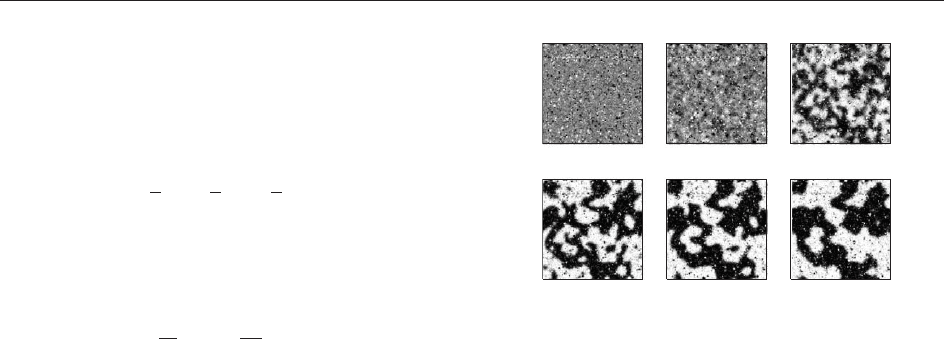
after a transient time. Numerically obtained snap-
shots of the subsequent (r, t) are shown in Figure 1
in two dimensions (2D), where we can see the
coarsening of the patterns. The characteristic domain
size ‘(t) grows algebraically as
‘ðtÞt
a
½9
where a = 1=2 is known for the model [1]. Scattering
experiments detect the time-dependent correlation
gðr; tÞ¼h ðr þ r
0
; tÞ ðr
0
; tÞi ½10
Sðk; tÞ¼
Z
drgðr; tÞe
ikr
½11
where S(k, t) is called the structure factor. We
assume the translational invariance and the spatial
isotropy after the thermal average hi.If
i
1,
the quartic term in F is negligible, leading to the
initial structure factor
Sðk; 0Þffi"=ð
i
þ k
2
Þ½12
which is produced by the thermal fluctuations.
However, when the domain size ‘(t) much exceeds
the microscopic length (lattice constant), the follow-
ing scaling behavior emerges:
gðr; tÞ¼Gðr=‘ðtÞÞ ½13
Sðk; tÞ¼‘ðtÞ
d
Qð‘ðtÞkÞ½14
where d is the space dimensionality and G(x)andQ(x)
are the scaling functions of order unity for x 1. The
correlation on the scale of ‘(t)ineqn[13] arises
from large-scale domain structures, while eqn [14]
is simply its Fourier t ransformation. The maxi-
mum of the structure factor grows as ‘(t)
d
.When
" 1, however, there can be a well-defined initial
stage in which S(k, t) grows exponentially at long
wavelengths.
0.5 2 5
10 20 40
Figure 1 Time evolution of in model [1] in 2D with system
length = 128. The numbers are the times after quenching. Noise
is added, but is not essential for large patterns or in the late
stage. Reproduced with permission from Onuki A (2002) Phase
Transition Dynamics. Cambridge, UK: Cambridge University
Press.
48 Phase Transition Dynamics

We may exp lain the roles of the terms on the
right-hand side of eqn [1] in phase ordering in a
simple manner.
1. The linear term triggers instability for <0.
2. The nonlinear term
3
gives rise to saturation
of into 1. To see this, we neglect r
2
and
to have @ =@t = (1
2
) for = 1. This
equation is solved to give
ðt Þ¼
0
=
ffiffiffiffiffiffiffiffiffiffiffiffiffiffiffiffiffiffiffiffiffiffiffiffiffiffiffiffiffiffiffiffiffiffiffiffiffi
2
0
þð1
2
0
Þe
2t
q
½15
where
0
= (0) is the initial value. Thus, !1
for
0
> 0and !1 for
0
< 0ast !1.
3. The gradient term limits the instability only in
the long wave length region k < 1 in the initial
stage (see eqn [8]) and creates the interfaces in
the late stage (see eqn [7]).
4. The noise term is relevant only in the early
stage wher e is still on the order of the initial
thermal fluctuations. The range of the early stage
is of order 1 for ">
1, but weakly grows as
ln(1=") for " 1. The noise term can be
neglected once the fluctuations much exceed the
thermal level.
5. If h is a small positive num ber, it favors growth
of regions with ffi 1.
Interface Dynamics
At long times t 1 domains with typical size ‘(t)
are separated by sharp interfaces and the thermal
noise is negligible. Allowing the presence of a small
positive h, we may approxim ate the free energy F as
F ¼SðtÞ2hV
þ
ðtÞþconst: ½16
where is a constant (surface tension), S(t)isthe
surface area, and V
þ
(t) is the volume of the
regions with ffi 1. In this stage the interface velocity
v
int
= v
int
n is giv en by the Allen–Cahn formula
(Allen and Cahn 1979):
v
int
¼Kþð2=Þh ½17
The normal unit vector n is from a region with ffi 1
to a region with ffi1. The K is the sum of the
principal curvatures 1=R
1
þ 1=R
2
in 3D. This equa-
tion can be derived from eqn [1]. If the interface
position r
a
moves to r
a
þ n infinitesimally, the
surface area changes by S =
R
daK, where
R
da
denotes the surface integral. Therefore, F in eqn [16]
changes in time as
dF
dt
¼
Z
daðK2hÞv
int
0 ½18
which is non-negative-definite owing to eqn [17].
Furthermore, we may draw three results from eqn [17].
1. If we set v
int
‘(t)=t and K1=‘(t), we obtain
a = 1=2 in the growth law [9].
2. In phase ordering under very small positive h,
the balance 1=‘(t) h= yields the crossover
time t
h
h
2
. For t < t
h
the effect of h is small,
while for t > t
h
the region with ffi 1 becomes
predominant.
3. A spherical droplet with ffi 1 evolves as
@R
@t
¼
2
R
þ
2h
½19
from which the critical radius is determined as
R
c
¼=h ½20
A droplet with R > R
c
(R < R
c
) grows (shrinks).
We mention a statistical theory of interface dynamics
at h = 0byOhta (1982). There, a smooth subsidiary
field u(r, t) is introduced to represent surfaces by
u = const. The differential geometry is much simplified
in terms of such a field. The two-phase boundaries are
represented by u = 0. If all the surfaces follow v
int
= K
in eqn [17] in the whole space, u obeys
@
@t
u ¼
h
r
2
X
ij
n
i
n
j
r
i
r
j
i
u ½21
where r
i
= @=@x
i
and n
i
= r
i
u=jruj. This equation
becomes a linear diffusion equation if n
i
n
j
r
i
r
j
is
replaced by d
1
ij
r
2
. Then u can be expressed in
terms of its initial value and the correlation function
of (r, t)(ffi u(r, t)=ju(r, t)j in the late stage) is
calculated in the form of eqn [13] with
GðxÞ¼
2
sin
1
exp
1
8ð1 1=dÞ
x
2
½22
which excellently agrees with simulations.
Spinodal Decomposition in Conserved
Systems
The order parameter can be a conserved variable
such as the density or composition in fluids or
alloys. With the same F in eqn [4], a simple dynamic
model in such cases reads
@
@t
¼r
2
F
rj
R
½23
Here j
R
is the random current characterized by
D
j
R
ðr; tÞj
R
ðr
0
; t
0
Þ
E
¼2"
ð r r
0
Þðt t
0
Þ½24
which ensures the equilibrium distribution [3] of .
However, the noise j
R
is negligible in late-stage
phase separation as in the nonconserved case. Note
that h in the conserved case is the chemical potential
Phase Transition Dynamics 49
conjugate to and, if it is homogeneous, it vanishes
in the dynamic equation [23]. In experiments the
average order parameter
M ¼h i¼
Z
dr ðrÞ=V ½25
is used as a con trol parameter instead of h, where
the integral is within the system with volume V.If
there is no flux from outside, M is constant in time.
Here the instability occurs below the so-called
spinodal M
2
< 1=3(M
2
< jj =3 for general <0).
In fact, small fluctuations with wave vector k grow
exponentially as
k
ðtÞexp½k
2
ð1 3M
2
k
2
Þt½26
right after the quenching as in eqn [8]. The growth rate
is largest at an intermediate wave number k = k
m
with
k
m
¼½ð1 3M
2
Þ=2
1=2
½27
This behavior and the exponential growth of the
structure factor have been observed in polymer mixtures
where the parameter " in eqn [3] or [12] is expected to be
small (Onuki 2002). In late-stage coarsening the peak
position of S(k, t) decreases in time as
k
m
ðtÞ2=‘ð tÞ½28
in terms of the domain size ‘(t). The growth
exponent in eqn [9] is given by 1/3 for the simple
model [23] (see eqn [33] below).
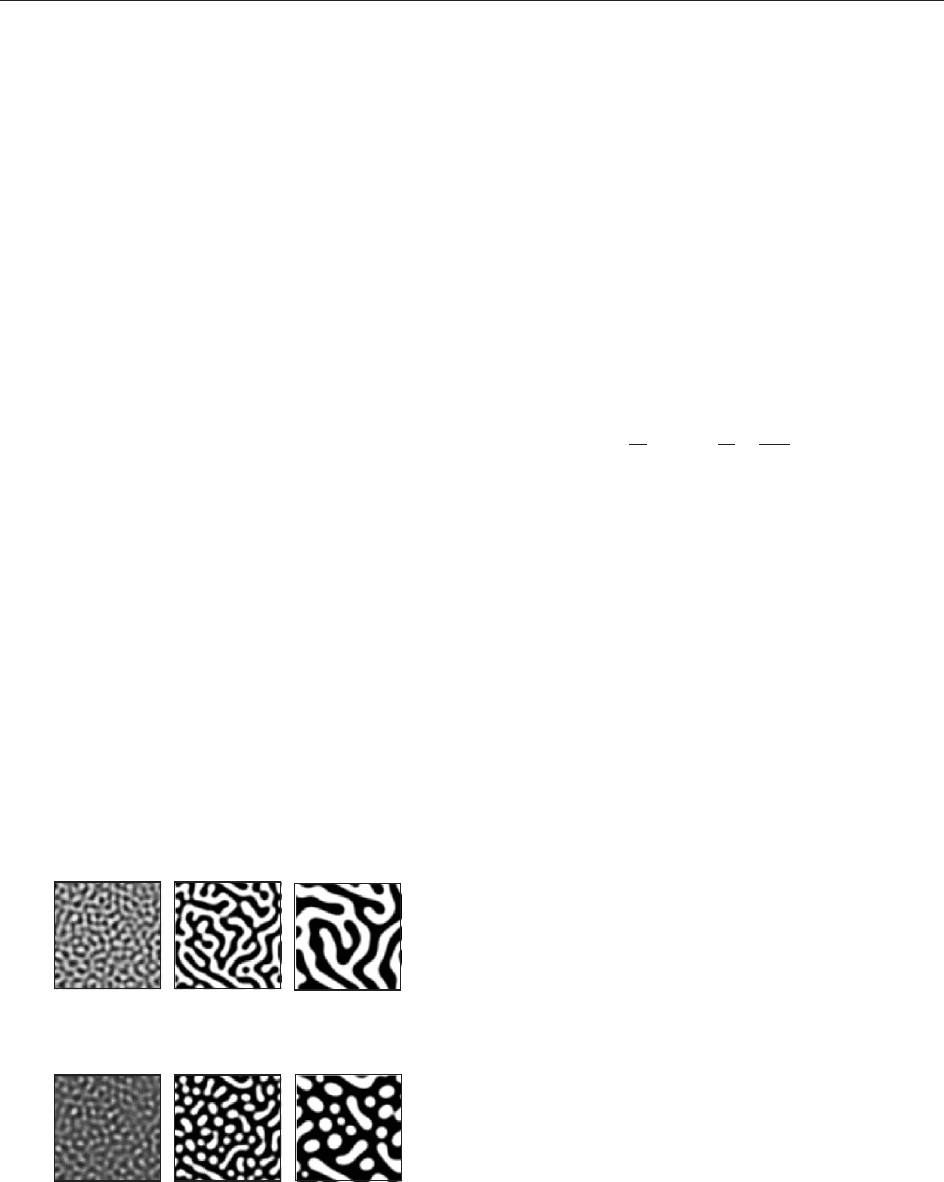
Figure 2 shows the patterns after quenching in 2D.
For M = 0 the two phases are symmetric and the
patterns are bicontinuous, while for M 6¼ 0the
minority phase eventually appears as droplets in the
percolating region of the majority phase.
Interface Dynamics
Interface dynamics in the conser ved case is much
more complicated than in the nonconserved case,
because the coarsening can proceed only through
diffusion. Long-distance correlations arise among
the domains and the interface velocity cannot be
written in terms of the local quantities like the
curvature. As a simple example, we give the counter-
part of eqn [19]. In 3D a spherical droplet with ffi 1
appears in a nearly homogeneous matrix with = M
far from the droplet. The droplet radius R is then
governed by (Lifshitz and Slyozov 1961)
@
@t
R ¼D
R
2d
0
R
2
½29
where =(M þ 1)=2 is called the supersaturation,
while D and d
0
are constants (equal to 2 and =8,
respectively, after the scaling). The critical radius is
written as
R
c
¼ 2d
0
= ½30
The general definition of the supersaturation is
¼ M
ð2Þ
cx
.
ð1Þ
cx
ð2Þ
cx
½31
Here the equilibrium values of are written as
(1)
cx
and
(2)
cx
and M is supposed to be slightly different
from
(2)
cx
.
Lifshitz and Slyozov (1961) analyzed domain coar-
sening in binary AB alloys when the volume fraction q
of the A-rich domains is small. They noticed that the
supersaturation around each domain decreases in
time with coarsening. That is, the A component atoms
in the B-rich matrix are slowly absorbed onto the
growing A-rich domains, while a certain fraction of the
A-rich domains disappear. Thus, q(t)and(t)both
depend on time, but satisfy the conservation law
qðtÞþðtÞ¼ð0Þ¼ðM þ 1Þ=2 ½32
With this overall constraint, they found the
asymptotic late-stage behavior
‘ðtÞðtÞ
1
t
1=3
½33
where ‘(t) is the averag e droplet radius. Notice that
this behavior is consistent with the droplet equation
[29], where each term is of order R=t t
2=3
.
Nucleation
In metastable states the free energy is at a local
minimum but not at the true minimum. Such states
20 100 400
20 100 400
M
= 0
M
= 0.1
(a)
(b)
Figure 2 Time evolution of in model [23] in 2D with system
length = 128 without thermal noise: (a) M = 0 and (b) M = 0.1.
The numbers are the times after quenching. Reproduced with
permission from Onuki A (2002) Phase Transition Dynamics.
Cambridge, UK: Cambridge University Press.
50 Phase Transition Dynamics
are stable for infinitesimal fluctuations, but rare
spatially localized fluctuations, called critical nuclei,
can continue to grow, leading to macroscopic phase
ordering (Onuki 2002, Debenedetti 1996). The birth
of a critical droplet is governed by the Boltzmann
factor exp (F
c
=k
B
T) at finite temperatures, where
F
c
is the free energy needed to create a critical
droplet and k
B
T is the thermal energy with k
B
being
the Boltzmann constant. In this section we explicitly
write k
B
T, but we may scale and space such that
= 1 at the final temperature.
Droplet Free Energy and Experiments
In the nonconserved case we prepare a spin-down state
with ffi1 in the time region t < 0 and then apply a
small positive field h at t = 0. For t > 0 a spin-up
droplet with radius R requires a free energy change
FðRÞ¼4R
2
8
3
hR
3
½34
The first term is the surface free energy and the
second term is the bulk decrease due to h. The
critical radius R
c
in eqn [20] gives the maximum of
F(R) given by
F
c
¼
4
3
R
2
c
½35
In fact, F
0
(R) = @F(R)=@R is written as
F
0
ðRÞ¼8ðR R
2
=R
c
Þ½36
In conserved systems such as fluids or alloys, we
lower the temperature slightly below the coexistence
curve with the average order parameter M held fixed.
We again obtain the droplet free energy [34],but
h ¼ð=2d
0
Þ ½37
in terms of the (initial) supersaturation =(0).
Let the equilibrium values
(1)
cx
and
(2)
cx
in the two
phases be written as A (T
c
T)
with A and
being constants ( ffi 1=3asT !T
c
). For each given
M, we define the coexistence temperature T
cx
by
M =
(2)
cx
= A(T
c
T
cx
)
. In nucleation experi-
ments the final temperature T is slightly below T
cx
and T T
cx
T is a positive temperature incre-
ment. For small T we find
ffi
2
T=ðT
c
T
cx
Þ½38
Droplet Size Distribution and Nucleation Rate
In a homogeneous met astable matrix, droplets of the
new phase appear as rare thermal fluctuations. We
describe this process by adding a thermal noise term
to the droplet equation [19] or [29]. The droplet size
distribution n(R, t) then obeys the Fokke r–Planck
equation
@
@t
n ¼
@
@R
LðRÞ
@
@R
þ
F
0
ðRÞ
k
B
T
n ½39
Here n(R, t)dR denotes the droplet number density
in the range [R, R þ dR]. We determine the kinetic
coefficient L(R) such that
vðRÞ LðRÞF
0
ðRÞ=k
B
T ½40
is the right-hand side of eqn [19] or [29].Itis
equal to @R=@t when the thermal noise is
neglected. Thus, L(R) / R
2
or R
3
for the non-
conserved or conserved case. T he second deriva-
tive (@=@R)L(R)(@=@R)ineqn[39] stem s f rom the
thermal noise and is negligible for R R
c
>
1in
3D (Onuki 2002). Hence, for R R
c
>
1, the
droplets follow the deterministic equation [19] or
[29] and n obeys
@
@t
n ¼
@
@R
½vðRÞn½41
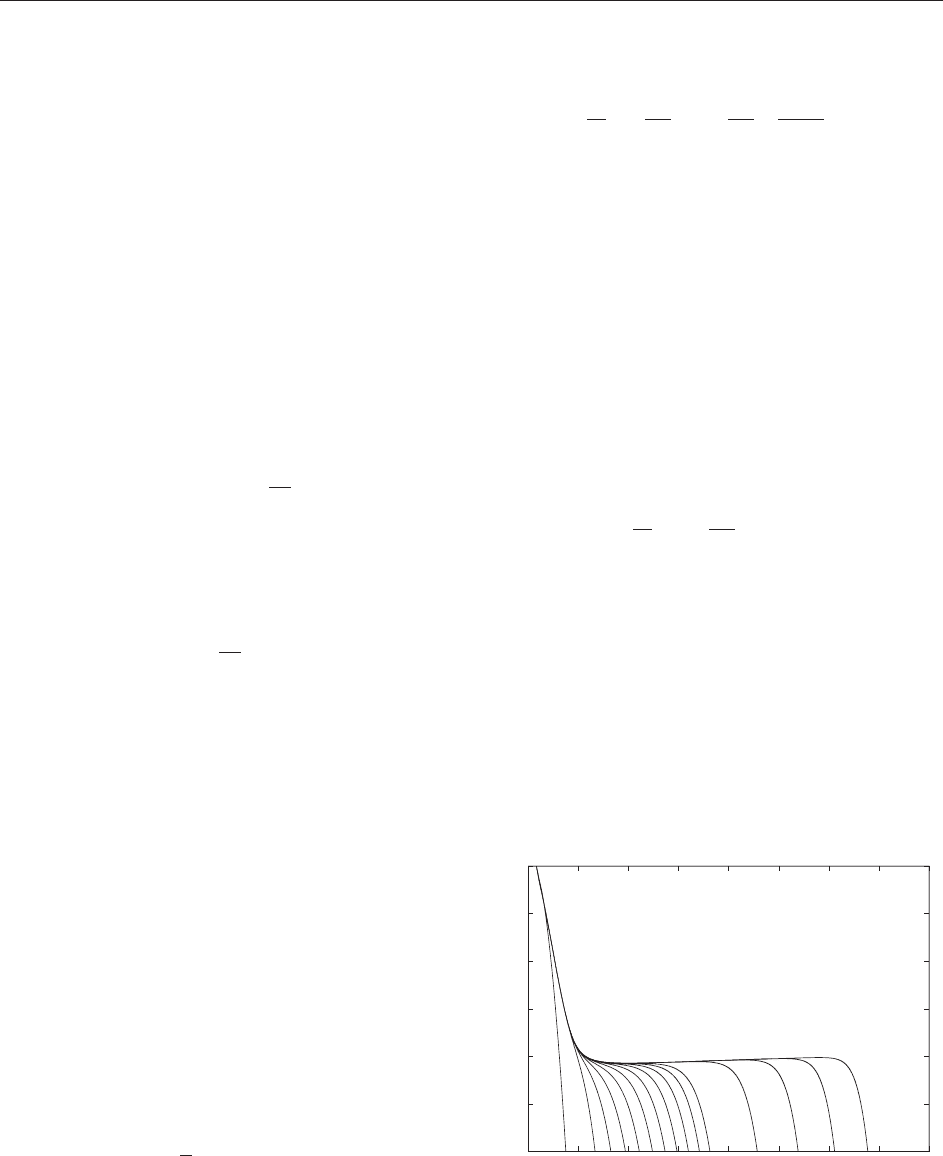
In Figure 3, we plot the solution of eqn [39] for
the conserved case with F
c
=k
B
T = 17.4 (Onuki
2002). The time is measured in units of 1=
c
,
which is the timescale of a critical droplet defined by
c
¼ð@vðRÞ=@RÞ
R¼R
c
½42
We notice
c
/ R
3
c
from eqn [29] so
c
is small.
The initial distribution is given by
nðR; 0Þ¼n
0
expð4R
2
=k
B
TÞ½43
–12
–10
– 8
–6
– 4
–2
0
0 1 2 3 4 5 6 7 8
log
10
n(R,t )
R
/R
c
Figure 3 Time evolution of the droplet size distribution n(R, t)
on a semilogarithmic scale as a solution of eqn [39] in the 3D
conserved case. The first 11 curves correspond to the times at
c
t = 0, 1, ... and 10. The last four curves are those at
c
t = 15, 20, 25, and 30. Reproduced with permission from
Onuki A (2002) Phase Transition Dynamics. Cambridge, UK:
Cambridge University Press.
Phase Transition Dynamics 51