
Francoise J.-P., Naber G.L., Tsun T.S. (editors) Encyclopedia of Mathematical Physics
Подождите немного. Документ загружается.


delta-function along with the symmetry and vertex
factors in [20], one is left with a set of momentum
space integrals
I
D
ðpÞ¼
Y
‘
i¼1
Z
d
dþ1
k
i
ð2Þ
dþ1
Y
n
j¼1
i
a
j
ðk; pÞþi
½21
where a
j
(k, p) are functions of both the internal and
external momenta.
It is convenient to exponentiate propagators using
the Schwinger parametrization
i
a
j
þ i
¼
Z
1
0
d
j
e
i
j
ða
j
þiÞ
½22
and after some straightforward manipulations one
may write the Feynman parametric formula
Y
n
j¼1
i
a
j
ðk; pÞþi
¼ðn 1Þ!
Y
n
j¼1
Z
1
0
d
j
1
P
j
j
D
D
ðk; ; pÞ
n
½23
where D
D
(k; , p):=
P
j
j
[a
j
(k, p) þ i] is generic-
ally a quadratic form
D
D
ðk; ; pÞ¼
1
2
X
‘
i;j¼1
k
i
Q
ij
ðÞk
j
þ
X
‘
i¼1
L
i
ðpÞk
i
þ p
2
½24
The positive symmetric matrix Q
ij
is independent
of the external momenta p
l
, invertible, and
has nonzero eigenvalues Q
1
, ..., Q
‘
. The vectors
L
i
are linear combinations of the p
j
, while (p
2
)
is a function of only the Lorentz invariants p
2
i
.
After some further elementary manipulations,
the loop diagram contribution [21] may be
written as
I
D
ðpÞ
¼ðn 1Þ!
Y
n
j¼1
Z
1
0
d
j
Y
‘
i¼1
1
Q
i
ðÞ
2
Z
d
dþ1
k
i
ð2Þ
dþ1
1
X
j
j
!
1
2
X
i
k
2
i
þ p
2
1
2
X
i;j
L
i
ðpÞQ
1
ðÞ
ij
L
j
ðpÞ
!
n
½25
Finally, the integrals over the loop momenta k
i
may be performed by Wick-rotating them
to Euclidean space and using the fact that
the combination of ‘ integrations in R
dþ1
has
O((d þ1)‘) rotational invariance. The contribu-
tion from the entire Feynman diagram D thereby
reduces to the calculation of the parametric
integrals:
I
D
ðpÞ¼
n
ðdþ1Þ‘
2
ð2Þ
ðdþ1Þ‘
2
i
d‘
Y
n
j¼1
Z
1
0
d
j
Y
‘
i¼1
1
Q
i
ðÞ
2
1
P
j
j
p
2
ðÞ
1
2
P
i;j
L
i
ðpÞQ
1
ðÞ
ij
L
j
ðpÞ
nðdþ1Þ‘
2
½26
where (s) is the Euler gamma-function.
Regularization
The parametric representation [26] is generically
convergent when 2n (d þ 1)‘>0. When diver-
gent, the infinities arise from the lower limits of
integration
j
!0. This is just the parametric
representation of the large-k divergence of the
original Feynman amplitude [20].Suchultraviolet
divergences plague the very meaning of a quan-
tum field theory and must be dealt with in some
way. We will now quickly tour the standard
methods of ultraviolet regularization for such
loop integrals, which is a prelude to the renor-
malization program that removes the divergences
(in a renormalizable field theory). Here we
consider regularization simply as a means of
justification for the various formal manipulations
thatareusedinarrivingatexpressionssuch
as [26].
Momentum Cutoff
Cutoff regularization introduces a mass scale
into the quantum field theory and throws away
the Fourier modes of the fields for spatial
momenta k with jkj > . This regularization
spoils Lorentz invariance. It is also nonlocal. For
example, if we restrict to a hypercube in
momentum space, so that jk
i
j < for i = 1, ..., d,
then
Z
jkj>
d
d
k
ð2Þ
d
e
ikx
¼
Y
d
i¼1
sinðx
i
Þ
x
i
which is a delta-function in the limit !1 but is
nonlocal for < 1. The regularized field theory is
finite order by order in perturbation theory and
depends on the cutoff .
32 Perturbation Theory and Its Techniques

Lattice Regularization
We can replace the spatial continuum by a lattice L
of rank d and define a Lagrangian on L by
L
L
¼
1
2
X
i2SðL Þ
_
2
i
þ J
X
hi;ji2LðL Þ
i
j
þ
X
i2SðL Þ
Vð
i
Þ½27
where S(L )isthesetofsitesi of the lattice on each
of which is situated a time-dependent function
i
,and
L
L
is the collection of links connecting pairs hi, ji of
nearest-neighbor sites i, j on L . The regularized field
theory is now local, but still has broken Lorentz
invariance. In particular, it suffers from broken rota-
tional symmetry. If L is hypercubic with lattice spacing
a,thatis,L = (Za)
d
, then the momentum cutoff is
at =a
1
.
Pauli–Villars Regularization
We can replace the propagator i(k
2
m
2
þ i)
1
by
i(k
2
m
2
þ i)
1
þ i
P
N
j = 1
c
j
(k
2
M
2
j
þ i)
1
, where
the masses M
j
m are identified with the momen-
tum cutoff as min{M
j
} =!1. The mass-depen-
dent coefficients c
j
are chosen to make the modified
propagator decay rapidly as (k
2
)
N1
at k !1,
which gives the N equations (m
2
)
i
þ
P
j
c
j
(M
2
j
)
i
=
0, i = 0, 1, ..., N 1. This regularization preserves
Lorentz invariance (and other symmetries that the
field theory may possess) and is local in the
following sense. The modified propagator can be
thought of as arising through the alteration of the
Lagrangian density [4] by N additional scalar fields
’
j
of masses M
j
with
L
PV
¼
1
2
@
@
1
2
m
2
2
þ
X
N
j¼1
1
2
@
’
j
@
’
j
1
2
M
2
j
’
2
j
þL
int
½½28
where := þ
P
j
ffiffiffiffi
c
j
p
’
j
. The contraction of the
field thus produces the required propagator.
However, the c
j
’s as computed above are gener-
ically negative numbers and so the Lagrangian
density [28] is not Hermitian (as 6¼
y
). It is
possible to make [28] formally Hermitian by
redefining the inner product on the Hilbert
space of physical states, but this produces
negative-norm states. This is no problem at
energy scales E M
j
on which the extra particles
decouple and the negative probability states are
invisible.
Dimensional Regularization
Consider a Euclidean space integral
R
d
4
k(k
2
þ a
2
)
r
arising after Wick rotation from some loop diagram
in (3 þ 1)-dimensional scalar field theory. We
replace this integral by its D-dimensional version
Z
d
D
k
k
2
þ a
2
ðÞ
r
¼
D=2
a
2
D=2r
ðr 1Þ!
r
D
2
½29
This integral is absolutely convergent for D < 2r.
We can analytically continue the result of this
integration to the complex plane D 2 C.Asan
analytic function, the only singularities of the Euler
function (z) are poles at z = 0, 1, 2, ....In
particular, (z) has a simple pole at z = 0 of residue
1. If we write D = 4 þ with jj!0, then the
integral [29] is proportional to (r 2 =2) and
plays the role of the regulator here. This regulariza-
tion is Lorentz invariant (in D dimensions) and is
distinguished as having a dimensionless regulariza-
tion parameter . This parameter is related to the
momentum cutoff by
1
= ln (=m), so that the
limit !0 corresponds to !1.
Infrared Divergences
Thus far we have only considered the ultraviolet
behavior of loop amplitudes in quantum field theory.
When dealing with massless particles (m = 0in[4])
one has to further worry about divergences arising
from the k !0 regions of Feynman integrals. After
Wick rotation to Euclidean momenta, one can show
that no singularities arise in a given Feynman diagram
as some of its internal masses vanish provided that all
vertices have superficial degree of divergence d þ 1,
the external momenta are not exceptional (i.e., no
partial sum of the incoming momenta p
i
vanishes), and
there is at most one soft external momentum. This
result assumes that renormalization has been carried
out at some fixed Euclidean point. The extension of
this property when the external momenta are con-
tinued to physical on-shell values is difficult. The
Kinoshita–Lee–Nauenberg theorem states that, as a
consequence of unitarity, transition probabilities in a
theory involving massless particles are finite when the
sum over all degenerate states (initial and final) is
taken. This is true order by order in perturbation
theory in bare quantities or if minimal subtraction
renormalization is used (to avoid infrared or mass
singularities in the renormalization constants).
Fermion Fields
We will now leave the generalities of our pure scalar
field theory and start considering the extensions of
our previous considerations to other types of
particles. Henceforth we will primarily deal with
the case of (3 þ 1)-dimensional spacetime. We begin
by indicating how the rudiments of perturbation
Perturbation Theory and Its Techniques 33
theory above apply to the case of Dirac fermion
fields. The Lagrangian density is
L
F
¼ ði@= mÞ þL
0
½30
where are four-component Dirac fermion fields in
3 þ 1 dimensions,
:=
y
0
and @= =
@
with
the generators of the Clifford algebra {
,
} = 2
.
The Lagrangian density L
0
contains couplings of the
Dirac fields to other field theories, such as the scalar
field theories considered previously.
Wick’s theorem for anticommuting Fermi fields
leads to the Pfaffian formula
h0jT ð1Þ ðnÞ½j0i
¼
0; n ¼ 2k 1
1
2
k
k!
X
2S
2k
sgnðÞ
Y
k
i¼1
h0jT ð2i 1ÞðÞ ð2iÞðÞ½j0i
n ¼ 2k
8
>
>
>
>
>
>
>
>
>
>
>
<
>
>
>
>
>
>
>
>
>
>
>
:
½31
where for compactness we have written in the
argument of (i) the spacetime coordinate, the
Dirac index, and a discrete index which distin-
guishes from
. The nonvanishing contractions
in [31] are determined by the free-fermion
propagator
F
ðx yÞ¼ 0T ðxÞ ðyÞ
0
¼ x ði@= mÞ
1
y
DE
¼ i
Z
d
4
p
ð2Þ
4
p= þ m
p
2
m
2
þ i
e
ipðxyÞ
½32
Perturbation theory now proceeds exactly as
before. Suppose that the coupling Lagrangian
density in [30] is of the form L
0
= (x)V(x) (x).
Both the Dyson formula [3] and the diagrammatic
formula [15] are formally the same in this instance.
For example, in the formal expansion in powers of
R
d
4
xL
0
, the vacuum-to-vacuum amplitude (the
denominator in [5]) will contain field products of
the form
Y
n
i = 1
Z
d
4
x
i
h0jT½ ðx
i
ÞVðx
i
Þ ðx
i
Þj0i
which correspond to fermion loops. Before applying
Wick’s theorem, the fields must be rearranged as
tr
Y
n
i = 1
Vðx
i
Þ ðx
i
Þ ðx
iþ1
Þ
(with x
nþ1
:= x
1
), where tr is the 4 4 trace
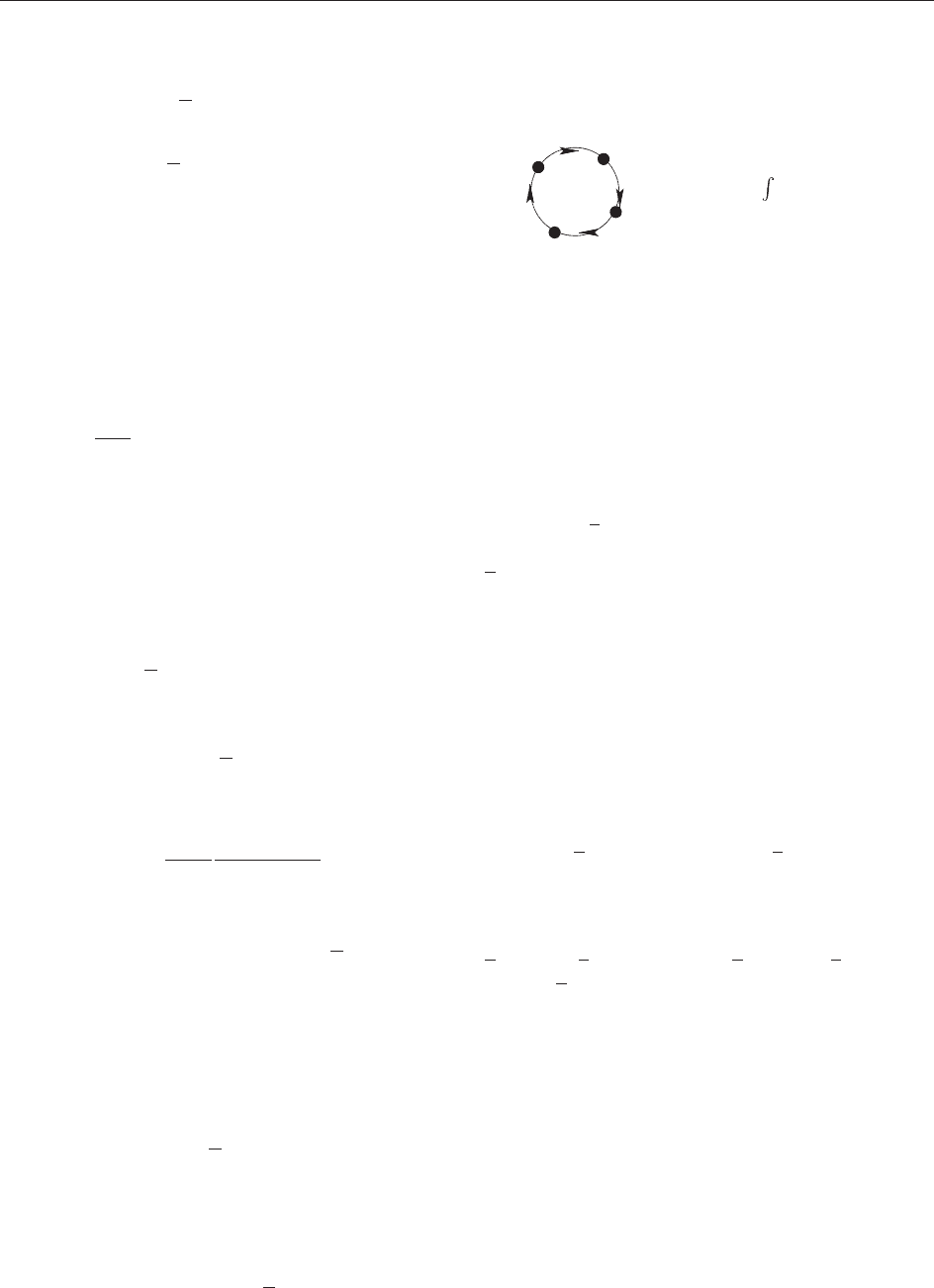
over spinor indices. This reordering introduces the
familiar minus sign for a closed fermion loop, and
one has
V(x
2
)
V(x
n
)
(–)
Π
n
n – 1
i
=
1
j
=
1
d
4
x
i
V(x
3
)
V(x
1
)
.
.
.
tr
Π
Δ
F
(x
j
–
x
j + 1
)
V(x
j + 1
) Δ
F
(x
j + 1
– x
j + 2
)
×
×
=
½33
Feynman rules are now described as follows.
Fermion lines are oriented to distinguish a particle
from its corresponding antiparticle, and carry both
a four-momentum label p as well as a spin
polarization index r = 1, 2. Incoming fermions (resp.
antifermions) are described by the wave functions
u
(r)
p
(resp. v
(r)
p
), while outgoing fermions (resp.
antifermions) are described by the wave functions
u
(r)
p
(resp. v
(r)
p
). Here u
(r)
p
and v
(r)
p
are the classical
spinors, that is, the positive and negative-energy
solutions of the Dirac equation (p= m)u
(r)
p
= (p=þ
m)v
(r)
p
= 0. Matrices are multiplied along a Fermi
line, with the head of the arrow on the left. Closed
fermion loops produce an overall minus sign as in
[33], and the multiplication rule gives the trace of
Dirac matrices along the lines of the loop. Unpolar-
ized scattering amplitudes are summed over the spins
of final particles and averaged over the spins of initial
particles using the completeness relations for spinors
X
r¼1;2
u
ðrÞ
p
u
ðrÞ
p
¼ p= þ m;
X
r¼1;2
v
ðrÞ
p
v
ðrÞ
p
¼ p= m ½34
leading to basis-independent results. Polarized
amplitudes are computed using the spinor bilinears
u
(r)
p
u
(s)
p
= v
(r)
p
v
(s)
p
= 2p
rs
, u
(r)
p
u
(s)
p
= v
(r)
p
v
(s)
p
= 2m
rs
,andu
(r)
p
v
(s)
p
= 0.
When calculating fermion loop integrals using
dimensional regularization, one utilizes the Dirac
algebra in D dimensions
¼
¼D
p=
¼ð2 DÞp=
p= k=
¼4p k þðD 4Þp=k=
p= k= q=
¼2q= k= p= ðD 4Þp= k= q=
tr1 ¼ 4; tr
1
2k1
¼0; tr
¼4
tr
¼4
ð
þ
Þ
½35
34 Perturbation Theory and Its Techniques
Specific to D = 4 dimensions are the trace identities
tr
5
¼ tr
5
¼ 0;
tr
5
¼4i
½36
where
5
:= i
0
1
2
3
. Finally, loop diagrams eval-
uated with the fermion propagator [32] require a
generalization of the momentum space integral [29]
given by
Z
d
D
k
ð2Þ
D
1
k
2
þ 2k p þ a
2
þ iðÞ
r
¼
iðÞ
D=2
r
D
2
ð2Þ
D
ðr 1Þ!
1
a
2
p
2
þ iðÞ
rD=2
½37
From this formula we can extract expressions for
more complicated Feynman integrals which are
tensorial, that is, which contain products of
momentum components k
in the numerators of
their integrands, by differentiating [37] with respect
to the external momentum p
.
Gauge Fields
The issues we have dealt with thus far have
interesting difficulties when dealing with gauge
fields. We will now discuss some general aspects of
the perturbation expansion of gauge theories using
as prototypical examples quantum electrodynamics
(QED) and quantum chromodynamics (QCD) in
four spacetime dimensions.
Quantum Electrodynamics
Consider the QED Lagrangian density
L
QED
¼
1
4
F
F
þ
1
2
2
A
A
þ ði@= eA= mÞ ½38
where A
is a U(1) gauge field in 3 þ 1 dimensions
and F
= @
A
@
A
is its field strength tensor.
We have added a small mass term !0for
the gauge field, which at the end of calculations
should be taken to vanish in order to describe
real photons (as opposed to the soft photons
described by [38]). This is done in order to cure
the infrared divergences generated in scattering
amplitudes due to the masslessness of the photon,
that is, the long-range nature of the electromag-
netic interaction. The Bloch–Nordsieck theorem
in QED states that infrared divergences cancel
for physical processes, that is, for processes
with an arbitrary number of undetectable soft
photons.
Perturbation theory proceeds in the usual way
via the Dyson formula, Wick’s theorem, and
Feynman diagrams. The gauge field propagator is
given by
h0jT A
ðxÞA
ðyÞ
j0i
¼hxj
& þ
2
@
@
1
jyi
¼ i
Z
d
4
p
ð2Þ
4
þ
p
p
2
p
2
2
þ i
e
ipðxyÞ
½39
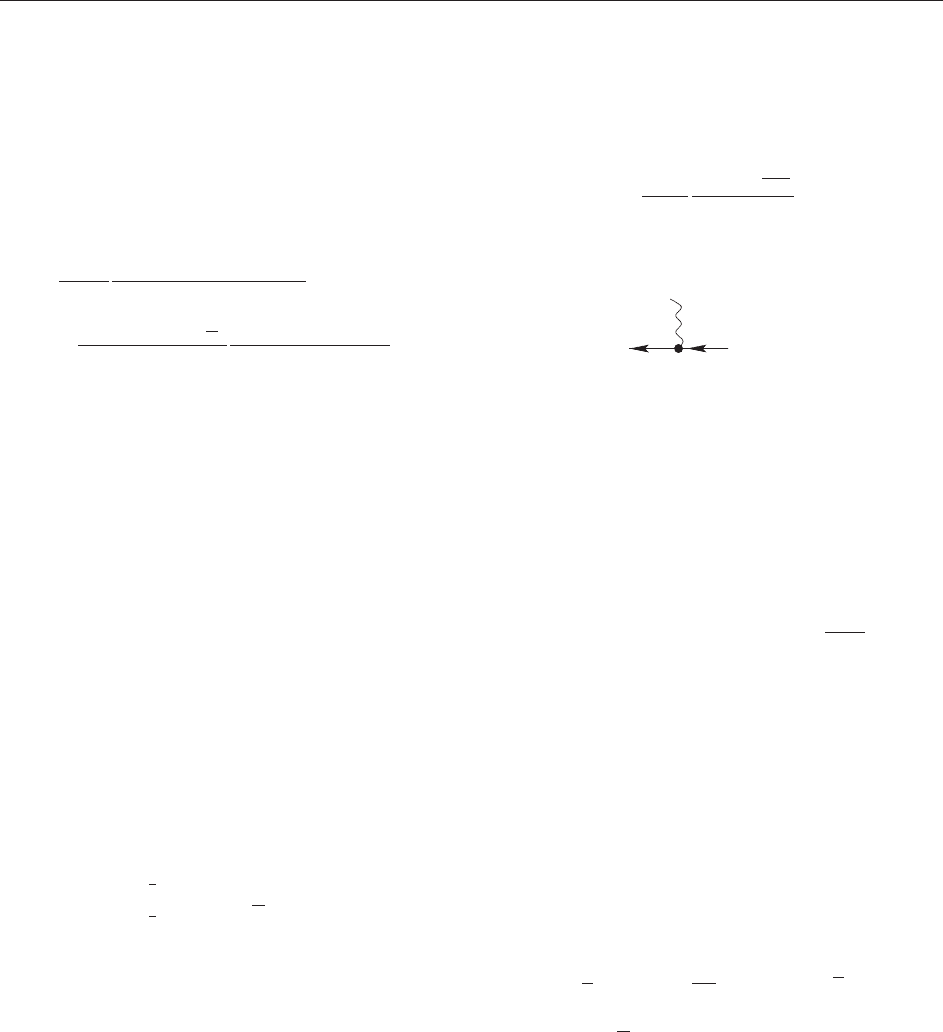
and is represented by a wavy line. The fermion–
fermion–photon vertex is
= –ie γ
μ
μ
½40
An incoming (resp. outgoing) soft photon of
momentum k and polarization r is described by the
wave function e
(r)
(k) (resp. e
(r)
(k)
), where the
polarization vectors e
(r)
(k), r = 1, 2, 3 solve the vector
field wave equation (& þ
2
)A
= @
A
= 0and
obey the orthonormality and completeness
conditions
e
ðrÞ
ðkÞ
e
ðsÞ
ðkÞ¼
rs
X
3
r¼1
e
ðrÞ
ðkÞe
ðrÞ
ðkÞ
¼
þ
k
k
2
½41
along with k e
(r)
(k) = 0. All vector indices are
contracted along the lines of the Feynman graph.
All other Feynman rules are as previously.
Quantum Chromodynamics
Consider nonabelian gauge theory in 3 þ 1 dimen-
sions minimally coupled to a set of fermion fields
A
, A = 1, ..., N
f
, each transforming in the funda-
mental representation of the gauge group G whose
generators T
a
satisfy the commutation relations
[T
a
, T
b
] = f
abc
T
c
. The Lagrangian density is given by
L
QCD
¼
1
4
F
a
F
a
þ
1
2
@
A
a
2
þ@
D
þ
X
N
f
A¼1
A
ðiD= m
A
Þ
A
½42
where F
a
= @
A
a
@
A
a
þ f
abc
A
b
A
c
and D
= @
þ
ieR(T
a
)A
a
, with R the pertinent representation of G
(R(T
a
)
bc
= f
a
bc
for the adjoint representation and
R(T
a
) = T
a
for the fundamental representation).
The first term is the Yang–Mills Lagrangian density,
the second term is the covariant gauge-fixing term,
and the third term contains the Faddeev–Popov
ghost fields which transform in the adjoint
representation of the gauge group.
Feynman rules are straightforward to write
down and are given in Figure 1 where wavy lines
Perturbation Theory and Its Techniques 35
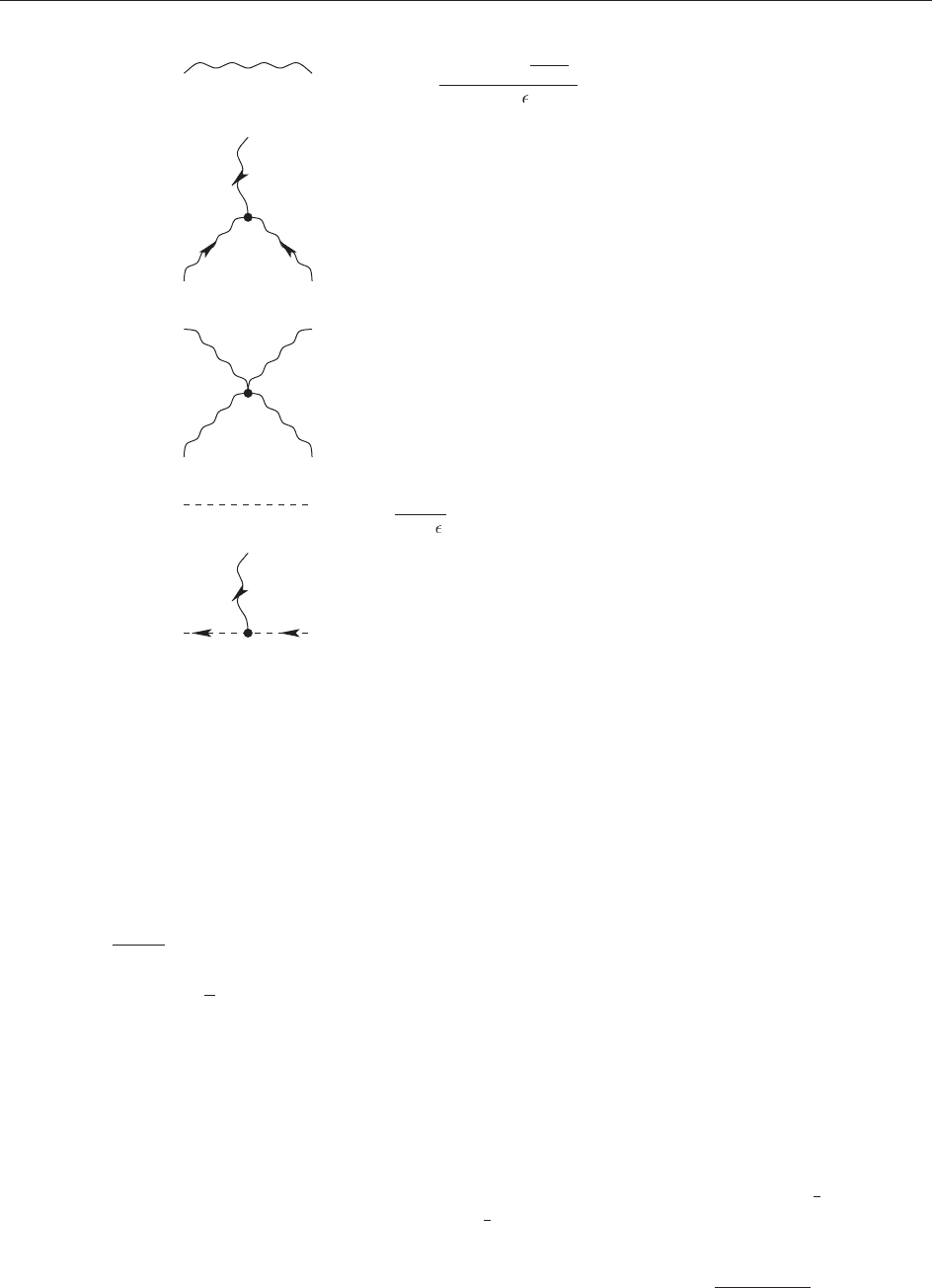
represent gluons and dashed lines represent ghosts.
Feynman rules for the fermions are exactly as
before, except that now the vertex [40] is multi-
plied by the color matrix T
a
. All color indices are
contracted along the lines of the Feynman graph.
Color factors may be simplified by using the
identities
Tr R
a
R
b
¼
dim R
dim G
C
2
ðRÞ
ab
; R
a
R
a
¼ C
2
ðRÞ
R
a
R
b
R
a
¼ C
2
ðRÞ
1
2
C
2
ðGÞ
R
b
½43
where R
a
:= R(T
a
) and C
2
(R) is the quadratic
Casimir invariant of the representation R (with
value C
2
(G) in the adjoint representation). For
G = SU(N), one has C
2
(G) = N and C
2
(N) = (N
2
1)=2N for the fundamental representation.
The cancellation of infrared divergences in loop
amplitudes of QCD is far more delicate than in
QED, as there is no analog of the Bloch–
Nordsieck theorem in this case. The Kinoshita–
Lee–Nauenberg theorem guarantees that, at the
end of any perturbative calculation, these diver-
gences must cancel for any appropriately defined
physical quantity. However, at a given order of
perturbation theory, a physical quantity typically
involves both virtual and real emission contribu-
tions that are separately infrared divergent.
Already at two-loop level these divergences have
a highly intricate structure. Their precise form is
specified by the Catani color-space factorization
formula, which also provides an efficient way of
organizing amplitudes into divergent parts, which
ultimately drop out of physical quantities, and
finite contributions.
The computation of multigluon amplitudes in
nonabelian gauge theory is rather complicated
when one uses polarization states of vector bosons.
A much more efficient representation of amplitudes
is provided by adopting a helicity (or circular
polarization) basis for external gluons. In the
spinor–helicity formalism, one expresses positive
and negative-helicity polarization vectors in terms
of massless Weyl spinors jk
i:=
1
2
(1
5
)u
k
=
1
2
(1
5
)v
k
through
e
ðk; qÞ¼
q
k
ffiffiffi
2
p
q
k
jhi
½44
d,ρ
c,λ b,ν
a,μ
k
ba
c,λ,k
b,ν,q
a,μ,p
c,kb,q
a,μ,p
k
b,ν
a,μ
– i e
2
[f
eab
f
ecd
(η
μλ
η
νρ
– η
μρ
η
νλ
)
+ f
eac
f
ebd
(η
μν
η
λρ
– η
μρ
η
νλ
) + f
ead
f
ebc
(η
μν
η
λρ
– η
νρ
η
μλ
)]
e f
abc
[η
λμ
(p
ν
– k
ν
) + η
μν
(q
λ
– p
λ
) + η
νλ
(k
μ
– q
μ
)]
ek
μ
f
abc
– i δ
ab
k
2
+ i
k
μ
k
ν
k
2
η
μν
+ (α – 1)
i
δ
ab
k
2
+ i
Figure 1 Feynman rules.
36 Perturbation Theory and Its Techniques
where q is an arbitrary null reference momentum
which drops out of the final gauge-invariant
amplitudes. The spinor products are crossing sym-
metric, antisymmetric in their arguments, and satisfy
the identities
k
i
jk
þ
j
DE
k
þ
j
jk
i
DE
¼ 2k
i
k
j
k
i
k
þ
j
E
k
l
jk
þ
r
D
¼ k
i
jk
þ
r
k
l
jk
þ
j
DE
þ k
i
jk
þ
l
k
j
jk
þ
r
DE
½45
Any amplitude with massless external fermions
and vector bosons can be expressed in terms of
spinor products. Conversely, the spinor products
offer the most compact representation of helicity
amplitudes which can be related to more conven-
tional amplitudes described in terms of Lorentz
invariants. For loop amplitudes, one uses a
dimensional regularizationschemeinwhichall
helicity states are kept four dimensional and only
internal loop momenta are continued to D = 4 þ
dimensions.
Computing Loop Integrals
At the very heart of perturbative quantum field
theory is the problem of computing Feynman
integrals for multiloop scattering amplitudes. The
integrations typically involve serious technical chal-
lenges and for the most part are intractable by
straightforward analytical means. We will now
survey some of the computational techniques that
have been developed for calculating quantum loop
amplitudes which arise in the field theories consid-
ered previously.
Asymptotic Expansion
In many physical instances one is interested in
scattering amplitudes in certain kinematical limits. In
this case one may perform an asymptotic expansion of
multiloop diagrams whose coefficients are typically
nonanalytic functions of the perturbative expansion
parameter h. The main simplification which arises
comes from the fact that the expansions are done
before any momentum integrals are evaluated. In the
limits of interest, Taylor series expansions in different
selected regions of each loop momentum can be
interpreted in terms of subgraphs and co-subgraphs
of the original Feynman diagram.
Consider a Feynman diagram D which depends on
a collection {Q
i
} of large momenta (or masses), and
a collection {m
i
, q
i
} of small masses and momenta.
The prescription for the large-momentum
asymptotic expansion of D may be summarized in
the diagrammatic formula
lim
Q!1
D ðQ; m; qÞ
¼
X
dD
ðD =dÞðm ; qÞ ? T
fm
d
;q
d
g
d
ðQ; m
d
; q
d
Þ½46
where the sum runs through all subgraphs d of D
which contain all vertices where a large momentum
enters or leaves the graph and is one-particle irredu-
cible after identifying these vertices. The operator
T
{m
d
, q
d
}
performs a Taylor series expansion before any
integration is carried out, and the notation (D =d) ?
(T
{m
d
, q
d
}
d) indicates that the subgraph d D is
replaced by its Taylor expansion in all masses and
external momenta of d that do not belong to the set
{Q
i
}. The external momenta of d which become loop
momenta in D are also considered to be small. The
loop integrations are then performed only after all
these expansions have been carried out. The diagrams
D =d are called co-subgraphs.
The subgraphs become massless integrals in which
the scales are set by the large momenta. For instance,
in the simplest case of a single large momentum Q one
is left with integrals over propagators. The co-
subgraphs may contain small external momenta and
masses, but the resulting integrals are typically much
simpler than the original one. A similar formula is true
for large-mass expansions, with the vertex conditions
on subdiagrams replace by propagator conditions. For
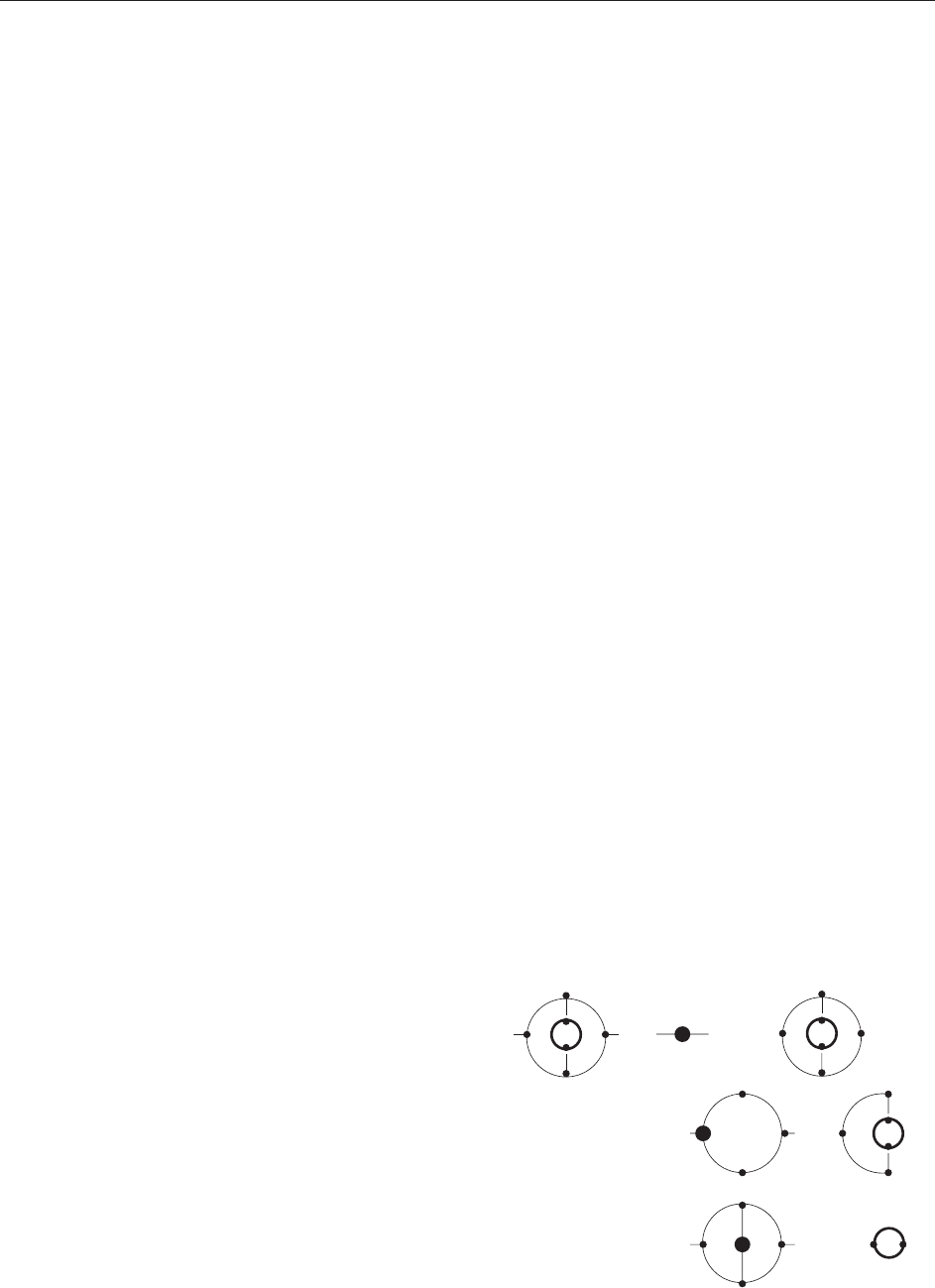
example, consider the asymptotic expansion of the
two-loop double bubble diagram (Figure 2)inthe
region q
2
m
2
,wherem is the mass of the inner loop.
The subgraphs (to the right of the stars) are expanded
in all external momenta including q and reinserted into
the fat vertices of the co-subgraphs (to the left of the
stars). Once such asymptotic expansions are carried
out, one may attempt to reconstruct as much informa-
tion as possible about the given scattering amplitude
*
*
+
+ 2
*
=
Figure 2 Asymptotic expansion of the two-loop double bubble
diagram.
Perturbation Theory and Its Techniques 37

by using the method of Pade´ approximation which
requires knowledge of only part of the expansion of
the diagram. By construction, the Pade´ approximation
has the same analytic properties as the exact
amplitude.
Brown–Feynman Reduction
When considering loop diagrams which involve
fermions or gauge bosons, one encounters tensorial
Feynman integrals. When these involve more than
three distinct denominator factors (propagators),
they require more than two Feynman parameters
for their evaluation and become increasingly
complicated. The Brown–Feynman method simpli-
fies such higher-rank integrals and effectively
reduces them to scalar integrals which typically
require fewer Feynman parameters for their
evaluation.
To illustrate the idea behind this method, consider
the one-loop rank-3 tensor Feynman integral
J
¼
Z
d
D
k
ð2Þ
D
k
k
k
k
2
ðk
2
2
Þðq kÞ
2
ððk qÞ
2
þ
2
Þðk
2
þ2k pÞ
½47
where p and q are external momenta with the mass-
shell conditions p
2
=(p q)
2
=m
2
. By Lorentz invar-
iance, the general structure of the integral [47] will
be of the form
J
¼ a
p
þ b
q
þ c
s
þ c
s
½48
where a
, b
are tensor-valued functions and
c
a vector-valued function of p and q.The
symmetric tensor s
is chosen to project out
components of vectors transverse to both p and q,
i.e., p
s
= q
s
= 0, with the normalization
s
= D 2. Solving these constraints leads to the
explicit form
s
¼
m
2
q
q
þq
2
p
p
ðp qÞ q
p
þp
q
ðÞ
m
2
q
2
ðp qÞ
2
½49
To determine the as yet unknown functions
a
, b
and c
above, we first contract both sides
of the decomposition [48] with p
and q
to get
2p
J
¼ 2m
2
a
þ 2ðp qÞb
2q
J
¼ 2ðp qÞa
þ 2q
2
b
½50
Inside the integrand of [47], we then use the trivial
identities
2k p ¼ k
2
þ 2k p
k
2
2q k ¼ k
2
þ q
2
ðk qÞ
2
½51
to write the left-hand sides of [50] as the sum of
rank-2 Feynman integrals which, with the exception
of the one multiplied by q
2
from [51], have one less
denominator factor. This formally determines the
coefficients a
and b
in terms of a set of rank-2
integrations. The vector function c
is then found
from the contraction
J
¼ p
a
þ q
b
þðD 2Þc
½52
This contraction eliminates the k
2
denominator
factor in the integrand of [47] and produces a
vector-valued integral. Solving the system of
algebraic equations [50] and [52] then formally
determines the rank-3 Feynman integral [47] in
terms of rank-1 and rank-2 Feynman integrals. The
rank-2 Feynman integrals thus generated can then
be evaluated in the same way by writing a
decomposition for them analogous to [48] and
solving for them in terms of vector-valued and
scalar-valued Feynman integrals. Finally, the rank-1
integrations can be solved for in terms of a set of
scalar-valued integrals, most of which have fewer
denominator factors in their integrands.
Generally, any one-loop amplitude can be reduced
to a set of basic integrals by using the Passarino–
Veltman reduction technique. For example, in
supersymmetric amplitudes of gluons any tensor
Feynman integral can be reduced to a set of scalar
integrals, that is, Feynman integrals in a scalar field
theory with a massless particle circulating in the
loop, with rational coefficients. In the case of N = 4
supersymmetric Yang–Mills theory, only scalar box
integrals appear.
Reduction to Master Integrals
While the Brown–Feynman and Passarino–Veltman
reductions are well suited for dealing with one-loop
diagrams, they become rather cumbersome for
higher-loop computations. There are other more
powerful methods for reducing general tensor
integrals into a basis of known integrals called
master integrals. Let us illustrate this technique on a
scalar example. Any scalar massless two-loop Feyn-
man integral can be brought into the form
IðpÞ¼
Z
d
D
k
ð2Þ
D
Z
d
D
k
0
ð2Þ
D
Y
t
j¼1
l
j
j
Y
q
i¼1
n
i
i
½53
where
j
are massless scalar propagators depending
on the loop momenta k, k
0
and the external
momenta p
1
, ..., p
n
, and
i
are scalar products of
a loop momentum with an external momentum or
of the two loop momenta. The topology of the
corresponding Feynman diagram is uniquely deter-
mined by specifying the set
1
, ...,
t
of t distinct
38 Perturbation Theory and Its Techniques

propagators in the graph, while the integral itself is
specified by the powers l
j
1 of all propagators, by
the selection
1
, ...,
q
of q scalar products and by
their powers n
i
0.
The integrals in a class of diagrams of the same
topology with the same denominator dimension
r =
P
j
l
j
and same total scalar product number
s =
P
i
n
i
are related by various identities. One
class follows from the fact that the integral over a
total derivative with respect to any loop momentum
vanishes in dimensional regularization as
Z
d
D
k
ð2Þ
D
@JðkÞ
@k
¼ 0
where J(k) is any tensorial combination of propaga-
tors, scalar products and loop momenta. The
resulting relations are called integration-by-parts
identities and for two-loop integrals can be cast
into the form
Z
d
D
k
ð2Þ
D
Z
d
D
k
0
ð2Þ
D
v
@f ðk; k
0
; pÞ
@k
¼ 0
¼
Z
d
D
k
ð2Þ
D
Z
d
D
k
0
ð2Þ
D
v
@f ðk; k
0
; pÞ
@k
0
½54
where f (k, k
0
, p) is a scalar function containing
propagators and scalar products, and v
is any
internal or external momentum. For a graph with ‘
loops and n independent external momenta, this
results in a total of ‘(n þ ‘) relations.
In addition to these identities, one can also exploit
thefactthatallFeynmanintegrals[53] are Lorentz
scalars. Under an infinitesimal Lorentz transformation
p
!p
þ p
,withp
= p
,
=
, one has
the invariance condition I(p þ p) = I(p), which leads
to the linear homogeneous differential equations
X
n
i¼1
p
i
@
@p
i
p
i
@
@p
i
IðpÞ¼0 ½55
This equation can be contracted with all possible
antisymmetric combinations of p
i
p
j
to yield
linearly independent Lorentz invariance identities
for (53).
Using these two sets of identities, one can either
obtain a reduction of integrals of the type (53)
to those corresponding to a small number of simpler
diagrams of the same topology and diagrams of
simpler topology (fewer denominator factors), or
a complete reduction to diagrams with simpler
topology. The remaining integrals of the topology
under consideration are called irreducible master
integrals. These momentum integrals cannot be
further reduced and have to be computed by different
techniques. For instance, one can apply a Mellin–
Barnes transformation of all propagators given by
1
ðk
2
þaÞ
l
¼
1
ðl 1Þ!
Z
i1
i1
dz
2i
a
z
ðk
2
Þ
lþz
ðl þzÞðzÞ½56
where the contour of integration is chosen to lie to the
right of the poles of the Euler function (l þz)andto
theleftofthepolesof(z ) in the complex z-plane.
Alternatively, one may apply the negative-dimension
method in which D is regarded as a negative integer in
intermediate calculations and the problem of loop
integration is replaced with that of handling infinite
series. When combined with the above methods, it may
be used to derive powerful recursion relations among
scattering amplitudes. Both of these techniques rely on
an explicit integration over the loop momenta of the
graph, their differences occurring mainly in the repre-
sentations used for the propagators.
The procedure outlined above can also be used to
reduce a tensor Feynman integral to scalar integrals, as
in the Brown–Feynman and Passarino–Veltman reduc-
tions. The tensor integrals are expressed as linear
combinations of scalar integrals of either higher
dimension or with propagators raised to higher
powers. The projection onto a tensor basis takes the
form [53] and can thus be reduced to master integrals.
String Theory Methods
The realizations of field theories as the low-energy
limits of string theory provides a number of power-
ful tools for the calculation of multiloop amplitudes.
They may be used to provide sets of diagrammatic
computational rules, and they also work well for
calculations in quantum gravity. In this final part we
shall briefly sketch the insights into perturbative
quantum field theory that are provided by tech-
niques borrowed from string theory.
String Theory Representation
String theory provides an efficient compact repre-
sentation of scattering amplitudes. At each loop
order there is only a single closed string diagram,
which includes within it all Feynman graphs along
with the contributions of the infinite tower of
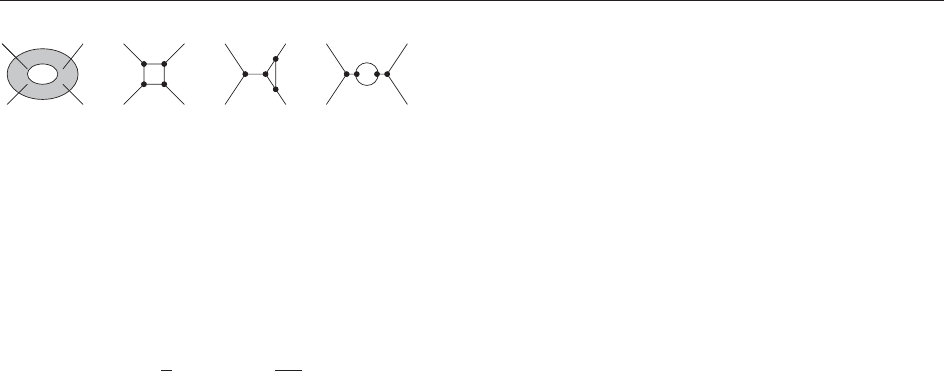
massive string excitations. Schematically, at one-
loop order, the situation is as shown in Figure 3.
The terms arising from the heavy string modes are
removed by taking the low-energy limit in which all
external momenta lie well below the energy scale set
by the string tension. This limit picks out the regions
of integration in the string diagram corresponding to
particle-like graphs, but with different diagrammatic
rules.
Perturbation Theory and Its Techniques 39
Given these rules, one may formulate a purely
field-theoretic framework which reproduces them.
In the case of QCD, a key ingredient is the use of a
special gauge originally derived from the low-energy
limit of tree-level string amplitudes. This is known
as the Gervais–Neveu gauge and it is defined by the
gauge-fixing Lagrangian density
L
GN
¼
1
2
Tr @
A
ie
ffiffiffi
2
p
A
A
2
½57
This gauge choice simplifies the color factors that
arise in scattering amplitudes. The string theory
origin of gauge theory amplitudes is then most
closely mimicked by combining this gauge with the
background field gauge, in which one decomposes
the gauge field into a classical background field and
a fluctuating quantum field as A
= A
cl
þ A
qu
, and
imposes the gauge-fixing condition D
cl
A
qu
= 0,
where D
cl
is the background field covariant deriva-
tive evaluated in the adjoint representation of the
gauge group. This hybrid gauge is well suited for
computing the effective action, with the quantum
part describing gluons propagating around loops
and the classical part describing gluons emerging
from the loops. The leading loop momentum
behavior of one-particle irreducible graphs with
gluons in the loops is very similar to that of graphs
with scalar fields in the loops.
Supersymmetric Decomposition
String theory also suggests an intimate relationship
with supersymmetry. For example, at tree level,
QCD is effectively supersymmetric because a multi-
gluon tree amplitude contains no fermion loops, and
so the fermions may be taken to lie in the adjoint
representation of the gauge group. Thus, pure gluon
tree amplitudes in QCD are identical to those in
supersymmetric Yang–Mills theory. They are con-
nected by supersymmetric Ward identities to ampli-
tudes with fermions (gluinos) which drastically
simplify computations. In supersymmetric gauge
theory, these identities hold to all orders of
perturbation theory.
At one-loop order and beyond, QCD is not super-
symmetric. However, one can still perform a super-
symmetric decomposition of a QCD amplitude for
which the supersymmetric components of the ampli-
tude obey the supersymmetric Ward identities. Con-
sider, for example, a one-loop multigluon scattering
amplitude. The contribution from a fermion propagat-
ing in the loop can be decomposed into the contribution
of a complex scalar field in the loop plus a contribution
from an N = 1 chiral supermultiplet consisting of a
complex scalar field and a Weyl fermion. The
contribution from a gluon circulating in the loop can
be decomposed into contributions of a complex scalar
field, an N = 1 chiral supermultiplet, and an N = 4
vector supermultiplet comprising three complex scalar
fields, four Weyl fermions and one gluon all in the
adjoint representation of the gauge group. This
decomposition assumes the use of a supersymmetry-
preserving regularization.
The supersymmetric components have important
cancellations in their leading loop momentum
behavior. For instance, the leading large loop
momentum power in an n-point 1PI graph is
reduced from jkj
n
down to jkj
n2
in the N = 1
amplitude. Such a reduction can be extended to any
amplitude in supersymmetric gauge theory and is
related to the improved ultraviolet behavior of
supersymmetric amplitudes. For the N = 4 ampli-
tude, further cancellations reduce the leading power
behavior all the way down to jkj
n4
. In dimensional
regularization, N = 4 supersymmetric loop ampli-
tudes have a very simple analytic structure owing to
their origins as the low-energy limits of superstring
scattering amplitudes. The supersymmetric Ward
identities in this way can be used to provide
identities among the nonsupersymmetric contribu-
tions. For example, in N = 1 supersymmetric Yang–
Mills theory one can deduce that fermion and gluon
loop contributions are equal and opposite for multi-
gluon amplitudes with maximal helicity violation.
Scattering Amplitudes in Twistor Space
The scattering amplitude in QCD with n incoming
gluons of the same helicity vanishes, as does the
amplitude with n 1 incoming gluons of one helicity
and one gluon of the opposite helicity for n 3. The
first nonvanishing amplitudes are the maximal helicity
violating (MHV) amplitudes involving n 2 gluons of
one helicity and two gluons of the opposite helicity.
Stripped of the momentum conservation delta-function
and the group theory factor, the tree-level amplitude
for a pair of gluons of negative helicity is given by
AðkÞ¼e
n2
k
r
k
þ
s
Y
n
i¼1
k
i
k
þ
iþ1
1
½58
This amplitude depends only on the holomorphic
(negative chirality) Weyl spinors. The full MHV
amplitude (with the momentum conservation
delta-function) is invariant under the conformal
group SO(4, 2) ffi SU(2, 2) of four-dimensional
×
××
=+ +
+
. . .
×
Figure 3 String theory representation at one-loop order.
40 Perturbation Theory and Its Techniques

Minkowski space. After a Fourier transformation of
the positive-chirality components, the complexifica-
tion SL(4, C) has an obvious four-dimensional repre-
sentation acting on the positive- and negative-chirality
spinor products. This representation space is iso-
morphic to C
4
and is called twistor space. Its elements
are called twistors.
Wave functions and amplitudes have a known
behavior under the C
-action which rescales twistors,
givingtheprojectivetwistorspaceCP
3
or RP
3
according to whether the twistors are complex valued
or real valued. The Fourier transformation to twistor
space yields (due to momentum conservation) the
localization of an MHV amplitude to a genus-0
holomorphic curve CP
1
of degree 1 in CP
3
(or to a
real line RP
1
RP
3
). It is conjectured that, generally,
an ‘-loop amplitude with p gluons of positive helicity
and q gluons of negative helicity is supported on a
holomorphic curve in twistor space of degree q þ ‘ 1
and genus ‘. The natural interpretation of this curve is
as the world sheet of a string. The perturbative gauge
theory may then be described in terms of amplitudes
arising from the couplings of gluons to a string. This
twistor string theory is a topological string theory which
gives the appropriate framework for understanding the
twistor properties of scattering amplitudes. This frame-
work has been used to analyze MHV tree diagrams and
one-loop N = 4 supersymmetric amplitudes of gluons.
See also: Constructive Quantum Field Theory;
Dispersion Relations; Effective Field Theories; Gauge
Theories from Strings; Hopf Algebra Structure of
Renormalizable Quantum Field Theory; Perturbative
Renormalization Theory and BRST; Quantum
Chromodynamics; Renormalization: General Theory;
Scattering, Asymptotic Completeness and Bound States;
Scattering in Relativistic Quantum Field Theory:
Fundamental Concepts and Tools; Stationary Phase
Approximation; Supersymmetric Particle Models.
Further Reading
Bern Z, Dixon L, and Kosower DA (1996) Progress in one-loop
QCD computations. Annual Review of Nuclear and Particle
Science 46: 109–148.
Brown LM and Feynman RP (1952) Radiative corrections to
Compton scattering. Physical Review 85: 231–244.
Cachazo F and Svrc
ˇ
ek P (2005) Lectures on twistor strings and
perturbative Yang–Mills theory. Preprint arXiv:hep-th/
0504194.
Catani S (1998) The singular behaviour of QCD amplitudes at
two-loop order. Physics Letters B 427: 161–171.
Chetyrkin KG and Tkachov FV (1981) Integration by parts: the
algorithm to calculate beta functions in 4 loops. Nuclear
Physics B 192: 159–204.
Dixon L (1996) Calculating scattering amplitudes efficiently. In:
Soper DE QCD and Beyond, pp. 539–584. Singapore: World
Scientific.
Fleischer J, Jegerlehner F, and Tarasov OV (2000) Algebraic
reduction of one-loop Feynman graph amplitudes. Nuclear
Physics B 566: 423–440.
Gehrmann T and Remiddi E (2000) Differential equations for two-
loop four-point functions. Nuclear Physics B 580: 485–518.
Halliday IG and Ricotta RM (1987) Negative dimensional
integrals 1: Feynman graphs. Physics Letters B 193: 241–246.
Itzykson C and Zuber J-B (1980) Quantum Field Theory. New
York: McGraw-Hill.
Mangano ML and Parke SJ (1991) Multiparton amplitudes in
gauge theories. Physics Reports 200: 301–367.
Magnen J and Seneor R (1979) Expansion and summability
methods in constructive field theory. Mathematical Problems
in Theoretical Physics, Proc. Lausanne 1979: 217–223.
Passarino G and Veltman MJG (1979) One-loop corrections for
e
þ
e
annihilation into
þ
in the Weinberg model. Nuclear
Physics B 160: 151–207.
Peskin ME and Schroeder DV (1995) An Introduction to
Quantum Field Theory. Reading, MA: Addison-Wesley.
Pokorski S (1987) Gauge Field Theories. Cambridge: Cambridge
University Press.
Steinhauser M (2002) Results and techniques of multiloop
calculations. Physics Reports 364: 247–357.
Steinmann O (1995) Axiomatic approach to perturbative quan-
tum field theory. Annales de Poincare en Physique Theorique.
63: 399–409.
Weinberg S (1995) The Quantum Theory of Fields, Volume 1:
Foundations. Cambridge: Cambridge University Press.
Perturbative Renormalization Theory and BRST
K Fredenhagen, Universita
¨
t Hamburg, Hamburg,
Germany
MDu¨ tsch, Universita
¨
tZu
¨
rich, Zu
¨
rich, Switzerland
ª 2006 Elsevier Ltd. All rights reserved.
Main Problems in the Perturbative
Quantization of Gauge Theories
Gauge theories are field theories in which the basic
fields are not directly observable. Field configurations
yielding the same observables are connected by a
gauge transformation. In the classical theory, the
Cauchy problem is well posed for the observables,
but in general not for the nonobservable gauge-
variant basic fields, due to the existence of time-
dependent gauge transformations.
Attempts to quantize the gauge-invariant objects
directly have not yet been completely satisfactory.
Instead, one modifies the classical action by adding a
gauge-fixing term such that standard techniques of
perturbative quantization can be applied and such
that the dynamics of the gauge-invariant classical
fields is not changed. In perturbation theory, this
Perturbative Renormalization Theory and BRST 41