
Francoise J.-P., Naber G.L., Tsun T.S. (editors) Encyclopedia of Mathematical Physics
Подождите немного. Документ загружается.


conormal bundle of the manifold S; it is a vector
sub-bundle of T
Mj
S
. The manifold S is called
‘‘coisotropic’’ if B
]
((TS)
) TS. In the physics
literature, coisotropic submanifolds appear some-
times under the name of ‘‘first-class constraints.’’
The following are equivalent:
1. S is coisotropic;
2. if f 2C
1
(M) satisfies f j
S
0, then X
f
j
S
2X(S);
3. for any s 2S, any open neighborhood U
s
of s in
M, and any function g 2C
1
(U
s
) such that
X
g
(s) 2T
s
S,iff 2C
1
(U
s
) satisfies {f , g}(s) = 0, it
follows that X
f
(s) 2T
s
S;
4. the subalgebra {f 2C
1
(M) j f j
S
0} is a Poisson
subalgebra of (C
1
(M), { , }).
The following proposition shows how to endow
the coisotropic submanifolds of a Poisson manifold
with a Poisson structure by using the reduction
theorem 1.
Proposition 1 Let (M,{ , }) be a Poisson manifold
with associated Poisson tensor B 2
2
(T
M). Let S
be an embedded coisotropic submanifold of M and
D := B
]
((TS)
). Then
(i) D = D \ TS = D
S
is a smooth generalized
distribution on S.
(ii) D is integrable.
(iii) If C
1
S=D
S
has the (D, D
S
)-local extension property,
then ( M,{, }, D, S) is Poisson reducible.
Coisotropic submanifolds usually appear as the
level sets of integrals in involution. Let (M,{ , }) be a
Poisson manifold with Poisson tensor B and let
f
1
, ..., f
k
2C
1
(M)bek smooth functions in involu-
tion, that is, {f
i
, f
j
} = 0, for any i, j 2{1, ..., k}.
Assume that 0 2R
k
is a regular value of the function
F := (f
1
, ..., f
k
):M !R
k
and let S := F
1
(0). Since for
any s 2S,span{df
1
(s), ..., df
k
(s)} (T
s
S)
and the
dimensions of both sides of this inclusion are equal,
it follows that span{df
1
(s), ..., df
k
(s)} = (T
s
S)
.
Hence, B
]
(s)((T
s
S)
) = span{X
f
1
(s), ..., X
f
k
(s)} and
B
]
(s)((T
s
S)
) T
s
S by the involutivity of the compo-
nents of F.Consequently,S is a coisotropic submani-
fold of (M,{ , }).
Cosymplectic Submanifolds and Dirac’s
Constraints Formula
The Poisson reduction theorem 2 allows us to define
Poisson structures on certain embedded submani-
folds that are not Poisson submanifolds.
Definition 6 Let (M,{ , }) be a Poisson manifold
and let B 2
2
(T
M) be the corresponding Poisson
tensor. An embedded submani fold S M is called
cosymplectic if
(i) B
]
((TS)
) \ TS = {0},
(ii) T
s
S þ T
s
L
s
= T
s
M,
for any s 2S and L
s
the symplectic leaf of (M,{ , })
containing s 2S.
The cosymplectic submanifolds of a symplectic mani-
fold (M, !) are its symplectic submanifolds. Cosym-
plectic submanifolds appear in the physics literature
under the name of ‘‘second-class constraints.’’
Proposition 2 Let (M,{ , }) be a Poisson manifold,
B 2
2
(T
M) the corresponding Poisson tensor,
and S a cosymplectic submanifold of M. then, for
any s 2S,
(i) T
s
L
s
= (T
s
S \ T
s
L
s
) B
]
(s)((T
s
S)
), where L
s
is
the symplectic leaf of (M,{ , }) that contains
s 2S.
(ii) (T
s
S)
\ ker B
]
(s) = {0}.
(iii) T
s
M = B
]
(s)((T
s
S)
) T
s
S.
(iv) B
]
((TS)
) is a sub- bundle of TMj
S
and hence
TMj
S
= B
]
((TS)
) TS.
(v) The symplectic leaves of (M,{ , }) intersect S
transversely and hen ce S \L is an initial
submanifold of S, for any symplectic leaf L of
(M,{, }).
Theorem 3 (The Poisson structure of a cosymplectic
submanifold). Let (M ,{ , }) be a Poisson manifold,
B 2
2
(T
M) the corresponding Poisson tensor,
and S a cosymplectic submanifold of M. Let
D := B
]
((TS)
) TMj
S
. Then,
(i) (M,{, }, D, S ) is Poisson reducible.
(ii) The corresponding quotient manifold equals S
and the reduced bracket { , }
S
is given by
ff ; gg
S
ðsÞ¼fF; GgðsÞ½5
where f , g 2C
1
S, M
(V) are arbitrary and F, G 2
C
1
(U) are local D-invariant extensions of f
and g around s 2S, respectively .
(iii) The Hamiltonian vector field X
f
of an arbitrary
function f 2C
1
S, M
(V) is given either by
Ti X
f
¼ X
F
i ½6
where F 2C
1
(U) is a local D-invariant exten-
sion of f and i : S ,!M is the inclusion, or by
Ti X
f
¼
S
X
F
i ½7
where
F 2C
1
(U) is an arbitrary local extension
of f and
S
: TMj
S
!TS is the projection
induced by the Whitney sum decomposition
TMj
S
= B
]
((TS)
) TS of TMj
S
.
(iv) The symplectic leaves of (S,{ , }
S
) are the
connected components of the intersections S \L,
where L is a symplectic leaf of (M,{ , }). Any
82 Poisson Reduction

symplectic leaf of (S,{ , }
S
) is a symplectic
submanifold of the symplectic leaf of (M,{ , })
that contains it.
(v) Let L
s
and L
S
s
be the symplectic leaves of
(M,{, }) and (S,{ , }
S
), respectively, that contain
the point s 2S. Let !
L
s
and !
L
S
s
be the correspond-
ing symplectic forms. Then B
]
(s)((T
s
S)
) is a
symplectic subspace of T
s
L
s
and
B
]
ðsÞððT
s
SÞ
Þ¼ T
s
L
S
s
!
L
s
ðsÞ
½8
where (T
s
L
S
s
)
!
L
s
(s)
denotes the !
L
s
(s)-orthogonal
complement of T
s
L
S
s
in T
s
L
s
.
(vi) Let B
S
2
2
(T
S) be the Poisson tensor associated
to (S,{ , }
S
). Then
B
]
S
¼
S
B
]
j
S
S
½9
where
S
: T
S !T
Mj
S
is the dual of
S
: TMj
S
!TS.
The ‘‘Dirac constraints formula’’ is the expression in
coordinates for the bracket of a cosymplectic
submanifold. Let (M,{ , }) be an n-dimensional
Poisson manifold and let S be a k-dimensional
cosymplectic submanifold of M. Let z
0
be an
arbitrary point in S and (U,
) a submanifold chart
around z
0
such that = (’, ):U ! V
1
V
2
, where
V
1
and V
2
are two open neighborhoods of the origin
in tw o Euclidean spaces su ch that
(z
0
) = (’(z
0
),
(z
0
)) = (0, 0) and
ðU \ SÞ¼V
1
f0g½10
Let
’ =:(’
1
, ..., ’
k
) be the components of ’
and define
b
’
1
:= ’
1
j
U\S
, ...,
b
’
k
:= ’
k
j
U\S
. Extend
b
’
1
, ...,
b
’
k
to D-invariant functions ’
1
, ..., ’
k
on U.
Since the differentials d
b
’
1
(s), ..., d
b
’
k
(s) a re linearly
independent for any s 2U \S, we can assume (by
shrinking U if necessary) that d’
1
(z), ..., d’
k
(z) are
also linearly independent for any z 2U. Conse-
quently, (U,) with := (’
1
, ..., ’
k
,
1
, ...,
nk
)is
a submanifold chart for M around z
0
with respect to
S such that, by construction,
d’
1
ðsÞj
B
#
ðsÞððT
s
SÞ
Þ
¼¼d’
k
ðsÞj
B
#
ðsÞððT
s
SÞ
Þ
¼ 0
for any s 2U \ S. This implies that for any
i 2{1, ...,k}, j 2{1, ..., n k}, and s 2S
f’
i
;
j
gðsÞ¼d’
i
ðsÞ X
j ðsÞ
¼ 0
since d
j
(s) 2(T
s
S)
by [10] and hence
X
j ðsÞ2B
#
ðsÞððT
s
SÞ
Þ½11
Additionally, since the functions ’
1
, ..., ’
k
are
D-invariant, by [6], it follows that
X
’
1 ðsÞ¼X
b
’
1 ðsÞ2T
s
S; ...; X
’
k
ðsÞ
¼ X
b
’
k
ðsÞ2T
s
S
for any s 2S. Consequently, {X
’
1
(s), ...,X
’
k
(s),
X
1
(s), ..., X
nk
(s)} spans T
s
L
s
with
fX
’
1 ðsÞ; ...; X
’
k
ðsÞg T
s
S \ T
s
L
s
and
fX
1
ðsÞ; ...; X
nk
ðsÞg B
#
ðsÞððT
s
SÞ
Þ
By Proposition 2(i),
spanfX
’
1 ðsÞ; ...; X
’
k
ðsÞg ¼ T
s
S \ T
s
L
s
and
spanfX
1
ðsÞ; ...; X
nk
ðsÞg ¼ B
#
ðsÞððT
s
SÞ
Þ
Since dim(B
#
(s)((T
s
S)
)) = n k by Proposition
2(iii), it follows that {X
1
(s), ..., X
nk
(s)} is a basis
of B
#
(s)((T
s
S)
).
Since B
#
(s)((T
s
S)
) is a sympl ectic subspace of
T
s
L
s
by Theorem 3(v), there exists some r 2N such
that n k = 2 r and, additionally, the matrix C(s)
with entries
C
ij
ðsÞ :¼f
i
;
j
gðsÞ; i; j 2f1; ...; n kg
is invertible. Therefore, in the coordinates (’
1
, ...,
’
k
,
1
, ...,
nk
), the matrix associated to the
Poisson tensor B(s)is
BðsÞ¼
B
S
ðsÞ 0
0 CðsÞ
where B
S
2
2
(T
S) is the Poisson tensor associated
to (S,{, }
S
). Let C
ij
(s) be the entries of the matrix
C(s)
1
.
Proposition 3 (Dirac formulas). In the coordinate
neighborhood (’
1
, ...,’
k
,
1
, ...,
nk
) constructed
above and for s 2S we have, for an y f , g 2 C
1
S,M
(V):
X
f
ðsÞ¼X
F
ðsÞ
X
nk
i;j¼1
fF;
i
gðsÞC
ij
ðsÞX
j ðsÞ½12
and
ff ; gg
S
ðsÞ¼fF; GgðsÞ
X
nk
i;j¼1
fF;
i
gðsÞC
ij
ðsÞf
j
; Ggðs Þ½13
where F, G 2C
1
(U) are arbitrary local extensions of
f and g, respectively, around s 2S.
Poisson Reduction 83

See also: Classical r-Matrices, Lie Bialgebras, and
Poisson Lie Groups; Cotangent Bundle Reduction;
Graded Poisson Algebras; Symmetry and Symplectic
Reduction; Hamiltonian Group Actions; Lie, Symplectic,
and Poisson Groupoids and their Lie Algebroids;
Singularity and Bifurcation Theory.
Further Reading
Abraham R and Marsden JE (1978) Foundations of Mechanics,
2nd edn. Reading, MA: Addison–Wesley.
Casati P and Pedroni M (1992) Drinfeld–Sokolov reduction on a
simple Lie algebra from the bi-Hamiltonian point of view.
Letters in Mathematical Physics 25(2): 89–101.
Castrillo´n-Lo´pez M and Marsden JE (2003) Some remarks on
Lagrangian and Poisson reduction for field theories. Journal of
Geometry and Physics 48: 52–83.
Cendra H, Marsden JE, and Ratiu TS (2003) Cocycles, compat-
ibility, and Poisson brackets for complex fluids. In: Capriz G and
Mariano P (eds.) Advances in Multifield Theories of Continua
with Substructures, Memoirs, pp. 51–73. Aarhus: Aarhus Univ.
Faybusovich L (1991) Hamiltonian structure of dynamical
systems which solve linear programming problems. Physica
D 53: 217–232.
Faybusovich L (1995) A Hamiltonian structure for generalized affine-
scaling vector fields. Journal of Nonlinear Science 5(1): 11–28.
Gotay MJ, Nester MJ, and Hinds G (1978) Presymplectic
manifolds and the Dirac–Bergmann theory of constraints.
Journal of Mathematical Physics 19: 2388–2399.
Krishnaprasad PS and Marsden JE (1987) Hamiltonian structure
and stability for rigid bodies with flexible attachments.
Archives for Rational and Mechanical Analysis 98: 137–158.
Lewis D, Marsden JE, Montgomery R, and Ratiu TS (1986) The
Hamiltonian structure for dynamic free boundary problems.
Physica D 18: 391–404.
Lu J-H and Weinstein A (1990) Poisson Lie groups, dressing
transformations and Bruhat decompositions. Journal of
Differential Geometry 31: 510–526.
Marsden JE and Ratiu TS (1986) Reduction of Poisson manifolds.
Letters in Mathematical Physics 11: 161–169.
Marsden JE and Ratiu TS (2003) Introduction to Mechanics and
Symmetry, second printing; 1st edn. (1994), Texts in Applied
Mathematics, 2nd edn., vol. 17. New York: Springer.
Ortega J-P and Ratiu TS (1998) Singular reduction of Poisson
manifolds. Letters in Mathematical Physics 46: 359–372.
Ortega J-P and Ratiu TS (2003) Momentum Maps and Hamiltonian
Reduction. Progress in Math. vol. 222. Boston: Birkha¨user.
Pedroni M (1995) Equivalence of the Drinfeld–Sokolov reduction
to a bi-Hamiltonian reduction. Letters in Mathematical
Physics, 35(4): 291–302.
Sundermeyer K (1982) Constrained Dynamics. Lecture Notes in
Physics, vol. 169. New York: Springer.
Weinstein A (1983) The local structure of Poisson manifolds.
Journal of Differential Geometry 18: 523–557.
Weinstein A (1985) The local structure of Poisson manifolds – errata
and addenda. Journal of Differential Geometry 22(2): 255.
Zaalani N (1999) Phase space reduction and Poisson structure.
Journal of Mathematical Physics 40: 3431–3438.
Polygonal Billiards
S Tabachnikov, Pennsylvania State University,
University Park, PA, USA
ª 2006 Elsevier Ltd. All rights reserved.
Mechanical Examples. Unfolding
Billiard Trajectories
The billiard system inside a polygo n P has a very
simple description: a point moves rectilinearly with
the unit speed until it hits a side of P; there it
instantaneously changes its velocity according to the
rule ‘‘the angle of incidence equals the angle of
reflection,’’ and continues the rectilinear motion. If
the point hits a corner, its further motion is not
defined. (see Billiards in Bounded Convex Domains).
From the point of view of the theory of dynamical
systems, polygonal billiards provide an example of
parabolic dynamics in which nearby trajectories
diverge with subexponential rate.
One of the motivations for the study of polygonal
billiards comes from the mechanics of elastic particles in
dimension 1. For example, consider the system of two
point-masses m
1
and m
2
on the positive half-line x 0.
The collision between the points is elastic, that is, the
energy and momentum are conserved. The reflection
off the left endpoint of the half-line is also elastic: if a
point hits the ‘‘wall’’ x = 0, its velocity changes sign.
The configuration space of this system is the wedge
0 x
1
x
2
. After the rescaling
x
i
=
ffiffiffiffiffiffi
m
i
p
x
i
, i = 1, 2,
this system identifies with the billiard inside a wedge
with the angle measure arctan
ffiffiffiffiffiffiffiffiffiffiffiffiffiffiffi
m
1
=m
2
p
.
Likewise, the system of two elastic point-masses
on a segment is the billiard system in a right
triangle; a system of a number of elastic point-
masses on the positive half-line or a segment is the
billiard inside a multidimensional polyhedral cone
or a polyhedron, respe ctively. The system of three
elastic point-masses on a cir cle has three degrees of
freedom; one can reduce one by assuming that the
center of mass of the system is fixed. The resulting
two-dimensional system is the billiard inside an
acute triangle with the angles
arctan m
i
ffiffiffiffiffiffiffiffiffiffiffiffiffiffiffiffiffiffiffiffiffiffiffiffiffiffiffiffiffiffi
m
1
þ m
2
þ m
3
m
1
m
2
m
3
r
; i ¼ 1; 2; 3
For comparison, the more realistic system of
elastic balls identifies with the billiard system in a
domain with nonflat boundary components.
84 Polygonal Billiards
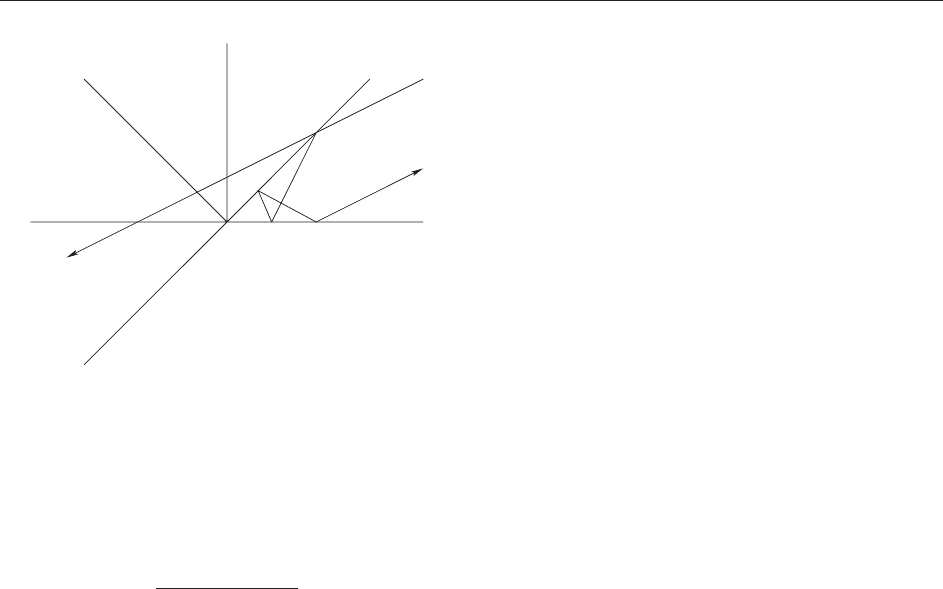
A useful elementary method of study is unfolding:
instead of reflecting the billiard trajectory in the
sides of the polygon, reflect the polygon in the
respective side and unfold the billiard trajectory to a
straight line. This method yields an upper bound
arctan
ffiffiffiffiffiffiffiffiffiffiffiffiffiffiffi
m
1
=m
2
p
"#
for the number of collisions in the syst em of two
point-masses m
1
and m
2
on the positive half-line.
Likewise, the number of collisions for any number
of elastic point-masses on the positive half-line is
bounded above by a constant dependi ng on the
masses only. Similar results are known for systems
of elastic balls (Figure 1).
Similarly, one studies the billiard inside the unit
square. Unfolding the square yields a square grid in
the plane, acted upon by the group of parallel
translations 2Z 2Z. Factor izing by this group
action yields a torus, and the billiard flow in a
given direction becomes a constant flow on the
torus. If the slope is rational, then all orbits are
periodic, and if the slope is irrational, then all orbits
are dense and the billiard flow is ergodic. Its metric
entropy is equal to zero. Periodic trajectories of the
billiard in a square come in bands of parallel ones.
Let f (‘) be the number of such bands of length not
greater than ‘. Then, f (‘) equals the number of
coprime lattice points inside the circle of radius ‘,
that is, f (‘) has quadratic growth in ‘.
Periodic Trajectories
The simplest exampl e of a periodic orbit in a
polygonal billiard is the 3-periodic Fangano trajec-
tory in an acute triangle: it connects the bases of the
three altitudes of the triangle and has minimal
perimeter among inscribed triangles. The Fagnano
trajectory belongs to a band of 6-periodic ones. It is
not known whether every acute triangle has other
periodic trajectories.
For a right triangle, one has the following result:
almost every (in the sense of the Lebesgue measure)
billiard trajectory that leaves a leg in the perpendicular
direction returns to the same leg in the same direction
and is therefore periodic. A similar existence result
holds for polygons whose sides have only two
directions.
In general, not much is known about the existence
of peri odic billiard trajectories in polygons. Con-
jecturally, every polygon has one, but this is not
known even for all obtuse triangles. Recently,
R Schwartz proved that every obtuse triangle with
the angles not exceeding 100
has a periodic billiard
path. This work substantially relies on a computer
program, McBi lliards, written by Schwartz and
Hooper.
If an arbitrary small perturbation of the vertices of a
billiard polygon leads to a perturbation of a periodic
billiard trajectory, but not to its destruction, then this
trajectory is called stable. Label the sides of the
polygon 1, 2, ..., k. Then a periodic trajectory is
coded by the word consisting of the labels of the
consecutively visited sides. An even-periodic trajectory
is stable if and only if the numbers in the respective
word can be partitioned in pairs of equal numbers, so
that the number from each pair appears once at an
even position, and once at an odd one. As a
consequence, if the angles of a polygon are indepen-
dent over the rational numbers, then every periodic
billiard trajectory in it is stable.
Complexity of Billiard Trajectories
The encoding of billiard trajectories by the consecu-
tively visited sides of the billiard polygon provides a
link between billiard and symbolic dynamics. For a
billiard k-gon P, denote by the set of words in
letters 1, 2, ..., k corresponding to billiard trajec-
tories in P, and let
n
be the set of such words of
length n.
One has a general theorem: the topological
entropy of the billiard flow is zero. This implies
that a number of quantities, associated with a
polygonal billiard, grow slower than exponentially,
as functions of n: the cardinality j
n
j, the number of
strips of n-periodic trajectories, the number of
generalized diagonals with n links (i.e., billiard
trajectories that start and end at corners of the
billiard polygon), etc. Conjecturally, all these quan-
tities have polynomial growth in n.
Figure 1 Unfolding a billiard trajectory in a wedge.
Polygonal Billiards 85
The complexity of the billiard in a polygon is
defined as the function p(n) = j
n
j. Likewise, one
may consider the billiard trajectories in a given
direction and define the corresponding complexity
p
(n).
In the case of a square, one modifies the encoding
using only two symbols, say, 0 and 1, to indicate
that a trajectory reflects in a horizontal or a vertical
side, respectively. If is a direction with an
irrational slope, then p
(n) = n þ 1. This is a classical
result by Hedlund and Morse. The sequences with
complexity p(n) = n þ 1 are called Sturmian; this
is the smallest complexity of aperiodic sequences.
A generalizatio n for multidimensional cubes and
parallelepipeds, due to Yu Baryshnikov, is known.
For a k-gon P, let N be the least common
denominator of its -rational angles and s be the
number of its distinct -irrational angles. Then,
p
ðnÞkNn 1 þ
n
2
s
Concerning billiard trajectories in all directions,
one has a lower bound for complexity: p(n) cn
2
for a constant c depending on the polygon. A similar
estimate holds for a d-dimensional polyhedron with
the exponent 2 replaced by d.
Rational Polygons and Flat Surfaces
The only class of polygons for which the billiard
dynamics is well understood are rational one, the
polygons satisfying the property that the angles
between all pairs of sides are rational multiples of .
Let P be a simply connected (without holes)
rational k-gon with angles m
i
=n
i
, where m
i
and n
i
are coprime integers. The reflections in the sides of P
generate a subgroup of the group of isometries of
the plane. Let G(P) O(2) consist of the linear
parts of the elements of this group. Then, G(P) is the
dihedral group D
N
consisting of 2N elements. When
a billiard trajecto ry reflects in a side of P, its
direction changes by the action of the group G(P),
and the orbit of a generic direction 6¼ k= N on the
unit circle consists of 2N points.
The phase space of the billiard flow is the unit
tangent bundle P S
1
. Let M
be the subset of
points whose projection to S
1
belongs to the orbit of
under G(P) = D
N
. Then, M
is an invariant surface
of the billiard flow in P. The surface M
is obtained
from 2N copies of P by gluing their sides according
to the action of D
N
. This oriented compac t surface
depends only on the polygon P, but not on the
choice of , and may be denoted by M. The
directional billiard flows F
on M in directions
are obtai ned, one from another, by rotations. The
genus of M is given by the formula
1 þ
N
2
k 2
X
1
n
i
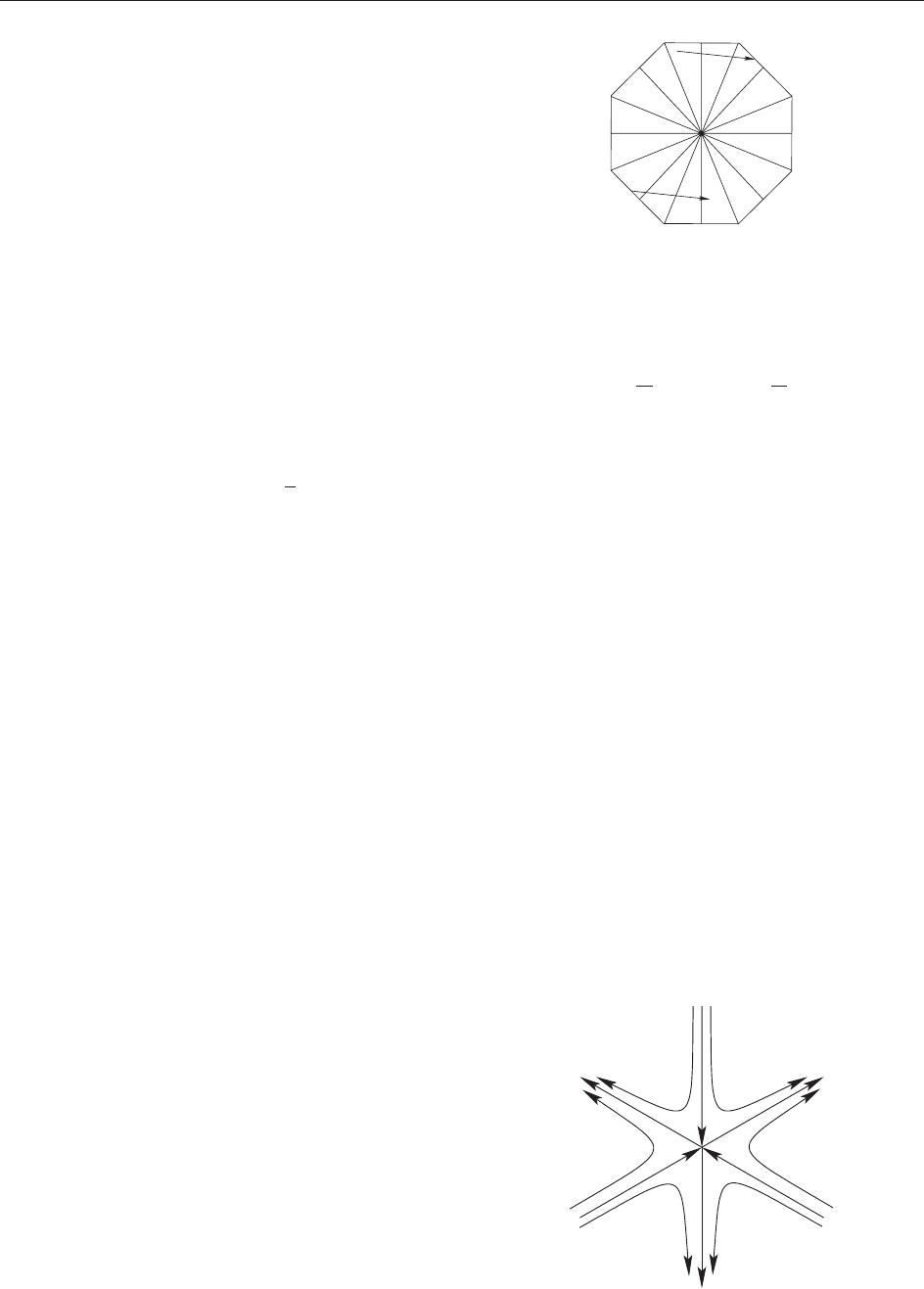
For example, if P is a right triangle with an acute
angle =8, then M is a surface of genus 2 (Figure 2).
The cases when M is a torus are as follows: the
angles of P are all of the form =n
i
, where n
i
are
equal, up to permutations, to
ð3; 3 ; 3Þ; ð2; 4; 4Þ; ð2; 3; 6Þ; ð2; 2; 2; 2Þ
and the respective polygons are an equilateral
triangle, an isosceles right triangle, a right triangle
with an acute angle =6, and a square. All these
polygons tile the plane.
The billiard flow on the surface M has saddle
singularities at the points obtained from the vertices
of P. The surface M inherits a flat metric from P
with a finite number of cone-type singularities,
corresponding to the vertices of P, with cone angles
multiples of 2 (Figure 3).
A flat surface M is a compact smooth surface with
a distinguished finite set of points .OnM n , one
has coordinate charts v = (x, y) such that the transi-
tion functions on the overlaps are of the form
v ! v þ c or v !v þ c
a
b
Figure 2 The invariant surface for a right triangle with acute
angle /8 has genus 2.
Figure 3 A cone singularity for the flow on an invariant surface.
86 Polygonal Billiards

In particular, one may talk about directions on a flat
surface.
The group PSL(2, R)actsonthespaceofflat
structures. From the point of view of complex analysis,
a flat surface is a Riemann surface with a holomorphic
quadratic differential; the set of cone points corre-
sponds to the zeros of the quadratic differential. Not
every flat surface is associated with a polygonal billiard.
Concerning ergodicity, one has the theorem of
Kerckhoff, Masur, and Smillie: given a flat surface of
genus not less than 2, for almost all directions (in the
sense of the Lebesgue measure), the flow F
is uniquely
ergodic. Furthermore, the Hausdorff dimension of the
setofangles for which ergodicity fails does not
exceed 1/2, and this bound is sharp. As a consequence,
the billiard flow on the invariant surface is uniquely
ergodic for almost all directions. Another corollary:
there is a dense G
subset in the space of polygons
consisting of polygons for which the billiard flow is
ergodic. If a billiard polygon admits approximation by
rational polygons at a superexponentially fast rate,
then the billiard flow in it is ergodic.
Concerning periodic orbits, one has the following
theorem due to H Masur: given a flat surface of genus
not less than 2, there exists a dense set of angles such
that F
has a closed trajectory. As a consequence, for
any rational billiard polygon, there is a dense set of
directions each with a periodic orbit. Furthermore,
periodic points are dense in the phase space of the
billiard flow in a rational polygon.
Similarly to the case of a square, let f (‘)bethe
number of strips of periodic trajectories of length not
greater than ‘ in a rational polygon P. By a theorem
of H Masur, there exist constants c and C such that
for sufficiently large ‘ one has: c‘
2
< f (‘) < C‘
2
,and
likewise for flat surfaces.
There is a class of flat surfaces, called Veech (or
lattice) surfaces, for which more refined results are
available. The groups of affine transformations of a
flat surface determine a subgroup in SL (2, R). If this
subgroup is a lattice in SL(2, R), then the flat surface
is called a Veech surface. Similarly, one defines a
Veech rational polygon. For example, regular poly-
gons and isosceles triangles with equal angles =n
are Veech. All acute Veech triangles are described.
For a Veech surface, one has the following Veech
dichotomy: for any direction ,eithertheflowF
is
minimal or its every leaf is closed (unless it is a saddle
connection, i.e., a segment connecting cone points).
For a Veech surface (and polygon), the quadratic
bounds for the counting function f ( ‘) become quad-
ratic asymptotics: f (‘) =‘
2
has a limit as ‘ !1.The
value of this limit is expressed in arithmetical terms.
A generic flat surface also has quadratic asymptotics.
The value of the limit depends only on the stratum of
the Teichmuller space that contains this surface. These
values are known, due to Eskin, Masur, Okunkov, and
Zorich. Since a generic flat surface does not correspond
to a rational polygon, this result does not immediately
apply to polygonal billiards. However, quadratic
asymptotics are established for rectangular billiards
with barriers.
Note, in conclusion, a close relation of billiards in
rational polygons and interval exchange transforma-
tions; the reduction of the former to the latter is a
particular case of the reduction of the billiard flow to
the billiard ball map. On an invariant surface M of the
billiard flow, consider a segment I, perpendicular to
the directional flow. Since ‘ ‘the width of a beam’’ is an
invariant transversal measure for the constant flow, the
first return map to I is a piecewise orientation preserving
isometry, that is, an interval exchange transformation.
Acknowledgment
This work was partially supported by NSF.
See also: Billiards in Bounded Convex Domains; Ergodic
Theory; Fractal Dimensions in Dynamics; Generic
Properties of Dynamical Systems; Holomorphic
Dynamics; Hyperbolic Billiards; Riemann Surfaces.
Further Reading
Burago D, Ferleger S, and Kononenko A (2000) A Geometric
Approach to Semi-Dispersing Billiards. Hard Ball Systems and
the Lorentz Gas, pp. 9–27. Berlin: Springer.
Chernov N and Markarian R Theory of Chaotic Billiards (to
appear).
Galperin G, Stepin A, and Vorobets Ya (1992) Periodic billiard
trajectories in polygons: generating mechanisms. Russian
Mathematical Surveys 47(3): 5–80.
Gutkin E (1986) Billiards in polygons. Physica D 19: 311–333.
Gutkin E (1996) Billiards in polygons: survey of recent results.
Journal of Statistical Physics 83: 7–26.
Gutkin E (2003) Billiard dynamics: a survey with the emphasis on
open problems. Regular and Chaotic Dynamics 8: 1–13.
Katok A and Hasselblatt B (1995) Introduction to the Modern
Theory of Dynamical Systems. Cambridge: Cambridge
University Press.
Kozlov V and Treshchev D (1991) Billiards. A Genetic Introduction
to the Dynamics of Systems with Impacts. Providence: American
Mathematical Society.
Masur H and Tabachnikov S (2002) Rational Billiards and
Flat Structures. Handbook of Dynamical Systems, vol. 1A,
pp. 1015–1089. Amsterdam: North-Holland.
Sinai Ya (1976) Introduction to Ergodic Theory. Princeton:
Princeton University Press.
Smillie J (2000) The Dynamics of Billiard Flows in Rational
Polygons, Encyclopaedia of Mathematical Sciences, vol. 100,
pp. 360–382. Berlin: Springer.
Tabachnikov S (1995) Billiards, Socie´te´ Math. de France,
Panoramas et Syntheses, No 1.
Tabachnikov S (2005) Geometry and Billiards. American Math-
ematical Society.
Polygonal Billiards 87

Positive Maps on C*-Algebras
F Cipriani, Politecnico di Milano, Milan, Italy
ª 2006 Elsevier Ltd. All rights reserved.
Introduction
The theme of positive maps on
-algebras and other
ordered vector spaces, dates back to the Perron–
Frobenius theory of matrices with positive entries,
the Shur’s product of matrices, the study of doubly
stochastic matrices describing discrete-time random
walks and the behavior of limits of powers of
positive matrices in ergodic theory.
A long experience proved that far-reaching general-
izations of the above situations have to be considered
in various fields of mathematical physics and that
C
-algebras, their positive cones, and other associated
ordered vector spaces provide a rich unifying frame-
work of functional analysis to treat them.
It is the scope of this note to review some of the
basic aspects both of the general theory and of the
applications.
In the next section we briefly recall the definitions
of C
-algebras and their positive cones. However,
throughout this article we refer to C
-Algebras and
their Classification and von Neumann Algebras:
Introduction, Modular Theory and Classification
Theory as sources of the definitions and general
properties of the objects of these ope rator algebras.
We then introduce positive maps, illustrate their
general properties, and discuss some relevant classes
of them. The correspondence between states and
representations is described next, as well as the
appearance of vector, normal and non-normal states
in applications. We then illustrate the structure of
completely positive maps and their relevance in
mathematical physics. Finally, we describe the
relevance of the class of compl etely positive maps
to understand the structure of nuclear C
-algebras.
Positive Cones in C
-Algebras
A C
-algebra A is a complex Banach algebra with a
conjugate-linear involution a 7!a
such that ka
ak=
kak
2
for all a 2 A.
When A has a unit 1
A
, the spectrum Sp(a)ofan
element a is the subset of all complex numbers
such that a 1
A
is not invertible in A. When A is
realized as a subalgebra of some B(H), and this is
always possible, the set Sp(a) coincides with the
spectrum of the bounded operator a on the Hilbert
space H.
The involution determines the self-adjoint part
A
h
:= {a 2 A: a = a
}ofA, a real subspace such that
A = A
h
þ iA
h
. A self-adjoint element a of A satisfies
Sp(a)R and, if k 0, one has kakk if and only
if Sp(a) [k, k].
The involution determines another important
subset of A: A
þ
:= {a
a: a 2 A}. This subset of A
h
is
closed in the norm topology of A and contains the
sums of its elements as well as their multiples by
positive scalars: in other words, it is a closed convex
cone. From a spectral point of view, one has the
following characterization: a self-adjoint element a
belongs to A
þ
if and only if its spectrum is positive
Sp(a)[0, þ1). It is this property that allows us to
call A
þ
the positive cone of A and its elements
positive. If it exists, a unit 1
A
in A is always positive
and a Hermitian element a is positive if and only if
k1
A
a=kakk1.
The continuous functional calculus in A allows
to write any self-adjoint element of A
h
as a
difference of elements of A
þ
: A
h
= A
þ
A
þ
.More-
over, A
þ
\ (A
þ
) = {0} and the decomposition
a = b c of a self-adjoint element a as difference
of positive elements b and c is unique provided one
requires that bc = cb = 0. In this case, it is called the
orthogonal decomposition.
The cone A
þ
determines an underlying structure
of order space on A: for a, b 2 A one says that a is
less than or equal to b, in symbols a b, if and only
if b a 2 A
þ
. In particular, a 0 just means that a
is positive.
Another fundamental characterization of the
positive cone is the following: a self-adjoint element
a = a
is positive if and only if there exists an
element b in A such that a = b
2
. Moreover, among
the elements b with this property, there exists one
and only one which is positive, the square root of a.
Some examples of positive cones are provided in the
following.
Example 1 By a fundamental result of I M
Gelfand, a commutative C
-algebra A is isomorphic
to the C
-algebra C
0
(X) of all complex continuous
functions vanishing at infinity on a locally compact
Hausdorff topological space X. The algebraic
operations have the usual pointwise meaning and
the norm is the uniform one. The constant function
1 represents the unit precisely when X is compact.
The positive cone C
0
(X)
þ
coincides with that of the
positive continuous functions in C
0
(X).
Example 2 Finite dimensional C
-algebras A are
classified as finite sums M
n
1
(C) M
n
2
(C)
M
n
k
(C) of full matrix algebras M
n
i
(C). An element
88 Positive Maps on C*-Algebras

a
1
a
2
a
k
is positive if and only if the
matrices a
i
have positive eigenvalues.
Example 3 When a C
-algebra A B(H) is rep-
resented as a self-adjoint closed algebra of operators
on a Hilbert space H, its positive elements are those
which have non-negative spectrum.
Positive Maps on C
-Algebras
Among the various relevant classes of maps between
C
-algebras, we are going to consider the following
ones, whose properties are connected with the
underlying structures of ordered vector spaces.
Definition 1 Given two C
-algebras A and B,a
map : A ! B is called positive if (A
þ
) B
þ
.In
other words, a map is positive if and only if it
transforms the positive elements of A into positive
elements of B:
a 2 A ) ð a
aÞ2B
þ
½1
If A and B have units, the map is called unital
provided (1
A
) = 1
B
.
Morphisms and Jordan Morphisms
A
-morphism between C
-algebras : A ! B is
positive; in fact, (a
a) = (a)
(a) 0.
This also the case for Jordan
-morphism, the
linear maps satisfying (a
) = (a)
and ({a, b}) =
{(a), (b)}, where {a, b} = ab þ ba denotes the Jor-
dan product. In fact, if a = a
then (a
2
) = (a)
2
is
positive.
Shur’s Product of Matrices
Let A 2 M
n
(C) be a positive matrix and define a
linear map : M
n
(C) ! M
n
(C) through the Shur’s
product of matrices:
A
(B):= [A
ij
B
ij
]
n
i, j = 1
. Since the
Shur’s product of positive matrices is positive too
(i.e., the positive cone of M
n
(C) is a semigroup
under matrix product), the above map is positive.
Positive-Definite Function on Groups
Positive maps also arise naturally in harmonic
analysis. Let G be a locally compact topological
group with identity e and left Haar’s measure m. Let
p : G ! C be a continuous positive-definite function
on G. This just means that for all n 1 and all
s
1
, ..., s
n
2 G, the matrix { p(s
1
i
s
j
)}
n
i,j = 1
belongs to
the positive cone of M
n
(C):
P
n
i, j = 1
p(s
1
i
s
j
)
i
j
0
for all
1
, ...,
n
. Such functions are necessarily
bounded with kpk
1
p(e), so that an operator
: L
1
(G, m) ! L
1
(G, m) is well defined by point-
wise multiplication: (f )(s):= p(s)f (s). This map
extends to a positive map : C
(G) ! C
(G),
which is unital when p(e) = 1, on the full group
C
-algebra C
(G). When G is amenable, this algebra
coincides with reduced C
-algebra C
r
(G) so that, if
G is also unimodular (as is the case if G is compact),
the positive elements can be approximated by
positive-definite functions in L
1
(G, m) and the
positivity of follows exactly as in the previous
example.
Positive Maps in Commutative C
-Algebras
Positive maps : C
0
(Y) ! C
0
(X) between commu-
tative C
-algebras have the following structure:
(a)(x) =
R
Y
k(x,dy)a(y), a 2 C
0
(Y). Here the kernel
x 7!k(x, ) is a continuous map from X to the space
of positive Radon measures on Y. In case X and Y
are compact, the map is unital provided k(x, )isa
probability measure for each x 2 X. In fact, for a
fixed x 2 X, the map a 7!(a)(x) is a positive linear
functional from C
0
(Y)toC and Riesz’s theorem
guarantees that it can be represented by a positive
Radon measure on Y.
In probability theory, one-parameter semigroups
t
s
=
tþs
of positive maps
t
: C
0
(X) !C
0
(X)
such that
t
(1) 1 for all t 0, are called Markovian
semigroups (conservative, if the maps are unital). They
represent the expectation at time t>0 of Markovian
stochastic processes on X.Inthiscase,thetime-
dependent kernel k(t, x, ) represents the distribution
probability at time t of a particle starting in x 2 X at
time t = 0.
These kinds of maps arise also in potential theory,
where the dependence of the solution (a)ofa
Dirichlet problem on a bounded domain , with
nice boundary @, upon the continuous boundary
data a 2 C(@) gives rise to a linear unital map
: C(@) ! C( [ @), whose positivity and uni-
tality translates the ‘‘maximum principle’’ for har-
monic functions. When is the unit disk, k is the
familiar Poisson’s kernel.
Continuity and Algebraic Properties
of Positive Maps
Since the order structure of a C
-algebra A is defined
by its positive cone A
þ
, positive maps are
1. real: (a
) = (a)
and
2. order preserving: (a) ( b) whenever a b.
From this follows an important interplay between
positivity and continuity:
a positive map : A ! B
between C
-algebras is continuous
In case A has a unit, this follows by the fact that is
order preserving and that, for self-adjoint a, one has
Positive Maps on C*-Algebras 89

kak1
A
a þkak1
A
,sothatkak(1
A
) (a)
þkak(1
A
) and then k(a)kk(1
A
)kkak.Ingen-
eral, splitting a = b þ ic as a combination of Hermitian
elements b and c,askbkkak and kckkak,one
obtains
kðaÞk kðb Þk þ kðcÞk
kð1
A
ÞkðkbkþkckÞ
2kð1
A
Þk kak
The second general result concer ning positivity
and continuity is the following:
Let : A ! B be a linear map between C
-algebras
with unit such that (1
A
) = 1
B
; then is positive if
and only if kk= 1.
The result relies, among other things, on the
generalized Schwarz inequality for unital positive
maps on normal elements,
ða
ÞðaÞða
aÞ; a
a ¼ aa
These results may be used to reveal the strong
interplay between the algebraic, continu ity and
positivity properties of maps:
Let : A ! B be an invertible linear map between
unital C
-algebras such that (1
A
) = 1
B
. The
following properties are equivalent:
1. is Jordan isomorphism,
2. is an isometry, and
3. is an order isomorphism ( and
1
are order
preserving).
The above conclusions can be strengthened if,
instead of individual maps, continuous groups of
maps are considered.
Let t 7!
t
be a strongly continuous, one-parameter
group of maps of a unital C
-algebra A and
assume that
t
(1
A
) = 1
A
for all t 2 R. The follow-
ing properties are equivalent:
1.
t
is a
-automorphism of A for all t 2 R,
2. k
t
k1 for all t 2 R, and
3.
t
is positive for all t 2 R.
An analogous result holds true for w
-continuous
groups on abelian, or factors, von Neumann algebras.
States on C
-Algebras
A state on a C
-algebra A is a positive functional
: A ! C of norm 1:
(a
a) 0 for all a 2 A, and
kk= 1.
As C is a C
-algebra, when A is unital, a state on it
is just a unital positive map:
(a
a) 0 for all a 2 A, and
(1
A
) = 1.
States for which (ab) = (ba) are called tracial states.
States constitute a distinguished class of positive
maps, both from a mathematical viewpoint and for
application to mathematical physics. We will see below
that states are deeply connected to representations of
C
-algebras (see C
-Algebras and their Classification).
States on Commutative C
-Algebras
Since this is a subcase of positive maps in commutative
C
-algebras we only add a comment. As far as a
C
-algebra represents observable quantities of a
physical system, states carry our actual knowledge
about the system itself. The smallest C
-sub-algebra
{f (a): f 2 C
0
(R)} of A containing a given self-adjoint
element a 2 A, representing a certain observable
quantity, is isomorphic to the algebra C(Sp(a)) of
continuous functions on the spectrum of a. A state on
A induces, by restriction, a state on C(Sp(a)), which,
by the Riesz representation theorem, is associated to a
probability measure
a
on Sp(a) through the formula
ðf ðaÞÞ ¼
Z
SpðaÞ
f ðxÞ
a
ðdxÞ
Since Sp(a) represents the possible values of the
observable associated to a,
a
represents the dis-
tribution of these values when the physical state of
the system is represented by .
Vector States and Density Matrices
In case A is acting on a Hilbert space h, A B(h),
each unit vector 2 h gives rise to a vector state
(a) = (ja ). In the quantum-mechanical descrip-
tion of a finite system, as far as observables with
discrete spectrum are concerned, one can assume A
to be the C
-algebra K(h) of compact operators on
the Hilbert space h. In this case every state is a
convex superposition of vector states, in the sense
that it can be represented by the formu la
ðaÞ¼trðaÞ=trðÞ; a 2KðhÞ
for a suitable density matrix , that is, a positive,
compact operator with finite trace. In quantum
statistical mechanics, the grand canonical Gibbs
equilibrium state of a finite system at inverse tempera-
ture and chemical potential ,withHamiltonianH
and number operator N, is of the above type
;
ðaÞ¼trðe
K
aÞ=trðe
K
Þ
90 Positive Maps on C*-Algebras

where K = H N, and the spectrum of H is assumed
to be discrete and such that e
K
is trace-class. For
infinite systems, A is a quasilocal C
-algebra generated
by a net {A
}
of C
-subalgebras describing observa-
bles referred to finite-volume regions. Infinite-volume
equilibrium states on A can then be obtained as
thermodynamic limits of finite-volume Gibbs equili-
brium states of the above type.
Normal and Singular States
When observables with continuous spectrum have to
be considered and one chooses the algebra B(h)of
all bounded operators, the above formula, although
still meaningful, does not describe all states on B(h)
but only the important subclass of the normal ones.
To this class, which can be considered on any von
Neumann algebra M, belong states which are
-weakly continuous functionals. Equivalently, these
are the states such that for all increasing net a
2M
þ
with least upper bound a 2M
þ
, ( a) is least upper
bound of the net (a
).
In general, each state on a von Neumann
algebra M spli ts as a sum of a maximal normal
piece and a singular one. Singular trac es appear in
noncommutative geometry as very useful tools to get
back local objects from spectral ones via the familiar
principle that local properties of functions depend
on the asymptotics of their Fourier coefficients.
This is best illustrated on a compact, Riemannian
n-manifold M by the formula
Z
M
f dm ¼ c
n
!
ðM
f
jDj
n
Þ
which expresses the Riemannian integral of a nice
function f in terms of the Dirac operator D acting on the
Hilbert space of square-integrable spinors, the multi-
plication operator M
f
by f, and the singular Dixmier
tracial state
!
on B(H). Here the compactness of M
implies the compactness of the operator M
f
jDj
n
and
!
is a limiting procedure depending only on the
asymptotic behavior of the eigenvalues of M
f
jDj
n
.
Similar formulas are valid on self-similar fractals as well
as on quasiconformal manifolds. Local index formulas
represent cyclic cocycles in Connes’ spectral geometry
(se e Noncommutative Geometry and the Standard
Model; Noncommutative Geometry from Strings;
Path-Integrals in Noncommutative Geometry).
States and Representations: The
GNS Construction
A fundamental tool in studying a C
-algebra A
are its representations. These are morphisms of
C
-algebras : A !B(H) from A to the algebra of
all bounded operat ors on some Hilbert space H.
There is a symbiotic appearance of states and
representations on C
-algebras. In fact, given a
representation : A !B(H), one easily constructs
states on A by unit vectors 2 H by
ðaÞ¼ðj ðaÞÞ
In fact, one checks that
(a
a) = (j(a
a) ) =
(j(a
)(a) ) = k(a) k
2
0 and, at least if a unit
exists, that
(1
A
) = kk
2
= 1.
A fundamental construction due to Gelfand,
Naimark, and Segal allows to associate a represen-
tation to each state in such a way that each state is a
vector state for a suitable representation.
‘‘Let ! be a state over the C
-algebra A. It follows
that there exists cyclic representation (
!
, H
!
,
!
)
of A such that
!ðaÞ¼ð
!
j
!
ðaÞ
!
Þ
Moreover, the representation is unique up to
unitary equivalence. It is called the canonical
cyclic representation of A associated with !.’’
The positivity property of the state allows to
introduce the positive-semidefinite scalar product
hajbi= !(a
b) on the vector space A. Moreover, its
kernel I
!
= {a 2 A: !(a
a) = 0} is a left-ideal of A:in
fact, if a 2 A and b 2I
!
then !((ba)
(ba))
kak
2
!(b
b) = 0. This allows to define, on the
quotient pre-Hilbert space A=I
!
, an action of
the elements a 2 A:
!
(a)(b þI
!
):= ab þI
!
.Itis
the extension of this action to the Hilbert space
completion H
!
of A=I
!
that gives the representation
associated to !.WhenA has a unit, the cyclic vector
!
with the stated propert ies is precisely the image of
1
A
þI
!
. By definition, the cyclicity of the represen-
tation amounts to check that
!
(A)
!
is dense in H
!
.
Completely Positive Maps
In a sense, the order structure of a C
-algebra A
is better understood through the sequence of
C
-algebras A M
n
(C) ffi M
n
(A), obtai ned as tensor
products of A and full matrix algebras M
n
(C). For
example, C
-algebras are matrix-ordered vector
spaces as
(M
m
(A))
þ
(M
n
(A))
þ
for all matrices
2 M
mn
(C).
In this respect, one is naturally led to consider
stronger notion of positivity:
‘‘A map : A ! B is called n-positive if its
extension
1
n
: A M
n
ðCÞ!B M
n
ðCÞ
ð 1
n
Þ½a
i;j
i;j
¼½ða
i;j
Þ
i;j
Positive Maps on C*-Algebras 91