
Francoise J.-P., Naber G.L., Tsun T.S. (editors) Encyclopedia of Mathematical Physics
Подождите немного. Документ загружается.


by which [88] tends to the orthogonality relation for
J
(3)
(x; q):
X
1
k¼1
J
ð3Þ
ð2q
ð1=2ÞðnþkÞ
; qÞJ
ð3Þ
ð2q
ð1=2ÞðmþkÞ
; qÞq
k
¼
n;m
q
n
ðn; m 2 ZÞ½90
q-Hahn Polynomials
Definition as q-hypergeometric series
Q
n
ðx; ; ; N; qÞ :¼
3
2
q
n
; q
nþ1
; x
q; q
N
; q; q
ðn ¼ 0; 1; ...; NÞ½91
Orthogonality relation
X
N
y¼0
Q
n
ðq
y
ÞQ
m
ðq
y
Þ
ðq; q
N
; qÞ
y
ðqÞ
y
ðq
N
1
; q; qÞ
y
¼ h
n
n;m
½92
where h
n
can be explicitly given.
Stieltjes–Wigert Polynomials
Definition as q-hypergeometric series
S
n
ðx; qÞ¼
1
ðq; qÞ
n
1
1
q
n
0
; q; q
nþ1
x
½93
The orthogonality measure is not uniquely determined:
Z
1
0
S
n
ðq
1=2
x; qÞS
m
ðq
1=2
x; qÞ wðxÞdx ¼
1
q
n
ðq; q Þ
n
n;m
;
where, for instance
wðxÞ¼
q
1=2
logðq
1
Þðq; q
1=2
x; q
1=2
x
1
; qÞ
1
or
q
1=2
ffiffiffiffiffiffiffiffiffiffiffiffiffiffiffiffiffiffiffiffiffiffiffiffi
2 logðq
1
Þ
p
exp
log
2
x
2 logðq
1
Þ
!
½94
Rahman–Wilson Biorthogonal Rational Functions
The following functions are rational in their first
argument:
R
n
1
2
ðz þ z
1
Þ; a; b; c; d; e
:¼
10
W
9
ða=e; q=ðbeÞ; q=ðceÞ ;
q=ðdeÞ; az; a=z; q
n1
abcd; q
n
; q; qÞ½95
They satisfy the biorthogonality relation
1
2i
I
C
R
n
1
2
ðz þ z
1
Þ; a; b; c; d; e
R
m
1
2
ðz þ z
1
Þ; a; b; c; d;
q
abcde
wðzÞ
dz
z
¼ 2h
n
n;m
½96
where the contour C is as in [70], and where
wðzÞ
¼
ðz
2
; z
2
; abcdez; abcde=z; qÞ
1
ðaz; a=z; bz; b=z; cz; c=z; dz; d=z; ez; e=z; qÞ
1
½97
h
0
¼
ðbcde;acde; abde; abce; abcd; qÞ
1
ðq;ab;ac; ad; ae;bc;bd;be;cd;ce;de; qÞ
1
½98
and h
n
=h
0
can also be given explicitly. For
ab= q
N
,n, m 2{0,1,...,N}, there is a related dis-
crete biorthogonality of the form
X
N
k¼0
R
n
1
2
ðaq
k
þ a
1
q
k
Þ; a; b; c; d; e
R
m
1
2
ðaq
k
þ a
1
q
k
Þ; a; b; c; d;
q
abcde
w
k
¼ 0
ðn 6¼ mÞ½99
Identities and Functions Associated
with Root Systems
-Function Identities
Let R be a root system on a Euclidean space of
dimension l. Then Macdonald (1972) g eneralizes
Weyl’s denominator formula to the case of an affine
root system. The resulting formula can be written as
an explicit expansion in powers of q of
Y
1
n¼1
ð1 q
n
Þ
l
Y
2R
ð1 q
n
e
Þ
!
which expansion takes the form of a sum over a
lattice related to the root syst em. For root system A
1
this reduces to Jacobi’s triple product identity [63].
Macdonald’s formula implies a similar expansion in
powers of q of (q)
lþjRj
, where (q) is ‘‘Dedekind’s
-function’’ (q):= q
1=24
(q; q)
1
.
Constant Term Identities
Let R be a reduced root system, R
þ
the positive
roots, and k 2 Z
>0
. Macdonald conjectured the
second equality in
R
T
Q
2R
þ
ðe
; qÞ
k
ðqe
; qÞ
k
dx
R
T
dx
¼ CT
Y
2R
þ
Y
k
i¼1
ð1 q
i1
e
Þð1 q
i
e
Þ
!
¼
Y
l
i¼1
kd
i
k
q
½100
112 q-Special Functions

where T is a torus determined by R,CTmeansthe
constant term in the Laurent expansion in e
,and
the d
i
are the degrees of the fundamental invariants
of the Weyl group of R. The conjecture was
extended for real k > 0, for several parameters k
(one for each root length), and f or root system BC
n
,
where Gustafson’s five-paramet er n-variable analog
of the Askey–Wilson integral ([70] for n = 0)
settles:
Z
½0;2
n
jðe
i
1
; ...; e
i
n
Þj
2
d
1
...
n
ð2Þ
n
¼ 2
n
n!
Y
n
j¼1
ðt; t
nþj2
abcd ; qÞ
1
ðt
j
; q; abt
j1
; act
j1
; ...; cdt
j1
; qÞ
1
½101
where
ðzÞ:¼
Y
1i<jn
ðz
i
z
j
; z
i
=z
j
; qÞ
1
ðtz
i
z
j
; tz
i
=z
j
; qÞ
1
Y
n
j¼1
ðz
2
j
; qÞ
1
ðaz
j
; bz
j
; cz
j
; dz
j
; qÞ
1
½102
Further extensions were in Macdonald’s conjectures
for the quadratic norms of Macdonald polynomials
associated with root systems (see the subsection
‘‘Macdonald–Koornwinder polynomials’’), and finally
proved by Cherednik.
Macdonald Polynomials for Root System A
n1
Let n 2 Z
>0
. We work with partitions = (
1
, ...,
n
)
of length n,where
1
n
0areintegers.
On the set of such partitions, we take the partial
order )
1
þþ
n
=
1
þþ
n
and
1
þþ
i
1
þþ
i
(i = 1, ..., n 1). Write
< iff and 6¼ . The monomials are
z
= z
1
1
...z
n
n
(
1
, ...,
n
2 Z
0
). For apartition
the symmetrized monomials m
(z)andtheSchur
functions s
(z) are defined by:
m
ðzÞ:¼
X
z
ðsum over all distinct
permutations of ð
1
; ...;
n
ÞÞ ½103
s
ðzÞ :¼
detðz
j
þnj
i
Þ
i;j¼1;...;n
detðz
nj
i
Þ
i;j¼1;...;n
½104
We integrate a function over the torus T := {z 2 C
n
j
jz
1
j= = jz
n
j= 1} as
Z
T
f ðzÞdz :¼
1
ð2Þ
n
Z
2
0
...
Z
2
0
f ðe
i
1
; ...; e
i
n
Þd
1
...d
n
½105
Definition For a partition and for 0 t 1, the
(analytically defined) Macdonald polynomial P
(z) =
P
(z; q, t) is of the form
P
ðzÞ¼P
ðz; q; tÞ¼m
ðzÞþ
X
<
u
;
m
ðzÞ
ðu
;
2 CÞ
such that for all <
Z
T
P
ðzÞm
ðzÞð zÞdz ¼ 0
where
ðzÞ¼ðz; q; tÞ :¼
Y
i6¼j
ðz
i
z
1
j
; qÞ
1
ðtz
i
z
1
j
; qÞ
1
½106
Orthogonality relation
1
n!
Z
T
P
ðzÞP
ðzÞð zÞdz
¼
Y
i<j
ðq
i
j
t
ji
; q
i
j
þ1
t
ji
; qÞ
1
ðq
i
j
t
jiþ1
; q
i
j
þ1
t
ji1
; qÞ
1
;
½107
q-Difference equation
X
n
i¼1
Y
j6¼i
tz
i
z
j
z
i
z
j
q;z
i
P
ðz; q; tÞ
¼
X
n
i¼1
q
i
t
ni
!
P
ðz; q; tÞ½108
where
q, z
i
is the q-shift operator:
q, z
i
f (z
1
, ..., z
n
):=
f (z
1
, ..., qz
i
, ..., z
n
). See (Macdonald 1995,ch.VI,§3)
for the full system of q-difference equations.
Special value
P
ð1; t; ...; t
n1
; q; tÞ¼
Y
n
i¼1
t
ði1Þ
i
Y
i<j
ðtq
ji
; qÞ
i
j
ðq
ji
; qÞ
i
j
½109
Restriction of number of variables
P
1
;
2
;...;
n1
;0
ðz
1
; ...; z
n1
; 0; q; tÞ
¼ P
1
;
2
;...;
n1
ðz
1
; ...; z
n1
; q; tÞ½110
Homogeneity
P
1
;...;
n
ðz; q; tÞ¼z
1
...z
n
P
1
1;...;
n
1
ðz; q; tÞ
ð
n
> 0Þ½111
q-Special Functions 113

Self-duality Let , be partitions.
P
ðq
1
t
n1
; q
2
t
n2
; ...; q
n
; q; tÞ
P
ðt
n1
; t
n2
; ...; 1; q; tÞ
¼
P
ðq
1
t
n1
; q
2
t
n2
; ...; q
n
; q; tÞ
P
ðt
n1
; t
n2
; ...; 1; q; tÞ
½112
Special cases and limit relations
Continuous q-ultraspherical polynomials (see [72]):
P
m;n
ðre
i
; re
i
; q; tÞ¼
ðq; qÞ
mn
ðt; qÞ
mn
r
mþn
C
mn
ðcos ; t j qÞ½113
Symmetrized monomials (see [103]):
P
ðz; q; 1Þ¼m
ðzÞ½114
Schur functions (see [104]):
P
ðz; q; qÞ¼s
ðzÞ½115
Hall–Littlewood polynomials (see Macdonald (1995),
ch. III):
P
ðz; 0; tÞ¼P
ðz; tÞ½116
Jack polynomials (see Macdonald (1995), §VI.10):
lim
q"1
P
ðz; q; q
a
Þ¼P
ð1=aÞ
ðzÞ½117
Algebraic definition of Macdo nald polynomials
Macdonald polynomials can also be defined
algebraically. We work now with partitions
(
1
2
0) of arbitrary length l(), and
with symmetric polynomials in arbi trarily many
variables x
1
, x
2
, ..., which can be canonically
extended to symmetric functions in infinitely
many variables x
1
, x
2
, ....Therth power sum p
r
and the symmetric functions p
are formally
defined by
p
r
¼
X
i1
x
r
i
; p
¼ p
1
p
2
... ½118
Put
z
:¼
Y
i1
i
m
i
m
i
! where m
i
¼ m
i
ðÞ is the number of
parts of equal to i: ½119
Define an inner product h, i
q, t
on the space of
symmetric functions such that
hp
; p
i
q; t
¼
;
z
Y
lðÞ
i¼1
1 q
i
1 t
i
½120
For partitions , the partial ordering
means now that
P
j1
j
=
P
j1
j
and
1
þþ
i
1
þþ
i
for all i. The Macdonald poly-
nomial P
(x; q, t) can now be algebraically defined
as the unique symmetric function P
of the form
P
=
P
u
,
m
(u
,
2 C, u
,
= 1) such that
hP
; P
i
q:t
¼ 0if 6¼ ½121
If l () n, then the newly defined P
(x) with
x
nþ1
= x
nþ2
= = 0 coincides with P
(x; q, t)
defined analytically, and the new inner product is a
constant multiple (depending on n) of the old inner
product.
Bilinear sum
X
1
hP
; P
i
q; t
P
ðx; q; tÞP
ðy; q; tÞ
¼
Y
i; j1
ðtx
i
y
j
; qÞ
1
ðx
i
y
j
; qÞ
1
½122
Generalized Kostka numbers The Kostka numbers
K
,
occurring as expansion coeffic ients in
s
=
P
K
,
m
were generalized by Macdonald to
coefficients K
,
(q, t) occurring in connection with
Macdonald polynomials, see Macdonald (1995,
§VI.8). Macdonald’s conjecture that K
,
(q, t)isa
polynomial in q and t with coefficients in Z
0
was
fully proved in Haiman (2001).
Macdonald–Koornwinder Polynomials
Macdonald (2000, 2001) also introduced Macdonald
polynomials associated with an arbitrary root
system. For root system BC
n
this yields a three-
parameter family which can be extended to the
five-parameter Macdonald–Koornwinder (M–K) poly-
nomials (Koornwinder 1992). They are orthogonal
with respect to the measure occurring in [101] with
(z)givenby[102]. The M–K polynomials are
n-variable analogs of the Askey–Wilson polynomials.
All polynomials just discussed tend, for q " 1, to
Jacobi polynomials associated with root systems.
Macdonald conjectured explicit expressions for
the quadratic norms of the Macdonald polynomials
associated with root systems and of the M–K
polynomials. These were proved by Cherednik by
considering these polynomials as Weyl group
symmetrizations of non-invariant polynomials
114 q-Special Functions

which are related to double affine Hecke algebras
(see Macdonald (2003)).
Elliptic Hypergeometric Series
Let p, q 2 C, jpj, jqj < 1. Define a modified Jacobi
theta function by
ðx; pÞ :¼ðx; p=x; pÞ
1
ðx 6¼ 0Þ½123
and the elliptic shifted factorial by
ða; q; pÞ
k
:¼ ða; pÞðaq; pÞ...ðaq
k1
; pÞ
ðk 2 Z
>0
Þ; ða; q; pÞ
0
:¼ 1 ½124
ða
1
; ...; a
r
; q; pÞ
k
:¼ða
1
; q; pÞ
k
...ða
r
; q; pÞ
k
½125
where a,a
1
,...,a
r
6¼0. For q=e
2i
, p= e
2i
(=>0),
and a 2C we have
ðae
2iðxþ
1
Þ
; e
2i
Þ
ðae
2ix
; e
2i
Þ
¼ 1
ðae
2iðxþ
1
Þ
; e
2i
Þ
ðae
2ix
; e
2i
Þ
¼a
1
q
x
½126
A series
P
1
k = 0
c
k
with c
kþ1
=c
k
being an elliptic
(i.e., doubly periodic meromorphic) function of k
considered as a compl ex variable is called an elliptic
hypergeometric series. In particular, define the
r
E
r1
theta hypergeometric series as the formal series
r
E
r1
ða
1
; ...; a
r
; b
1
; ...; b
r1
; q; p; zÞ
:¼
X
1
k¼0
ða
1
; ...; a
r
; q; pÞ
k
ðb
1
; ...; b
r1
; q; pÞ
k
z
k
ðq; q; pÞ
k
½127
It has g(k):= c
kþ1
=c
k
with
gðxÞ¼
zða
1
q
x
; pÞ...ða
r
q
x
; pÞ
ðq
xþ1
; pÞðb
1
q
x
; pÞ...ðb
r1
q
x
; pÞ
By [126], g(x) is an elliptic function with periods
1
and
1
(q = e
2i
, p = e
2i
) if the balancing condi-
tion a
1
...a
r
= qb
1
...b
r1
is satisfied.
The
r
V
r1
very well-poised theta hypergeometric
series (a special
r
E
r1
) is defined, in case of
argument 1, as:
r
V
r1
ða
1
; a
6
; ...; a
r
; q; pÞ
:¼
X
1
k¼0
ða
1
q
2k
; pÞ
ða
1
; pÞ
ða
1
; a
6
; ...; a
r
; q; pÞ
k
ðqa
1
=a
6
; ...; qa
1
=a
r
; q; pÞ
k
q
k
ðq; q; pÞ
k
½128
The series is called balanced if a
2
6
...a
2
r
= a
r6
1
q
r4
.
The series terminates if, for instance, a
r
= q
n
.
Elliptic Analog of Jackson’s
8
W
7
Summation
10
V
9
ða; b; c; d; q
nþ1
a
2
=ðbcdÞ; q
n
; q; pÞ
¼
ðqa; qa=ðbcÞ; qa=ðbdÞ; qa=ðcdÞ; q; pÞ
n
ðqa=b; qa=c; qa=d; qa=ðbcdÞ; q; pÞ
n
½129
Elliptic Analog of Bailey’s
10
W
9
Transformation
12
V
11
a;b; c;d;e; f ;
q
nþ2
a
3
bcdef
;q
n
;q;p
¼
ðqa;qa=ðef Þ;ðqaÞ
2
=ðbcdeÞ;ðqaÞ
2
=ðbcdf Þ;q;pÞ
n
ðqa=e;qa=f ;ðqaÞ
2
=ðbcdef Þ;ðqaÞ
2
=ðbcdÞ; q;pÞ
n
12
V
11
qa
2
bcd
;
qa
cd
;
qa
bd
;
qa
bc
;e;f ;
q
nþ2
a
3
bcdef
;q
n
;q;p
½130
Suitable
12
V
11
functions satisfy a discrete biortho-
gonality relation which is an elliptic analog of [99].
Ruijsenaars’ elliptic gamma function
ðz; q; pÞ :¼
Y
1
j;k¼0
1 z
1
q
jþ1
p
kþ1
1 zq
j
p
k
½131
which is symmetric in p and q. Then
ðqz; q; pÞ¼ðz; pÞðz; q; pÞ
ðq
n
z; q; pÞ¼ðz; q; pÞ
n
ðz; q; pÞ
½132
Applications
Quantum Groups
A specific quantum group is usually a Hopf algebra
which is a q-deformation of the Hopf algebra of
functions on a specific Lie group or, dually, of a
universal enveloping algebra (viewed as Hopf
algebra) of a Lie algebra. The general philosophy is
that representations of the Lie group or Lie algebra
also deform to representations of the quantum
group, and that special functions associated with
the representations in the classical case deform to
q-special functions associated with the representa-
tions in the quantum case. Sometimes this is
straightforward, but often new subtle phenomena
occur.
The representation-theoretic objects which may
be explicitly written in terms of q -special functions
include matrix elements of representations with
respect to specific bases (in particular spherical
elements), Clebsch–Gordan coefficients and Racah
coefficients. Many one-variable q-hypergeometric
functions have found interpretation in some way
in connection with a quantum analog of a three-
dimensional Lie group (generically the Lie g roup
q-Special Functions 115

SL(2, C) and its real forms). Classical by now are:
little q-Jacobi polynomials interpreted as matrix
elements of irreducible representations of SU
q
(2)
with respect to the standard basis; Askey–Wilson
polynomials similarly interpreted with respect to a
certain basis not coming from a quantum subgroup;
Jackson’s third q-Bessel functions as matrix elements
of irreducible representations of E
q
(2); q-Hahn
polynomials and q-Racah polynomials interpreted
as Clebsch–Gordan coefficients and Racah coeffi-
cients, respectively, for SU
q
(2).
Further developments include: Macdonald poly-
nomials as spherical elements on quantum analogs
of compact Riemannian symmetric spaces; q-analogs
of Jacobi functions as matrix elements of irreducible
unitary representations of SU
q
(1, 1); Askey–Wilson
polynomials as matrix elements of representations
of the SU(2) dynamical quantum group; an inter-
pretation of discrete
12
V
11
biorthogonality relations
on the elliptic U(2) quantum group.
Since the q-deformed Hopf algebras are usually
presented by generators and relations, identities for
q-special functions involving noncommuting vari-
ables satisfying simple relations are important for
further interpretations of q-special functions in
quantum groups, for instance:
q-Binomial formula with q-commuting variables
ðx þ yÞ
n
¼
X
n
k¼0
n
k
q
y
nk
x
k
ðxy ¼ qyxÞ½133
Functional equations for q-exponentials with xy
= qyx
e
q
ðx þ yÞ¼e
q
ðyÞe
q
ðxÞ
E
q
ðx þ yÞ¼E
q
ðxÞE
q
ðyÞ
½134
e
q
ðx þ y yxÞ¼e
q
ðxÞe
q
ðyÞ
E
q
ðx þ y þ yxÞ¼E
q
ðyÞE
q
ðxÞ
½135
Various Algebraic Settings
Classical groups over finite fields (Chevalley
groups) q-Hahn polynomials and various kinds of
q-Krawtchouk polynomials have interpretations as
spherical and intertwining functions on classi cal
groups (GL
n
,SO
n
,Sp
n
) over a finite field F
q
with
respect to suitable subgroups, see Stanton (1984).
Affine Kac–Moody algebras (see Lepowsky
(1982)) The Rogers–Ramanujan ident ities [57],
[58] and some of their generalizations were inter-
preted in the context of characters of representations
of the simplest affine Kac–Moody algebra A
(1)
1
.
Macdonald’s generalization of Weyl’s denominator
formula t o affine root systems has an interpretation
as an identity for the denominator of the character
of a representation of an affine Kac–Moody
algebra.
Partitions of Positive Integers
Let n be a positive integer, p(n) the number of
partitions of n, p
N
(n) the number of partitions of n
into parts N, p
dist
(n) the number of partitions of
n into distinct parts, and p
odd
(n) the number of
partitions of n into odd parts. Then, Euler observed:
1
ðq; qÞ
1
¼
X
1
n¼0
pðnÞq
n
1
ðq; q Þ
N
¼
X
1
n¼0
p
N
ðnÞq
n
½136
ðq; qÞ
1
¼
X
1
n¼0
p
dist
ðnÞq
n
1
ðq; q
2
Þ
1
¼
X
1
n¼0
p
odd
ðnÞq
n
½137
and
ðq; qÞ
1
¼
1
ðq; q
2
Þ
1
; p
dist
ðnÞ¼p
odd
ðnÞ½138
The Rogers–Ramanujan identity [57] has the
following partition-theoretic interpretation: the
number of partitions of n with parts differing at
least 2 equals the number of partitions of n into
parts congruent to 1 or 4 (mod 5). Similarly, [58]
yields: the number of partitions of n with parts
larger than 1 and differing at least 2 equals the
number of partitions of n into parts congruent to
2 or 3 (mod 5).
The left-hand sides of the Rogers–Ramanujan
identities [57] and [58] have interpretations i n
the ‘‘hard hexagon model,’’ see Baxter (1982).
Much further work has been done on Rogers–
Ramanujan-type identities in connection with
more general models in statistical mechanics. The
so-called ‘‘fermionic expressions’’ do occur.
See also: Combinatorics: Overview; Eight Vertex and
Hard Hexagon Models; Hopf Algebras and q-Deformation
Quantum Groups; Integrable Systems: Overview; Ordinary
Special Functions; Solitons and Kac–Moody Lie Algebras.
Further Reading
Andrews GE (1986) q-Series: Their Development and Application in
Analysis, Number Theory, Combinatorics, Physics, and Compu-
ter Algebra, CBMS Regional Conference Series in Mathematics,
vol. 66. Providence, RI: American Mathematical Society.
116 q-Special Functions

Andrews GE, Askey R, and Roy R (1999) Special Functions.
Cambridge: Cambridge University Press.
Andrews GE and Eriksson K (2004) Integer Partitions. Cambridge:
Cambridge University Press.
Baxter RJ (1982) Exactly Solved Models in Statistical Mechanics.
London: Academic Press.
Gasper G and Rahman M (2004) Basic Hypergeometric Series,
2nd edn. Cambridge: Cambridge University Press.
Haiman M (2001) Hilbert schemes, polygraphs and the Macdonald
positivity conjecture. Journal of the American Mathematical
Society 14: 941–1006.
Koekoek R and Swarttouw RF (1998) The Askey-Scheme of
Hypergeometric Orthogonal Polynomials and Its q-Analogue.
Report 98-17, Faculty of Technical Mathematics and Infor-
matics, Delft University of Technology.
Koornwinder TH (1992) Askey–Wilson polynomials for root
systems of type BC. In: Richards DStP (ed.) Hypergeometric
Functions on Domains of Positivity, Jack Polynomials, and
Applications, Contemp. Math., vol. 138, pp. 189–204.
Providence, RI: American Mathematical Society.
Koornwinder TH (1994) Compact quantum groups and q-special
functions. In: Baldoni V and Picardello MA (eds.) Representa-
tions of Lie Groups and Quantum Groups, Pitman Research
Notes in Mathematics Series, vol. 311, pp. 46–128. Harlow:
Longman Scientific & Technical.
Koornwinder TH (1997) Special functions and q-commuting
variables. In: Ismail MEH, Masson DR, and Rahman M (eds.)
Special Functions, q-Series and Related Topics, Fields Institute
Communications, vol. 14, pp. 131–166. Providence, RI:
American Mathematical Society.
Lepowsky J (1982) Affine Lie algebras and combinatorial
identities. In: Winter DJ (ed.) Lie Algebras and Related
Topics, Lecture Notes in Math., vol. 933, pp. 130–156.
Berlin: Springer.
Macdonald IG (1972) Affine root systems and Dedekind’s
-function. Inventiones Mathematicae 15: 91–143.
Macdonald IG (1995) Symmetric Functions and Hall Polynomials,
2nd edn. Oxford: Clarendon.
Macdonald IG (2000, 2001) Orthogonal polynomials associated
with root systems. Se´minaire Lotharingien de Combinatoire
45: Art. B45a.
Macdonald IG (2003) Affine Hecke Algebras and Orthogonal
Polynomials. Cambridge: Cambridge University Press.
Stanton D (1984) Orthogonal polynomials and Chevalley groups.
In: Askey RA, Koornwinder TH, and Schempp W (eds.)
Special Functions: Group Theoretical Aspects and Applica-
tions, pp. 87–128. Dordrecht: Reidel.
Suslov SK (2003) An Introduction to Basic Fourier Series.
Dordrecht: Kluwer Academic Publishers.
Van der Jeugt J and Srinivasa Rao K (1999) Invariance groups of
transformations of basic hypergeometric series. Journal of
Mathematical Physics 40: 6692–6700.
Vilenkin NJ and Klimyk AU (1992) Representation of Lie Groups
and Special Functions, vol. 3. Dordrecht: Kluwer Academic
Publishers.
Quantum 3-Manifold Invariants
C Blanchet, Universite
´
de Bretagne-Sud,
Vannes, France
V Turaev, IRMA, Strasbourg, France
ª 2006 Elsevier Ltd. All rights reserved.
Introduction
The idea to derive topological invariants of smooth
manifolds from partition functions of certain action
functionals was suggested by A Schwarz (1978) and
highlighted by E Witten (1988). Witten interpreted
the Jones polynomial of links in the 3-sphere S
3
as a
partition function of the Chern–Simons field theory.
Witten conjectured the existence of mathematically
defined topological invariants of 3-manifolds, gen-
eralizing the Jones polynomial (or rather its values
in complex roots of unity) to links in arbitrary
closed oriented 3-manifolds. A rigorous construction
of such invariants was given by N Reshetikhin and
V Turaev (1989) using the theory of quantum
groups. The Witten–Reshetikhin–Turaev invar iants
of 3-manifolds, also called the ‘‘quantum invar-
iants,’’ extend to a topological qua ntum field theory
(TQFT) in dimension 3.
Ribbon and Modular Categories
The Reshetikhin–Turaev approach begins with fixing
suitable algebraic data, which are best described in terms
of monoidal categories. Let C be a monoidal category
(i.e., a category with an associative tensor product and
unit object 1). A ‘‘braiding’’ in C assigns to any objects
V, W 2C an invertible morphism c
V, W
: V W !
W V such that, for any U, V, W 2C,
c
U;VW
¼ðid
V
c
U;W
Þðc
U;V
id
W
Þ
c
UV;W
¼ðc
U;W
id
V
Þðid
U
c
V;W
Þ
A ‘‘twist’’ in C assigns to any object V 2C an
invertible morphism
V
: V ! V such that, for any
V, W 2C,
VW
¼ c
W;V
c
V;W
ð
V
W
Þ
A ‘‘duality’’ in C assigns to any object V 2Ca ‘ ‘dual’’
object V
2C, and evaluation and co-evaluation
morphisms d
V
: V
V ! 1, b
V
: 1 ! V V
such
that
ðid
V
d
V
Þðb
V
id
V
Þ¼id
V
ðd
V
id
V
Þðid
V
b
V
Þ¼id
V
Quantum 3-Manifold Invariants 117
The category C with duality, braiding, and twist is
ribbon, if for any V 2C,
ð
V
id
V
Þb
V
¼ðid
V
V
Þb
V
For an endomorphism f : V ! V of an object V 2C,
its trace ‘‘tr(f ) 2 End
C
(1)’’ is defined as
trðf Þ¼d
V
c
V;V
ðð
V
f Þid
V
Þb
V
: 1 ! 1
This trace shares a number of properties of the
standard trace of matrices, in particular,
tr(fg) = tr(gf ) and tr(f g) = tr(f )tr(g). For an object
V 2C, set
dimðVÞ¼trðid
V
Þ¼d
V
c
V;V
ð
V
id
V
Þb
V
Ribbon categories nicely fit the theory of knots
and links in S
3
. A link L S
3
is a closed one-
dimensional submanifold of S
3
. (A manifold is
closed if it is compact and has no boundary.) A
link is oriented (resp. framed) if all its components
are oriented (resp. provided with a homotopy class
of nonsingular normal vector fields). Given a framed
oriented link L S
3
whose components are labeled
with objects of a ribbon category C, one defines a
tensor hLi2End
C
(1). To compute hLi, present L by
a plane diagram with only double transversal cross-
ings such that the framing of L is orthogonal to the
plane. Each double point of the diagram is an
intersection of two branches of L, going over and
under, respectively. Associate with such a crossing
the tensor (c
V, W
)
1
where V, W 2Care the labels of
these two branches and 1 is the sign of the crossing
determined by the orientation of L. We also
associate certain tensors with the points of the
diagram where the tangent line is parallel to a fixed
axis on the plane. These tensors are derived from the
evaluation and co-ev aluation morphisms and the
twists. Finally, all these tensors are contracted into a
single element hLi2End
C
(1). It does not depend on
the intermediate choices and is preserved under
isotopy of L in S
3
. For the trivial knot O(V) with
framing 0 and label V 2C, we have hO(V)i=
dim (V).
Further constructions need the notion of a tangle.
An (oriented) tangle is a compact (oriented) one-
dimensional submanifold of R
2
[0, 1] with end-
points on R 0 {0, 1}. Near each of its endpoints,
an oriented tangle T is directed either down or up,
and thus acquires a sign 1. One can view T as a
morphism from the sequence of 1’s associated
with its bottom ends to the sequence of 1’s
associated with its top ends. Tangles can be
composed by putting one on top of the other.
This defines a category of tangles T whose objects
are finite sequences of 1’s and whose morphisms
are isotopy classes of framed oriented tangles.
Given a ribbon category C, we can consider C-
labeled tangles, that is, (framed oriented) tangles
whose components are labeled with objects of C.
They form a category T
C
. Links appear here as
tangles without endpoints, that is, as morphisms
;!;. The link invariant hLi generalizes to a
functor hi: T
C
!C.
To define 3-manifold invariants, we need modular
categories (Turaev 1994). Let k be a field. A
monoidal category C is k-additive if its Hom sets
are k-vector spaces, the composition and tensor
product of the morphisms are bilinear, and
End
C
(1) = k. An object V 2C is simple if
End
C
(V) = k. A modular category is a k-addi tive
ribbon category C with a finite family of simple
objects {V
}
such that (1) for any object V 2C
there is a finite expansion id
V
=
P
i
f
i
g
i
for
certain morphisms g
i
: V ! V
i
, f
i
: V
i
! V and
(2) the S-matrix (S
,
) is invertible over k where
S
,
= tr(c
V
, V
c
V
, V
). Note that S
,
= hH(, )i
where H(, ) is the oriented Hopf link with framing 0,
linking number þ1, and labels V
, V
.
Axiom (1) implies that every simple object in C is
isomorphic to exactly one of V
. I n most interesting
cases (when there is a well-defined direct summa-
tion in C), this axiom m ay be rephrased by saying
that C is finite semi simple, that is, C has a finite set
of isomorphism classes of simple objects and all
objects of C are direct sums of simple objects. A
weaker version of the axiom (2) yields premodular
categories.
The invariant hi of links and tangles extends by
linearity to the case wher e labels are finite linear
combinations of objects of C with coefficients in k.
Such a linear combination =
P
dim (V
)V
is
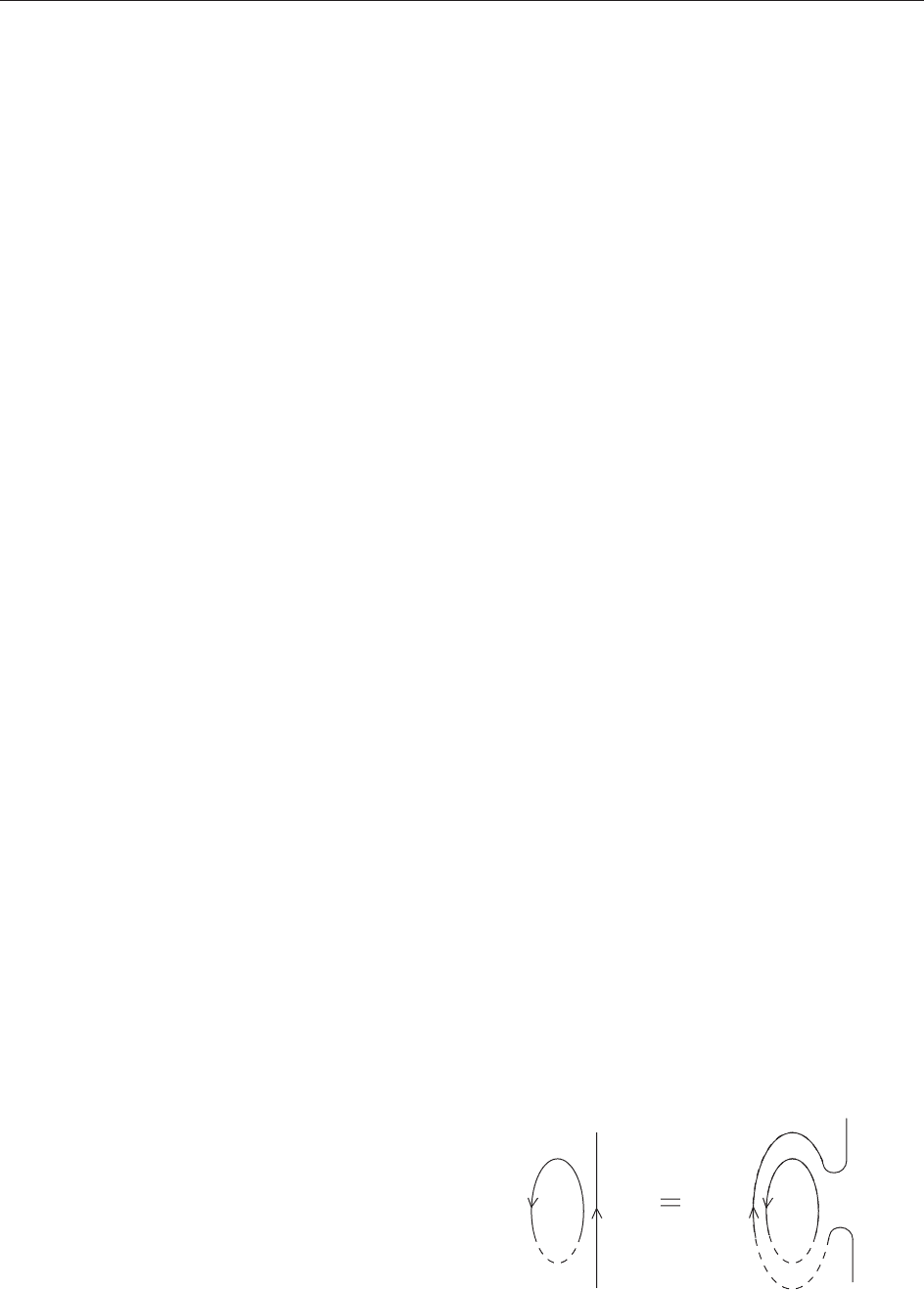
called the Kirby color. It has the following sliding
property: for any object V 2C, the two tangles in
Figure 1 yield the same morphism V ! V. Here, the
dashed line represents an arc on the closed compo-
nent labeled by . This arc can be knotted or linked
with other components of the tangle (not shown in
the figure).
VV
Ω
Ω
Figure 1 Sliding property.
118 Quantum 3-Manifold Invariants

Invariants of Closed 3-Manifolds
Given an embedded solid torus g : S
1
D
2
,!S
3
,
where D
2
is a 2-disk and S
1
= @D
2
, a 3-manifold can
be built as follows. Remove from S
3
the interior of
g(S
1
D
2
) and glue back the solid torus D
2
S
1
along gj
S
1
S
1
. This process is known as ‘‘surgery.’’
The resulting 3-manifold depends only on the
isotopy class of the framed knot represented by g.
More generally, a surgery on a framed link
L = [
m
i = 1
L
i
in S
3
with m components yields a
closed oriented 3-manifold M
L
. A theorem of
W Lickorish and A Wallace asserts that any closed
connected oriented 3-manifold is homeom orphic to
M
L
for some L. R Kirby proved that two framed
links give rise to homeomorphic 3-manifolds if and
only if these links are related by isotopy and a finite
sequence of geometric transformations called Kirby
moves. There are two Kirby moves: adjoining a
distant unknot O
"
with framing " = 1, and sliding
a link component over another one as in Figure 1.
Let L = [
m
i = 1
L
i
S
3
be a framed link and let
(b
i, j
)
i, j = 1,..., m
be its linking matrix: for i 6¼ j, b
i, j
is
the linking number of L
i
, L
j
, and b
i, i
is the framing
number of L
i
. Denote by e
þ
(resp. e
) the number of
positive (resp. negative) eigenvalues of this matrix.
The sliding property of modular categories implies
the following theorem. In its statement, a knot K
with label is denoted by K().
Theorem 1 Let C be a modular category with
Kirby color . Then hO
1
()i 6¼ 0, hO
1
()i 6¼ 0 and
the expression
C
ðM
L
Þ¼hO
1
ðÞi
e
þ
hO
1
ðÞi
e
hL
1
ðÞ; ...; L
m
ðÞi
is invariant under the Kirby moves on L. This
expression yields, therefore, awell-defined topological
invariant
C
of closed connected oriented 3-manifolds.
Several competing normalizations of
C
exist in
the literature. Here, the normalization used is such
that
C
(S
3
) = 1 and
C
(S
1
S
2
) =
P
(dim (V
))
2
.
The invariant
C
extends to 3-manifolds with a
framed oriented C-labeled link K inside by
C
ðM
L
; KÞ
¼hO
1
ðÞi
e
þ
hO
1
ðÞi
e
hL
1
ðÞ; ...; L
m
ðÞ; Ki
Three-Dimensional TQFTs
A three-dimensional TQF T V assigns to every closed
oriented surface X a finite-dimensional vector space
V(X) over a field k and assigns to every cobordism
(M, X, Y) a linear map V(M) = V(M, X, Y):V(X) !
V(Y). Here, a ‘‘cobordism’’ (M, X, Y) between
surfaces X and Y is a compact oriented 3-manifold
M with @M = (X) q Y (the minus sign indicates the
orientation reversal). A TQFT has to satisfy axioms
which can be expressed by saying that V is a
monoidal functor from the category of surfaces and
cobordisms to the category of vector spaces over k.
Homeomorphisms of surfaces should induce iso-
morphisms of the corresponding vector spaces
compatible with the action of cobordisms. From
the definition, V(;) = k. Every compact oriented
3-manifold M is a cobordism between ; and @M
so that V yields a ‘‘vacuum’’ vector V(M) 2 Hom(V( ; ),
V(
@M)) = V(@M). If @M = ;, then this gives a
numerical invariant V(M) 2 V(;) = k.
Interestingly, TQFTs are oft en defined for
surfaces and 3-cobordisms with additional struc-
ture. The surfaces X are normally endowed with
Lagrangians, that is, with m aximal isotropic
subspaces in H
1
(X; R). For 3-cobordisms, several
additional structures are considered in the litera-
ture: f or example, 2-framings, p
1
-structures, and
numerical weights. All these choices are equiva-
lent. The TQFTs requiring such additional struc-
tures are said to be ‘‘projective’’ since they provide
projective linear representations of the mapping
class groups of s urfaces.
Every modular category C with ground field k
and simple objects {V
}
gives rise to a projective
three-dimensional TQFT V
C
. It depends on the
choice of a square root D of
P
(dim (V
))
2
2 k.
For a connected surface X of genus g,
V
C
ðXÞ¼Hom
C
1;
M
1
;...;
g
O
g
r¼1
ðV
r
V
r
Þ
0
@
1
A
The dimension of this vecto r space enters the
Verlinde formula
dim
k
ðV
C
ðXÞÞ 1
k
¼D
2g2
X
ðdimðV
ÞÞ
22g
where 1
k
2 k is the unit of the field k. If char( k) = 0,
then this formula computes dim
k
(V
C
(X)). For a
closed connected oriented 3-manifold M with
numerical weight zero, V
C
(M) = D
b
1
(M)1
C
(M),
where b
1
(M) is the first Betti number of M.
The TQFT V
C
extends to a vaster class of surfaces
and cobordisms. Surfaces may be enriched with a
finite set of marked points, each labeled with an
object of C and endowed with a tangent direction.
Cobordisms may be enriched with ribbon (or fat)
graphs whose edges are labeled with objects of C and
whose vertices are labeled with appropriate inter-
twiners. The resulting TQFT , also denoted V
C
,is
nondegenerate in the sense that, for any surface X,
the vacuum vectors in V(X) determined by all M
Quantum 3-Manifold Invariants 119
with @M = X span V(X). A detailed construction
of V
C
is given in Turaev (1994).
The two-dimensional part of V
C
determines a
‘‘modular functor’’ in the sense of G Segal,
G Moore, and N Seiberg.
Constructions of Modular Categories
The universal enveloping algebra Ug of a (finite-
dimensional complex) simple Lie algebra g admits
a deformation U
q
g, which is a quasitriangular Hopf
algebra. The representation category Rep(U
q
g)is
C-linear and ribbon. For generic q 2 C,thiscategoryis
semisimple. (The irreducible representations of g can
be deformed to irreducible representations of U
q
g.)
For q, an appropriate root of unity , a certain
subquotient of Rep(U
q
g) is a modular category
with ground field k = C. For g = sl
2
(C), it was
pointed out by Reshetikhin and Turaev; the general
case involves the theory of tilting modules. The
corresponding 3-manifold invariant is denoted
g
q
. For example, if g = sl
2
(C) and M is the Poincare´
homology sphere (obtained by surgery on a left-
hand trefoil with framing 1), then (Le 2003)
g
q
ðMÞ¼ð1 qÞ
1
X
n0
q
n
ð1 q
nþ1
Þ
ð1 q
nþ2
Þð1 q
2nþ1
Þ
The sum here is finite since q is a root of unity.
There is another construction (Le 2003)ofa
modular category associated with a simple Lie
algebra g and certain roots of unity q. The
corresponding quantum invariant of 3-manifolds is
denoted
Pg
q
. (Here, it is normalized so that
Pg
q
(S
3
) = 1.) Under mild assumptions on the order
of q,wehave
g
q
(M) =
g
q
(M)
0
(M) for all M , where
0
(M) is a certain Gauss sum determined by g, the
homology group H = H
1
(M) and the linking form
Tors H Tors H ! Q=Z.
A different construction derives modular categories
from the category of framed oriented tangles T .Given
aringK, a bigger category K [T ] can be considered
whose morphisms are linear combinations of tangles
with coefficients in K.BothT and K[T ]havea
natural structure of a ribbon monoidal category.
The skein method builds ribbon categories by
quotienting K[T ] using local ‘‘skein’’ relations,
which appear in the theory of knot polynomials
(the Alexander–Conway polynomial, the Homfly
polynomial, and the Kauffman polynomial). In
order to obtain a semisimple category, one com-
pletes the quotient category with idempotents as
objects (the Karoubi completion). Choosing appro-
priate skein relations, one can recover the modular
categories derived from quantum groups of series
A, B, C, D. In particular, the categories determined
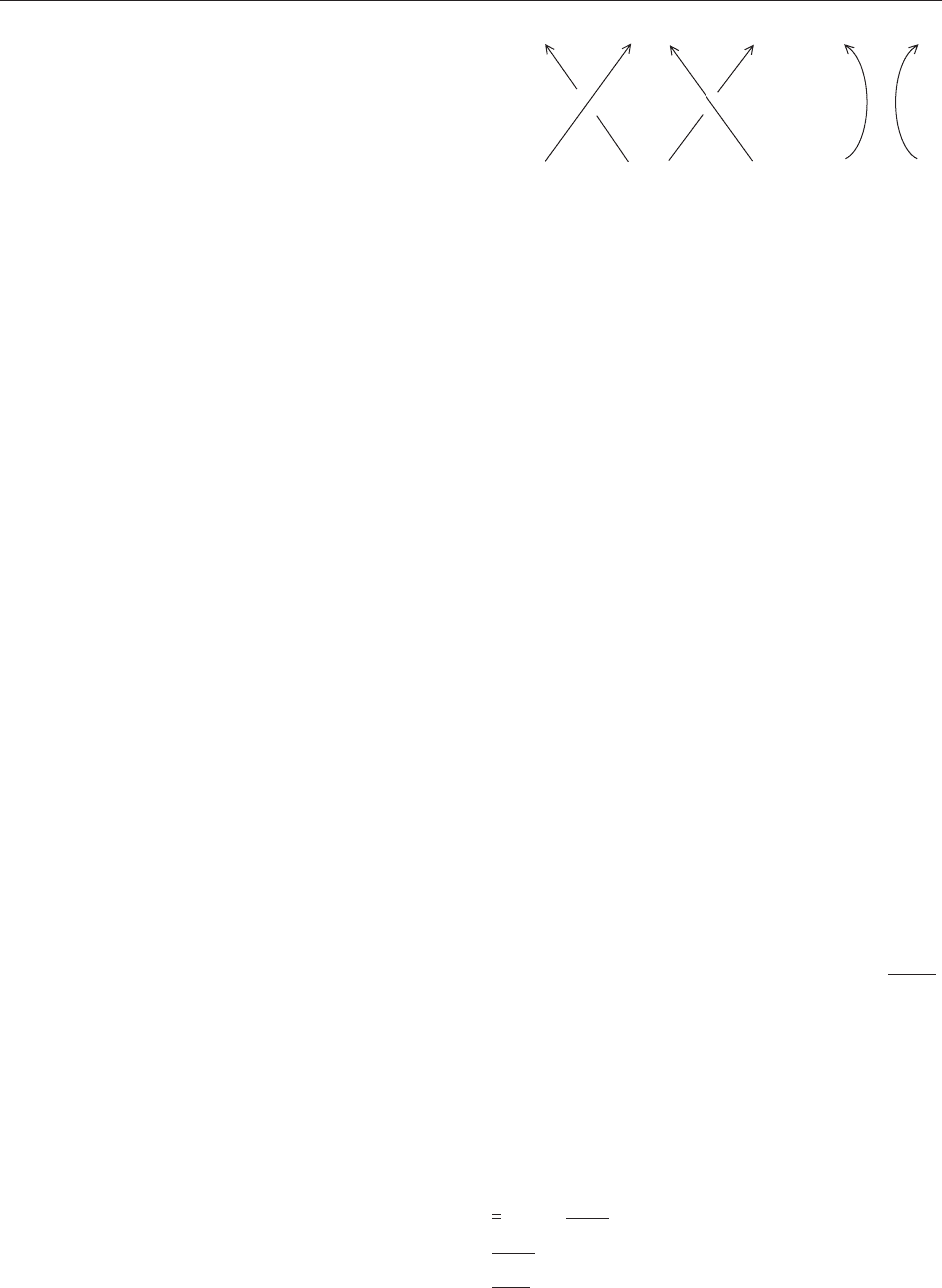
by the series A arise from the Homfly skein relation
shown in Figure 2 where a, s 2 K. The categories
determined by the series B, C, D arise from the
Kauffman skein relation.
The quantum invariants of 3-manifolds and the
TQFTs associated with sl
N
can be directly described
in terms of the Homfly skei n theory, avoiding the
language of ribbon categories (W Lickorish,
C Blanchet, N Habegger, G Masbaum, P Vogel for
sl
2
and Y Yokota for all sl
N
).
Unitarity
From both physical and topological viewpoints,
one is mainly interested in Hermitian and unitary
TQFTs (over k = C). A TQFT V is Hermitian if the
vector space V(X) is endowed with a nondegene-
rate Hermitian form h.,.i
X
: V(X)
C
V(X) ! C
such that:
1. the form h.,.i
X
is natural with respect to homeo-
morphisms and multiplicative with respect to
disjoint union and
2. for any cobordism (M, X, Y) and any
x 2 V(X), y 2 V(Y),
hVðM; X; YÞðxÞ; yi
Y
¼hx; VðM; Y; XÞðyÞi
X
If h.,.i
X
is positive definite for every X,thenthe
Hermitian TQFT is ‘‘unitary.’’ Note two features of
Hermitian TQFTs. If @M = ;, then V(M) =
V(M).
The group of self-homeomorphisms of any X
acts in V(X) preserving the form h.,.i
X
. For a
unitary TQFT, this gives an action by unitary matrices.
The three-dimensional TQFT derived from a mod-
ular category V is Hermitian (resp. unitary) under
additional assumptions on V which are discussed
briefly. A ‘‘conjugation’’ in V assigns to each morph-
ism f : V ! W in V a morphism
f : W ! V so that
f ¼ f ; f þ g ¼
f þ
g for any f ; g : V ! W
f g ¼
f
g for any morphisms f ; g in C
f g ¼
g
f for any morphisms
f : V ! W; g : W ! V
a
–1
= (s – s
–1
)
–a
Figure 2 The Homfly relation.
120 Quantum 3-Manifold Invariants

One calls V Hermitian if it is endowe d with
conjugation such that
V
¼ð
V
Þ
1
; c
V;W
¼ðc
V;W
Þ
1
b
V
¼ d
V
c
V;V
ð
V
1
V
Þ
d
V
¼ð1
V
1
V
Þc
1
V
;V
b
V
for any objects V, W of V. A Hermitian modular
category V is unitary if tr(f
f ) 0 for any morphism
f in V. The three-dimensional TQFT, derived from a
Hermitian (resp. unitary) modular category, has a
natural structure of a Hermitian (resp. unitary)
TQFT.
The modular category derived from a simple Lie
algebra g and a root of unity q is always Hermitian.
It may be unitary for some q. For simply laced g,
there are always such roots of unity q of any given
sufficiently big order. For non-simply-laced g, this
holds under certain divisibility conditions on the
order of q.
Integral Structures in TQFTs
The quantum invariants of 3-manifolds have one
fundamental property: up to an appropriate res-
caling, they are algebraic integers. This was
first observed by H Murakami, who proved that
sl
2
q
(M) is an algebraic integer, provided the order of
q is an odd prime and M is a homology sphere. This
extends to an arbitrary closed connected oriented 3-
manifold M and an arbitrary simple Lie algebra g as
follows (Le 2003): for any sufficiently big prime
integer r and any primitive rth root of unity q,
Pg
q
ðMÞ2Z½q¼Z½expð2i=rÞ ½1
This inclusion allows one to expand
Pg
q
(M)as
a polynomial in q. A study of its coefficients leads
to the Ohtsuki invariant s of rational homology
spheres and further to perturbative invariants of
3-manifolds due to T Le, J Murakami, and
T Ohtsuki (see Ohts uki (2002)). Conjecturally, the
inclusion [1] holds for nonprime (sufficiently big) r
as well. Connections with the algebraic number
theory (specifically modular forms) were studied by
D Zagier and R Lawrence.
It is important to obtain similar integrality results
for TQFTs. Following P Gilmer, fix a Dedekind
domain D C and call a TQFT V almost D-integral
if it is nondegenerate and there is d 2 C such
that dV(M) 2 D for all M with @M = ;.Given
an almost-integral TQFT V and a surface X,we
define S(
^
X)tobetheD-submodule of V(X), generated
by all vacuum vectors for X. This module is prese rved
under the action of self-homeomorphisms of X.
It turns out that S (X) is a finitely generated
projective D-module and V(X) = S(X)
D
C.
A cobordism (M, X, Y) is t argeted if all its connected
components meet Y along a nonempty set. In
this case, V(M)(S(X)) S(Y). Thus, applying S to
surfaces and restricting to targetet cobordisms, we
obtain an ‘‘integral version’’ of V.Inmanyinterest-
ing cases, the D-module S(X) is free and its basis
may be described explicitly. A simp le Lie algebra g
and a primitive rth (in some cases 4rth) root of unity
q with sufficiently big prime r give rise to an almost
D-integral T QFT for D = Z[q].
State-Sum Invariants
Another approach to three-dimensional TQFTs is
based on the theory of 6j-symbols and state sums on
triangulations of 3-manifolds. This approach intro-
duced by V Turaev and O Viro is a quantum
deformation of the Ponzano–Regge model for the
three-dimensional lattice gravity. The quantum 6j-
symbols derived from representations of U
q
(sl
2
C)are
C-valued rational functions of the variable q
0
= q
1=2
ijk
lmn
½2
numerated by 6-tuples of non-negative integers i, j,
k, l, m, n. One can think of these integers as labels
sitting on the edges of a tetrahedron (see Figure 3).
The 6j-symbol admits various equivalent normal-
izations and we choose the one which has full
tetrahedral symmetry. Now, let q
0
2 C be a
primitive 2rth r oot of unity with r 2. Set
I = {0, 1, ..., r 2}. Given a labeled tetrahedron T
as in Figure 3 with i, j, k, l, m, n 2 I,the6j-symbol
[2] can be evaluated at q
0
and we can obtain a
complex number denoted jTj. Consider a closed
three-dimensional manifold M with triangulation t.
(Note that all 3-manifolds can be triangulated.) A
coloring of M is a mapping ’ from the set Edg(t)
of the edges of t to I.Set
jMj¼ð
ffiffiffiffiffi
2r
p
=ðq
0
q
1
0
ÞÞ
2a
X
’
Y
e2EdgðtÞ
h’ðeÞi
Y
T
jT
’
j
i
k
l
m
n
j
Figure 3 Labeled tetrahedron.
Quantum 3-Manifold Invariants 121