
Francoise J.-P., Naber G.L., Tsun T.S. (editors) Encyclopedia of Mathematical Physics
Подождите немного. Документ загружается.


suitable bound, for the finite-volume Gibbs state
({
}j
m
) under the boundary conditions
m
,on
the probability that a fixed point in is encircled
by a contour from @. If this is the case, we say that
the phase m is s table. It turns out that such a bound
is actually an integral part of the construction of
metastable free energies f
m
(t) yielding the home-
omorphism t 7!a (t). In this way, we get the main
claim formulated as follows:
Theorem 1 Consider a parametric set of Hamilto-
nians H
t
= H
(0)
þ
P
r1
‘ = 1
t
‘
H
(‘)
with periodic finite-
range interactions satisfying the condition of
removal of degeneracy as well as the Peierls
condition with respect to the reference set
G = g(H
(0)
). Let d 2 and let be sufficiently
large. Then there exists a homeomorphism t 7!a(t)
of a neighborhood V
of the origin of the parameter
space R
r1
onto a neighborhood U
of the origin of
@Q
r
such that, for any t 2 V
, the set of all stable
phases is {m 2 {1, ..., r}ja
m
(t) = 0}.
The Peierls condition can be actually assumed
only for the Hamiltonian H
(0)
inferring its validity
for H
t
on a sufficiently small neighborhood V
.
Notice also that the result can be actually stated
not as a claim about phase diagram in a space of
parameters, but as a statement about stable phases
of a fixed Hamiltonian H. Namely, for a Hamilto-
nian H satisfying Peierls condition with respect to a
reference set G, one can assure the existence of
parameters a
m
labeled by elements from G such that
the set of extremal periodic Gibbs states of H
consists of all those m-phases for which a
m
= 0.
Construction of Metastable Free Energies
An important part of the Pirogov–Sinai theory is
an actual construction of the metastable free
energies – a set of functions f
m
(t), m = 1, ..., r,
that provide the homeomorphism a(t)bytaking
a
m
(t) = f
m
(t) min
m
f
m
(t).
We start with a contour representation of
partition function Z(j
q
). Considering, for each
contributing configuration , the collection @()of
its contours, we notice that, in addition to the fact
that different contours ,
0
2 @() have disjoint
supports, \
0
= ;, the contours from @()have
to satisfy the matching conditions:ifC is a
connected component of Z
d
n
S
2@
, then the
restrictions of the spin configurations
to C
are the same for all contours 2 @()with
dist(, C) = 1. In other words, the contours touch-
ing C inducethesamelabelonC. Let us observe
that there is actually one-to-one correspondence
between configurations that coincide with
q
on
c
and collections M(, q) of contours @ in
satisfying the matching condition, and such that the
external among them are q-contours. Here, a contour
2 @ is called an external contour in @ if Ext
0
for all
0
2 @ different from .
With this observation and using
m
(@) to denote
the union of all components of n
S
2@
with label
m, we get
Zðj
q
Þ¼
X
@2Mð;qÞ
Y
m
e
e
m
ðHÞj
m
ðÞj
Y
2@
e
ðÞ
½9
Usefulness of such contour representations stems
from an expectation that, for a stable phase q,
contours should constitute a suppressed excitation
and one should be able to use cluster expansions to
evaluate the behavior of the Gibbs state
q
.
However, the direct use of the cluster expansion on
[9] is trammeled by the presence of the energy terms
e
e
m
(H)j
m
(@)j
and, more seriously, by the require-
ment that the contour labels match.
Nevertheless, one can rewrite the partition func-
tion in a form that does not involve any matching
condition. Namely, considering first a sum over
mutually external contours @
ext
and resumming over
collections of contours which are contained in their
interiors without touching the boundary (being thus
prevented to ‘‘glue’’ with external contours), we get
Zðj
q
Þ¼
X
@
ext
e
e
q
ðHÞjExtj
Y
2@
ext
e
ðÞ
Y
m
Z
dil
ðInt
m
j
m
Þ
½10
Here the sum goes over all collections of
compatible external q-contours in , Ext =
Ext
(@
ext
) =
T
2@
ext
(Ext \ ), and the partition
function Z
dil
ðj
q
Þ is defined by [9] with
Mð, qÞ replaced by M
dil
ð, qÞMð, qÞ,the
set of all those collections whose external coun-
tours are such that dist ð,
c
Þ > 1: Multiplying
now each term by
1 ¼
Y
2@
ext
Y
m
Z
dil
ðInt
m
j
q
Þ
Z
dil
ðInt
m
j
q
Þ
½11
we get
Zðj
q
Þ¼
X
@
ext
e
e
q
ðHÞjExtj
Y
2@
ext
e
e
q
ðHÞjj
w
q
ðÞZ
dil
ðInt j
q
Þ
½12
where w
q
() is given by
w
q
ðÞ¼e
ðÞ
e
e
q
ðHÞjj
Y
m
Z
dil
ðInt
m
j
m
Þ
Z
dil
ðInt
m
j
q
Þ
½13
62 Pirogov–Sinai Theory

Observing that a similar expression is valid for
Z
dil
ðj
q
Þ (with an appropriate restriction on the
sum over external contours @
ext
) and proceeding by
induction, we eventually get the representation
Zðj
q
Þ¼e
e
q
ðHÞjj
X
@2Cð;qÞ
Y
2@
w
q
ðÞ½14
where C(, q) denotes the set of all collections of
nonoverlapping q-contours in . Clearly, the sum on
the right-hand side is exactly of the form needed to
apply cluster expansion, provided the contour weights
satisfy the necessary convergence assumptions.
Even though this is not necessarily the case, there
is a way to use this representation. Namely, one can
artificially change the weights to satisfy the needed
bound, for example, by modifying them to the form
w
0
q
ðÞ¼min w
q
ðÞ; e
jj
½15
with a suitable constant . The modified partition
function
Z
0
ðj
q
Þ¼e
e
q
ðHÞjj
X
@2Cð; q Þ
Y
2@
w
0
q
ðÞ½16
can then be controlled by cluster expansion allowing
to define
f
q
ðHÞ¼
1
lim
jj!1
1
jj
log Z
0
ðj
q
Þ½17
This is the metastable free energy corresponding to the
phase q. Applying the cluster expansion to the
logarithm of the sum in [16],wegetjf
q
(H) e
q
(H)j
e
=2
. The metastable free energy corresponds to
taking the ground state
q
and its excitations as long
as they are sufficiently suppressed. Once w
q
() exceeds
the weight e
jj
(and the contour would have been
actually preferred), we suppress it ‘‘by hand.’’ The
pointisthatifthephaseq is stable, this never happens
and w
0
q
() = w
q
()forall q-contours .Thisistheidea
behind the use of the function f
q
(H) as an indicator of
the stability of the phase q by taking
a
q
ðtÞ¼f
q
ðH
t
Þmin
m
f
m
ðH
t
Þ½18
Of course, the difficult point is to actually prove that
the stability of phase q (i.e., the fact that a
q
(t) = 0)
indeed implies w
0
q
() = w
q
() for all . The crucial step
is to prove, by induction on the diameter of and ,
the following three claims (with = 2e
=2
):
1. If is a q-contour with a
q
(t) diam =4, then
w
0
q
() = w
q
().
2. If a
q
(t) diam =4, then Z(j
q
) = Z
0
(j
q
) 6¼ 0
and
Zðj
q
Þ
e
f
q
ðH
t
Þjjj@j
½19
3. If m 2 G, then
Zðj
m
Þ
jj
e
min
q
f
q
ðH
t
Þjj
e
j@j
½20
A standard example illuminating the perturbative
construction of the metastable free energies and
showing the role of entropic contributions is the
Blume–capel model. It is defined by the Hamiltonian
H
ðÞ¼J
X
hx;yi
ð
x
y
Þ
2
X
x2
2
x
h
X
x2
x
½21
with spins
x
2 { 1, 0, 1}. Taking into account only
the lowest-order excitations, we get:
~
f
ð; hÞ¼ h
1
e
ð2dhÞ
(sea of pluses or minuses with a single spin flip !0)
and
~
f
0
ð; hÞ¼
1
e
ð2dþÞ
e
h
þ e
h
(sea of zeros with a single spin flip either 0 !þor
0 !)
Since these functions differ from full metastable free
energies f
(, h), f
0
(, h) by terms of higher order
(e
(4d2)
), the real phase diagram differs in this
order from the one constructed by equating the
functions
~
f
(, h)and
~
f
0
(, h). It is particularly
interesting to inspect the origin, = h = 0. It is only
the phase 0 that is stable there at all small
temperatures since
f
0
ð0; 0Þ
2
e
2d
< f
ð0; 0Þ
1
e
2d
½22
The only reason why the phase 0 is favored at this
point with respect to phases þ and is that there
are two excitations of order e
2d
for the phase 0,
while there is only one such excitation for þ or .
The entropy of the lowest-order contribution to
f
0
(0, 0) is overweighting the entropy of the contribu-
tion to f
(0, 0) of the same order.
Applications
Several applications, stemming from the Pirogov–
Sinai theory, are based on the fact that, due to the
cluster expansion, we have quite accurate descrip-
tion of the model in finite volume.
One class of applications concerns various
problems featuring interfaces between coexisting
phases. To be able to transform the problem into a
study of the random boundary line separating the
two phases, one needs a precise cluster expansion
formula for partition functions in volumes occupied
by those phases. In the situation with no symmetry
Pirogov–Sinai Theory 63

between the phases, the use of the Pirogov–Sinai
theory is indispensable.
Another interesting class of applications concerns
the behavior of the system with periodic boundary
conditions. It is based on the fact that the partition
function Z
T
N
on a torus T
N
consisting of N
d
sites
can be, again with the help of the cluster expan-
sions, explicitly and very accurately evaluated in
terms of metastable free energies,
Z
T
N
X
r
q¼1
e
f
q
ðHÞN
d
expf min
m
f
m
ðHÞN
d
bNg½23
with a fixed constant b. This formula (and its
generalization to the case of complex parameters)
allows us to obtain various results concerning the
behavior of the model in finite volumes.
Finite-Size Effects
Considering as an illustration a perturbation of the
Ising model, so that it does not have the symmetry
any more (and the value h
t
() of external field
at which the phase transition between plus and
minus phase occurs is not known), we can pose a
natural question that has an importance for correct
interpretation of simulation data. Namely, what is
the asymptotic behavior of the magnetization
m
per
N
(, h) =
T
N
(1/
P
x2
x
) on a torus? In the
thermodynamic limit, the magnetization m
per
1
(, h)
displays, as a function of h, a discontinuity at
h = h
t
(). For finite N, we get a rounding of the
discontinuity – the jump is smoothed. What is the
shift of a naturally chosen finite-volume transition
point h
t
(N) with respect to the limiting value h
t
?
The answer can be obtained with the help of [23]
once sufficient care is taken to use the freedom in
the definition of the metastable free energies f
þ
(h)
and f
(h) to replace them with a sufficiently smooth
version allowing an approximation of the functions
f
(h) around limiting point h
t
in terms of their
Taylor expansion.
As a result, in spite of the asymmetry of the model,
the finite-volume magnetization m
per
N
(, h)hasauni-
versal behavior in the neighborhood of the transition
point h
t
. With suitable constants m and m
0
,wehave
m
per
N
ð; hÞm
0
þ m tanhfN
d
mðh h
t
Þg ½24
Choosing the inflection point h
max
(N)ofm
per
N
(, h)
as a natural finite-volume indicator of the occurence
of the transition, one can show that
h
max
ðNÞ¼h
t
þ
3
2
2
m
3
N
2d
þ OðN
3d
Þ½25
Zeros of Partition Functions
The full strength of the formula [23] is revealed
when studying the zeros of the partition function
Z
T
N
(z) as a polynomial in a complex parameter z
entering the Hamiltonian of the model. To be able
to use the theory in this case, one has to extend the
definitions of the metastable free energies to com-
plex values of z. Indeed, the construction still goes
through, now yielding genuinely complex, contour
models w
with the help of an inductive procedure.
Notice that no analytic continuation is involved. An
analog of [23] is still valid,
Z
T
N
ðzÞ
X
r
m¼1
e
f
m
ðzÞN
d
expf min
m
<ef
m
ðzÞN
d
bNg½26
Using [26], it is not difficult to convince oneself
that the loci of zeros can be traced down to the
phase coexistence lines. Indeed, on the line of
the coexistence of two phases <ef
m
= <ef
q
,the
partition function Z
T
N
(z) is approximated by
e
fN
d
(e
=mf
m
N
d
þ e
=mf
n
N
d
). The zeros of this
approximation are thus given by the equations
<ef
m
¼<ef
n
< < ef
‘
for all ‘ 6¼ m; n
N
d
ð=mf
m
=mf
n
Þ¼ mod 2
½27
The zeros of the full partition function Z
T
N
(z) can
be proved to be exponentially close, up to a shift
of order O(e
bN
), to those of the discussed
approximation.
Briefly, the zeros of Z
T
N
(z) asymptotically con-
centrate on the phase coexistence curves with the
density (1=2)N
d
j(d=dz)(f
m
f
n
)j.
Bibliographical Remarks
and Generalizations
The original works Pirogov and Sinai (1975, 1976)
and Sinai (1982) introduced an analog of the weights
w
0
q
()andparametersa
q
(H) as a fixed point of a
suitable mapping on a Banach space. The inductive
definition used here was introduced in Kotecky´and
Preiss (1983) and Zahradnı´k (1984).Thecompleteness
of phase diagram – the fact that the stable phases
exhaust the set of all periodic extremal Gibbs states
was first proved in Zahradnı´k (1984). Extension to
complex parameters was first considered in Gawe¸dzki
et al. (1987) and Borgs and Imbrie (1989).Forareview
of the standard Pirogov–Sinai theory, see Sinai (1982)
and Slawny (1987).
Application of Pirogov–Sinai theory for finite-size
effects was studied in Borgs and Kotecky´ (1990) and
64 Pirogov–Sinai Theory

general theory of zeros of partition functions is
presented in Biskup et al. (2004).
The basic statement of the Pirogov–Sinai theory
yielding the construction of the full phase diagram
has been extended to a large class of models. Let us
mention just few of them (with rather incomplete
references):
1. Continuous spins. The main difficulty in these
models is that one has to deal with contours
immersed in a sea of fluctuating spins (Dobrushin
and Zahradnı´k 1986, Borgs and Waxler 1989).
2. Potts model. An example of a system a transi-
tion in temperature with the coexistence of the
low-temperature ordered and the high-tempera-
ture disordered phases. Contour reformulation is
employing contours between ordered and dis-
ordered regions (Bricmont et al. 1985, Kotecky´
et al. 1990). The treatment is simplified with help
of Fortuin–Kasteleyn representation (Laanait
et al. 1991).
3. Models with competing interactions. ANNNI
model, microemulsions. Systems with a rich
phase structure (Dinaburg and Sinai 1985).
4. Disordered systems . An example is a proof of
the existence of the phase transition for the three-
dimensional random field Ising model (Bricmont
and Kupiainen 1987, 1988) using a renormaliza-
tion group version of the Pirogov–Sinai theory
first formulated in Gaw¸edzki et al. (1987).
5. Quantum lattice models. A class of quantum
models that can be viewed as a quantum perturba-
tion of a classical model. With the help of Feyn-
man–Kac formula these are rewritten as a (d þ 1)-
dimensional classical model that is, in its turn,
treated by the standard Pirogov–Sinai theory (Datta
et al. 1996, Borgs et al. 1996).
6. Continuous systems. Gas of particles in con-
tinuum interacting with a particular potential of
Kac type. Pirogov–Sinai theory is used for a proof
of the existence of the phase transitions after a
suitable discretisation (Lebowitz et al. 1999).
See also: Cluster Expansion; Falicov–Kimball Model;
Phase Transiti ons in Continuous Syst ems; Quantum
Spin Systems.
Further Reading
Biskup M, Borgs C, Chayes JT, and Kotecky´ R (2004) Partition
function zeros at first-order phase transitions: Pirogov–Sinai
theory. Journal of Statistical Physics 116: 97–155.
Borgs C and Imbrie JZ (1989) A unified approach to phase
diagrams in field theory and statistical mechanics. Commu-
nications in Mathematical Physics 123: 305–328.
Borgs C and Kotecky´ R (1990) A rigorous theory of finite-size
scaling at first-order phase transitions. Journal of Statistical
Physics 61: 79–119.
Borgs C, Kotecky´ R, and Ueltschi D (1996) Low temperature phase
diagrams for quantum perturbations of classical spin systems.
Communications in Mathematical Physics 181: 409–446.
Borgs C and Waxler R (1989) First order phase transitions in
unbounded spin systems: construction of the phase diagram.
Communications in Mathematical Physics 126: 291–324.
Bricmont J, Kuroda T, and Lebowitz J (1985) First order phase
transitions in lattice and continuum systems: extension of
Pirogov–Sinai theory. Communications in Mathematical Phy-
sics 101: 501–538.
Bricmont J and Kupiainen A (1987) Lower critical dimensions for
the random field Ising model. Physical Review Letters 59:
1829–1832.
Bricmont J and Kupiainen A (1988) Phase transition in the 3D
random field Ising model. Communications in Mathematical
Physics 116: 539–572.
Datta N, Ferna´ndez R, and Fro¨ hlich J (1996) Low-temperature
phase diagrams of quantum lattice systems. I. Stability for
quantum perturbations of classical systems with finitely-many
ground states. Helv. Phys. Acta 69: 752–820.
Dinaburg EL and Sinaı¨ YaG (1985) An analysis of ANNNI model
by Peierls contour method. Communications in Mathematical
Physics 98: 119–144.
Dobrushin RL and Zahradnı´k M (1986) Phase diagrams of
continuous lattice systems. In: Dobrushin RL (ed.) Math.
Problems of Stat. Physics and Dynamics, pp. 1–123. Dordrecht:
Reidel.
Gawe¸dzki K, Kotecky´ R, and Kupiainen A (1987) Coarse-graining
approach to first-order phase transitions. Journal of Statistical
Physics 47: 701–724.
Kotecky´ R, Laanait L, Messager A, and Ruiz J (1990) The q-state
Potts model in the standard Pirogov–Sinai theory: surface
tensions and Wilson loops. Journal of Statistical Physics 58:
199–248.
Kotecky´ R and Preiss D (1983) An inductive approach to PS
theory, Proc. Winter School on Abstract Analysis, Suppl. ai
Rend. del Mat. di Palermo.
Lebowitz JL, Mazel A, and Presutti E (1999) Liquid–vapor phase
transitions for systems with finite range interactions. Journal
of Statistical Physics 94: 955–1025.
Laanait L, Messager A, Miracle-Sole´ S, Ruiz J, and Shlosman SB
(1991) Interfaces in the Potts model I: Pirogov–Sinai theory of
the Fortuin–Kasteleyn representation. Communications in
Mathematical Physics 140: 81–91.
Pirogov SA and Sinai YaG (1975) Phase diagrams of classical
lattice systems (Russian). Theoretical and Mathematical
Physics 25(3): 358–369.
Pirogov SA and Sinai YaG (1976) Phase diagrams of classical
lattice systems. Continuation (Russian). Theoretical and
Mathematical Physics
26(1): 61–76.
Sinai YaG (1982) Theory of Phase Transitions: Rigorous Results.
New York: Pergamon.
Slawny J (1987) Low temperature properties of classical lattice
systems: phase transitions and phase diagrams. In: Domb C and
Lebowitz JL (eds.) Phase Transitions and Critical Phenomena,
vol. 11, pp. 127–205. New York: Academic Press.
Zahradnı´k M (1984) An alternate version of Pirogov–Sinai theory.
Communications in Mathematical Physics 93: 559–581.
Pirogov–Sinai Theory 65
Point-Vortex Dynamics
S Boatto, IMPA, Rio de Janeiro, Brazil
D Crowdy, Imperial College, London, UK
ª 2006 Elsevier Ltd. All rights reserved.
Introduction
Vortices have a long fascinating history. Descartes
wrote in his Le Monde:
...que tous les mouvements qui se font au Monde sont
en quelque fac¸on circulaire: c’est a` dire que, quand un
corps quitte sa place, il entre toujours en celle d’un
autre, et celui-ci en celle d’un autre, et ainsi de suite
jusques au dernier, qui occupe au meˆme instant le lieu
de´laisse´ par le premier.
In particular, Descartes thought of vortices to
model the dynamics of the solar system, as reported
by W W R Ball (1940):
Descartes’ physical theory of the universe, embodying
most of the results contained in his earlier and
unpublished Le Monde, is given in his Principia,
1644, ... He assumes that the matter of the universe
must be in motion, and that the motion must result in a
number of vortices. He stated that the sun is the center
of an immense whirlpool of this matter, in which the
planets float and are swept round like straws in a
whirlpool of water.
Descartes’ theory was later on recused by Newton
in his Principia in 1687. Few centuries later,
W Thomson (1867) the later Lord Kelvin, made use
of vortices to formulate his atomic theory: each atom
was assumed to be made up of vortices in a sort of
ideal fluid. In 1878–79 the American physicist A M
Mayer conducted a few experiments with needle
magnets placed on floating pieces of cork in an
applied magnetic field, as toy models for studying
atomic interactions and forms (Mayer 1878, Aref
et al. 2003). In 1883 inspired by Mayer experiments,
J J Thomson combined W Thomson’s atomic theory
with H von Helmholtz’s point-vortex theory
(Helmholtz 1858): he thought as the electrons were
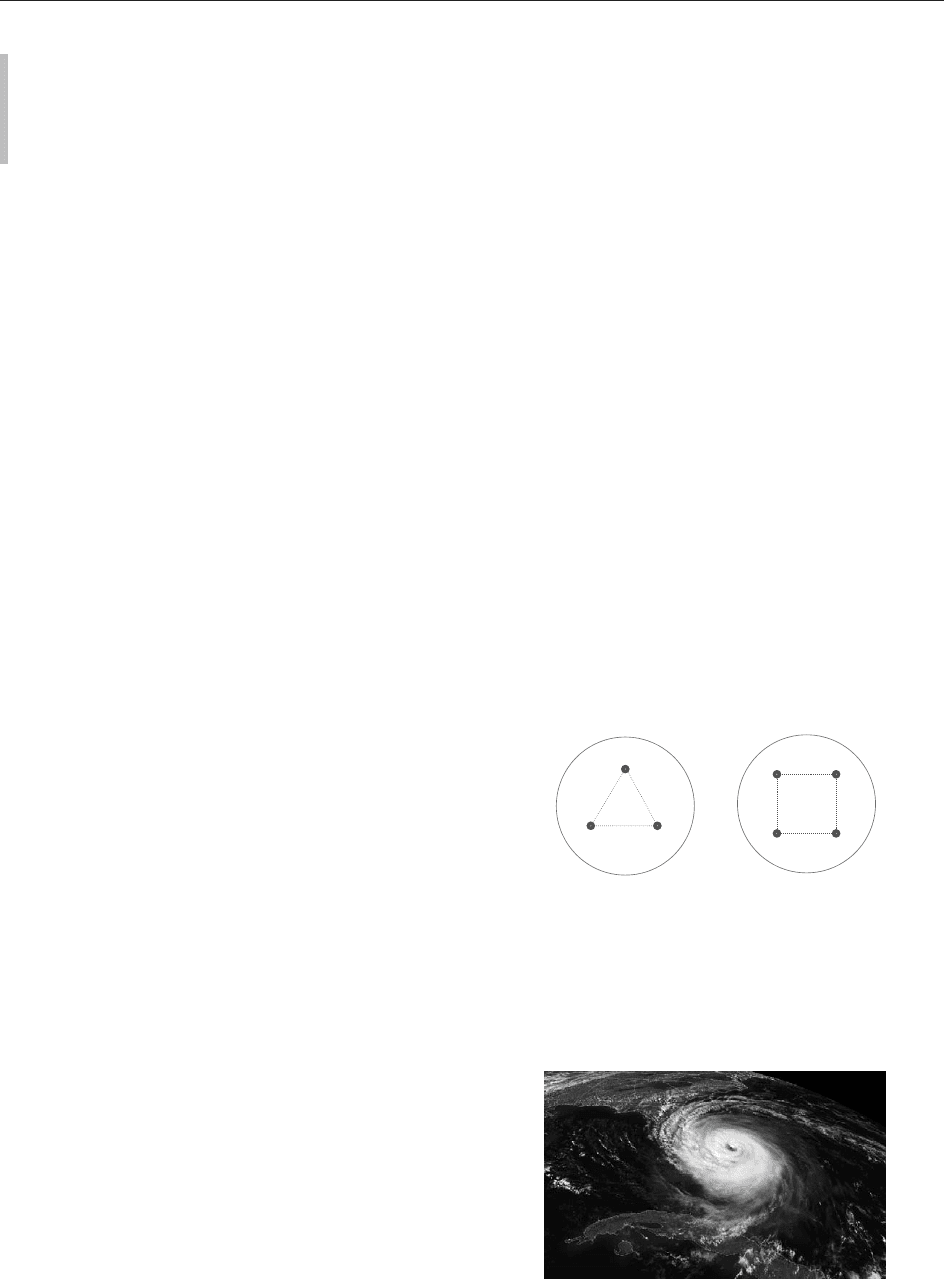
point vortices inside a positively charged shell (see
Figure 1), the vortices being located at the vertices of
regular parallelograms and investigated about the
stability of such structures (see Thomson (1883,
section 2.1)). The vortex-atomic theory survived for
quite a few years up to Rutherford’s experiments
proved that atoms have quite a different structure!
Before continuing this historical/modeling overview,
let’s address the following question:
what is a vortex and, more specifically, what is a point-
vortex?
Roughly speaking, following Descart es, a vortex
is an entity which makes particles move along
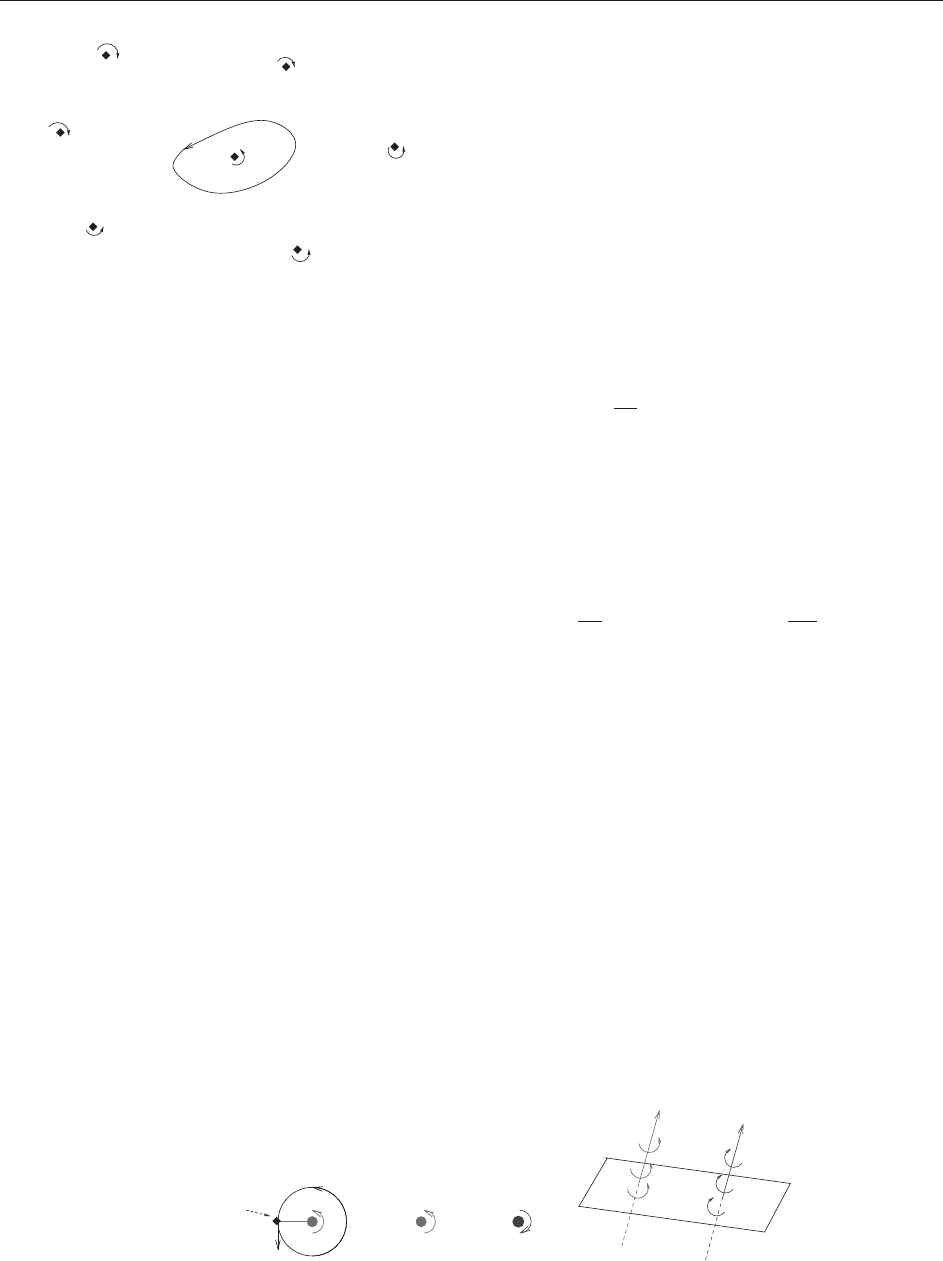
circular-like orbits. Examples are the cyclones and
anticyclones in the atmosphere (see Figure 3).
Mathematically speaking, let u = (u, v, w) 2 R
3
be a
velocity field, the associated vorticity field ! is
defined to be
! ¼r^u ½1
In this article we are considering exclusively inviscid
flows which are also incompressible, that is,
ru ¼ 0 ½2
and have constant density , which we normalize to
be equal to 1 ( = 1). In two dimensions, a point-
vortex field is the simplest of all vorticity fields: it
can be thought as an entity where the vorticity field
is concentrated into a point. In other words, point
vortices are singularities of the vorticity field! Then,
in the plane the vorticity field associated to a system
of N point vortices is
!ðrÞ¼
X
N
¼1
ðr r
Þ½3
Figure 2 Hurricane Jeanne. Reproduced with permission from
the National Oceanic and Atmospheric Administration (NOAA)
(www.noaanews.noaa.gov).
+
+
+
+
+
+
+
+
+
+
+
+
+
+
+
+
+
+
+
+
(a) (b)
Figure 1 Thomson atomic model: (a) atom with three
electrons and (b) atom with four electrons. From Thomson JJ
(1883) A Treatise on the Motion of Vortex Rings. New York:
Macmillan and Thomson JJ (1904) Electricity and Matter.
Westmister: Archibald Constable.
66 Point-Vortex Dynamics
where
, = 1, ..., N, is a constant and corre-
sponds to the vorticity (or circulation) of the
-vortex, situated at r
. In fact by definition,
the circulation around a curve C de limiting a region
with boundary C,
C
¼
I
C
u ds ¼
ZZ
ðr ^ uÞn dA ¼
ZZ
! ½4
where we have used Stokes’ theorem to bring in the
vorticity. Then if the region contains only the th
point vortex, we obtain
C
¼
ZZ
! dA ¼
½5
by eqn [3]. A positive (resp. negative) sign of
indicates that the corresponding point vortex
induces an anticlockwise (resp. clockwise) particle
motion, see Figure 4a)). Is there an analog of a
point-vortex system for a three-dimensional flow?
Yes, and this brings in the analogy between vortex
lines and magnetic field lines that Mayer used in his
experiments with floating magnets. In fact, in three
dimensions, the notion of a point vortex can be
extended to that one of a straight vortex line (see
Figure 4b), where, by definition, a vortex line is a curve
that is tangent to the vorticity vector ! at each of its
point. In this context we would like to mention the
beautiful experiments of Yarmchuck–Gordon–Packard
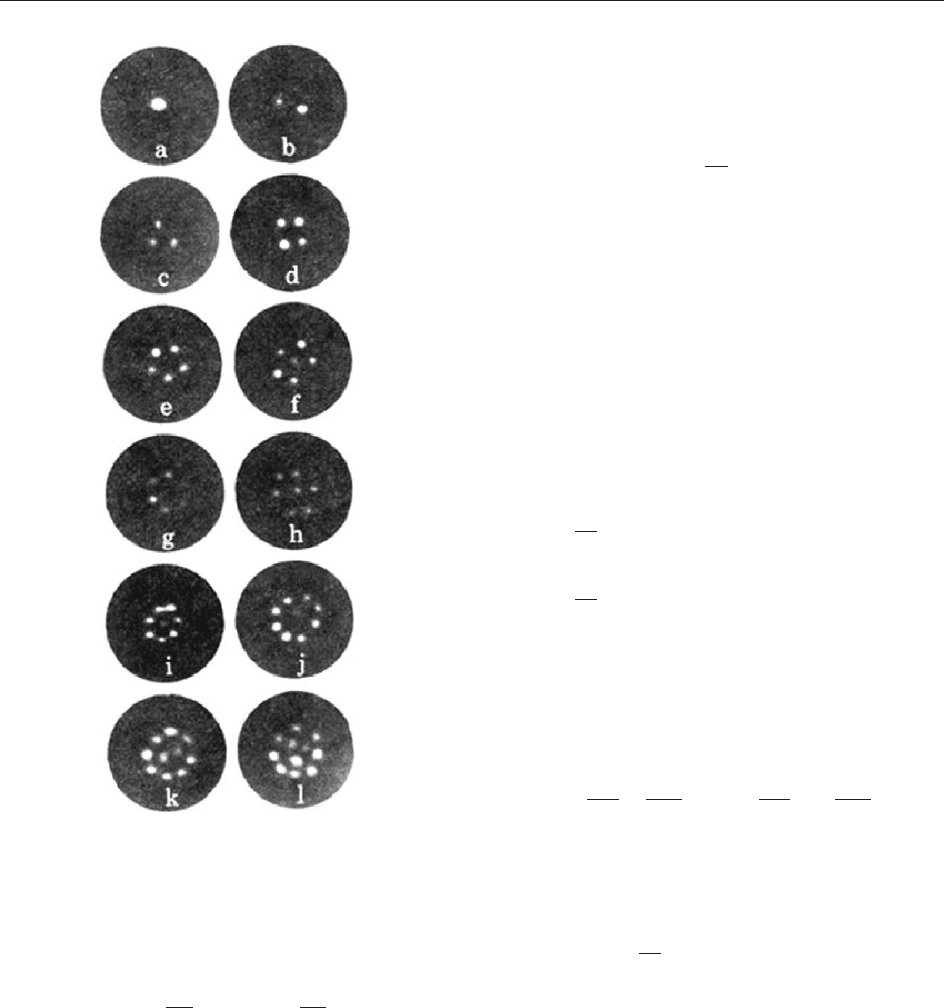
on vortices in superfluid helium. They observed the
formation of stable polygonal configurations of iden-
tical vortices, quite similar to the ones observed by
Mayer with his magnets (see Figures 5 and 1).
One would like to understand how such configura-
tions form and to give a theoretical account about their
stability. In order to answer these questions we have to
first be able to describe the dynamics of a system of
point vortices from a mathematical point of view.
Evolution Equations
Can point vortices be viewed as ‘‘discrete’’ (or
localized) solutions of Euler equ ation in two dimen-
sions? Let us consider the Euler equ ation
@u
@t
þ u ru ¼rp þ f ½ 6
where p is the pressure, f = rU is a conservative
force, and restrict our attention to the two-dimensional
setting, for example, vortex dynamics on the plane (or a
sphere). Then it is immediate that by taking the curl of
eqn [6] we obtain the evolution equation of the
vorticity, that is,
@!
@t
þ u r! ¼ 0; or
D!
Dt
¼ 0 ½7
where the operator D=Dt = @=@t þ u ris called the
material derivative and describes the evolution along
the flow lines. It follows from eqn [7] that in two
dimensions the vorticity is conserved as it is trans-
ported along the flow lines. Then a natural question
arises: supposing the vorticity field ! is known, is it
possible to deduce the velocity field u generating !?Or
in other words, is it possible to solve the system of eqns
[1]–[2]? It is immediate to see that in general the
solution is not unique, if some boundary conditions
are not specified (see Marchioro and Pulvirenti
(1993)). Furthermore, as already observed by Kirchh-
off in 1876 (Boatto and Cabral 2003), in two
dimensions we can recast the fluid equations [1]–[2]
into a Hamiltonian formalism. In fact, notice that on
the plane u = (
_
x,
_
y)andeqn [2] is still satisfied if we
represent the velocity components as
C
Γ
1
Γ
7
Γ
6
Γ
4
Γ
5
Γ
3
Γ
2
Σ
Figure 3 Cyclones and anticyclones in the atmosphere. Repro-
duced from Boatto S and Cabrel HE, SIAM Journal of Applied
Mathematics 64:216–230 (2003). With the permission of SIAM.
r
Γ > 0 Γ > 0
r
2
__
Γ
=
c|u|
particle
u
ω
u
(a) (b)
Figure 4 (a) Advected by the velocity field of one point vortex, a test particle follows a circular orbit, with a speed proportional to the
absolute value of the vortex circulation and inversely proportional to the square of its distance from the vortex. (b) Straight vortex lines.
Point-Vortex Dynamics 67
_
x ¼
@
@y
;
_
y ¼
@
@x
½8
that is, by means of , called the stream function.
Formally, plays the roˆ le of a Hamiltonian for the pair
of conjugate variables (x, y) and it is used to describe the
dynamics of a test particle, located at (x, y) and advected
by the flow. By substituting [8] into [1], we obtain
ðrÞ¼!ðrÞ½9
that is, a Poisson equation with ! as a source term.
Then, once we specify the vorticity field, by
inverting [9] we obtain the stream function to be
ðrÞ¼
Z
Gðr; r
0
Þ!ðr
0
Þdr
0
½10
where G(r, r
0
) is the Green’s function, solution of
the equation G(x, y) = (x, y). The Green’s func-
tion both for the plane and the sphere is (Marchioro
and Pulvirenti 1993)
Gðr; r
0
Þ¼
1
4
log kr r
0
k
2
½11
where kr r
0
k
2
= (x x
0
)
2
þ (y y
0
)
2
.By[10],once
we specify the vorticity field !(r) we can compute ,
and by replacing it into [8] the velocity field becomes
uðrÞ¼
Z
Kðr; r
0
Þ!ðr
0
Þdr
0
½12
where K(r, r
0
) = ( r r
0
)
?
=½2kr r
0
k
2
and it
represents the velocity field generated by a point
vortex of intensity one, located at r
0
. Then by
considering the vorticity field generated by point
vortices, eqn [3], together with eqn [11], eqn [10]
becomes
ðrÞ¼
1
4
Z
log kr r
0
k
2
X
N
¼1
ðr
0
r
Þ
!
dr
0
¼
1
4
X
N
¼1
log kr r
k
2
½13
Equation [13] describes together with [8], the
dynamics of a test particle at a point r = ( x, y)in
the plane. Analogously, it can be shown that the
dynamics of a systems of point vortices in the plane
is given by the equations
dx
dt
¼
@H
v
@y
;
dy
dt
¼
@H
v
@x
½14
where (q
, p
) = (x
,
y
), = 1, ..., N, is a pair of
conjugate variables and H
v
is the generalization of
the stream function (eqn [13]):
H
v
¼
1
4
X
N
;¼1
6¼
log kr
r
k
2
½15
Notice that the vortex Hamiltonian H
v
(eqn [15])is
an autonomous Hamiltonian and, as we will discuss
in the first subsection, it provides a good Lyapunov-
like function to study stability properties of some
vortex configurations. Moreover, H
v
is invariant
with respect to rotations and translations, then by
the Noether theorem there are other first integrals of
motion, that is,
L ¼
X
N
k¼1
k
k x
k
k
2
; M
x
¼
X
N
k¼1
k
x
k
;
M
y
¼
X
N
k¼1
k
y
k
Figure 5 Photographs of vortex configurations in a rotated
sample of superfluid helium with 1, ...,11 vortices. Reprinted
figure with permission from Yarmchuk EJ, Gordon MJV, and
Packard RE (1979) Observation of stationary vortices arrays in
rotating superfluid Helium. Physical Review Letters 43(3): 214–
217. Copyright (1979) by the American Physical Society.
68 Point-Vortex Dynamics
expressing, respectively, the conservation of angular
momentum, L, and linear momentum, M =
(M
x
, M
y
), on the plane. We shall denote with M
the magnitude of M (i.e., M = kMk). Furthermore,
by introducing the Poisson bracket
½f ; g¼
X
N
¼1
@f
@q
@g
@p
@f
@p
@g
@q
¼
X
N
¼1
1
@f
@x
@g
@y
@f
@y
@g
@x
we can construct three integrals in involution out of
the four conserved quantities L, M
x
, M
y
, and H
v
.
These are L, M
2
x
þ M
2
y
and H
v
: in fact,
½H
v
; L¼0; H
v
; M
2
x
þ M
2
y
hi
¼0;
L; M
2
x
þ M
2
y
hi
¼0
It is then possible to reduce the system of equations
from N to N 2 degrees of freedom. A Hamiltonian
system with N degrees of freedom is integrable
whenever there are N independent integrals of
motion in involution. It follows that a vortex system
with N 3 is integrable, wher eas the system of
equations of four identical vortices has been shown
by Ziglin to be nonintegrable in the sense that there
are no other first integrals analytically depending on
the coordinates and circulations, and functionally
independent of L, H
v
, M
x
, M
y
(see Ziglin (1982)).
The following, however, has been shown:
1. Let K =
P
N
= 1
k
be the total vorticity,
M = (M
x
, M
y
) the total momentum and M = kMk .
Then, as shown by Aref and Stremler (1999),ifK = 0
and M = 0, N-vortex problem [16] is integrable.
2. A system of four identical vortices (i.e., k
= k
for = 1, ..., 4) can undergo periodic or quasi-
periodic motion for special initial conditions (see
Khanin (1981) Russian Math. Surveys 36: 231;
Aref and Pomphrey (1982) Proc. R. Soc. Lond. A
380: 359–387). More specifically, the motion of a
system of four identical vortices can be periodic,
quasiperiodic, or chaotic depending on the symme-
try of the initial configuration. In fact, every vortex
configuration that belongs to the subspace of
symmetric configurations – x
= x
þ2
and y
=
y
þ2
, = 1, 2 – gives rise to an integrable vortex
motion.
We have that up to two vortices, the motion is
almost always periodic and the orbits are circles; the
only exception being the case for which k
2
= k
1
,
when the circles degenerate into straight lines. Thus,
a configuration of two point vortices is always a
relative equilibrium configuration, that is, there exists
a specific reference frame in which the two vortices
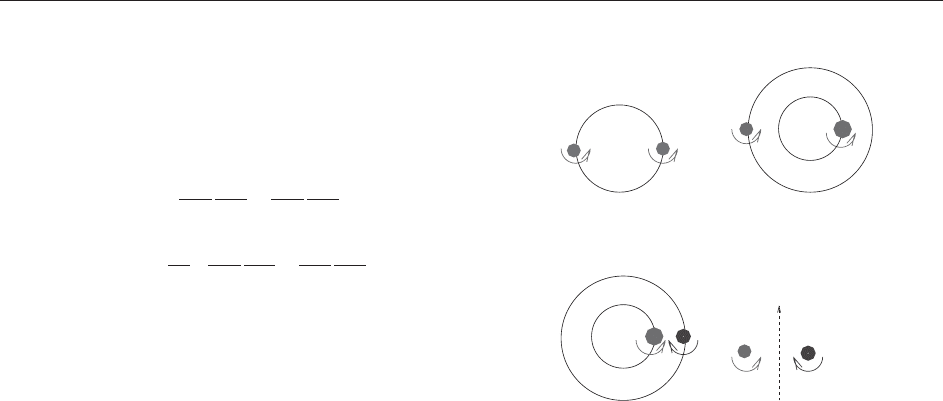
are at rest. If the vortices are identical (
1
=
2
=),
the motion is synchronous with frequency ==
and the vortices share the same circular orbit (see
Figure 6a). If the vortices are not identical and have
vorticities of different magnitudes (say j
1
j > j
2
j),
their motion is still synchronous and periodic, with
frequency =(
1
þ
2
)=(2), and the vortices move
on different circular orbits (with r
2
< r
1
) both
centered at the center of vorticity. Note that for
both cases, identical and nonidentical vortices, we
can view the vortex dynamics in a co-rotating frame
where the vortices are simply at rest.
For three vortices we can have periodic and
quasiperiodic motion, depending on the initial
conditions, and for four vortices we can have
periodic, quasiperiodic, or weakly chaotic motion.
Remarks
(i) The nonintegrability of the 4-vortex system was
also proved for configurations of nonidentical vortices.
Koiller and Carvalho (1989) gave an analytical proof
for
1
=
2
and
3
=
4
= ,0 1. Moreover,
Castilla et al. (1993) considered the case:
1
=
2
=
3
= 1and
4
= .
(ii) Due to the translational and rotational
symmetries of H
v
, there are some analogies between
the N-vortex problem and the N-body problem,
especially for what concerns configurations of
relative equilibria (see Albouy (1996) and Glass
(2000)). A relative equilibrium is a vortex (or mass)
configuration that moves without change of shape
or form, that is, a configuration which is steadily
Γ = Γ
Γ
1
Γ
2
>
⏐⏐⏐⏐
Γ
1
=
–Γ
2
0 < Γ
1
< Γ
2
(a) (b)
(c) (d)
Figure 6(a–d) For N = 2 the vortex dipole exhibits a synchro-
nous and the orbits are in general circular orbits, with the
exception of the case (d) for which
1
=
2
and the circular
orbit degenerates into a line (or a circle of infinite radius).
Point-Vortex Dynamics 69
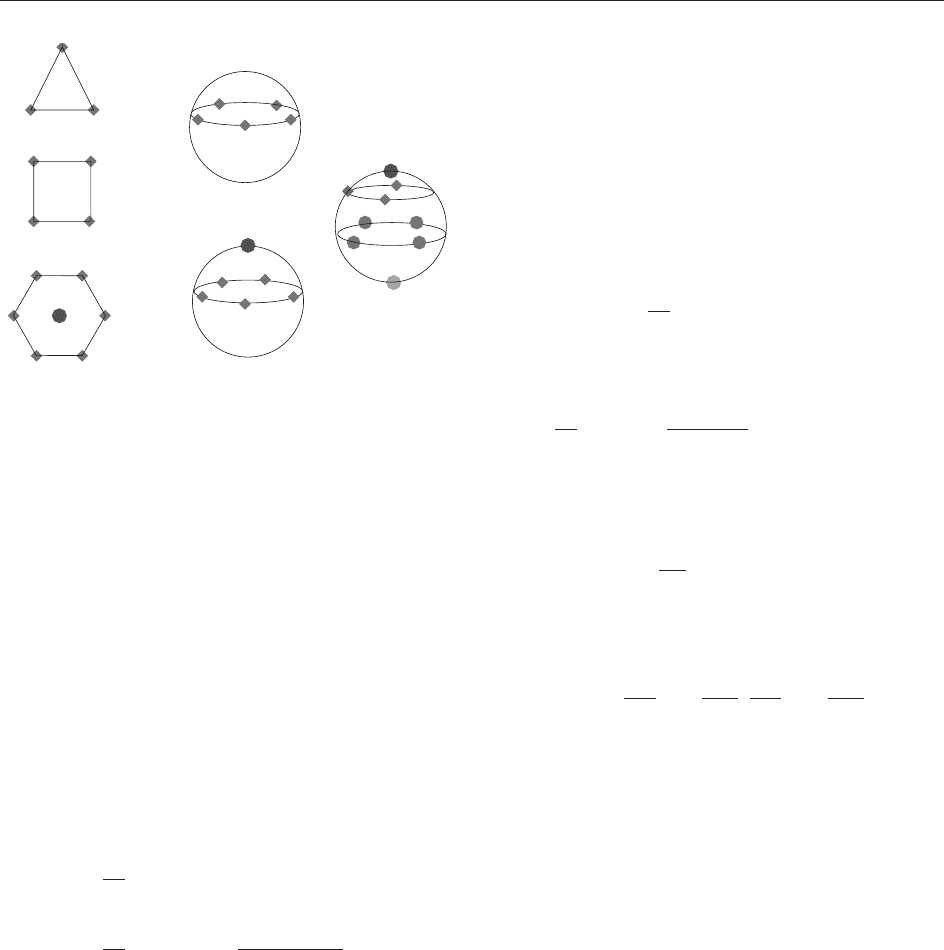
rotating or translating. A few examples are vortex
polygons (see Figure 7) like the ones studied by
Thomson, Mayer, Yarmchuk–Gordon–Packard,
Boatto–Cabral (2003), Cabral–Schmidt (1999/
2000), Dritschel–Polvani (1993), Lim–Montaldi–
Roberts (2001), Sakajo (2004). For an exhaust ive
review on relative equilibria of vortices, see the
article by Aref et al. (2003). We shall discuss
stability of polygonal vortex configu ration in the
following subsection.
(iii) As shown by Kimura (1999) in a beautiful
geometrical formalism, on the unit sphere (S
2
) and
on the Hyperbolic plane (H
2
), the vortex Hamilto-
nians [15] are
H
v
¼
1
4
X
N
6¼
logð1 cos
Þ on S
2
H
v
¼
1
4
X
N
6¼
log
cosh
1
cosh
þ 1
on H
2
where
cos
¼ cos
cos
þ sin
sin
cosð
Þ on S
2
cosh
¼ cosh
cosh
þ sinh
sinh
cosð
Þ on H
2
On S
2
,
and
are, respectively, the co-latitude
and the longitude of the -vortex, = 1, ..., N.We
can define cano nical varia bles q
and p
on S
2
and
H
2
, respectively, as
q
¼
cos
; p
¼
on S
2
q
¼
cosh
; p
¼
on H
2
Montaldi et al. (2002) studied vortex dyna mics on
a cylindrical surface, and Soulie` re and Tokieda
(2002) considered vortex dynamics on surfaces
with symmetries.
(iv) As we shall see in the section on point
vortex motion, it is sometimes useful to employ
the complex analysis formalism. Then the vari-
ables of interest are z
= x
þ iy
, = 1, ..., N,and
its conjugate
z
, the Hami ltonian [15] takes the
form
H
v
¼
1
2
X
6¼
log jz
z
j
and the equations of motions become
_
z
¼
i
2
X
N
6¼;¼1
z
z
jz
z
j
2
;¼ 1; ...; N ½16
(v) Equation [14] can we rewritten in a more
compact form as
dX
dt
¼ Jr
X
H
v
½17
where
X ¼ðq
1
; ...; q
N
; p
1
; ...; p
N
Þ
r
X
¼
@
@q
1
; ...;
@
@q
N
;
@
@p
1
; ...;
@
@p
N
J ¼
O I
I O
I being the N N identit y matrix.
(vi) How clos e is the point-vortex model to the
original Euler equation? Point-vortex systems repre-
sent discrete solutions of the Euler equation in a
‘‘weak’’ sense – see both the book and the article by
Marchioro and Pulvirenti (1993, 1994). These
authors proved that the Euler dynamics is ‘‘similar’’
to the vortex dynamics in which the vortices are
localized in very small regions, and the vorte x
intensities are the total vorticities associated to
such small regions. In particular, let us consider a
vorticity field with compact support on a family of
-balls, that is,
!
¼
X
N
i¼1
!
i
with support of !
i
contained in the ball of center x
i
(independent of ) and radius . Furthermore let us
assume that
Z
jrr
i
j
!
i
dr ¼
i
(a) (b)
Γ
Γ
Γ
N
Γ
S
Γ
Γ
Γ
Γ
Figure 7 Polygonal configuration of vortices: (a) planar
configurations and (b) configurations of vortex rings on a sphere,
with and without polar vortices.
70 Point-Vortex Dynamics
with the
i
independent of . Then in the limit !0
the dynamics of the center of vorticity
B
(t) =
R
r!
(r, t)dr, of a given -ball, ‘‘converges’’
to the motion of a single point vortex (see Figure 8).
This result is important to illustrate as vortex
systems provide both a useful heuristic tool in the
analysis of the general properties of the solutions of
Euler’s equations (Poupaud 2002, Schochet 1995),
and a useful starting point for the construction of
practical algorithms for solving equations in specific
situations. In particular, it provides a theoretical
justification to the vortex method previously intro-
duced by Carnevale et al. (1992). These authors
constructed a numerical algorithm to study turbu-
lence decaying in two dimensions. Their vortex
method greatly simplifies fluid simulations as basi-
cally it relies on a discretization of the fluid into
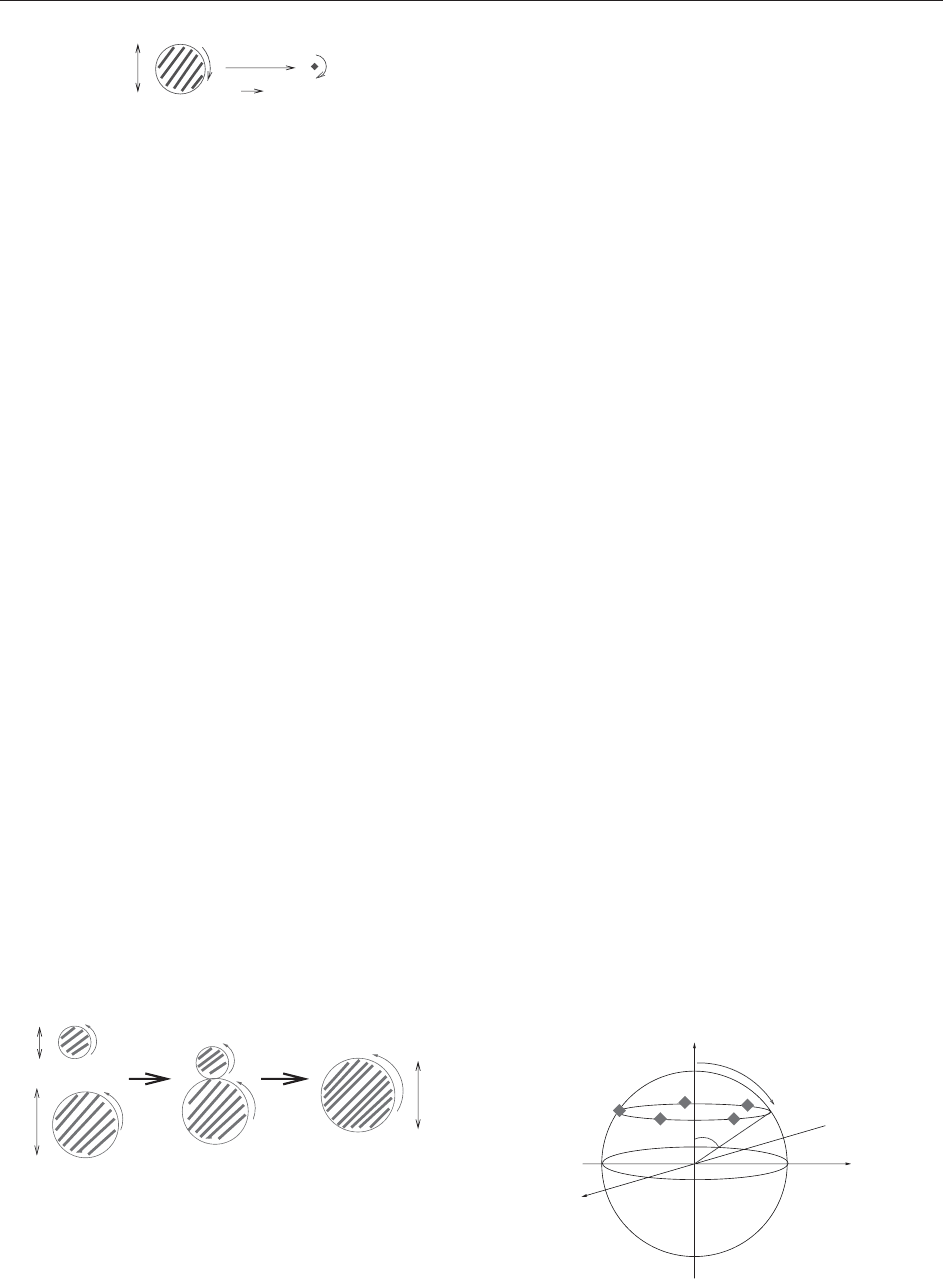
circular patches. The dynamics of patches is given
by the centers of vorticity, which interact as a point-
vortex system, endowed with a rule dictating how
patches merge (see Figure 9).
Stability of a Vortex Ring
As mentioned in the Introduction section, the study
of vortex relative equilibria has a long history.
Kelvin showed that steadily rotating patterns of
identical vortices arise as solutions of a variational
problem in which the interaction energy (vortex
Hamiltonian) is minimized subject to the constraint
that the angular impulse be maintain ed (see Aref
(2003). In 1883, while studying and modeling the
atomic structure, J J Thomson investigated the linear
stability of co-rotating point vortices in the plane. In
particular, his interest was in configurations of
identical vortices equally spaced along the circum-
ference of a circle, that is, located at the vertices of a
regular polygon (see Figure 7). He proved that for
six or fewer vortices the polygonal configurations
are stable, while for seven vortices – the Thomson
heptagon – he erroneously concluded that the
configuration is slightly unstable. It took more
than a century to make some progresses on this
problem. D G Dritschel (1985) succeeded in solving
the heptagon mystery for what concerns its linear
stability analysis, leaving open the nonlinear stabi-
lity question: he proved that the Thomson heptagon
is neutrally stable and that for eight or more vortices
the corresponding polygonal configurations are
linearly unstable. Later on in 1993, Polvani and
Dritschel (1993) gen eralized the techniques used in
Dritschel (1985) to study the linear stability of a
‘‘latitudinal’’ ring of point vortices on the sphere, as
a function of the number N of vortices in the ring,
and of the ring’s co-latitude (see Figure 10). They
proved that polygonal configurations are more
unstable on the sphere than in the plane. In
particular, they showed that at the pole, for N < 7
the configuration is stable, for N = 7 it is neutrally
stable and for N > 7itisunstable.Bymeansofthe
energy momentum method (Marsden–Meyer–Weistein
reduction), J E Marsden and S Pekarsky (1998)
studied the nonlinear stability analysis for the
integrable case of polygonal configurations of
three vortices of arbitrary vorticities (
1
,
2
and
3
) on the sphere, leaving open the stability
analysis for nonintegrable vortex systems (N > 3).
In 1999 H E Cabral and D S Schmidt completed
the linear an d nonlinear stability analysis at once
for polygonal configurations in the plane. In 2003
Boatto and Cabral studied the nonlinear stability of
a ring of vortices on the sphere, as a function of the
number of vortices N and the ring colatitude .
ε
ε
0
Figure 8 In the limit !0, the dynamics of the center of
vorticity of a vortex -ball is approximated by the dynamics of a
point vortex.
2a
1
2a
2
2a
3
Figure 9 In Carnevale et al. (1992) the fluid is modeled by a
dilute vortex gas with density and typical radius a . The
dynamics is governed by the point-vortex dynamics of the disk
centers, each disk corresponding to a point vortex of intensity
=
ext
a
2
, where
ext
plays the role of a vorticity density. Two
vortices or radius a
1
and a
2
merge when their center-to-center
distance is less or equal to the sum of their radii, a
1
þ a
1
. Then a
new vortex is created and its radius a
3
is given by
a
3
= (a
4
1
þ a
4
2
)
1=4
.
θ
y
x
z
Figure 10 Latitudinal ring of vortices. Reproduced with
permission from Boatto S and Cabral HE SIAM Journal of
Applied Mathematics 64: 216–230 (2003).
Point-Vortex Dynamics 71