
Francoise J.-P., Naber G.L., Tsun T.S. (editors) Encyclopedia of Mathematical Physics
Подождите немного. Документ загружается.


where a is the number of vertices of t, hni= (1)
n
(q
n
0
q
n
0
)
(q
0
q
1
0
) for any integer n, T runs over
all tetrahedra of t, and T
’
is T with the labeling
induced by ’. It is important to note that jMj does
not depend on the choice of t and thus yields a
topological invariant of M.
The invariant jMj is closely related to the
quantum invariant
g
q
(M) for g = sl
2
(C). Namely,
jMj is the square of the absolute value of
g
q
(M), that
is, jMj= j
g
q
(M)j
2
. This computes j
g
q
(M)j inside M
without appeal to surgery. No such computation of
the phase of
g
q
(M) is known.
These constructions generalize in two directions.
First, they extend to manifolds with boundary. Second,
instead of the representation category of U
q
(sl
2
C), one
can use an arbitrary modular category C.Thisyieldsa
three-dimensional TQFT, which associates to a surface
X avectorspacejXj
C
, and to a 3-cobordism (M, X, Y)
a homomorphism jMj
C
: jXj
C
!jYj
C
,(seeTuraev
(1994)). When X = Y = ;, this homomorphism is
multiplication C ! C by a topological invariant
jMj
C
2 C. The latter is computed as a state sum on a
triangulation of M involving the 6j-symbols associated
with C. In general, these 6j-symbols are not numbers
but tensors so that, instead of their product, one
should use an appropriate contraction of tensors. The
vectors in V(X) are geometrically represented by
trivalent graphs on X such that every edge is labeled
with a simple object of C and every vertex is labeled
with an intertwiner between the three objects labeling
the incident edges. The TQFT jj
C
is related to the
TQFT V = V
C
by jMj
C
= jV(M)j
2
. Moreover, for any
closed oriented surface X,
jXj
C
¼EndðVðXÞÞ ¼ VðXÞðVðXÞÞ
¼VðXÞVðXÞ
and for any three-dimensional cobordism (M, X, Y),
jMj
C
¼ VðMÞVðMÞ : VðXÞVðXÞ
! VðYÞVðYÞ
J Barrett and B Westbury introduced a general-
ization of jMj
C
derived from the so-called spherical
monoidal categories (which are assumed to be
semisimple with a finite set of isomorphism classes
of simple objects). This class includes modular
categories and a most interesting family of (unitary
monoidal) categories arising in the theory of sub-
factors (see Evans and Kawahigashi (1998) and
Kodiyalam and Sunder (2001)). Every spherical
category C gives rise to a topological invariant jMj
C
of a closed oriented 3-manifold M. (It seems that this
approach has not yet been extended to cobordisms.)
Every monoidal category C gives rise to a double (or
a center) Z(C), which is a braided monoidal category
(see Majid (1995)). If C is spherical, then Z (C)is
modular. Conjecturally, jMj
C
=
Z(C)
(M). In the case
where C arises from a subfactor, this has been recently
proved by Y Kawahigashi, N Sato, and M Wakui.
The state sum invariants above are closely related
to spin networks, spin foam models, and other
models of quantum gravity in dimension 2 þ 1 (see
Baez (2000) and Carlip (1998)).
See also: Axiomatic Approach to Topological Quantum
Field Theory; Braided and Modular Tensor Categories;
Chern–Simons Models: Rigorous Results; Finite-type
Invariants of 3-Manifolds; Large-N and Topological
Strings; Schwarz-Type Topological Quantum Field
Theory; Topological Quantum Field Theory: Overview;
von Neumann Algebras: Subfactor Theory.
Further Reading
Baez JC (2000) An Introduction to Spin Foam Models of BF
Theory and Quantum Gravity, Geometry and Quantum
Physics, Lecture Notes in Physics, No. 543, pp. 25–93. Berlin:
Springer.
Bakalov B and Kirillov A Jr. (2001) Lectures on Tensor
Categories and Modular Functors. University Lecture Series,
vol. 21. Providence, RI: American Mathematical Society.
Blanchet C, Habegger N, Masbaum G, and Vogel P (1995)
Topological quantum field theories derived from the
Kauffman bracket. Topology 34: 883–927.
Carlip S (1998) Quantum Gravity in 2 þ 1 Dimensions,, Cambridge
Monographs on Mathematical Physics Cambridge: Cambridge
University Press
Carter JS, Flath DE, and Saito M (1995) The Classical and
Quantum 6j-Symbols. Mathematical Notes, vol. 43. Princeton:
Princeton University Press.
Evans D and Kawahigashi Y (1998) Quantum Symmetries on
Operator Algebras, Oxford Mathematical Monographs,
Oxford Science Publications. New York: The Clarendon
Press, Oxford University Press.
Kauffman LH (2001) Knots and Physics, 3rd edn., Series on
Knots and Everything, vol. 1. River Edge, NJ: World
Scientific.
Kerler T and Lyubashenko V (2001) Non-Semisimple Topological
Quantum Field Theories for 3-Manifolds with Corners.
Lecture Notes in Mathematics, vol. 1765. Berlin: Springer.
Kodiyalam V and Sunder VS (2001) Topological Quantum Field
Theories from Subfactors. Research Notes in Mathematics,
vol. 423. Boca Raton, FL: Chapman and Hall/CRC Press.
Le T (2003) Quantum invariants of 3-manifolds: integrality,
splitting, and perturbative expansion. Topology and Its
Applications 127: 125–152.
Lickorish WBR (2002) Quantum Invariants of 3-Manifolds.
Handbook of Geometric Topology, pp. 707–734. Amsterdam:
North-Holland.
Majid S (1995) Foundations of Quantum Group Theory.
Cambridge: Cambridge University Press
Ohtsuki T (2002) Quantum Invariants. A Study of Knots,
3-Manifolds, and Their Sets, Series on Knots and Everything,
vol. 29. River Edge, NJ: World Scientific.
Turaev V (1994) Quantum Invariants of Knots and 3- Manifolds.
de Gruyter Studies in Mathematics, vol. 18. Berlin: Walter de
Gruyter.
122 Quantum 3-Manifold Invariants

Quantum Calogero–Moser Systems
R Sasaki, Kyoto University, Kyoto, Japan
ª 2006 Elsevier Ltd. All rights reserved.
Introduction
Calogero–Moser (C–M) systems are multiparticle
(i.e., finite degrees of freedom) dynamical systems
with long-range interactions. They are integrable
and solvable at both classical and quan tum levels.
These systems offer an ideal arena for interplay of
many important concepts in mathematical/theoreti-
cal physics: to name a few, classical and quantum
mechanics, classical and quantum integrability,
exact and quasi-exact solvability, addition of dis-
crete (spin) degrees of freedom, quantum Lax pair
formalism, supersymmetric quantum mec hanics,
crystallographic root systems and associated Weyl
groups and Lie algebras, noncrystallographic root
systems, and Coxeter groups or finite reflection
groups. The quantum integrability or solvability of
C–M systems does not depend on such known
solution mechanisms as Yang–Baxter equations,
quantum R-matrix or Bethe ansatz for the quantum
systems. In fact, quantum C–M systems provide a
good material for pondering about quantum
integrability.
Quantum (Liouville) Integrability
The classical Liouville theorem for an integrable
system consists of two parts. Let us consider
Hamiltonian dynamics of finite degrees of freedom
N with coordinates q = (q
1
, ..., q
N
) and conjugate
momenta p = (p
1
, ..., p
N
) equipped with Poisson
brackets {q
j
, p
k
} =
jk
,{q
j
, q
k
} = {p
j
, p
k
} = 0. The first
part is the existence of a set of independent and
involutive {K
j
, K
k
} = 0 conserved quantities {K
j
}as
many as the degrees of freedom (j = 1, ..., N). The
second part asserts that the generating function of the
canonical transformation for the action-angle vari-
ables can be constructed from the conserved quan-
tities via quadrature. In other words, the second part,
that is, the reducibility to the action-angle variables is
the integrability. The quantum counterpart of the
first half is readily formulated: that is, the existence
of a set of independent and mutually commuting
(involutive) [K
j
, K
k
] = 0 conserved quantities {K
j
}as
many as the degrees of freedom. (This does not
necessary imply, however, that they are well defined
in a proper Hilbert space.) The definition of the
quantum integrability should come as a second part,
which is yet to be formulated. It is clear that the
quantum Liouville integrability does not imply the
complete determination of the eigenvalues and
eigenfunctions. Such systems would be called exactly
solvable. This can be readily understood by consider-
ing any (autonomous) degree-1 Hamiltonian system,
which, by definition, is Liouville integrable at the
classical and quantum levels. However, it is known
that the number of excatly solvable degree-1 Hamil-
tonians are very limited. What would be the quantum
counterpart of the ‘‘transformation to action-angle
variables by quadrature’’? Could it be better for-
mulated in terms of a path integral? Many questions
remain to be answered. The quantum C–M systems,
an infinite family of exactly solvable multiparticle
Hamiltonians, would shed some light on the problem
of quantum integrability, in addition to their own
beautiful structure explored below.
Throughout this article, the dependence on
Planck’s constant, h, is shown explicitly to distin-
guish the quantum effects.
Simplest Cases (Based on A
r1
Root
System)
The simplest example of a C–M system consists of r
particles of equal mass (normalized to unity) on a
line with pairwise 1=(distance)
2
interactions
described by the following Hamiltonian:
^
H¼
1
2
X
r
j¼1
p
2
j
þ gðg hÞ
X
r
j<k
1
ðq
j
q
k
Þ
2
½1
in which g is a real positive coupling constant.
Here q = (q
1
, ..., q
r
) are the coordinates and
p = (p
1
, ..., p
r
) are the conjugate canonical momenta
obeying the canonical commutation relations:
[q
j
, p
k
] = ih
jk
,[q
j
, q
k
] = [p
j
, p
k
] = 0, j, k = 1, ..., r.
The Heisenberg equations of motion are
_
q
j
= (i=h)
[
^
H, q
j
] = p
j
,
€
q
j
=
_
p
j
= (i=h)[
^
H, p
j
] = 2g(g h)
P
k6¼j
1=
(q
j
q
k
)
3
. The repulsive 1=(distance)
2
potential
cannot be surmounted classically or quantum
mechanically, and the relative position of the
particles on the line is not changed during the time
evolution. Classically, it means that if a motion
starts at a configuration q
1
>q
2
>>q
r
, then the
inequalities remain valid throughout the time evolu-
tion. At the quantum level, the wave functions
vanish at the boundaries, and the configuration
space can be naturally limited to q
1
>q
2
>>q
r
(the principal Weyl chamber).
Similar integrable quantum many-particle
dynamics are obtained by replacing the inverse
square potential in [1] by the trigonometric
Quantum Calogero–Moser Systems 123
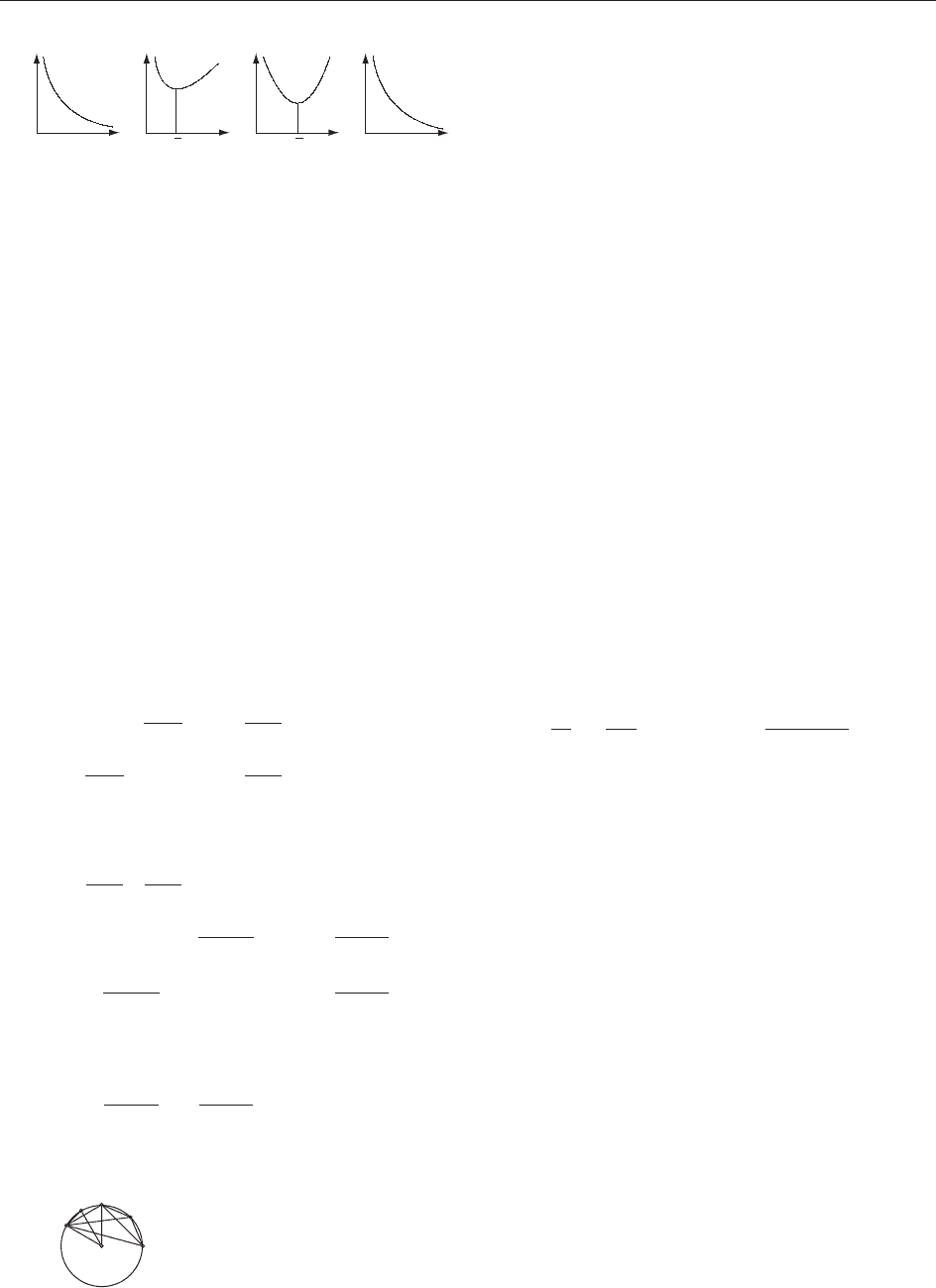
(hyperbolic) counterpart (see Figure 1)
1=(q
j
q
k
)
2
!a
2
=sinh
2
a(q
j
q
k
), in which a > 0is
a real parameter. The 1=sin
2
q potential case
(the Sutherland system) corresponds to the
1=(distance)
2
interaction on a circle of radius 1/2a,
see Figure 2. A harmonic confining potential
!
2
P
r
j = 1
q
2
j
=2 can be added to the rational Hamil-
tonian [1] without breaking the integrability
(the Calogero system, see Figure 1). At the
classical level, the trigonometric (hyperbolic) and
rational C–M systems are obtained from the
elliptic potential systems (with the Weierstrass }
function) as the degenerate limits: }(q
1
q
2
) !
a
2
=sinh
2
a(q
1
q
2
) ! 1=(q
1
q
2
)
2
, namely as one
(two) period(s) of the } function tends to infinity.
It is remarkable that these equations of motion can
be expressed in a matrix form (Lax pair):
i=h[
^
H,L] = dL=dt = LM ML = [L, M] , Heisenberg
equation of motion, in which L and M are given by
L ¼
p
1
ig
q
1
q
2
ig
q
1
q
r
ig
q
2
q
1
p
2
ig
q
2
q
r
.
.
.
.
.
.
.
.
.
.
.
.
ig
q
r
q
1
ig
q
r
q
2
p
r
0
B
B
B
B
B
B
B
B
B
B
@
1
C
C
C
C
C
C
C
C
C
C
A
M ¼
m
1
ig
ðq
1
q
2
Þ
2
ig
ðq
1
q
r
Þ
2
ig
ðq
2
q
1
Þ
2
m
2
ig
ðq
2
q
r
Þ
2
.
.
.
.
.
.
.
.
.
.
.
.
ig
ðq
r
q
1
Þ
2
ig
ðq
r
q
2
Þ
2
m
r
0
B
B
B
B
B
B
B
B
B
B
B
@
1
C
C
C
C
C
C
C
C
C
C
C
A
½2
The diagonal element m
j
of M is given by
m
j
= ig
P
k6¼j
1=(q
j
q
k
)
2
. The matrix M has a special
property
P
r
j = 1
M
jk
=
P
r
k = 1
M
jk
= 0, which ensures
the quantum conserved quantities as the total sum of
powers of Lax matrix L:[
^
H, K
n
] = 0, K
n
Ts(L
n
) =
P
j,k
(L
n
)
jk
,(n = 1, 2, 3, ...), [K
n
, K
m
] = 0.
It should be stressed that the trace of L
n
is not
conserved because of the noncommutativity of q and
p. The Hamiltonian is equivalent to K
2
,
^
H/K
2
þ
const. In other words, the Lax matrix L is like a
‘‘square root’’ of the Hamiltonian. The quantum
equations of motion for the Sutherland and hyper-
bolic potentials are again expressed by Lax pairs if
the following replacements are made: 1=(q
j
q
k
) !
a coth a(q
j
q
k
)inL and 1=(q
j
q
k
)
2
!
a
2
=sinh
2
a(q
j
q
k
)inM. The quantum conserved
quantities are obtained in the same manner as above
for the systems with the trigonometric and hyperbolic
interactions.
Themaingoalhereistofindalltheeigenvalues
{E} and eigenfunctions { (q)} of the Hamiltonians
with the rational, Calogero, Sutherland, and
hyperbolic potentials:
^
H (q) = E (q). The mome-
ntum operator p
j
acts as differential operat ors
p
j
= ih@=@q
j
. For example, for the rational
model Hamiltonian [1], the eigenvalue equation
reads
h
2
2
X
r
j¼1
@
2
@q
2
j
þ gðg hÞ
X
r
j<k
1
ðq
j
q
k
Þ
2
2
4
3
5
ðqÞ
¼E ðqÞ½3
which is a second-order Fuchsian differential
equation for each variable {q
j
} with a regular
singularity at each hyperplane q
j
= q
k
whose expo-
nents are g=h,1 g =h. Any solution of [3] is
regular at all points, except for those on t he union
of hyperplanes q
j
= q
k
. Since the structure of the
singularity is the same for the other three types of
potentials, the s ame assertion for the regularity and
singularity of the solution holds for these cases,
too. For the trigonometric (Sutherland) case, there
are other singularities at q
j
q
k
= l=a, l 2 Z, due
to the periodicity of the potential. As is clear from
the shape of the potentials, see Figure 1,the
rational a nd hyperbolic Hamiltonians have only
continuous spectra, whereas the Calogero and
Sutherland Hamiltonians have only discrete
spectra.
The integrability or more precisely the triangular-
ity of the quantum C–M Hamiltonian was first
discovered by Calogero for particles on a line with
inverse square potential plus a confining harmonic
force and by Sutherland for the particles on a circle
Rational
1/q
2
V(q)
q
Hyperbolic
1/sinh
2
q
q
2
+
1/q
2
q
Calo
g
ero
q
Sutherland
1/sin
2
q
Figure 1 Four different types of quantum C–M potentials.
q
1
q
2
q
3
q
4
R = 1/2a
distance(q
1
, q
2
) = sin a(q
1
– q
2
)/
a
Figure 2 Sutherland potential is 1=(distance)
2
interaction on a
circle. The large-radius limit, a ! 0, gives the rational potential.
124 Quantum Calogero–Moser Systems

with the trigonometric potential. Later, classical
integrability of the models in terms of Lax pairs was
proved by Moser. Olshanetsky and Perelomov
showed that these systems were based on A
r1
root
systems, that is, q
j
q
k
= q, and is one of the
root vectors of A
r1
root system [13]. They also
introduced generalizations of the C–M systems
based on any root system including the noncrystal-
lographic ones.
As shown by Heckman–Opdam and Sasaki and
collaborators, quantum C–M systems with degen-
erate potentials (i.e., the rational potentials with/
without harmonic force, the hyperbolic, and the
trigonometric potentials), based on any root system
can be formulated and solved universally. To be
more precise, the rational and Calogero systems are
integrable for all root systems, the crystallographic
and noncrystallographic. The hyperbolic and trigo-
nometric (Sutherland) systems are integrable for any
crystallographic root system. The universal formulas
for the Hamiltonians, Lax pairs, ground state wave
functions, conserved quantities, the triangularity, the
discrete spectra for the Calogero and Sutherland
systems, the creation and annihilation operators,
etc., are equally valid for any root system. This will
be shown in the next section. Some rudimentary
facts of the root systems and reflections are
summarized in the appendix.
Universal Formalism
A C–M system is a Hamiltoni an dynamical systems
associated with a root system of rank r, whi ch is a
set of vectors in R
r
with its standard inner product.
A brief review of the properties of the root systems
and the associated reflections together with explicit
realizations of all the classical root systems will be
found in the appendix.
Factorized Hamiltonian
The Hamiltonian for the quantum C–M system can
be written in terms of a pre-potential W(q)ina
‘‘factorized form’’:
H¼
1
2
X
r
j¼1
p
j
i
@WðqÞ
@q
j
p
j
þ i
@WðqÞ
@q
j
½4
The pre-potential is a sum over positive roots:
WðqÞ¼
X
2
þ
g
ln jwð qÞj þ
!
2
q
2
½5
The real positive coupling constants g
are
defined on orbits of the corresponding Coxeter
group, that is, they are identical for roots in the
same orbit. That is, for the simple Lie algebra cases,
one coupling constant, g
= g, for all roots in simply
laced models and two independent coupling con-
stants, g
= g
L
for long roots and g
= g
S
for short
roots, in non-simply laced models. The function
w(u) and the other functions x(u) and y(u) appearing
in the Lax pair [10], [11] are listed in Table 1 for
each type of degenerate potentials. The dynamics of
the prepotentials W(q) (eqn [5]) has been discussed
by Dyson from a different point of view (rando m-
matrix model). The above factorized Hamiltonian
[4] consists of an operator part
^
H, which is the
Hamiltonian in the usual definition (see the Hamil-
tonians in the previous section, e.g., [1]), and a
constant E
0
which is the ground-state energy,
H=
^
HE
0
. The factori zed Hamiltonian [4] also
arises within the context of supersymmetric quan-
tum mechanics.
The pre-potential and the Hamiltonian are
invariant under reflection of the phase space
variables in the hyperplane perpendicular to any
root W(s
(q)) = W(q), H(s
(p), s
(q)) = H(p, q), 8 2
,withs
defined by [12]. The above Coxeter
(Weyl) invariance is the only (discrete) symmetry of
the C–M systems. The main problem is, as in the A
r1
case, to find all the eigenvalues {E} and eigenfunctions
{ (q)} of the above Hamiltonian H (q) = E (q).
For any root system and for any choice of
potential, the C–M system has a hard repulsive
potential 1=( q)
2
near the reflection hyperplane
H
= {q 2 R
r
, q = 0}. The C–M eigenvalue equa-
tion is a second-order Fuchsian differential equation
with regular singularities at each reflection hyper-
plane H
and those arising from the periodicity in
the case of the Sutherland potential. Near the
reflection hyperplane H
, the solution behaves as
follows:
ð qÞ
g
=h
ð1 þ regular termsÞ; or
ð qÞ
1g
=h
ð1 þ regular termsÞ
The former solution is chosen for the square
integrability. Because of the singularities, the con-
figuration space is restricted to the principal Weyl
chamber PW or the principal Weyl alcove PW
T
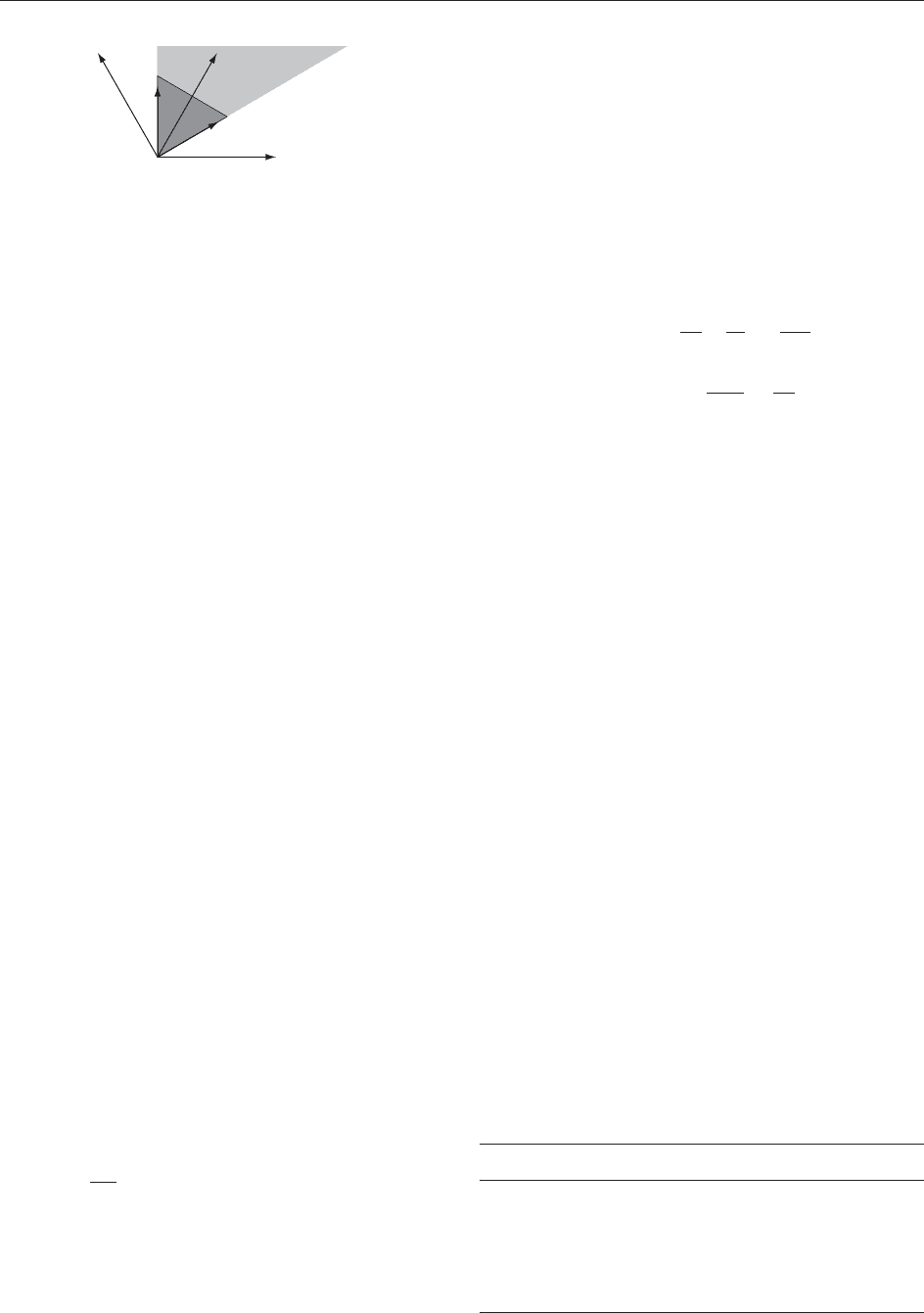
for the trigonometric potent ial (see Figure 3): PW =
{q 2 R
r
j q > 0, 2 }, PW
T
= {q 2 R
r
j q > 0,
Table 1 Functions appearing in the prepotential and Lax pair
Potential w (u) x (u) y (u)
Rational u 1/u 1=u
2
Hyperbolic sinh au a coth au a
2
=sinh
2
au
Trigonometric sin au a cot au a
2
=sin
2
au
Quantum Calogero–Moser Systems 125
2 ,
h
q <=a}, (: set of simple roots, see the
appendix). Here
h
is the highest root.
Ground-State Wave Function and Energy
One straightforward outcome of the factorized
Hamiltonian [4] is the universal ground-state wave
function, which is given by
0
ðqÞ¼e
WðqÞ=h
¼
Y
2
þ
jwð qÞj
g
=h
e
ð!=2hÞq
2
H
0
ðqÞ¼0
½6
The exponential factor e
(!=2h)q
2
exists only for the
Calogero systems. The ground-state energy, that is,
the constant part of H=
^
HE
0
, has a universal
expression for each potential:
E
0
¼
0 rational
! hr=2 þ
P
2
þ
g
Calogero
(
E
0
¼ 2a
2
2
1 hyperbolic
1 Sutherland
½7
where = 1=2
P
2
þ
g
is called a ‘‘deformed
Weyl vector.’’ Obviously,
0
(q) is square integrable
in the configuration spaces for the Calogero and
Sutherland systems and not square integrable for the
rational and hyperbolic potentials.
Excited States, Triangularity, and Spectrum
Excited states of the C–M systems can be easily
obtained as eigenfunctions of a differential operator
~
H obtained from H by a similarity transformation:
~
H¼e
W=h
He
W=h
¼
1
2
X
r
j¼1
ðh
2
@
2
=@q
2
j
þ 2h@W=@ q
j
@=@q
j
Þ
The eigenvalue equation for
~
H,
~
H
E
= E
E
, is then
equivalent to that of the original Hamiltonian,
H
E
e
W
= E
E
e
W
. Since all the singularities of the
Fuchsian differential equation H (q) = E (q) are
contained in the ground-state wave funct ion e
W
,
E
must be regular at finite q, including all the
reflection boundaries. As for the rational and
hyperbolic potentials, the energy eigenvalues are
only continuous. For the rational case, the eigen-
functions are multivariable generalization of Bessel
functions.
Calogero systems The similarity-transformed
Hamiltonian
~
H reads
~
H¼h!q
@
@q
h
2
2
X
r
j¼1
@
2
@q
2
j
h
X
2
þ
g
q
@
@q
½8
which maps a Coxeter-invariant polynomial in q of
degree d to another of degree d. Thus, the
Hamiltonian
~
H (8) is lower-triangu lar in the basis
of Coxeter-invariant polynomials and the diagonal
elements have values as h! degree, as given by the
first term. Independent Coxeter-invar iant polyno-
mials exist at the degrees f
j
listed in Table 2: f
j
= 1 þ
e
j
, j = 1, ..., r, where {e
j
}, j = 1, ..., r, are the
exponents of .
The eigenvalues of the Hamiltonian H are h!N
with N a non-negative integer. N can be
expressed as N =
P
r
j = 1
n
j
f
j
, n
j
2 Z
þ
, and the
degeneracy of the eigenvalue h!N is the number
of partitions of N. It is remarkable that the
coupling constant dependence appears only in the
ground-state energy E
0
. This is a deformation of
the isotropic harmonic oscillator confined in the
principal Weyl chamber. The eigenpolynomials
are generalization of multivariable Laguerre
(Hermite) polynomials. One immediate consequence
of this spectrum is the periodicity of the quantum
motion. If a system has a wave function (0) at
t = 0, then at t = T = 2=! the system has physically
thesamewavefunctionas (0), that is,
(T) = e
iE
0
T=h
(0). The same assertion holds at the
classical level, too.
λ
2
λ
1
α
2
α
1
α
h
Figure 3 Simple roots, the highest root, fundamental weights,
and the principal Weyl alcove (grey) and the principal Weyl
chamber (light grey, extending to infinity) in a two-dimensional
root system.
Table 2 The degrees f
j
in which independent Coxeter-invariant
polynomials exist
f
j
= 1 þ e
j
f
j
= 1 þ e
j
A
r
2, 3, 4, ..., r þ 1 E
8
2, 8, 12, 14, 18, 20, 24, 30
B
r
2, 4, 6, ...,2rF
4
2, 6, 8, 12
C
r
2, 4, 6, ...,2rG
2
2, 6
D
r
2, 4, ...,2r 2, rI
2
(m)2,m
E
6
2, 5, 6, 8, 9, 12 H
3
2, 6, 10
E
7
2, 6, 8, 10, 12, 14, 18 H
4
2, 12, 20, 30
126 Quantum Calogero–Moser Systems

Sutherland Systems The periodicity of the trigono-
metric potential dictates that the wave function
should be a Bloch factor e
2iaq
(where is a weight)
multiplied by a Fourier series in terms of simple
roots. The basis of the Weyl invariant wave
functions is specified by a dominant weight
=
P
r
j = 1
m
j
j
, m
j
2 Z
þ
,
(q)
P
2O
e
2iaq
, where
O
is the orbit of by the action of the Weyl group:
O
= {g() jg 2 G
}. The set of functions {
} has an
order , jj
2
> j
0
j
2
)
0
. The similarity-
transformed Hamiltonian
~
H given by
~
H¼
h
2
2
X
r
j¼1
@
2
@q
2
j
ah
X
2
þ
g
cot ða qÞ
@
@q
½9
is lower-triangular in this basis:
~
H
= 2a
2
(h
2
2
þ
2h )
þ
P
j
0
j<jj
c
0
0
. That is, the eigenvalue is
E = 2a
2
(h
2
2
þ 2h )orEþE
0
= 2a
2
(h þ )
2
.
Again, the coupling constant dependence comes
solely from the deformed Weyl vector . This
spectrum is a deformation of the spectrum corre-
sponding to the free motion with momentum 2ha
in the principal Weyl alcove. The corresponding
eigenfunction is called a generalized Jack polynomial
or Heckman–Opdam’s Jacobi polynomial. For the
rank-2 (r = 2) root systems, A
2
, B
2
ffi C
2
and I
2
(m)
(the dihedral group), the complete set of eigenfunc-
tions are known explicitly.
Quantum Lax Pair and Quantum Conserved
Quantities
The universal Lax pair for C–M systems is given in
terms of the representations of the Coxeter (Weyl)
group in stead of the Lie algebra. The Lax operators
without spectral parameter for the rational, trigono-
metric, and hyperbolic potentials are
Lðp; qÞ¼p
^
H þ XðqÞ
XðqÞ¼i
X
2
þ
g
ð
^
HÞxð qÞ
^
s
½10
MðqÞ¼
i
2
X
2
þ
g
2
yð qÞ
^
s
IðÞ½11
where I is the identity operator and {
ˆ
s
j 2 } are
the reflec tion operators of the root system. They act
on a set of R
r
vectors, R= {
(k)
2 R
r
jk = 1, ..., d },
permuting them under the action of the reflection
group. The vectors in R form a basis for the
representation space V of dimension d. The matrix
elements of the operators {
ˆ
s
j 2 }and
{
ˆ
H
j
jj = 1, ..., r} are defined as follows:
(
ˆ
s
)
=
, s
()
=
, s
()
,(
ˆ
H
j
)
=
j
, 2 , ,
2R. The form of the functions x, y depends on
the chosen potential as given in Table 1. Then the
equations of motion can be expressed in a matrix
form dL=dt = i=h[H, L] = [L, M]. The operator M
satisfies the relation
P
2R
M
=
P
2R
M
= 0,
which is essential for deriving quantum conserved
quantities as the total sum (Ts) of all the matrix
elements of L
n
: K
n
= Ts(L
n
)
P
, 2R
(L
n
)
,
[H, K
n
] = 0, [K
m
,K
n
] = 0, n, m = 1, ... In particular,
the power 2 is universal to all the root systems, and
the quantum Hamiltonian is given by H/K
2
þ
const. As in the affine Toda molecule systems, a Lax
pair with a spectral parameter can also be intro-
duced universally for all the above potentials. The
Dunkl operators, or the commuting differential–
difference operators are also used to construct
quantum conserved quantities for some root sys-
tems. This method is essentially equivalent to the
universal Lax ope rator formalism. As the La x
operators do not contain the Planck’s constant, the
quantum Lax pair is essentially of the same form as
the classical Lax pair. The difference betw een the
trace (tr) and the total sum (Ts) vanishes as h ! 0.
Lax pair for Calogero systems The quantum Lax
pair for the Calogero systems is obtained from the
universal Lax pair [10] by replacement L !
L
= L i!Q, Q q
ˆ
H, which correspond to the
creation and annihilation operators of a harmonic
oscillator. The equations of motion are rewritten as
dL
=dt = i=h[H, L
] = [L
, M] i!L
. Then L
=
L
L
satisfy the Lax type equation dL
=dt =
i=h[H, L
], giving rise to conserved quantities
Ts(L
)
n
, n = 1, 2, ... The Calogero Hamiltonian is
given by H/Ts(L
).
All the eigenstates of the Calogero Hamiltonian H
with eigenvalues h!N, N =
P
r
j = 1
n
j
f
j
, n
j
2 Z
þ
, are
simply constructed in terms of L
:
Q
r
j = 1
(B
þ
f
j
)
n
j
e
W
.
Here the integers {f
j
}, j = 1, ..., r, are listed in
Table 2. The creation operators B
þ
f
j
and the
corresponding annihilation operators B
f
j
are defined
by B
f
j
= Ts(L
)
f
j
, j = 1, ..., r. They are Hermitian
conjugate to each other (B
f
j
)
y
= B
f
j
with respect to
the standard Hermitian inner product of the states
defined in PW. They satisfy commutat ion relations
[H, B
k
] = hk!B
k
,[B
þ
k
, B
þ
l
] = [B
k
, B
l
] = 0, k, l 2
{f
j
jj = 1, ..., r}. The ground state is annihilated by
all the annihilation operators B
f
j
e
W
= 0, j = 1, ..., r.
Further Developments
Rational Potentials: Superintegrability
The systems with the rational potential have a remark-
able property: superintegrability. A rational C–M
system based on a rank-r root system has 2r 1
Quantum Calogero–Moser Systems 127

independent conserved quantities. Roughly speaking,
they are of the form K
n
= Ts(L
n
), J
m
= Ts(QL
m
), Q
q
ˆ
H, among which only r are involutive. At the
classical level, superintegrability can be characterized
as algebraic linearizability. Since a commutator of any
conserved quantities is again a conserved quantity, these
conserved quantities form a nonlinear algebra called a
quadratic algebra. It can be considered as a finite-
dimensional analog of the W-algebra appearing in
certain conformal field theory.
Quantum vs Classical Integrability
In C–M systems, the classi cal and quantum integr-
ability are very closely related. The quantum discrete
spectra of the Calogero and the Sutherland systems
are, as shown above, expressed in terms of the
coupling constant (!, g) and the exponents or the
weights of the corresponding root systems. Namely,
they are integral multiples of coupling constants. The
corresponding classical systems with the potential
V(q) = (1=2)
P
r
j = 1
(@W(q)=@q
j
)
2
share many remark-
able properties. As is clear from Figure 1, they always
have an equilibrium position. The equilibrium posi-
tions (
¯
q) are described by the zeros of a classical
orthogonal polynomial; the Hermite polynomial
(A-type Calogero), the Laguerre polynomial (B, C, D-
type Calogero), the Chebyshev polynomial (A-type
Sutherland) and the Jacobi polynomial (B, C,D-type
Sutherland). For the exceptional root systems, the
corresponding polynomials were not known for a long
time. The minimum energy of the classical potential
V(q) at the equilibrium is the quantum ground-state
energy lim
h!0
E
0
itself. It is also an integral multiple of
coupling constants for both Calogero and Sutherland
cases. Near a classical equilibrium, a multiparticle
dynamical system is always reduced to a system of
coupled harmonic oscillators. For Calogero systems,
the eigenfrequencies of these small oscillations are, in
fact, exactly the same as the quantum eigenfrequen-
cies, !f
j
= !(1 þ e
j
). For Sutherland systems, the
classical eigenfrequencies are the same as the o(h)
part of the quantum spectra corresponding to all
the fundamental weights
j
:2a
2
j
. Moreover, the
eigenvalues of various Lax matrices L and M at the
equilibrium take many ‘‘interesting values.’’ These
results provide ample explicit examples of the general
theorem on the quantum–classical correspondence
formulated by Loris–Sasaki.
Spin Models
For any root system and an irreduci ble represen-
tation R of the Coxeter (Weyl) group G
, a spin
C–M system can be defined for each of the
potentials: rational, Calogero, hyperbolic and
Sutherland. For each member of R, to be called
a ‘‘site,’’ a vector space V
is associated whose
element is called a ‘‘spin.’’ The dynamical variables
are those of the particles {q
j
, p
j
} and the spin
exchange operators {
^
P
}( 2 ) which exchange
the spins at the sites and s
(). For each and R
a spin exchange model can be defined by ‘‘freezing’’
the particle degrees of freedom at the equilibrium
point of the corresponding classical potential
{q, p} ! {
¯
q, 0}. These are generalization of Hal-
dane–Shastry model for Sutherland potentials and
that of Polychronakos for the Calogero potentials.
Universal Lax pair operators for both spin C–M
systems and spin exchange models are known and
conserved quantities are constructed.
Integrable Deformations
C–M systems allow various integrable deformations at
the classical and/or quantum levels. One of the well-
known deformations is the so-called ‘ ‘relativistic’’ C–M
system or the Ruijsenaars–Schneider (R–S) system. For
degenerate potentials, they are integrable both at the
classical and quantum levels. The classical quantities of
the R–S systems at equilibrium exhibit many interesting
properties, too. The equilibrium positions are described
by the zeros of certain deformation of the above-
mentioned classical polynomials. The frequencies of
small oscillations are also related to the exact quantum
spectrum, and they can be expressed as coupling
constant times the (q-) integers.
Inozemtsev models are classically integ rable mul-
tiparticle dynamical systems related to C–M systems
based on classical root systems (A, B, C, D) with
additional q
6
(rational) or sin
2
2q (trigonometric)
potentials. Their quantum versions are not exactly
solvable in contrast to the C–M or R–S systems,
although there is some evidence of their Liouville
integrability (without a proper Hilbert space).
Quantum Inozemtsev systems can be deformed to
be a widest class of quasi-exactly solvable multi-
particle dynamical systems. They possess a form of
higher-order supersymmetry for which the method
of prepotential is also useful.
Appendix: Root Systems
Some rudimentary facts of the root systems and
reflections are recapitulated here. The set of roots
is invariant under reflections in the hyperplane
perpendicular to each vector in . In other words,
s
() 2 , 8, 2 , where
s
ðÞ¼ ð
_
Þ;
_
2=jj
2
½12
128 Quantum Calogero–Moser Systems

The set of reflections {s
j 2 } generates a group
G
, known as a Coxeter group, or finite reflection
group. The orbit of 2 is the set of root vectors
resulting from the action of the Coxeter group on
it. The set of positive roots
þ
may be defined in
terms of a vec tor U 2 R
r
,with U 6¼ 0, 8 2 ,
as the roots 2 such that U > 0. Given
þ
,
there is a unique set of r simple roots
={
j
jj = 1, ..., r} defined such that they span
the r oot space and the coefficients {a
j
}in
=
P
r
j = 1
a
j
j
for 2
þ
are all non-negative.
The highest root
h
,forwhich
P
r
j = 1
a
j
is max-
imal, is then also determined uniquely. The subset
of reflections {s
j 2 } i n fac t gene rat es the
Coxeter group G
. The products of s
,with 2
, are subject solely to the relations
(s
s
)
m(, )
= 1, , 2 . The interpretation is that
s
s
is a rotation in some plane by 2=m(, ). The
set of positive integers m(, )(with
m(, ) = 1, 8 2 ) uniquely specifies the Coxeter
group. The weight lattice P()isdefinedasthe
Z-span of the fundamental weights {
j
}, defined by
_
j
k
=
jk
, 8
j
2 .
The root systems for finite reflection groups may
be divided into two types : crystallographic and
noncrystallographic. Crystallographic root systems
satisfy the additional condition
_
2 Z, 8, 2 .
The remaining noncrystallographic root systems are
H
3
, H
4
, whose Coxeter groups are the symmetry
groups of the icosahedron and four-dimensional
600-cell, respectively, and the dihedral group of
order 2m,{I
2
(m)jm 4}.
The explicit examples of the classical root
systems, that is, A, B, C, and D are given below.
For the exceptional and noncrystallographic root
systems, the reader is referred to Humphrey’s book.
In all cases, {e
j
} denotes an orthonormal basis in R
r
.
1. A
r1
: This root system is related with the Lie
algebra su(r).
¼
[
1jkr
fðe
j
e
k
Þg;
Y
¼
[
r1
j¼1
fe
j
e
jþ1
g
½13
2. B
r
: This root system is associated with Lie
algebra so(2r þ1). The long roots have
(length)
2
= 2 and short roots have (length)
2
= 1:
¼
[
1jkr
fe
j
e
k
g[
r
j¼1
fe
j
g
Y
¼
[
r1
j¼1
fe
j
e
jþ1
g[fe
r
g
½14
3. C
r
: This root system is associated with Lie
algebra sp(2r). The long roots have (length)
2
= 4
and short roots have (length)
2
= 2:
¼
[
1jkr
fe
j
e
k
g[
r
j¼1
f2e
j
g
Y
¼
[
r1
j¼1
fe
j
e
jþ1
g[f2e
r
g
½15
4. D
r
: This root system is associated with Lie
algebra so(2r):
¼
[
1jkr
fe
j
e
k
g
Y
¼
[
r1
j¼1
fe
j
e
jþ1
g[fe
r1
þ e
r
g
½16
See also: Calogero–Moser–Sutherland Systems
of Nonrelativistic and Relativistic Type;
Dynamical Systems in Mathematical Physics:
An Illustration from Water Waves; Functional Equations
and Integrable Systems; Integrable Discrete Systems;
Integrable Systems in Random Matrix Theory; Integrable
Systems: Overview; Isochronous Systems; Toda
Lattices.
Further Reading
Calogero F (1971) Solution of the one-dimensional N-body
problem with quadratic and/or inversely quadratic pair
potentials. Journal of Mathematical Physics 12: 419–436.
Calogero F (2001) Classical Many-Body Problems Amenable to
Exact Treatments. New York: Springer.
Dunkl C (2001) Orthogonal Polynomials of Several Variables.
Cambridge: Cambridge University Press.
Humphreys JE (1990) Reflection Groups and Coxeter Groups.
Cambridge: Cambridge University Press.
Macdonald IG (1995) Symmetric Functions and Hall Polynomials,
2nd edn. Oxford University Press.
Moser J (1975) Three integrable Hamiltonian systems connected
with isospectral deformations. Advances in Mathematics 16:
197–220.
Olshanetsky MA and Perelomov AM (1983) Quantum integrable
systems related to Lie algebras. Physics Reports 94: 313–404.
Ruijsenaars SNM (1999) Systems of Calogero–Moser Type. CRM
Series in Mathematical Physics 1: 251–352. Springer.
Sasaki R (2001) Quantum Calogero–Moser Models: Complete
Integrability for All the Root Systems. Proceedings Quantum
Integrable Models and Their Applications, 195–240. World
Scientific.
Sasaki R (2002) Quantum vs Classical Calogero–Moser Systems.
NATO ARW Proceedings, Elba, Italy.
Stanley R (1989) Some combinatorial properties of Jack sym-
metric function. Adv. Math. 77: 76–115.
Sutherland B (1972) Exact results for a quantum many-body
problem in one dimension. II. Physical Review A 5:
1372–1376.
Quantum Calogero–Moser Systems 129

Quantum Central-Limit Theorems
A F Verbeure, Institute for Theoretical Physics,
KU Leuven, Belgium
ª 2006 Elsevier Ltd. All rights reserved.
Introduction
Statistical physics deals with systems with many
degrees of freedom and the problems concern finding
procedures for the extraction of relevant physical
quantities for these extremely complex systems. The
idea is to find relevant reduction procedures which
map the complex systems onto simpler, tractable
models at the price of introducing elements of
uncertainty. Therefore, probability theory is a natural
mathematical tool in statistical physics. Since the early
days of statistical physics, in classical (Newtonian)
physical systems, it is natural to model the observables
by a collection of random variables acting on a
probability space. Kolmogorovian probability techni-
ques and results are the main tools in the development
of classical statistical physics. A random variable is
usually considered as a measurable function with
expectation given as its integral with respect to a
probability measure. Alternatively, a random variable
can also be viewed as a multiplication operator by the
associated function. Different random variables com-
mute as multiplication operators, and one speaks of a
commutative probabilistic model.
Now, looking at genuine quantum syst ems, in
many cases the procedure mentioned above leads to
commutative probabilistic models, but there exist
the realms of physics where quantum noncommuta-
tive probabilistic concepts are unavoidable. Typical
examples of such areas are quantum optics, low-
temperature solid-state physics and ground-state
physics such as quantum field theory. During the
last 50 years physicists have developed more or less
heuristic methods to deal with, for example,
manifestations of fluctuations of typical quantum
nature. In the last 30 years, mathematical founda-
tions of such theories were also formulated, and a
notion of quantum probability was launched as a
branch of mathematical physics and mathematics
(Cushen and Hudson 1971, Fannes and Quaegebeur
1983, Quaegebeur 1984, Hudson 1973, Giri and
von Waldenfels 1978).
The aim of this article is to review briefly a few
selected rigorous results concerning noncommuta-
tive limit theorems. This choice is made not only
because of the author’s interest but also for its close
relation to concrete problems in statistical physics
where one aims at understanding the macroscopic
phenomena on the basis of the microscopic struc-
ture. A precise definition or formulation of a
microscopic and a macroscopic system is of prime
importance. The so-called algebraic approach of
dynamical systems (Brattelli and Robinson 1979 and
2002) offers the necessary generality and mathema-
tical framework to deal with classical and quantum,
microscopic and macroscopic, finite and infinite
systems. The observables of any system are assumed
to be elements of an (C
- or von Neumann) algebra
A, and the physical states are given by positive
linear normalized functionals ! of A, mapping the
observables on their expectation values.
A common physicist’s belief is that the macro-
scopic behavior of an idealized infinite system is
described by a reduced set of macroscopic quantities
(Sewell 1986). Some examples of these are the
average densities of particles, energy, momentum,
magnetic moment, etc. Analogously as the micro-
scopic quantities, the macroscopic observables
should be elements of an algebra, and macroscopic
states of the system should be states on this algebra.
The main problem is to construct the precise
mathematical procedures to go from a given micro-
scopic system to its macroscopic systems.
A well-known macroscopic system is the one
given by the algebra of the observables at infinity
(Lanford and Ruelle 1969) containing the spacial
averages of local micro-observables, that is, for any
local observable A one considers the observable
A
!
¼ !
lim
V !1
1
V
Z
V
dx
x
A
where V is any finite volume in R
and
x
the
translation over x 2 R
, and where ! lim is the
weak operator limit in the microstate !. The limits
A
!
obtained correspond to the law of large numbers
in probability. The algebra generated by these limit
observables A
!
= {A
!
jA 2A} is an abelian algebra
of observables of a macroscopic system. This
algebra can be identified with an algebra with
pointwise product of measurable functions for
some measure or macroscopic state.
The content of this review is to describe an
analogous mapping from micro to macro but for a
different type of scaling, namely the scaling of
fluctuations. For any local observable A 2A, one
considers the limit
lim
V
1
V
1=2
Z
V
dx
x
A !ð
x
AÞðÞFðAÞ
The problem consists in characterizing the F(A)as
an operator on a Hilbert space, called fluctuation
130 Quantum Central-Limit Theorems

operator, and to specify the algebraic character of
the set of all of these.
Based on this quantum central-limit theorem, one
notes that not all locally different microscopic
observables always yield different fluctuation opera-
tors. Hence the central-limit theorem realizes a well-
defined procedure of coarse graining or reduction
procedure which is handled by the mathematical
notion of an equivalence relation on the microscopic
observables yielding the same fluctuation operator.
In the following sections we discuss the prelimin-
aries, the basic results about normal and abnormal
fluctuations. Three model-independent applications
are also discussed. In this review, we omit the
properties of the so-called modulated fluctuations.
One should remark that we discuss only fluctua-
tions in space. One can also consider timelike
fluctuations. The theory of fluctuation operators
for these has not been explicitly worked out so far.
However, it is clear that for normal fluctuations the
clustering properties of the time correlation func-
tions will play a crucial role. On the other hand,
typical properties of the structure of this fluctuation
algebra may come up.
Another point which one has to stress is that all
systems, which are treated in this review, are quasilocal
systems. Other systems, for example, fermion systems,
are note treated. But, in particular, fermion systems
share many properties of quasilocality, and many of
the results mentioned hold true also for fermion
systems.
Preliminaries
Quantum Lattice Systems
Although all results we review can be extented to
continuous or more general systems, modulo some
technicalities, we limit ourself to quasilocal quantum
dynamical lattice systems.
We consider the quasilocal algebra built on a
-dimensional lattice Z
. Let D(Z
) be the directed
set of finite subsets of Z
where the direction is the
inclusion. With each point x 2 Z
we associate an
algebra (C
- or von Neumann algebra) A
x
, all copies
of an algebra A. For all 2D(Z
), the tensor
product
x2
A
x
is denoted by A
. We take A to be
nuclear, then there exists a unique C
-norm on A
.
Every copy A
x
is naturally embedded in A
.
The family {A
}
2D(Z
)
has the usual relations of
locality and isotony:
A
1
; A
2
½¼0if
1
\
2
¼; ½1
A
1
A
2
if
1
2
½2
Denote by A
L
all local observables, that is,
A
L
¼
[
A
This algebra is naturally equipped with a C
-norm
kkand its closure
B¼
A
L
is called a quasilocal C
-algebra and considered as the
microscopic algebra of observables of the system.
Typical examples are spin systems where A= M
n
is the
n n complex matrix algebra. In this case, every state
! of B is then locally normal, that is, there exists a
family of density matrices {
j 2D(Z
)} such that
!ðAÞ¼tr
A for all A 2A
An important group of -automorphisms of B is the
group of space translations {
x
, x 2 Z
}:
x
: A
y
2A
y
!
x
A
y
¼ A
xþy
2A
yþx
for all A 2A.
Note that the quasilocal algebra B is asymptoti-
cally ab elian for space translations: that is, for all
A, B 2B
lim
jxj!1
k½A;
x
Bk ¼ 0
Astate! of B represents a physical state of the
system, assigning to every observable A its expecta-
tion value !(A). Therefore, this setting can be viewed
as the quantum analog of the classical probabilistic
setting. Sequences of random variables or observables
can be constructed by considering an observable and
its translates, that is,
x
(A)
x2Z
is a noncommutative
random field. If a state ! is translation invariant, that
is, !
x
= ! for all x,thenall
x
(A) are identically
distributed random variables. The mixing property of
the random field is then expressed by the spatial
correlations tending to zero:
!
x
ðAÞ
y
ðBÞ
!
x
ðAÞðÞ!
y
ðBÞ
!0 ½3
if jx yj!1.
One of the basic limit theorems of probability theory
is the weak law of large numbers. In this noncommu-
tative setting the law of large numbers is translated into
the problem of the convergence of space averages of an
observable A 2B. A first result was given by the mean
ergodic theorem of von Neumann (1929). In Brattelli
and Robinson (1979, 2002) one finds the following
theorem: if the state ! is space translation invariant and
mixing (see [3]) then for all A , B,andC in B
lim
!Z
! A
1
jj
X
x 2
x
ðBÞ
!
C
!
¼ !ðACÞ!ðBÞ½4
Quantum Central-Limit Theorems 131