
Francoise J.-P., Naber G.L., Tsun T.S. (editors) Encyclopedia of Mathematical Physics
Подождите немного. Документ загружается.

Goderis D, Verbeure A, and Vets P (1991) About the exactness of
the linear response theory. Communications in Mathematical
Physics 136: 265–583.
Goderis D and Vets P (1989) Central limit theorem for mixing
quantum systems and the CCR-algebra of fluctuations.
Communications in Mathematical Physics 122: 249.
Goldshtein BG (1982) A central limit theorem of non-commutative
probability theory. Theory of Probability and its Applications
27: 703.
Hudson RL (1973) A quantum mechanical central limit theorem for
anti-commuting observables. Journal of Applied Probability 10:
502–509.
Ibragimov IA and Linnick YuV (1971) Independent and stationary
sequences of random variables. Groningen: Wolters-Noordhoff.
Ino¨nu¨ E and Wigner EP (1953) On the contraction groups and
their representations. Proceedings of the National Academy of
Sciences, USA 39: 510–524.
Lanford DE and Ruelle D (1969) Observables at infinity and
states with short-range correlations in statistical mechanics.
Journal of Mathematical Physics 13: 194.
Manuceau J, Sirugue M, Testard D, and Verbeure A (1973) The
smallest C
-algebra for canonical commutation relations.
Communications in Mathematical Physics 32: 231.
Matsui T (2003) On the algebra of fluctuations in quantum spin
chains. Annales Henri Poincare´ 4: 63–83.
Michoel T and Verbeure A (2001) Goldstone boson normal
coordinates. Communications in Mathematical Physics 216:
461–490.
Momont B, Verbeure A, and Zagrebnov VA (1997) Algebraic
structure of quantum fluctuations. Journal of Statistical
Physics 89: 633–653.
Quaegebeur J (1984) A non-commutative central limit theorem
for CCR-algebras. Journal of Functional Analysis 57: 1–20.
Sewell GL (1986) Quantum theory of collective phenomena.
Oxford: Oxford University Press.
Verbeure A and Zagrebnov VA (1992) Phase transitions and
algebra of fluctuation operators in an exactly soluble model
of a quantum anharmonic crystal. J. Stat. Phys. 69:
329–359.
Quantum Channels: Classical Capacity
A S Holevo, Steklov Mathematical Institute, Moscow,
Russia
ª 2006 Elsevier Ltd. All rights reserved.
The Definition
A numerical measure of the ability of a classical or
quantum information processing system (for definite-
ness, one speaks of a communication channel)to
transmit information expressible as a text message
(called ‘‘classical information’’ as distinct from quan-
tum information). It is equal to the least upper bound
for rates of the asymptotically perfect transmission of
classical information through the system, when the
transmission time tends to infinity, and arbitrary pre-
and post-processing (encoding and decoding) are
allowed at the input and the output of the system.
Typically, for rates exceeding the capacity, not only
the asymptotically perfect transmission is impossible,
but the error probability with arbitrary encoding–
decoding scheme tends to 1, so that the capacity has a
nature of a threshold parameter.
From Classical to Quantum
Information Theory
A central result of the classical information theory is
the Shannon coding theorem, giving an explicit
expression to the capacity in terms of the maximal
mutual information between the input and the
output of the channel. The issue of the information
capacity of quantum communication channels arose
soon after the publication of the pioneering papers
by Shannon and goes back to the classical works of
Gabor, Brillouin, and Gordon, asking for funda-
mental physical limits on the rate and quality of
information transmission. This work laid a physical
foundation and raised the question of consistent
quantum treatment of the problem. Important steps
in this direction were made in the early 1970s when
a quantum probabilistic framework for this type
of problem was created and the conjectured upper
bound for the classical capacity of quantum
channel was proved. A long journey to the quantum
coding theorem culminated in 1996 with the
proof of achievability of the upper bound
(the Holevo–Schumacher–Westmoreland theorem;
see Holevo (1998) for a detailed historical survey).
Moreover, it was realized that quantum channel is
characterized by the whole spectrum of capacities
depending on the nature of the information resources
and the specific protocols used for the transmission.
To a great extent, this progress was stimulated by an
interplay between the quantum communication theory
and quantum information ideas related to more recent
development in quantum computing. This new age of
quantum information science is characterized by
emphasis on the new possibilities (rather than restric-
tions) opened by the quantum nature of the informa-
tion processing agent. On the other hand, the question
of information capacity is important for the theory of
quantum computer, particularly in connection with
quantum error-correcting codes, communication and
algorithmic complexity, and a number of other
important issues.
142 Quantum Channels: Classical Capacity
The Quantum Coding Theorem
In the simplest and most basic memoryless case, the
information processing system is described by the
sequence of block channels,
n
¼
|fflfflfflfflfflfflfflffl{zfflfflfflfflfflfflfflffl}
n
; n ¼ 1; ...
of n parallel and independent uses of a channel , n
playing the role of transmission time (Holevo 1998).
More generally, one can consider memory channels
given by open dynamical systems with a kind of
ergodic behavior and the limit where the transmission
time goes to infinity (Kretschmann and Werner 2005).
Restricting to the memoryless case, encoding is given
by a mapping of classical messages x from a given
codebook of size N into states (density operators)
(n)
x
in the input space H
n
1
of the block channel
n
,and
decoding – by an observable M
(n)
in the output space
H
n
2
,thatis,afamily{M
(n)
y
} of operators constituting a
resolution of the identity in H
n
2
:
M
ðnÞ
y
0;
X
y
M
ðnÞ
y
¼ I
Here y plays the role of outcomes of the whole
decoding procedure involving both the quantum
measurement at the output and the possible classical
information post-processing. Then the diagram for
the classical information transmission is
x !
ðnÞ
i
|{z}
input
state
!
n
½
ðnÞ
x
|fflfflfflfflffl{zfflfflfflfflffl}
output
state
!
M
ðnÞ
y
The such-described encoding and decoding consti-
tute a quantum block code of length n and size N
for the memoryless channel. The conditional prob-
ability of obtaining an outcome y provided the
message x was sent for a chosen block code is given
by the statistical formula
p
ðnÞ
ðyjxÞ¼tr
n
½
ðnÞ
x
M
ðnÞ
y
and the error probability for the code is just
max
x
(1 p
(n)
(x jx)).
Denoting by p
e
(n, N) the infimum of the error
probability over all codes of length n and size N, the
classical capacity C() of the memoryless channel is
defined as the least upper bound of the rates R for
which lim
n !1
p
e
(n,2
nR
) = 0.
Let be a quantum channel from the input to the
output quantum systems, assumed to be finite
dimensional. The coding theorem for the classical
capacity says that
CðÞ¼lim
n!1
1
n
C
ð
n
Þ½1
where
C
ðÞ¼max H
X
x
p
x
x
½
!(
X
x
p
x
H
x
½ðÞ
)
½2
H() = tr log
2
is the binary von Neumann
entropy, and the maximum is taken over all
probability distributions {p
x
} and collections of
density operators {
x
}inH
1
.
The Variety of Capacities
This basic definition and the formulas [1], [2] generalize
the definition of the Shannon capacity and the coding
theorem for classical memoryless channels. For quantum
channel, there are several different capacities because
one may consider sending different kinds (classical or
quantum) of information, restrict the admissible coding
and decoding operations, and/or allow the use of
additional resources, such as shared entanglement,
forward or backward communication, leading to really
different quantities (Bennett et al. 2004). Few of these
resources (such as feedback) also exist for classical
channels but usually influence the capacity less drama-
tically (at least for memoryless channels). Restricting to
the transmission of classical information with no
additional resources, one can distinguish at least four
capacities (Bennett and Shor 1998), according to
whether, for each block length n, one is allowed to use
arbitrary entangled quantum operations on the full
block of input (resp. output) systems, or if, for each of the
parallel channels, one has to use a separate quantum
encoding (resp. decoding), and combine these only by
classical pre- (resp. post-) processing:
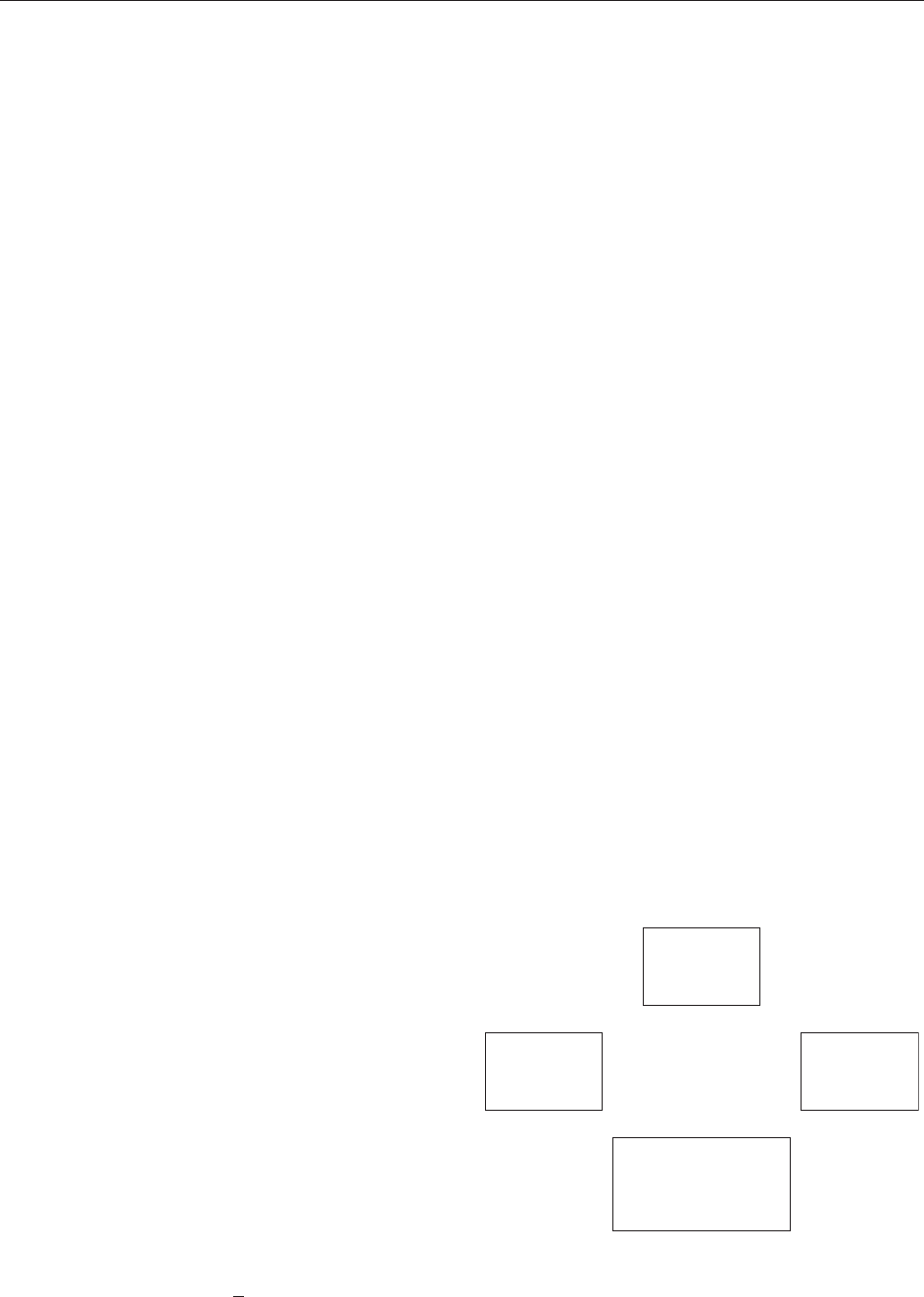
???
=
≥
≥
C
1∞
= C
χ
:
unentangled
coding, quantum
block decoding
C
∞1
: quantum
block
coding, separate
decoding
C
∞∞
: full
capacity, arbitary
(de)coding
C
11
: one-shot
capacity or accessible
information, separate
quantum (de)coding, block
(de)coding only classical
The full capacity C
11
is just the classical capacity
C()givenby[1]. That C
11
coincides with the
Quantum Channels: Classical Capacity 143

quantity C
()givenby[2] is the essential content
of the HSW theorem, from which [1] is obtained
by additional blocking. Since C
is apparently
superadditive, C
(
1
2
) C
(
1
) þ C
(
2
), one
has C
11
C
.Itisstillnotknownwhetherthe
quantity C
() is in fact additive for all channels,
which would imply the equalities here. Additivity of
C
() would have the important physical conse-
quence – it would mean that using entangled input
states does not increase the classical capacity of
quantum channel. While such a result would be very
much welcome, giving a single-letter expression for
the classical capacity, it would call for a physical
explanation of asymmetry between the effects of
entanglement in encoding and decoding procedures.
Indeed, the inequality in the lower left is known to be
strict sometimes (Holevo 1998), which means that
entangled decodings can increase the classical capa-
city. There is even an intermediate capacity between
C
11
and C
11
obtained by restricting the quantum
block decodings to adaptive ones (Shor 2002). The
additivity of the quantity C
for all channels is one of
the central open problems in quantum information
theory; it was shown to be equivalent to several other
important open problems, notably (super)additivity
of the entanglement of formation and additivity of
the minimal output entropy (Shor 2004).
For infinite-dimensional quantum pro cessing sys-
tems, one needs to consider the input constraints
such as the power constraint for bosonic Gaussian
channels. The definition of the classical capacity and
the capacity formula are then modified by introduc-
ing the constraint in a way similar to the classical
theory (Holevo 1998, Holevo and Werner 2001).
Another important extension concerns multiuser
quantum information processing systems and their
capacity regions (Devetak and Shor 2003).
See also: Capacities Enhanced by Entanglement;
Capacity for Quantum Information; Channels in Quantum
Information Theory; Entanglement Measures.
Further Reading
Bennett CH and Shor PW (1998) Quantum information theory.
IEEE Transactions on Information Theory 44: 2724–2742.
Bennett CH, Devetak I, Shor PW, and Smolin JA Inequality and
separation between assisted capacities of quantum channel,
e-print quant-ph/0406086.
Devetak I and Shor PW The capacity of quantum channel for
simultaneous transmission of classical and quantum informa-
tion, e-print quant-ph/0311131.
Holevo AS (1998) Quantum Coding Theorems. Russian Math.
Surveys vol. 53. pp. 1295–1331, e-print quant-ph/9808023.
Holevo AS (2000) Coding theorems of quantum information
theory. In: Grigoryan A, Fokas A, Kibble T, and Zegarlinski B
(eds.) Proc. XIII ICMP, pp. 415–422. London: International
Press of Boston.
Holevo AS and Werner RF (2001) Evaluating capacities of
bosonic Gaussian channels. Physical Review A 63: 032312
(e-print quant-ph/9912067).
Kretschmann D and Werner RF Quantum channels with memory,
e-print quant-ph/0502106.
Shor PW The adaptive classical capacity of a quantum channel, or
information capacity of 3 symmetric pure states in three
dimensions, e-print quant-ph/0206058.
Shor PW (2004) Equivalence of additivity questions in quantum
information theory. Communications in Mathematical Physics
246: 4334–4340 (e-print quant-ph/0305035).
Quantum Chromodynamics
G Sterman, Stony Brook University, Stony Brook,
NY, USA
ª 2006 Elsevier Ltd. All rights reserved.
Introduction
Quantum chromodynamics, or QCD, as it is normally
called in high-energy physics, is the quantum field
theory that describes the strong interactions. It is the
SU(3) gauge theory of the current standard model for
elementary particles and forces, SU(3)SU(2)
L
U(1),
which encompasses the strong, electromagnetic, and
weak interactions. The symmetry group of QCD, with
its eight conserved charges, is referred to as color
SU(3). As is characteristic of quantum field theories,
each field may be described in terms of quantum waves
or particles.
Because it is a gauge field theory, the fields that
carry the forces of QCD transform as vectors under
the Lorentz group. Corresponding to these vector
fields are the particles called ‘‘gluons,’’ which carry
an intrinsic angu lar momentum, or spin, of 1 in
units of h. The strong interactions are understood as
the cumulative effects of gluons, interacting among
themselves and with the quarks, the spin-1/2
particles of the Dirac quark fields.
There are six quark fields of varying masses in
QCD. Of these, three are called ‘‘light’’ quarks, in a
sense to be defined below, and three ‘‘heavy.’’ The
light quarks are the up (u), down (d), and strange (s),
while the heavy quarks are the charm (c), bottom (b),
144 Quantum Chromodynamics
and top (t). Their well-known electric charges are
e
f
= 2e=3(u, c, t)ande
f
= e=3(d, s, b), with e the
positron charge. The gluons interact with each quark
field in an identical fashion, and the relatively light
masses of three of the quarks provide the theory with
a number of approximate global symmetries that
profoundly influence the manner in which QCD
manifests itself in the standard model.
These quark and gluon fields and their correspond-
ing particles are enumerated with complete confidence
by the community of high-energy physicists. Yet, none
of these particles has ever been observed in isolation,
as one might observe a photon or an electron. Rather,
all known strongly interacting particles are colorless;
most are ‘ ‘mesons,’’ combinations with the quantum
numbers of a quark q and a antiquark
q
0
,or
‘‘baryons’’ with the quantum numbers of (possibly
distinct) combinations of three quarks qq
0
q
00
.This
feature of QCD, that its underlying fields never
appear as asymptotic states, is called ‘‘con finement.’’
The very existence of confinement required new ways
of thinking about field theory, and only with these
was the discovery and development of QCD possible.
The Background of QCD
The strong interactions have been recognized as a
separate force of nature since the discovery of the
neutron as a constituent of atomic nuclei, along with
the proton. Neutrons and protons (collectively,
nucleons) possess a force, attractive at intermediate
distances and so strong that it overcomes the electric
repulsion of the protons, each with charge e. A sense
of the relative strengths of the electromagnetic and
strong interactions may be inferred from the typical
distance between mutually repulsive electrons in an
atom, 10
8
cm, and the typical distance between
protons in a nucleus, of order 10
13
cm.
ThehistorythatleduptothediscoveryofQCDisa
fascinating one, beginning with Yukawa’s 1935 theory
of pion exchange as the source of the forces that bind
nuclei, still a useful tool for low-energy scattering.
Other turning points include the creation of nonabelian
gauge theories by Yang and Mills in 1954, the discovery
of the quantum number known as strangeness, the
consequent development of the quark model, and then
the proposal of color as a global symmetry. The role of
pointlike constituents in hadrons was foreshadowed by
the identification of electromagnetic and weak currents
and the analysis of their quantum-mechanical algebras.
Finally, the observation of ‘ ‘scaling’’ in deep-inelastic
scattering, which we will describe below, made QCD,
with color as a local symmetry, the unique explanation
of the strong interactions, through its property of
asymptotic freedom.
The Lagrangian and Its Symmetries
The QCD Lagrangian may be written as
L¼
X
n
f
f ¼ 1
q
f
i 6D½Am
f
q
f
1
2
tr F
2
ðAÞ
hi
2
B
a
ðAÞðÞ
2
þ
c
b
B
b
ðAÞ
a
c
a
½1
with 6D[A] = @ þ ig
s
A the covariant derivative in
QCD. The
are the Dirac matrices, satisfying the
anticommutation relations, [
,
]
þ
= 2g
.TheSU(3)
gluon fields are A
=
P
8
a = 1
A
a
T
a
,whereT
a
are the
generators of SU(3) in the fundamental representation.
The field strengths F
[A] = @
A
@
A
þ ig
s
[A
, A
]
specify the three- and four-point gluon couplings of
nonabelian gauge theory. In QCD, there are n
f
= 6
flavors of quark fields, q
f
, with conjugate
q
f
= q
y
f
0
.
The first two terms in the expression [1] make up
the classical Lagrangian, followed by the gauge-fixing
term, specified by a (usually, but not necessarily
linear) function B
a
(A), and the ghost Lagrangian. The
ghost (anti-ghost) fields c
a
(
c
a
) carry the same adjoint
index as the gauge fields.
The classical QCD Lagrangian before gauge fixing
is invariant under the local gauge trans formations
A
0
ðxÞ¼
i
g
s
@
ðxÞ
1
ðxÞþðxÞA
0
ðxÞ
1
ðxÞ
¼A
ðxÞ@
ðxÞ
þ ig
s
ðxÞ; A
ðxÞ
þ
0
i
ðxÞ¼ðxÞ
ij
j
ðxÞ¼
i
ðxÞ
þ ig
s
ðxÞ
ij
j
ðxÞþ
ðxÞ¼
X
8
a¼1
a
ðxÞT
a
½2
The full QCD action including gauge-fixing and
ghost terms is also invariant under the Bechi, Rouet,
Stora, Tyutin (BRST) transformations with an
anticommuting variable.
A
;a
¼
ab
@
þ gA
c
f
abc
c
b
c
a
¼
1
2
gC
abc
c
b
c
c
;
c ¼ B
a
i
¼igT
b
½
ij
c
b
j
½3
with f
abc
the SU(3) structure constants. The Jacobian
of these transformations is unity.
In ad dition, neglecting masses of the light quarks,
u, d, and s, the QCD Lagranian has a class of global
flavor and chiral symmetries, the latter connecting
left- and right-handed components of the quark
fields,
L, R
(1=2)(1
5
) ,
0
ðxÞ¼e
i
P
5
ðxÞ; P ¼ 0; 1 ½4
Quantum Chromodynamics 145

Here, power P = 0 describes phase, and P = 1 chiral,
transformations. Both transformations can be
extended to transformations among the light flavors,
by letting become a vector, and an element in
the Lie algebra of SU(M), with M = 2 if we take only
the u and d quarks, and M = 3 if we include the
somewhat heavier strange quark. These symmetries,
not to be confused with the local symmetries of the
standard model, are strong isospin and its extension
to the ‘‘eightfold way,’’ which evolved into the
(3-)quark model of Gell–Mann and Zweig. The
many successes of these formalisms are automati-
cally incorporated into QCD.
Green Functions, Phases,
and Gauge Invariance
In large part, the business of quantum field theory is
to calculate Green functions,
G
n
x
1
...x
n
ðÞ
¼ 0 T
1
ðx
1
Þ...
i
ðx
i
Þ...
n
ðx
n
ÞðÞ
jj
0
hi
½5
where T denotes time ordering. The
i
(x) are
elementary fields, such as A or q
f
, or composite
fields, such as currents like J
=
q
f
q
f
.Sucha
Green function generates amplitudes for the scatter-
ing of particles of definite momenta and spin, when
in the limit of large times the x
i
-dependence of the
Green function is that of a plane wave. For example,
we may have in the limit x
0
i
!1,
G
n
x
1
...x
n
ðÞ!
i
ðp;Þe
ipx
i
ðp;Þ T
1
ðx
1
Þ...ð
jh
i1
ðx
i1
Þ
iþ1
ðx
iþ1
Þ...
n
ðx
n
ÞÞj0i½6
where
i
(p, ) is a solution to the free-field equation for
field
i
, characterized by momentum p and spin . (An
inegral over possible momenta p is understood.)
When this happens for field i, the vacuum state is
replaced by j(p, )i, a particle state with precisely
this momentum and spin; when it occurs for all
fields, we derive a scattering (S)-matrix amplitude.
In essence, the statement of confinement is that
Green functions with fields q
f
(x) never behave as
plane waves at large times in the past or future.
Only Green functions of color singlet composite
fields, invariant under gauge transform ations, are
associated with plane wave behavior at large times.
Green functions remain invariant under the BRST
transformations [3], and this invariance implies a set
of Ward identities
ðzÞ
X
n
i¼1
0 T
1
ðx
1
Þ...
BRS
i
ðx
i
Þ...ð
jh
n
ðx
n
ÞÞj0i¼0 ½7
The variation of the anti-ghost as in [3] is equivalent
to an infinitesimal change in the gauge-fixing term;
variations in the remaining fields all cancel single-
particle plane wave behavior in the corresponding
Green functions. These identities then ensure the
gauge invariance of the perturbative S-matrix, a result
that turns out to be useful despite confinement.
To go beyond a purely perturbative descr iption of
QCD, it is useful to introduce a set of nonlocal
operators that are variously called nonabelian
phases, ordered exponenti als, and Wilson lines,
U
C
ðz; yÞ¼P exp ig
s
Z
z
y
dx
A
ðxÞ
"#
½8
where C is some self-avoiding curve between y and z.
The U’s transform at each end linearly in nonabelian
gauge transformations (x)atthatpoint,
U
0
C
ðz; yÞ¼ðzÞU
C
ðz; yÞ
1
ðyÞ½9
Especially interesting are closed curves C, for which
z = y. The phases about such closed loops are, like
their abelian counterparts, sensitive to the magnetic
flux that they enclose, even when the field strengths
vanish on the curve.
QCD at the Shortest and Longest
Distances
Much of the fascination of QCD is its extraordinary
variation of behavior at differing distance scales. Its
discovery is linked to asymptotic freedom, which
characterizes the theory at the shortest scales.
Asymptotic freedom also suggests (and in part
provides) a bridge to longer distances.
Most analyses in QCD begin with a path-integral
formulation in terms of the elementary fields
a
= q
f
...,
G
n
x
i
;ðz
j
;y
j
Þ
¼
Z
Y
a¼q;
q;G;c;
c
D
a
"#
Y
i
i
ðx
i
Þ
Y
j
U
C
j
ðz
j
;y
j
Þe
iS
QCD
½10
with S
QCD
the action. Perturbation theory keeps
only the kinetic Lagrangian, quadratic in fields, in
the exponent, and expands the potential terms in
the coupling. This procedure produces Feynman
diagrams, with vertices corresponding to the cubic
and quartic terms in the QCD Lagrangian [1].
Most nonperturbative analyses of QCD require
studying the theory on a Eucliean, rather than
Minkowski space, related by an analytic continuation
in the times x
0
, y
0
, z
0
in G
n
from real to imaginary
values. In Euclidean space, we find, for example,
146 Quantum Chromodynamics

classical solutions to the equations of motion, known as
instantons, that provide nonperturbative contributions
to the path integral. Perhaps the most flexible non-
perturbative approach approximates the action and the
measure at a lattice of points in four-dimensional space.
For this purpose, integrals over the gauge fields are
replaced by averages over ‘ ‘gauge links,’’ of the form of
eqn [8] between neighboring points.
Perturbation theory is most useful for processes
that occur over short timescales and at high relative
energies. Lattice QCD, on the other hand, can
simulate processes that take much longer times, but
is less useful when large momentum transfers are
involved. The gap between the two methods remains
quite wide, but between the two they have covered
enormous ground, enough to more than confirm
QCD as the theory of strong interactions.
Asymptotic Freedom
QCD is a renormalizable field theory, which implies
that the coupling constant g must be defined by its
value at a ‘‘renormalization scale,’’ and is denoted
g(). Usually, the magnitude of
s
() g
2
=4,is
quoted at = m
Z
, where it is 0.12. In effect, g()
controls the amplitude that connects any state to
another state with one more or one fewer gluon,
including quantum corrections that occur over time-
scales from zero up to h= (if we measure in units of
energy). The QCD Ward identities mentioned above
ensure that the coupling is the same for both quarks
and gluons, and indeed remains the same in all terms
in the Lagrangian, ensuring that the symmetries of
QCD are not destr oyed by renormalization.
Quantum corrections to gluon emission are not
generally computable directly in renormalizable
theories, but their dependence on is computable,
and is a power series in
s
() itself,
2
d
s
ðÞ
d
2
¼b
0
2
s
ðÞ
4
b
1
3
s
ðÞ
ð4Þ
2
þð
s
Þ½11
where b
0
=11 2n
f
=3 and b
1
=2(31 19n
f
=3). The
celebrated minus signs on the right-hand side are
associated with both the spin and self-interactions of
the gluons.
The solution to this equation provides an expres-
sion for
s
at any scale
1
in terms of its value at
any other scale
0
. Keeping only the lowest-order,
b
0
, term, we have
s
ð
1
Þ¼
s
ð
0
Þ
1 þðb
0
=4Þln
2
1
=
2
0
¼
4
b
0
ln
2
1
=
2
QCD
½12
where in the second form, we have introduced
QCD
,
the scale parameter of the theory, which embodies
the condition that we get the same coupling at scale
1
no matter which scale
0
we start from.
Asymptotic freedom consists of the observation that
at larger renormalization masses , or correspond-
ingly shorter timescales, the coupling weakens, and
indeed vanishes in the limit !1. The other side of
the coin is that over longer times or lower momenta,
the coupling grows. Eventually, near the pole at
1
=
QCD
, the lowest-order approximation to the
running fails, and the theory becomes essentially
nonperturbative. Thus, the discovery of asymptotic
freedom suggested, although it certainly does not
prove, that QCD is capable of producing very strong
forces, and confinement at long distances. Current
estimates of
QCD
are 200 MeV.
Spontaneous Breaking of Chiral Symmetry
The number of quarks and their masses is an external
input to QCD. In the standard model masses are
provided by the Higgs mechanism, but in QCD they
are simply parameters. Because the standard model
has chosen several of the quarks to be especially light,
QCD incorporates the chiral symmetries implied by
eqn [4] (with P = 1). In the limit of zero quark
masses, these symmetries becomes exact, respected to
all orders of perturbation theory, that is, for any
finite number of gluons emitted or absorbed.
At distances on the order to 1=
QCD
, however,
QCD cannot respect chiral symmetry, which would
require each state to have a degenerate partner with
the opposite parity, something not seen in nature.
Rather, QCD produces, nonperturbatively, nonzero
values for matrix elements that mix right- and left-
handed fields, such as h0j
u
L
u
R
j0i,withu the up-quark
field. Pions are the Goldstone bosons of this symmetry,
and may be thought of as ripples in the chiral
condensate, rotating it locally as they pass along. The
observation that these Goldstone bosons are not
exactly massless is due to the ‘ ‘current’’ masses of the
quarks, their values in L
QCD
. The (chiral pertu rbation
theory) expansion in these light-quark masses
also enables us to estimate them quantitatively:
1.5 m
u
4MeV, 4 m
d
8MeV, and 80m
s
155MeV. These are the light quarks, with masses
smaller than
QCD
.(Like
s
, the masses are renorma-
lized; these are quoted from Eidelman (2004) with
=2GeV.) For comparison, the heavy quarks
have masses m
c
1–1.5GeV, m
b
4–4.5GeV, and
m
t
180GeV (the giant among the known elementary
particles).
Although the mechanism of the chiral condensate
(and in general other nonperturbative aspects of
Quantum Chromodynamics 147
QCD) has not yet been demonstrated from first
principles, a very satisfactory description of the origin
of the condensate, and indeed of much hadronic
structure, has been given in terms of the attractive
forces between quarks provided by instantons. The
actions of instanton solutions provide a dependence
exp[8
2
=g
2
s
] in Euclidean path integrals, and so are
characteristically nonperturbative.
Mechanisms of Confinement
As described above, confinement is the absence of
asymptotic states that transform nontrivially under
color transformations. The full spectrum of QCD,
however, is a complex thing to study, and so the
problem has been approached somewhat indirectly. A
difficulty is the same light-quark masses associated
with approximate chiral symmetry. Because the masses
of the light quarks are far below the scale
QCD
at
which the perturbative coupling blows up, light quarks
are created freely from the vacuum and the process of
‘‘hadronization,’’ by which quarks and gluons form
mesons and baryons, is both nonperturbative and
relativistic. It is therefore difficult to approach in both
perturbation theory and lattice simulations.
Tests and studies of confinement are thus normally
formulated in truncations of QCD, typically with no
light quarks. The question is then reformulated in a
waythatissomewhatmoretractable,without
relativistic light quarks popping in and out of the
vacuum all the time. In the limit that its mass becomes
infinite compared to the natural scale of fluctuations in
the QCD vacuum, the propagator of a quark becomes
identical to a phase operator, [8],withapathC
corresponding to a constant velocity. This observation
suggests a number of tests for confinement that can be
implemented in the lattice theory. The most intuitive is
the vacuum expectation value of a ‘‘Wilson loop,’’
consisting of a rectangular path, with sides along the
time direction, corresponding to a heavy quark and
antiquark at rest a distance R apart, and closed at some
starting and ending times with straight lines. The
vacuum expectation value of the loop then turns out to
be the exponential of the potential energy between the
quark pair, multiplied by the elapsed time,
0
P exp ig
s
I
C
A
ðxÞdx
0
¼ expðVðRÞT=hÞ½13
When V(R) / R (‘‘area law’’ behavior), there is a
linearly rising, confining potential. This behavior,
not yet proven analytically yet well confirmed on the
lattice, has an appealing interpretation as the energy
of a ‘‘string,’’ connecting the quark and antiquark,
whose energy is proportional to its length.
Motivation for such a string picture was also
found from the hadron spectrum itself, before any of
the heavy quarks were known, and even before the
discovery of QCD, from the obs ervation that many
mesonic (
qq
0
) states lie along ‘‘Regge trajectories,’’
which consist of sets of states of spin J and mass m
2
J
that obey a relation
J ¼
0
m
2
J
½14
for some constant
0
. Such a relation can be modeled
by two light particles (‘‘quarks’’) revolving around each
other at some constant (for simplicity, fixed nonrela-
tivistic) velocity v
0
and distance 2R, connected by a
‘‘string’’ whose energy per unit length is a constant .
Suppose the center of the string is stationary, so
the overall system is at rest. Then neglecting the
masses, the total energy of the system is M = 2R.
Meanwhile, the momentum density per unit length
at distance r from the center is v(r) = (r=R)v
0
, and
the total angular momentum of the system is
J ¼ 2v
0
Z
R
0
drr
2
¼
2v
0
3
R
2
¼
v
0
6
M
2
½15
and for such a system, [14] is indeed satisfied.
Quantized values of angular momentum J give
quantized masses m
J
, and we might take this as a
sort of ‘‘Bohr model’’ for a meson. Indeed, string
theory has its origin in related consideration in the
strong interactions.
Lattice data are unequivocal on the linearly rising
potential, but it requires further analysis to take a
lattice result and determine what field configura-
tions, stringlike or not, gave that result. Probably the
most widely accepted explanation is in terms of an
analogy to the Meissner effect in superconductivity,
in which type II superconductors isolate magnetic
flux in quantized tubes, the result of the formation
of a condensate of Cooper pairs of electrons. If the
strings of QCD are to be made of the gauge field,
they must be electric (F
0
) in nature to couple to
quarks, so the analogy postulates a ‘‘dual’’ Meissner
effect, in which electric flux is isolated as the result
of a condensate of objects with magnetic charge
(producing nonzero F
ij
). Although no proof of this
mechanism has been provided yet, the role of
magnetic fluctuations in confinement has been
widely investigated in lattice simulations, with
encouraging results. Of special interest are magnetic
field configurations, monopoles or vortices, in the
Z
3
center of SU(3), exp [ik=3]I
33
, k = 0, 1, 2. Such
configurations, even when localized, influence
closed gauge loops [13] through the nonabelian
Aharonov–Bohm effect. Eventually, of course, the
role of light quarks must be crucial for any complete
148 Quantum Chromodynamics
description of confinement in the real world, as
emphasized by Gribov.
Another related choice of closed loop is the
‘‘Polyakov loop,’’ implemented at finite temperature,
for which the path integral is taken over periodic
field configurations with period 1=T, where T is the
temperature. In this case, the curve C extends from
times t = 0tot = 1=T at a fixed point in space. In
this formulation it is possible to observe a phase
transition from a confined phase, where the expec-
tation is zero, to a deconfined phase, where it is
nonzero. This phase transition is currently under
intense experimental study in nuclear collisions.
Using Asymptotic Freedom:
Perturbative QCD
It is not entirely obvious how to use asymptotic
freedom in a theory that should (must) have
confinement. Such applications of asymptotic free-
dom go by the term perturbative QCD, which has
many applications, not the least as a window to
extensions of the standard model.
Lepton Annihilation and Infrared Safety
The electromagnetic current, J
=
P
f
e
f
q
f
q
f
,isa
gauge-invariant operator, and its correlation functions
are not limited by confinement. Perhaps, the simplest
application of asymptotic freedom, yet of great
physical relevance, is the scalar two-point function,
ðQÞ¼
i
3
Z
d
4
x e
iQx
0TJ
ð0ÞJ
ðxÞ
0
½16
The imaginary part of this function is related to the
total cross section for the annihilation process e
þ
e
!
hadrons in the approximation that only one photon
takes part in the reaction. The specific relation is
QCD
= (e
4
=Q
2
)Im(Q
2
), which follows from the
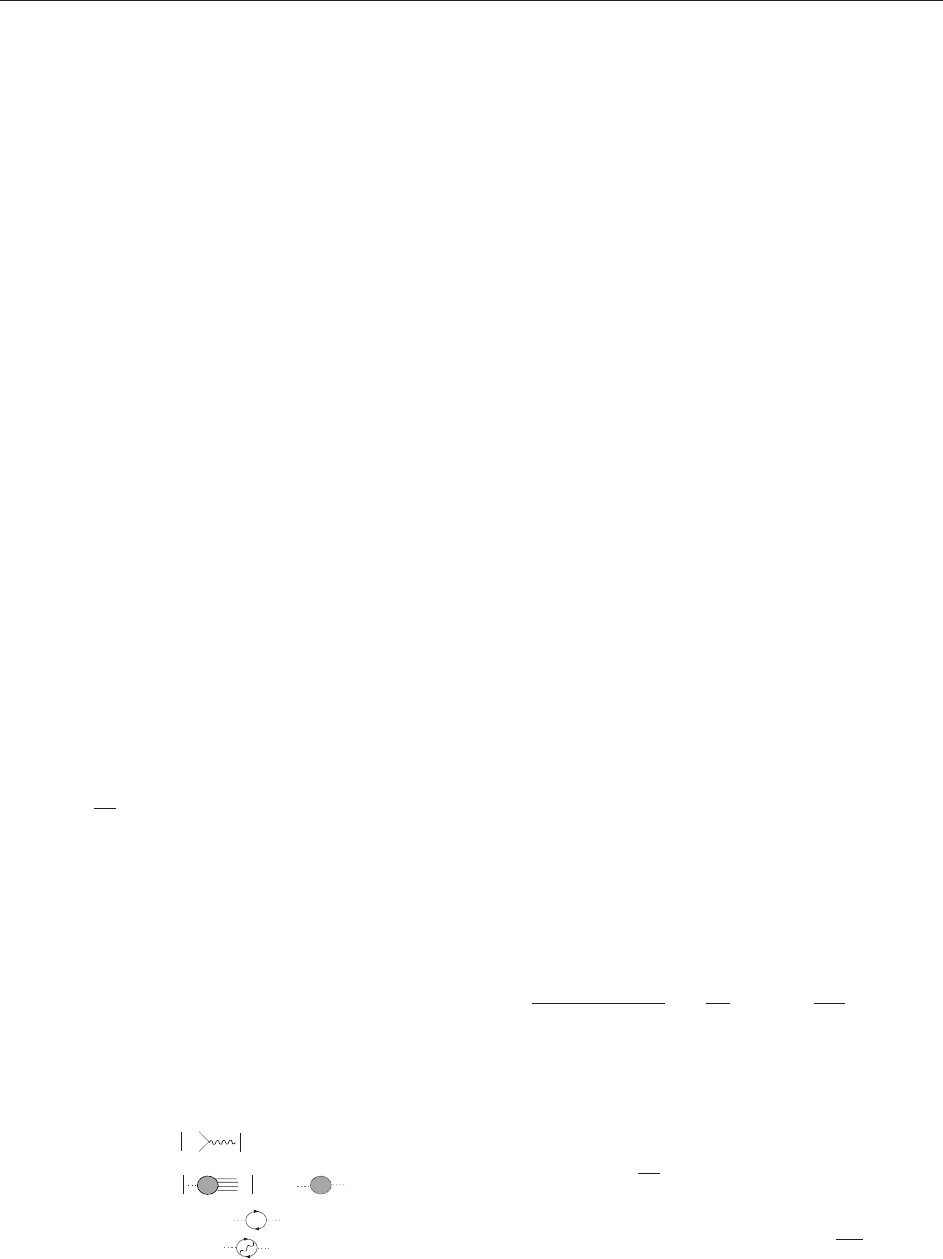
optical theorem, illustrated in Figure 1. The perturba-
tive expansion of the function (Q) depends, in
general, on the mass scales Q and the quark masses
m
f
as well as on the strong coupling
s
() and on the
renormalization scale . We may also worry about the
influence of other, truly nonperturbative scales,
proportional to powers of
QCD
. At large values of
Q
2
, however, the situation simplifies greatly, and
dependence on all scales below Q is suppressed by
powers of Q. This may be expressed in terms of the
operator product expansion,
0 TJ
ð0ÞJ
ðxÞ
0
¼
X
O
I
ðx
2
Þ
3þd
I
=2
C
I
ðx
2
2
;
s
ðÞÞ
0 O
I
ð0Þ
jj
0
hi
½17
where d
I
is the mass dimension of operator O
I
, and
where the dimensionless coefficient functions C
I
incorporate quantum corrections. The sum over
operators begins with the identity (d
I
= 0), whose
coefficient function is identified with the sum of
quantum corrections in the approximation of zero
masses. The sum continues with quark mass correc-
tions, which are suppressed by powers of at least
m
2
f
=Q
2
, for those flavors with masses below Q. Any
QCD quantity that has this property, remaining
finite in perturbation theory when all particle masses
are set to zero, is said to be ‘‘infrared safe.’’
The effects of quarks whose masses are above Q
are included indirectly, through the couplings and
masses observed at the lower scales. In summary,
the leading power behavior of (Q), and hence of
the cross section, is a function of Q, , and
s
()
only. Higher-order operators whose vacuum matrix
elements receive nonpe rturbative corrections include
the ‘‘gluon condensate,’’ identified as the product
s
()G
G
/
4
QCD
.
Once we have concluded that Q is the only
physical scale in , we may expect that the right
choice of the renormalization scale is = Q. Any
observable quantity is independent of the choice of
renormalization scale, , and neglecting quark
masses, the chain rule gives
dðQ=;
s
ðÞÞ
d
¼
@
@
þ 2ð
s
Þ
@
@
s
¼ 0 ½18
which shows that we can determine the beta
function directly from the perturbative expansion
of the cross section. Definin g a
s
()=, such a
perturbative calculation gives
ImðQ
2
Þ¼
3
4
X
f
e
2
f
1 þ a þ a
2
1:986
0:115n
f
ðb
0
=4Þln
Q
2
2
½19
with b
0
as above. Now, choosing = Q, we see that
asymptotic freedom implies that when Q is large,
the total cross section is given by the lowest order,
m
2
= Im
= Im(
+ +
. . .
)
Π(Q) =
σ(Q) =
Σ
2
e
–
e
+
q
Σ
m
Π(Q)
e
2
q
Figure 1 First line: schematic relation of lowest order e
þ
e
annihilation to sum over quarks q, each with electric charge e
q
.
Second line: perturbative unitarity for the current correlation
function (Q).
Quantum Chromodynamics 149
plus small and calculable QCD corrections, a result
that is bor ne out in experiment. Compari ng experi-
ment to an expression like [19], one can measu re the
value of
s
(Q), and hence, with eqn [12] ,
s
() for
any
QCD
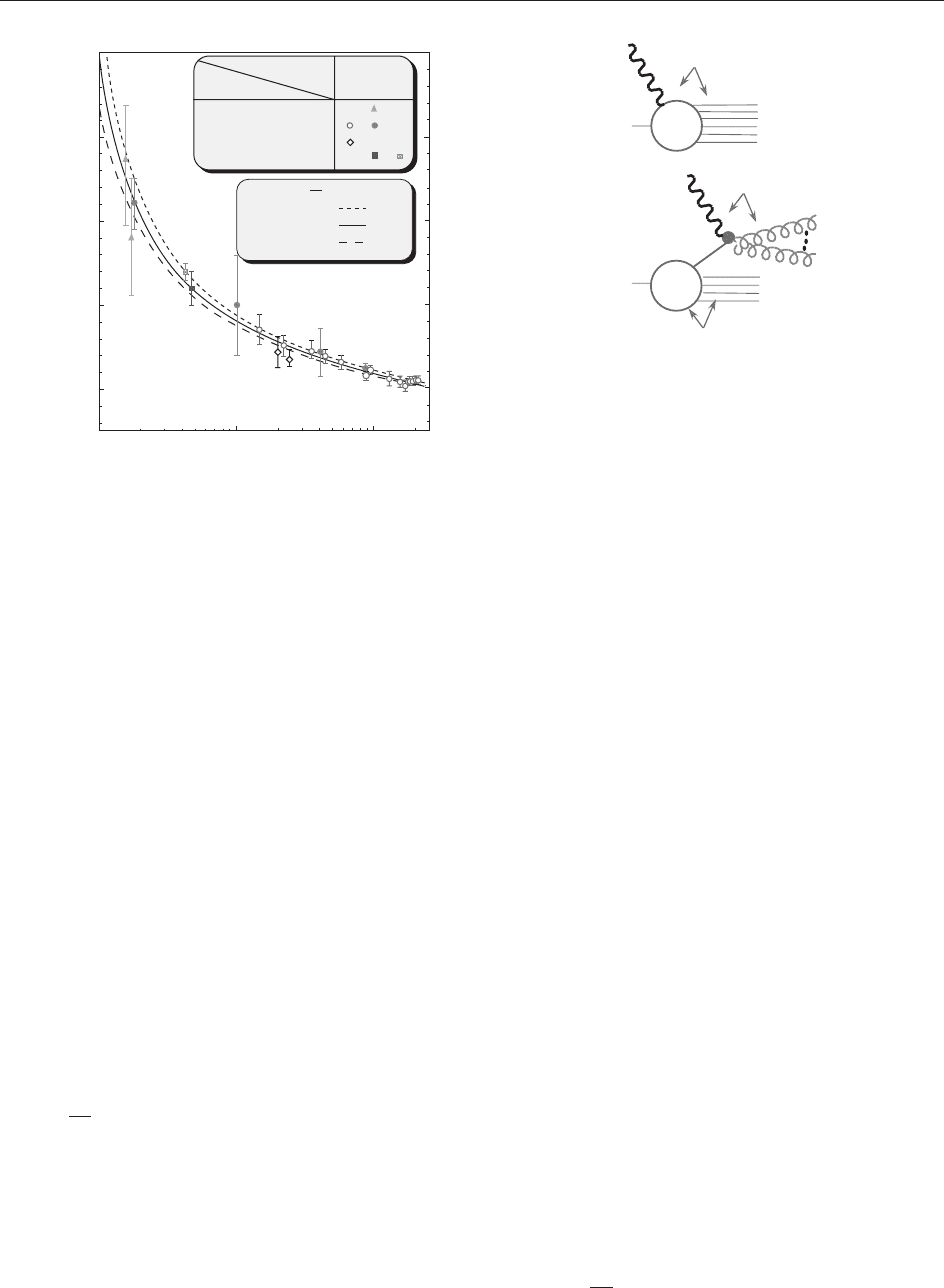
. Figure 2 shows a recent compilation
of values of
s
from this kind of analysis in different
experiments at different scales, clearly demonstrat-
ing asymptotic freedom.
Factorization, Scaling, and Parton distributions
One step beyond vacuum matrix elements of currents
are their expectation values in single-particle states,
and here we make contact with the discovery of
QCD, through scaling. Such expectations are relevant
to the class of experiments known as deep-inelastic
scattering, in which a high-energy electron exchanges
a photon with a nucleon target. All QCD information
is contained in the tensor matrix element
W
N
ðp; qÞ
1
8
X
Z
d
4
x e
iqx
p;J
ð0ÞJ
ðxÞ
jj
p;
hi
½20
with q the momentum transfer carried by the
photon, and p, the momentum and spin of the
target nucleon, N. This matrix element is not
infrared safe, since it depends in principle on the
entire history of the nucleon state. Thus, it is not
accessible to direct pertur bative calculation.
Nevertheless, when the scattering involves a large
momentum transfer compared to
QCD
,wemay
expect a quantum-mechanical incoherence between
the scattering reaction, which occurs (by the uncer-
tainty principle) at short distances, and the forces that
stabilize the nucleon. After all, we have seen that the
latter, strong forces, should be associated with long
distances. Such a separation of dynamics, called
factorization, can be implemented in perturbation
theory, and is assumed to be a property of full QCD.
Factorization is illustrated schematically in Figure 3.
Of course, short and long distances are relative
concepts, and the separation requires the introduction
of a so-called factorization scale,
F
, not dissimilar to
the renormalization scale described above. For many
purposes, it is convenient to choose the two equal,
although this is not required.
The expression of factorization for deep-inelastic
scattering is
W
N
ðp; qÞ
¼
X
i¼q
f
;
q
f
;G
Z
1
x
dC
i
ðp; q;
F
;
s
ð
F
ÞÞ
f
i=N
ð;
F
Þ½21
where the functions C
i
(the coefficient functions)
can be computed as an expansion in
s
(
F
), and
describe the scattering of the ‘‘partons,’’ quarks, and
gluons, of which the target is made. The variable
ranges from unity down to x q
2
=2p q > 0, and
has the interpretation of the fractional momentum
of the proton carried by parton i. (Here q
2
= Q
2
is
positive.) The parton distributions f
i=N
can be
defined in terms of matrix elements in the nucleon,
in which the currents are replaced by quark (or
antiquark or gluon) fields, as
f
q=N
ðx;Þ¼
1
4
Z
1
1
de
ixp
þ
p;
qðnÞU
n
ðn;0Þn qð 0Þjjp;hi½22
Q (GeV)
α
s
(Q)
0.5
0.4
0.3
0.2
0.1
10 100
1
Data
Theory
Deep-inelastic scattering
e
+
e
–
Annihilation
Hadron collisions
Heavy quarkonia
NLO
NNLO
Lattice
QCD
O(α
4
)
S
245 MeV
210 MeV
180 MeV
0.1209
0.1182
0.1155
α
S
(M
Z
)
MS
(5)
Λ
{
Figure 2 Experimental variation of the strong coupling with
scales. Reproduced from Bethke S (2004) Alpha(s) at Zinnowitz.
Nuclear Physics Proceedings Supplements 135: 345–352, with
permission from Elsevier.
ξP
q
q
to W
to C
to f
i/N
i
P
P
=
Figure 3 Schematic depiction of factorization in deep-inelastic
scattering.
150 Quantum Chromodynamics

n
is a light-like vector, and U
n
a phase operator
whose path C is in the n-direction. The dependence
of the parton distribution on the factorization scale
is through the renormalization of the composite
operator consisting of the quark fields, separated
along the light cone, and the nonabelian phase
operator U
n
(n, 0), which renders the matrix ele-
ment gauge invariant by eqn [9]. By combining the
calculations of the C’s and data for W
N
, we can
infer the parton distributions, f
i=N
. Important factor-
izations of a similar sort also apply to some
exclusive processes, including amplitudes for elastic
pion or nucelon scattering at large momentum
transfer.
Equation [21] has a number of extraordinary
consequences. First, because the coefficient function
is an expansion in
s
, it is natural to choose
2
F
Q
2
p q (when x is of order unity). When Q is
large, we may approximate C
i
by its lowest order,
which is first order in the electromagnetic coupling
of quarks to photons, and zeroth order in
s
. In this
approximation, dependence on Q is entirely in the
parton distributions. But such dependence is of
necessity weak (again for x not so small as to
produce another scale), because the
F
dependence
of f
i=N
(,
F
) must be compensate d by the
F
dependence of C
i
, which is order
s
. This means
that the overall Q dependence of the tensor W
N
is
weak for Q large when x is moderate. This is the
scaling phenomenon that played such an important
role in the discovery of QCD.
Evolution: Beyond Scaling
Another consequence of the factorization [21],or
equivalently of the operator definition [22], is that
the
F
-dependence of the coefficient functions and
the parton distributions are linked. As in the lepton
annihilation cross section, this may be thought of as
due to the independence of the physically observable
tensor W
N
from the choice of factorization and
renormalization scales. This implies that the
F
-dependence of f
i=N
may be calculated perturba-
tively since it must cancel the corresponding
dependence in C
i
. The resulting relation is coven-
tionally expressed in terms of the ‘‘evolution
equations,’’
df
a=N
ðx;Þ
d
¼
X
c
Z
1
x
d P
ac
ðx=;
s
ðÞÞf
c=N
ð; Þ½23
where P
ac
() are calculable as power series, now
known up to
3
s
. This relation expands the applic-
ability of QCD from scales where parton
distributions can be inferred directly from experi-
ment, to arbitrarily high scales, reachable in accel-
erators under construction or in the imagination, or
even on the cosmic level.
At very high energy, however, the effective values
of the variable x can become very small and
introduce new scales, so that eventually the evolu-
tion of eqn [23] fails. The study of nuclear collisions
may provide a new high-density regime for QCD,
which blurs the distinction between perturbative and
nonperturbative dynamics.
Inclusive Production
Once we have evolution at our disposal, we can take
yet another step, and replace electroweak currents
with any operator from any extension of QCD, in
the standard model or beyond, that couples quarks
and gluons to the particles of as-yet unseen fields.
Factorization can be extended to these situations as
well, providing predictions for the production of
new particles, F of mass M, in the form of factorized
inclusive cross sections,
AB!FðMÞ
ðM; p
A
; p
B
Þ
¼
X
i;j¼q
f
q
f
;G
Z
d
a
d
b
f
i=A
ð
a
;Þf
j=B
ð
b
;Þ
H
ij!FðMÞ
ðx
a
p
A
; x
b
p
B
; M;;
s
ðÞÞ ½24
where the functions H
ij !F
may be calculated
perturbatively, while the f
i=A
and f
j=B
parton
distributions are known from a combination of
lower-energy observation and evolution. In this
context, they are said to be ‘‘universal,’’ in that
they are the same functions in hadron–hadron
collisions as in the electron–hadron collisions of
deep-inelastic scattering. In general, the calculation
of hard-scattering functions H
ij
is quite nontrivial
beyond lowest order in
s
. The exploration of
methods to compute higher orders, currently as far
as
2
s
, has required extraordinary insight into the
properties of multidimensi onal integrals.
The factorization method helped predict the
observation of the W and Z bosons of electroweak
theory, and the discovery of the top quark. The
extension of factorization from deep-inelastic scat-
tering to hadron production is nontrivial; indeed , it
only holds in the limit that the velocities,
i
, of the
colliding particles approach the speed of light in the
center-of-momentum frame of the produced particle.
Corrections to the relation [24] are then at the level
of powers of
i
1, which translates into inverse
powers of the invariant mass(es) of the pro duced
particle(s) M. Factorizations of this sort do not
apply to low-velocity collisions. Arguments for this
Quantum Chromodynamics 151