
Francoise J.-P., Naber G.L., Tsun T.S. (editors) Encyclopedia of Mathematical Physics
Подождите немного. Документ загружается.


There is a simple consequence of Lemma 8.
Corollary 4 If A is seminormal and is an isolated
point of (A), then is an eigenvalue of A.
We also have the following:
Theorem 27 Let A be a seminormal operator such
that (A) has no nonzero limit points. Then A is
compact and normal. Thus, it is of the form [37]
with the {’
k
} orthonormal and
k
! 0.
Corollary 5 If A is seminormal and co mpact, then
it is normal.
Spectral Resolution
We saw in the sect ion ‘‘Operat ional calculus ’’ that,
in a Banach space X, we can define f (A) for any
A 2 B(X) provided f (z) is a function analytic in a
neighborhood of (A). In this section, we shall show
that we can do better in the case of self-adjoint
operators.
A linear operator A on a Hilbert space X is called
self-adjoint if it has the property that x 2 D(A) and
Ax = f if and only if
ðx; AyÞ¼ðf ; yÞ; y 2 DðAÞ
In particular, it satisfies
ðAx; yÞ¼ðx; AyÞ; x; y 2 DðAÞ
A bounded self-adjoint operator is normal.
To get an idea, let A be a compact, self-adjoint
operator on H. Then by Theorem 24,
Au ¼
X
k
ðu;’
k
Þ’
k
½56
where {’
k
} is an orthonormal sequence of eigenvec-
tors and the
k
are the corresponding eigenvalues of
A. Now let p(t) be a polynomial with real
coefficients having no consta nt term
pðtÞ¼
X
m
1
a
k
t
k
½57
Then p(A) is compact and self-adjoint. Let 6¼ 0be
a point in (p(A)). Then = p() for some 2 (A)
(Theorem 8). Now 6¼ 0 (otherwise we would have
= p(0) = 0). Hence, it is an eigenvalue of A (see the
section ‘‘Th e spect rum and resolven t sets ’’). If ’ is a
corresponding eigenvector, then
½pðAÞ’ ¼
X
a
k
A
k
’ ’
¼
X
a
k
k
’ ’
¼½pðÞ’ ¼ 0
Thus is an eigenvalue of p(A) and ’ is a
corresponding eigenvector. This shows that
pðAÞu ¼
X
pð
k
Þðu;’
k
Þ’
k
½58
Now, the right-hand side of [58] makes sense if p(t)
is any function bounded on (A) (see the section
‘‘No rmal operat ors’’). Therefo re it seems plausib le
to define p(A) by means of [58]. Of course, for such
a definition to be useful, one would need certain
relationships to hold. In particular, one would want
f (t)g(t) = h(t)toimplyf (A)g(A) = h(A). We shall
discuss this a bit later.
If A is not compact, we cannot, in general, obtain
an expansion in the form [56]. However, we can
obtain something similar. In fact, we have
Theorem 28 Let A be a self-adjoint operat or in
B(H). Set
m ¼ inf
kuk¼1
ðAu; uÞ; M ¼ sup
kuk¼1
ðAu; uÞ
Then there is a family {E()} of orthogonal projection
operators on H depending on a real parameter and
such that:
(i) E(
1
) E(
2
) for
1
2
;
(ii) E()u !E(
0
)u as
0
<!
0
, u 2 H;
(iii) E() = 0 for <m, E() = I for M;
(iv) AE() = E()A; and
(v) if a < m, b Mandp(t) is any polynomial,
then
pðAÞ¼
Z
b
a
pðÞdEðÞ½59
This means the following. Let a =
0
<
1
< <
n
= b be any partition of [a, b], and let
0
k
be any
number satisfying
k1
0
k
k
. Then
X
n
1
p
0
k
½Eð
k
ÞEð
k1
Þ ! pðAÞ½60
in B(H) as = max (
k
k1
) !0.
Theorem 29 Let A be a self-adjoint operator on H.
Then there is a family {E()} of orthogonal projec-
tion operators on H satisfying (i) and (ii) of
Theorem 28 and
(i)
EðÞ!
0as !1
I as !þ1
(ii) EðÞA AEðÞ
(iii)
pðAÞ=
Z
1
1
pðÞdEð Þ
for any polynomial p(t).
642 Spectral Theory of Linear Operators

These theorems are known as the spectral
theorems for self-adjoint operators.
Appendix
Here we include some background material related
to the text.
Consider a collection C of elements or ‘‘vectors’’
with the following properties:
1. They can be added. If f and g are in C,soisf þ g.
2. f þ (g þ h) = (f þ g) þ h, f , g, h 2 C.
3. There is an element 0 2 C such that h þ 0 = h
for all h 2 C.
4. For each h 2 C there is an element h 2 C such
that h þ (h) = 0.
5. g þ h = h þ g, g, h 2 C.
6. For each real number , h 2 C.
7. (g
þ h) = g þ h.
8. ( þ )h = h þ h.
9. (h) = ()h.
10. To each h 2 C there corresponds a real number
khk with the following properties :
11. khk= jjkhk.
12. khk= 0 if, and only if, h = 0.
13. kg þ hkkgkþkhk.
14. If {h
n
} is a sequence of elements of C such
that kh
n
h
m
k!0asm, n !1, then there is
an element h 2 C such that kh
n
hk!0as
n !1.
A collection of objects which satisfies statements
(1)–(9) and the additional statement
15. 1h = h
is called a vector space or linear space.
A set of objects satisfying statements (1)–(13) is
called a normed vector space, and the number khk
is called the norm of h. Although statement (15) is
not implied by statements (1)–(9), it is implied by
statements (1)–(13). A sequence satisfying
kh
n
h
m
k!0asm; n !1
is called a Cauchy sequence. Property (14) states
that every Cauchy sequence converges in norm to
a limit (i.e., satisfies kh
n
hk!0asn !1).
Property (14) is called completeness, and a normed
vector space satisfying it is called a complete normed
vector space or a Banach space.
We shall write
h
n
! h as n !1
when we mean
kh
n
hk!0asn !1
A subset U of a vector space V is called a subspace
of V if
1
x
1
þ
2
x
2
is in U whenever x
1
, x
2
are in U
and
1
,
2
are scalars.
A subset U of a normed vector space X is called
closed if for every sequence {x
n
} of elements in U
having a limit in X, the limit is actually in U.
Consider a vector space X having a mapping ( f , g)
from pairs of its elements to the reals such that
1. (f , g) = (f , g)
2. (f þ g, h) = (f , h) þ (g, h)
3. (f , g) = (g, f )
4. (f , f ) > 0 unless f = 0.
Then
ðf ; gÞ
2
ðf ; f Þðg; gÞ; f ; g 2 X ½61
An expression (f , g) that assigns a real number to
each pair of elements of a vector space and satisfies
the aforementioned properties is called a scalar
(or inner) product.
If a vector space X has a scalar product (f , g), then
it is a normed vector space with norm kf k= (f , f )
1=2
.
A vector space which has a scalar product and is
complete with respect to the induced norm is called
a Hilbert space. Every Hilbert space is a Banach
space, but the converse is not true. Inequality [61] is
known as the Cauchy–Schwarz inequality. R
n
is a
Hilbert space.
Let H be a Hilbert space and let (x, y) denote its
scalar product. If we fix y, then the expression
(x, y)assignstoeachx 2 H a number. An assign-
ment F of a number to each element x of a vector
space is called a functional and denoted by F(x).
The scalar product is not the first functional we
have encountered. In any normed vector space, the
norm is also a functional. The functional
F(x ) = (x, y)satisfies
Fð
1
x
1
þ
2
x
2
Þ¼
1
Fðx
1
Þþ
2
Fðx
2
Þ½62
for
1
,
2
scalars. A functional satisfying [62] is
called linear. Another property is
jFðxÞj Mkxk; x 2 H ½63
which follows immediately from Schwarz’s inequal-
ity (cf. [61]). A functional satisfying [63] is called
bounded. The norm of such a functional is defined
to be
kFk¼ sup
x2H; x6¼0
jFðxÞj
kxk
Thus for y fixed, F(x) = (x, y) is a bounded linear
functional in the Hilbert space H. We have
Spectral Theory of Linear Operators 643

Theorem 30 For every bounded linear functional F
on a Hilbert space H there is a unique element
y 2 H such that
FðxÞ¼ðx; yÞ for all x 2 H ½64
Moreover,
kyk¼ sup
x2H; x6¼0
jF ðxÞj
kxk
¼kFk½65
Theorem 30 is known as the ‘‘Riesz representation
theorem.’’
For any normed vector space X, let X
0
denote the
set of bounded linear functionals on X.Iff , g 2 X
0
,
we say that f = g if
f ðxÞ¼gðxÞ for all x 2 X
The ‘‘zero’’ functional is the one assigning zero to all
x 2 X. We define h = f þ g by
hðxÞ¼f ðxÞþgðxÞ; x 2 X
and g = f by
gðxÞ¼f ðxÞ; x 2 X
Under these definitions, X
0
becomes a vector space.
We have been employing the expression
kf k¼sup
x6¼0
jf ðxÞj
kxk
; f 2 X
0
½66
This is easily seen to be a norm. Thus X
0
is a normed
vector space.
We also have
Theorem 31 Let M be a subspace of a normed vector
space X, and suppose that f (x) is a bounded linear
functional on M. Set
kf k¼ sup
x2M;x6¼0
jf ðxÞj
kxk
Then there is a bounded linear functional F(x) on
the whole of X such that
FðxÞ¼f ðxÞ; x 2 M ½67
and
kFk¼ sup
x2X;x6¼0
jFðxÞj
kxk
¼kf k¼ sup
x2M;x6¼0
jf ðxÞj
kxk
½68
Theorem 31 is known as the ‘ ‘Hahn–Banach theorem.’ ’
If A is a linear operator from X to Y, with
R(A) = Y and N(A) = {0} (i.e., consists only of the
vector 0), we can assign to each y 2 Y the unique
solution of
Ax ¼ y
This assignment is an operator from Y to X and is
usually denoted by A
1
and called the inverse
operator of A. It is linear because of the linearity
of A. One can ask: ‘‘when is A
1
continuous?’’ or,
equivalent by, ‘‘when is it bounded?’’ A very
important answer to this question is given by
Theorem 32 If X, Y are Banach spaces and A is a
closed linear operator from X to Y with
R(A) = Y, N(A) = {0}, then A
1
2 B(Y, X).
This theorem is sometimes referred to as the
‘‘bounded inverse theorem.’’
If A is self-adjoint and
ðA Þx ¼ 0; ðA Þy ¼ 0
with 6¼ , then
ðx; yÞ¼0
If A has a compact inverse, its eigenvalues cannot
have limit points. If A
1
is compact, then the
eigenelements corresponding to the same eigenvalue
form a finite-dimensional subspace.
See also: Ljusternik–Schnirelman Theory; Quantum
Mechanical Scattering Theory; Regularization for
Dynamical Zeta Functions; Spectral Sequences;
Stochastic Resonance.
Further Reading
Bachman G and Narici L (1966) Functional Analysis. New York:
Academic Press.
Banach S (1955) The´orie des Ope´rations Line´aires. New York:
Chelsea.
Berberian SK (1974) Lectures in Functional Analysis and
Operator Theory. New York: Springer.
Brown A and Pearcy C (1977) Introduction to Operator Theory.
New York: Springer.
Day MM (1958) Normed Linear Spaces. Berlin: Springer.
Dunford N and Schwartz IT (1958, 1963) Linear Operators, I, II.
New York: Wiley.
Edwards RE (1965) Functional Analysis. New York: Holt.
Epstein B (1970) Linear Functional Analysis. Philadelphia:
W. B. Saunders.
Gohberg IC and Krein MS (1960) The basic propositions on
defect numbers, root numbers and indices of linear operators.
Amer. Math. Soc. Transl, Ser. 2, 13, 185–264.
Goldberg S (1966) Unbounded Linear Operators. New York:
McGraw-Hill.
Halmos PR (1951) Introduction to Hilbert Space. New York: Chelsea.
Hille E and Phillips R (1957) Functional Analysis and Sem-Groups.
Providence: American Mathematical Society.
Kato T (1966, 1976) Perturbation Theory for Linear Operators.
Berlin: Springer.
644 Spectral Theory of Linear Operators

Mu¨ ller V (2003) Spectral Theory of Linear Operators – and Spactral
System in Banach Algebras. Basel: Birkha¨user Verlag.
Reed M and Simon B (1972) Methods of Modern Mathematical
Physics, I. Academic Press.
Riesz F and St.-Nagy B (1955) Functional Analysis. New York: Ungar.
Schechter M (2002) Principles of Functional Analysis. Providence:
American Mathematical Society.
Stone MH (1932) Linear Transformations in Hilbert Space.
Providence: American Mathematical Society.
Taylor AE (1958) Introduction to Functional Analysis. New York:
Wiley.
Weidmann J (1980) Linear Operators in Hilbert Space. New York:
Springer.
Yosida K (1965, 1971) Functional Analysis. Berlin: Springer.
Spin Foams
A Perez, Penn State University, University Park,
PA, USA
ª 2006 Elsevier Ltd. All rights reserved.
Introduction
In loop quantum gravity (LQG) (see Loop Quantum
Gravity) – a background independent formulation of
quantum gravity – the full quantum dynamics is
governed by the following (constraint) operator
equations or quantum Einstein equations:
Gauss Law
b
G
i
ðA; EÞj >:¼
d
D
a
E
a
i
j >¼ 0
Vector constraint
b
V
a
ðA; EÞj >:¼
d
E
a
i
F
i
ab
ðAÞj >¼ 0
Scalar constraint
b
SðA; EÞ >:¼
d
ffiffiffiffiffiffiffiffiffiffi
detE
p
1
E
a
i
E
b
j
F
ij
ab
ðAÞþ
>¼ 0
½1
where A
i
a
is an SU(2) connection (i = 1, 2, 3,
a = 1, 2, 3), E
a
i
is its conjugate momentum (the triad
field), F
ij
ab
(A) is the curvature of A
i
a
,andD
a
is the
covariant derivative (see Canonical General Relativ-
ity). The hat means that the classical phase-space
functions are promoted to operators in a kinematical
Hilbert space H
kin
; the solutions are in the so-called
physical Hilbert space H
phys
. The goal of the spin foam
approach is to construct a mathematically well-defined
notion of path integral for LQG as a device for
computing the solutions of the previous equations.
The space of solution of the Gauss and vector
constraints [1] is well understood in LQG (see Loop
Quantum Gravity), and often also called kinematical
Hilbert space H
kin
. The solutions of the scalar
constraint can be characterized by the definition of
the generalized projection operator P from the
kinematical Hilbert space H
kin
into the kernel of
the scalar constraint H
phys
. Formally, one can write
P as
P ¼“
Y
x2
ð
b
SðxÞÞ”
¼
Z
D½Nexp i
Z
NðxÞ
d
SðxÞ
½2
A formal argument shows that P can also be defined
in a manifestly covariant manner as a regularization
of the formal path integral of general relativity. In
first-order variables, it becomes
P ¼
Z
D½e D½A ½A; eexp iS
GR
ðe; AÞ½½3
where e is the tetrad field, A is the spacetime connection,
and [A, e] denotes the appropriate measure.
In both cases, P char acterizes the spac e of
solutions of quantum Einstein equations as for
any arbitrary state j>2H
kin
then Pj> is a
(formal) solution of [1]. Moreover, the matrix
elements of P define the physical inner product
(< ,>
p
) providing the vector s pace of solutions of
[1] with the Hilbert space structure that defines
H
phys
. Explicitly,
<s; s
0
>
p
:¼ <Ps; s
0
>
for s, s
0
2H
kin
.
When these matrix elements are computed in
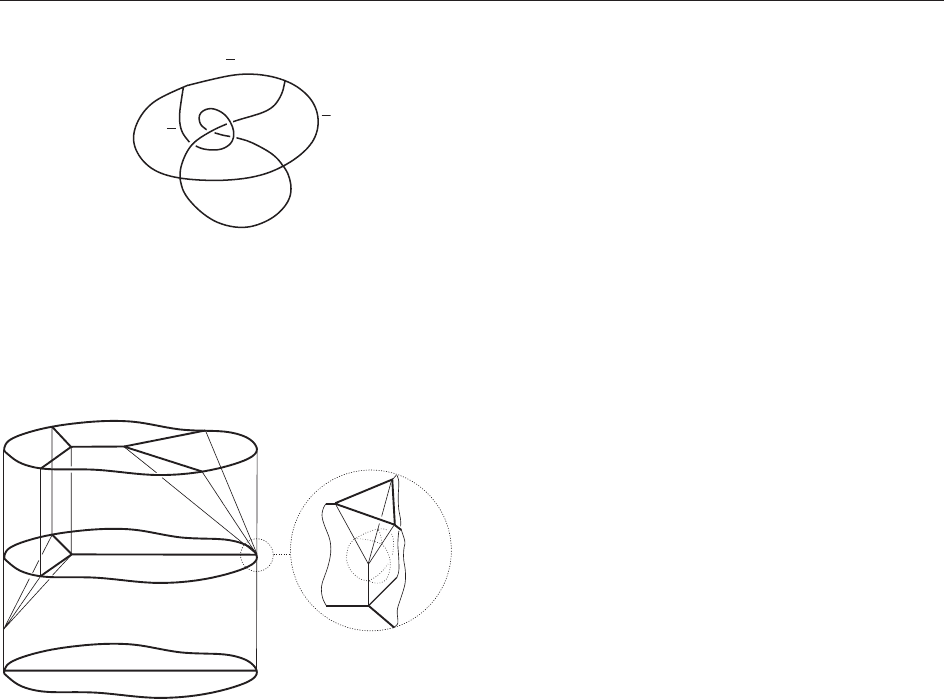
the spin network basis (see Fig ure 1)(see Loop
Quantum Gravity), they c an be e xpressed as a
sum over amplitudes of ‘‘spin network histories’’:
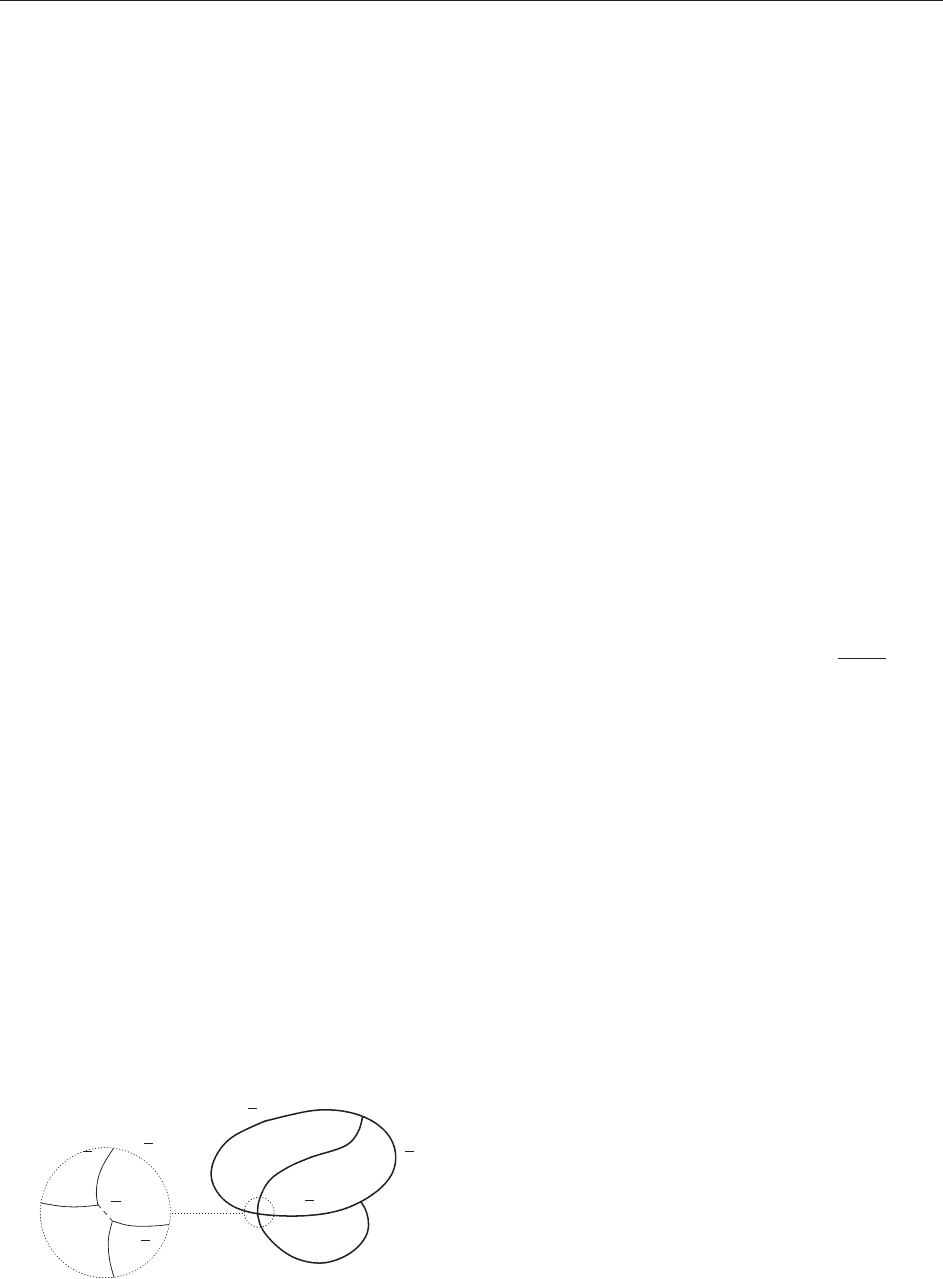
spin foams (Figure 2). The latter are naturally
given by foam-like combinatorial structures
whose basic elements carry quantum numbers of
geometry (see Loop Quantum Gravity). A spin
foam history, from the st ate js> to the state js
0
>,
is denoted by a pair (F
s !s
0
,{j}), where F
s !s
0
is the
2-complex with boundary given by the graphs of
the spin network states js
0
> and js>, respectively,
and {j}isthesetofspinquantumnumbers
labeling its edges (denoted e 2 F
s !s
0
)andfaces
(denoted f 2 F
s !s
0
). Vertices are denoted
Spin Foams 645
v 2 F
s !s
0
. The physical inner product can be
expressed as a sum over spin foam amplitudes
<s
0
; s>
p
¼<Ps
0
; s>
¼
X
F
s!s
0
NðF
s!s
0
Þ
X
fjg
Y
f 2F
s!s
0
A
f
ðj
f
Þ
Y
e2F
s!s
0
A
e
ðj
e
Þ
Y
v2F
s!s
0
A
v
ðj
v
Þ½4
where N(F
s !s
0
) is a (possible) normalization
factor, and A
f
(j
f
), A
e
(j
e
), and A
v
(j
v
)arethe2-cell
or face amplitude, the edge or 1-cell amplitude,
and the 0-cell or vertex amplitude, respectively.
These l ocal amplitudes depend on the spin quan-
tum numbers labeling neighboring cells in F
s !s
0
(e.g., the vertex amplitude of the vertex magnified
in Figure 2 is A
v
(j, k, l, m, n, s)).
The underlying discreteness discovered in LQG
is crucial: in the spin foam representation, the
functional integral for gravity is replaced by a sum
over amplitudes of combinatorial objects given by
foam-like configurations (spin foams) as in [4].A
spin foam represents a possible history of the
gravitational field and can be interpreted as a set
of transitions through different quantum states of
space. Boundary data in the path integral are given
by the polymer-like excitations (spin network
states, Figure 1) represent ing 3-geometry sta tes in
LQG.
Spin Foams in 3D Quantum Gravity
Now we introduce the concept of spin foams in a
more explicit way in the context of the quantizati on
of three-dimensional (3D) Riemannian gravity. Later
in this section we will present the definition of P
from the canonical and covariant viewpoint for-
mally stat ed in the introduction by eqns [2] and [3],
respectively.
The Classical Theory
Riemannian gravity in 3D is a theory with no local
degrees of freedom, that is, a topological theory (see
Topological Quantum Field Theory: Overview). Its
action (in the first-order formalism) is given by
Sðe;!Þ¼
Z
M
trðe ^ F ð!ÞÞ ½5
where M = R (for an arbitrary Riemann
surface), ! is an SU(2) connection, and the triad e
is an su(2)-valued 1-form. The gauge symmetries of
the action are the local SU(2) gauge transformations
e ¼½e;;!¼ d
!
½6
where is an su(2)-valued 0-form, and the
‘‘topological’’ gauge transformation
e ¼ d
!
; ! ¼ 0 ½7
where d
!
denotes the covariant exter ior derivative
and is an su(2)-valued 0-form. The first invariance
is manifest from the form of the action, while the
second is a consequence of the Bianchi identity,
d
!
F(!) = 0. The gauge symmetries are so large that
all the solutions to the equations of motion are
locally pure gauge. The theory has only global or
topological degrees of freedo m.
Upon the standard 2 þ 1 decomposition (see Cano-
nical General Relativity), the phase space in these
variables is parametrized by the pullback to of ! and
e. In local coordinates, one can express them in terms of
the two 2D connection A
i
a
and the triad field
E
b
j
=
bc
e
k
c
jk
,wherea = 1, 2 are space coordinate
indices and i, j = 1, 2, 3 are su(2) indices. The symplec-
tic structure is defined by
fA
i
a
ðxÞ; E
b
j
ðyÞg ¼
b
a
i
j
ð2Þ
ðx; yÞ½8
1
2
1
3
2
2
5
2
1
1
Figure 1 A spin network state is given by a graph embedded
in space whose links and nodes are labeled by unitary
irreducible representations of SU(2). These states form a
complete basis of the kinematical Hilbert space of LQG where
the operator equations [1] are defined.
j
j
j
k
k
k
l
l
l
p
o
q
q
p
o
m
n
s
j
k
l
m
n
s
Figure 2 A spin foam as the ‘‘colored’’ 2-complex representing
the transition between three different spin network states. A
transition vertex is magnified on the right.
646 Spin Foams
Local symmetries of the theory are generated by the
first-class constraints
D
b
E
b
j
¼ 0; F
i
ab
ðAÞ¼0 ½9
which are referred to as the Gauss law and the
curvature constraint, respectively – the quantization
of these is the analog of [1] in 4D. This simple
theory has been quantized in various ways in the
literature; here we will use it to introduce the spin
foam quantization.
Kinematical Hilbert Space
In analogy with the 4D case, one follows Dirac’s
procedure finding first a representation of the basic
variables in an auxiliary or kinematical Hilbert
space H
kin
. The basic states are functionals of the
connection depending on the paral lel transport
along paths : the so-called holono my. Given
a connection A
i
a
(x) and a path , one defines the
holonomy h
[A] as the path-ordered exponential
h
½A¼P exp
Z
A ½10
The kinematical Hilbert space, H
kin
, corresponds
to the Ashtekar–Lewandowski (AL) representation
of the algebra of functions of holonomies or
generalized connections. This algebra is in fact a
C
-algebra and is denoted Cyl (see Loop Quantum
Gravity). Functionals of the connection act in the
AL representation simply by multiplication. For
example, the holonomy operator acts as follows:
d
h
½A½A¼h
½A½A½11
As in 4D, an orthonormal basis of H
kin
is defined
by the spin network states. Each spin network is
labeled by a graph , a set of spins {j
‘
} labeling
links ‘ 2 , and a set of intertwiners {
n
} labeling
nodes n 2 (Figure 3), namely:
s
;fj
‘
g;f
n
g
½A¼
O
n2
n
O
‘2
Y
j
‘
ðh
‘
½AÞ ½12
where
j
is the unitary irreducible representation matrix
of spin j (for a precise definition, see Loop Quantum
Gravity). For simplicity, we will often denote spin
network states js > omitting the graph and spin labels.
Spin Foams from the Hamiltonian Formulation
The physical Hilbert space, H
phys
,isdefinedby
those ‘‘states’’ that are annihilated by the con-
straints. By construction, spin-network states solve
the Gauss constraint –
d
D
a
E
a
i
js > = 0–asthey
are manifestly SU(2) gauge invariant ( see Loop
Quantum Gravity). To complete the quantization,
one needs to characterize the space of solutions of
the quantum curvature constraints (
b
F
i
ab
), and t o
provide it with the physical inner product. The
ex istence of H
phys
is granted by the following:
Theorem 1 There exists a normalized positive
linear form P over Cyl, that is, P(
) 0 for 2
Cyl and P(1) = 1, yielding (through the GNS
construction (see Algebraic Approach to Quantum
Field Theory)) the physical Hilbert space H
phys
and
the physical representati on
p
of Cyl.
The state P contains a very large Gelfand ideal (set
of zero norm states) J : = { 2 Cyl s.t. P(
) = 0}. In
fact, the physical Hilbert space H
phys
:= Cyl=J corre-
sponds to the quantization of finitely many degrees of
freedom. This is expected in 3D gravity as the theory
does not have local excitations (no ‘‘gravitons’’) (see
Topological Quantum Field Theory: Overview). The
representation
p
of Cyl solves the curvature con-
straint in the sense that for any functional f
[A] 2 Cyl
defined on the subalgebra of functionals defined on
contractible graphs 2 , one has that
p
½f
¼ f
½0 ½13
This equation expresses the fact that ‘‘
b
F = 0’’ in H
phys
(for flat connections, parallel transport is trivial
around a contractible region). For s, s
0
2H
kin
, the
physical inner product is given by
<s; s
0
>
p
:¼ Pðs
sÞ½14
where the -operation and the product are defined
in Cyl.
The previous equation admits a ‘‘sum over
histories’’ representation. We shall introduce the
concept of the spin foam represent ation as an
explicit construction of the positive linear form P
which, as in [2], is formally given by
P ¼
Z
D½Nexp i
Z
tr½N
b
FðAÞ
¼
Y
x2
½
d
FðAÞ ½15
1
2
3
2
2
5
2
5
1
2
1
1
5
3
1
2
2
2
Figure 3 A spin network state in 2 þ 1 LQG. The decomposi-
tion of a 4-valent node in terms of basic 3-valent intertwiners is
shown.
Spin Foams 647
where N(x) 2 su(2). One can make the previous
formal expression a rigorous definition if one intro-
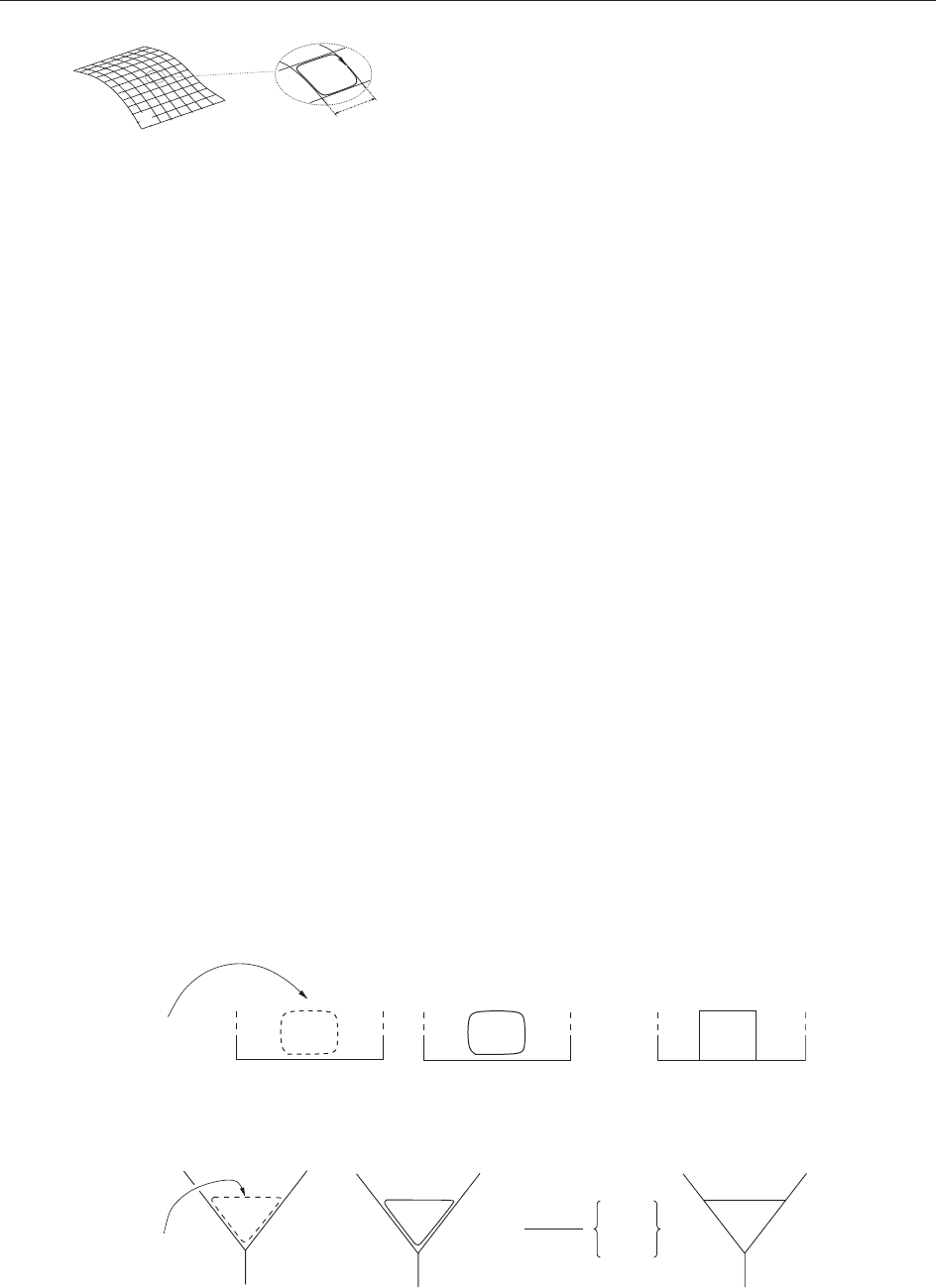
duces a regularization. Given a partition of in terms
of 2D plaquettes of coordinate area
2
, one has that
Z
tr½NFðAÞ ¼ lim
!0
X
p
i
2
tr½N
p
i F
p
i ½16
where N
p
i and F
p
i are values of N
i
and
ab
F
i
ab
[A]
at some interior point of the plaquette p
i
and
ab
is
the Levi-Civita tensor. Similarly, the holonomy
W
p
i [A] around the boundary of the plaquette p
i
(see Figure 4) is given by
W
p
i ½A¼1 þ
2
F
p
i ðAÞþOð
2
Þ½17
where F
p
i =
j
ab
F
j
ab
(x
p
i )(
j
are the generators of
su(2) in the fundamental representation). The pre-
vious two equations lead to the following definition:
given s 2 Cyl (think of spin network state based on a
graph ), the linear form P(s) is defined as
PðsÞ :¼ lim
!0
Y
p
i
Z
dN
p
i expðitr½N
p
i W
p
i Þ; s
*+
½18
where < , > is the inner product in the AL
representation and j > is the ‘‘vacuum’’ (1 2 Cyl)
in the AL representation. The partition is chosen so
that the links of the underlying graph border the
plaquettes. One can easily perform the integration
over the N
p
i using the identity (Peter–Weyl
theorem)
Z
dN expðitr½NWÞ
¼
X
j
ð2j þ 1Þtr
h
j
ðWÞ
i
½19
Using the previous equation
PðsÞ :¼ lim
!0
Y
p
i
X
jðp
i
Þ
ð2jðp
i
Þþ1Þ
< tr
h
jðp
i
Þ
ðW
p
i
Þ
i
; s> ½20
where j(
p
i
) is the spin labeling element of the sum
[19] associated to the ith plaquette. Since the
tr[
j
(W)] commute, the ordering of plaquette opera-
tors in the previous product does not matter. It can be
shown that the limit !0 exists and one can give a
closed expression of P(s).
Now in the AL representation (see eqn [11]), each
tr½
jðp
i
Þ
ðW
p
i Þ acts by creating a closed loop in the j
p
i
representation at the boundary of the corresponding
plaquette (Figures 5 and 6).
One can introduce a (nonphysical) time parameter
that works simply as a coordinate providing the means
of organizing the series of actions of plaquette loop
operators in [20]; that is, one assumes that each of the
loop actions occurs at different ‘‘times.’’ We have
introduced an auxiliary time slicing (arbitrary para-
metrization). If one inserts the AL partition of unity
1 ¼
X
2
X
fjg
j; fjg >< ; fjgj ½21
where the sum is over the complete basis of spin
network states {j,{j} > } – based on all graphs 2
and with all possible spin labeling – between each time
W
p
ε
Σ
Figure 4 Cellular decomposition of the space manifold
(a square lattice in this example), and the infinitesimal
plaquette holonomy W
p
[A].
j
k
j
p
j
k
m
=
=
N
j,m,k
Σ
m
tr[∏(W
p
)]
Δ
k
Figure 5 Graphical notation representing the action of one plaquette holonomy on a spin network state. On the right is the result
written in terms of the spin network basis. The amplitude N
j,m,k
can be expressed in terms of Clebsch–Gordan coefficients.
j
k
m
po
n
j
k
m
n
j
k
m
p
tr[∏(W
p
)]
Δ
k
==
jkm
no p
1
Δ
n
Δ
j
Δ
k
Δ
m
Σ
o,p
Figure 6 Graphical notation representing the action of one plaquette holonomy on a spin network vertex. The object in brackets (fg)
is a 6j-symbol and
j
:= 2j þ 1.
648 Spin Foams
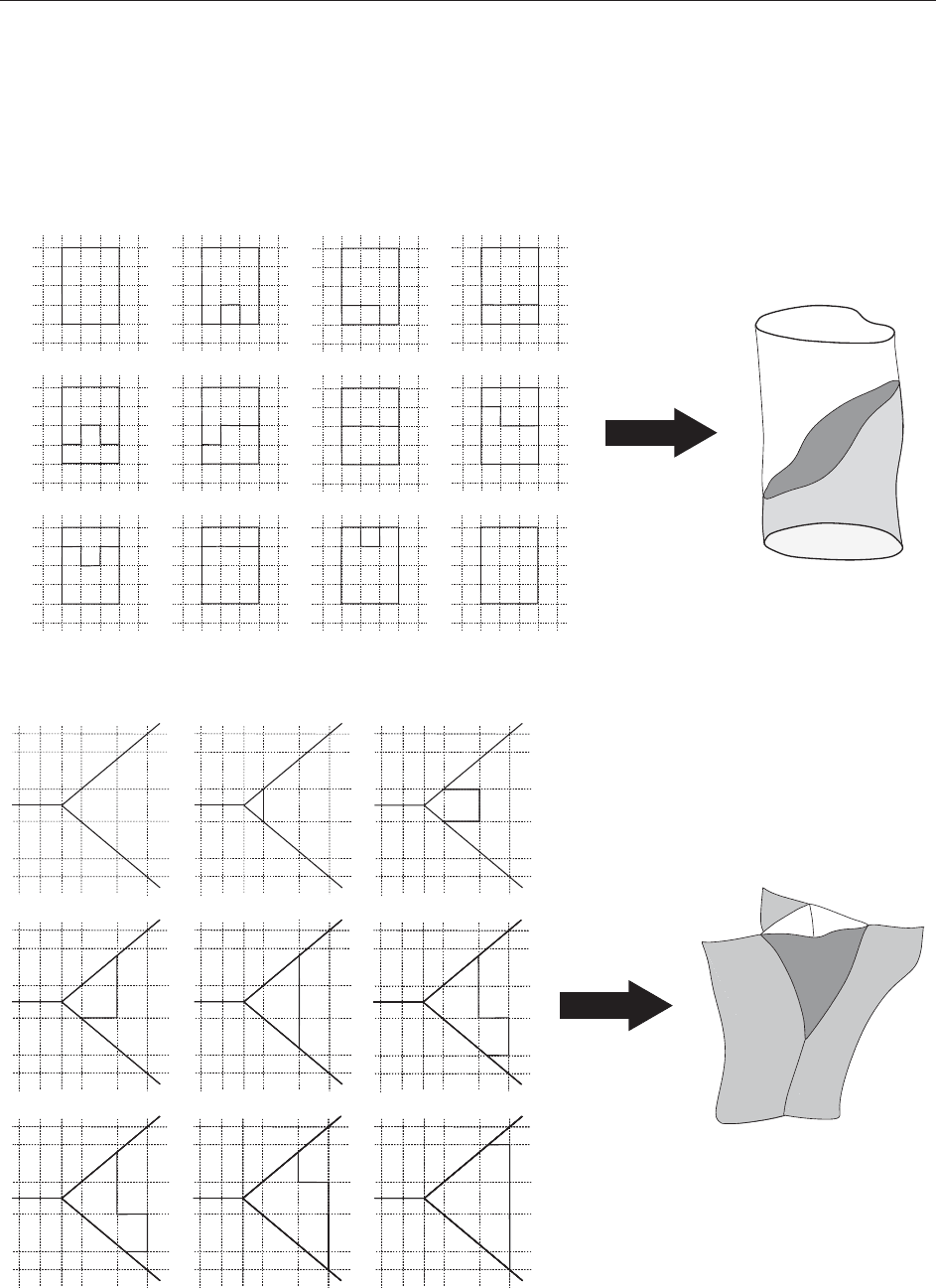
slice, one arrives at a sum over spin network histories
representation of P(s). More precisely, P(s)canbe
expressed as a sum over amplitudes corresponding to a
series of transitions that can be viewed as the ‘‘time
evolution’’ between the ‘‘initial’’ spin network s and
the ‘‘final’’ ‘‘vacuum state’’ . The physical inner
product between spin networks s and s
0
is defined as
<s; s
0
>
p
:¼ Pðs
s
0
Þ
and can be expressed as a sum over amplitudes
corresponding to transitions interpolating between
the ‘‘initial’’ spin network s
0
and the ‘‘final’’ spin
network s (e.g., Figures 7 and 8).
m
k
j
o
n
p
m
k
j
p
o
n
m
n
k
j
p
o
m
n
k
j
p
o
m
p
o
n
k
j
m
j
k
o
p
n
j
mko
p
n
m
n
k
j
p
o
m
o
n
k
j
p
m
j
k
Figure 8 A set of discrete transitions representing one of the contributing histories at a fixed value of the regulator. On the right, the
continuous spin foam representation when the regulator is removed.
k
m
j
m
j
k
m
m
k
j
m
j
k
j
j
k
m
m
k
j
m
j
k
m
k
j
m
j
k
j
m
k
m
k
j
Figure 7 A set of discrete transitions in the loop-to-loop physical inner product obtained by a series of transitions as in Figure 5.On
the right, the continuous spin foam representation in the limit ! 0.
Spin Foams 649
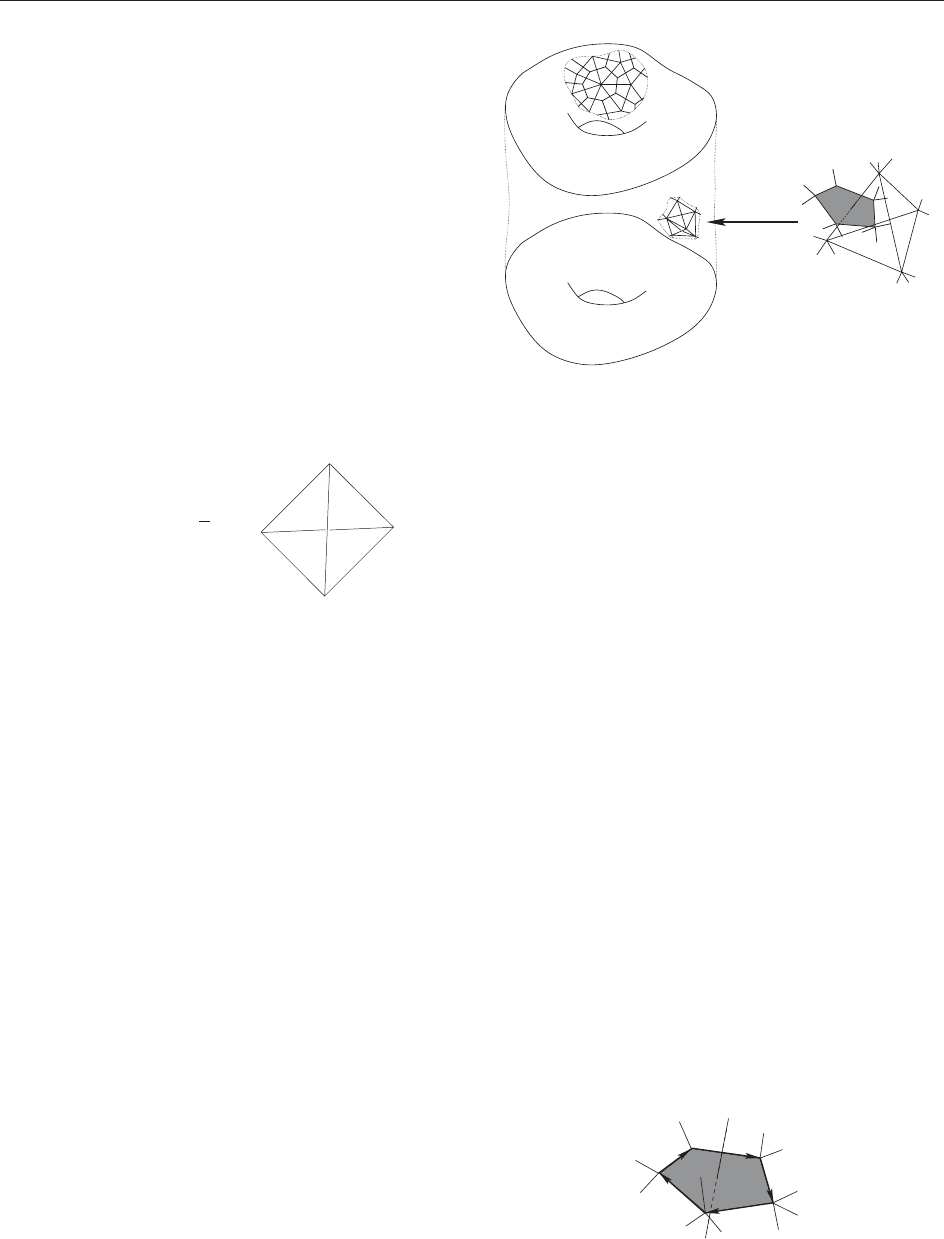
Spin network nodes evolve into edges while spin
network links evolve into 2D faces. Edges inherit the
intertwiners associated to the node s and faces inherit
the spins associated to links. Therefore, the series of
transitions can be represented by a 2-complex whose
1-cells are labeled by intertwiners and whose 2-cells
are labeled by spins. The places where the actio n of
the plaquette loop operators create new links
(Figures 6 and 8) define 0-cells or vertices. These
foam-like structures are the so-called spin foams.
The spin foam amplitudes are purely combinatorial
and can be explicitly computed from the simple
action of the loop operator in the AL representation
(see Loop Quantum Gravity). A particularly simple
case arises when the spin network states s and s
0
have only 3-valent nodes. Explicitly,
<s; s
0
>
p
:¼ Pðs
s
0
Þ
¼
X
fjg
Y
f 2F
s!s
0
ð2j
f
þ 1Þ
f
2
Y
v2F
s!s
0
j
4
j
3
j
1
j
2
j
6
j
5
½22
where the notation is that of [4], and
f
= 0if
f \ s 6¼ 0 ^ f \ s
0
6¼ 0,
f
= 1iff \ s 6¼ 0 _ f \ s
0
6¼ 0,
and
f
= 2iff \ s = 0 ^ f \ s
0
= 0. The tetrahedral
diagram denotes a 6j-symbol: the amplitude obtained
by means of the natural contraction of the four
intertwiners corresponding to the 1-cells converging
at a vertex. More generally, for arbitrary spin
networks, the vertex amplitude corresponds to 3nj-
symbols, and <s, s
0
>
p
takes the general form [4].
Spin Foams from the Covariant Path Integral
In this section we re-derive the spin foam represen-
tation of the physical scalar product of 2 þ 1
(Riemannian) quantum gravity directly as a regular-
ization of the covaria nt path integral. The formal
path integral for 3D gravity can be written as
P ¼
Z
D½eD½Aexp i
Z
M
tr½e ^ FðAÞ
½23
Assume M =I,whereI R is a closed (time)
interval (for simplicity, we ignore boundary
terms).
In order to give a meaning to the formal
expression above, one replaces the 3D manifold
(with boundary) M with an arbitrary cellular
decomposition . One also needs the notion of the
associated dual 2-complex of denoted by
. The
dual 2-complex
is a combinatorial object de fined
by a set of vertices v 2
(dual to 3-cells in ),
edges e 2
(dual to 2-cells in ), and faces f 2
(dual to 1-cells in ). The intersection of the dual
2-complex
with the boundaries defines two
graphs
1
,
2
2 (see Figure 9). For simplicity, we
ignore the bounda ries until the end of this section.
The fields e and A are discretized as follows. The
su(2)-valued 1-form field e is represented by the
assignment of e
f
2 su(2) to each 1-cell in .We
use the fact that faces in
are in one-to-one
correspondence with 1-cells in and label e
f
with a
face subindex (Figure 9). The connection field A is
represented by the assignment of group elements
g
e
2 SU(2) to each edge in e 2
(see Figure 10).
With all this, [23] becomes the regularized version
P
defined as
P
¼
Z
Y
f 2
de
f
Y
e2
dg
e
exp i tr e
f
W
f
½24
where de
f
is the regular Lebesgue measure on R
3
,
dg
e
is the Haar measure on SU(2), and W
f
denotes
the holonomy around (spacetime) faces, that is,
W
f
= g
1
e
g
N
e
for N being the number of edges
bounding the corresponding face (see Figure 10).
The discretization procedure is reminiscent of the
one used in standard lattice gauge theory (see Lattice
f
Σ
Σ
Figure 9 The cellular decomposition of M = I (=T
2
in
this example). The illustration shows part of the induced graph
on the boundary and the detail of a tetrahedron in and a face
f 2
in the bulk.
f
g
e
3
g
e
4
g
e
5
g
e
1
g
e
2
Figure 10 A (2-cell) face f 2
in a cellular decomposition of
the spacetime manifold M and the corresponding dual 1-cell. The
connection field is discretized by the assignment of the parallel
transport group elements g
i
e
2 SU(2) to edges e 2
(i = 1, ..., 5 in the face shown here).
650 Spin Foams

Gauge Theory). The previous definition can be
motivated by an analysis equivalent to the one
presented in [16].
Integrating over e
f
, and using [19], one obtains
P
¼
X
fjg
Z
Y
e2
dg
e
Y
f 2
ð2j
f
þ 1Þ
tr
j
f
ðg
1
e
...g
N
e
Þ
"#
½25
Now it remains to integrate over the lattice con-
nection {g
e
}. If an edge e 2
bounds n faces f 2
there will be n traces of the form tr[
j
f
( g
e
)] in
[25] containing g
e
in the argument. In order to
integrate over g
e
we can use the following identity:
I
n
inv
:¼
Z
dg
j
1
ðgÞ
j
2
ðgÞ
j
n
ðgÞ
¼
X
C
j
1
j
2
j
n
C
j
1
j
2
j
n
½26
where I
n
inv
is the projector from the tensor product of
irreducible representations H
j
1
j
n
= j
1
j
2
j
n
onto the invariant component H
0
j
1
j
n
= Inv[j
1
j
2
j
n
]. On the right-hand side, we have chosen an
orthonormal basis of invariant vectors (intertwiners)
in H
j
1
j
n
to express the projector. Notice that the
assignment of intertwiners to edges is a consequence
of the integration over the connection. Using [26]
one can write P
in the general spin foam
representation form [4]
P
¼
X
ff g
Y
f 2
ð2j
f
þ 1Þ
Y
v2
A
v
ðj
v
Þ½27
where A
v
(
v
, j
v
) is given by the appropriate trace of
the intertwiners corresponding to the edges bounded
by the vertex. As in the previous section, this
amplitude is given in general by an SU(2 ) 3Nj-
symbol. When is a simplicial complex, all the
edges in
are 3-valent and vertices are 4-valent.
Consequently, the vertex amplitude is given by the
contraction of the corresponding four 3-valent
intertwiners, that is, a 6j symbol. In that case, the
path integral takes the (Ponzano–Regge) form
P
¼
X
fjg
Y
f 2
ð2j
f
þ 1Þ
Y
v2
j
4
j
3
j
1
j
2
j
6
j
5
½28
The labeling of faces that intersect the boundary
naturally induces a labeling of the edges of the
graphs
1
and
2
induced by the discretization.
Thus, the boundary states are given by spin network
states on
1
and
2
, respectively. A careful analysis
of the boundary contribution shows that only the
face amplitude is modified to (
j
‘
)
f
=2
, and that the
spin foam amplitudes are as in eqn [22].
A crucial property of the path integral in 3D
gravity (and of the transition amplitudes in general)
is that it does not depend on the discretization –
this is due to the ab sence of local degrees of freedom
in 3D gravity and not expected to hold in 4D. Given
two different cellular decompositions and
0
,
one has
n
0
P
¼
n
0
0
P
0
½29
where n
0
is the number of 0-simplexes in ,and
=
P
j
(2j þ 1)
2
.As is given by a divergent sum,
the discretization independence statement is formal.
Moreover, the sum over spins in [28] is typically
divergent. Divergences occur due to infinite gauge-
volume factors in the path integral corresponding to
the topological gauge freedom [7]. Freidel and
Louapre have shown how these divergences can be
avoided by gauge-fixing unphysical degrees of free-
dom in [24]. In the case of 3D gravity with positive
cosmological constant, the state sum generalizes to
the Turaev–Viro invariant (see Topological Quan-
tum Field Theory: Overview) defined in terms of the
quantum group SU
q
(2) with q
n
= 1 where the
representations are finitely many and thus <1.
Equation [29] is a rigorous statement in that case.
No such infrared divergences appear in the canoni-
cal treatment of the previous section.
Spin Foams in 4D
Spin Foam from the Canonical Formulation
There is no rigorous construction of the physical
inner product of LQG in 4D. The spin foam
representation as a device for its definition has
been introduced formally by Rovelli. In 4D LQG,
difficulties in understanding dynamics are centered
around the quantum scalar constraint
b
S =
d
ffiffiffiffiffiffiffiffiffiffi
detE
p
1
E
a
i
E
b
j
F
ij
ab
(A) þ (see [1]) – the vector
constraint
b
V
a
(A, E) is solved in a simple manner
(see Loop Quantum Gravity). The physical inner
product formally becomes
hPs; s
0
i
diff
¼
Y
x
½
b
SðxÞ
¼
Z
D½N < exp i
Z
NðxÞ
b
SðxÞ
s; s
0
>
diff
¼
Z
D½N
X
1
n¼0
i
n
n!
<
Z
NðxÞ
b
SðxÞ
n
s; s
0
>
diff
½30
Spin Foams 651