
Francoise J.-P., Naber G.L., Tsun T.S. (editors) Encyclopedia of Mathematical Physics
Подождите немного. Документ загружается.


where we have defined
c
i
¼ cosh ðh þ
i
ðÞÞ ½52
as arising from the sums over ’s.
Now we apply the comparison theorem. In the
first case, the covariances involve the sums of
squares of overlaps
1
2
ðq
2
ð;
0
Þþp
2
ð;
0
ÞÞ ½53
In the second case, a very simple calculation shows
that the covariances involve the overlap products
qð;
0
Þpð;
0
0Þ ½54
Therefore, the comparison is very easy and, by
collecting all expressions, we end up with the useful
estimate, as in Aizenman et al. (2003), holding for
any auxiliary system as defined before,
N
1
E log Z
N
ð; h; JÞ
log 2 þ N
1
E log
X
w
c
1
c
2
c
N
ðÞ
E log
X
w
exp
ffiffiffiffiffi
N
2
r
^
KðÞ
½55
The Parisi Representation
for the Free Energy
We refer to the original papers, reprinted in the
extensive review given in Me´zard et al. (2002), for
the general motivations, and the derivation of the
broken replica ansatz, in the frame of the ingenious
replica trick. Here, we limit ourselves to a synthetic
description of its general structure, independently
from the replica trick.
First of all, let us introduce the convex space X of
the functional order parameters x, as nondecreasing
functions of the auxiliary variable q, both x and q
taking values on the interval [0, 1], that is,
X3x : ½0; 13q ! xðqÞ2½0; 1½56
Notice that we call x the function, and x(q) its
values. We introduce a metric on X through the
L
1
([0, 1], dq)-norm, where dq is the Lebesgue
measure.
For our purposes, we will consider the case of
piecewise constant functional order parameters,
characterized by an integer K, and two sequences
q
0
, q
1
, ..., q
K
, m
1
, m
2
, ..., m
K
of numbers satisfying
0 ¼ q
0
q
1
q
K1
q
K
¼ 1
0 m
1
m
2
m
K
1 ½57
such that
xðqÞ¼m
1
for 0 ¼ q
0
q < q
1
xðqÞ¼m
2
for q
1
q < q
2
.
.
.
xðqÞ¼m
K
for q
K1
q q
K
½58
In the followi ng, we will find it convenient to
define also m
0
0, and m
Kþ1
1. The replica
symmetric case of Sherrington and Kirkpatrick
corresponds to
K ¼ 2; q
1
¼
q; m
1
¼ 0; m
2
¼ 1 ½59
Let us now introduce the function f, with values
f (q, y; x, ), of the variables q 2 [0, 1], y 2 R,
depending also on the functional order parameter
x, and on the inverse temperature , defined
as the solution of the nonlinear antiparabolic
equation
ð@
q
f Þðq; yÞþ
1
2
ð@
2
y
f Þðq; yÞ
þ
1
2
xðqÞð@
y
f Þ
2
ðq; yÞ¼0 ½60
with final condition
f ð1; yÞ¼log coshðyÞ½61
Here, we have stressed only the dependence of f on q
and y.
It is very simple to integrate eqn [60] when x is
piecewise constant. In fact, consider x(q) = m
a
, for
q
a1
q q
a
, firstly with m
a
> 0. Then, it is
immediately seen that the correct solution of eqn
[60] in this interval, with the right final boundary
condition at q = q
a
, is given by
f ðq; yÞ
¼
1
m
a
log
Z
exp m
a
f ðq
a
; y þz
ffiffiffiffiffiffiffiffiffiffiffiffiffi
q
a
q
p
ÞðÞdðzÞ½62
where d(z) is the centered unit Gaussian measure
on the real line. On the other hand, if m
a
= 0, then
[60] loses the nonlinear part and the solution is
given by
f ðq; yÞ¼
Z
f ðq
a
; y þ z
ffiffiffiffiffiffiffiffiffiffiffiffiffiffi
q
a
q
p
Þdðz Þ½63
which can be seen also as deriving from [62] in the
limit m
a
! 0. Starting from the last interval K, and
using [62] iteratively on each interval, we easily get
the solution of [60], [61], in the case of piecewise
order parameter x,asin[58], through a chain of
interconnected Gaussia n integrations.
Now, we introduce the following important
definitions. The trial auxiliary function, associated
to a given mean-field spin glass system, as described
662 Spin Glasses

earlier, depending on the functional order parameter
x, is defined as
log 2 þ f ð0; h; x;Þ
2
2
Z
1
0
qxðqÞdq ½64
Notice that in this expression the function f appears
evaluated at q = 0, and y = h, wher e h is the value of
the external magnetic field. This trial expression
shoul be considered as the analog of that appearing
in [14] for the ferromagnetic case.
The Parisi spontaneously broken replica symmetry
expression for the free energy is given by the definition
f
P
ð; hÞ
inf
x
ðlog 2 þ f ð0; h; x;Þ
2
2
Z
1
0
qxðqÞdqÞ½65
where the infimum is taken with respect to all
functional order parameters x. Notice that the
infimum appears here, as compared to the supre-
mum in the ferromagnetic case.
By exploiting a kind of generalized comparison
argument, involving a suitably defined interpolation
function, Guerra (2003) has established the follow-
ing important result.
Theorem 3 For all values of the inverse tempera-
ture , an d the external magnetic field h, and for
any functional order parameter x, the following
bound holds:
N
1
E log Z
N
ð; h; JÞ
log 2 þ f ð0; h; x;Þ
2
2
Z
1
0
qxðqÞdq
uniformly in N. Consequently, we have also
N
1
E log Z
N
ð; h; JÞ
inf
x
log 2 þ f ð0; h; x;Þ
2
2
Z
1
0
qxðqÞdq
uniformly in N.
However, this result can also be understood in the
framework of the generalized variational principle
established by Aizenman–Sims–Starr as described
earlier.
In fact, one can easily show that there exist
systems such that
N
1
E log
X
w
c
1
c
2
...c
N
f ð0; h; x;Þ½66
N
1
E log
X
w
exp
ffiffiffiffiffi
N
2
r
^
KðÞ
!
2
2
Z
1
0
qxðqÞdq ½67
uniformly in N. This result stems from earlier work
of Derrida, Ruelle, Neveu, Bolthausen, Sznitman,
Aizenman, Contucci, Talagrand, Bovier, and others,
and in a sense is implicit in the treatmen t given in
Me´zard et al. (1987). It can be reached in a very
simple way. Let us sketch the argument.
First of all, let us consider the Poisson point
process y
1
y
2
y
3
..., uniquely characterized by
the following conditions. For any interval A,
introduce the occupation numbers N(A), defined by
NðAÞ¼
X
ðy
2 AÞ½68
where ()= 1, if the random variable y
belongs to
the interval A, and ()= 0, otherwise. We assume
that N(A) and N(B) are independent if the intervals
A and B are disjoint, and moreover that for each A,
the random variable N(A) has a Poisson distribution
with parameter
ðAÞ¼
Z
b
a
expðyÞdy ½69
if A is the interval (a, b), that is,
PðNðAÞ¼kÞ¼expððAÞÞðAÞ
k
=k! ½70
We will exploit y
as energy levels for a statistical
mechanics system with configurations indexed by .
For a parameter 0 < m < 1, playing the role of inverse
temperature, we can introduce the partition function
v ¼
X
exp
y
m
½71
For m in the given interval it turns out that v is a
very well defined random variable, with the sum
over extendi ng to infinity. In fact, there is a strong
inbuilt smooth cutoff in the very definit ion of the
stochastic energy levels.
From the general properties of Poisson point
processes, it is very well known that the following
basic invariance property holds. Introduce a random
variable b, independent of y, subject to the condition
E( exp b) = 1, and let b
be independent copies.
Then, the randomly biased point process y
0
= y
þb
,
= 1,2, ..., is equivalent to the original one in
distribution. An immediate consequence is the follow-
ing. Let f be a random variable, independent of y,such
that E(expf) < 1, and let f
be independent copies.
Then, the two random variables
X
exp
y
m
expðf
Þ½72
X
exp
y
m
E expðmf ÞðÞ
1=m
½73
Spin Glasses 663
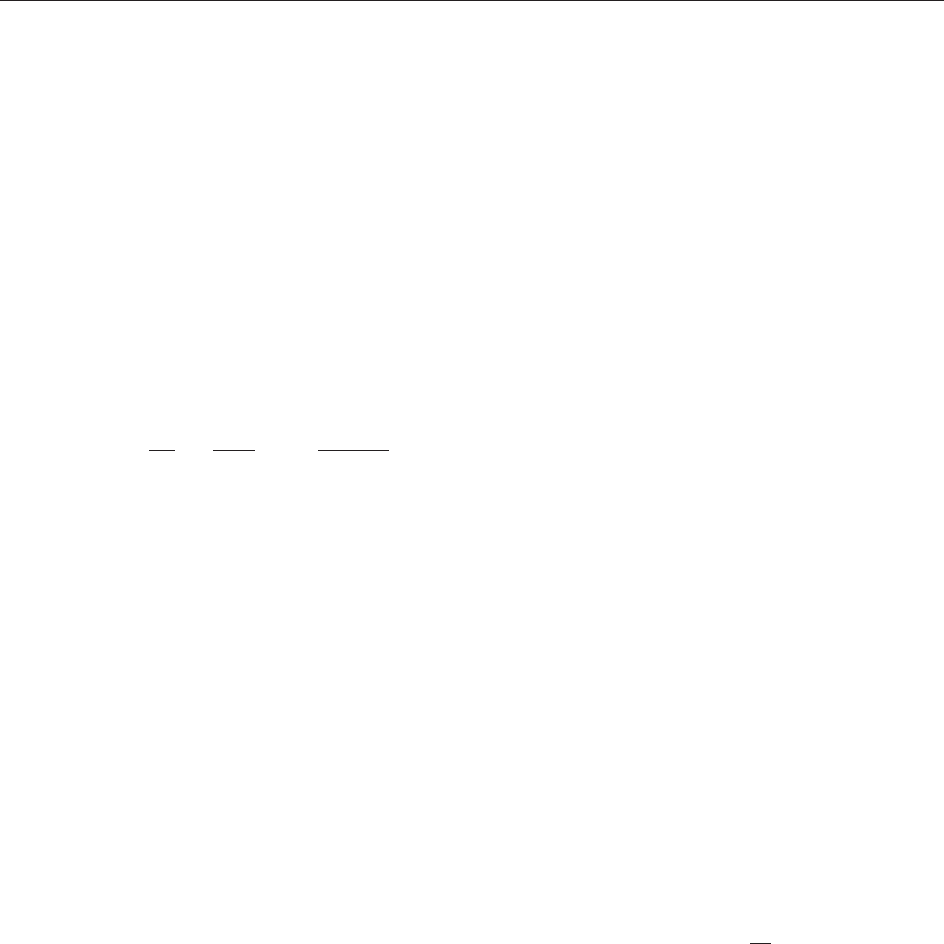
have the same distribution. In particular, they can be
freely substituted under averages.
The auxiliary system which gives rise to the Parisi
representation according to [66] and [67],fora
piecewise constant order parameter, is expressed in
the following way. Now will be a multi-index
= (
1
,
2
, ...,
K
), where each
a
runs on
1, 2, 3, .... Define the Poisson point process y
1
,then,
independently, for each value of
1
processes y
1
2
,
andsoonuptoy
1
2
...
K
. Notice that in the cascade of
independent processes y
1
, y
1
2
, ..., y
1
2
...
K
,thelast
index refers to the numbering of the various points of
the process, while the first indices denote independent
copies labeled by the corresponding ’s.
The weights w
have to be chosen according to
the definition
w
¼ exp
y
1
m
1
exp
y
1
2
m
2
...exp
y
1
2
...
K
m
K
½74
The cavity fields and K have the following
expression in terms of independent unit Gaussian
random variables J
i
1
, J
i
1
2
,..., J
i
1
2
...
K
,J
0
1
, J
0
1
2
,...,
J
0
1
2
...
K
,
i
ðÞ¼
ffiffiffiffiffiffiffiffiffiffiffiffiffiffiffiffi
q
1
q
0
p
J
i
1
þ
ffiffiffiffiffiffiffiffiffiffiffiffiffiffiffiffi
q
2
q
1
p
J
i
1
2
þ
þ
ffiffiffiffiffiffiffiffiffiffiffiffiffiffiffiffiffiffiffiffiffi
q
K
q
K1
p
J
i
1
2
...
K
½75
KðÞ¼
ffiffiffiffiffiffiffiffiffiffiffiffiffiffiffiffi
q
2
1
q
2
0
q
J
0
1
þ
ffiffiffiffiffiffiffiffiffiffiffiffiffiffiffiffi
q
2
2
q
2
1
q
J
0
1
2
þ
þ
ffiffiffiffiffiffiffiffiffiffiffiffiffiffiffiffiffiffiffiffiffi
q
2
K
q
2
K1
q
J
0
1
2
...
K
½76
It is immediate to verify that E(
i
()
i
0
(
0
) is zero if
i 6¼ i
0
, while
Eð
i
ðÞ
i
ð
0
ÞÞ ¼
0if
1
6¼
0
1
q
1
if
1
¼
0
1
;
2
6¼
0
2
q
2
if
1
¼
0
1
;
2
¼
0
2
;
3
6¼
0
3
;
.
.
.
1if
1
¼
0
1
;
2
¼
0
2
; ...;
K
¼
0
K
8
>
>
>
>
>
>
>
<
>
>
>
>
>
>
>
:
½77
Similarly, we have
EðKðÞKð
0
ÞÞ ¼
0if
1
6¼
0
1
q
2
1
if
1
¼
0
1
;
2
6¼
0
2
q
2
2
if
1
¼
0
1
;
2
¼
0
2
;
3
6¼
0
3
;
.
.
.
1if
1
¼
0
1
;
2
¼
0
2
; ...;
K
¼
0
K
8
>
>
>
>
>
>
>
>
>
>
<
>
>
>
>
>
>
>
>
>
>
:
½78
This ends the definition of the system, associated
to a given piecewise constant order pa rameter.
Now, it is simple to verify that [66] and [67]
hold. Let us consider, for example, [66] .Withthe
system chosen as before, the repeated applica-
tion of the stochastic e quivalence of [72] and [73]
will give rise to a sequence of interchained
Gaussian integrations exactly equivalent to those
arising from t he expression for f ,assolutionof
the eqn [60].For[73],thereareequivalent
considerations.
Therefore, we see that the estimate in Theorem 3
is also a consequence of the generalized variational
principle.
Up to this point we have seen how to obtain
upper bounds. The problem arises whether, as in the
ferromagnetic case, we can also get lower bounds,
so as to shrink the thermodynamic limit to the value
given by the inf
x
in Theorem 3. After a short
announcement, Talagrand (2005) has firmly estab-
lished the complete proof of the control of the lower
bound. We refer to the original paper for the
complete details of this remarkable achievement.
About the methods, here we only recall that in
Guerra (2003) we have given also the corrections to
the bounds appearing in Theorem 3, albeit in a quite
complicated form. Talagrand has been able to
establish that these corrections do in fact vanish in
the thermodynamic limit.
In conclusion, we can establish the following
extension of Theorem 1 to spin glasses.
Theorem 4 For the mean-field spin glass model we
have
lim
N!1
N
1
E log Z
N
ð; h; JÞ
¼ sup
N
N
1
E log Z
N
ð; h; JÞ½79
¼ inf
x
log 2 þ f ð0; h; x;Þ
2
2
Z
1
0
qxðqÞdq
½80
Diluted Models
Diluted models, in a sense, play a role intermediate
between the mean-field case and the short-range
case. In fact, while in the mean-field model each site
is interacting with all other sites, on the other hand,
in the diluted model, each site is interacting with
only a fixed number of other sites. However, while
for the short-range models there is a definition of
distance among sites, relevant for the interaction, no
such definition appears in the diluted models, where
all sites are in any case equivalent. From this point
of view, the diluted models are structurally similar
to the mean-field models, and most of the
664 Spin Glasses

techniques and results explained before can be
extended to them.
Let us define a typical diluted model. The
quenched noise is described as follows. Let K be a
Poisson random variable with parameter N, where
N is the number of sites, and is a param eter
entering the theory, together with the temperature.
We consider also a sequence of independent cen-
tered random variables J
1
, J
2
, ..., and a sequence of
discrete independent random variables i
1
, j
1
,
i
2
, j
2
, ..., uniformly distributed over the set of sites
1, 2, ..., N. Then we assume as Hamiltonian
H
N
ðÞ¼
X
K
k¼0
J
k
i
k
j
k
½81
Only the variables contribute to thermodynamic
equilibrium. All noise coming from K, J
k
, i
k
, j
k
is
considered quenched, and it is not explicitly indi-
cated in our notation for H.
The role pla yed by Gaussian integration by
parts in the Sherrington–Kirckpatrick model, here
is assumed by the following elementary derivation
formula, holding for Poisson distributions,
d
dt
PðK ¼ k; tN Þ
d
dt
expðtNÞðtNÞ
k
=k!
¼ NðPðK ¼ k 1; tNÞ
PðK ¼ k; tNÞÞ ½82
Then, all machinery of interpolation can be easily
extended to the diluted models, as firstly recognized
by Franz and Leone in (2003).
In this way, the superaddivity property, the
thermodynamic limit, and the generalized varia-
tional principle can be easily established. We refer to
Franz and Leone (2003), and De Sanctis (2005), for
a complete treatment.
There is an important open problem here. While
in the fully connected case, the Poisson probability
cascades provide the right auxiliary systems to be
exploited in the variational principle, on the other
hand in the diluted case more complicated prob-
ability cascades have been proposed, as shown, for
example, in Franz and Leone (2003), and in
Panchenko and Talagrand (2004). On the other
hand, in De Sanctis (2005), the very interesting
proposal has been made that also in the case of
diluted models the Poisson probability cascades play
a very important role. Of course, here the auxiliary
system interacts with the original system differently,
and involves a multi-overlap structure as explained
in De Sanctis (2005). In this way a kind of very deep
universality is emerging. Poisson probability cas-
cades are a kind of universal class of auxiliary
systems. The different models require different
cavity fields ruling the interaction between the
original system and the auxiliary system. But further
work will be necessary in or der to clarify this very
important issue. For results about diluted models in
the high-temperature region, we refer to Guerra and
Toninelli (2004).
Short-Range Model and Its Connections
with the Mean-Field Version
The investigations of the connections between the
short-range version of the model and its mean-field
version are at the beginning. Here, we limit ourselves
to a synthetic description of what should be done, and
to a short presentation of the results obtained so far.
First of all, according to the conventional wisdom,
the mean-field version should be a kind of limit of the
short-range model on a lattice in dimension d,when
d !1, with a proper rescaling of the strength of the
Hamiltonian, of the form d
1=2
. Results of this kind
are very well known in the ferromagnetic case, but
the present technology of interpolation does not seem
sufficient to assure a proof in the spin glass case. So,
this very basic result is still missing. In analogy with
the ferromagnetic case, it would be necessary to
arrive at the notion of a critical dimension, beyond
which the features of the mean-field case still hold,
for example, in the expression of the critical
exponents and in the ultrametric hierarchical struc-
ture of the pure phases, or at least for the overlap
distributions. For physical dimensions less than the
critical one, the short-range model would need
corrections with respect to its mean-field version.
Therefore, this is a completely open problem.
Moreover, always according to the conventional
wisdom, the mean-field version should be a kind of
limit of the short-range models, in finite fixed
dimensions, as the range of the interaction goes to
infinity, with proper rescaling. Important work of
Franz and Toninel li shows that this is effectively the
case, if a properly defined Kac limit is performed.
Here, interpolation methods are effective, and we
refer to Franz and Toninelli (2004), and references
quoted there, for full details.
Due to the lack of efficient analytical methods, it is
clear that numerical simulations play a very important
role in the study of the physical properties emerging
from short-range spin glass models. In particular, we
refer to Marinari et al. (2000) for a detailed account of
the evidence, coming from theoretical considerations
and extensive computer simulations, that some of the
more relevant features of the spontaneous replica
breaking scheme of the mean field are also present in
Spin Glasses 665

short-range models in three dimensions. Different
views are expressed, for example, in Newman and
Stein (1998), where it is argued that the phase-space
structure of short-range spin glass models is much
simpler than that foreseen by the Parisi spontaneous
replicasymmetrymechanism.
Such very different views, both apparently
strongly supported by reasonable theoretical con-
siderations and powerful numerical simulations, are
a natural consequence of the extraordinary difficulty
of the problem.
It is clear that extensive additional work will be
necessary before the clarification of the physical
features exhibited by the realistic short-range spin
glass models.
Conclusion and Outlook for Future
Developments
As we have seen, in these last few years, there has
been an impressive progress in the understanding of
the mathematical structure of spin glass models,
mainly due to the systematic exploration of com-
parison and interpolation methods. However, many
important problems are still open. The most
important one is to establish rigorously the full
hierarchical ultrametric organization of the overlap
distributions, as appears in Parisi theory, and to
fully understand the decomposition in pure states of
the glassy phase, at low temperatures.
Moreover, it would be important to extend these
methods to other important disordered models as,
for example, neural networks. Here the difficulty is
that the positivity arguments, so essential in com-
parison methods, do not seem to eme rge naturally
inside the structure of the theory.
Finally, the problem of connecting properties of
the short-range model, with those arising in the
mean-field case, is still almost completely open.
Acknowledgment
We gratefully acknowledge useful conversati ons
with Michael Aizenman, Pierluigi Contucci, Giorgio
Parisi, and Michel Talagrand. The strategy
explained in this report grew out from a systematic
exploration of comparison and interpolation meth-
ods, developed in collaborat ion with Fabio Lucio
Toninelli, and Luca De Sanctis.
This work was supported in part by MIUR
(Italian Ministry of Instruction, University and
Research), and by INFN (Italian National Institute
for Nuclear Physics).
See also: Glassy Disordered Systems: Dynamical
Evolution; Large Deviations in Equilibrium Statistical
Mechanics; Mean Field Spin Glasses and Neural
Networks; Short-Range Spin Glasses: The Metastate
Approach; Statistical Mechanics and Combinatorial
Problems.
Further Reading
Aizenman M, Sims R, and Starr S (2003) Extended variational
principle for the Sherrington–Kirkpatrick spin-glass model.
Physical Review B 68: 214403.
De Sanctis L (2005) Structural Approachs to Spin Glasses and
Optimization Problems. Ph.D. thesis, Department of Math-
ematics, Princeton University.
Edwards SF and Anderson PW (1975) Theory of spin glasses.
Journal of Physics F: Metal Physics 5: 965–974.
Franz S and Leone M (2003) Replica bounds for optimization
problems and diluted spin systems. Journal of Statistical
Physics 111: 535–564.
Franz S and Toninelli FL (2004) The Kac limit for finite-range
spin glasses. Physical Review Letters 92: 030602.
Guerra F (2001) Sum rules for the free energy in the
mean field spin glass mod el. Fields Institute Communica-
tions 30: 161.
Guerra F (2003) Broken replica symmetry bounds in the mean
field spin glass model. Communications in Mathematical
Physics 233: 1–12.
Guerra F and Toninelli FL (2002) The thermodynamic limit in
mean field spin glass models. Communications in Mathema-
tical Physics 230: 71–79.
Guerra F and Toninelli FL (2004) The high temperature region of
the Viana–Bray diluted spin glass model. Journal of Statistical
Physics 115: 531–555.
Marinari E, Parisi G, Ricci-Tersenghi F, Ruiz-Lorenzo JJ, and
Zuliani F (2000) Replica symmetry breaking in short range
spin glasses: A review of the theoretical foundations and of the
numerical evidence. Journal of Statistical Physics 98:
973–1074.
Me´zard M, Parisi G, and Virasoro MA (1987) Spin Glass Theory
and Beyond. Singapore: World Scientific.
Me´zard M, Parisi G, and Zecchina R (2002) Analytic and
algorithmic solution of random satisfiability problems. Science
297: 812.
Newman CM and Stein DL (1998) Simplicity of state and overlap
structure in finite-volume realistic spin glasses. Physical
Review E 57: 1356–1366.
Panchenko D and Talagrand M (2004) Bounds for diluted mean-
field spin glass models. Probability Theory Related Fields 130:
319–336.
Sherrington D and Kirkpatrick S (1975) Solvable model of a spin-
glass. Physical Review Letters 35: 1792–1796.
Stein DL (1989) Disordered systems: Mostly spin glasses. In: Stein
DL (ed.) Lectures in the Sciences of Complexity. New York:
Addison-Wesley.
Talagrand M (2003) Spin Glasses: A Challenge for Mathemati-
cians. Mean Field Models and Cavity Method. Berlin:
Springer.
Talagrand M (2006) The Parisi formula. Annals of Mathematics
163: 221–263.
Young P (ed.) (1987) Spin Glasses and Random Fields. Singapore:
World Scientific.
666 Spin Glasses

Spinors and Spin Coefficients
K P Tod, University of Oxford, Oxford, UK
ª 2006 Elsevier Ltd. All rights reserved.
Introduction
Spinors were invented by the mathematician
E Cartan (see, e.g., Cartan (1981) ) in the early
years of the last century in the course of his study of
rotation groups. The physicist Pauli reinvented what
Cartan would have called the spinors of SU( 2),
which is the double cover of the rotation group
SO(3), in order to explain the spectroscopy of alkali
atoms and the anomalous Zeeman effect. For this,
he needed an essential two-valuedness of the
electron, an internal quantum number to contribute
to the angular momentum, which is now called spin.
Now the wave function becomes a two-component
column vector. It is worth noting that, despite the
name, Pauli resisted the picture of an electron as a
spinning ‘‘thing’’ on the grounds that, as a repre-
sentation of SU(2) which was not a representation of
SO(3), it should have no classical kinematic model,
which a spinning object would have.
According to the review article of van der Waerden
(1960), the term ‘‘spinor’’ is due to Ehrenfest in
1929, and was introduced in the flurry of interest
after the next important step in the evolution of
spinors in the physics literature, which was the
introduction of a relativistic equation for the
electron by Dirac (1928).
Dirac sought a linear, first-order but Lorentz-
invariant equation for the electron which was to be
the square root of the linear, Lorentz-invariant but
second-order Klein–Gordon equation. He assumed
the equation for the wave function would take
the form
L :¼ði
a
p
a
þ mcIÞ ¼ 0 ½1
where p
a
= ih@=@x
a
for a = 0, 1, 2, 3, but where
a
are complex square matrices, of a size to be
determined, and I is the corresponding identity
matrix. Differentiating [1] again, one obtains the
Klein–Gordon equation for provided these
matrices satisfy the equation
a
b
þ
b
a
¼ 2
ab
I ½2
where
ab
is the Minkowski metric, diag(1, 1,
1, 1).
Assuming the
a
have been found, the usual
substitution p ! p ieA, for a particle in a mag-
netic field with vector potential A, leads to the
correct magnetic moment for the electron, so that
this equation does describe an electron with spin in
the form made familiar by Pauli.
To decide on the size of the matrices
a
and
therefore the dimension of the space of ’s, one
notices, with the aid of [2], that the following are a
basis for the algebra generated by the
a
:
1;
a
;
½a
b
;
½a
b
c
;
½a
b
c
d
½3
There are 16 elements in this basis, assuming that
there are no ex tra identities among them, so that we
might hope to find a representation as 4 4
matrices. This can be done, and Dirac gave explicit
formulas in terms of Pauli matrices. The space of
Dirac spinors is now a complex four-dimensional
vector space, which turns out to split as the sum of a
complex two-dimensional vector space S, which is
referred to as a spin space, and its complex
conjugate S
¯
(the relationship between a complex
vector space and its complex conjugate is described
in the text below and eqn [9]). Under proper,
orthochronous Lorentz transformations, S trans-
forms into itself by SL(2, C) transform ation, but
space and time reflections relate S to S
¯
. The fact that
there are two spin spaces S and S
¯
in dimension 4 is
the basis of chirality: an electron is represented by a
Dirac spinor , which is a pair of spinors, one in each
of S and S
¯
, which are related under space reflection;
a particle represented just by a spinor in S cannot be
invariant under space reflection.
The Clifford algebra (see Clifford Algebras and
their Representations) associated with a vector space
V with metric g is defined as the algebra genera ted
by elements v, w of V with the multiplication [
satisfying
v [ w þ w [ v ¼ 2gðv; wÞ½4
The matrices
a
define a representation of the
Clifford algebra by associating a covector v
a
with a
matrix v = v
a
a
, since [2] is then equivalent to [4].
This part of the process works in any dimension n
and signature s. For odd n, as, for example, with Pauli
spinors, the
a
are square matrices of size 2
N
2
N
,
where N = (n 1)=2, and there is a single spin space
of dimension 2
N
. For even n, as with the original Dirac
spinors, the
a
are square matrices of size 2
N
2
N
,
where N = n=2, but there are two spin spaces each of
dimension 2
N1
. Reality properties of the spin spaces
and the existence of other structures on them depend
in an intricate way on n and s (Penrose and Rindler
1984, 1986, Benn and Tucker 1987).
Spinors and Spin Coefficients 667

The dimension of the space of spinors rises rapidly
with n, which is one reason why historically spinors
have been most useful in spaces of dimensions 3 and 4,
wherethespinspacehasdimension2.Inaspaceof
dimension 11, a case considered in supergravity, the
spin space already has dimension 32.
Spinors in General Relativity: Spinor
Algebra
In this section, we start again with a different
emphasis. Conventions follow Penrose and Rindler
(1984, 1986). To introduce spinors as a calculus in a
four-dimensional, Lorentzian spacetime M, one can
begin by choosing an orthonormal tetrad of vectors
(e
0
, e
1
, e
2
, e
3
) at a point p. The following conven-
tions are used:
gðe
a
; e
b
Þ¼
ab
¼ diagð1; 1; 1; 1Þ
Any vector v in the tangent space V = T
p
M at p has
components v
a
in this basis, which we arrange as a
matrix and label in two ways:
ðvÞ¼
1
ffiffiffi
2
p
v
0
þv
3
v
1
þiv
2
v
1
iv
2
v
0
v
3
¼
v
00
0
v
01
0
v
10
0
v
11
0
½5
The reason for the factor 1=
ffiffiffi
2
p
will be seen below,
as will the rationale for the second form of the
matrix. Note that (v) is Hermitian an d that
2 det ðvÞ¼gðv; vÞ¼
ab
v
a
v
b
½6
Clearly, there is a one-to-one correspondence
between elements of V and Hermitian 2 2
matrices. Further, if t is any matrix in SL(2, C),then
the transformation
ðvÞ!tðvÞt
y
½7
where t
y
is the Hermitian conjugate of t,islinearinv,
and preserves both Hermiticity and the norm of v.
Thus, it must represent a Lorentz transformation. It is
straightforward to check that it is a proper, ortho-
chronous Lorentz transformation and that all such
transformations arise in this way (recall that ‘‘proper’’
means transformations of determinant 1 so that
orientation is preserved, and ‘‘orthochronous’’ means
that future-pointing timelike or null vectors are taken
to future-pointing timelike or null vectors, so that time
orientation is preserved; the proper, orthochronous
Lorentz group is equivalently the identity-connected
component of the Lorentz group). Since both t and t
give the same Lorentz transformation, this provides an
explicit demonstration of the (2 – 1)-homomorphism
of SL(2,C) with the proper, orthochronous Lorentz
group O
"
þ
(1,3).
If the vector v in [5] is null, then the matrix has
vanishing determinant, or, equivalently, it has rank
1, and so it can be written as the outer product of a
two-component column vector = (
0
,
1
)
T
and its
Hermitian conjugate:
ðvÞ¼
y
½8
Furthermore, under [7], transforms as
! t ½9
The two-complex-dimensional space to which
belongs is the spin space S at p,alreadymetinthe
previous section, and it follows from [8],sincenull
vectors span V, that the tensor product S
¯
S of S with
its complex conjugate vector space S
¯
is the complex-
ification of V. Complex conjugation gives an antilinear
map from S to S
¯
. (One associates the complex-
conjugate vector space V
¯
to any given complex vector
space V as follows: scalar multiplication for V can be
considered as a function : C V ! V given by
(z, v) = zv, while vector addition is a map : V
V ! V given by (u, v) = u þ v
.Defineanother
complex vector space by taking the same vectors and
the same but with scalar multiplication
, where
(z, v) = (
¯
z, v). This is the complex-conjugate vector
space V
¯
. Given a choice of basis, we think of V as, say,
n-component column vectors of complex numbers,
and then V
¯
is the corresponding complex-conjugate
columns.)
Conventionally, S is the space of unprimed spinors
and S
¯
the space of primed spinors, and one also has
the two duals S
0
and
¯
S
0
which are associated in the
corresponding way to the dual V
0
of V. Analogously
to the situation with vectors and covectors, index
conventions for spinors are as follows:
A
2 S;
A
0
2
S;
A
2 S
0
;
A
0
2
S
0
where A = 0, 1, A
0
= 0
0
,1
0
.
Spinor algebra mirrors tensor algebra: a spinor
A
1
...A
p
A
0
1
...A
0
q
B
1
...B
r
B
0
1
...B
0
s
is an element of the tensor
product of p copies of S, q copies of S
¯
, r copies of S
0
,
and s copies of
¯
S
0
. The second way of writing the
matrix in [5] enables the identification of a vector
with a matrix to be conventionally written as
v
a
¼ v
AA
0
½10
andthenextendedtoanytensorT
a...b
c...d
by replacing
each vector index, say b,withapairBB
0
of spinor
indices. In particular, from [8], it follows that any
real null vector n
a
can be written in the form
n
a
¼
A
A
0
for some spinor
A
.
668 Spinors and Spin Coefficients

One must pay attention to the order of spinor
indices of a given type, primed or unprimed, but by
convention may permute primed and unprimed
indices. A spinor with an equa l number n of primed
and unprimed indices corresponds to a tensor of
valence n, and the tensor is real if the spinor satisfies
a suitable Hermiticity relation.
Spinors may have various symmetries among their
indices, much as tensors have. However, since S is two
dimensional, there is only a one-dimensional space of
2-forms on S. This has two consequences: no spinor
can be antisymmetric over more than two indices; and
if we make a choice of canonical 2-form, all spinors
can be written in terms of symmetric spinors and the
canonical 2-form. This is a decomposition of spinors
into irreducibles for SL(2, C).
One makes a choice of 2-form
AB
according to
AB
¼
BA
;
01
¼ 1
There is an inverse
AB
defined by
AC
BC
¼
A
B
½11
where
A
B
is the Kronecker delta. The complex
conjugate of
AB
is conventionally written without
an overbar as
A
0
B
0
, and analogously
A
0
B
0
is the
complex conjugate of
AB
.
Because of the antisymmetry of
AB
, order of
indices is crucial in equations such as [11]. The
2-form
AB
has a role akin to that of a metric as it
provides an identification of S and its dual,
according to
A
!
B
¼
A
AB
B
!
A
¼
AB
B
with corresponding formulas for primed spinors.
Note that, because of the antisymmetry of
AB
,
necessarily
A
A
= 0 for any
A
.
With conventions made so far, it can be checked
that
g
ab
v
a
v
b
¼
AB
A
0
B
0
v
AA
0
v
BB
0
½12
for any vector v
a
, where g
ab
is the spacetime metric
at p, so that
g
ab
¼
AB
A
0
B
0
It is the desire to have this formula without
constants that necessitates the choice of the factor
1=
ffiffiffi
2
p
in [5].
One final piece of spinor algebra that we note is
the following: given a symmetric spinor
A
1
...A
n
there
is a factorization
A
1
...A
n
¼
ð1Þ
ðA
1
ðnÞ
A
n
Þ
½13
where the round brackets indicate symmetrization
over the indices A
1
, ..., A
n
, and the n spinors
(1)
A
1
, ...,
(n)
A
n
, which are determined only up to
reordering and rescaling, are known as the principal
spinors of . To prove this, note that the principal
spinors can be identified with the solutions
A
of the
equation
A
1
...A
n
A
1
A
n
¼ 0
and there are n of these, co unting multiplicities, by
the ‘‘fundamental theorem of algebra.’’
Spinors in General Relativity: Spinor
Calculus
We now want to define spinor fields on the
spacetime M as sections of a spinor bundle S
whose fiber at each point is S and such that the
tensor product S
S is the complexified tangent
bundle. The existence of such an S imposes global
restrictions on M: M must be orientable and time
orientable, and a certain characteristic class, the
second Stiefel–Whitney class, must vanish (for an
explanation of these terms see, e.g., Penrose and
Rindler (1984, 1986)). Assuming that M satisfies
these conditions, spinor fields can be defined. It is
convenient to retain the algebraic formulas from the
previous section (e.g., [10] or [12]) but with indices
now regarded as abstract (a note on the abstract
index convention appears in Twistors).
By an argument analogous to that for the
fundamental theorem of Riemannian geometry,
there is a unique covariant derivative that satisfies
the Leibniz condition, coincides with the Levi-
Civita derivative on tensors and the gradient on
scalars, and annihilates
AB
and
A
0
B
0
. Following the
conventions of the previous section, the spinor
covariant derivative will be denoted as r
AA
0
.The
commutator of derivatives can be written in terms
of irreduc ible parts (for SL(2, C)) according to the
formula
r
AA
0
r
BB
0
r
BB
0
r
AA
0
¼
A
0
B
0
AB
þ
AB
A
0
B
0
where
AB
= r
C
0
(A
r
C
0
B)
. The definition of the
Riemann curvature tensor is in term s of the Ricci
identity
ðr
a
r
b
r
b
r
a
Þv
c
¼ R
abd
c
v
d
and then this translates into two Ricci identities for
a spinor field:
AB
C
¼
ABCD
D
A
0
B
0
C
¼
A
0
B
0
CD
D
Spinors and Spin Coefficients 669

The curvature spinors
ABCD
and
A
0
B
0
CD
are related
to the curvature tensor. The Ricci spinor
A
0
B
0
AB
is
Hermitian and symmetric on both index pairs and is
a multiple of the trace-free part of the Ricci tensor:
A
0
B
0
AB
¼
1
2
R
ab
1
4
Rg
ab
The spinor
ABCD
is symmetric on the first and last
pairs of indices and decomposes into irreducibles
according to
ABCD
¼
ABCD
2
DðA
BÞC
where =R=24 in terms of the Ricci scalar or scalar
curvature R, while
ABCD
, which is totally sym-
metric and is known as the Weyl spinor, is related to
the Weyl tensor C
abcd
by the equation
C
abcd
¼
ABCD
A
0
B
0
C
0
D
0
þ
A
0
B
0
C
0
D
0
AB
CD
Thus, the ten real components of the Weyl tensor
are coded into the five complex components of the
Weyl spinor.
Following the last remark in the previous section,
the Weyl spinor has four principal spinors, each of
which defines a null direction, the principal null
directions of the Weyl tensor. There is a classifica-
tion of Weyl tensors, the Petrov–Pirani–Penrose
classification, based on coincidences among the
principal null direction s (Penrose and Rindler
1984, 1986).
As a final exercise in spinor calculus, we recall the
zero-rest-mass equations (see Twistors). In flat
spacetime, these are the equations
r
A
0
A
AB...C
¼ 0
on a totally symmetric spinor field
AB...C
. The field
is said to have spin s if it has 2s indices, and the
cases s = 1=2, 1, or 2, respectively, are the Weyl
neutrino equation, the Maxwell equation, and the
linearized Einstein equation. In flat spacetime, these
hyperbolic equations are well understood and
solvable in a variety of ways. In curved spacetime,
however, if s 3=2, then there are curvature
obstructions to the existence of solutions, known
as Buchdahl conditions. This can be seen at once by
differentiating again, say by r
B
A
0
, and using the
spinor Ricci identity. After a little algebra, one finds
ABC
ðD
E...FÞABC
¼ 0
so that, whenever the field has three or more indices,
there are algebraic constraints on its components in
terms of the Weyl spinor.
The Spin-Coefficient Formalism
The spin-coefficient formalism of Newman and
Penrose is a formalism for spinor calculus in space-
times (see, e.g., Penrose and Rindler (1984, 1986)
and Stewart (1990)). It finds application in
any calculation dealing with curvature tensors,
including solving the Einstein equations. The form-
alism exploits the compression of terminology which
the introduction of complex quantities permits.
The formalism starts with a choice of spinor dyad,
a basis of spinor fields (o
A
,
A
) normalized so that
o
A
A
= 1. From the dyad, one constructs a null
tetrad, which is a basis of vector fields, according to
the scheme
‘
a
¼ o
A
o
A
0
; n
a
¼
A
A
0
; m
a
¼ o
A
A
0
;
m
a
¼
A
o
A
0
Given the normalization of the spinor dyad, each of
the vectors in the null tetrad is null (hence the name)
and all inner products are zero, except for
‘
a
n
a
¼ 1 ¼m
a
m
a
It follows that the metric can be written in the
basis as
g
ab
¼ 2‘
ða
n
bÞ
2m
ða
m
bÞ
The components of the covariant derivative in the
null tetrad are given separate names according to the
following scheme:
‘
a
r
a
¼ D; n
a
r
a
¼ ; m
a
r
a
¼ ;
m
a
r
a
¼
and the spin coefficients are the 12 components of
the covariant deri vative of the basis. Each is labeled
with a Greek letter according to the following
scheme:
Do
A
¼ o
A
A
; o
A
¼ o
A
A
o
A
¼ o
A
A
;
o
A
¼ o
A
A
D
A
¼ o
A
A
;
A
¼ o
A
A
A
¼ o
A
A
;
A
¼ o
A
A
½14
The spin coefficients code the 24 real Ricci rotation
coefficients into 12 compl ex quantities. Some of the
spin coefficients have direct geometrical interpreta-
tion. For example, the vanishing of is the
condition for the integral curves of ‘
a
to be geodesic,
while, if is also zero, this congruence of geodesics
is shear free. The same role is played by and for
the n
a
-congruence. The real and imaginary parts of
are, respectively (minus), the expansion and the
twist of the congruence of integral curves of ‘
a
.
670 Spinors and Spin Coefficients

In pr actice, it is often simpler to calculate the spin
coefficients from the commutators of the basis
vectors, now regarded as directional derivatives, as
follows:
DD ¼ð þ
ÞDþðþ
Þ ð þÞ ð þÞ
D D ¼ð
þ ÞDþ ð
þ
Þ
¼
D þð
Þ þð þ
Þ þ
¼ð
Þ D þð
Þ þð
Þ ð
Þ
½15
The commutator of second derivatives applied to
the spinor dyad expresses the components of the
curvature tensor in terms of the derivatives of
the spin coefficients. Before presen ting these, we
adopt a convention for labeling the components of
curvature. The components of the Weyl spinor are
given as follows:
0
¼
ABCD
o
A
o
B
o
C
o
D
1
¼
ABCD
o
A
o
B
o
C
D
2
¼
ABCD
o
A
o
B
C
D
3
¼
ABCD
o
A
B
C
D
4
¼
ABCD
A
B
C
D
½16
so that these five complex scalars encode the ten real
components of the Weyl tensor. For the Ricci spinor, set
00
¼
ABA
0
B
0
o
A
o
B
o
A
0
o
B
0
;
01
¼
ABA
0
B
0
o
A
o
B
o
A
0
B
0
02
¼
ABA
0
B
0
o
A
o
B
A
0
B
0
;
11
¼
ABA
0
B
0
o
A
B
o
A
0
B
0
12
¼
ABA
0
B
0
o
A
B
A
0
B
0
;
22
¼
ABA
0
B
0
A
B
A
0
B
0
together with
10
=
01
,
20
=
02
,and
21
=
12
.
The nine components of the trace-free Ricci tensor
are encoded in these scalars of which three are real
and three complex. The Ricci scalar, as before, is
replaced by the real scalar =R=24.
Now the commutators of covariant derivatives on
the spinor dyad lead to the following system:
D
¼
2
þ þð þ
Þ
ð3 þ
Þ þ
00
D ¼ð þ
þ 3
Þ
ð þ
þ 3Þ þ
0
D ¼ð þ Þ þð þ Þ þð
Þ
ð3 þ
Þ þ
1
þ
01
D
¼ð þ
2Þ þ
þð þ Þ þ
10
D ¼ð þ Þ þð
Þ ð þ Þ
ð
Þ þ
1
D ¼ð þÞ þð þÞ ð þ
Þ ð þ
Þ
þþ
2
þ
11
D
¼ð 3 þ
Þ þ þð þ
Þ
þ
20
D ¼ð
Þ þ þð
þÞ
þ
2
þ2
D ¼ð þ Þ þð þÞ þð
Þ
ð3 þ
Þ þ
3
þ
21
¼ð þ
þ3
Þ
þð3 þ
þ Þ
4
¼ð
þÞ ð3
Þ þð
Þ
þð
Þ
1
þ
01
¼ þ
þ
2 þð
Þ
þð
Þ
2
þ þ
11
¼ð
Þ þð
Þ þð þ
Þ
þð
3Þ
3
þ
21
¼ð þ þ
Þ
þ
þð
þ3 Þ
22
¼ð
þ Þ þ þ
þð
Þ
12
¼ð 3 þ
Þ
ð þ
Þ
þ
02
¼ð þ
Þ þð
Þ
þ
2
2
¼ð þÞ ð þÞ þð
Þ
þð
Þ
3
½17
Finally, it is possible to write out the Bianchi
identities in this formalism. For simplicity, and
with a view to an application, we do this below
only for vacuum, so that the Ricci tensor is zero:
D
1
0
¼ð 4Þ
0
þ 2ð2 þ Þ
1
3
2
0
1
¼ð4 Þ
0
2ð2 þ Þ
1
þ 3
2
D
2
1
¼
0
þ 2ð Þ
1
þ 3
2
2
3
1
2
¼
0
þ 2ð Þ
1
3
2
þ 2
3
D
3
2
¼2
1
þ 3
2
þ 2ð Þ
3
4
2
3
¼ 2
1
3
2
þ 2ð Þ
3
þ
4
D
4
3
¼3
2
þ 2ð þ 2Þ
3
þð 4Þ
4
3
4
¼ 3
2
2ð þ 2Þ
3
þð4 Þ
4
½18
The whole system is then loosely described as the
spin-coefficient equations.
As a simple application, we shall prove the
Goldberg–Sachs theorem: for vacuum spacetimes, a
Spinors and Spin Coefficients 671