
Francoise J.-P., Naber G.L., Tsun T.S. (editors) Encyclopedia of Mathematical Physics
Подождите немного. Документ загружается.

where < , >
diff
denotes the inner product in the
Hilbert space of solutions of the vector constraint,
and the exponential has been expanded in power s in
the last expression on the right-hand side.
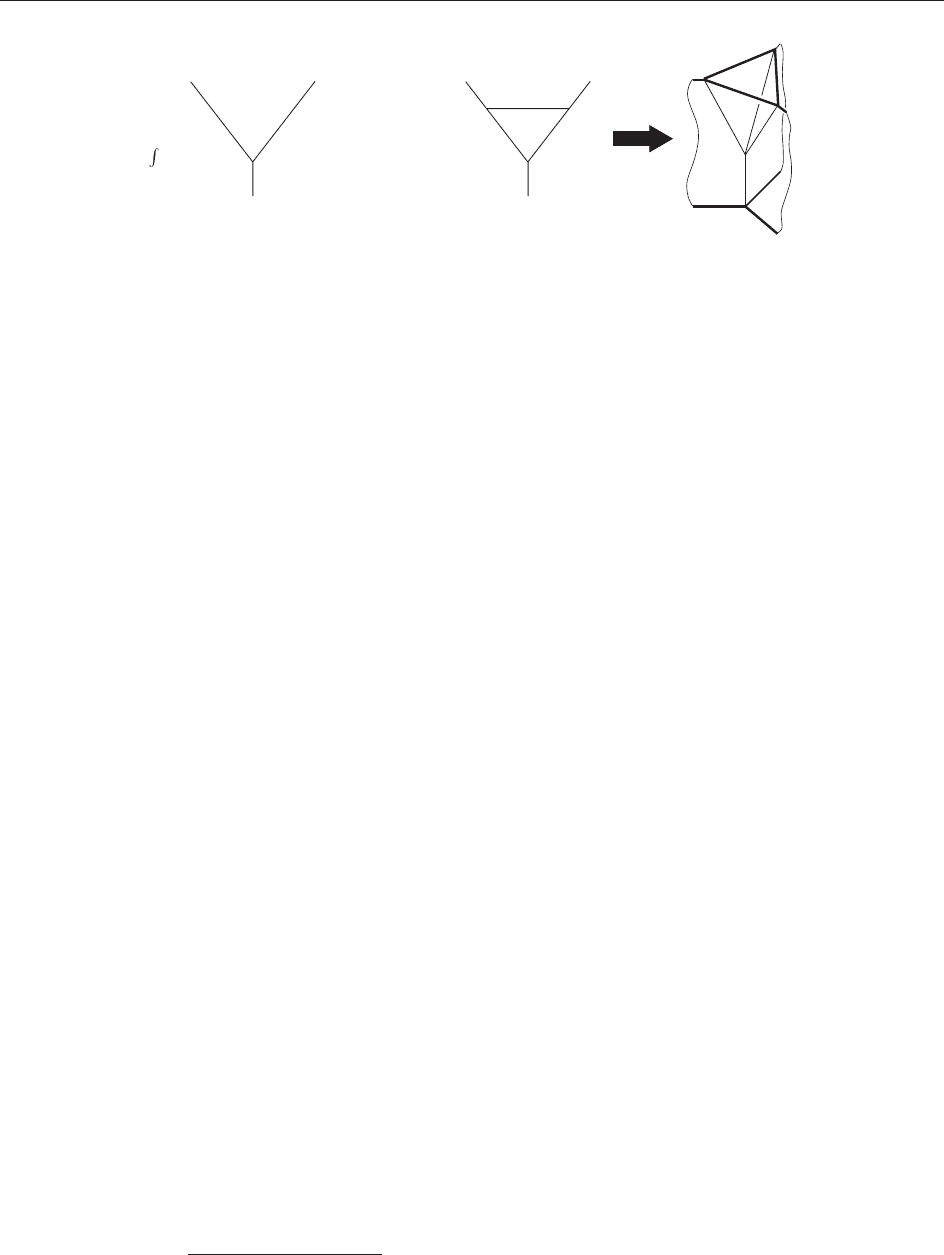
From early on, it was realized that smooth loop
states are naturally annihilated by
b
S (indepen-
dently of any quantization ambiguity). Conse-
quently,
b
S acts only on spin network nodes.
Generically, it does so by creating new links and
nodes modifying the underlying graph of the spin
network states (Figure 11).
Therefore, each term in the sum [30] represents a
series of transitions – given by the local action of
b
S
at spin network nodes – through different spin
network states interpolating the boundary states s
and s
0
, respectively. The action of
b
S can be
visualized as an ‘‘interaction vertex’’ in the ‘‘time’’
evolution of the node (Figure 11). A s in the explicit
3D case, eqn [30] can be expressed as sum over
‘‘histories’’ of spin networks pictured as a system of
branching surfaces described by a 2-complex whose
elements inherit the representation labels on the
intermediate states. The value of the ‘‘transition’’
amplitudes is controlled by the matrix elements of
b
S. Therefore, although the qualitative picture is
independent of quantization ambiguities, transition
amplitudes are sensitive to them.
Before even considering the issue of convergence
of [30], the problem with this definition is evident:
every single term in the sum is a divergent integral!
Therefore, this way of presenting spin foams has to
be considered as formal until a well-defined regular-
ization of [2] is provided. That is the goal of the spin
foam approach.
Instead of dealing with an infinite number of
constraints Thiemann recently proposed to impose
one single master constraint de fined as
M ¼
Z
dx
3
S
2
ðxÞq
ab
V
a
ðxÞV
b
ðxÞ
ffiffiffiffiffiffiffiffiffiffiffiffiffiffiffiffiffi
det qðxÞ
p
½31
Using techniques developed by Thiemann, this
constraint can indeed be promoted to a quantum
operator acting on H
kin
. The physical inner product
is given by
<s; s
0
>
p
:¼ lim
T!1
<s;
Z
T
T
dt e
it
b
M
s
0
> ½32
A spin foam representation of the previous expres-
sion could now be achieved by the standard
skeletonization that leads to the path-integral repre-
sentation in quantum mechanics. In this context,
one splits the t -parameter in discrete steps and
writes
e
it
b
M
¼ lim
N!1
½e
it
b
M=N
N
¼ lim
N!1
½1 þ it
b
M=N
N
½33
The spin foam representation follows from the fact
that the action of the basic operator 1 þ it
b
M=N on a
spin network can be written as a linear combination
of new spin networks whose graphs and labels have
been modified by the creation of new nodes (in a
way qualitatively analogous to the local action
shown in Figure 11). An explicit derivation of the
physical inner product of 4D LQG along these lines
is under current investigation.
Spin Foams from the Covariant Formulation
In 4D, the spin foam representation of the dynamics
of LQG has been investigated more intensively in
the covariant formulation. This has led to a series of
constructions which are referred to as spin foam
models. These treatments are related more closely to
the construction based on the covariant path-
integral approach of the last section. Here we
illustrate the formulation which has captured much
interest in the literature: the Barrett–Crane (BC)
model.
Spin foam models for gravity as constrained quan-
tum BF theory The BC model is one of the most
extensively studied spin foam models for quantum
gravity. To introduce the main ideas involved, we
concentrate on the definition of the model in the
Riemannian sector. The BC model can be formally
j
p
o
n
k
m
j
k
m
p
o
n
N(x
n
)S
nop
Σ
nop
=
j
k
m
N(x)S(x)
Δ
ˆ
Σ
Figure 11 The action of the scalar constraint and its spin foam representation. N(x
n
) is the value of N at the node and S
nop
are the
matrix elements of
b
S.
652 Spin Foams
viewed as a spin foam quantization of SO(4)
Plebanski’s form ulation of general relativity. Ple-
banski’s Riemannian action depends on an SO(4)
connection A, a Lie-alg ebra-valued 2-form B , and
Lagrange multiplier fields and . Writing explicitly
the Lie algebra indices, the action is given by
S½B; A;;
¼
Z
B
IJ
^ F
IJ
ðAÞþ
IJKL
B
IJ
^ B
KL
þ
IJKL
IJKL
½34
where is a 4-form and
IJKL
=
JIKL
=
IJLK
=
KLIJ
is a tensor in the internal space.
Variation with respect to imposes the constraint
IJKL
IJKL
= 0on
IJKL
. The Lagrange multiplier
tensor
IJKL
has then 20 independent components.
Variation with respect to imposes 20 algebraic
equations on the 36 components of B. The (non-
degenerate) solutions to the equations obtained by
varying the multipliers and are
B
IJ
¼
IJKL
e
K
^ e
L
and
B
IJ
¼e
I
^ e
J
½35
in terms of the 16 remaining degrees of freedom of
the tetrad field e
I
a
. If one substitutes the first solution
into the original action, one obtains Palatini’s
formulation of general relativity; therefore, on shell
(and on the right sector), the action is that of
classical gravity.
The key idea in the definition of the model is that
the path integral for the theory corresponding to the
action S[B, A, 0, 0], namely
P
topo
¼
Z
D½BD½Aexp i
Z
B
IJ
^ F
IJ
ðAÞ
½36
can be given a meani ng as a spin foam sum, [4],in
terms of a simple generalization of the construction
of the previous sect ion. In fact, S[B, A, 0, 0] corre-
sponds to a simple theory known as BF theory that
is formally very similar to 3D gravity (see BF
Theories). The result is independent of the chosen
discretization because BF theory does not have local
degrees of freedom (just as 3D gravity).
The BC model aims at providing a definition of
the path integral of gravity pursuing a well-posed
definition of the formal expression
P
GR
¼
Z
D½BD½A B !
IJKL
e
K
^ e
L
exp i
Z
B
IJ
^ F
IJ
ðAÞ
½37
where D[B]D[A](B !
IJKL
e
K
^ e
L
) means that one
must restrict the sum in [36] to those configurations
of the topological theory satisfying the constraints
B = (e ^ e) for some tetrad e. The remarkable fact
is that this restriction can be implemented in a
systematic way directly on the spin foam configura-
tions that define P
topo
.
In P
topo
spin foams are labeled with spins corre-
sponding to the unitary irreducible representations of
SO(4) (given by two spin quantum numbers (j
R
, j
L
)).
Essentially, the factor ‘‘(B !
IJKL
e
K
^ e
L
)’’ restricts
the set of spin foam quantum numbers to the so-
called simple representations (for which j
R
= j
L
= j).
This is the ‘‘quantum’’ version of the solution to the
constraints [35]. There are various versions of this
model. The simplest definition of the transition
amplitudes in the BC model is given by
Pðs
sÞ¼
X
fjg
Y
f 2 F
s!s
0
ð2j
f
þ 1Þ
f
Y
v2F
s!s
0
X
1
5
ι
2
ι
1
ι
3
ι
5
ι
4
j
12
j
15
j
14
j
45
j
35
j
24
j
25
j
13
j
23
j
34
ι
1
*
ι
3
*
ι
2
*
j
15
*
j
12
*
j
23
*
ι
5
*
j
45
*
j
14
*
j
35
*
j
25
*
j
24
*
j
13
*
j
34
*
ι
4
*
½38
where we use the notation of [22], the graphs denote
15j-symbols, and
i
are half-integers labeling SU(2)
normalized 4-intertwiners. No rigorous connection
with the Hilbert space picture of LQG has yet been
established. The self-dual version of Plebanski’s
action leads, through a similar construction, to
Reisenberger’s model.
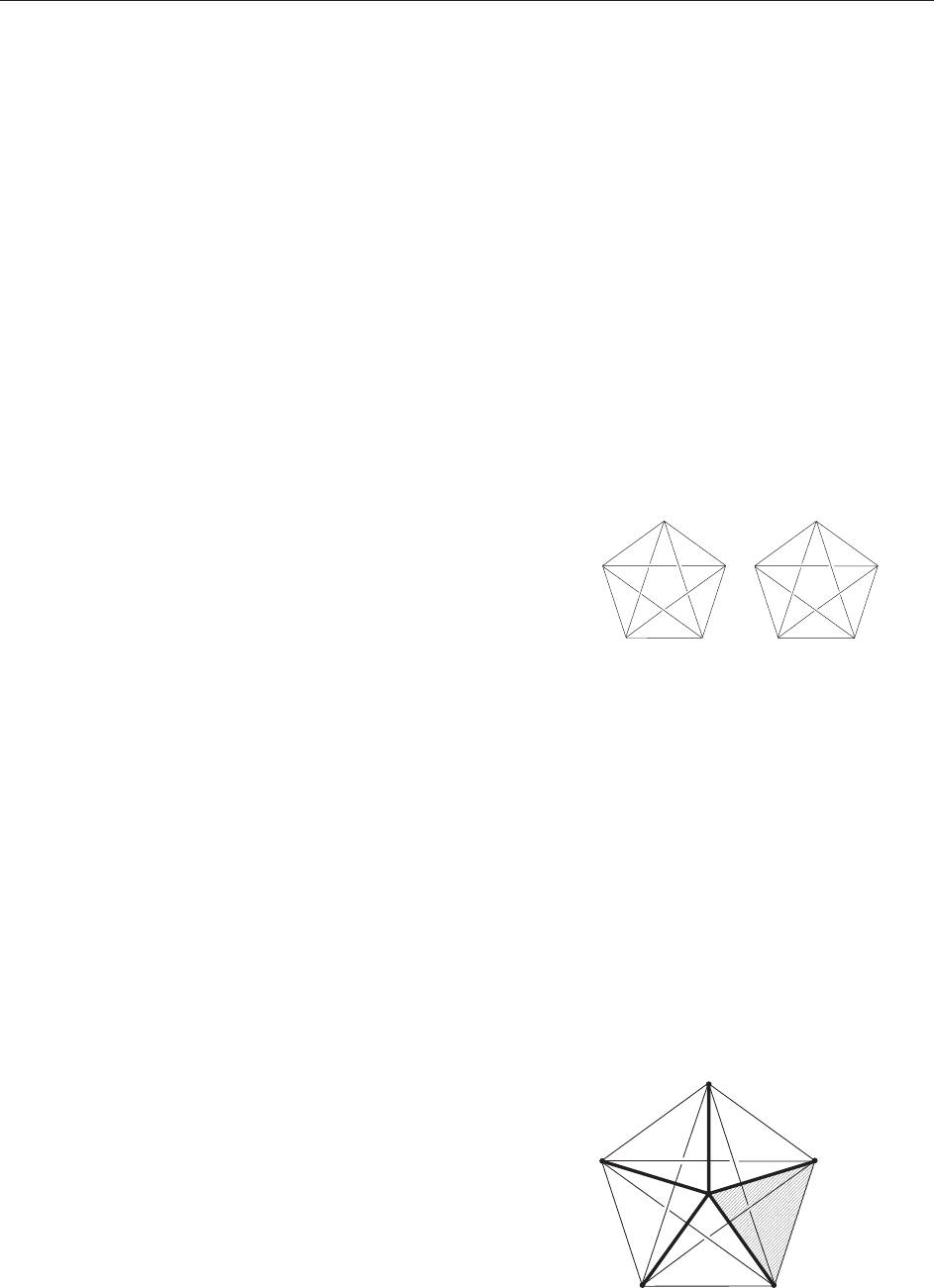
The simplest amplitude in the BC model corre-
sponds to a single 4-simplex, which can be viewed
as the simplest triangulation of the 4D spacetime
given by the interior of a 3-sphere (the correspond-
ing 2-complex is shown in Figure 12). States of the
4-simplex are labeled by ten spins j (labeling the ten
edges of the boundary spin network, see Figure 12)
which can be shown to be related to the area in
1
2
3
4
5
0
Figure 12 The dual of a 4-simplex.
Spin Foams 653
Planck units of the ten triangular faces that form the
4-simplex. A first indication of the connection of the
model with gravity was that the large-j asymptotics
appeared to be dominated by the exponential of the
Regge action (the action derived by Regge as a
discretization of general relativity). This estimate
was done using the stationary-phase approximation
to the integral that gives the amplitude of a
4-simplex in the BC model. However, more detailed
calculations showed that the amplitude is dominated
by configurations corresponding to degenerate
4-simplexes. This seems to invalidate a simple
connection to general relativity and is one of the
main puzzles in the model.
Spin Foams as Feynman Diagrams
The main problem with the models of the previous
section is that they are defined on a discretization
of M and that – contrary to what happens with a
topological theory, for example, 3D gravity
(eqn [29]) – the amplitudes depend on the discretiza-
tion . Various possibilities to eliminate this reg-
ulator have been discussed in the literature but no
explicit results are yet known in 4D. An interesting
proposal is a discretization-independent definition of
spin foam models achieved by the introduction of an
auxiliary field theory living on an abstract group
manifold – Spin(4)
4
and SL(2, C)
4
for Riemannian
and Lorentzian gravity, respectively. The action of
the auxiliary group field theory (GFT) takes the form
S½¼
Z
G
4
2
þ
5!
Z
G
10
M
ð5Þ
½½39
where M
(5)
[] is a fifth-order m onomial, and
G is the corresponding group. In the simp-
lest m odel, M
(5)
[] = (g
1
, g
2
, g
3
, g
4
)(g
4
, g
5
, g
6
, g
7
)
(g
7
, g
3
, g
8
, g
9
)(g
9
, g
6
, g
2
, g
10
)(g
10
, g
8
, g
5
, g
1
). The
field is required to be invariant under the
(simultaneous) right action of the group on its
four arguments in addition to other sym metries
(not described here f or simplicity). The perturba-
tive expansion in of the GFT Euclidean path
integral is given by
P ¼
Z
D½e
S½
¼
X
F
N
N
sym½F
N
A½F
N
½40
where A[F
N
] corresponds to a sum of Feynman-
diagram amplitudes for diagrams with N interaction
vertices, and sym[F
N
] denotes the standard symme-
try facto r. A remarkable property of this expansion
is that A[F
N
] can be expressed as a sum over spin
foam amplitudes, that is, 2-complexes labeled by
unitary irreduci ble representations of G. Moreover,
for very simple interaction M
(5)
[], the spin foam
amplitudes are in one-to-one correspondence to
those found in the models of the previous section
(e.g., the BC model). This duality is regarded as a
way of providing a fully combinatorial definition of
quantum gravity where no reference to any dis-
cretization or even a manifold structure is made.
Transition amplitudes between spin network states
correspond to n-point functions of the field theory.
These models have been inspired by generalizations
of matrix models applied to BF theory.
Divergent transition amplitudes can arise by the
contribution of ‘‘loop’’ diagrams as in standard
quantum field theory. In spin foams, diagrams
corresponding to 2D bubbles are potentially divergent
because spin labels can be arbitrarily high leading to
unbounded sums in [4]. Such divergences do not occur
in certain field theories dual (in the sense above) to the
BC model. However, little is known about the
convergence of the series in and the physical meaning
of this constant. Nevertheless, Freidel and Louapre
have shown that the series can be re-summed in certain
models dual to lower-dimensional theories.
Causal Spin Foams
Let us con clude by presenting a fundamentally
different construction leading to spin foams. Using
the kinematical setting of LQG with the assumption
of the existence of a microlocal (in the sense of
Planck scale) causal structure, Markopoulou and
Smolin define a general class of (causal) spin foam
models for gravity. The elementary transition ampli-
tude A
s
I
!s
Iþ1
from an initial spin network s
I
to
another spin network s
Iþ1
is defined by a set of
simple combinatorial rules based on a definition of
causal propagation of the information at nodes. The
rules and amplitudes have to satisfy certain causal
restrictions (motivated by the standard concepts
in classical Lorentzian physics). These rules gene-
rate surface-like excitations of the same kind one
encounters in the previous formulations. Spin foams
F
N
s
i
!s
f
are labeled by the number of times, N, these
elementary transitions take place. Transition
amplitudes are defined as
hs
i
; s
f
i¼
X
N
AðF
N
s
i
!s
f
Þ½41
which is of the generic form [4]. The models are not
related to any continuum action. The only guiding
principles in the construction are the restrictions
imposed by causality, and the requirement of the
existence of a nontrivial critical behavior that
reproduces genera l relativity at large scales. Some
indirect evidence of a possible nontrivial continuum
limit has been obtained in certain versions of these
models in 1 þ 1 dimensions.
654 Spin Foams
See also: Algebraic Approach to Quantum Field Theory;
BF Theories; Canonical General Relativity; Chern–
Simons Models: Rigorous Results; Lattice Gauge
Theory; Loop Quantum Gravity; Quantum Dynamics in
Loop Quantum Gravity; Quantum Geometry and its
Applications; Topological Quantum Field Theory:
Overview.
Further Reading
Ashtekar A (1991) Lectures on Nonperturbative Canonical
Gravity. Singapore: World Scientific.
Ashtekar A and Lewandowski J (2004) Background independent
quantum gravity: a status report.
Baez J (1998) Spin foams. Classical and Quantum Gravity 15:
1827–1858.
Baez J (2000) An introduction to spin foam models of quantum
gravity and BF theory. Lecture Notes in Physics 543: 25–94.
Baez J and Muniain JP (1995) Gauge fields, Knots and Gravity.
Singapore: World Scientific.
Oriti D (2001) Spacetime geometry from algebra: spin foam
models for nonperturbative quantum gravity. Reports on
Progress in Physics 64: 1489–1544.
Perez A (2003) Spin foam models for quantum gravity. Classical
and Quantum Gravity 20: R43.
Rovelli C Quantum Gravity. Cambridge: Cambridge University
Press (to appear).
Thiemann T Modern Canonical Quantum General Relativity.
Cambridge: Cambridge University Press (to appear).
Spin Glasses
F Guerra,Universita
`
di Roma ‘‘La Sapienza’’,
Rome, Italy
ª 2006 Elsevier Ltd. All rights reserved.
Introduction
From a physical point of view, spin glasses, as dilute
magnetic alloys, are very interesting systems. They
are characterized by such features as exhibiting a new
magnetic phase, where magnetic moments are frozen
into disordered equilibrium orientations, without any
long-range order. See, for example, Young (1987) for
general reviews, and also Stein (1989) for a very
readable account about the physical properties of
spin glasses. The experimental laboratory study of
spin glasses is a very difficult subject, because of their
peculiar properties. In particular, the existence of
very slowly relaxing modes, with consequent memory
effects, makes it difficult to realize the very basic
physical concept of a system at thermodynamical
equilibrium, at a given temperature.
From a theoretical point of view some models
have been proposed, which try to capture the
essential physical features of spin glasses, in the
frame of very simple assumptions.
The basic model has been proposed by Edwards
and Anderson (1975) many years ago. It is a simple
extension of the well-known nearest-neighbor Ising
model. On a large region of the unit lattice in d
dimensions, we associate an Ising spin (n) to each
lattice site n, and then we introduce a lattice
Hamiltonian
H
ð; JÞ¼
X
ðn;n
0
Þ
Jðn; n
0
ÞðnÞðn
0
Þ½1
Here, the sum runs over all couples of nearest-
neighbor sites in , and J are quenched random
couplings, assumed for simplicity to be independent
identically distributed random variables, with cen-
tered unit Gaussian distribution. The quenched
character of the J means that they do not contribute
to thermodynamic equilibrium, but act as a kind of
random extern al noise on the coupling of the
variables. In the expression of the Hamiltonian, we
have indicated with the set of all (n), and with J
the set of all J(n, n
0
). The region must be taken
very large, by letting it invade all lattice in the limit.
The physical motivation for this choice is that for
real spin glasses the interaction between the spins
dissolved in the matrix of the alloy oscillates in sign
according to distance. This effect is taken into
account in the model through the random character
of the couplings between spins.
Even though very drastic simplifications have
been introduced in the formulation of this model,
as compared to the extremely complicated nature
of physical spin glasses, nevertheless a rigorous
study of all properties emerging from the static
and dynamic behavior of a thermodynamic system
of this kind is far from being complete. In particular,
with reference to static equ ilibrium properties, it
is not yet possible to reach a completely substan-
tiated description of the phases emerging in the
low-temperature region. Even physical intuition
gives completely different guesses for different
people.
In the same way as a mean-field version can be
associated to the ordinary Ising model, so it is possible
for the disordered model described by [1].Nowwe
consider a number of sites i = 1, 2, ..., N, and let each
spin (i)atsitei interact with all other spins, with the
intervention of a quenched noise J
ij
. The precise form
of the Hamiltonian will be given in the following.
This is the mean-field model for spin glas ses,
introduced by Sherrington and Kirkpatrick (1975).
Spin Glasses 655

It is a celebrated model. Numerous articles have
been devoted to its study during the years, appearing
in the theoretical physics literature.
The relevance of the model stems surely from the
fact that it is intended to represent some important
features of the physic al spin glass systems, of great
interest for their peculiar properties, at least at the
level of the mean-field approximation.
But another important source of interest is
connected with the fact that disordered systems, of
the Sherrington–Kirkpatrick type, and their general-
izations, seem to play a very important role for
theoretical and practical assessments about hard
optimization problems, as it is shown, for example,
by Me´zard et al. (2002).
It is inte resting to remark that the original paper
was entitled ‘‘Solvable model of a spin-glass,’’ while
a previous draft, as told by David Sherrington,
contained the even stronger designation ‘‘Exactly
solvable.’’ However, it turned out that the very
natural solution devised by the authors is valid only
at high temperatures, or for large external magnetic
fields. At low temperatures, the proposed solution
exhibits a nonphysical drawback given by a negative
entropy, as properly recognized by the authors in
their very first paper.
It took some years to find an acceptable solution.
This was done by Giorgio Parisi in a seri es of
papers, marking a radical departure from the
previous meth ods. In fact, a very intense method of
‘‘spontaneous replica symmetry breaking’’ was
developed. As a consequence, the physical content
of the theory was encoded in a functional order
parameter of new type, and a remarkable structure
emerged for the pure states of the theory, a kind of
hierarchical, ultrametric organization. These very
interesting developments, due to Parisi, and his
coworkers, are explained in a brilliant way in the
classical book by Me´zard et al. (1987). Part of this
structure will be recalled in the following.
It is important to remark that the Parisi solution is
presented in the form of an ingenious and clever
‘‘ansatz.’’ Until few years ago, it was not known
whether this ansatz would give the true solution for
the model, in the so-called thermodynamic limit,
when the size of the system becomes infinite, or it
would be only a very good approximation for the
true solution.
The general structures offered by the Parisi solu-
tion, and their possible generalizations for similar
models, exhibit an extremely rich and interesting
mathematical content. Very appropriately, Talagrand
(2003) has used a strongly suggestive sentence in the
title to his recent book: ‘‘Spin glasses: a challenge for
mathematicians.’’
As a matter of fact, how to face this challenge is a
very difficult problem. Here we would like to recall
the main features of a very powerful method, yet
extremely simple in its very essence, based on a
comparison and interpolation argument on sets of
Gaussian random variables.
The method found its first simple application in
Guerra (2001), where it was shown that the
Sherrington–Kirkpatrick replica symmetr ic approxi-
mate solution was a rigorous lower bound for the
quenched free energy of the system, uniformly in
the size. Then, it was possible to reach a long-
awaited result (Guerra and Toninelli 2002): the
convergence of the free energy density in the
thermodynamic limit, by an intermediate step
where the quenched free energy was shown to be
subadditive in the size of the system.
Moreover, still by interpolation on families of
Gaussian random variables, the first mentioned result
was extended to give a rigorous proof that the
expression given by the Parisi ansatz is also a lower
bound for the quenched free energy of the system,
uniformly in the size (Guerra 2003). The method gives
not only the bound, but also the explicit form of the
correction in a complex form. As a recent and very
important result, along the task of facing the challenge,
Michel Talagrand has been able to dominate these
correction terms, showing that they vanish in the
thermodynamic limit. This milestone achievement was
first announced in a short note, containing only a
synthetic sketch of the proof, and then presented with
all details in a long paper (Talagrand 2006).
The interpolation method is also at the basis of
the far-reaching generalized variational principle
proved by Aizenman et al. (2003).
In our presentation, we will try to be as self-
contained as possible. We will give all definitions,
explain the basic structure of the interpolation
method, and show how some of the results are
obtained. We will concentrate mostly on questions
connected with the free energy, its properties of
subadditivity, the existence of the infinite-volume
limit, and the replica bounds.
For the sake of comparison, and in order to
provide a kind of warm-up, we will recall also some
features of the standard elementary mean-field
model of ferromagnetism, the so-called Curie–
Weiss model. We will concentrate also here on the
free energy, and systema tically exploit elementary
comparison and interpolation arguments. This will
show the strict analogy between the treatment of the
ferromagnetic model and the developments in the
mean-field spin glass case. Basic roles will be played
in the two cases, but with different expressions, by
positivity and convexity propert ies.
656 Spin Glasses

Then, we will consider the problem of connecting
results for the mean-field case to the short-range case.
An intermediate position is occupied by the so-called
diluted models. They can be studied through a
generalization of the methods exploited in the mean-
field case, as shown, for example, in De Sanctis (2005).
The organization of the paper is as follows. We
first introduce the ferromagnetic model and discuss
behavior and properties of the free energy in the
thermodynamic limit, by emphasizing, in this very
elementary case, the comparison and interpolation
methods that will be also exploited, in a differe nt
context, in the spin glass case.
The basic features of the mean-field spin glass
models are discussed next, by introducing all
necessary definitions. This is followed by the
introduction, for generic Gaussian interactions, of
some important formulas, concerning the derivation
with respect to the strength of the interaction, and
the Gaussian comparison and interpolation method.
We then give simple applications to the mean-field
spin glass model, in particular to the existence of the
infinite-volume limit of the quenched free energy
(Guerra and Toninelli 2002), and to the proof of
general variational bounds, by following the useful
strategy developed in Aizenman et al. (2003).
The main features of the Parisi representation are
recalled briefly, and the main theorem concerning
the free energy is stated. This is followed by a brief
mention of results for diluted models.
We also attack the problem of connecting the
results for the mean-field case to the more realistic
short-range models.
Finally we provide conclusions and outlook for
future foreseen developments.
Our treatment will be as simple as possible, by
relying on the basic structural properties, and by
describing methods of presumably very long lasting
power. The emphasis given to the mean-field case
reflects the status of research. After some years from
now this review would perhaps be written according
to completely different patterns.
A Warm-up. The Mean-field
Ferromagnetic Model: Structure
and Results
The mean-field ferromagnetic model is among the
simplest models of statistical mechanics. How ever, it
contains very interesting features, in particular a
phase transition, characterized by spontaneous
magnetization, at low temperatures. We refer to
standard textbooks for a full treatment and a
complete appreciation of the model in the frame of
the theory of ferromagnetism. Here we first consider
some properties of the free energy, easily obtained
through comparison methods.
The generic configuration of the mean-field
ferromagnetic model is defined through Ising spin
variables
i
= 1, attached to each site i = 1,
2, ..., N.
The Hamiltonian of the model, in some external
field of strength h, is given by the mean-field expression
H
N
ð; hÞ¼
1
N
X
ði;jÞ
i
j
h
X
i
i
½2
Here, the first sum extends to all N(N 1)=2 site
couples, and the second to all sites.
For a given inverse temperature , let us now
introduce the partition function Z
N
(, h) and the
free energy per site f
N
(, h), according to the well-
known definitions
Z
N
ð; hÞ¼
X
1
...
N
expðH
N
ð; hÞÞ ½3
f
N
ð; hÞ¼N
1
E log Z
N
ð; hÞ½4
It is also convenient to define the average spin
magnetization
m ¼
1
N
X
i
i
½5
Then, it is immediately seen that the Hamiltonian
in [2] can be equivalently written as
H
N
ð; hÞ¼
1
2
Nm
2
h
X
i
i
½6
where an unessential constant term has been
neglected. In fact, we have
X
ði;jÞ
i
j
¼
1
2
X
i;j;i6¼j
i
j
¼
1
2
N
2
m
2
1
2
N ½7
where the sum over all couples has been equivalently
written as one half the sum over all i, j with i 6¼ j,
and the diagonal terms with i = j have been added
and subtracted out. Notice that they give a constant
because
2
i
= 1.
Therefore, the partition function in [3] can be
equivalently substituted by the expression
Z
N
ð;hÞ¼
X
1
...
N
exp
1
2
Nm
2
exp h
X
i
i
!
½8
which will be our starting point.
Our interest will be in the lim
N!1
N
1
log Z
N
(, h).
To this purpose, let us establish the important
subadditivity property, holding for the splitting of the
Spin Glasses 657
large-N system in two smaller systems with N
1
and N
2
sites, respectively, with N = N
1
þ N
2
,
log Z
N
ð; hÞlog Z
N
1
ð; hÞþlog Z
N
2
ð; hÞ½9
The proof is very simple. Let us denote, in the most
natural way, by
1
, ...,
N
1
the spin variables for the
first subsystem, and by
N
1
þ1
, ...,
N
the N
2
spin
variables of the second subsystem. Introduce also the
subsystem magnetizations m
1
and m
2
, by adapting
the definition [5] to the smaller systems, in such a
way that
Nm ¼ N
1
m
1
þ N
2
m
2
½10
Therefore, we see that the large system magnetiza-
tion m is the linear convex combination of the
smaller system ones, according to the obvious
m ¼
N
1
N
m
1
þ
N
2
N
m
2
½11
Since the mapping m ! m
2
is convex, we also have
the general bound, holding for all values of the
variables
m
2
N
1
N
m
2
1
þ
N
2
N
m
2
2
½12
Then, it is enough to substitute the inequality in the
definition [8] of Z
N
(, h), and recognize that we
achieve factorization with respect to the two sub-
systems, and therefore the inequality Z
N
Z
N
1
Z
N
2
.
So we have established [9]. From subadditivity, the
existence of the limit follows by standard arguments.
In fact, we have
lim
N!1
N
1
log Z
N
ð; hÞ¼inf
N
N
1
log Z
N
ð; hÞ½13
Now we will calculate explicitly this limit, by
introducing an order parameter M, a trial function,
and an appropriate variational scheme. In order to
get a lower bound, we start from the elementary
inequality m
2
2mM M
2
, holding for any value
of m and M. By inserting the inequality in the
definition [8] we arrive at a factorization of the sum
over ’s. The sum can be explicitly calculated, and
we arrive immediately to the lower bound, uniform
in the size of the system,
N
1
log Z
N
ð; hÞ
log 2 þ log cosh ðh þ MÞ
1
2
M
2
½14
holding for any value of the trial order parameter M.
Clearly, it is convenient to take the supremum over M.
Then, we establish the optimal uniform lower bound
N
1
log Z
N
ð; hÞ
sup
M
log 2 þ log cosh ðh þ MÞ
1
2
M
2
½15
It is simple to realize that the supremum coincides
with the limit as N !1. To this purpose we follow
the following simple procedure. Let us consider all
possible values of the variable m. There are N þ 1of
them, corresponding to any number K of possible
spin flips, starting from a given configuration,
K = 0, 1, ..., N. Let us consider the trivial decom-
position of the identity, holding for any m,
1 ¼
X
M
mM
½16
where M in the sum runs over the N þ 1 possible
values of m,and is Kroneker delta, being equal to 1
if M = N, and zero otherwise. Let us now insert [16]
in the definition [8] of the partition function inside
the sum over ’s, and invert the two sums. Because of
the forcing m = M given by the , we can write
m
2
= 2mM M
2
inside the sum. Then if we neglect
the , by using the trivial 1, we have an upper
bound, where the sum over ’s can be explicitly
performed as before. Then it is enough to take the
upper bound with respect to M, and consider that
there are N þ 1 terms in the now trivial sum over M,
in order to arrive at the upper bound
N
1
log Z
N
ð; hÞ
sup
M
log 2 þ log cosh ðh þ MÞ
1
2
M
2
þ N
1
logðN þ 1Þ½17
Therefore, by going to the limit as N !1, we can
collect all our results in the form of the following
theorem giving the full characterization of the
thermodynamic limit of the free energy.
Theorem 1 For the mean-field ferromagnetic
model we have
lim
N !1
N
1
log Z
N
ð; hÞ¼inf
N
N
1
log Z
N
ð; hÞ½18
¼ sup
M
log 2 þ log cosh ðh þ MÞ
1
2
M
2
½19
This ends our discussion about the free energy in
the ferromagnetic model.
Other properties of the model can be easily
established. Introduce the Boltzmann–Gibbs state
!
N
ðAÞ
¼ Z
1
N
X
1
...
N
A exp
1
2
Nm
2
exp
h
X
i
i
½20
where A is any function of
1
...
N
.
The observable m() becomes self-averaging under
!
N
, in the infinite-volume limit, in the sense that
lim
N!1
!
N
ððm Mð; hÞÞ
2
Þ¼0 ½21
658 Spin Glasses
This property of m is the deep reason for the success
of the strategy exploited earlier for the convergence
of the free energy. Easy consequences are the
following. In the infinite-volume limit, for h 6¼ 0,
the Boltzmann–Gibbs state becomes a factor state
lim
N!1
!
N
ð
1
...
s
Þ¼Mð; hÞ
s
½22
A phase transition appears in the form of sponta-
neous magnetization. In fact, while for h = 0 and
1 we have M(, h) = 0, on the other hand, for
>1, we have the discontinuity
lim
h!0
þ
Mð; hÞ¼lim
h!0
Mð; hÞMðÞ > 0 ½23
Fluctuations can also be easily controlled. In fact,
one proves that the rescaled random variable
ffiffiffiffiffi
N
p
(m M(, h)) tends in distribution, under !
N
,
to a centered Gaussian with variance given by the
susceptibility
ð; hÞ
@
@h
Mð; hÞ
ð1 M
2
Þ
1 ð1 M
2
Þ
½24
Notice that the variance becomes infinite only at the
critical point h = 0, = 1, wher e M = 0.
Now we are ready to attack the much more
difficult spin glass model. But it will be surprising to
see that, by following a simple extension of the
methods described here, we will arrive at similar
results.
Basic Definitions for the Mean-Field Spin
Glass Model
As in the ferromagnetic case, the generic configura-
tion of the mean-field spin glass model is defined
through Ising spin variables
i
= 1, attached to
each site i = 1, 2, ..., N.
But now there is an external quenched disorder
given by the N(N 1)=2 independent and identical
distributed random variables J
ij
, defined for each
pair of sites. For the sake of simplicity, we assume
each J
ij
to be a centered unit Gaussian with averag es
E(J
ij
) = 0, E(J
2
ij
) = 1. By quenched disorder we mean
that the J have a kind of stochastic external
influence on the system, without contributing to
the thermal equilibrium.
Now the Hamiltonian of the model, in some
external field of strength h, is given by the mean-
field expression
H
N
ð; h; JÞ¼
1
ffiffiffiffiffi
N
p
X
ði;jÞ
J
ij
i
j
h
X
i
i
½25
Here, the first sum extends to all site pairs, and the
second to all sites. Notice the
ffiffiffiffiffi
N
p
, necessary to
ensure a good thermodynamic behavior to the free
energy.
For a given inverse temperature , let us now
introduce the disorder-dependent partition func-
tion Z
N
(, h, J) and the quenched average of the
free energy per site f
N
(, h), according to the
definitions
Z
N
ð; h; JÞ¼
X
1
...
N
expðH
N
ð; h; JÞÞ ½26
f
N
ð; hÞ¼N
1
E log Z
N
ð; h; JÞ½27
Notice that in [27] the average E with respect to the
external noise is made ‘‘after’’ the log is taken. This
procedure is called quenched averaging. It represents
the physical idea that the external noise does not
contribute to the thermal equilibrium. Only the ’s
are thermalized.
For the sake of simplicity, it is also convenient to
write the partition function in the following equiva-
lent form. First of all let us introduce a family of
centered Gaussian random variables K(), indexed
by the configurations , and characterized by the
covariances
EðKðÞKð
0
ÞÞ ¼ q
2
ð;
0
Þ½28
where q(,
0
) are the overlaps between two generic
configurations, defined by
qð;
0
Þ¼N
1
X
i
i
0
i
½29
with the obvious bounds 1 q(,
0
) 1, and
the normalization q(, ) = 1. Then, starting from
the definition [25], it is immediately seen that the
partition function in [26] can also be written, by
neglecting unessential constant terms, in the form
Z
N
ð; h; JÞ
¼
X
1
...
N
exp
ffiffiffiffiffi
N
2
r
KðÞ
!
exp h
X
i
i
!
½30
which will be the starting point of our treatment.
Basic Formulas of Derivation
and Interpolation
We work in the following general setting. Let U
i
be a family of centered Gaussian random variables,
i = 1, ..., K, with covariance matrix given by
E(U
i
U
j
) S
ij
.Wetreattheindexi now as configura-
tion space for some statistical mechanics system, with
partition function Z and quenched free energy given by
E log
X
i
w
i
expð
ffiffi
t
p
U
i
ÞE log Z ½31
Spin Glasses 659
where w
i
0 are generic weights, and t is a
parameter ruling the strength of the interaction.
It would be hard to underestimate the relevance of
the following derivation formu la
d
dt
E log
X
i
w
i
expð
ffiffi
t
p
U
i
Þ
¼
1
2
E
Z
1
X
i
w
i
expð
ffiffi
t
p
U
i
S
ii
1
2
E
Z
2
X
i
X
j
w
i
w
j
expð
ffiffi
t
p
U
i
Þ:
expð
ffiffi
t
p
U
j
ÞS
ij
½32
The proof is straightforward. First we perform
directly the t-derivative. Then, we notice that the
random variable s appear in expressions of the form
E(U
i
F), where F are functions of the U’s. These can
be easily handled through the following integration
by parts formula for generic Gaussia n random
variables, strongly reminiscent of the Wick theorem
in quantum field theory,
EðU
i
FÞ¼
X
j
S
ij
E
@
@U
j
F
½33
Therefore, we see that always two derivatives are
involved. The two terms in [32] come from the
action of the U
j
derivatives, the first acting on the
Boltzmann factor, and giving rise to a Kronecker
ij
,
the second acting on Z
1
, and giving rise to the
minus sign and the duplication of variables.
The derivation form ula can be expressed in a
more compact form by introducing replicas and
suitable averages. In fact, let us introd uce the state !
acting on functions F of i as follows
!ðFði ÞÞ ¼ Z
1
X
i
w
i
expð
ffiffi
t
p
U
i
ÞFðiÞ½34
together with the associated product state acting
on replicated configuration spaces i
1
, i
2
, ..., i
s
.By
performing also a global E average, finally we define
the averages
hFi
t
EðFÞ½35
where the subscript is introduced in order to recall
the t dependence of these averag es.
Then, eqn [32] can be written in a more compact
form
d
dt
E log
X
i
w
i
expð
ffiffi
t
p
U
i
Þ¼
1
2
hS
i
1
i
1
i
1
2
hS
i
1
i
2
i½36
Our basic comparison argument will be based on
the following very simple theorem.
Theorem 2 Let U
i
and
^
U
i
, for i = 1, ..., K, be
independent families of centered Gaussian random
variables, whose covariances satisfy the inequalities
for generic configurations
EðU
i
U
j
ÞS
ij
Eð
^
U
i
^
U
j
Þ
^
S
ij
½37
and the equalities along the diagonal
EðU
i
U
i
ÞS
ii
¼ Eð
^
U
i
^
U
i
Þ
^
S
ii
½38
then for the quenched averages we have the inequal-
ity in the opposite sense
E log
X
i
w
i
expðU
i
ÞE log
X
i
w
i
expð
^
U
i
Þ½39
where the w
i
0 are the same in the two
expressions.
Considerations of this kind are present in the
mathematical literature, as mentioned, for example,
in Talagrand (2003).
The proof is extremely simple and amounts to a
straightforward calculation. In fact, let us consider
the interpolating expression
E log
X
i
w
i
expð
ffiffi
t
p
U
i
þ
ffiffiffiffiffiffiffiffiffiffiffi
1 t
p
^
U
i
Þ½40
where 0 t 1. Clearly, the two expressions under
comparison correspond to the values t = 0andt = 1,
respectively. By taking the derivative with respect to
t, with the help of the previous derivation formula,
we arrive at the evaluation of the t derivati ve in
the form
d
dt
E log
X
i
w
i
expð
ffiffi
t
p
U
i
þ
ffiffiffiffiffiffiffiffiffiffiffi
1 t
p
^
U
i
Þ
¼
1
2
EZ
1
X
i
w
i
expð
ffiffi
t
p
U
i
ÞðS
ii
^
S
ii
!
1
2
EZ
2
X
i
X
j
w
i
w
j
expð
ffiffi
t
p
U
i
Þ
expð
ffiffi
t
p
U
j
ÞðS
ij
^
S
ij
!
½41
From the conditions assumed for the covariances,
we immediately see that the interpolating function is
nonincreasing in t, and the theorem follows.
The derivation formula and the comparison
theorem are not restricted to the Gaussian case.
Generalizations in many directions are possi ble. For
the diluted spin glass mod els and optimization
problems we refer, for example, to Franz and
Leone (2003), and to De Sanctis (2005), and
references therein.
660 Spin Glasses
Thermodynamic Limit and the
Variational Bounds
We give here some striking applications of the basic
comparison theorem. Guerra and Toninelli (2002)
have given a very simple proof of a long-awaited
result, about the convergence of the free energy per
site in the thermodynamic limit. Let us show the
argument. Let us consider a system of size N and
two smaller systems of sizes N
1
and N
2
respectively,
with N = N
1
þ N
2
, as before in the ferromagnetic
case. Let us now compare
E log Z
N
ð; h; JÞ
¼ E log
X
1
...
N
exp
ffiffiffiffiffi
N
2
r
KðÞ
!
exp h
X
i
i
!
½42
with
E log
X
1
...
N
exp
ffiffiffiffiffiffiffi
N
1
2
r
K
ð1Þ
ð
ð1Þ
Þ
!
exp
ffiffiffiffiffiffiffi
N
2
2
r
K
ð2Þ
ð
ð2Þ
Þ
!
exp h
X
i
i
!
E log Z
N
1
ð; h; JÞþE log Z
N
2
ð; h; JÞ½43
where
(1)
stands for
i
, i = 1, ..., N
1
, and
(2)
for
i
, i = N
1
þ 1, ..., N. Covariances for K
(1)
and K
(2)
are expressed as in [28], but now the overlaps are
substituted with the partial overlaps of the first and
second block, q
1
and q
2
, respectively. It is very
simple to apply the comparison theorem. All one has
to do is to observe that the obvious
Nq ¼ N
1
q
1
þ N
2
q
2
½44
analogous to [10], implies, as in [12],
q
2
N
1
N
q
2
1
þ
N
2
N
q
2
2
½45
Therefore, the comparison gives the superaddivity
property, to be compared with [9],
E log Z
N
ð; h; JÞ
E log Z
N
1
ð; h; JÞþE log Z
N
2
ð; h; JÞ½46
From the superaddivity property the existence of the
limit follows in the form
lim
N!1
N
1
E log Z
N
ð; h; JÞ
¼ sup
N
N
1
E log Z
N
ð; h; JÞ½47
to be compared with [13].
The second application is in the form of the
Aizenman–Sims–Starr generalized variatio nal princi-
ple. Here, we will need to introduce some auxiliary
system. The denumerable configuration space is
given by the values of = 1, 2, .... We introduce
also weights w
0 for the system, and suitably
defined overlaps between two generic configurations
p(,
0
), with p(, ) = 1.
A family of centered Gaussian random variables
^
K(), now indexed by the configurations , will be
defined by the covariances
Eð
^
KðÞ
^
Kð
0
ÞÞ ¼ p
2
ð;
0
Þ½48
We will also need a family of centered Gaussian
random variables
i
(), indexed by the sites i of our
original system and the configurations of the
auxiliary system, so that
Eð
i
ðÞ
i
0
ð
0
ÞÞ ¼
ii
0
pð;
0
Þ½49
Both the probability measure w
, and the overlaps
p(,
0
) could depend on some additional external
quenched noise, which does not appear explicitly in
our notation.
In the following, we will denote by E averages
with respect to all random variables involved.
In order to start the comparison argument, we
will con sider first the case where the two and
systems are not coupled, so as to appear factorized
in the form
E log
X
1
...
N
X
w
exp
ffiffiffiffiffi
N
2
r
KðÞ
!
exp
ffiffiffiffiffi
N
2
r
^
KðÞ
!
exp h
X
i
i
!
E log Z
N
ð; h; JÞþE log
X
w
exp
ffiffiffiffiffi
N
2
r
^
KðÞ
!
½50
In the second case, the K fields are suppressed and
the coupling between the two systems will be taken
in a very simple form, by allowing the field to act
as an external field on the system. In this way
the ’s appear as factorized, and the sums can
be explicitly performed. The chosen form for the
second term in the comparison is
E log
X
1
...
N
X
w
exp
X
i
i
ðÞ
i
!
exp h
X
i
i
!
N log 2 þ E log
X
w
ðc
1
c
2
...c
N
Þ½51
Spin Glasses 661