
Francoise J.-P., Naber G.L., Tsun T.S. (editors) Encyclopedia of Mathematical Physics
Подождите немного. Документ загружается.


spinor field o
A
is geodesic and shear free iff it is a
repeated principal spinor of the Weyl spinor.
In the spin-coefficient formalism, o
A
is geodesic
and shear-free iff and vanish, and, from [16],isa
repeated principal spinor of the Weyl spinor
provided
0
=
1
= 0. It will be repeated three
times if also
2
= 0 and four times if
3
= 0, but
one must have
k
6¼ 0 for some k if the spacetime is
not to be flat.
Suppose that o
A
is a (twice) repeated principal
spinor of the Weyl spinor, then at once from the first
two expressions in [18] both and vanish. If it is
repeated three times, one gets the same result from
the third and fourth expressions in [18], while if o
A
is repeat ed four times then the fifth and sixth
expressions of [18] should be used.
For the converse, suppose that = = 0. Then, by
the first equation in [14], o
A
canberescaledtoensure
that = 0andaspinorfield
A
can be chosen which is
normalized against o
A
and parallelly propagated along
‘
a
, so that, by the fifth equation in [14], = 0. From
the second expression in [17], one can see at once that
0
= 0, so that the first two equations in [18] simplify
to give expressions for D
1
and
1
.BycommutingD
and on
1
and using the second expression of [15]
with the relevant parts of [17], it can be concluded that
1
= 0, as required.
Another application which is easy to describe is
the solution of the type-D vacuum equations. A
type-D solution is one for which the Weyl spinor has
two (linearly independent) repeated principal spi-
nors. If these are taken as the normalized dyad, then
from [16] only
2
is nonzero among the
k
. By the
Goldberg–Sachs theorem, both spinors are geodesic
and shear free, so that the spin coefficients , , ,
and all vanish. With these conditions, the spin-
coefficient equations simplify to the point that
careful choices of coordinates and the remaining
freedom in the dyad enable the equations to be
solved explicitly. One obtains metrics that depend
only on a few parameters. Analogous methods
reduce the Einstein equations to simpler systems
for the other vacuum algebraically special metrics,
that is, the other vacuum metrics for which the Weyl
spinor does not have four distinct principal null
directions (Mason 1998).
The spin-coefficient formalism has also been
extensively used in the study of asymptotically flat
spacetimes and gravitat ional radiation (Penrose and
Rindler 1984, 1986, Stewart 1990).
The Positive-Mass Theorem
A very important application of spinor calculus in
recent years was the proof by Witten (1981) of the
positive-mass (or positive-energy) theorem. The
proof was motivated by ideas from supergravity
and gave rise to an increased interest in spinors in
general relativity.
The positive-mass theorem is the following asser-
tion: given an asymptotically flat spacetime M with
a spacelike hypersurface , which is topologically
R
3
and in which the dominant energy condition
holds, the total (or Arnowitt–Deser–Misner (ADM))
momentum is timelike and future-pointing. (The
dominant-energy condition is the requirement that
T
ab
U
a
V
b
is non-negative for every pair of future-
pointing timelike or null vectors U
a
and V
b
.)
We follow the notation of Penrose and Rindler
(1984, 1986), where the proof begins by considering
the 2-form defined in terms of a spinor field
A
on
by
¼i
B
0
r
a
B
dx
a
^ dx
b
If
a
tends to a constant spinor at spatial infinity on
, then
1
4G
I
S
! p
a
A
A
0
½19
as the spacelike spherical surface S tends to spatial
infinity, where p
a
is the ADM momentum. Suppose
has unit normal t
a
, intrinsic metric h
ab
= g
ab
t
a
t
b
and the dual-volume 3-form is d
a
= t
a
d. Then
Stokes’ theorem states that
I
S
¼
Z
d
We calculate
d ¼ þ
where
¼ 4GT
ab
‘
a
d
b
¼i
ab
cd
r
c
B
r
d
B
0
d
a
where ‘
a
=
a
A
0
and we have used the Einstein field
equations to replace curvature terms in by the
energy–momentum tensor T
ab
. Provided the matter
satisfies the dominant-energy condition, is every-
where a positive multiple of the volume form on
and its integral is positive (it can vanish only in
vacuum). To make the integral of positive,
A
is
required to satisfy
D
AA
0
A
¼ 0 ½20
where D
a
= h
b
a
r
b
, which is the projection of the four-
dimensional covariant derivative rather than the
intrinsic covariant derivative of . Equation [20] is
the Sen–Witten equation; it is elliptic and reduces to
672 Spinors and Spin Coefficients

the Dirac equation on a maximal surface; furthermore,
given an asymptotically constant value for
A
on an
asymptotically flat 3-surface with the topology of
R
3
, it has a unique solution. Equation [20] removes
part of the derivative of
A
from to leave
¼h
ab
D
a
C
D
b
C
0
d
c
Now h
ab
is negative definite and has timelike
normal so that is a positive multiple of the v olume
form on (unless
A
is covariantly constant, a case
which is dealt with separately). Thus, the integral of
d is non-negative and therefore, by [19], so is the
inner product of the ADM momentum p
a
with any
null vector constructed from asymptotically constant
spinors. Furthermore, this inner product is strictly
positive, except in a vacuum spacetime admitting a
constant spinor. Such spacetimes can be found
explicitly and cannot be asymptotically flat, so that
the ADM momentum is always timelike and future
pointing, and vanishes only in flat spacetime.
The basic positive-energy theorem outlined above
can be extended in several directions:
to prove that the total momentum at future null
infinity is also timelike and future pointing;
to deal with surfaces which have inner
boundaries, for example, at black holes;
to prove inequalities between charge and mass; and
to deal with spacetimes which are asymptotically
anti-de Sitter rather than flat.
Further Applications of Spinors
Supersymmetry is a symmetry in quantum field
theory relating bosons and fermions. In the languag e
of spinors, bosons are represented by fields with an
even number of spinor indices and fermions by fields
with an odd number of indices. Thus, the gauge
transformations of supersymmetry are generated by
spinors with a single index.
Supergravity is supersymmetry in the case that one of
the fields is the graviton. A supergravity theory is
labeled by an integer N for the number of independent
supersymmetries and much of the numerology of these
theories follows from properties of spinors. N = 1
supergravity contains a graviton and a spin-3/2 field
coupled together, and the presence of the super-
symmetry allows the Buchdahl condition to
be evaded. Supergravity theory with one supersymme-
try in 11 spacetime dimensions depends on one spinor,
which, in 11 dimensions, has 32 components. This is as
many components as eight Dirac spinors in a four-
dimensional spacetime, and, by a process of dimen-
sional reduction, N = 1 supergravity in 11 dimensions
is related to N = 8 supergravity in four dimensions. For
reasons related to the Buchdahl conditions, 8 is the
largest N that is considered in four dimensions.
In superstring theory and in some supergravity
theories, one often wishes to consider spaces
with ‘‘residual supersymmetry,’’ by which is meant
that there is a spinor field satisfying a condition of
covariant constancy in some connection (Candelas et
al. 1985). The existence of such constant spinors, as a
result of spinor Ricci identities analogous to those
given above, typically imposes strong restrictions on
the curvature. Riemannian manifolds admitting con-
stant spinors for the Levi-Civita connection are Ricci-
flat (Hitchin 1974); Lorentzian ones can often be
found in terms of a few functions. Manifolds of
special holomorphy, which are of interest in super-
string theory, can usually be characterized as admit-
ting special spinors (Wang 1989).
See also: Clifford Algebras and Their Representations;
Dirac Operator and Dirac Field; Einstein Equations: Exact
Solutions; Einstein’s Equations with Matter; General
Relativity: Overview; Geometric Flows and the Penrose
Inequality; Index Theorems; Relativistic Wave Equations
Including Higher Spin Fields; Spacetime Topology,
Causal Structure and Singularities; Supergravity; Twistor
Theory: Some Applications [in Integrable Systems,
Complex Geometry and String Theory]; Twistors.
Further Reading
Benn IM and Tucker RW (1987) An Introduction to Spinors and
Geometry with Applications in Physics. Bristol: Adam Hilger.
Budinich P and Trautman A (1988) The Spinorial Chessboard.
Berlin: Springer.
Candelas P, Horowitz G, Strominger A, and Witten E (1985)
Vacuum configurations for superstrings. Nuclear Physics
B 258: 46–74.
Cartan E (1981) The Theory of Spinors. New York: Dover.
Chevalley CC (1954) The Algebraic Theory of Spinors. New
York: Columbia University Press.
Dirac PAM (1928) The quantum theory of the electron.
Proceedings of the Royal Society of London A 117: 610–624.
Harvey FR (1990) Spinors and Calibrations. Boston: Academic
Press.
Hitchin NJ (1974) Harmonic spinors. Advances in Mathematics.
14: 1–55.
Mason LJ (1998) The asymptotic structure of algebraically special
spacetimes. Classical Quantum Gravity 15: 1019–1030.
Penrose R and Rindler W (1984, 1986) Spinors and Space–Time.
vol. 1 and 2. Cambridge: Cambridge University Press.
Stewart J (1990) Advanced General Relativity. Cambridge:
Cambridge University Press.
van der Waerden BL (1960) Exclusion principle and spin. In:
Fierz M and Weisskopf VF (eds.) Theoretical Physics in
the Twentieth Century: A Memorial Volume to Wolfgang Pauli,
pp. 199–244. New York: Interscience.
Wang MY (1989) Parallel spinors and parallel forms. Annals of
Global Analysis and Geometry 7: 59–68.
Witten E (1981) A new proof of the positive energy theorem.
Communications in Mathematical Physics 80: 381–402.
Spinors and Spin Coefficients 673

Stability of Flows
S Friedlander, University of Illinois-Chicago,
Chicago, IL, USA
ª 2006 Elsevier Ltd. All rights reserved.
Introduction
This article gives a brief disc ussion of a topic with
an enormous literature, namely the stability/instabil-
ity of fluid flows. Following the seminal observa-
tions and experiments of Reynolds in 1883, the issue
of stability of a fluid flow became one of the central
problems in fluid dynamics: stable flows are robust
under inevitable disturbances in the environment,
while unstable flows may break up, sometimes
rapidly. These possibilities were demonstrated in a
relatively simple experiment where flow in a pipe is
examined at increasing speeds. As a dimensionless
parameter (now known as the Reynolds number)
increases, the flow completely changes its nature
from a stable flow to a completely different regime
that is irregular in space and time. Reynolds called
this ‘‘turbulence’’ and observed that the transition
from the simple flow to the chaotic flow was caused
by the phenomenon of instability.
Even though the topic has been the subject of
intense study over more than a century, Reynolds
experiment is still not fully explained by current
theory. Although there is no rigorous proof of
stability of the simple flow (known as Poiseuille
flow in a circular pipe), analytical an d numerical
investigations of the equations suggest theoretical
stability for all Reynolds numbers. However, experi-
ments show instability for sufficiently large
Reynolds numbers. A plausible explanation for this
phenomenon is the instability of such flows with
respect to small but finite disturbances combined
with their stability to infinitesimal disturbances.
The issue of fluid stability, in contexts much
more complex than the fundamental experiment of
Reynolds, arises in a multitude of branches of
science, including engineeering, physics, astrophy-
sics, oceanography, and meteorology. It is far
beyond the scope of this short article to even
touch upon most of the extensive literature. In the
bibliography we list just a few of the substantive
books where classical results can be found
(Chandrasekhar 1961, Drazin and Reid 1981,
Gershuni and Zhukovitiskii 1976, Joseph 1976,
Lin 1967, Swinney and Gollub 1985). Recent
extensive bibliographies on mathematical aspects
of fluid instability are given in several articles in the
Handbook of Mathematical Fluid Dynamics
(Friedlander and Serre 2003) and the compendium
of articles on hydrodynamics and nonlinear
instabilities in Godreche and Maneville (1998).
The Equations of Motion
The Navier–Stokes equations for the motion of an
incompressible, constant density, viscous fluid are
@q
@t
þðq rÞq ¼
1
rP þ r
2
q ½1a
div q ¼ 0 ½1b
where q(x, t) denotes the velocity vector, P(x, t) the
pressure, and the constants and are the density
and kinematic viscosity, respectively. This system is
considered in three (or sometimes two) spatial
dimensions with a specified initial velocity field
qðx; 0 Þ¼q
0
ðxÞ½1c
and physic ally appropriate boundary conditions : for
example, zero velocity on a rigid boundary, or
periodicity conditions for flow on a torus. This
nonlinear system of partial differential equations
(PDEs) has proved to be remarkably challenging,
and in three dimensions the fund amental issues of
existence and uniqueness of physically reasonable
solutions are still open problems.
It is often useful to consider the Navier–Stokes
equations in nondimensional form by scaling the
velocity and length by some intrinsic scale in the
problem, for example, in Reynolds’ experiment by
the mean speed U and the diameter of the pipe d.
This leads to the nondimensional equations
@q
@t
þðq rÞq ¼rP þ
1
R
r
2
q ½2a
div q ¼ 0 ½2b
where the Reynolds number R is
R ¼ Ud= ½3
In many situations, the siz e of R has a crucial
influence on stability. Roughly speaking, when R is
small the flow is very sluggish and likely to be
stable. However, the effects of viscosity are actually
very complicated and not only is viscosity able to
smooth and stabilize fluid motions, sometimes it
actually also destroys and destabilizes flows.
The Euler equations, which predate the Navier–
Stokes equations by many decades , neglect the
effects of viscosity and are obtained from [1a] by
setting the viscosity parameter to zero. Since this

removes the highest-derivative term from the equa-
tions, the nature of the Euler equations is funda-
mentally differe nt from that of the Navier–Stokes
equations and the limit of vanishing viscosity (or
infinite Reynolds number) is a very singular limit.
Since all real fluids are at least very weakly viscous,
it could be argu ed that only the the Navier–Stokes
equations are physically relevant. However, many
important physical phenomena, such as turbulence,
involve flows at very high Reyn olds numbers (10
4
or
higher). Hence, an understanding of turbulence is
likely to involve the asymptotics of the Navier–
Stokes equations as R !1. The first step towards
the construction of such asymptotics is the study of
inviscid fluids governed by the Euler equations:
@q
@t
þðq rÞq ¼rP ½4a
div q ¼ 0 ½4b
Stability issues for the Euler equations are in many
respects distinct from those of the Navier–Stokes
equations and in this article we will briefly touch
upon stability results for both systems.
Comments on Some ‘‘Classical’’
Instabilities
To illustrate the complexity of the structure of
instabilities that can arise in the Navier–Stokes
equations, we mention one classical example,
namely the centrifugal instabilities called Taylor–
Couette instabilities. Consider a fluid between two
concentric cylinders rotating with different angular
velocities. If the inner cylinder rotates sufficiently
faster than the outer one, the centrifugal force is
stronger on inside particles than outside particles
and a disturbance which exchanges the radial
position of particles is enhanced, that is, the
configuration is unstable. As the angular velocity
of the inner cylinder is increased above a certain
critical rate, the instability is manifested in a series
of small toroidal (Taylor) vortices that fill the space
between the cylinders. There follows a hierarchy of
successive instabilities: azimuthal traveling waves,
twisting regimes, and qua siperiodic regimes until
chaotic solutions appear. Such a sequence of
bifurcations is a scenario for a transition to
turbulence postulated by Ruelle–Takens. Details
concerning bifurcation theory and fluid behavior
can be found in the book of Chossat and Iooss
(1994).
We note that phenomena of successive bifurca-
tions connected with loss of stability, such as
regimes of Taylor–Couette instabilities, occur at
moderately large Reynolds numbers. Fully devel-
oped turbulence is a phenomenon associated with
very high Reynolds numbers. These are parameter
regimes basically inaccessible in current numerical
investigations of the Navier–Stokes equations and
turbulent models. The Euler equations lie at the
limit as R !1. It is an interesting observation that
results at the limit of infinite Reynolds number are
sometimes also applicable and consistent with
experiments for flows with only moderate Reynolds
number.
There is a huge diversity of forces that couple
with fluid motion to produce instability. We will
merely mention a few of these which an interested
reader could pursue in consultation with texts listed
in the ‘‘Further readi ng’’ sect ion and referenc es
therein.
1. The so-called Be´nard problem of convective
instability concerns a horizontal layer of fluid
between parallel plates and subject to a tempera-
ture gradient. The governing equations are the
Navier–Stokes equation for a nonconstant den-
sity fluid and the heat equation. In this problem,
the critical parameter governing the onset of
instability is called the Rayleigh number. The
patterns that can develop as a result of instability
are strongly influenced by the boundary condi-
tions in the horizontal coordinates. With lattice
type conditions, bifurcating solutions include
rolls, rectangles, and hexagons. Convection rolls
are themselves subject to secondary instabilities
that may break the trans lation symmetry and
deform the rolls into meandering shapes. Further
refinements of convective instabilities include
doubly diffusive convection, where the density
depends on concentration as well as temperature.
Competition between stabilizing diffusivity and
destabilizing diffusivity can lead to the so-called
‘‘salt-finger’’ instabilities.
2. Of considerable interest in astrophysics and
plasma physics are the instabilities that occur in
electrically conducting fluilds. Here the fluid
equations are coupled with Maxwell’s equations.
Much work has been done on the topic of
magnetohydrodynamical (MHD) stability, which
was developed to address various important
physical issues such as thermonuclear fusion,
stellar and planetary interiors, and dynamo
theory. For example, dynamo theory addresses
the issue of how a magnetic field can be
generated and sustained by the motion of an
electrically conducting fluid. In the simplest
scenario, the fluid motion is assumed to be a
given divergence-free vector field and the study of
2 Stability of Flows

the instabilities that may occur in the evolution
of the magnetic field is called the kinematic
dynamo problem. This gives rise to interesting
problems in dynamical systems and actually is
closely analogous to the topic of vorticity
generation in the three-dimensional (3D) fluid
equations in the absence of MHD effects.
In the next section we discuss certain mathema-
tical results that have been rigorously proved for
particular problems in the stability of fluid flows.
We restrict our attention to the ‘‘basic’’ equations,
that is, [2a] and [2b], [4a] and [4b], observing that
even in rather simple configurations there are still
more open problems than precise rigorous results.
The Navier–Stokes Equations:
Mathematical Definitions of
Stability/Instability
Instability occurs when there is some disturbance of
the internal or external forces acting on the fluid
and, loosely speaking, the question of stability or
instability considers whether there exist disturbances
that grow with time. There are many mat hematical
definitions of stability of a solution to a PDE. Most
of these definitions are closely related but they may
not be equivalent. Because of the distinctly different
nature of the Navier–Stokes equations for a viscous
fluid and the Euler equations for an inviscid fluid,
we will adopt somewhat different precise definitions
of stability for the two systems of PDEs. Both
definitions are related to the concept known as
Lyapunov stability. A steady state described by a
velocity field U
0
(x) is called Lyapunov stable if
every state q(x, t) ‘‘close’’ to U
0
(x)att = 0 stays
close for all t > 0. In mathematical terms, ‘‘close-
ness’’ is defined by considering metrics in a normed
space X. While in finite-dimensional systems the
choice of norm is not significant because all Banach
norms are equivalent, in infinite-dimensi onal sys-
tems, such as a fluid configuration, this choice is
crucial. The point was emphasized by Yudovich
(1989) and it is a version of the definit ion of
stability given in this book that we will adopt in
connection with the parabolic Navier–Stokes
equations.
Definitions for a General Nonlinear
Evolution Equation
Consider an evolution equation for u(x, t) whose
phase space is a Banach space X:
@u
@t
¼ Lu þ Nðu; uÞ
We assume that if the initial value u(x,0)2 X is
given, the future evolution u(x, t), t > 0, of the
equation is uniquely defined (at least for sufficiently
small initial data). Without loss of generality, we
can assume that zero is a steady state.
We define a version of Lyapunov (nonlinear)
stability and its converse instability.
Definition 1 Let (X, Z) be a pair of Banach spaces.
The zero steady state is called (X, Z) nonlinearly
stable if, no matter how small >0, there exists
>0 so that u(x,0)2 X and
kuðx; 0Þk
Z
<
imply the following two assertions:
(i) there exists a global in time solution such that
u(x, t) 2 (([0, 1); X);
(ii) ku(x, t)k
Z
<for a.e. t 2 [0, 1).
The zero state is called nonlinearly unstable if either
of the above assertions is violated. We note that
under this strong definition of stability, loss of
existence of a solution is a particular case of
instability. The concept of existence that we will
invoke in considering the Navier–Stokes equations is
the existence of ‘‘mild’’ solutions introduced by Kato
and Fujita (1962). Local-in-ti me existence of mild
solutions is known in X = L
q
for q n, where n
denotes the space dimension. (L
q
denotes the usual
Lebesque space).
We now state two theorems for the Navier–Stokes
equations [2a] and [2b]. The theorems are valid in any
space dimension n and in finite or infinite domains. Of
course, the most physically relevant cases are n = 3or
2. Both theorems relate properties of the spectrum of
the linearized Navier–Stokes equations to stability or
instability of the full nonlinear system. Let
U
0
(x), P
0
(x) be a steady state flow:
ðU
0
rÞU
0
¼rP
0
þ
1
R
r
2
U
0
þ
1
R
F ½5a
rU
0
¼ 0 ½5b
where U
0
2 C
1
vanishes on the boundary of the
domain D and F is a suitable external force. We
write [2a] and [2b] in perturbation form as
qðx; tÞ¼U
0
ðxÞþuðx; tÞ½6
where
@u
@t
¼ L
NS
u þ Nðu; u Þ½7a
ru ¼ 0 ½7b
Stability of Flows 3
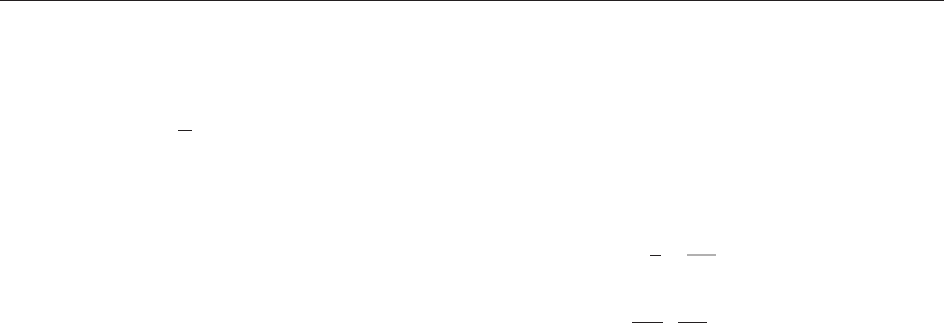
with
L
NS
u ðU
0
rÞu ðu rÞU
0
þ
1
R
r
2
u rP
1
½8
Nðu; uÞðu rÞu rP
2
½9
Here P
1
and P
2
are, respectively, the portions of the
pressure required to ensure that L
NS
u and N(u, u)
remain divergence free. The operators L
NS
and N act
on the space of divergence-free vector-valued func-
tions in the closure of the Sobolev space W
s, p
that
vanish on the boundary of D.
We note that the spectrum of the elliptic linear
operator L
NS
with appropriate bounda ry conditions
in a bounded domain is purely discrete: that is, it
consists of a countable number of eigenvalues of
finite multiplicity with the sole limit point being at
infinity.
Theorem 2 (Nonlinear instability). Let 1 < p < 1
be arbitrary. Suppose that the operator L
NS
over L
p
has spectrum in the right half of the complex plane.
Then the flow U
0
(x) is (L
q
, L
p
) nonli nearly unstable
for any q > max(p, n).
Theorem 3 (Asymptotic Lyapunov stability). Let
q > n be arbitrary. Assume that the operator L
NS
over L
q
has spectrum confined to the left half of the
complex plane. Then the flow U
0
(x) is (L
q
, L
q
)
nonlinearly stable.
A recent proof of these theorems is given in
Friedlander et al. (2006) using a bootstrap type
argument. In Theorem 2, the space L
q
, q > n, is used
as an auxiliary space inwhich the norm of the
nonlinear term is control led, while the final instabil-
ity result is proved in L
p
for p 2 (1, 1). We note
that this includes the most physically relevant case
of instability in the L
2
energy norm. An earlier proof
of the theorems under the restriction p n was
given by Yudovich (1989).
To apply Theorem 2 or 3 to conclude nonlinear
instability or stability of a given flow U
0
,itis
necessary to have information concerning the spec-
trum of the linear operator L
NS
. Obtaining such
information has been the goal of much of the
literature concerning fluid stability (see the biblio-
graphy and the references therein). However, except
in the case of some relatively simple flows, the
eigenvalues of L
NS
have not yet been calcu lated
explicitly. Perhaps the example that is the most
tractable is plane parallel shear flows. Here the
eigenvalue problem is governed by an ordinary
differential equation (ODE) known as the Orr–
Sommerfeld equation, which has been the subject of
extensive analytical and numerical investigations.
Consider the parallel flow U
0
= (U(z), 0, 0) in the
strip 1 z 1. For disturbances of the form
ðzÞe
iðk
1
xþk
2
yÞ
e
t
½10
the eigenvalue is determined by the following
equation with k
2
= k
2
1
þ k
2
2
:
U i
k
d
2
dz
2
k
2
"#
U
00
¼
1
ikR
d
2
dz
2
k
2
"#
½11
with boundary conditions = 0atz = 1. We note
that the discreteness of the spectrum is preserved if
periodicity conditions are imposed in the (x, y)
plane.
The complexity of the spectral problem [11] is
apparent even for the simple case U(z) = 1 z
2
(known as plane Poiseuille flow). Unstable eigenva-
lues exist but only in certain regions of (k, R)
parameter space. There is a critical Reynolds number,
R
c
= 5772, below which Re <0 for all wave
numbers k.ForR > R
c
, instability occurs in a band
of wave numbers and the thickness of this band
shrinks to zero as R !1 (i.e., the inviscid limit).
Hence, Poiseuille flow with R < R
c
can be considered
as an example where the stability Theorem 3 can be
applied, that is, the flow is nonlinearly stable to
infinitesimal disturbances. However, extremely care-
ful experiments are needed to obtain agreement with
the theoretical value of R
c
= 5772. Rather it is more
usual in an experiment with R 2000 that the flow
exhibits instability in the form of streamwise streaks
that appear near the walls. These structures do not
look like traveling waves of the form given by
expression [10], rather they are finite-amplitude
effects of nonmodal growth. Such linear growth of
disturbances, along with energy growth and pseudos-
pectra have recently been investigated extensively.
An example where Theorem 3, proving nonlinear
instability, can be applied is the so-called
Kolmogorov flow. This is also a shear flow with the
spectral problem for the linearized operator given by
eqn [11]. In this example, the profile is oscillatory in z
with U(z) = sin mz. In an elegant paper, Meshalkin
and Sinai (1961) used continued fractions to prove
the existence of a real uns table positive eigenvalue. It
is interesting, and in some sense surprising, that the
particular case of sinusoidal profiles leads to a
nonconstant-coefficient eigenvalue problem, where
it is possible to construct in explicit form the
transcendental characteristic equation that relates
the eigenvalues and the wave numbers. Usually,
4 Stability of Flows

this can be done only for constant-coefficient equa-
tions. In the case U(z) = sin mz, a Fourier series
representation for the eigenfunctions leads to a
tridiagonal infinite matrix for the algebraic system
satisfied by the Fourier coefficients. This is amenable
to examination using continued fractions. Analysis of
the characteristic equation shows that there exist real
eigenvalues >0 provided R is larger than some
critical value for each wave number k with k
2
< m
2
.
The Euler Equation: Linear and
Nonlinear Stability/Instability
We conclude this brief article with some discussion
of instabilities in the inviscid Euler equations whose
existence is likely to be important as a ‘‘trigger’’ for
the development of instabilities in high-Reynolds-
number viscous flows. As we mentioned, the Euler
equations are very different from the Navier–Stokes
equations in their mathematical structure. The
Euler equations are degenerate and nonelliptic. As
such, the spectrum of the linearized operator L
E
is
not amenable to standard spectral theory of elliptic
operators. For example, unlike the Navier–Stokes
operator, the spectrum of L
E
is not purely discrete
even in bounded domains. To define L
E
we consider
a steady Euler flow {U
0
(x), P
0
(x)}, where
U
0
rU
0
¼rP
0
½12a
rU
0
¼ 0 ½12b
We assume that U
0
2 C
1
. For the Euler equations,
appropriate boundary conditions include zero nor-
mal component of U
0
on a rigid boundary, or
periodicity conditions (i.e., flow on a torus) or
suitable decay at infinity in an unbounded domain.
The theorems that we will be describing have been
proved mainly in the cases of the second and third
conditions stated above. There are many classes of
vector fields U
0
(x), in two and three dimensions,
that satisfy [12a] and [12b]. We write [4a] and [4b]
in perturbation form as
qðx; tÞ¼U
0
ðxÞþuðx; tÞ½13
with
@u
@t
¼ L
E
u þ Nðu; u Þ½14a
ru ¼ 0 ½14b
Here
L
E
u ðU
0
rÞu ðu rÞU
0
rP
1
½15
Nðu; uÞðu rÞu rP
2
½16
Linear (spectral) instability of a steady Euler flow
U
0
(x) concerns the structure of the spectrum of L
E
.
Assuming U
0
2 C
1
(T
n
), the linear equation
@u
@t
¼ L
E
u; ru ¼ 0 ½17
defines a strongly continuous group in every Sobolev
space W
s, p
with generator L
E
. We denote this group
by exp {L
E
t}. For the issue of spectral instability of
the Euler equation it proves useful to study not only
the spectrum of L
E
but also the spectrum of the
evolution operator exp {L
E
t}. This permits the
development of an explicit formula for the growth
rate of a small perturbation due to the essential (or
continuous) spectrum. It was proved by Vishik
(1996) that a quantity , refered to as a ‘‘fluid
Lyapunov exponent’’ gives the maximum growth
rate of the essential spectrum of exp{L
E
t}. This
quantity is obtained by computing the exponential
growth rate of a cert ain vector that satisfies a
specific system of ODEs over the trajectories of the
flow U
0
(x). This proves to be an effective mechan-
ism for detecting instabilities in the essential
spectrum which result due to high-spatial-frequency
perturbations. For example, for this reason any flow
U
0
(x) with a hyperbolic fixed point is linearly
unstable with growth in the sense of the L
2
-norm.
In two dimensions, is equal to the maximal
classical Lyapunov exponent (i.e., the exponential
growth of a tangent vector over the ODE
_
x = U
0
(x)).
In three dimensions, the exis tence of a nonzero
classical Lyapunov exponent implies that > 0.
However, in three dimensions there are also exam-
ples where the classical Lyapunov exponent is zero
and yet > 0. We note that the delicate issue of the
unstable essential spectrum is strongly dependent on
the function space for the perturbations and that ,
for a given U
0
, will vary with this function space.
More details and examples of instabilities in the
essential spectrum can be found in references in the
bibliography.
In contrast with instabilities in the essential
spectrum, the existence of discrete unstable eigenva-
lues is independent of the norm in which growth is
measured. From this point of view, such instabilities
can be considered as ‘‘strong.’’ However, for most
flows U
0
(x) we do not know the existence of such
unstable eigenvalues. For fully 3D flows there are no
examples, to our knowledge, where such unstable
eigenvalues have been proved to exist for flows with
standard metrics. The case that has received the
most attention in the literature is the ‘‘relatively
simple’’ case of plane parallel shear flow. The
eigenvalue problem is governe d by the Rayleigh
Stability of Flows 5

equation (which is the inviscid version of the Orr–
Sommerfeld equation [11]):
U
i
k
d
2
dz
2
k
2
"#
U
00
¼ 0
¼ 0atz ¼1 ½18
The celebrated Rayleigh stability criterion says that
a sufficient condition for the eigenvalues to be
pure imaginary is the absence of an inflection point
in the shear profile U(z). It is more difficult to prove
the converse; however, there have been several
recent results that show that oscillating profiles
indeed produce unstable eigenvalues. For example, if
U(z) = sin mz the continued fraction proof of
Meshalkin and Sinai can be adapted to exhibit the
full unstable spectrum for [18]. We note the ‘‘fluid
Lyapunov exponent’’ is zero for all shear flows;
thus the only way the unstable spectrum can be
nonempty for shear flows is via discrete unstable
eigenvalues.
As we have discussed, it is possible to show that
many classes of steady Euler flows are linearly
unstable, either due to a nonempty unstable essential
spectrum (i.e., cases where > 0) or due to unstable
eigenvalues or possibly for both reasons. It is natural
to ask what this means abo ut the stability/instability
of the full nonli near Euler equations [14]–[16]. The
issue of nonlinear stability is complex and there are
several natural precise definitions of nonlinear
stability and its converse instability.
One definition is to consider nonlinear stability
in the energy norm L
2
and the enstrophy norm H
1
,
which are natural function spaces to measure
growth of disturbances but are not ‘‘correct’’ spaces
for the Euler equations in terms of proven proper-
ties of existence and uniqu eness of solutions to the
nonlinear equation. Fa lling under this definition is
the most frequently employed method to prove
nonlinear stability, which is an elegant technique
developed by Arnol’d (cf. Arnol’d and Khesin
(1998) and references therein). This is based on
the existence of the so-called energy-Casimirs. The
vorticity curl q is transported by the motion of
the fluid so that at time t it is obtained from the
vorticity at time t = 0 by a volume-preserving
diffeomorphism. In the terminology of Arnol’d,
the velocity fields obtained in this manner at any
two times are called isovortical. For a given field
U
0
(x), the class of isovortical fields is an infinite-
dimensional manifold M, which is the orbit of the
group of volume-preserving diffeomorphisms in the
space of divergence-free vector fields. The steady
flows are exactly the critical points of the energy
functional E restricted to M. If a critical point is a
strict local maximum or minim um of E, then the
steady flow is nonlinearly stable in the space J
1
of
divergence-free vectors u(x, t) (satisfying the bound-
ary conditions) that have finite norm,
kuk
J
1
kuk
L
2
þkcurl uk
L
2
½19
This theory can be applied, for example, to show
that any shear flow with no inflection points in the
profile U(z) is nonlinearly unstable in the function
space J
1
, that is, the classical Rayleigh criterion
implies not only spectral stability but also nonlinear
stability.
We note that Arnol’d’s stability method cannot be
applied to the Euler equations in three dimensi ons
because the second vari ation of the energy defined
on the tangent space to M is never definite at a
critical point U
0
(x). This result is suggestive, but
does not prove, that most Euler flows in three
dimensions are nonlinearly unstable in the Arnol’d
sense. To quote Arnol’d, in the context of the Euler
equations ‘‘there appear to be an infinitely great
number of unstable configurations.’’
In recent years, there have been a number of
results concerning nonlinear instability for the
Euler e quation. Most of these results prove non-
linear instability under certain assumptions on the
structure of the spectrum of the linearized Euler
operator. To date, none of the approaches prove
the definitive result that in general linear instability
implies nonlinear instability. As we have remarked,
this is a much more delicate issue for Euler than for
Navier–Stokes because of the existence, for a
generic Euler flow, of a nonempty essential
unstable spectrum. To give a flavor of the mathe-
matical treatment of nonlinear instability for the
Euler equations, we present one recent result and
refer the interested reader to articles listed in the
‘‘Further reading’’ section for f urther results and
discussions.
In the context of Euler equations in two dimen-
sions, we adopt the following definition of Lyapu-
nov stability.
Definition 4 An equilibrium solution U
0
(x)is
called Lyapunov stable if for every ">0 there exists
>0 so that for any divergence-free vector u(x,0)2
W
1þs, p
, s > 2=p, such that ku(x,0)k
L
2
<the unique
solution u(x, t)to[14]–[16] satisfies
kuðx; tÞk
L
2
<" for t 2½0; 1Þ
We note that we require the initial value u(x,0) to
be in the Sobolev space W
1þs, p
, s > p=2, since it is
known that the 2D Euler equations are globally in
time well posed in this function space.
6 Stability of Flows

Definition 5 Any steady flow U
0
(x) for which the
conditions of Definition 4 are violated is called
nonlinearly unstable in L
2
.
Observe that the open issues (in three dimensions)
of nonuniqueness or nonexistence of solutions to
[14]–[16] would, under Definition 5, be scenarios
for instability.
Theorem 6 (Nonlinear instability for 2D Euler
flows). Let U
0
(x) 2 C
1
(T
2
) be satisfy [12]. Let
be the maximal Lyapunov exponent to the ODE
_
x = U
0
(x). Assume that there exists an eigenvalue
in the L
2
spectrum of the linear operator L
E
given
by [15] with Re >. Then in the sense of
Definition 5, U
0
(x) is Lyapunov unstable with
respect to growth in the L
2
-norm.
The proof of this result is given in Vishik and
Friedlander (2003) and uses a so-called ‘‘bootstrap’’
argument whose origins can be found in referenc es
in that article. We remark that the above result gives
nonlinear instability with respect to growth of the
energy of a perturbation which seems to be a
physically reasonable measure of instability.
In order to apply Theorem 6 to a specific 2D flow
it is necessary to know that the linear operator L
E
has an eigenvalue with Re >. As we have
discussed, such knowledge is lacking for a generic
flow U
0
(x). Once again, we turn to shear flows. As
we noted =0 for shear flows, any shear profile for
which unstable eigenvalues have been proved to
exist provides an example of nonlinear instability
with respect to growth in the energy.
We conclude with the observation that it is
tempting to speculate that, given the complexity
of flows in three dimensions, most, if not all, such
inviscid flows are nonlinearly unstable. It is clear
from the concept of the fluid Lyapunov exponent
that stret ching in a flow is associated with
instabilities and there are more m echanisms for
stretching in three, as opposed to two, dimensions.
However, to date there are virtually no mathema-
tical results for the nonlinear stability problem for
fully 3D flows and many challenging issues rem ain
entirely open.
Acknowledgments
The author is very grateful to IHES and ENS-
Cachan for their hospitality during the writing of
this paper. She thanks Misha Vishik for much
helpful advice.
The work is partially supported by NSF grant
DMS-0202767.
See also: Compressible Flows: Mathematical Theory;
Incompressible Euler Equations: Mathematical Theory;
Magnetohydrodynamics; Newtonian Fluids and
Thermohydraulics; Non-Newtonian Fluids; Topological
Knot Theory and Macroscopic Physics.
Further Reading
Arnol’d VI and Khesin B (1998) Topological Methods in
Hydrodynamics. New York: Springer.
Chandrasekhar S (1961) Hydrodynamic and Hydromagnetic
Stability. Oxford: Oxford University Press.
Chossat P and Iooss G (1994) The Couette–Taylor Problem.
Berlin: Springer.
Drazin PG and Reid WH (1981) Hydrodynamic Stability.
Cambridge: Cambridge University Press.
Friedlander S, Pavlovic N, and Shvydkoy R (2006) Nonlinear
instability for the Navier–Stokes equations (to appear in
Communications in Mathematical Physics).
Friedlander S and Serre D (eds.) (2003) Handbook of Mathema-
tical Fluid Dynamics, vol. 2. Amsterdam: Elsevier.
Friedlander S and Yudovich VI (1999) Instabilities in fluid
motion. Notices of the American Mathematical Society 46:
1358–1367.
Gershuni GZ and Zhukovitiskii EM (1976) Convective Instabil-
ity of Incompressible Fluids. Jerusalem: Keter Publishing
House.
Godreche C and Manneville P (eds.) (1998) Hydrodynamics and
Nonlinear Instabilities. Cambridge: Cambridge University
Press.
Joseph DD (1976) Stability of Fluid Motions, 2 vols. Berlin:
Springer.
Kato T and Fujita H (1962) On the nonstationary Navier–Stokes
system. Rend. Sem. Mat. Univ. Padova 32: 243–260.
Lin CC (1967) The Theory of Hydrodynamic Stability.
Cambridge: Cambridge University Press.
Meshalkin LD and Sinai IaG (1961) Investigation of stability for a
system of equations describing the plane movement of an
incompressible viscous liquid. App. Math. Mech. 25:
1700–1705.
Swinney H and Gollub L (eds.) (1985) Hydrodynamic Instabilities
and Transition to Turbulence. New York: Springer.
Vishik MM (1996) Spectrum of small oscillations of an ideal fluid
and Lyapunov exponents. Journal de Mathe´matiques Pures et
Applique´es 75: 531–557.
Vishik M and Friedlander S (2003) Nonlinear instability in
2 dimensional ideal fluids: the case of a dominant
eigenvalue. Communications in Mathematical Physics 243:
261–273.
Yudovich VI (1989, US translation) Linearization Method in
Hydrodynamical Stability Theory, Transl. Math. Monog.
vol. 74. Providence: American Mathematical Society.
Stability of Flows 7

Stability of Matter
J P Solovej , University of Copenhagen, Copenhagen,
Denmark
ª 2006 Elsevier Ltd. All rights reserved.
Introduction
The theorem on stability of matter is one of the most
celebrated results in mathematic al physics. It is one
of the rare cases where a result of such great
importance to our understanding of the world
around us appeare d first in a completely rigorous
formulation.
Issues of stability are, of course, extremely impor-
tant in physics. One of the major triumphs of the
theory of quantum mechanics is the explanation it
gives of the stability of the hydrogen atom (and the
complete description of its spectrum). Quantum
mechanics or, more precisely, the uncertainty princi-
ple explains not only the stability of tiny microscopic
objects, but also the stability of gigantic stellar
objects such as white dwarfs. Chandrasekhar’s
famous theory on the stability of white dwarfs
required, however, not only the usual uncertainty
principle, but also the Pauli exclusion principle for
the fermionic electrons.
Whereas both the stability of atoms and the
stability of white dwarfs were early triumphs of
quantum mechanics, it, surprisingly, took nearly
40 years before the question of stability of everyday
macroscopic objects was even raised (Fisher and
Ruelle 1966). The rigorous answer to the question
came shortly thereafter in what came to be known
as the ‘‘theorem on stability of matter’’ proved first
by Dyson and Lenard (1967).
Both the stability of hydrogen and the stability of
white dwarfs simply mean that the total energy of
the system cannot be arbitrarily negative. If there
were no such lower bound to the energy, one would
have a system from which it would be possible, in
principle, to extract an infinite amount of energy.
One often refers to this kind of stability as stability
of the first kind.
Stability of matter is somewhat different. Stability
of the first kind for atoms generalizes, as noted later,
to objects of macroscopic size. The question arises
as to how the lowest possible energy depends on the
size or, more precisely, on the (macrosc opic) number
of particles in the object. Stability of matter in its
precise mathematical formulation is the requi rement
that the lowest possible energy depends at most
linearly on the number of particles. Put differently,
the lowest possible energy calculated per particle
cannot be arbitrarily negative as the number of
particles increases. This is often referred to as
‘‘stability of the second kind.’’ If stability of the
second kind does not hold, one would be able to
extract an arbitrarily large amount of energy by
adding a single atomic particle to a sufficiently large
macroscopic object.
A perhaps more intuitive notion of stability is
related to the volume occupied by a macroscopic
object. M ore precisely, the volume of the object,
when its total energy is close to the lowest possible
energy, grows at least linearly in the number of
particles. This volume dependence is a fairly simple
consequence of stabi lity of matter as formulated
above.
The first mention of stability of the second kind
for a charged system is perhaps by Onsager (1939),
who studied a system of charged classical particles
with a hard core and proved the stability of the
second kind. The proof of stability of matter by
Dyson and Lenard, which does not rely on any hard-
core assumption, but rather on the properties of
fermionic quantum particles, used results from
Onsager’s paper.
The real relevance of the notion of stability of the
second kind was first realized by Fisher and Ruelle
(1966) in an attempt to understand the thermo-
dynamic properties of matter and to give meaning
to thermodynamic quantities such as the energy
density (energy per volume). Stability of matter is a
necessary ingredient in explaining the existence of
thermodynamics, that is, that the energy per
volume has a well-defined lim it as the volume and
number of particles tend to infinity, with the ratio
(i.e., the density of particles) kept fixed. The
existence of this lim it is, however, not just a simple
consequence of stability of matter. The existence of
the thermodynamic limit for ordinary charged
matter was proved rigorously by Lieb and Lebowitz
(1972) using the result on stability of matter a s an
input.
After the original proof of stability of matter by
Dyson and Lenard, several other proofs were given
(see, e.g., reviews by Lieb (1976, 1990, 2004) for
detailed references). Lieb and Thirring (1975) in
particular presented an elegant and simple proof
relying on an uncertainty principle for fermions. As
explained in a later section, the best mathematical
formulation of the usual uncertainty principle is in
terms of a Sobolev inequality. The method of Lieb
and Thirring is related to a Sobolev type inequality
for antisymmetric functions. The Lieb–Thirring
inequality is discussed later. The proof by Dyson
8 Stability of Matter