
Francoise J.-P., Naber G.L., Tsun T.S. (editors) Encyclopedia of Mathematical Physics
Подождите немного. Документ загружается.

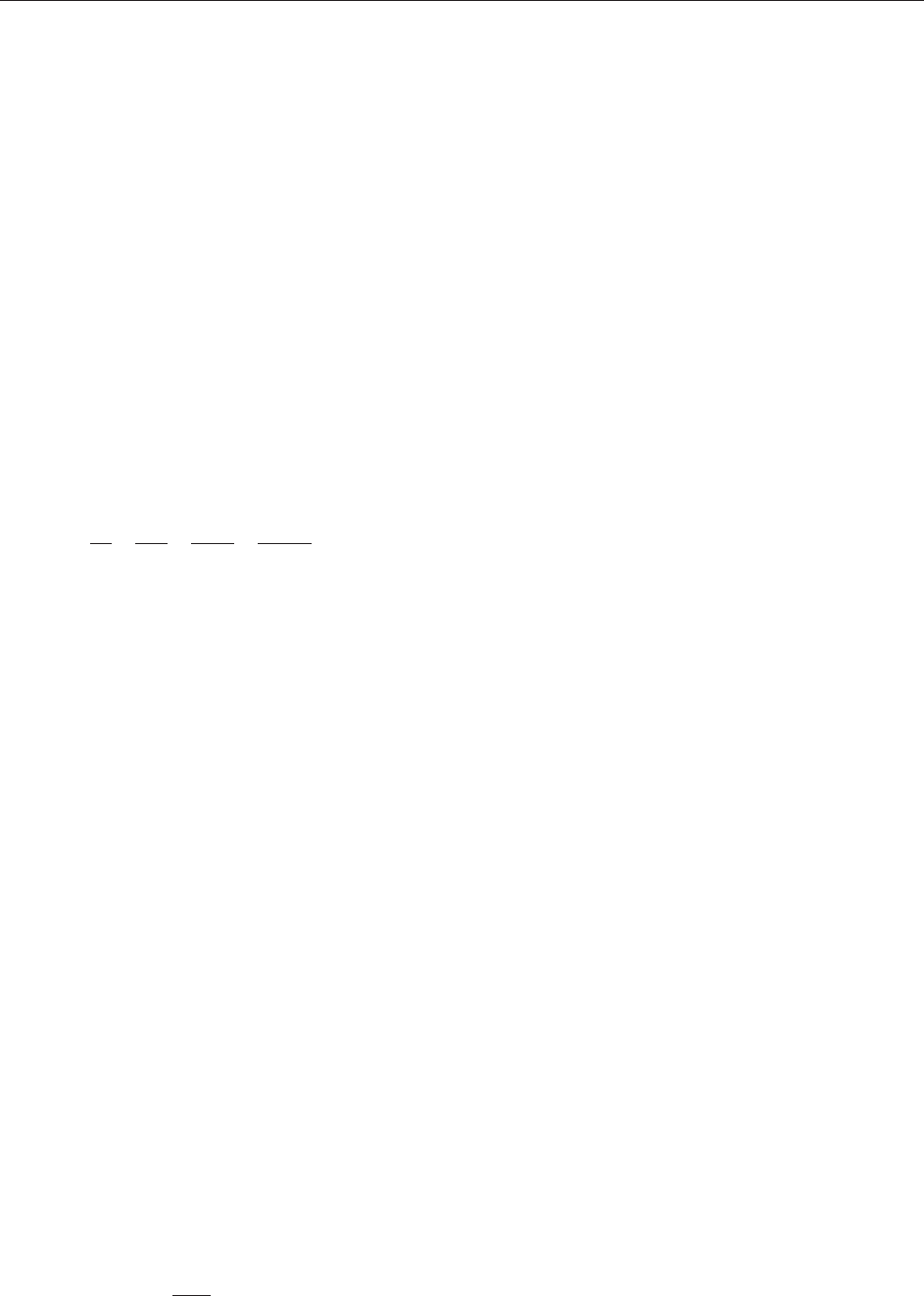
which can be shown to be smooth on I
þ
. The
physical interpretation of this tensor field is based
on the following properties. In source-free regi ons
the field satisfies the spin-2 zero-rest-mass equation
b
r
a
K
a
bcd
¼ 0
which is very similar to the Maxwell equations for
the electromagnetic (spin-1) Faraday tensor. Thus,
K
a
bcd
is interpreted as the gravitational field, which
describes the gravitational waves contained inside
the system. The zero-rest-mass equation for K
a
bcd
and the fact that the field is smooth on I implies that
the Weyl tensor satisfies the ‘‘peeling’’ property. This
is a characteristic conspiracy between the fall-off
behavior of certain components of the Weyl tensor
along outgoing g-null-geodesics approaching I
þ
in
M with respect to an affine parameter s for s !1
and their algebraic type. Symbolically, the Weyl
tensor has the following behavior as s !1 along
the null geodesic:
C ¼
½4
s
þ
½31
s
2
þ
½211
s
3
þ
½1111
s
4
þ Oðs
5
Þ½5
where the numerator of each component indi cates
its Petrov type. The repeated principal null direction
(PND) in the first three components and one of the
PNDs in the fourth component are aligned with the
tangent vector of the geodesic. This implies that
the farthest reaching component of the Weyl tensor,
which is O(1=s), has the Petrov type of a radiati on
field. It is customary to combine the components
which are O(1=s
i
) into one complex function and
denote it by
5i
. When expressed in terms of the
field K
a
bcd
on
c
M, this fall-off behavior implies that
of all components of K
a
bcd
only
4
does not
necessarily vanish on I
þ
.
In special cases like the Minkow ski, Schwarzs-
child, Kerr, and more generally in all asymptotically
flat stationary spacetimes, even
4
vanishes on I
þ
.
For these reasons,
4
is called the radiation field of
the system, that is, that part of the gravitational field
which can be registered by the observers at infinity.
It describes the outgoing radiation which is being
emitted by the system during its evolution.
The Bondi–Sachs Mass-Loss Formula
Gravitational waves carry away energy from the
system. This is a consequence of the Bondi–Sachs
mass-loss formula. The Bondi–Sachs energy–
momentum is related to a weighted integral over a
cut C,
P
C
½W¼
1
4G
Z
C
W
2
þ
_
½d
2
S ½6
The quantity in brackets, the mass aspect, is a
combination of the scalar
2
which in a sense
measures the strength of the Coulomb-like part of
the gravitational field on I
þ
and the complex
quantity . In a so-called Bondi coordinate system,
this quantity is related to the radiation field
4
by
the relation
4
¼
€
the dot indicating differentiation with respect to the
affine parameter along the null generators. Thus,
is essentially the second time integral of the
radiation field. The mass aspect is integrated against
a function W which is an asymptotic translation,
that is, a linear combination of the first four
spherical harmonics. Thus, one can view the
expression [6] as defin ing a linear map T ! R.
Since T and M are isometric this defines a covector
P
a
on M, which can always be shown to be timelike,
P
a
P
a
0. This positivity property together with the
fact that in the special cases of Schwarzschild and
Kerr spacetimes the integral yields the mass para-
meters when evaluated for a time translation
(W = 1) motivates the interpretation of P
C
as the
energy–momentum 4-vector of the spacetime at the
instant defined by the cut C. In particular, for W = 1
the integral gives the time component of P
C
, the
Bondi–Sachs energy E.
The interpretation of [6] as energy–momentum is
strengthened by the fact that P
C
arises as dual to the
translations which is familiar from Lagrangian field
theories where energy and momentum appear as
generators for time and space translations. In fact,
one can set up a Hamiltonian framework where the
role of the Bondi–Sachs energy–momentum as
generator of asymptotic translations is made
explicit.
This point of view suggests that one should also
be able to define a notion of angular momentum for
asymptotically flat spacetimes because angular
momentum arises as the generator of rotations,
which can also be defined asymptoti cally. However,
while there is a unique notion of translation on I
þ
,
this is not the case for rotations (and boosts). The
reason is hidden in the structure of the BMS group
where the Lorentz group appears naturally as a
factor group but not as a unique subgroup. In
physical terms, the angular momentum depends on
an origin but there is no natural way to choose an
origin on I
þ
. This ambiguity in the choice of origin
leads to sever al noneq uivalent expressions for
angular momentum in the literature.
Consider now two cuts C and C
0
, with C
0
later than
C. Then we may compute the difference E = E E
0
of the Bondi–Sachs energies with respect to the two
Asymptotic Structure and Conformal Infinity 225

cuts. It turns out that this difference can be
expressed as an integral over the (three-dimensional)
piece of I
þ
which is bounded by the two cuts
(i.e., @=C
0
C):
E
0
E ¼
1
4G
Z
_
_
d
3
V ½7
This result means that the Bondi–Sachs energy of the
system decreases, since E
0
< E and the rate of
decrease is given by the (positive-definite) amount
of gravitational radiation which leav es the system
during the period defined by the two cuts.
It is necessary to point out that in this article the
structure of null infinity has been postulated based
on physical reasonings. The Einstein equations have
been used only in a very weak sense, namely only in
a neighborhood of I . It is an entirely different
question whether the field equations are compatible
with this postulated structure. To answer it, one
needs to show that there are global solutions of the
Einstein equations which exhibit the postulated
behavior in the asymptotic region. This question
has been settled recently in the affirmative: there are
many global spacetimes which are asymptotically
flat in the sense described here.
This article discussed has the notion of null
infinity, that is, of spacetimes which are asymptoti-
cally flat in lightlike directions. Spacetimes which
are asymptotically flat in spacelike directions have
not been covered. The latter is a notion which has
been developed largely independently of null infinity
since it is essentially a property of an initial data set
and not of the entire four-dimensional spacetime.
Ultimately, these two notions should coincide, in the
sense that if one has an initial data set which is
asymptotically flat in spatial directions in an appro-
priate sense then its Cauchy development will be an
asymptotically flat spacetime. However, as of yet, it
is not clear what the appropriate conditions should
be because the structure of the gravitational field in
the neighborhood of spacelike infinity i
0
is not
sufficiently well understood so far.
See also: Black Hole Mechanics; Boundaries for
Spacetimes; Canonical General Relativity; Einstein
Equations: Exact Solutions; Einstein Equations: Initial
Value Formulation; General Relativity: Overview;
Gravitational Waves; Quantum Entropy; Spacetime
Topology, Causal Structure and Singularities; Stability of
Minkowski Space; Stationary Black Holes.
Further Reading
Ashtekar A (1987) Asymptotic Quantization. Naples: Bibliopolis.
Bondi H, van der Burg MGJ, and Metzner AWK (1962)
Gravitational waves in general relativity VII. Waves from
axi-symmetric isolated systems. Proceedings of the Royal
Society of London, Series A 269: 21–52.
Frauendiener J (2004) Conformal infinity. Living Reviews in
Relativity, vol. 3. http://relativity.livingreviews.org/Articles/
lrr-2004-1/index.html.
Friedrich H (1992) Asymptotic structure of space-time. In: Janis AI
and Porter JR (eds.) Recent Advances in General Relativity.
Boston: Birkha¨user.
Friedrich H (1998a) Einstein’s equation and conformal structure.
In: Huggett SA, Mason LJ, Tod KP, Tsou SS, and Woodhouse
NMJ (eds.) The Geometric Universe: Science, Geometry and
the Work of Roger Penrose. Oxford: Oxford University Press.
Friedrich H (1998b) Gravitational fields near space-like and null
infinity. Journal of Geometry and Physics 24: 83–163.
Geroch R (1977) Asymptotic structure of space-time. In: Esposito
FP and Witten L (eds.) Asymptotic Structure of Space-Time.
New York: Plenum.
Hawking S and Ellis GFR (1973) The Large Scale Structure of
Space-Time. Cambridge: Cambridge University Press.
Penrose R (1965) Zero rest-mass fields including gravitation:
asymptotic behaviour. Proceedings of the Royal Society of
London, Series A 284: 159–203.
Penrose R (1968 ) Structure of space-time. In: DeWitt CM
and Whe eler JA (eds.) Battel le Rencontres.NewYork:
W. A. Benjamin.
Penrose R and Rindler W (1984, 1986) Spinors and Space-Time,
Cambridge: Cambridge University Press.
Sachs RK (1962) Gravitational waves in general relativity VIII.
Waves in asymptotically flat space-time. Proceedings of the
Royal Society of London, Series A 270: 103–127.
Averaging Methods
A I Neishtadt, Russian Academy of Sciences,
Moscow, Russia
ª 2006 Elsevier Ltd. All rights reserved.
Introduction
Averaging methods are the methods of perturbation
theory that are based on the averaging principle and
the idea of dividing the dynamics into slow drift and
fast oscillations. The most common field of applica-
tions of averaging methods is the analysis of the
behavior of dynamical systems that differ from
integrable systems by small perturbations.
Averaging Principle
Equations of motion of a system that differ from an
integrable system by small perturbations often can
be written in the form
226 Averaging Methods

_
I ¼ "gðI;’;"Þ;
_
’ ¼ !ðIÞþ"f ðI;’;"Þ
I ¼ðI
1
; ...; I
n
Þ2R
n
’ ¼ð’
1
; ...;’
m
Þ2T
m
modd 2; 0 <" 1
½1
The small parameter " characterizes the amplitude
of the perturbation. For " = 0 one gets the
unperturbed system. The equation I = const. sin-
gles out an invariant m-dimensional torus of the
unperturbed system. The motion on this torus is
quasiperiodic with frequency vector !(I); compo-
nents of vector I are called ‘‘slow variables’’
whereas components of vector ’ are called ‘‘fast
variables’’ or ‘‘phases.’’ The rig ht-hand sides of
system [1] are 2-periodic with respect to all ’
j
.It
is assumed that they are smooth enough functions
of all arguments. It is also assumed that compo-
nents of the frequency v ector are not linearly
dependent over the ring of i nteger numbers
identically with respect to I. System [1] is called
a ‘‘system with rotating phases.’’
In applications, one is often interested mainly in
the behavior of slow variables. The ‘‘averaging
principle’’ (or method) consists in replacing the
system of perturbed equations [1] by the ‘‘averaged
system’’
_
J ¼ "GðJÞ; GðJÞ¼ð2Þ
m
I
T
m
gðJ;’;0Þd’ ½2
for the purpose of providing an approximate
description of the evolution of the slow variables
over time intervals of order 1=" or longer. Here,
d’ = d’
1
d’
m
. System [2] contains only slow
variables and, therefore, is much simpler for
investigation than system [1]. When passing from
system [1] to system [2], one ignores the terms
g(I, ’,0) G(I) on the right-hand side of [1]. The
averaging principle is based on the idea that these
terms oscillate and lead only to small oscillations
which are superimposed on the drift described by
the averaged system. To justify the averaging
principle, one should establish a relation between
the behavior of the solutions of systems [1] and [2].
This problem is still far from being completely
solved.
Another version of the averaging principles is
used in the case when frequencies are approxi-
mately in resonance. This means that one or
several relations of the form (k, !) = 0 approxi-
mately are valid with irreducible integer coefficient
vectors k 6¼ 0; here, (k, !) is the standard scalar
product in R
m
.Let be a sublattice of the integer
lattice Z
m
generated by these vectors. Let
r = rank and k
(1)
, k
(2)
, ..., k
(m)
be a basis in Z
m
,
the f irst r vectors of which belong to . Instead of
’, one can introduce new variables:
# ¼ð#
1
; ...;#
r
Þ2T
r
modd 2
¼ð
1
; ...;
mr
Þ2T
mr
modd 2
#
i
¼ðk
ðiÞ
;’Þ;
j
¼ðk
ðrþjÞ
;’Þ
Let R be an r m matrix whose rows are vectors
k
(i)
,1 i r. For an approximate description of the
behavior of variables I, #, the averaging principle
prescribes replacing syst em [1] by the system
_
J ¼ "G
ðJ;Þ;
_
¼ R!ðJÞþ"RF
ðJ;Þ
G
ðJ;#Þ¼ð2Þ
ðmrÞ
I
T
mr
gðJ;’;0Þd
F
ðJ;#Þ¼ð2Þ
ðmrÞ
I
T
mr
f ðJ;’;0Þd
½3
(one should express g, f through #, and then
integrate over ,d = d
1
d
mr
). System [3] is
called ‘‘partially averaged system’’ for resonances in
. Functions G
, F
can be obtained from Fourier
series expansions of functions g, f for " = 0
by throwing away harmonics exp (i(k, ’)), k =2
(nonresonant harmonics). Passing from system [1]
to system [3] is based on the idea that the ignored
nonresonant harmonics oscillate fast and do not
affect essentially the evolution of the slow variables.
Now let system [1] be a Hamiltonian system close
to an integrable one. The Hamiltonian function has
the form
H ¼ H
0
ðpÞþ"H
1
ðp;’;y; x;"Þ
where ’, x are coordinates and p, y are conjugated
to them. The equations of motion have the same
form as [1], with I = (p, y, x):
_
p ¼"
@H
1
@’
;
_
y ¼"
@H
1
@x
_
x ¼ "
@H
1
@y
;
_
’ ¼
@H
0
@I
þ "
@H
1
@I
½4
The averaging principle in the case when there are
no resonant relations leads to the system
_
p ¼ 0;
_
y ¼"
@H
1
@x
;
_
x ¼ "
@H
1
@y
H
1
¼ð2Þ
m
I
T
m
H
1
ðp;’;y; x; 0Þd’
½5
Therefore, in this case there is no drift in p, and the
behavior of y, x is described by the Hamiltonian
system, which contains p as a parameter. Equations
of motion of planets around the Sun can be reduced
to the form [4]. The issue of the absence of the
evolution of momenta p is known in this problem as
Averaging Methods 227
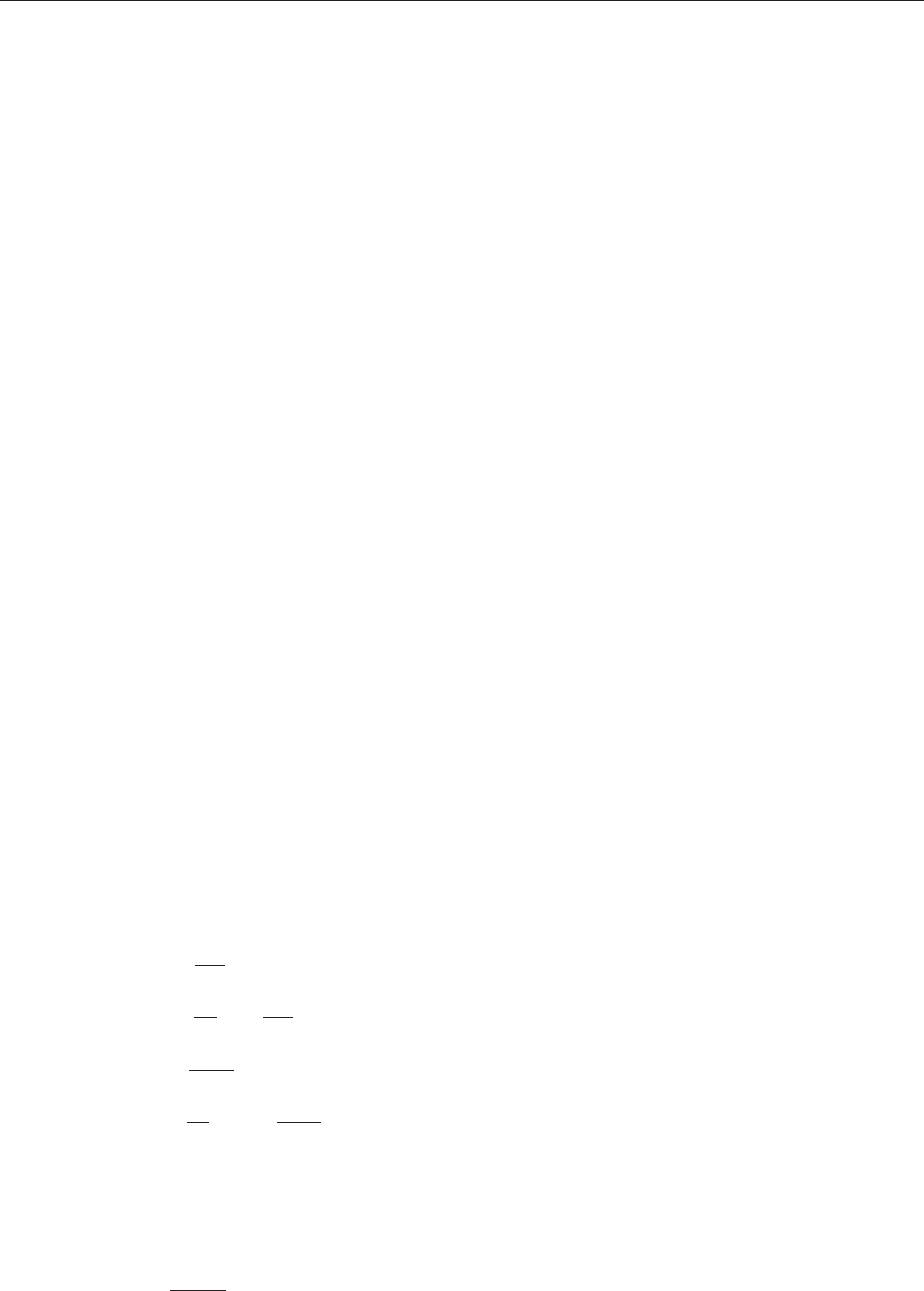
the Lagrange–Laplace theorem, about the absence of
the evolution of semimajor axes of planetary orbits.
Elimination of Fast Variables, Decoupling
of Slow and Fast Motions
The basic role in the averaging method is played by
the idea that the exact system can be in the principal
approximation transformed into the averaged sys-
tem by means of a transformation of variables close
to the identical one. The extension of this idea is the
idea that similar transformation of variables allows
one to eliminate, up to an arbitrary degree of
accuracy, the fast phases from the right-hand sides
of the equations of perturbed motion and in this
way decouple the slow motion from the fast one.
For system [1], provided there are no resonant
relations between frequencies, the elimination of fast
variables is performed as follow s. The desirable
transformation of variables (I, ’) 7!(J, ) is sought
as a formal series
I ¼ J þ "u
1
ðJ; Þþ"
2
u
2
ðJ; Þþ
’ ¼ þ "v
1
ðJ; Þþ"
2
v
2
ðJ; Þþ
½6
where functions u
j
, v
j
are 2-periodic in . The
transformation [6] should be chosen in such a way
that in the new variables the right-hand sides of
equations of motion do not contain fast variables,
that is, the equations of motion should have the
form
_
J ¼ "G
0
ðJÞþ"
2
G
1
ðJÞþ
_
¼ !ðJÞþ"F
0
ðJÞþ"
2
F
1
ðJÞþ
½7
Substituting [6] into [7], taking into account [1], and
equating the terms of the same order in ", we obtain
the following set of relations:
G
0
ðJÞ¼gðJ; ;0Þ
@u
1
@
!
F
0
ðJÞ¼f ðJ; ;0Þþ
@!
@J
u
1
@v
1
@
!
G
i
ðJÞ¼X
i
ðJ; Þ
@u
iþ1
@
!
F
i
ðJÞ¼Y
i
ðJ; Þþ
@!
@J
u
iþ1
@v
iþ1
@
!; i 1
½8
The functions X
i
, Y
i
are uniquely determined by the
terms u
1
, v
1
, ..., u
i
, v
i
in expansion [6]. The first
equation in [8] implies that
G
0
ðJÞ¼g
0
ðJÞ¼GðJÞ
u
1
ðJ; Þ¼
X
k6¼0
g
k
iðk;!Þ
expðiðk; ÞÞ þ u
0
1
ðJÞ
½9
where g
k
, k 2 Z
m
, are Fourier coefficients of func-
tion g at " = 0, and u
0
1
is an arbitrary function of J.It
is assumed that the denominators in [9] do not
vanish, and that the series in [9] converges and
determines a smooth function. In the same way,
from the other equations in [8] one can sequentially
determine F
0
, v
1
, ..., G
i
, u
iþ1
, F
i
, v
iþ1
, i 1.
On truncating the series in [6] and [7] at the terms
of order "
l
, we obtain a truncated system of the lth
approximation. The equation for J is decoupled
from the other equations an d can be solved
separately. Then the behavior of is determined
by means of quadrature. The behavior of original
variable I in this approximation is a slow drift
(described by the equation for J), on which small
oscillations (described by transformation of variables)
are superimposed. The behavior of ’ can be repre-
sented as a rotation with slowly varying frequency,
on which oscillations are also superimposed. For l = 1,
the truncated system coincides with the averaged
system [2].
If the sublattice Z
m
specifying possible
resonant relations is given, then in an analogous
manner one can construct a formal transformation
of variables (I, ’) 7!(J, ) such that, in the new
variables, the fast phase will appear on the right-
hand sides of the differential equations for the new
variables only in combinations (k, ), with k 2
(see, e.g., Arnol’d et al. (1988)). Again, on truncat-
ing the series on the right-hand sides of the
differential equations for the new variables at the
terms of order "
l
, we obtain a truncated system of
the lth approximation. At l = 1, this truncated
system coincides with the partially averaged system
[3] (for some special choice of arbitrary functions
that are contained in the formulas for transformation
of variables). If the original system is a Hamiltonian
system of the form [4], then the transformation of
variables eliminating the fast phases from the right-
hand sides of the differential equations can be
chosen to be symplectic. The corresponding
procedures are called ‘‘Lindstedt method’’ and
‘ ‘Newcomb method’ ’ (nonresonant case for n = m),
‘‘Delaunay method’’ (resonant case for n = m), and
‘‘von Zeipel method’’ (resonant case for n m)(see
Poincare´ (1957) and Arnol’d et al. (1988)).
The calculation of high-order terms in the
procedures of elimination of fast variables is rather
cumbersome. There are versions of these procedures
which are convenient for symbolic processors
(especially for Hamiltonian systems, e.g., the
Deprit–Hori method; Giacaglia 1972).
The averaging method consists in using the
averaged system for the description of motion in
the first approximation and the truncated systems
228 Averaging Methods

obtained by means of the procedures of elimination
of fast variables in the higher approximations,
together with the corresponding transformations of
variables.
Justification of the Averaging Method
To justify the averaging method, one should estab-
lish conditions under which the deviation of the
slow variables along the solutions of the exact
system from the solutions of the averaged system
with appropriate initial data on time intervals of
order 1=" or longer tends to 0 as " ! 0. It is
desirable to have estimates from the above for these
deviations. The estimates of deviations of the
solutions of the exact syst em from the solutions of
the truncated systems obtained by means of the
procedure of elimination of fast phases are impor-
tant as well. It can happen that there are ‘‘bad’’
initial data for which the slow component of the
solution of the exact system deviates from the
solution of the averaged system by a value of order
1 over time of order 1=". In this case, one should
have estimates from above for the measure of the set
of such ‘‘bad’’ initial data; on the complementary set
of initial data, one should have estimates from
above for the deviation of slow variables along the
solutions of the exact system from the solution of
the averaged system. These problems are currently
far from being completely solved. Some general
results are described in the follow ing.
Let functions !, f , g on the right-hand side of
system [1] be defined and bounded together with a
sufficient number of derivatives in the domain D{I}
T
m
{’} [0, "
0
]. Let J(t) be the solution of the
averaged system [2] with initial condition I
0
2 D.
Let (I(t), ’(t)) be the solution of the exact system [1]
with initial conditions (I
0
, ’
0
). So, I(0) = J(0). It is
assumed that the solution J(t) is defined and stays at
a positive distance from the boundary of D on the
time interval 0 t K=" , K = const > 0.
If system [1] is a one-frequency system (m = 1),
and the frequency ! does not vanish in D, then for
0 t K=" the solution (I(t ), ’(t)) is well defined,
and jI(t) J(t)j < C ", C = const. > 0. For ! = 1, this
assertion was proved by P Fatou (1928) and, by a
different method, by L I Mandel’shtam and L D
Papaleksi (1934). This was historically the
first result on the justification of the averaging
method (Mintropol’skii 1971). There is a proof
based on the elimination of fast variables (see , e.g.,
Arnol’d (1983)). For a one-frequency system, higher
approximations of the procedure of elimination of
fast variables allow the description of the dynamics
with an accuracy of the order of any power in " on
time intervals of order 1=" (Bogolyubov and
Mitropol’skii 1961).
If system [1] is a multifrequency system (m 2), but
the vector of frequencies is constant and nonresonant,
then for any >
0 and small enough "<"
0
()itholds
that jI(t) J(t)j < for 0 t K=" (Bogolyubov
1945, Bogolyubov and Mitropol’skii 1961). If, in
addition, the frequencies satisfy the Diophantine
condition j(k, !)j > const jkj
for all k 2 Z
m
n{0}
and some >0, then one can choose = O("). In
this case, higher approximations of the procedure of
elimination of fast variables allow one to describe
the dynamics with an accuracy of the order of any
power in " on time intervals of order 1=" (see, e.g.,
Arnol’d et al. (1988)).
If the system is a multifrequency system, and
frequencies are not constant (but depend on the slow
variables I), then due to the evolution of slow
variables the frequencies themselves are evolving
slowly. At certain time moments, they can satisfy
certain resonant relations. One of the phenomena
that can take place here is a capture into a
resonance; this capture leads to a large deviation of
the solutions of the exact and averaged systems.
However, the general Anosov averag ing theorem
(Anosov 1960) implies that if the frequencies ! are
nonresonant for almost all I, then for any >0, the
inequality jI(t) J( t)j <is satisfied for 0 t K="
for all initial data outside a set E(, ") whose
measure tends to 0 as " ! 0. In many cases, it
turns out that mes E(, ") = O(
ffiffiffi
"
p
=) (in particular,
the sufficient condition for the last estimate is that
rank(@!=@I) = m)(Arnol ’d et al. (1988)).
The knowledge about averaging in two-
frequency systems (m = 2) on time intervals, of order
of 1="
, is relatively more complete (see Arnol’d
(1983), Arnol’d et al. (1988),andLochak and
Meunier (1988)). For Hamiltonian and reversible
systems, the justification of the averaging method is
a by-product of Kolmogorov–Arnold–Moser (KAM)
theory. The KAM theory provides estimates of the
difference between the solutions of the exact and
averaged systems for majority of initial data on
infinite time interval 1 < t < þ1. For remaining
data this difference can grow because of Arnol’d
diffusion, but, in general, very slowly. According to
the Nekhoroshev theorem, this difference is small on
time intervals whose length grows exponentially when
the perturbation decays linearly (for an analytic
Hamiltonian if the unperturbed Hamiltonian is a
generic function, the so-called steep function).
Another aspect of justification of the averaging
method is establishing relations between invariant
manifolds of the exact and averaged systems.
Consider, in particular, the case of a one-frequency
Averaging Methods 229

system and a multifrequency system with constant
Diophantine frequencies. Suppose that the averaged
system has an equilibrium such that real parts of all
its eigenvalues are different from 0, or a limit cycle
such that the absolute values of all but one of its
multipliers are different from 1. Then the exact
system has an invariant torus, respectively, m-or
(m þ 1)-dimensional, whose projection onto the
space of the slow variables is O(")-close to the
equilibrium (cycle) of the averaged system. This
torus is stable or unstable together with the
equilibrium (cycle) of the averaged system. For
Hamiltonian and reversible systems, the problem of
invariant manifolds is considered in the framework
of the KAM theory.
Averaging in Bogolyubov’s Systems
Systems in the standard form of Bogolyubov (1945)
are of the form
_
x ¼ "Xðt; x;"Þ; x 2 R
p
; 0 <" 1 ½10
It is assumed that the function X, besides the usual
smoothness conditions, satisfies the condition of
uniform average: the limit (time average)
X
0
ðxÞ¼ lim
T!1
1
T
Z
T
0
Xðt; x; 0Þdt ½11
exists uniformly in x. The averaging principle of
Bogolyubov consists of the replacement of the
original system in standard form by the averaged
system
_
¼ " X
0
ðÞ½12
with a goal to provide an approximate description
of the behavior of x. This approach generalizes the
appro ach of the section ‘‘Averag ing principle’’ for
the case of constant frequencies (! = const). Upon
introducing in the given system with constant
frequencies the deviation from uniform rotation
= ’ !t and denoting x = (I, ), we obtain a
system in the standard form [10]. Here the condition
of uniform average is fulfilled because X(t, x ,0) is a
quasiperiodic function of time t. The averag ed
system [12] for nonresonant frequencies coincides
with the averaged system [2]; for resonant frequen-
cies, it coincides with the partially averaged system
[3] (one should only supply systems [2] and [3] with
equations for some components of the vector ’ !t
that do not enter into the right-hand side of the
averaged system).
The averaging principle of Bogolyubov is justified
by three Bogolyubov theorems. According to the
first theorem, if (t ), 0 t K=", is a solution of
the averaged system, and x(t) is a solution of the
exact system with initial condition x(0) = (0), then
for any >0 there exists "
0
() > 0 such that
jx(t ) (t)j < for 0 t K=" and 0 <"<"
0
().
The second and the third Bogolyubov theorems
describe the motion in the neighborhoods of
equilibria and the limit cycles of the averag ed
system. In particular, if for an equilibrium real
parts of all its eigenvalues are differe nt from 0, or,
for a limit cycle, the absolute values of all but one
multipliers are different from 1, then the exact
system has a solution which eternally stays near
this equilibrium (cycle). The stability properties of
this solution are the same as the stability properties
of the corresponding equilibrium (cycle) of the
averaged system.
For systems of the form [10] a procedure exists
that, similarly to the procedure in the section
‘‘Elim ination of fast variab les, decoupl ing of slow
and fast motion s,’’ allows us to elimina te time t
from the right-hand side of the system with an
accuracy of the order of any power in " by means of
a transformation of variables. (To perform this
procedure, one should assume that the conditions
of uniform average are satisfied for functions
that arise in the process of constructing higher
approximations in this procedure ( Bogolyubuv and
Mitropol’skii 1961).) In the first approximation,
such a transformation of variables transforms the
original system into the averaged one.
The condition of uniform average is very impor-
tant for theory. If the limit in [11] exists, but
convergence is nonuniform in x, then the time
average X
0
could be, for example, a discontinuous
function of x, and the averaged system would not be
well defined.
Averaging in Slow–Fast Systems
Systems of the form [1] are particular cases of the
systems of the form
_
x ¼ f ðx; y;"Þ;
_
y ¼ "gðx; y;"Þ½13
which are called ‘‘slow–fast systems’’ (or systems
with slow and fast motions, with slow and fast
variables). The generalization of the approach of the
section ‘‘Avera ging principl e’’ for these systems is
the following averaging principle of Anosov (1960).
In the system [6], let x 2 M, y 2 R
n
, where M is a
smooth compact m-dimensional manifold . At " = 0,
the system for fast variables x contains slow
variables y as parameters. Assume that this system
(which is called ‘‘fast system’’) has a finite smooth
230 Averaging Methods

invariant measure
y
and is ergodic for almost all
values of y. Introduce the averaged syst em
_
Y ¼ " GðYÞ; GðYÞ¼
1
Y
ðMÞ
Z
M
gðx; Y; 0Þd
Y
According to the averaging principle, one should use
the solution Y(t) of the averaged system with initial
condition Y(0) = y(0) for approximate description of
slow motion y(t) in the original system. This
averaging principle is justified by the following
Anosov theorem [1]: for any positive the measure
of the set E(, ") of initial data (from a compact in
the phase space) such that
max
0 t 1="
jyðtÞYðt Þj >
tends to 0 as " ! 0.
The particular case when the original system is
a Hamiltonian system depending on slowly vary-
ing parameter = "t, and for almost all values of
the motion o f the system with = const is
ergodic on almost all energy levels, is considered
in Kasuga (1961).
For the case when the has strong mixing proper-
ties, see Bakhtin (2004) and Kifer (2004).
For slow–fast systems, there is also a general-
ization of approach of the previous section that uses
time averaging and the condition of uniform average
(Volosov 1962).
Applications of the Averaging Method
The averaging method is one of the most pro ductive
methods of perturbation theory, and its applications
are immense. It is widely used in celestial mechanics
and space flight dynamics for the description of the
evolution of motions of celestial bodies, in plasma
physics and theory of accelerators for description of
motion of charged pa rticles, and in radio engineer-
ing for the description of nonlinear oscillatory
regimes. There are also applications in hydrody-
namics, physics of lasers, optics, acoust ics, etc. (see
Arnol’d et al. (1988), Bogolyubov and Mitropol’skii
(1961), Lochak and Meunier (1988), Mitropol’skii
(1971), and Volosov (1962)).
See also: Central Manifolds, Normal Forms;
Diagrammatic Techniques in Perturbation Theory;
Hamiltonian Systems: Stability and Instability Theory;
KAM Theory and Celestial Mechanics; Multiscale
Approaches; Random Walks in Random Environments;
Separatrix Splitting; Stability Problems in Celestial
Mechanics; Stability Theory and KAM.
Further Reading
Anosov DV (1960) Averaging in systems of ordinary differential
equations with rapidly oscillating solutions. Izvestiya Akade-
mii Nauk SSSR, Ser. Mat. 24(5): 721–742 (Russian).
Arnol’d VI (1983) Geometrical Methods in the Theory
of Ordinary Differential Equations. New York–Berlin:
Springer.
Arnol’d VI, Kozlov VV, and Neishtadt AI (1988) Mathematical
Aspects of Classical and Celestial Mechanics, Encyclopaedia
of Mathematical Sciences, vol. 3. Berlin: Springer.
Bakhtin VI (2004) Crame´r asymptotics in the averaging method
for systems with fast hyperbolic motions. Proceedings of the
Steklov Institute of Mathematics 244(1): 79.
Bogolyubov NN (1945) On some statistical methods in mathe-
matical physics. Akad. Nauk USSR. L’vov (Russian).
Bogolyubov NN and Mitropol’skii YuA (1961) Asymptotic
Methods in the Theory of Nonlinear Oscillations. New York:
Gordon and Breach.
Giacaglia GEO (1972) Perturbation Methods in Nonlinear
Systems, Applied Mathematical Science, vol. 8. Berlin: Springer.
Kasuga T (1961) On the adiabatic theorem for the
Hamiltonian system of differential equations in the classical
mechanics I, II, III. Proceedings of the Japan Academy 37(7):
366–382.
Kevorkian J and Cole JD (1996) Multiple Scale and Singular
Perturbations Methods, Applied Mathematical Sciences,
vol. 114. New York: Springer.
Kifer Y (2004) Some recent advances in averaging. In: Modern
Dynamical Systems and Applications, 403. Cambridge:
Cambridge Unive rsity Press.
Lochak P and Meunier P (1988) Multiphase Averaging for
Classical Systems, Applied Mathematical Sciences, vol. 72.
New York: Springer.
Mitropol’skii YuA (1971) Averaging Method in Nonlinear
Mechanics. Kiev: Naukova Dumka (Russian).
Poincare´ H (1957) Les Me´thodes Nouvelles de la Me´canique
Ce´leste, vols. 1–3. New York: Dover.
Sanders JA and Verhulst F (1985) Averaging Methods in
Nonlinear Dynamical Systems, Applied Mathematical
Sciences, vol. 59. New York: Springer.
Volosov VM (1962) Averaging in systems of ordinary differential
equations. Russian Mathematical Surveys 17(6): 1–126.
Averaging Methods 231

Axiomatic Approach to Topological Quantum Field Theory
C Blanchet, Universite
´
de Bretagne-Sud, Vannes,
France
V Turaev, IRMA, Strasbourg, France
ª 2006 Elsevier Ltd. All rights reserved.
Introduction
The idea of topological invariants defined via path
integrals was introduced by A S Schwartz (1977) in a
special case and by E Witten (1988) in its full
power. To formalize this idea, Witten (1988)
introduced a notion of a topological quantum field
theory (TQFT). Such theories, independent of
Riemannian metrics, are rather rare in quantum
physics. On the other hand, they admit a simple
axiomatic description first suggested by M Atiyah
(1989). This description was inspired by G Segal’s
(1988) axioms for a two-dimensional conformal
field theory. The axiomatic formulation of TQFTs
makes them suitable for a purely mathematical
research combining methods of topology, algebra,
and mathematical physics. Several authors explored
axiomatic foundations of TQFTs (see Quinn (1995)
and Turaev (1994).
Axioms of a TQFT
An (n þ 1)-dimensional TQFT (V, ) over a scalar
field k assigns to every closed oriented n-dimen-
sional manifold X a finite-dimensional vector space
V(X) over k and assigns to every cobordism
(M, X, Y)ak-linear map
ðMÞ¼ðM; X; YÞ : Vð XÞ!VðYÞ
Here a cobordism (M, X, Y) between X and Y is a
compact oriented (n þ 1)-dimensional manifold M
endowed with a diffeomorphism @M
X q Y (the
overline indicates the orientation reversal). All
manifolds and cobordisms are supposed to be
smooth. A TQFT must satisfy the following axioms.
1. Naturality Any orientation-preserving diffeo-
morphism of closed oriented n-dimensional mani-
folds f : X !X
0
induces an isomorphism f
]
: V
(X)!V(X
0
). For a diffeomorphism g between the
cobordisms (M, X, Y)and(M
0
, X
0
, Y
0
), the follow-
ing diagram is commutative:
VðXÞ
!
ðg
jX
Þ
]
VðX
0
Þ
ðMÞ
#
#
ðM
0
Þ
VðYÞ
!
ðg
jY
Þ
]
VðY
0
Þ
2. Functoriality If a cobordism (W, X, Z )is
obtained by gluing two cobordisms (M, X, Y)and
(M
0
, Y
0
, Z) along a diffeomorphism f : Y !Y
0
,then
the following diagram is commutative:
VðXÞ
!
ðWÞ
VðZÞ
ðMÞ
#
#
ðM
0
Þ
VðYÞ
!
f
]
VðY
0
Þ
3. Normalization For any n-dimensional manifold
X, the linear map
ð½0; 1XÞ : VðXÞ!VðXÞ
is identity.
4. Multiplicativity There are functorial
isomorphisms
VðX q YÞVðXÞVðYÞ
Vð;Þ k
such that the following diagrams are commutative:
VððX q YÞqZÞ VðXÞVðYÞðÞVðZÞ
##
VðX qðY q ZÞÞ VðXÞ VðYÞVðZÞðÞ
VðX q;Þ VðXÞk
##
VðXÞ¼ VðXÞ
Here =
k
is the tensor product over k. The
vertical maps are respectively the ones induced
by the obvious diffeomorphisms, and the stan-
dard isomorphisms of vector spaces.
5. Symmetry The isomorphism
VðX q YÞVðY q XÞ
induced by the obvious diffeomorphism corre-
sponds to the standard isomorphism of vector
spaces
VðXÞVðYÞVðYÞVðXÞ
Given a TQFT (V, ), we obtain an action of the
group of diffeomorphisms of a closed oriented
n-dimensional manifold X on the vector space
V(X). This action can be used to study this group.
An important feature of a TQFT (V, ) is that it
provides numerical invariants of compact oriented
(n þ 1)-dimensional manifolds without boundary.
Indeed, such a manifold M can be considered as a
cobordism between two copies of ; so that (M) 2
Hom
k
(k, k) = k. Any compact oriented (n þ 1)-
dimensional manifold M can be considered as a
232 Axiomatic Approach to Topological Quantum Field Theory
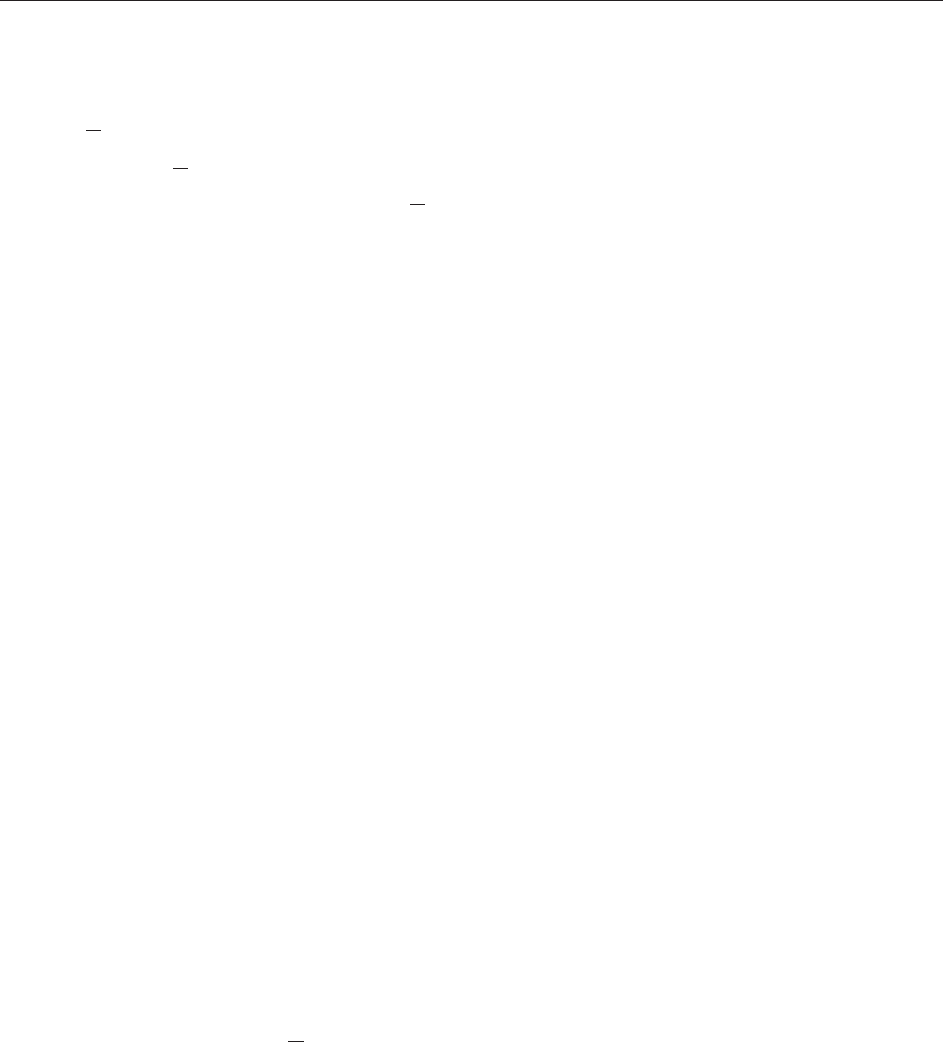
cobordism between ; and @M; the TQFT assigns to
this cobordism a vector (M) in Hom
k
(k,
V(@M)) = V(@M) called the vacuum vector.
The manifold [0, 1] X, considered as a cobord-
ism from
X q X to ; induces a nonsingular pairing
Vð
XÞVðXÞ!k
We obtain a functorial isomorphism V(
X) =
V(X)
= Hom
k
(V(X), k).
We now outline definitions of several important
classes of TQFTs.
If the scalar field k has a conjugation and all the
vector spaces V(X) are equipped with natural
nondegenerate Hermitian forms, then the TQFT
(V, ) is Hermitian. If k = C is the field of complex
numbers and the Hermitian forms are positive
definite, then the TQFT is unitary.
A TQFT (V, ) is nondegenerate or cobordism
generated if for any closed oriented n-dimensional
manifold X, the vector space V(X) is generated by
the vacuum vectors derived as above from the
manifolds bounded by X.
Fix a Dedekind domain D C. A TQFT (V, )
over C is almost D-integral if it is nondegenerate and
there is d 2 C such that d(M) 2 D for all M with
@M = ;. Given an almost integral TQFT (V, )anda
closed oriented n-dimensional manifold X,wedefine
S(X)tobetheD-submodule of V(X) generated by all
the vacuum vectors. This module is preserved under
the action of self-diffeomorphisms of X and yields a
finer ‘‘arithmetic’’ version of V(X).
The notion of an (n þ 1)-dimensional TQFT over
k can be reformulated in the categorical language as
a symmetric monoidal functor from the category of
n-manifolds and (n þ 1)-cobordisms to the category
of finite-dimensional vector spaces over k. The
source category is called the (n þ 1)-dimensional
cobordism category. Its objects are closed oriented
n-dimensional manifolds. Its morphisms are cobord-
isms considered up to the following equivalence:
cobordisms (M, X, Y) and (M
0
, X, Y) are equivalent
if there is a diffeomorphism M !M
0
compatible
with the diffeomorphisms @M
X q Y @M
0
.
TQFTs in Low Dimensions
TQFTs in dimension 0 þ 1 = 1 are in one-to-one
correspondence with finite-dimensional vector
spaces. The correspondence goes by associating
with a one-dimensional TQFT (V, ) the vector
space V(pt) where pt is a point with positive
orientation.
Let (V, ) be a two-dimensional TQFT. The linear
map associated with a pair of pants (a 2-disk with
two holes considered as a cobordism between two
circles S
1
q S
1
and one circle S
1
) defines a commu-
tative multiplication on the vector space A= V(S
1
).
The 2-disk, considered as a cobordism between S
1
and ;, induces a nondegenerate trace on the algebra
A. This makes A into a commutative Frobenius
algebra (also called a symmetric algebra). This
algebra completely determines the TQFT (V, ).
Moreover, this construction defines a one-to-one
correspondence between equivalence classes of two-
dimensional TQFTs and isomorphism classes of
finite dimensional commutative Frobenius algebras
(Kock 2003).
The formalism of TQFTs was to a great extent
motivated by the three-dimensional case, specifi-
cally, Witten’s Chern–Simons TQFTs. A mathema-
tical definition of these TQFTs was first given
by Reshetikhin and Turaev using the theory of
quantum groups. The Witten–Reshetikhin–Turaev
three-dimensional TQFTs do not satisfy exactly the
definition above: the naturality and the functoriality
axioms only hold up to invertible scalar factors
called framing anomalies. Such TQFTs are said to
be projective. In order to get rid of the framing
anomalies, one has to add extra structures on the
three-dimensional cobordism category. Usually one
endows surfaces X with Lagrangians (maximal
isotropic subspaces in H
1
(X; R)). For 3-cobordisms,
several competing – but essentially equivalent –
additional structures are considered in the literature:
2-framings (Atiyah 1989), p
1
-structures (Blanchet
et al. 1995), numerical weights (K Walker, V Turaev).
Large families of three-dimensional TQFTs are
obtained from the so-called modular categories.
The latter are constructed from quantum groups at
roots of unity or from the skein theory of links.
See Quantum 3-Manifold Invariants.
Additional Structures
The axiomatic definition of a TQFT extends in
various directions. In dimension 2 it is interesting to
consider the so-called open–closed theories involving
1-manifolds formed by circles and intervals and
two-dimensional cobordisms with boundary
(G Moore, G Segal). In dimension 3 one often
considers cobordisms including framed links and
graphs whose components (resp. edges) are labeled
with objects of a certain fixed category C.Insucha
theory, surfaces are endowed with finite sets of
points labeled with objects of C and enriched with
tangent directions. In all dimensions one can study
manifolds and cobordisms endowed with homotopy
classes of mappings to a fixed space (homotopy
quantum field theory, in the sense of Turaev).
Additional structures on the tangent bundles – spin
Axiomatic Approach to Topological Quantum Field Theory 233

structures, framings, etc. – may be also considered
provided the gluing is well defined.
See also: Braided and Modular Tensor Categories; Hopf
Algebras and q-Deformation Quantum Groups; Indefinite
Metric; Quantum 3-Manifold Invariants; Topological
Gravity, Two-Dimensional; Topological Quantum Field
Theory: Overview.
Further Reading
Atiyah M (1989) Topological Quantum Field Theories. Publica-
tions Mathe´matiques de l’Ihe´s 68: 175–186.
Bakalov B and Kirillov A Jr. (2001) Lectures on Tensor
Categories and Modular Functors. University Lecture Series
vol. 21. Providence, RI: American Mathematical Society.
Blanchet C, Habegger N, Masbaum G, and Vogel P (1995)
Topological quantum field theories derived from the Kauff-
man bracket. Topology 34: 883–927.
Kock J (2003) Frobenius Algebras and 2D Topological Quantum
Field Theories. LMS Student Texts, vol. 59. Cambridge:
Cambridge University Press.
Quinn F (1995) Lectures on axiomatic topological quantum field
Freed DS and Uhlenbeck KK (eds.) Geometry and Quantum
Field Theory, pp. 325–453. IAS/Park City Mathematical Series,
University of Texas, Austin: American Mathematical Society.
Segal G (1988) Two-dimensional conformal field theories and
modular functors. In: Simon B, Truman A, and Davies IM
(eds.) IXth International Congress on Mathematical Physics,
pp. 22–37. Bristol: Adam Hilger Ltd.
Turaev V (1994) Quantum Invariants of Knots and 3-Manifolds.
de Gruyter Studies in Mathematics, vol. 18. Berlin: Walter de
Gruyter.
Witten E (1988) Topological quantum field theory. Communica-
tion in Mathematical Physics 117(3): 353–386.
Axiomatic Quantum Field Theory
B Kuckert, Universita
¨
t Hamburg, Hamburg, Germany
ª 2006 Elsevier Ltd. All rights reserved.
Introduction
The term ‘‘axiomatic quantum field theory’’ sub-
sumes a collection of research branches of quantum
field theory analyzing the general principles of
relativistic quantum physics. The content of the
results typically is structural and retrospective rather
than quantitative and predictive.
The first axiomatic activities in quantum field theory
date back to the 1950s, when several groups started
investigating the notion of scattering and S-matrix in
detail (Lehmann, Symanzik, and Zimmermann 1955
(LSZ-approach), Bogoliubov and Parasiuk 1957, Hepp
and Zimmermann (BPHZ-approach), Haag 1957–59
and Ruelle 1962 (Haag–Ruelle theory) (see Scattering,
Asymptotic Completeness and Bound States and
Scattering in Relativistic Quantum Field Theory:
Fundamental Concepts and Tools).
Wightman (1956) analyzed the properties of the
vacuum expectation values used in these approaches
and formulated a system of axioms that the vacuum
expectation values ought to satisfy in general. Together
with Ga˚rding (1965), he later formulated a system of
axioms in order to characterize general quantum fields
in terms of operator-valued functionals, and the two
systems have been found to be equivalent.
A couple of spectacular theorems such as the PCT
theorem and the spin–statistics theorem have been
obtained in this setting, but no interacting quantum
fields satisfying the axioms have been found so far
(in 1 þ 3 spacetime dimensions). So, the develop-
ment of alternatives and modifications of the setting
got into the focus of the theory, and the axioms
themselves became the objects of research. Their
role as axioms – understood in the common sense –
turned into the role of mere properties of quantum
fields. Today, the term ‘‘axiomatic quantum field
theory’’ is widely avoided for this reason.
In a long list of publications spread over the
1960s, Araki, Borchers, Haag, Kastler, and others
worked out an algebraic approach to quantum field
theory in the spirit of Segal’s ‘‘postulates for general
quantum Mechanics’’ (1947) (see Algebraic Approach
to Quantum Field Theory).
The Wightman setting was the basis of a frame-
work into which the causal construction of the
S-matrix developed by Stu¨ ckelberg (1951) and
Bogoliubov and Shirkov (1959) has been fitted by
Epstein and Glaser (1973). The causality principle
fixes the time-ordered products up to a finite
number of parameters at each order, which are to
be put in as the renormalization constants.
Already in 1949, Dyson had seen that problems in
the formulation of quantum electrodynamics (QED)
could be avoided by ‘‘just’’ multiplying the time
variable and, correspondingly, the energy variable by
the imaginary unit constant (‘‘Wick rotation’’). Schwin-
ger then investigated time-ordered Green functions of
QED in this Euclidean setting. This approach was
formulated in terms of axioms by Osterwalder and
Schrader (1973, 1975)(see Euclidean Field
Theory).
Other extensions of the aforementioned settings
are objects of current research (see Indefinite Metric,
234 Axiomatic Quantum Field Theory