
Francoise J.-P., Naber G.L., Tsun T.S. (editors) Encyclopedia of Mathematical Physics
Подождите немного. Документ загружается.


Anderson Localization see Localization for Quasi-Periodic Potentials
Anomalies
S L Adler, Institute for Advanced Study, Princeton, NJ,
USA
ª 2006 Elsevier Ltd. All rights reserved.
Synopsis
Anomalies are the breaking of classical symmetries by
quantum mechanical radiative corrections, which arise
when the regularizations needed to evaluate small
fermion loop Feynman diagrams conflict with a
classical symmetry of the theory. They have important
implications for a wide range of issues in quantum
field theory, mathematical physics, and string theory.
Chiral Anomalies, Abelian
and Nonabelian
Consider quantum electrodynamics, with the fer-
mionic Lagrangian density
L¼
ði
@
e
0
B
m
0
Þ ½1a
where
=
y
0
, e
0
and m
0
are the bare charge and
mass, and B
is the electr omagnetic gauge potential.
(We reserve the notation A for axial-vector quan-
tities.) Under a chiral transformation
! e
i
5
½1b
with constant , the kinetic term in eqn [1a] is
invariant (because
5
commutes with
0
), whereas
the mass term is not invariant. Therefore, naive
application of Noether’s theorem would lead one to
expect that the axial-vector current
j
5
¼
5
½1c
obtained from the Lagrangian density by applying a
chiral transformation with spatially varying ,should
have a divergence given by the change under chiral
transformation of the mass term in eqn [1a].Upto
tree approximation, this is indeed true, but when one
computes the AVV Feynman diagram with one axial-
vector and two vector vertices (see Figure 1), and
insists on conservation of the vector current
j
=
, one finds that to order e
2
0
, the classical
Noether theorem is modified to read
@
j
5
ðxÞ¼2im
0
j
5
ðxÞþ
e
2
0
16
2
F
ðxÞF
ðxÞ
½2
with F
(x) = @
B
(x) @
B
(x) the electromagnetic
field strength tensor. The second term in eqn [2],
which would be unexpected from the application of
the classical Noether theorem, is the abelian axial-
vector anomaly (often called the Adler–Bell–Jackiw
(or ABJ) anomaly after the sem inal papers on the
subject). Since vector current conservation, together
with the axial-vector curre nt anomaly, implies that
the left- and right-handed chiral currents j
j
5
are
also anomalous, the axial-vector anomaly is fre-
quently called the ‘‘chiral anomaly,’’ and we shall
use the terms interchangeably in this article.
There are a number of different ways to understand
whytheextratermineqn[2] appears. (1) Working
through the formal Feynman diagrammatic Ward
identity proof of the Noether theorem, one finds that
there is a step where the closed fermion loop contribu-
tions are eliminated by a shift of the loop-integration
variable. For Feynman diagrams that are convergent,
this is not a problem, but the AVV diagram is linearly
divergent. The linear divergence vanishes under sym-
metric integration, but the shift then produces a finite
residue, which gives the anomaly. (2) If one defines the
AVV diagram by Pauli–Villars regularization with
regulator mass M
0
that is allowed to approach infinity
at the end of the calculation, one finds a classical
Noether theorem in the regulated theory,
@
j
5
j
m
0
@
j
5
j
M
0
¼ 2im
0
j
5
j
m
0
2iM
0
j
5
j
M
0
½3a
with the subscripts m
0
and M
0
indicating that
fermion loops are to be calculated with fermion
mass m
0
and M
0
, respectively. Taking the vacuum
to two-photon matrix element of eqn [3a], one finds
that the matrix element h0jj
5
j
M
0
ji, which is
unambiguously computable after imposing vector-
current conservation, falls off only as M
1
0
as the
regulator mass approaches infinity. Thus, the
product of 2iM
0
with this matrix element has a
finite limit, which gives the anomaly. (3) If the
VV
A
Figure 1 The AVV triangle diagram responsible for the abelian
chiral anomaly.
Anomalies 205

gauge-invariant axial-vector current is defined by
point-splitting
j
5
ðxÞ¼
ðx þ =2Þ
5
ðx =2Þe
ie
0
B
ðxÞ
½3b
with ! 0 at the end of the calculation, one
observes that the divergence of eqn [3b] contains
an extra term with a factor of . On careful
evaluation, one finds that the coefficient of this
factor is an expression that behaves as
1
, which
gives the anomaly in the limit of vanishing . (4)
Finally, if the field theory is defined by a functional
integral over the classical action, the standard
Noether analysis shows that the classical action is
invariant under the chiral transformation of eqn
[1b], apart from the contribution of the mass term,
which gives the naive axial-vector divergence. How-
ever, as pointed out by Fujikawa, the chiral
transformation must also be applied to the func-
tional integration measure, and since the measure is
an infinite product, it must be regularized to be well
defined. Careful calculation shows that the regular-
ized measure is not chiral invariant, but contributes
an extra term to the axial-vector Ward identity that
is precisely the chiral anomaly.
A key feature of the anomaly is that it is
irreducible: a local polynomial counter term cannot
be added to the AVV diagram that preserves
vector-current conservation and eliminates the
anomaly. More generally, one can show that there
is no way of m odifying quantum electrodynamics
so as to eliminate the chiral anomaly, without
spoiling either vector-current conservation (i.e.,
electromagnetic gauge invariance), renormalizabil-
ity, or unitarity. Thus, the chiral anomaly is a new
physical effect in renormalizable quantum field
theory, which is not present in the prequantization
classical theory.
The abelian chiral anomaly is the simplest case of
the anomaly phenomenon. It was extended to
nonabelian gauge theories by Bardeen using a
point-splitting method to compute the divergence,
followed by adding polynomial counter terms to
remove as many of the residual terms as possible.
The resulting irr educible divergence is the nonabe-
lian chiral anomaly, whi ch in terms of Yang–Mills
field strengths for vector and axial-vector gauge
potentials V
and A
,
F
V
ðxÞ¼@
V
ðxÞ@
V
ðxÞi½V
ðxÞ; V
ðxÞ
i½A
ðxÞ; A
ðxÞ
F
A
ðxÞ¼@
A
ðxÞ@
A
ðxÞi½V
ðxÞ; A
ðxÞ
i½A
ðxÞ; V
ðxÞ
½4a
is given by
@
j
a
5
ðxÞ¼normal divergence term
þð1=4
2
Þ
tr
a
A
½ð1=4ÞF
V
ðxÞF
V
ðxÞ
þð1=12ÞF
A
ðxÞF
A
ðxÞ
þð2=3ÞiA
ðxÞA
ðxÞF
V
ðxÞ
þð2=3ÞiF
V
ðxÞA
ðxÞA
ðxÞ
þð2=3ÞiA
ðxÞF
V
ðxÞA
ðxÞ
ð8=3ÞA
ðxÞA
ðxÞA
ðxÞA
ðxÞ ½4b
In eqn [4b], ‘‘tr’’ denotes a trace over internal
degrees of freedom, and
a
A
is the internal symmetry
matrix associat ed with the axial-vector external
field. In the abelian case, where there is no internal
symmetry structure, the terms involving two or four
factors of A
, A
, ... vanish by antisymmetry of
, and one recovers the AVV triangle anomaly,
as well as a kinematically related anomaly in the
AAA triangle diagram. In the nonabelian case, with
nontrivial internal symmet ry structure, there are also
box- and pentagon-diagram anomalies.
In addition to coupling to spin-1 gauge fields,
fermions can also couple to spin-2 gauge fields,
associated with the graviton. When the coupling of
fermions to gravitation is taken into account, the
axial-vector current
T
5
, with T an internal
symmetry matrix, has an additional anomalous
contribution to its divergence proportional to
tr T
R
R
½4c
where R
is the Riemann curvature tensor of the
gravitational field.
Chiral Anomaly Nonrenormalization
A salient feature of the chiral anomaly is the fact
that it is not renormalized by higher-order radia-
tive correcti ons. In other words, the one -loop
expressions of eqns [2] and [4b] give the exact
anomaly coefficient without modification in higher
orders of perturbation theory. In gauge theories
such as quantum electrodynamics and quantum
chromodynamics, this result (the Adler–Bardeen
theorem) can be understood heuristically as fol-
lows. Write down a modified Lagrangian, in
which regulators are included for all gauge-boson
fields. Since the gauge-boson regulators do not
influence the chiral-symmetry properties of the
theory, the divergences of the chiral currents are
not affected by their inclusion, and so the only
sources of anomalies in the regularized theory are
small single-fermion loops, giving the anomaly
expressions of eqns [2] and [4b].Sincethe
renormalized theory is obtained as the limit of
206 Anomalies
the regularized theory as the regulator masses
approach infinity, this result applies to the
renormalized t heory as wel l.
The above argument can be made precise, and
extends to nongauge theories such as the -model as
well. For both gauge theories and the -model,
cancellation of radiative correction s to the anomaly
coefficient has been explicitly demonstrated in
fourth-order calculations. Nonperturbative demon-
strations of anomaly renormalization have also been
given using the Callan–Symanzik equations. For
example, in quantum electrodynamics, Zee, and
Lowenstein and Schroer, showed that a factor f
that gives the ratio of the true anomaly to its one-
loop value obeys the differential equation
m
@
@m
þ ðÞ
@
@
f ¼ 0 ½5
Since f is dimensionless, it can have no dependence
on the mass m, and since () is nonzero this implies
@f =@ = 0. Thus, f has no dependence on , and so
f = 1.
Applications of Chiral Anomalies
Chiral anomalies have numerous applications in the
standard model of particle physics and its exten-
sions, and we describe here a few of the most
important ones.
Neutral Pion Decay p
0
!gg
As a result of the abelian chiral anomaly, the
partially conserved axial-vector current (PCAC)
equation relevant to neutral pion decay is modified
to read
@
F
5
3
ðxÞ
¼ f
2
=
ffiffiffi
2
p
ðxÞþS
0
4
F
ðxÞF
ðxÞ
½6a
with
the pion mass, f
’ 131 MeV the charged-
pion decay constant, and S a constant determined
by the constituent fermion charges and axial-vector
couplings. Taking the matrix element of eqn [6a]
between the vacuum state and a two-photon state,
and using the fact that the left-hand side has a
kinematic zero (the Sutherland–Veltman theorem),
one sees that the
0
! amplitude F is comple-
tely determined by the anomaly term, giving the
formula
F ¼ð=Þ2S
ffiffiffi
2
p
=f
½6b
For a single set of fractionally charged quarks, the
amplitude F is a factor of three too small to agree
with experiment; for three fractionally charged
quarks (or an equivalent Han–Nambu triplet), eqn
[6b] gives the correct neutral pion decay rate. This
calculation was one of the first pieces of evidence for
the color degree of freedom of quarks.
Anomaly Cancellation in Gauge Theories
In quantum electrodynamics, the gauge particle (the
photon) couples to the vector current, and so the
anomalous conservation properties of the axial-
vector current have no effect. The same statement
holds for the gauge gluons in quantum chromody-
namics, when treated in isolation from the other
interactions. However, in the electroweak theory
that embeds quantum ele ctrodynamics in a theory of
the weak force, the gauge particles (the W
and Z
intermediate bosons) couple to chiral currents,
which are left- or right-handed linear combinations
of the vector and axial-vector currents. In this case,
the chiral anomaly leads to proble ms with the
renormalizability of the theory, unless the anomalies
cancel between different fermion species. Writing all
fermions as left-handed, the condition for anomaly
cancellation is
trfT
; T
gT
¼ trðT
T
þ T
T
ÞT
¼ 0
for all ; ; ½7
with T
the coupling matrices of gauge bosons to
left-handed fermions. These conditions are obeyed
in the standard model, by virtue of three nontrivial
sum rules on the fermion gauge couplings being
satisfied (four sum rules, if one includes the
gravitational contribution to the chiral anomaly
given in eqn [4c], which also cancels in the standard
model). Note that anomaly cancellation in the
locally gauged curren ts of the standa rd model does
not imply anomaly cancellation in global -flavor
currents. Thus, the flavor axial-vector current
anomaly that gives the
0
! matrix element
remains anomalous in the full electroweak theory.
Anomaly cancellation imposes important constraints
on the construction of grand unified models that
combine the electroweak theory with quantum
chromodynamics. For instance, in SU(5) the fer-
mions are put into a
5 and 10 represent ation, which
together, but not individually, are anomaly free. The
larger unification groups SO(10) and E
6
satisfy eqn
[7] for all representations, and so are automatically
anomaly free.
Instanton Physics and the Theta Vacuum
The theory of anomalies is intimately tied to the
physics associated with instanton classical Yang–
Mills theory solutions. Since the instanton field
Anomalies 207

strength is self-dual, the nonvanishing instanton
Euclidean action
S
E
¼
Z
d
4
x
1
4
F
F
¼ 8
2
½8a
implies that the integral of the pseudoscalar density
F
F
over the instanton is also nonzero,
Z
d
4
xF
F
¼ 64
2
½8b
Referring back to eqn [4b], this means that the
integral of the nonabelian chiral anomaly for
fermions in the background field of an instanton is
an inte ger, which in the Minkowski space continua-
tion has the interpretation of a topological winding
number change produced by the instanton tunneling
solution. This fact has a number of profound
consequences. Since a vacuum with a definite wind-
ing number ji is unstable unde r instanton tunnel-
ing, careful analysis shows that the nonabelian
vacuum that has correct clustering properties is a
Fourier superposition
ji¼
X
e
i
ji½8c
giving rise to the -vacuum of quantum chromody-
namics, and a host of issues associated with (the lack
of) strong CP violation, the Peccei–Quinn mecha-
nism, and axion physics. Also, the fact that the
integral of eqn [8b] is nonzero means that the U(1)
chiral symmetry of quantum chromodynamics is
broken by instantons, which as shown by ’t Hooft
resolves the longstanding ‘‘U(1) problem’’ of strong
interactions, that of explaining why the flavor
singlet pseudoscalar meson
0
is not light, unlike its
flavor octet partners.
Anomaly Matching Conditions
The anomaly structure of a theory, as shown by ’t
Hooft, leads to important constraints on the forma-
tion of massless composite bound states. Consider a
theory with a set of left-handed fermions
if
, with i a
‘‘color’’ index acted on by a nonabelian gauge force,
and f an ungauged family or ‘‘flavor’’ index. Suppose
that the family multiplet structure is such that the
global chiral symmetries associated with the flavor
index have nonvanishing anomalies tr{T
, T
}T
.
Then the ’t Hooft condition asserts that if the color
forces result in the formation of composite massless
bound states of the original completely confined
fermions, and if there is no spontaneous breaking of
the original global flavor symmetries, then these
bound states must contain left-handed spin-1/2
composites with a representation structure S that
has the same anomaly coefficient as that in the
underlying theory. In other words, we must have
trfS
; S
gS
¼ trfT
; T
gT
½9
To prove this, one adjoins to the theory a set of
right-handed spectator fermions
f
with the same
flavor structure as the original set, but which are not
acted on by the color force. These right-handed
fermions cancel the original anomaly, making the
underlying theory anomaly free at zero color
coupling; since dynamics cannot spontaneously
generate anomalies, the theory, when the color
dynamics is turned on, must also have no global
chiral anomalies. This implies that the bound-state
spectrum must conspire to cancel the anomalies
associated with the right-handed spectators; in other
words, the bound-state anomaly structure must
match that of the original fermions. This anomaly
matching co ndition has found applications in the
study of the possible compositeness of quarks and
leptons. It has also been app lied to the derivation of
nonperturbative dynamical results in whole classes
of supersymmetric theories, where the combined
tools of holomorphicity, instanton physics, and
anomaly matching have given incisive results.
Global Structure of Anomalies
We noted earlier that chiral anomalies are irreduci-
ble, in that they cannot be eliminated by adding a
local polynomial counter-term to the action. How-
ever, anomalies can be described by a nonlocal
effective action, obtained by integrating out the
fermion field dynamics, and this point of view proves
very useful in the nonabelian case. Starting with the
abelian case for orientation, we note that if A
is an
external ax ial-vector field, and we write an effective
action [A], then the axial-vector current j
5
asso-
ciated with A
is given (up to an overall constant) by
the variational derivative expres sion
j
5
ðxÞ¼
½A
A
ðxÞ
½10a
and the abelian anomaly appears as the fact that the
expression
@
j
5
¼ X½A¼G 6¼ 0; X ¼ @
A
ðxÞ
½10b
is nonvanishing even when th e t heory is classically
chiral invariant. Turning now to the nonabelian
case, the variational derivative appearing in eqns
[10a] and [10b] must be replaced by an appropriate
208 Anomalies

covariant derivative. In terms of the internal-
symmetry component fields A
a
and V
a
of the
Yang–Mills potentials of eqn [4a], one introduces
operators
X
a
ðxÞ¼@
A
a
ðxÞ
þ f
abc
V
b
A
c
ðxÞ
þ f
abc
A
b
V
c
ðxÞ
Y
a
ðxÞ¼@
V
a
ðxÞ
þ f
abc
V
b
V
c
ðxÞ
þ f
abc
A
b
A
c
ðxÞ
½11a
with f
abc
the antisymmetric nonabelian group struc-
ture constants. The operators X
a
and Y
a
are easily
seen to obey the commutation relations
½X
a
ðxÞ; X
b
ðyÞ ¼ f
abc
ðx yÞY
c
ðxÞ
½X
a
ðxÞ; Y
b
ðyÞ ¼ f
abc
ðx yÞX
c
ðxÞ
½Y
a
ðxÞ; Y
b
ðyÞ ¼ f
abc
ðx yÞY
c
ðxÞ
½11b
Let [V, A] be the effective action as a functional of
the fields V
, A
, constructed so that the vector
currents are covariantly conserved, as expressed
formally by
Y
a
½V; A¼0 ½12a
Then the nonabelian axial-vector current anomaly is
given by
X
a
½V; A¼G
a
½12b
From eqns [12a] and [12b] and the first line of
eqn [11b], we have
X
b
G
a
X
a
G
b
¼ðX
b
X
a
X
a
X
b
Þ½V; A
/ f
abc
Y
c
½V; A¼0 ½12c
which is the Wess–Zumino consistency condition on
the structure of the anomaly G
a
. It can be shown
that this condition uniquely fixes the form of the
nonabelian anomaly to be that of eqn [4b],uptoan
overall constant, which can be determined by
comparison with the simplest anomalous AVV
triangle graph. A physical consequence of the
consistency condition is that the
0
! decay
amplitude determines uniquely certain other anom-
alous amplitudes, such as 2 ! 3, ! 3, and a
five pseudoscalar vertex.
Although the action [V, A] is necessarily non-
local, Wess and Zumino were able to write down a
local action, involving an auxiliary pseudoscalar
field, that obeys the anomalous Ward identities and
the consistency conditions. Subsequently, Witten
gave a new construction of this local action, in
terms of the inte gral of a fifth-rank antisymmetric
tensor over a five-dimensional disk which has a
four-dimensional space as its boundary. He also
showed that requiring e
i
to be independent of the
choice of the spanning disk requires, in analogy with
Dirac’s quantization condition for monopole charge,
the condition that the overall coefficient in the
nonabelian anomaly be quantized in integer multi-
ples. Comparison with the lowest-order triangle
diagram shows that in the case of SU(N
c
) gauge
theory, this integer is just the number of colors N
c
.
Thus, global considerations tightly constrain the
nonabelian chiral anomaly structure, and dictate
that up to an integer-proportio nality constant, it
must have the form given in eqns [4a] and [4b].
Trace Anomalies
The discovery of chiral anomalies inspired the search
for other examples of anomalous behavior. First
indications of a perturbative trace anomaly obtained
in a study of broken scale invariance by Coleman and
Jackiw were shown by Crewther, and by Chanowitz
and Ellis, to correspond to an anomaly in the three-
point function
V
V
,where
is the energy–
momentum tensor. Letting
(p) be the momentum
space expression for this three-point function, and
the corresponding V
V
two-point function, the trace
anomaly equation in quantum electrodynamics reads
ðpÞ¼ 2 p
@
@p
ðpÞ
R
6
2
ðp
p
p
2
Þ½13a
with the first term on the right-hand side the naive
divergence, and the second term the trace anomaly,
with anomaly coefficient R given by
R ¼
X
i;spin
1
2
Q
2
i
þ
1
4
X
i;spin 0
Q
2
i
½13b
The fact that there should be a trace anomaly can
readily be inferred from a trace analog of the Pauli–
Villars regulator argument for the chiral anomaly
given in eqn [3a]. Letting j =
be the scalar
current in abelian electrodynamics, one has
j
m
0
j
M
0
¼ m
0
jj
m
0
M
0
jj
M
0
½13c
Taking the vacuum to two-photon matrix element
of this equation, and imposing vector-current con-
servation, one finds that the matrix element
h0jjj
M
0
ji is proportional to M
1
0
h0jF
F
ji
M
0
for a large regulator mass, and so makes a
Anomalies 209

nonvanishing contribution to the right-hand side of
eqn [13c], giving the lowest-order trace anomaly.
Unlike the chiral anomaly, the trace anomaly is
renormalized in higher orders of perturbation
theory; heuristically, the reason is that whereas
boson field regulators do not affect the chiral
symmetry properties of a gauge theory (which are
determined just by the fermionic terms in the
Lagrangian), they do alter the energy–momentum
tensor, since gravitation couples to all fields, includ-
ing regulator fields. An analysis using the Callan–
Symanzik equations shows, however, that the trace
anomaly is computable to all orders in terms of
various renormalization group functions of the
coupling. For example, in abelian electrodynamics,
defining () and ()by() = (m=)@=@m and
1 þ () = (m=m
0
)@m
0
=@m, the trace of the energy–
momentum tensor is given to all orders by
¼½1 þ ðÞm
0
þ
1
4
ðÞN½F
F
þ ½14
with N[ ] specifying conditions that make the division
into two terms in eqn [14] unique, and with the
ellipsis indicating terms that vanish by the equa-
tions of motion. A similar relation holds in the
nonabelian case, again with the function appearing
as the coefficient of the anomalous tr N[F
F
]term.
Just as in the chiral anomaly case, when spin-0,
spin-1/2, or spin-1 fields propagate on a background
spacetime, there are curvature-dependent contribu-
tions to the trace anomaly, in other words, gravita-
tional anomalies. These typically take the form of
complicated linear combinations of terms of the
form R
2
, R
R
, R
R
, R
,
;
, with coefficients
depending on the matter fields involved.
In supersymmetric theories, the axial-vector current
and the energy–momentum tensor are both
components of the supercurrent, and so their anoma-
lies imply the existence of corresponding supercurrent
anomalies. The issue of how the nonrenormalization
of chiral anomalies (which have a supercurrent
generalization given by the Konishi anomaly), and
the renormalization of trace anomalies, can coexist in
supersymmetric theories originally engendered con-
siderable confusion. This apparent puzzle is now
understood in the context of a perturbatively exact
expression for the function in supersymmetric field
theories (the so-called NSVZ, for Novikov, Shifman,
Vainshtein, and Zakharov, function). Supersymme-
try anomalies can be used to infer the structure of
effective actions in supersymmetric theories, and these
in turn have important implications for possibilities
for dynamical supersymmetry breaking. Anomalies
may also play a role, through anomaly mediation, in
communicating supersymmetry breaking in ‘‘hidden
sectors’’ of a theory, which do not contain the physical
fields that we directly observe, to the ‘‘physical sector’’
containing the observed fields.
Further Anomaly Topics
The above discussion has focused on some of the
principal features and applications of anomalies.
There are further topics of interest in the physics and
mathematics of anomalies that are discussed in
detail in the referenc es cited in the ‘‘Further reading’’
section. We briefly describe a few of them here.
Anomalies in Other Spacetime Dimensions
and in String Theory
The focus above has been on anomalies in four-
dimensional spacetime, but anomalies of various
types occur both in lower-dimensional quantum
field theories (such as theories in two- and three-
dimensional spacetimes) and in quantum field the-
ories in higher-dimensional spacetimes (such as N = 1
supergravity in ten-dimensional spacetime). Anoma-
lies also play an important role in the formulation
and consistency of string theory. The bosonic string is
consistent only in 26-dimensional spacetime, and the
analogous supersymmetric string only in ten-dimen-
sional spacetime, because in other dimensions both
these theories violate Lorentz invariance after quanti-
zation. In the Polyakov path-integral formulation of
these string theories, these special dimensions are
associated with the cancellation of the Weyl anomaly,
which is the relevant form of the trace anomaly
discussed above. Yang–Mills, gravitational, and
mixed Yang–Mills gravitational anomalies make an
appearance both in N = 1 ten-dimensional super-
gravity and in superstring theory, and again special
dimensions play a role. In these theories, only when
the associated internal symmetry groups are either
SO(32) or E
8
E
8
is elimination of all anomalies
possible, by cancellation of hexagon-diagram anoma-
lies with anomalous tree diagrams involving
exchange of a massless antisymmetric two-form
field. This mechanism, due to Green and Schwarz,
requires the factorization of a sixth-order trace
invariant that appears in the hexagon anomaly in
terms of lower-order invariants, as well as two
numerical conditions on the adjoint representation
generator structure, restricting the allowed gauge
groups to the two noted above.
Covariant versus Consistent Anomalies;
Descent Equations
The nonabelian anomaly of eqns [4a] and [4b] is
called the ‘‘consistent anomaly,’’ because it obeys the
210 Anomalies

Wess–Zumino consistency conditions of eqn [12c].
This anomaly, however, is not gauge covariant, as can
be seen from the fact that it involves not only the
Yang–Mills field strengths F
V, A
, but the potentials
V
, A
as well. It turns out to be possible, by adding
appropriate polynomials to the currents, to transform
the consistent anomaly to a form, called the ‘‘covariant
anomaly,’’ which is gauge covariant under gauge
transformations of the potentials V
, A
.Thisanom-
aly, however, does not obey the Wess–Zumino
consistency conditions, and cannot be obtained from
variation of an effective action functional.
The consistent anomalies (but not the covariant
anomalies) obey a remarkable set of relations, called
the Stora–Zumino descent equations, which relate
the abelian anomaly in 2n þ 2 spacetime dimensions
to the nonabelian anomaly in 2n spacetime dimen-
sions. This set of equations has been interpreted
physically by Callan and Harvey as reflecting the
fact that the Dirac equation has chiral zero modes in
the presence of strings in 2n þ 2 dimensions and of
domain walls in 2n þ 1 dimensions.
Anomalies and Fermion Doubling in Lattice
Gauge Theories
A longstanding problem in lattice formulations of
gauge field theories is that when fermions are
introduced on the lattice, the process of discretization
introduces an undesirable doubling of the fermion
particle modes. In particular, when an attempt is made
to put chiral gauge theories, such as the electroweak
theory, on the lattice, one finds that the doublers
eliminate the chiral anomalies, by cancellation between
modes with positive and negative axial-vector charge.
Thus, for a long time, it appeared doubtful whether
chiral gauge theories could be simulated on the lattice.
However, recent work has led to formulations of lattice
fermions that use a mathematical analog of a domain
wall to successfully incorporate chiral fermions and the
chiral anomaly into lattice gauge theory calculations.
Relation of Anomalies to the Atiyah–Singer
Index Theorem
The singlet (
a
A
= 1) anomaly of eqn [4b] is closely
related to the Atiyah–Singer index theorem. Specifi-
cally, the Euclidean spacetime integral of the singlet
anomaly constructed from a gauge field can be
shown to give the index of the related Dirac
operator for a fermion moving in that backgrou nd
gauge field, where the index is defined as the
difference between the numbers of right- and left-
handed zero-eigenvalue normalizable solutions of
the Dirac equation. Since the index is a topological
invariant, this again implies that the Euclidean
spacetime integral of the anomaly is a topological
invariant, as noted above in our discussion of
instanton-related applicat ions of anomalies.
Retrospect
The wide range of implications of anomalies has
surprised – even astonished – the founders of the
subject. New anomaly applications have appeared
within the last few years, and very likely the future
will see continued growth of the area of quantum
field theory concerned with the physics and mathe-
matics of anomalies.
Acknowledgment
This work is supported, in part, by the Depart-
ment of Energy under grant #DE-FG02-90ER40542.
See also: Bosons and Fermions in External Fields;
BRST Quantization; Effective Field Theories; Gauge
Theories from Strings; Gerbes in Quantum Field Theory;
Index Theorems; Lagrangian Dispersion (Passive
Scalar); Lattice Gauge Theory; Nonperturbative and
Topological Aspects of Gauge Theory; Quantum
Electrodynamics and Its Precision Tests; Quillen
Determinant; Renormalization: General Theory;
Seiberg–Witten Theory.
Further Reading
Adler SL (1969) Axial-vector vertex in spinor electrodynamics.
Physical Review 177: 2426–2438.
Adler SL (1970) Perturbation theory anomalies. In: Deser S,
Grisaru M, and Pendleton H (eds.) Lectures on Elementary
Particles and Quantum Field Theory, vol. 1, pp. 3–164.
Cambridge, MA: MIT Press.
Adler SL (2005) Anomalies to all orders. In: ’t Hooft G (ed.) Fifty Years
of Yang–Mills Theory, pp. 187–228. Singapore: World Scientific.
Adler SL and Bardeen WA (1969) Absence of higher order
corrections in the anomalous axial-vector divergence equation.
Physical Review 182: 1517–1536.
Bardeen W (1969) Anomalous ward identities in spinor field
theories. Physical Review 184: 1848–1859.
Bell JS and Jackiw R (1969) A PCAC puzzle:
0
! in the
-model. Nuovo Cimento A 60: 47–61.
Bertlmann RA (1996) Anomalies in Quantum Field Theory.
Oxford: Clarendon.
De Azca´rraga JA and Izquierdo JM (1995) Lie Groups,
Lie Algebras, Cohomology and Some Applications in Physics,
ch. 10. Cambridge: Cambridge University Press.
Fujikawa K and Suzuki H (2004) Path Integrals and Quantum
Anomalies. Oxford: Oxford University Press.
Golterman M (2001) Lattice chiral gauge theories. Nuclear
Physics Proceeding Supplements 94: 189–203.
Green MB, Schwarz JH, and Witten E (1987) Superstring Theory.
vol. 2, sects. 13.3–13.5. Cambridge: Cambridge University Press.
Hasenfratz P (2005) Chiral symmetry on the lattice. In: ’t Hooft G
(ed.) Fifty Years of Yang–Mills Theory, pp. 377–398.
Singapore: World Scientific.
Anomalies 211

Jackiw R (1985) Field theoretic investigations in current algebra
and topological investigations in quantum gauge theories. In:
Treiman S, Jackiw R, Zumino B, and Witten E (eds.) Current
Algebra and Anomalies. Singapore: World Scientific and
Princeton: Princeton University Press.
Jackiw R (2005) Fifty years of Yang–Mills theory and our
moments of triumph. In: ’t Hooft G (ed.) Fifty Years of Yang–
Mills Theory, pp. 229–251. Singapore: World Scientific.
Makeenko Y (2002) Methods of Contemporary Gauge Theory,
ch. 3. Cambridge: Cambridge University Press.
Neuberger H (2000) Chiral fermions on the lattice. Nuclear
Physics Proceeding Supplements 83: 67–76.
Polchinski J (1999) String Theory, vol. 1, sect. 3.4; vol. 2, sect.
12.2. Cambridge: Cambridge University Press.
Shifman M (1997) Non-perturbative dynamics in supersymmetric
gauge theories. Progress in Particle and Nuclear Physics 39:
1–116.
van Nieuwenhuizen P (1988) Anomalies in Quantum Field
Theory: Cancellation of Anomalies in d = 10 Supergravity.
Leuven: Leuven University Press.
Volovik GE (2003) The Universe in a Helium Droplet, ch. 18.
Oxford: Clarendon.
Weinberg S (1996) The Quantum Theory of Fields, Vol. II
Modern Applications, ch. 22. Cambridge: Cambridge
University Press.
Zee A (2003) Quantum Field Theory in a Nutshell, sect. IV.7.
Princeton: Princeton University Press.
Arithmetic Quantum Chaos
J Marklof, University of Bristol, Bristol, UK
ª 2006 Elsevier Ltd. All rights reserved.
Introduction
The central objective in the study of quantum chaos
is to characterize universal properties of quantum
systems that reflect the regular or chaotic features of
the underlying classical dynamics. Most develop-
ments of the past 25 years have been influenced by
the pioneering models on statistical properties of
eigenstates (Berry 1977) and energy levels (Berry
and Tabor 1977, Bohigas et al. 1984). Arithmetic
quantum chaos (AQC) refers to the investigation of
quantum systems with additional arithme tic struc-
tures that allow a significantly more extensive
analysis than is generally possible. On the other
hand, the special number-theoretic features also
render these systems nongeneric, and thus some of
the expected universal phenomena fail to emerge.
Important examples of such systems include the
modular surface and linear automorphisms of tori
(‘‘cat maps’’) which will be described below.
The geodesic moti on of a point particle on a
compact Riemannian surface M of constant nega-
tive curvature is the prime example of an Anosov
flow, one of the strongest characterizations of
dynamical chaos. The corresponding quantum
eigenstates ’
j
and energy levels
j
are given by the
solution of the eigenvalue problem for the Laplace–
Beltrami operator (or Laplacian for short)
ð þ Þ’ ¼ 0; k’k
L
2
ðMÞ
¼ 1 ½1
where the eigenvalues
0
¼ 0 <
1
2
!1 ½2
form a discrete spectrum with an asymptotic density
governed by Weyl’s law
#fj :
j
g
AreaðnHÞ
4
; !1 ½3
We rescale the sequence by setting
X
j
¼
AreaðnHÞ
4
j
½4
which yields a sequence of asymptotic density 1.
One of the central con jectures in AQC says that, if
M is an arithme tic hyperbolic surface (see the next
section for examples of this very special class of
surfaces of constant negative curvature), the eigen-
values of the Laplacian have the same local
statistical properties as independent random vari-
ables from a Poisson process (see, e.g., the surveys by
Sarnak (1995) and Bogomolny et al. (1997)). This
means that the probability of finding k eigenvalues X
j
in randomly shifted interval [ X, X þ L]offixed
length L is distributed according to the Poisson law
L
k
e
L
=k!. The gaps between eigenvalues have an
exponential distribution,
1
N
#fj N : X
jþ1
X
j
2½a; bg!
Z
b
a
e
s
ds ½5
as N !1, and thus eigenvalues are likely to appear
in clusters. This is in contrast to the general
expectation that the energy level statistics of generic
chaotic systems follow the distri butions of random
matrix ensembles; Poisson statistics are usually
associated with quantized integrable systems.
Although we are at present far from a proof of [5],
the deviation from random matrix theory is well
understood (see the section ‘‘Eigenvalue statistics
and Selberg trace formula’’).
Highly excited quantum eigenstates ’
j
(j !1)
(cf. Figure 1) of chaotic systems are conjectured to
behave locally like random wave solutions of [1],
212 Arithmetic Quantum Chaos
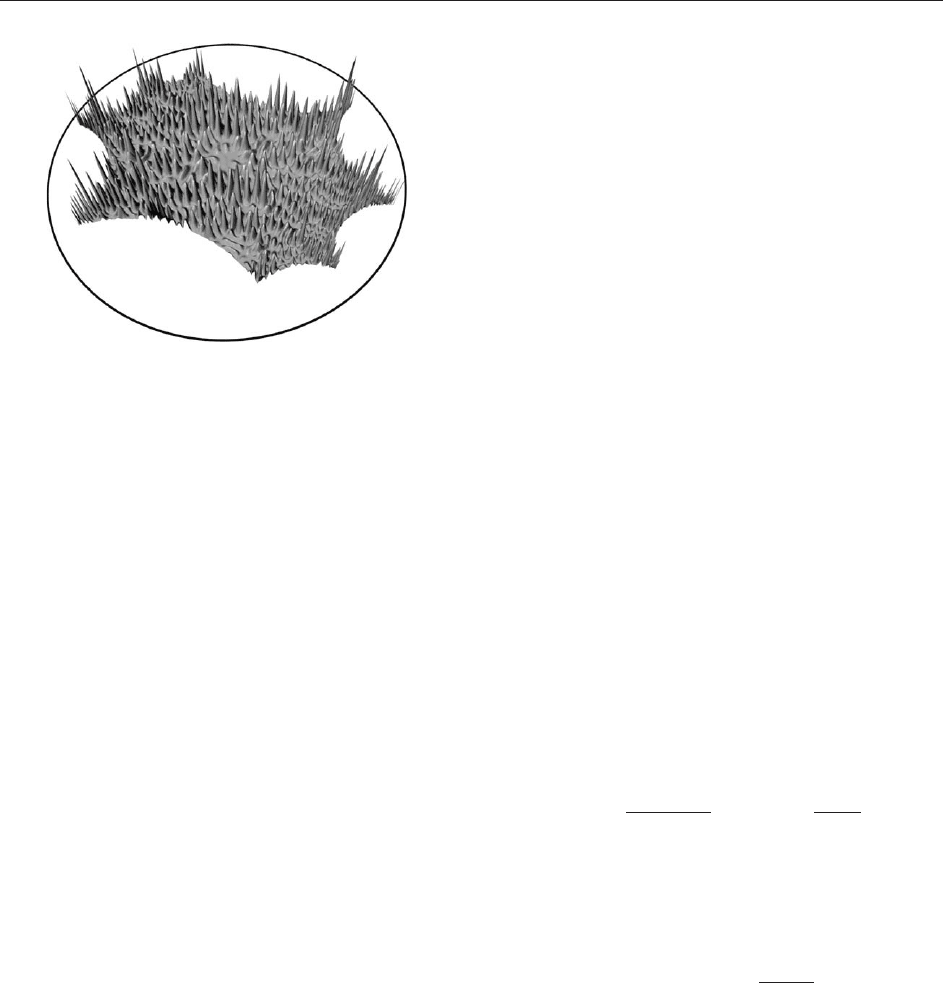
where boundary conditions are ignored. This
hypothesis was put forward by Berry in 1977 and
tested numerically, for example, in the case of
certain arithmetic and nonarithmetic surfaces of
constant negative curvature (Hejhal and Rackner
1992, Aurich and Steiner 1993). One of the
implications is that eigenstates should have uniform
mass on the surface M, that is, for any bounded
continuous function g : M!R
Z
M
j’
j
j
2
g dA !
Z
M
g dA; j !1 ½6
where dA is the Riemannian area element on M.
This phenomenon, referred to as quantum unique
ergodicity (QUE), is expected to hold for general
surfaces of negative curvature, according to a
conjecture by Rudnick and Sarnak (1994). In the
case of arithmetic hyperbolic surfaces, there has
been substantial progress on this conje cture in the
works of Lindenstrauss, Watson, and Luo– Sarnak
(discussed later in this article; see also the review by
Sarnak (2003)). For general manifolds with ergodic
geodesic flow, the convergence in [6] is so far
established only for subsequences of eigenfunctions
of density 1 (Schnirelman–Zelditch–Colin de Verdie`re
theorem, see Quantum Ergodicity and Mixing of
Eigenfunctions), and it cannot be ruled out that
exceptional subsequences of eigenfunctions have
singular limit, for example, localized on closed
geodesics. Such ‘‘scarring’’ of eigenfunctions, at least
in some weak form, has been suggested by numerical
experiments in Euclidean domains, and the existence
of singular quantum limits is a matter of controversy
in the current physics and mathematics literature. A
first rigorous proof of the existence of scarred
eigenstates has recently been established in the case
of quantized toral automorphisms. Remarkably,
these quantum cat maps may also exhibit QUE. A
more detailed account of results for these maps is
given in the section ‘‘Quantum eigenstates of cat
maps’’; see also Rudnick (2001) and De Bie`vre (to
appear).
There have been a number of other fruitful
interactions between quantum chaos and number
theory, in particular the connections of spectral
statistics of integrable quantum systems with the
value distribution properties of quadratic forms, and
analogies in the statistical behavior of energy levels
of chaotic systems and the zeros of the Riemann zeta
function. We refer the reader to Marklof (2006) and
Berry and Keating (1999), respectively, for informa-
tion on these topics.
Hyperbolic Surfaces
Let us begin with some basic notions of hyperbolic
geometry. The hyperbolic plane H may be abstr actly
defined as the simply connected two-dimensional
Riemannian manifold with Gaussian curvature 1.
A convenient parametrization of H is provided by
the complex upper-half plane, H = { x þ iy: x 2
R, y > 0}, with Riemannian line and volume
elements
ds
2
¼
dx
2
þ dy
2
y
2
; dA ¼
dx dy
y
2
½7
respectively. The group of orientation-preserving
isometries of H is given by fractional linear
transformations
H !H ; z 7!
az þ b
cz þ d
ab
cd
2 SLð2; RÞ
½8
where SL(2, R) is the group of 2 2 matrices with
unit determinant. Since the matrices 1 and 1
represent the same transformation, the group of
orientation-preserving isometries can be identified
with PSL(2, R):= SL(2, R)={1}. A finite-volume
hyperbolic surface may now be represented as the
quotient nH, where PSL(2, R) is a Fuchsian
group of the first kind. An arithmetic hyperbolic
surface (such as the modular surface) is obtained, if
has, loosely speaking, some representation in n n
matrices with integer coefficients, for some suitable n.
Figure 1 Image of the absolute-value-squared of an eigenfunc-
tion ’
j
(z) for a nonarithmetic surface of genus 2. The surface is
obtained by identifying opposite sides of the fundamental region.
Reproduced from Aurich and Steiner (1993) Statistical properties of
highly excited quantum eigenstates of a strongly chaotic system.
Physica D 64(1–3): 185–214, with permission from R Aurich.
Arithmetic Quantum Chaos 213
This is evident in the case of the modular surface,
where the fundamental group is the modular group
¼ PSLð2; ZÞ
¼
ab
cd
2 PSLð2; RÞ: a; b; c; d 2 Z
=f1g
A fundamental domain for the action of the
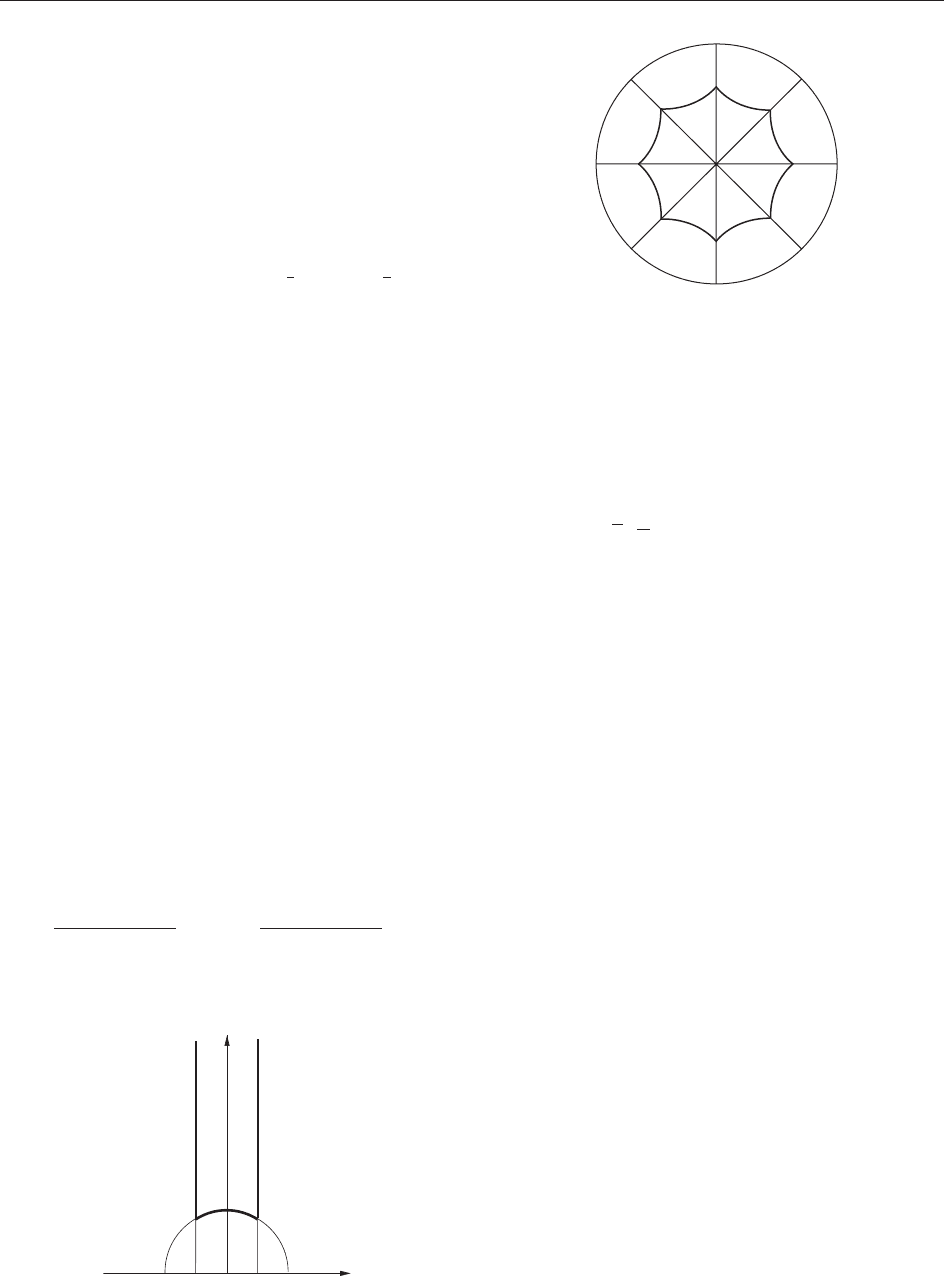
modular group PSL(2, Z)onH is the set
F
PSLð2;ZÞ
¼ z 2 H : jzj > 1;
1
2
< Re z <
1
2
½9
(see Figure 2). The modular group is generated by
the translation
11
01
: z 7!z þ 1
and the inversion
0 1
10
: z 7!1=z
These generators identify sections of the boundary
of F
PSL(2, Z)
. By gluing the fundamental domain
along identified edges, we obtain a realization of the
modular surface, a noncompact surface with one
cusp at z !1, and two conic singularities at z = i
and z = 1=2 þ i
ffiffiffi
3
p
=2.
An interesting example of a compact arithmetic
surface is the ‘‘regular octagon,’’ a hyperbolic
surface of genus 2. Its fundamental domain is
shown in Figure 3 as a subset of the Poincare´ disc
D = {z 2 C: jzj< 1}, which yields an alternative
parametrization of the hyperbolic plane H. In these
coordinates, the Riemannian line and volume
element read
ds
2
¼
4ðdx
2
þ dy
2
Þ
ð1 x
2
y
2
Þ
2
; dA ¼
4dx dy
ð1 x
2
y
2
Þ
2
½10
The group of orientation-preserving isometries is
now represented by PSU(1, 1) = SU(1, 1)={1},
where
SUð1;1Þ¼
: ; 2C; jj
2
jj
2
¼1
½11
acting on D as above via fractional linear transfor-
mations. The fundamental group of the regular
octagon surface is the subgroup of all elements in
PSU(1,1) with coefficients of the form
¼ k þ l
ffiffiffi
2
p
;¼ðm þ n
ffiffiffi
2
p
Þ
ffiffiffiffiffiffiffiffiffiffiffiffiffiffiffiffi
1 þ
ffiffiffi
2
p
q
½12
where k, l, m, n 2 Z[i], that is, Gaussian integers of
the form k
1
þ ik
2
, k
1
, k
2
2 Z. Note that not all
choices of k, l, m, n 2 Z[i] satisfy the condition
jj
2
jj
2
= 1. Since all elements 6¼1of act
fix-point free on H, the surface nH is smooth
without conic singularities.
In the follow ing, we will restrict our attention to a
representative case, the modular surface with
=PSL(2, Z).
Eigenvalue Statistics and Selberg
Trace Formula
The statistical properties of the resc aled eigenvalues
X
j
(cf. [4]) of the Laplacian can be characterized by
their distribution in small intervals
Nðx; LÞ:¼ #fj : x X
j
x þ L g½13
where x is uniformly distributed, say, in the
interval [X,2X], X large. Numerical experiments
by Bogomolny, Georgeot, Giannoni, and Sch mit,
as well as Bolte, Steil, and Steiner (see references in
–1
0
1
y
x
Figure 2 Fundamental domain of the modular group PSL(2, Z )
in the complex upper-half plane.
Figure 3 Fundamental domain of the regular octagon in the
Poincare
´
disk.
214 Arithmetic Quantum Chaos