
Francoise J.-P., Naber G.L., Tsun T.S. (editors) Encyclopedia of Mathematical Physics
Подождите немного. Документ загружается.


Quantum Field Theory in Curved Spacetime,
Symmetries in Quantum Field Theory of Lower
Spacetime Dimensions, and Thermal Quantum Field
Theory).
Quantum Fields
Ga˚ rding and Wightman characterized operator-
valued quantum fields on the Minkowski spacetime
R
1þ3
by a couple of axioms. Given additional
assumptions concerning the high-energy behavior,
the Ga˚ rding–Wightman fields are in one–one corre-
spondence with algebraic field theories.
Without specifying or presupposing these addi-
tional assumptions, the axioms will now be for-
mulated and discussed in detail and compared to the
corresponding conditions in the algebraic setting.
Adjoint operators are marked by an asterisk, and
Einstein’s summation convention is used.
Operator-valued functionals The components of a
field F are an n-tuple F
1
F
n
of linear maps that
assign to each test function ’ 2C
1
0
(R
1þ3
) linear
operators F
1
(’) F
n
(’) in a Hilbert space H with
domains of definition D(F
1
(’)) D(F
n
(’)). There
exists a dense subspace D of H with
DD(F
(’)) \D(F
(’)
) and F
(’)D[F
(’)
DD
for all indices . Consider m such fields F
1
F
m
with components F
a
,1a m,1 n
a
. Assume
there to be an involution :(1m) !(1 m) such
that F
a
(’) = F
a
(’)
, where ’(x) :¼’(x).
Quantum fields cannot be operator-valued func-
tions on R
1þ3
if one wants them to exhibit (part of)
the properties to follow. But point fields can be
quadratic forms; typically this is the case for fields in
a Fock space.
For each component F
a
and each open region
OR
1þ3
, the field operators F
a
(’) with supp ’ O
generate a
-algebra F
a
(O) of operators defined on
D. These operators typically are unbounded, which
is one of the differences with the traditional setting
of the algebraic approach. There a C
-algebra A (O)
is assigned to each open region O in such a way
that OP implies A (O) A (P). Each C
-algebra
is a
-algebra, but in contrast to a C
-algebra,
a
-algebra does not need to be endowed with a
norm. The fundamental observables in quantum
theory are bounded positive operators (typically, but
not always, projections), and these generate a C
-
algebra.
There is no fundamental physical motivation for
confining the setting to fields with a finite number of
components, except that it includes most of the
fields known from ‘‘daily life.’’
Continuity as a distribution For all , 2D, the
linear functionals T
, ,
on C
1
0
(R
1þ3
) defined by
T
a
;;
ð’Þ:¼h; F
a
ð’Þi
are distributions. They can be extended to tempered
distributions.
The Fourier transform of a tempered distribution
is well defined as a tempered distribution. It is
mainly due to the importance of Fourier transforma-
tions that the preceding assumption is convenient.
Bogoliubov et al. (1975) remark that the assumption
is not a mere technicality, since it rules out
nonrenormalizable quantum fields.
Microcausality (Bose–Fermi alt ernative) If ’ and
are test functions with spacelike separated support,
then
F
a
ð’ÞF
b
ð Þj
D
¼F
b
ð ÞF
a
ð’Þj
D
:
The sign depends on the statistics of the fields, it
is ‘‘’’ if and only if both F
a
and F
b
are fermion
fields.
Microcausality is closely related to Einstein
causality. Einstein causality requires that any two
observables located in spacelike separated regions
commute in the strong sense, that is, their spectral
measures commute. But fields with Fermi–Dirac
statistics are not observables, and not even for Bose–
Einstein fields with self-adjoint field operators does
the above condition imply that the spectral projec-
tions commute, which is the criterion for commen-
surability. The sign on the right-hand side does,
however, specify the statistics of the field.
This is a crucial difference with the algebraic
approach. If O and P are spacelike separated open
regions and if A 2A (O) and B 2A (P), then one
assumes, like in the above case, that AB = BA
(locality). But being elements of C
-algebras, A and
B are bounded operators (or can be represented
accordingly), so if A and B are self-adjoint, they are,
indeed, commensurable.
Doplicher, Haag, and Roberts (1974) and Buch-
holz and Fredenhagen (1984) have derived from this
input of observables a field structure of locali zed
particle states, and they showed that the statistics of
these fields is Bose–Einstein, Fermi–Dirac, or some
corresponding parastatistics (which is, a priori,
forbidden if one assumes microcausality).
Recall that the unimodular group SL(2, C)is
isomorphic to the universal covering group of
the restricted Lorentz group L
"
þ
(the connected
component containing the unit element). Denote by
: SL(2, C) !L
"
þ
a covering map.
Axiomatic Quantum Field Theory 235

Covariance There exist strongly continuous uni-
tary representations U and T of SL(2, C) and
(R
1þ3
, þ), respectively, and representations
D
1
D
m
of SL(2, C) in C
n
1
C
n
m
, respectively,
such that
UðgÞF
a
ð’ÞUð g Þ
¼ D
a
ðg
1
Þ
F
a
ð’ððgÞ
1
ÞÞ
and
TðyÞF
a
ð’ÞTðyÞ
¼ F
a
ð’ð yÞÞ;
where D
a
(g
1
)
are the elements of the matrix
D
a
(g
1
). Dropping coordinate indices, this reads
UðgÞF
a
ð’ÞUðgÞ
¼ D
a
ðg
1
ÞF
a
ð’ððgÞ
1
ÞÞ
and
TðyÞF
a
ð’ÞTðyÞ
¼ F
a
ð’ð yÞÞ:
The representations U and T generate a representa-
tion of the universal covering of the restricted
Poincare´ group.
As it stands, this assumption is a very strong one,
since it manifestly fixes the action of the representa-
tion on the field operators. In the algebraic
approach, the covariance assumption is more mod-
estly formulated. Namely, it is assumed that
U(g)A (O)U(g)
= A ((g)O) and T(y)A (O)T(y )
=
A (Oþy), leaving open how the representation acts
on the single local observables.
Vacuum vector There exists a unique (up to a
multiple) vector 2D that is invariant under the
representations U and T and cyclic with respect to
the algebra F(R
1þ3
) g enerated by all field operators
F
a
(’), that is, F(R
1þ3
)=H.
Spectrum condition The joint spectrum of the
components of the 4-momentum, i.e., of the gen-
erators of the spacetime translations, has support in
the closed forward light cone
V
þ
, that is, the set
{k
2
0, k
0
0}.
The existence of an invariant ground state called
the vacuum is standard in algebraic quantum field
theory as well.
N-Point Functions
Consider the above fields F
1
F
m
. For each N 2N
and each N-tuple (a
1
a
N
) of natural numbers m
(labeling fields), define families (F
a
1
a
N
) :¼
(F
a
1
a
N
1
N
)
i
n
a
i
and w
a
1
a
N
:¼(w
a
1
a
N
1
N
)
i
n
a
i
of dis-
tributions on (R
1þ3
)
N
by
F
a
1
a
N
1
N
ð’
1
’
N
Þ:¼F
a
1
1
ð’
1
ÞF
a
N
N
ð’
N
Þ
(using the nuclear theorem) and
w
a
1
a
N
1
N
ð Þ:¼h; F
a
1
a
N
1
N
ð Þi: ½1
These distributions are called the ‘‘N-point func-
tions’’ of the fields F
1
F
m
and yield the vacuum
expectation values of the theory. It is straightfor-
ward to deduce the following properties from the
Ga˚ rding–Wightman axioms.
Microcausality (Bose–Fermi alternative) If ’
i
and
’
iþ1
have spacelike separated supports, then
w
a
1
a
i
a
iþ1
a
N
1
i
iþ1
N
ð’
1
’
i
’
iþ1
’
N
Þ
¼w
a
1
a
iþ1
a
i
a
N
1
iþ1
i
N
ð’
1
’
iþ1
’
i
’
N
Þ:
or dropping coordinate indices ,
w
a
1
a
i
a
iþ1
a
N
ð’
1
’
i
’
iþ1
’
N
Þ
¼w
a
1
a
iþ1
a
i
a
N
ð’
1
’
iþ1
’
i
’
N
Þ:
Invariance For all g 2SL(2, C) and y 2R
1þ3
, one has
w
a
1
a
N
1
N
ð’
1
’
N
Þ
¼ D
a
1
ðg
1
Þ
1
1
D
a
N
ðg
1
Þ
N
N
w
a
1
a
N
1
N
ððgÞ’
1
ðgÞ’
N
Þ
¼ w
a
1
a
N
1
N
ð’
1
ð yÞ’
N
ð yÞÞ
or dropping coordinate indices ,
w
a
1
a
N
ð’
1
’
N
Þ
¼ D
a
1
ðg
1
ÞD
a
N
ðg
1
Þ
w
a
1
a
N
ððgÞ’
1
ðgÞ’
N
Þ
¼ w
a
1
a
N
ð’
1
ð yÞ’
N
ð yÞÞ:
By translation invariance, the N-point functions
w
a
1
a
N
1
N
ðx
1
x
N
Þ only depend on the N 1 relative-
position vectors
1
:¼ x
1
x
2
,
2
:¼ x
2
x
3
; ...,
N1
:¼ x
N
1
x
N
. This means that there are distribu-
tions W
a
1
N
1
N
on ðR
1þ3
Þ
N1
related to the N-point
functions by the symbolic condition
w
a
1
a
N
1
N
ðx
1
x
N
Þ¼W
a
1
a
N
1
N
ð
1
N 1
Þ:
In precise notation, this reads
w
a
1
a
N
1
N
ð’Þ¼
Z
1þ3
W
a
1
a
N
1
N
ð’
x
Þdx;
where
’
x
ð
1
N 1
Þ :¼’ðx; x
1
; x
1
2
; ...; x
1
N 1
Þ:
The functions W
a
1
a
N
1
N
are called the Wightman
functions, and they have the following property
because of the spectrum condition of the field.
236 Axiomatic Quantum Field Theory

Spectrum condition The support of the Fourier
transform of each W
a
1
a
N
1
N
is contained in (V
þ
)
N1
.
The uniqueness of the vacuum vector (up to a
phase) is equivalent to the following condition.
Cluster property For N 2, let x be a spacelike
vector in R
1þ3
, let L be a natural number <N, and
let ’ and be tempered test functions on (R
1þ3
)
L
and (R
1þ3
)
N L
, respectively. then
lim
0<!1
w
a
1
a
N
1
...
N
ð’ ð xÞÞ
¼ w
a
1
a
L
1
L
ð’Þw
a
Lþ1
a
N
Lþ1
N
ð Þ:
On the one hand, these properties have been
deduced from the Ga˚rding–Wightman axioms via
eqn [1]. Conversely, a family of distributions
labeled in the above fashion and satisfying the
above properties may be used to construct a
Ga˚ rding–Wightman field theory provided that two
more conditions – which hold for all systems of
N-point functions – are satisfied. This requires
some elementary notation.
Define the index sets
I
N
:¼
a
1
a
N
1
N
: 1 a
i
m; 1
i
n
a
i
for all 1 i N
; N 2N
I
0
:¼{;}, and I :¼
S
N 2N
0
I
N
.OnI a concatena-
tion is defined by
a
1
a
N
1
N
b
1
b
M
1
M
:¼
a
1
a
N
b
1
b
M
1
N
1
M
and
; :¼ ;:¼
and an involution by
a
1
a
N
1
N
:¼
a
N
a
1
N
1
and ;
:¼;:
Define an antilinear involution on S
N
:¼
S((R
1þ3
)
N
)by
ðx
1
x
N
Þ:¼ ðx
N
x
1
Þ
for each N 2N. Put S
0
:¼C and z
:¼z for all
z 2 C.
Define S
I
N
:¼S
N
I
N
, and S
I
:¼
S
N
S
I
N
. For
each 2I
N
, the set S
:¼S((R
1þ3
)
N
) {}isa
linear space. On the direct sum B
I
:¼
L
2I
S
define an associative product by
ð ;Þð; Þ:¼ð ; Þ
and an antilinear involution by ( , )
:¼(
,
).
This endows B
I
with the structure of a nonabelian
-algebra with unit element 1 = (1, ;) (Borchers
algebra).
If one defines F
;
(z) :¼z1, then w
;
(z) = z, and the
Wightman functions induce a C-linear functional !
on B
I
by
!ð ;Þ:¼w
ð Þ½2
! exhibits the following two properties, which are
the announced additional conditions required for
reconstructing the fields from the N-point functions.
Hermiticity !(
) = !():
Positivity !(
) 0:
To see Hermiticity, compute
!ð
;
Þ¼h; F
ð
Þi
¼hF
ð Þ; i¼!ð ;Þ
and use C-linearity to prove the statement for
arbitrary 2B. For positivity, write any as a finite
sum = (
1
,
1
) þ þ(
M
,
M
), and compute
!ð
Þ¼!
X
M
i;j¼1
ð
i
;
i
Þ
ð
j
;
j
Þ
!
¼ !
X
ij
i
j
;
i
j
!
¼
X
ij
w
i
j
i
j
¼
X
ij
h; F
i
j
i
j
i
¼
X
ij
h; F
i
i
F
j
ð
j
Þi
¼
X
ij
hF
i
ð
i
Þ; F
j
ð
j
Þi
¼
X
i
F
i
ð
i
Þ
2
0:
Theorem 1 (Wightman’s reconstruction theorem).
Let m and n
1
n
m
be natural numbers, let
I
0
, I
1
, I
2
, ..., and I be the above index sets, and
let B
I
be the above Borchers algebra. Let D
1
D
m
be matrix representations of SL(2, C) in C
n
1
C
n
m
,
respectively.
For each natural number N, let (w
)
2I
N
be a
family of distributions on (R
1þ3
)
N
. Suppose the
family (w
)
2I
defined this way satisfies microcaus-
ality, covariance, spectrum condition, and the
cluster property. If the linear functional ! defined
on B
I
by eqn [2] is Hermitian and positive, then
Axiomatic Quantum Field Theory 237

there is (up to unitary equivalence) a unique family
F
1
F
m
of Ga˚ rding–Wightman fields with n
1
n
m
components such that eqn [1] holds.
The proof uses the GNS construction known from
the theory of operator algebras. The Borchers
algebra plays several roles. On the one hand, it is a
linear space with an inner product. The Hilbert
space H and the invariant space D of the field theory
are constructed from this structure. On the other
hand, the Borchers algebra acts on itself as an
algebra of linear operators by its own algebra
multiplication. This is the structure the -algebra of
field operators is constructed from.
Results
The mathematical and structural analysis of quan-
tum fields has improved the understanding of
scattering theory in the different approaches men-
tioned above; see Bogoliubov et al. (1975) and the
relevant articles in this encyclopedia. Apart from
this, the following results deserve to be mentioned.
Evidently, many others have to be omitted for
practical reasons.
PCT Symmetry
An early famous result was Lu¨ ders’s proof (1957)
that all fields in the above setting exhibit PCT
symmetry, that is, the symmetry under reflections in
all space and time variables combined with a charge
conjugation. This symmetry is exhibited by all
particle reactions observed so far. The proof, like
several of the main results, made extensive use of the
fact that the N-point functions are boundary values
of analytic functions due to the spectrum condition,
and that a fundamental theorem by Bargmann, Hall,
and Wightman (1957) yields invariant analytic
extensions.
Reeh–Schlieder Theorem
For each field F
a
and each bounded open region
OR
1þ3
, the vacuum vector is cyclic with respect
to F
a
(O) (Reeh and Schlieder 1961). So excitations
of the vacuum vector by field operators located in O
are not to be considered as state vectors of a particle
localized in O, since they are not perpendicular to
the excitations by field operators located outside O.
Unruh Effect and Modular P
1
CT Symmetry
In the 1970s, Bisognano and Wichmann (1975, 1976)
discovered a surprising link of symmetries to the
intrinsic algebraic structure of quantum fields, which is
established by the Tomita–Takesaki modular theory
(see Tomita–Takesaki Modular Theory). Namely, the
unitary operators implementing the Lorentz boosts on
the fields are elements of modular groups. This means
that a uniformly accelerated observer perceives the
vacuum as a thermal state with a temperature
proportional to its acceleration, corresponding to the
famous Unruh effect.
In addition, it was shown that P
1
CT symmetries
(i.e., PCT combined with rotations by the angle )are
implemented by modular conjugations (modular P
1
CT
symmetry). Modular P
1
CT symmetry is a consequence
of the Unruh effect (Guido and Longo 1995).
Spin and Statistics
Immediately following Lu¨ ders’s PCT theorem, the
spin–statistics theorem was proved for the N-point
functions of the Wightman setting (Lu¨ders and
Zumino 1958, Burgoyne 1958, Dell’Antonio 1961).
This was a remarkable and widely acknowledged
progress. But as remarked earlier, the confinement to
finite-component fields, which is used in the proof,
cannot be motivated by physical first principles (i.e., in
a truly axiomatic fashion). The representation D of
SL(2, C) acting on the components, however, is forced
to be finite dimensional by this assumption, and since
the representations D
a
are objects of investigation, a
considerable part of the result is assumed this way
from the outset. Even more so, there are examples of
fields with a ‘‘wrong’’ spin–statistics connection and
infinitely many components.
This was one reason to continue working on the
subject. At the beginning of the 1990s, it was found
that the spin–statistics theorem can be derived from
the symmetries discovered by Bisognano and Wich-
mann, and Unruh. Two approaches not referring to
the number of internal degrees of freedom have been
worked out: one assumes the Unruh effect (Guido
and Longo 1995), the other modular P
1
CT symme-
try (Kuckert 1995, 2005, Kuckert and Lorenzen
2005). The first approach has been generalized to
conformal fields, the second to the case that the
symmetry group’s homogeneous part is not SL(2, C),
but only SU(2).
Both approaches can be applied to infinite-
component fields. They yield existence theorems; a
distinguished representation is constructed from the
modular symmetries, and this representation exhib-
its Pauli’s spin–statistics connection. As mentioned
before, nothing more can be expected at this level of
generality. The line of argument works in both the
algebraic and the Wightman setting.
A Dynamical Property of the Vacuum
One can derive the spectrum condition, the Bisog-
nano–Wichmann symmetries/the Unruh effect, and
238 Axiomatic Quantum Field Theory

covariance from the condition that no (inertial or)
uniformly accelerated observer can extract mechan-
ical energy from the field in vacuo by means of a
cyclic process (Kuckert 2002).
Interacting Fields
The examples of interacting quantum fields that fit
into the above settings live in one or two spatial
dimensions only, and their relevance for physics
mainly consists in being such examples. This
has contributed to some frustration and to doubts
on whether one is not, in fact, proving theorems on
pretty empty sets, or in other words, working on
‘‘the most sophisticated theory of the free field.’’
The computations in quantum field theory are, like
most of the computations in physics, perturbative. In
order to be successful, they need to yield good
agreement with experiment with reasonable compu-
tational efforts, that is, by evolution up to the second
or third order. This asymptotic convergence is more
important than convergence of the series as a whole.
There are low-dimensional examples of interacting
Wightman fields (e.g., (’
4
)
2
; cf. the monograph by
Glimm and Jaffe (1987)), and time will tell whether
four-dimensional interacting Wightman fields exist.
But there is no reason to expect convergence for
general interacting fields; for example, QED does not
fit into the Wightman framework.
The appropriate extension of the Wightman
setting has been formulated by Epstein and Glaser
(1973). It defines the S-matrix rather than the field
itself as a (in general divergent) formal power series
of operator-valued distributions.
The above results apply to this somewhat more
modest setting as well, so the ‘‘axiomatic’’
approaches do help in understanding the known
high-energy physics interactions. This even includes
gauge theories (see Perturbative Renormalization
Theory and BRST). The high-precision results of
QED can be reproduced within this setting, and
there occur no UV singularities: renormalization
amounts to the need to extend distributions by
fixing some parameters, that is, the renormalization
constants. The infrared problem is circumvented by
considering the S-matrix as a (position-dependent)
distribution taking values in the unitary formal
power series of distributions rather than as a single
(global) unitary operator (or unitary power series).
Quantum Energy Inequalities
Energy densities of Wightman fields admit negative
expectation values (Epstein, Glaser, and Jaffe 1965).
This is in contrast to the positivity conditions that
the energy–momentum tensors of classical general
(and, hence, also special) relativity have to satisfy to
ensure causality. But the conflict can be solved by
smearing the densities out in space or time, as has
first been realized by Ford (1991). The extent to
which the energy density can become negative
depends on the extent to which it is smeared out:
‘‘more smearing means less violation of positivity,’’
so the classical positivity conditions are restored at
medium and large scales. There are many ways to
make this principle concrete. Quantum energy
inequalities hold for thermodynamically well-
behaved quantum fields on causally well-behaved
classical spacetime backgrounds.
Bibliographic Notes
Important monographs on axiomatic quantum field
theory are those by Streater and Wightman (1964),
Jost (1965), Bogoliubov et al. (1975),andBogoliubov
et al. (1990). Note that the books of Bogoliubov et al.
differ in setup fundamentally and that neither replaces
the other. For a lecture notes volume, see also Vo¨lkel
(1977), and for a review article, see Streater (1975).
A valuable discussion of the Wightman axioms can
also be found in the second volume of the series by
Reed and Simon (1970).
The first monograph on the algebraic approach to
quantum field theory is due to Haag (1992), a more
recent one has been written by Araki (1999).
Concerning the sufficient conditions for ‘‘switching’’
between the Ga˚ rding–Wightman and the algebraic
approach, see Wollenberg (1988) and the Ph.D.
thesis of Bostelmann (2000) and references given
there. Dynamical and thermodynamical foundation
of standard axioms, the Bisognano–Wichmann
symmetries (Unruh effect), and the spin–statistics
theorem, have been investigated by Kuckert (2002,
2005), see also the references given there for related
work.
In different formulations and at differing degrees of
mathematical sophistication, the causal approach to
perturbation theory can be found in the monographs
by Bogoliubov and Shirkov (1959), Scharf (1989,
2001), and Steinmann (2000). Two modern review
articles have been written by Brunetti and Fredenhagen
(2000) and by Du¨ tsch and Fredenhagen (2004).
The reference original articles on the Euclidean
axioms are those of Osterwalder and Schrader (1973,
1975). Note that the first one contains an error. (cf.
also Zinoviev (1995)). A monograph on Euclidean
field theory and its relations to the other axiomatic
settings of quantum field theory and to statistical
mechanics is that by Glimm and Jaffe (1987).
A recent review on quantum energy inequalities is
due to Fewster (2003).
Axiomatic Quantum Field Theory 239

Acknowledgments
The author is a fellow of the Emmy-Noether
Programme (DFG). Thanks for discussions are due
to Professor D Arlt.
See also: Algebraic Approach to Quantum Field Theory;
C*-Algebras and Their Classification; Constructive
Quantum Field Theory; Dispersion Relations; Euclidean
Field Theory; Indefinite Metric; Perturbative
Renormalization Theory and BRST; Quantum Field
Theory: A Brief Introduction; Quantum Field Theory in
Curved Spacetime; Scattering, Asymptotic Completeness
and Bound States; Scattering in Relativistic Quantum
Field Theory: Fundamental Concepts and Tools;
Scattering in Relativistic Quantum Field Theory: The
Analytic Program; Symmetries in Quantum Field Theory:
Algebraic Aspects; Symmetries in Quantum Field Theory
of Lower Spacetime Dimensions; Thermal Quantum Field
Theory; Tomita–Takesaki Modular Theory;
Two-Dimensional Models.
Further Reading
Araki H (1999) Mathematical Theory of Quantum Fields.
Oxford: Oxford University Press.
Bogoliubov NN, Logunov AA, and Todorov IT (1975) Introduc-
tion to Axiomatic Quantum Field Theory, (Russian original
edition: Nauka (Moskow) 1969). New York: Benjamin.
Bogoliubov NN, Logunov AA, Oksak AI, and Todorov IT (1990)
General Principles of Quantum Field Theory, (Russian
original edition Nauka (Moskow) 1987). Dordrecht–Boston–
London: Kluwer.
Bostelmann H (2000) Lokale Algebren und Operatorprodukte am
Punkt (in German). Ph.D. thesis, Go¨ ttingen.
Brunetti R and Fredenhagen K (2004) Microlocal Analysis and
Interacting Quantum Field Theories: Renormalization on
Physical Backgrounds. Communications in Mathematical
Physics 208: 623.
Du¨ tsch and Fredenhagen K (2004) Causal Perturbation Theory in
terms of retarded products, and a proof of the Action Ward
Identity, to appear in. Rev. Math. Phys.
Fewster CJ (2003) Energy Inequalities in Quantum Field Theory.
Proceedings of the International Conference on Mathematical
Physics (revised version under math-ph/0501073).
Glimm J and Jaffe A (1987) Quantum Physics: A Functional
Integral Point of View, 2nd edn. Berlin–Heidelberg–
New York: Springer.
Guido D and Longo R (1995) An algebraic spin and statistics
Theorem. Communications in Mathematical Physics 172: 517.
Haag R (1992) Local Quantum Physics. Berlin–Heidelberg–New
York: Springer.
Jost R (1965) The General Theory of Quantized Fields. American
Mathematical Society.
Kuckert B (2002) Covariant thermodynamics of quantum
systems: passivity, semipassivity, and the Unruh effect. Annals
of Physics 295: 216.
Kuckert B (2005) Spin, statistics, and reflections, I. Annales Henri
Poincare´ 6: 849.
Kuckert B and Lorenzen R (2005) Spin, Statistics, and Reflec-
tions, II. Preprint (math-ph/0512068).
Osterwalder K and Schrader R (1973) Axioms for Euclidean
Green’s functions. Communications in Mathematical Physics
31: 83.
Osterwalder K and Schrader R (1975) Axioms for Euclidean
Green’s functions. 2. Communications in Mathematical
Physics 42: 281.
Reed M and Simon B (1970) Methods of Modern Mathematical
Physics, (4 volumes). London: Academic Press.
Scharf G (1989) Finite Quantum Electrodynamics. Berlin–
Heidelberg–New York: Springer.
Scharf G (2001) Quantum Gauge Theories A True Ghost Story.
Weinheim: Wiley.
Streater RF (1975) Outline of axiomatic quantum field theory.
Reports on Progress in Physics 38: 771.
Streater RF and Wightman AS (1964) PCT, Spin & Statistics, and
All That. New York: Benjamin.
Vo¨ lkel AH (1977) Fields, Particles, and Currents. Lecture Notes
in Physics, vol. 66. Berlin–Heidelberg–New York: Springer.
Wollenberg M (1988) The existence of quantum fields for local
nets of observables. Journal of Mathematical Physics 29: 2106.
Zinoviev YM (1995) Equivalence of Euclidean and Wightman field
theories. Communications in Mathematical Physics
174: 1.
240 Axiomatic Quantum Field Theory
B
Ba¨ cklund Transformations
D Levi, Universita
`
‘‘Roma Tre’’, Rome, Italy
ª 2006 Elsevier Ltd. All rights reserved.
Introduction
Ba¨cklund transformations ap peared for the first time
in the work of the geometers of the end of the
nineteenth century, for instance, Bianchi, Lie,
Ba¨cklund, and Darboux, when studying surfaces
of constant curvature. If on a surface in three-
dimensional Euclidean space, the asymptotic direc-
tions are taken as coordinate directions, then the
surface metric may be written as
ds
2
¼ dx
2
þ 2 cosðwÞdx d y þ dy
2
½1
where w(x, y) is a function of the surface coordi-
nates x, y. A necessary and sufficient condition for
the surface to be of constant curvature is that w
satisfies the nonlinear partial differential equation
w
;xy
¼ sinðwÞ½2
where the subscript denotes partial derivative.
Equation [2] is nowadays called the sine Gordon
(sG) equation. Bianchi (1879), Lie (1888, 1890,
1893), and Ba¨cklund (1874) introduced a transfor-
mation which allows one to pass from a solution of
eqn [2] to a new solution, that is, from a surface of
constant curvature to a new one. Starting from the
work of Clarin (1903), this transformation has been
referred to as Ba¨ cklund transformation (BT ). The
BT for eqn [2] reads
~
w
;x
¼ w
;x
þ 2a sin
~
w þ w
2
½3a
~
w
;y
¼w
;y
þ
2
a
sin
~
w w
2
½3b
where a is a nonzero constant parameter and
˜
w is a
different solution of eqn [2]. It is immediate to prove
by appropriate differentiation of eqn s [3] with
respect to y and x that both w and
˜
w must satisfy
eqn [2]. The BT [3] provides a denumerable set of
exact solutions once a solution w is known. Bianchi
showed that four such solutions can be related in an
algebraic way:
tan
~
w
0
w
4
¼
a
1
þ a
2
a
1
a
2
tan
w
0
~
w
4
½4
Equation [4] is derived using the permutability
theorem proved by Bianchi in his Ph.D. thesis in
1879:
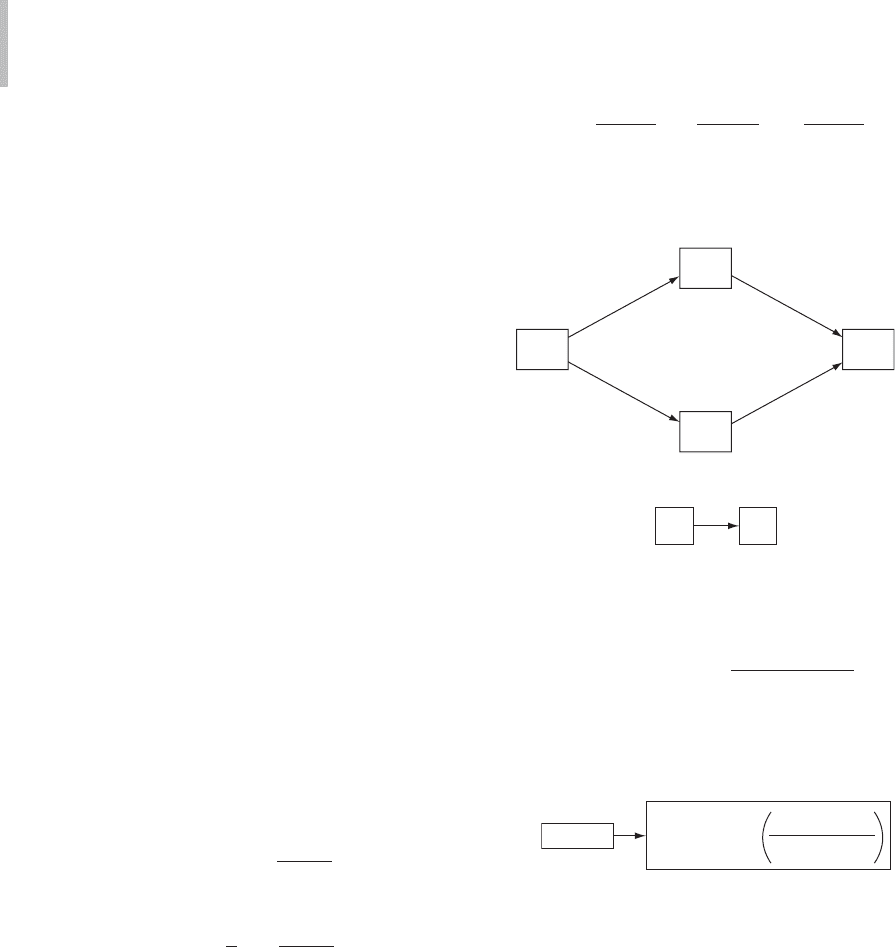
a
1
a
2
a
1
a
2
w
w′
w
~
w′
~
½5
whereby the diagram
w
w′
a
we mean a BT from w to w
0
with parameter a.
For sG equation [2] a trivial solution is given, for
example, by w(x, y) = . Then, from eqn [3a] we get
~
wðx; yÞ¼2 arcsin
1 e
2½axþðyÞ
1 þ e
2½axþðyÞ
Introducing this result in eqn [3b],weget
,y
= 1=a.
So, the application of the BT [3] to sG equation gives
the nontrivial solution
w = π
w
~
= 4 arctan
1 e
–[ax–y/a]
1 + e
–[ax–y/a]
−
½6
Clarin (1903) extended the results of Ba¨ cklund to
the case of a generic partial differential equation of
second order,
Fðx; y; w; w
;x
; w
;y
; w
;xx
; w
;xy
; w
;yy
Þ¼0 ½7
by assuming that
w
;x
¼ f ðw;
~
w;
~
w
;x
;
~
w
;y
Þ
w
;y
¼ gðw;
~
w;
~
w
;x
;
~
w
;y
Þ
½8

If the compatibility of eqns [8]
f
;y
g
;x
¼ 0 ½9
is identically satisfied by eqn [7] for the variable
˜
w(x, y), then we say that eqns [8] are an
auto-Ba¨cklund transformation for eqn [7]. In this
case, eqns [8] transform a solution of eqn [7] into a
new solution of the same equation. Thus, eqns [8]
simplify the problem of finding solutions of eqn [7].
Given one solution w(x, y) of eqn [7], the existence
of a BT reduces the problem of integrating eqn [7]
into that of solving two first-order ordinary differ-
ential equations. From this point of view, the
Cauchy–Riemann relations
w
;x
¼
~
w
;y
; w
;y
¼
~
w
;x
½10
for the Laplace equation
w
;xx
þ w
;yy
¼ 0 ½11
are a BT ante litteram (however, without a free
parameter).
Consider the case when
˜
w(x, y ) satisfies a different
partial differential equation,
Gðx; y;
~
w;
~
w
;x
;
~
w
;y
;
~
w
;xx
;
~
w
;xy
;
~
w
;yy
Þ¼0 ½12
In this case, one still has a BT, but not an auto-BT.
The best-known cases are when F
1
= w
,y
þ w
,xxx
þ
ww
,x
and G
1
=
˜
w
,y
þ
˜
w
,xxx
þ
˜
w
2
˜
w
,x
, and F
2
= w
,xy
e
w
and G
2
=
˜
w
,xy
(Lamb 1976). In the first case, the
BT relates the Korteweg–de Vries (KdV) equation to
the modified KdV equation and this transformation
paved the way to the discovery of the complete
integrability of the KdV equation by Gardner et al.
(1967). In the second case, the BT relates the
Liouville equation to the wave equation, and can
be used to solve it completely. Due to the first
example, often a non-auto-BT is denoted as Miura
transformation.
One can now state an operative definition of BT,
extending the results of Ba¨cklund and Clarin to
more general equations.
Definition 1 Consider two partial differential
equations of order m
1
and m
2
:
F
1
ðx; u; u
ð1Þ
; u
ð2Þ
; ...; u
ðm
1
Þ
Þ¼0 ½13a
F
2
ðx;
~
u;
~
u
ð1Þ
;
~
u
ð2Þ
; ...;
~
u
ðm
2
Þ
Þ¼0 ½13b
where x 2 R
n
and (u,
~
u) 2 C
p
, and
u
(k)
is the set of
k-order derivative of u. The set of n equations
G
j
ðx; u; u
ð1Þ
; ...; u
ðs
1
Þ
;
~
u;
~
u
ð1Þ
; ...;
~
u
ðs
2
Þ
Þ¼0
j ¼ 1; 2; ...; n ½14
with s
1
< m
1
and s
2
< m
2
, represents the BT of
eqns [13] iff the compatibility of eqns [14] is
identically satisfied on the solutions of eqns [13]
and G
j
depends on a set of essential arbitrary
constant parameters.
The Clarin formulation [8] and the classical BT
for the sG [3] are clearly special subcases of this
definition. When a solution of F
1
= 0 is known, a
solution of F
2
= 0 is obtained by solving a set of
lower-order partial differential equations. By a
proper choice of the BT parameters, once a new
solution is obtained by solving the BT [14], one can
use the obtained solution as a starting point to
construct another one, and so on. In this way, one
can construct a whole ladder of solutions, a priori a
denumerable set of solutions. This same construc-
tion has been applied also to the case of functional
equations. In particular, it has been considered for
the case of differential–difference and difference–
difference equations both for finite (dynamical
systems (Wojciechowski 1982)) and infinite lattices
(Toda 1989).
In the case when F
1
and F
2
represent the same
equation, s
1
= s
2
= 1 and the BTs G
j
= 0 are linear in
u
(1)
, then Definition 1 is strictly related to the notion
of nonclassi cal symmetry or conditional symmetry
(Levi and Winternitz 1989, Olver 1993), an exten-
sion of the concept of Lie symmetry used to reduce
and integrate a differential equation. In the case of
the nonclassical symmetries, the known solution
~
u is
included in the arbitrary x-dependent coefficients of
the transformation. In this case, the BT is just a way
to construct an explicit solution of the differential
equation [7].
Definition 1 is often too general to be able to get
explicit results. It is constructive for any partial
differential equation, linear or nonlinear, but if one
is not able to get a nontrivial BT this does not
mean that a BT does not exist. As noted later, the
existence of an auto-BT is associated to the
existence of an infinity of symmetries, and this is
a condition for the exact integrability of eqn [13]
(Fokas 1980, Ibragimov and Shabat 1980 ). So, the
existence of a BT is closely related to the integr-
ability of eqn [13].
Ba¨ cklund via Integrability
One can derive the BT from the integrability
properties of eqn [13a]. Equation [13a] is said to
be integrable if it can be written as the compatibility
condition of an ov erdetermined system of linear
partial differential equations for an auxiliary func-
tion depending on a free parameter belonging to the
242 Ba¨ cklund Transformations

complex C plane. The prototype of such a situation
is given by the Lax pair for the KdV equation
u
;t
þ u
;xxx
6uu
;x
¼ 0 ½15
introduced by Lax (1968):
L ¼ k
2
; L ¼@
2
x
þ uðx; tÞ½16a
;t
¼M ; M ¼ 4@
xxx
3ðu@
x
þ @
x
uÞ½16b
where k is a free parameter and = (x, t; k). As eqn
[16a] is nothing else but the stationary Schro¨ dinger
equation, the function can be interpre ted as a
wave function, and k
2
is the spectral parameter
corresponding to the potential u(x, t). The condition
for the existence of a solution of the over-
determined system of eqns [16] is given by the
operator equation
L
;t
¼½L; M½17
the so-called Lax equation. In the case of
asymptotically bounded potentials, eqn [16a]
defines the spectrum unique. Introducing the
following asymptotic boundary conditions for the
wave function ,
ðx; t; kÞ!
x!1
Tðk; tÞe
ikx
ðx; t; kÞ!
x!þ1
e
ikx
þ Rð k; tÞe
ikx
½18
where R(k, t)andT(k, t) are, respectively, the
reflection and the transmission coefficient, the
spectrum is defined in the complex plane of
the variable k by
S½ufRðk; tÞ; 1 < k < 1; p
n
; c
n
ðtÞ;
j ¼ 1; 2; ...; Ng½19
where p
n
are the bound state parameters corre-
sponding to isolated singularities of the reflection
coefficients on the imaginary positive k-axis corre-
sponding to a solution
n
(x, t; p
n
) of the spectral
problem vanishing for x !1and such that
lim
x!þ1
½e
p
n
x
n
ðx; t; p
n
Þ ¼ 1 ½20
and c
n
are some functions of t related to the residues
of R(k, t) at the poles p
n
. There is a one-to-one
correspondence between the evolution of the poten-
tial u(x, t) in eqn [15] and that of the spectrum S[u]
of the Schro¨ dinger spectral prob lem [16a]. In parti-
cular, for the KdV, taking into account eqn [16 b],
the evolution of the reflection coefficient R(k, t)is
given by
dRðk; tÞ
dt
¼ 8ik
3
Rðk; tÞ½21
In eqn [21] and henceforth, d=dt denotes the total
derivative with respect to t.
In the following, for the sake of the simplicity
of exposition and for the concreteness of the
presentation, all the results presented on the BT
will be derived for the KdV equation. Similar
results can be obtained and have been obtained in
the literature for many classes o f integrable
partial differential equations in two and three
dimensions and for differential–difference and
difference–d ifferenc e equa tions. For a partial
review of the available recent literature on
the subject, see Rogers and Shadwick (1982) and
Coley et al. (2001)
A more general form of introducing the non-
linear partial differential equation as a compat-
ibility of an overdetermined system of linear
equations has been provided by Zaharov and
Shabat (1979) with the dress ing method (DM). In
the DM, the dif ferential equations [16] are
substituted by a matrix system of linear equations
;x
¼ Uðuðx; tÞ; kÞ ½22a
;t
¼ Vðuðx; tÞ; kÞ ½22b
where =(x, t; k)andU and V are matrix
functions. The existence of a nonsingular solution
of the system of linear equations [22] requires
that the matrix functions U and V satisfy the
equation
U
;t
V
;x
þ½U; V¼0 ½23
often called zero-curvature condition. The KdV
equation [15] in the DM is obtained by choosing
Uðuð x; tÞ; kÞ¼
ikuðx; tÞ
1 ik
Vðuðx; tÞ; kÞ
¼
2u þ4k
2
u
x
2iku 4ik
3
u
x
þ2iku þ4ik
3
2uðu þ2k
2
Þ2iku
x
u
x
x
!
½24
The existence of an auto-BT implies the existence
of a differential equation (see De finition 1)which
relates two solutions of the same nonlinear equa-
tion. The new solution
˜
u(x, t)ofeqn[15] w ill be
associated to a different Lax operator and a
different spectral problem (but of the same opera-
tional form)
~
L ¼@
xx
þ
~
uðx; tÞ½25a
~
L
~
¼ k
2
~
½25b
Ba¨ cklund Transformations 243

The existence of a relation between the potentials
u(x, t) and
˜
u(x, t) thus implies that there must be a
(u,
˜
u; k)-dep endent operator D such that
~
¼ D ½26
The compatibility of eqns [16a], [25b], and [26]
implies that
˜
LD = Dk
2
, that is,
~
LD ¼ DL ½ 27
Equation [27] is the auto-BT in the Lax formalism.
If
˜
L and L are two different spectral problems
related to two different nonlinear partial differential
equations, then eqn [27] will provide a Miur a
transformation. In the DM, the requirement of the
existence of a BT is given again by eqn [26] with
and
˜
substituted by and
˜
and the operator D
substituted by a matrix function D. The BT in the
DM is given by
D
;x
¼ Uð
~
uðx; tÞ; kÞD DUðuðx; tÞ; kÞ½28a
D
;t
¼ Vð
~
uðx; tÞ; kÞD DVðuðx; tÞ; kÞ½28b
In the particular case of the Hilbert–Riemann
problem with zeros, providing the soliton solutions,
the matrix D can be expressed as a function of .In
this way, one derives the Moutard or Darboux
transformation (DT) (Moutard 1878, Levi et al.
1984), the most efficient way to get soliton solutions
of the nonlinear partial differential equation.
Given a linear ordinary differential equation for
the unknown , depending on a set of arbitrary
functions u(x) and parameters k, the DT provides a
discrete transformation which leaves the equation
invariant. In the particular case of the KdV equation
associated with the stationary Schro¨ dinger spectral
problem [16a], we have
~
uðx; tÞ¼uðx; tÞ2ðlog Fðx; tÞÞ
;xx
½29a
~
ðx; t; kÞ¼
i
k þ ip
;x
ðx; t; kÞ
F
x
ðx; tÞ
Fðx; tÞ
ðx; t; kÞ½29b
where the intermediate wave function
Fðx; tÞ¼ ðx; t; k ¼ ipÞþa ðx; t; k ¼ipÞ
is a linear combination of the Jost solut ion of the
Schro¨ dinger spectral problem with p a real para-
meter and a an arbitrary constant. If one looks for
an equation involving only the potentials u and
˜
u,
from eqns [29], one gets the BT for the KdV
equation. Given a trivial solution of the KdV
equation, together with the corresponding solution
of the spectral problem, eqn [29a] provides a new
solution of the KdV, while eqn [29b] gives a new
solution of the spectral problem. This procedure can
be carried out recursively and gives a ladder of
explicit solutions for the KdV equation.
The DM is a particularly simple setting in which
one can derive DTs. In fact, expressing the matrix
D in terms of ,eqn[28a] gives a relation between
the potentials of the type given by eqn [29a], while
eqn [26] gives eqn [29b]. Depending on the form of
the matrix D in terms of k, one can introduce more
parameters in the DT. The classical DT [29]
depends on just one parameter; however, in the
case of the Schro¨ dinger spectral problem
[16a], one
can also have DTs depending on two parameters, a
TDT.
A more general DT, which can provide solutions
even when the initial solution is not bounded
asymptotically, can be obtained for many equations
and, in particular, also for the KdV equation. This is
obtained in a particular limit of the TDT when the
parameters coincide ( Levi 1988) and it is ofte n
referred to as binary DT (Matveev and Salle 1991).
The binary DT for the KdV is given by
~
uðx; tÞ¼uðx; tÞ2ðlog Fðx; tÞÞ
;xx
½30a
~
ðx;t;kÞ¼
1
k
2
2
k
2
2
Fðx;t Þ
;xx
2Fðx;t Þ
;x
ðx;t;kÞ
F
x
ðx;tÞ
Fðx;t Þ
ðx;t;kÞ
½30b
where is a value of k for which the function
(x,t;k) is asymptotically bounded at þ1 and the
function F(x,t ) is given by
Fðx; tÞ¼1 þ
Z
þ1
x
ðy; t; Þ
2
dy ½31
with an arbitrary constant. The corresponding BT
obtained eliminating the function F from eqns [30]
reads
~
q
;xx
q
;xx
¼
1
8
ð
~
q qÞ
3
½
~
q
x
þ q
x
2gðxÞþ2ð
~
q qÞ
þ
1
2
ð
~
q
x
q
x
Þ
2
~
q q
½32
where q =
R
1
x
u
0
(y, t)dy with u
0
(x, t) = u(x, t)
g(x), the asymptotically bounded part of u(x, t),
and g(x) its asymptotic behavior, and
˜q =
R
1
x
˜
u
0
(y, t)dy with
˜
u
0
(x, t) =
˜
u(x, t) g(x).
Once the Lax operator L is given, we can obtain
in a constructive way the operators M which
give the admissible nonlinear partial differential
244 Ba¨ cklund Transformations