
Francoise J.-P., Naber G.L., Tsun T.S. (editors) Encyclopedia of Mathematical Physics
Подождите немного. Документ загружается.


intensity " emerges in the small noise limit. To
explain this, let us focus on the basic indicator for
periodic transitions – the time the Brownian particle
needs to exit from the starting well, say the left one.
In the ‘‘frozen’’ case, that is, if the time variation of
the potential term is eliminated just by freezing it at
some time s, the asymptotics of the exit time is
derived from the classical large deviation theory of
randomly perturbed dynamical systems (see Freidlin
and Wentzell 1998). Let us assum e that U is locally
Lipschitz. We denote by D
l
(resp. D
r
) the domai n
corresponding to the left (resp. right) well and
their common boundary. The law of the first exit
time
"
D
l
= inf {t 0, X
"
t
=2D
l
} is described by some
particular functional related to large deviation. For
t > 0, we introduce the ‘‘action functional’’ on the
space of continuous functions C([0, t]) on [0, t]by
S
s
t
ð’Þ¼
1
2
R
t
0
_
’
u
þ
@U
@x
ðs;’
u
Þ
2
du; if ’ is abs:
continuous
þ1 otherwise
(
which is non-negative and vanishes on the set
of solutions of the ordinary differential equation
_
x = (@U=@x)(s, x). Let x and y 2R. In relation with
the action functional, we define the quasipotential
V
s
ðx; yÞ¼ inf f S
s
t
ð’Þ: ’ 2Cð½0; tÞ;’
0
¼x;’
t
¼y; t 0g
It represents the minimal work the diffusion starting
in x has to do in order to reach y. To switch wells,
the Brownian particle starting in the left well ’s
bottom x
l
has to overcome the barrier. So we let
V
s
¼ inf
y 2
V
s
ðx
l
; yÞ
This minimal work needed to exit from the left well
can be computed explicitly, and is seen to equal to
twice its depth. The asymptotic behavior of the exit
time is expressed by
lim
" !0
" ln E½
"
D
l
¼V
s
and
lim
" !0
P
x
e
ðV
s
Þ="
<
"
D
l
< e
ðV
s
þ="Þ
¼ 1
for any >0
The prefactor for the exponential rate, derived by
Freidlin and Wentzell (1998), was first given by
Eyring and Kramers and then by Bovier et al. (2004).
Let us now assume that the left well is the deeper
one at time s. If the Brownian particle has enough
time to cross the barrier, that is, if T > e
V
s
=
, then
whatever the starting point is, Freidlin (2000) proved
that it should stay near x
l
in the following sense:
ðt 2½0; 1 : jX
"
tT
x
l
j >Þ!0
in probability as " !0. Here denotes Lebesgue
measure on R.IfT < e
V
s
=
, the time left is not long
enough for crossings: the particle stays in the
starting well, near the stable equilibrium point:
ðt 2½0; 1: j X
"
tT
ðx
l
1
fx 2D
l
g
þx
r
1
fx 2D
r
g
Þj >Þ!0
This observation is at the basis of Freidlin’s law of
quasideterministic periodic motion discussed in the
subsequent section. The lesson it teaches is this: to
observe switching of the position to the energetically
most favorable well, T should be larger than some
critical level e
=
. Measuring time in exponential
scales by through the equation T
"
= e
="
, the
condition becomes >.
Stochastic Resonance for Landscapes,
Frozen on Half-Periods
This particular case has analytical advantages, since
it allows one to employ classical techniques of
semigroup and operator theory. The situation is the
following: let U be a double-well potential with
minima x
l
= 1andx
r
= 1 and a saddle point at
the origin. We assume that U(x) !1 as jxj!1
and U(1) = V=2 =
V
l
=2, U(1) = v=2 = V
r
=2,
U(0) = 0, and 0 < v < V. We define the 1-periodic
potential by U(t, x) = U(t þ1=2, x). Hence on each
half-period the corresponding diffusion is time homo-
geneous. The critical level is then easily defined by
= v, that is, twice the depth of the shallow well. By
letting
ðtÞ¼
1 for t 2½k; k þ
1
2
Þ
1 for t 2½k þ
1
2
; k þ 1Þ; k ¼ 0; 1; 2; ...
(
the periodic function which describes the location of
the global minimum of the potential, we get in the
small noise limit
ðt 2½0; 1 : jX
"
tT
ðtÞj >Þ!0
in probability as " !0. This result expresses
Freidlin’s law of quasideterministic motion: for
large periods, the trajectories of the particle
approach a periodic deterministic function. But the
sense in which this notion measures periodicity does
not take into account that for large periods short
excursions to the wrong well may occur in an erratic
way without counting much for Lebesgue measure
of time. In fact, if the period is too large, that is,
>V, the time availab le in one period permits the
exit of not only the shallow well but also that of the
deep well. So, whatever the starting position of
Stochastic Resonance 89

the particle is, the number of observed transitions in
one half period becomes very large. Indeed the first
time the particle starting in x
l
hits again x
l
after
visiting the position x
r
satisfies
EðÞ¼e
v="
þ e
V="
< T
"
¼ e
="
The motion of the particle appears more chaotical
than periodic: noise intensity is too large compared
to period length. We avoid this range of chaotic
spontaneous transitions by defining the resonance
interval I
R
= [v, V], as the range of admissible energy
parameters for randomly periodic behavior. In this
regime, the trajecto ries possess periodicity proper-
ties. In these terms the resonance point describes the
tuning rate
R
2I
R
for which the stochastic response
to weak external periodic forcing is optimal. To
make sense, this point has to refer to some measure
of quality for periodicity of random trajectories. In
the huge physics literature concerning resonance,
two families of criteria can be distinguished. The
first one is based on invariant measures and spectral
properties of the infini tesimal generator associated
with the diffusion X
"
. Now, X
"
is not Markovian
and consequently does not admit invar iant mea-
sures. But by taking into account deterministic
motion of time in the interval of periodicity and
considering the process Z
t
= (t mod(T
"
), X
t
), we
obtain a Markov process with an invariant measure
t
(x)dx. In other words, the law of X
t
t
(x)dx and
the law of X
tþT
tþT
(x)dx, under this measure,
are the same for all t 0. Let us present the most
important ones:
the spectral power amplification (SPA) which
plays an eminent role in the physics literature
describes the energy carried by the spectral
component of the averaged trajectories of X
"
corresponding to the period:
M
SPA
ð"; TÞ¼
Z
1
0
E
½X
"
sT
e
2is
ds
2
the SPA-to-noise ratio, giving the ratio of the
amplitude of the response and the noise intensity,
which is also related to the signal-to-noise ratio:
M
SPN
ð"; TÞ¼M
SPA
ð"; TÞ="
2
the total energy of the averaged trajectories
M
EN
ð"; TÞ¼
Z
1
0
ðE
½X
sT
Þ
2
ds
The second family of criteria is more probabilistic.
It refers to quality measures based on transition
times between the domains of attraction of the local
minima, residence times distributions measuring the
time spent in one well between two transitions, or
interspike times. This family is certainly less popular
in the physics community.
However, measures related to invariant measures
may suffer from robustness deficiency (Imkeller and
Pavlyukevich 2002). To explain what we mean by
robustness, let us introduce a model reduction first
discussed by McNamara and Wie senfeld (1989).
Instead of studying the diffu sion X
"
in the double-
well landscap e, they introduce a two-state Markov
chain Y
"
(Figure 5) the dynamics of which just
takes account of the domain of attraction the diffusion
is in, and therefore with state space {1, 1}. A
reasonable choice of the infinitesimal generator should
retain the dynamics of the diffusion’s transitions
characterized by Kramers’ rate. We may take
QðtÞ¼
’’
; 0 t
T
2
QðtÞ¼
’ ’
;
T
2
t < T
periodically continued on R
þ
. Here, ’ = pe
V="
and
= qe
v="
. The prefactors of subexponential order
are beyond the scope of large deviation theory. They
are related to the curvature of the potential in the
0 T 2T 3T 4T
–1
0
1
0 T 2T 3T 4T
–1
0
1
0 T 2T 3T 4T
–1
0
1
Figure 5 Resonance pictures for Markov chain.
90 Stochastic Resonance

minima and the saddle point of the landscape and
given by
p ¼
1
2
ffiffiffiffiffiffiffiffiffiffiffiffiffiffiffiffiffiffiffiffiffiffiffiffiffiffiffiffiffiffiffi
U
00
ð1ÞjU
00
ð0Þj
p
q ¼
1
2
ffiffiffiffiffiffiffiffiffiffiffiffiffiffiffiffiffiffiffiffiffiffiffiffiffiffiffiffi
U
00
ð1ÞjU
00
ð0Þj
p
On the intervals [kT=2, (k þ 1)T=2[, k 0, the
Markov chain Y
"
is time-homogeneous and its
transition probabilities can be expres sed in terms
of ’ and . For instance, the probability with which
the chain jumps from state 1 to state þ1 in the time
window [t, t þ h] equals ’h þ o(h), if this time
interval is contained in [kT=2, (k þ 1)T=2[ for
some even k. The stationar y measure of the Markov
chain denoted by can be explicitly calculated, and
so can the classical quality measures based on the
spectral notions. For instance, the spectral power
amplification coefficient equals
M
SPA
ð"; TÞ¼
Z
1
0
E
½Y
"
st
e
2is
ds
2
¼
4
2
T
2
ð’ Þ
2
ð’ þ Þ
2
T
2
þ
2
This simple expression admits asymptotically a
unique maximum which exhibits the resonance
point:
T
"
opt
¼
ffiffiffiffiffiffiffiffi
2pq
p
ffiffiffiffiffiffiffiffiffiffiffiffi
v
V v
r
e
ðVþvÞ=2"
1 þOðe
ðVvÞ="
Þ
no
The optimal period is then exponentially large – as
was suggested by large deviation theory – and the
growth rate is the sum of the two wells’ depths. The
simple Markov chain model is popular since the
usual physical quantities are easy computable and
since it is believed to mimic the dynamics of a
Brownian particle in the corresponding double-well
landscape. However, the models are not as similar
as expected (Freidlin 2003). Indeed, in a reasonably
large time window around the resonance point for
Y
"
, the tuning picture of the spectral power
amplification for the diffusion is different. Under
weak regularity conditions on the potential, it
exhibits strict monotonicity in the window. Hence,
optimal tuning points for diffusion and Markov
chain differ essentially. In other words, the SPA
tuning behavior of the diffusion is not robust for
passage to the reduced model. This strange defi-
ciency is difficult to explain. The main reason of this
subtle effect appears to be that the diffusive nature
of the Brownian particle is neglected in the reduced
model. In order to point out this feature, we may
compute the SPA coefficient of g(X
"
), where g is a
particular function designed to cut out the small
fluctuations of the diffusion in the neighborhood of
the bottoms of the wells, by identif ying all states
there. So g(x) = 1 (resp. 1) in some neighborhood
of 1 (resp. 1) and otherwise g is the identity. This
results in
e
M
SPA
ð"; TÞ¼
Z
1
0
E
gðX
"
sT
Þe
2is
ds
2
In the small noise limit this quality function admits a
local maximum close to the resonance point of the
reduced model: the growth rate of T
"
opt
is also given
by the sum of the wells’ depths. So the lack of
robustness seems to be due to the small fluctuations
of the particle in the wells’ bottoms. In any case, this
clearly calls for other quality measures to be used to
transfer properties of the reduced model to the
original one. Our discussion indicates that due to
their emphasis on the pure transition dynamics, the
second family of quality measures should be used.
For these notions there is no need to restrict to
landscapes frozen in time-independent potential
states on half-period intervals.
Stochastic Resonance for Continuously
Varying Landscapes
From now on the potential U(t, x) is supposed to be
continuously varying in (t, x). For simplicity, its
local minima are assumed to be located at 1, and
its only saddle point at 0, indepen dently of time. So
the only meta-stable states on the whole time axis
are 1. Let us denote by
(t) (resp.
þ
(t)) the
depth of the left (resp. right) well at time t. Together
with U, these functions are continuous and
1-periodic. Assume that they are strictly monoto-
nous between their global extrema. Let us now come
back to the motion of a Brownian particle in this
landscape. The exit time law by Eyring–Kramers–
Freidlin entails that trajectories get close to the
global minimum, if the period is large enough.
Stated as before in exponential rates T = e
="
, with
max
i =
sup
t0
2
(t), that is, exceeds the
maximal work needed to cross the barrier, the
particle often switches between the two wells and
should stay close to the deepest position in the
landscape. This position being described by the
function (t) = 21
{
þ
(t)>
(t)}
1, we get in the small
noise limit
ðt 2½0; 1 : jX
"
tT
ðtÞj >Þ!0
in probability. But on these long timescales, many
short excursions to the wrong well are observed, and
trajectories look chaotical instead of periodic. So we
Stochastic Resonance 91
have to look at smaller periods even at the cost that
the particle may not stay close to the global
minimum. Let us study the transition dynamics.
Assume that the starting point is 1 corresponding
to the bottom of the deep well. If the depth of the well
is always larger than = " log T
"
, the particle has too
little time during one period to climb the barrier, and
should stay in the starting well. If, on the contrary,
the minimal work to leave the starting well, given by
2
(s), becomes smaller than at some time s, then
the transition can and will happen. More formally,
for 2[ inf
t0
2
(t), sup
t0
2
(t)], we define
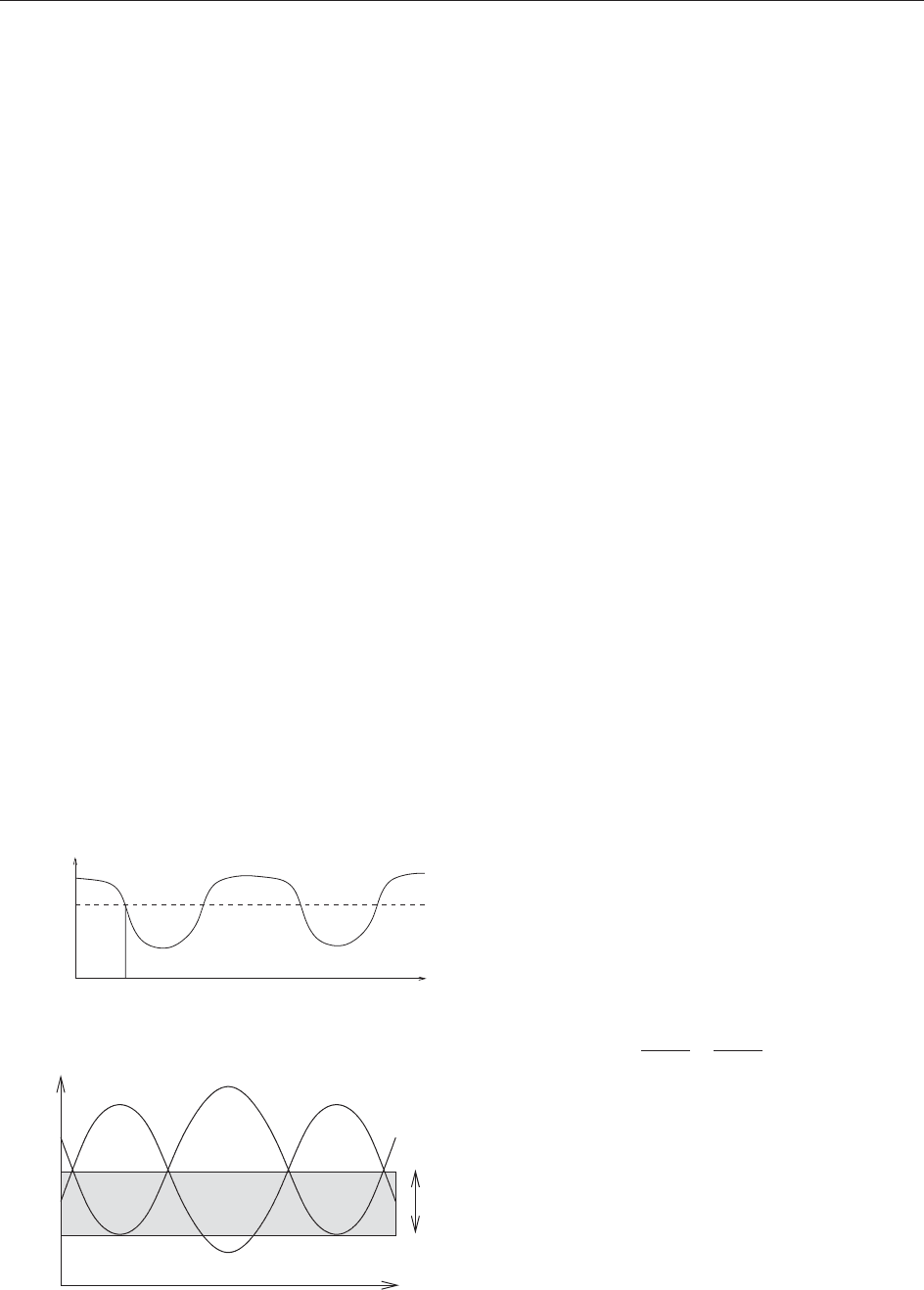
(Figure 6).
a
ðsÞ¼infft s : 2
ðtÞg
The first transition time from 1 to 1 denoted
þ
has the following asymptotic behavior as
" !0:
þ
=T
"
!a
(0). At the second transition the
particle returns to the starting well. If a
þ
is defi ned
analogously with respect to the depth function
þ
,
this transition will occur near the deterministic time
a
þ
(a
(s))T
"
. In order to observe periodicity, and to
exclude chaoticity from all parts of its trajectories,
the particle has to stay for some time in the other
well before returning. This will happen under the
assumption 2
þ
(a
(0)) >, that is, the right well is
the deep one at transition time. In fact, we can
define the resonance interval I
R
(Figure 7), as the set
of all scales for which trajectories exhibit
periodicity in the small noise limit, by
I
R
¼
h
max
i¼
inf
t0
2
i
ðtÞ; inf
t0
max
i¼
2
i
ðtÞ
i
On this interval they get clos e to deterministic
periodic ones. Again, periodicity is quantified by a
quality measure, to be maximized in order to obtain
resonance as the best possible response to periodic
forcing. One interesting measure is based on the
probability that random transitions happen in some
small time window around a deterministic time, in
the small noise limit (Herrmann and Inkeller 2005).
Formally, for h > 0, the meas ure gives
M
h
ð"; TÞ¼min
i¼
P
i
ð
=T
"
2½a
i
h; a
i
þ hÞ
where P
i
is the law of the diffusion starting in i.In
the small noise limit, this quality measure tends to 1,
and optimal tuning can be related to the exponential
rate at which this happens. This is due to the
following large deviations principle:
lim
" !0
" logð1 M
h
ð"; TÞÞ ¼ max
i¼
f 2
i
ða
i
hÞg
for 2I
R
, with uniform convergence on each
compact subset of I
R
. The result is established
using classical large-deviation techniques app lied to
locally time homogeneous approximations of the
diffusion. Maximizing the transition probability in
the time window position means minimizing the
default rate obtained by the large deviations
principle. This can be easily achieved. In fact, if the
window length 2h is small, then 2
i
(a
i
h)
2h
0
i
(a
i
), since 2
i
(a
i
) = by definition. The value
0
i
(a
i
) is negative, so we have to find the position
where its absolute value is maximal. In this position
the depth of the starting well has the most rapid
drop under the level , characterizing the link
between the noise intensity and the period. So the
transition time is best concent rated around it.
It is clear that a good candidate for the resonance
point is given by the eventually existing limit of the
global minimizer
R
(h) as the window length h tends
to 0. This limit is therefore called the resonance
point of the diffusion with time-periodic landscape
U. Let us note that for sinusoidal depth functions
ðtÞ¼
V þ v
4
þ
V v
4
cosð2tÞ
and
þ
ðtÞ¼
ðt þ Þ
the optimal tuning is given by T
"
= exp
R
=" with
R
= (v þ V)=2. This optimal rate is equivalent to
the optimal rate given by the SPA coeff icient of the
reduced dynamics’ Markov chain in the preceding
section.
The big advantage of the quality measure M
h
is its
robustness. Indeed, consider the reduced model
t
µ
2Δ
–
(t )
a
µ
(0)
–
Figure 6 Definition of a
.
I
R
2Δ
–
(t )
2Δ
+
(t )
Figure 7 Resonance interval.
92 Stochastic Resonance

consisting of a two-state Markov chain with
infinitesimal generator
QðtÞ¼
’ðtÞ ’ðtÞ
ðt Þ ðtÞ
where ’(t) = exp 2
(t=T)=" and (t) =
exp 2
þ
(t=T)=". The law of transition times of
this Markov chain is readily computed from Laplace
transforms. Normalized by T
"
it converges to a
i
.
This calculation even reveals a rigorous underlying
pattern for the second- and higher-order transition
times interpreting the interspike dist ributions of
the physics literature. The dynamics of diffusion
and Markov chain are similar. Resonance points
provided by M
h
for the diffusion and its analog for
the Markov chain agree.
Related Notions: Synchronization
In the preceding sections, we interpreted stochastic
resonance as optimal response of a randomly
perturbed dynamical system to weak periodic forcing,
in the spirit of the physics literature (see Gammaitoni
et al. (1998)). Our crucial assumption concerned the
barrier heights a Brownian particle has to overcome
in the potential landscape of the dynamical system: it
is uniformly lower bounded in time. Measures for the
quality of tuning were based on essentially two
concepts: one concerning spectral criteria, with the
spectral power amplification as most prominent
member, the other one concerning the pure transi-
tions dynamics between the domains of attraction of
the local minima. A number of different criteria can
be used to create an optimal tuning between the
intensity of the noise perturbation and the large
period of the dynamical system. The relations have to
be of an exponential type T = exp =", since the
Brownian particle needs exponentially long times to
cross the barrier separating the wells according to the
Eyring–Kramers–Freidlin transition law. Our barrier
height assumption seems natural in many situations,
but can fail in others. If it becomes small periodically,
and eventually scales with the noise-intensity para-
meter, the Brownian particle does not need to wait an
exponentially long time to climb it. So periodicity
obtains for essentially smaller timescales. In this
setting, the slowness of periodic forcing may also be
assumed to be essentially subexponential in the noise
intensity.
If it is fast enough to allow for substantial changes
before large deviation effects can take over, we are
in the situation of Berglund and Gentz (2002). They
in fact consider the case in which the barrier
between the wells becomes low twice per period,
to the effect of modulating periodically a bifurcation
parameter: at time zero the right-hand well becomes
almost flat, and at the same time the bottom of the
well and the saddle approach each other; half a
period later, a spatially symmetric scenario is
encountered. In this situation, there is a threshold
value for the noise intensity under which transitions
become unlikely. Above this threshold, the trajec-
tories typically contain two transitions per period.
Results are formulated in terms of concentration
properties for random trajectories. The intuitive
picture is this: with overwhelming probability,
sample paths will be concentrated in spacetime sets
scaling with the small parameters of the problem. In
higher dimensions, these sets may be given by
adiabatic or center manifolds of the deterministic
system, which allow model reduction of higher-
dimensional systems to lower-dimensional ones.
Asymptotic results hold for any choice of the small
parameters in a whole parameter region. A passage
to the small noise limit as for optimal tuning in the
preceding sections is not needed.
Related problems studied by Berglund and Gentz
in the multidimensional case concern the noise-
induced passage through periodic orbits, where
unexpected phenomena arise. Here, as opposed to
the classical Freidlin–Wentzell theory, the distribu-
tion of first-exit points depends nontrivially on the
noise intensity. Again aiming at results valid for
small but nonvanishing parameters in subexponen-
tial scale ranges, they investigate the density of first-
passage times in a large regime of parameter values,
and obtain insight into the transition from the
stochastic resonance regime into the synchronization
regime.
See also: Dynamical Systems in Mathematical Physics:
An Illustration from Water Waves; Magnetic Resonance
Imaging; Spectral Theory for Linear Operators;
Stochastic Differential Equations.
Further Reading
Benzi R, Sutera A, and Vulpiani A (1981) The mechanism of
stochastic resonance. Journal of Physics A 14: L453–L457.
Berglund N and Gentz B (2002) A sample-paths approach to
noise-induced synchronization: stochastic resonance in a
double-well potential. Annals of Applied Probability 12(4):
1419–1470.
Bovier A, Eckhoff M, Gayrard V, and Klein M (2004) Meta-
stability in reversible diffusion processes. I. Sharp asymptotics
for capacities and exit times. Journal of the European
Mathematical Society 6(4): 399–424.
Freidlin MI (2000) Quasi-deterministic approximation,
metastability and stochastic resonance. Physica D 137(3–4):
333–352.
Stochastic Resonance 93

Freidlin M (2003) Noise sensitivity of stochastic resonance and
other problems related to large deviations. In: Sri
Namachchivaya and Lin YK (eds.) IUTAM Symposium on
Nonlinear Stochastic Dynamics, Solid Mech. Appl, vol. 110,
pp. 43–55. Dordrecht: Kluwer Academic.
Freidlin MI and Wentzell AD (1998) Random Perturbations of
Dynamical Systems, 2nd edn. New York: Springer.
Gammaitoni L, Ha¨nggi P, Jung P, and Marchesoni F (1998)
Stochastic resonance. Reviews of Modern Physics 70(1):
223–287.
Gardiner CW (2004) Handbook of Stochastic Methods for
Physics, Chemistry and the Natural Sciences. Springer Series
in Synergetics, 3rd edn., vol. 13. Berlin: Springer.
Herrmann S and Imkeller P (2005) The exit problem for
diffusions with time-periodic drift and stochastic resonance.
Annals of Applied Probability 15(1A): 39–68.
Imkeller P and Pavlyukevich I (2002) Model reduction and
stochastic resonance. Stochastics and Dynamics 2(4):
463–506.
Mazo RM (2002) Brownian Motion: Fluctuations, Dynamics,
and Applications. International Series of Monographs on
Physics, vol. 112. New York: Oxford University Press.
McNamara B and Wiesenfeld K (1989) Theory of stochastic
resonance. Physical Review A 39(9): 4854–4869.
Nelson E (1967) Dynamical Theories of Brownian Motion.
Princeton, NJ: Princeton University Press.
Schweitzer F (2003) Brownian Agents and Active Particles,
Springer Series in Synergetics, (Collective dynamics in the
natural and social sciences, With a foreword by J. Doyne
Farmer). Berlin: Springer.
Strange Attractors see Lyapunov Exponents and Strange Attractors
String Field Theory
L Rastelli, Princeton University, Princeton, NJ, USA
ª 2006 Elsevier Ltd. All rights reserved.
Introduction
String field theory (SFT) is the second-quantized
approach to string theory. In the usual, first-
quantized, formulation of string perturbation the-
ory, one postulates a recipe for the string S-matrix in
terms of a sum over two-di mensional (2D) world
sheets embedded in spacetime. Very schematically,
hhV
1
ðk
1
Þ...V
n
ðk
n
Þii
¼
X
topologies
g
s
Z
½d
hV
1
ðk
1
Þ...V
n
ðk
n
Þi
f
g
½1
Here the left-hand side stands for the S-matrix of the
physical string states {V
a
(k
a
)}. The symbol h...i
{
}
denotes a correlation function on the 2D world sheet,
which is a punctured Riemann surface of Euler number
and given moduli {
}. In SFT, one aims to recover
this standard prescription from the Feynman rules of a
second-quantized spacetime action S[]. The string
field , the fundamental dynamical variable, can be
thought of as an infinite-dimensional array of space-
time fields {
i
(x
)}, one field for each basis state in the
Fock space of the first-quantized string.
The most straightforward way to construct S[]
uses the unitary light-cone gauge. Light-cone SFT is
an almost immediate transcription of Mandelstam’s
light-cone diagrams in a second-quantized language.
While often useful as a bookkeeping device, light-
cone SFT seems unlikely to represent a real
improvement over the first-quantized approach. By
contrast, from our experience in ordinary quantum
field theory, we should expect Poincare´ -covariant
SFTs to give important insights into the issues of
vacuum selection, background independence and the
nonperturbative definition of string theory.
Covariant SFT actions are well established for the
open (Witten 1986), closed (Zwiebach 1993)and
open/closed (Zwiebach 1998) bosonic string. These
theories are based on the BRST formalism, where the
world sheet variables include the bc ghosts intro-
duced in gauge-fixing the world sheet metric to the
conformal gauge g
ab
ab
. (An alternative approach
(Hata et al.), based on covariantizing light-cone SFT,
will not be described in this article.) Much less is
presently known for the superstring: classical actions
have been established for the Neveu-Schwarz sector
of the open superstring (Berkovits 2001)andforthe
heterotic string (Berkovits et al. 2004).
During the first period of intense activity in SFT
(1985–1992), the covariant bosonic actions were
constructed and shown to pass the basic test of
reproducing the S-matrix [1] to each order in the
perturbative expansion. The more recent revival of
the subject (since 1999) was triggered by the
realization that SFT contains nonperturbative infor-
mation as well: D-branes emerge as solitonic
solutions of the classical equations of motion in
94 String Field Theory

open SFT (OSFT). We can hope that the nonpertur-
bative string dualities will also be understood in the
framework of SFT, once covarian t SFTs for the
superstring are better developed.
In this article, we review the basic formalism of
covariant SFT, using for illustration purposes the
simplest model – cubic bosonic OSFT. We then
briefly sketch the generalization to bosonic SFTs
that include closed strings. Finally, we turn to the
subjects of classical solutions in OSFT and the
physics of the open-string tachyon.
Open Bosonic SFT
The standard formulation of string theory starts with
the choice of an on-shell spacetime background where
strings propagate. In the bosonic string, the closed
string background is described by a conformal field
theory of central charge 26 (the ‘‘matter’’ CFT). The
total world sheet CFT is the direct sum of this matter
CFT and of the universal ghost CFT, of central charge
26. To describe open strings, we must further specify
boundary conditions for the string endpoints. The
open-string background is encoded in a boundary CFT
(BCFT), a CFT defined in the upper-half plane, with
conformal boundary conditions on the real axis
(see Boundary Conformal Field Theory in this encyclo-
pedia). In modern language, the choice of BCFT
corresponds to specifying a D-brane state.
In classical OSFT, we fix the closed-string back-
ground (the bulk CFT) and consider varying the
D-brane configuration (the boundary conditions).
To lowest order in g
s
, we can neglect the back-
reaction of the D-brane on the closed-string fields,
since this is a quantum effect from the open-string
viewpoint. Let us prepare the ground by recalling
the standard -model philosophy. To describe off-
shell open-string configurations, we should allow for
general (not necessarily conformal) boundary condi-
tions. We can imagine to proceed as follows:
1. We choose an initial open-string background, a
reference BCFT that we shall call BCFT
0
. For
example, a Dp brane in flat 26 dimensions
(Neumann boundary conditions on p þ 1 coordi-
nates, Dirichlet on 25 p coordinates).
2. We then write a basis of boundary perturbations
around this background. Taking, for example,
BCFT
0
to be a D25 brane in flat space, the world
sheet action S
WS
takes the schematic form
S
WS
¼
1
2
0
Z
UHP
@X
@X
þ
Z
R
~
Tðx
Þ
þ
~
A
ðx
Þ@X
þ
~
B
ðx
Þ@
2
X
þ ½2
Here to the standard free bulk action (integrated
over the upper-ha lf complex plane UHP) we have
added perturbation localized on the real axis R.
Notice that the basis of perturbations depends on
the chosen BCFT
0
.
3. We interpret the coefficients {
~
i
(x
)} of the
perturbations as spacetime fields. (The tilde on
~
i
(x) serves as a reminder that these fields are not
quite the same as the fields
i
(x) that will appear
in the OSFT action). We are after a spacetime
action S[{
~
i
}] such that solut ions of its classical
equations of motion correspond to conformal
boundary conditions:
S
~
i
¼ 0ðspacetimeÞ
$
i
½f
~
j
g ¼ 0 ðworld sheetÞ½3
We recognize in [2] the familiar open-string
tachyon
~
T(x) and gauge field
~
A
(x), which are the
lowest modes in an infinite tower of fields. Relevant
perturbations on the world sheet (with conformal
dimension h < 1) correspond to tachyonic fields in
spacetime (m
2
< 0), whereas marginal world sheet
perturbations (h = 1) give massless spacetime fields.
To achieve a complete description, we must include
all the higher massive open-string modes as well,
which correspond to nonrenormalizable boundary
perturbations (h > 1). In the traditional -model
approach, this appears like a daunting task. The
formalism of OSFT will automatically circumvent
this difficulty.
The Open-String Field
In covariant SFT the reparametrization ghosts play
a crucial role. The ghost CFT consists of the
Grassmann odd fields b(z), c(z),
b(
z),
c(
z), of dimen-
sions (2, 0), (1, 0), (0, 2), (0, 1), respectively. The
boundary conditions on the real axis are
b =
b, c =
c. The state space H
BCFT
0
of the full
matter þghost BCFT can be broken up into
subspaces of definite ghost number,
H
BCFT
0
¼
M
1
G¼1
H
ðGÞ
BCFT
0
½4
We use conventions where the SL(2, R) vacuum j0i
carries zero ghost number, G(j0i) = 0, while
G(c) = þ1 and G(b) = 1. As is familiar from the
first-quantized treatment, physical open-string states
are identified with G = þ1 cohomology classes of
the BRST operator,
QjV
phys
i¼0; jV
phys
ijV
phys
iþQji
GðjV
phys
iÞ ¼ þ1
½5
String Field Theory 95

where the nilpotent BRST operator Q has the
standard expression
Q ¼
1
2i
I
cT
matter
þ : bc@c :ðÞ½6
Though not a priori obvious, it turns out that the
simplest form of the OSFT action is achieved by
taking as the fundamental off-shell variable an
arbitrary G = þ1 element of the first-quantized
Fock space,
ji2H
ð1Þ
BCFT
0
½7
By the usual state–operator correspondence of CFT,
we can also represent ji as a local (boundary)
vertex operator acting on the vacuum,
ji¼ð0Þj0i½8
The open-string field ji is really an infinite-
dimensional array of spacetime fields. We can
make this transparent by expanding it as
ji¼
X
i
Z
d
pþ1
kj
i
ðkÞi
i
ðk
Þ½9
where {j
i
(k)i} is some convenient basis of H
(1)
BCFT
0
that diagonalizes the momentum k
. The fields
i
are a priori complex. This is remedied by
imposing a suitable reality condition on the string
field, which will be stated momentarily. Notice that
there are many more elements in {j
i
(k)i} than in the
physical subspace (the cohomology clas ses of Q).
Some of the extra fields will turn out to be
nondynamical and could be integrated out, but at
the price of making the OSFT action look much
more complicated.
It is often useful to think of the string field in
terms of its Schro¨ dinger representation, that is, as a
functional on the configuration space of open
strings. Consider the unit half-disk in the upper-
half plane, D
H
{jzj1, =z 0}, with the vertex
operator (0) inserted at the origin. Impose BCFT
0
open string boundary conditions for the fields X(z,
z)
on the real axis (here X(z,
z) is a short-hand notation
for all matter and ghost fields), and boundary
conditions X() = X
b
() on the curved boundary of
D
H
, z = exp (i), 0 . The path integral over
X(z,
z) in the interior of the half-disk assigns a
complex number to any given X
b
(), so we obtain a
functional [X
b
()]. This is the Schro¨ dinger wave
function of the state (0)j0i. Thus, we can think of
open-string functionals [X
b
()] as the fundamental
variables of OSFT. This is as it should be: the
first-quantized wave functions are promoted to
dynamical fields in the second-quantized theory.
Finally, let us quote the reality condition for the
string field, which takes a compact form in the
Schro¨ dinger representation:
½X
ðÞ; bðÞ; cðÞ
¼
½X
ð Þ; bð Þ; cð Þ ½10
where the superscript denotes complex conjugation.
The Classical Action
With all the ingredients in place, it is immediate to
write the quadratic part of the OSFT action. The
linearized equations of motion must reproduce the
physical-state condition [5]. This suggests
S hjQji½11
Here hji is the usual BPZ inner product of BCFT
0
,
which is defined in terms of a two-point correlator on
the disk, as we review below. The ghost anomaly
implies that on the disk we must have G
tot
= þ3,
which happily is the case in [11]. Moreover, since the
inner product is nondegenerate, variation of [11] gives
Qji¼0 ½12
as desired. The equivalence relation jV
phys
i
jV
phys
iþQji is interpreted in the second-quantized
language as the spacetime gauge invariance
ji¼Qji; ji2H
ð0Þ
BCFT
0
½13
valid for the general off-shell field. This equation is
a very compact generalization of the linearized
gauge invariance for the mass less gauge field.
Indeed, focusing on the level-zero components,
jiA
(x)(c@X
)(0)j0i and ji(x)j0i, we find
A
(x) = @
(x). It is then plausible to guess that the
nonlinear gauge invariance should take the form
ji¼Qjiþjij ijiji½14
where is some suitable product operation that
conserves ghost number
: H
ðnÞ
BCFT
0
H
ðmÞ
BCFT
0
!H
ðnþmÞ
BCFT
0
½15
Based on a formal analogy with 3D nonabelian
Chern–Simons theory, Witten proposed the cubic
action
S ¼
1
g
2
o
1
2
hjQjiþ
1
3
hj i
½16
The string field ji is analogous to the Chern–
Simons gauge potential A = A
i
dx
i
, the product to
the ^ product of differential forms, Q to the exterior
derivative d, and the ghost number G to the degree
96 String Field Theory
of the form. The analogy also suggests a number of
algebraic identities:
Q
2
¼ 0
hQAjBi ¼ ð1Þ
GðAÞ
hAjQBi
QðA BÞ¼ðQAÞB þð1Þ
GðAÞ
A ðQBÞ
hAjBi¼ð1Þ
GðAÞGðBÞ
hBjAi
hAjB Ci¼hBjC Ai
A ðB CÞ¼ðA BÞC
½17
Note in particular the associativity of the -product.
It is straightforward to check that this algebraic
structure implies the gauge invariance of the cubic
action under [14].A-product satisfying all required
formal properties can indeed be defined. The most
intuitive prese ntation is in the functional language.
Given an open-st ring curve X(), 0 ,we
single out the string mid-point = =2 and define
the left and right ‘‘half-string’’ curves
X
L
ðÞXðÞ for 0
2
X
R
ðÞXð Þ for
2
½18
A functional [X()] can, of course, be regarded as
a functional of the two half-strings, [X] !
[X
L
, X
R
]. We define
ð
1
2
Þ½X
L
; X
R
Z
½dY
1
½X
L
; Y
2
½Y; X
R
½19
where
R
[dY] is meant as the functional integral over
the space of half-strings Y(), with Y(=2) =
X
L
(=2) = X
R
(=2). Figure 1a shows two open
strings interacting (to form a single ope n string) if
and only if the right half of the first string precisely
overlaps with the left half of the second string.
Associativity is transparent (Figure 1b).
We can now trans late this formal construction in
the precise CFT language. Very generally, an n -point
vertex of open strings can be defined by specifying
an n-punctured disk, that is, a disk with marked
points on the boundary (punctures) and a choice of
local coordinates around each puncture. Local
coordinates are essential since we are dealing with
off-shell open-string states. The BPZ inner product
(two-point vertex) is given by
h
1
j
2
ihI
1
ð0Þ
2
ð0Þi
UPH
IðzÞ¼
1
z
½20
The symbol f (0), where f is a complex map,
means the conformal transform of (0) by f. For
example, if is a dimension-d primary field, then
f (0) = f
0
(0)
d
(f (0)). If is nonprimary, the
transformation rule will be more complicated and
involve extra terms with higher derivatives of f.By
performing the SL(2, C) transformation
w ¼ hðzÞ
1 þ iz
1 iz
½21
we can represent the two-point vertex as a corre-
lator on the unit disk D = {jwj1},
h
1
j
2
i¼hf
1
1
ð0Þ; f
2
2
ð0Þi
D
f
1
ðz
1
Þ¼hðz
1
Þ; f
2
ðz
2
Þ¼hðz
2
Þ
½22
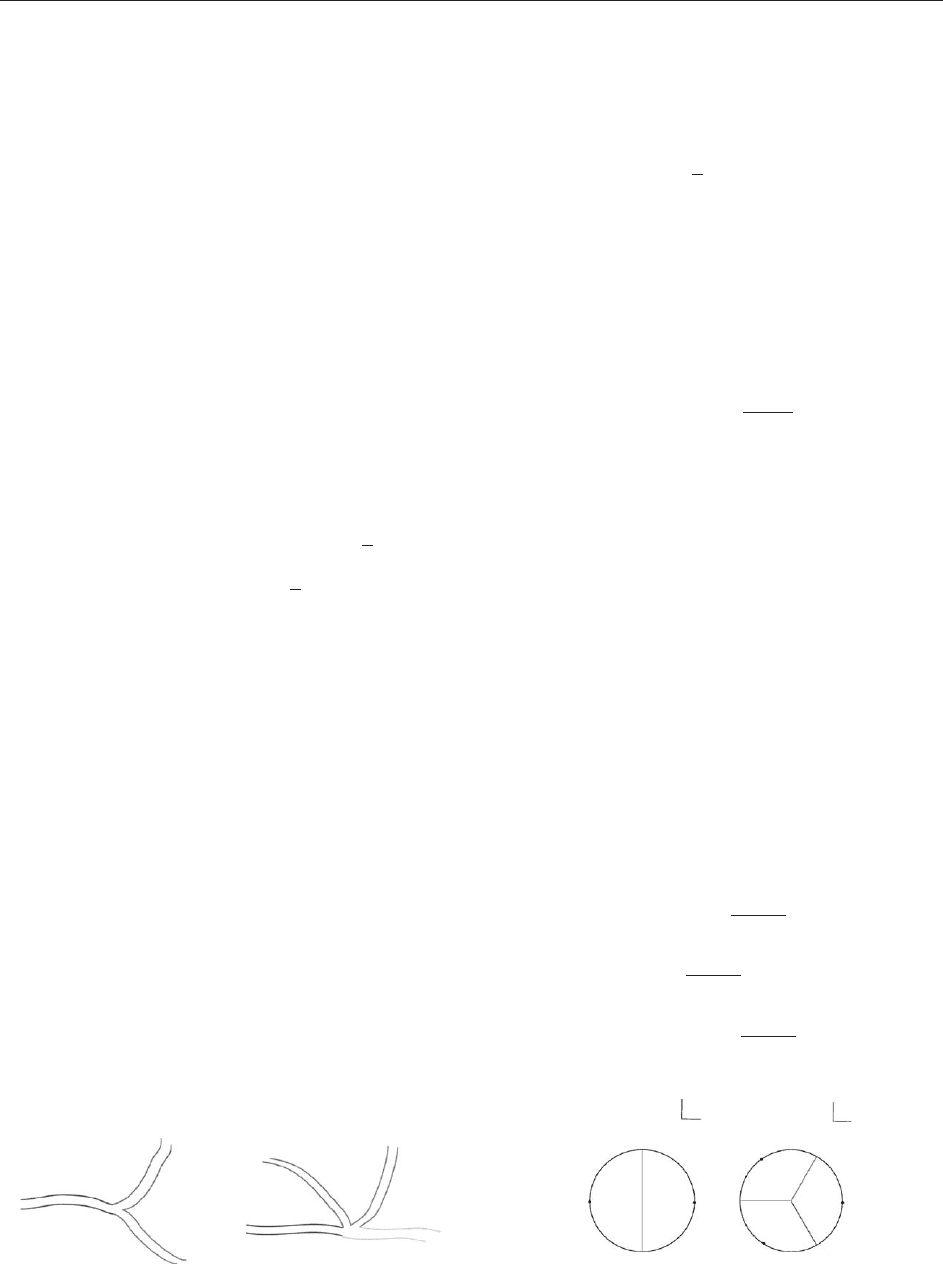
The vertex operators are inserted as w = 1 and
w = þ1onD (see Figure 2a) and correspond to the
two open strings at (Euclidean) world sheet time
= 1 (we take z = exp (i þ )). The left half of
D is the world sheet of the first open string; the right
half of D is the worl d sheet of the second string. The
two strings meet at = 0 on the imaginary w axis.
The three-point Witten vertex is given by
h
1
;
2
;
3
i
hg
1
1
ð0Þg
2
2
ð0Þg
3
3
ð0Þi
D
½23
where
g
1
ðz
1
Þ¼e
2i=3
1 þiz
1
1 iz
1
2=3
g
2
ðz
2
Þ¼
1 þiz
2
1 iz
2
2=3
g
3
ðz
3
Þ¼e
2i=3
1 þiz
3
1 iz
3
2=3
½24
0
A
0
B
A
*
B
A
A
*
B
*
C
B
C
(a) (b)
π
π
π/2
π/2
Figure 1 Midpoint overlaps of open strings.
w
w
φ
1
φ
1
φ
2
φ
3
φ
2
(a) (b)
Figure 2 Representation of the quadratic and cubic vertices as
2- and 3-punctured unit disks.
String Field Theory 97

The 3-punctured disk is depicted in Figure 2b, and
describes the symmetric mid-point overlap of the
three strings at = 0. Finally, the relation between
the three-point vertex and the -product is
h
1
j
2
3
ih
1
;
2
;
3
i½25
Knowledge of the right-hand side (RHS) in [25] for
all allows to reconstruct the -product. All formal
properties [17] are easily shown to hold in the CFT
language. This complet es the definition of the OSFT
action.
Evaluation of the classical action is completely
algorithmic and can be carried out for arbitrary
massive states, with no fear of divergences, since in
all required correlators the operators are inserted
well apart from each other.
Quantization
Quantization is defined by the path integral over the
second-quantized string field. The first step is to deal
with the gauge invariance [14] of the classical action.
The gauge symmetry is reducible: not all gauge
parameters
(0)
(the superscript labels ghost number)
lead to a gauge transformation. This is clear at the
linearized level; indeed, if
(0)
= Q
(1)
,then
(0)
(1)
= Q
2
(0)
= 0. Thus, the set {
(0)
}givesa
redundant parametrization of the gauge group.
Characterizing this redundancy is somewhat subtle,
since fields of the form
(1)
= Q
(2)
do not really
lead to a redundancy in
(0)
, and so on, ad infinitum.
It is clear that we need to introduce an infinite tower
of (second-quantized) ghosts for ghosts.
The Batalin–Vilkovisky formalism is a powerful way
to handle the problem. The basic object is the master
action S(
s
,
s
), which is a function of the ‘‘fields’’
s
and of the ‘‘antifields’’
s
. Each field is paired with a
corresponding antifield of opposite Grassmanality.
(‘‘Grassmanality’ ’ is defined to be even or odd: a
Grassmann even (odd) field is a commuting (antic-
ommuting) field). The master action must obey the
boundary condition of reducing to the classical action
when the antifields are set to zero. (Note that in general
the set of fields
s
will be larger than the set of fields
i
that appear in the classical action). Independence of the
S-matrix on the gauge-fixing procedure is equivalent to
the BV master equation
1
2
fS; Sg¼hS ½26
The antibracket { , } and the operator are defined as
fA; Bg
@
r
A
@
s
@
l
B
@
s
@
r
A
@
s
@
l
B
@
s
@
r
@
s
@
l
@
s
½27
where @
l
and @
r
are derivatives from the left and
from the right. It is often convenient to expand S in
powers of h, S = S
0
þ hS
1
þ h
2
S
2
þ, with
fS
0
; S
0
g¼0
fS
0
; S
1
gþfS
0
; S
1
g¼2hS
0
; ...
½28
With these definitions in place, we shall simply
describe the answer, which is extremely elegant. In
OSFT the full set of fields and antifields is packaged
in a single string field ji of unrestricted ghost
number. If we write
ji¼j
iþj
þ
i
with G ð
Þ1 and Gð
þ
Þ2
½29
all the fields are contained in j
i and all the
antifields in j
þ
i. To make the pairing explicit, we
pick a basis {j
s
i}ofH
BCFT
0
, and define a conjugate
basis {j
C
s
i}by
h
C
r
j
s
i¼
rs
½30
Clearly, G(
C
s
) þ G(
s
) = 3. Then
j
i¼
X
Gð
s
Þ1
j
s
i
s
; j
þ
i¼
X
Gð
s
Þ1
j
C
s
i
s
½31
Basis states j
s
i with even (odd) ghost number
G(
s
) are defined to be Grassmann even (odd). The
full string field ji is declared to be Grassmann
odd. It follows that
s
is Grassmann even (od d) for
G(
s
) odd (even), and that the corresponding
antifield
s
has the opposite Grassmanality of
s
,
as it must be. With this understanding of ji , the
classical master action S
0
is identical in form to the
Witten action [16]! The boundary condition is
satisfied; indeed, setting j
þ
i= 0, the ghost number
anomaly implies that only the terms with G = þ1
survive. The equation {S
0
, S
0
} = 0 follows from
straightforward manipulations using the algebraic
identities [17]. On the other hand, the issue of
whether S
0
= 0, or whether instead quantum
corrections are needed to satisfy full BV master
equation, is more subtle and has never been fully
resolved. The operator receives singular contri-
butions from the same region of moduli space
responsible for the appearance of closed-string
poles, which are discussed below. (See Thorn
(1989) for a classic statement of this issue). It
seems possible to choose a basis in H
BCFT
0
such that
there are no quantum corrections to S
0
(Erler and
Gross 2004). In the following we shall derive the
Feynman rules implied by S
0
alone.
98 String Field Theory