
Francoise J.-P., Naber G.L., Tsun T.S. (editors) Encyclopedia of Mathematical Physics
Подождите немного. Документ загружается.


for the gauge field and six associated scalars
I
(all in
the adjoint representations of the gauge group G)is
S
N¼4
¼
1
4g
2
Z
d
4
xtr
F
F
þ2
X
I
D
I
D
I
þ
X
I<J
2½
I
;
J
2
!
32
2
Z
d
4
xtr F
F
þfermionic terms ½11
Consider for simplicity the case G =SU(2). The
scalar potential has flat directions along which the
six
I
commute. By an SO(6) R-symmetry rotation,
we can set all but one of them to zero, and let
<tr(
1
1
)> = v
2
in the vacuum. In this ‘‘Coulomb
phase’’ of the theory, a U(1) gauge multiplet stays
massless, while the charged states become massive
by the Higgs effect. The theory admits furthermore
smooth magnetic-monopole and dyon solutions, and
there is an elegant formula for their mass:
M ¼ vjn
el
þ n
mg
j; where ¼
2
þ
4i
g
2
½12
and n
el
(n
mg
) denotes the quantized electric (mag-
netic) charge. This is a BPS formula that receives
no quantum corrections. It exhibits the SL(2, Z)
covariance of the theory,
!
a þ b
c þ d
and
ðn
el
; n
mg
Þ!ðn
el
; n
mg
Þ
ab
cd
1
½13
Here a, b, c, d are integers subject to the condition
ad bc = 1. Of special importance is the transfor-
mation !1=, which exchanges electric and
magnetic charges and (at least for = 0) the strong-
with the weak-coupling regimes. For more details
see the review by Harvey (1996).
The extension of these ideas to string theory can be
illustrated with the strong/weak- coupling duality
between the type I theory, and the Spin(32)=Z
2
heterotic string. Both have the same massless spec-
trum and low-energy action, whose form is dictated
entirely by supersymmetry. The only difference lies in
the relations between the string and supergravity
parameters. Eliminating the latter, one finds
het
¼
1
2
I
and
0
het
¼
ffiffiffi
2
p
I
0
I
½14
It is thus tempting to conjecture that the strongly
coupled type I theory has a dual description as a
weakly coupled heterotic string. These are, indeed,
the only known ultraviolet completions of the
theory [7]. Furthermore, for
I
1, the D1 brane
of the type I theory becomes light, and could be
plausibly identified with the heterotic string. This
conjecture has been tested successfully by comparing
various supersymmetry-protected quantities (such as
the tensions of BPS excitations and special higher-
derivative terms in the effective action), which can be
calculated exactly either semiclassically, or at a given
order in the perturbative expansion. Testing the duality
for nonprotected quantities is a hard and important
problem, which looks currently out of reach.
The other three string theories have also well-
motivated dual descriptions at strong coupling .
The type IIB theory is believed to have an SL(2, Z)
symmetry, similar to that of the N = 4 super Yang–
Mills. (Note that is a dynamical parameter, that
changes with the vacuum expectation value of the
dilaton <>. Thus, dualities are discrete gauge
symmetries of string theory.) The type IIA theory
has a more surprising strong-coupling limit: it grows
one extra dimension (of radius R
11
= 1=
ffiffiffiffiffi
0
p
), and
can be approximated at low energy by the maximal
11-dimensional supergravity of Cremmer, Julia, and
Scherk. The latter is a very economical theory – its
massless bosonic fields are only the graviton and a
3-form potential A
3
. The bosonic part of the action
reads
S
11D
¼
1
2
2
11
Z
d
11
x
ffiffiffiffiffiffiffiffi
G
p
ðR
1
2
jF
4
j
2
Þ
1
12
2
11
Z
A
3
^ F
4
^ F
4
½15
The electric and magnetic charges of the 3-form are a
(fundamental?) membrane and a solitonic 5-brane.
Standard Kaluza–Klein reduction on a circle maps S
11D
to the IIA supergravity action [6],whereG
, ,andC
1
descend from the 11-dimensional graviton, and B
2
and
C
3
from the 3-form A
3
.Furthermore,allBPSexcita-
tions of the type IIA string theory have a counterpart in
11 dimensions, as summarized in Table 1. Finally, if
one compactifies the eleventh dimension on an interval
(rather than a circle), one finds the conjectured strong-
coupling limit of the E
8
E
8
heterotic string.
The web of duality relations can be extended by
compactifying further to D 9 dimensions. Readers
interested in more details should consult Polchinski
(1998) or one of the many existing reviews of the
subject(Townsend(1996),seealso‘‘FurtherRead-
ing’’section).Inninedimensions,inparticular,the
two type II theories, as well as the two heterotic
superstrings, are pairwise T-dual. T-duality is a
perturbative symmetry (thus firmly established, not
138 Superstring Theories
only conjectured) which exchanges momentum and
winding modes. Putting together all the links one
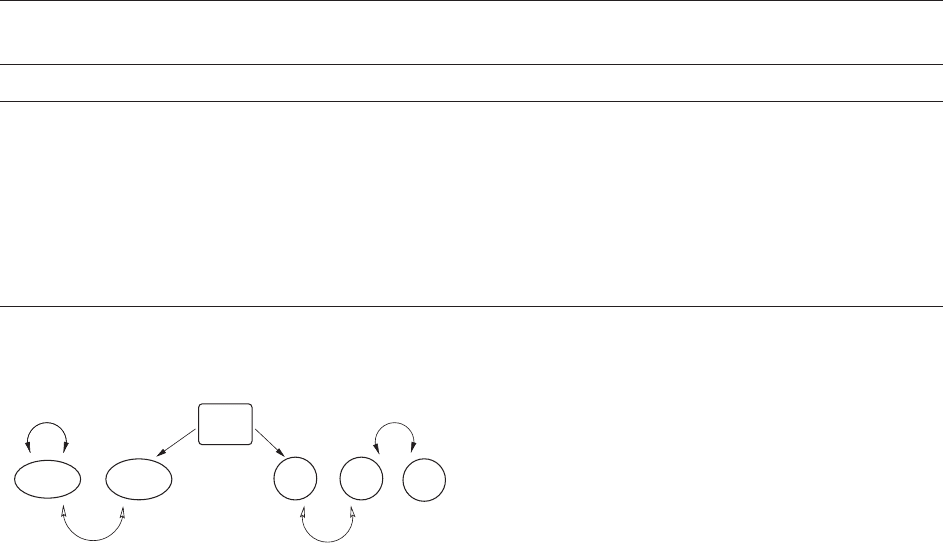
arrives at the fully connected web of Figure 4. This
makes the point that all five consistent superstrings,
and also 11-dimensional supergravity, are limits of a
unique underlying structure called M theory. (For
lack of a better definition, ‘‘M’’ is sometimes also
used to denote the D = 11 supergravity plus
supermembranes, as in Figure 4.) A background-
independent definition of M theory has remained
elusive. Attempts to define it as a matrix model of
D0 branes, or by quantizing a fundamental mem-
brane, proved interesting but incomplete. A diffi-
culty stems from the fact that in a generic
background, or in D = 11 Minkowski spacetime,
there is only a dimensionful parameter fixing the
scale at which the theory becomes strongly coupled.
Other Developments and Outlook
We have not discussed in this brief review some
important developments covered in other contribu-
tions to the encyclopedia. For the reader’s conve-
nience, and for completeness, we enumerate (some
of) them giving the appropriate cross-references:
Compactification. To make contact with the
standard model of particle physics, one has to
compactify string theory on a six-dimensional
manifold. There is an embarassment of riches,
but no completely realistic vacuum and, more
significantly, no guiding dynamical principle to
help us decide (see Compactification of Superstring
Theory). The controlled (and phenomenologically
required) breaking of spacetime supersymmetry is
also a problem.
Conformal field theory and quantum geometry.
The algebraic tools of 2D conformal field theory,
both bulk and boundary (see Two-Dimensional
Conformal Field Theory and Vertex Operator
Algebras), play an important role in string theory.
They allow, in certain cases, a resummation of
0
effects, thereby probing the regime where classical
geometric notions do not apply.
Microscopic models of black holes. Charged extre-
mal black holes can be modeled in string theory by BPS
configurations of D-branes. This has led to the first
microscopic derivation of the Bekenstein–Hawking
entropy formula, a result expected from any consistent
theory of quantum gravity. As with the tests of duality,
the extension of these results to neutral black holes is a
difficult open problem – see Branes and Black Hole
Statistical Mechanics.
AdS/CFT and holography. A new type of (holo-
graphic) duality is the one that relates supersym-
metric gauge theories in four dimensions to string
theory in asymptotically anti-de Sitter spacetimes.
The sharpest and best-tested version of this duality
relates N = 4 super Yang–Mills to string theory in
AdS
5
S
5
. Solving the -model in this latter back-
ground is one of the keys to further progress in the
subject (see AdS/CFT Correspondence).
String phenomenology. Finding an experimental
confirmation of string theory is clearly one of the most
pressing outstanding questions. There exist several
interesting possibilities for this – cosmic strings, large
extra dimensions, modifications of gravity, primordial
cosmology (see String Theory: Phenomenology for a
Table 1 BPS excitations of type IIA string theory, and their counterparts in M theory compactified on a circle of radius R
11
Tension Type IIA M on S
1
Tension
(
ffiffiffi
p
=
10
)(2
ffiffiffiffiffi
0
p
)
3
D0 brane K–K excitation 1=R
11
T
F
= (2
0
)
1
String Wrapped membrane 2R
11
2
2
=
2
11
1=3
(
ffiffiffi
p
=
10
)(2
ffiffiffiffiffi
0
p
) D2 brane Membrane T
M
2
= 2
2
=
2
11
1=3
(
ffiffiffi
p
=
10
)(2
ffiffiffiffiffi
0
p
)
1
D4 brane Wrapped 5-brane R
11
2
2
=
2
11
2=3
(=
2
10
)(2
0
) NS-5-brane 5-brane 1=2ðÞ2
2
=
2
11
2=3
(
ffiffiffi
p
=
10
)(2
ffiffiffiffiffi
0
p
)
3
D6 brane K–K monopole 2
2
R
2
11
=
2
11
From Bachas CP (1997) Lectures on D-branes. In: Olive DI and West PC (eds.) Duality and Supersymmetric Theories, Proceedings,
Easter School, Newton Institute, Euroconference, Cambridge, UK, April 7–18. With permission of Cambridge University Press.
II A
II B
HE HO
I
M
Strong/weak Strong/weak
s
1
s
1
/z
2
TT
Figure 4 Web of dualities in nine dimensions. From Bachas CP
(1997) Lectures on D-branes. In: Olive DI and West PC (eds.)
Duality and Supersymmetric Theories, Proceedings, Easter School,
Newton Institute, Euroconference, Cambridge, UK, April 7–18. With
permission of Cambridge University Press.
Superstring Theories 139
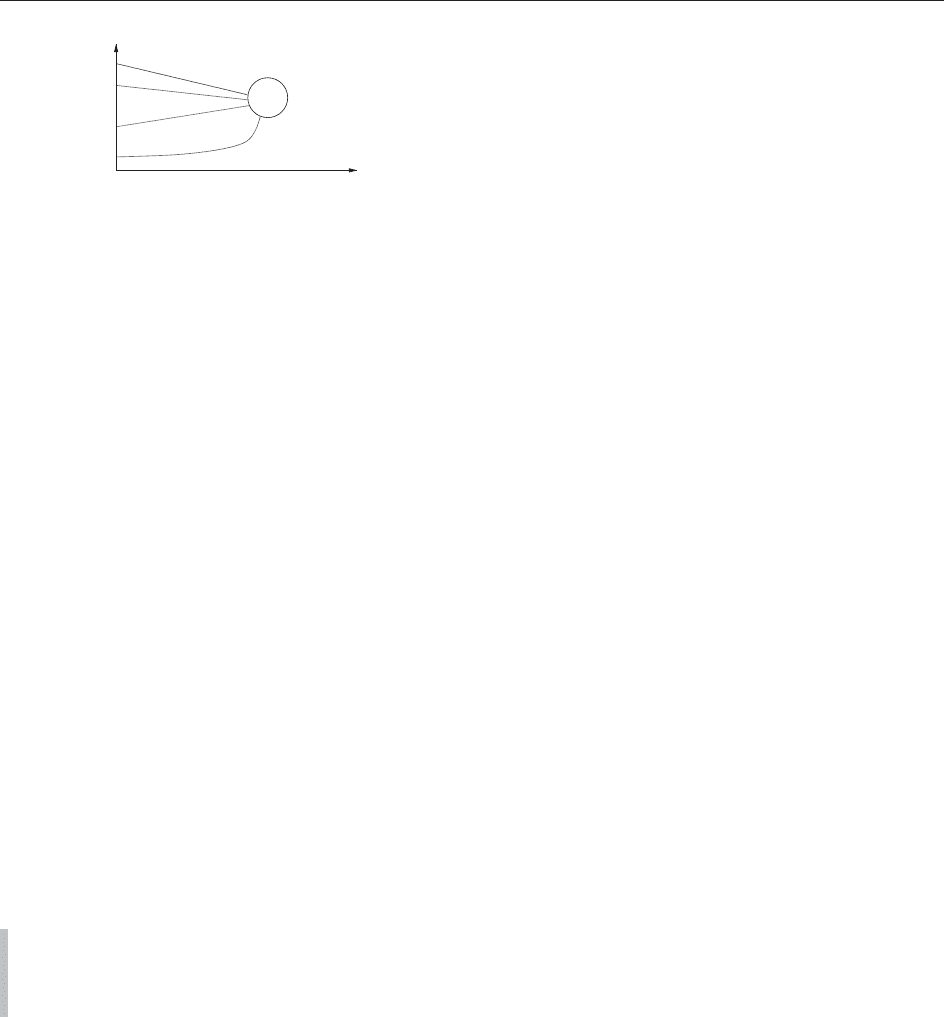
review). Here we point out the one supporting piece
of experimental evidence: the unification of the
gauge couplings of the (supersymmetric, minimal)
standard model at a scale close to, but below the
Planck scale, as illustrated in Figure 5.Thisisa
generic ‘‘prediction’’ of string theory, especially in its
heterotic version.
See also: AdS/CFT Correspondence; Boundary
Conformal Field Theory; Brane Construction of Gauge
Theories; Brane Worlds; Branes and Black Hole
Statistical Mechanics; Compactification of Superstring
Theory; Derived Categories; Electroweak Theory;
Gauge Theories from Strings; Noncommutative
Geometry from Strings; Supermanifolds; String Field
Theory; String Theory: Phenomenology; Supergravity;
Two-Dimensional Conformal Field Theory and Vertex
Operator Algebras; Wheeler–DeWitt Theory.
Further Reading
Aharony O, Gubser SS, Maldacena JM, Ooguri H, and Oz Y
(2000) Large N field theories, string theory and gravity.
Physics Report 323: 183 (arXiv:hep-th/9905111).
Angelantonj C and Sagnotti A (2002) Open strings. Physics
Report 371: 1.
Angelantonj C and Sagnotti A (2003) Open strings – erratum.
Physics Report 376: 339 (arXiv:hep-th/0204089).
Bachas CP (1997) Lectures on D-branes. In: Olive DI and West
PC (eds.) Duality and Supersymmetric Theories, Proceedings,
Easter School, Newton Institute, Euroconference, Cambridge,
UK, April 7–18, arXiv:hep-th/9806199.
Berkovits N (2002) ICTP lectures on covariant quantization of the
superstring, arXiv:hep-th/0209059.
D’Hoker E and Phong DH (2002) Lectures on two-loop super-
strings, arXiv:hep-th/0211111.
Green MB, Schwarz JH, and Witten E (1987) Superstring Theory.
Vol. 1: Introduction; Vol. 2: Loop Amplitudes, Anomalies and
Phenomenology. Cambridge: Cambridge University Press.
Harvey JA (1996) Magnetic monopoles, duality, and super-
symmetry. arXiv:hep-th/9603086.
Kiritsis E (2004) D-branes in standard model building, gravity
and cosmology. Fortschritte der Physik 52: 200 (arXiv:hep-th/
0310001).
Lust D (2004) Intersecting brane worlds: A path to the standard
model? Classical and Quantum Gravity 21: S1399 (arXiv:hep-
th/0401156).
Obers NA and Pioline B (1999) U-duality and M-theory. Physics
Report 318: 113 (arXiv:hep-th/9809039).
Polchinski J (1998) String Theory. Vol. 1: An Introduction to the
Bosonic String; Vol. 2: Superstring Theory and Beyond.
Cambridge: Cambridge University Press.
Salam A and Sezgin E (1989) Supergravities in Diverse Dimen-
sions. Amsterdam: North-Holland/World Scientific.
Sen A (1997) An introduction to non-perturbative string theory,
arXiv:hep-th/9802051.
The following URL of the HEP-SPIRES database: http://www.slac.-
stanford.edu collects many popular string theory reviews.
Townsend PK (1996) Four lectures on M-theory, arXiv:hep-th/
9612121.
Zwiebach B (2004) A First Course in String Theory. Cambridge:
Cambridge University Press.
Supersymmetric Particle Models
S Pokorski, Warsaw University, Warsaw, Poland
ª 2006 Elsevier Ltd. All rights reserved.
Introduction
Supersymmetric quantum field theories (see Super-
gravity) are characterized by the existence of one
(N = 1 supersymmetry) or several (N > 1 extended
supersymmetry) conserved Noether-like charges
Q
A
A = 1, ..., N, which establish symmetry links
between particle states of different spin. Super-
symmetry ensures equal numbers of bosonic and
fermionic particle states. If it is exact, bosons and
fermions related by supersymmetry transformations
have equal masses. Moreover, supersymmetry
imposes stringent relations between interactions
which involve particles of different spin. This gives
rise to a special ultraviolet behavior of supersym-
metric theories. Their ultraviolet divergences are
much softer than in nonsupersymmetric theories. In
particular, N = 4 supersymmetric quantum field
theories are finite and for any N they are free from
quadratic divergences plaguing ordinary theories
with elementary scalars. N > 4 supersymmetric
theories necessarily involve particles of spin higher
than 1 and are not renormalizable. Supersymmetry
promoted to a local symmetry includes gravity.
Only N = 1 supersymmetric theories allow for
chiral fermions which are the fundamental objects in
elementary particle interactions (see Standard Model
of Particle Physics). This is because parity and
α
3
α
2
α
1
log E (GeV)
317
κ
Figure 5 The unification of couplings.
140 Supersymmetric Particle Models

charge conjugation symmetries are violated in weak
interactions. Therefore, N > 1 theories may not be
of immediate phenomenological relevance. How-
ever, they may be useful for constructing super-
symmetric theories in more than four dimensions
(more than three spatial dimensions). Chiral (effec-
tive) theory in four dimensions can be then obtained
after compactification of extra dimensions. For
instance, N = 2 theory in five dimensions (x
, y)
compactified on a circle with reflection symmetry
y !y (orbifold compactification) gives chiral
N = 1 theory in four dimensions.
Absence of quadratic divergences in supersym-
metric theories is the main argument supporting the
belief that fundamental interactions of elementary
particles at energies not higher that O(1 TeV) should
be described by an (approximately) N = 1 super-
symmetric extension of the standard model (SM).
Indeed, supersymmetric models elegantly solve the
so-called hierarchy problem of the SM. At present,
supersymmetry remains a theoretical hypothesis.
No experimental evidence for it has been found yet
(for experimental lower bounds on the masses of
supersymmetric particles see Eidelman et al. (2004)).
Supersymmetric models will be tested experimentally
at the Large Linear Collider at CERN (Geneva), after
the completion of its construction in 2007. Super-
gravity theories may be physically relevant as an
intermediate step in constructing phenomenologically
viable models from superstring theories.
The essence of the hierarchy problem of the
standard model (SM) – the successful SU(3)
c
SU(2)
L
U( 1)
Y
gauge theory of interactions of
quarks and leptons at energies up to about 100 GeV –
is the following. By itself, the SM does not explain the
value of the Fermi scale v of the electroweak
SU(2)
L
U( 1)
Y
symmetry breaking (v G
1=2
F
where
G
F
is the Fermi constant determined by the life time
of the muon). Indeed, in the SM, the electroweak
symmetry breaking is realized by an elementary Higgs
field H (an SU(2) doublet) with a potential
V ¼m
2
H
y
H þ
2
ðH
y
HÞ
2
½1
where m and are free parameters of the SM. When
m
2
< 0 is chosen, the minimum of the potential
occurs when
hH
y
Hi¼
m
2
v
2
2
½2
that is, the Higgs doublet acquires SU(2) U(1)
Y
breaking vacuum expectation value v which is just
the Fermi scale. The masses of the intermediate
vector bosons W
and Z
0
are proportional to v and
depend also on the gauge couplings. Within the SM
understood as a theory with the momentum cut-off
SM
, quantum corrections to the mass parameter m
2
in eqn [1] are quadratically divergent :
m
2
¼
3
64
2
3g
2
2
þ g
2
1
þ 8y
2
t
2
SM
þ ½3
Here, g
1
, g
2
, and y
t
are the gauge couplings of the
groups U(1)
Y
, SU(2)
L
, and the top-quark Yukawa
coupling, respectively. This means that if, above the
energy scale
SM
, the SM is replaced by some more
fundamental theory, in which there are particles of
masses M &
SM
, the quantum corrections to m
2
are
quadratically dependent on the new mass scale M.
For M v, this is very unnatural even if the original
parameter m
2
remains a free parameter of this
underlying theory and particul arly difficult to accept
if in the underlying theory m
2
is fixed by some more
fundamental considerations. If the SM was the
correct theory up to, for example, the mass scale
suggested by the see-saw mechanism for the neu-
trino masses,
SM
10
15
GeV
jm
2
j10
28
GeV
2
10
24
v
2
!
Clearly, this excludes the possibility of understand-
ing the magnitude of the Fermi scale v in any
sensible way. Thus, for naturalness of the Higgs
mechanism in the SM there should exist a new mass
scale M & v, say only one order of magnitude higher
than v and the theory describing the physics above
that scale should be free of quadratic divergences.
(Approximate) supersymmetry is at present the most
elegant a nd theoretically most complete solution to
the hierarchy problem of the SM.
Supersymmetric Extensions of the SM
In supersymmetry, the gauge fields A
a
are promoted
to vector superfields
^
V
a
= (A
a
,
a
, D
a
), one for each
gauge symmetry group generator, where
a
’s are
Weyl fermions (called gauginos) and D
a
’s are
nondynamical auxiliary fields. A renormalizable
supersymmetric gauge theory is completely defined
(see, e.g., Sohnius (1985) and Wess and Bagger
(1992)) by specifying the gauge group, the set of
chiral supermultiplets
^
i
= (
i
,
i
, F
i
) representing
matter fields, and the superpotential – a holo-
morphic polynomial function of at most third
order in the chiral superfields which determines
Yukawa couplings of the fermions
i
and scalars
i
.
Auxiliary fields D
a
and F
i
can be eliminated via their
(algebraic) equations of motion.
The so-called minimal supersymmetric SM
(MSSM) encodes the main features of any super-
symmetric extension of the SM. Its gauge group is
Supersymmetric Particle Models 141

SU(3) SU(2) U(1) – the same as in the SM – and
the chiral superfie lds are associated to each of the
SM quark and lepton fields. Thus, quarks and
leptons get scalar spin zero superpartners, the
squarks and sleptons, carrying the same quantum
numbers as their corresponding fermions and the
vector superfields provide spin 1/2 superpartners for
the gauge fields – the gluinos, the winos, and the
bino. The SM Higgs doublet with weak hypercharge
Y = 1=2 becomes a scalar component of a chiral
superfield
^
H
u
which contains in addition one
doublet of Weyl fermions – the Higgsinos. The
chiral anomaly cancelation condition requires that
there be a lso a second Higgs chiral superfield
^
H
d
with Y = 1 =2. Such a superfield is also required for
giving masses to all flavors of quarks; because of the
holomorphicity of the superpotential the same Higgs
doublet cannot couple simultaneously to all quarks.
With the MSSM superfield content, the most
general renormalizable superpotential consistent
with the gauge symmetry has the form
W ¼ Y
u
^
U
c
^
Q
^
H
u
þY
d
^
D
c
^
Q
^
H
d
þY
l
^
E
c
^
L
^
H
d
þ
^
H
d
^
H
u
þ
1
^
D
c
^
Q
^
L þ
2
^
E
c
^
L
^
L þ
3
^
U
c
^
D
c
^
D
c
þ
4
^
L
^
H
u
½4
(flavor indices are suppressed) where the superfield
^
Q
contains the SU(2) quark doublet Q and its scalar
superpartner
~
Q and similarly for the lepton doublet
^
L, quark singlets
^
U,
^
D, and lepton singlet
^
E super-
fields. The three first terms in [4] give the SM-like
Yukawa couplings of quarks and leptons to the Higgs
fields together with Yukawa coupling s of the corre-
sponding superpar tners. The fourth term has no SM
analogy; it gives supersymmetric masses to the Higgs
scalar and Higgsinos. The interactions in the second
line do not conserve baryon and lepton numbers,
respectively B and L, and should be forbidden (or
strongly suppressed) by some additional symmetry of
the theory as they would lead to rapid proton decay. A
discrete symmetry, called R-parity R= (1)
2Sþ3(BL)
,
where S is the spin of the field, is an interesting
possibility. R-parity acts differently on the different
components of the superfields: it is even for all SM
particles and odd for their superpartners. Its conserva-
tion implies that superpartners must appear in pairs in
any interaction vertex. Thus, with R-parity imposed,
the lightest supersymmetric particle is stable and it is an
excellent candidate for the dark matter in the universe.
Supersymmetry cannot be an exact symmetry of
nature because there do not exist elementary fermions
and bosons degenerate in mass. The superpotential
[4] does not break supersymmetry spontaneously but
even if it did the elementary fermions and bos ons
would on average have equal masses (they would
satisfy some mass sum rule) which is also
contradicted by the experimental data. Therefore, in
the MSSM, supersymmetry has to be broken expli-
citly but in such a way that the soft ultraviolet
behavior remains intact. Remarkably, the super-
symmetry breaking terms which can be added to the
MSSM Lagrangian without reintrodu cing quadratic
divergences make heavy just those fields which are
opposite statistics superpartners of the SM gauge
bosons and fermions. These so-called soft terms are:
L
soft
¼
1
2
~
G
~
G
a
~
G
a
1
2
~
W
~
W
a
~
W
a
1
2
~
B
~
B
~
B
m
2
Q
j
~
Qj
2
m
2
U
j
~
U
c
j
2
m
2
D
j
~
D
c
j
2
m
2
L
j
~
Lj
2
m
2
E
j
~
E
c
j
2
m
2
H
u
jH
u
j
2
m
2
H
d
jH
d
j
2
m
2
3
ðH
u
H
d
þc:c:Þ
þA
U
~
U
c
~
QH
u
þA
D
~
D
c
~
QH
d
þA
E
~
E
c
~
LH
d
½5
and yield gaugino (gluino
~
G, wino
~
W, and bino
~
B)
and scalar mass terms as well as explicit trilinear
couplings between scalars (scalar mass terms and
A-terms are 3 3 matrices in the flavor space). As a
result, supersymmetry is broken in the mass spectra
but not in the dimensionless couplings.
The origin of the soft supersymmetry breaking
remains an open issue. Terms [5] are most probably
remnants of the spontaneous supersymmetry break-
ing in the so-called ‘‘hidden’’ sector – a hypothetical
set of fields that do not interact directly with the
MSSM fields. For example, in the popular scenario,
they interact with the MSSM fields only gravitation-
ally and spontaneous supersymmetry breaking in the
hidden sector is communicated to the MSSM sector
by gravitational interactions giving rise to terms [5].
Several other mechanisms of supersymmetry break-
ing transmission have also been proposed (gauge
mediation, anomaly mediation, etc.).
The mass parameters and A-terms in [5] are free
parameters of the low-energy supersymmetric theory
and, combined with the interactions like Q
~
Q
~
G
originating from supersymmetric kinetic terms, may
be a new, troublesome, source of flavor changing
neutral currents and of CP violation.
Higgs Sector of the MSSM
The MSSM Higgs potential reads
V ¼m
2
1
jH
d
j
2
þ m
2
2
jH
u
j
2
þ m
2
3
ðH
u
H
d
þ c:c:Þ
þ
g
2
1
þ g
2
2
8
jH
d
j
2
jH
u
j
2
2
½6
Its quartic part is uniquely determined by the
structure of the supersymmetric gauge theory. The
parameters m
2
1
, m
2
2
,andm
2
3
are determined by
142 Supersymmetric Particle Models

the soft supersymmetry breaking Higgs boson
masses [5] and the pa rameter in [4]. The potential
[6] is bounded from below for m
2
1
þ m
2
2
> 2m
4
3
, and
for m
2
1
m
2
2
m
2
3
< 0 it has the electroweak symmetry
breaking minimum at v
u
= hH
0
u
i 6¼ 0, v
u
= hH
0
d
i 6¼ 0.
The ratio v
u
=v
d
tan is then phen omenologically
a very important parameter.
Quantum corrections to the mass parameters in
[6] are controlled by the mass scale M
soft
of the
supersymmetry breaking terms [5]; at the one-loop
level instead of [3], one finds
m
2
1;2
1
16
2
3g
2
2
þ g
2
1
12y
2
b;t
M
2
soft
ln
2
NEW
M
2
soft
½7
where y
b
and y
t
are the bottom- and top-quark
Yukawa couplings, respectively and
NEW
is the scale
at which the soft supersymmetry breaking terms are
generated by the putative supersymmetry breaking
transmission mechanism. In gravity mediation scenar-
ios,
NEW
M
Pl
. In gauge mediation scenarios,
NEW
is low but it is a new scale, introduced by hand.
In the softly broken supersymmetric models, the
hierarchy problem is solved for M
soft
. O(10)v.
Moreover, eqn [7] shows that via quantum correc-
tions the large top-quark Yukawa coupling y
t
drives
the mass parameter m
2
2
to a negative value, inducing
the electroweak symmetry breaking. This means that
in supersymmetric models the electroweak scale is
calculable in terms of the known coupling constants
and the (unknown) scales M
soft
and cutoff scale
NEW
to the MSSM. If M
soft
. O(10)v, the correct
electroweak scale is obtained for
NEW
M
GUT
.
This nicely fits with unification of the gauge
couplings.
In supersymmetric models, the quartic couplings
in the Higgs potential are restricted. This typically
leads to a strong uppe r bound on the mass of the
lightest Higgs particl e. In the minimal model with
the potential [6], at the tree level
M
Higgs
< M
Z
91 GeV ½8
This bound is substantially modified by quantum
corrections. They depend quadratically on the top-
quark mass and logarit hmically on the stop mass
scale M
~
t
M
soft
:
M
2
Higgs
<v
2
½9
where is given by
¼
1
8
g
2
2
þ g
2
1
cos
2
2 þ
with ¼
3g
2
2
8
2
m
4
t
v
2
M
2
W
ln
M
2
~
t
m
2
t
½10
For M
~
t
< 1 TeV, M
Higgs
< 130 GeV.
The minimal-model bound on the Higgs mass can
be relaxed in models with extended Higgs sector.
For instance, if an additional gauge group singlet
chiral superfield couples to the Higgs doublets, the
Higgs self-coupling in [9] receives additional
contributions. Explicit calculations show that in
such and other models, with M
soft
. 1 TeV, the
bound on the Higgs mass cannot be raised above
150 GeV if one wants to preserve perturbative
gauge coupling unification.
Supersymmetric Grand Unified Theories
There are two striking aspects of the matter
spectrum in the SM. One is the chiral anomalies
cancelation (Weinberg 1996–2000, Pokorski 2000),
which is necessary for a unitary (and renormaliz-
able) theory, and occurs thanks to certain conspiracy
between quarks and leptons suggesting a deeper link
between them. The second one is that the spectrum
fits into simple representations of the SU(5) and
SO(10) groups (Ross 1985). Indeed, each generati on
of the SM matter fills 5
þ 10 þ 1 (if the right-handed
neutrino is included into the spectrum) representations
of SU(5) and for SO(10), 16 = 5
þ 10 þ 1.The
assignment of fermions to the SU(5) or SO(10)
representations fixes the normalization of the U(1)
Y
generator. Both facts suggest unification of strong and
electroweak elementary forces in a grand unified
theory with some bigger gauge symmetry group. Such
unification implies that all the SM gauge forces
become of equal strength at some unification scale.
Their strength is measured by the running gauge
couplings
i
= g
2
i
=4, i = 1, 2, 3, of the three group
factors SU(3)
c
SU(2)
L
U(1 )
Y
. The energy scale
dependence of
i
is governed by the renormalization
group equations. In the first nontrivial approximation,
they read:
1
i
ðQÞ
¼
1
i
ðM
Z
Þ
b
ðiÞ
0
2
ln
Q
M
Z
½11
Here, 1=
i
(M
Z
) = (58.98 0.04, 29.57 0.03,
8.40 0.14) are the experimental values of the
gauge couplings at the Fermi scale and b
(i)
0
are the
coefficients which depend on the matter content of
the theory. They are
b
0
¼
1
10
þ
4
3
N
g
;
43
6
þ
4
3
N
g
; 11 þ
4
3
N
g
in the SM and
b
0
¼
3
5
þ 2N
g
; 5 þ 2N
g
; 9 þ 2N
g
in the MSSM, where N
g
is the number of fermion
generations. In the SM, the running gauge couplings
Supersymmetric Particle Models 143

approach each other at high scale of order 10
13
GeV
but never unify.
In the MSSM, with sparticle spectrum character-
ized by M
soft
1 TeV and for the initial Fermi scale
values given above, the three gauge couplings unify
with high precision at the scale M
GUT
10
16
GeV.
Therefore, the MSSM can be embedded into super-
symmetric grand unified theories with no hierarchy
problem for the Fermi scale (it is stable with respect
to radiative corrections generated by particles with
masses M
GUT
) and no conflict with the measured
values of the gauge couplings.
In the SM, the baryon number is (perturbatively)
conserved since there are no renormalizable couplings
violating this symmetry. Experimental search for
proton decay, for example, p !e
þ
0
, p !K
þ
,is
one of the most fundamental tests for particle physics.
The present limit on the proton life time is
p
>
10
33
yr. In grand unified theories, baryon number
conservation is violated by interactions mediated by
the heavy gauge bosons corresponding to the enlarged
gauge symmetry (e.g., SU(5)), spontaneously broken at
M
GUT
to the SM gauge symmetry. Such interactions
manifest themselves at low energy as additional,
nonrenormalizable interactions added to the SM
Lagrangian. Proton decay is then induced by the set
of dimension-6 operators of the form
O
ð6Þ
i
¼
c
ð6Þ
i
M
2
ð6Þ
qqql ½12
where q, l denote quarks and leptons, respectively.
For c
(6)
i
GUT
1=25, the experimental limit on
p
requires M
(6)
& 10
15
GeV, consistently with
M
GUT
= 10
16
GeV in supersymmetric GUTs. How-
ever, in supersymmetric GUTs, there is still another,
genuinely supers ymmetric, source of contributions
to the pro ton decay amplitudes. These are the
dimension-5 operators
O
ð5Þ
i
¼
c
ð5Þ
i
M
2
ð5Þ
qq
~
q
~
l ½13
where
~
q,
~
l denote squarks and sleptons, respectively.
Such operators originate from the exchange of the
color triplet scalars present in the Higgs boson GUT
multiplets, with M
(5)
M
GUT
10
16
GeV, and
c
(5)
& 10
7
is given by the Yukawa couplings.
Inserted into diagrams with gaugino exchanges they
give rise to dimension-6 operators of the form [12].
One then gets c
(6)
=
GUT
c
(5)
, M
2
(6)
= M
(5)
M
SUSY
.
Given various uncertainties, for example, in the
unknown squark, gaugino, and heavy Higgs boson
mass spectrum, such contributions in supersym-
metric GUT models predict the proton life time to
be consistent with but close to the present experi-
mental limits.
Summary
Supersymmetry is distinct in several very important
points from all other proposed solutions to the
hierarchy problem. First of all, it provides a general
theoretical framework which allows one to address
many physical questions. Supersymmetric models,
like the MSSM or its simple extensions, satisfy a
very important criterion of ‘‘perturbative calculabil-
ity.’’ In particular, they are easily consistent with
the precision electroweak data. The SM is their
low-energy approximation in the sense of the
Appelquist–Carazzone decoupling, so most of the
successful structure of the SM is built into super-
symmetric models. The quadratically divergent quan-
tum corrections to the Higgs mass parameter (the
origin of the hierarchy problem in the SM) are absent
in any order of perturbation theory. Therefore, the
cutoff to a supersymmetric theory can be as high as
the Planck scale, and ‘ ‘small’ ’ scale of the electroweak
breaking is still natural. Supersymmetry is not only
consistent with grand unification of elementary forces
but, in fact, makes it very successful. And, finally,
supersymmetry is needed for string theory.
However, there are also some problems to be solved:
the hierarchy problem of the electroweak scale is solved
but the origin of the soft supersymmetry breaking scale
M
soft
remains an open question: spontaneous super-
symmetry breaking and its transmission to the visible
sector is a difficult problem and a fully satisfactory
mechanism which would yield M
soft
hierarchically
smaller than the Planck (string) scale has not yet been
found. On the phenomenological side, there are new
potential sources of flavor-changing neutral current
transitions and of CP violation, and baryon and lepton
numbers are not automatically conserved by the
renormalizable couplings. But even those problems
can at least be discussed in a concrete quantitative way.
See also: Brane Construction of Gauge Theories;
Perturbation Theory and its Techniques; Seiberg–Witten
Theory; Standard Model of Particle Physics;
Supergravity; Supermanifolds.
Further Reading
Eidelman S et al. (The Particle Data Group) (2004) Review of
particle physics. Physics Letters B 592: 1.
Kane GL (ed.) (1998a) Perspectives in Supersymmetry. Singapore:
World Scientific.
Kane GL (ed.) (1998b) Perspectives on Higgs Physics II.
Singapore: World Scientific.
Nilles H-P (1984) Physics Reports C 110: 1.
144 Supersymmetric Particle Models

Pokorski S (2000) Gauge Field Theories, Cambridge Monographs
on Mathematical Physics, 2nd edn. Cambridge: Cambridge
University Press.
Ross GG (1985) Grand Unified Theories. Redwood City, CA:
Addison-Wesley.
Sohnius M-F (1985) Physics Reports C 128: 39.
Weinberg S (1996–2000) The Quantum Theory of Fields,
vols. I–III. Cambridge: Cambridge University Press.
Wess J and Bagger J (1992) Supersymmetry and Supergravity,
Princeton Series in Physics, 2nd edn. Princeton: Princeton
University Press.
Supersymmetric Quantum Mechanics
J-W van Holten, NIKHEF, Amsterdam,
The Netherlands
ª 2006 Elsevier Ltd. All rights reserved.
Introduction
Supersymmetric quantum mechanics is a specific
extension of quantum mechanics with fermionic
degrees of freedom. In quantum field theory and
many-body theory, a fermionic degree of freedom is
one which is subject to Pauli’s principle: any
nondegenerate quantum state associated with a
fermionic degree of freedom can be occupied at
most once at any time. Similarly, in quantum
mechanics, one associates a fermionic degree of
freedom with an observable, the eigenvalue spec-
trum of which is restricted to the discrete set (0, 1).
The simplest example of a purely fermionic
quantum system is the fermionic oscillator. It is
represented by conjugate operators (f , f
y
) such that
f
2
¼ 0; f
y2
¼ 0; ff
y
þ f
y
f ¼ 1 ½1
with a Hamiltonian H given by the bilinear
expression
H
f
¼ "
f
þ h!f
y
f ½2
The state space of this system is spanned by two
independent state vectors j0i and j1i, such that
f j0i¼0; f
y
j0i¼j1i
f j1i¼j0i; f
y
j1i¼0
½3
By constru ction, the states jn
f
i are eigenstates of
fermion number,
N
f
¼ f
y
f ; N
2
f
¼ N
f
½4
with eigenvalue n
f
= (0, 1); this implements the Pauli
principle. The states have energy eigenvalues
E
n
f
¼ "
f
þ n
f
h!; n
f
¼ð0; 1Þ½5
differing in energy by E =h!. Physically, the system
can be identified with a single fixed magnetic dipole in
an external magnetic field, the only polarization states
of the dipole being spin up or spin down.
In the Schro¨ dinger representation of quantum
mechanics (wave mechanics), fermionic degrees of
freedom are represented by anticommuting Grassmann
variables. These have no immediate classical analog,
but can be used to construct quasiclassical obser-
vables like spin.
A supersymmetric quantum system is a system
possessing both fermionic and bosonic degrees of
freedom, characterized by a degeneracy between
states with even and odd fermion number. In the
Schro¨ dinger representation, this is manifest in a
symmetry transforming bosonic (Grassmann-even)
into fermionic (Grassmann-odd) variables. The
generators of the supersymmetry transformations
square to the Hamiltonian of the system.
The Supersymmetric Oscillator
An elementary example of a supersymmetric quan-
tum system is the supersymmetric oscillator. It is a
physical system combin ing a standard bosonic
quantum oscillator with a fermionic oscillator of
the same frequency. The ordinary harmonic oscilla-
tor is described by the pair of lowering and raising
operators (b, b
y
), with commutator
bb
y
b
y
b ¼ 1 ½6
and the Hamiltonian
H
b
¼ "
b
þ h!b
y
b ½7
In this case, the eigenvalue spectrum of the occupa-
tion number
N
b
¼ b
y
b ½8
consists of all non-negative integers n
b
= 0, 1, 2, ...,
with corresponding energy eigenvalues. To construct
the supersymmetric oscillator, the harmonic oscilla-
tor is combined with a fermionic oscillator [2] of the
same frequency:
H
s
¼ "
0
þ h! b
y
b þ f
y
f
½9
Supersymmetric Quantum Mechanics 145

where "
0
= "
b
þ "
f
. The ground state of this system is
the state annihilated by both b and f:
bj0; 0i¼f j0; 0i¼0 ½10
The full set of energy eigenstates of the system is
constructed by taking
jn
b
; n
f
i¼
1
ffiffiffiffiffiffiffi
n
b
!
p
b
yn
b
f
yn
f
j0; 0i
n
b
¼ð0; 1; 2; ...Þ; n
f
¼ð0; 1Þ
½11
with the energy eigenvalue spectrum
Eðn
b
; n
f
Þ¼"
0
þ nh!; n ¼ n
b
þ n
f
½12
Clearly, there is a degeneracy in energy between the
states jn
b
þ 1, 0i and jn
b
,1i, which have the same
total occupation number n, but differ in the bosonic
and fermionic occupation number by one unit. This
is illustrated in Figure 1. Such pairs of states which
are degenerate in energy can be transformed into
each other by the operators
Q ¼
ffiffiffiffiffiffiffiffiffi
2h!
p
b
y
f ; Q
y
¼
ffiffiffiffiffiffiffiffiffi
2h!
p
f
y
b ½13
The explicit transformations are
jn
b
þ 1; 0i¼
1
ffiffiffiffiffiffiffiffiffiffiffiffiffiffiffiffiffiffiffiffiffiffiffiffiffiffi
2ðn
b
þ 1Þh!
p
Qjn
b
; 1i
jn
b
; 1i¼
1
ffiffiffiffiffiffiffiffiffiffiffiffiffiffiffiffiffiffiffiffiffiffiffiffiffiffi
2ðn
b
þ 1Þh!
p
Q
y
jn
b
þ 1; 0i
½14
The operations [14] are called supersymmetry
transformations, and the operators Q and Q
y
are
called supercharges.
As the zero point of energy is arbitrary in systems
without gravitational inte ractions, it is customary to
take "
0
= 0, that is, "
f
= "
b
; with the normal-
ization [13], the Hamiltonian H is then the symme-
trized absolute square of the supercharges:
QQ
y
þ Q
y
Q ¼ 2H ½15
whilst
Q
2
¼ Q
y2
¼ 0 ½16
The above relations suffice to guarantee that the
supercharges (Q, Q
y
) are conserved:
½Q; H¼ Q
y
; H
¼ 0 ½17
a result re-expressing the degener acy between states
with the same n but different n
b
and n
f
. The real
form of the supercharges is
Q
1
¼
1
2
Q þ Q
y
; Q
2
¼
1
2i
Q Q
y
½18
In this representation
H ¼ Q
2
1
þ Q
2
2
½19
An important observation is that the ground state is the
only state annihilated by both supersymmetry operators:
Qj0; 0i¼0; Q
y
j0; 0i¼0 ½20
Indeed, it is the only state with zero energy
eigenvalue, and only such a state can be an
invariant supersinglet; all other states have positive
energy and t hey necessarily occur in supersymmetry
pairs.
Anticommuting Variables
Fermionic degrees of freedom can be described in a
pseudoclassical formulation by anticommuting vari-
ables taking values in an infinite-dimensional
Grassmann algebra:
0
þ
0
¼ 0 ½21
With an anticommuting variable , we can associate
a derivative operator @=@, which is an element of
another Grassmann algebra such that
@
@
;
¼
@
@
þ
@
@
¼ 1;
@
2
@
2
¼ 0 ½22
This extends the original Grassmann algebra to a
Clifford algebra. Integration with respect to an
anticommuting variable is defined in the same
way:
Z
d ¼ 1;
Z
d 1 ¼ 0 ½23
that is, integration i s t he same as differentiation for
anticommuting variables. With these definitions,
we can represent the fermionic raising and lowering
operators in terms of anticommuting variables as
f
y
! ; f !
@
@
½24
21
n
b
430
(0, 0)
(0, 1) (1, 0)
(1, 1)
(2, 0)
(2, 1)
(3, 0)
(3, 1) (4, 0)
States (n
b
, n
f
)
1
0
2
3
4
E/
hω
Figure 1 Spectrum of states of the supersymmetric oscillator.
146 Supersymmetric Quantum Mechanics

and the states by
j0i!1; j1i! ½ 25
Then an arbitrary state takes the form of a linear
superposition
ji¼
0
j0iþ
1
j1i!ðÞ¼
0
þ
1
½26
and the standard positive-semidefinite inner product
on the state space is represented on the wave
functions by the double integral
hji¼
Z
d d
e
ð
ÞðÞ¼
0
0
þ
1
1
½27
By construction, f
y
= and f = @=@ are conjugates
with respect to this inner product:
Z
d d
e
ð
ÞðÞ¼
Z
d
e
@
@
ð
ÞðÞ½28
The real (self-conjugate) forms of the fermion
operators are, therefore, defined by
1
¼ þ
@
@
;
2
¼ i
@
@
½29
which satisfy the Pauli–Dirac anticommutation
relations
i
j
þ
j
i
¼ 2
ij
½30
By taking the product, we obtain
3
¼i
1
2
¼ 1 2
@
@
¼ 1 2N
f
, N
f
¼
1
2
1
3
ðÞ ½31
Thus, we may think of the wave functions as two-
component spinors, the components being labeled
either by the eigenvalues of the spin operator
3
,or
equivalently by the fermion number N
f
, which is a
projection operator on the states with negative spin.
The action of the Hamiltonian on a wave function
() is represented by the integral
½HðÞ¼
Z
d
0
d
e
ð
0
Þ
Hð;
Þð
0
Þ½32
where H(,
) is the ordered symbol of the Hamilt onian:
Hð;
Þ¼"
f
þ h!
½33
This expression is to be considered as the classical
Hamiltonian of the system. In particular, the
exponent of the action
S ¼
Z
2
1
dt i h
_
Hð;
Þ
¼ h
Z
2
1
dt i
_
þ !
þ "
f
ðt
2
t
1
Þ½34
provides the integrand for the path-inte gral repre-
sentation of the evolution operator in the quantum
theory. The proof is not given here; the reader is
referred to the literature. In passing, note that as the
anticommuting variables (,
) are taken to be
dimentionless, one actually should identify the
momentum conjugate to with = ih
;inthe
quantum theory, this is replaced by the operator
ih@=@.
Classical Supersymmetry
The classical action for the supersymmetric oscilla-
tor with bosonic amplitude x and fermionic ampli-
tude is
S ¼
Z
2
1
dt
1
2
_
x
2
!
2
x
2
þ i
_
þ !
½35
As inferred from the quantum theory, it is a
combination of a linear harmonic oscillator and a
fermionic oscillator of the same frequency. A factor
ffiffiffi
h
p
is also absorbed in and
; equivalently, we can
use natural units in which h = 1. In the following,
we use this convention.
The action [35] is invariant under infinitesimal
symmetry transformations
x ¼i
þ
¼ð
_
x þ i!xÞ;
¼ð
_
x i!xÞ
½36
with (
, ) Grassmann-odd parameters. The Noether
theorem then implies that there are conserved
fermionic charges
Q ¼ðp i!xÞ;
Q ¼ðp þ i!xÞ
½37
with the momentum defined by p =
˙
x. The other
conserved quantity is the energy, represented by the
Hamiltonian
H ¼
1
2
p
2
þ !
2
x
2
þ !
½38
The canonical phase-space formulation is obtained
by defining brackets of two functions (A, B) on the
phase space (x, p ; ,
)by
fA; Bg¼
@A
@x
@B
@p
@A
@p
@B
@x
þ ið1Þ
A
@A
@
@B
@
þ
@A
@
@B
@
½39
where (1)
A
is the Grassmann parity of A. In terms
of these brackets, the time evolution a nd super-
symmetry transformations take the form
_
A ¼ H; A
fg
;A ¼ i
Q þ
Q; A
½40
Supersymmetric Quantum Mechanics 147