
Francoise J.-P., Naber G.L., Tsun T.S. (editors) Encyclopedia of Mathematical Physics
Подождите немного. Документ загружается.


building involve the construction of stable and
holomorphic vector bundles and the computation
of the relevant indexes to obtain the 4D gauge group
and charge matter content. An important difference
is that gauge interactions propagate only over the
10D boundaries of spacetime, while gravity propa-
gates over the 11 dimensions. This makes the setup
share some features of brane-world constructions,
and, in particular, it allows one to lower the
fundamental scale of the theory (the 11D Planck
scales) to reconcile it with the traditional unification
scale.
A different setup for M-theory phenomenology
involves the compactification of the 11D theory on a
7-manifold of G
2
holonomy X
7
, in order to lead to
N = 1 supersymmetry in four dimensions. Although
a fundamental formulation of the M-theory is
lacking, duality arguments and indirect evidence
can be used to show that nonabelian gauge
symmetries of the A–D–E classical groups arise if
X
7
contains 3-cycles of codimension-4 singularities,
locally of the form C
2
=,with an A–D–E Kleinian
subgroup of SU(2). Similarly, it can be shown that
chiral multiplets charged under these gauge symme-
tries arise if X
7
contains certain codimension-7
singularities. The local geometry of the latter has
been explicitly described, and can be regarded as lying
at the intersections of codimension-4 singularities.
The direct construction of such singular G
2
holonomy manifolds is very difficult, and there are
no known topological conditions that guarantee
existence of such a metric for a fixed topology.
However, the existence of large classes of such
models can be indirectly shown by using duality
arguments. Namely, any type IIA models of inter-
secting D6 branes and O6 planes, preserving N = 1
supersymmetry, lifts to an M-theory compactifica-
tion on a singular G
2
holonomy manifold. In fact,
the local structure of the codimension-4 and -7
singularities agrees in particular cases with the local
structure of D6 branes on 3-cycles and D6 brane
intersections.
Further Topics
Some additional topics related to the phenomenol-
ogy of the string theory, but not covered by the
above model building description are discussed in
the following.
Effective Actions
The construction of effective actions for such classes
of models has been carried out in general in
supersymmetric compactifications, using the
parametrization of the general 4D N = 1 super-
gravity action in terms of the Ka¨hler potential for
the moduli and matter fields, the gauge kinetic
functions, and the superpotential. The moduli action
is quite universal, at least for geometric compactifi-
cations and for untwisted moduli in orbifold
compactifications. For instance, the Ka¨hler potential
for the 4D dilaton multiplet S and the modulus T
controlling the size of the internal manifold, in the
large volume and weak coupling regime, reads
K ¼logðS þ S
Þ3 logðT þ T
Þ½10
The corresponding expression including matter
fields is more model dependent, but known within
each particular class.
Moduli Stabilization and Supersymmetry
Breaking
Both issues are often related. Although moduli
stabilization preserving supersymmetry is possible,
it often occurs that the potential stabilizing moduli
has its origin in mechanisms related to super-
symmetry breaking.
The description of purely string theoretical
mechanisms to break supersymmetry is difficult,
and most approaches rely on field-theoretical
mechanisms in the effective action. One of the better-
studied mechanisms, mostly in the heterotic string
setup (but also in type II compactifications), is
gaugino condensation in a strongly coupled hidden
sector, interacting with the standard model sector
via gravitational (or perhaps additional gauge)
interactions. Although explicit models with such
hidden sectors and strong dynamics exist, they
often result in runaway potentials for moduli.
Racetrack scenarios where several condensates
balance each other are possible but contrived.
A second mechanism to break supersymmetry,
mostly explored in type IIB/F-theory compactifica-
tions, is the introduction of field-strength fluxes for
p-form fields. Interestingly, such fluxes lead to
nontrivial potentials depending on moduli, and
generically breaking supersymmetry. The existence
of several remnant flat directions in the leading
0
, g
s
approximation, leaves unanswered the question of
possible runaway moduli potentials in those direc-
tions. However, evidence for nonperturbative con-
tributions stabilizing the remaining moduli at finite
distance has been proposed. Preliminary results in the
analysis of flux stabilized vacua have been obtained
in simple examples of (still unrealistic) Calabi–Yau
compactifications with small number of moduli.
Most explored mechanisms propose supersymmetry
breaking below the Kaluza–Klein compactification
String Theory: Phenomenology 109

scale, and, therefore, can be described in the 4D
effective theory. They can be nicely parametrized in
terms of vacuum expectation values for the dilaton
and geometric moduli of the compactification. This
description allows for a computation of the soft
terms using the expansion of the N = 1 supergravity
formulas in components. Concrete patterns, such as
the universality of squark masses, or the complex
phases of diverse soft terms, can be explored using
this approach.
Alternative mechanisms of breaking supersymme-
try at higher scales, such as the introduction of
antibranes or nonsupersymmetric compactifications,
lead to generic difficulties with stability.
Related to the question of supersymmetry break-
ing is the question of the cosmological constant.
Unfortunately, there is no manifest mechanism in
the string theory that explains the smallness of the
observed value of this scale. Given that many
aspects of both quantum gravity in the string theory
and realistic model building (with proper super-
symmetry breaking and moduli stabilization) are
still under progress, an open-minded point of view
on this problem and the proposed solutions is kept.
Cosmology
Although somewhat different from the traditional
focus of string phenomenology, recent progress in
observational cosmology has triggered much interest
in string theory realizations of inflationary models
(or alternatives such as pre-big bang scenarios).
Most inflationary models have centered on using
moduli as the inflaton field, due to their flat
potentials. A simple setup in type II compactifica-
tions, known as brane inflation models, uses the
modulus controlling a brane position as the inflaton
field, which has a flat enough potential with a
moderate fine-tuning. Such setups may lead to
interesting additional features, such as a moderate
but potentially observable density of cosmic strings
created in the reheating process.
On the other hand, many interesting questions in
string cosmology await further understanding of
time-dependent backgrounds in the string theory.
Retrospect
It is remarkable that the formal framework of
the string theory admits tractable solutions with
reasonable resemblance to the structure of the
standard model. In particular, generic features such
as nonabelian gauge symmetry and chirality, coupled
to gravity, are generic in 4D compactifications. This
is already a success. In addition, much progress has
been made in the general description of the relevant
mathematical tools, and physical mechanisms and
ingredients involved in these vacua, as well as in the
explicit construction of models with the standard
model spectrum (or supersymmetric extensions of
it). Yet, many questions remain open and much
more work is needed in order to make contact with
the physics observed in nature.
See also: Brane Worlds; Compactification of Superstring
Theory; Cosmology: Mathematical Aspects; Superstring
Theories.
Further Reading
Acharya B and Witten E (2001) Chiral fermions from manifolds
of G(2) holonomy, hep-th /0109152.
Aldazabal G, Iba´n˜ez LE, Quevedo F, and Uranga AM (2000)
D-branes at singularities: a bottom up approach to the string
embedding of the standard model. Journal of High Energy
Physics 0008: 002.
Angelantonj C and Sagnotti A (2002) Open strings. Physics
Reports 371: 1–150.
Angelantonj C and Sagnotti A (2003) Open strings – erratum.
Physics Reports 376: 339–405.
Antoniadis I, Arkani-Hamed N, Dimopoulos S, and Dvali GR
(1998) New dimensions at a millimeter to a Fermi and
superstrings at a TeV. Physics Letters B 436: 257–263.
Bachas C (1995) A way to break supersymmetry, hep-th /
9503030.
Blumenhagen R, Cvetic˘ M, Langacker P, and Shiu G (2005)
Toward realistic intersecting D-brane models, hep-th /
0502005.
Candelas P, Horowitz GT, Strominger A, and Witten E (1985)
Vacuum configurations for superstrings. Nuclear Physics B
258: 46–74.
Donagi R, He Y-H, Ovrut BA, and Reinbacher R (2004) The
spectra of heterotic standard model vacua, hep-th/0411156.
Green MB, Schwarz JH, and Witten E (1987) Superstring Theory.
Cambridge Monographs On Mathematical Physics, vols. 1
and 2. Cambridge: Cambridge University Press.
Iba´n˜ ez LE (1987) The search for a standard model SUð3Þ
SUð2ÞUð1Þ superstring: an introduction to orbifold con-
structions. Seoul Sympos. 1986, 46.
Polchinski J (1998) String Theory. vols. 1 and 2. Cambridge:
Cambridge University Press.
Uranga AM (2003) Chiral four-dimensional string compactifica-
tions with intersecting D-branes. Classical and Quantum
Gravity 20: S373–S394.
Witten E (1996) Strong coupling expansion of Calabi–Yau
compactification. Nuclear Physics B 471: 135–158.
110 String Theory: Phenomenology

String Topology: Homotopy and Geometric Perspectives
R L Cohen, Stanford University, Stanford, CA, USA
ª 2006 Elsevier Ltd. All rights reserved.
String topology is a new field of study involving the
geometric and algebraic topology of spaces of loops
and paths in manifolds. The subject was initiated in
the important work of Chas and Sullivan (1999)
who uncovered previously unknown algebraic struc-
ture in the homology and equivariant homology of
loop spaces. While the structure is purely topologi-
cal, it was motivated by formalisms in quantum field
theory and string theory. Since that time this subject
has attracted the attention of many mathematicians,
but one of the main lines of research continues to be
motivated by the attempt to understand the relation
between this structure (and its generalizations) with
topological and conformal field theories.
In order to describe some of the recent advances in
this field, we begin with some notation. Throughout
this article M
n
will denote a closed, n-dimensional,
oriented manifold. LM will denote the free loop space,
LM ¼MapðS
1
; MÞ
For D
1
, D
2
M closed submanifolds, P
M
(D
1
, D
2
)
will denote the space of paths in M that start at D
1
and end at D
2
,
P
M
ðD
1
; D
2
Þ¼f : ½0; 1!M;ð0Þ2D
1
;ð1 Þ2D
2
g
The paths and loops we consider will always be
assumed to be piecewise smooth. Such spaces of paths
and loops are well known to be infinite-dimensional
manifolds, and roughly speaking, string topology is the
study of the intersection theory in these manifolds.
Recall that for closed, oriented manifolds, there is
an intersection pairing,
H
r
ðMÞH
s
ðMÞ!H
rþsn
ðMÞ
which is defined to be Poincare´ dual to the cup
product,
H
nr
ðMÞH
ns
ðMÞ!
[
H
2nrs
ðMÞ
The geometric significance of this pairing is that if
the homology classes are represented by submani-
folds, P
r
and Q
s
with transverse intersection, then
the image of the intersection pairing is represented
by the geometric intersection, P \Q.
The remarkabl e result of Chas and Sullivan says
that even without Poin care´ duality, there is an
intersection type product
: H
p
ðLMÞH
q
ðLMÞ!H
pþqn
ðLMÞ
that is compatible with both the intersection product
on H
(M) via the map ev : LM !M( !(0)), and
with the Pontrjagin product in H
(M).
The construction of this pairing involves consid-
eration of the diagram,
LM
Mapð8; M Þ!
e
LM LM ½1
Here Map(8, M) is the mapping space from the
figure 8 to M, which can be viewed as the subspace
of LM LM consisting of those pairs of loops that
agree at the basepoint. : Map(8, M) !LM is the
map on mapping spaces induced by the pinch map
S
1
!S
1
_S
1
.
Chas and Sullivan constructed this pairing by
studying intersections of chains in loop spaces.
A more homotopy-theoretic viewpoint was taken
by Cohen and Jones (2002) who viewed e : Map
(8, M) !LM LM as an embedding, and showed
there is a tubular neighborhood homeomorphic to a
normal given by the pullback bundle, ev
(TM),
where ev : LM !M is the evaluation map mentioned
above. They then constructed a Pontrjagin–Thom
collapse map whose targe t is the Thom space of the
normal bundle,
e
: LM LM !Map(8, M)
ev
(TM)
.
Computing
e
in homology and applying the Thom
isomorphism defines an ‘‘umkehr map,’’
e
!
: H
ðLM LMÞ!H
n
ðMapð8; MÞÞ
The Chas –Sullivan loop product is defined to be the
composition
¼
e
!
: H
ðLM LMÞ!H
n
ðMapð8; MÞÞ
!H
n
ðLMÞ
Notice that the umkehr map e
!
can be defined for a
generalized homology theory h
whenever one has a
Thom isomorphism of the tangent bundle, TM,
which is to say a generalized homology theory h
for
which the repre senting spectrum is a ring spectrum,
and which supports an orientation of M.
By twisting the Pontrjagin–Thom construction by
the virtual bundle TM, one obtains a map of
spectra,
e
: LM
TM
^LM
TM
!Mapð8; MÞ
ev
ðTMÞ
where LM
TM
is the Thom spectrum of the pullback
of the virtual bundle ev
(TM). Now we can
compose, to obtain a multiplication,
LM
TM
^LM
TM
!
e
Mapð8; M Þ
ev
0
ðTMÞ
!
LM
TM
The following was proved by Cohen and Jones
(2002).
String Topology: Homotopy and Geometric Perspectives 111
Theorem 1 Let M be a closed manifold, then
LM
TM
is a ring spectrum. If M is orientable the ring
structure on LM
TM
induces the Chas–Sullivan loop
product on H
(LM) by applying homology and the
Thom isomorphism.
The ring structure on the spectrum LM
TM
was
also observed by Dwyer and Miller using different
methods.
Cohen and Godin (2004) generalized the loop
product in the following way. Observe that the
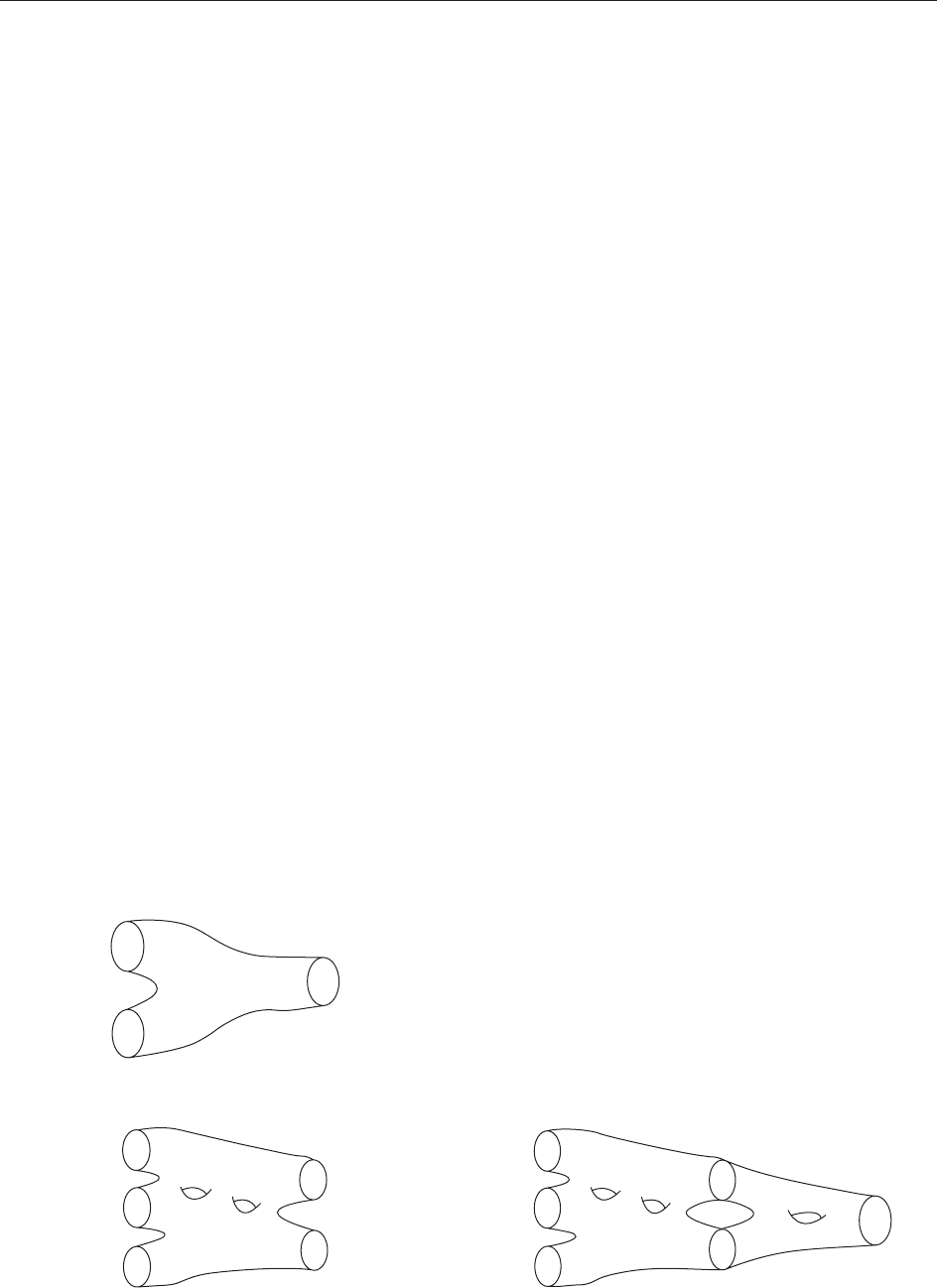
figure 8 is homotopy equivalent to the pair of pants
surface P, which we think of as a g enus 0 cobordism
between two circles and one circle.
Furthermore, Figure 1 is homotopic to the
diagram of mapping spaces,
LM
out
MapðP; M Þ!
in
ðLMÞ
2
where
in
and
out
are restriction maps to the
‘‘incoming’’ and ‘‘outgoing’’ boundary components
of the surface P. So the loop product can be viewed
as a composition,
¼
P
¼ð
out
Þ
ð
in
Þ
!
: ðH
ðLMÞÞ
2
!H
ðMapðP; MÞÞ
!H
ðLMÞ
where using the figure 8 to replace the surface P can
be viewed as a technical device that allows one to
define the umkehr map (
in
)
!
.
In general if one considers a surface of genus g,
viewed as a cobordism from p incoming circles to q
outgoing circles,
g, pþq
, one gets a similar diagram
(Figure 2)
ðLMÞ
q
out
Mapð
g;pþq
; MÞ!
in
ðLMÞ
p
Cohen and Godin (2004) used the theory of ‘‘fat’’ or
‘‘ribbon’’ graphs to represent surfaces as developed
by Harer (1985), Penner (1987), and Strebel (1984),
in order to define Pontrjagin–Thom maps,
g;pþq
: ðLMÞ
p
!Mapð
g;pþq
; MÞ
ð
g;pþq
Þ
where (
g, pþq
) is the appropriately defined normal
bundle of
in
. By applying (perhaps generalized)
homology and the Thom isomorphism, they defined
the umkehr map,
ð
in
Þ
!
: H
ððLMÞ
p
Þ!H
þð
g;pþq
Þn
ðMapð
g;pþq
; MÞÞ
where (
g, pþq
) = 2 2g p q is the Euler char-
acteristic. Cohen and Godin then defined the string
topology operation to be the composition,
g;pþq
¼
out
ð
in
Þ
!
: H
ððLMÞ
p
Þ!H
þð
g;pþq
Þn
ðMapð
g;pþq
; MÞÞ!H
þð
g;pþq
Þn
ððLMÞ
q
Þ
They proved that these operations respect gluing of
surfaces,
1
#
2
¼
2
1
where
1
#
2
is the glued surface as shown in
Figure 3.
The coherence of these operations is summarized
in the following theorem.
Theorem 2 (Cohen and Godin 2004). Let h
be
any multip licative generalized homology theory that
supports an orientation of M. Then the assignment
g;pþq
!
g;pþq
: h
ððLMÞ
p
Þ!h
ððLMÞ
q
Þ
is a positive boundary topological quantum field
theory. ‘‘Positive boundary’’ refers to the fact that
the number of outgoing boundary components, q,
must be positive.
A theory with open strings was initiated
by Sullivan (2004) and developed further by
A Ramirez (2005) and by Harrelson (2004). In this
Figure 1 Pair of pants P.
p circles
q circles
Figure 2
g, pþq
.
p circles
q circles
r circles
Figure 3
1
#
2
.
112 String Topology: Homotopy and Geometric Perspectives
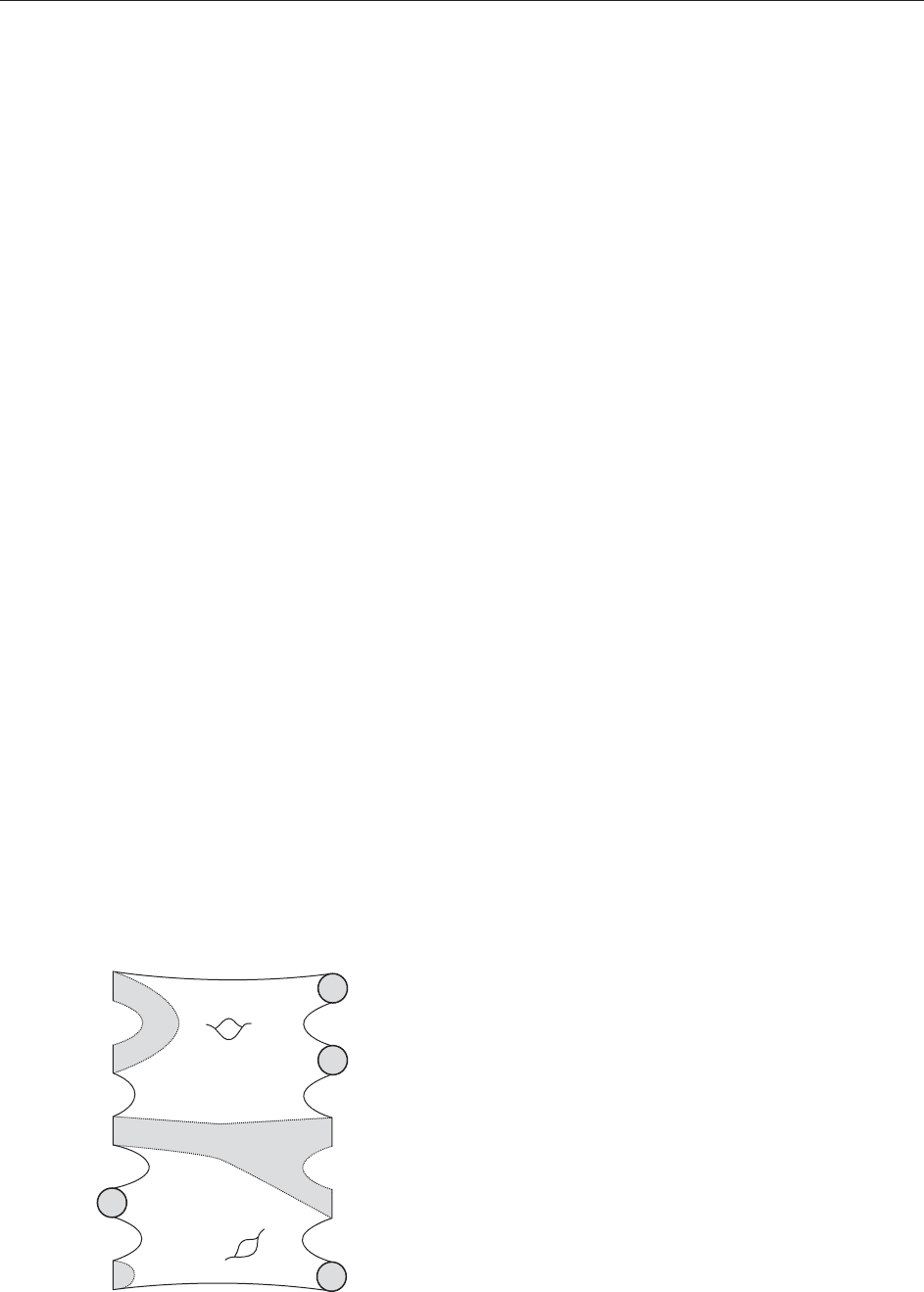
setting one has a collection of submanifolds, D
i
M,
referred to as ‘‘D-branes.’’ This theory studies
intersections in the path spaces P
M
(D
i
, D
j
).
A theory with D-branes involves ‘‘open–closed
cobordisms’’ which are cobordisms between co m-
pact one-dimensional manifolds whose boundary is
partitioned into three parts:
1. Incoming circles and intervals.
2. Outgoing circles and intervals.
3. The rest is the ‘‘free boundary’’ which is itself a
cobordism between the boundary of the incom-
ing and boundary of the outgoing intervals. Each
connected component of the ‘‘free boundary’’ is
labeled by a D-brane (see Figure 4).
In a topological field theory with D-branes,
one associates to each boundary circle a vector
space V
S
1 (in our case V
S
1 = H
(LM)) and to an
interval whose endpoints are labeled by D
i
, D
j
, one
associates a vector space V
D
i
, D
j
(in our case V
D
i
, D
j
=
H
(P
M
(D
i
, D
j
))).
To an open–closed cobordism as above, one
associates an operation from the tensor product of
these vector spaces corresponding to the incoming
boundaries to the tensor product of the vector
spaces corresponding to the outgoing bounda ries.
Of course, these operations have to respect the
relevant gluing of open–closed cobordisms.
By developing a theory of fat graphs that encode
the open–closed boundary data, Ramirez was able
to prove that there are string topology operations
that form a positive boundary, topological quantum
field theory with D-branes (Ramirez 2005).
We end these notes by a discussion of three
applications of string topology to classifying spaces
of groups.
Example 1 Application to Poincare´ duality groups –
(Abbaspour et al. to appear). For G any discrete
group, one has that the loop space of the classifying
space satisfies
LBG ’
a
½g
BC
g
where [g] is the co njugacy class determined by
g 2G, and C
g
< G is the centralizer of g.
When BG is represented by a closed manifold, or
more generally, when G is a Poincare´ duality group,
the Chas–Sullivan loop produ ct then defines pairings
among the homologies of the centralizer subgroup s.
Abbaspour et al. describe this loop product entirely
in terms of group homology, thus giving structure
to the homology of Poincare´-duality groups that
previously had not been known.
Example 2 Applications to 3-manifolds.
(Abbaspour 2005). Let : H
M !H
(LM)be
induced by inclusion of constant loops. This is a
split injection of rings. Write H
(LM) = H
(M)
A
M
. We say H
(LM) has nontrivial extended loop
products if the composition
A
M
A
M
,!H
ðLMÞH
ðLMÞ!
H
ðLMÞ
is nontrivial.
Let M be a closed, irreducible 3-manifold. In a
remarkable piece of work, Abbaspour showed the
relationship between having a trivial extended loop
product and M being ‘‘algebraically hyperbolic.’’
This means that M is a K(, 1) and its fundamental
group has no rank-2 abelian subgroup. (If geome-
trization conjecture is true, this is equivalent to M
admitting a complete hyperbolic metric.)
Example 3 The string topology of classifying
spaces of compact Lie groups ( Gruher (to app ear)
and of Gruher and Salvatore (to appear)). The goal
of Gruher’s work is to construct string topological
invariants of LBG ’EG
G
G, where G acts on
itself via conjugation. Ultimately, one would like to
understand the relationship between this structure
and the work of Freed (2003) on twisted equivariant
K-theory, K
G
(G) and the Verlinde algebra.
The first observation in this program was to
notice that the key ingredient in the forming of the
Chas–Sullivan loop product is that the fibration
ev : LM !M is a fiberwise monoid over a closed
oriented manifold. The fiber is M, which has the
usual Pontrjagin product.
The following was proved by Gruher an d
Salvatore:
Lemma 3 Let G !E !M be a fiberw ise monoid
over a closed manifold M. Then E
TM
is a ring
spectrum.
D
2
D
1
D
3
D
5
D
4
D
6
Figure 4 Open–closed cobordism.
String Topology: Homotopy and Geometric Perspectives 113

The following construction gives a large supply of
examples of such fiberwise monoids over manifolds.
Let G !P !M be a principal G bundle over a
closed manifold M. We can construct the corre-
sponding adjoint bundle,
AdðPÞ¼P
G
G ! M
It is an easy observation that G !Ad(P) !M is a
fiberwise monoid.
Theorem 4 Ad(P)
TM
is a ring spectrum. This ring
structure is natural with respect to maps of principal
G-bundles.
Let BG be classifying space of compact Lie
groups. It is possible to construct a filtration of BG,
M
1
,!M
2
,!,!M
i
M
iþ1
,!,!BG
where the M
i
’s are compact, closed manifolds. An
example of this is filtering BU(n) by Grassmannians.
Let G !P
i
!M
i
be the restriction of EG !BG.
By the above theorem one obtains an inverse system
of ring spectra
P
TM
1
1
P
TM
2
2
P
TM
i
i
P
TM
iþ1
iþ1
Theorem 5 The homotopy type of this pro-ring-
spectrum is a well-defined invariant of BG. It is
referred to as the ‘‘string topology of BG.’’
Potential Application: Twisted K-theory
and the Verlinde Algebra
Let G be a connected, compact Lie group. Using the
observation that the loop space of a classifying space
is the classifying space of the loop group,
L(BG) ’B(LG), the string topology gives new
structure on the classifying space of these loop
groups. In particular, one has new structure on the
K-theory of these classifying spaces. Now classical
results of Atiyah and Segal suggest that K-theory of
classifying spaces should be related to the representa-
tion theory of the group. In this case, the representa-
tion theory of loop groups has been widely studied
and is very important in conformal field theory.
Understanding the precise relationship between the
string topology of the classifying space and
this representation theory is an interesting area of
current research. To motivate this, first recall that the
loop space, LBG, has a well-known description as
LBG ’EG
Ad
G
where the right-hand side refers to the homotopy
orbit space of the conjugation (or adjoint) action of
G on itself. Thus, the homology H
(LBG) is the
equivariant homology H
G
(G). Similarly, the
K-theory K
(LBG) maps to the equivariant K-theory,
K
G
(G). Now in recent work of Freed (2003) twisted
equivariant K-homology, K
G
(G) was shown to be
isomorphic to the Verlinde algebra. This algebra is a
space of representations of the loop group, LG.The
multiplication in this algebra is the ‘‘fusion product,’’
coming from conformal field theory. One topic of
current research is to understand the relationship
between multiplicative structure coming from the
string topology of BG, and this fusion product in the
Verlinde algebra. More generally, the goal is to bring
to bear the considerable calculational techniques of
algebraic topology that are available in string
topology, to understand the recently uncovered field
theoretic structure of twisted K-theory (Freed 2003),
and its applications to string theory.
Acknowledgment
The author was partially supported by a grant
from the NSF.
See also: Mathematical Knot Theory; Topological
Defects and Their Homotopy Classification.
Further Reading
Abbaspour H (2005) On string topology of three manifolds.
Topology 44: 1059–1091.
Abbaspour H, Cohen RL, and Gruher K String Topology of
Poincare´ Duality Groups (in preparation).
Chas M and Sullivan D (1999) String topology. To appear in
Annals of Mathematics. Preprint: math.GT/9911159.
Cohen RL and Godin V (2004) A polarized view of string
topology. In: Topology, Geometry, and Quantum Field Theory,
London Math. Soc. Lecture Notes, vol. 308, pp. 127–154.
Cohen RL and Jones JDS (2002) A homotopy theoretic realization
of string topology. Mathematisches Annalen 324: 773–798.
Freed D, Hopkins M, and Teleman C Twisted K-theory and loop
group representations. Preprint: math.AT/0312155.
Godin V (2004) A Category of Bordered Fat Graphs and the
Mapping Class Group of a Bordered Surface. Ph.D. thesis,
Stanford University.
Gruher K Ph.D. thesis, Stanford University (in preparation).
Gruher K and Salvatore P String Topology of Classifying Spaces
(in preparation).
Harrelson E (2004) On the homology of open–closed string
theory. Preprint: math.AT/0412249.
Harer JL (1985) Stability of the homology of the mapping class groups
of orientable surfaces. Annals of Mathematics 121: 215–249.
Penner R (1987) The decorated Teichmuller space of punctured
surfaces. Communications in Mathematical Physics 113:
299–339.
Ramirez A (2005) Open–Closed String Topology. Ph.D thesis,
Stanford University.
Strebel K (1984) Quadratic Differentials. Berlin: Springer.
Sullivan D (2004) Open and closed string field theory interpreted
in classical algebraic topology. In: Tillman U (ed.) Topology,
Geometry, and Quantum Field Theory, London Math.
Soc. Lecture Notes, vol. 308, pp. 344–357. Cambridge:
Cambridge University Press.
114 String Topology: Homotopy and Geometric Perspectives
Superfluids
D Einzel, Bayerische Akademie der Wissenschaften,
Garching, Germany
ª 2006 Elsevier Ltd. All rights reserved.
Introduction
Superfluidity has been known to exist since the
1930s. This widespread phenomenon occurs in
many-particle Bose and Fermi systems as different
as liquid
4
He, liquid
3
He, atomic gases like Rb and
Li, atomic nuclei, pulsars and last, but not least, in
metals, where the itinerant electrons may become
superfluid. This article is devoted to a unifying
theoretical description of Bose and Fermi super-
fluidity. The mechanisms leading to superfluidity
include Bose–Einstein condensation (BEC) and
Bardeen, Cooper, and Schrieffer (BCS)–Leggett
pairing correlations. We hope to be able to
demonstrate why this fascinating phenomenon is –
even roughly 80 years after its experimental discov-
ery and its first theoretical explanation – still a
subject of intensive research.
The phenomenon of superfluidity is closely
connected with the apparent lack of any measurable
flow resistance, which scales with the shear viscosity
of the fluid. Its complete absence implies that
the system is frictionless moving with zero viscosity.
The observa tion of superfluidity is usually precluded
by the solidification of most liquids as the temp era-
ture is lowered. Only systems with particularly
light atoms (like the helium isotopes
4
He and
3
He)
stay liquid down to the lowest temperatures.
These systems are referred to as ‘‘quantum liquids,’’
since their liquid state is caused by the quantum-
mechanical zero-point motion of the atoms. It
should be noted that the Helium isotopes
belong to two different kinds of elementary
particles which can be distinguished by their
statistics:
4
He is a spin-0 boson and
3
He a spin-
1/2 fermion.
In 1924, Satyendra Nath Bose and Albert Einstein
proposed that below a characteristic degeneracy
temperature T
B
, a macroscopic number of bosons
can condense into the state of lowest energy
k
= 0.
In the 1930s, Fritz London and Heinz London
showed that this so-called Bose–Einstein condensate
can be described by a macroscopic quantum-
mechanical wave function like the one for a single
elementary particle, but with the probability density
replaced by the density of the condensed particles.
By the end of the 1930s, the experimental results of
Allen, Kamerlingh–Onnes, Keesom, Kapitza,
Miesener, Wolfke, and others accumulated the
evidence that liquid
4
He undergoes a second-order
phase transition at T
= 2.17 K to a state referred to
as a superfluid, since the liquid could flow without
any sign of a flow resistance. This superfluid state
was interpreted in terms of Bose condensation of the
4
He atoms in the liquid (London 1938).
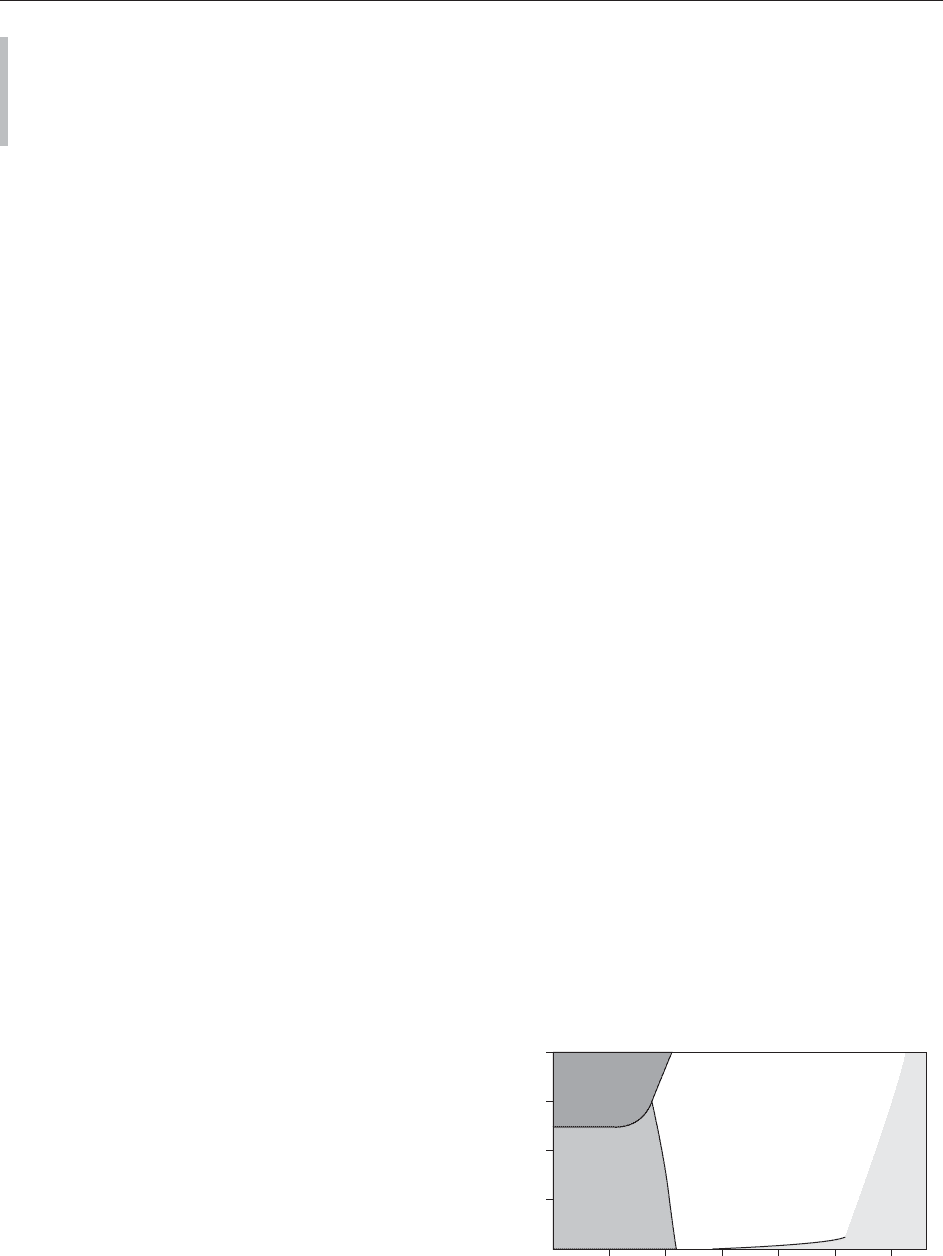
In Figure 1 the P–T phase diagram of liquid
4
He is
shown with a normal liquid phase, a solid phase and
the superfluid phase below the -line at about 2 K.
Fermions cannot condense in a way similar to the
BEC, due to the Pauli exclusion principle. In 1957
Bardeen, Cooper, and Schrieffer came up with their
ingenious proposal that the superfluidity of the
electron system (usually referred to as superconduc-
tivity) comes about through the formation of
fermion pairs (quasibosons) in k-space in a spin-
singlet state. In 1971, several superfluid phases of
liquid
3
He at a few mK were discovered by Lee,
Osheroff, and Richardson at Cornell University.
Experimental aspects connected with the spin
degrees of freedo m of the quantum liquid gave
strong evidence for Cooper pairing of the
3
He atoms
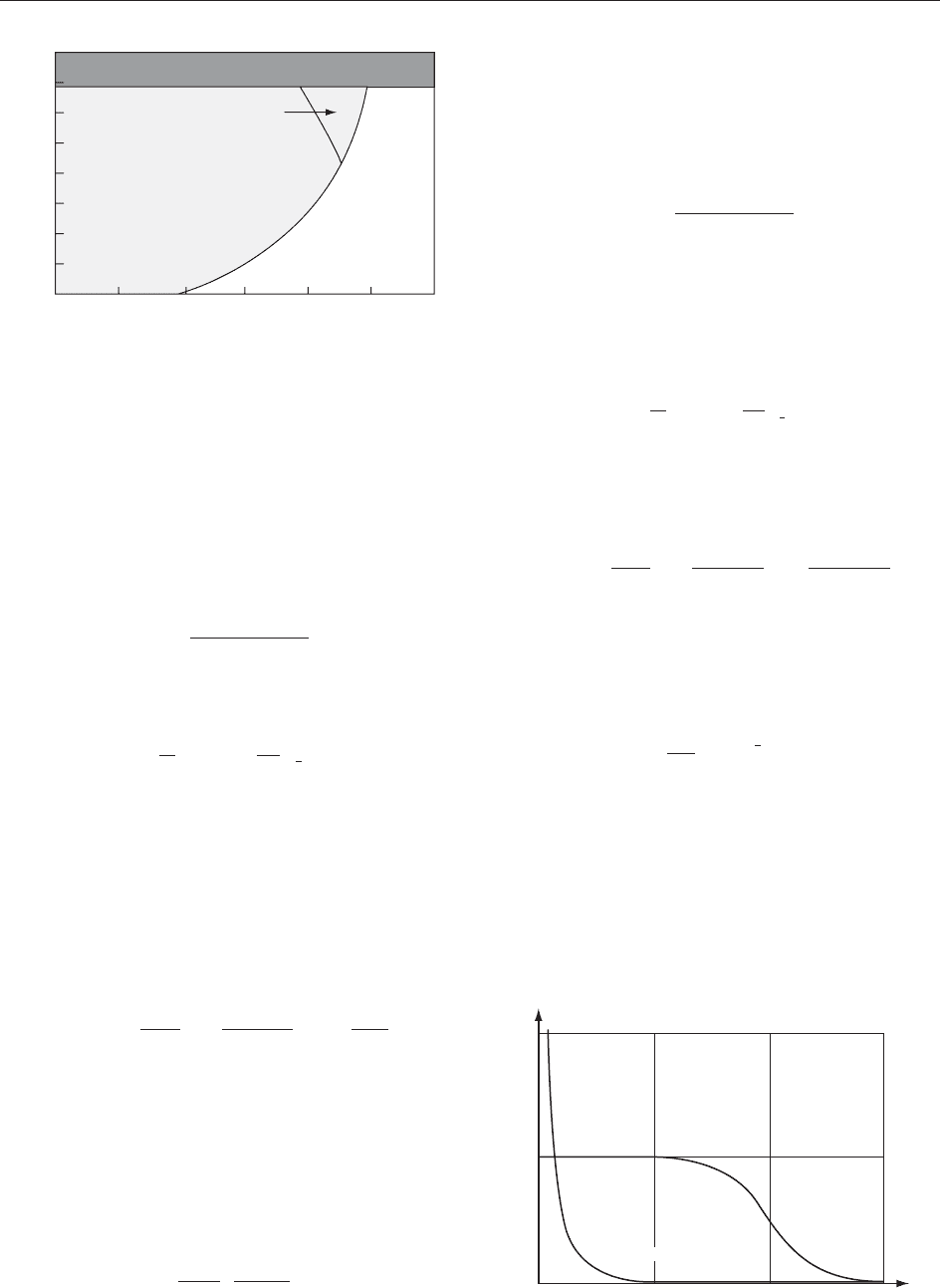
in a spin-triplet state. In Figure 2 the zero-field P–T
phase diagram of liquid
3
He is shown with a normal
(Fermi) liquid phase, a solid phase and the super-
fluid A and B phases.
Immediately after this discovery, Anthony
J Leggett applied the BCS ideas to liquid
3
He and
introduced a generalized scheme, that allowed for
triplet-pairing correlations. His theory turned out to
describe a large variety of experimental results
accurately. A new and exciting development set in
when Bose–Einstein con densates were discovered for
the first time in dilute gases of alkali atoms in 1995
by Cornell and Wiemann et al. (Rb), Ketterle et al.
(Na), and Hulet et al. (Li).
4
3
2
1
0
0123456
Temperature (K)
Normal liquid
Pressure (MPa)
Gas
λ
Solid
Superfluid
Figure 1 The phase diagram of liquid
4
He. Courtesy of Erkki
Thuneberg.
Superfluids 115
Boson and Fermion Degeneracy
In what follows, the energy dispersion of Bose and
Fermi systems is denoted as
k
(free bosons/fermions
would be represented by
k
=h
2
k
2
=2m). A large
number of bosons can occupy Bose quantum states
jki, the average occupation is dictated by the Bose–
Einstein distribution
n
k
¼
1
e
ð
k
Þ=k
B
T
1
½1
For Bose systems, the chemical potential is negative
= k
B
T and is fixed by the condition
n ¼
1
V
X
k
0
n
k
¼
1
3
T
B3
2
ðÞ½2
where the prime indicates the summation over
excited states jkj > 0. In [2],
T
= h=
ffiffiffiffiffiffiffiffiffiffiffiffiffiffiffiffiffiffi
2mk
B
T
p
denotes the thermal de Broglie wavelength which
provides a criterion for the importance of quantum
effects or degeneracy through n
3
T
O(1). The Bose
integrals B
() originate from the conversion of the
momentum sum into an energy integral and read for
parabolic dispersion:
B
ðÞ¼
1
ðÞ
Z
1
0
dyy
1
e
yþ
1
¼
X
1
¼1
e
½3
with B
(0) = (), the Euler -function and denot-
ing the Riemann -function. It is important to under-
stand that in order to have a constant total density
n, B
3=2
() has to increase /T
3=2
inthesamewayas
3
T
. This is, however, impossible at all temperatures
since the chemical potential of the Bose gas vanishes
( ! 0) at a finite temperature T
B
given by
T
B
¼
2h
2
mk
B
n
ð3=2Þ
2=3
½4
for which n
3
T
B
= B
3=2
(0) = (3=2) = 2.612 ... .
In sharp contrast, fermions obey the Pauli exclu-
sion principle, which states that only one fermion
can occupy a quantum state jk, i specified in
addition by the spin projection . The average
statistical occupation is given by the Fermi–Dirac
distribution
f
k
¼
1
e
ð
k
Þ=k
B
T
þ 1
½5
Figure 3 shows a comparison of Bose–Einstein
and Fermi–Dirac momentum distributions n
k
plotted
vs.
k
. The chemical potential is shown for fermions
only,
F
= k
B
T is always positive and the total
density can be expressed as
n ¼
1
V
X
k;
f
k
¼
2
3
T
F
3
2
ðÞ½6
where the factor of 2 originates from the spin
degeneracy. For parabolic dispersion, the Fermi
integral reads:
F
ðÞ¼
1
ðÞ
Z
1
0
dyy
1
e
y
þ 1
¼
T!0
ð=k
B
TÞ
ð þ 1Þ
½7
One recognizes that the degeneracy condition
n
3=2
T
1 corresponds to the limit T T
F
=
(0)=k
B
, whi ch is connected with the formation of
a ‘‘Fermi sea,’’ with (0) E
F
the Fermi energy:
¼
T!0
h
2
2m
ð3
2
nÞ
2
3
¼ E
F
½8
To summarize, quan tum behavior in Bose and
Fermi system sets in below the degeneracy tempera-
ture T
, defined through n
3
T
= O(1). For bosons,
T
= T
B
is the temperature at which the chemical
potential vanishes, whereas for fermions T
= T
F
is
the Fermi temperature.
0123
0
1
2
3
4
Temperature (mK)
Pressure (MPa)
Superfluid A phase
Superfluid B phase
Normal fluid
Solid
Figure 2 The phase diagram of liquid
3
He. Courtesy of Erkki
Thuneberg.
0
0
1
2
Fermi–Dirac
n
k
ε
k
μ
F
Bose–Einstein
Figure 3 The Fermi and Bose momentum distribution.
116 Superfluids

London Quantum Hydrodynamics
For a general treatment of the quantum-mechanical
origin of the equations describing Bose and Fermi
superfluidity, it is convenient to introduce a para-
meter which describes single bosons ( = 1) or
Fermion pairs ( = 2) of mass M = m. The basic
assumption (London 1938) is that the laws of
quantum mechanics are applicable also to a macro-
scopic number of single ( = 1) or composite ( = 2)
particles of density
s
=m, the so-called condensate,
which is represented by a macroscopi c wave func-
tion (r, t). has the property
ðr; tÞ
ðr; tÞ¼
s
ðr; tÞ
m
; ¼ 1; 2
The dynamics of the condensate is governed by
the Schro¨ dinger equation
i
h
@
@t
¼
h
2
r
2
2
2
m
þ
!
½9
in which represents the condensate’s chemical
potential. After performing a Madelung transforma-
tion (Madelung 1926):
¼ ae
i’
; a
2
¼
s
m
one arrives at two coupled hydrodynamic equations,
the first of which reads
@
s
@t
þrj
s
m
¼ 0
j
s
m
¼
s
v
s
; v
s
¼
h
m
r’
½10
Equation [10] can be interpreted as a contin uity
equation, which represents the conservation law for
the condensate mass density
s
. The second equation
h
@’
@t
¼
1
2
mv
s2
þ þ O ðh
2
r
2
Þ½11
assumes the form of the Hamilton–Jacobi equation
for the action field of classical mechanics h’, if the
quasiclassical limit (terms /O(h
2
r
2
) ! 0) is taken.
From [10] and [11] a condensate acceleration
equation can be derived, which resembles the Euler
equation of classical hydrodynamics ( =
0
þ ):
@v
s
@t
þðv
s
rÞv
s
¼
1
m
r ½12
The physical nature of the driving force becomes
evident after applying the Gibbs–Duhem relation
n = P
0
T. Finally, the acceleration of the
mass supercurrent j
s
m
is of the form
@j
s
m
@t
¼
s
r P
0
TðÞ½13
It turns out that the London equations [10] and
[13], in which
s
is an unknown phenomenological
parameter, explain many experimental observations
such as persistent currents, U-tube oscillations,
thermomechanical (e.g., fountain-) effects, beaker
flow phenomena, and many others.
Bose–Einstein Condensation (BEC)
In order to understand the macroscopic quantum
state in case of Bose systems, we consider first the
simple case of a Bose gas. Let us decompose the
energy eigenstates
k
into those with
k
=
0
= 0
(condensate) and average occupation number
n
0
¼
N
0
V
¼
1
V
1
e
1
½14
and those with
k
> 0 (excited states) and average
occupation number
n
ex
¼
N
ex
V
¼
X
k
0
n
k
¼ n
B
3/2
ðÞ
B
3/2
ð0Þ
T
T
B
3/2
½15
with the total density n = n
ex
þ n
0
. The consequence of
the chemical potential vanishing at T
B
clearly is a mac-
roscopic occupation of the ground state of the Bose gas:
N
0
=
!0
1
1 þ þ1
¼
1
!1 ½16
This phenomenon is referred to as BEC. Below
T
B
, = 0 and from [15] we see that
n
ex
¼
free bosons
n
T
T
B
3=2
; T < T
B
½17
The average occupation of the ground state is given by
n
0
ðTÞ¼n n
ex
ðTÞ; T < T
B
½18
It is important to understand that the number
density of condensed particles n
ex
has nothing to
do with the current response function
s
(eqn [10]).
A derivation of
s
will be given in the section ‘‘Local
response of condensates and excitation gases.’’
Let us now discuss the structure of the excitation
spectrum, which will turn out to be crucial for the
observability of superfluidity, in some more detail.
Suppose that a macroscopic object of mass M moves
through the superfluid. Then one may ask the question,
at what velocity does this motion cause the creation of
an excitation of energy E
p
and momentum p.The
condition can be formulated in terms of the velocity
Superfluids 117
difference v
i
v
f
as E
p
= M(v
2
i
v
2
f
)=2and
p = M(v
i
v
f
). Eliminating v
f
yields
p
= p v
i
þ
O(M
1
) so that condition for the creation of an excit-
ation leads to the so-called Landau critical velocity
v
L
¼ min
E
p
jpj
> 0 ½19
It is immediately clear that for free bosons v
L
= 0.
This means that a free Bose gas can never be a
superfluid, since drag forces on moving objects will
start to act even at smallest velocities.
It turns out that interaction effects can drastically
modify the nature of the elementary excitations. In
1947, Nikolai Bogoliubov showed (for the first time
using the method of second quantization) that even in
the limit of weak repulsive interactions the excitation
spectrum is phonon-like E
p
= cjpj,withc the sound
velocity. Lev Landau and Richard Feynman investi-
gated the situation for superfluid
4
He, where the
interactions between the atoms are far from weak.
Landau (1947) postulated the following form for the
excitation spectrum, for which Feynman (1953) gave
the microscopic justification. At low momenta, the
spectrum is phonon-like and linear in p:
lim
p!0
E
p
¼ E
phon
p
¼ cjpj½20
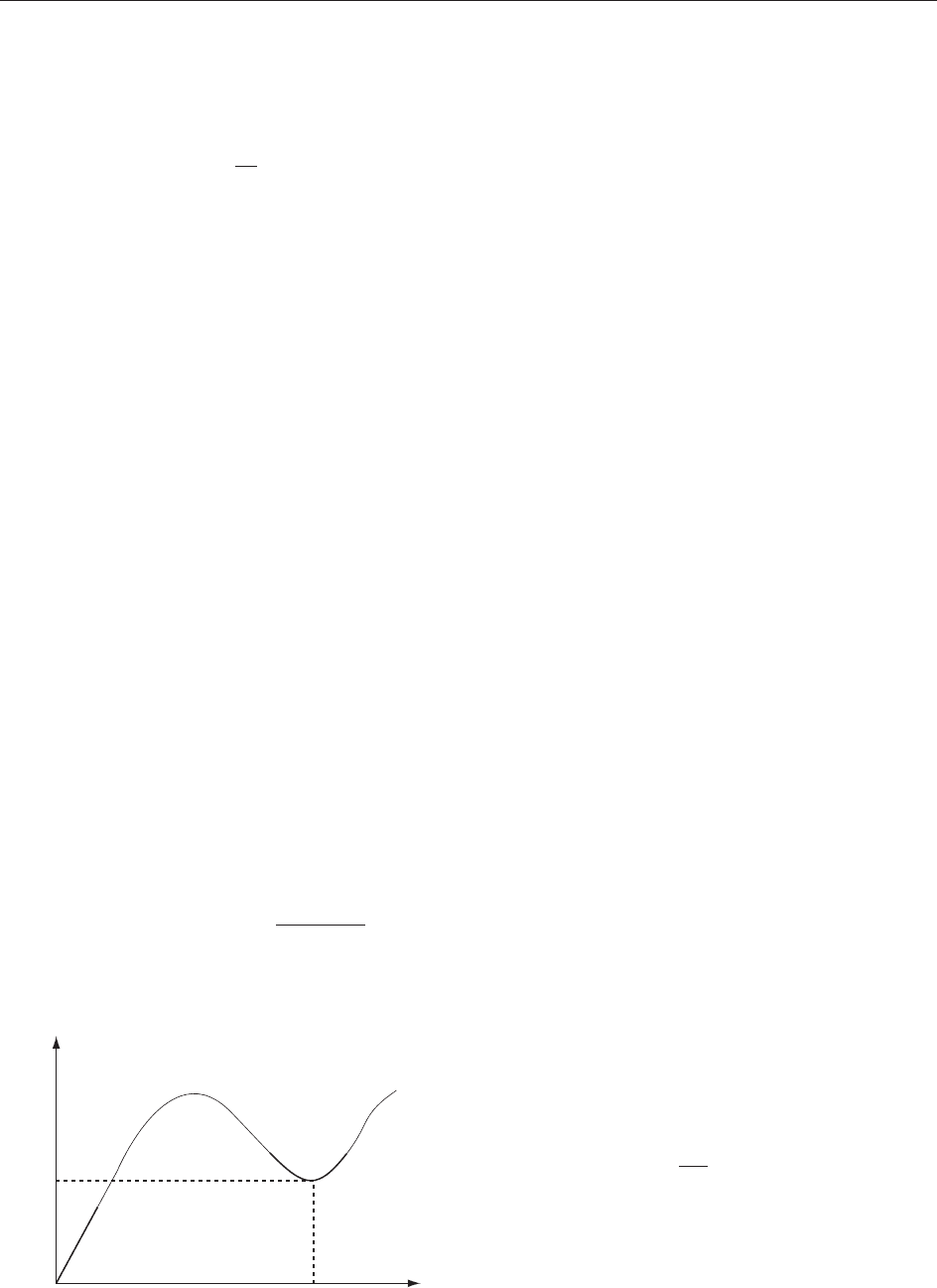
At higher momenta, the spectrum is reminiscent
of that of crystal phonons in that E
p
passes though a
maximum, and then, at a characteristic momentum
p
0
approaches the next minimum, which, however,
is located at a finite energy D. Feynman called this
part of the spectrum the ‘‘roton’’ (mass m
r
)inan
analogy with a ‘‘smoke ring,’’ since it is connected
with the forward motion of a particle accompanied
by a ring of back-flowing other particles:
lim
jpj!p
0
E
p
¼ E
rot
p
¼ D þ
ðjpjp
0
Þ
2
2m
r
½21
Figure 4 shows a sketch of the phonon–roton
spectrum of superfluid
4
He. Clearly, the Landau
critical velocity for the phonon–roton spectrum is
characterized by the roton minimum and is given by
v
L
D=p
0
.
BCS–Leggett Pair Condensation
The key assumptions of the weak-coupling mean-
field BCS–Leggett pairing model can be summarized
as follows: one first assumes that at sufficiently low
temperatures it is energetically favorable that a
temperature-dependent part of the fermions forms
so-called Cooper pairs. This pair formation is caused
by an attractive interaction in k-space near the
Fermi surface:
ðsÞ
kp
< 0; j
k
j; j
p
j <
c
Here
k
=
k
measures the energy from the
chemical potent ial. The index s denotes the total
spin of the pair. Classical superconductors have
pairs in a relative singlet state s = 0, m
s
= 0 whereas
the superfluid phases of liquid
3
He have pairs in a
relative spin-triplet state s = 1, m
s
= 0, 1, with m
s
the magnetic quantum number. The amplitude of
spontaneous pair formation is
g
k
1
2
h
^
c
k
1
^
c
k
2
i 6¼ 0; T T
c
½22
with k = k
1
k
2
the relative momentum of the
pair. The attractive interaction that drives the
Cooper-pair formation connects the pairing ampli-
tude g
k
1
2
with a new energy scale, the so-called
pair potential
D
k
1
2
¼
X
p
ðsÞ
kp
g
p
1
2
½23
As a consequence of triplet pairing the spin part of
the pair potential is ‘‘even’’ upon interchange of
1
and
2
: D
k
2
1
= D
k
1
2
. Then the Pauli principle
requires that D
k
1
2
must be ‘‘odd’’ with respect
to the interchange of k
1
and k
2
or, equivalently,
k !k. The k-dependence can now be classified by
an orbital qua ntum number ‘ with the special cases
of ‘ = 1(p-wave) pairing, ‘ = 3(f-wave) pairing, etc.
All superfluid phases of
3
He are characterized by
p-wave orbital symmetry.
The transition temperature T
c
from [23] reads
k
B
T
c
¼
2e
c
e
1=ðN
F
ðsÞ
Þ
with N
F
= 3n=2E
F
the density of states at the Fermi
level and = 0.577 ... the Euler constant. The
energies
k
can trivially be divided into particle-like
(
k
> 0) and hole-like (
k
< 0) terms. The presence
of the pair potential D
k
leads to a mixing of particle-
and hole-like contributions to the energy, which
Rotons
Phonons
p
0
0
E
p
Δ
p
0
Figure 4 The phonon–roton spectrum.
118 Superfluids