
Francoise J.-P., Naber G.L., Tsun T.S. (editors) Encyclopedia of Mathematical Physics
Подождите немного. Документ загружается.

becomes a matrix in particle–hole, or Nambu space
(Nambu 1960), and generates what is referred to as
off-diagonal long-range order (ODLRO):
k
¼
k
1 D
k
D
y
k
k
1
!
½24
As usual, the diagonalization of
k
(Bogoliubov
1958) leads to the energy dispersion of the relevant
thermal excitations of the superfluid state, the so-
called Bogoliubov quasiparticles or ‘‘bogolons’’:
E
k
¼
ffiffiffiffiffiffiffiffiffiffiffiffiffiffiffiffi
2
k
þ D
2
k
q
; D
2
k
¼ D
k
D
y
k
½25
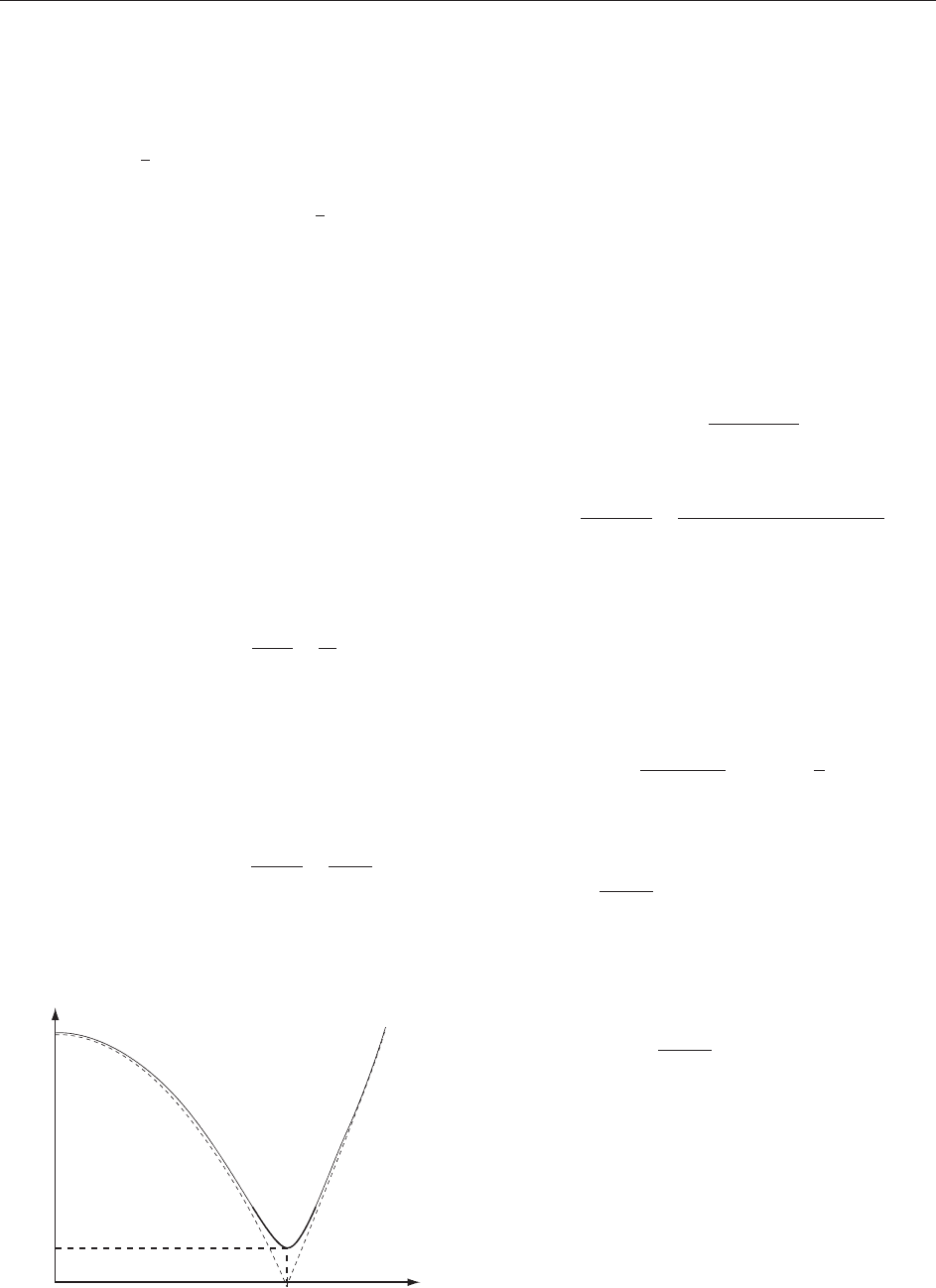
In Figure 5, the dispersion E
p
of Bogoliubov
quasiparticles vs. jpj is shown. It turns out that the
superfluid phases (A and B) of liquid
3
He in zero
magnetic field are characterized by unitary matrices
D
k
, so that the scalar quantity D
k
can be interpreted
as the energy gap in the bogolon spectrum, which, in
general, may be anisotropic in k-space.
The energy gap D
k
of the superfluid B-phase can
be represented in the simple nodeless (pseudoiso-
tropic) and BCS-like form (Balian and Wert hamer,
(BW), 1963):
D
k
¼ DðTÞ;
Dð0 Þ
k
B
T
c
¼
e
½26
Its spin structure is characterized by the presence of all
three triplet components m
s
= 0, 1 and will be
discussed further with respect to the magnetization
response (see next section). The gap symmetry of
3
He-A
is uniaxial with respect to an axis
^
‘ (Anderson and
Morel 1960; Anderson and Brinkman 1973)
k
¼
0
ðTÞsin
k
;
0
ð0Þ
k
B
T
c
¼
e
5=6
2e
½27
where cos
k
= k
^
‘, and characterized by two point
nodes of D
k
at the zeros (
k
= 0, ) on the Fermi
surface. It has furthermore turned out that only the
m
s
= 1 components of the spin triplet contribute
to its spin dependence (equal spin pairing (ESP)).
Local Response of Condensates
and Excitation Gases
In the previous sections we have seen that the
structure (energy dispersion, statistics, critical flow
velocity) of the relevant thermal excitations is of
crucial importance for the superfluidity. We can
now aim at a generalized statistical description of
bosonic (phonons, rotons) and fermionic (bogolons)
excitation gases, by introducing a generalized
momentum distribution
n
fE
k
g¼
1
e
E
k
=k
B
T
½28
and its energy derivative
’
k;
¼
@n
fE
k
g
@E
k
¼
1
2k
B
T coshðE
k
/k
B
TÞ½
½29
Special cases are
¼
1; Bose ðphonons ; rotonsÞ
1; Fermi ðbogolonsÞ
Introducing the spin s = (1 )=4, the total
momentum density response to the presence of a
superfluid velocity
v
s
¼
hr’
ð2s þ 1Þm
; s ¼ 0;
1
2
and a normal fluid velocity v
n
can be written in the
general form
j
m
¼
2s þ 1
V
X
k
pn
E
k
þ E
k
fg
þ v
s
½30
After Taylor-expanding n
with respect to the
small energy shifts E
k
= p ( v
s
v
n
), one may
introduce the so-called normal fluid density tensor
n
ij
¼
2s þ 1
V
X
k
’
k;
p
i
p
j
½31
and the momentum density assum es the form
j
m
¼
s
v
s
þ
n
v
n
;
s
¼ 1
n
½32
Equation [32] forms the central result of this
essay because it represents the microscopic counter-
part of the generalized London equation [10].Itis
clearly seen how the phenomenon of superfluidity
originates from
s
> 0 due to a qualitative change
in the dispersion of the elementary excitations,
which may in particular be characterized by a gap in
Bogolons
0
Δ
0 p
F
E
p
p
Figure 5 The bogolon energy dispersion.
Superfluids 119
the excitation spectrum. Equation [32] is more general
than [10] in that it introduces a two-fluid picture in
which the mass supercurrent j
s
m
=
s
v
s
(eqn [10])is
complemented by a normal (excitation) mass current
j
n
m
=
n
v
n
in the presence of a macroscopic velocity
field v
n
of the excitation gas obeying arbitrary
statistics. The temperature dependence of
s
(T)can
now be computed via [31] and the result depends on
the dispersion of the thermal excitation under con-
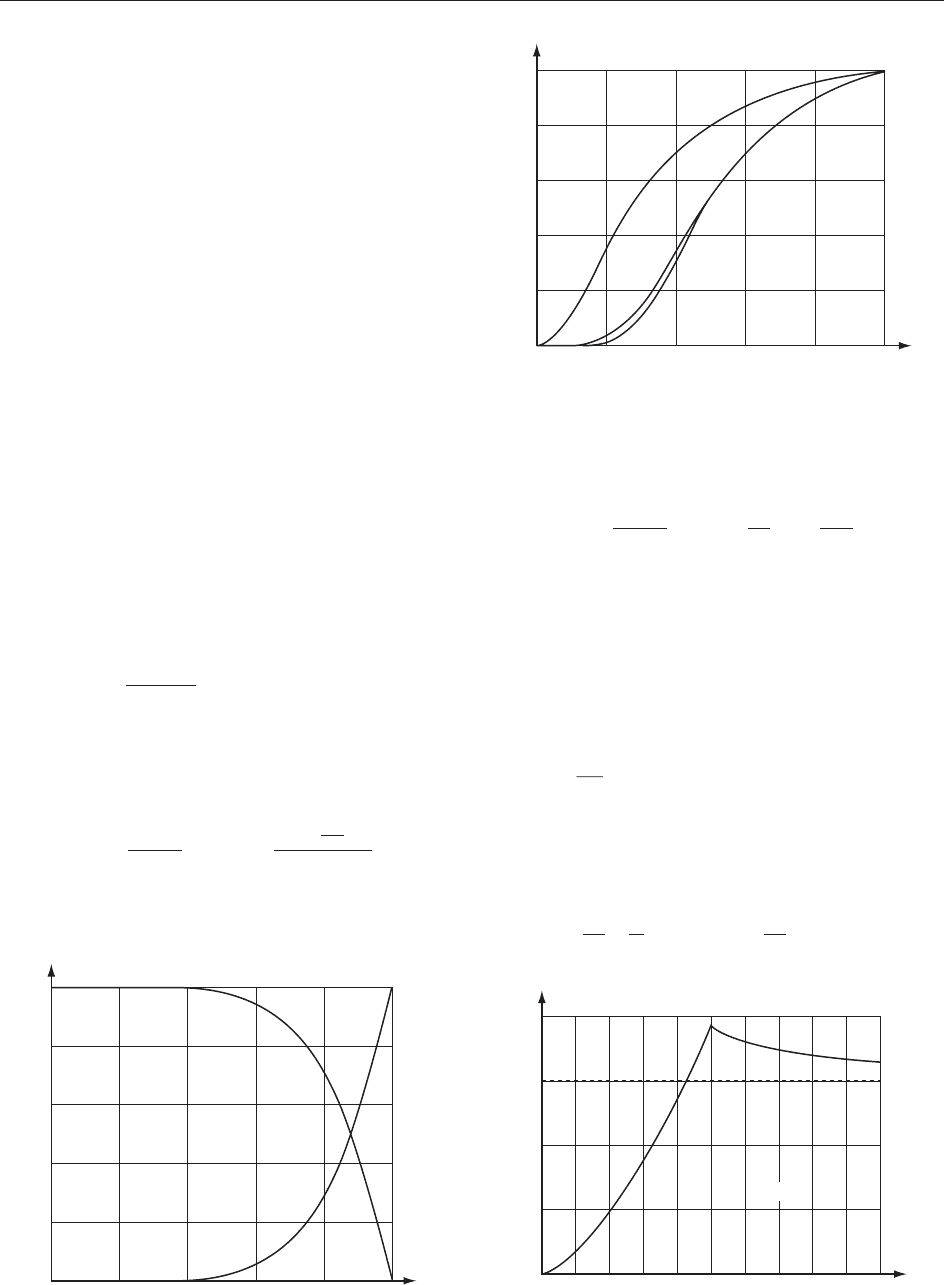
sideration. Figure 6 shows the temperature depen-
dence of the normal and superfluid density of
superfluid
4
He. The normal fluid density of superfluid
3
He is, in general, a tensor quantity
n
ij
¼
n
k
^
‘
i
^
‘
j
þ
n
?
ð
ij
^
‘
i
^
‘
j
Þ;
3
He-A
n
ij
;
3
He-B
(
½33
The short-range Fermi liquid interaction leads to a
quasiparticle mass enhancement m
=m = 1 þ F
s
1
=3
characterized by the pressure-dependent dimensionless
Landau parameter F
s
1
.InFigure 7, the normal fluid
density (
n
k, ?
for
3
He-A,
n
for
3
He-B) is shown as a
function of reduced temperature at a pressure of 27
bar, where F
s
1
= 12.53. The entropy density of an
excitation system of arbitrary statistics below the
transition can be written as
0
¼ k
B
ð2s þ 1Þ
V
X
k
P
k
P
k
¼ ð1 þ n
Þlnð1 þ n
Þn
ln n
½34
with n
= n
{E
k
}, from which one may derive the
specific heat capacity
T ¼
2s þ 1
V
X
k
E
k
n
E
k
þ
@E
k
@T
T
k
B
ðT þ TÞ
()
¼ c
V
T ½35
After a Taylor expansion of n
with respect to the small
local temperature change T, the result for c
V
(T)reads
c
V
¼
2s þ 1
V
X
k
’
k;
E
2
k
T
E
k
@E
k
@T
½36
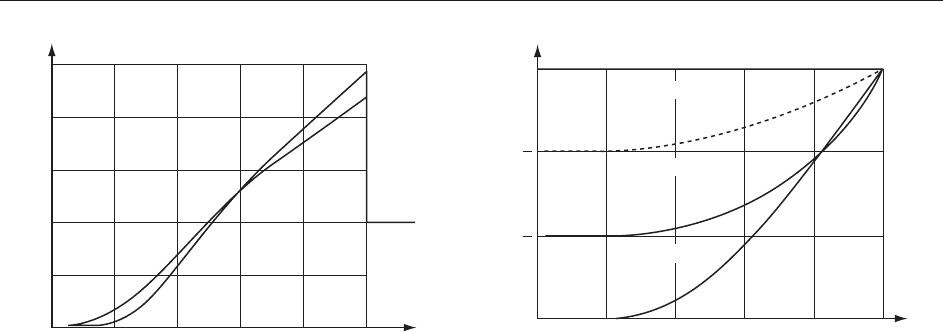
In Figures 8 and 9 we show the cusp-like specific heat
of a Bose gas as compared with the specific heat of
3
He-A, B, which display discontinuities at T
c
.
Finally, the superfluid phases of
3
He are char-
acterized in add ition by the spin degrees of freedom,
reflected by the bogolon spin magnetization
response to an external magnetic field B:
M
n
¼
h
2V
X
k;
n
1
E
k
hB=2
fg
¼
0
B ½37
where denotes the gyromagnetic ratio of the fermions.
The bogolon spin susceptibility
0
is obtained after a
Taylor expansion of n
1
with respect to B as
0
¼
h
2
2
1
V
X
k;
’
k;1
h
2
2
N
F
YðTÞ½38
0
0
1
1
ρ
s
(T )/ρ
ρ
n
(T )/ρ
T/
T
λ
Figure 6 The normal and superfluid density for He-II.
0
1
01
27 bar
ρ
n
(T )/ρ
T/T
c
B
A
⊥
A
||
Figure 7 The normal fluid density for
3
He-A, B.
2
1
0
012
T/T
B
C(T )/Nk
B
Figure 8 The specific heat capacity of a Bose gas.
120 Superfluids
Note that eqn [38] accounts only for the m
s
= 0
(bogolon) contribution to the spin-triplet suscept-
ibility, the temperature dependence of which is given
by the so-called Yosida function Y(T) = N
1
F
P
k
’
k, 1
. The total susceptibility reads
tot
¼
0
|{z}
bogolons
þ
1
þ
1
|fflfflfflfflfflffl{zfflfflfflfflfflffl}
condensate
½39
with the condensate contributing through
m
s
= 1
a
fraction of 2/3 of the normal state Pauli suscept-
ibility. In Figure 10, the reduced spin susceptibility
=
N
of
3
He-A, B is plotted vs. reduced tempera-
ture. While the constant susceptibility is character-
istic of the ESP pairing state, the reduction of the
B-phase susceptibility is due to the lack of the
nonmagnetic m
s
= 0 contribution to the spin triplet
in the low-temperature limit. Exchange interaction
effects, characterized by the dimensionless Landau
parameter F
a
0
, lead to a further reduction of the
Balian-Werthamer (BW)-state susceptibility, which
is shown for 27 bar, where F
a
0
= 0.755. Note that
the theoretical picture reflected in Figure 10, and
also in Figures 6, 7,and9, is in quantitative
agreement with experimental observations.
In summary, superfluidity is a quantum-mechanical
phenomenon seen on a macroscopic scale. It occurs
below the degeneracy temperature T
/ n
2=3
=m of
both Bose and Fermi many-particle systems (like liquid
4
He and
3
He) and is a property of a macroscopic
number of particles, the condensate. The role of (weak
or strong) interactions is manifested in the structure of
the relevant elementa ry excitations, which always exist
in addition to the condensate at finite temperatures and
above certain critical velocities. These excitations form
a gas, referred to as the normal fluid, since it gives rise
to temperature-dependent thermodynamic and response
functions and contributes to the entropy and the flow
dissipation. Superfluidity is now well understood using
various aspects of the concept of the macroscopic wave
function. On the microscopic level, the mechanisms of
BEC and BCS–Leggett pair formation have been
successfully invoked to understand the fascinating
properties of Bose and Fermi superfluids.
See also: Bose–Einstein Condensates; Bosons and
Fermions in External Fields; High T
c
Superconductor
Theory; Topological Knot Theory and Macroscopic
Physics; Variational Techniques for Ginzburg–Landau
Energies; Vortex Dynamics.
Further Reading
Anderson PW and Brinkman WF (1973) Physical Review Letters
30: 1911.
Anderson PW and Morel P (1960) Physical Review Letters 5: 136.
Annett J (2004) Superconductivity, Superfluids and Condensates.
Oxford: Oxford University Press.
Balian R and Werthamer NR (1963) Physical Review 131: 1553.
Bogoliubov NN (1947) Journal of Physics USSR 11: 23.
Bogoliubov NN (1958) Soviet Physics JETP 7: 794.
Dobbs ER (2000) Helium Three. Oxford: Oxford University
Press.
Feynman RP (1953) Physical Review 91: 1301.
Keller WE (1969) Helium-3 and Helium-4. New York: Plenum.
Landau LD (1947) Journal of Physics USSR 11: 91.
London F (1938) Physical Review 54: 947.
Madelung E (1926) Z. Physik 40: 322.
Nambu Y (1960) Physical Review 117: 648.
Tilley DR and Tilley J (1990) Superfluidity and Superconductiv-
ity. Adam Hilger.
Tisza L (1938) Journal de Physique et Radium 1: 164.
Tsuneto T (1998) Superconductivity and Superfluidity. Cambridge:
Cambridge University Press.
Vollhardt D and Wo¨ lfle P (1990) The Superfluid Phases of
Helium 3. Taylor and Francis.
0
0
1
1
X(T
)/X
N
T/T
c
m
s
=
0
2
3
1
3
A(m
s
=
±1)
B(m
s
=
±1,0)
B (27 bar)
Figure 10 The spin susceptibility of
3
He-A, B.
2
1
0
01
T/T
c
A
A
B
B
C(T
)/C
N
Figure 9 The specific heat of
3
He-A, B.
Superfluids 121

Supergravity
K S Stelle, Imperial College, London, UK
ª 2006 Elsevier Ltd. All rights reserved.
Introduction: Minimal D = 4 Supergravity
The essential idea of supersymmetry is an extension of
the relativistic structure group of spacetime, which in
ordinary four-dimensional physics in the absence of
gravity is the Poincare´ group ISO(3, 1). In a minimal
supersymmetric theory in flat D = 4spacetime,the
minimal supersymmetry algebra (the ‘‘graded Poincare´
algebra’’) adds spinorial generators Q
to the Lorentz
generators M
mn
and the translational generators
(momenta) P
m
,wherem = 0, 1, 2, 3. The core relation
is the ‘‘anticommutator’’ of two Q
:
fQ
;
Q
g¼2
m
P
m
½1
where
Q = Q
y
0
and the
m
are the Dirac gamma
matrices. In the minimal D = 4 supersymmetry
algebra, the spinor generator Q
is taken to be
Majorana: Q = C(
Q)
T
, where C is the charge-
conjugation matrix and A
T
denotes the transpose
of the matrix A. The full supersymmetry algebra
adjoins to the anticommutation relation [1] the
usual commutation relations among the Lorentz
generators and the commutators of the Lorentz
generators with the momenta and the spinors Q
;
the latter express respe ctively the vectorial and
spinorial characters of P
m
and Q
:
i½M
mn
; M
pq
¼
np
M
mq
mp
M
nq
½2
i½M
mn
; P
q
¼
nq
P
m
mq
P
n
½3
i½M
mn
; Q
¼
1
2
ð
mn
QÞ
½4
where
mn
= (1=2)(
m
n
n
m
)and
mn
= diag(1,
1, 1, 1) is the Minkowski metric. The final relation
in the supersymmetry algebra expresses the flatness
of Minkowski space:
½P
m
; P
n
¼0 ½5
This algebra has been considered as an extension of the
symmetry algebra of particle physics since the work of
Gol’fand and Likhtman in 1971, and especially since
the linearly realized supersymmetric model of Wess
and Zumino in 1974. That model contains a pair of
D = 4scalarfieldsandaD = 4 Majorana spinor, so
the numbers of bosonic and fermionic degrees of
freedom are equal; this is a fundamental characteristic
of supersymmetric theories.
The work of Wess and Zumino led to an
explosion of interest in supersymmetry, especially
once it was realized that renormalizable supersym-
metric models display a cancellation of some of the
divergences that have plagued relativistic quantum
field theory since its inception in the 1930s. In
particular, in renormalizable flat-space field theory
models, divergences quadratic in a high-momentum
cutoff vanish as a result of cancellations between
virtual bosonic and fermionic particles. This is a
very attractive feature for control of the ‘‘hierarchy
problem’’ in particle physics, especially for the
instability inherent in having vastly different scales
within the same theory, for example, the TeV scale
of ordinary electroweak physic s and the 10
16
GeV
scale wher e unification with the strong interactions
might come in.
When one includes gravity, the stability problems
of particle physics become much more severe.
Einstein’s theory of general relativity is itself non-
renormalizable, that is, its ultraviolet divergences are
of different forms from the terms present in the
original ‘‘classical’’ action and there is no acceptable
finite set of correction terms that can be added to it
to remove this defect. Moreover, when otherwise
tolerably behaved matter field theories that are
renormalizable in a flat-spacetime context are
coupled to general relativity, the gravitational
couplings pollute the matter theories with non-
renormalizable divergences. This is a key aspect of
the great difficulty that has been encountered in
interpreting gravity as a quantum theory.
Supersymmetry, with its divergence-canceling
powers, was thus a very attractive option in the
struggle to formulate a quantum theory of gravity, and
the creation of a supergravity theory was thus a very
high priority task. This was achieved in 1976 by
Freedman, Ferrara, and Van Nieuwenhuizen using the
technique of iterative Noether coupling to build up this
nonlinear theory order-by-order in powers of the
fermionic fields. The fermionic partner of the massless
spin-2 ‘‘graviton’’ field is a massless fermionic spin-3/2
field that has come to be called the ‘‘gravitino.’’
A second 1976 paper by Deser and Zumino soon
followed, emphasizing how supergravity manages to
circumvent the well-known problems of coupling
spins higher than 1 to gravity. A key point in
achieving this result is the role played by the local
version of the supersymmetry algebra [1]–[5].As
one can see from the translations occurring on the
right-hand side of [1], when one replaces translation
symmetry by local general coordinate invariance in a
gravitational context, the supersymmetry transfor-
mations must themselves become local as well. Local
symmetries allow for transformation parameters
122 Supergravity

that are local in the spacetime coordinates x
m
, and
in interacting theories they require coupling of the
corresponding ‘‘gauge field’’ to a conserved current.
In the case of supergravity, the gravitino field
m
plays this gauge-field role, and its coupling to the
conserved current of supersymmetry is the key to
allowing a consistent coupling between the spin-2
graviton and the spin-3/2 gravitino.
The Minimal Supergravity Action
The action for minimal supergravity in D = 4
dimensions can be written, using the vierbein
formalism where the metric is expressed as a
quadratic expression in a nonsymmetric 4 4
vierbein matrix e
a
m
, g
mn
= e
a
m
e
b
n
ab
,as
I ¼
1
2
2
Z
d
4
x detðeÞRðe;!ðeÞþKð ÞÞ
i
2
Z
d
4
x
mnpq
m
5
n
D
p
ðe;!ðeÞþKð ÞÞ
q
½6
where =
ffiffiffiffiffiffiffiffiffiffi
8G
p
is the gravitational coupling
constant,
!
ab
m
ðeÞ¼
1
2
e
na
e
b
n;m
e
b
m;n
1
2
e
nb
e
a
n;m
e
a
m;n
þ
1
2
e
na
e
rb
ðe
nc;r
e
rc;n
Þe
c
m
½7
is the usual vierbein formalism spin connection (in
which e
b
n, m
= @
m
e
b
n
and e
ma
is the matrix inverse of
e
ma
), and
K
ab
m
ð Þ¼
i
2
4
ð
m
a
b
þ
a
m
b
m
b
a
Þ½8
is the fermionic contorsion, an additional part of the
covariant derivative D
m
(e þ K( )) appearing in the
action [6].(Indicesm, n are taken to be ‘‘world’’
indices while indices a, b are ‘‘tangent space’’ indices;
one can convert from one type to another using the
vierbein e
a
m
and its inverse, e.g.,
a
= e
m
a
m
.)
Keeping the terms in the action grouped as above
using the nonstandard covariant derivative e
ab
m
þ K
ab
m
is what has been called ‘‘1.5 order formalism’’: this
greatly simplifies the writing and analysis of the
supergravity action [6]. In the action [6], one has the
Ricci scalar R(e, !(e) þ K ( )) written in terms of this
generalized torsional spin connection. One may of
course expand out all the !
ab
m
þ K
ab
m
combinations
and write the nonlinear fermionic terms separately.
Doing this produces a quartic term
L
4
¼
2
32
½
b
a
c
ð
b
a
c
þ 2
a
b
c
Þ
4ð
a
b
c
Þð
a
b
c
Þ
showing the highly nonlinear nature of supergravity
theory – when expanded out, the theory becomes
much more cumbersome to study. The 1.5 order
formalism trick is one of a large number of algebraic
simplifications that had to be developed in order to
master the technical aspects of supergravity. It also
reveals a characteristic physical feature: this theory
naturally involves a connection with torsion built
from the fermionic fields.
In terms of the torsional covariant derivative
D
m
(x) = (@
m
þ (1=4)(!
ab
m
(e) þ K
ab
m
( ))
ab
)(x)ofthe
infinitesimal supersymmetry parameter (x), the
local supersymmetry transformations which leave
the action [6] invariant (up to the integral of a total
derivative) are
e
a
m
¼ i
a
m
½9
m
¼ 2
1
D
m
½10
The inhomogeneous part 2
1
@
m
in the gravitino
transformation [10] demonstrates the gauge-field
nature of the gravitino field. For a distribution of
‘‘supermatter’’ fields (e.g., Wess–Zumino model
scalars and spinors), the integrated ‘‘charge’’ that
one would get from a Gauss’s law surface integral at
spatial infinity using the gravitino gauge field is the
total supercharge Q
, which in turn plays the role of
the supersymmetry generator in the original matter-
sector supersymmetry algebra [1].
Both the gravitational field and the gravitino field
are thus effectively gauge fields, albeit not of a
standard Yang–Mills type. The local algebra is a
deformation of the rigid supersymmetry algebra [1]–
[5], generalizing the relation between general covar-
iance and flat-space Poincare´ symmetry. Some basic
consequences of the flat-space algebra are preserved,
however. An extremely important instance of this is
energy positivity. As one can see by multiplying [1]
by
0
and then contracting on the spinor index,
E ¼ P
0
¼
1
2
X
fQ
; Q
y
g
The right-hand side is manifestly non-negative
provided the theory is quantized in a positive-metric
Hilbert space. One can see this even more explicitly
in a Majorana spinor basis, where Q
y
= Q
.
Accordingly, for flat-space supersymmetric theories,
one obtains directly the result that energy is
non-negative. This carries over to the local algebra
of supergravity, where the total energy is obtained
from a Gauss’s law integral over the sphere at
spatial infinity.
In general relativity, an integrated energy can be
defined with respect to an asymptotic timelike
Killing vector at spa tial infinity. Showing that this
Supergravity 123

energy is non-negative remained for decades a
famously unsolved problem in gravitational physics;
it was ultimately proven in Yau’s positive-energy
theorem. The algebraic structure of supergr avity
makes energy positivity much more transparent,
however. Since pure general relativity can be
obtained by setting the gravitino field to zero, this
result is inherited by pure Einst ein theory as a
consequence of its being embeddable into super-
gravity. Energy positivity can thus be proved even at
the classical leve l using ideas taken from super-
gravity, as was done by Witten and later streamlined
by Nester, in an argument much simpler than Yau’s
proof. This argument writes the energy as an
integral over a positive-semidefinite expression
quadratic in a commuting spinor field which is
analogous to the (anticommuting) spinor parameter
of supergravity in the transformations [9] and [10].
Auxiliary Fields and Superspace
Supergravity shares with flat-space supersymmetric
theories a curious technical feature that gives a hint
of a new underlying geometry. Standard counting of
the gauge-invariant continuous degrees freedom of
the graviton and the gravitino in momentum space
yield the same result per momentum value: two
bosonic degrees of freedom and two fermionic
degrees of freedom. This accords with the general
requirement in supersymmetric theories that the
numbers of bosonic and fermionic degrees of free-
dom match. This count follows from the Einstein
and spin-3/2 equations of motion, or ‘‘on-shell.’’
If one compares the count of nongauge deg rees
of freedom without using the equations of motion
(i.e., ‘‘off-shell’’), one obtains an imbalance, how-
ever: six nongauge graviton versus 12 nongauge
fermion fields. This is directly related to another
puzzling feature of the supergravity realization of
local supersymmetry: the local supersymmetry alge-
bra closes onto a finite set of transformations only
when the equations of motion are imposed.
As in flat-space supersymmetry, the cure for this
problem is to add nondy namical ‘‘auxiliary’’ fields
to the action. In the supergr avity case, the
imbalance in the off-shell bose–fermi field count
indicates that an additional six bosonic fields are
needed. In the minimal set of auxiliary fields, these
organize into a vector b
m
and a scalar-pseudoscalar
pair M, N; the additional term s in the action [6] are
simply
Z
d
4
x detðeÞ
1
3
M
2
1
3
N
2
þ
1
3
b
m
b
m
while the local supersymmetry transformations are
changed to include the auxiliary fields, e.g., the
gravitino transformation becomes
m
¼2
1
D
m
ð!; KÞ
þ
5
b
m
1
3
m
n
b
n
1
3
m
ðM þ
5
NÞÞ
while the auxiliary fields transform into expressions
that vanish on-shell. Since the field equations for the
auxiliary fields are algebraic in character and since
for source-free supergr avity they have the simple
solution b
m
= M = N = 0, one can directly regain the
on-shell formalism by algebraically eliminating the
auxiliary fields.
The inclusio n of auxiliary fields is not an empty
trick, however. The local supersymmetry transfor-
mations including the auxiliary fields form a closed
set without the use of equations of motion (‘‘off-
shell closure’’). This standardizes the form of the
supersymmetry transformations so that they remain
the same even when supermatter is coupled to
supergravity instead of needing a case-by-case
Noether construction as in the case without the
auxiliary fields. In this way, a standard set of
coupling rules can be drawn up, known as the
‘‘tensor calculus.’’ This tensor calculus is of great
importance as it allows for the construction of
general models of supergravity coupled to super-
matter (Wess–Zumino multiplets and super Yang–
Mills multiplets consisting of spin-1 gauge fields and
spin-1=2 ‘‘gaugino’’ fields). These general couplings
form the basis for essentially all supersymmetric
phenomenology, and in particular for the formula-
tion of the Minimal Supersymmetric Standard
Model. Since supersymmetry is not directly observed
in low-energy physics, it must be spontane ously
broken, like many other gauge symmetries. As it
happens, the physically realistic mechanisms of
supersymmetry breaking all originate from super-
gravity couplings derived using the tensor calculus.
Given the regular set of tensor calculus rules for
coupling supergravity to supermatter, one is led to
suspect that a geometrical structure lies in the
background. This is indeed the case; the corre spond-
ing construction is known as ‘‘superspace.’’
The basic idea of superspace is a generalization of
the coset space construction of Minkowski space as
the coset space give n by the Poincare´ group divided
by the Lorentz group: M
4
(x
m
) = ISO(3, 1)=SO(3, 1).
For supersymmetric theories, one analogously con-
structs Superspace(x
m
,
)= Graded Poincare´/SO(3, 1).
The basic ideas of superspace were introduced by
Akulov and Volkov in 1972, while the idea of
expanding in ‘ ‘functions’’ on this space, thus yielding
‘ ‘superfield,’’ was introduced by Salam and Strathdee
124 Supergravity

in 1974. This led to a formulation of the Wess–
Zumino model in terms of a chiral superfield (x, ),
which is subjected to a covariant superspace
constraint.
In order to manage the formalism of superspace
more efficiently, it is convenient to use a two-
component spinor formalism corresponding to the
Weyl basis for the Dirac gamma matrices, in which
the Majorana spinor coordinate is represented as
¼
_
where two-component indices ,
˙
= 1, 2 are raised
and lowered with the covariant two-index antisym-
metric tensors
,
˙
˙
, which both take the numer-
ical value i
2
. The flat-space fermionic covariant
derivatives are then
D
¼
@
@
þ i
m
_
_
@
m
D
_
¼
@
@
_
þ i
m
_
@
m
½11
where the
m
˙
= (1,
i
) for m = (0, i) (where
i
are the
Pauli matrices) are the Van der Waerden matrices
which establish the mapping between vector indices
and (chiral, antichiral) spinor index pairs. The
Wess–Zumino multiplet is then described by a
complex chiral superfield satisfying the constraint
D
˙
= 0. Unlike the situation in Minkowski space,
where the only Lorentz-covariant solution to a
constraint that sets to zero the @=@x
m
derivatives is
a constant, superspace has a reducible set of
coordinates (x
m
,
,
˙
) and, as a result, requiring
to be annihilated by
D
˙
does not require the whole
superfield to be a constant.
Since the fermionic coordinates of superspace
,
˙
are anticommuting (i.e., they are elements of
a Grassman algebra), and since ,
˙
= 1, 2 have an
index range of two, powers of them higher than the
second order necessarily vanish. As a result, super-
fields like can be expanded into sets of component
fields, each of which is an ordinary field in
Minkowski space. In this way, a chiral superfield
expands into (A(x), B(x),
(x),
˙
(x), F(x), G(x)),
where the fields A, B, , and
are the physical
fields of the Wess–Zumino model, while F and G
are dimension-2 auxiliary fields. In this way, the
auxiliary fields of supersymmetry naturally fit into a
superspace formalism as higher components in a
superfield expansion. It is in this sense that they
point toward the superspace formulations of super-
symmetric theories.
For supergravity, there are a number of different
approaches to realizing the theory in superspace,
and these correspond naturally to the various
possible choices of auxiliary-field sets. With the
minimal set, the supergravity multiplet is described
by a superfield carrying a vector index H
m
(x, ,
);
this superfield is called the prepotential of super-
gravity. Note the fact that since the divisor group in
the coset-space construction of superspace is the
Lorentz group, superfields may carry indices corre-
sponding to any Lorentz representation. The com-
ponent-field expansion of the H
m
superfield yields
the physical e
a
m
,
m
,
m
˙
and auxiliary fields
(b
m
, M, N) together with a number of other compo-
nents of dimension lower than those of the physical
fields. This is not, however, all that surprising: even
the physical fields e
a
m
,
m
,
m˙
contain components
that are not directly related to the physical modes
because we are dealing with a gauge theory. What
occurs in superspace is a redundant expression of
the supergravity multiplet with the presence of
various component gauge fields.
The full expression of local supersymmetry in
superspace can be given in a number of different
formalisms. Suffice it here to indicate the transfor-
mation of the linearized theory expanded in small
fluctuations about empty flat superspace. Convert-
ing the vector index of H
m
into a (chiral, antichiral)
spinor index pair via H
,
˙
=
m
˙
H
m
, the linearized
local symmetry transformation of the supergravity
multiplet is
H
_
¼ D
L
_
D
_
L
½12
where the trans formation parameter superfield L
carrying a spinor index is antichiral: D
L
˙
= 0
(while the conjugate parameter superfield
L
is
chiral). Expanding in component fields and compar-
ing with the expansion of H
m
, one sees that the
chiral spinor superfield contains precisely the com-
ponents needed to provide the standard gauge
symmetries of e
a
m
and
m
,
m˙
and also to trans-
form the other gauge components of H
m
as well.
One can then make various gauge choices according
to taste in a given context.
One frequently encountered superspace gauge
choice sets to zero all the fields in H
m
except for
the physical and auxiliary fields (e
a
m
,
m
,
m
˙
,
b
m
, M, N). This is called a Wess–Zumino gauge
following the analogy to a similar construction for
super Maxwell theory (containing spins 1 and 1/2).
Wess–Zumino gauge choices are not, however,
supersymmetrically covariant. This shows up when
one works out the supersymmetry algebra in such a
gauge: the presence of auxiliary fields gives closure,
as required, without use of the equations of motion,
but the anticommutator of two supersymmetry
Supergravity 125
transformations when acting on a gauge field such
as the Maxwell field or the vierbein gives a
combination of the anticipated translation with an
admixture of a gauge trans formation with a field-
dependent parameter.
The prepotential superfield of minimal super-
gravity can itself be fit into larger formalisms in
superspace that are analogous to standard differen-
tial geometry, with supervielbeins, superspin con-
nections and so forth. An unavoidable feature of
these more seemingly geometric constructions, how-
ever, is their high degree of redundancy: superspace
vielbeins and spin connections carrying Lorentz
indices have many component fields in addition to
those found in the prepotential. This redundancy is
then cut down in turn by imposing superspace
constraints on the geometrical superfields, for
example, on the components of the torsion tensor
in superspace.
Extended Supergravities and
Supergravities in Higher Dimensions
The possible graded extensions of the Poincare´
algebra allow for more than one spinorial generator.
Thus, one can have N supersymmetry generators
Q
i
,
Q
˙
j
, i, j = 1, ...N, with basic anticommutators
(in Lorentz two-component notation)
fQ
i
;
Q
_
i
g¼2
i
j
m
_
P
m
½13
fQ
i
; Q
j
g¼2
a
‘ij
Z
‘
½14
f
Q
_
i
;
Q
_
j
g¼2
_
_
a
‘
ij
Z
‘
½15
The right-hand sides of [14] and [15] allow for the
possibility of nonvanishing commutators between
supersymmetry generators of the same chirality. As
one can see from the overall symmetry in pairs of
indices (i, j), the coefficients a
‘ij
must be antisym-
metric in the i, j indices, so such nonvanishing same-
chirality anticommutators cannot occur for N = 1.
The corresponding abelian generators Z
‘
are called
central charges since they must commute with all the
other (Q
i
,
Q
˙
], j
, P
m
) elements of the algebra.
The i, j indices may be endowed with a symmetry
meaning as well, although this is not obligatory in
every model. When the central charges are absent,
Z
‘
= 0, one has U(N) (or SU(N)) as the maximal
such external automorphism; the choice of index
placement on Q
i
and
Q
˙
j
anticipates this. If such a
symmetry is realized in a given model, the fact that
the Q
i
,
Q
˙
j
carry representations both for that
symmetry and for the sp acetime Poincare´ symmetry
demonstrates how supersymmetry evades the no-go
theorem barring unified spacetime and internal
symmetries. This theorem (the Coleman–Mandula
theorem) can be evaded, since at the time it was
written, graded Lie symmetry algebras were not yet
considered. For nonzero central charge s, the exter-
nal automorphism algebra becomes a subalgebra of
U(N) determined by the requirement that invariant
antisymmetric tensors a
‘ij
exist.
The representation s of the algebra [13]–[14] span
an increasing range of spins as the number N of
D = 4 supersymmetries increases. For massive repre-
sentations without central charges, the spins of the
smallest supersymmetry representation extend from
states of spin 0 (scalars) up to spin N/2; with central
charges, the spin range can be shortened down to a
minimum range of N=4. For massless representa-
tions, the range of helicities in a PCT (parity–
change–time reversal) symmetric multiplet is from
N=4toN=4. This spin range has an important
implication for the maximal extension of super-
symmetry that can be realized in an interacting
supersymmetric field theory, because no interacting
theories with a finite set of spins exist for spins > 2.
Accordingly, the maximal extension of supersym-
metry is N = 8 for massless theories, and in order to
have massive states with spins that do not exceed
spin 2 in an N = 8 theory, the central charges have
to be active for maximal multiplet shortening.
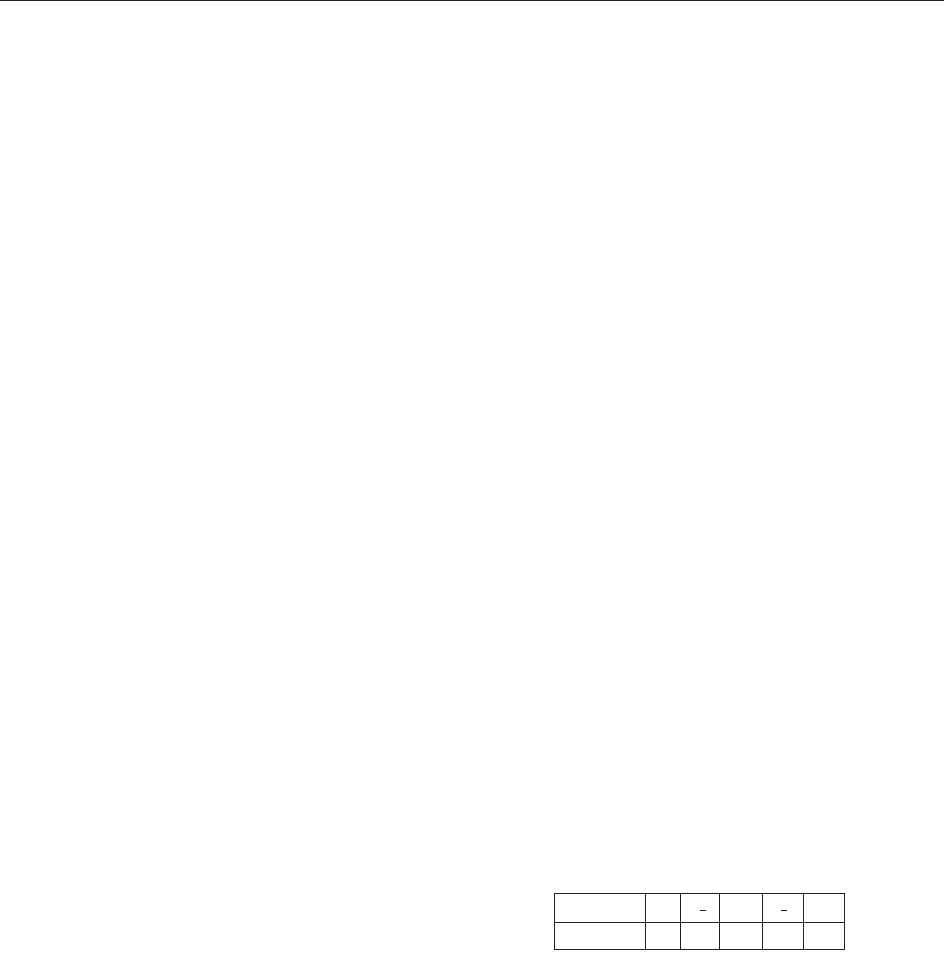
The N = 8 supergravity theory, found by Crem-
mer and Julia in 1978, is thus the largest possible
supergravity in D = 4 dimensions. It contains the
following ‘‘spin’’ range (allowing for a certain
imprecision of expression: for massless fields one
should really speak only of helicities)
In order to realize the automorphism SU(8) symme-
try, one has to consider the field strengths for the 28
spin-1 fields, separated into complex self-dual and
anti-self-dual parts in their antisymmetric Lorentz
indices. These complex field strengths can then be
endowed with a complex 28-dimensional represen-
tation of SU(8). The 70 scalars, on the other hand,
fit precisely into the four-index antisymmetric
self-dual representation of SU(8),
i
1
i
2
i
3
i
4
=
1=(4!)
i
1
i
2
i
3
i
4
j
1
j
2
j
3
j
4
j
1
j
2
j
3
j
4
. It is the use of the eight-
index epsilon tensor here that restricts the auto-
morphism group to SU(8) instead of U(8 ).
The SU(8) automorphism symmetry of N = 8
supergravity theory is linearly realized. It plays an
important role in another symmetry of this theory
which is highly nonlinear. This theory has a
N = 8 supergravity spins
Spin 2
3
2
1
1
2
0
Multiplicity 1 8 28 56 70
126 Supergravity

remarkable nonlinear E
7
symmetry. In fact, the 70
scalars form a nonlinear sigma model with the fields
taking their values in the coset space E
7
=SU(8) (of
dimension 133 63 = 70), where the SU(8) divisor
is the linearly realized automorphism group dis-
cussed above.
The extended supergravities point to another
aspect of supergravity theory: the existence of
higher-dimensional supergravities, from which the
extended theories in D = 4 spacetime can be derived
by Kaluza–Klein dim ensional reduct ion. If one
considers a D
0
dimensional massless theory in a
spacetime where d dimensions form a compact
d-torus, then the theory can be viewed as a D = D
0
d
dimensional theory in which the discrete Fourier
modes arising from the periodicity requirements on
the d-torus give rise to towers of equally spaced
massive Kaluza–Klein states, plus a massless sector
in D
0
d dimensions corresponding to the modes
with no dependence on the d-torus coo rdinates.
Importantly, N = 8 supergravity in four-
dimensional spacetime can be obtained in this way
from a supergravity theory that exists in 11 space-
time dimensions. Upon dimensional redu ction on a
7-torus to four dim ensions, one obtains N = 8, D = 4
supergravity at the massless level, plus an infinite
tower of massive N = 8 supermultiplets with central
charges so that their spin range extends only up to
spin 2. This D = 11 supergravity was in fact found
before the N = 8 theory by Cremmer, Julia, and
Scherk, with the details of the more complicated
N = 8, D = 4 theory being worked out via the
techniques of Kaluza–Klein dimensional reduction.
The fields of the D = 11 theory include an exotic
field type not encountered in D = 4 theories: the
bosonic fields of the theory comprise the graviton e
A
M
plus a three-index antisymmetric tensor gauge field
C
MNP
. Counting the number of propagating modes
of these fields for a given momentum value gives
44 þ 84 = 128 bosonic degrees of freedom. This
precisely balances the 128 fermionic degrees of
freedom coming from the D = 11 gravitino
M
.
Supergravity Effective Theories, Strings
and Branes
The hope for a cancellation of the ultraviolet
divergences in a supersymmetric theory of gravity
turned out to be ephemeral, although there is in fact
a postponement of the divergence onset until a
higher order in quantum field loops. There is
agreement that the nonmaximal supergravities
diverge at the three-loop order. For the
N = 8, D = 4 theory, the situation remains unclear,
but divergences are nonetheless expected to occur at
some finite loop order.
This persistence of nonrenormalizability in D = 4
supergravity theories is no longer seen as a disaster,
however, because these theories are now seen as
effective theories for the massless modes arising
from a deeper microscopic quantum theory. In
addition, the theories that are most directly con-
nected to this underlying quantum theory are,
surprisingly, the maximal supergravities in space-
time dimensi ons 10 and 11. D = 11 supergravity can
be dimensionally reduced on a 1-torus (i.e., a circle)
to D = 10 where the massless sector yields type IIA
supergravity theory. This theory is the effective
theory for a consistent quantum theory of type IIA
superstrings in D = 10. Theories of relativistic
strings (i.e., one-dimensional extended objects)
have strikingly different properties from theories of
point particles. In particular, the spread-out nature
of the interactions leads to a damping out of the
quantum field theory divergences, while the under-
lying supers ymmetry causes a cancellation of other
infinities that could have arisen owing to the two-
dimensional nature of the string world sheets. This
gives, for the first time, a perturbatively well -defined
quantum theory including gravity.
In addition to the type IIA theory, there are four
other consistent superstring theories in D = 10, and
these are in turn related to various D = 10 super-
gravity effective theories for the massless modes:
type IIB, E
8
E
8
heterotic, SO(32) heterotic, and
SO(32) type I. Remarkably, the maximal D = 11
supergravity enters into this picture as well, as a
consequence of a pattern of duality symmetries that
have been found among the superstring theories.
The dualities of string theory are directly related
to the nonlinear symmetries of the dimensionally
reduced supergravities in D = 4. The string quantum
corrections do not respect the E
7
symmetry of the
classical N = 8 theory, but they do respect a discrete
subgroup of this symmetry in which the E
7
group
elements are required to take integer values: E
7
(Z).
This quantum-level restriction to a discrete sub-
group can be seen from another phenomenon
characteristic of superstring theories: the existence
of ‘‘electric’’ and ‘‘magnetic’’ brane solutions. The
antisymmetric-tensor (or ‘‘form’’) fields of the
higher-dimensional supergravities natural ly give rise
to soliton ic solutions in which p þ 1 dimensions
form a flat Poincare´ invariant subspace. This can be
interpreted as the world volume of an infinite
p-brane extended object. In the D = 11 supergravity
theory, the branes that emerge in this way are a
2-brane and a 5-brane. The three-dimensional world
volume of the 2-brane naturally couples to the
Supergravity 127

3-form field C
MNP
, just as an ordinary Maxwell
vector field couples to the one-dimensional world
line of a point particle (or 0-brane). The 2-bran e is
thus naturally electrically charged with respect to
the 3-form field; its charge can be obtained, in a
direct generalization of the Maxwell case, from a
Gauss’ law integral of the field strength H
[4]
= dC
[3]
over a 7-sphere at spatial infinity in the eight
directions transverse to the brane worldvolume.
The 5-brane, on the other hand, has a magnetic
type charge; it is the 7-form dual to H
[4]
that is
integrated to give its charge. In addition to these
static infinite p-branes, the theory contains dynami-
cal finite-extent br anes as well, although for these
one generally does not have explicit solutions.
As one reduces a higher-dimensional supergravity
to lower and lower dimensions, there is a proliferation
of solitonic brane solutions of varying dimensionality,
and of both electric and magnetic charge types. In a
quantum theory context, these electrically and magne-
tically charged branes pair up in ways that must satisfy
a generalization of the Dirac quantization condition
for D = 4 electric and magnetic point particles. This
ends up requiring all the supergravity solitonic brane
charges to lie on a charge lattice. It is the requirement
that this discrete brane-charge lattice be respected that
restricts the classical supergravity nonlinear symmetry
groups to discrete duality subgroups.
The dualities relate brane solutions within a given
theory and also between different string theories.
They include transformations that invert the radii of
compactifying tori, giving a large–small compactifi-
cation scale duality. They also include transforma-
tions that invert the string coupling constant, thus
interchanging strong and weak coupling. The type
IIB theory, for example, is self-dual under strong–
weak coupling duality. In the case of the type IIA
theory, however, something remarkable happens.
The strong coupling limit of this theory turns out to
be related by duality, not to another string theory,
but to the maximal D = 11 supergravity. The role of
the Kaluza–Klein massive modes for the 11 to 10
reduction is played by an infinite tower of extremal
charged black holes.
Thus, even D = 11 supergravity theory has a role
to play in the effective theory of the underlying
quantum dynamics. This underlying theory has been
dubbed ‘‘M-theory.’’ It is still only partially under-
stood, but many of its most important properties are
presaged by the remarkable nonlinear structure of
the classical supergravities.
See also: Brane Construction of Gauge Theories; Brane
Worlds; Branes and Black Hole Statistical Mechanics;
Random Algebraic Geometry, Attractors and Flux Vacua;
Renormalization: General Theory; Spinors and Spin
Coefficients; Stability of Minkowski Space;
Supermanifolds; Superstring Theories;
Supersymmetric Particle Models; Symmetries
and Conservation Laws; Symmetries in Quantum
Field Theory: Algebraic Aspects.
Further Reading
Buchbinder JL and Kuzenko SM (1998) Ideas and Methods of
Supersymmetry and Supergravity. Bristol: IoP Publishing Ltd.
Stelle KS (1998) BPS branes in supergravity, Trieste 1987 School of
High-Energy Physics and Cosmology, arXiv:hep-th/9803116.
Van Nieuwenhuizen P (1981) Supergravity. Physics Reports 68:
189–398.
Wess J and Bagger J (1983) Supersymmetry and Supergravity.
Princeton: Princeton University Press.
128 Supermanifolds