
Francoise J.-P., Naber G.L., Tsun T.S. (editors) Encyclopedia of Mathematical Physics
Подождите немного. Документ загружается.


effects that occur as a result of a curved spacetime is
provided in Quant um Field Theory in Curved
Spacetime. Another subject, which is missing almost
completely, is perturbation theory. This subject has
been covered extensively in three well-known text-
books by Kapusta, Le Bellac, and Umezawa.
Observables and States
Following Heisenberg, we start from the basic
assumption that quantum theory can be formulated
in terms of observables which form an algebra A,that
is, a vector space with a (noncommutative) multi-
plication law. Although our emphasis on the abstract
algebraic structure may look strange, there is a
profound reason for starting out with an abstract
algebra of observables: as soon as one considers
systems with infinitely many degrees of freedom, one
encounters a possibility to realize the abstract elements
of the algebra A as operators on a Hilbert space in
various inequivalent ways. The famous equivalence
between the Heisenberg and the Schro¨ dinger picture
simply breaks down. States which are macroscopically
different (e.g., thermal equilibrium states for different
temperatures) give rise – in a natural way, which will
be discussed in the sequel – to unitarily inequivalent
representations of the abstract algebra of observables
A, while states which only differ microscopically can
be accommodated by density matrices within the same
Hilbert space. In other words, a physical state is
described macroscopically by specifying a representa-
tion, and microscopically by a density matrix in this
representation.
In a Lagrangian approach, the algebra of obser-
vables A may be thought of as being generated by
the underlying fields, currents, etc. This leads to the
so-called polynomial algebras. It is mathematically
convenient to assume that A is an algebra of
bounded operators, generated by the bounded
functions of the underlying quantum fields. If (x)
is any such field and if f 2S(R
dþ1
) is any real test
function with support in a bounded region of
spacetime, then the corresponding operator
Wðf Þ¼exp i
Z
dxfðxÞðxÞ
would be a typical element of A. The set of
operators {W(f ) j supp f O} will generate a sub-
algebra A(O)ofA. The underlying fields can be
recovered by taking (functional) derivatives, once a
representation of A on a Hilbert space is specified.
The spacetime symmetry of Minkowski space
manifests itself in the existence of a representation
: ð; xÞ7!
;x
2 AutðAÞ; ð ; xÞ2P
"
þ
of the (orthochronous) Poincare´ group P
"
þ
. Here
, x
is an automorphism of A, that is, a mapping
from A to A which prese rves the algebraic structure.
Once a Lorentz frame is fixed by choosing a timelike
vector e 2 V
þ
, the time evolution t 7!
1, te
will be
denoted by t 7!
t
.
For the free field, the group of automorphisms
(, x) 7!
, x
is defined by
;x
ðWðf ÞÞ :¼ Wfð
1
ð: xÞÞ
As before, f 2S(R
dþ1
) is a Schwarz function over
the Minkowski space R
dþ1
.
While the invariance of the equations of motion is
reflected in the existence of a representation of the
Poincare´ group in terms of automorphisms in the
Heisenberg picture, at least the invariance with
respect to Lorentz boosts is spontaneously broken
in the Schro¨ dinger picture for a thermal equilibrium
state.
The usual notions of vector states and density
matrices associated with a given Hilbert space
(usually Fock space) a re a priori not general enough
to cover all cases of interest in thermal field theory.
The following algebraic definition of a state sub-
stantially generalizes the notion of a stat e: A state !
is a positive, linear, and normalized functional, that
is, a linear map ! : A!C such that
!ða
aÞ0 and !ð1Þ¼1
Once a state ! is distinguished on physic al grounds,
the GNS reconstruction theorem provides a Hilbert
space H
!
and a representation
!
of A, that is, a
map from A to the set of bounded operators B(H
!
),
which preserves the algebraic relations.
It is instructive to consider the GNS representa-
tion of the Pauli matrices {
0
= 1,
1
,
2
,
3
}. Given a
state (a diagonal 2 2 matrix with positive entries
and tr = 1), the left regular representati on (a
construction well known from group theory)
ð
i
Þj
ffiffiffi
p
>¼j
i
ffiffiffi
p
>; i ¼ 0; 1; 2; 3
defines a reducible representation on C
4
, unless one
of the entries in the diagonal of is zero (which
corresponds to a pure state). In the latter case, the
GNS Hilbert space is C
2
. By construction,
<
ffiffiffi
p
j(
i
)j
ffiffiffi
p
> = tr
i
, i = 1, 2, 3.
Thermal Equilibrium
The variety of nonequilibrium states ranges from
mild perturbations of equilibrium states through
steady states, whose properties are governed
by external heat baths, or hydrodynamic flows
up to totally chaotic states which no longer
228 Thermal Quantum Field Theory

admit a description in terms of thermodynamic
notions. Buchholz et al. (2002) have initiated an
investigation of nonequilibrium states that are
locally (but not globally) close to thermal equili-
brium. Unfortunately, we will not be able to cover
this topic. Instead, we will concentrate on states
which deviate from a true equilibrium state only
microscopically.
Characterization of Thermal Equilibrium States
When the time evolution t 7!
t
2 Aut(A) is changed
by a local perturbation, which is slowl y switched on
and slowly switc hed off again, then an equilibrium
state ! returns to its original form at the end of this
procedure. This heuristic condition of adiabatic
invariance can be expressed by the stability
requirement
lim
t!1
Z
t
t
dt !ð½a;
t
ðbÞÞ ¼ 0 8a; b 2A ½1
In a pioniering work Haag, Kastler, and Trych-
Pohlmeyer showed that the characterization [1] of
an equilibrium state leads to a sharp mathematical
criterion, first encountered by Haag, Hugenholtz,
and Winnink and more implicitly by Kubo, Martin,
and Schwinger:
Definition 1 A state !
over A is called a KMS
state for some >0, if for all a, b 2A, there exists a
function F
a, b
which is continuous in the strip 0
=z and analytic and bounded in the open strip
0 < =z <, with boundary values given by
F
a;b
ðtÞ¼!
ða
t
ðbÞÞ and
F
a;b
ðt þ iÞ¼!
ð
t
ðbÞaÞ8t 2 R ½2
Before we start analyzing the properties of KMS
states, we should mention an alternative character-
ization of thermal equilibrium states: passivity. The
amount of work a cycle can perform when applied
to a moving thermodynamic equilibrium state is
bounded by the amount of work an ideal windmill
or turbine could perform; this property is called
semipassivity (Kuckert 2002): a state ! is called
semipassive (passive) if there is an ‘‘efficiency
bound’’ E 0(E = 0) such that
ðW
!
; H
!
W
!
ÞE ðW
!
; jP
!
jW
!
Þ
8W 2
!
ðAÞ
00
with W
1
= W
,[H
!
, W] 2
!
(A)
00
,and[P
!
, W] 2
!
(A)
00
. Here (H
!
, P
!
) denote the generators imple-
menting the spacetime translations in the GNS
representation (H
!
,
!
,
!
). Generalizing the notion
of complete passivity, the state ! is called completely
semipassive if all its finite tensorial powers are
semipassive with respect to one fixed efficiency
bound E. It has been shown by Kuckert (2002)
that a state is completely semipassive in all inertial
frames if and only if it is completely passive in some
inertial frame. The latter implies that ! is a KMS
state or a ground state (a result due to Pusz and
Woronowicz).
Let us now turn to properties of thermal
equilibrium states which are specific for relativistic
models. It was first recognized by Bros and
Buchholz (1994) that KMS states of a relativistic
theory have stronger analyticity properties in con-
figuration space than those imposed by the tradi-
tional KMS condition:
Definition 2 A KMS state !
satisfies the relativis-
tic KMS condition (Bros and Buchholz 1994) if there
exists a unit vector e in the forward light cone V
þ
such that for every pair of local elements a, b of A
the function F
a, b
F
a;b
ðx
1
; x
2
Þ¼!
ð
x
1
ðaÞ
x
2
ðbÞÞ
extends to an analytic function in the tube domain
T
e=2
T
e=2
, where T
e=2
= {z 2 C j=z 2 V
þ
\
(e=2 V
þ
)}.
The relativistic KMS condition can be understood
as a remnant of the relativistic spectrum condition in
the vacuum sector. It has been rigorously established
(Bros and Bruchholz 1994) for the KMS states
constructed by Buchholz and Junglas (1989) and by
CGe´rard and the author for the P()
2
model. In the
thermal Wightman framework (Bros and Buchholz
1996) it has been shown that the relativistic KMS
condition implies existence of model-independent
analyticity properties of thermal n-point functions.
These properties also appear in perturbative compu-
tations of the thermal Wightman functions
(Steinmann 1995).
We now turn to the properties of the set of KMS
states. For given , the convex set S
of all KMS
states is known to form a simplex; the extreme
points in the set S
are called extremal KMS states.
As a consequence, the extremal states in S
can be
distinguished with the help of ‘‘classical’’ (central)
observables, that is, by observables which commute
with all other observables.
If ! is an extremal KMS state and is an
automorphism which commutes with the time
evolution t 7!
t
, then the state !
0
defined by
!
0
ðaÞ : ¼ !ððaÞÞ; a 2A
is again an extremal KMS state to the same
parameter values. If !
0
6¼!, one says that the
symmetry is spontaneously broken.
Thermal Quantum Field Theory 229

Lorentz invariance with respect to boosts is
always broken by a KMS state, since the KMS
condition distinguishes a rest frame. A KMS state
might also break spatial translation or rotation
invariance. However, by averaging over the different
configurations one can usually construct a transla-
tion- and rotation-invariant state. The situation is
drastically different with respect to supersymmetry.
Buchholz and Ojima (1997) have shown that super-
symmetry is broken in any thermal state and it is
impossible to proceed from it by ‘‘symmetrization’’
to states on which an action of supercharges can be
defined.
Existence of Thermal Equilibrium States
Buchholz and Junglas (1989) demonstrated that the
existence of KMS states can be guaranteed for a
large class of quantum field-theoretic models. The
basic assumption to be met concerns the phase-space
properties of the model. A generalized trace norm
(the so-called ‘‘nuclear norm’’) is used to estimate
the ‘‘number’’ of degrees of freedom in phase space.
The first step is to construction a subspace H()
of the vacuum Hilbert space H
vac.
, which represents
excitations of the vacuum strictly localized inside of
a bounded spacetime region
ˆ
O. Due to the strong
correlations present in the vacuum state of any
relativistic model, as a consequence of the Reeh–
Schliede r propert y (see the section ‘‘Analy ticity of n-
point funct ions’’) this is a delicate procedur e, which
involves the so-called ‘‘split property.’’ This prop erty
ensures that there exists a product vector in
vacuum Hilbert space H
vac.
such that
ð;
vac:
ðabÞÞ¼!
vac:
ðaÞ!
vac:
ðbÞ
8a 2 AðOÞ; b 2Að
^
OÞ
c
½3
Here O
ˆ
O denotes a slightly smaller open space-
time region (such that the closure
O is inside the
interior of
ˆ
O) and A(
ˆ
O)
c
:= {A 2Aj[A, B] = 0 8B 2
A(
ˆ
O)}. The existence of a product vector can be
ensured if the nuclear norm satisfies some mild
bounds which are expected to hold in all models of
physical interest. Given a product vector which
satisfies [3], the sought after subspace is
HðÞ:¼
vac:
ðAðOÞÞ
00
vac:
The crucial step in the proof of ex istence of KMS
states is to show that
tr EðÞe
H
EðÞ < 1 for >0
if the nuclearity condition holds. Here E() denotes
the projection onto the subspace H() representing
localized excitat ions and H denotes the Hamiltonian
in the vacuum representation
vac.
. Next it is shown
that the function
t 7!!
;
ða
t
ðbÞÞ
¼
1
Z
tr EðÞe
H
EðÞ
vac:
ða
t
ðbÞÞ
allows an analytic extension to a strip of width
which satisfies the KMS boundary condition [2] for
jtj <if a, b 2A(O
) and O
þ te Ofor jtj <.In
the final step, Buchholz and Junglas were able to
demonstrate that bounds on the nuclear norm are
even sufficient to control the thermodynamic limit.
Given a thermal field theory, a slight variation of
the method used by Buchholz and Junglas allows
one to construct a KMS state for a new temperature
(Ja¨ kel 2004), that is, to change the temperature of a
thermal state.
Thermal Representations
Given a KMS state !
, the GNS construction gives
rise to a Hilbert space H
and a representation
,
called a thermal representation, of A. The algebra
R
:=
(A)
00
possesses a cyclic (due to the GNS
construction) and separating (due to the KMS
condition) vector
such that
!
ðaÞ¼
;
ðaÞ
8a 2A
The KMS condition implies that !
is invariant
under time translations, that is, !
t
= !
for all
t 2 R. Thus,
UðtÞ
ðaÞ
¼
t
ðaÞðÞ
; a 2A
defines a strongly continuous unitary group
{U(t)}
t2R
implementing the time evolution in the
representation
. By Stone’s theorem there exists a
self-adjoint generator L such that
UðtÞ¼e
iLt
; t 2 R ½4
For 0 <1, the Liouville operator L is not
bounded from below; its spectrum is symmetric and
consists typically of the whole real line. However,
the negative part of L is ‘‘suppressed’’ with respect
to the algebra of observables R
:=
(A)
00
in the
following sense ( Haag 1992): let 1
]1,]
be the
spectral projection of L for the interval ]1, ]
Sp(L), then
k1
1;
A
ke
kAk8A 2R
We now turn to structural aspects which are
characteristic for a relativistic model, na mely the
existence of strong spatial correlations and the
connection between the decay of these correlations
and the spectral properties of the Liouville operato r.
230 Thermal Quantum Field Theory

Let !
be a state, which satisf ies the relativistic
KMS condition. It follows (using a theorem of
Glaser) that for a 2Athe function
a
: R
4
!H
,
x 7!
x
ðaÞðÞ
can be analytically continued from the real axis into
the domain T
e=2
such that it is weakly continuous
for =z & 0. If the usual additivity assumption
[
i
O
i
= O)_
i
R
(O
i
) = R
(O) for the local von
Neumann algebras holds, then
H
¼
AðOÞðÞ
½5
for any open spacetime region OR
dþ1
. Junglas
has shown that the thermal Reeh–Schlieder property
[5] follows as well from the standard KMS condi-
tion, if !
is locally normal with respect to the
vacuum representation .
The decay of spatial correlations depends on
infrared properties of the model, and the essential
ingredients for the following cluster theorem are the
continuity properties of the spectrum of L ne ar zero.
Theorem 3 Let
denote the unique (up to a
phase) normalized eigenvector with eigenvalue {0} of
the Liouvillean L and let P
þ
denote the projection
onto the strictly positive part of the spectrum of L.
Assume that there exist positive constants m > 0
and C
1
(O) > 0 such that
ke
L
P
þ
ðaÞ
k
C
1
ðOÞ
m
kak8a 2 AðOÞ
Here OR
dþ1
is an ope n and bounded spacetime
region. Now consider two spacelike separated
spacetime regions O
1
, O
2
, which can be embedded
into O by translation and such that O
1
þ e
O
0
2
, >>. then, for a 2A(O
1
) and b 2A(O
2
),
j!
ðbaÞ!
ðbÞ!
ðaÞj C
2
2m
kakkbk
The constant C
2
(, O) 2 R
þ
may depend on the
temperature
1
and the size of the region O but is
independent of , a, and b.
From explicit calculations one expects that
m = 1=2 for free massless bosons in 3 þ 1 spacetime
dimensions. Consequently, the exponent given on
the right-hand side is optimal since it is well known
that in this case the correlations decay only like
1
.
A description of thermal representations would be
inadequate without pointing out one of the deepest
connections between pure mathematics and physics
that emerged in the last century: consider a von
Neumann algebra R which possesses a cyclic and
separating vector . Then polar deco mposition of
the closeable operator S : A 7!A
, A 2R, pro-
vides an antiunitary operator J (the modular
conjugation) and a self-adjoint operator
1=2
. The
connection to physics was established independently
by Takesaki and Winnink, showing that the pair
(R, ) satisfies the KMS condition for = 1, if one
sets
t
(A) =
it
A
it
for A 2R.
Taking advantage of the Reeh–Schlieder property
[5], one can associate modular objects to certain
spacetime regions O. In general, a physical inter-
pretation of these modular objects is missing. But for
two-dimensional thermal models, which factorize in
light-cone coordinates, the modular group corre-
sponding to the algebra of a spacelike wedge admits
a simple description: at larg e distances (compared to
) from the boundary, the flow pattern is essentially
the same as time translations. These are results due
to Borchers and Yngvason (1999).
Analyticity Properties of n-Point Functions
The correlation functions describe the full physical
content of the theory: all observable quantities can
in principle be derived from them. This is so because
according to the Wightman reconstruction theorem
(which is closely related to the GNS construction)
knowledge of the correlation functions allows the
reconstruction of the full representation of the field
algebra. The Wightman distributions {W
(n)
}
n2N
,
W
ðnÞ
ðt
2
t
1
; x
2
x
1
; ...; t
n
t
n1
; x
n
x
n1
Þ
:¼ð
;
ðt
1
; x
1
Þ
ðt
n
; x
n
Þ
Þ½6
where
(W(f )) =: exp(i
R
dt dxf(t, x)
(t, x)), satisfy
a number of key properties: locality, positivity,
Poincare´ covariance, and temperedness. These prop-
erties have been formulated for thermal field by Bros
and Buchholz (1996), and this section is entirely
based on their work.
The relativistic KMS condition implies that the
Wightman distributions {W
(n)
}
n2N
of a translation-
invariant equilibrium state admit in the correspond-
ing set of spacetime variables (t
2
t
1
, x
2
x
1
), ...,
(t
n
t
n1
, x
n
x
n1
) an analytic continuation into
the union of domains
ð
1
T
e
Þð
n1
T
e
Þ
for
i
> 0, i = 1, ..., n 1and
P
n1
i = 1
i
= 1. The
tube domains T
e
were specified in Definition 2.
For !1, the tube T
e
tends to the vacuum tube
T
vac.
= R
dþ1
þ iV
þ
; thus, one recovers the spectrum
condition for the vacuum expectation values.
Let us now turn to the Fourier transformed
Wightman correlat ion functions. Translation invar-
iance implies
e
W
ðnÞ
ð
1
; p
1
; ...;
n
; p
n
Þ ð
1
þþ
n
Þðp
1
þþp
n
Þ
Thermal Quantum Field Theory 231

The Wightman distribution
e
W
(n)
satisfies on the
linear manifold (
1
, p
1
) þþ(
n
, p
n
) = 0 the KMS
relation in the energy variables: for any pair of
multi-indices (I, J) the identity
e
W
ðnÞ
ðJ; IÞ¼e
I
e
W
ðnÞ
ðI; JÞ
holds, where
e
W
(n)
(J, I) is an abbreviation for
e
W
(n)
({p
i
}
i2I
,{p
j
}
j2J
)and
I
=
P
i2I
i
.
We now specialize to the two-point function W
(2)
.
The corresponding commutation function C(x )is
given by
Cðx
1
x
2
Þ¼W
ðnÞ
ðx
1
; x
2
ÞW
ð2Þ
ðx
2
; x
1
Þ
Locality implies that supp C
V
þ
[ V
. The
retarded and the advanced propagator r and a,
formally given by
rðxÞ¼iðx
ÞCðxÞ; að xÞ¼iðx
ÞCðxÞ
satisfy the relation
r a ¼iC
which corresponds to a partition of the support of
C in its convex components: supp r
V
þ
and
supp a
V
. For the free scalar field of mass m
the commutator function is
C
ðmÞ
ðxÞ¼
1
ð2Þ
2
Z
R
4
dp e
ipx
~
C
ðmÞ
ðpÞ
with
~
C
ðmÞ
ðpÞ¼
1
2
sgnðÞð
2
p
2
m
2
Þ
and subsequently the retarded and advanced propa-
gators r
(m)
and a
(m)
are structural funct ions of the
field algebra, which are determined by the c-number
commutation relations of the fields. Thus, they are
independent of the temperature, in contrast to the
two-point function:
~
W
ð2Þ
ðpÞ¼
~
C
ðmÞ
ðpÞ
1 e
½7
Let now
˜
(p) be the Fourier transform of the time-
ordered function (x). The relation
~ðp Þ¼
i
~
rðpÞþi
~
aðpÞe
1 e
shows that
˜
(p) and i
~
r(p) only ‘‘coincide up to an
exponential tail’’ at very high energies (Bros and
Buchholz 1996).
Particle Aspects
The condition of locality (together with the relati-
vistic KMS condition) leads to strong constraints on
the general form of the thermal two-point functions
that allow one to apply the techniques of the Jost–
Lehmann–Dyson representation. As has been shown
by Bros and Buchholz (1996), the interacting two-
point function W
can be represented in the form
W
ðt; xÞ¼
Z
1
0
dm D
ðx; mÞW
ð2Þ
ðt; x; mÞ
Here D
(x, m) is a distribution in x, m which is
symmetric in x, and
W
ð2Þ
ðt; x; mÞ¼ð2Þ
1
Z
ddp e
iðtpxÞ
~
W
ð2Þ
ð;pÞ
is the two-point correlation function of the free
thermal field of mass m. In contrast to the vacuum
case, the damping factors D
(x, m) depend in a
nontrivial way on the spatial variables x. The
damping factors describe the dissipative effects of
the thermal system on the propagation of sharply
localized excitations. Bros and Buchholz suggested
that the damping factor D
(x, m) can be decom-
posed into a discrete and an absolute continuous
part
D
ðx; mÞ¼ðm m
0
ÞD
;d
ðxÞþD
;c
ðx; mÞ
and that the -contribution in the damping factors is
due to stable constituent particles of mass m
0
out of
which the thermal states are formed, whereas the
collective quasiparticle-like excitations only contri-
bute to the continuous part of the damping factors
(Bros and Buchholz 1996).
In the case of spontaneously brok en internal
symmetries Bros and Buchholz (1998) have shown
that the damping facto rs D
(x, m) which appear in
the representation of current-field correlations
functions
ð
; j
0
ðt; xÞ
ð0; 0Þ
Þ
¼
Z
1
0
dm D
þ
ðx; mÞ@
t
W
ð2Þ
ðt; x; mÞ
þD
ðx; mÞW
ð2Þ
ðt; x; mÞ
indeed contain a discrete (in the sense of measures)
zero-mass contribution and are slowly decreasing in
jxj for small values of m. Thus, these damping
factors coincide locally with the Ka¨lle´n–Lehmann
weights appearing in the case of spontaneous
symmetry breaking in the vacuum sector (Bros and
Buchholz 1998). It is easily seen in examples that
there is no sharp energy–momentum dispe rsion law
for the Goldstone particles. Thus, the Ka¨ lle´n–
Lehmann representation is better suited than Fourier
transformation to uncover the particle aspects of
thermal equilibrium states.
232 Thermal Quantum Field Theory

Models of Thermal Field Theory
In the simplest case, the classical Lagrangian density
of the so-called P()
2
models is given by
L¼ð@
Þð@
Þm
2
2
4
4
½8
Here ( t, x) denotes a real scalar field over space-
time. The construction of the corresponding quan-
tized thermal field presented in this section (Ge´rard
and Ja¨ kel 2005) is based on the original ideas of
Høegh-Krohn (1974).
Free Fields
Let h
m
denote the L
2
-closure of C
1
0
(R) with respect to
the norm kf k= (f ,(1=2)f ), where (k) =
ffiffiffiffiffiffiffiffiffiffiffiffiffiffiffiffiffi
k
2
þ m
2
p
denotes the one-particle energy for a single neutral
scalar boson and the scalar product is the usual
L
2
-scalar product. The subspaces associated to a
double cone O are given by
h
m
ðOÞ :¼fh 2 h
m
jsupp <h; supp
1
=h Og
where O denotes the basis of the double cone O.
The corresponding free quantum field is described by
the Weyl algebra W(h
m
):= {W(f ) jf 2 h
m
}, together
withthetimeevolution{
t
}
t2R
,
t
ðWðf ÞÞ ¼ Wðe
it
f Þ; f 2 h
m
If m > 0, the KMS condition allows just one unique
(quasifree) (
, )-KMS state:
!
ðWðf ÞÞ :¼ e
ð1=4Þðf ;ð1þ2Þf Þ
m
;:¼ðe
1Þ
1
The GNS representation associated to the pair
(W(h
m
), !
) is the well-known Araki–Woods repre-
sentation, given by
H
AW
:¼ h
m
h
m
;
AW
:¼
F
;
AW
ðWðhÞÞ :¼ W
F
ð1 þ Þ
1=2
h
1=2
h
; h 2 h
m
Here h
m
is the Hilbert space conjugate to h
m
, W
F
(.)
denotes the usual Weyl operator on the Foc k space
(h
m
h
m
) and
F
2 (h
m
h
m
) is the Fock
vacuum. The Liouvillean L
AW
(see [4]) can be
identified with d( ).
The local von Neumann algebra generated by
{
AW
(W(h)) jh 2 h
m
(O)} is denoted by R
AW
(O). The
algebra of observables for the free quantum field
(and, as we will see, the P()
2
model) is the norm
closure
A :¼
[
OR
2
R
AW
ðOÞ
C
of the local von Neumann algebras.
The Thermal P()
2
Model
In 1 þ 1 spacetime dimensions Wick ordering is
sufficient to eliminate the UV divergences of poly-
nomial interactions. As it turns out, the leading
order in the UV divergences is independent of the
temperature (in agreement with the results found in
Kopper et al. (2001)). Thus, it is a matter of
convenience whether one uses the thermal covar-
iance function C
,
C
ðh
1
; h
2
Þ :¼ h
1
;
ð1 þ e
Þ
2ð1 e
Þ
h
2
L
2
ðRÞ
h
1
; h
2
2SðR Þ
or the vacuum covariance function C
vac.
to define
the Wick ordering:
:ðf Þ
n
:
C
¼
X
½n=2
m¼0
n!
m!ðn 2m!Þ
ðf Þ
n2m
1
2
Cðf ; f Þ
m
Now let P() be a real-valued polynomial, which is
bounded from below. Then Euclidean techniques
can be used to define the operator sum
H
l
:¼ L
AW
þ
Z
l
l
:Pð
ðxÞÞ :
C
dx
in the Araki–Woods representation and to show that
H
l
is essentially self-adjoint Ge´rard and Ja¨ kel (2005).
Thus, (the closure of) H
l
can be used to define a
perturbed time evolution t 7!
l
t
on A and the vector
l
:¼
e
ð=2ÞH
l
AW
ke
ð=2ÞH
l
AW
k
induces a KMS state !
l
for the dynamical system
(
AW
(A)
00
,
l
).
A finite prop agation speed argument (using
Trotter’s product formula) shows that
l
t
ðAÞ :¼ e
itH
l
Ae
itH
l
; t 2 R ½9
is independent of l for A 2R
AW
(O), t 2 R fixed and
l sufficiently large. Thus, there exists a limiting
dynamics such that
lim
l!1
k
l
t
ðAÞ
t
ðAÞk ¼ 0 ½10
for all A 2R
AW
(O), O bounded. This norm conver-
gence extends to the norm closure A of the local von
Neumann algebras.
The existence of weak
limit points (which are
states) of the (generalized) sequence {!
l
}
l > 0
is a
consequence of the Banach–Alaoglu theorem. The
fact that all limit states satisfy the KMS condition
with respect to the pair (A, ) follows from [10].To
Thermal Quantum Field Theory 233

prove that the sequence {!
l
}
l>0
has only one
accumulation point,
!
¼ lim
l!1
!
l
½11
is more delicate. Following Høegh-Krohn, Nelson
symmetry is used in Ge´rard and Ja¨ kel (2005) to
relate the interacting thermal theory on the real line
to the P()
2
model on the circle S
1
of length at
temperature 0. The existence of the limit [11] then
follows from the uniqueness of the vacuum state on
the circle. The relativistic KMS condition can be
derived by Nelson symmetry as well, using the fact
that the discrete spectrum of the model on the circle
satisfies the spectrum condition. Since the limit [11]
exists on the norm closure A of the weakly closed
local algebras, it follows from a result of Takesaki
and Winnink that !
is locally normal with respect
to the Arak i–Woods representation (which itself is
locally normal with respect to the Fock representa-
tion). Consequently,
R
ðOÞ :¼
ðAðOÞÞ
00
ffiR
AW
ðOÞ; O bounded
that is, R
(O) is (isomorphic to) the unique
hyperfinite factor of type III
1
. Moreover, the local
Fock property implies that the split property holds.
Perturbation Theory
Steinmann (1995) has shown that perturbative expan-
sions for the Wightman distributions of the :
4
:
4
model
can be derived directly in the thermodynamic limit,
using as only inputs the equations of motion and the
(thermal) Wightman axioms. The result can be
represented as a sum over generalized Feynman graphs.
The method consists in solving the differential
equations for the correlation functions which follow
from the field equation, by a power series expansion
in the coupling constant, using the axiomatic
properties of the Wightman functions as subsidiary
conditions. The Wightman axioms are expected to
hold separately in each order of perturbation theory,
with the exception of the cluster property.
As expected, the UV renormalization can be
chosen to be temperature independent, that is, one
can use the same counterterms as in the vacuum
case. But the infrared divergencies are more severe,
they cannot be removed by minor adjustments of the
renormalization procedure. Various elaborate
resummation techniques have been proposed to (at
least partially) remove the infrared singularities.
Another approach has been pursued by Kopper et al.
(2001). They have investigated the perturbation expan-
sion of the :
4
:
4
model in the imaginary-time formal-
ism, using Wilson’s flow equations. The result is once
again that all correlation functions become ultraviolet-
finite in all orders of the perturbation expansion, once
the theory has been renormalized at zero temperature
by usual renormalization prescriptions.
Asymptotic Dynamics of Thermal Fields
Timelike asymptotic properties of thermal correlation
functions cannot be interpreted in terms of free fields
due to persistent dissipative effects of a thermal
system. This well-known fact manifests itself in a
softened pole structure of the Green’s functions in
momentum space and is at the root of the failure of
the conventional approach to thermal perturbation
theory (Bros and Bruchholz 2002). In fact, assuming
a sharp dispersion law, one would be forced to
conclude that the scattering matrix is trivial (a
famous no-go theorem by Narnhofer et al. (1983)).
However, there seems to be a possibility to find an
effective theory, which is much simpler and still
reproduces the correct asymptotic behavior of the full
theory. Disregarding low-energy excitations, Bros and
Buchholz (2002) have shown that the -contributions
in the damping factors give rise to asymptotically
leading terms which have a rather simple form: they are
products of the thermal correlation function of a free
field and a damping factor describing the dissipative
effects of the model-dependent thermal background.
This result is based on the assumption that the
truncated n-point functions satisfy
lim
T!1
T
3ðn1Þ=2
W
ðnÞ
ðt
1
; x
1
; ...; t
n
; x
n
Þ
trunc:
¼ 0
>0
while the -cont ribution in the damping factors
exhibit, for large timelike separations T,aT
3=2
type behavior (in 3 þ 1 spacetime dimensions).
Bros and Buchholz (2002) have shown that the
asymptotically dominating parts of the correlation
functions can be interpreted in terms of quasifree
states acting on the algebra generated by a Hermi-
tian field
0
satisfying the commutation relations
½
0
ðt
1
; x
1
Þ;
0
ðt
2
; x
2
Þ
¼
m
0
ðt
1
t
2
; x
1
; x
2
ÞZðx
1
x
2
Þ
Here
m
0
is the usual commutator function of a free
scalar field of mass m
0
and Z is an operator-valued
distribution commuting with
0
such that !
ˆ
(Z(x
1
x
2
)) = D
,d
(x
1
x
2
). (Here !
ˆ
denotes a KMS state
for the algebra generated by
0
.) Intuitively speak-
ing, the field
0
carries an additional stochastic
degree of freedom, which manifests itself in a central
element that appears in the commutation relations
and couples to the thermal background.
As
0
describes the interacting field asymptoti-
cally, one may expect that
0
satisfies the field
234 Thermal Quantum Field Theory

equation of the interacting field in an asymptotic
sense. Buchholz and Bros (2002) have demonstrated
that this assumption allows one to derive an explicit
expression for the discrete part of the damping
factors D
,d
(x) in simple models.
See also: Axiomatic Quantum Field Theory; Quantum
Field Theory in Curved Spacetime; Scattering in
Relativistic Quantum Field Theory: The Analytic
Program; Tomita–Takesaki Modular Theory.
Further Reading
Borchers H-J and Yngvason J (1999) Modular groups of quantum
fields in thermal states. Journal of Mathematical Physics 40:
601–624.
Birke L and Fro¨ hlich J (2002) KMS, etc., Reviews in Mathema-
tical Physics 14: 829–871.
Bros J and Buchholz D (1994) Towards a relativistic KMS
condition. Nuclear Physics B 429: 291–318.
Bros J and Buchholz D (1996) Axiomatic analyticity properties
and representations of particles in thermal quantum field
theory. Annales de l’Institut Henri Poincare´ 64: 495–521.
Bros J and Buchholz D (1998) The unmasking of thermal
Goldstone bosons. Physical Review D 58: 125012-1.
Bros J and Buchholz D (2002) Asymptotic dynamics of thermal
quantum fields. Nuclear Physics B 627: 289–310.
Buchholz D and Junglas P (1989) On the existence of equilibrium
states in local quantum field theory. Communications in
Mathematical Physics 121: 255–270.
Buchholz D and Ojima I (1997) Spontaneous collapse of super-
symmetry. Nuclear Physics B 498: 228–242.
Buchholz D, Ojima I, and Roos H (2002) Thermodynamic
properties of non-equilibrium states in quantum field theory.
Annals of Physics 297: 219–242.
Cuniberti G, De Micheli E, and Viano GA (2001) Reconstructing the
thermal green functions at real times from those at imaginary
times. Communications in Mathematical Physics 216: 59–83.
Derezinski J, Jaksic V, and Pillet CA (2003) Perturbations of W
-
dynamics, Liouvilleans and KMS states. Reviews in
Mathematical Physics 15: 447–489.
Fro¨ hlich J (1975) The reconstruction of quantum fields from
Euclidean Green’s functions at arbitrary temperatures. Helve-
tica Physica Acta 48: 355–363.
Ge´rard C and Ja¨kel C (2005) Thermal quantum fields with
spatially cutoff interactions in 1 þ 1 space-time dimensions.
Journal of Functional Analysis 220: 157–213.
Ge´rard C and Ja¨kel C (2005) Thermal quantum fields without
cutoffs in 1 þ 1 space-time dimensions. Reviews in Mathema-
tical Physics 17: 113–173.
Haag R (1992) Local Quantum Physics. Berlin: Springer.
Høegh-Krohn R (1974) Relativistic quantum statistical mechanics
in two-dimensional space-time. Communications in Mathe-
matical Physics 38: 195–224.
Ja¨kel CD (2004) The relation between KMS states for different
temperatures. Annales de l’Institut Henri Poincare´ 5: 1–30.
Kopper C, Mu¨ ller VF, and Reisz T (2001) Temperature
independant renormalization of finite temperature field the-
ory. Annales de l’Institut Henri Poincare´ 2: 387–402.
Kuckert B (2002) Covariant thermodynamics of quantum
systems: passivity, semipassivity, and the Unruh effect. Annals
of Physics 295: 216–229.
Landsman NP and van Weert Ch G (1987) Real- and imaginary-
time field theory at finite temperature and density. Physics
Reports 145: 141–249.
Narnhofer H (1994) Entropy density for relativistic quantum field
theory. Reviews in Mathematical Physics 6: 1127–1145.
Narnhofer H, Requardt M, and Thirring W (1983) Quasiparticles
at finite temperature. Communications in Mathematical
Physics 92: 247–268.
Steinmann O (1995) Perturbative quantum field theory at positive
temperatures: an axiomatic approach. Communications in
Mathematical Physics 170: 405–415.
Thermohydraulics see Newtonian Fluids and Thermohydraulics
Toda Lattices
Y B Suris, Technische Universita
¨
tMu
¨
nchen,
Mu
¨
nchen, Germany
ª 2006 Elsevier Ltd. All rights reserved.
Lattices, or differential–difference equations, are a
special class of ordinary differe ntial equations, with
the dependent variable t playing the role of time and
an infinite number of dependent variables q
n
= q
n
(t)
numbered by integer indices n, characterized by a
translational invariance with respect to the shift
n !n þ 1. Due to this property, such equations are
well suited for descr iption of processes in
translationally symmetric systems like crystals. On
his search for lattice models admitting interesting
explicit solutions, M Toda discovered in 1967 the
lattice which nowadays carries his name:
€
q
n
¼ e
q
nþ1
q
n
e
q
n
q
n1
½1
Toda lattice is one of the most celebrated systems of
mathematical physics, and a large amount of
literature is devote d to it and to its various gen era-
lizations. Its most prominent property is ‘‘integr-
ability,’’ so that it is amenable to a rather complete
exact treatment; moreover, it can be regarded as one
of the basic models, illustrating all the relevant
Toda Lattices 235

paradigms, notions, methods, and results of the
theory of integrable systems (sometimes called the
theory of solitons). One has a rare possibility to read
the first-hand presentation of a large body of
relevant results, including the authentic story of the
original discovery, in Toda (1989) .
The Infinite Toda Lattice
Model
The classical infinite Toda lattice [1] describes a one-
dimensional chain of unit mass particles, each one
interacting with the nearest neighbors only, q
n
being
thedisplacementofthenth particle from equilibrium.
It can be treated within the Hamiltonian formalism
of the classical mechanics (with some care, because of
the infinite number of degrees of freedom). In this
framework, the second-order Newtonian equations
of motion [1] are replaced by the first-order
Hamiltonian ones, for the coordinates q
n
and
canonically conjugate momenta p
n
:
_
q
n
¼ p
n
;
_
p
n
¼ e
q
nþ1
q
n
e
q
n
q
n1
½2
The corresponding Hamilton function is
H
2
ðp; q Þ¼
1
2
X
n2Z
p
2
n
þ
X
n2Z
e
q
nþ1
q
n
1ðÞ½3
One can understand infinite sums here formally, or,
alternatively, one can impose suitable boundary condi-
tions, like q
nþ1
q
n
!0, p
n
!0asjnj!1 (usually
one requires decay faster than any degree of 1=jnj).
Multisoliton Solutions
M Toda found in 1967 a number of exact traveling
wave solutions of this system, including the 1-soliton
solution:
q
n
ðtÞ¼log
1 þ e
2ð
1
n
1
tþ
1
Þ
1 þ e
2ð
1
ðn1Þ
1
tþ
1
Þ
½4
or, equivalently,
e
q
nþ1
ðtÞq
n
ðtÞ
¼ 1 þ
2
1
cosh
2
ð
1
n
1
t þ
1
Þ
½5
where
1
> 0,
1
= sinh
1
,and
1
is an arbitrary
phase. Such a soliton moves with the velocity
v
1
=
1
=
1
(to the right, if v
1
>0, and to the left, if
v
1
<0). Note that the faster the soliton is, the larger its
amplitude. Multisoliton solutions were constructed in
1973 by R Hirota with the help of his ingenious
‘‘direct’’ (or bilinear) method. They can be written as
e
q
nþ1
ðtÞq
n
ðtÞ
¼
nþ1
ðtÞ
n1
ðtÞ
2
n
ðtÞ
½6
where, for an M-soliton solution,
n
(t)canbe
represented through the M M determinant depend-
ing on 2M parameters z
j
2 (1, 1) and c
j
2 R:
n
ðtÞ¼det
ij
þ
c
i
ðtÞc
j
ðtÞðz
i
z
j
Þ
nþ1
1 z
i
z
j
!
1i;jM
½7
where c
j
(t) = c
j
e
j
t
,
j
= (1=2)(z
1
j
z
j
). If one sets
z
j
= e
j
with
j
> 0, then
j
= sinh
j
, and one
can show that asymptotically both for t !1and
for t !þ1 the solution [6] looks like the sum of
well-separated solitons [4] with the velocities
v
j
=
j
=
j
and the respective phases
j
n
j
t þ
()
j
.
This is usually interpreted as a particle-like behavior
of solitons. One can show that the scattering of
solitons is factorized:
ðþÞ
j
ðÞ
j
¼
X
v
k
<v
j
log
1 z
j
z
k
z
j
z
k
X
v
k
>v
j
log
1 z
j
z
k
z
j
z
k
½8
which means that the phase shifts of individual
solitons can be interpreted as coming from the
pairwise interactions only.
Integrability
The infinite Toda lattice is completely integrable in
the sense of the classical Hamiltonian mechanics: it
admits an infinite number of functionally indepen-
dent integrals of motion in involution. This was
demonstrated in 1974 by M He´non. An instance of
these higher integrals of motion is given by
H
3
ðp; qÞ¼
1
3
X
n2Z
p
3
n
þ
X
n2Z
ðp
n
þ p
nþ1
Þe
q
nþ1
q
n
½9
Hamiltonian flows corresponding to the higher
integrals of motion (usually referred to as higher
Toda flows) form the ‘‘Toda lattice hierarchy.’’ A
beautiful approach to this hierarchy is based on the
Lax representation of the Toda lattice, discovered in
1974 independently by H Flaschka and S Manakov.
In the variables a
n
, b
n
, related to q
n
, p
n
by
a
n
¼ e
q
nþ1
q
n
; b
n
¼ p
n
½10
equations of motion of the Toda lattice [2] are
rewritten as
_
a
n
¼ a
n
ðb
nþ1
b
n
Þ;
_
b
n
¼ a
n
a
n1
½11
236 Toda Lattices
It turns out that eqns [11] are equivalent to the
operator equation
_
L ¼½L; A
þ
¼½A
; L½12
where L and A
are linear difference operators with
coefficients depending on a
n
, b
n
:
L ¼
X
n2Z
b
n
E
n;n
þ
X
n2Z
a
n
E
n;nþ1
þ
X
n2Z
E
nþ1;n
½13
A
þ
¼
X
n2Z
b
n
E
n;n
þ
X
n2Z
E
nþ1;n
A
¼
X
n2Z
a
n
E
n;nþ1
½14
Here difference operators are represented as infinite
matrices, E
m, n
being the matrix with the only
nonvanishing element equal to 1 in the position
(m, n). A diagonal similarity (gauge) transformation
of the matrix L leads to an equivalent Lax
representation of the Toda lattice:
_
L
0
¼½L
0
; A
0
½15
with
L
0
¼
X
n2Z
b
n
E
n;n
þ
X
n2Z
a
1=2
n
E
nþ1;n
þ E
n;nþ1
½16
A
0
¼
1
2
X
n2Z
a
1=2
n
E
nþ1;n
E
n;nþ1
½17
Being equivalent for the Toda lattice, these two Lax
representations ad mit nonequivalent generalizations
(see below). Note that the matrices A
in [14] may
be interpre ted as A
=
(L), wher e
stands for
the lower-triangular, resp., strictly upper-triangular
part. The commuting higher members of the Toda
lattice hierarchy (enumerated by s 2 N) are char-
acterized by the Lax equations of the form [12] with
the same Lax matrix L as in [13] and with
A
=
(L
s
). In the Lax representation [15], the
higher Toda flows are obtained by choosing
A
0
= skew(L
s
0
), where ‘‘skew’’ denotes the skew-
symmetric part (strictly lower-triangular part minus
strictly upper-triangular part) of the symmetric
matrix. The Hamilton functions of the higher flows
are obtained as H
s
tr(L
s
) = tr(L
s
0
).
Inverse Scattering
H Flaschka and S Manakov laid the Lax representa-
tion into the base of the application of the inverse-
scattering, or inverse-spectral, transformation
method (IST) to the infinite Toda lattice. It was the
first application of IST in the lattice context. The
matrix L
0
in [16] is symmetric tridiagonal, which
yields that the operator L
0
is second order and self-
adjoint. The direct and inverse-spectral problem for
L
0
= with such operators L
0
is well studied and
parallel, to a large extent, to the corre sponding
theory for second-order differential operators. In the
rapidly decaying case, the set of spectral data of the
operator L
0
, allo wing for a solut ion of the inverse
problem, consists of:
1. eigenvalues
j
= z
j
þ z
1
j
of the discrete spectrum,
with z
j
2 (1, 1);
2. normalizing coefficients
j
of the corresponding
eigenfunctions; and
3. reflection coefficient r(z)forjzj= 1, characterizing
the continuous spectrum = z þ z
1
2 [2, 2].
The solution of the inverse-spectral problem is given
in terms of the Riemann–Hilbert problem or its
variants, like the Gelfand–Levitan equation. Equa-
tion [12] means that the evolution of the operator L,
induced by the evolution of q
n
(t), p
n
(t) in virtue of
the Toda lattice equations [2], is ‘‘isospectral.’’ More
precisely, the discrete eigenvalues are integrals of
motion, while the evolution of other spectral data is
governed by simple linear equations:
z
j
¼ const:;
j
ðtÞ¼
j
ð0Þe
z
1
j
z
j
ðÞ
t
rðz; tÞ¼rðz; 0Þe
ðz
1
zÞt
½18
In particular, the multisoliton solutions correspond
to the reflectionless case r(z, t ) 0. The IST solution
of the initial-value problem for the infinite Toda
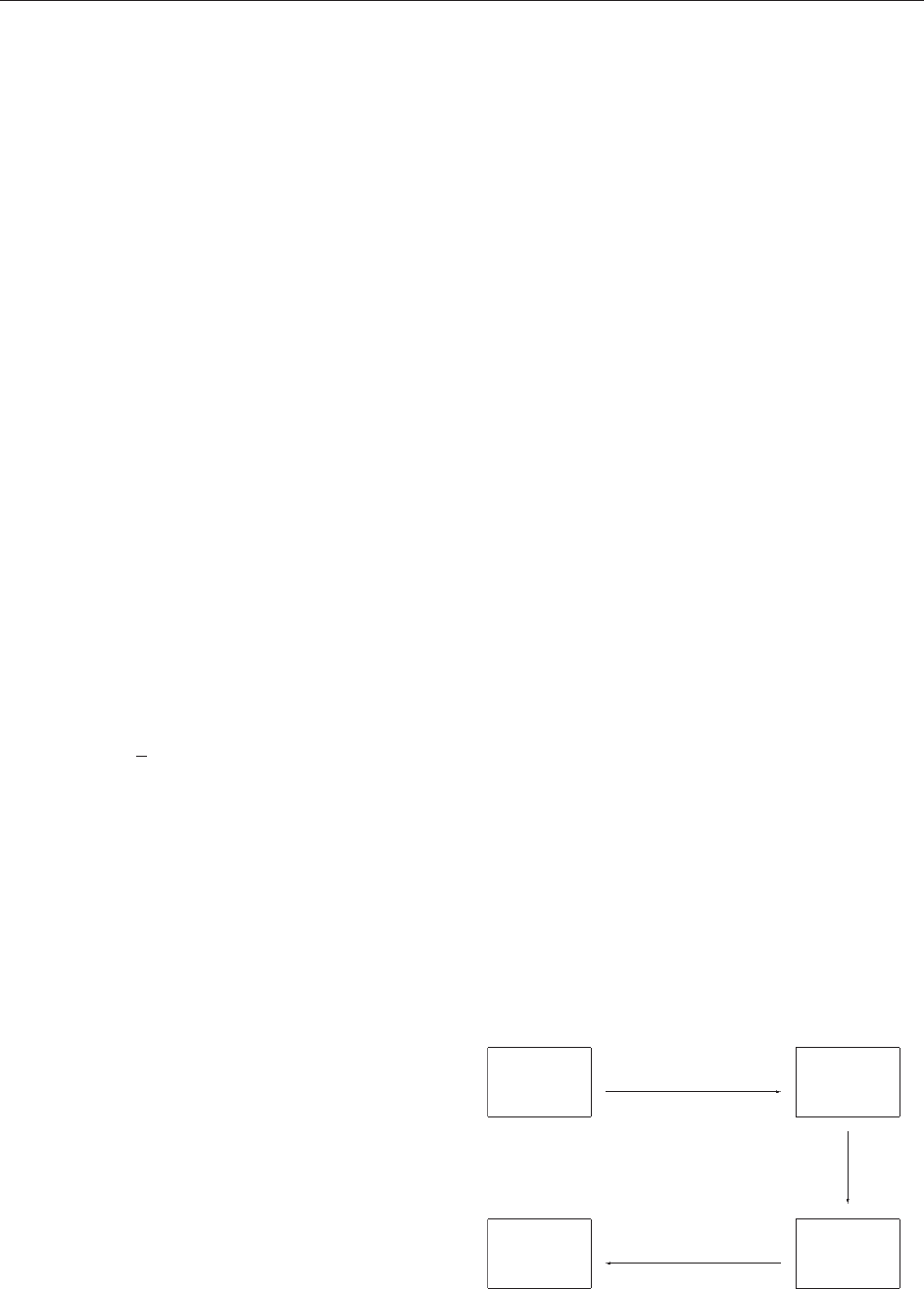
lattice can be schematically depicted as in Figure 1.
Bi-Hamiltonian Structure
The canonical Poisson bracket for the variables q
n
, p
n
turns in the Flasch ka–Manakov variables [10] into
fb
n
; a
n
g
1
¼a
n
; fa
n
; b
nþ1
g
1
¼a
n
½19
q
n
(0), p
n
(0)
Direct-spectral problem
z
j
, γ
j
(0), r (z, 0)
Linear
evolution
z
j
, γ
j
(t ), r (z, t )
Inverse-spectral problem
q
n
(t ), p
n
(t )
Figure 1 General scheme of the IST.
Toda Lattices 237