
Francoise J.-P., Naber G.L., Tsun T.S. (editors) Encyclopedia of Mathematical Physics
Подождите немного. Документ загружается.

stability subgroup H of
0
(the group of unbroken
symmetries in this ground state):
H ¼fg 2 G : Dð gÞ
0
¼
0
g½3
In terms of this subgroup, we can find a useful
characterization of the manifold M of degenerate
ground states. As noted above, for each g 2 G,
ˆ
U(g)j0i is also a ground state. However, these are
not all distinct, because clearly
ˆ
U(gh)j0i=
ˆ
U(g)j0i
for all h 2 H. Hence, the distinct ground states are
in one-to-one correspondence with the left cosets gH
of H in G,andM may be identified with the
quotient space G/H, the space of left cosets.
For example, suppose G is the rotation group
SO(3), and
ˆ
f belongs to the three-dimensional
vector representation. If f 6¼ 0 in the groun d state,
we may choose f
0
= (0, 0, v). Then, clearly,
H = SO(2), the group of rotations about the z-axis,
and M= SO(3 )=SO(2) = S
2
, the 2-sphere. It is useful
to think of M as the subset of the order-parameter
space comprising the possible expectation values
f = h
ˆ
i for the various degenerate ground states. For
example, in this case, M= {f: f
2
= v
2
}.
Defect Formation
It is often possible to characterize the dynamics at
finite temperature in terms of a function of the order
parameter, the effective potential V(), which is
necessarily invariant under G, and whose minima
define the equilibrium states. At low temperatures, it
has a form like V = (f
2
v
2
)
2
, whose minima
occur at nonzero values of f. But above the critical
temperature T
c
, the only minimum is at f = 0, so the
equilibrium state is symmetric under G. In the high-
temperature phase, there may be large fluctuations
in
ˆ
f, but its mean value will be zero.
Now, when the system is cooled through the
phase tra¨nsition,
ˆ
will acquire a nonzero expecta-
tion value, gradually approaching one of the
degenerate ground states characterized by a point
of M. But the choice of which one is unpredict-
able; the symmetry breaking is spontaneous.
Moreover, in a large system, there is no reason
why the same choice should be made everywhere.
For example, a ferromagnet cooling through its
Curie point may acquire a spontaneous magneti-
zation in differe nt direct ions in different parts of
the sample.
Of course, there is an energetic penalty to having
a spatially varying order parameter, so it will tend to
become more unifor m as the temperature is lowered.
But the question arises whether there may be any
topological obstruction to this process. It can
happen that if we choose points on M in a
continuous manner everywhere around the periph-
ery of some region, it is topologically impossible to
complete the process throughout its interior.
Continuity may require that there are points where
leaves the surface M. For example, if our
ferromagnet has two opposite possible directions of
easy magnetization, described by f
0
and f
0
, then
M consists essentially of these two points. Regions
where f f
0
and where f f
0
must be separated
by domain walls across which f varies smoothly
from one to the other.
Homotopy Groups
To classify the various possible types of defect, we
need to consider the homotopy groups of the
manifold M of degenerate ground states. In this
section, we briefly review the necessary definitions.
A path in M is a map : I !Mfrom the unit
interval I = [0, 1] R. We choose a base point m
0
2
M (which may be identified with
0
), and consider
loops in M, paths such that (0) = (1) = m
0
.We
say that two loops are homotopic, and write ,
if one can be continuously deformed into the other
within M, that is, if there exists a map : I
2
!M
such that
ð0; tÞ¼ðtÞ and ð1; tÞ¼ ðtÞ½4
for all t, and
ðs; 0Þ¼ðs; 1Þ¼m
0
½5
for all s. This is an equivalence relation. The set
1
(M) is the set of equivalence classes [] of loops
under this relation.
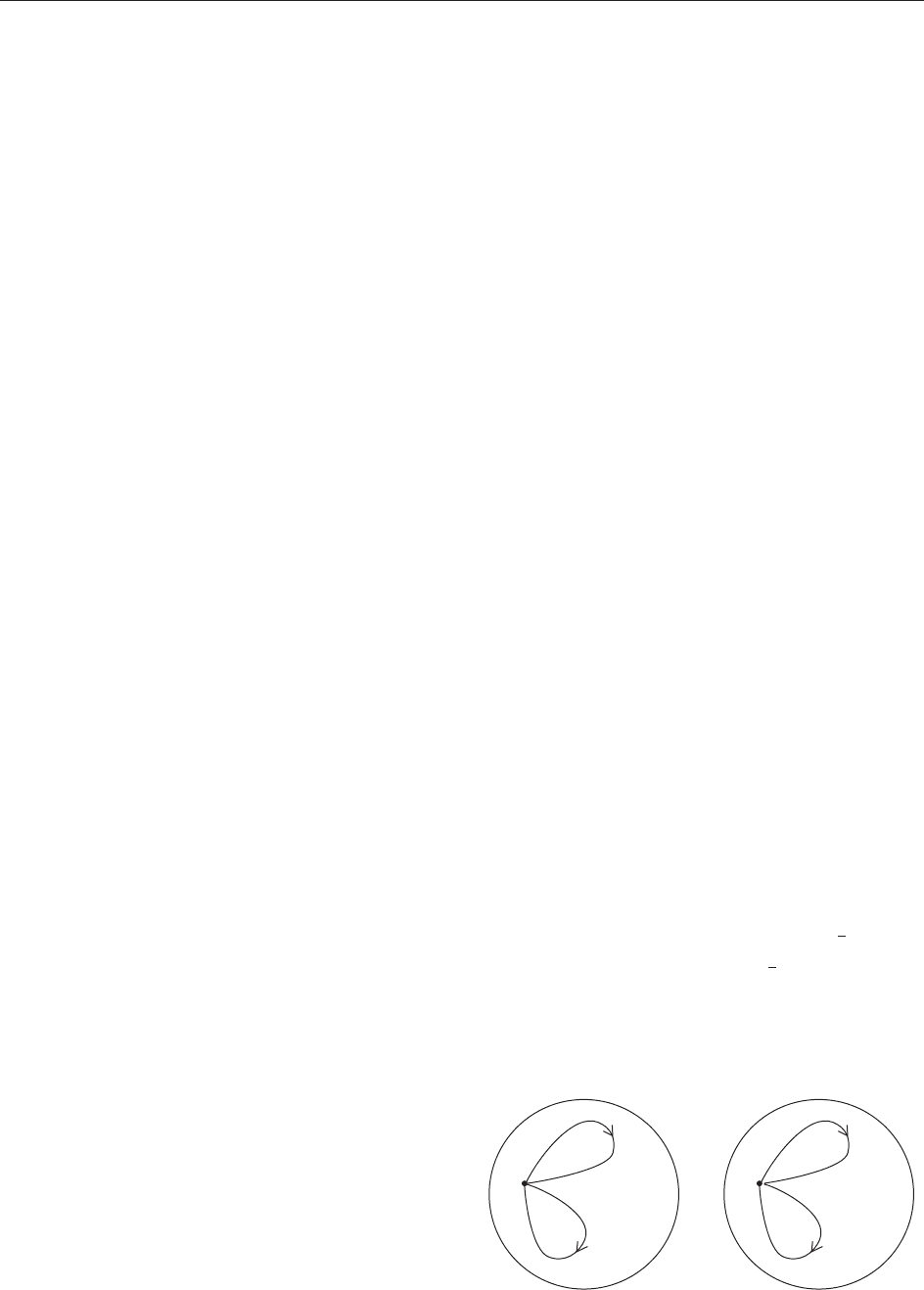
On the set of loops, we may define a product ,
comprising the loop followed by (see Figure 1).
Explicitly,
ð ÞðtÞ¼
ð2tÞ; 0 t
1
2
ð2t 1Þ;
1
2
< t 1
(
½6
It is easy to show that if
0
and
0
, then
0
0
. Hence, this defines a product on
1
(M),
by [][ ] = [ ]. So equipped,
1
(M) becomes the
φ
ψ
φψ
Figure 1 The product of loops.
258 Topological Defects and Their Homotopy Classification

fundamental group or first homotopy group of M.
Note that the identity is the equivalence class [
0
]of
the trivial loop with
0
(t) m
0
, while the inverse is
[]
1
= [
˜
], where the map
˜
is the reverse of
:
˜
(t) = (1 t).
Strictly speaking, we should write
1
(M, m
0
)in
place of
1
(M). However, for any path-connected
space, the groups
1
(M, m
0
)and
1
(M, m
0
0
)are
always isomorphic, and, more importantly, the same
is true for any coset space M= G=H,whereG is a
Lie group and H a closed subgroup. For a general
manifold M,
1
(M) is not necessarily abelian, but it
is so if M is a Lie group, or more generally a
Riemannian symmetric space. The space M is said to
be simply connected if
1
(M) = 0, the group compris-
ing only the identity element, 0 = {[
0
]}. (Although
1
(M) is not always abelian, it is conventional for
homotopy groups to use an additive notation and
represent the trivial group by 0 rather than 1.)
The nth homotopy group
n
(M) may be defined
similarly, as a set of equivalence classes of maps
: I
n
!Msuch that maps the entire boundary @I
n
to the base point m
0
. Two such maps are homotopic
( )ifthereexistsamap : I
nþ1
!Msuch that
ð0; tÞ¼ðtÞ and ð1; tÞ¼ ðtÞ½7
for all t = (t
1
, ..., t
n
), and, for each s 2 I , (s, t ) = m
0
for all t 2 @I
n
. The product is defined by
ð Þðt
1
; ...; t
n
Þ
¼
ð2t
1
; t
2
; ...; t
n
Þ; 0 t
1
1
2
ð2t
1
1; t
2
; ...; t
n
Þ;
1
2
< t
1
1
(
½8
The choic e of t
1
rather than any other t
j
is arbitrary;
all choices yield homotopic product maps. The
product again defines a product on
n
(M), which
thereby becom es a group, the nth homotopy group.
One new feature is that, for all n > 1,
n
(M)is
always abelian.
Note that since the entire boundary of I
n
is
mapped to a single point, it is possible to collapse it,
and talk instead about maps from the n-sphere S
n
to
M, taking one designated point to m
0
. The fact that
n
(M) is nontrivial indicates the existence in M of
closed n-surfaces that cannot be smoothly shrunk to
a point. In particular, it is worth noting that, for any n,
n
(S
n
) = Z, the additive group of integers, while
m
(S
n
) = 0 for all m < n.
A special case is n = 0. Here, S
0
comprises two
points only, and since one of them is always mapped
to m
0
, we really have to consider maps from a single
point to M, that is, points in M. Two points are
homotopic if they can be joined by a path in M.
Thus,
0
(M) may be identified with the set of path-
connected components of M. Note, however, that in
general no product can be defined on
0
(M), so
0
(M) should be called the zeroth homotopy set
(not group). There is an important exception,
however: if G is a Lie group, and G
0
its connected
subgroup (the subset of elements joined by paths to
the identity e), then
0
(M) may be identified with
the quotient group G=G
0
. Note, however, that this
group
0
(M) = G=G
0
is not necessarily abelian.
Classification of Defects
We now turn to the classification of defects by
means of homotopy groups. It will be useful to start
with simple specific examples in three-dimensional
space, R
3
.
First, suppose again that f belongs to the vector
representation of G = SO(3). Then M= SO(3)/
SO(2) = S
2
may be identified with the sphere
M= {f: f
2
= v
2
}in space. Consider a closed surface
S, an embedding of a 2-sphere S
2
in R
3
. Assume
that everywhere on S the field f (r)hasoneofthe
ground-state values. In other words, we have a map
f : S!M, from one 2-sphere to another. The map f
can be extended to a map from the interior of S to M
only if it belongs to the trivial homotopy class [f
0
] 2
2
(M), where
0
: I
2
!M:(t
1
, t
2
) 7!m
0
= eH.Inall
other cases, there must be at least one point where
f(r) = 0; this is a point defect. The second homotopy
group in this case is
2
(S
2
) = Z,sothepossible
point defects, or monopoles, are labeled by an integer
n 2 Z, the winding number. (An example of a map
with winding number n is (in spherical polars)
(r, , ’) 7!(v, , n’).)
More generally, point defects in R
d
are classified
by
d1
(M). A map from a closed (d 1)-
dimensional surface SR
d
to M can be extended
to the interior of S if and only if it belongs to the
trivial homotopy class [
0
] 2
d1
(M). If this is not
the case, there must be at least one point around
which (r) leaves the surface M, although in general
it is not required to vanish anywhere.
Second, take the case wher e is a single complex
field, and G is the phase symmetry group U(1). In
this case, H is the subgroup 1 = {1} G. Thus,
M= U(1)=1 = S
1
; this manifold may be identified
with the circle {: jj= v} in the order-parameter
space. Now consider a closed loop C in space, an
embedding of S
1
in R
3
(see Figure 2). Suppose that
on C, (r) takes one of the ground-state values,
say (r) = v exp [i(r)]. If S is some surface with
boundary C, then the map : C!M can be
extended to a map : S!Mif and only if it
belongs to the trivial homotopy class [
0
] 2
1
(M).
If it does not, then there must be at least one
point on S within C where = 0. Moreover, this
Topological Defects and Their Homotopy Classification 259
must be true of every surface S spanning C, so there
must be a curve passing through C along which
= 0. This is a linear defect, a string or vortex line.
In this case, the first homotopy group is
1
(S
1
) = Z,
so we see that the possible linear defects are
classified by an integer, the winding number n.An
example of a map with winding number n is
’ 7!ve
ni’
.
Again, this result can easily be generalized. Linear
defects in R
d
are classified by
d2
(M). If, on a
(d 2)-dimensional surface C, (r) takes values in
M, and if it does not belong to the trivial homotopy
class, there must be a linear defect threading
through C, around which leav es the surface M –
although again it need not necessarily vanish.
More generally yet, in the d-dimensional space R
d
,
defects of dimension p are classified by the homotopy
group
dp1
(M). For example, in three dimensions,
planar defects – domain walls – are classified by
0
(M).
The Exact Sequence
There are mathematical theorems that greatly
facilitate the computation of the homotopy group
of homogeneous spaces, of the form M= G=H.
We begin with the maps relating these spaces to
each other. There is a canonical injective homo-
morphism i : H ! G : h 7!h, and a canonical pro-
jection associating each element of G with its coset:
p : G !M: g 7!gH. Moreover, it is clear that the
image of i, namely the subgroup H, is also the kernel
of p, the inverse image p
1
m
0
of the distinguished
element m
0
= eH of M. These statements can be
summarized by saying that
1 ! H !
i
G !
p
M!1
is an exact sequence: the image of each map is the
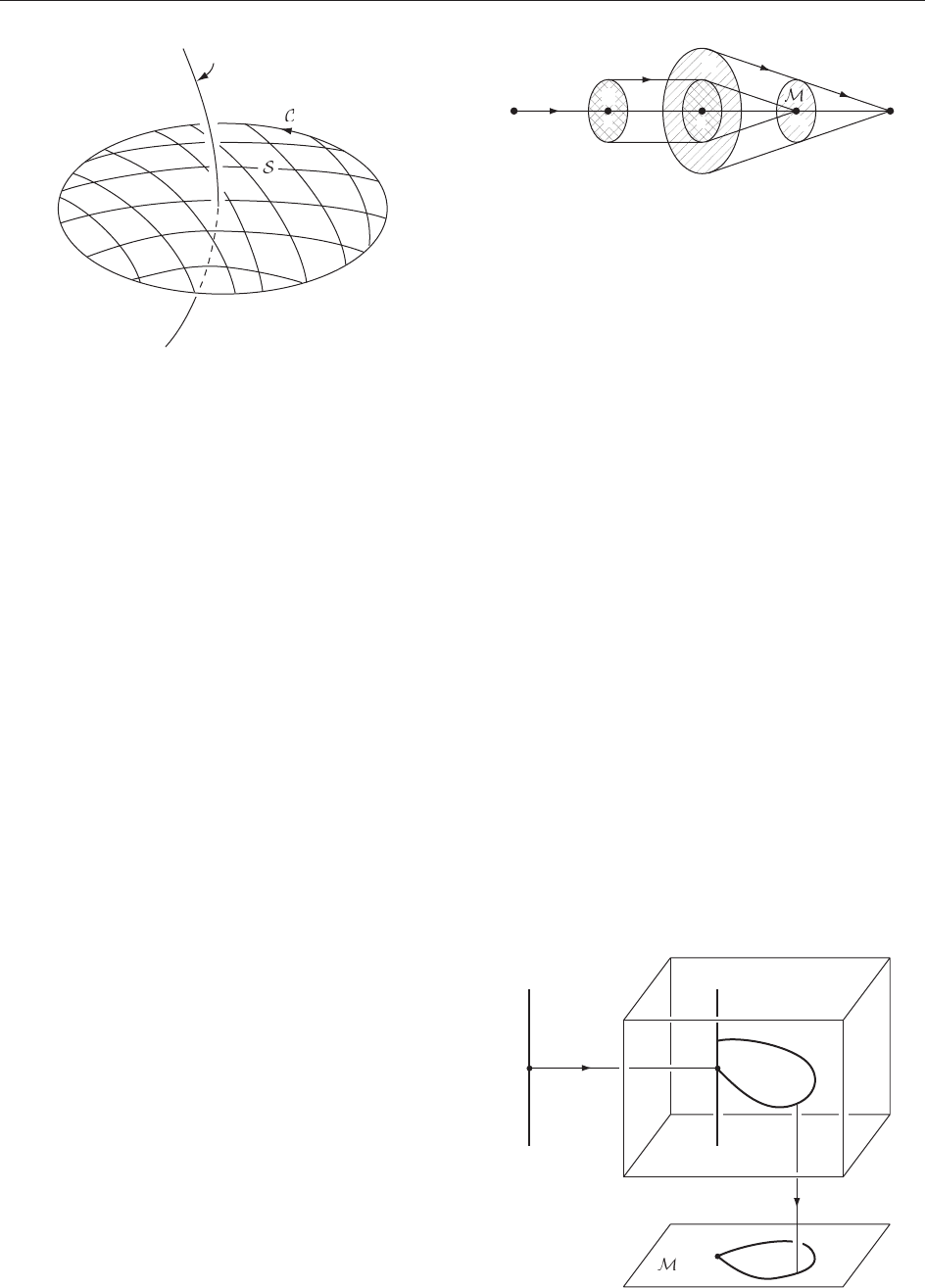
kernel of the following one (see Figure 3).
Next, we note that since any closed loops (or
n-surfaces) in H belongi ng to the same homotopy
class are also homotopic as loops (or n-surfaces) in
G, there is an induced homomorphism i
:
n
(H) !
n
(G). Similarly, homotopic loops or n-surfaces in G
project to homotopic loops or n-surfaces in M,so
there is an induced homomorphism p
:
n
(G) !
n
(M). Moreover, it is easy to see that although i
is
not necessarily injective and p
not necessarily
projective, it is true that the image of i
is the kernel
of p
. For example, any loop in G will be mapped to
a homotopically trivial loop in M if and only if it is
homotopic to the image of a loop in H.
In addition, there is a boundary map that
relates homotopy groups of different dimension:
@ :
nþ1
(M) !
n
(H). To see this, it is useful to
think of G as a fiber bundle with base space M and
fiber H. Now consi der a map :(I
nþ1
, @I
nþ1
) !
(M, m
0
). Since p is a projection, can always be
lifted to a map
ˆ
:(I
nþ1
, @I
nþ1
) ! (G, H), that is, we
can find a (nonunique) map
ˆ
such that = p
ˆ
(see Figure 4). However,
ˆ
does not necessarily map
the boundary to a single point; what is true is that
ˆ
must map the boundary to a subset of H, and since
topologically @I
nþ1
’ S
n
, this defines a map
˜
: S
n
! H.
If we allow to vary over some homotopy class
of maps, and
ˆ
to vary continuously, then
˜
will
e
e
G
H
i
p
m
0
1
1
Figure 3 An exact sequence.
H
G
e
e
i
m
0
φ (t )
φ
(t )
∧
p
Figure 4 Lift of a loop.
φ = 0
Figure 2 A linear defect.
260 Topological Defects and Their Homotopy Classification
also remain in one homotopy class. Thus, we have
defined a map @ :
nþ1
(M) !
n
(H):[] 7![
˜
].
It is also easy to see that the image
of @ :
nþ1
(M) !
n
(H) is the kernel of i
:
n
(H) !
n
(G), because the n-surface in H defined by
˜
is
necessarily homotop ically trivial in G. Similarly, one
can see that the image of p
:
nþ1
(G) !
nþ1
(M)is
the kernel of @ :
nþ1
(M) !
n
(H).
Putting all these results together, we see that there
is a (semi-infinite) exact sequence connecting all the
homotopy groups:
!
p
nþ1
ðMÞ!
@
n
ðHÞ!
i
n
ðGÞ!
p
n
ðMÞ
!
@
n1
ðHÞ!
i
1
ðGÞ!
p
1
ðMÞ!
@
0
ðHÞ
!
i
0
ðGÞ!
p
0
ðMÞ
½9
This sequence makes it easy to compute most of
the low-dimensional homotopy groups of M. Let us
begin with
0
(M), which mer ely labels its discon-
nected components. As noted earlier, for the Lie
group G,
0
(G) is the quotient group
0
(G) = G=G
0
,
where G
0
is the connected subgroup of G. Now the
image of
0
(H) under i
is clearly the set of
connected components of G that contain ele ments
of H,soifG has m connected components, and n of
them contain elements of H, then
0
(M) has m=n
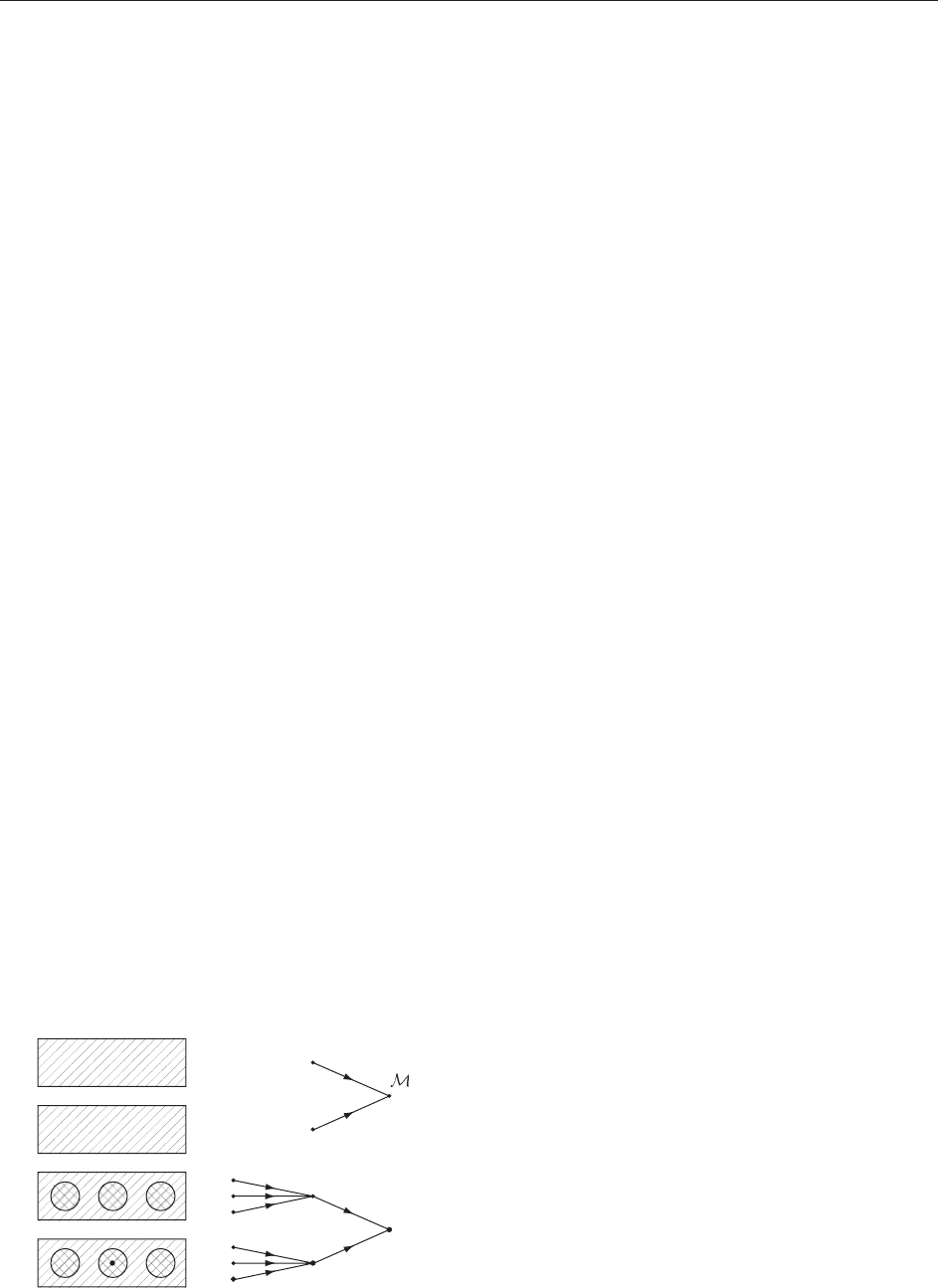
elements (see Figure 5).
Next, we note that, for all the higher homotopy
groups, disconnected pieces are irrelevant. Since a
loop, for example, starting at m
0
must remain
within its connected component M
0
M,it
follows that
1
(M) =
1
(M
0
), and similarly
n
(M) =
n
(M
0
) for all n > 1. So one can ignore
any disconnected parts of the symmetry group G,
and assume from now on that
0
(G) = 0. Moreover,
it is always possible to replace G by its simply
connected covering group, replacing SO(3), for
example, by SU(2). Thus, we may also assume that
1
(G) = 0. Then the section of the exact sequence in
the second line of [9] becomes
0 !
p
1
ðMÞ!
@
0
ðHÞ!
i
0
which implies that the two groups in the center are
isomorphic:
1
ðMÞ ¼
0
ðHÞ½10
For example, if the symmetry group G = SO(3) is
completely broken, so that H = 1, then replacing G by
˜
G = SU(2) requires replacing H by
˜
H = { þ1, 1}
’ Z
2
, hence also
1
(M) =
0
(
˜
H) = Z
2
; there is only
one nontrivial class of linear defects in this model.
To find
2
(M), we need a standard theorem
about Lie groups, namely that the second homotopy
group of any Lie group is trivial: for any
G,
2
(G) = 0. (No details of the proof are given
here. It derives from the fact that a generic element
g 2 G belongs to a unique one-parameter subgroup
{ exp (tX), t 2 R} G, where X is an element of the
Lie algebra of G. Thus, all the points on a surface in
G may be joined by these paths to the identity, and
the surface may then be shrunk along the resulting
cone. There are exceptional elements for which
this is not true, but it can be shown that in a d-
dimensional group they lie on (d 3)-dimensional
surfaces, so any 2-surface can be smoothly deformed
to avoid them.)
It follows from this theorem that another section
of the exact sequence is
0 !
p
2
ðMÞ!
@
1
ðHÞ!
i
0
which again implies an isomorphism:
2
ðMÞ ¼
1
ðHÞ½11
For example, if G = SO(3) and H = SO(2), or
equivalently
˜
G = SU(2) and
˜
H = U(1) (a double
cover of the SO(2)), then
2
(M) =
1
(
˜
H) = Z,so
point defects in this theory are labeled by an integer
winding number.
Examples
The simplest continuous symmetry is the U(1) phase
symmetry
ˆ
7!
ˆ
e
i
of a complex field. In a weakly
interacting Bose gas, below the Bose–Einstein con-
densation temperature, or in superfluid helium-4,
a macroscopic fraction of the atoms occupies a
single quantum state, and
ˆ
acquires a nonzero
expectation value, h
ˆ
i= , whose phase is arbitrary,
so the symmetry is completely broken to H = 1.
Thus, M= S
1
; we have a circle of equivalent
degenerate ground states. (This corresponds to
π
0
(G)
π
0
( )
π
0
(H )
Figure 5 The disconnected components of G are shaded, those
of H are cross-hatched. Here
0
(M) has two elements.
Topological Defects and Their Homotopy Classification 261
spontaneous breaking of the particle-number sym-
metry. It is possible to describe the system in a U(1)-
invariant way, by projecting out a state of definite
particle number, a uniform superposition of all the
states in M, but it is generally less convenient to do
so.) In this case, the only nontrivial homotopy group
is
1
(M) = Z, so the only defects are linear defects
classified by a winding number n 2 Z. The defects
with n = 1 are stable vortices. Those with jnj > 1
are in general unstable and tend to break up into jnj
single-quantum vortices.
Low-temperature superc onductors also have a
U(1) symmetry, although there are important differ-
ences. This is not a global symmetry but a local,
gauge symmetry, with coupling to the electromag-
netic field. Moreover, it is not single atoms that
condense but Cooper pairs, pairs of electrons of
equal and opposite momentum and spin. These
systems too exhibit linear defects, magnetic flux
tubes carrying a magnetic flux 4nh=e.
A less trivial example is a nematic liquid crystal.
These materials are composed of rod-shaped mole-
cules that tend, at low temperatures, to line up
parallel to one another. The nematic state is
characterized by a preferred orientation, described
by a unit vector n, the director. (Note that n and n
are physically equivalent.) There is long-range
orientational order, with molecules preferentially
lining up parallel to n, but unlike a solid crystal
there is no long-range translational order – the
molecules move freely past each other as in a normal
liquid.
A convenient order parameter here is the mean
mass quadrupole tensor of a molecule. In the
nematic state, is proportional to (3nn 1); for
example, if n = (0, 0, 1), then is diagonal with
diagonal elements proportional to (1, 1, 2). In
this case, the symmetry group is SO(3) (or, more
precisely, O(3); but the inversion symmetry is not
broken, so we can restrict our attention to the
connected part of the group). The subgrou p H that
leaves this invariant is a semidirect product,
H = SO(2) n Z
2
(isomorphic to O(2)), composed of
rotations about the z-axis and rotations through
about axes in the x–y plane. (If we enlarge G to its
simply connected covering group
˜
G = SU(2), then H
becomes
˜
H = [U(1) n Z
4
]=Z
2
, where U(1) is gener-
ated as before by J
z
. The essential difference is that
the square of any of the elements in the disconnected
piece of
˜
H is not now the ident ity but the element
e
2iJ
z
= 1 2 U(1).) The manifold M of degenerate
ground states in this case is the projective space RP
2
(obtained by identifying opposite points of S
2
).
Since
˜
H has disconnected pieces, we have
1
(M) =
0
(
˜
H) = Z
2
. Thus, there can be topologically
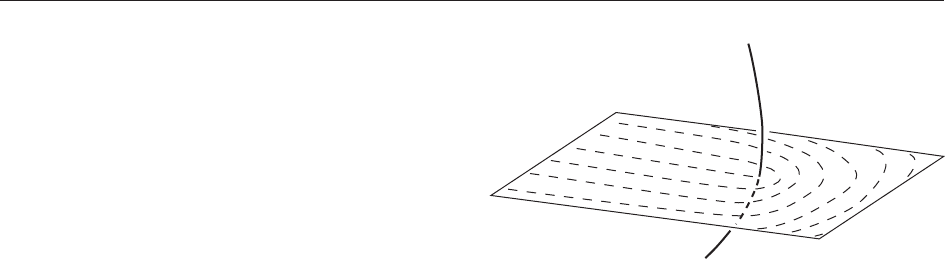
stable linear defects, here called disclination lines,
around which the director n rotates by (see Figure 6).
The fact that these defects are classified by Z
2
rather
than Z means that a line around which n rotates by 2
is topologically trivial; indeed, n can be smoothly
rotated near the line to run parallel to it, leaving a
configuration with no defect.
There are also point defects; since
2
(M) =
1
(
˜
H) = Z, they are labeled by an integer winding
number n. In a defect with n = 1, the vector n points
radially outwards all round the defect position.
Helium-3
Finally, let us turn to helium-3, one of the most
fascinating and complex examples of spontaneous
symmetry breaking, which becomes a superfluid at a
temperature of a few millikelvin. Unlike helium-4, this
is, of course, a Fermi liquid, so it is not the atoms that
condense, but bound pairs of atoms, analogous to
Cooper pairs. In this case, however, the most attractive
channel is not the
1
S, but the
3
P, so the pairs have both
orbital and spin angular momentum, L = S = 1. There-
fore, the order parameter is not a single complex scalar
field but a 3 3 complex matrix
jk
,wherethetwo
indices label the orbital and spin angular momentum
states.
To a good approximation, the system is invar iant
under separate rotations of L and S (the effects of
the small spin–orbit coupling will be discussed
later), so the symmetry group is
G ¼ Uð1Þ
Y
SOð 3Þ
L
SOð3Þ
S
½12
where the subscripts denote the generators and U(1)
Y
represents multiplication by an overall phase factor,
e
iY
:
jk
7!
jk
e
i
. This complicated symmetry allows
much scope for a large variety of defects. There are, in
fact, two distinct superfluid phases, A and B,with
different symmetries (and indeed in the presence of a
magnetic field there is a third, A1).
In the
3
He-A phase, the order parameter has the
form
jk
/ (m
j
þ in
j
)d
k
, where m, n, d are unit
vectors, with m ? n; if we set l = m ^ n, then
Figure 6 Orientation of molecules around a disclination line.
262 Topological Defects and Their Homotopy Classification
l defines the orb ital angular momentum state by
l L = 1, while d defin es the spin quantization axis,
such that d S = 0. The manifold M
A
for this
phase is
M
A
¼½SOð3ÞS
2
=Z
2
½13
where the Z
2
is present because (m, n, d)and
(m, n, d) represent the same state . If, for
example, we take l and d in the z-direction, the
unbroken symmetry subgroup is
H
A
¼ SOð2Þ
L
z
þY
½SOð2Þ
S
z
n Z
2
½14
where the nontrivial element of Z
2
may be taken to
be e
i(S
x
þL
z
)
. The covering group of G is, of course,
~
G ¼ R
Y
SUð2Þ
L
SUð2Þ
S
½15
Correspondingly,
~
H
A
¼ R
L
z
þY
½Uð1Þ
S
z
n Z
4
½16
It follows that the homotopy groups are
0
ðM
A
Þ¼0;
1
ðM
A
Þ¼Z
4
;
2
ðM
A
Þ¼Z ½17
There are linear defects labeled by a mod-4 quantum
number and point defects labeled by an integer.
For the
3
He-B phase, by contrast, the order
parameter is of the form
jk
/ R
jk
e
i
½18
where R is a rotation matrix, R 2 SO(3). Her e then,
M
B
¼ SOð3ÞS
1
½19
with homotopy groups
0
ðM
B
Þ¼0;
1
ðM
B
Þ¼Z
2
Z;
2
ðM
B
Þ¼0 ½20
In this phase, there are two distinct types of linear
defect, the mass vortices with an integer label, and
the spin vortices with a mod-2 label. (One can also
have a ‘‘spin–mass vortex’’ carry ing both quantum
numbers.)
Composite Defects
There are several cases, including in particular
helium-3, that exhibit symmetry breaking with
multiple length or energy scales. For example, there
may be two order parameters, say , , with
jjj j.Ifj j is negligible, the symmetry G is
broken by to H, and the manifold of degenerate
ground states is M= G=H. However, these states
are not all exactly degenerate: breaks the
symmetry further to K H, so the precisely degen-
erate ground states form a submanifold M
0
= G=K.
The c ase of h elium-3 is slightly different. Here it
is the small spin–orbit coupling, arising f rom long-
range dipole–dipole interactions, that introduces
the sec ond scale. Its effect is only significant over
large distances.
In the
3
He-A phase, at short range the l and d
vectors are uncorrelated but, over large distances,
they tend to be aligned parallel or antiparallel. We
can use the Z
2
symmetry mentioned earlier to
choose l = d. Hence, the mani fold M
0
A
of true
ground states is only a submanifold of M
A
, namely
M
0
A
= SO( 3), whose homotopy groups are
0
ðM
0
A
Þ¼0;
1
ðM
0
A
Þ¼Z
2
;
2
ðM
0
A
Þ¼0 ½21
Because of different behavior on different scales,
‘‘composite’’ defects can arise. For example, because
2
(M
A
) = Z, there are short-range monopole con-
figurations. For the n = 1 monopole, we have a
configuration with uniform l, and with d pointing
outwards from the center. But, eventually the
misalignment of d with l is energetically disfavored,
and at large distances d tends to rotate to align with
l except around one particular direction where it is
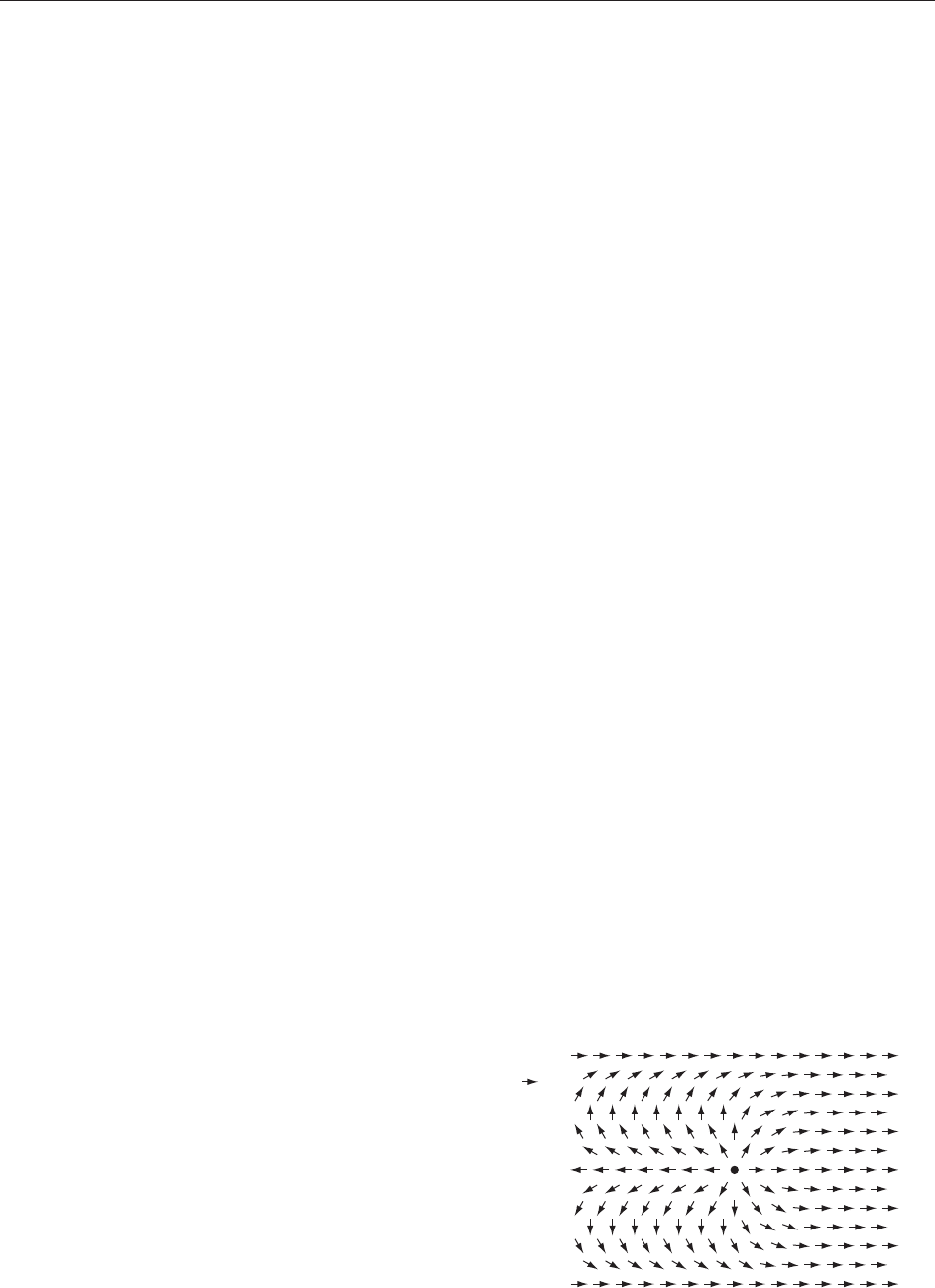
oppositely aligned (see Figure 7). We have a
composite defect: a small monopole coupled to a
relatively fat string.
To see how the small- and large-scale structures fit
together, one has to look also at the relative
homotopy groups
n
(M, M
0
), whose elements are
homotopy classes of maps from I
n
to M such that
one face of the boundary is mapped into M
0
, and the
remainder to the chosen base point m
0
. For example,
1
(M, M
0
) classifies paths that terminate at m
0
while
beginning at any point of M
0
. There is, in fact, a
long exact sequence, similar to [9], relating these
homotopy groups, of which a typical segment is
!
@
n
ðM
0
Þ!
i
n
ðMÞ!
p
n
ðM; M
0
Þ
!
@
n1
ðM
0
Þ!
i
½22
l
d
Figure 7 Cross-section of a short-range monopole attached to
a fat string.
Topological Defects and Their Homotopy Classification 263

The relevant groups in the present case are
1
ðM
A
; M
0
A
Þ¼Z
2
;
2
ðM
A
; M
0
A
Þ¼Z ½23
Because
1
(M
A
) = Z
4
, there are three distinct classes
of linear defects at small scales, but only those with
quantum number n = 2 (mod 4) survive unchanged to
large scales; they correspond to the nontrivial element
of
1
(M
0
A
) = Z
2
. On the other hand, the homotopy
classes n = 1 (mod 4) are mapped to nontrivial
elements of
1
(M
A
, M
0
A
) = Z
2
, which indicates that
the corresponding linear defects are coupled at long
range to fat domain walls, across which d rotates
through with a compensating rotation through
about l. Similarly, the nontrivial elements of
2
(M
A
) = Z are mapped to nontrivial elements of
2
(M
A
, M
0
A
), confirming that these short-range mono-
poles are coupled to fat strings, as in Figure 7.
For
3
He-B, the effect of the spin–orbit coupling
is to make the most energetically favorable
configurations those in which the rotation
matrix R in [18] represents a rotation about an
arbitrary axis n through the Leggett angle
L
=
arccos(1/4) = 104
: R = exp (i
L
n J).
Consequent ly,
M
0
B
¼ S
2
S
1
½24
and so
0
ðM
0
B
Þ¼0;
1
ðM
0
B
Þ¼Z;
2
ðM
0
B
Þ¼Z ½25
The relative homotopy groups are
1
ðM
B
; M
0
B
Þ¼Z
2
;
2
ðM
B
; M
0
B
Þ¼0 ½26
Here the mass vortex persists at long range, but the
configuration around the spin vortex deforms so
that they become attached to fat domain walls. The
‘‘monopole’’ configurations corresponding to
nontrivial elements of
2
(M
0
B
) have no short-range
singularity at all.
See also: Abelian Higgs Vortices; Leray–Schauder
Theory and Mapping Degree; Liquid Crystals; Phase
Transition Dynamics; Quantum Field Theory: A Brief
Introduction; Quantum Fields with Topological Defects;
Solitons and Other Extended Field Configurations; String
Topology: Homotopy and Geometric Perspectives;
Symmetries and Conservation Laws; Symmetry Breaking
in Field Theory; Variational Techniques for
Ginzburg–Landau Energies.
Further Reading
Helgason S (2001) Differential Geometry, Lie Groups and Sym-
metric Spaces. Providence, RI: American Mathematical Society.
Hu S-T (1959) Homotopy Theory. New York: Academic Press.
Kibble TWB (1976) Topology of cosmic domains and strings. Journal
of Physics A: Mathematical and General 9: 1387–1398.
Kibble TWB (2000) Classification of topological defects and their
relevance to cosmology and elsewhere. In: Bunkov YM and
Godfrin H (eds.) Topological Defects and the Non-Equilibrium-
Dynamics of Symmetry Breaking Phase Transitions,NATO
Science Series C: Mathematical and Physical Sciences. vol. 249,
pp. 7–31. Dordrecht: Kluwer Academic Publishers.
Shellard EPS and Vilenkin A (1994) Cosmic Strings and
Other Topological Defects. Cambridge: Cambridge University
Press.
Tilley DR and Tilley J (1990) Superfluidity and Superconductiv-
ity, 3rd edn. Bristol: IoP Publishing.
Toulouse G and Kle´man M (1976) Principles of a classification of
defects in ordered media. Journal de Physique Lettres 37: 149.
Vollhardt D and Wo¨ lfle P (1990) The Superfluid Phases of
Helium 3. London: Taylor and Francis.
Volovik GE (1992) Exotic Properties of Superfluid
3
He.
Singapore: World Scientific.
Volovik GE and Mineev VP (1977) Investigation of singularities
in superfluid
3
He and in liquid crystals by the homotopic
topology methods. Zhurnal Eksperimentalnoi i Teoreticheskoi
Fiziki 72: 2256–2274 (Soviet Physics–JETP 24: 1186–1196).
Topological Gravity, Two-Dimensional
T Eguchi, University of Tokyo, Tokyo, Japan
ª 2006 Elsevier Ltd. All rights reserved.
Introduction
It is well known that large-N Hermitian matrix models
generate Feynman diagrams which represent the
triangulation of Riemann surfaces. For instance, if we
consider the integral of an N N Hermitian matrix H
Z ¼
Z
dH exp N
1
2
tr H
2
þ
4
tr H
4
½1
we find that the free energy F = log Z has the 1=N
expansion
F ¼
X
1
g¼0
N
22g
F
g
ðÞ½2
Inspection of the Feynman diagrams shows that F
g
reproduces the sum over the triangulations of genus
g Riemann surfaces. The theory [1] is obviously well
defined for 0. In the large-N expansion, the
theory continues to exist also at negative values of
down to the critical point
c
= 1=12.
The double scaling limit of large-N matrix
models (Bre´zin and Kazakov 1990, Douglas and
264 Topological Gravity, Two-Dimensional

Shenker 1990, Gross and Migdal 1990) is given by
adjusting the coupling to
c
and at the same time
taking the limit N !1. In this limit, contributions of
all genera survive, and the theory describes the
dynamics of fluctuating surfaces of arbitrary topolo-
gies. Results obtained in this way do not, in fact,
depend on the detailed choice of the potential (
4
type
in [1]) and have a high degree of universality. Thus, it
provides an interesting model of two-dimensional (2D)
quantum gravity.
Soon after the discovery of double scaling limit of
matrix models, Witten observed that the correlation
functions of the 2D gravity theory may be given a
geometrical interpretation as topological invariants
of the moduli space of Riemann surfaces M, and
that the 2D gravity theory may be reformulated as a
topological field theory (Witten 1990). This refor-
mulation of the results of the 2D gravity theory is
called ‘‘2D topological gravity.’’
In fact, 2D gravity theories come in a family
parametrized by a pair of integers (p, q). The double
scaling limit of [1] gives the simplest example
(p = 2, q = 1). Models with a chain of p 1 Hermi-
tian matric es give the (p, q) 2D gravity theories. The
label q stands for the order of criticality of the
model, and higher values of q are achieved by fine-
tuning the parameters of the potential. At q = 1, 2D
gravity theories possess a topological interpretation.
The most basic case (p = 2, q = 1) is called pure
topological gravity, and in theories at higher values
of p, topo logical gravity is coupled to a matter
system, that is, topological minimal models. Topo-
logical minimal models are obtained by twisting
N = 2 superconformal field theories.
Let us first consider the case of pure gravity (p = 2, 1).
Let O
n
denote the observables in the theory and t
n
the
coupling constants to these operators. The correlation
functions of topological gravity are given by
hO
n
1
O
n
2
...O
n
s
i
g
; n
i
¼ 1; 2; ... ½3
where hi
g
denotes the expectation value on a
surface with g handles. The precise significance of
eqn [3] as the intersection number on the moduli
space is discussed below. The string partition
function (t) is defined as the genera ting function
of all possible correlation functions
ð tÞ¼exp
X
1
g¼0
exp
X
t
n
O
n
DE
g
½4
The most striking aspect of topological gravity is
the connection of the intersection theory on M to
the theory of completely integrable systems, that is,
Korteveg–de Vries (KdV) and KP hierarchies.
Witten conjectured that the generating function of
intersection numbers on moduli space (t) is the
-function of KdV hierarchy. KdV hierarchy is
obtained by generalizing the well-known KdV
equation
@u
@t
¼
3
2
u
@u
@x
þ
1
4
@
3
u
@x
3
½5
Identification of the KdV equation with topological
gravity is give n by u = 2hO
1
O
1
i, x = t
1
, t = t
3
.
Witten’s conjecture was verified by Kontsevich
(1991) by an explicit construction of a new type of
matrix model which generates the triangulation of
the moduli space of Riemann surfaces.
In the general case of (p, 1) topological gravi ty,
the partition function of the theory obeys the
equations of pth generalized KdV hierarchy (p
reduction of KP hierarchy).
Intersection Theory
We now present some basic features of intersection
theory on the moduli space of Riemann surfa ces. It
is known that 2D oriented surfa ces with g handles
and s marked points x
i
(i = 1, ..., s) possess a finite
number of inequivalent complex structures (comple x
structures are identified when they differ only by
diffeomorphism). The space of inequivalent complex
structures is called the moduli space M
g,s
of the
Riemann surface . Its dimensi on is given by
dim M
g;s
¼ 3g 3 þ s ½6
For a mathematically rigorous treatment, we have to
consider a compactification
M
g,s
of moduli space
M
g,s
by adding suitable boundary components
which arise due to va rious types of degenerations
of Riemann surfaces. In the Deli gne–Mumford or
stable compactification, one considers the following
three classes of singular Riemann surfaces :
1. Two points, x
i
and x
j
,on come close together. In
this case, an extra 2-sphere is pinched off from the
surface by forming a thin neck. The sphere contains
points x
i
and x
j
and also the point x
l
at the end of
the neck (see Figure 1a). Since the original surface
now has one point less and the 2-sphere with three
points has no moduli, the degenerate surface has
3g 4 þ s parameters and forms a boundary
divisor of the moduli space
M
g,s
.
2. If a cycle of nontrivial homology class shrinks to
a point, we have a surface with one less genus
and two extra marked points. Singular surface
has 3(g 1) 3 þ s þ 2 number of moduli and
this is again a complex codimension-1 compo-
nent (see Figure 1b).
Topological Gravity, Two-Dimensional 265
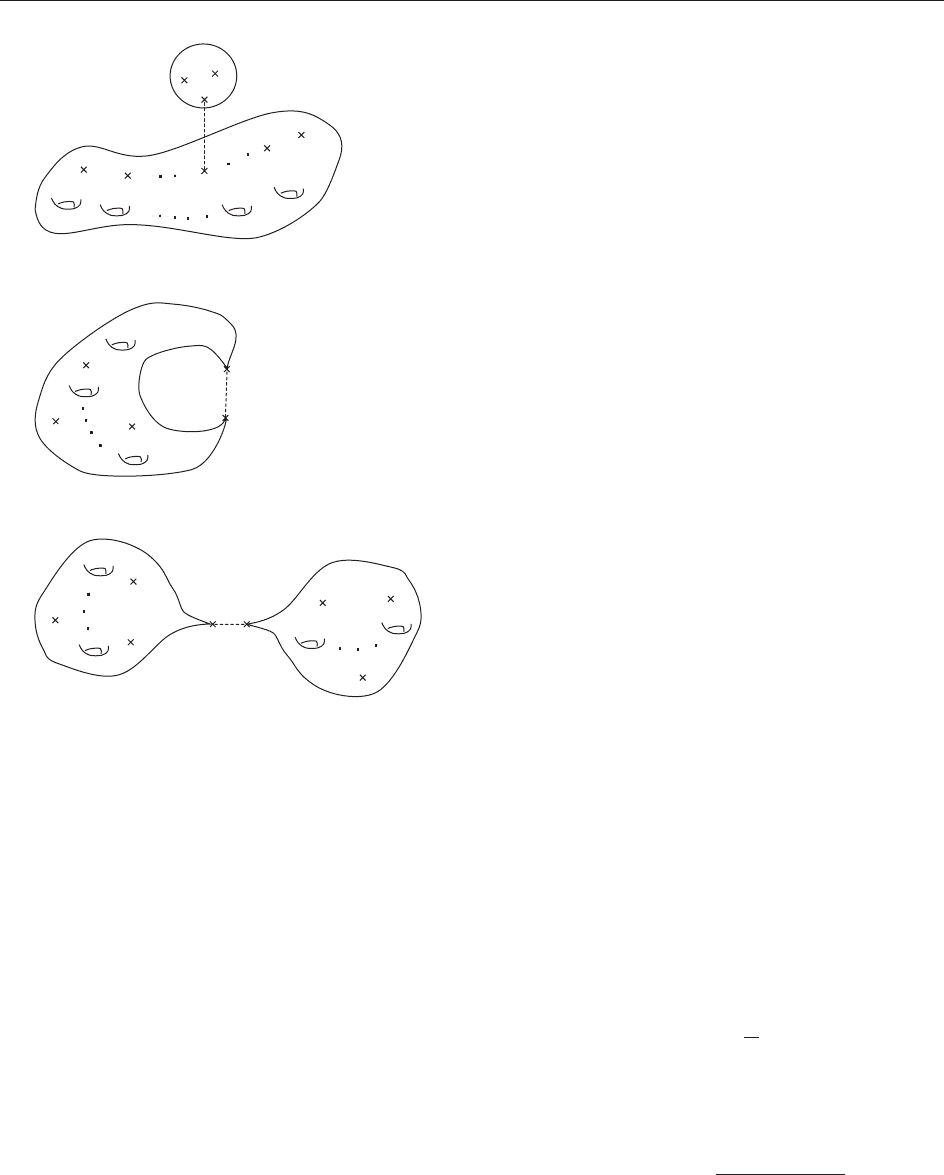
3. Similarly, if a dividing cycle pinches, one obtains
two disconnected surfaces of genus g
i
with s
i
þ 1
marked points (i = 1, 2; g
1
þ g
2
= g, s
1
þ s
2
= s).
This type of degeneration also has the same
number of parameters
P
(3g
i
3) þ
P
(s
1
þ 1) =
3g 4 þ s (see Figure 1c).
It is known that
M
g,s
is a compact and smooth
orbifold space, and observables of topological gravity
are given by the cohomology classes on
M
g,s
. There
exist special cohomology classes introduced by
Mumford and Morita, which are defined as follows:
There are natural line bundles L
1
, ..., L
s
on the
moduli space
M
g,s
. The fiber of the bundle L
i
at a
point 2
M
g,s
is the cotangent space T
x
i
to the
point x
i
on the surface . These line bundles have the
first Chern classes c
1
(L
i
) and by taking their exterior
power we can define 2n-dimensional classes
n
ðiÞ¼c
1
ðL
i
Þ
n
2 H
2n
ð
M
g;s
Þ½7
Correlation functions are defined by integrating
these classes over the moduli space:
h
n
1
n
s
i
g
Z
M
g;s
c
1
ðL
1
Þ
n
1
^^c
1
ðL
s
Þ
n
s
½8
These integrals are topological invariants of
M
g,s
and are nonzero only when the degree of the
cohomology classes adds up to the dimension of
the moduli space
X
s
i¼1
n
i
¼ 3g 3 þ s ½9
n
(i) is known as the nth descendant of the puncture
operator
0
(i), since it is associated with the marked
point x
i
.
The above correlation functions are evaluated
using various recursion relations. First, one has the
puncture equation
h
0
n
1
n
s
i
g
¼
X
s
i¼1;n
i
6¼0
h
n
1
n
i
1
n
s
i
g
½10
which can be derived by considering a map
:
M
g, sþ 1
!
M
g, s
where one forgets the position of
an extra point. Contributions arise when the for-
gotten point coincides with the other points. This
relation can be used to eliminate
0
’s from correla-
tion functions when they are well defined. At g = 0,
less than three insertions are ill-defined and one has
h
0
0
0
i
0
¼ 1 ½11
Another basic relation is the dilaton equation for
the operator
1
:
h
1
n
1
n
s
i
g
¼ð2g 2 þ sÞh
n
1
n
s
i
g
½12
The dilaton equation follows from the fact that since
1
is the first Chern class c
1
(L), it calculates the
degree of the canonical line bundle of genus g
surface with s punctures. At g = 1, one insertion is
required and one has
h
1
i
1
¼
1
24
½13
By combining these recursion relations, one can
evaluate the correlation functions. For instance, at
g = 0 one finds
h
n
1
n
s
i
0
¼
ðn
1
þþn
s
Þ!
n
1
! n
s
!
½14
A powerful way of computing correlation functions is
given by the KdV hierarchies and Virasoro conditions
as discussed below. In the context of integrable
systems, it is convenient to redefine the observables as
O
2nþ1
¼ð2n þ 1Þ!!
n
; n 0 ½15
x
i
x
1
x
2
x
s
x
j
x
l
(a)
x
i
x
j
x
s
x
2
x
1
(b)
x
1
x
i
x
j
x
s
(c)
Figure 1 Degenerate Riemann surface obtained when (a) the
points x
i
and x
j
coincide; (b) a nontrivial cycle collapses, two
new points x
i
and x
j
are created; (c) a pinching cycle collapses,
two new points x
i
and x
j
are created.
266 Topological Gravity, Two-Dimensional
Topological Minimal Models
Standard intersection theory applies to the case of
pure topological gravity, p = 2. At higher values of
p, the theory is generalized as follows: one intro-
duces the coupling of topological gravity to the
topological matter sector which is obtained by
twisting the N = 2 superconformal theories.
We recall that N = 2 superconformal symmetry is
generated by the operators, stress tensor T(z), U(1)
current J(z), and two types of supersymmetry
generators G(z)
. (In the holomorphic sector of the
theory these operators depend on the holomorphic
coordinate z of the Riemann surface. In the antiholo-
morphic sector they depend on the antiholomorphic
variable
¯
z.) Mode expansion of the stress tensor and
U(1) current is given by
TðzÞ¼
X
n
L
n
z
n2
; JðzÞ¼
X
n
J
n
z
n1
½16
L
n
generates the Virasoro algebra
½L
m
; L
n
¼ðm nÞL
mþn
þ
c
12
mðm
2
1Þ
mþn;0
½17
where c denotes the central charge of the theory.
Commutators of J
n
and L
n
are given by
½J
m
; J
n
¼
c
3
m
mþn;0
; ½L
m
; J
n
¼nJ
mþn
½18
It is known that there is a continuum of unitary
N = 2 conformal theories in the range c 3;
however, only discrete values of the central charge
c = 3k=(k þ 2), k = 1, 2, ... are allowed in the
region 3 c 1. These are the N = 2 m inimal
models labeled by the level k. Only a finite
number of primary fields exist in these theories.
In N = 2 theory, primary fields
are characterized
by their conformal dimension and U(1) charge:
L
0
j
i¼hj
i; J
0
j
i¼qj
i½19
There exists a special set of primary operators, chiral
primary fields
‘
(‘ = 0, ..., k), which are annihilated
by the supercharge operator G
þ
:
I
dzG
þ
ðzÞj
‘
i¼0 ½20
‘
has the dimension and U(1) charge
qð
‘
Þ¼
‘
k þ2
; hð
‘
Þ¼
1
2
qð
‘
Þ;‘¼0; 1; ...; k ½21
By considering primary fields annihilated by G
,
we can also define antichiral fields. Antichiral fields
have U(1) charge opposite to those of chiral fields.
If one defines the twisted stress tensor by
T
0
ðzÞ¼TðzÞþ
1
2
@JðzÞ½22
then T
0
(z) has a vanishing central charge. Further-
more, the conformal dimensions of the supersym-
metry operators G
become shifted from 3/2 to
h(G
þ
) = 1andh(G
) = 2. It is then possible to
integrate G
þ
on the Riemann surface and define a
fermionic scalar operator G
þ
0
=
H
dzG
þ
(z). From the
N = 2 algebra, one has
ðG
þ
0
Þ
2
¼ 0; fG
þ
0
; G
ðzÞg ¼ 2 T
0
ðzÞ½23
If we identify G
þ
0
as the Becchi–Rouet–Stora–Tyupin
(BRST) operator of the theory, then the twisted
stress tensor becomes BRST trivial, which is the
characteristic feature of topological field theory.
Thus, we obtain a topological field theory by twisting
N = 2 conformal theory (Eguchi and Yang 1990).
These are topological minimal models. BRST-invar-
iant observables are given by the chiral primary fields
[20]. (To be precise, when we take account of the
antiholomorphic sector, we may define either Q =
G
þ
0
þ
¯
G
þ
0
or Q = G
þ
0
þ
¯
G
0
as the BRST operator.
Thus, in general, we obtain two different topological
field theories. This is the origin of the mirror
symmetry. In the context of topological gravity, one
takes the convention Q = G
þ
0
þ
¯
G
þ
0
.)
Now, we consider the coupling of topological
gravity to topological minimal models. We identify
k = p 2. Making use of chiral fields
‘
(‘ = 0, ...,
p 2), observables are constructed:
n;‘
¼
n
‘
½24
N = 2U(1) charge is identified as the degree of
differential form of the moduli space. Thus, the
degree of
n, ‘
is n þ ‘= p. Correlation functions
h
Q
s
i = 1
n
i
,‘
i
i
g
are nonzero if the selection rule
X
s
i¼1
n
i
þ
‘
i
p
¼ 3
p 2
p
ðg 1Þþs ½25
is obeyed.
We may assemble
n, ‘
into operators with one
index O
m
as
O
npþ‘þ1
¼
Y
n
r¼0
ðrp þ ‘ þ 1Þ
n;‘
½26
where one introduces a convenient normalization
factor. Note that the operators O
m
do not exist
when m 0 mod p and the corresponding paramters
t
m
are ab sent. This is a characteristic feature of p
reduced KP hierarchy.
Topological Gravity, Two-Dimensional 267