
Francoise J.-P., Naber G.L., Tsun T.S. (editors) Encyclopedia of Mathematical Physics
Подождите немного. Документ загружается.


value of a certain nondimensional quantity was
likely to exist beyond which a laminar flow gives
rise to a ‘‘sinuous’’ motion. This was followed by
observations of the flow for tubes with different
diameter L, different mean velocities U across the
tube section, and with the kinematic viscosity
= = being altered through changes in tempera-
ture. The experime nts confirmed the existence of
such a critical value for what is now called the
Reynolds number:
Re ¼
LU
The dimensional analysis argument can be repro-
duced in the following form: the physical dimension
for the inertial term in [1a] is U
2
=L, while that for
the viscous term is U=L
2
. The ratio between them
is precisely Re = LU=. For small values of Re
viscosity dominates and the flow is laminar, whereas
for large values of Re the inertial term dominates,
and the flow becomes more complicated and
eventually turbulent. In applications, different types
of Reynolds number can be used depending on the
choice of the characteristic velocity and length, but
in an y case, the larger the Reynolds number, the
more complicated the flow.
The Reynolds Equations
Another advance put forward by Reynolds in a
subsequent article was to decompose the flow into a
mean component and the remaining fluctuations. In
terms of the velocity and pressure fields this can be
written as
u ¼
u þ u
0
; p ¼
p þ p
0
½2
with
u and
p representing the mean components and
u
0
and p
0
, the fluctuations. By substituting [2] into
[1], one finds the Reynolds-averaged Navier– Stokes
(RANS) equations for the mean flow:
@
u
@t
u þð
u rÞ
u þr
p ¼f þr
r
u ¼ 0
It differs from [1] only by the addition of the
Reynolds stress tensor:
¼
u
0
u
0
¼ u
0
i
u
0
j
3
i;j¼1
In a laminar flow, the fluctuations are negligible,
otherwise this decomposition shows how they
influence the mean flow through this additional
turbulent stresses.
The Closure Problem and Turbulence
Models
The RANS equations cannot be solved directly for the
mean flow since the Reynolds stresses are unknown.
Equations for these stress terms can be derived but they
involve further unknown moments. This continues
with equations for moments of a given order depend-
ing on new moments up to a higher order, leading to
an infinite system of equations known as the Fried-
man–Keller system. For practical applications,
approximations closing the system at some finite
order are needed, in what is called the closure problem.
Several ad hoc approximations exist, the most famous
being the Boussinesq eddy-viscosity approximation, in
which the turbulent fluctuations are regarded as
increasing the viscosity of the flow. Prandtl’s mixing-
length hypothesis yields a prescription for the compu-
tation of this eddy viscosity, and together they form the
basis of the algebraic models of turbulence. Other
models involve additional equations, such as the k-
and k-! models. Most of the practical computations of
industrial flows are based on such lower-order models,
and a large amount of research is done to determine
appropriate values for the various ad hoc parameters
which appear in these models and which are highly
dependent on the geometry of the flow. This depen-
dency can be explained by the fact that the RANS is
supposed to model the mean flow even at the large
scales of motion, which are highly affected by the
geometry.
Computational fluid dynamics (CFD) is indeed a
fundamental tool in turbulence, both for research and
engineering applications. From the theoretical side,
direct numerical simulations (DNS), which attempt to
resolve all the active scales of the flow, reveal some
fundamental mechanisms involved in the transition to
turbulence and in vortex stretching. As for applica-
tions, DNS applies to flows up to low-Reynolds
turbulence, with the current computational power
not allowing for a full resolution of all the scales
involved in high-Reynolds flows. And the current rate
of evolution of computational power predicts that
this will continue so for several decades.
An intermediate CFD method between RANS and
DNS is the large-eddy simulation (LES), which
attempts to fully resolve the large scales while
modeling the turbulent motion at the smaller scales.
Several models have been proposed which have their
own advantages and limitations as compared to
RANS and DNS. It is currently a subject of intense
research, particularly for the development of suitable
models for the structure functions near the boundary.
Theoretical results on fully developed turbulence play
a fundamental role in the modeling process.
298 Turbulence Theories

LESs are a promising tool and they have been
successfully applied to a number of situations. The
choice of the best method for a given application,
however, depends very much on the Reynolds
number of the flow and the prior knowledge of
similar situations for adjusting the parameters.
Elements of the Statistical Theory
Several types of averages can be used. The ensemble
average is taken with respect to a number of experi-
ments at nearly identical conditions. Despite the
irregular motion of, say, the velocity vector u
(n)
(x, t)
of each experiment n = 1, ..., N, the average value
uðx; tÞ¼
1
N
X
N
n¼1
u
ðnÞ
ðx; tÞ
is expected to behave in a more regular way. This
type of averaging is usually denoted with the symbol
hi. This notion can be cast into the context of a
probability space (M, , P), where M is a set, is a
-algebra of subsets of M, and P is a probability
measure on . The velocity field is a random
variable in the sense that it is a density function
! 7!u(x, t, !) from M into the space of time-
dependent divergence-free velocity fields. The mean
velocity field in this context is regarded as
huðx; tÞi ¼
Z
M
uðx; t;!ÞdPð!Þ
Other flow quantities such as energy and correla-
tions in space and time can be expressed by means
of a function ’ = ’(u( , )) of the velocity field,
with their mean value given by
h’ðuð; ÞÞi ¼
Z
M
’ðuð; ;!ÞdPð!Þ
In general, the statistics of the flow are allowed to
change with time. A particular situation is when
statistical equilibrium is reached, so that hu(x, t)i
and, more generally, h’(u( , þt))i are independent
of t . In this case, an ergodic assumption is usually
invoked, which means that for ‘‘most’’ individual
flows u( , , !
0
) (i.e, for almost all !
0
with respect to
the probability measure P), the time averages along
this flow converge to the mean ensemble value as
the period of the average increases to the mean value
obtained by the ensemble average:
lim
T!1
1
T
Z
T
0
’ðuð; þs;!
0
ÞÞds
¼
Z
M
’ðuð; ;!ÞÞdPð!Þ
Based on this assumption, the averages may in
practice be calculated as time averages over a
sufficiently large period T. There is a related
argument for substituting space averages by time
averages and based on the mechanics of turbulence
which is called the ‘‘Taylor hypothesis.’’
Another fundamental concept in the statistical
theory is that of homogeneity, which is the spatial
analog of the statistical equilibrium in time.
In homogeneous turbulence, the statistical qua ntities
of a flow are independent of translations in space,
that is,
h’ðuð þ‘; Þi¼h’ðuð; Þi
for all ‘ 2 R
3
. The concept of isotropic turbulence
assumes further independence with respect to
rotations and reflections in the frame of reference,
that is,
h’ðQ
t
uðQ ; Þi¼h’ðuð; Þi
for all orthogonal transformations Q in R
3
, with
adjoint Q
t
.
Under the homogeneity assumption, mean quan-
tities can be defined independently of position in
space, such as the mean kinetic energy per unit mass
e ¼
1
2
hjuðxÞj
2
i¼
1
2
X
3
j¼1
hju
i
ðxÞj
2
i
and the mean rate of viscous energy dissipation per
unit mass and unit time
¼
X
3
i¼1
hjru
i
ðxÞj
2
i¼
X
3
i;j¼1
@u
i
ðxÞ
@x
j
2
The mean kinetic energy can be written as
e = trR(0)=2, where
trRð‘Þ¼R
11
ð‘ÞþR
22
ð‘ÞþR
33
ð‘Þ;‘2 R
3
;
is the trace of the correlation tensor
Rð‘Þ¼huðxÞuðx þ ‘Þi ¼ ðR
ij
ð‘ÞÞ
3
i;j¼1
¼ðhu
i
ðxÞu
j
ðx þ ‘ÞiÞ
3
i;j¼1
which measures the correlation between the velocity
components at different positions in space. From the
homogeneity assumption, this tensor is a function
only of the relative position ‘. Then, assuming that
the Fourier transform of trR(‘) exists, and denoting
it by Q(), for 2 R
3
, we have
trRð‘Þ¼
1
ð2Þ
3=2
Z
R
3
QðÞe
i‘
d
¼ 2
Z
1
0
SðÞe
i‘
d
Turbulence Theories 299
where S() is the energy spectrum defined by
SðÞ¼
1
2ð2Þ
3=2
Z
jj¼
QðÞdðÞ
8>0
with d() denoting the area element of the
2-sphere of radius jj. Then we can write
e ¼
1
2
hjuðxÞj
2
i¼
1
2
trRð0Þ
¼
Z
1
0
SðÞd
By expanding the velocity coordinates into Four-
ier modes exp (‘ ), with jj þ d and
interpreting them as ‘‘eddies’’ with characteristic
wave number jj, the quantity S()d can be
interpreted as the energy of the component of the
flow formed by the ‘‘eddies’’ with characteristic
wave number between and þ d.
Similarly,
¼ 2
Z
1
0
2
SðÞd
and we obtain the dissipation spectrum 2
2
S(),
which can be interpreted as the density of energy
dissipation occurring at wave number .
In the previous arguments it is assumed that the
flow extends to all the space R
3
. This avoids the
presence of boundaries, addressing the idealized case
of fully developed turbulence. It is sometimes
customary to assume as well that the flow is
periodic in space to avoid problems with unbounded
domains such as infinite kinetic energy.
The random nature of turbulent flows was greatly
explored by Taylor in the early twentieth century,
who introduced most of the concepts described
above. Another important concept he introduced
was the Taylor microlength ‘
T
, which is a char-
acteristic length for the small scales based on the
correlation tensor. A microscale Reynolds number
based on the Taylor microlength is very often used
in applications.
Kolmogorov Theory
An inspiring concept in the theory of turbulence is
Richardson’s ‘‘energy cascade’’ process. For large
Reynolds numbers the nonlinear term dominates the
viscosity according to the dimensional analysis, but
this is valid only for the large-scale structures. The
small scales have their own characteristic length and
velocity. In the cascade process, the inertial term is
responsible for the transfer of energy to smaller and
smaller scales until small enough scales are reached
for which viscosity becom es important (Figure 3). At
those smallest scales kinetic energy is finally dis-
sipated into heat. It should be emphasized that
turbulence is a dissipative process; no matter how
large the Reynolds number is, viscosity plays a role
in the smallest scales.
The Kolmogorov theory of locally isotropic
turbulence allows for inhomogeneity and anisotropy
in the large scales, which contain most of the energy,
assuming that with the cascade transfer of energy to
smaller scales, the orienting effects generated in the
large scales become weaker and weaker so that for
sufficiently small eddies the motion becomes statis-
tically homogeneous, isotropic, and independent of
the particular energy-productive mechanisms. He
proposed that the statistical regime of the small-
scale eddies is then universal and depends only on
and . The equilibrium range is defined as the range
of scales in which this universality holds.
Simple dimensional analysis shows that the only
algebraic combination of and with dimension of
length is ‘
= (
3
=)
1=4
, which is then interpreted as
that near which the viscous effect becomes impor-
tant and hence most of the energy dissipation takes
place. The scale ‘
is known as Kolmogorov
dissipation length.
Kolmogorov theory gives particular attention to
moments involving differences of velocities, such as
the pth-order structure funct ion
S
p
ð‘Þ¼
def
hðuðx þ ‘eÞe uðxÞeÞ
p
i
where e may be taken as an arbitrary unit vector,
thanks to the isotropy assumption. By restricting the
search for universal laws for the structure functions
only for small value s of ‘ anisotropy and inhomo-
geneity are allowed in the large scales.
Figure 3 Illustration of the eddy breakdown process in which
energy is transferred to smaller eddies and so on until the smallest
scales are reached and the energy is dissipated by viscosity.
300 Turbulence Theories
The theory assumes a wide separation between
the energy-containing scales, of order say ‘
0
, and the
energy-dissipative scales, of order ‘
, so that the
cascade process occurs within a wide range of scales
‘ such that ‘
0
‘ ‘
. In this range, termed the
inertial range, the viscous effects are still negligible
and the statistical regime should depend only on .
Then, the Kolmogorov ‘‘two-thirds law’’ asserts that
within the inertial range the second-order correla-
tions must be proportional to (‘)
2=3
, that is,
S
2
ð‘Þ¼C
K
ð‘Þ
2=3
for some constant C
K
known as the Kolmogorov
constant in physical space (there is a related constant
in spectral space). The argument extends to higher-
order structure functions, yielding
S
p
ð‘Þ¼C
p
ð‘Þ
p=3
Kolmogorov’s derivation of these results was not by
dimensional analysis, it was in fact a more convincing
self-similarity argument based on the universality
assumed for the equilibrium range. A different argu-
ment without resorting to universality assumptions,
however, was applied to the third-order structure
function, yielding the more precise ‘‘four-fifths law’’:
S
3
ð‘Þ¼
4
5
‘
The ‘‘Kolmogorov five-thirds law’’ concerns the
energy spectrum S() and is the spectral version of
the two-thirds law, given by Obukhoff:
SðÞ¼C
0
K
2=3
5=3
The constant C
0
K
is the Kolmogorov constant
in spectral space. The spectral version of the
dissipation length is the Kolmogorov wave number
= (=
3
)
1=4
.
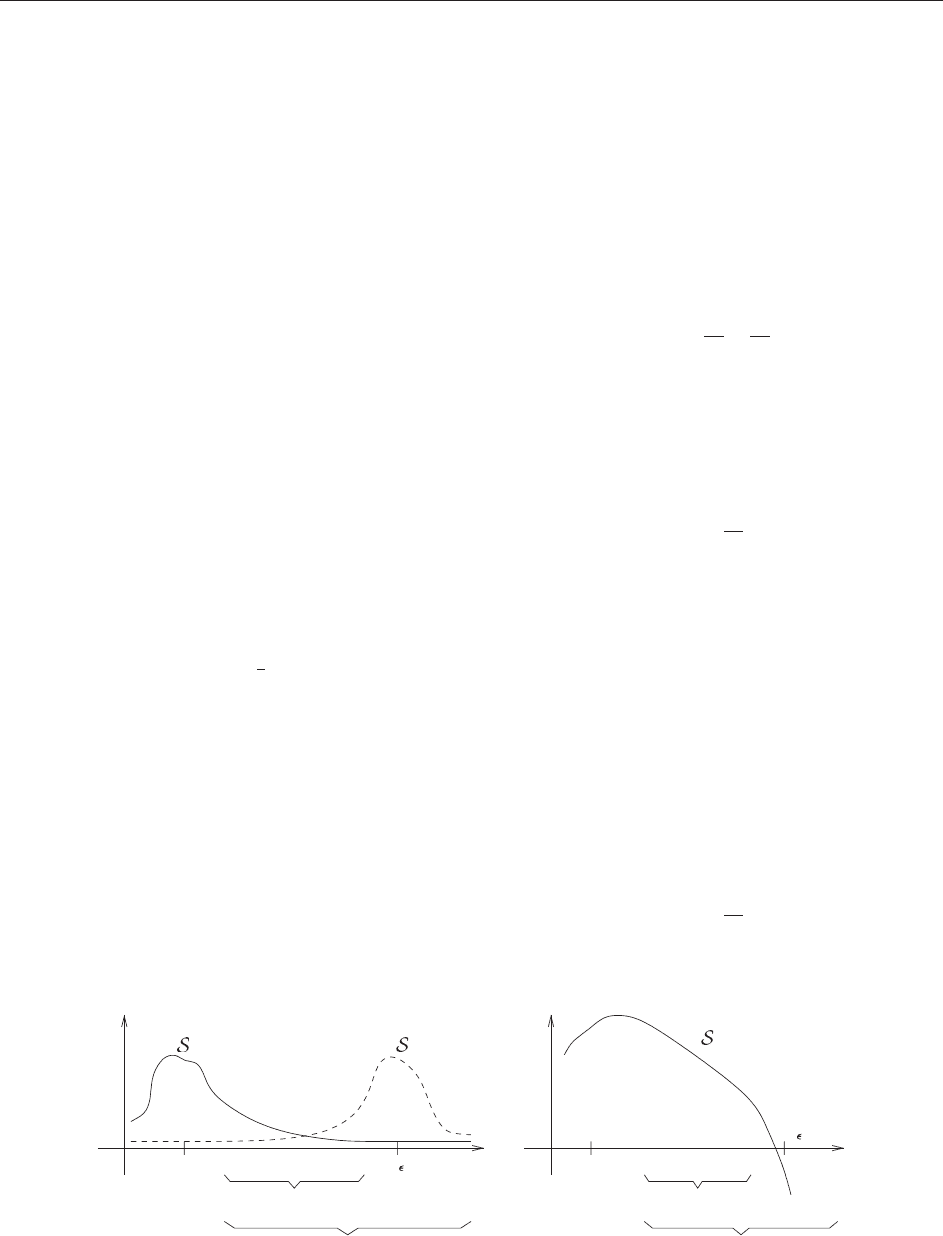
A typical distribution of energy in a turbulent
flow is depicted in Figure 4. The energy is
concentrated on the large scales, while the dissipa-
tion is concentrated near the Kolmogorov scale ‘
.
The four-fifths law becomes visible as a straight line
in the logarithmic scale.
A more precise mechanism for the energy cascade
assumes that in the inertial range, eddies with length
scale ‘ transfer kinetic energy to smaller eddies during
their characteristic timescale, also known as circula-
tion time. If u
‘
is their characteristic velocity, then
‘
= ‘=u
‘
is their circulation time, so that the kinetic
energy transferred from these eddies during this time is
‘
u
2
‘
‘
¼
u
3
‘
‘
In statistical equilibrium, the energy lost to the
smaller scales equals the energy gained from the
larger scales, and that should also equal the total
kinetic energy dissipated by viscous effects. Hence,
‘
, and we find
u
3
‘
‘
It also follows that
‘
= ‘=u
‘
= ‘(‘ )
1=3
=
1=3
‘
2=3
so
that the circulation time decreases with the length
scale and becomes of the order of the viscous
dissipation time (=)
1=2
precisely when ‘ ‘
.
A similar relation between and the large scales
can also be obtained with heuristic arguments: let e
be the mean kinetic energy and ‘
0
, a characteristic
length for the large scales. Then u
0
given by e = u
2
0
=2
is a characteristic velocity for the large scales, and
0
= ‘
0
=u
0
is the large-scale circulation time. In
statistical equilibrium, the rate of kinetic energy
dissipated per unit time and unit mass is expected to
be of the order of e=
0
, hence
u
3
0
‘
0
which is called the ‘‘energy dissipation law.’’
(κ)
κ
0
κ κ
ln κ
0
Inertial range
ln κ
Equilibrium ran
g
e
Inertial range
Equilibrium ran
g
e
ln
(κ)
ln κ
2νκ
2
(κ)
Figure 4 A typical distribution for the energy spectrum S() and the dissipation spectrum 2
2
S() in spectral space in
nonlogarithmic and logarithmic scales. The energy is mostly concentrated on the large scales while the dissipation is concentrated
near the dissipation scale. In the logarithmic scale, the four-fifths law for the energy spectrum stands out as a straight line with
slope 4=5 over the inertial range.
Turbulence Theories 301
From the energy dissipation law, several relations
between characteristic quantities of turbulent flows can
be obtained, such as ‘
0
=‘
Re
3=4
,forRe = ‘
0
u
0
=.
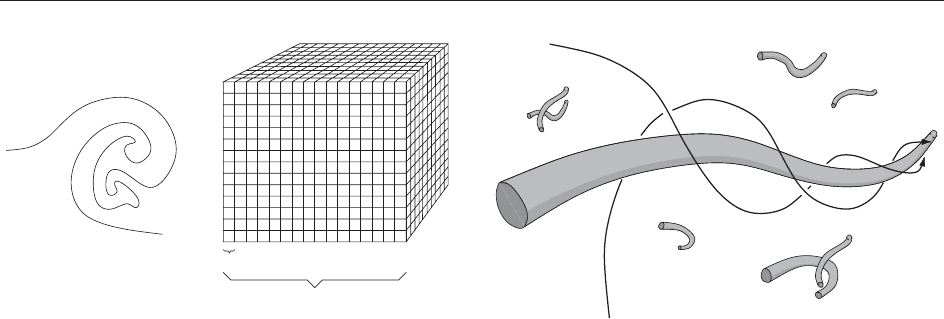
Now, assuming the active scales in a turbulent
flow exist down to the Kolmogorov scale ‘
, one
needs a three-dimensional grid with mesh spacing ‘
to resolve all the scales, which means that the
number N of degrees of freedom of the system is of
the order of N (‘
0
=‘
)
3
(see Figure 5). This
number can be estimated in terms of the Reynolds
number by N Re
9=4
. This relation is important in
predicting the computational power needed to
simulate all the active scales in turbul ent flows.
Several such universal laws can be deduced and
extended to other situations such as turbulent
boundary layers, with the famous logarithmic law
of the wall. They play a fundamental role in
turbulence modeling and closure, for the calculation
of the mean flow and other quantities.
Intermittency
The universality hypothesis based on a constant mean
energy dissipation rate throughout the flow received
some criticisms and was later modified by Kolmo-
gorov in an attempt to account for observed large
deviations on the mean rate of energy dissipation. Such
phenomenon of intermittency is related to the vortex
stretching and thinning mechanism, which leads to the
formation of coherent structures of vortex filaments of
high vorticity and low dissipation (Figure 6). These
filaments have diameter as small as the Kolmogorov
scale and longitudinal length extending from the
Taylor scale up to the large scales and with a lifetime
of the order of the large-scale circulation time.
It has been argued based on experimental evidence
that intermittency leads to modified power laws
S
p
(‘) / ‘
(p)
, (p) < p=3, for high-order (p > 3) struc-
ture functions. The issues of intermittency and
coherent structures and whether and how they could
affect the deductions of the universality theory such as
the power laws for the structure functions are far from
settled and are currently one of the major and most
fascinating issues being addressed in turbulence
theory. Several phenomenological theories attempt to
adjust the universality theory to the existence of such
coherent structures. Multifractal models, for instance,
suppose that the eddies generated in the cascade
process do not fill up the space and form multifractal
structures. Field-theoretic renormalization group
develops techni ques based on quantum field renor-
malization theory. Intermediate asymptotics also
exploits self-similar analysis and renormalization
theory but wi th a somewhat different flavor. Detailed
mathematical analysis of the vorticity equatio ns is
also playing a major role in the understanding of the
dynamics of the vorticity field.
Mathematical Aspects
of Turbulence Theory
From a mathematical perspective, it is fundamental to
develop a rigorous background upon which to study
the physical quantities of a turbulent flow. The first
problem in the mathematical theory is related to the
deterministic nature of chaotic systems assumed in
dynamical system theory and believed to hold in
turbulence. This has actually not been proved for the
Navier–Stokes equations. It is in fact one of the most
outstanding open problems in mathematics to deter-
mine whether given an initial condition for the velocity
field there exists, in some sense, a unique solution of
the Navier–Stokes equations starting with this initial
condition and valid for all later times. It has been
proved that a global solution (i.e., valid for all later
ᐉ
ᐉ
0
Figure 5 A schematic representation of a flow structure
displaying a range of active scales and a three-dimensional
grid with linear dimension ‘
0
and mesh length ‘
, sufficient to
represent all the active scales in a turbulent flow. The number of
degrees of freedom is the number of blocks: (‘
0
=‘
)
3
.
Figure 6 A portion of rotating fluid gets stretched and thinned
as the flow speeds up, generating one of many coherent
structures of high vorticity and low dissipation.
302 Turbulence Theories

times) exists but which may not be unique, and it has
been proved that unique solutions exist which may not
be global (i.e., they are guaranteed to exist as unique
solutions only for a finite time).
The difficulty here is the possible existence of
singularities in the vorticity field (vorticity becoming
infinite at some points in space and time). Depending
on how large the singularity set is, uniqueness may fail
in strictly mathematical terms. The existence of
singularities may not be a purely mathematical
curiosity, it may in fact be related with the inter-
mittency phenomenon. Rigorous studies of the vorti-
city equation may continue to reveal more fundamental
aspects on vortex dynamics and coherent structures.
The statistical theory has also been put into a firm
foundation with the notion of statistical solution of the
Navier–Stokes equations. It addresses the existence
and regularity of the probability distribution assumed
for turbulent flows and of the fundamental elements of
the statistical theory such as correlation functions and
spectra. Based on that, a number of relations between
physical quantities of turbulent flows may be derived
in a mathematically sound and definitive way. This
does not replace other theories, it is mostly a
mathematical framework upon which other techni-
ques can be applied to yield rigorous results.
Despite the difficulties in the mathematical theory
of the NSE some successes have been collected such
as estimates for the number of degrees of freedom in
terms of frac tal dimensions of suitable sets asso-
ciated with the solutions of the Navier–Stokes
equations, and partial estimates of a number of
relations derived in the statistical theory of fully
developed turbulence.
See also: Bifurcations in Fluid Dynamics; Geophysical
Dynamics; Incompressible Euler Equations:
Mathematical Theory; Intermittency in Turbulence;
Inviscid Flows; Lagrangian Dispersion (Passive Scalar);
Stochastic Hydrodynamics; Variational Methods in
Turbulence; Viscous Incompressible Fluids:
Mathematical Theory; Vortex Dynamics; Wavelets:
Application to Turbulence.
Further Reading
Adzhemyan LT, Antonov NV, and Vasiliev AN (1999) The Field
Theoretic Renormalization Group in Fully Developed Turbu-
lence. Amsterdam: Gordon and Breach.
Barenblatt GI and Chorin AJ (1998) New perspectives in
turbulence: scaling laws, asymptotics, and intermittency.
SIAM Review 40(2): 265–291.
Batchelor GK (1953) The Theory of Homogeneous Turbulence.
Cambridge Monographs on Mechanics and Applied Mathe-
matics. New York: Cambridge University Press.
Chorin AJ (1994) Vorticity and Turbulence. Applied Mathema-
tical Sciences vol. 103, New York: Springer.
Constantin P (1994) Geometric statistics in turbulence. SIAM
Review 36: 73–98.
Foias C, Manley OP, Rosa R, and Temam R (2001) Navier–Stokes
Equations and Turbulence. Encyclopedia of Mathematics and its
Applications, vol. 83. Cambridge: Cambridge University Press.
Friedlander S and Topper L (1961) Turbulence. Classic Papers on
Statistical Theory. New York: Interscience Publisher.
Frisch U (1995) Turbulence. The Legacy of A. N. Kolmogorov.
Cambridge: Cambridge University Press.
Hinze JO (1975) Turbulence. McGraw-Hill Series in Mechanical
Engineering. New York: McGraw-Hill.
Holmes P, Lumley JL, and Berkooz G (1996) Turbulence,
Coherent Structures, Dynamical Systems, and Symmetry.
Cambridge: Cambridge University Press.
Lesieur M (1997) Turbulence in Fluids. Fluid Mechanics and its
Applications, 3rd edn. vol. 40. Dordrecht: Kluwer Academic.
Monin AS and Yaglom AM (1975) Statistical Fluid Mechanics:
Mechanics of Turbulence 2. Cambridge: MIT Press.
Sagaut P (2001) Large Eddy Simulation for Incompressible Flows.
Berlin: Springer.
Schlichting H and Gersten K (2000) Boundary Layer Theory, 8th
edn. Berlin: Springer.
Tennekes H and Lumley JL (1972) A First Course in Turbulence.
Cambridge, MA: MIT Press.
Vishik MI and Fursikov AV (1988) Mathematical Problems of
Statistical Hydrodynamics. Dordrecht: Kluwer.
Wilcox DC (2000) Turbulence Modeling for CFD, 2nd edn.
Anaheim, CA: DCW Industries Inc.
Twistor Theory: Some Applications
L Mason, University of Oxford, Oxford, UK
ª 2006 Elsevier Ltd. All rights reserved.
Introduction
Roger Penrose introduced twistor theory as a geome-
trical framework for basic physics in order to unify
quantum theory and gravity. This program has had
many successes along the way, but the long-term goals
of reformulating and superceding the established
theories of basic physics are still a long way from
being fulfilled. Nevertheless, the successes have had
many important applications across mathematics and
mathematical physics. This article will concentrate on
three areas of application: integrable systems, geome-
try, and perturbative gauge theory (via twistor-string
theory). It is intended to be self-contained as far as
possible, but the reader may well find it easier to first
read the article Twistors.
Twistor Theory: Some Applications 303

Twistor Theory
A basic motivation of twistor theory is to bring out
the complex (holomorphic) geometry that underlies
real spacetime. In genera l relativity, a spacetime is a
4-manifold with metric g of signature (1, 3), and
when it is flat, that is, g = dt
2
dx
2
dy
2
dz
2
,
where (t, x, y, z) are coordinates on R
4
, it is called
Minkowski space. The first appearance of a com-
plex structure arises from the fact that, at a given
event, the celestial sphere of light rays (directions of
zero length with respect to g) naturally has the
structure of the Riemann sphere, CP
1
, in such a way
that Lorentz transformations (linear transformations
of the tangent space preserving the metric) act on
this sphere by Mo¨ bius transformations. These are
the maximal group of complex analytic transforma-
tions of CP
1
.
Twistor space extends this idea to the whole of
Minkowski space. Denoted PT, the twistor space for
Minkowski space is complex projective 3-space, CP
3
,
the space of one-dimensional subspaces of C
4
;itisa
three-dimensional complex manifold obtained by add-
ing a ‘ ‘plane at infinity’ ’ to C
3
. Explicitly, we can
introduce homogeneous coordinates Z
2 C
4
{0}
with =0,1, 2,3 but where Z
Z
for 2C {0}.
Affine coordinates on a C
3
chart Z
3
6¼0can
be obtained by setting (z
1
,z
2
,)= (Z
0
=Z
3
,Z
1
=Z
3
,
Z
2
=Z
3
). Physically, points of twistor space corre-
spond to spinning massless particles in Minkowski
space. Mathematically, the correspondence can be
understood as the Klein correspondence.
The Klein Correspondence
The correspondence between PT and Minkowski
space can be extended first to complexified Minkowski
space so that the coordinates are allowed to take on
values in C, and then to its conformal compactification
by including the ‘‘light cone at infinity.’’ It then
coincides with the classical complex Klein correspon-
dence. The Klein correspondence is the one-to-one
correspondence between lines in CP
3
and points of a
four complex-dimensional quadric, CM,inCP
5
.The
4-quadric CM can be understood as conformally
compactified complexified Minkowski space. Introdu-
cing affine coordinates (z
1
, z
2
, )onPT and (t, x, y, z)
on CM,wefindthatapoint(t, x, y, z)inCM
corresponds to a line in PT according to
z
1
z
2
¼
t zxþ iy
x iytþ z
1
Alternatively, fixing (, z
1
, z
2
) in these equations
gives a 2-plane in complex Minkowski space
corresponding to all the lines in PT through
(, z
1
, z
2
). Such 2-planes are called ‘‘-planes.’’
They are totally null (i.e., the tangent vectors not
only have zero length but are also mutually
orthogonal) and also self-dual (under the differential
geometer’s notion of Hodge duality).
This complex correspondence can also be
restricted to give correspondences for R
4
with
metrics of positive-definite, Euclidean, signature or
ultrahyperbolic, (2, 2), signature. A particular sim-
plification in Euclidean signature is that the complex
-planes intersect the real slice in a point. The
conformal compactification of Euclidean R
4
is the
4-sphere S
4
given by adding a single point at infinity,
and so we have a projection p : PT !S
4
whose
fibers are holomorphically embedded CP
1
s. These
fibers can be characterized as the lines in PT that
are invariant under a quaternionic complex con-
jugation which is an antiholomorpic map^: PT !
PT with no fixed points. (Here quaternionic means
that on the nonprojective twistor space, T = C
4
, the
conjugation has the propert y
^
^
Z = Z so that it
defines a second complex structure anticommuting
with the standard one; this is sufficient to express
T = Q
2
, where Q denotes the quaternions. The
complex structures i, j, and k of the quaternions
are given by identifying i with
ffiffiffiffiffiffiffi
1
p
on C
4
and j
with^and k = ij.)
The Penrose Transform
A basic task of twistor theory is to transform
solutions to the field equations of mathematical
physics into objects on twistor space. This works
well for linear massless fields such as the Weyl
neutrino equation, Maxwell’s equations for electro-
magnetism and linearized gravity. In its general
form, this transform has become known as the
Penrose transform. Such fields correspond to freely
prescribable holomorphic functions f (, z
1
, z
2
) (or,
more precisely, analytic cohomology classes) on
regions of twistor space. The field can be obtained
from this function by means of a contour integral.
The simplest of these integral form ulas is
ðx
a
Þ¼
I
f ; t z þ ðx þ iyÞ; x iyð
þðt þ zÞÞd
and differentiation under the integral sign leads
easily to the fact that satisfies the wave equation
@
2
@t
2
@
2
@x
2
@
2
@y
2
@
2
@z
2
¼ 0
This formula was originally discovered by Bateman.
Note that f must have singularities on twistor space
to yield a nontrivial and even then, there are many
choices of f that yield zero. For a solution defined
304 Twistor Theory: Some Applications

over a region U in spacetime, the function f is
correctly understood as a representative of a Cech
cohomology class defined on the region U
0
in twistor
space swept out by the lines corre sponding to points
of U. Furthermore, the function f should be taken
globally to be a function of homogeneity 2,
f (Z
) =
2
f (Z
). This formula has generalizations
to massless fields of all helicities in which a field of
helicity s corresponds to a function (Cech cocycle) of
homogeneity degree 2s 2.
The Penrose transform has found important
applications in representation theory and integral
geometry. For a review, the reader is referred to
Baston and Eastwood (1989), the relevant survey
articles in Bailey and Baston (1990),orMason and
Hughston (1990, chapter 1).
Twistor Theory and Nonlinear Equations
The Penrose transform for the Maxwell equations
and linearized gravity turns out to be linearizations
of correspondences for the nonlinear analogs of
these equations: the Einstein vacuum equations and
the Yang–Mills equations. However, the construc-
tions only work when these fields are anti-self-dual.
This is the condition that the curvature 2-forms
satisfy F
= iF, where denotes the Hodge dual
(which, up to certain factors of i, has the effect of
interchanging electric and magnetic fields); it is a
nonlinear generalization of the right-handed circular
polarization condition. Explicitly, in terms of space-
time indices a, b, ... =0, 1, 2, 3, F
ab
= (1=2)"
abcd
F
cd
,
where "
0123
= 1 and "
abcd
= "
[abcd]
. In Minkowski
signature, the i factor in the anti-self-duality condi-
tion implies that real fields cannot be anti-self-dual.
Thus, these extensions are not sufficient to fulfill the
ambitions of twistor theory to incorporate real
classical nonlinear physics in Minkowski space.
However, the factor of i is not present in Euclidean
and ultrahyperbolic signature, so the anti-self-
duality condition is consistent with real fields in
these signatures and this is where the main applica-
tions of these constructions have been.
The Nonlinear Graviton Construction
and Its Generalizations
The first nonlinear twistor construction was due to
Penrose (1976), and was inspired by Newman’s
(1976) construction of ‘‘heavens’’ from the infinities
of asymptotically flat spacetimes in general
relativity.
The nonlinear graviton construction proceeds
from the definition of twisto rs in flat spacetime as
-planes in complexified Minkowski space. It is
natural to ask which complexified metrics admit a
full family of -surfaces, that is, 2-surfaces that are
totally null and self-dual. The answer is that a full
family of -surfaces exists iff the conformally
invariant part of the curvature tensor, the Weyl
tensor, is anti-self-dual. If this is the case, twistor
space can be defined to be the (necessarily three-
dimensional) space of such -surfaces.
The remarkable fact is that the twistor space,
together with its complex structure, is sufficient to
determine the original spacetime. Twistor space is
again a three-dimensional complex manifold, and
contains holomorphically embedded rational curves,
CP
1
s, at least one for each point of the spacetime.
However, holomorphic rigidity implies that the
family of rational curves is precisely four-
dimensional over the complex numbers. Further-
more, incidence of a pair of curves can be taken to
imply that the corresponding points in spacetime lie
on a null geodesic and this yields a conformal
structure on spacetime. Further structures on twistor
space can be imposed to give the complex spacetime
a metric that is vacuum, perhaps with a cosmologi-
cal constant. The correspondence is stable under
small deformations and so the data defining the
twistor space is effectively freely prescribable, see
Penrose (1976).
In Euclidean signature, again the complex
-planes intersect the real spacetime in a point, so
the tw istor space again fibers over spacetime. The
twistor fibration can be constr ucted as the projecti-
vized bundle of self-dual spinors or more commonly
as the unit sphere bundle in the space of self-dual
2-forms (Atiyah et al. 1978). In the latter formula-
tion, the complex structure on the twistor space
arises from the direct sum of the naturall y defined
complex structures on the horizontal and vertical
tangent spaces to the bundle; that on the vertical
subspace is the standard one on the sphere, and that
on the horizontal subspace is a multiple of the self-
dual 2-form at the given point of the fiber.
There are now large families of extensions,
generalizations, and reductions of this construction.
They are all based on the idea of realizing a space
with a given complexified geometric structure as the
parameter space of a family of holom orphically
embedded submanifol ds inside a twistor space. In
general, the most useful of these constructions are
those in which the ‘‘spacetime’’ is obtained as the
space of rational curves in a twistor space. This is
because the equations that are solved on the
corresponding spacetime can be though t of as a
completely integrable system in which the integr-
ability condition for the generalized -surfaces is
interpreted as the consistency condition of a Lax
Twistor Theory: Some Applications 305

pair or more general linear system. For a more
detailed discussion from this point of view, see
Mason and Woodhouse (1996, chapter 13).
The Anti-Self-Dual Yang–Mills Equation
and Its Twistor Correspondence
The anti-self-dual Yang–Mills equations extend
Maxwell’s equations for electr omagnetism in the
right-circularly polarized case. They are a family of
equations that depend on a choice of Lie group G,
usually taken to be a group of complex matrices;
Maxwell’s equations arise when G = U(1).
Introduce coordinates x
a
, a = 0, 1, 2, 3, on R
4
with
metric ds
2
= dx
0
dx
3
dx
1
dx
2
(this is a metric of
ultrahyperbolic signature – Euclidean signature can
be obtained by choosing the coo rdinates to be
complex, but with (x
3
, x
2
) the complex conjugates
of (x
0
, x
1
)). The dependent variables are the compo-
nents A
a
of a connection D
a
= @
a
A
a
, where
@
a
= @=@x
a
and A
a
= A
a
(x
b
) 2 Lie G, the Lie algebra
of G. This connection defines a method of differ-
entiating vector-valued functions s in some repre-
sentation of G. The freedom in changing bases for
the vector bundle induce the gauge transformations
A
a
!g
1
A
a
g g
1
@
a
g, g(x) 2 G on A
a
; two connec-
tions that are related by a gauge transformation are
deemed to be the same. The self-dual Yang–Mills
equations are the condition
½D
0
; D
2
¼½D
1
; D
3
¼½D
0
; D
3
½D
1
; D
2
¼0
They are the compatibility conditions
½D
0
þ D
1
; D
2
þ D
3
¼0
for the linear system of equations
ðD
0
D
1
Þs ¼ðD
2
D
3
Þs ¼ 0 ½1
where 2 C and s is an n-component column
vector. The se latter equations form a ‘‘Lax pair’’
for the system.
The Ward (1977) construction provides a one–one
correspondence between gauge equivalence classes
of solut ions of the self-dual Yang–Mills equations
and holomorphic vector bundles on regions in
twistor space. The key point here is that eqn [1]
defines parallel propagation along -planes. To each
point Z in twistor space, we can associate the vector
space E
Z
of solutions to eqn [1] along the
corresponding -plane. These vector spaces vary
holomorphically with Z and that is what one means
by a holomorphic vector bundle E !PT. The
remarkable fact is that the anti-self-dual Yang–
Mills field can be reconstructed up to gauge from E,
and, in effect, for local analytic solutions, E can be
represented by freely prescribable ‘‘patching’’ data
consisting of local holomorphic matrix-valued func-
tions on twistor space. To construct the solution on
spacetime, one must first find a Birkhoff factoriza-
tion of the patching data on each Riemann sphere in
twistor space corresponding to points of the appro-
priate region in spacetime. On each Riemann sphere,
the Birkhoff factorization starts with the given
patching function with values in GL(n, C) on the
real axis in the complex plane, and expresses it as a
product of functions with values in GL(n, C) one of
which extends over the upper-half plane, and the
other over the lower-half complex plane. The anti-
self-dual conn ection can be obtained by differentiat-
ing the resulting matrices. See Penrose (1984, 1986),
Ward and Wells (1990),orMason and Woodhouse
(1996) for a full discussion, and Atiyah (1979) for
the formulation appropriate to Euclidean signature.
Completely Integrable Systems
In effect, the twistor constructions amount to
providing a geometric general local solution to the
anti-self-duality equations; the twistor data is, for a
local solution, freely prescribable. In this sense, they
demonstrate complete integrability of the anti-self-
duality equations. The reconstruction of a solution
on spacetime from twistor data is not a quadrature –
it involves, in the anti-self-dual Yang–Mills case, a
Birkhoff fact orization (also sometimes referred to as
the solution to a Riemann–Hilbert problem), and in
the case of the anti-self-dual Einstei n equations, the
construction of a family of rational curves inside a
complex manifold. Nevertheless, such constructions
are a familiar part of the apparatus of the theory of
integrable systems.
In Ward (1985), this connection with integrable
systems was developed further, and the anti-self-
dual Yang–Mills equations were shown to yield
many important integrable systems under symmetry
reduction. Ward’s list has been extended and now
includes many of the most famous examples of
integrable systems such as the Painleve´ equation s,
the Korteweg–de Vries (KdV) equation, the non-
linear Schro¨ dinger equation, the n-wave equations,
and so on, see Mason and Woodhouse (1996) for a
review. There are some notable omissions from the
list such as the Kadomtsev–Petviashvili (KP) and
Davey–Stewartson equations (at least if one restricts
oneself to finite-dimensional gauge groups; reduc-
tions using infinite dimensional gauge groups have
been obtained).
The list of integrable systems obtainable by
symmetry reduction nevertheless remains impressive
and provides a route to the classification of at least
those integrable systems that can be obtained in this
306 Twistor Theory: Some Applications

way. Such systems can be classified by the choice of
ingredients required in the symmetry reduction: the
gauge group, the group of spacetime symmetries to
be reduced by, the choice of Euclidean or ultra-
hyperbolic signature, and the choice of certain
constants of integration that arise in the reduction.
Another implication is that if an integrable system
can be obtained from one of the self-duality
equations by symmetry reduction, then it inherits a
reduced twistor correspondence because the twistor
correspondences share the symmetry groups of the
spacetime field equations. These twistor correspon-
dences can be seen to underlie much of the theory of
these equations; for example, Backlund transforma-
tions of so lutions correspond to elementary alge-
braic operations on the twistor data, similarly the
Kac–Moody Lie algebras of hidden symmetries act
locally on the twistor data by matrix multiplicat ion
of the appropriate loop algebras. Similarly, the
inverse-scattering transform for the KdV and non-
linear Schrodinger equations can be seen to arise as
particular presentation s of the twistor construction.
By and large, although twistor methods have
yielded new insight into the geometry and structure
of systems in dimensions 1 and 2, they have not
necessarily superceded pre-existing techniques for
constructing solutions and analyzing the solution
space. The systems for which twistor method s have
been particularly effective for constructing solutions
and characterizing their properties are in 2 þ 1or
higher dimension. Key examples here are of course
the anti-self-dual Yang–Mills and Einstein equations
themselves, and their single translation reductions.
In the anti-self-dual Yang–Mills case, these reduc-
tions lead either to Ward’s or Manakov and
Zakharov’s chiral model in Lorentzian signature,
2 þ 1, or the Bogomolny equations for monopoles,
the reduction from Euclidean signature. In both
cases, the twistor construction has played a major
role in constructing and studying the solitonic
solutions.
See Ward and Wells (1990), Mason and Wood-
house (1996), Ward’s article in Huggett et al. (1998)
and the first few chapters of Mason et al. (1995),
and Mason et al. (2001) for more examples of
aspects of the theory of integrable systems arising
from twistor correspondences.
Applications to Geometry
These applications are, to a large extent, higher-
dimensional analogs of those discussed above; most
of the problems in geometry to which twistor theory
has been applied are those for which the unde rlying
differential equations are integrable. These start
with the Euclidean signature versions of the original
Ward construction for anti-self-dual Yang– Mills
fields and Penrose’s nonlinear graviton construction
for Ricci-flat anti-self-dual metrics but, as we will
discuss, these constructions have a number of
extensions and generalizations.
The first dramatic application of these construc-
tions was the ADHM construction of Yang–Mills
instantons. These are absolute minima of the Yang–
Mills action, S[A] =
R
tr(F ^ F
) on the 4-sphere, S
4
,
with its round metric. A simple argument shows that
the action is bounde d below by the second Chern
class of the bundle and that this bound is achieved
only for anti-self-dual fields. Thus, the problem was
to characterize all the anti-self-dual Yang–Mills
fields on S
4
. In this Euclidean context, twistor
space, CP
3
, fibers over S
4
and the corresponding
Ward vector bundle is a bundle over all of CP
3
.It
turns out that all such bundles satisfying a certain
stability condition had been constructed reasonably
explicitly by alge braic geome ters. Since the stability
condition was implied by the context, this could be
turned into an algebraic construction of the general
instanton explicit enough to give some insight into
both the local and global structure of the solution
space. See Atiyah (1979) for a review.
Hitchin used the Euclidean version of the non-
linear graviton to develop the theory of gravitational
instantons that are asymptotically locally Euclidean
(i.e., asymptotically R
4
=, where is a finite
subgroup of the rotation group). These were finally
constructed by Kronheimer who again used twistor
theory to identify the appropriate parameter space,
see his article in Mason et al. (2001) and Dancer’s
review of hyper-Ka¨ hler manifolds in LeBrun and
Wang (1999).
Even in four dimensions, there are a number of
variants of the nonlinear graviton construction. The
basic twistor correspondence produces a twistor
space that is a complex 3-manifold PT for
4-manifolds with conformal structures whose Weyl
tensor is anti-self-dual. There are four natural
specializations that have attracted study: (1) the
Ricci-flat case, (2) the Einstein case (with nonzero
cosmological constant), (3) the scalar-flat Ka¨ hler
case, and (4) the hypercomplex case.
The twistor space in the Ricci-flat case admits the
additional structure of a fibration over CP
1
together
with a holomorphic Poisson structure on the fibers
with values in the pullback of the 1-forms on CP
1
(alternatively, the bundle of holomorphic 3-forms
should be the pullback of the square of the bundle of
holomorphic 1-forms on CP
1
). The Einstein case
with nonzero cosmological constant is a variant of
this in which the twistor space admits a
Twistor Theory: Some Applications 307