
Francoise J.-P., Naber G.L., Tsun T.S. (editors) Encyclopedia of Mathematical Physics
Подождите немного. Документ загружается.

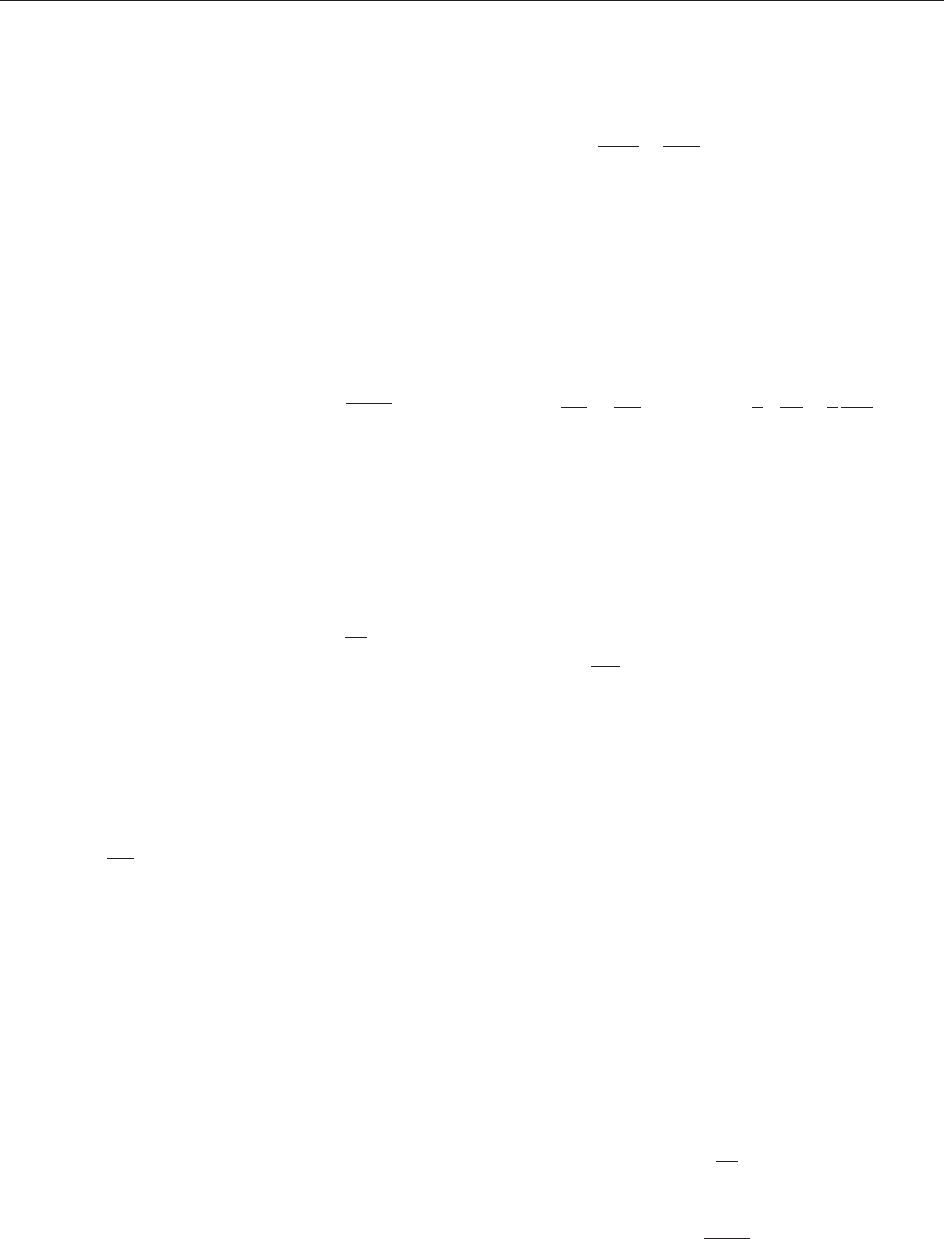
The puncture and dilaton equations for (p,1)
theories read
h
0;0
n
1
;k
1
n
s
;k
s
i
g
¼
X
s
i¼1;n
i
6¼0
h
n
1
;k
1
n
i
1;k
i
n
s
;k
s
i
g
½27
h
1;0
n
1
;k
1
n
s
;k
s
i
g
¼ð2g 2 þ sÞh
n
1
;k
1
n
s
;k
s
i
g
½28
The special terms at g = 0 and g = 1 are given by
h
0;0
0;i
0;pi2
i
0
¼ 1; h
1;0
i
1
¼
p 1
24
½29
Integrable Hierarchy
We now summarize some basic facts about the
integrable hierarchy (see for instance eqn [5]). We
introduce a pth order differential operator:
L ¼ D
p
þ
X
p2
i¼0
u
i
ðxÞD
i
; D
@
@x
½30
where the coefficient functions u
i
are arbitrary
functions of x. This Lax operator describes the pth
generalized KdV hierarch y. We consider the time
evolution of the operator L by an infi nite set of
commuting H amiltonians:
@L
@t
n
¼½H
n
; L; n ¼ 1; 2; ... ½31
where H
n
is given by
H
n
¼ L
n=p
þ
½32
Here ‘‘þ’’ denotes the non-negative part of a
pseudodifferential operator and is defined as
A ¼
X
n
i¼1
f
i
ðxÞD
i
; A
þ
¼
X
n
i¼0
f
i
ðxÞD
i
½33
We also use the notation
res A ¼ f
1
ðxÞ; A
¼
X
1
i¼1
f
i
ðxÞD
i
½34
Note that x is identified as the first time variable t
1
,
that is, x = t
1
.
It is a basic result of the calculus of pseudodiffer-
ential operators that the a bove Hamiltonians satisfy
the zero-curvature condition
@H
m
@t
n
@H
n
@t
m
þ½H
m
; H
n
¼0 ½35
Note that when m is a multiple of p, H
m
becomes a
power of L and trivially commutes with L. Thus, the
time variables t
m
are absent for n 0 mod p. In the
simple case of p = 2, one has
L ¼ D
2
þ uðxÞ½36
and H
3
= D
3
þ (3=2)uD þ (3=4)u
0
. One finds
@L
@t
3
¼
@u
@t
3
¼½H
3
; L¼
3
2
u
@u
@x
þ
1
4
@
3
u
@x
3
½37
which is the standard KdV equation.
In the case of KP hierarchy, one starts with a
pseudodifferential operator
Q ¼ D þ
X
1
i¼1
a
i
D
i
½38
and considers the time evolution equations
@Q
@t
n
¼½H
n
; Q; H
n
¼ Q
n
ðÞ
þ
½39
p-reduced KP hierarchy is obtained if one has
Q
p
¼ 0 ½40
By introducing a pseudodifferential operator K, one
may bring Q to the sim ple derivative operator D as
Q ¼ KDK
1
½41
K has an expansion of the form
K ¼ 1 þ
X
1
i¼1
a
i
D
i
½42
After time evolution, the coefficient functions u
i
(x)
of the Lax operator dep end also on the variables
t
2
, t
3
, ... and become functions of t {t
1
, t
2
, ...}.
These functions are expressed by the -function (t)
of the hierarchy in the following manner :
res K ¼
@
@x
log ðtÞ½43
res L
i=p
¼
@
2
@x@t
i
log ðtÞ½44
These residues are expressed in terms of {u
i
} and
their derivatives in x, and one can determine them in
terms of the -function.
268 Topological Gravity, Two-Dimensional
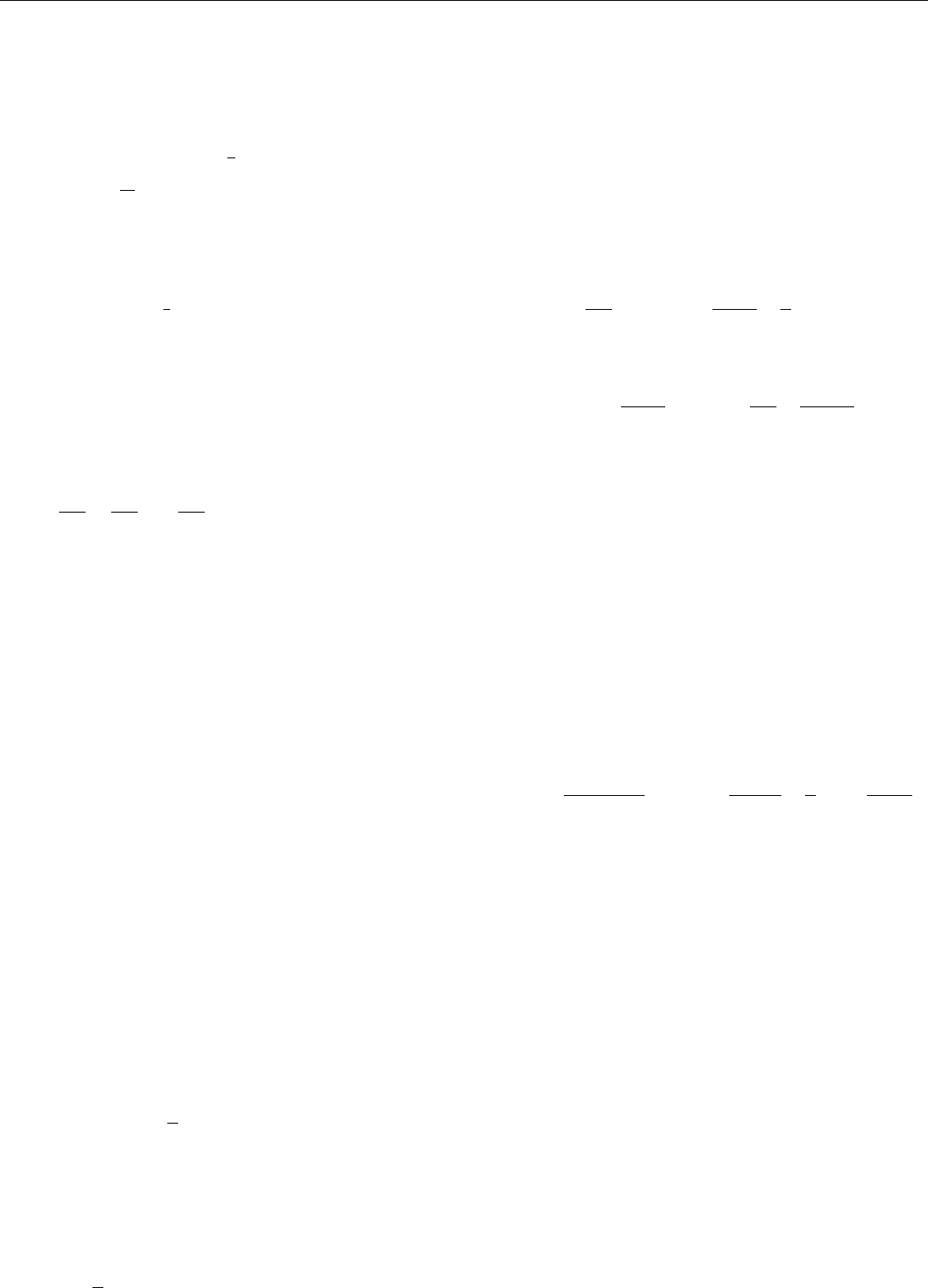
In the case p = 2, one has
½H
k
; L¼2D resðL
k=2
Þ¼DR
k
; k ¼ odd ½45
Here {R
k
} are the Gelfand–Dikii potentials
R
1
¼ u; R
3
¼
1
4
ð3u
2
þ u
00
Þ
R
5
¼
1
16
ð10u
3
þ 5u
02
þ 10uu
00
þ u
0000
Þ
.
.
.
½46
and obey the recursion relation
DR
kþ2
¼
1
4
D
3
þ 2ðDu þ uDÞ
R
k
½47
If one uses the relation [44], Gelfand–Dikii potentials
are identified as
R
k
¼ 2hO
1
O
k
i½48
By setting k = 1, we note u = 2hO
1
O
1
i and find that
the evolution equations [31] are all satisfied as
@L
@t
k
¼
@u
@t
k
¼ 2
@
@t
k
hO
1
O
1
i¼2DhO
1
O
k
i
¼ DR
k
¼½H
k
; L½49
Now it is possible to identify the initial condition
for the Lax operator in the case of topological (p,1)
gravity. By using the definition
log ðtÞ¼
X
1
g¼0
exp
X
n
t
n
O
n
*+
g
½50
one has
res L
i=p
ð0Þ¼hO
1
O
i
i; i ¼ 1; ...; p 1 ½51
From [29] one finds
resL
i=p
ð0Þ¼ix
i;p1
½52
This gives the initial value of the Lax operat or:
Lð0Þ¼D
p
þ px ½53
Thus, only the lowest term u
0
(x) = px is nonzero
and higher coefficients all vanish at t = 0. This is the
special simplification which takes place in the
topological gravity theory.
We note a relation
1
p
D; Lð0Þ
¼ 1 ½54
This is the so-called ‘‘string equation’’ (at t = 0). At
nonzero values of t, the string equation takes the form
½P; L¼1
P ¼
1
p
ðL
1=p
Þ
þ
X
k¼pþ1
kt
k
ðL
ðkpÞ=p
Þ
þ
0
@
1
A
½55
From [55], we see that (p, 1) theory corresponds to the
background value of the coupling t
pþ1
= 1=(p þ 1).
In the case of (p, q) theory, background value is given
by t
pqþ1
= 1=(pq þ 1).
Virasoro Conditions
A powerful algebraic machinery controlling
the structure of 2D gravity is the so-called ‘‘Virasoro
conditions.’’ One introduces differential operators
L
1
¼
@
@t
1
þ
X
1
k¼pþ1
kt
k
@
@t
kp
þ
1
2
X
iþj¼p
ijt
i
t
j
½56
L
0
¼
@
@t
pþ1
þ
X
1
k¼1
kt
k
@
@t
k
þ
p
2
1
24
½57
By using the fact that deri vative in t
n
brings down
the operator O
n
when acting on the -function, it is
easy to show that
L
1
¼ 0 ½58
L
0
¼ 0 ½59
reproduce the puncture [27] and dilaton equation
[28], respectively. It is possible to show that the
L
1
-condition, L
1
= 0, is equivalent to the
string equation [55].
Together with the operators (n 1)
L
n
¼
@
@t
1þðnþ1Þp
þ
X
1
k¼1
kt
k
@
@t
kþnp
þ
1
2
X
iþj¼np
@
2
@t
i
@t
j
they generate Virasoro algebra (L
0
n
(1=p)L
n
)
½L
0
m
; L
0
n
¼ðm nÞL
0
mþn
; n; m 1 ½60
It is possible to show that the (p, 1) model obeys the
Virasoro conditions [6]
L
n
¼ 0; n 1 ½61
It is known that (p, 1) models with p > 2 also obey
constraints of W-algebra.
The relationship of the Virasoro conditions to
KdV hierarchy is summarized as
string equation þ KdV hierarchy
() Virasoro and W-algebra constraints
Topological -Model
It is known that when the target space of a
supersymmetric nonlinear -model is a Kahler
manifold K, the theory acquires an enhanced N = 2
Topological Gravity, Two-Dimensional 269

supersymmetry. Then we can twist the theory and
converted into a topological field theory. This is the
topological -model [7]. The partition function of
the theory consists of a sum over world-sheet
instantons, that is, holomorphic maps from the
Riemann surface to the target space K. Due to
supersymmetry, functional determinants around
instantons cancel and the theory simply counts the
number of holomorphic curves inside the Kahler
manifold K. Thus, the topological -model has a
close relationship with enumerative problems in
algebraic geometry, that is, Gromov–Witten invar-
iants and quantum cohomology theory .
When the topological -model is coupled to topolo-
gical gravity, the BRST-invariant observables are given
by
n
(
i
)
n
i
,where
i
are cohomology classes
of K. Correlation functions are defined as
Y
s
i¼1
n
i
ð
i
Þ
*+
g;d
¼
Z
MðK;dÞ
g;s
Y
s
i¼1
c
i
ðL
i
Þ
n
i
^ e
i
ð
i
Þ½62
Here
M
g, s
(K; d) denotes the (stable compactification
of) moduli space of degree d holomorphic maps
to K from genus g Riemann surfaces . e
i
is the
pullback of the evaluatio n map e
i
:(f ; x
1
, ..., x
s
) 2
M
g, s
(K; d) ! f (x
i
) 2 K by f where f is a holo-
morphic map. Correlation functions [62] give
topological (symplectic) invariants of the manifold
K. In the cases n
i
= 0(i = 1, ..., s), they are known as
Gromov–Witten invariants.
Equation [62] is nonvanishing if the selection rule
X
s
i¼1
ðn
i
þq
i
Þ¼dim M
g;s
ðK; dÞ
¼ c
1
ðKÞd þð3 dim KÞðg 1Þþs ½63
is obeyed, where q
i
is the degree of cohomology
class
i
and c
1
(K) is the first Chern class of the
tangent bundle of K.
We see that there is a close parallel between the
topological -model and (p, 1) topological gravity.
If we formally set q
i
= ‘
i
=p, c
1
(K) = 0, and dim K =
(p 2)=p, eqn [63] agrees with eqn [25]. Based on this
analogy, Eguchi, Hori, and Xiong proposed the
Virasoro conjecture [8], that is, generating functions
of the number of holomorphic maps to arbitrary
Kahler manifolds are annihilated by the Virasoro
operators which are constructed by taking an analogy
with those of (p, 1) gravity. The Virasoro conjecture is
a natural generalization of Witten’s conjecture, and
has recently been rigorously proved in the case of
curves and projective spaces.
Excellent reviews on the theory of 2D topological
gravity are given in Witten (1991) and Dijkgraaf (1991).
See also: Axiomatic Approach to Topological Quantum
Field Theory; Large-N and Topological Strings; Mirror
Symmetry: A Geometric Survey; Moduli Spaces: An
Introduction; Riemann Surfaces; Topological Sigma
Models; WDVV Equations and Frobenius Manifolds.
Further Reading
Bre´zin E and Kazakov V (1990) Exactly soluble field theory of
closed strings. Physics Letters B 236: 144.
Dijkgraaf R (1991) Lectures Presented a t Carge´ se Summer
School on New Symmetry Principles in Quantum Field
Theory, hep-th/9201003.
Dijkgraaf R, Verlinde E, and Verlinde H (1991) Loop equations
and Virasoro constraints in non-perturbative 2d quantum
gravity. Nulcear Physics B 348: 435.
Douglas M and Shenker S (1990) Strings in less than one dimension.
Nuclear Physics B 335: 635.
Eguchi T and Yang S-K (1990) N = 2 superconformal models
as topological field theories. Modern Physics Letters A 5: 1693.
Eguchi T, Hori K, and Xiong C-S (1997) Quantum cohomology
and Virasoro algebra. Physics Letters B 402: 71.
Fukuma M, Kawai H, and Nakayama R (1991) Continuum
Schwinger–Dyson equations and universal structures in two-
dimensional quantum gravity. International Journal of Mod-
ern Physics A 6: 1385.
Gelfand IM and Dikii LA (1975) Asymptotic behavior of the
resolvent of Sturm–Liouville equations and the algebra of the
Korteweg–de Vries equations. Russian Mathematical Surveys
30(5): 77–113.
Gross D and Migdal A (1990) Non-perturbative two dimensional
quantum gravity. Physical Review Letters 64: 17.
Kontsevich M (1991) Intersection theory on the moduli space of
curves and the matrix Airy function. Communications in
Mathematical Physics.
Witten E (1988) Topological sigma models. Communications in
Mathematical Physics 118: 411.
Witten E (1990) On the topological phase of two dimensional
gravity. Nuclear Physics B 340: 281.
Witten E (1991) Two-dimensional gravity and intersection theory of
moduli space. Surveys in Differential Geometry 1: 243–310.
270 Topological Gravity, Two-Dimensional

Topological Knot Theory and Macroscopic Physics
L Boi, EHESS and LUTH, Paris, France
ª 2006 Elsevier Ltd. All rights reserved.
Introduction to the Physical and
Mathematical Contexts and Issues
One of the most exciting developments of mathema-
tical physics in the last three decades has been the
discovery of numerous intimate relationships between
the topology and the geometry of knot theory and the
dynamics of many domains of ‘‘classical’’ and ‘‘new’’
macroscopic physics. Indeed, complex systems of
knotted and entangled filamentary structures are
ubiquitous in nature and arise in such disparate
contexts as electrodynamics, magnetohydrodynamics,
fluid dynamics (vortex structures), superfluidity,
dynamical systems, plasma physics, cosmic string
theory, chaos of magnetic flows and nonlinear
phenomena, turbulence, polymer physics, and mole-
cular biology. In the recent years, mathematical tools
have been developed to identify and analyze the
geometrical and topological complex structures and
behaviors of such systems and relate this information
to energy levels and stable states.
The influence of geometry and topology on
macroscopic physics has been especially fruitful in
the study and comprehension of the following topics.
1. Knots and braids in dynamical systems.Itis
now clear that the chaotic behavior of the He´non–
Heiles system and other nonlinear systems is driven
and controlled by topological properties. For example,
it has been found that trajectories in the phase space
form hyperbolic knots. The finding of knots in the
Lorenz equations is another important theme closely
related to the previous. By varying the Rayleigh
number r, a parameter in the Lorenz equations, both
chaotic and periodic behavior is observed. In the recent
years, the knots (notably several torus knots) corre-
sponding to the different periodic solutions of the
system have been found and classified. By finding
hyperbolic knots and in particular hyperbolic figure-8
knot as a solution to the Lorenz equations the
suspicion that there exists a new route to chaos
would be strengthened.
2. Topological structures of electromagnetic fields.
Progress in the field of space physics, astronomy, and
astrophysics over the last decade, increasingly reveals
the significance of topological magnetic fields in these
areas. In particular, the interaction of plasma and
magnetic field can create an astonishing variety of
structures, which often exhibit linked and knotted
forms of magnetic flux. In these complex structures of
the fields, huge amounts of magnetic energy can be
stored. It is, however, a typical property of astro-
physical plasmas, that the dynamics of magnetic fields
is alternating between an ideal motion, where all forms
of knottedness and linkage of the field are conserved
(topology conservation), and a kind of disruption of
the magnetic structure, the so-called magnetic recon-
nection. In the latter, the magnetic structure breaks up
and reconnects, a process often accompanied by
explosive eruptions, where enormous amounts of
energy are set free. Magnetic reconnection is in close
analogy to splitting of knots, which makes us
confident that the global dynamics of magnetic and
electromagnetic fields can be characterized with the
help of such topological quantities as well.
3. Knotting and unknotting of phase singularities.
It has long been known that dislocation lines can be
closed, and recently it was shown that they can be
knotted and linked. Moreover, Berry and Dennis
(2001) constructed exact solutions of the Helmhotz
equation representing torus knots and links; in fact,
a straightforward application of this idea led to
knotted and linked dislocation lines in stationary
states of electrons in hydrogen. As a parameter,
called , is varied, the topo logy of dislocation lines
can change, leading to the creation of knots and
links from initially simple dislocation loops, and the
reverse process of unknotting and unlinking. The
main purpose here is to elucidate the mechanism of
these changes of topology. All waves are solutions of
monochromatic wave equations, that is, stationary
waves, and is an external parameter that could be
manipulated experimentally. However, could
represent time, and then the analogous solutions of
time-dependent wave equations would describe
knotting and linking events in the history of waves.
The methods of Berry and Dennis are based on exact
stationary solutions of wave equations, and lead to
knots and links threaded by multistranded helices.
The Origins of Topological Vortex
Dynamics Ideas
The intimate relationship between three-dimensional
vortex dynamics and topology was recognized as early
as 1869 by W Thomson (Lord Kelvin) who tried to
elaborate a theory of matter in which atoms were
thought to be tiny vortex filaments embedded in an
elastic-like fluid medium, called ether. Accordingly,
the infinite variety of possible chemical compounds
was given by the endless family of topological
Topological Knot Theory and Macroscopic Physics 271
combinations of linked and knotted vortices. Kelvin
was inspired by the work of Gauss, who in an attempt
to describe topologically the behavior of two insepar-
ably closed linked circuits carrying electric current,
found a relationship between the magnetic action
induced by the currents and a pure number that
depends only on the type of link, and not on the
geometry: this number is the first topological invariant
now known as the linking number.
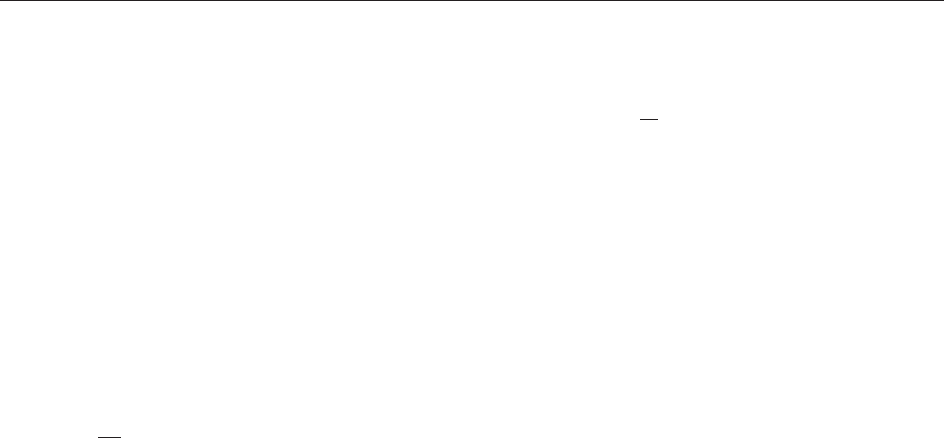
In modern mathematical terms, Gauss introduced
an invariant of a link consisting of two simple closed
curves
1
,
2
in R
3
, namely the signed number of turns
of one of the curves around the other, the linking
coefficient {
1
,
2
} of the link. His formula for this is
N ¼f
1
;
2
g
¼
1
4
Z
1
Z
2
ð½d
1
ðtÞ; d
2
ðtÞ;
1
2
Þ=
j
1
ðtÞ
2
ðtÞj
3
½1
where [ , ] denotes the vector (or cross) product of
vectors in R
3
and ( , ) the Euclidean scalar product.
Thus, this integral always has an integer value N.If
we take one of the curves to be the z-axis in R
3
and
the other to lie in the (x, y)-plane, then the formula
[1] gives the net number of turns of the plane curve
around the z-axis. It is interesting to note that the
linking coefficient [1] may be zero even though the
curves are nontrivially linked. Thus, its having
nonzero value represents only a sufficient condition
for nontrivial linkag e of the loops. This last
consideration leads naturally to the mathematical
concepts of knots and links whose most striking
properties have been investigated in our introduc-
tory article (see Mathematical Knot Theory).
The other source of inspiration of Kelvin’s theory
of matter was the Helmholtz’s laws of vortex
motion, which state that in an ideal fluid (where
there is no viscosity) vortex lives forever: two closed
vortex rings, once linked, will always be linked. The
classical results obtained by Helmholtz are basic to
understanding the dynamics of Euler motion s. The
vorticity of a velocity field is its curl and is denoted
!
t
(z):= curl(X(z, t)). In two dimensions, the vorticity
is a real-valued function and !
t
= , where is
the stream function of X(z, t). Recall that the push-
forward of a scalar field (0-form) s under a
diffeomorphism f is f
s = s f
1
. These results, in
modern terms, can be stated as follow s:
Theorem (Helmholtz–Kelvin). An incompres sible
fluid motion (M
t
,
t
) with velocity field X and
vorticity !
t
is Euler if and only if its vorticity is
passively transported,
t
!
0
¼!
t
and circulation around all smoot h simple closed
curves C are preserved under the flow,
d
dt
Z
t
ðCÞ
X dr ¼0
One knows that in three dimensions, the Helmholtz–
Kelvin theorem says that the vorticity (now a vector
field) is transported. Thus, with generic initial
vorticity a 3D time-periodic Euler fluid motion
preserves a nontrivial vector field. One very interest-
ing question that remains to be elucidated is the
following: are there any chaotic, time-periodic Euler
flows with stationary boundaries?
The Connection between Topological and
Numerical Invariants of Knots and the
Physical Helicity of Vector Fields
The writhing number of a curve in Euclidean three-
dimensional space is the standard measure of the
extent to which the curve wraps and coils around
itself; it has proved its importance for electrody-
namics and fluid mechanics in the study of the
knotted structures of magnetic vortices and
dynamics flows, and for molecular biologists in the
study of knotted duplex DNA and the enzymes
which affect it. The helicity of a divergenceless
vector field defined on a domain in Euclidean
3-space, introduced by Woltjer in 1958 in an
astrophysical context and coined by Moffat in
1969 in the study of its topological meaning, is the
standard measure of the extent to which the field
lines wrap and coil around one another; it plays
important roles in fluid mechanics, magnetohydro-
dynamics, and plasma physics. The ‘‘Biot–Savart
operator’’ associates with each current distribution
on a given domain the restriction of its magnetic
field to the domain. When the domain is simply
connected, the divergence-free fields which are
tangent to the boundary and which minimize energy
for given helicity provide model s for stable force-
free magnetic fields in space and laboratory plasmas;
these fields appear mathematically as the extreme
eigenfields for an appropri ate modification of the
Biot–Savart operator. Information about these fields
can be converted into bounds on the writhing
number of a given piece of DNA.
Recent researches (Cantarella et al. 2001)
obtained rough uppe r bounds for the writhi ng
number of a knot or link in terms of its length and
thickness, and rough upper bounds for the helicity
of a vector field in terms of its energy and the
geometry of its domain. It was also showed that in
the case of classical electrodynamics in vacuum, the
272 Topological Knot Theory and Macroscopic Physics
natural helicity invariant, called the electromagnetic
helicity, has an important particle meaning: the
difference between the numbers of right- and left-
handed photons. Recently, a topological model of
classical electrodynamics has been proposed in
which the helicity is topologically quantized, in a
relation that connects the wave and particle aspects
of the fields (Trueba and Ran˜ ada 2000).
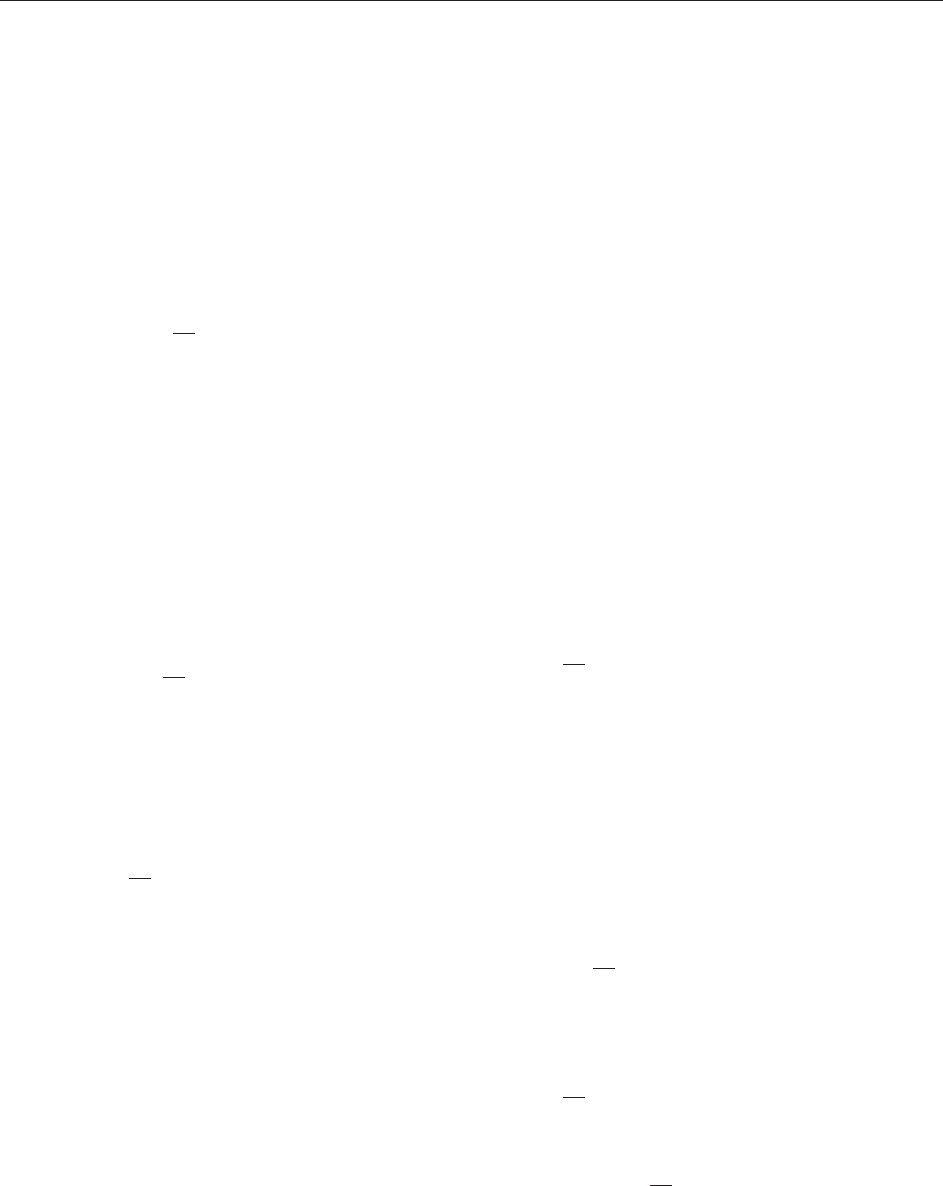
Consider two disjoint closed space curves, C and
C
0
, and the Gauss’ integral formula for their linking
number
LkðC; C
0
Þ¼
1
4
Z
C C
0
ðdx=ds dy=dtÞ
x y= jx yjds dt ½2
The curves C and C
0
are assumed to be smooth and
to be parametrized by arclength. Now the question
is to know what happens to this integral when the
two space curves C and C
0
come together and
coalesce as one curve C. At first glance, the
integrand looks like it might blow up along the
diagonal of C C
0
, but a careful calculation shows
that in fact the integrand approaches zero on the
diagonal, and so the integral converges. Its value is
the writhing number Wr(C)ofC defined above:
WrðCÞ¼
1
4
Z
C C
ðdx=ds dy=dtÞ
x y= jx yj ds dt ½3
Here is the very useful result, due to Fuller (1978).
The writhing number of a knot K is the average
linking number of K with its slight perturbations in
every possible direction:
WrðKÞ¼
1
4
Z
W2S
2
LkðK; K þ "WÞdðareaÞ½4
This is helpful for getting a quick approximation to
the writhing number of a knot which almost lies in a
plane; in the example of a trefoil knot, Wr(K) 3.
Here, a very important result must be recalled, a
‘‘bridge theorem,’’ proved by Berger and Field
(1984), see also Ricca and Moffatt (1992), which
connects helicity of vector fields to writhing of knots
and links, and which can be used to convert upper
bounds on helicity into upper bounds on writhing.
Proposition (Berger and Field). Let K be a smooth
knot or link in 3-space and =N(K, R) a tubular
neighborhood of radius R about K. Let V be a
vector field defined in , orthogonal to the cross-
sectional disks, with length depending only on
distance from K. This makes V divergence-free and
tangent to the boundary of . Then the writhing
number Wr(K) of K and the helicity H(V) of the
vector field V are related by the formula
HðVÞ¼FluxðVÞ
2
WrðKÞ
In the formula, Flux(V) denotes the flux of V
through any of the cross-sectional disks D,
FluxðVÞ¼
Z
D
V n dðareaÞ
where n is a unit normal vector field to D.
A key feature of this formula is that the helicity of V
depends on the writhing number of K,butnotany
further on its geometry; in particular, such quantities
as the curvature and torsion of K do not enter into the
formula. Berger and Field actually showed that the
helicity H(V) is a sum of two terms: a ‘‘kink helicity,’’
which is given by the right-hand side of the above
formula, and a ‘‘twist helicity,’’ which is easily shown
in our case to be zero. Their proof assumes K is a knot,
but it is straightforward to extend it to cover links.
Let be a compact domain in 3-space with
smooth bounda ry @; we allow both and @ to be
disconnected. Let V be a smooth vector field (where
‘‘smooth’’ means of class C
1
), defined on the
domain . The helicity H(V) of the vector field V
is defined by the formula
HðVÞ¼
1
4
Z
VðxÞVðyÞx y=jx yj
3
dðvol Þ
x
dðvolÞ
y
½5
Clearly, helicity for vector fields is the analog of
writhing number for knots. Both formulas are
variants of Gauss’ integral formula for the linking
number of two disjoint closed space curves.
In order to understand this formula for helicity,
think of V as a distribution of electric current, and
use the Biot–Savart law of electrodynamics to
compute its magnetic field:
BSðVÞðyÞ¼
1
4
Z
VðxÞy x=jy xj
3
dðvolÞ
x
½6
Then the helicity of V can be expressed as an integrated
dot product of V with its magnetic field BS(V):
HðVÞ¼
1
4
Z
VðxÞVðyÞx y=jy xj
3
dðvolÞ
x
dðvolÞ
y
¼
Z
VðgÞ
1
4
Z
VðxÞy x=jx yj
3
dðvolÞ
x
dðvolÞ
y
¼
Z
VðyÞBSðVÞðyÞdðvol Þ
y
¼
Z
V BSðVÞdðvolÞ
Topological Knot Theory and Macroscopic Physics 273

Cantarella et al. (2001) found two very interesting
results.
Theorem 1 Let K be a smooth knot or link in
3-space, with length L and with an embedded
tubular neighborhood of radius R. Then the wri-
thing number Wr(K) of K is bounded by
jWrðKÞj < 1=4ðL=RÞ
4=3
For the proof, see Cantarella et al. (2001).
Theorem 2 The helicity of a unit vector field V
defined on the compact domain is bounded by
jHðVÞj < 1=2volðÞ
4=3
Let us now give a brief overview of the methods
used to find sharp upper bounds for the helicity of
vector fields defined on a given domain in
3-space. As usual, will denote a compact domain
with smooth boundary in 3-space. Let K() denotes
the set of all smooth divergence-free vect or fields
defined on and tangent to its boundary. These
vector fields, sometimes called ‘‘fluid knots,’’ are
prominent for several reasons: (1) They are natural
vector fields to study in a ‘‘fluid dynamics
approach’’ to geometric knot theory. (2) They
correspond to incompressible fluid flows inside a
fixed container. (3) They are vector fields most often
studied in plasma physics. (4) For given energy
(equivalently minimize energy for given helicity),
they provide models for stable force-free magnetic
fields in gaseous nebulaes and laboratory plasmas.
(5) The search for these helicity-maximizing fields
can be converted to the task of solving a system of
partial differential equations. (6) The fluid knots can
reveal some fundamental and still unknown
mechanisms, which characterize the phenomenon
of phase transition, and in particular the transition
from chaotic (unstable) phases and behaviors of
matter to ordered (stable) ones.
Knots and Fluid Mechanics (Vortex Lines,
Magnetic Helicity, and Turbulence)
The Kelvin’s theory of explaining atoms as knotted
vortices in fluid ether was seminal in the develop-
ment of topological fluid mechanics. The recent
revival (starting in the 1970s) is mainly due to the
work of Moffat, on topological interpretation of
helicity, and Arnol’d, on asymptotic linking number
of space-filling curves. Modern developments have
been influenced by recent progress in the theory of
knots and links.
Influence of Geometry and Topology
on Fluid Flows
Ideal topological fluid mechanics deals essentially
with the study of fluid structures that are
continuously deformed from one configuration to
another by ambient isotopies. Since the fluid flow
map ’ is both continuous and invertible, then
’
t
1
(K)and’
t
2
(K) generate isotopies of a fluid
structure K (e.g., a vortex filament) for any
{t
1
, t
2
} 2 I. Isotopic flows generate equivalence
classes of (linked and knotted) fluid structures. In
the case of (vortex or magnetic) fluid flux tubes,
fluid actions induce continuous deformations in D.
One of the simplest deformations is local stretch-
ing of the tube. From a mathematical viewpoint,
this deformation corresponds to a time-dependent,
continuous reparametrization of t he tube center-
line. This reparametrization (via homotopy classes)
generates ambient isotopies of the flux tube, with
a continuous deformation of the integral curves.
Moreover, in the context of the Euler equations,
the Reidemeister moves (or isotopic plane deforma-
tions), whose changes conserves the knot topology,
are performed quite naturally by the action of local
flows on flux tube strands. If the fluid in (D K)is
irrotational, then these fluid flows (with velocity u)
must satisfy the Dirichlet problem for the Laplacian
of the stream function ’, that is,
u ¼r’ in ðD KÞ
r
2
’ ¼0
½7
with normal component of the velocity to the tube
boundary u
?
given. Equations [7] admit a unique
solution in terms of local flows, and these flows are
interpretable in terms of Reidemeister’s moves
performed on the tube strands. Note that boundary
conditions prescribe only u
?
, whereas no condition
is imposed on the tangential component of the
velocity. This is consistent with the fact that
tangential effects do not alter the topology of the
physical knot (or link). The three type of Reidemeister’s
moves are therefore performed by local fluid flows,
which are solutions to [7], up to arbitrary tangential
actions.
Knotted and Linked Tubes of Magnetic Flux
Let T be the standard solid torus in R
3
given by
ðð2 þ " cos Þcos ’; ð 2 þ " cos Þsin ’; " sin ÞÞ ½8
where 0 , ’<2, and 0 "<1. For relatively
prime integers p and q, let F
p, q
denote the foliation
274 Topological Knot Theory and Macroscopic Physics
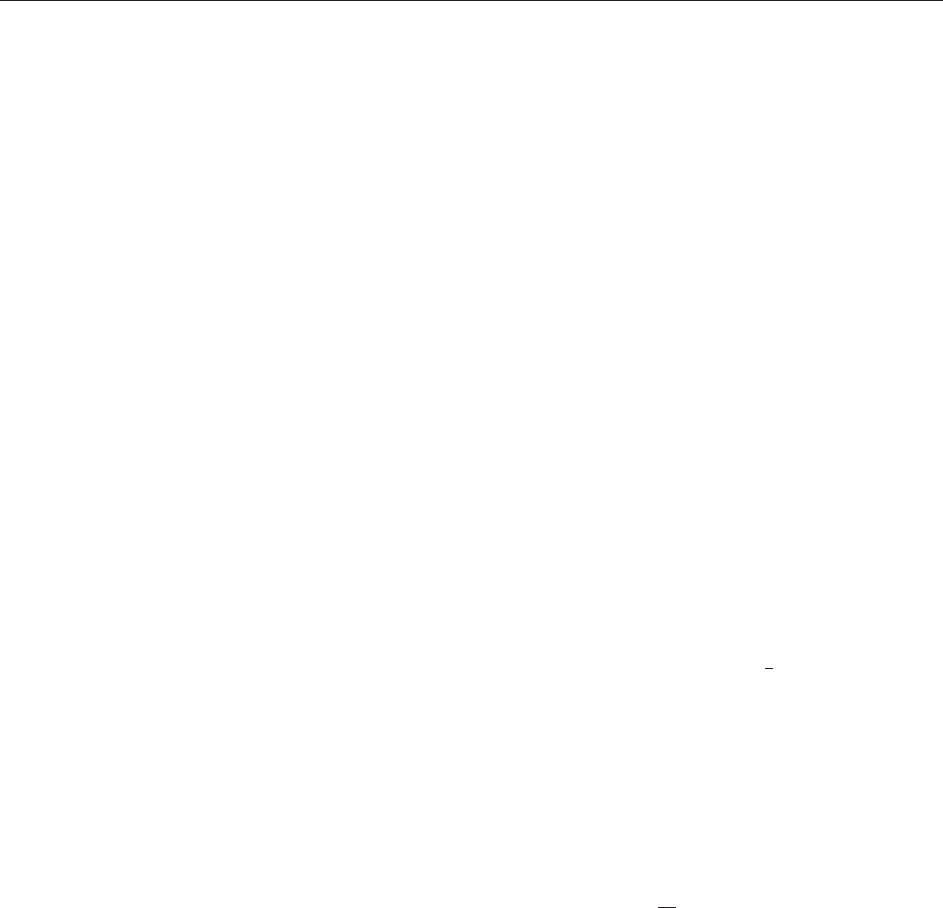
of T by the curves
",
(where 0 " 1 and
0 <2) given by
";
ðsÞ¼ð2 þ " cosð þ qsÞÞcosðpsÞ;
ð2 þ " cosð þ qsÞÞsinðpsÞ;"sinð þ qsÞ½9
where 0 s < 2.
Definition A magnetic tubular link (or magnetic
link) is a smooth immersion into R
3
of finitely many
disjoint standard solid tori [
n
i = 1
T
i
L : [
n
i ¼1
T
i
! R
3
and a smooth magnetic field B on R
3
such that
(i) L is an imbedding when restricted to the
interior of [
n
i = 1
T
i
,
(ii) the bounding surface of [
i
L(T
i
), that is,
[
i
L(@T
i
) is a magnetic surface, and
(iii) for each component LT
i
, there exist relatively
prime nonzero integers p
i
and q
i
such that L
maps the foliation F
p
i
, q
i
of T
i
onto the integral
curves of B in LT
i
.
Remark Thus, for every fixed i and j, the linking
number between an arbitrary field line in LT
i
and
an arbitrary field line in LT
j
is the same regardless
of which integral curves are chosen from LT
i
and
LT
j
, respectively. This is true even when i = j.
It follows that a magnetic link [
i
LT
i
remains a
magnetic link under the action of the fluid flow, that
is, [
i
g
t
LT
i
is a magnetic link for t 0.
Keeping that the magnetic field B is frozen in the
fluid, we can now find and study those properties of
magnetic links that are invariant under the action of
fluid flow. One obvious invariant is the volume V
i
of each flux tube g
t
LT
i
, that is,
V
i
¼VolðLT
i
Þ¼Volðg
t
LT
i
Þ¼
ZZZ
g
t
LT
i
dðvolÞ½10
which remains unchanged because of incompressibility.
Another invariant of fluid flow is defined as
follows:
Definition Let L be a magnetic link. For each solid
torus T
i
, choose a meridional disk D
i
. The magnetic
flux
i
=(LT
i
) in the ith component is the surface
integral defined as
i
¼ðLT
i
Þ :
ZZ
LD
i
B U dðareaÞ
where U deno tes the normal to the surface LD
i
pointing in the positive direction induced by the B
field.
It can be shown that
i
is independent of the
chosen meridional disk. It also can be shown that
each
i
is a fluid flow invariant, that is,
i
ðg
t
LT
i
Þ¼
ZZ
g
t
LD
i
B U dðareaÞ½11
is independent of t.
One more fluid invariant that will play a central
role in the energy minimization of magnetic links is
given by the following definition.
Definition The helicity of a magnetic link L is
defined as
HðLÞ¼
ZZZ
[
i
LT
i
A B dðvolÞ
The term helicity was first introduced in a fluid
context by Moffat, and it was previously used in
particle physics for the scalar product of the momen-
tum and spin of a particle. In another connection, note
that the helicity H(L) is the same as the Chern–Simons
action:
HðLÞ¼
Z
A ^ dA
¼
Z
trðA ^ dA þ
2
3
A ^ A ^ AÞ½12
where A now denotes the magnetic vector potential
as a 1-form.
It can be shown that H(L) is gauge invariant, and
hence well defined.
Theorem (Moffat). The helicity is invariant under
fluid flow, that is,
d
dt
Hðg
t
LÞ¼0
Arnol’d (1998) defines the helicity in a more abstract
setting and shows that it is invariant under the group
S(Diff) of volume-preserving diffeomorphisms.
The following theorem summarizes the many
results due to Moffat, Ricca, Berger, Lomonaco,
Hornig, Kauffman, and others, relating the helicity
of magnetic links to linking and to magnetic flux.
Theorem Let L be a magnetic link. Then
HðLÞ¼
X
1in
2
i
SL
F
i
þ 2
X
1i<jn
i
j
LK
ij
where SL
F
i
denotes the self-link ing number of
the axis curve of the tube LT
i
with respect to the
framing F
i
induced by the integral curves of the
magnetic field B within LT
i
, and LK
ij
denotes
the linking number between any integral curve of
Topological Knot Theory and Macroscopic Physics 275
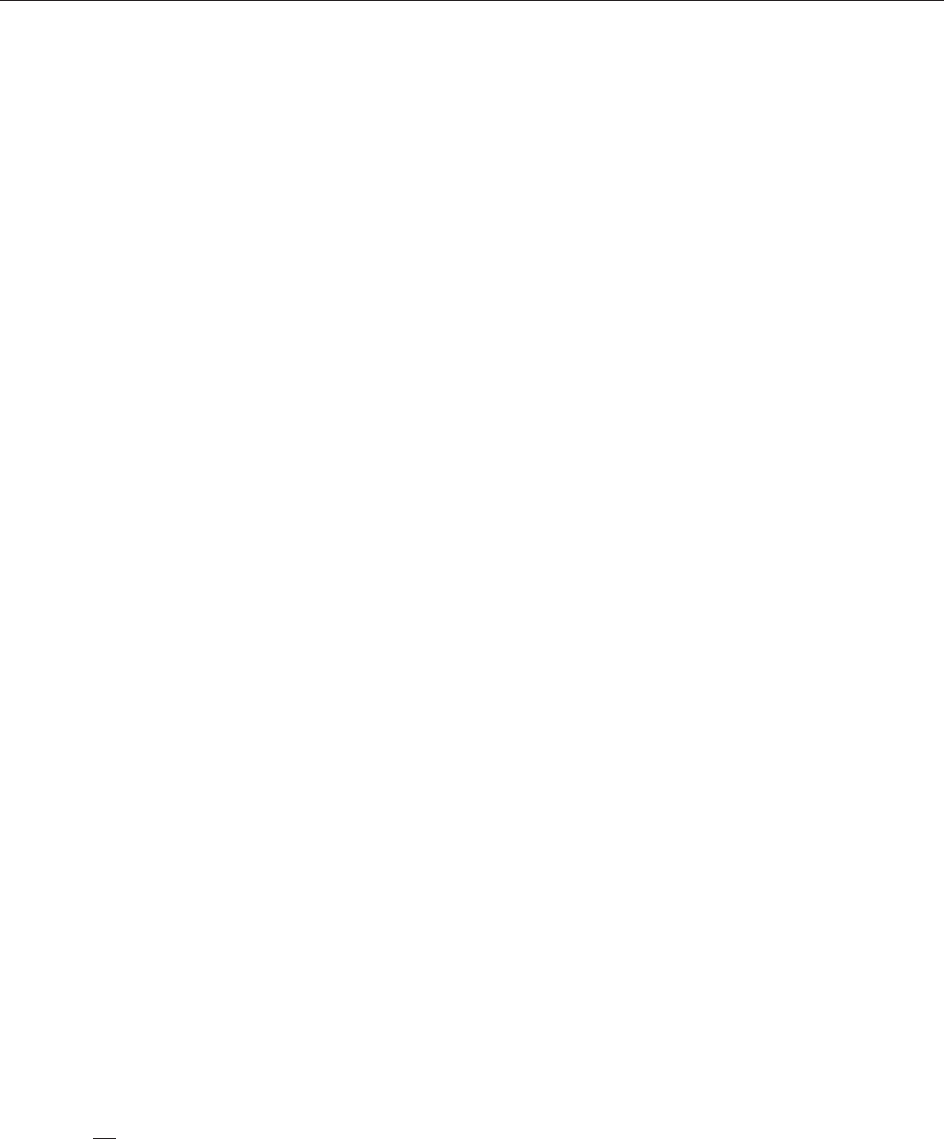
the magnetic field B in LT
i
with any integral curve
of the magnetic field B in LT
j
.
Remark In fact, SL
F
i
is the same as the linking
number between any two integral curves of the
magnetic field B within the tube LT
i
.
Thus, as many authors have showed, the helicity
does reflect the topology and the geometry of the
magnetic lines of force within a magnetic link. If, for
example, L has only one component, that is, L is a
magnetic knot, then
HðLÞ¼
2
SL
F
ðCÞ½13
where SL
F
(C) is the self-linking number of the axis
curve C of the knotted tube with respect to the
framing F induced by the integral curves of the
magnetic field B within the magnetic knot. If, for
example, the tube is knotted in the form of a trefoil
and if the magnetic lines of force appear to be
parallel to the axis curve when the trefoil is placed
on a plane flat surface, then SL = 3 and
H ¼3
2
½14
On the other hand, if for example, the magnetic
lines of force induce the trivial framing in each
component, then
HðLÞ¼2
X
1i<jn
i
j
LK
ij
½15
Thus, if L is a magnetic two-component Hopf link
with no twisting of the integral curves of the
magnetic field within the components of L, then
HðLÞ¼2
1
2
½16
because the self-linking number based on the B-field
framing is zero for each component, and the linking
number between the two components is 1.
Energy of Magnetic Knots and Links
Let us conclude this section with the definition of
the energy of a magnetic link.
Definition The magnetic energy E
M
(L) of a mag-
netic link L is defined by the classical formula
E
M
ðLÞ¼
1
8
ZZZ
[
i
LT
i
jBj
2
dðvolÞðGaussian unitsÞ
Although the energy E
M
is not flow invariant, it will
play a central role in magnetic relaxation of knots
and minimum energy magnetic links.
Consider a magnetic link L in a perfectly
conducting, incompressible, viscous fluid. As a result
of dissipative frictional fluid forces, the magnetic
energy E
M
(g
t
L)ofg
t
L will decrease with time t.In
losing energy, the magnetic lines of force will
contract. On the other hand, since this is a volume-
preserving process, the cross sections of the flux
tubes of g
t
L will at the same time expand. These
changes of topology occur while the flux , volume
V, and helicity of g
t
L will remain the same. In other
words, knotted magnetic flux tubes left free to
evolve in such a fluid will do so by conserving their
magnetic flux and volume V, but converting their
magnetic energy into kinetic energy, which in turn
dissipates by internal friction. Magnetic links and
knots evolve from high to low magnetic energy
levels, conserving topology; and because of the
induced shortening of field lines under conservation
of volume, they become fatter and fatter, with an
increase of the average tube cross section.
This process cannot continue indefinitely. Even-
tually, the magnetic flux tubes of g
t
L must make
contact with each other. In other words, the topology
of the magnetic link g
t
L, as expressed in knotting and
linking, creates a barrier to the full dissipation of the
magnetic link’s energy, that is, E
M
(g
t
L) has a positive
lower bound that results from the topology of g
t
L.
That means, in other words, that relaxation is
obstructed by the knottedness and entanglement of
the field lines, and a minimum magnetic energy is
reached. Thus, the magnetic link will reach a
nontrivial stable and invariant energy state, much as
Kelvin conjectured his atomic vortices would.
Various estimates of magnetomechanical energy in
terms of topological quantities have been put forward
in recent years (see Freedmann and He (1994)). These
relations give lower bounds for the energy levels
attainable by knot or link types by taking into account
the effects that linking numbers and number of
crossings have on the energy of the relaxed state.
These bounds are expressed by relationship of the kind
E
min
ðC
min
; ; V; NÞ½17
where E
min
is the equilibrium energy and gives the
relationship between physical quantities – such as
total flux ,numberoftubesN,magneticvolumeV –
and topology, given here by the minimal possible
number of crossing C
min
. These relations offer
numerous advantages due to the explicit dependence
on qualitative properties of the flow field. A simple
example is provided by the analysis of three braids,
which shows that magnetic energy grows quadrati-
cally in time due to random braiding. This means
that the least possible amount of magnetic energy
that can be attained by the physical knot or link is
determined purely by its topology. If topological
information sets the levels of minimum energy
accessible to the knot or link, geometric properties
276 Topological Knot Theory and Macroscopic Physics
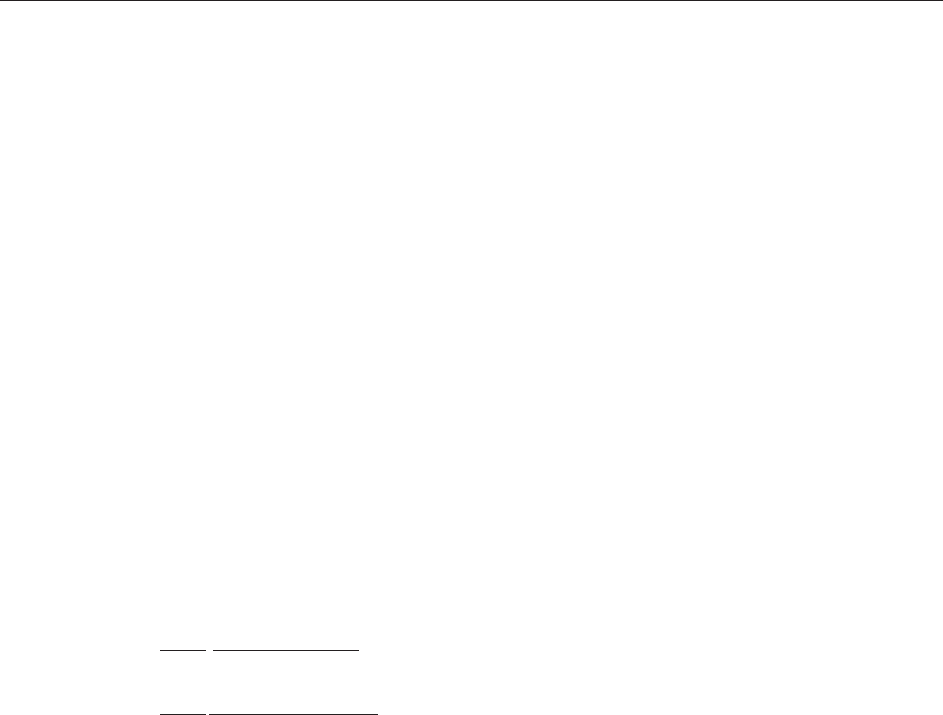
may also influence the relaxation process. Consid-
erations of helicity and linking numbers, for
example, demonstrate that internal rearrangement
of magnetic field geometry leads to a spectrum of
different asymptotic endstates with the same topol-
ogy. Moreover, magnetic knots have a natural
tendency to get rid of excessive torsion of field
lines and S-shaped tube geometries, and this may
influence the relaxation process.
Since the helicity H(g
t
L) is both an invariant of
fluid flow and an expression of the magnetic link
g
t
L’s topology, the following theorem, first stated by
Moffat, is a mathematical expression of this
topological bounds.
Theorem Let L be a magnetic link. Then
E
M
ðLÞq
0
jHðLÞj
where q
0
is a nonzero constant that is independent
of the magnetic link.
Freedman and He (1991) obtain more subtle and
tighter topological bounds on the minimum energy
of magnetic links. For example, for a magnetic knot
K, they prove that
E
M
ðKÞ
1
4
5=4
ðKÞ
3=2
acðKÞ
3=4
VðKÞ
1=3
1
4
5=4
ðKÞ
3=2
ð2gðKÞ1Þ
VðKÞ
1=3
ðGaussian unitsÞ½18
where V(K) denotes the volume of the magnetic knot
K, (K)denotesthefluxinK,ac(K) is the asymptotic
crossing number, and g(K) is the genus of the knot K.
Freedman and He conjecture that ac(K) = c(K ), where
c(K) is the crossing number, that is, the minimum
number of crossings among all plane diagrams repre-
senting the knot K. Besides, Moffat (1990) suggests
that the minimum energy spectrum of a magnetic knot
can be used to construct new knot invariants.
Topological Changes, Dissipation,
and Reconnection in Fluid Patterns
As we saw above, topological changes do occur
when dissipative effects become predominant over
the coherency of structures. When this happens,
there is a dramatic change of fluid patterns, often on
small timescales compared to evolution. The change
occurs through the formation and disappearance of
physical reconnections in the fluid pattern. In real
fluids, for example, vortex and magnetic tubes do
interact and reconnect freely. From a dynamical
system viewpoint, reconnection s take place when the
vector field lines (streamlines, vortex lines, or
magnetic lines) cross each other. If two field lines
meet, the point of crossing is a true nodal point, like
a bifurcation in a path. Dissipative effects allow the
reconnection to proceed through such points.
In dissipative fluids, mathematical and physical
properties are no longer conserved, and during the
process we lose part of the original information.
However, some of the invariants are rather robust
and may only degrade slowly. One of them is magnetic
helicity, the magnetic analog of the kinetic helicity. Its
dissipation during reconnection can be modest; in
particular, if the reconnection timescale is small
compared to classical dissipation times, then helicity
loss will be negligible. The robustness of magnetic
helicity plays a central role in fusion plasma physics
and in many astrophysical contexts. On the other hand,
large changes in kinetic helicity are intimately related to
qualitative changes in the topology of vortex flows.
Under Euler’s equations, the helicity of a vortex
tube of vorticity ! and velocity u is defined by
H =
R
u ! dV. The integral is taken over the tube
volume V occupied by !. Now, for n knotted and
linked vortex tubes, each of (constant) strength
(total vorticity)
i
(1 i N), the helicity of the
whole system can be expressed in terms of linking
numbers Lk
ij
as
H ¼
X
ij
Lk
ij
i
j
Lk
ij
which is equal to Lk
ji
; this is a topological invariant
whose value does not change under continuous
deformation of the fluid structure. Since helicity
and flux-tube strength are measurable conserved
quantities, the above equation provides useful
information about the topology of the flow field
and flow structures. In addition, by direct measure-
ments of helicity and application of conservation of
topology, one can estimate average geometric
quantities, such as the mean twist of field lines,
and their contribution to the total energy.
Brief Conclusion
In this article, we have made an attempt to indicate
how ‘‘classical’’ field theories, which have been
successfully used to describe physics of fundamental
structures and forces of nature, can also be used to
study geometry and topology of low-dimensional
manifolds. These developments not only provide new
insights into old problems of topology of these
manifolds but also have been responsible for pro-
foundly interesting new mathematics (fluid
mechanics, dynamical flows, and polymer biophysics
Topological Knot Theory and Macroscopic Physics 277