
Francoise J.-P., Naber G.L., Tsun T.S. (editors) Encyclopedia of Mathematical Physics
Подождите немного. Документ загружается.


are maybe the most significant examples in the last
years). In particular fluid dynamics, a topological
macroscopic field theory, provides a powerful frame-
work for modern theory of knots and links in
3-manifolds. Moreover, as we saw here, it provides
a physical interpretation of the link, self-linking, and
writhing number of knots and links. The present
article was essentially aimed to illustrate such a
relationship. Thus, the most fundamental result we
reported here is the relation (formula) connecting the
helicity of vector (magnetic) fields to the writhing
number of knots: H(V) = Flux(V)
2
Wr(K). So, wri-
thing number for knots is the analog of helicity for
vector fields. Both expressions of these invariants are
variants of the (Gaussian) integral formula for the
linking number of two disjoint closed space curves.
Further investigations of these invariants and their
mathematical properties might throw new light on
the interfaces between many different areas of
macroscopic and quantum physics.
See also: The Jones Polynomial; Knot Theory and
Physics; Magnetohydrodynamics; Mathematical Knot
Theory; Stability of Flows; Superfluids; Topological
Quantum Field Theory: Overview; Vortex Dynamics;
Yang–Baxter Equations.
Further Reading
Arnol’d V and Khesin B (1998) Topological Methods in
Hydrodynamics. Heidelberg: Springer.
Berger MA and Field GB (1984) The topological properties of
magnetic helicity. Journal of Fluid Mechanics 147: 133–148.
Berry MV and Dennis MR (2001) Knotted and linked phase
singularities in nonchromatic waves. Proceedings of the Royal
Society A 457: 2251–2263.
Boi L (2005) Topological knots’ models in physics and biology.
In: Boi L (ed.) Geometries of Nature, Living Systems and
Human Cognition. New Interactions of Mathematics with
Natural Sciences and Humanities, pp. 211–294. Singapore:
World Scientific.
Boyland P (2001) Fluid mechanics and mathematical structures.
In: Ricca RL (ed.) An Introduction to the Geometry and
Topology of Fluid Flows, pp. 105–134. NATO-ASI Series:
Mathematics. Dordrecht: Kluwer.
Cantarella J, De Turk D, and Gkuck H (2001) The Biot–Savart
operator for application to knot theory fluid dynamics, and
plasma physics. Journal of Mathematical Physics 42: 876–905.
Freedman MH and Zheng-Xu He (1991) Divergence free fields:
energy and asymptotic crossing number. Annals of Mathe-
matics 134: 189–229.
Fuller FB (1978) Decomposition of the linking number of a closed
ribbon: a problem from molecular biology. Proceedings of the
National Academy of Sciences, USA 75: 3557–3561.
Ghrist RW, Holmes PhJ, and Sullivan MC (1997) Knots and
Links in Three-Dimensional Flows. Heidelberg: Springer.
Hornig G (2002) Topological Methods in Fluid Dynamics.
Preprint. Ruhr-Universita¨t-Bochum.
Kauffman LH (1995) Knots and Applications. Series on Knots
and Everything, vol. 6, Singapore: World Scientific.
Lomonaco SJ (1995) The modern legacies of Thomson’s atomic
vortex theory in classical electrodynamics. In: Kauffman LH
(ed.) The Interface of Knots and Physics, Proc. Symp. Appl.
Math., vol. 51, pp. 145–166. American Mathematical Society.
Moffatt HK (1969) The degree of knottedness of tangled vortex
lines. Journal of Fluid Mechanics 35: 117–129.
Moffat HK (1990) The energy spectrum of knots and links.
Nature 347: 367–369.
Moffatt HK, Zaslavsky GM, Comte P, and Tabor M (1992)
Topological Aspects of the Dynamics of Fluids and Plasmas,
NATO ASI Series, Series E: Applied Sciences, vol. 218.
Dordrecht: Kluwer Academic.
Ricca RL (1998) New developments in topological fluid
mechanics: from Kelvin’s vortex knots to magnetic knots. In:
Stasiak A, Katritch V, and Kauffman LH (eds.) Ideal Knots.
Singapore: World Scientific.
Ricca RL and Moffat HK (1992) The helicity of a knotted vortex
filament. In: Moffat HK (ed.) Topological Aspects of
Dynamics of Fluids and Plasmas, pp. 225–236. Dordrecht:
Kluwer.
Tait PG (1900) On Knots I, II, III. In: Scientific Papers.
Cambridge: Cambridge University Press.
Thomson JJ (1883) A Treatise on the Motion of Vortex Rings.
London: Macmillan.
Trueba JL and Ran˜ ada AF (2000) Helicity in classical electro-
dynamics and its topological quantization. Apeiron 7: 83–88.
Woltjer L (1958) A theorem on force-free magnetic fields. Proceed-
ings of the National Academy Sciences, USA 44: 489–491.
Topological Quantum Field Theory: Overview
J M F Labastida, CSIC, Madrid, Spain
C Lozano, INTA, Torrejo
´
n de Ardoz, Spain
ª 2006 Elsevier Ltd. All rights reserved.
Introduction
Topological quantum field theory (TQFT) constitu-
tes one of the most successful fields of mathematical
physics since it originated in the 1980s. It possesses
an inherent property which makes it unique: TQFT
provides predictions in mathematics which open
new fields of research. A well-known example is the
prediction of Seiberg–Witten invariants as building
blocks of Donaldson invariants. However, there are
others such as the recent proposal for the coeffi-
cients of the HOMFLY polynomial invariants for
knots as quantities related to enumerative geometry.
These developments have drawn the attention of
mathematicians and physicists into TQFT since the
1980s, a very fruitf ul period in which both commu-
nities have benefited from each other.
Topology has always been present in mathematical
physics, in particular when dealing with aspects of
278 Topological Quantum Field Theory: Overview

quantum physics. Global effects play an important
role in quantum-mechanical models and topology
becomes an essential ingredient in their description.
TQFT itself appeared in the winter of 1987 after
Witten’s work (Witten 1988a) on Donaldson theory
(Donaldson 1990), but a series of papers during the
1980s which dealt with topological aspects of field and
string theory anticipated its existence. Two of these
correspond to Witten’s works on supersymmetric
quantum mechanics and supersymmetric sigma mod-
els (Witten 1982) that led to a generalization of Morse
theory. This generalization was considered by Floer
(1987) in a new context that constituted the key
element in Witten’s construction of TQFT. These
developments were certainly influenced by Atiyah
(1988). TQFT was born as a result of the interplay
between physics and mathematics. This has been a
constant feature all along its development.
Soon after the formulation of the TQFT
addressing Donaldson theory, now known
as Donaldson–Witten theory, Witten formulated a
new TQFT which focuses on knot invariants such as
the Jones polynomial and its generalizations (Jones
1985). Witten (1989) constructed Chern–Simons
gauge theory and proved its relation to the theory
of knot and link invariants. This theory possesses
different features than Donaldson–Witten theory,
and in fact it turns out that these two theories fall
into two different general types of TQFTs as will
be explained in the following section. Anyhow,
despite their formal differences, both Donaldson–
Witten and Chern–Simons gauge theory emerged
as a novel way to express topological invariants in
terms of quantum field theory quantities as well as
to generalize their previous formulation. But there
was much m ore to them than it seemed in their
beginnings. Once these topological invariants were
formulated in field theory language, one had a
huge machinery to study them from different
points of view. Theoretical physicists have devel-
oped many useful tools to study quantum field
theory. T he use of these tools led to new frame-
works for these topological invariants.
In this overview we are going to provide the basics
of TQFT and briefly describe two examples –
Donaldson–Witten theory and Chern–Simons gauge
theory – to explain how the general features are
implemented. Some excellent reviews on the subject
(Birmingham et al. 1991, Cordes et al. 1996,
Labastida and Marin˜o 2004) are available. The
organization of this work is as follows. In the
following section we present a general introduction
to TQFT from a functional integral point of view.
Next, we touch upon the twisting of extended
supersymmetry as a general constructive approach
to TQFT. This is followed by a section on
Donaldson–Witten theory where we discuss the
computation of its observables from a perturbative
approach, showing their relation to the Donaldson
invariants. Next, we introduce Chern–Simons gauge
theory as a theory of knot and link invariants. The
penultimate section deals with advanced develop-
ments in TQFT. Finally, we end up with some
concluding remarks.
Topological Quantum Field Theory
We will start our overview by presenting the most
general structure of a TQFT from a functional
integral point of view which, though not rigorously
defined, is the approach that has led to the most
important developments. As in conventional quan-
tum field theory, axiomatic approaches to TQFT do
exist, but we will not follow that route here.
Let us consider an n-dimensional Riemannian
manifold X endowed with a metric g
and a
quantum field theory on it. We will say that this
theory is ‘‘topological’’ if there exist operators in the
theory such that their correlation functions do not
depend on the metric. If we denote these operators
by O
i
(where i is a generic label), then
g
hO
i
1
O
i
n
i¼0 ½1
where hi denotes a vacuum expectation value.
The operators that satisfy this equation are called
‘‘topological observables.’’
The simplest way to achieve metric independence is
to consider a theory whose action and operators do not
depend on the metric. In this situation, if no
anomalous metric dependence is generated upon
quantization, the correlation functions of these opera-
tors satisfy [1] and lead to topological invariants on X.
Theories of this sort are collectively referred to as
Schwarz-type TQFTs, and well-known examples are
Chern–Simons gauge theory and BF theories. How-
ever, Schwarz-type theories are too restrictive. One
would like to have a theory satisfying property [1] with
a weaker condition on the action. This can be achieved
with the help of a symmetry. The resulting TQFTs are
called of Witten or cohomological type, the main
examples being Donaldson–Witten theory and topo-
logical sigma models (Witten 1988b).
For TQFTs of Witten type, the action may depend
on the metric. However, the theory has an underlying
scalar symmetry acting on the fields
i
.Since is a
symmetry, the action of the theory satisfies S(
i
) = 0.
In these theories, metric independence of the correla-
tion functions is achieved as follows. Let T
=
(=g
)S(
i
) be the energy–momentum tensor of
Topological Quantum Field Theory: Overview 279

the theory. It turns out that the energy–momentum
tensor is -exact:
T
¼iG
½2
G
being some tensor. Indeed, if [2] is satisfied, it
follows that for any set of operators O
i
which are
-invariant,
g
hO
i
1
O
i
2
O
i
n
i¼hO
i
1
O
i
2
O
i
n
T
i
¼ihO
i
1
O
i
2
O
i
n
G
i
¼ihðO
i
1
O
i
2
O
i
n
G
Þi
¼0 ½3
In this computation we have assumed that
the symmetry is not anomalous and that there are
no contributions coming from boundary terms since
we have integrated by parts in field space. This is not
always the case and in fact the situations in which one
of these two properties fails lead to rich phenomena. In
those cases, for example, in Donaldson–Witten theory
on manifolds with b
þ
2
= 1, the correlation functions fail
to be topological invariants in a controlled manner
which unveils many interesting properties.
We will now describe Witten-type theories in a
general context. The general structure of Schwarz-type
theories is much simpler and will be illustrated in
the example presented below. In Witten-type theories
the observables are the -invariant operators. It is
simple to prove that -exact operators decouple from
the theory. Indeed, if O
a
is -exact, O
a
=
^
O
a
,then
hO
a
O
i
1
O
i
2
O
i
n
i¼h
^
O
a
O
i
1
O
i
2
O
i
n
i
¼hð
^
O
a
O
i
1
O
i
2
O
i
n
Þi ¼ 0 ½4
Thus, one can restrict the set of observables to the
cohomology of :
O2
Ker
Im
½5
There is no reason a priori why the -symmetry
should be a scalar Grassmannian symmetry, but in
all known models of Witten-type TQFTs this turns
out to be the case. Thus, these theories violate the
spin-statistics theorem. In all these models the
algebra of the symmetry has the form
2
¼ Z ½6
where Z is a symmetry transformation (typically a
gauge symmetry of some sort). This property forces
to consider Z-invariant observables and to work in
the context of ‘‘equivariant cohomology.’’
The observables of Witten-type theories fit into a
general pattern that we describe now. The key
ingredient is a map between the homology of X and
the equivariant cohomology of . Given an operator
(0)
in the equivariant cohomology of , let us
consider the following set of equations:
d
ðnÞ
¼
ðnþ1Þ
; n 0 ½7
where the operators
(n)
(n = 1, ...,dim X) are diff-
erential forms of degree n on X and d is the de Rham
differential. These differential equations are called
‘‘descent equations’’ and their solutions
(n)
(n 0)
‘‘topological descendants’’ of
(0)
. We will show how
to construct a solution to these equations on general
grounds.
The topological descendants lead to the construc-
tion of a set of elements of the equivariant coho-
mology of . Let
n
be an n-cycle on X,
n
2 H
n
(X),
and let us consider the following operator:
W
ð
n
Þ
ð0Þ
¼
Z
n
ðnÞ
½8
This operator is -invariant,
W
ð
n
Þ
ð0Þ
¼
Z
n
ðnÞ
¼
Z
n
d
ðn1Þ
¼
Z
@
n
ðn1Þ
¼ 0 ½9
since @
n
= 0. On the other hand, if
n
were trivial
in homology, that is, if
n
= @
nþ1
, we would have
that W
(
n
)
(0)
is -exact:
W
ð
n
Þ
ð0Þ
¼
Z
@
nþ1
ðnÞ
¼
Z
nþ1
d
ðnÞ
¼
Z
nþ1
ðnþ1Þ
½10
Thus, given the operator
(0)
, we have constructed a
map between the homology of X and the equivar-
iant cohomology of . There are as many maps as
basic operators
(0)
one finds in the theory.
To actually construct these maps, we need to find
a solution of the descent equations [7].As
announced before, there is a general solution to
those equations in Witten-type theories. Since in this
type of theories [2] holds, there exists an operator
G
G
0
½11
that satisfies
P
¼ T
0
¼iG
½12
Notice that G
is an anticommuting operator and a
1-form in spacetime. With the aid of this operator,
one constructs the following solution to the descent
equations [7]:
ðnÞ
¼
1
n!
ðnÞ
1
2
...
n
dx
1
^^ dx
n
½13
where
ðnÞ
1
2
...
n
ðxÞ¼G
1
G
2
G
n
ð0Þ
ðxÞ;
n ¼ 1; ...; dim X ½14
280 Topological Quantum Field Theory: Overview
One can easily check using [12] and the -invariance
of
(0)
that the operators [13] do satisfy the descent
equations [7].
We have seen that Witten-type TQFTs are char-
acterized by property [2]. It would be desirable to have
at hand a systematic procedure to build theories
satisfying that property. It has been found that
extended supersymmetry provides a very helpful
starting point to build those theories. Although super-
symmetry guarantees from first principles only the
weaker condition [12] instead of [2],allTQFTsthat
have been constructed from extended supersymmetry
actually satisfy [2]. To build a TQFT from a theory
with extended supersymmetry, one needs to go
through the twisting procedure that we now describe.
Twisting of Extended Supersymmetry
All known Witten-type theories are related to an
underlying extended supersymmetric quantum field
theory. The topological theory is a modified version of
the supersymmetric theory in which the Lorentz
transformation properties (spins) of some of the fields
have been modified. This modification of spin assign-
ments is known as twisting, and it can be carried out
on any theory with extended supersymmetry in any
spacetime dimension. We will not consider the
procedure in such a general setting but instead we
will illustrate it by considering the case of N = 2
supersymmetry in four dimensions. We will begin with
a general description and then we will apply it to a
specific example: Donaldson–Witten theory.
Let us consider the Euclidean version of the N = 2
supersymmetry algebra with no central charges. Central
charges can be included without much ado but we will
not consider them for simplicity. The total symmetry
group of the theory is H= SU(2)
þ
SU(2)
SU(2)
R
U(1)
R
, K= SU(2)
þ
SU(2)
being the rotation group,
and SU(2)
R
U(1)
R
the internal symmetry group of
the N = 2 supersymmetry algebra. The generator
algebra takes the following form:
fQ
v
; Q
_
w
g¼2
vw
_
P
;
½P
; Q
v
¼0;
½M
; Q
v
¼
ð
Q
Þ v
;
½
M
_
_
; Q
v
¼0;
½B
vw
; Q
u
¼
uðv
Q
wÞ
;
½Q
v
; R¼Q
v
;
fQ
v
; Q
w
g¼0
½P
; Q
_
v
¼0
½M
; Q
_
v
¼0
½
M
_
_
; Q
_
v
¼
_
ð
_
Q
_
Þ v
½B
vw
; Q
u
_
¼
uðv
Q
wÞ
_
½Q
_
v
; R¼Q
_
v
½15
In these relations v, w 2 {1, 2} are SU(2)
R
indices and
and
˙
denote spinorial indices of SU(2)
and
SU(2)
þ
, respectively. The supersymmetry generators
Q
v
and Q
˙v
transform under H as (0, 2, 2)
1
and
(2, 0, 2)
1
,respectively.M
˙
˙
and M
are the
generators of SU(2)
þ
and SU(2)
, respectively, while
B
vw
and R generate SU(2)
R
and U(1)
R
,respectively.
The twisting of a supersymmetric theory involves a
modification of the couplings of the theory to a
background metric on the space where the theory is
defined. This modification is carried out redefining
the Lorentz transformation properties of the different
fields making use of the internal symmetry SU(2)
R
.In
particular, we will redefine the couplings of the fields
to the SU(2)
þ
spin connection according to the way
they transform under SU(2)
R
.Thisiseasilydoneby
identifying the SU(2)
R
indices v with the SU(2)
þ
indices
˙
. The procedure involves a redefinition of
the rotation group into K
0
= SU
0
(2)
þ
SU(2)
, where
SU
0
(2)
þ
is generated by
M
0
_
_
¼ M
_
_
B
_
_
½16
The supersymmetry generators Q
v
and Q
˙
v
get
transformed in the following way:
Q
_
v
! Q
_
_
Q
v
! Q
_
½17
which allows us to define the ‘‘topological
supercharge’’:
Q
_
_
Q
_
_
½18
It is simple to prove using [15] and [16] that this
quantity is a scalar under the new rotation group
K
0
:[M
, Q] = 0 and [M
0
˙
˙
, Q] = 0. In addition, from
[15], it follows that
Q is nilpotent (in the absence of
central charges):
Q
2
¼ 0 ½19
The scalar generator
Q leads to the topological
symmetry of the previous section. Actually, the
twisting procedure provides also the operator G
in
[12]. Defining
G
¼
i
4
ð
Þ
_
Q
_
½20
one easily finds, after using [15] and [18],
f
Q; G
g¼@
½21
which is indeed equivalent to [12]. On general
grounds we cannot prove that twisted supersym-
metric theories lead to theories which satisfy [12].
However relation [12], which is weaker, is guaran-
teed. It turns out that in all the models originated
from extended supersymmetry which have been
studied, [2] is satisfied and thus the resulting
theories are TQFTs of Witten type.
Topological Quantum Field Theory: Overview 281

Donaldson–Witten Theory
One of the greatest successes of TQFT has been the
discovery of Seiberg–Witten invariants as building
blocks of Donaldson invariants. This was achieved
in two main steps. First, Donaldson theory was
reformulated in field-theoretical terms, using pertur-
bative methods. Second, the resulting TQFT was
solved using nonperturba tive methods. In this sec-
tion we are going to describe in some detail the first
step. The second one will be brie fly addressed later
and is the main object of a separate article in the
encyclopedia (see Seiberg–Witten Theory).
Let us consider N = 2 supersymmetric Yang–Mills
theory in four dimensions. The field content of the
theory is the following: a gauge field A
, two spinors
v
, and a complex scalar , all of them in the
adjoint representation of a gauge group G.In
addition, the theory possesses the auxiliary fields
D
vw
in the 3 of the internal SU(2)
R
. The theory has
the following action:
Z
d
4
x tr r
y
r
i
v
r
v
1
4
F
F
þ
1
4
D
vw
D
vw
1
2
½;
y
2
i
ffiffiffi
2
p
vw
v
½
y
;
w
i
ffiffiffi
2
p
vw
v
_
½
w
_
;
½22
This action is invariant under the following N = 2
supersymmetric transformations:
¼
ffiffiffi
2
p
vw
v
w
A
¼i
v
v
i
v
v
v
¼D
v
w
w
i
v
½;
y
i
v
F
þ i
ffiffiffi
2
p
vw
_
w
_
r
D
vw
¼2i
ðv
r
wÞ
þ 2ir
ðv
wÞ
þ 2i
ffiffiffi
2
p
ðv
½
wÞ
;
y
þ2i
ffiffiffi
2
p
ðv
½
wÞ
;
½23
v
being spinor ial N = 2 supersymmetric pa rameters.
We can now twist the above theory following the
procedure explained in the previous section. Upon
twisting, the fields of the theory change their spin
content as follows:
A
ð2; 2; 0Þ
0
! A
ð2; 2Þ
0
v
ð2; 0; 2Þ
1
!
_
ð2; 2 Þ
1
_
v
ð0; 2; 2Þ
1
! ð0; 0Þ
1
;
_
_
ð3; 0Þ
1
ð0; 0; 0Þ
2
! ð0; 0Þ
2
y
ð0; 0; 0Þ
2
!
y
ð0; 0Þ
2
D
vw
ð0; 0; 3Þ
0
! D
_
_
ð0; 0 Þ
0
½24
In this table the representations of the respective
rotation groups carried by the fields have been
indicated. The superindices refer to the U(1)
R
charge
which is also called ‘‘ghost number’’ in the context
of TQFT. The fields and are given by the
antisymmetric and symmetric pieces of
˙
˙
:
˙
˙
=
(
˙
˙
)
and = (1=2)
˙
˙
˙
˙
.
Notice that the twisted fields in [24] are differ-
ential forms on X; therefore, the twisted theory
makes sense globally on any arbitrary Riemannian
4-manifold. This is not the case with the original
N = 2 supersymmetric Yang–Mills, which contains
fermionic fields. Making global sense of those on
arbitrary Riemannian 4-manifolds requires the
manifold to be Spin.
The dynamics of the twisted theory is governed by
an action which can be obt ained by twisting the
action [22]. On an arbitrary Riemannian 4-manifold
endowed with a metric g
, the twisted action
becomes
S ¼
Z
d
4
x
ffiffiffi
g
p
tr
r
r
y
i
_
_
r
_
_
i
_
r
_
1
4
F
F
þ
1
4
D
_
_
D
_
_
1
2
½;
y
2
i
ffiffiffi
2
p
_
_
½;
_
_
þ i
ffiffiffi
2
p
½;
i
ffiffiffi
2
p
_
½
_
;
y
½25
where
ffiffiffi
g
p
= (det(g
))
1=2
.
To obtain the transformations of the fields under
the topological symmetry, we need to compute the
Q-transformations. These are easily obtained using
[18] and [23]. They turn out to be
½
Q;¼0
½
Q; A
¼
fQ;g¼½;
y
f
Q;
g¼2
ffiffiffi
2
p
r
½
Q;
y
¼2
ffiffiffi
2
p
i
f
Q;
_
_
g¼iðF
þ
_
_
D
_
_
Þ
½
Q; D¼ð2r Þ
þ
þ 2
ffiffiffi
2
p
½;
½26
where
=
˙
˙
and F
þ
˙
˙
=
˙
˙
F
is the self-dual
part of F
. Using these transformations, one easily
finds that
Q
2
is a gauge transformation. This is not
unexpected since the N = 2 supersymmetric trans-
formations [23] are in the Wess–Zumino gauge and
they close only up to gauge transformations. This
property implies that one must consider the equiv-
ariant cohomology of
Q defined on the set of gauge-
invariant operators.
282 Topological Quantum Field Theory: Overview

The action [25] is Q-exac t up to a topological
term:
S ¼f
Q; Vg
1
2
Z
F ^ F ½27
where
V ¼
Z
d
4
x
ffiffiffi
g
p
tr
i
4
_
_
ðF
_
_
þ D
_
_
Þ
1
2
½;
y
þ
1
2
ffiffiffi
2
p
_
r
_
y
½28
Actually, it turns out that in all the theories obtained
after twisting extended supersymmetry, the resulting
actions are
Q-exact up to topological terms. In the
case of N = 2 theories, topological (theta) terms
R
F ^ F are generically not observable (due to a chiral
anomaly), so it is customary to pick
S
DW
¼fQ; Vg½29
as the action of the theory, which immediately implies
[2] and therefore the topological character of the
theory. Notice, however, that [29] is stronger than [2].
As we described in the previo us section, the
observables of the theory can be constructed using
the operator G
in [20]. Its action on the twisted
fields is easily obtained using [23]:
½G
;¼
1
2
ffiffiffi
2
p
½G
; A
¼
i
2
g
i
½G;¼
i
ffiffiffi
2
p
4
r
fG
;
g¼ðF
þ D
þ
Þ
½G;
¼0
½G; F
þ
¼ir þ
3i
2
r
fG;g¼
3i
ffiffiffi
2
p
8
r
½G; D¼
3i
4
r þ
3i
2
r
½30
We now need to fix the basic operator
(0)
in [14].
The starting point must be a set of gauge-invariant,
Q-closed operators which are not Q-trivial. Since
[
Q, ] = 0, these operators are the gauge-invariant
polynomials in the field . For a simple gauge group
of rank r the algebra of these polyn omials is
generated by r elements, and we shall denote this
basis by O
n
, n = 1, ..., r. A simple choice for SU(N)
consists of the following Casimirs:
O
n
¼ trð
nþ1
Þ; n ¼ 1; ...; N ½31
Using G
we can now construct the map between
the homology of X and the equivariant cohomology
of
Q. Let us consider the simple case SU(2). There
exists only one independent Casimir and, corre-
spondingly, only one basic operator:
O¼trð
2
Þ½32
for which one finds the following set of descendants:
O
ð1Þ
¼ tr
1
ffiffiffi
2
p
dx
O
ð2Þ
¼
1
2
tr
1
ffiffiffi
2
p
ðF
þ D
Þ
1
4
dx
^ dx
.
.
.
½33
The map from the homology of X to the equiva riant
cohomology of
Q can now be constructed very
easily. Let
i
be an element of the homology group
H
i
(X). We associate to it the following obs ervable:
i
! I
i
ð
i
Þ¼
Z
i
O
ðiÞ
½34
where O
(i)
is given in [33]. The construction assures
that I
i
(
i
) is invariant under Q and gauge transfor-
mations. Furthermore, it is also assured that I
i
(
i
)is
not
Q-exact.
Let us consider the computation of correlation
functions. The discussion will be presented for a
generic gauge group. We will consider the topologi-
cal theory defined by the Donaldson–Witten action
S
DW
¼fQ; Vg½35
where V is defined in [28]. The property [35] has a
very important consequence. The action S
DW
shows
up in the correlation functions as exp(S
DW
=e
2
),
where e is a free parameter which corresponds to
the coupling constant of the N = 2 theory. Since the
term involving the coupling constant is
Q-exact, the
correlation functions of
Q-invariant operators are
independent of e. Let us explain this in some detail.
The (unnormalized) correlation functions of the
theory are defined by
h
1
n
i¼
Z
D
1
n
e
ð1=e
2
ÞS
DW
½36
where
1
, ...,
n
are invariant under Q transforma-
tions. Using the fact that S
DW
is Q-exact, one obtains
@
@e
h
1
n
i¼
2
e
3
h
1
n
S
DW
i
¼
2
e
3
hfQ;
1
n
Vgi ¼ 0 ½37
Topological Quantum Field Theory: Overview 283

where we have used the fact that Q is a symmetry of
the theory, and therefore as in [3] the last functional
integral gives zero. This result implies that one can
compute these correlation functions in different
limits of e. In the weak-coupling limit (semiclassical
or saddle point approximation), one establishes the
connection with Donaldson theory. In the strong-
coupling limit, Seiberg–Witten invariants appear and
one finds the connection between these two types of
invariants. We will briefly explore the weak-
coupling limit e ! 0. The functional integral [36]
can be evaluated exactly in two steps: first one
analyzes the zero modes or classical configurations
that minimize the action, then one expands around
them considering only quadratic fluctuations. The
integration over these quadratic fluctuations
involves ratios of determinants of kinetic operators
that because of the
Q-symmetry of the theory (which
in fact is a Bose–Fermi symmetry) are 1. One is
then left with an integral over the bosonic zero
modes which leads to a finite-dimensional integral
over the space of bosonic collective coordinates, and
a finite Grassmannian integral over the zero modes
of the fermionic fields. A careful analysis of the zero
modes, first carried out by Witten, reveals that the
infinite-dimensional functional integral is replaced
by a finite-dimensional inte gral over the moduli
space of anti-self-dual (ASD) connections M
ASD
,
that is, the space of connections satisfying F
þ
= 0.
Therefore, the correlation functions [36] have the
form
h
1
n
i¼
Z
M
ASD
^
1
^^
^
n
½38
where the fields in
1
n
are mapped to differ-
ential forms
^
1
^
n
on M
ASD
– the degree of each
form being given by the ghost number of its
partner. Notice that the integral on the right-hand
side vanishes unless the form has top degree. From
the field-theoreti cal point of view, this is the
requirement that the overall ghost number of the
correlation function must be equal to dim M
ASD
.
The quantities on the right-hand side of [38] are –
for gauge group SU(2) – precisely the Donaldson
invariants. Thus, Witten’s work provided a new
point of view on these invariants by reformulating
them in a quantum field theory language. This is a
very important contribution since quantum field
theory is a very rich framework and a wide variety
of methods can be used to analyze the correlation
functions. This opened an entirely new strategy to
investigate the Donaldson invariants. The emergence
of Seiberg–Witten invariants is perhaps the great est
achievement of the implementation of this strategy.
We finish this section by pointing out that many
features of the evaluation of the functional integral
of the Donaldson–Witten theory developed here are
common to most topological field theories of the
Witten type. These features can be studied in the
context of the Mathai–Quillen formalism which is
the object of a separate article in the encyclopedia
(see Mathai–Quillen Formalism).
Chern–Simons Gauge Theory
for Knots and Links
Chern–Simons gauge theory is the most important
example of Schwarz-type TQFTs. Let us begin by
introducing its basic elements. Chern–Simons gauge
theory is a quantum field theory whose action is
based on the Chern–Simons form associated to a
nonabelian gauge group. The theory is defined by
the following data: a smooth 3-manifold M which
will be taken to be compact, a gauge group G which
will be taken semisimple and compact, and an
integer parameter k. The action of the theory is
S
CS
ðAÞ¼
k
4
Z
M
tr A ^ dA þ
2
3
A ^ A ^ A
½39
where A is a gauge connection and the trace is taken
in the fundamental representation . The exponential
of i times this action is invariant under gauge
transformations,
A ! A þ g
1
dg ½40
where g is a map g : M ! G.
Notice that the action [39] is independent of the
metric on the 3-manifold M. In this theory, appro-
priate observa bles lead to correlation funct ions
which correspond to topological invariants. Candi-
dates to be observables of this type must be metric
independent and gauge invariant. Wilson loops
satisfy these properties. They correspond to the
holonomy of the gauge connection A along a loop.
Given a representation R of the gauge group G and
a 1-cycle on M, it is defined as
W
R
ðAÞ¼tr
R
Hol
ðAÞ
¼ tr
R
P exp
Z
A ½41
Products of these operators are the natural candi-
dates to obtain topological invariants after comput-
ing their correlation functions. These correlation
functions are formally written as
hW
R
1
1
W
R
2
2
W
R
n
n
i
¼
Z
½DAW
R
1
1
ðAÞW
R
2
2
ðAÞW
R
n
n
ðAÞe
iS
CS
ðAÞ
½42
284 Topological Quantum Field Theory: Overview
where
1
,
2
, ...,
n
are 1-cycles on M and R
1
, R
2
,
and R
n
are representations of G.In[42], the
quantity [DA] denotes the functional integral mea-
sure and it is assumed that an integration over
connections modulo gauge transformations is car-
ried out. As usual in quantum field theory, this
integration is not well defined. Field theorists have
developed methods to assign a meaning to the right-
hand side of [42]. These methods mainly fall into
two categories – perturbative and nonperturbative –
and their degree of success mostly depends on the
quantum field theory under consideration. For gauge
theories, it is also possible to take an alternative
approach, the large-N expansion, which in general
provides further insights into the theory . In Chern–
Simons gauge theory all these three methods have
proved of great value.
Witten (1989) showed, using nonperturbative
methods, that when one considers nonintersecting
cycles
1
,
2
, ...,
n
without self-intersections, the
correlation functions [42] lead to the polynomial
invariants of knot theory discovered a few years
earlier starting with the work of Jones (1985).
Knot theory studies embeddings : S
1
! M.Any
two of such embeddings are considered equivalent if
the image of one of them can be deformed into the
image of the other by a homeomorphism on M.The
main goal of knot theory is to classify the resulting
equivalence classes. Each of these classes is a knot.
Most of the work on knot theory has been carried
out for the simple case M = S
3
. Chern–Simons gauge
theory, however, being a formulation intrinsically
three dimensional, provides a framework to study the
case of more general 3-manifolds M.
A powerful approach to classify knots is based on
the construction of knot invariants. These are
quantities which can be comput ed for a representa-
tive of a class and are invariant within the class, that
is, under continuous deformations of the chosen
representative. At present, it is not known if there
exist enough knot invariants to classify knots.
Vassiliev invariants (Vassiliev 1990) are the most
promising candidates, but it is already known that if
they do provide such a classification, infinitely many
of them are needed.
The problem of the classification of knots in S
3
can be reformulated in a two-dimensional frame-
work using regular knot projections. Given a
representative of a knot in S
3
, deform it continuously
in such a way that the projection on a plane has
simple crossings. Draw the projection on the plane,
and at each crossing use the convention that the line
that goes under the crossing is erased in a neighbor-
hood of the crossing. The resulting diagram is a set
of segments on the plane, containing the relevant
information at the crossings. The problem of
classifying knots is equivalent to the problem
of classifying knot projections modulo a series of
relations among them. These relations are known as
Reidemeister moves. Invariance of a quantity under
the three Reidemeister moves is called invariance
under ambient isotopy. If a quantity is invariant
under all but the first move, it is said to possess
invariance under regular isotopy.
The formalism described for knots generalizes to
the case of links. For a link of n components, one
considers n embeddings,
i
: S
1
! M (i = 1, ..., n),
with no intersections among them. Again, the main
problem that link theory faces is the problem of
their classification modulo homeomorphisms on M.
In this case one can also define regular projections
and reformulate the problem in terms of their
classification modulo the Reidemeister moves.
The study of knot and link invariants experimen-
ted important progress in the 1980s. Jones (1985)
discovered a new invariant which carries his name.
The Jones polynomial can be defined very simply in
terms of skein relations. These are a set of rules that
can be app lied to the diagram of a regular knot
projection to construct the polynomial invariant.
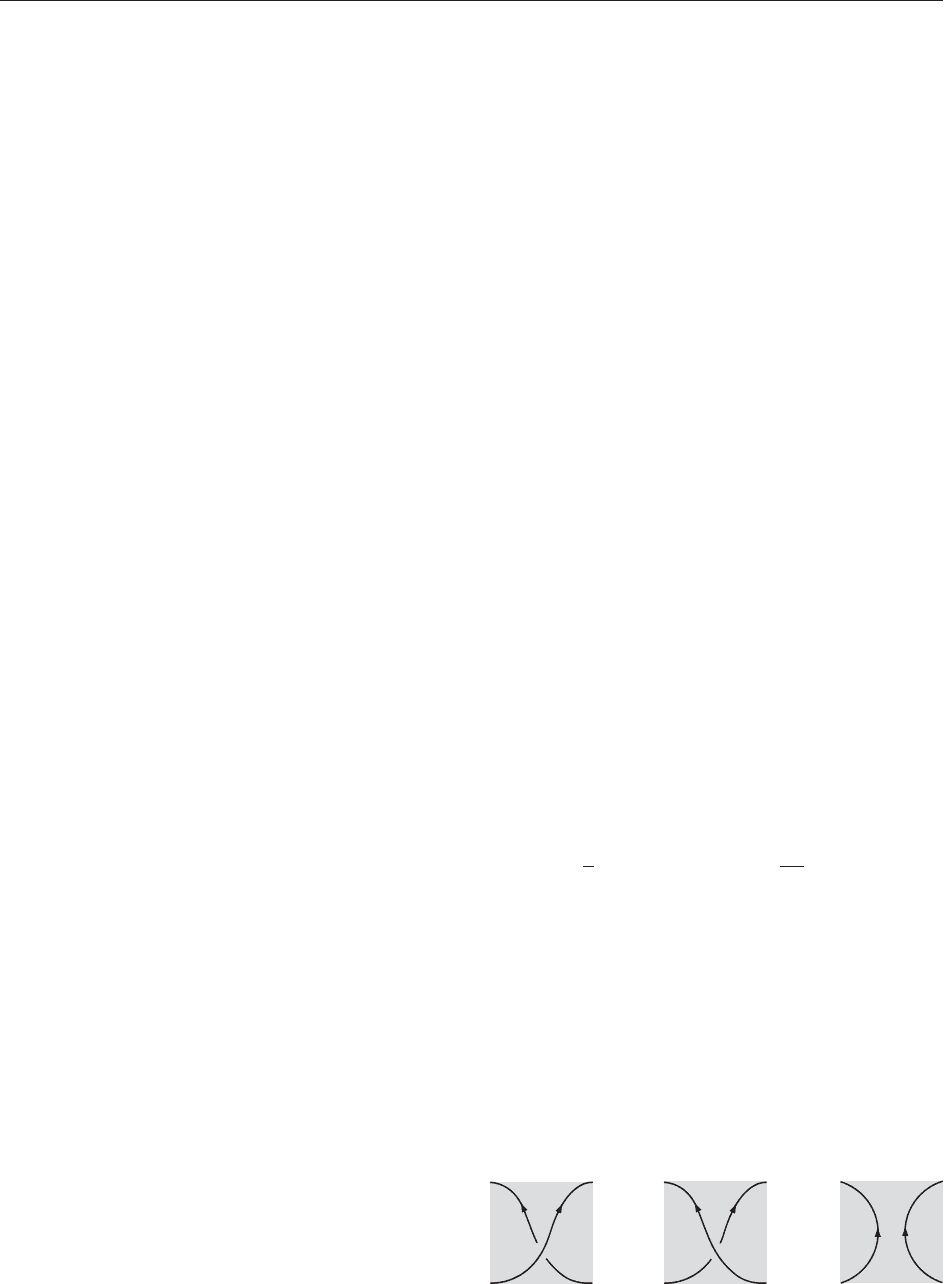
They establish a relation between the invar iants
associated to three links which only differ in a
region as shown in Figure 1 where arrows have been
introduced to take into account that the Jones
polynomial is defined for oriented links.
If one denotes by V
L
(t) the Jones polynomial
corresponding to a link L, t being the argument of
the polynomial, it must satisfy the skein relation:
1
t
V
L
þ
tV
L
¼
ffiffi
t
p
1
ffiffi
t
p
V
L
0
½43
where L
þ
, L
, and L
0
are the links shown in
Figure 1. This relation plus a choice of normali-
zation for the unknot (U) are enough to compute the
Jones polynomial for any link. The standard choice
for the unknot is
V
U
¼ 1 ½ 44
though it is not the most natural one from the point
of view of Chern–Simons gauge theory. After Jones
L
+
L
–
L
0
Figure 1 Skein relations.
Topological Quantum Field Theory: Overview 285

work in 1984, many other polynomial invariants
were discovered, as the HOMFLY and the
Kauffman polynomial invariants.
The pioneering work of Witten in 1988 showed
that the correlation functions of products of Wilson
loops [42] correspond to the Jones polynomial when
one considers SU(2) as gauge group and all the
Wilson loops entering in the correlation function are
taken in the fundamental representation F. For
example, if one considers a knot K, Witten showed
that
V
K
ðtÞ¼ W
F
K
½45
provided that one performs the identification
t ¼ exp
2i
k þ h
½46
where h = 2 is the dual Coxeter number of the gauge
group SU(2). Witten also showed that if instead of
SU(2) one considers SU(N) and the Wilson loop
carries the fundamental representation, the resulting
invariant is the HOMFLY polynomial. The second
variable of this polynomial originat es in this context
from the N dependence. However, these cases are
just a sample of the general framework intrinsic to
Chern–Simons gauge theory. Taking other groups
and other representations, one possesses an enormous
set of knot and link invariants. These invariants
can also be obtained in the context of quantum
groups.
Many nonperturbative studies of Chern–Simons
gauge theory have been carried out. The quantiza-
tion of the theory has been studied from the point of
view of the operator formalism as well as other
more geometrical methods. Also, its connection to
two-dimensional conformal field theory has been
further elucidated, and a powerful method for the
general computation of knot and link invariants has
been developed by Kaul and collaborators.
Chern–Simons theory is also amenable to pertur-
bative analysis, which has provided important
representations of the Vassiliev invariants. These
invariants, proposed by Vassiliev in 1990, turned
out to be the coefficients of the perturbative series
expansion of the correlators of Chern–Simons gauge
theory. Perturbative studies can be carried out in
different gauges, originating a variety of new
representations of Vassiliev invariants. Among the
most relevant results related to these topics are the
integral expressions for Vassiliev invariants by
Kontsevich and by Bott and Taubes, as well as the
recent combinatorial ones. These developments are
not described here but the interested reader is
referred to the recent review (Labastida 1999).
Advanced Developments
Topological sigma models are another important
type of (Witten-type) TQFTs. These theories are
obtained after twisting 2D N = 2 supersymmetric
sigma models. The twisting can be done in two
different ways leading to two types of models, A and
B. Their existence is related to mirror symmetry.
Only type-A models will be described in what
follows. These model s can be defined on an
arbitrary almost-complex manifold, though typically
they are considered on Ka
¨
hler manifolds. The theory
involves maps from two-dimensional Riemann sur-
faces to target spaces X, together with fermionic
degrees of freedom on which are mapped to
tangent vectors on X. The functional integral of the
resulting theory is localized on holomorphic maps,
defining the corre sponding moduli space. The
corresponding
Q-cohomology provides the set of
physical observables, which can be mapped to
cohomology classes on the moduli space and
integrated to produce topological invariants.
Topological sigma models keep fixed the com-
plex structure of the Riemann surface .Moti-
vated by string theory, one also considers the
situation in which one integrates over complex
structures. In this c ase, one ends up working with
holomorphic maps in the entire moduli space of
curves. The resulting theories are called topologi-
cal strings.
We will review now a particular example of
topological string theory which, besides being very
interesting from the point of view of physics and
mathematics, will be very useful in establishing a
relation with Chern–Simons gauge theory. Let us
consider topological strings with target manifold X
a Calabi–Yau 3-fold. In this case, the virtual
dimension of the moduli space of holomorphic
maps turns out to be zero. Two situations can
occur: either the space is given by a number of
points (the real dimension is zero) or the moduli
space is finite dim ensional and possesses a bundle of
the same dimension as the tangent bundle. In the
first case, topological strings count the number of
points weighted by the exponential of the area of the
holomorphic map (the pullback of the Ka
¨
hler form
integrated over the surface) times x
2g2
, where x is
the string-coupling constant and g is the genus of .
In the second case, one computes the top Chern class
of the appropriate bundles (properly defined), again
weighted by the same factor. In both cases one can
classify the contributions according to the cohomology
class on X in which the image of the holomorphic
map is contained. The sum of the numbers obtained
for each and fixed g are known as Gromov–Witten
286 Topological Quantum Field Theory: Overview

invariants, N
g
. The topological string contribution
takes the form
X
g0
x
2g2
X
2H
2
ðX;ZÞ
N
g
e
R
!
0
@
1
A
½47
where ! is the Ka
¨
hler class of the Calabi–Yau manifold.
In general, the quantities N
g
are rational numbers.
The precedent discussion has shown how Gromov–
Witteninvariantscanbeinterpretedintermsofstring
theory. One could think that this is just a fancy
observation and that no further insight on these
invariants can be gained from this formulation. The
situation turns out to be quite the opposite. Once a string
formulation has been obtained, the whole machinery of
string theory is at our disposal. One should look to new
ways to compute the quantity [47], where Gromov–
Witten invariants are packed. The hope is that, if this is
possible, the new emerging picture will provide new
insights on these invariants. This is indeed what
occurred recently. It turns out that the quantity [47]
can be obtained from an alternative point of view in
which the embedded Riemann surfaces are regarded as
D-branes. The outcome of this approach is that the
Gromov–Witten invariants can be written in terms of
other invariants which are integers and that possess a
geometrical interpretation. To be more specific, the
quantity [47] takes the form
X
g0
2H
2
ðX;ZÞ
X
d>0
n
g
1
d
2 sin
dx
2
2g2
e
d
R
!
½48
where n
g
are the new ‘‘integer’’ invar iants. This
prediction has been verified in all the cases in which
it has been tested. A similar structure will be found
in the next section in the context of knot theory in
the large-N limit.
Let us now consider also Donaldson–Witten theory
from a new perspective. To be more specific, let us
consider the case in which the gauge group is SU(2),
and the 4-manifold X is simply connected and has
b
þ
2
> 1 (the case b
þ
2
= 1 is anomalous). In this situation
there are 1 þ b
2
physical observables [34], O= I
1
and
I(
a
) = I
2
(
a
)(a = 1, ..., b
2
), where
a
is a basis of
H
2
(X). These can be packed in a generating functional:
exp
X
a
a
Ið
a
ÞþO
!*+
½49
where and
a
(a = 1, ..., b
2
)areparameters.In
computing this quantity one can argue that the
contribution is localized on the moduli space of
instantons configurations and one ends up, after
taking into account the selection rule dictated by the
dimensionality of the moduli space, with integrations
over the moduli space of the selected forms. The
resulting quantities are Donaldson invariants.
As in the case of topological sigma models one could
be tempted to argue that the observation leading to a
field-theoretical interpretation of Donaldson invar-
iants does not provide any new insight. Quite on the
contrary, once a field theory formulation is available,
one has at his disposal a huge machinery which could
lead, on the one hand, to further generalizations of the
theory and, on the other hand, to new ways to
compute quantities such as [49], obtaining new
insights on these invariants. This is indeed what
happened in the 1990s, leading to an important
breakthrough in 1994 when Seiberg and Witten
calculated [49] in a different way and pointed out the
relation of Donaldson invariants to new integer
invariants that nowadays bear their names.
The localization argument that led to the interpreta-
tion of [49] as Donaldson invariants is valid because
the theory under consideration is exact in the weak-
coupling limit. Actually, the topological theory under
consideration is independent of the coupling constant
and thus calculations in the strong-coupling limit are
also exact. These types of calculations were out of
reach before 1994. The situation changed dramatically
after the work of Seiberg and Witten in which N = 2
super Yang–Mills theory was solved in the strong-
coupling limit. Its application to the corresponding
twisted version was immediate and it turned out that
Donaldson invariants can be written in terms of new
integer invariants now known as Seiberg–Witten
invariants (Witten 1994). The development has a
strong resemblance with the one described above for
topological strings: certain noninteger invariants can
be expressed in terms of new integer invariants.
The Seiberg–Witten invariants are actually simpler
to compute than Donaldson invariants. They corre-
spond to partition functions of topological
Yang–Mills theories where the gauge group is
abelian. These contributions can be grouped into
classes labeled by x = 2c
1
(L), where c
1
(L)isthe
first Chern class of the corresponding line bundle.
The sum of contributions, each being 1, for a given
class x is the integer Seiberg–Witten invariant n
x
.The
strong-coupling analysis of topological Yang–Mills
theory leads to the following expression for [49]:
2
1þð1=4Þð7þ11Þ
e
ððv
2
=2Þþ2Þ
X
x
n
x
e
vx
þi
þ=4
e
ððv
2
=2Þ2Þ
X
x
n
x
e
ivx
½50
where v =
P
a
a
a
, and and are the Euler
number and the signature of the manifold X. This
result matches the known structure of [49] (structure
theorem of Kronheimer and Mrowka) and provides
Topological Quantum Field Theory: Overview 287