
Francoise J.-P., Naber G.L., Tsun T.S. (editors) Encyclopedia of Mathematical Physics
Подождите немного. Документ загружается.


a meaning to its unknown quantities in terms of the
new Seiberg–Witten invariants. Equation [50] is a
rather remarkable prediction that has been tested in
many cases, and for which a general pro of has been
recently proposed. For a review of the subject, see
Labastida and Lozano (1998).
The situation for manifolds with b
þ
2
= 1 involves a
metric dependence and has been worked out in
detail (Moore and Witten 1998). The formulation of
Donaldson invariants in field-theoretical terms has
also provided a generalization of these invariants.
This generalization has been carried out in several
directions: (1) the con sideration of higher-rank
groups, (2) the coupling to matter fields after
twisting N = 2 hypermultiplets, and (3) the twist of
theories involving N = 4 supersymm etry.
We will now look at Chern–Simons gauge theory
from the perspective that emerges from its treatment
in the context of the large-N expansion. We will
restrict the discussion to the case of knots on S
3
with
gauge group SU(N). Gauge theories with gauge group
SU(N) admit, besides the perturbative expansion, a
large-N expansion. In this expansion correlators are
expanded in powers of 1/N while keeping the
’t Hooft coupling t = Nx fixed, x being the coupling
constant of the gauge theory. For example, for the
free energy of the theory, one has the general form
F ¼
X
1
g0
h1
C
g;h
N
22g
t
2g2þh
½51
In the case of Chern–Simons gauge theory, the coupling
constant is x = 2i=(k þ N) after taking into account
the shift in k.Thelarge-N expansion [51] resembles a
string-theory expansion and indeed the quantities C
g, h
can be identified with the partition function of a
topological open string with g handles and h bound-
aries, with N D-branes on S
3
in an ambient six-
dimensional target space T
S
3
. This was pointed out by
Witten in 1992. The result makes a connection between
a topological three-dimensional field theory and the
topological strings described in the previous section.
In 1998 an important breakthrough took place
which provided a new approach to compute quan-
tities such as [51]. Using arguments inspired by the
AdS/CFT correspondence, Gopakumar and Vafa
(1999) provided a closed-string-theory interpretation
of the partition function [51]. They conjectured that
the free energy F can be expressed as
F ¼
X
1
g0
N
22g
F
g
ðtÞ½52
where F
g
(t) corresponds to the partition function of a
topological closed-string theory on the noncompact
Calabi–Yau manifold X called the resolved conifold,
O(1) O(1) ! P
1
, t being the flux of the B-field
through P
1
. The quantities F
g
(t) have been computed
using both physical and mathematical arguments,
thus proving the conjecture.
Once a new picture for the partition function of
Chern–Simons gauge theory is available, one should
ask about the form that the expectation values of
Wilson loops could take in the new context. The
question was faced by Ooguri and Vafa and they
provided the answer, later refined by Labastida,
Marin˜ o, and Vafa. The outcome is an entirely new
point of view in the theory of knot and link
invariants. The new picture provides a geometrical
interpretation of the integer coefficients of the
quantum group invariants, an issue that has been
investigated during many years. To present an
account of these developments, one needs to review
first some basic facts of large-N expansions.
To consider the presence of Wilson loops, it is
convenient to introduce a particular generating
functional. First, one performs a change of basis
from representations R to conjugacy classes C(k)of
the symmetric group, labeled by vectors
k = (k
1
, k
2
, ...) with k
i
0, and jkj=
P
j
k
j
> 0.
The change of basis is W
k
=
P
R
R
(C(k))W
R
,
where
R
are characters of the permutation group
S
‘
of ‘ =
P
j
jk
j
elements ( ‘ is also the number of
boxes of the Young tableau associated to R).
Second, one introduces the gen erating functional:
FðVÞ¼log ZðVÞ¼
X
k
jCðkÞj
‘!
W
ðcÞ
k
k
ðVÞ½53
where
ZðVÞ¼
X
k
jCðkÞj
‘!
W
k
k
ðVÞ
k
ðVÞ¼
Y
j
ðtr V
j
Þ
k
j
In these expressions jC(k)j denotes the number of
elements of the class C( k)inS
‘
. The reason behind
the introduction of this generating functional is that
the large-N structure of the connected Wilson loops,
W
(c)
k
, turns out to be very simple:
jCðkÞj
‘!
W
ðcÞ
k
¼
X
1
g¼0
x
2g2þjkj
F
g; k
ðÞ½54
where = e
t
and t = Nx is the ’t Hooft coupling.
Writing x = t=N, it corresponds to a power series
expansion in 1/N. As before, the expansion looks
like a perturbative series in string theory where g is
the genus and jkj is the number of holes. Ooguri and
Vafa conjectured in 1999 the appropriate string-
theory description of [54]. It corresponds to an open
topological string theory (notice that the ones
288 Topological Quantum Field Theory: Overview

described in the previous section were closed),
whose target space is the resolved conifold X. The
contribution from this theory will lead to open-
string analogs of Gromov–Witten invariants.
In order to describe in more detail the fact that one
is dealing with open strings, some new data need to
be introduced. Here is where the knot description
intrinsic to the Wilson loop enters. Given a knot K on
S
3
, let us associate to it a Lagrangian submanifold C
K
with b
1
= 1 in the resolved conifold X and consider a
topological open string on it. The contributions in
this open topological string are localized on holo-
morphic maps f :
g, h
! X with h = jkj which satisfy
f
[
g, h
] = Q,andf
[C] = j[]fork
j
oriented circles
C. In these expressions 2 H
1
(C
K
, Z), and Q2
H
2
(X, C
K
, Z), that is, the map is such that k
j
boundaries of
g, h
wrap the knot j times, and
g, h
itself gets mapped to a relative two-homology class
characterized by the Lagrangian submanifold C
K
.
The number of such maps (in the sense described in
the previous section) is the open-string analog of
Gromov–Witten invariants. They will be denoted by
N
Q
g, k
. Comparing to the situation that led to [47] in
the closed-string case, one concludes that in this case
the quantities F
g, k
()in[54] must take the form
F
g; k
ðÞ¼
X
Q
N
Q
g; k
e
R
Q
!
; t ¼
Z
P
1
! ½55
where ! is the Ka
¨
hler class of the Calabi–Yau
manifold X and = e
t
. For any Q, one can always
write
R
Q
! = Qt, where Q is in genera l a half-integer
number. Therefore, F
g, k
() is a polynomial in
1=2
with rational coefficients.
The result [55] is very impressive but still does not
provide a representation where one can assign a
geometrical interpretation to the integer coefficients
of the quantum-group invariants. Notice that to
match a polynomial invariant to [55], after obtain-
ing its connected part, one must expand it in x after
setting q = e
x
keeping fixed. One would like to
have a refined version of [55], in the spirit of what
was described in the previous section leading from
the Gromov–Witten invariants N
g
of [47] to the
new integer invariants n
g
of [48]. It turns out that,
indeed, F(V) can be expressed in terms of integer
invariants in complete analogy with the description
presented in the previous section for topological
strings. A good review on the subject can be found
in Marin˜ o (2005).
Concluding Remarks
In this overview we have introduced key features of
TQFTs and we have described some of the most
relevant results emerged from them. We have
described how the many faces of TQFT provide a
variety of important insights in a selected set of
problems in topology. Among these outstand the
reformulation of Donaldson theory and the discovery
of the Seiberg–Witten invariants, and the string-theory
description of the large-N expansion of Chern–Simons
gauge theory, which provides an entirely new point of
view in the study of knot and link invariants and points
to an underlying fascinating interplay between string
theory, knot theory, and enumerative geometry which
opens new fields of study.
In addition to their intrinsic mathematical inter-
est, TQFTs have been found relevant to important
questions in physics as well. This is so because, in a
sense, TQFTs are easier to solve than conventional
quantum field theories. For example, topological
sigma models are relevant to the computation of
certain couplings in string theory. Also, Witten-type
gauge TQFTs such as Donaldson–Wi tten theories
and its generalizations play a role in string theory as
effective world-volume theories of extended string
states (branes) wrapping curved spaces, and TQFTs
arising from N = 4 gauge theories in four dimen-
sions have shed light on field- (and string-) theory
dualities.
Most of these developments, and others that we
have not touched upon or only mentioned in passing
have their own entries in the encyclopedia, to which
we refer the interested reader for further details.
See also: Axiomatic Approach to Topological Quantum
Field Theory; BF Theories; Chern–Simons Models:
Rigorous Results; Donaldson–Witten Theory; Gauge
Theoretic Invariants of 4-Manifolds; Gauge Theory:
Mathematical Applications; Hamiltonian Fluid Dynamics;
The Jones Polynomial; Knot Theory and Physics;
Mathai–Quillen Formalism; Mathematical Knot Theory;
Schwarz-Type Topological Quantum Field Theory;
Seiberg–Witten Theory; Stationary Phase Approximation;
Topological Sigma Models.
Further Reading
Atiyah MF (1988) New invariants of three and four dimensional
manifolds. In: The Mathematical Heritage of Herman Weyl,Proc.
Symp. Pure Math., vol. 48. American Math. Soc. pp. 285–299.
Birmingham D, Blau M, Rakowski M, and Thompson G (1991)
Topological field theory. Physics Reports 209: 129–340.
Cordes S, Moore G, and Rangoolam S (1996) Lectures on 2D
Yang–Mills theory, equivariant cohomology and topological
field theories. In: David F, Ginsparg P, and Zinn-Justin J (eds.)
Fluctuating Geometries in Statistical Mechanics and Field
Theory, Les Houches Sesion LXII, p. 505 (hep-th/9411210).
Elsevier.
Donaldson SK (1990) Polynomial invariants for smooth four-
manifolds. Topology 29: 257–315.
Floer A (1987) Morse theory for fixed points of symplectic
diffeomorphisms. Bulletin of the American Mathematical
Society 16: 279.
Topological Quantum Field Theory: Overview 289

Freyd P, Yetter D, Hoste J, Lickorish WBR, Millet K, and
Ocneanu A (1985) A new polynomial invariant of knots and
links. Bulletin of the American Mathematical Society 12(2):
239–246.
Gopakumar R and Vafa C (1999) On the gauge theory/geometry
correspondence. Advances in Theoretical and Mathematical
Physics 3: 1415 (hep-th/9811131).
Jones VFR (1985) A polynomial invariant for knots via von
Neumann algebras. Bulletin of the American Mathematical
Society 12: 103–112.
Jones VFR (1987) Hecke algebra representations of braid groups
and link polynomials. Annals of Mathematics 126(2): 335–388.
Kauffman LH (1990) An invariant of regular isotopy. Transac-
tions of American Mathematical Society 318(2): 417–471.
Labastida JMF (1999) Chern-Simons gauge theory: ten years
after. In: Falomir H, Gamboa R, and Schaposnik F (eds.)
Trends in Theoretical Physics II, ch. 484, 1. New York: AIP
(hep-th/9905057).
Labastida JMF and Lozano C (1998) Lectures in topological
quantum field theory. In: Falomir H, Gamboa R, and
Schaposnik F (eds.) Trends in Theoretical Physics, ch. 419,
54. New York: AIP (hep-th/9709192).
Labastida JMF and Marin˜o M (2005) Topological Quantum Field
Theory and Four Manifolds. Dordrecht: Elsevier; Norwell, MA:
Springer.
Marin˜ o M (2005) Chern–Simons theory and topological strings.
Reviews of Modern Physics 77: 675–720.
Moore G and Witten E (1998) Integrating over the u-plane in
Donaldson theory. Advances in Theoretical and Mathematic
Physics 1: 298–387.
Vassiliev VA (1990) Cohomology of knot spaces. In: Theory of
Singularities and Its Applications, Advances in Soviet Mathe-
matics, vol. 1, pp. 23–69. American Mathematical Society.
Witten E (1982) Supersymmetry and Morse theory. Journal of
Differential Geometry 17: 661–692.
Witten E (1988a) Topological quantum field theory. Commu-
nications in Mathematical Physics 117: 353.
Witten E (1988b) Topological sigma models. Communications in
Mathematical Physics 118: 411.
Witten E (1989) Quantum field theory and the Jones polynomial.
Communications in Mathematical Physics 121: 351.
Witten E (1994) Monopoles and four-manifolds. Mathematical
Research Letters 1: 769–796.
Topological Sigma Models
D Birmingham, University of the Pacific,
Stockton, CA, USA
ª 2006 Elsevier Ltd. All rights reserved.
Introduction
Topological sigma models govern the quantum
mechanics of maps from a Riemann surface to a
target space M. In contrast to the standard super-
symmetric sigma model, the topological version has a
special local shift symmetry. This symmetry takes the
form u
i
=
i
,where
i
is an arbitrary local function of
the coordinates on the base manifold . In essence, this
topological shift symmetry ensures that all local
degrees of freedom of the model can be gauged away.
As a result, the dynamics of such a model resides in a
finite number of global topological degrees of freedom.
This feature is generic to all topological field theories
of Witten type, also known as cohomological field
theories (see Topological Quantum Field Theory:
Overview). The topological shift symmetry is respon-
sible for the special topological nature of the model,
which is seen most readily by BRST quantizing the
local shift symmetry. This gives rise to a nilpotent
BRST operator Q. The properties of this BRST
operator are crucial for establishing the topological
nature of the model. The key point in the construction
of any cohomological field theory is the fact that the
full quantum action S
q
can be written as a BRST
commutator S
q
= {Q, V}, where V is a function of the
fields needed to define the path integral. In particular,
one can show that the partition function and all
correlation functions are independent of the metric on
both the base manifold and the target space M.For
example, let us define the path integral by
Z ¼
Z
d e
fQ;Vg
½1
where denotes the full set of fields required at the
quantum level. In general, the function V depends
on geometric data of both and M. Nevertheless,
one can easily establish that the partition function is
independent of this data by noting the following.
Variation of Z with respect to the metric of the
target space g (for example) gives
g
Z ¼
Z
d e
fQ;Vg
fQ;
g
Vg½2
The right-hand side of this equation is nothing but
the vacuum expectation value of a BRST commu-
tator, and this vanishes by BRST invariance of the
vacuum. It is important to note here that the BRST
operator Q can be constructed to be independent of
g. Apart from the necessity of introducing the metric
tensor, these models also require additional geo-
metric data for their construction. The complex
structure of , and at least an almost-complex
structure on M, is required. By a similar argument,
one can show that the partition funct ion and
correlation functions are independent of this extra
290 Topological Sigma Models

geometric data. As mentioned above, these models
possess no local degrees of freedom. One can then
show that the path-integral expression for the
correlation funct ions can be localized to a finite-
dimensional moduli space of instanton configura-
tions which minimize the classical action.
We will first show how the full quantum action of
the theory can be obtained as a BRST quantization of a
classical action with a local gauge symmetry. How-
ever, we shall then highlight the fact that the gauge
algebra for this topological shift symmetry only closes
on-shell. In order to proceed with a BRST quantization
of the model, and obtain the complete quantum
action, one must take recourse to the Batalin–
Vilkovisky quantization scheme. This machinery is
ideally tailored for such a problem, with the end result
that quartic ghost terms are present in the action.
However, the presence of such terms does not affect
the arguments presented above, since the quantum is
still obtained as a BRST commutator. Following this,
we construct all observables of the theory and
demonstrate their connection to the de Rham coho-
mology of the target space. The special topological
properties of the observables are then discussed, and it
is shown how their computation is localized to the
moduli space M of holomorphic maps from to M.
As a particular example, we show how the computa-
tion of a certain class of observables determines the
intersection numbers of the moduli space M.We
present a brief discussion of the connection between
topological sigma models with Calabi–Yau target
space M, and the mirror symmetry of M.
Construction of the Model
We begin with the following classical action:
S
c
¼
Z
d
2
ffiffiffi
h
p
h
g
ij
K
i
K
j
½3
where
K
i
¼ G
i
1
2
@
u
i
þ
J
i
j
@
u
j
½4
The fields G
i
and K
i
both sati sfy the self-duality
constraint
G
i
¼ P
i
þ
j
G
j
K
i
¼ P
i
þ
j
K
j
½5
where the self-dual and anti-self-dual projection
operators are defined as
P
i
j
¼
1
2
i
j
J
i
j
½6
The above action describes a theory of maps u
i
()
from a Riemann surface to an almost complex
manifold M. The coordinates on are denoted by
( = 1, 2), while those on the target manifold M
are denoted by u
i
(i = 1, ..., dim M). The metric and
complex structure of are denoted by h
and
,
respectively; they obey the relations
=
and
= h
. The metric tensor g
ij
and almost-
complex structure J
i
j
of M obey analogous relations
to the above. In the general model, the target space
need only be an almost-complex manifold. This
requires the existence of a globally defined tensor
field J
i
j
such that J
i
j
J
j
k
=
i
k
.
The action [3] is invariant under the topological
shift symmetry
u
i
¼
i
½7
where
i
is an arbitrary local function of the
coordinates on the base manifold . Already, at
this level, we see the distinction with the standard
sigma model. The presence of this shift symmetry
means that all local degrees of freedom can be
gauged away, leaving only a finite number of global
topological degrees of freedom. It requires some
work to determine the corresponding transformati on
for G
i
, the key point being the preservation of the
self-duality constraint. We find
G
i
¼P
i
þ
j
D
j
þ
1
2
l
D
l
J
j
k
@
u
k
þ
1
2
k
D
k
J
i
j
G
j
i
lk
k
G
l
½8
where the covariant derivative is defined by
D
i
= @
i
þ
i
jk
(@
u
j
)
k
.
Having determined the classical symmetries of the
model, we can now proceed with the BRST quantized
form of the quantum action. As a topological field
theory of Witten type, one can show that the quantum
action can be written as a BRST commutator, that is,
S
q
= {Q, V}, where the gauge fermion V is defined by
V ¼
Z
d
2
ffiffiffi
h
p
C
i
@
u
i
4
B
i
½9
where is an arbitrary gauge-fixing parameter. The
BRST operator Q is nilpotent Q
2
= 0, off-shell. It is
defined by ={Q, }, and takes the form
u
i
¼C
i
C
i
¼0
C
i
¼ B
i
þ
1
2
D
k
J
i
j
C
j
C
k
þ
k
ij
C
k
C
j
B
i
¼
4
C
k
C
l
R
i
t
kl
þR
klrs
J
ri
J
s
t
C
t
2
D
k
J
i
j
C
k
B
j
þ
4
C
k
D
k
J
i
s
C
l
D
l
J
t
s
C
t
þ
i
jk
C
j
B
k
½10
Topological Sigma Models 291

In the abo ve, the ghost field is denoted by C
i
, while
the anti-ghost field
C
i
and the multiplier field B
i
obey the self-dua lity constraint [5]. The key point to
note in the above transformations is the fact that the
ghost field C
i
is BRST invariant. Again, this is a
feature which is generic to all cohomological field
theories. The exis tence of such a field allows the
construction of an entire set of topological correla-
tion functions, as we shall see in the following
section.
While the gauge-fixing parameter is arbitrary, a
conventional choice is to take = 1, and then
integrate out the multiplier field B. This yields the
action in the form
S
q
¼
Z
d
2
ffiffiffi
h
p
1
2
h
g
ij
@
u
i
@
u
j
þ
1
2
J
ij
@
u
i
@
u
j
þ
C
i
D
C
i
þ
1
2
D
j
J
i
k
@
u
k
C
j
þ
1
8
C
m
C
k
R
mkjr
C
j
C
r
þ
1
16
C
i
C
k
ðD
j
J
li
ÞðD
r
J
lk
ÞC
j
C
r
½11
It should be stressed that the classical gauge algebra
[7] and [8] only closes on-shell. Quantization of the
model is therefore more subtle, and requires use of
the Batalin–Vilkovisky formalism. The on-shell
closure problem automatically results in the pre-
sence of quartic ghost coupling terms in the action
and consequently cubic terms in the BRST transfor-
mations. Despite this, we have established that the
full quantum action can be written as a BRST
commutator.
The form of the action simplifies when the
complex structure of the target manifold is
covariantly constant, D
k
J
i
j
= 0. In thi s c ase, the
target ma nifold M is Ka¨hler and we denote the
complex coordinates as u
I
, with their complex
conjugates denoted by u
I
. The nonzero c ompo-
nents of the metric tensor are then g
I
J
. Similarl y,
the coordinates of are denoted
, with nonzero
metric components h
þ
. The nonzero components
of the ghost and anti-ghost are then given by
C
I
, C
I
,
C
þ
I
,
C
I
. The action can be writt en in t he
form
S
q
¼
Z
d
2
ffiffiffi
h
p
h
þ
g
I
J
@
þ
u
I
@
u
J
þ
1
2
C
þ
I
ðD
C
J
Þh
þ
g
I
J
þ
1
2
C
I
ðD
þ
C
J
Þh
þ
g
I
J
þ
1
4
h
þ
C
þ
I
C
I
R
I
IJ
J
C
J
C
J
½12
Construction of Observables
Having defined the quantum action, it is now of
interest to consider the correlation functions of the
model. In the functional integral, we integrate over
all maps !M in a fixed homotopy class. Let us
consider a correlation function
hOi ¼
Z
du
i
d
C
i
dC
i
e
tS
q
O½13
where t > 0 is a parameter, and the observable O is
BRST invariant {Q, O} = 0. From the BRST invar-
iance of the vacuum, it follows immediately that the
vacuum expectation value of a BRST commutator is
zero, h{Q, O}i= 0. An operator which is a BRST
commutator is said to be Q-exact. Hence, our
interest is in the Q-cohomology classes of operators,
that is, BRST invariant operators modulo BRST
exact operators. It is for this reason that such a
model is called a cohomological field theory.
One can now show that the variation of [13] with
respect to t is a BRST commutator, namely
t
hOi ¼ t
Z
du
i
d
C
i
dC
i
e
tS
q
fQ; VOg ¼ 0 ½14
As a result, one can evalu ate the correlation function
in the large-t (weak-coupling) limit. In this limit, the
path integral is dominated by fluctuations around
the classical minima. For the sigma model under
study, the classical action is minimized by the
instanton configurations
@
u
i
þ
J
i
j
@
u
i
¼ 0 ½15
Indeed, this localization of the path integral to the
moduli space of instantons can also be seen by
choosing the = 0 gauge in [9]. Integration over the
multiplier field then imposes a delta function
constraint to the instanton configurations. The key
point in the above derivation is the fact that the
quantum action is a BRST commutator, S
q
= {Q, V}.
By a similar argument, one can show that variations
of hOi with respect to the metric and complex
structure of and M are also zero.
Our aim now is to construct the Q-cohomology
classes of operators in the theory. Let us first associate
an operator O
(0)
A
to each p-form A = A
i
1
i
p
du
i
1
^^
du
i
p
on the target space M,givenby
O
ð0Þ
A
¼ A
i
1
i
p
C
i
1
C
i
p
½16
where C
i
is the ghost field. Under a BRST
transformation, we see that
fQ; O
ð0Þ
A
g¼@
i
0
A
i
1
i
p
C
i
0
C
i
p
¼O
ð0Þ
dA
½17
292 Topological Sigma Models

since the ghost fields are BRST invariant by [10].
Hence, O
(0)
A
is BRST invariant if and only if A is a
closed p-form. Similarly, if A is an exact p-form,
then the corresponding operator is Q-exact. Hence,
the BRST cohomology classes of these operators are
in one to one correspondence with the de Rham
cohomology classes on M. The reason for assigning
the peculiar superscript to the operator O
(0)
will
become clear at the end of this construction. Notice
also that operators of the form O
(0)
A
can be used as
building blocks for constructing new observables. If
we consider a set of closed forms A
1
, ..., A
k
, then
the product of the associated operators O
(0)
A
1
O
(0)
A
k
is clearly Q-invariant as well.
When considering the vacuum expectation values
of operators which are polynomials in the fields,
there is an implicit dependence on the points where
the operators are located. In the case at hand
however, the operator O
(0)
A
() at the point has a
vacuum expectation value which is a topological
invariant, and thus cannot depend on the chosen
point. To see this explicitly, we consider all fields
defined over , and differentiate the operator with
respect to some local coordinates
:
@
@
A
i
1
i
p
C
i
1
C
i
p
¼ð@
i
0
A
i
1
i
p
Þ
@u
i
0
@
C
i
1
C
i
p
þ pA
i
1
i
p
ð@
i
0
C
i
1
Þ
@u
i
0
@
C
i
2
C
i
p
½18
In terms of exterior derivatives, this takes the form,
dO
ð0Þ
A
¼ @
i
0
A
i
1
i
p
du
i
0
C
i
1
C
i
p
þpA
i
1
i
p
dC
i
1
C
i
2
C
i
p
¼fQ; O
ð1Þ
A
g½19
where O
(1)
A
= pA
i
1
i
p
du
i
1
C
i
2
C
i
p
, and we have
used the fact that A is a closed p-form. If we let
represent any path between two arbitrary points P
and P
0
, then this expression has the integral form,
O
ð0Þ
A
ðPÞO
ð0Þ
A
ðP
0
Þ¼ Q;
Z
O
ð1Þ
A
½20
and we see that the vacuum expectation value of
O
(0)
A
is point independent by the BRST invariance of
the vacuum. The same remark applies to any
product of operators of the form we are considering.
To continue our construction, consider a one-
dimensional homology cycle (@ = 0), and define
W
ð1Þ
A
ðÞ¼
Z
O
ð1Þ
A
½21
This new operator W
(1)
A
() is BRST invariant by
inspection,
Q; W
ð1Þ
A
ðÞ
no
¼
Z
Q; O
ð1Þ
A
no
¼
Z
dO
ð0Þ
A
¼ 0 ½22
Moreover, if happens to be the boundary of a two-
dimensional surface ( = @), so that is trivial in
homology, then this new operator is likewise trivial
in Q cohomology:
W
ð1Þ
A
ðÞ¼
Z
O
ð1Þ
A
¼
Z
dO
ð1Þ
A
¼ Q;
Z
O
ð2Þ
A
½23
where
O
ð2Þ
A
¼
pðp 1Þ
2
A
i
1
i
p
du
i
1
^ du
i
2
C
i
3
C
i
p
As before, let us now associate to each homology
2-cycle (@ = 0), another BRST invariant operator
W
(2)
A
defined by
W
ð2Þ
A
ðÞ¼
Z
O
ð2Þ
A
½24
The BRST invariance follows trivially as in [23].
In summary, we have produced three operators
O
(0)
A
, O
(1)
A
, and O
(2)
A
from any given closed form A,
which satisfy the relations:
0 ¼ Q; O
ð0Þ
A
no
; dO
ð0Þ
A
¼ Q; O
ð1Þ
A
no
dO
ð1Þ
A
¼ Q; O
ð2Þ
A
no
; dO
ð2Þ
A
¼ 0
½25
The BRST observables are then given by arbitrary
products of the integrated operators W
(i)
A
() =
R
O
(i)
A
, where is any i-cycle in homology.
Observables and Intersection Theory
Let us consider the computation of the correlation
function hOi in the background field method. We
first pick a background instanton configuration [15],
and then integrate over the quantum fluctuations
around that instanton. The relevant part of the
quantum action is quadratic in the quantum fields,
and localization of the model then ensures that such
a computation is exact. The quantum fields are
expanded into eigenfunctions of the operators that
appear in the quadratic part of the action, and the
functional integral is replaced by an integral over the
eigenmodes. However, if there are fermionic zero
modes, then those modes do not enter in the action.
As a result, the fermionic integrals (
R
d = 0) over
those modes will cause hOi to vanish unless it has
the correct fermion content; the zero modes must be
absorbed. In our case, a glance at the quantum
action indicates that we should concern ourselves
with the zero modes of the ghost C
i
and anti-ghost
Topological Sigma Models 293

C
i
.AC
i
zero mode is clearly in the kernel of the
operator
D
i
j
¼ D
i
j
þ
J
i
jD
þ
D
j
J
i
k
@
u
k
½26
and a
C
i
zero mode is a zero eigenfunction of its
adjoint
D
. In the BRST quantization of the model,
the ghost fields C
i
are assigned ghost number þ1,
while the anti-ghost fields
C
i
have gho st number
1. It is therefore apparent that the vacuum
expectation value of any observable will vanish
unless that observable has a ghost number equal to
the number of
D zero modes, a, minus the number
of
D
zero modes, b. This difference, ! = a b,is
called the index of the operator
D.
There is a direct link between this index and the
dimension of the moduli space of instantons. Recall
that we are considering the space of maps !M in a
specified homotopy class, which satisfy equation [15].
It is then of interest to determine the dimension of the
space of such solutions. To this aim, we examine the
constraint that arises by considering an instanton u
i
,
and another neighboring solution u
i
þ
^
u
i
,where
^
u
i
is
an infinitesimal deformation. To first order in
^
u
i
,we
see that
^
u
i
must be a zero mode of the operator
D.
This is no coincidence, and we can thus interpret the
ghost fields C
i
as cotangent vectors to instanton
moduli space M. In particular, if M is a smooth
manifold, then dim M= a. The index of the operator
D is called the virtual dimension of the moduli space.
In generic situations, the virtual dimension is equal to
the actual dimension dim M.
It is possible to interpret some of the obs ervables
that we have described in terms of intersection
theory applied to the moduli space of instantons. In
particular, one can show that all correlation func-
tions of the form
O
ð0Þ
A
1
O
ð0Þ
A
s
DE
½27
are intersection numbers of certa in submanifolds of
moduli space. In order to see this in a simple
example, we first recall the notion of Poincare´
duality and the relationship between cohomology
and homology.
Poincare´ duality can be formulated as a relation-
ship between de Rham cohomology (defined in
terms of closed differential forms) and homology
(defined in terms of subspaces of M). For our
purposes here, it is sufficient to state that we can
associate to each boundaryless submanifold N of
codimension k, a cohomology class [] 2 H
k
(M),
such that
Z
M
^ ¼
Z
N
½28
for all [ ] 2 H
nk
(M). By on the right-hand side of
this equation , we mean the pullback i
under the
inclusion i : N !M. Conversely, to each closed
k-form on M, we can associate an (n k)-cycle
N (it is in general a chain of subspaces), unique up
to homology, such that the previous relation is
satisfied. Furthermore, one can show that the
Poincare´ dual to N can be chosen in such a way
that its support is localized within any given open
neighborhood of N in M (essentially delta funct ion
support on N).
Let us now define the notion of transversal
intersection. For simplicity, we will first consider
the intersection of two submanifolds M
1
and M
2
contained in M. We will say that these two
submanifolds have transversal intersection if the
tangent spaces satisfy
T
x
ðM
1
ÞþT
x
ðM
2
Þ¼T
x
ðMÞ½29
for all x 2 M
1
\ M
2
. It is a theorem that a submanifold
of codimension k can be locally ‘‘cu t-out’’ by k smooth
functions, that is, the submanifold is locally specified by
the zeros of this set of functions. It is a worthwhile
exercise to convince oneself that the definition of
transversal intersection is equivalent to the statement
that the functions which cut-out M
1
are independent
from those which cut-out M
2
. Thus, we can write
codimðM
1
\ M
2
Þ¼codimðM
1
ÞþcodimðM
2
Þ½30
More generally, we say that the intersection M
1
\\
M
s
of s submanifolds is transversal if the intersection of
every pair of them is transversal. It then follows
trivially by the previous argument that the codimen-
sions must satisfy
codimðM
1
\\M
s
Þ¼
X
s
i¼1
codimðM
i
Þ½31
The special case which will be important for us
occurs when the intersection of submanifolds is a
collection of points, that is, when the codimension
of the intersection is equal to the dimension of M.
Since these points are isolated, the compactness of
M guarantees that they are finite in num ber.
We are now in a position to describe in what sense
correlation functions of the form O
(0)
A
1
O
(0)
A
s
DE
determine intersection numbers in the moduli space
M of instantons. By definition, this moduli space is
the set of maps from to M which satisfy [15].Let
us consider the generic situation, where the virtual
dimension of M (i.e., the index of
D) is equal to
dim M. For convenience, let us begin by choosing the
forms A
i
which represent de Rham cohomology
classes on M, together with their Poincare´dualsM
i
,
such that the forms have essentially delta function
294 Topological Sigma Models

support on their respective submanifolds. Since each
of the operators in the correlation function depends
on some fixed point
i
,itismeaningfultodefinethe
submanifolds L
i
{u 2Mju(
i
) 2 M
i
} M.Now,
the correlation function represents a functional
integral over the space of maps Map(, M), and we
have argued that this integral only receives contribu-
tions from the instanton configurations. Since the
operators A
i
(u(
i
)) vanish unless u 2 L
i
by our choice
of the Poincare´ duals, we see that the only contribu-
tion to the functional integral can be from those maps
which lie in the intersection L
1
\\L
s
.Byghost
number considerations, this correlation function must
vanish unless the codimension of the intersection
equals the virtual dimension of M. In the generic
case where the virtual dimension is equal to dim M,
this means that the intersection is simply a finite
number of points. Intersection numbers 1 can then
be assigned to each point in the intersection L
1
\
\L
s
, by considering the relative orientation of the
submanifolds L
i
at the intersection points. From the
functional integral point of view, the computation
reduces to an evaluation of the ratio of the bosonic
determinant (integration over u
i
) to the fermionic
determinant (integration over C
i
and
C
i
). In the
Ka¨ hler case, for example, the intersection number
assigned to each point in the intersection is always þ1.
This is due to the fact that the C
I
,
C
I
determinant is
the complex conjugate of the C
I
,
C
þ
I
determinant.
A and B Models and Mirror Symmetry
The topological sigma model for a Ka¨ hler target
space [12] is also known as the topological A model.
In this case, the action can be recovered by twisting
the standard N = 2 supersymmetric sigma model.
This twisting procedure amount s to a reassignment
of the spins of the fields in the theory. However,
there is an alternative twisting which can be done,
and this leads to another model known as the
topological B model. The usefulness of this observa-
tion lies in the fact that the topolog ical A model on a
Calabi–Yau target space M is related to the
topological B model on the mirror of M. This
relationship and the computation of correlation
functions in the A and B model s thus sheds light
on the nature of mirror symmetry.
See also: Batalin–Vilkovisky Quantization;
BRST Quantization; Functional Integration in Quantum
Physics; Graded Poisson Algebras; Mathai–Quillen
Formalism; Mirror Symmetry: A Geometric Survey;
Several Complex Variables: Compact Manifolds;
Singularities of the Ricci Flow; Topological Gravity, Two-
Dimensional; Topological Quantum Field Theory:
Overview; WDVV Equations and Frobenius Manifolds.
Further Reading
Baulieu L and Singer I (1989) The topological sigma model.
Communications in Mathematical Physics 125: 227.
Birmingham D, Blau M, Rakowski M, and Thompson G (1991)
Topological field theory. Physics Reports 209: 129.
Birmingham D, Rakowski M, and Thompson G (1989) BRST
quantization of topological field theory. Nuclear Physics B
315: 577.
Eguchi T and Yang SK (1990) N = 2 superconformal models as
topological field theories. Modern Physics Letters A 5: 1693.
Floer A (1987) Morse theory for fixed points of symplectic
diffeomorphisms. Bulletin of the American Mathematical
Society 16: 279.
Floer A (1988) An instanton invariant for three manifolds.
Communications in Mathematical Physics 118: 215.
Gromov M (1985) Pseudo holomorphic curves in symplectic
manifolds. Inventiones Mathematicae 82: 307.
Gromov M (1986) In: Proceedings of the International Congress
of Mathematicians, p. 81. Berkeley.
Vafa C (1991) Topological Landau–Ginzburg models. Modern
Physics Letters A 6: 337.
Witten E (1988) Topological sigma models. Communications in
Mathematical Physics 118: 411.
Witten E (1991) Mirror manifolds and topological field theory.
In: Yau ST (ed.) Mirror Symmetry I, p. 121. American
Mathematical Society.
Turbulence Theories
R M S Rosa, Universidade Federal do Rio de Janeiro,
Rio de Janeiro, Brazil
ª 2006 Elsevier Ltd. All rights reserved.
Introduction
Turbulence has initially been defined as an irregular
motion in fluids. The cloud formations in the
atmosphere and the motion of water in rivers make
this point clear. These are but a few readily available
examples of a multitude of flows which display
turbulent regimes: from the blood that flows in our
veins and arterie s to the motion of air within our
lungs and around us; from the flow of water in
creeks to the atm ospheric and oceanic currents;
from the flows past submarines, ships, automobiles,
and aircraft to the combustion processes propelling
them; and in the flow of gas, oil, and water, from
the prospecting end to the entrails of the cities. The
great majority of flows in nature and in engineering
applications are somehow turbulent.
Turbulence Theories 295
But turbulent flows are much more than simply
irregular. More refined definitions were desirable
and were later coined. A definitive and precise one,
however, may only come when the phenomenon is
fully understood. Nevertheless, several characteristic
properties of a turbulent flow can be listed:
Irregularity and unpredictability A turbulent flow
is irregular both in space and time, displaying
unpredictable, random patterns.
Statistical order From the irregularity of a turbu-
lent motion there emerges a certain statistical
order. Mean quantities and corre lation are regular
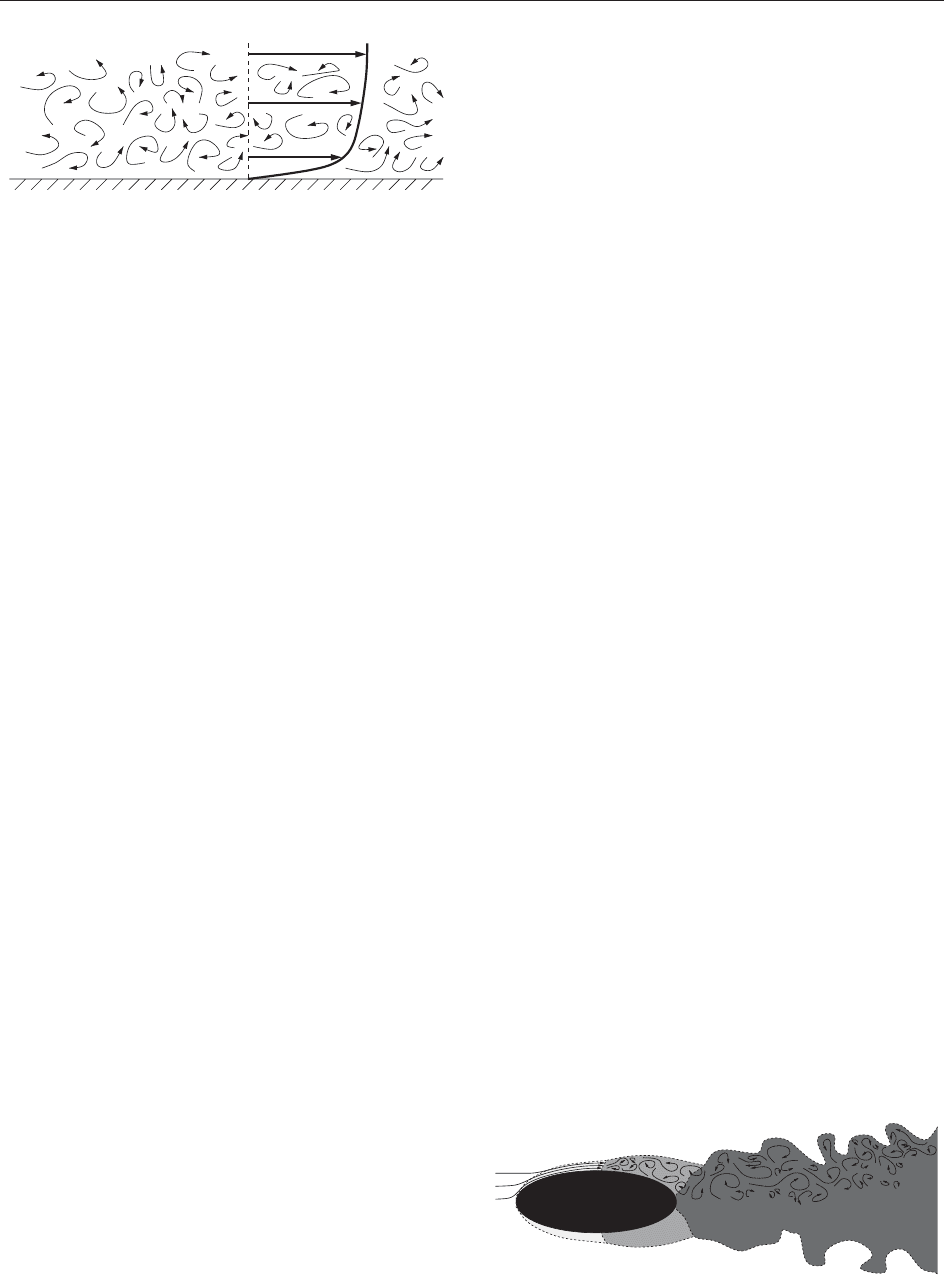
and predictable (Figure 1).
Wide range of active scales A wide range of scales of
motion are active and display an irregular motion,
yielding a large number of degrees of freedom.
Mixing and enhanced diffusivity The fluid particles
undergo complicated and convoluted paths, caus-
ing a large mixing of different parts of fluid. This
mixing significantly enhances diffusion, increasing
the transport of momentum, energy, heat, and
other advected quantities.
Vortex stretching When a moving portion of fluid
also rotates transversally to its motion an increase
in speed causes it to rotate faster, a phenomenon
called vortex stretching. This causes that portion
of fluid to become thinner and elongated, and fold
and intertwine with other such portions. This is
an intrinsically three-dimensional mechanism
which plays a fundamental role in turbulence
and is associated with large fluctuat ions in the
vorticity field.
Turbulent Regimes
Turbulence is studi ed from many perspectives. The
subject of ‘‘transition to turbulence’’ attempts to
describe the initial mechanisms responsible for the
generation of turbulence starting from a laminar
motion in particular geometries . This transition can
be followed with respect to position in space (e.g.,
the flow becomes more complicated as we look
further downstream on a flow past an obstacle or
over a flat plate) or to parameters (e.g., as we
increase the angle of attack of a wing or the pressure
gradient in a pipe). This subject is divided into two
cases: wall-bounded and free-shear flows. In the
former, the viscosity, which causes the fluid to
adhere to the surface of the wall, is the primary
cause of the instability in the transition process. In
the latter, inviscid mechanisms such as mixing layers
and jets are the main factors. The tools for studying
the transition to turbulence include linearization of
the equations of motion around the laminar solu-
tion, nonlin ear amplitude equations, and bifurcation
theory.
‘‘Fully developed turbulence,’’ on the other hand,
concerns turbulence which evolves without imposed
constraints, such as boundaries and external forces.
This can be thought of turbulence in its ‘‘pure’’
form, and it is somewhat a theoretical framework
for research due to its idealized nature. Hypotheses
of homogeneity (when the mean quantities asso-
ciated with the statistical order characterizing a
turbulent flow are independent in space), stationar-
ity (idem in time), and isotropy (idem with respect
to rotations in space) concern fully developed
turbulent flows. The Kolmogorov theory was devel-
oped in this context and it is the most fundamental
theory of turbulence. Current research is dedicated
in great part to unveil the mechanisms behind a
phenomenon called intermittency and how it affects
the laws obtained from the conventional theory.
Research is also dedicated to derive such laws as
much from first principles as possible, minimizing
the use of phenomenological and dimensional
analysis.
Real turbulent flows involve various regimes at
once. A typical flow past a blunt object, for
instance, displays laminar motion at its upstream
edge, a turbulent boundary layer further down-
stream, and the formation of a turbulent wake
(Figure 2). The subject of turbulent boundary layer
is a world in itself with current research aiming to
determine mean properties of flows over rough
surfaces and varied topography. Convective turbu-
lence involves coupling with active scalars such as
Figure 1 Illustration of the irregular motion of a turbulent flow
over a flat plate (thin lines), and of the well-defined velocity
profile of the mean flow (thick lines).
Figure 2 Illustration of a flow past an object, with a laminar
boundary layer (light gray), a turbulent boundary layer (medium
gray), and a turbulent wake (dark gray).
296 Turbulence Theories

large heat gradients, occurring in the atmosphere,
and large salinity gradients, in the ocean. Geophy-
sical turbulence involves also stratification and the
anisotropy generated by Earth’s rotation. Anisotro-
pic turbulence is also crucial in astrophysics and
plasma theory. Multiphase and multicomponent
turbulence appear in flows with suspended particles
or bubbles and in mixtures such as gas, water, and
oil. Transonic and supersonic flows are also of great
importance and fall into the category of compres-
sible turbulence, much less explored than the
incompressible case.
In all those real situations one would like, from the
engineering point of view, to compute mean proper-
ties of the flow, such as drag and lift for more
efficient designs of aircraft, ships, and other vehicles.
Knowledge of the drag coefficient is also of funda-
mental importance in the design of pipes and pumps,
from pipelines to artificial human organs. Mean
turbulent diffusion coefficients of heat and other
passive scalars – quantities advected by the flow
without interfering on it, such as chemical products,
nutrients, moisture, and pollutants – are also of
major importance in industry, ecology, meteorology,
and climatology, for instance. And in most of those
cases a large amount of research is dedicated to the
‘‘control of turbulence,’’ either to increase mixing
or reduce drag, for instance. From a theoretical
point of view, one would like to fully understand
and characterize the mechanisms involved in
turbulent flows, clarif yin g this fascinating phe-
nomenon. This could also improve practical appli-
cations and lead to a better control of turbulence.
The concept of ‘‘two-dimensional turbulence’’ is
controversial. A two-dimensional flow may be
irregular and display mixing, statistical order, and
a wide range of active scales but definitely it does
not involve vortex stretching since the velocity field
is always perpendicular to the vorticity field. For this
reason many researchers discard two-dimensional
turbulence altogethe r. It is also argued that real
two-dimensional flows are unstable at complicated
regimes and soon develop into a three-dimensional
flow. Nevertheless, many believe that two-dimensional
turbulence, even lacking vortex stretching, is of
fundamental theoretical importance. It may shed
some light into the three-dimensional theory and
modeling, and it can serve as an approximation to
some situations such as the motion of the atmos-
phere and oceans in the large and meso scales and
some magnetohydrodynamic flows. The relative
shallowness of the atmosphere and oceans or the
imposition of a strong uniform magnetic field may
force the flow into two-dimensionality, at least for
a certain range of scales.
‘‘Chaos’’ serves as a paradigm for turbulence, in
the sense that it is now accepted that turbulence is a
dynamic processes in a sensitive deterministic
system. But not all chaotic motions in fluids are
termed turbulent for they may not display mixing
and vortex stretching or involve a wide range of
scales. An important such example appears in the
dispersive, nonlinear interactions of waves.
The Equations of Motion
It is usually stressed that turbulence is a continuum
phenomenon, in the sense that the active scales are
much larger than the collision mean free path
between molecules. For this reason, turbulence is
believed to be fully account ed for by the Navier–
Stokes equations.
In the case of incompressible homogeneous flows,
the Navier–Stokes equations in the Eulerian form
and in vector notation read
@u
@t
u þðu rÞu þrp ¼ f ½1a
ru ¼0: ½1b
Here, u = u(x, t) = (u
1
, u
2
, u
3
) denotes the velocity
vector of an idealized fluid particle located at
position x = (x
1
, x
2
, x
3
), at time t . The mass density
in a homogeneous flow is constant, denoted . The
constant denotes the kinematic viscosity of the
fluid, which is the molecular viscosity divid ed by
. The variable p = p(x, t) is the kinemati c pressure,
and f = f (x, t ) = (f
1
, f
2
, f
3
) denotes the mass density
of volume forces.
Equation [1a] expresses the conservation of linear
momentum. The term u accounts for the dissipa-
tion of energy due to molecular viscosity, and the
nonlinear term (u r)u, also called the inertial term,
accounts for the redistribution of energy among
different structures and scales of motion. Equation
[1b] represents the incompressibility condition. In
Einstein’s summation convention, these equations
can be written as
@u
i
@t
þ
@
2
u
i
@x
2
j
þ u
j
@u
i
@x
j
þ
@p
@x
i
¼ f
i
;
@u
j
@x
j
¼ 0
The Reynolds Number
The transition to turbulence was carefully studied by
Reynolds in the late nineteenth century in a series of
experiments in which water at rest in a tank was
allowed to flow through a glass pipe. Starting with
dimensional analysis, Reynolds argued that a critical
Turbulence Theories 297