
Francoise J.-P., Naber G.L., Tsun T.S. (editors) Encyclopedia of Mathematical Physics
Подождите немного. Документ загружается.


Assumption of the Initial Values
We begin by showing that u(t) !u
0
, weakly in
L
2
(), as t !0
þ
. Of course, ku(t)k remains bounded
as t !0
þ
, in virtue of [48], and the eigenfunctions
{a
l
} are complete in J(). Writing
uðtÞu
0
; a
l
¼ uðtÞu
n
ðtÞ; a
l
þ
u
n
ðtÞ
u
n
ð0Þ; a
l
þ u
n
ð0Þu
0
; a
l
note that the first and third terms on the right-hand
side can be made small by choosing n large. The
second can be written as
u
n
ðtÞu
n
ð0Þ; a
l
¼
Z
t
0
u
n
t
; a
l
d
which will be small if t is small, in view of [34].
Thus, (u(t) u
0
, a
l
) !0, as t !0
þ
, which implies
the desired weak convergence.
The strong convergence u(t) !u
0
in L
2
() follows
from the weak convergence if lim sup
t !0
þ
ku(t)k
ku
0
k. The energy estimate [48] for the approxima-
tions implies this also.
To conclude that u(t) !u
0
strongly in J
1
(), it only
remains to be shown that lim sup
t !0
þ
kru(t)k
kru
0
k. This readily follows from [29],providedthe
bounding function M(t)satisfiesM (t) !ru
0
kk
,as
t !0
þ
. The bounding functions provided by our basic
estimates [24], [26], and [27] all have this property.
We may conclude that u(t) !u
0
weakly in W
2
2
(),
provided u(t)
kk
W
2
2
()
remains bounded as t !0
þ
.To
see this, remember that Pu
kk
and u
t
kk
are of
essentially the same order. Thus the term u
t
(t)
kk
2
on
the left-hand side of [34] can be accompanied by a
term u(t)
kk
2
W
2
2
()
.
Finally, to prove that u(t) !u
0
strongly in W
2
2
(),
we need only show that lim sup
t !0
þ
Pu(t)
kk
Pu
0
kk
, since P
kk
and
kk
W
2
2
()
are equivalent
norms on J
1
() \ W
2
2
(). To this end, multiply [46]
by
l
dc
ln
=dt and sum to get
1
2
d
dt
Pu
n
kk
2
þru
n
t
2
¼ u
n
ru
n
; Pu
n
t
¼
d
dt
u
n
ru
n
; Pu
n
ðÞ
u
n
t
ru
n
þ u
n
ru
n
t
; Pu
n
Integrating this gives
Pu
n
ðtÞ
kk
2
Pu
n
ð0Þ
kk
2
¼
Z
t
0
d
dt
Pu
n
kk
2
ds
¼ 2 u
n
ru
n
; Pu
n
ðÞj
t
2 u
n
ru
n
; Pu
n
ðÞj
0
2
Z
t
0
ru
n
t
2
ds 2
Z
t
0
u
n
t
ru
n
þu
n
ru
n
t
; Pu
n
ds ½53
For the terms under the last integral we have
u
n
t
ru
n
; Pu
n
þ u
n
ru
n
t
; Pu
n
ru
n
t
2
þc ru
n
kk
1=2
Pu
n
kk
3=2
Therefore, [53] implies
Pu
n
ðtÞkk
2
Pu
n
ð0Þkk
2
þ2 u
n
ru
n
; Pu
n
ðÞj
t
2 u
n
ru
n
; Pu
n
ðÞj
0
þKt
uniformly in n,ast !0
þ
, where K is a constant
depending on the estimates [32] and [34]. Letting
n !1, gives
Puðt Þ
kk
2
Puð0Þ
kk
2
þ2 u ru; PuðÞj
t
2 u ru; PuðÞj
0
þKt
Since u ru !u
0
ru
0
strongly in L
2
(), and
Pu !Pu
0
weakly in L
2
(), we get the desired
result. The continuous assumption of the initial values
in W
2
2
() also implies their continuous assumption in
the classical sense, and hence that u 2 C(
[0, T)).
Conclusion
Years ago, mathematical questions concerning the
Navier–Stokes equations were usually considered in
the context of generalized or weak solutions, which was
a technical barrier to many in the scientific community.
Nowadays, realizing that solutions are at least locally
classical, fundamental questions such as that of global
regularity can be studied within the classical context. If
the estimate [29] is proved for classical solutions, with
T = 1, and without a restriction on the size of the data,
this particular matter will be settled.
This work has been supported by the Natural
Sciences and Engineering Research Council of Canada.
See also: Compressible Flows: Mathematical Theory;
Elliptic Differential Equations: Linear Theory;
Incompressible Euler Equations: Mathematical Theory;
Interfaces and Multicomponent Fluids; Leray–Schauder
Theory and Mapping Degree; Non-Newtonian Fluids;
Partial Differential Equations: Some Examples;
Stochastic Hydrodynamics; Turbulence Theories;
Wavelets: Application to Turbulence.
Further Reading
Beira˜o da Veiga H (1997) A new approach to the L
2
-regularity
theorem for linear stationary nonhomogeneous Stokes sys-
tems. Portugaliae Mathematica 54(Fasc. 3): 271–286.
Cattabriga L (1961) Su un probleme al contorno relativo al
sistema di equazioni di Stokes. Rendi conti del Seminario
Matematico della Universita` di Padova 31: 308–340.
378 Viscous Incompressible Fluids: Mathematical Theory

Heywood JG (1976) On uniqueness questions in the theory of
viscous flow. Acta Mathematica 136: 61–102.
Heywood JG (1980) The Navier–Stokes equations: on the
existence, regularity and decay of solutions. Indiana Univer-
sity Mathematics Journal 29: 639–681.
Heywood JG (1990) Open problems in the theory of the
Navier–Stokes equations for viscous incompressible flow. In:
Heywood JG, Masuda K, Rautmann R, and Solonnikov VA
(eds.) The Navier–Stokes Equations: Theory and Numerical
Methods, Lecture Notes in Mathematics, vol. 1431, pp. 1–22.
Berlin–Heidelberg: Springer Verlag.
Heywood JG (1994) Remarks concerning the possible global
regularity of solutions of the three-dimensional incompressible
Navier–Stokes equations. In: Galdi GP, Malek J, and Necas J
(eds.) Progress in Theoretical and Computational Fluid
Dynamics, Pitman Research Notes in Mathematics Series,
vol. 308, pp. 1–32. Essex: Longman Scientific and Technical.
Heywood JG (2001) On a conjecture concerning the Stokes
problem in nonsmooth domains. In: Neustupa J and Penel P
(eds.) Mathematical Fluid Mechanics: Recent Results and
Open Problems, Advances in Mathematical Fluid Mechanics
vol. 2, pp. 195–206. Basel: Birkhauser Verlag.
Heywood JG (2003) A curious phenomenon in a model problem,
suggestive of the hydrodynamic inertial range and the smallest
scale of motion. Journal of Mathematical Fluid Mechanics 5:
403–423.
Heywood JG and Rannacher R (1982) Finite element approxima-
tion of the nonstationary Navier–Stokes problem, Part I:
Regularity of solutions and second-order error estimates for
the spatial discretization. SIAM Journal on Numerical
Analysis 19: 275–311.
Heywood JG and Xie W (1997) Smooth solutions of the vector
Burgers equation in nonsmooth domains. Differential and
Integral Equations 10: 961–974.
Ladyzhenskaya OA (1969) The Mathematical Theory of Viscous
Incompressible Flow, 2nd edn. New York: Gordon and
Breach.
Prodi G (1962) Teoremi di tipo lacale per il sistema de Navier–
Stokes e stabilita` delle soluzione stazionarie. Rendi conti del
Seminario Matematico della Universita` di Padova 32:
374–397.
Solonnikov VA (1964) On general boundary-value problems for
elliptic systems in the sense of Douglis–Nirenberg. I. Izvestiya
Akademii Nauk SSSR, Sariya Matematicheskaya 28: 665–706.
Solonnikov VA (1966) On general boundary-value problems for
elliptic systems in the sense of Douglis–Nirenberg. II. Trudy
Matematiceskogo Instituta Imeni V.A. Steklova 92: 233–297.
Solonnikov VA and Sc
ˇ
adilov VE (1973) On a boundary value
problem for a stationary system of Navier–Stokes equations.
Proceedings. Steklov Institute of Matematics 125: 186–199.
Xie W (1991) A sharp pointwise bound for functions with L
2
Laplacians and zero boundary values on arbitrary three-
dimensional domains. Indiana University Mathematics Journal
40: 1185–1192.
Xie W (1992) On a three-norm inequality for the Stokes operator in
nonsmooth domains. In: Heywood JG, Masuda K, Rautmann R,
and Solonnikov VA (eds.) The Navier–Stokes Equations II:
Theory and Numerical Methods, Lecture Notes in Mathematics,
vol. 1530, pp. 310–315. Berlin–Heidelberg: Springer Verlag.
Xie W (1997) Sharp Sobolev interpolation inequalities for the
Stokes operator. Differential and Integral Equations 10:
393–399.
von Neumann Algebras: Introduction, Modular Theory,
and Classification Theory
V S Sunder, The Institute of Mathematical Sciences,
Chennai, India
ª 2006 Elsevier Ltd. All rights reserved.
Introduction
von Neumann algebras, as they are called now,
first made their appearance under the name
‘‘rings of operators’’ in a series of seminal papers –
see Murray and von Neumann (1936, 1937, 1943)
and von Neumann (1936) – by F J Murray and J von
Neumann starting in 1936. Murray and von
Neumann (1936) specifically cite ‘‘attempts to
generalize the theory of unitary group representa-
tions’’ and ‘‘demands by various aspects of the
quantum-mechanical formalism’’ among the reasons
for the elucidation of this subject.
In fact, the simplest definition of a von Neumann
algebra is via unitary group representations:
a collection M of continuous linear operators on a
Hilbert space H (in order to avoid some potential
technical problems, we shall restrict ourselves to
separable Hilbert spaces throughout this article) is
a von Neumann algebra precisely when there is a
representation of a group G as unitary operators
on H such that
M ¼fx 2 LðHÞ : xðtÞ¼ ðtÞx 8t 2 Gg
As above, we shall write L(H) for the collection of
all continuous linear operators on the Hilbert space H;
recall that a linear mapping x : H!H is continuous
precisely when there exists a positive constant K such
that kxkKkk8 2H. If the norm kxk of the
operator x is defined as the smallest constant K with
the above property, then the set L(H) acquires the
structure of a Banach space. In fact L(H
)isaBanach
-algebra with respect to the composition product, and
involution x 7!x
given by
hx; i¼h; x
i8; 2H
The first major result in the subject is the
remarkable ‘‘double commutant theorem,’’ which
establishes the equivalence of a purely algebraic
requirement to purely topological ones. We need
von Neumann Algebras: Introduction, Modular Theory, and Classification Theory 379

two bits of terminology to be able to state the
theorem.
First, define the commutant S
0
of a subset S
L(H)by
S
0
¼fx
0
2 LðHÞ : x
0
x ¼ xx
0
8x 2 Sg
Second, the strong (resp., weak) operator topology is
the topology on L(H) of ‘‘pointwise strong (resp.,
weak) convergence’’: that is, x
n
!x precisely when
kx
n
xk!0 8 2H (resp., hx
n
x, i!0 8,
2H).
Theorem 1 The following conditions on a unital
-subalgebra M of L(H) are equivalent:
(i) M = M
00
(= (M
0
)
0
).
(ii) M is closed in the strong operator topology.
(iii) M is closed in the weak operator topology.
The conventional definition of a von Neumann
algebra is that it is a unital
-subalgebra of L(H)
which satisfies the equivalent conditions above. The
equivalence with our earlier ‘‘simplest definition’’ is
a consequence of the double commutant theorem
and the fact that any element of a von Neumann
algebra is a linear combination of four unitary
elements of the algebra: simply take G to be the
group of unitary operators in M
0
.
Another consequence of the double commutant
theorem is that von Neumann algebras are closed
under any ‘‘canonical construction.’’ For instance,
the uniqueness of the spectral measure E 7!P
x
(E)
associated to a normal operator x shows that if u is
unitary, then P
uxu
(E) = uP
x
(E)u
for all Borel sets E.
In particular, if x 2 M and u
0
2U(M
0
), then
u
0
P
x
(E)u
0
= P
u
0
xu
0
(E) = P
x
(E), and hence, we may
conclude that P
x
(E) 2U(M
0
)
0
= (M
0
)
0
= M (we will
write U(N) (resp., P(N)) to denote the collection of
unitary (resp., projection) operators in any von
Neumann algebra N); that is, if a von Neumann
algebra contains a normal operator, it also contains
all the associated spectral projections. This fact,
together with the spectral theorem, has the conse-
quence that any von Neumann algebra M is the
closed linear span of P(M).
The analogy with unitary group representations is
fruitful. Suppose then that M = (G)
0
, for a unitary
representation of G. Then the last sentence of the
previous paragraph implies that (G)
0
= C precisely
when there exist no nontrivial -stable subspaces
(here and in the sequel, we identify C with its image
under the unique unital homomorphism of C into
L(H); and we reserve the symbol Z(M )todenotethe
center of M), that is, when is irreducible. In general,
the -stable subspaces are precisely the ranges of
projection operators in M. The notion of unitary
equivalence of subrepresentations of is seen to
translate to the equivalence defined on the set P(M)
of projections in M,wherebyp q if and only if
there exists an operator u 2 M such that u
u = p and
uu
= q. (Such a u is called a partial isometry, with
‘‘initial space’’ = range p,and‘‘finalspace’’= range q.)
This is the definition of what is known as the
‘‘Murray–von Neumann equivalence rel M’’ and is
denoted by
M
. The following accompanying defini-
tion is natural: if p, q 2P(M ), say p
M
q if there
exists p
0
2P(M)suchthatp
M
p
0
q –whereof
course e f ,range(e) range(f ).
The Murray–von Neumann
Classification of Factors
We start with a fact (whose proof is quite easy) and
a consequent fundamental definition.
Proposition 2 The following conditions on a von
Neumann algebra M are equivalent:
(i) for any p, q 2P(M), it is true that either p
M
q
or q
M
p.
(ii) Z(M) = M \ M
0
= C.
The von Neumann algebra M is called a ‘‘factor’’ if
it satisfies the equivalent conditions above.
The alert reader would have noticed that if G is
a finite group, then (G)
0
is a factor precisely when
the representation is ‘‘isotypical.’’ Thus, the
‘‘representation-theoretic fact,’’ that any unitary
representation is expressible as a direct sum of
isotypical subrepresentations, translates into the
‘‘von Neumann algebraic fact’’ that any -subalgebra
of L(H) is isomorphic, when H is finite dimensional,
to a direct sum of factors. In complete generality,
von Neumann (1949) showed that any von
Neumann algebra is expressible as a ‘‘direct integral
of factors.’’ We shall interpret this fact from
‘‘reduction theory’’ as the statement that all the
magic/mystery of von Neumann algebras is con-
tained in factors and hence restrict ourselves, for a
while, to the consideration of factors.
Murray and von Neumann initiated the study of a
general factor M via a qualitative as well as a
quantitative analysis of the relation
M
on P(M).
First, call a p 2P(M) infinite if there exists a p
0
p
such that p
M
p
0
and p
0
6¼ p; otherwise, say p is
finite. They obtained an analog, called the ‘‘dimen-
sion function,’’ of the Haar measure, as follows.
Theorem 3
(i) With M as above, there exists a function
D
M
: P(M) ![0, 1] which satisfies the following
380 von Neumann Algebras: Introduction, Modular Theory, and Classification Theory

properties, and is determined up to a multiplicative
constant, by them:
p
M
q ,D
M
(p) D
M
(q)
p is finite if and only if D
M
(p) < 1
If {p
n
: n = 1, 2, ...} is any sequence of pairwise
orthogonal projections in P(M) and
p =
P
n
p
n
, then D
M
(p) =
P
n
D
M
(p
n
)
(ii) M falls into exactly one of five possible cases,
depending on which of the following sets is the
range of some scaling of D
M
:
(I
n
) {0, 1, 2, ..., n}
(I
1
) {0, 1, 2, ..., 1}
(II
1
) [0, 1]
(II
1
) [0, 1]
(III ) {0, 1}
In words, we may say that a factor M is of:
1. type I (i.e., of type I
n
for some 1 n 1)
precisely when M contains a minimal projection,
2. type II (i.e., of type II
1
or II
1
) precisely when M
contains nonzero finite projections but no mini-
mal projections, and
3. type III precisely when M contains no nonzero
finite projections.
Examples L
1
(, ) may be regarded as a von
Neumann algebra acting on L
2
(, )asmulti-
plication operators; thus, if we set m
f
() = f ,
then m : f 7!m
f
defines an isomorphism of L
1
(, )
onto a commutative von Neumann subalgebra of
L(L
2
(, )). In fact, ‘‘up to multiplicity,’’ this is how
any commutative von Neumann algebra looks.
It is a simple exercise to prove that M L(H)isa
factor of type I
n
,1 n 1, if and only if there exist
Hilbert spaces H
n
and K and identifications H= H
n
K, M = {x id
K
: x 2L(H
n
)} where dim H
n
= n;and
so M ffiL(H
n
).
To discuss examples of the other types, it will be
convenient to use ‘‘crossed products’’ of von
Neumann algebras by ergodically acting groups of
automorphisms. We shall now digress with a
discussion of this generalization of the notion of a
semidirect product of groups.
If : G !Aut(M) is an action of a countable group
G on M,whereM L(H) is a von Neumann
algebra, and
e
H= ‘
2
(G, H), there are representations
: M !L(
e
H)and : G !U(L(
e
H)) defined by
ðxÞðÞðsÞ¼
s
1 ðxÞðsÞ;ðtÞðÞðsÞ¼ðt
1
sÞ
These representations satisfy the commutation rela-
tion (t)(x)(t
1
) = (
t
(x)), and the crossed pro-
duct Mo
G is the von Neumann subalgebra of L(
e
H)
defined by
e
M = ((M) [ (G))
00
.
Let us restrict ourselves to the case of
M = L
1
(, ) acting on L
2
(, ). In this case, it is
true that any automorphism of M is of the form
f 7!f T
1
, where T is a ‘‘nonsingular transforma-
tion of the measure space (, )’’ (= a bijection
which preserves the class of sets of -measure 0). So,
an action of G on M is of the form
t
(f ) = f T
1
t
,
for some homomorphism t 7!T
t
from G to the
group of nonsingular transformations of (, ). We
have the following elegantly complete result from
Murray and von Neumann (1936).
Theorem 4 Let M, G, be as in the last section,
and let
e
M = Mo
G. Assume the G-action is ‘‘free,’’
meaning that if t 6¼ 1 2 G, then ({! 2 :
T
t
(!) = !}) = 0. Then:
(i)
e
M is a factor if and only if G acts ergodically on
(, )–meaning that the only G-fixed functions
in M are the constants.
(ii) Assume that G acts ergodically. Then the type of
the factor
e
M is determined as follows:
e
M is of type I or II if and only if there exists
aG-invariant measure which i s mutually
absolutely continuous with respect to ,
meaning (E) = 0 ,(E) = 0; (the ergodicity
assumption implies that such a is necessa-
rily unique up to scaling by a positive
constant;)
e
M is of type I
n
precisely when the as ab ove is
totally atomic, and is the disjoint union of n
atoms for ;
e
M is of type II precisely when the as above is
nonatomic;
e
M is of finite type – meaning that 1 is a finite
projection in
e
M – precisely when the as
above is a finite measure;
e
M is of type III if and only if there exists no
as above.
Thus, we get all the types of factors by this
construction; for instance, we may take:
(I
n
)G = Z
n
acting on =Z
n
by translation, and
= = counting measure
(I
1
)G = Z acting on =Z by translation, and
= = counting measure
(II
1
)G = Z acting on =T = {z 2 C : jzj= 1} by
powers of an aperiodic rotation, and = =
arclength measure
(II
1
)G = Q acting on =R by translations, and
= = Lebesgue measure
(III )G = ax þ b group acting in the obvious manner
on =R, = = Lebesgue measure.
Such crossed products of a commutative von
Neumann algebra by an ergodically acting countable
von Neumann Algebras: Introduction, Modular Theory, and Classification Theory 381

group were intensively studied by Krieger (1970,
1976). We shall simply refer to such factors as
‘‘Krieger factors.’’ The term ‘‘Krieger factor’’ is
actually used for factors obtained from a slightly
more general construction, with ergodic group
actions replaced by more general ergodic equiva-
lence relations. Since there is no difference in the
two notions at least in good (amenable) cases, we
will say no more about this.
Abstract von Neumann Algebras
So far, we have described matters as they were in
von Neumann’s time. To come to the modern era, it
is desirable to ‘‘free a von Neumann algebra from
the ambient Hilbert space’’ and to regard it as an
abstract object in its own right which can act on
different Hilbert spaces – for example, L
1
(, )is
an object worthy of study in its own right, without
reference to L
2
(, ).
The abstract viewpoint is furnished by a theorem
of Sakai (1983); let us define an abstract von
Neumann algebra to be an abstract C
-algebra
(this is a Banach algebra with an involution related
to the norm by the so-called C
-identity kxk
2
=
kx
xk) M which admits a pre-dual M
– i.e., M is
isometrically isomorphic to the Banach dual space
(M
)
. It turns out that a predual of such an abstract
von Neumann algebra is unique up to isometric
isomorphism. Consequently, an abstract von
Neumann algebra comes equipped with a canonical
‘‘weak
-topology,’’ usually called the ‘‘-weak topol-
ogy’’ on M. The natural morphisms in the category
of abstract von Neumann algebras are -homo-
morphisms which are continuous with respect to
-weak topologies on domain and range. It is
customary to call a linear map between abstract
von Neumann algebras ‘‘normal’’ if it is continuous
with respect to -weak topologies on domain and
range.
The equivalence of the ‘‘abstract’’ definition of
this section, with the ‘‘concrete’’ one given earlier
(which depends on an ambient Hilbert space), relies
on the following four facts:
1. L(H) is an abstract von Neumann algebra, with
the predual L(H)
being the so-called ‘‘trace class’’
of operators, equipped with the ‘‘trace norm.’’
2. A self-adjoint subalgebra of L(H) is closed in the
strong operator topology, and is hence a ‘‘con-
crete von Neumann algebra’’ precisely when it is
closed in the -weak topology on L(H).
3. If M is an abstract von Neumann algebra, and N
is a
-subalgebra of M which is closed in the
-weak topology of M, then N is also an abstract
von Neumann algebra, with one candidate for N
being M
=N
?
(where N
?
= { 2 M
: n() =
0 8n 2 N}).
4. Any abstract von Neumann algebra (with separ-
able predual) is isomorphic (in the category of
abstract von Neumann algebras) to a (concrete)
von Neumann subalgebra of L(H) (for a separ-
able H).
With the abstract viewpoint available, we shall
look for modules over a von Neumann algebra M,
meaning pairs (H, ) where : M !L(H) is a normal
-homomorphism.
A brief digression into the proof of fact (4)
above – which asserts the existence of faithful
M-modules – will be instructive and useful. Suppose
M is an abstract von Neumann algebra. A linear
functional on M is called a normal state if:
(positivity) (x
x) 08x 2 M;
(normality) : M !C is normal; and
(normalization) (1) = 1.
(Normal states on L
1
(, ) correspond to non-
negative probability measures on which are
absolutely continuous with respect to .) It is true
that there exist plenty of normal states on M.
In fact, they linearly span M
. This implies that if
M
is separable, then there exist normal states
on M which are even ‘‘faithful’’ – meaning
(x
x) = 0 ,x = 0.
Fix a faithful normal state on M. (Consistent
with our convention about separable H’s, we shall
only consider M’s with separable preduals.) The
well-known ‘‘Gelfand–Naimark–Segal’’ construction
then yields a faithful M-module which is usually
denoted by L
2
(M, ) – motivated by the fact that if
M = L
1
(, ), and (f ) =
R
f d, with a probabil-
ity measure mutually absolutely continuous with
respect to , then L
2
(M, ) = L
2
(, ) with L
1
(, )
acting as multiplication operators. The construction
mimics this case: the assumptions on ensure that
the equation
hx; yi¼ðy
xÞ
defines a positive-definite inner product on M; let
L
2
(M, ) be the Hilbert space completion of M.It
turns out that the operator of left-multiplication by
an element of M extends as a bounded operator to
L
2
(M, ), and it then follows easily that L
2
(M, )is
indeed a faithful M-module, thereby establishing
fact (4) above.
Since we wish to distinguish between elements of
the dense subspace M of L
2
(M, ) and the operators
of left-multiplication by members of M , let us write
^
x for an element of M when thought of as an
382 von Neumann Algebras: Introduction, Modular Theory, and Classification Theory

element of L
2
(M, ), and x for the operator of left-
multiplication by x; thus, for instance,
^
x = x
^
1, and
x
^
y =
c
xy, hx
^
1,
^
1i= (x), etc.
Modular Theory
While type III factors were more or less an enigma
at the time of von Neumann, all that changed with
the advent of Connes. The first major result of this
‘‘type III era’’ is the celebrated ‘‘Tomita–Takesaki
theorem’’ (cf. Takesaki (1970)), which views the
adjoint mapping on M as an appropriate operator
on L
2
(M, ), and analyzes its polar decomposition.
Specifically, we have:
Theorem 5 If is any faithful normal state on M,
consider the densely defined conjugate-linear opera-
tor given, with domain {
^
x: x 2 M}, by S
(0)
(
^
x) =
b
x
.
Then,
(i) there is a unique conjugate-linear operat or
S
(the ‘‘closure of S
(0)
’’) whose graph is
the closure of the graph of S
(0)
; if we write
S
= J
1=2
for the polar decomposition of the
conjugate-linear closed operator S
, then
(ii) J
is an antiunitary involution on L
2
(M, )(i.e.,
it is a conjugate -linear norm-preserving bijec-
tion of L
2
(M, ) onto itself which is its own
inverse);
(iii)
is an injective positive self -adjoint operator
on L
2
(M, ) such that J
f (
)J
=
f (
1
) for all
Borel functions f : R !R, and most crucially
(iv)
J
MJ
¼ M
0
and
it
M
it
¼ M 8t 2 R
(Here and elsewhere, we shall identify x 2 M
with the operator of ‘‘left-multiplication by x’’
on L
2
(M, ).)
Thus, each faithful normal state on M yields a
one-parameter group {
t
: t 2 R} of automorphisms
of M – referred to as the group of ‘‘modular
automorphisms’’ – given by
t
ðxÞ¼
it
x
it
The extent of dependence of the modular group on
the state is captured precisely by Connes’ Radon
Nikodym theorem (Connes 1973), which shows that
the modular groups associated to two different
faithful normal states are related by a ‘‘unitary
cocycle in M.’’ This has the consequence that if
: Aut(M) !Out(M) = Aut(M)=Int(M) is the quoti-
ent mapping – where Int(M) denotes the normal
subgroup of inner automorphisms given by unitary
elements of M – then the one-parameter subgroup
{(
t
):t 2 R} of Out(M) is independent of .
Connes’ Classification and
Injective Factors
Given a factor M, Connes defined
SðMÞ¼
\
fspecð
Þ : a faithful normal state on Mg
which is obviously an isomorphism invariant. He
then classified (Connes 1973) type III factors into a
continuum of factors:
Theorem 6 Let M be a factor. Then,
(i) 0 2 S(M) , M is of type III; and
(ii) if M is a type III factor, there are three mutually
exclusive and exhaustive possibilities:
(III
0
)S(M) = {0, 1}
(III
)S(M) = {0} [
Z
, for some 0 <<1
(III
1
)S(M) = [0, 1)
Example 7 Consider the compact group =
Q
1
n = 1
G
n
where G
n
is a finite cyclic group of order
n
for
each n. Let =
Q
1
n = 1
n
, where
n
is a probability
measure defined on the subsets of G
n
which assigns
positive mass to each singleton. Let G =
1
n = 1
G
n
be
the dense subgroup of consisting of finitely
nonzero sequences. It is not hard to see that each
translation T
g
, g 2 G (given by T
g
(!) = g þ !)isa
nonsingular transformation of the measure space
(, ). The density of G in shows that this action
of G on L
1
(, ) is fixed-point-free and ergodic,
with the result that the crossed product L
1
(, )o G
is a factor.
Krieger showed that in the case of a Krieger factor
M = L
1
(, )o G, the invariant S(M) agrees with the
so-called ‘‘asymptotic ratio set’’ of the group G of
nonsingular transformations, which is computable
purely in terms of the Radon–Nikodym derivatives
d( T
t
)=d. Using this ratio set description, it is
not hard to see that the Krieger factor M given by
the infinite product
is a factor of type III
if
n
= 2and
n
{0} = =(1 þ )
for all n;
is a factor of type III
1
if
n
= 2 and
2n
{0} =
=(1 þ ),
2nþ1
{0} = =(1 þ ), for all n, pro-
vided that {, } generates a dense multiplicative
subgroup of R
þ
;
can be of type III
0
.
Among all factors, Connes identified one tractable
class – the so-called injective factors – which are
ubiquitous and amenable to classification. To start
von Neumann Algebras: Introduction, Modular Theory, and Classification Theory 383

with, he established the equivalence of several
(seemingly quite disparate) requirements on a von
Neumann algebra M L(H) – ranging from injec-
tivity (meaning the existence of a projection of norm
1 from L(H) onto M) to ‘‘approximate finite
dimensionality’’ (meaning M = ( [
n
A
n
)
00
for some
increasing sequence A
1
A
2
A
n
of
finite-dimensional -subalgebras). In the same
paper, Connes (1976) essentially finished the com-
plete classification of injective factors. Only the
injective III
1
factor withstood his onslaught; but
eventually even it had to surrender to the technical
virtuosity of Haagerup (1987) a few years later!
In the language we have developed thus far, the
classification of injective factors may be summarized
as follows:
Every injective factor is isomorphic to a Krieger
factor.
Up to isomorphism, there is a unique injective
factor of each type with the solitary exception of
III
0
.
Injective factors of type III
0
are classified (up to
isomorphism) by an invariant of an ergodic-
theoretic nature called the ‘‘flow of weights’’;
unfortunately, coming up with a crisp description
of this invariant, which is simultaneously acces-
sible to the nonexpert and is consistent with the
stipulated size of this survey, is beyond the scope
of this author.
The interested reader is invited to browse through
one of the books (Connes 1994, Sunder 1986,
Dixmier 1981) for further details; the third book is
the oldest (a classic but the language has changed a
bit since it was written), the second is more recent
(but quite sketchy in many places), and the first is
clearly the best choice (if one has the time to read it
carefully and digest it). Alternatively, the interested
reader might want to browse through the encyclo-
pediac treatments (Kadison and Ringrose) or
(Takesaki).
See also: Algebraic Approach to Quantum Field Theory;
Bicrossproduct Hopf Algebras and Noncommutative
Spacetime; Braided and Modular Tensor Categories;
C
-Algebras and Their Classification; Ergodic Theory;
Finite-Type Invariants; Hopf Algebra Structure of
Renormalizable Quantum Field Theory; Hopf Algebras
and q-Deformation Quantum Groups; The Jones
Polynomial; Knot Theory and Physics; Noncommutative
Geometry and the Standard Model; Noncommutative
Tori, Yang–Mills and String Theory; Positive Maps on
C
-Algebras; Quantum 3-Manifold Invariants; Quantum
Entropy; Tomita–Takesaki Modular Theory;
von Neumann Algebras: Subfactor Theory.
Further Reading
Connes A (1973) Une classification des facteurs de type III.
Annales Scientifiques de l’Ecole Normale Superieure 6:
133–252.
Connes A (1976) Classification of injective factors. Annals of
Mathematics 104: 73–115.
Connes A (1994) Non-commutative Geometry. San Diego:
Academic Press.
Dixmier J (1981) von Neumann Algebras. Amsterdam: North
Holland.
Haagerup U (1987) Connes’ bicentralizer problem and uniqueness
of the injective factor of type III
1
. Acta Mathematica 158:
95–148.
Kadison RV and Ringrose JR (1983/1986) Fundamentals of the
Theory of Operator Algebras, vol. I–IV. New York: Academic
Press.
Krieger W (1970) On the Araki–Woods asymptotic ratio set and
non-singular transformations of a measure space. In: Con-
tributions to Ergodic Theory and Probability, pp. 158–177.
Lecture Notes in Mathematics, vol. 160, Springer-Verlag.
Krieger W (1976) On ergodic flows and the isomorphism of
factors. Mathematische Annalen 223: 19–70.
Murray FJ and von Neumann J (1936) Rings of operators. Annals
of Mathematics 37: 116–229.
Murray FJ and von Neumann J (1937) On rings of operators, II.
Transactions of the American Mathematical Society 41:
208–248.
Murray FJ and von Neumann J (1943) On rings of operators, IV.
Annals of Mathematics 44: 716–808.
Sakai S (1983) C
-algebras and W
-algebras. Berlin–New York:
Springer-Verlag.
Sunder VS (1986) An Invitation to von Neumann Algebras.
New York: Springer-Verlag.
Takesaki M (1970) Tomita’s Theory of Modular Hilbert Algebras
and its Applications, Lecture Notes in Mathematics 128,
Berlin–Heidelberg–New York: Springer-Verlag.
Takesaki M (1979/2003) Theory of Operator Algebras,
vols. I–III. Heidelberg: Springer Verlag.
von Neumann J (1936) On rings of operators, III. Annals of
Mathematics 37: 111–115.
von Neumann J (1949) On rings of operators. Reduction theory.
Annals of Mathematics, 50: 401–485.
384 von Neumann Algebras: Introduction, Modular Theory, and Classification Theory

von Neumann Algebras: Subfactor Theory
Y Kawahigashi, University of Tokyo, Tokyo, Japan
ª 2006 Elsevier Ltd. All rights reserved.
Introduction
Subfactor theory was initiated by Jones (1983) and
has experienced rapid progress beyond the frame-
work of operator algebras. Here we start with a
basic introduction in this section.
A factor is a von Neumann algebra with a trivial
center. A von Neumann algebra M is an algebra of
bounded linear operators on a Hilbert space H,
which contains the identitiy ope rator and is closed
under the -operation and weak operator topology,
and its center is the intersection of M and its
commutant
M
0
¼fx 2 BðHÞjxy ¼ yx for all y 2 Mg
where B(H) denotes the set of all the bounded linear
operators on H. (We are mostly interested in
separable, infinite-dimensional Hilbert spaces. A
von Neumann algebra is automatically closed also
in the norm topolog y and thus it is also a C
-algebra.)
By definition, a factor M acts on a certain Hilbert
space H, but we also consider its action on another
Hilbert space K, that is, a -weakly continuous
homomorphism preserving the -operation from M
into B(K). A subfactor is a factor N which is
contained in another factor M and has the same
identity. A factor is classified into types
I
n
(n = 1, 2, 3, ...), I
1
,II
1
,II
1
, and III. In most of
the interesting studies of subfactors, the two factors
are of both type II
1
or both type III. A factor M is
said to be of type II
1
if it is infinite dimensional
and has a finite trace tr : M !C. By definition, a
finite trace tr is a linear functional on M satisfying
tr(1) = 1, tr(xy) = tr(yx) for all x, y 2 M,and
tr(x
x) 0 for all x 2 M. When a factor M, not
isomorphic to C, acts on a separable Hilbert space, it
is of type III if and only if for any two nonzero
projections p, q 2 M, we have an operator v 2 M
with vv
= p and v
v = q. One obviously cannot have
a trace on such a factor. (See Takesaki (2002, 2003)
for a general theory on factors.)
Let M be a type II
1
factor acting on a Hilbert
space H. We then have the coupling constant of
Murray and von Neumann, which is denoted by
dim
M
H and belongs to (0, 1]. This measures the
relative dimension of H with respect to M.Note
that the factor M acts on M itself by the left
multiplication. We introduce an inner product on
M by (x, y) = tr(y
x) and denote the completion by
L
2
(M). Then M acts on this Hilbert space and we
have dim
M
L
2
(M) = 1.
Let N M be a subfactor and suppose that both
N and M are of type II
1
. (We then simply say that
N M is a type II
1
subfactor.) Suppose that M acts
on a Hilbert space H with dim
M
H < 1. Then we
define the Jones index of N in M by
½M : N¼
dim
N
H
dim
M
H
2½1; 1
This number is independent of the choice of H,as
long as dim
M
H < 1, so we can take H = L
2
(M),
then we have [M : N] = dim
N
L
2
(M). The equality
[M : N] = 1 means M = N. The first major discovery
of Jones (1983) is that the value of the Jones index is
in the set
f4 cos
2
ð=mÞjm ¼ 3; 4; 5; ...g[½4; 1 ½1
and all the values in this set are indeed realized.
Suppose we have a II
1
factor M and an action of
an at most countable, discrete group G on M, that
is, a homomorphism : G ! Aut(M), where Aut(M)
is the automorphism group of M. Then we have a
construction Mo
G, called the crossed product. If
g
is not an inner automorphism of M for any g 2 G
other than the identity element of G, then Mo
G is
also a type II
1
factor. (An automorphism of M is
said to be inner if it is of the form (x) = uxu
for
some unitary operator u 2 M.) The index of a
subfactor M Mo
G is the order of G, which can
be infinite. If we have a subgroup H of G, then we
obtain a subfactor Mo
H Mo
G and its index is
given by the index [G : H] of the subgroup H. This
analogy to the index of a subgroup is the origin of
the terminology of the Jones index for a subfactor.
The Jones index is also analogous to the de gree of
an extension of a field. From the viewpoint of this
analogy, subfactor theory can be regarded as a
certain generalized analogue (or the ‘‘quantum’’
version) of the classical Galois theory for field
extensions. (The direct analog of the classical Galois
correspondence for subfactors was studied by
Nakamura–Takeda in the early days, and Izumi–
Longo–Popa gave the most genera l form.)
The tools Jones (1983) has introduced to study
subfactors are as follows. Let N M be a subfactor of
type II
1
with finite Jones index. We consider the
actions of N, M on L
2
(M). The completion of N with
respect to the inner product given by the trace gives
L
2
(N), which is naturally regarded as a closed
subspace of L
2
(M). Let e
N
be the projection on
L
2
(M)ontoL
2
(N), which is called the Jones
von Neumann Algebras: Subfactor Theory 385
projection. We define M
1
to be the von Neumann
algebra generated by M and e
N
on L
2
(M). This is again
atypeII
1
factor and denoted by M
1
. This construction
is called the basic construction. We obtain [M
1
: M] =
[M : N]. Repeat the same procedure for M M
1
acting on L
2
(M
1
) this time. In this way, we have an
increasing sequence of type II
1
factors,
N M M
1
M
2
M
3
which is called the Jones tower. We label the
corresponding Jones projections as e
1
= e
N
, e
2
= e
M
,
e
3
= e
M
1
, .... We then have the following celebrated
Jones relations:
e
j
e
k
¼ e
k
e
j
; if jj kj > 1
e
j
e
j1
e
j
¼
1
½M : N
e
j
½2
Jones proved the above-mentioned restriction on
the possible values of the Jones index using these
relations. The realization of the index values below
4intheset[1] by Jones also relies on these
relations of the Jones projection. The basic con-
struction is also possible for the other direction.
That is, we can construct a subfactor N
1
N so
that N M is the basic construction of N
1
N.
This is called the downward basic construction.
This N
1
is not unique, but is unique up to an inner
automorphism of N.
A subfactor N M is said to be irreducible if the
relative commutant N
0
\ M is equal to C.Ifa
subfactor has Jones index less than 4, then it is
automatically irreducible. The original realization of
the Jones index values above 4 by Jones was through
reducible subfactors. Popa proved that all the values
above 4 are realiz ed with irreducible subfactors. A
factor is said to be hyperfinite if it has a dense
subalgebra given as the union of increasing sequence
of finite-dimensional -algebras. If M is a hy perfinite
type II
1
factor, then its subfactor is automatically
also hyperfinite by a deep theorem of Connes. For
hyperfinite, irreducible type II
1
subfactors, it is still
an open problem to determine all the possible values
of the Jones index.
For type II
1
factors N M P , the Jones index
[P : N] is equal to the product [P:M][M:N]. Thus for
the Jones tower, we have [M
k
:N] = [M:N]
kþ1
.In
general, if a subfactor N M has a finite Jones
index, then the relative commutant N
0
\ M is
automatically finite dimensional. So, if we start
with a type II
1
subfactor N M with finite Jones
index, we have an increasing sequence of finite-
dimensional algebras as follows:
N
0
\ M N
0
\ M
1
N
0
\ M
2
N
0
\ M
3
½3
These finite-dimensional algebras are called higher
relative commutants of N M. We draw the
Bratteli diagram for the higher relative commutants
as follows. Consider N
0
\ M
k
(with convention
M
1
= N, M
0
= M), then it is a finite-dimensional
-algebra; thus, it is of the form
L
j
M
n
j
(C), where
we have only finitely many direct summands. We
draw a dot for each summand. We similarly draw a
dot for each summand in
L
l
M
m
l
(C) for N
0
\ M
kþ1
.
Let be the inclusion map from N
0
\ M
k
=
L
j
M
n
j
(C)toN
0
\ M
kþ1
L
l
M
m
l
(C)andp
l
the
identity of M
m
l
(C), which is a projection in N
0
\
M
kþ1
. We denote by
jl
the mul tiplicity of the
embedding map x 7!(x)p
l
from M
n
j
(C)toM
m
l
(C).
Then we draw
jl
edges from the jth dot for M
n
j
(C)
to the lth dot for M
m
l
(C). We repeat this procedure
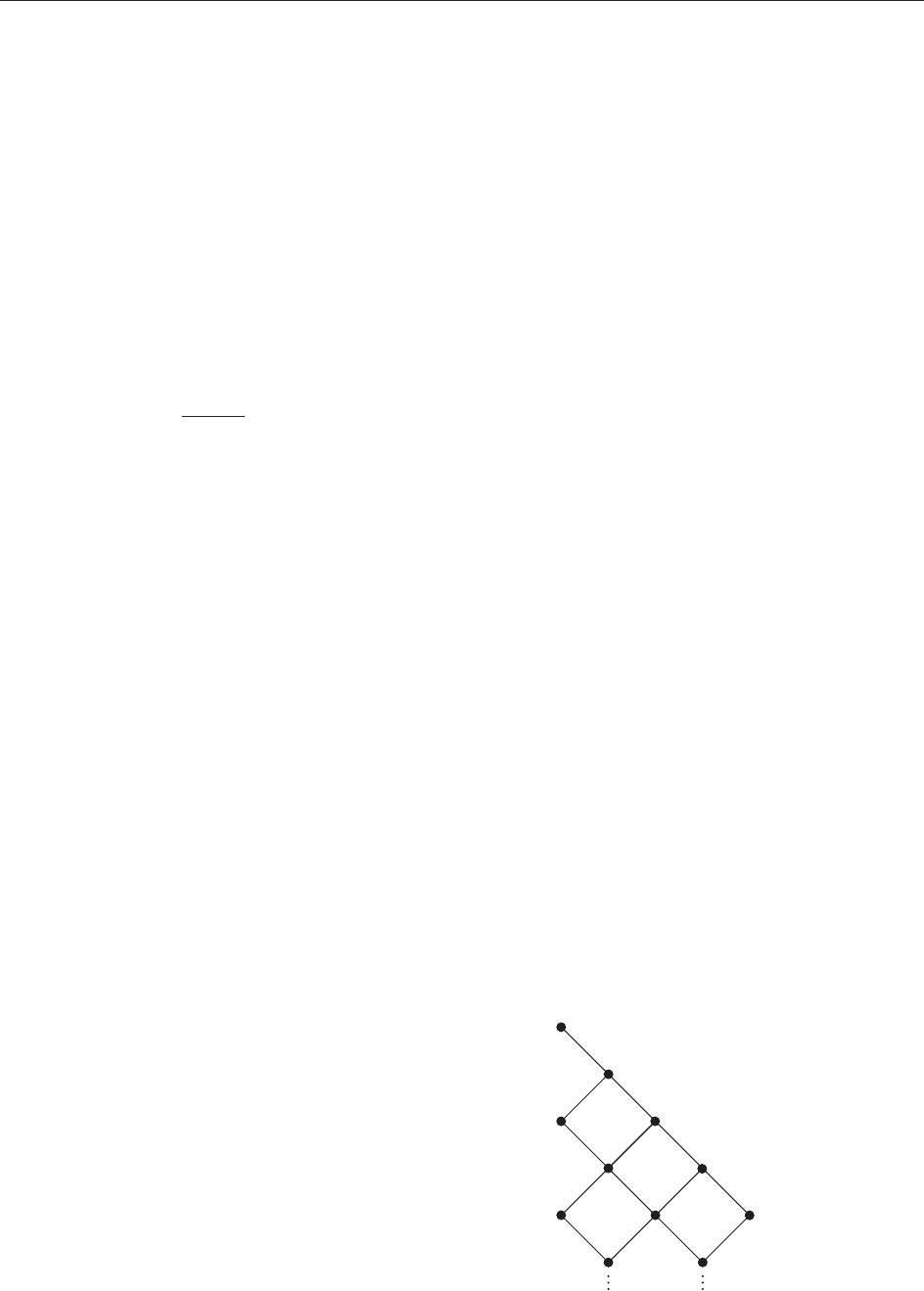
for all k, and get a picture as in Figure 1, which is
called the Bratteli diagram of the higher relative
commutants of N M .
It turns out that the edges connecting the kth and
(k þ 1)th steps of the Bratteli diagram consist of the
reflection of those connecting the (k 1)th and kth
steps, and a (possibly empty) new part. The ‘‘new’’
parts taken altogether in the above Bratteli diagram
constitute the principal graph of a subfactor N M.
In the example of Figure 1, the principal graph is the
Dynkin diagram A
5
. In general, a principal graph
can be finite or infinite. If it is finite, we say that a
subfactor is of finite depth. If a subfactor has the
Jones index less than 4, it is automatically of
finite depth and the principal graph must be one of
the A–D–E Dynkin diagrams.
Pimsner and Popa (1986) obtained the character-
ization of the Jones index value in terms of the
Pimsner–Popa inequality for a conditional expec-
tation. This can be used as a definition of the index
for a subfactor of arbitrary type (and even for
C
-subalgebras). Kosaki obtained a definition of the
index for type III subfactors based on works of
Connes and Haagerup.
N ′ ∩ N
N
′ ∩ M
N
′ ∩ M
1
N ′ ∩ M
2
N ′ ∩ M
3
N ′ ∩ M
4
Figure 1 The Bratteli diagram of the higher relative commutants.
386 von Neumann Algebras: Subfactor Theory

Analytic Classification Theory
If M is a hyperfinite type II
1
factor, then it is unique
up to isomorphism. So any subfactor of such M is
isomorphic to M itself. We next consider the
classification problem of hyperfinite type II
1
subfac-
tors. We say that a subfactor N M is isomorphic to
P Q if we have an isomorphism of M onto Q
which maps N onto P. The following tower of finite-
dimensional algebras is a natural invariant for a type
II
1
subfactor N M with finite Jones index and it is
called the standard invariant for N M:
M
0
\ M M
0
\ M
1
M
0
\ M
2
\\ \
N
0
\ M N
0
\ M
1
N
0
\ M
2
½4
Each square
M
0
\ M
k
M
0
\ M
kþ1
\\
N
0
\ M
k
N
0
\ M
kþ1
is a special combination of inclusions called a
commuting square. Under a fairly general condition
(called extremality of a subfactor, which automati-
cally holds for an irreducible subfactor), the above
sequence [4] is anti-isomorphic to the following
sequence of finite-dimensional algebras, including
the trace values:
M
0
\ M N
0
\ M N
0
1
\ M
\\\
M
0
\ M
1
N
0
\ M
1
N
0
1
\ M
1
½5
where N
3
N
2
N
1
N M is given by
repeated downward basic constructions. So, if the
closure of
S
j
(N
0
j
\ M
1
) in the weak operator topology
is equal to M
1
for an appropriate choice of N
j
’s,
then the closure of
S
j
(N
0
j
\ M) is also M, and the
isomorphism class of the subfactor N M is recov-
ered from the standard invariant. In such a case, we
say that a subfactor has a generating property, and
then we have a complete classification of subfactors
in terms of the standard invariant. Popa (1994)
introduced a notion called strong amenability and
proved that a subfactor of type II
1
is strongly
amenable if and only if it has the generating property.
This is the fundamental result in the classification of
subfactors. A hyperfinite type II
1
subfactor with finite
Jones index and finite depth is automatically strongly
amenable, so such a subfactor is covere d by this
classification theorem of Popa. Popa also has a
similar result for subfactors of type III.
Constructions and Combinatorial
Classification
As mentioned in the above section, Jones con-
structed hyperfinite type II
1
subfactors for all
possible index values below 4. They have the
Dynkin diagrams A
n
as the principal graphs. It has
been an im portant problem to construct new
subfactors since then. Using the Hecke algebras,
Wenzl constructed a series of subfactors with index
values sin
2
(N=k)= sin
2
(=k) with N = 2, 3, 4, ...,
where the series for N = 2 coincide with the ones
constructed by Jones. Wenzl’s dimension estimate in
this work for the relative commutant has been an
important tool to study subfactors. It was soon
noticed that the subfactors of Jones and Wenzl are
related to the quantum groups U
q
(sl
N
) of Drinfel’d–
Jimbo, at the value of the deformation parameter q
at exp (i=k). Constructions of subfactors from other
quantum groups have been given by Wenzl.
Ocneanu (1988) has introduced a notion of a
paragroup and characterized the higher relative
commutants arising from a type II
1
subfactor with
finite Jones index and finite depth as a paragroup. If
we start with a subfactor N No
G for a finite
group G, the corresponding paragroup contains
complete information on the group G and its
representations. In this sense, a paragroup is a
generalization of a (finite) group. The basic idea is
to regard the bimodule
N
L
2
(M)
M
as an analog of the
fundamental representation of a compact Lie group
and make finite relative tensor pro ducts
N
L
2
ðMÞ
M
L
2
ðMÞ
N
L
2
ðMÞ
M
Then one makes an irreducible decomposition and
studies various intertwiners arising from these
irreducible bimodules. In this way, we obtain a
certain combinatorial object and it is called a
paragroup. The vertices of the principal graphs
correspond to irreducible bimodules and the edges
correspond to basis vectors in the intertwiner spaces.
Note that by Popa’s theorem explained in the
previous section, a classification of subfactors of a
hyperfinite type II
1
factor with finite Jones index
and finite depth is reduced to one of paragroups.
Using this theory of paragroups, Ocne anu has
found that the Dynkin diagrams A
n
, D
2n
, E
6
, and
E
8
are realized as principal graphs of subfactors, but
D
2nþ1
and E
7
are not. Furthermore, each of the
graphs A
n
and D
2n
has unique realization and each
of E
6
, E
8
has two realizations. At the index value 4,
the principal graph must be one of the extended
Dynkin diagrams, A
(1)
2n1
, D
(1)
n
, E
(1)
6
, E
(1)
7
, E
(1)
8
, A
1
,
A
1,1
, and D
1
, and all are realized. (The last
three correspond to subfactors of infinite depth.)
von Neumann Algebras: Subfactor Theory 387