
Francoise J.-P., Naber G.L., Tsun T.S. (editors) Encyclopedia of Mathematical Physics
Подождите немного. Документ загружается.

Cellular Automata
M Bruschi, Universita
`
di Roma ‘‘La Sapienza’’, Rome,
Italy
F Musso, Universita
`
‘‘Roma Tre’’, Rome, Italy
ª 2006 Elsevier Ltd. All rights reserved.
What is a Cellular Automaton?
Cellular automata (CAs) were first introduced by
J von Neumann in his investigation of ‘‘complexity,’’
following an inspired suggestion by S Ulam. But in the
last 50 years they have been investigated and used in a
number of fields; widely diff erent terminologies have
been used by researchers that now it is difficult even
to give a precise general definition of a CA. Thus,
some definitions and approximations are in order.
First a broad definition:
1. have a number of cells (boxes);
2. at any (discrete) time step, any cell can present
itself in a certain ‘‘state’’ among a finite number
of different states;
3. the state of any cell can change (evolve) from a
time step to the subsequent time step; a nd
4. there is a rule (evolution law, EL) which
determines this transition.
Note that the number of cells can be finite or infinite;
thecellscanbearrangedonaline,onasurface,inthe
ordinary three-dimensional (3D) space, or possibly in a
hyperspace (in any case, the cells can be numbered); the
different states of a cell can be denoted by integer
numbers but, in different contexts of application of
CAs, different imaginative pictures have also been used
(e.g., different colors, dead and living cells, number of
balls in a box, etc.); the evolution of a CA proceeds in
finite time steps (time is also discrete); the EL, provided
that it is effective on any possible configuration of a
given CA (computability), is otherwise completely
arbitrary (indeed, there are not only deterministic and
probabilistic ELs, but also those that ‘‘evolve’’ in time –
following a meta-EL, which in turn can be determinis-
tic or probabilistic).
Consider some examples of CAs.
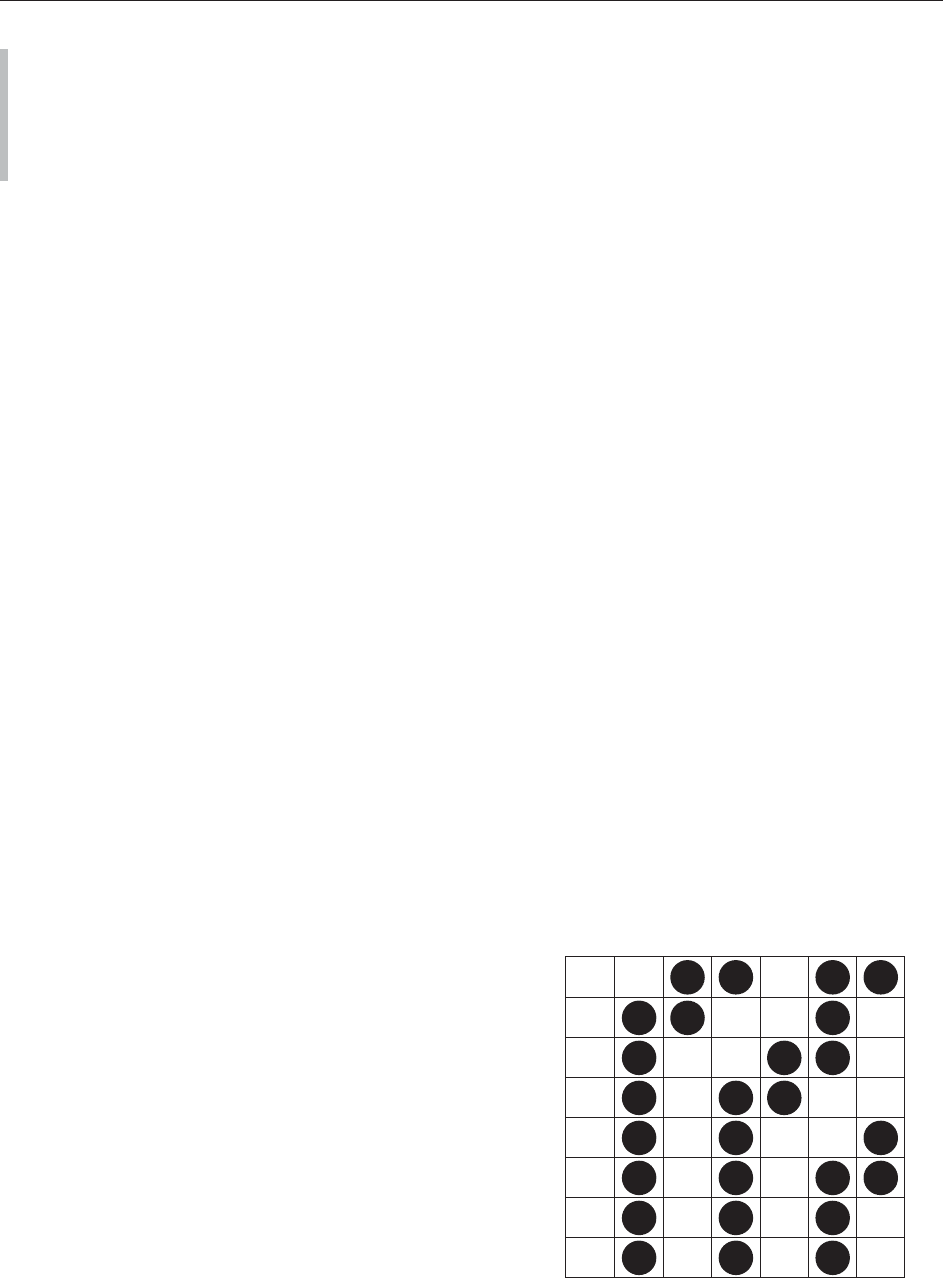
Example 1 (CA1) Consider a linear array of seven
boxes (cells; one can number them c(i), i = 1, 2, ..., 7).
Each box can be empty or it can contain a ball (so
there are just two states for each cell). Given a
configuration of this CA at time t, what happens at
time t þ 1(EL)?
(i) the state of the first box c(1) never changes;
(ii) for each other box c(i), i = 2, 3, ...,7;
(iia) if the box is empty and the box on its left is
empty then put a ball in the box;
(iib) if there is a ball in the box and also there is a ball
in the box on its left then empty the box.
An example of the evolution of such a rather trivial
CA is given in Figure 1.
A more precise notation can now be established.
First, let us denote the state of a cell at time t by a
‘‘state function,’’ say S. According to the point (iib)
above, the number of possible states is arbitrary but
finite: denote this number by the positive integer M
(M > 1). Then S takes values on a finite field, say
Z
M
= Z=MZ = {0, 1, 2, ..., M 1} (in plain words,
we have denoted the M states for the CA by the
first M non-negative integers). Different cells can be
labeled with a progressive number: c(n), n = n
1
, n
1
þ
1, ..., n
2
1, n
2
; possibly, in case of an infinite
number of cells, one has n
1
! 1 and/or
n
2
! þ 1 . In the case of n
1
= 1, n
2
= 1, one
speaks of a unidimensional CA. Of course, the field S
depends on n as well as on time (remember that, for a
CA, ‘‘time’’ is a discrete variable: t = 0, 1, 2, ...). The
field S(n, t) describes completely the CA. If the EL is
deterministic, then one can determine (com-
pute) S(n, t) step by step for t > 0 from the initial
configuration S(n, 0) (initial datum, ID). Consider
only static ELs, namely those that do not change in
time. A further distinction can be made: there are
ELs such that the future state of the generic cell,
S(n, t þ 1), depends on the whole current configura-
tion of the CA (these are called nonlocal ELs) and
there are ELs for which S(n, t þ 1) depends only on
c (1) c (2) c (3) c
(4) c (5) c (6) c (7)
t
= 0
t
= 1
t
= 2
t = 3
t
= 4
t
= 5
t
= 6
t
= 7
Figure 1 A seven time-step evolution of CA1 starting from a
given ID (t = 0). Note that a stable configuration has been
reached at t = 6.
Cellular Automata 455
the current state of a finite number, say N, of cells
(local ELs):
fSðn þ k
i
; tÞg; i ¼ 1; 2; ...; N; k
i
2 Z
¼) Sðn; t þ 1Þ½1
Note that, in principle, the set of cells that
determine, according to the EL, the future state of the
generic cell n, could depend on n, namely one can have
N = N(n), as well k
i
= k
i
(n), i = 1, 2, ..., N(n)(see
CA2 below). In any case, such a set of cells is called
the interaction set (IS). Moreover, the distance from
the cell n of the farthest cell in the IS is called
the range R (of the interaction): R = max( k
i
jj
). If
IS {c(n R), c(n R þ 1), ...c(n), ...c(n þ R 1),
c(n þ R)}, then this IS is called a neighborhood of
range R. It is, moreover, clear that, for unidimensional
CA, there exists at least one infinite subset of cells that
have the same state. If there is only one such subset,
then it is called the vacuum set and the state of its
cells is called vacuum state: let V denote the value of
this state (0 V < M, S(n, t) !
n!1
V).
Example 2 (CA2) An example of CA with
n-dependent IS (M = 2, R = 3, V = 0). This is the
EL: the cell c(n) changes its state (0 ! 1, 1 ! 0) iff
(i) n is even and at least one of the two cells on its
left is not in the vacuum state;
(ii) n is odd and one or three of the three cells on its
right are not in the vacuum state.
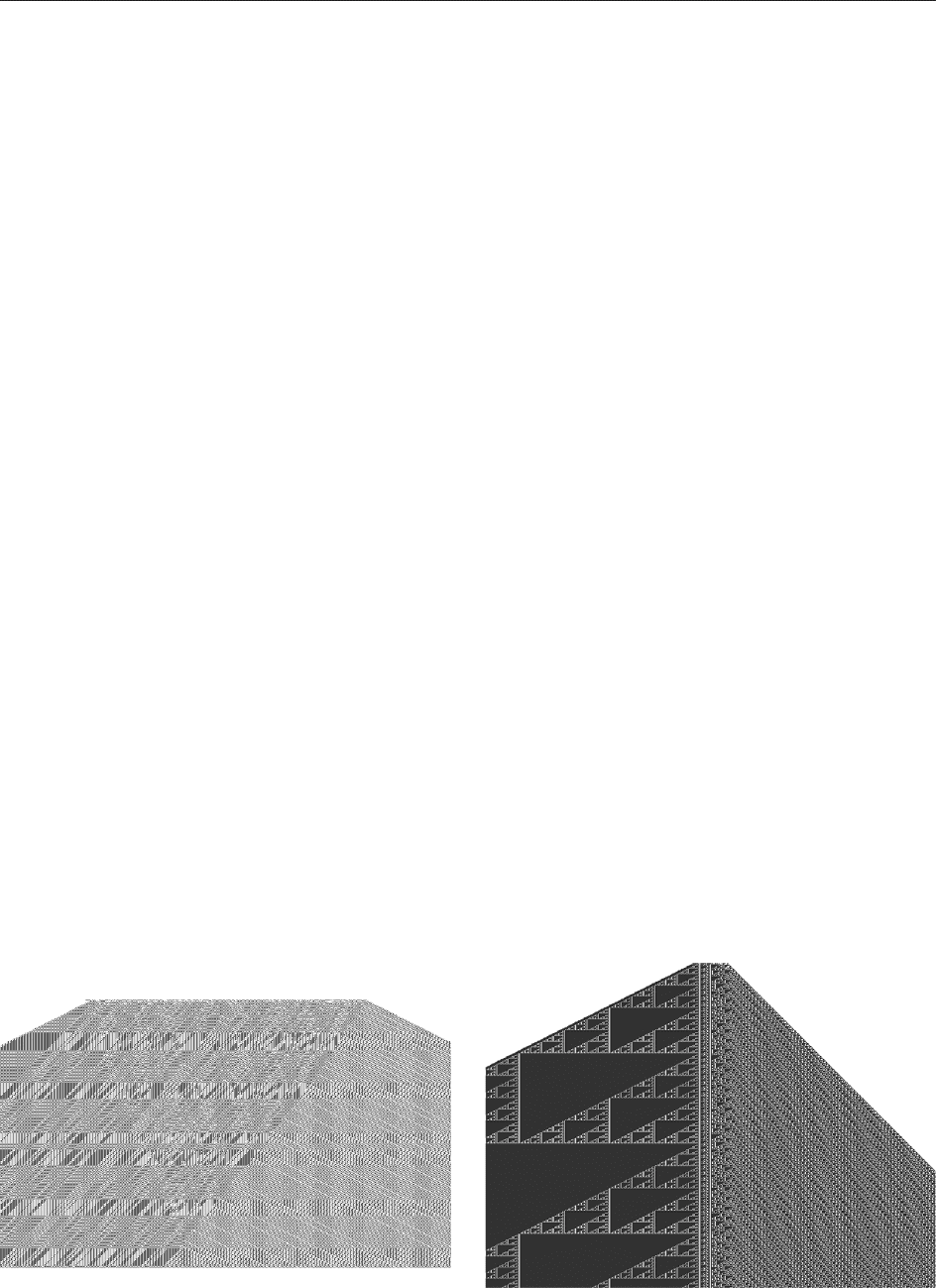
An example of the evolution of such a CA is given
in Figure 2.
Usually, only a subclass of ELs is considered for
which the phenomenon of vacuum excitation
cannot occur. Namely, during the evolution of
the CA, an infinite subset of the vacuum set
cannot change its state in just one time step. In
other words: if the set of cells starting from the
first c ell and ending with the last one for which
S(n, t) 6¼ V be called population set (PS), then PS is
a finite set at each time.
Of course, one can easily devise an EL for which
this is not true; nevertheless, the EL itself is still
valid (computable), for instance,
Example 3 (CA3) This is an unidimensional CA,
namely there are infinite cells on a line (n 2 Z). The
cells have M states and V = 0; the EL reads:
the state of each cell cycles in the set of available states
ð0 ! 1; 1 ! 2; ...; M 2 ! M 1; M 1 ! 0Þ
Note that the range R is zero, there is a vacuum
excitation; nevertheless, the EL is effective.
Deterministic, static, and local ELs that do not give
rise to vacuum excitation are called normal ELs (NELs).
Since M, N are finite for an NEL, one can give the
NEL itself as a table, considering every possible
configuration of the IS and specifying the outcome
for each configuration (note that there are M
N
possible configurations) .
Example 4 (CA4) n 2 Z, M = 2, V = 0, IS {c(n),
c(n 1), c(n þ 2)}, N = 3, R = 2. The EL is:
Sðn; tÞ 00001111
Sðn 1; tÞ 00110011
Sðn þ 2; tÞ 01010101
Sðn; t þ 1Þ 01101101
½2
An example of the evolution of such a CA is given
in Figure 3.
However, these NELs can also be given in an
alternative repre sentation (more useful in view of the
extensions of the concept of CA itself, see below).
Namely, an NEL can be given as a discrete-time
EL for the state function S (n, t) in the finite field
Z
M
= {0, 1, 2, ..., M 1}.
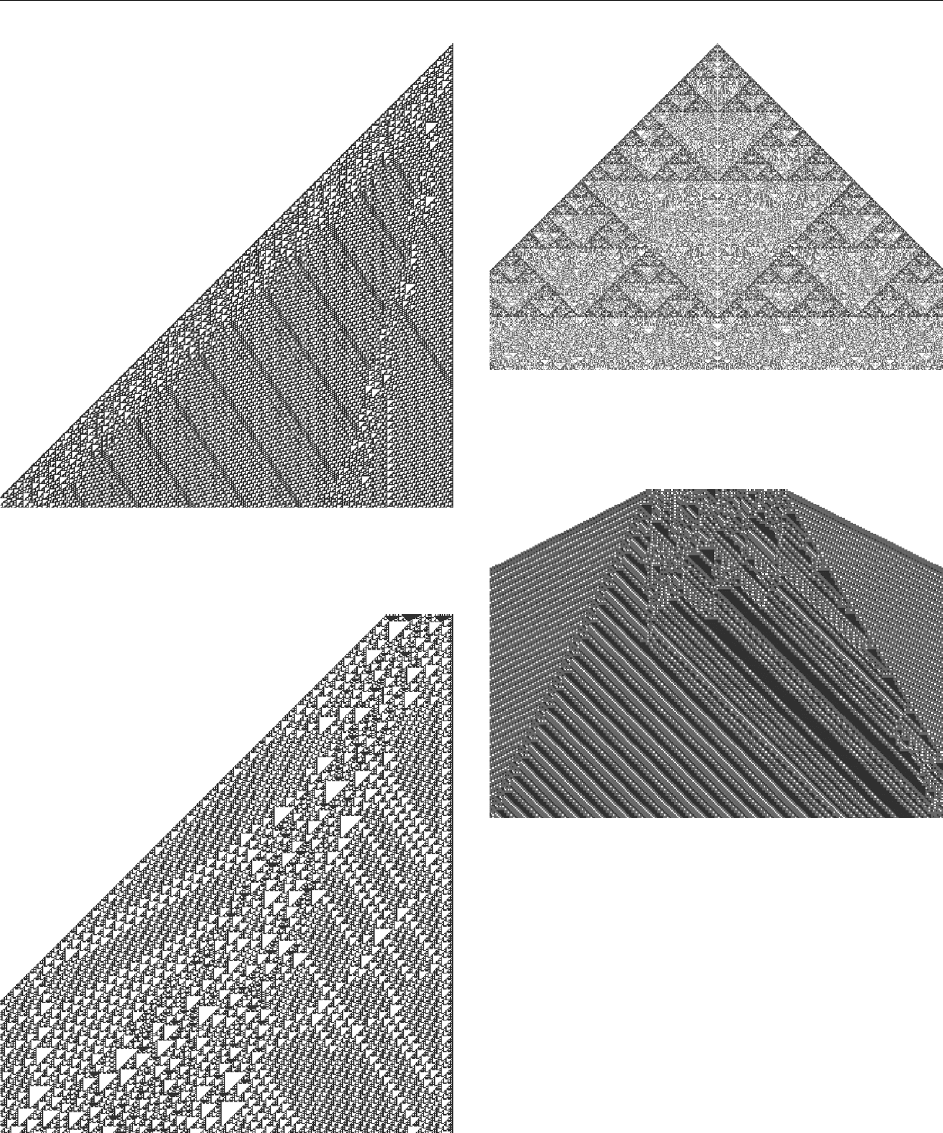
Figure 2 Three hundred and eighty time steps of CA2, starting
from a random chosen initial configuration. Note the left–right
asymmetry due to the asymmetry of its IS and EL.
Figure 3 Four hundred and sixty-one time steps of CA4,
starting from a random chosen PS of 50 cells.
456 Cellular Automata
For example, the NEL above for CA4 can be
expressed as follows:
Sðn; t þ 1Þ¼
2
Sðn 1; tÞþSðn; tÞþSðn þ 2; tÞ
þ Sðn; tÞSðn þ 2; tÞ
þ Sðn 1; tÞSðn; tÞSðn þ 2; tÞ½3
Here and in the following, the symbol ¼
M
denotes a
congruence mod M.
Another example is the following.
Example 5 (CA5) n 2 Z, M = 3, N = 3, V = 0, R = 1,
IS {c(n 1), c(n), c(n þ 1)}. The NEL is:
Sðn; t þ 1Þ¼
3
Sðn 1; tÞþSðn; tÞþSðn þ 1; tÞ
þ 2Sðn 1; tÞSðn þ 1; tÞ½4
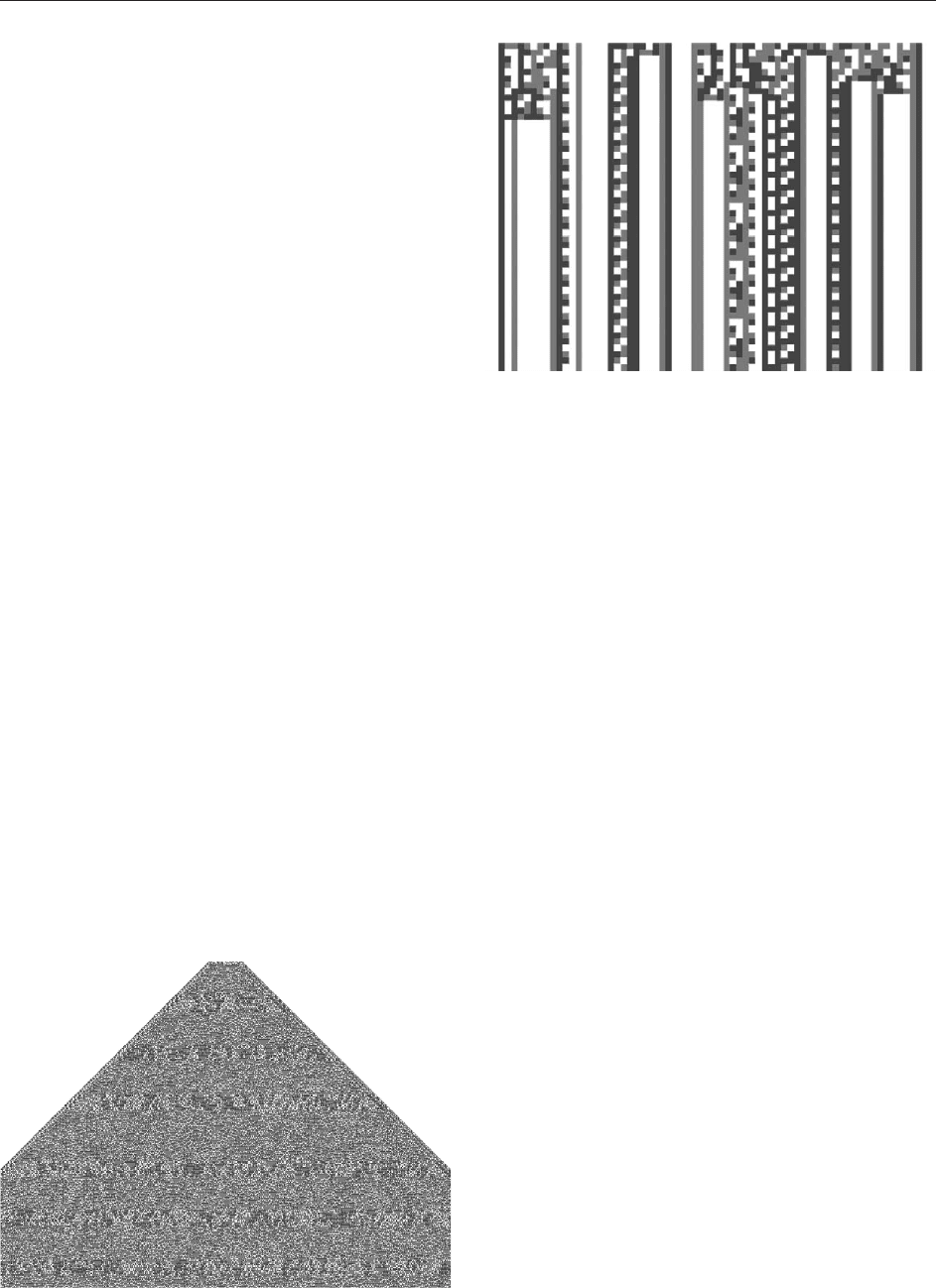
An example of the evolution of such a CA is given
in Figure 4.
Classification of ELs
Considering a CA with given M > 1, N 1, the
number L of possible deterministic, static ELs is
LðM; NÞ¼M
M
N
ðÞ
½5
Of course, this number can be very large for
relatively small values of M and N also. Never-
theless, it is a finite positive integer, so that, for
given M, N, one could denote every EL by an
integer number and investigate the typical behavior
of each EL. A considerabl e reduction of this
number is obtained if one limits attention to
totalistic ELs, namely to those whose outcome
depends only on the global configuration of the
IS, often just on
ðn;tÞ¼
X
N
i¼1
Sðn þk
i
Þ; i ¼1;2;...;N; k
i
2Z ½6
Deep and extensive computer investigations have
been exploited for unidimensional CAs with small
values of M, N. Surprisingly enough, it seems that
the typical behavior of all these CAs can be (roughly
and heuristically) classified in just four classes
(Wolfram 2002):
Class 1 (simple): possibly after a complicated
transient, simple patterns emerge.
Class 2 (fractalic): possibly after a transient,
overall regular nested structures are obtained.
Class 3 (chaotic): complicated but seemingly
random behavior.
Class 4 (complex): possibly after a transient,
localized structures emerge that interact in com-
plex ways.
Due to the looseness of the above definitions,
perhaps a better way to distinguish between classes
is to train one’s eye. Consider some examples of
CAs for each class: the typical behavior of class-1
CA is shown in Figures 5 and 6, of class-2 CA in
Figures 7 and 8, of class-3 CA in Figures 4 and 9,
of class-4 CA in Figures 10 and 11. Note, however,
that often one has ‘‘mixed type’’ CA: for example,
CA4 is of class 1 on the right and of class 2 on
the left (see Figure 3); Figure 12 exhibits a CA
where the typical behaviors of classes 2 and 3 are
superimposed.
Extensions
The concept of a CA is so simple that many
extensions of the above-sketched definition of a
CA can be easily devised. A (nonexhaustive) survey
of such extensions follows.
Figure 4 Four hundred and sixty-one time steps of CA5,
starting from a random chosen PS of 50 cells.
Figure 5 A class-1 CA: every ID rapidly evolves to
periodic structures; M = 3,V = 0, R = 2, EL: S(n, t þ 1) =
3
S(n, t)þ
S(n 1, t)S(n þ 2, t).
Cellular Automata 457
Vector CA
In this extension, the state function S(n, t)is
considered as a ‘‘vector,’’ namely S(n, t)
(S
1
(n, t), S
2
(n, t), ...S
L
(n, t)), L being a positive inte-
ger. Each component S
l
(n, t)(l = 1, 2, ..., L) takes
values in a finite field, say Z
M
l
= {0, 1, 2, ..., M
l
1}, and evolves, according to some EL, interacting
with the other components. Of course, one can give
separately the time evolution for each component;
however, it is also possible to give a global
representation of a vector CA, introducing a global
function
~
S(n, t) that takes values in the finite field
Z
M
, M = M
1
M
2
...M
L
; for example,
~
Sðn; tÞ¼S
L
ðn; tÞþ
X
L1
l¼1
S
l
ðn; tÞ
Y
L
k>l
M
k
!
½7
Thus, in a sense, vector CAs are still usual CAs
with a complicated EL.
Example 6 (CA6) A two-com ponent vector CA:
S
1
ðn; t þ1Þ¼
M
1
S
1
ðn; tÞS
1
ðn þ1; tÞ
þðM
1
1ÞS
2
ðn 1; tÞS
2
ðn;t Þþc
1
½8
S
2
ðn; t þ 1Þ¼
M
2
S
1
ðn 1; tÞS
2
ðn; tÞ
þ S
1
ðn; tÞS
2
ðn þ 1; tÞþc
2
½9
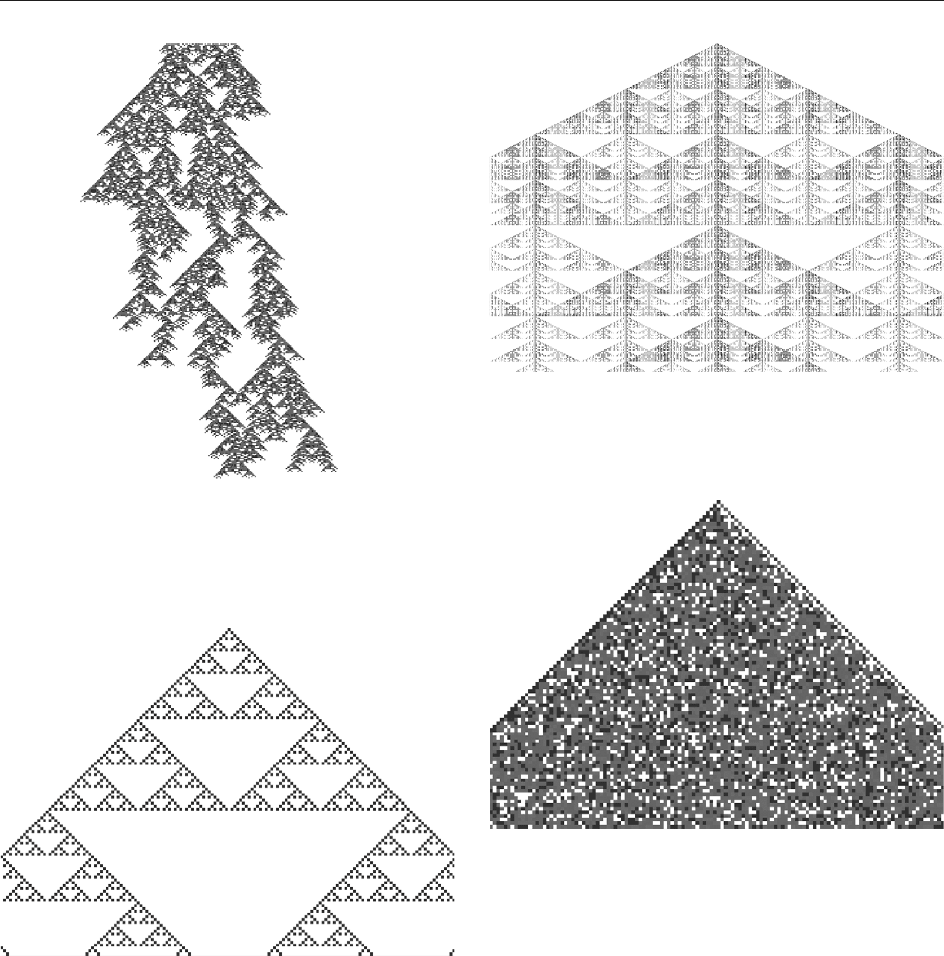
Figure 8 A class-2 CA: a double fractal structure appears; M = 4,
V = 0, R = 2, EL: S(n, t þ1) =
4
S(n 2, t) þS(n, t) þS(n þ2, t):
Figure 7 A class-2 CA: Sierpinsky triangles appear; M = 2,
V = 0, R = 1, EL: S(n, t þ 1) =
2
S(n 1, t) þ S(n þ 1, t).
Figure 6 A class-1 CA, a random ID vanishes after 337
time steps, M = 5, V = 0, R = 2, EL: S(n, t þ 1) =
5
S(n 1, t)
S(n 2,t)þS(n þ1,t)S(n þ2,t)þS(n 1,t)S(n þ1,t) þS(n 2,t)
S(n þ2,t).
Figure 9 A class-3 CA: M = 5, V = 0, R = 2, EL: S(n, t þ 1) =
5
2S(n 1, t) þ S(n þ 1, t) þ S(n, t)(S(n þ 1, t) þ S(n þ 2, t)) þ
S(n 1, t)S(n þ 1, t).
458 Cellular Automata
The global behavior of this CA can be expressed,
for example, through the global state function
~
Sðn; tÞ¼M
2
S
1
ðn; tÞþS
2
ðn; tÞ½10
Obviously,
~
S 2 Z
M
with M = M
1
M
2
. Figure 13
represents the global behavior of this CA with
M
1
= 2, M
2
= 3, c
1
= 1, c
2
= 1, V = 0.
Note that this CA can be considered as an
extension of the celebrated qua dratic map.
Multidimensional CA
Up to now we have considered CAs with finite number
of cells (finite CAs) or with an infinite number of cells
arranged on a line (unidimensional CAs). Now we
consider CAs with cells arranged on a surface,
usually a plane (bidimensional CAs), or on 3-space
(tridimensional CAs), or even on a hyperspace (multi-
dimensional CAs). In any case, if the number of cells
is finite, the evolution of such CAs, according to an
NEL, must end up to a final cycle: this is due to the
finiteness of the ‘‘phase space’’ (thus, these CAs should
be classified as class 1; however, note that, if the
‘‘phase space’’ is large enough, the dynamics of
Figure 10 A class-4 CA (Wolfram CA 110): M = 2, V = 0, R = 1,
EL: S(n,t þ1)=
2
S(n,t) þS(n þ1,t) þS(n,t)S( n þ1,t) þS(n 1,t)
S(n,t)S(n þ1,t).
Figure 11 A class-4 CA. Note the interacting moving struc-
tures on the left and on the right; note also the apparently
chaotic behavior in the center; M = 2,V = 0,R = 2,EL: S(n,t þ 1)=
2
S(n,t) þ S(n þ 1,t) þ S(n 1,t)S(n þ 2,t).
Figure 12 A mixed-class CA: a fractalic structure is super-
imposed on a chaotic one; M = 4, V = 0, R = 2, EL: S(n, t þ 1) =
2
S(n, t)(S(n 2, t) þ S(n þ 2, t)) þ S(n 1, t)S(n þ 1, t).
Figure 13 Global behavior of the vector CA6.
Cellular Automata 459
such CAs can still be very rich). Usually, one
considers an infinite number of cells tessellating
the whole s-space, s = 2, 3, ... (e.g., squares o r
hexagons on the plane, cubic cells in 3-space). The
changes in the previous notation and definitions are
plain: for exam ple, for a bidimensional CA, the state
function depend s now on two discrete ‘‘space’’
variables (S(n
1
, n
2
, t), n
1
2 Z, n
2
2 Z); furthermore,
there is a greater freedom in choosing a neighbor-
hood of range R. Two most-u sed neighborhoods of
range 1 are shown below:
Neumann neighborhood
}
Moore–Conway neighborhood
}
½11
The most famous (and interesting) bidimensional
CA is ‘‘Life’’, introduced by J H Conway, which is
discussed next.
Example 7 (CA ‘‘Life’’; Moore–Conway neighbor-
hood, V = 0, M = 2). A cell in the vacuum state 0 is
called ‘‘dead’’; a cell in the state 1 is called ‘‘alive.’’
The EL is as follows:
(i) If a cell is dead at time t, it comes alive at time
t þ 1 if and only if exactly three of its eight
neighbors are alive at time t (reproduction).
(ii) If a cell is alive at time t, it dies at time t þ 1ifand
only if fewer than two (loneliness) or more than
three (overcrowding) neighbors are alive at time t.
Clearly, this is a totalistic NEL. Now considering
the explicit form of (see [6]):
ðn
1
; n
2
;tÞ¼Sðn
1
; n
2
;tÞ
þ
X
1
k
1
¼1
X
1
k
2
¼1
Sðn
1
þk
1
; n
2
þk
2
; tÞ½12
the above EL can be simply expressed as:
Sðn
1
; n
2
; t þ 1Þ¼
3;
þ
2;
Sðn
1
; n
2
; tÞ½13
where
3,
is the Kroenecker symbol.
Life is a class-4 CA; it exhibits a rich variety of
interesting structures: stable structures, oscillators
(periodic structures), gliders and ships (moving
structures), emitters and absorbers (namely, struc-
tures that, after a time period, reconstitute them-
selves, but meanwhile they have emitted or adsorbed
moving structures). These structures are essential to
prove that Life can be used to construct a universal
Turing machine (see below). One can get a rough
idea of such ‘‘richness’’ from Figure 14.
As in the previou s case of vector CA, one could
object that also multidimensional CAs are not true
extensions of the unidimensional CAs. Indeed, since
the whole set of cells is still a countable set, one
could number the cells with just a discrete ‘‘space’’
variable (say n 2 Z ). For example, in the case of a
square tessellation of the plane, we could enumerate
the cells in the plane starting from the origin as
follows:
22 !
21 20 19 18
13 12 11 4 5 6 17
14 9 10 3 2 7 16
15 8 101815
16 7 2 310 914
17 6 5 4111213
18 19 20 21
22
½14
Thus, any multidimensional CA could in principle
be viewed as a unidimensional one. Of course, one
has to pa y a price for this: ISs and ELs that are
simple for a multidimensional CA become cumber-
some for its unidimensional version and vice versa.
Higher Time Derivatives
Up to now, we have considered CAs whose evolved
state S(t þ 1) depends only on the state S (t), namely
the state of the CA itself at the previous time step. In
other words the EL involves just the first (discrete)
time derivative (1
CA). One can easily extend all the
previous definitions to consider higher-order disc rete
time derivatives (K
CA). Of course, the ID and the IS
for such a CA involve the state of the CA at K
subsequent time steps.
An example of a unidimensional 2
CA is given
below.
Example 8 (CA7) M = 3, V = 0, R = 1. The EL is:
Sðn; t þ1Þ¼
3
Sðn 1; tÞþSðn; t 1ÞþSðn þ1; tÞ½15
An example of the evolution of such a CA is given in
Figure 15.
460 Cellular Automata
It is plain that taki ng a suitable continuum limit
of a K
CA one gets a partial differential equation of
order K for the evolution. However, there are also
special and interesting CAs, called ‘‘filter’’ CAs,
that in a suitable continuum limit end up in integral
evolution equations. For a filter unidimensional
CA, the evolved state at the cell n, S(n, t þ 1),
depends also on the (already) evolved states of the
cells on its left (or right): for example, an NEL of
the type
Sðn; t þ 1Þ¼
M
FðSðn þ k
i
; tÞ; Sðn
~
k
j
; t þ 1ÞÞ
i ¼ 1; 2; ...; N; k
i
2 Z
j ¼ 1; 2; ...;
~
N;
~
k
j
2 N ½16
is still valid (computable). Extensions to K
CAs or
vector CAs or multidimensional CA are plain. Very
often filter CAs exhibi t a class-4 behavior with
particle-like structures moving and interacting in a
complex way; see the following example and
examples in the next section.
Example 9 (CA8) M = 2, V = 0, R = 2. The EL is:
Sðn; t þ 1Þ¼
2
Sðn 1; t 1ÞSðn 2; tÞ
þ Sðn; tÞþSðn þ 1; tÞSðn þ 2; tÞ½17
An example of the evolution of such a CA is given
in Figure 16.
Invertible CA
For most of the ELs there is a loss of information
in the course of the evolution (see, e.g., Figures 5
and 6). Indeed, different definitions of ‘‘CA
entropy’’ have been introduced to measure the
‘‘randomness’’ in the behavior of a given CA.
However, since CAs are im portant in physical
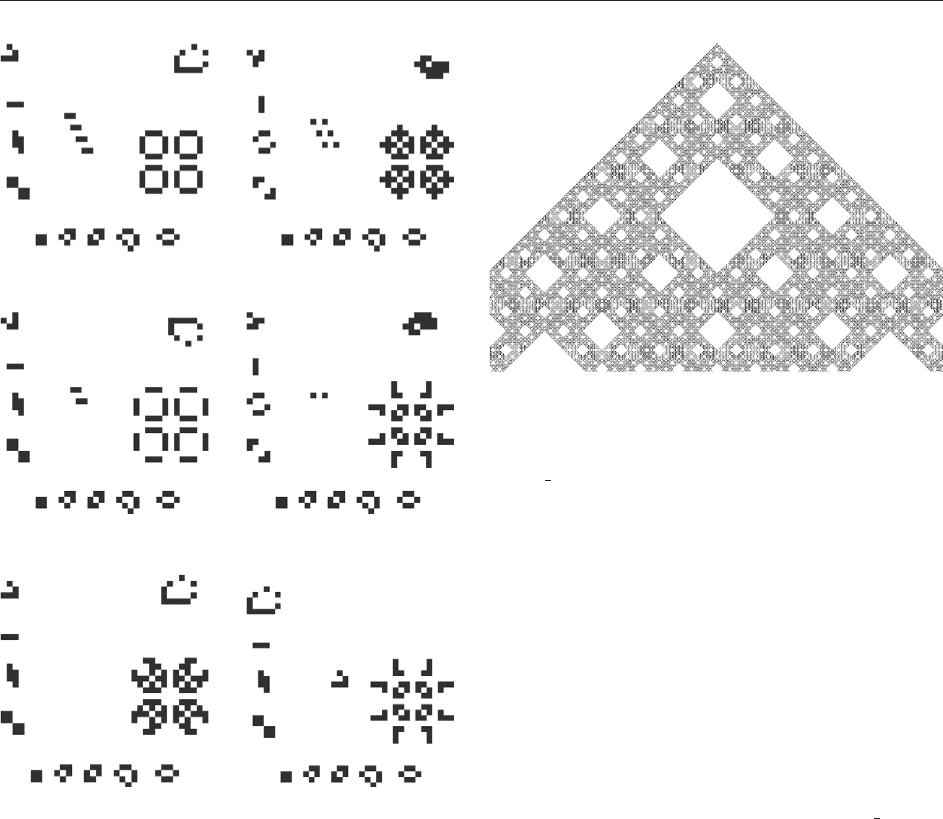
(e) (f)
(c) (d)
(a) (b)
Figure 14 CA ‘‘Life’’: (a) Time 0. Near the lower border, five
stable structures (from the left to the right: a ‘‘block’’, a ‘‘boat’’, a
‘‘ship’’, a ‘‘loaf’’, a ‘‘beehive’’); near the left border three ‘‘blinkers’’
(period-2 oscillators); near the right corner, a symmetric structure
that, in one time step, evolves into a ‘‘pulsar’’ (a period-3
oscillator), on the left-up corner a ‘‘glider’’ (a moving structure);
on the right-up corner a ‘‘medium weight spaceship’’ (another
moving structure); in the center, a configuration that vanishes in a
few time steps. (b) Time 1. The structures on the lower border are
unchanged, the blinkers, the glider, and the space ship are in an
intermediate state, on the right border, the pulsar starts to pulse.
(c) Time 2. The three blinkers on the left border are again in their
original configurations (periodic structure with period 2), the
pulsar, the glider and the spaceship are in another intermediate
state. (d) Time 3. The pulsar is in its second state, the glider and
the spaceship in their third, the structure in the center is going to
vanish. (e) Time 4. The pulsar has completed its pulsation (period-
3 oscillator, see Figure 14b); the structure in the center has
vanished, the glider and the spaceship have recovered their
original configurations (see Figure 14a) but meanwhile they have
moved of a cell in four time steps (1n4 of the highest velocity
attainable by a moving structure in a CA of range 1). The glider is
moving downward and to the right, the space ship in horizontal to
the left. (f) Time 60. The space ship has almost completed its
crossing, the glider has reached the center and it is in a collision
route with the pulsar.
Figure 15 CA7, clearly a class-2 CA.
Cellular Automata 461
modeling as well as in cryptography and data
compression, there is great interest in a special
subclass of CAs which are ‘‘invertible’’ (time
reversible). Namely, for an ‘‘invertible’’ CA fol-
lowing a given EL a nd starting from an arbitrary
ID, there exists an ‘‘inverse’’ EL such that one
can recover the ID from the evo lved states.
Invertible CAs can be easily devised in the case of
K
CA (K > 1). For example, if K = 2, 3 ..., one can
consider ELs of the form
Sðn;t þ1Þ¼
M
Sðn;t K þ1ÞþFSðn þk
j
i
;t jÞ
½18a
where
i ¼ 1; 2; ...; N
j
; k
j
i
2 Z
j ¼ 0; 1; 2; ...; K 2
½18b
and F is an arbitrary polynomial function.
It is then clear that the inverse EL reads
~
Sðn;
~
t þ1Þ¼
M
~
Sðn;
~
t K þ1Þ
þðM 1ÞF
~
Sðn þk
j
i
;
~
t þj K þ2
½19
Indeed, if an arbitrary ID evolves according to
the EL [18], then applying the inverse EL [19] to K
subsequent evolved states (taken in reversed order),
eventually the original ID is recovered (in reversed
order) (see the following exampl e).
Example 10 (CA9) A 6
CA: M = 2, V = 0, R = 1.
The EL is:
Sðn; t þ 1Þ¼
2
Sðn; t 5ÞþSðn; t 3ÞþSðn þ 1; t 2Þ
þ Sðn 1; t 1Þ
þ Sðn; t 2ÞSðn þ 1; t 2Þ
þ Sðn; tÞSðn 1; tÞ½20
The inverse EL, according to [19], reads
(Figure 17)
~
Sðn;
~
t þ 1Þ¼
2
~
Sðn;
~
t 5Þþ
~
Sðn;
~
t 1Þþ
~
Sðn þ 1;
~
t 2Þ
þ
~
Sðn 1;
~
t 3Þ
þ
~
Sðn;
~
t 2Þ
~
Sðn þ 1;
~
t 2Þ
þ
~
Sðn;
~
t 4Þ
~
Sðn 1;
~
t 4Þ½21
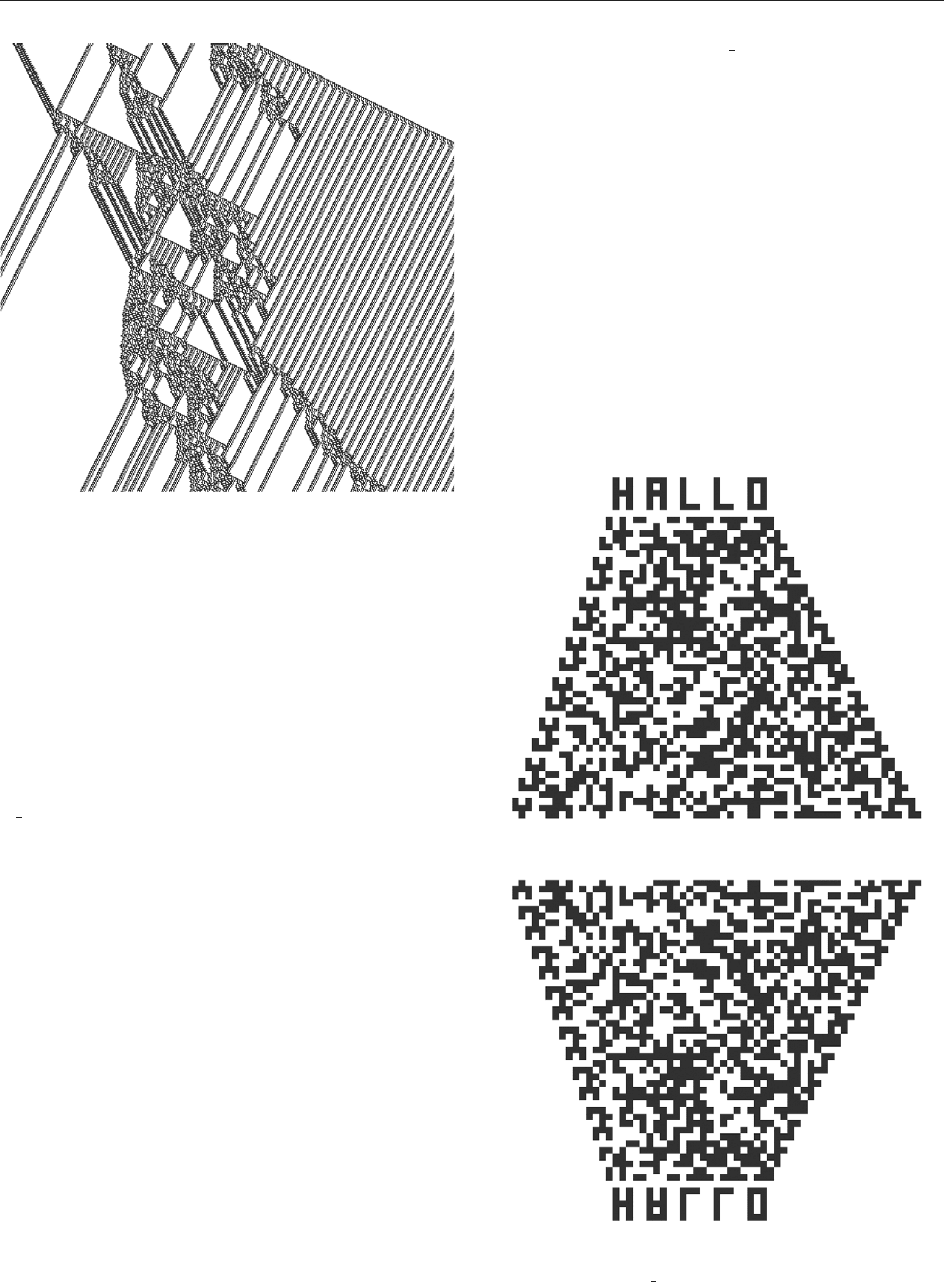
Figure 16 CA8, a ‘‘filter’’ CA. Note the emerging of particle-like
structures moving to the left and to the right and interacting in
complex ways.
(a)
(b)
Figure 17 CA9, a 6 CA: (a) a 50 time-step evolution from a
peculiar ID; (b) a 50 time-step evolution of the inverse EL, starting
from the last six configurations of Figure 17a (taken in inverse
order); the ID of Figure 17a is recovered (in inverse order).
462 Cellular Automata
Of course, more complicated invertible ELs can be
devised. Invertible ELs can be also easily devised for
‘‘filter’’ CA, for example, if an NEL for a ‘‘filter’’ CA
reads
Sðn; t þ 1Þ¼
M
Sðn; tÞ
þ FðSðn þ k
i
; tÞ; Sðn
~
k
j
; t þ 1ÞÞ ½22
where k
i
and
~
k
j
are positive integers
(i = 1, 2, ..., N; j = 1, 2, ...,
~
N) and F is an arbitrary
(polynomial) function, then it is invertible an d
the inverse NEL reads
~
Sðn;
~
t þ 1Þ¼
M
~
Sðn;
~
tÞþðM 1Þ
Fð
~
Sðn þ k
i
;
~
t þ 1Þ;
~
Sðn
~
k
j
;
~
tÞÞ ½23
Note that [22] is computable starting from
n = 1, whereas [23] is computable star ting from
n = þ1.
Example 11 (CA10) A 1.5
CA, M = 2, V = 0, R = 3.
The EL is:
Sðn; t þ 1Þ¼
2
Sðn; tÞþSðn 3; t þ 1ÞSðn 2; t þ 1Þ
þ Sðn þ 2; tÞSðn þ 3; tÞ
þ Sðn 2; t þ 1ÞSðn 1; t þ 1Þ
þ Sðn þ 1; tÞSðn þ 2; tÞ½24
Note that this EL is of the form [22]; therefore, it
is invertible (see Figure 18a). According to [23], the
inverse EL reads:
~
Sðn;
~
t þ 1
Þ¼
2
Sðn;
~
tÞþ
~
Sðn þ 3;
~
t þ 1Þ
~
Sðn þ 2;
~
t þ 1Þ
þ
~
Sðn 2; tÞ
~
Sðn 3; tÞ
þ
~
Sðn þ 2;
~
t þ 1Þ
~
Sðn þ 1;
~
t þ 1Þ
þ
~
Sðn 1;
~
tÞ
~
Sðn 2;
~
tÞ½25
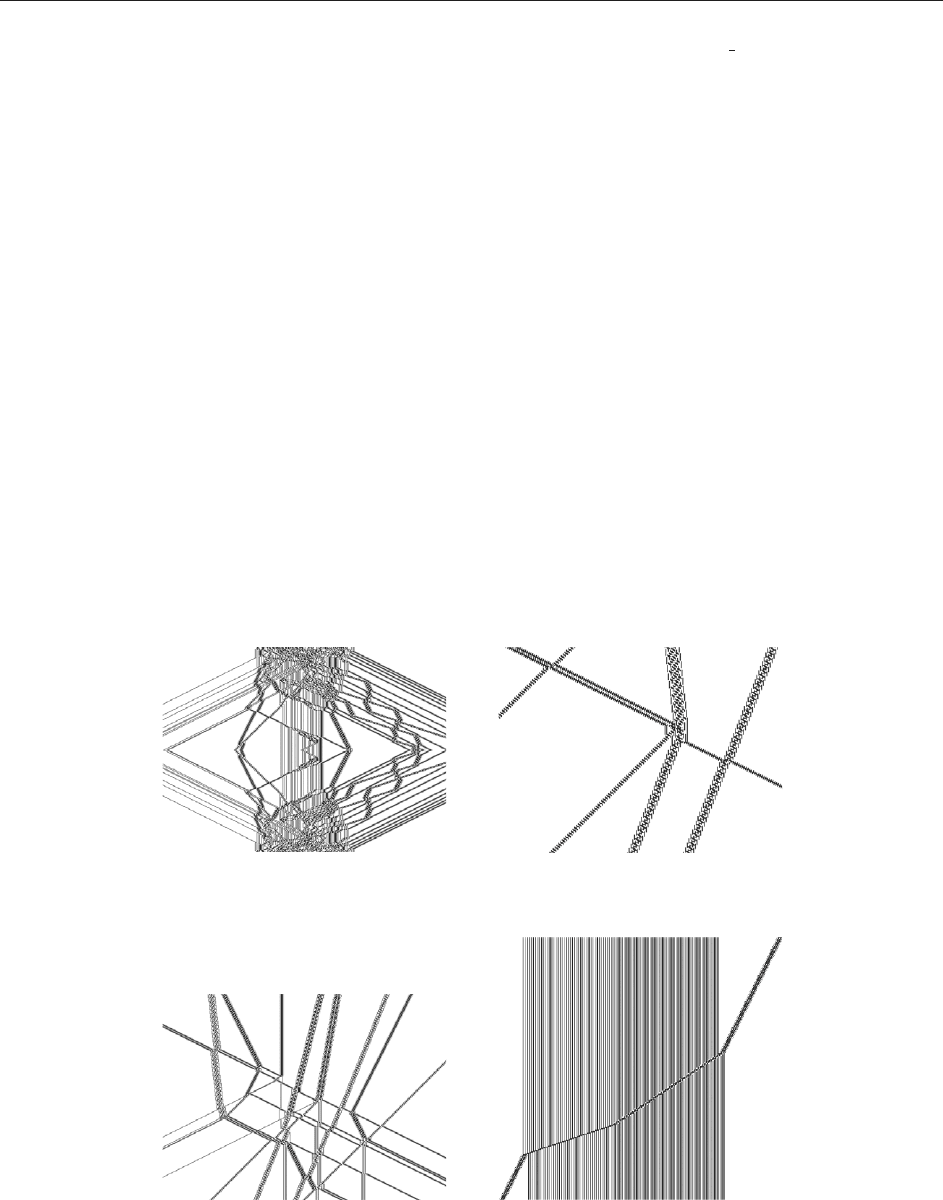
This CA exhibits a very rich dynamics: any
complex ID rapidly decays in a great variety of coherent
particle-like structures, steady or moving to the right or
(a)
(c) (d)
(b)
Figure 18 CA10: (a) 230 time-step evolution, then the inverse EL is applied for 230 further time step in order to recover the initial
configuration. (b) Collisions between different kinds of particle-like coherent moving structures. The last collision (on the right) is
a solitonic one: the interaction produces just a phase shift, preserving number, shape, and velocities of the involved ‘‘particles.’’
(c) ‘‘Particles’’ moving with different velocities and interacting in complex ways (solitonic collisions, particle creations and annihilations).
(d) A particle goes through a nonhomogeneous medium and undergoes refraction by the medium itself.
Cellular Automata 463

to the left with different velocities. The interactions
between different particles may be solitonic (the
particles emerge unchanged but shifted) or annihila-
tion–creation phenomena can occur (see Figures 18a–d).
Applications of CAs
CAs as Universal Constructors and
Turing Machines
In the 1950s, von Neumann, who contributed to the
development of the first computer (ENIAC), decided
to work out a mathematical theory of automata.
Such a theory was finalized to give an answer to the
following question: is it possible to build an
automaton such that it allows universal computa-
tion (i.e., it embodies a universal Turing machine)
and, moreover, it is able to build (in order of
decreasing generality)
1. an arbitrary automata (universal constructor);
2. a copy of itself (self-reproducing); and
3. an automaton that is itself a universal Turing
machine (constructor)?
The last question von Neumann had intention to
address was if in the process of automata self-
reproduction (if possible) a process of evolution
could take place, that is, if a simpler automaton
could generate a more complex one.
In the beginning, the idea of von Neumann was to
describe, using mathematical axioms, an automaton
moving inside a warehouse and selecting various
elementary spare parts (e.g., ‘ ‘muscles,’’ switches, rigid
girders) and then assembling them into a new auto-
maton. While this original idea was very realistic, it was
also very difficult to pursue, so that von Neumann,
following a suggestion by Ulam, decided to consider his
questions in the more abstract framework of CAs.
The particular CA he considered is an infinite
square CA with 29 possible states. The transition rule
is dependent upon the cell to update and its north,
east, south, and west neighbor cell (the von Neumann
neighborhood). Among the 29 possible states there is
one state that is ‘‘quiescent’’ (the vacuum state).
von Neumann proved the existence of a configura-
tion of 50 000 cells immersed in a sea of quiescent
states that embodies a universal Turing machine and
that is a universal constructor. An infinite one-
dimensional ‘‘tape’’ is used to store a description of
the automaton to build. The universal constructor
reads the description on the tape, develops a
‘‘constructing arm’’ that builds the configuration
described on the tape in an unoccupied part of the
cellular space, makes a copy of the tape and finally
attaches it to the newly built automaton and retracts
the constructing arm. When on the tape, it stores a
description of the universal constructor itself, then it
self-reproduces. The total size of the self-reproducing
automaton amounts to 200 000 cells. (Some com-
puter simulations of von Neumann self-reproducing
automaton are available on the web.)
Since von Neumann’s CA is a very complex one,
it led researchers to think that a CA able to simulate
a universal Turing machine should also be quite
complex. The perspective changed completely after
the introduction of CA Life. Conway was looking
for a simple CA with a possible rich dynami cs;
however, it was subsequently realized that Life was
much more complicated that anyone could have
thought. Finally, thanks to the development of faster
computers that allowed visualization of the evolu-
tion of quite large populations and through the
contribution of a large number of researchers, it was
proved that a universal Turing machine could be
embedded in Life.
The discovery that even a simple CA such as Life
could incorporate a universal Turing machine led to
the question whether it could be possible to build a
universal Turing machine inside a simple one-
dimensional CA. This is indeed the case: up to
now, the simplest CA capable of universal computa-
tion is the W110 CA (see Figure 10), as proved
recently by Cook after a conje cture formulated by
Wolfram in 1985.
CAs for Computer Simulations
One of the major applications of CAs is the
computer simulation of various dynamical pro-
cesses. Even if CAs were not invented for this
purpose, they possess peculiarities that make them
particularly suitable for this task. The main advan-
tage of using a CA for a dynamical simulation is due
to their completely discrete nature that allows exact
simulations on a computer. Thus, any spurious
effect due to rounding errors is ruled out. Another
advantage is that the EL of a CA can be seen as a
function between finite sets. For this reason, one can
specify the EL through a ‘‘lookup table’’ (see [2]):
then when running the simulations, the computer
has only to access the table instead of computing the
function every time, shortening considerably the
computation time. Another great advantage of CAs
in computer simulations is that, for their very nature
(at least for local EL), they can be implemented on
parallel machines. These two concepts are at the
basis of dedicated computers for CAs simulations
developed by Toffoli, Margolus, and co-workers
(CAM series). The possibility to use efficiently
parallel computers for CA simulation could prove
464 Cellular Automata