
Francoise J.-P., Naber G.L., Tsun T.S. (editors) Encyclopedia of Mathematical Physics
Подождите немного. Документ загружается.

Bounding Tori
As experimental conditions or control parameters
change, strange attractors can undergo ‘‘grosser’’
perestroikas than those that can be described by a
change in the basis set of orbits. This occurs when new
orbits are created that cannot be contained on the initial
branched manifold – for example, when orbits are
created that must be described by a new symbol. This is
seen experimentally in the transition from horseshoe
type dynamics to gateau roule´ type dynamics. This
involves the addition of a third branch to the branched
manifold with two branches, as shown in Figures 7a
and 7b. Strange attractors can undergo perestroikas
described by the addition of new branches to, or
deletion of old branches from, a branched manifold.
These perestroikas are in a very real sense ‘‘grosser’’
than the perestroikas that can be described by changes
in the basis sets of orbits on a fixed branched manifold.
There is a structure that provides constraints on
the allowed bifurcations of branched manifolds
(creation/annihilation of branches), which is analo-
gous to the constraints that a branched manifold
provides on the bifurcations and topological organi-
zation of the periodic orbits that can exist on it. This
structure is called a bounding torus.
Bounding tori are constructed as follows. The semi-
flow on a branched manifold is ‘‘inflated’’ or ‘‘blown
up’’ to a flow on a thin open set in R
3
containing this
branched manifold. The boundary of this open set is a
two-dimensional surface. Such surfaces have been
classified. They are uniquely tori of genus g; g = 0
(sphere), g = 1 (tire tube), g = 2, 3, .... The torus of
genus g has Euler characteristic = 2 2g. The flow is
into this surface. The flow, restricted to the surface,
exhibits a singularity wherever it is normal to the
surface. At such singularities the stability is determined
by the local Lyapunov exponents:
1
> 0and
3
< 0,
since the flow direction (
2
= 0) is normal to the
surface. As a result, all singularities are saddles; so, by
the Poincare´–Hopf theorem, the number of singularities
is strongly related to the genus. The number is 2(g 1).
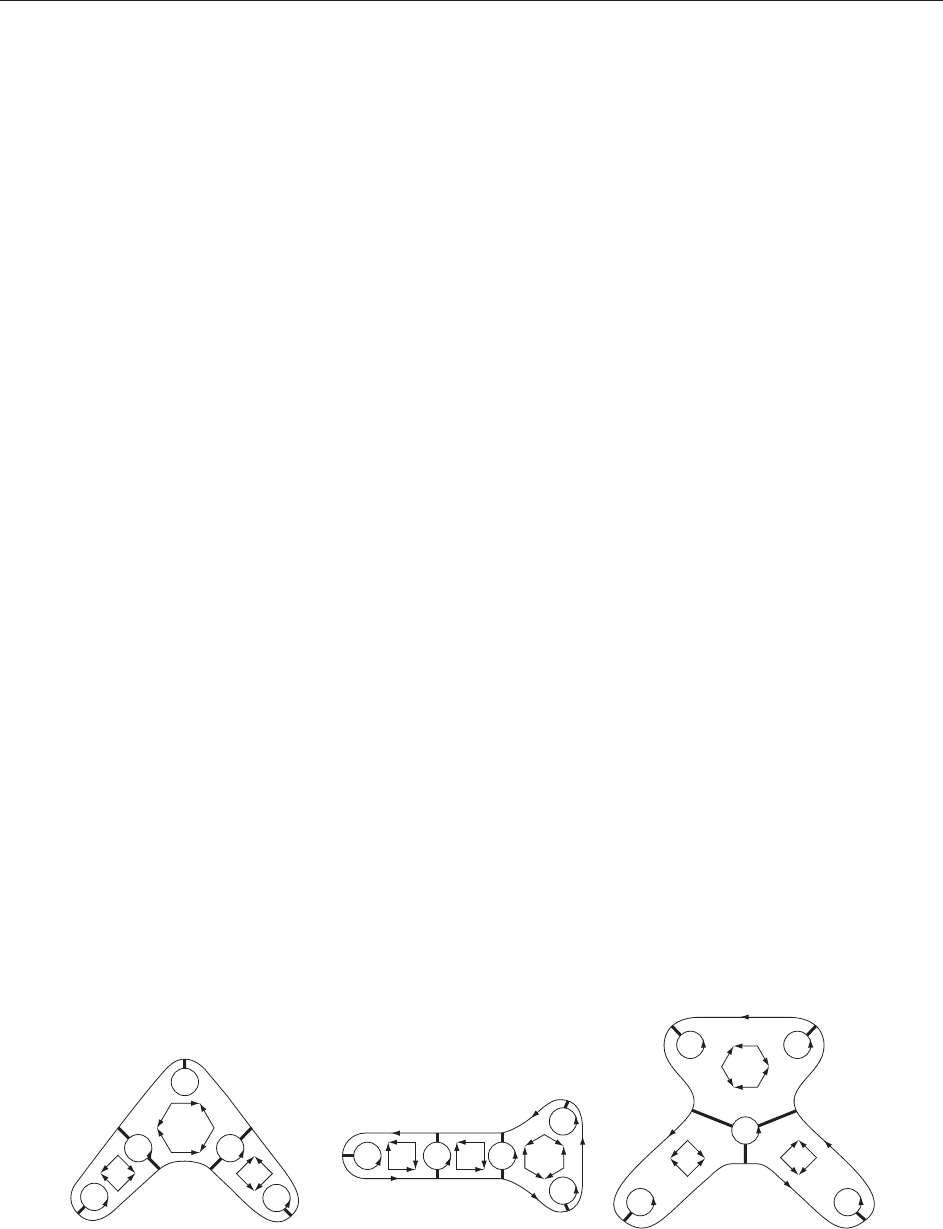
The flow, restricted to the genus-g surface, can be
put into canonical form and these canonical forms can
be classified. The classification involves projection of
the genus-g torus onto a two-dimensional surface. The
planar projection consists of a disk with outer
boundary and g interior holes. All singularities can be
placed on the interior holes. The flow on the interior
holes without singularities is in the same direction as
the flow on the exterior boundary. Interior holes with
singularities have an even number, 4, 6, ....Some
canonical forms are shown in Figure 9.
Poincare´ sections have been used to simplify the
study of flows in low-dimensional spaces by effec-
tively reducing the dimension of the dynamics. In
three dimensions, a Poincare´ surface of section for a
strange attractor is a minimal two-dimensional sur-
face with the property that all points in the attractor
intersect this surface transversally an infinite number
of times under the flow. The Poincare´ surface need
not be connected and in fact is often not connected.
The Poincare´ section for the flow in a genus-g torus
consists of the union of g 1 disjoint disks (g 3) or
is a single disk (g = 1). The locations of the disks are
determined algorithmically, as shown in Figure 9.The
interior circles without singularities are labeled by
capital letters A, B, C, ... and those with singularities
are labeled with lowercase letters a, b, c , ... The
components of the global Poincare´ surface of section
are numbered sequentially 1, 2, ..., g 1, in the order
they are encountered when traversing the outer
boundary in the direction of the flow, starting from
any point on that boundary. Each component of the
global Poincare´ surface of section connects (in the
projection) an interior circle without singularities to
the exterior boundary. There is one component
between each successive encounter of the flow with
ABCBDED ABCDCBE ABCBDBE
abbccaaabccbaaabbacca
(a) (b) (c)
c
A
b
a
E
B
D
c
3
2
4
1
7
5
6
D
A
E
c bac
B
1
4
5
32
6
7
3
A E
C
D
b
c
B
a
1
7
2
6
5
4
Figure 9 Three inequivalent canonical forms of genus 8 are shown. Each is identified by a ‘‘period-7 orbit’’ and its dual. Reprinted
figure with permission from Physical Review E, 69, 056206, 2004. Copyright (2004) by the American Physical Society.
Chaos and Attractors 485

holes that have singularities. Heavy lines are used to
show the location of the seven components of the
global Poincare´ surface of section for each of the three
inequivalent genus-8 canonical forms shown in
Figure 9. The structure of the flow is summarized by
a transition matrix. For the canonical form shown in
Figure 9c the transition matrix is
T ¼
1100000
0011000
0011000
0000110
0000110
0100001
1000001
2
6
6
6
6
6
6
6
6
4
3
7
7
7
7
7
7
7
7
5
where T
i, j
= 1 if the flow can proceed directly from
component i to component j, 0 otherwise.
Bounding tori, dressed with flows, can be labeled. In
fact, two dual labeling schemes are possible. Following
the outer boundary in the direction of the flow, one
encounters the g 1 components of the global Poin-
care´ surface of section sequentially, the interior holes
without singularities at least once each, and the interior
holes with singularites at least twice each. The
canonical form (genus-g torus dressed with a flow) on
the genus-8 bounding torus shown in Figure 9a can be
labeled by the sequence in which the holes without
singularities are encountered (ABCBDED) or the order
in which the holes with singularities are encountered
(abbacca). Both sequences contain g 1symbols.
These labels are unique up to cyclic permutation.
Symbol sequences for canonical forms for bounding
tori act in many ways like symbol sequences for
periodic orbits on branched manifolds. Although there
is a 1:1 correspondence between bounded closed two-
dimensional surfaces in R
3
and genus g, the number of
canonical forms grows rapidly with g, as shown in
Table 4. In fact, the number, N(g), grows exponen-
tially and can even be assigned an entropy:
lim
g !1
lnðNðgÞÞ
g 1
¼ ln 3 ½5
In some sense, canonical forms that constrain
branched manifolds within them behave like branched
manifolds that constrain periodic orbits on them.
Every strange attractor that has been studied in R
3
has been described by a canonical bounding torus that
contains it. This classification is shown in Table 5.
Branched manifold perestroikas are constrained
by bounding tori as follows. Each branch line of any
branched manifold can be moved into one of the
g 1 components of the global Poincare´ surface of
section. Any branched manifold contained in a
genus-g bounding torus (g 3) must have at least
one branch between each pair of components of the
global Poincare´ surface of section between which the
flow is allowed, as summarized by the canonical
form’s transition matrix. New branches can only be
added in a way that is consistent with the canonical
form’s transition matrix, continuity requirements,
and the no intersection condition.
Table 4 Number of canonical bounding tori as a function of
genus g
gN(g) gN(g) gN(g)
3 1 9 15 15 2 211
4 1 10 28 16 5 549
5 2 11 67 17 14 290
6 2 12 145 18 36 824
7 5 13 368 19 96 347
8 6 14 870 20 252 927
Table 5 All known strange attractors of dimension d
L
< 3 are bounded by one of the standard dressed tori. Dual labels for the
bounding tori depend on g 1 symbols describing holes with or without singularities
Strange attractor Holes w/o singularites Holes with singularities Genus
Rossler, Duffing, Burke, and Shaw A 1
Various lasers, gateau roule
´
A 1
Neuron with subthreshold oscillations A 1
Shaw–van der Pol A 1
Lorenz, Shimizu–Morioka, Rikitake AB aa 3
C
2
covers of Rossler AB a
2
3
C
2
cover of Lorenz
a
ABCD a
4
5
C
2
cover of Lorenz
b
ABCB abba 5
2 ! 1 Image of figure-8 branched manifold ABCB ab(ab)
1
5
Figure-8 branched manifold AEBECEDE a
2
b
2
c
2
d
2
9
C
n
covers of Rossler AB Na
n
n þ 1
C
n
cover of Lorenz
a
AB (2N) a
2n
2n þ 1
C
n
cover of Lorenz
b
(AZ )(BZ ) (NZ ) a
2
b
2
n
2
2n þ 1
Multispiral attractors A(B M)N(B M)
1
(ab m)(ab m)
1
2m þ 1
a
Rotation axis through origin.
b
Rotation axis through one focus.
486 Chaos and Attractors
In the simplest case, g = 1, a third branch can be
added to a branched manifold with two branches only
if its local torsion differs by 1fromtheadjacent
branch. In addition, the ordering of the new branch
must be consistent with the continuity and no
intersection (ODE uniqueness theorem) requirements.
Embeddings of Bounding Tori
The last level of topological structure needed for the
classification of strange attractors in R
3
describes
their embeddings in R
3
. The classification using
genus-g bounding tori is intrinsic – that is, the
canonical form shows how the flow looks from
inside the torus. Strange attractors, and the tori that
bound them, are actually embedded in R
3
. For a
complete classification, we must specify not only the
canonical form but also how this form sits in R
3
.
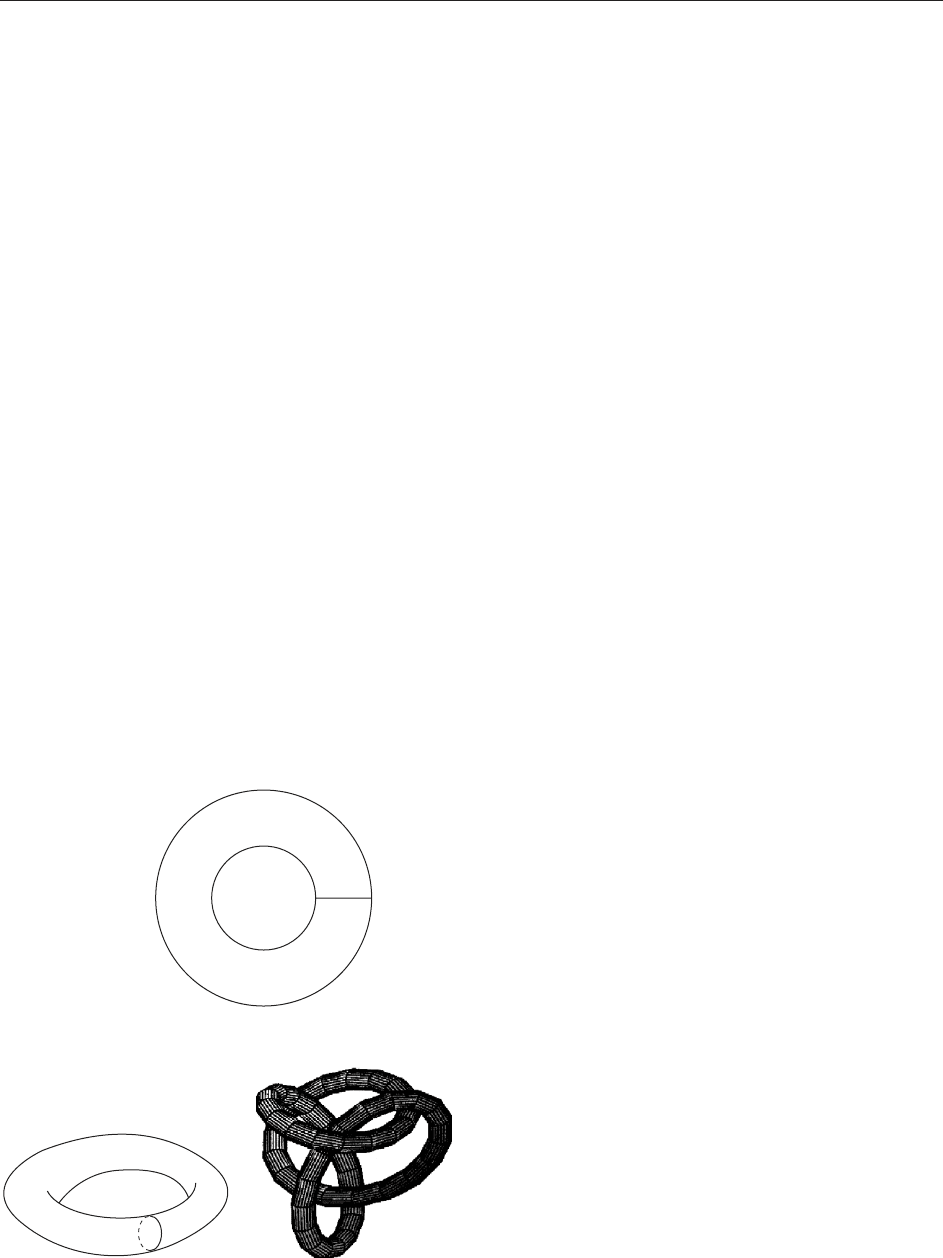
This program has not yet been completed, but we
illustrate it with the genus-1 bounding torus in
Figure 10. Figure 10a shows the canonical form, and
two different embeddings of it in R
3
. The embedding
on the left is unknotted. The embedding on the right is
knotted like a figure-8 knot. Extrinsic embeddings of
genus-1 tori are described by tame knots in R
3
,and
tame knots can be used as ‘‘centerlines’’ for extrinsi-
cally embedded genus-1 tori. Higher-genus (g 3)
canonical forms – intrinsic genus-g tori dressed with a
canonical flow – have a larger (but discrete) variety of
extrinsic embeddings in R
3
.
The Embedding Question
The mechanism that nature uses to generate chaotic
behavior in physical systems is not directly observable,
and must be deduced by examining the data that are
generated. Typically, the data consist of a single scalar
time series that is discretely recorded: x
i
, i = 1, 2, ....
In order to exhibit a strange attractor, a mapping of the
data into R
N
must also be constructed. If the attractor
is low dimensional (d
L
< 3), one can hope that a
mapping into R
3
can be constructed that exhibits no
self-intersections or other degeneracies. Such a map is
called an embedding. Once an embedding in R
3
is
available, a topological analysis can be carried out. The
analysis reveals the mechanism that underlies the
creation of the embedded strange attractor.
But how do you know that the mechanism that
generates the observed, embedded strange attractor
has anything to do with the mechanism nature used
to generate the experimental data?
If the embedding is contained in a genus-1 bounding
torus, then the topological mechanism that generates
the data, as defined by some unknown branched
manifold BM
EXP
, and the topological mechanism that
is identified from the embedded strange attractor
BM
EMB
, are identical up to three degrees of freedom:
parity, global torsion, and the knot type. As a result, in
this case (genus-1) a topological analysis of embedded
data does reveal nature’s hidden secrets.
See also: Ergodic theory; Fractal dimensions in
dynamics; Generic Properties of Dynamical Systems;
Gravitational N-body Problem (Classical);
Homeomorphisms and Diffeomorphisms of the Circle;
Homoclinic phenomena; Inviscid Flows; Lyapunov
Exponents and Strange Attractors; Nonequilibrium
Statistical Mechanics (Stationary): Overview; Random
Algebraic Geometry, Attractors and Flux Vacua; Random
Matrix Theory in Physics; Regularization for Dynamical
Zeta Functions; Singularity and Bifurcation Theory;
Symmetry and Symmetry Breaking in Dynamical
Systems; Synchronization of Chaos.
Further Reading
Abraham R and Shaw CD (1992) Dynamics: The Geometry of
Behavior, Studies in Nonlinearity, 2nd edn. Reading, MA:
Addison-Wesley.
Eckmann J-P and Ruelle D (1985) Ergodic theory of chaos and
strange attractors. Reviews of Modern Physics 57(3): 617–656.
Gilmore R (1998) Topological analysis of chaotic dynamical
systems. Reviews of Modern Physics 70(4): 1455–1529.
Gilmore R and Lefranc M (2002) The Topology of Chaos, Alice
in Stretch and Squeezeland. New York: Wiley.
(b) (c)
(a)
Figure 10 (a) Canonical form for genus-1 bounding torus.
Extrinsic embeddings of the torus into R
3
that are (b) unknotted
and (c) knotted like the figure-8 knot.
Chaos and Attractors 487

Gilmore R and Letellier C (2006) The Symmetry of Chaos Alice
in the Land of Mirrors. Oxford: Oxford University Press.
Gilmore R and Pei X (2001) The topology and organization of
unstable periodic orbits in Hodgkin–Huxley models of receptors
with subthreshold oscillations. In: Moss F and Gielen S (eds.)
Handbook of Biological Physics, Neuro-informatics, Neural
Modeling, vol. 4, pp. 155–203. Amsterdam: North-Holland.
Ott E (1993) Chaos in Dynamical Systems. Cambridge: Cambridge
University Press.
Solari HG, Natiello MA, and Mindlin GB (1996) Nonlinear
Physics and Its Mathematical Tools. Bristol: IoP Publishing.
Tufillaro NB, Abbott T, and Reilly J (1992) An Experimental
Approach to Nonlinear Dynamics and Chaos. Reading, MA:
Addison-Wesley.
Characteristic Classes
P B Gilkey, University of Oregon, Eugene, OR, USA
R Ivanova, University of Hawaii Hilo, Hilo, HI, USA
S Nikc
ˇ
evic
´
, SANU, Belgrade, Serbia and Montenegro
ª 2006 Elsevier Ltd. All rights reserved.
Vector Bundles
Let Vect
k
(M, F) be the set of isomorphism classes of
real (F = R) or complex (F = C) vector bundles of
rank k over a smooth connected m-dimensional
manifold M. Let
VectðM; FÞ¼
[
k
Vect
k
ðM; FÞ
Principal Bundles – Examples
Let H be a Lie group. A fiber bundle
: P!M
with fiber H is said to be a principal bundle if there
is a right action of H on P which acts transitively on
the fibers, that is, if P=H = M.IfH is a closed
subgroup of a Lie group G, then the natural
projection G ! G =H is a principal H bundle over
the homogeneous space G=H. Let O(k) and U(k)
denote the orthogonal and unitary groups, respec-
tively. Let S
k
denote the unit sphere in R
kþ1
. Then
we have natural principal bundles:
OðkÞOðk þ 1Þ!S
k
UðkÞUðk þ 1Þ!S
2kþ1
Let RP
k
and CP
k
denote the real and complex
projective spaces of lines through the origin in R
kþ1
and C
kþ1
, respectively. Let
Z
2
¼fIdgOðkÞ
S
1
¼f Id : jj¼1gUðkÞ
One has Z
2
and S
1
principal bundles:
Z
2
! S
k1
! RP
k1
S
1
! S
2k1
! CP
k1
Frames
A frame s := (s
1
, ..., s
k
) for V 2 Vect
k
(M, F) over an
open set OM is a collection of k smooth sections
to V j
O
so that {s
1
(P), ..., s
k
(P)} is a basis for the
fiber V
P
of V over any point P 2O. Given such a
frame s, we can construct a local trivialization which
identifies OF
k
with Vj
O
by the mapping
ðP;
1
; ...;
k
Þ!
1
s
1
ðPÞþþ
k
s
k
ðPÞ
Conversely, given a local trivialization of V, we can
take the coordinate frame
s
i
ðPÞ¼P ð0; ...; 0; 1; 0; ...; 0Þ
Thus, frames and local trivializations of V are
equivalent notions.
Simple Covers
An open cover {O
}ofM, where ranges over some
indexing set A, is said to be a simple cover if any
finite intersection O
1
\\O
k
is either empty or
contractible.
Simple covers always exist. Put a Riemannian
metric on M.IfM is compact, then there exists a
uniform >0 so that any geodesic ball of radius is
geodesically convex. The intersection of geodesically
convex sets is either geodesically convex (and hence
contractible) or empty. Thus, covering M by a finite
number of balls of radius yields a simple cover.
The argument is similar even if M is not compact
where an infinite number of geodesic balls is used
and the radii are allowed to shrink near 1.
Transition Cocycles
Let Hom(F, k) be the set of linear transformations of
F
k
and let GL(F, k) Hom(F, k) be the group of all
invertible linear transformations.
Let {s
} be frames for a vector bundle V over some
open cover {O
}ofM. On the intersection O
\O
,
one may express s
=
s
, that is
s
;i
ðPÞ¼
X
1jk
;
i
j
ðPÞs
;j
ðPÞ
488 Characteristic Classes

The maps
: O
\O
! GL(F, k) satisfy
¼ Id on O
¼
on O
\O
\O
½1
Let G be a Lie group. Maps belonging to a
collection {
} of smooth maps from O
\O
to G
which satisfy eqn [1] are said to be transition
cocycles with values in G;ifG GL(F, k), they
can be used to define a vector bundle by making
appropriate identifications.
Reducing the Structure Group
If G is a subgroup of GL(F, k), then V is said to have
a G-structure if we can choose frames so the
transition cocycles belong to G; that is, we can
reduce the structure group to G.
Denote the subgroup of orientation-preserving
linear maps by
GL
þ
ðR; kÞ :¼f 2 GLðR; kÞ: detð Þ > 0g
If V 2 Vect
k
(M, R), then V is said to be orientable if
we can choose the frames so that
2 GL
þ
ðR; kÞ
Not every real vector bundle is orientable; the first
Stiefel–Whitney class sw
1
(V) 2 H
1
(M; Z
2
), which is
defined later, vanishes if and only if V is orientable.
In particular, the Mo¨ bius line bundle over the circle
is not orientable.
Similarly, a real (resp. complex) bundle V is
said to be Riemannian (resp. Hermitian) if we can
reduce the structure group to the orthogonal group
O(k) GL(R, k) (resp. to the unitary group
U(k) GL(C, k)).
We can use a partition of unity to put a positive-
definite symmetric (resp. Hermitian symmetric) fiber
metric on V. Applying the Gram–Schmidt process
then constructs orthonormal frames and shows that
the structure group can always be reduced to O(k)
(resp. to U(k)); if V is a real vector bundle, then the
structure group can be reduced to the special
orthogonal group SO(k) if and only if V is
orientable.
Lifting the Structure Group
Let be a representation of a Lie group H to
GL(F, k). One says that the structure group of V can
be lifted to H if there exist frames {s
} for V and
smooth maps
: O
\O
! H,so
=
where eqn [1] holds for .
Spin Structures
For k 3, the fundamental group of SO(k)isZ
2
.
Let Spin(k) be the universal cover of SO(k) and let
: SpinðkÞ!SOðkÞ
be the associated double cover; set Spin(2) = S
1
and
let () =
2
. An oriented bundle V is said to be spin
if the transition functions can be lifted from SO(k)
to Spin(k); this is possible if and only if the second
Stiefel–Whitney class of V, which is defined later,
vanishes. There can be inequivalent spin structures,
which are parametrized by the cohomology group
H
1
(M; Z
2
).
The Tangent Bundle of Projective Space
The tangent bundle TRP
m
of real projective space is
orientable if and only if m is odd; TRP
m
is spin if
and only if m 3 mod 4. If m 3 mod 4, there are
two inequivalent spin structures on this bundle as
H
1
(RP
m
; Z
2
) = Z
2
.
The tangent bundle TCP
m
of complex projective
space is always orientable; TCP
m
is spin if and only
if m is odd.
Principal and Associated Bundles
Let H be a Lie group and let
: O
\O
! H
be a collection of smooth functions satisfying the
compatibility conditions given in eqn [1]. We define
a principal bundle P by gluing O
H to O
H
using :
ðP; hÞ
ðP;
ðPÞhÞ
for P 2O
\O
Because right multiplication and left multiplication
commute, right multiplication gives a natural action
of H on P:
ðP; hÞ
~
h :¼ðP; h
~
hÞ
The natural projection P!P=H = M is an H fiber
bundle.
Let be a representation of H to GL(F, k). For
2P, 2 F
k
, and h 2 H, define a gluing
ð; Þð h
1
;ðhÞÞ
The associated vector bundle is then given by
P
F
k
:¼PF
k
=
Clearly, {
} are the transition cocycles of the
vector bundle P
F
k
.
Characteristic Classes 489

Frame Bundles
If V is a vector bundle, the associated principal
GL(F, k) bundle is the bundle of all frames; if V is
given an inner product on each fiber, then the
associated principal O(k)orU(k) bundle is the bundle
of orthonormal frames. If V is an oriented Riemannian
vector bundle, the associated principal SO(k) bundle is
the bundle of oriented orthonormal frames.
Direct Sum and Tensor Product
Fiber-wise direct sum (resp. tensor product) defines the
direct sum (resp. tensor product) of vector bundles:
: Vect
k
ðM; FÞVect
n
ðM; FÞ
! Vect
kþn
ðM; FÞ
: Vect
k
ðM; FÞVect
n
ðM; FÞ
! Vect
kn
ðM; FÞ
The transition cocycles of the direct sum (resp.
tensor product) of two vector bundles are the direct
sum (resp. tensor product) of the transition cocycles
of the respective bundles.
The set of line bundles Vect
1
(M, F) is a group
under . The unit in the group is the trivial line
bundle l := M F; the inverse of a line bundle L is
the dual line bundle L
:= Hom(L, F) since
L L
¼ l
Pullback Bundle
Let : V ! M be the projection associated with
V 2 Vect
k
(M, F). If f is a smooth map from N to M,
then the pullback bundle f
V is the vector bundle
over N which is defined by setting
f
V :¼fðP; vÞ2N V : f ðPÞ¼ðvÞg
The fiber of f
V over P is the fiber of V over f (P).
Let {s
} be local frames for V over an open cover
{O
}ofM. For P 2 f
1
(O
), define
ff
s
gðPÞ :¼ðP; s
ðf ðPÞÞÞ
This gives a collection of frames for f
V over the
open cover {f
1
(O
)} of N. Let
f
:¼
f
be the pullback of the transition functions. Then
ff
s
gðPÞ¼ðP;
ðf ðPÞÞs
ðf ðP ÞÞÞ
¼fðf
Þðf
s
ÞgðPÞ
This shows that the pullback of the transition
functions for V are the transition functions of the
pullback f
(V).
Homotopy
Two smooth maps f
0
and f
1
from N to M are
said to be homotopic if there exists a smooth map
F : N I ! M so that f
0
(P) = F(P, 0) and so that
f
1
(P) = F(P, 1). If f
0
and f
1
are homotopic maps from
N to M, then f
1
V is isomorphic to f
2
V.
Let [N, M] be the set of all homotopy classes
of smooth maps from N to M. The association
V ! f
V induces a natural map
½N; MVect
k
ðM; FÞ!Vect
k
ðN; FÞ
If M is contractible, then the identity map is
homotopic to the constant map c. Consequently,
V = Id
V is isomorphic to c
V = M F
k
. Thus, any
vector bundle over a contractible manifold is trivial.
In particular, if {O
} is a simple cover of M and if
V 2 Vect(M, F), then Vj
O
is trivial for each . This
shows that a simple cover is a trivializing cover for
every V 2 Vect(M, F).
Stabilization
Let l 2 Vect
1
(M, F) denote the isomorphism class of
the trivial line bundle M F over an m-dimensional
manifold M. The map V ! V l induces a stabili-
zation map
s : Vect
k
ðM; FÞ!Vect
kþ1
ðM; FÞ
which induces an isomorphism
Vect
k
ðM; RÞ¼Vect
kþ1
ðM; RÞ for k > m
Vect
k
ðM; C Þ¼Vect
kþ1
ðM; C Þ for 2k > m
½2
These values of k comprise the stable range.
The K-Theory
The direct sum and tensor product make
Vect(M, F) into a semiring; we denote the associated
ring defined by the Grothendieck construction by
KF(M). If V 2 Vect(M, F), let [V] 2 KF(M) be the
corresponding element of K-theory; KF(M) is gener-
ated by formal differences [V
1
] [V
2
]; such formal
differences are called virtual bundles.
The Grothendieck construction (see K-theory)
introduces nontrivial relations. Let S
m
denote the
standard sphere in R
mþ1
. Since
TðS
m
Þl ¼ðm þ 1Þl
we can easily see that [TS
m
] = m[ l ]inKR(S
m
),
despite the fact that T(S
m
) is not isomorphic to ml
for m 6¼ 1, 3, 7.
Let L denote the nontrivial real line bundle over
RP
k
. Then TRP
k
l = (k þ 1)L,so
½TRP
k
¼ðk þ 1Þ½L½l
490 Characteristic Classes

The map V ! Rank(V) extends to a surjective
map from KF(M)toZ. We denote the associated
ideal of virtual bundles of virtual rank 0 by
f
KFðMÞ :¼ kerðRankÞ
In the stable range, V ! [V] k[ l ] identifies
Vect
k
ðM; RÞ¼
g
KRðMÞ if k > m
Vect
k
ðM; C Þ¼
g
KCðMÞ if 2k > m
½3
These groups contain nontrivial torsion. Let L be the
nontrivial real line bundle over RP
k
. Then
g
KRðRP
k
Þ¼Z f½L½l g=2
ðkÞ
Zf½L½l g
where (k) is the Adams number.
Classifying Spaces
Let Gr
k
(F, n) be the Grassmannian of k-dimensional
subspaces of F
n
. By mapping a k-plane in F
n
to the
corresponding orthogonal projection on , we can
identify Gr
k
(F, n) with the set of orthogonal projec-
tions of rank k:
f 2 HomðF
n
Þ:
2
¼ ;
¼ ; trðÞ¼kg
There is a natural associated tautological k-plane
bundle
V
k
ðF; nÞ2Vect
k
ðGr
k
ðF; nÞ ; FÞ
whose fiber over a k-plane is the k-plane itself:
V
k
ðF; nÞ :¼fð; xÞ2HomðF
n
ÞF
n
: x ¼ xg
Let [M,Gr
k
(F, n)] denote the set of homotopy
equivalence classes of smooth maps f from M to
Gr
k
(F, n). Since [f
1
] = [f
2
] implies that f
1
V is
isomorphic to f
2
V, the association
f ! f
V
k
ðF; nÞ2Vect
k
ðM; FÞ
induces a map
½M; Gr
k
ðF; nÞ ! Vect
k
ðM; FÞ
This map defines a natural equivalence of functors
in the stable range:
½M; Gr
k
ðR;þ kÞ ¼ Vect
k
ðM; RÞ for >m
½M; Gr
k
ðC;þ kÞ ¼ Vect
k
ðM; C Þ for 2>m
½4
The natural inclusion of F
n
in F
nþ1
induces natural
inclusions
Gr
k
ðF; nÞGr
k
ðF; n þ 1Þ
V
k
ðF; nÞV
k
ðF; n þ 1Þ
½5
Let Gr
k
(F, 1) and V
k
(F, 1) be the direct limit
spaces under these inclusions; these are the infinite-
dimensional Grassmannians and classifying bundles,
respectively. The topology on these spaces is the
weak or inductive topology. The Grassmannians are
called classifying spaces. The isomorphisms of
eqn [4] are compatible with the inclusions of eqn [5]
and we have
½M; Gr
k
ðF; 1Þ ¼ Vect
k
ðM; FÞ½6
Spaces with Finite Covering Dimension
A metric space X is said to have a covering
dimension at most m if, given any open cover {U
}
of X, there exists a refinement {O
} of the cover so
that any intersection of more than m þ 1 of the {O
}
is empty. For example, any manifold of dimension
m has covering dimension at most m. More
generally, any m-dimensional cell complex has
covering dimension at most m.
The isomorphisms of [2]–[4],and[6] continue to
hold under the weaker assumption that M is a metric
space with covering dimension at most m.
Characteristic Classes of Vector
Bundles
The Cohomology of Gr
k
(F, 1)
The cohomology algebras of the Grassmannians are
polynomial algebras on suitably chosen generators:
H
ðGr
k
ðR; 1Þ; Z
2
Þ¼Z
2
½sw
1
; ...; sw
k
H
ðGr
k
ðC; 1Þ; ZÞ¼Z½c
1
; ...; c
k
½7
The Stiefel–Whitney Classes
Let V 2 Vect
k
(M, R). We use eqn [6] to find
: M ! Gr
k
(R, 1) which classifies V; the map
is uniquely determined up to homotopy and, using
eqn [7], one sets
sw
i
ðVÞ :¼
sw
i
2 H
i
ðM; Z
2
Þ
The total Stiefel–Whitney class is then defined by
swðVÞ¼1 þ sw
1
ðVÞþþsw
k
ðVÞ
The Stiefel–Whitney class has the properties:
1. If f : X
1
! X
2
, then f
(sw(V)) = sw(f
V).
2. sw(V W) = sw(V)sw(W).
3. If L is the Mo¨ bius bundle over S
1
, then sw
1
(L)
generates H
1
(S
1
; Z
2
) = Z
2
.
The cohomology algebra of real projective space
is a truncated polynomial algebra:
H
ðRP
k
; Z
2
Þ¼Z
2
½x=x
kþ1
¼ 0
Characteristic Classes 491

Since TRP
k
l = (k þ 1)L, one has
swðTRP
k
Þ¼ð1 þ xÞ
kþ1
¼ 1 þ kx þ
ðk þ 1Þk
2
x
2
þ ½8
Orientability and Spin Structures
The Stiefel–Whitney classes have real geometric
meaning. For example, sw
1
(V) = 0 if and only if V
is orientable; if sw
1
(V) = 0, then sw
2
(V) = 0 if and
only if V admits a spin structure. With reference to
the discussion on the tangent bundle or projective
space, eqn [8] yields
sw
1
ðTRP
k
Þ¼
0ifk 0 mod 2
x if k 1 mod 2
Thus, RP
k
is orientable if and only if k is odd.
Furthermore,
sw
2
ðTRP
k
Þ¼
0ifk 3 mod 4
x if k 1 mod 4
Thus, TRP
k
is spin if and only if k 3 mod 4.
Chern Classes
Let V 2 Vect
k
(M, C). We use eqn [6] to find
: M ! Gr
k
(C, 1) which classifies V; the map
is uniquely determined up to homotopy and, using
eqn [7], one sets
c
i
ðVÞ :¼
c
i
2 H
2i
ðM; ZÞ
The total Chern class is then defined by
cðVÞ :¼ 1 þ c
1
ðVÞþþc
k
ðVÞ
The Chern class has the properties:
1. If f : X
1
! X
2
, then f
(c(V)) = c(f
V).
2. c(V W) = c(V)c(W).
3. Let L be the classifying line bundle over
S
2
= CP
1
. Then
R
S
2
c
1
(L) = 1.
The cohomology algebra of complex projective
space also is a truncated polynomial algebra
H
ðCP
k
; ZÞ¼Z½x=x
kþ1
where x = c
1
(L) and L is the complex classifying line
bundle over CP
k
= Gr
1
(C, k þ 1). If T
c
CP
k
is the
complex tangent bundle, then
cðT
c
CP
k
Þ¼ð1 þ xÞ
kþ1
The Pontrjagin Classes
Let V be a real vector bundle over a topological
space X of rank r = 2k or r = 2k þ1. The Pontrjagin
classes p
i
(V) 2 H
4i
(X; Z) are characterized by the
properties:
1. p(V) = 1 þ p
1
(V) þþp
k
(V).
2. If f : X
1
! X
2
, then f
(p(V)) = p(f
V).
3. p(V W) = p(V)p(W) mod elements of order 2.
4.
R
CP
2
p
1
(TCP
2
) = 3.
We can complexify a real vector bundle V to
construct an associated complex vector bundle V
C
.
We have
p
i
ðVÞ :¼ð1Þ
i
c
2i
ðV
C
Þ
Conversely, if V is a complex vector bundle, we can
construct an underlying real vector bundle V
R
by
forgetting the underlying complex structure. Mod-
ulo elements of order 2, we have
pðV
R
Þ¼cðVÞcðV
Þ
Let TCP
k
be the real tangent bundle of complex
projective space. Then
pðTCP
k
Þ¼ð1 x
2
Þ
kþ1
Line Bundles
Tensor product makes Vect
1
(M, F) into an abelian
group. One has natural equivalences of functors
which are group homomorphisms:
sw
1
: Vect
1
ðM; RÞ!H
1
ðM; Z
2
Þ
c
1
: Vect
1
ðM; C Þ!H
2
ðM; ZÞ
A real line bundle L is trivial if and only if it is
orientable or, equivalently, if sw
1
(L) vanishes. A
complex line bundle L is trivial if and only if
c
1
(L) = 0. There are nontrivial vector bundles with
vanishing Stiefel–Whitney classes of rank k > 1. For
example, sw
i
(TS
k
) = 0 for i > 0 despite the fact that
TS
k
is trivial if and only if k = 1, 3, 7.
Curvature and Characteristic Classes
de Rham Cohomology
We can replace the coefficient group Z by C at the cost
of losing information concerning torsion. Thus, we
may regard p
i
(V) 2 H
4i
(M; C)ifV is real or c
i
(V) 2
H
2i
(M; C)ifV is complex. Let M be a smooth
manifold. Let C
1
p
M be the space of smooth
p-forms and let
d : C
1
p
M ! C
1
pþ1
M
492 Characteristic Classes

be the exterior derivative. The de Rham cohomology
groups are then defined by
H
p
deR
ðMÞ :¼
kerðd : C
1
p
M ! C
1
pþ1
MÞ
imðd : C
1
p1
M ! C
1
p
MÞ
The de Rham theorem identifies the topological
cohomology groups H
p
(M; C) with the de Rham
cohomology groups H
p
deR
(M) which are given
differential geometrically.
Given a connection on V, the Chern–Weyl theory
enables us to compute Pontrjagin and Chern classes in
de Rham cohomology in terms of curvature.
Connections
Let V be a vector bundle over M. A connection
r : C
1
ðVÞ!C
1
ðT
M VÞ
on V is a first-order partial differential operator
which satisfies the Leibnitz rule, that is, if s is a
smooth section to V and if f is a smooth function
on M,
rðfsÞ¼df s þ f rs
If X is a tangent vector field, we define
r
X
s ¼hX; rsi
where h, i denotes the natural pairing between the
tangent and cotangent spaces. This generalizes to the
bundle setting the notion of a directional derivative
and has the properties:
1. r
fX
s = f r
X
s.
2. r
X
(fs) = X(f )s þ f r
X
s.
3. r
X
1
þX
2
s = r
X
1
s þr
X
2
s.
4. r
X
(s
1
þ s
2
) = r
X
s
1
þr
X
s
2
.
The Curvature 2-Form
Let !
p
be a smooth p-form. Then
r : C
1
ð
p
M VÞ!C
1
ð
pþ1
M VÞ
can be extended by defining
rð!
p
sÞ¼d!
p
s þð1Þ
p
!
p
^rs
In contrast to ordinary exterior differentiation, r
2
need not vanish. We set
ðsÞ : ¼r
2
s
This is not a second-order partial differential
operator; it is a zeroth-order operator, that is,
ðfsÞ¼ddf s df ^rs þ df ^rs þ f r
2
s
¼ f ðsÞ
The curvature operator can also be computed
locally. Let (s
i
) be a local frame. Expand
rs
i
¼
X
j
!
j
i
s
j
to define the connection 1-form !. One then has
r
2
s
i
¼ d!
j
i
!
k
i
^ !
j
k
s
k
and so
j
i
¼ d!
j
i
!
k
i
^ !
j
k
If
˜
s =
js
i
j is another local frame, we compute
~
! ¼ dgg
1
þ g!g
1
and
~
¼ gg
1
Although the connection 1-form ! is not tensorial, the
curvature is an invariantly defined 2-form-valued
endomorphism of V.
Unitary Connections
Let ( , ) be a nondegenerate Hermitian inner product
on V.Wesaythatr is a unitary connection if
ðrs
1
; s
2
Þþðs
1
; rs
2
Þ¼dðs
1
; s
2
Þ
Such connections always exist and, relative to a
local orthonormal frame, the curvature is skew-
symmetric, that is,
þ
¼ 0
Thus, can be regarded as a 2-form-valued element
of the Lie algebra of the structure group, O(V) in the
real setting or U(V) in the complex setting.
Projections
We can always embed V in a trivial bundle 1
of
dimension ; let
V
be the orthogonal projection on
V. We project the flat connection to V to define a
natural connection on V. For example, if M is
embedded isometrically in the Euclidean space R
,
this construction gives the Levi-Civita connection on
the tangent bundle TM. The curvature of this
connection is then given by
¼
V
d
V
d
V
Let V
P
be the fiber of V over a point P 2 M. The
inclusion i : V R
n
defines the classifying map
f : P ! Gr
k
(R, n) where we set
f ðPÞ¼iðV
P
Þ
Characteristic Classes 493

Chern–Weyl Theory
Let r be a Riemannian connection on a real vector
bundle V of rank k. We set
pðÞ :¼ det I þ
1
2
Let
T
denote the transpose matrix of differential
form. Since þ
T
= 0, the polynomials of odd
degree in vanish and we may expand
pðÞ¼1 þ p
1
ðÞþþp
r
ðÞ
where k = 2r or k = 2r þ 1 and the differential forms
p
i
() 2 C
1
4i
(M) are forms of degree 4i.
Changing the gauge (i.e., the local frame) replaces
by gg
1
and hence p() is independent of the
local frame chosen. One can show that dp
i
() = 0;
let [p
i
()] denote the corresponding element of de
Rham cohomology. This is independent of the
particular connection chosen and [p
i
()] represents
p
i
(V)inH
4i
(M; C).
Similarly, let V be a complex vector bundle of
rank k with a Hermitian connection r. Set
cðÞ :¼ det I þ
ffiffiffiffiffiffiffi
1
p
2
!
¼ 1 þ c
1
ðÞþþc
k
ðÞ
Again c
i
() is independent of the local gauge and
dc
i
() = 0. The de Rham cohomology class [c
i
()]
represents c
i
(V)inH
2i
(M; C).
The Chern Character
The total Chern character is defined by the formal
sum
chðÞ :¼ trðe
ffiffiffiffiffi
1
p
=2
Þ
¼
X
ð
ffiffiffiffiffiffiffi
1
p
Þ
ð2Þ
!
trð
Þ
¼ ch
0
ðÞþch
1
ðÞþ
Let ch(V) = [ch()] denote the associated de Rham
cohomology class; it is independent of the particular
connection chosen. We then have the relations
chðV WÞ¼chðVÞþchðWÞ
chðV WÞ¼chðVÞchðWÞ
The Chern character extends to a ring isomorph-
ism from KU(M) Q to H
e
(M; Q), which is a
natural equivalence of functors; modulo torsion,
K theory and cohomology are the same functors.
Other Characteristic Classes
The Chern character is defined by the exponential
function. There are other characteristic classes
which appear in the index theorem that are defined
using other generating functions that appear in
index theory. Let x := (x
1
, ...) be a collection of
indeterminates. Let s
(x) be the th elementary
symmetric function;
Y
ð1 þ x
Þ¼1 þ s
1
ðxÞþs
2
ðxÞþ
For a diagonal matrix A := diag(
1
, ...), denote the
normalized eigenvalues by x
j
:=
ffiffiffiffiffiffiffi
1
p
j
=2. Then
cðAÞ¼det 1 þ
ffiffiffiffiffiffiffi
1
p
2
A
!
¼ 1 þ s
1
ðxÞþ
Thus, the Chern class corresponds in a certain sense
to the elementary symmetric functions.
Let f (x) be a symmetric polynomial or more
generally a formal power series which is symmetric.
We can express f (x) = F(s
1
(x), ...) in terms of the
elementary symmetric functions and define
f () = F(c
1
(), ...) by substitution. For example,
the Chern character is defined by the generating
function
f ðxÞ :¼
X
k
¼1
e
x
The Todd class is defined using a different
generating function:
tdðxÞ :¼
Y
x
ð1 e
x
Þ
1
¼ 1 þ td
1
ðxÞþ
If V is a real vector bundle, we can define
some additional characteristic classes similarly. Let
{
ffiffiffiffiffiffiffi
1
p
1
, ...} be the nonzero eigenvalues of a
skew-symmetric matrix A.Wesetx
j
=
j
=2
and define the Hirzebruch polynomial L and the
ˆ
A
genus by
LðxÞ :¼
Y
x
tanhðx
Þ
¼ 1 þ L
1
ðxÞþL
2
ðxÞþ
^
AðxÞ :¼
Y
x
2 sinhðð1=2Þx
Þ
¼ 1 þ
^
A
1
ðxÞþ
^
A
2
ðxÞþ
The generating functions
x
tanhðxÞ
and
x
2 sinhðð1=2ÞxÞ
494 Characteristic Classes