
Francoise J.-P., Naber G.L., Tsun T.S. (editors) Encyclopedia of Mathematical Physics
Подождите немного. Документ загружается.


That is, the constraints (
a
, C
b
) form together a
second-class system: there is no first-class constr aint
left once the conditions C
a
= 0 are included. One
can then eliminate all the constraints and gauge
conditions and introduce the corresponding Dirac
bracket. For gauge-invariant functions, this Dirac
bracket coincides with the original Poisson bracket.
The reduced phase space is the unconstrained
space obtained after this reduction, equipped with
the Dirac bracket. It has dimension 2n s 2
A,
where 2n is the dimension of the original phase
space, s is the number of second-class constraints,
and
A is the number of first-class constraints. In the
bosonic case, this number is even (as it should)
because s is even. One sees that ‘‘first-class con-
straints strike twice’’ since they need gauge
conditions.
The observables of the theory are the reduced
phase-space functions. They form a Poisson algebra,
the relevant reduced phase-space bracket being the
Dirac bracket associated with all the constraints and
gauge conditions. The symplectic structure defined
in the reduced phase space is nondegenerate because
one has removed all the first-class constraints.
The definition of reduced phase space given above
is useful in practice but has the conceptual
drawback of relying on gauge conditions. This
approach does not display clearly its intrinsic
significance and, furthermore, in the case of the
so-called Gribov problems (global obstructions to
cutting each gauge orbit once and only once), may
yield the incorrect expectation that the reduced
phase space does not exist. We shall provide a more
intrinsic definition below, which does not involve
gauge conditions.
Examples
First example (see eqn [2]). There is here one
primary constraint, namely
= 0. The canonical
Hamiltonian is (1=2)((p
1
)
2
þ (p
2
)
2
) þ (p
1
þ p
2
).
The consistency algorithm yield s the secondary
constraint p
1
þ p
2
= 0 and no condition on the u’s.
The constraints are first class. They generate the
gauge transformations q
1
! q
1
þ ", q
2
! q
2
þ ",
and ! þ , which coincide with the Lagrangian
gauge transformations if one identifies with
_
"
(" and
_
" are, of course, independent at any given
time). One can fix the gauge by means of the gauge
conditions = 0, q
1
þ q
2
= 0. The reduced phase
space is two-dimensional and the observables can
be identified with the funct ions of the gauge-
invariant variables (1=2)(q
1
q
2
) and p
1
p
2
,
which are conjugate. Any other gauge condition
leads to the same reduced phase space.
Second example (see eqn [4] ). The primary
constraints are p
1
z
2
= 0 and p
2
= 0 and define a
two-dimensional plane in the four-dimensional
phase space (z
1
, z
2
, p
1
, p
2
). The consistency algo-
rithm forces u
1
= z
2
and u
2
= 0 and does not bring
any further constraint. The constraints are second
class since [p
2
, p
1
z
2
] = 1. One can eliminate p
1
and p
2
through the constraints. The Dirac brackets
of the remaining variables vanish, except
[z
1
, z
2
] = 1. The reduced phase is the space of the
z’s, with z
2
conjugate to z
1
. The Hamiltonian is the
free-particle Hamiltonian , H = (1/2)(z
2
)
2
. Thus, one
recovers the original description which was already
in Hamiltonian form. (The recognition that a system
is already in first-order form often enables one to
shortcut some aspects of the Dirac procedure by not
introducing the unnecessary mom enta which would
in any case be eliminated in the end.)
Quantization
The phase space of physical interest is the reduced
phase space and the physical algebra is the algebra
of the observa bles. The quantization of the theory
then amounts to quantizing the algebra of the
observables. This can be achieved along two
different lines:
1. Reduce then quantize: In this direct approach,
one represents as quantum operators only the
reduced phase-space functions. There is no
operator associated with non-gauge-invariant
functions.
2. Quantize then reduce: In this approach, one
represents as quantum operators the bigger alge-
bra of functions of all the phase-space variables.
One must then take into account the constraints.
The second-class constraints are enforced as
operator equations, which is consistent with the
correspondence rule that the commutator in the
quantum theory is ih times the Dirac bracket,
AB BA ¼ ih½A; B
D
½27
(plus higher-order terms in h). The first-class
constraints are implemented in a more subtle
way. It would be inconsistent to impose them as
operator equations since in general [
a
, F]
D
6¼ 0
(even in the Dirac bracket). What one does is to
impose them as conditions on the physical states:
these are defined as the states annihilated by the
first-class constraints,
a
j i¼0 ½28
For simple systems, it is easy to verify that the two
procedures are equivalent. There is yet another
Constrained Systems 615

approach, in which one extends the system rather
than reduce it. This is the Becchi–Rouet–Stora–
Tyutin (BRST) approach, in which the new variables
are called ghosts.
Geometric Description
We defined above first-class and second-class
constraints through algebraic means. It turns out
that these definitions also have a geometrical
interpretation, which sheds considerable insight
into their nature.
The phase-space symplectic 2-form induces, by
pullback, a 2-form
on the constr aint surface .
While is of maximal rank, this may not be the case
for the induced
, which may be degenerate. In
fact, the rank of
fails to be equal to the
maximum rank 2n J (where J is the total number
of constraints) by precisely the number
A of first-
class constraints.
Indeed, the Hamiltonian vector fields X
a
associated
with the first-class constraints are tangent to the
constraint surface and are null eigenvectors of
,
ðX
a
; YÞ¼0 8Y tangent to ½29
as an immediate consequence of the first-class
property. Here, all first-class constraints (primary
and secondary) yield a null eigenvector. The integral
surfaces of the vector fields X
a
are the gauge orbits.
The reduced phase space is nothing else but the
quotient space of the constraint surface by the gauge
orbits. The 2-form induced in the quotient space is
invertible because one has removed all degeneracy
directions (including the ones associated with sec-
ondary first-class constraints). Reaching the reduced
phase space falls under the scope of Hamiltonian
reduction. The observables are the functions on the
reduced phase space.
Thus, the reduced phase space is obtained through
a two-step procedure. First, one restricts the functions
to functions on the constraint surface . One may
view the algebra C
1
()ofsmoothfunctionson as
the quotient algebra C
1
(P)=N of the algebra C
1
(P)
of smooth phase-space functions by the ideal N of
phase-space functions that vanish on the constraint
surface . The second step in the reduction procedure
is to impose the gauge-invariant condition on the
functions in C
1
(), that is, to impose that they are
constant along the gauge orbits O.Assumingall
necessary smoothness and regularity conditions to be
fulfilled (i.e., that the orbits fiber which is, for
instance, the case if the gauge orbits are the orbits
of a free and proper group action), one may denote
the algebra of observables as C
1
(=O). This algebra
is a Poisson algebra because the induced 2-form on
the quotient space =O is nondegenerate. The
algebraic description of the observables underlies the
BRST construction.
It is interesting to note that in the covariant
approach to phase space, a similar two-step reduc-
tion procedure occurs. What plays the role of the
constraint surface is the stationary surface in the
space of all histories q
i
(t) of the dynamical variables.
The gauge symmetry acts on this space and the
reduced phase space is just the quotient space. One
can establish the equivalence of the two descriptions
(Barnich et al. 1991).
See also: Batalin–Vilkovisky Quantization; BRST
Quantization; Canonical General Relativity; Operads;
Perturbative Renormalization Theory and BRST;
Quantum Dynamics in Loop Quantum Gravity; Quantum
Field Theory: A Brief Introduction.
Further Reading
Anderson JL and Bergmann PG (1951) Constraints in covariant
field theories. Physical Review 83: 1018.
Barnich G, Henneaux M, and Schomblond C (1991) On the
covariant description of the canonical formalism. Physical
Review D 44: 939.
Dirac PAM (1950) Generalized Hamiltonian dynamics. Canadian
Journal of Mathematics 2: 129.
Dirac PAM (1967) Lectures on Quantum Mechanics. New York:
Academic Press.
Flato M, Lichnerowicz A, and Sternheimer D (1976) Deforma-
tions of Poisson brackets, Dirac brackets and applications.
Journal of Mathematical Physics 17: 1754.
Hanson A, Regge T, and Teitelboim C (1976) Constrained
Hamiltonian Systems. Rome: Accad. Naz. dei Lincei.
Henneaux M and Teitelboim C (1992) Quantization of Gauge
Systems. Princeton: Princeton University Press.
Henneaux M, Teitelboim C, and Zanelli J (1990) Gauge
invariance and degree of freedom count. Nuclear Physics B
332: 169.
Marsden JE and Weinstein A (1974) Reduction of sympl ectic
manifolds wi th sy mmet ry. Reports on Mathematical Physics
5: 121.
616 Constrained Systems
Constructive Quantum Field Theory
G Gallavotti, Universita
`
di Roma ‘‘La Sapienza,’’
Rome, Italy
ª 2006 G Gallavotti. Published by Elsevier Ltd.
All rights reserved.
Euclidean Quantum Fields
The construction of a relati vistic quantum field is
still an open problem for fields in spacetime
dimension d 4. The conceptual difficulty that
sometimes led to fear an incompatibility between
nontrivial quantum systems and special relativity
has however been solved in the case of dimension
d = 2, 3 although, so far, has not influ enced the
corresponding debate on the foundations of quan-
tum mechanics, still much alive.
It began in the early 1960s with Wightma n’s work
on the axioms and the attempts at understanding the
mathematical aspects of renormalization theory and
with Hepps’ renormalization theory for scalar fields.
The breakthrough idea was, perhaps, Nelson’s
realization that the problem could really be studied
in Euclidean form. A solution in dimensions d = 2, 3
has been obtained in the 1960s and 1970s through a
remarkable series of papers by Nelson, Glimm,
Jaffe, and Guerra. While the works of Nelson and
Guerra relied on the ‘‘Euclidean approach ’’ (see
below) and on d = 2, the early works of Glimm and
Jaffe dealt with d = 3 making use of the ‘ ‘Minkowskian
approach’’ (based on second quantization) but
making already use of a ‘‘multiscale analysis’’
technique. The latter received great impulsion and
systematization by the adoption of Wilson’ s views
and methods on renormalization: in physics termi-
nology, renormalization group methods; a point of
view taken here following the Euclidean approach.
The solution dealt initially with scalar fields but it
has been subsequently consid erably extended.
The Euclidean approach studies quantum fields
through the following problems:
1. existence of the functional integrals defining the
generating functions (see below) of the probabil-
ity distribution of the interacting fields in finite
volume: the ‘‘ultraviolet stability problem,’’
2. existence of the infinite-volume limit of the
generating functions: the ‘‘infrared problem,’’
and
3. check that the infinite volume generating
functions satisfy the axioms needed to pass
from the Euclidean, probabilistic, formulation
to a Minkowskian formulation guaranteeing
the existence of the Hamiltonian operator,
relativistic covariance, Ruelle–H aag scatte ring
theory: the ‘‘reconstruction problem.’’
The characteristic problem for the construction of
quantum fields is (1) and here attention will be
confined to it with the further restriction to the
paradigmatic massive scalar fields cases. The dimen-
sion d of the spacetime will be d = 2, 3 unless
specified otherwise.
Given a cube of side L, R
d
, consider the
following functional integral on the space of the fields on
, that is, on functions ’
(N)
x
defined for x 2 ,
Z
N
ð; f Þ¼
Z
exp
Z
N
’
ðN Þ
4
x
þ
N
’
ðN Þ
2
x
þ
N
þ f
x
’
ðN Þ
x
dx
P
N
ðd’
ðN Þ
Þ½1
The fields ’
(N)
x
are called ‘‘Euclidean’’ fields with
ultraviolet cutoff N > 0, f
x
is a smooth function with
compact support bounded by jf
x
j1 (for definiteness),
the constants
N
> 0,
N
,
N
are called ‘‘bare cou-
plings,’’ and P
N
is a Gaussian probability distribution
defining the free-field distribution with mass m and
ultraviolet cutoff N; the probability distribution P
N
is determined by its ‘‘covariance’’ C
(N)
x, h
=
def
R
’
(N)
x
’
(N)
h
dP
N
, which in the physics literature is called a
‘‘propagator,’’ given by
C
ðNÞ
x;h
¼
1
ð2Þ
d
X
n2Z
d
Z
e
ipðxhþnLÞ
p
2
þ m
2
N
ðjpjÞd
d
p ½2
The sum over the integers n 2 Z
d
is introduced so that
the field ’
(N)
x
is periodic over the box :thisisnot
really necessary as in the limit L !1either translation
invariance would be recovered or lack of it properly
understood, but it makes the problem more symmetric
and generates a few technical simplifications; here
N
(z) is a ‘‘regularizer’’ and a standard choice is
N
ðjpjÞ¼
m
2
ð
2N
1Þ
p
2
þ
2N
m
2
with >1, which is such that
N
ðjpjÞ
p
2
þ m
2
1
p
2
þ m
2
1
p
2
þ
2N
m
2
X
N
h¼1
1
p
2
þ
2ðh1Þ
m
2
1
p
2
þ
2h
m
2
½3
here >1 can be chosen arbitrarily: so = 2. If
d > 3, the above regularization will not be sufficient
and a
N
decaying faster than p
2
would be needed.
Constructive Quantum Field Theory 617

A simple estimate yields, if " 2 (0, 1) is fixed and c
is suitably chosen,
C
ðN Þ
x;h
c
ðd2ÞN
e
mjxhj
C
ðN Þ
x;h
C
ðN Þ
x;h
0
c
ðd2ÞN
ð
N
mjh h
0
jÞ
"
½4
with
(d2)N
interpreted as N if d = 2.
The
ðf Þ¼ log
Z
N
ð; f Þ
Z
N
ð; 0Þ
defines a ‘‘generating function’’ of a probability
distribution P
int
over the fields on which will be
called the ‘‘distribution with ’
4
-interaction’’ regu-
larized on and at length scale m
1
N
: the
integral, in [1],
V
N
’
ðN Þ
¼
def
Z
N
’
ðN Þ
4
x
þ
N
’
ðNÞ
2
x
þ
N
þ f
x
’
ðN Þ
x
d
d
x ½5
will be called the ‘‘interaction potential’’ with
external field f. The regularization is introduced to
guarantee that the integral [1],
R
e
V
N
dP
N
, is well
defined if
N
> 0. The momenta of P
int
are the
functional derivatives of (f ): they are called
‘‘Schwinger functions.’’
The problem (1) can now be made precise: it is to
show the existence of
N
,
N
,
N
so that the limit
lim
N!1
Z
N
ð; f Þ
Z
N
ð; 0Þ
exists for all f and is not Gaussian, that is, it is not
the exponential of a quadratic form in f: which
would be the case if
N
,
N
!0 fast enough: the last
requirement is of course essential because the
Gaussian case describes, in the physical interpreta-
tion, free fields and noninteracting particles, that is,
it is trivial. Note that
N
does not play a role: its
introduction is useful to be able to study separately
the numerator and the denominator of the fraction
Z
N
ð; f Þ
Z
N
ð; 0Þ
For more details, the reader is referred to Wightman
and Ga¨rding (1965), Streater and Wightman (1964),
Nelson (1966), Guerra (1972), Osterwalder and
Schrader (1973),andSimon (1974).
The Regularized Free Field
Since the propagator, see [4], decays exponentially
over a scale m
1
and is smooth over a scale m
1
N
,
the fields ’
(N)
x
sampled with distribution P
N
are rather singular objects. Their properties cannot be
described by a single length scale: they are extremely
large for large N, take independent values only beyond
distances of order m
1
but, at the same time, they look
smooth only on the much smaller scale m
1
N
.Their
essential feature is that fixed "<1, for example,
" = 1=2, with P
N
-probability 1 there is B > 0such
that (interpreting
(d2)=2N
as N if d = 2)
’
ðN Þ
x
B
Nðd2Þ=2
’
ðN Þ
x
’
ðN Þ
h
< B
Nðd2Þ=2
N
mjx hj
"=2
½6
and furthermore the probability of the relations in
[6] will be N-independent, that is, ’
(N)
x
are
bounded and roughly of size
N(d2)=2
as N !1
and, on a very small length scale m
1
N
, almost
constant.
Substantial control on the field ’
(N)
x
statisti-
cally sampled with distribution P
N
can be obtained
by decomposing it, through [3], into ‘‘components
of various scales’’: that is, as a sum of statistically
mutually independent fields whose properties
are entirely characterized by a single scale of length.
This means that they have size of order 1 and
are independent and smooth on the same length
scale.
Assuming the side of to be an integer multiple
of m
1
,letQ
h
be a pavement of into boxes of
side m
1
h
, imagined hierarchically arranged so
that the boxes of Q
h
are e xactly paved by t hose of
Q
hþ1
.
Define z
(h)
x
to be the random field with propa-
gator C
(h)
x, h
with Fourier transform
X
n2Z
d
1
p
2
þ
2
m
2
1
p
2
þ m
2
e
inp L
h
so that ’
(N)
x
and its propagator C
(N)
x, h
can be repre-
sented, see [2], [3],as
’
ðN Þ
x
X
N
h¼1
hðd2Þ=2
z
ðhÞ
h
x
C
ðN Þ
x;h
¼
X
N
h¼1
hðd2Þ
C
ðhÞ
h
x;
h
h
½7
where the fields z
(h)
are independently distributed
Gaussian fields . Note that the fields z
(h)
are also
almost identically distributed because their propa-
gator is obtained by periodizing over the period
h
L
the same function
C
ð0Þ
x;h
¼
def
Z
e
ipðxhÞ
dp
ð2Þ
d
1
p
2
þ
2
m
2
1
p
2
þ m
2
618 Constructive Quantum Field Theory

that is, their propagator is
C
ðhÞ
x;h
¼
X
n2Z
d
C
ð0Þ
x;hþ
h
nL
The reason why they are not exactly equally
distributed is that the field z
(h)
x
is periodic with
period
h
L rather than L. But proceeding with care
the sum over n in the above expressions can be
essentially ignored: this is a little price to pay if one
wants translation invariance built in the analysis
since the beginning.
The representation [7] defines a ‘‘multiscale
representation’’ of the field ’
(N)
x
. Smoothness
properties for the field ’
(N)
x
can be read from
those of its ‘‘components’’ z
(h)
. Define, for 2Q
0
,
z
ðhÞ
¼ max
x2;h2
jxhjm
1
z
ðhÞ
x
þ
z
ðhÞ
x
z
ðhÞ
h
x h
jj
1=4
0
@
1
A
½8
and will be chosen = 0or = 1 as needed (in
practice = 0ifd = 2and = 1ifd = 3): = 1 will
allow us to discuss some smoothness properties of
the fields which will be necessary (e.g., if d = 3).
Then the size jjzjj
of any field z
(h)
, for all h 1, is
estimated by
P
max
Q
0
jjzjj
B
e
ce
c
0
B
2
jj
Pðjjzjj
B
; 8 2DÞ
Y
2D
ce
c
0
B
2
½9
where P is the Gaussian probability distribution of
z, D is any collection of boxes 2Q
0
and c, c
0
> 0
are suitable constants. The [9] imply in particular
[6]. The estimates [9] follow from the Markovian
nature of the Gaussian field z
(h)
, that is, from the
fact that the propagator is the Green’s function of an
elliptic operator (of fourth order, see the first of [3]),
with constant coefficients which implies also the
inequalities (fixing " 2(0, 1))
C
ðhÞ
x;h
Z
z
x
z
h
PðdzÞ
ce
mc
0
jxhj
C
ðhÞ
x;h
C
ðhÞ
x;h
0
cðmjh h
0
jÞ
"
½10
where jx hj is reinterpreted as the distance
between x, h measured over the periodic box
h
(hence jx hj differs from the ordinary distance
only if the latter is of the order of
h
L). The
interpretation of [10] is that z
(h)
x
are essentially
bounded variables which, on scale m
1
, are
essentially constant and furthermore beyond length
m
1
are essentially independently distributed.
For more details, the reader is referred to Wilson
(1970, 1972) and Gallavotti (1981, 1985) .
Perturbation Theory
The naive approach to the problem is to fix
N
>0 and to develop Z
N
(, f ) or, more conveniently
and equivalently, (1=jj) log Z
N
(, f ) in powers of .
If one fixes a priori
N
,
N
independent of N,
however, even a formal power series is not possible:
this is trivially due to the divergence of the
coefficients of the power series, already to second
order, for generic f in the limit N !1. Nevertheless
it is possible to determine
N
(),
N
() as functions
of N and so that a formal power series exists (to
all orders in ): this is the key result of renormaliza-
tion theory.
To find the perturbative expansion, the simplest is
to use a graphical representation of the coefficients of
the power expansion in ,
N
,
N
, f and the Gaussian
integration rules which yield (after a classical
computation) that the coefficient of
n
p
N
f
x
1
...f
x
r
is
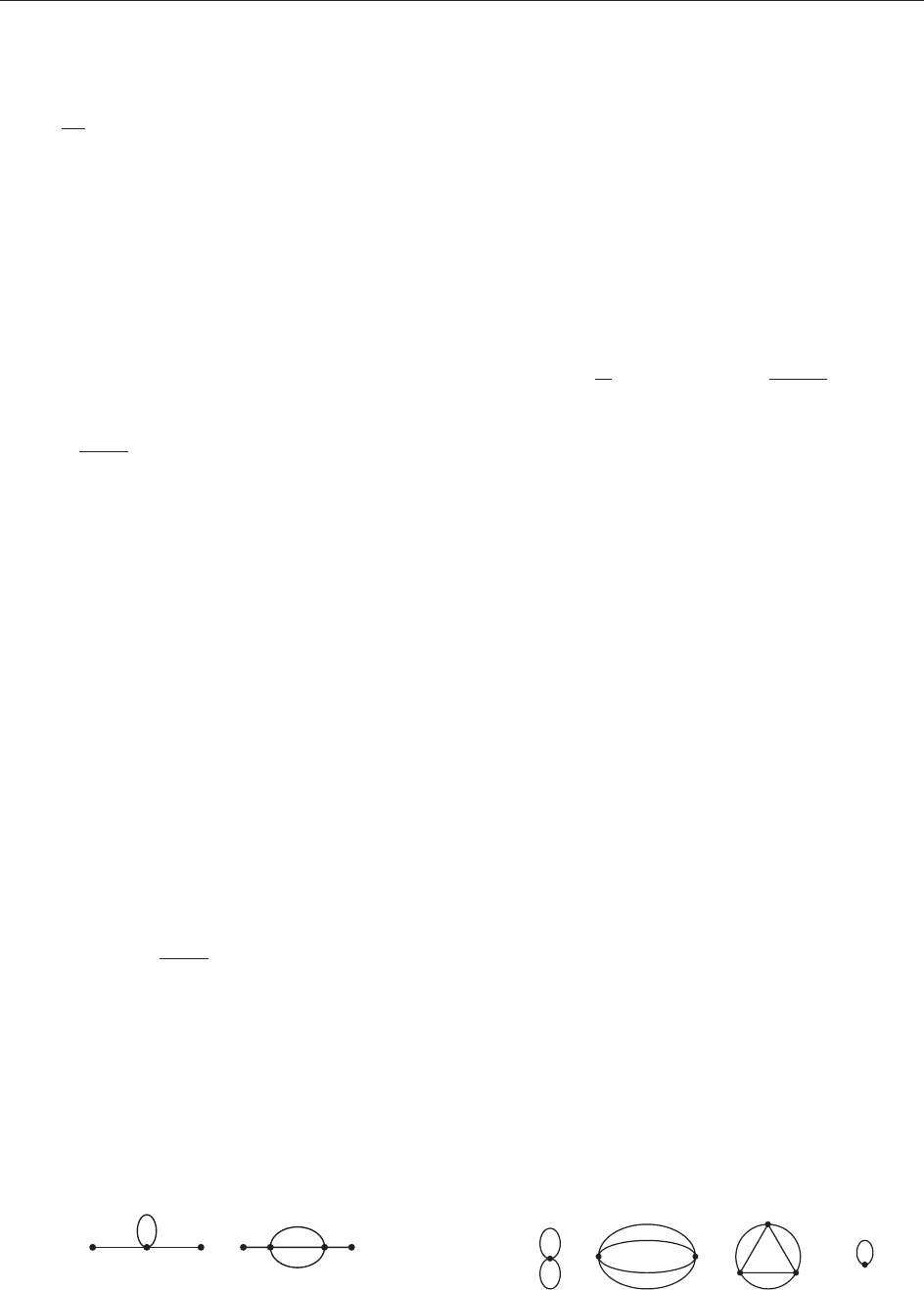
obtained by considering the graph elements shown in
Figure 1, where the segments will be called half-lines
and the graph elements will be called, respectively,
‘‘coupling’’ or ‘‘’
4
-vertex,’’ ‘‘mass vertex,’’ ‘‘vacuum
vertex,’’ and ‘‘external vertex.’’
The half-lines of the graph elements are consid-
ered distinct (i.e., imagine a label attached to
distinguish them). Then consider all possible con-
nected graphs G obtained by first drawing, respec-
tively, n, p, r graph elements in Figure 1, which are
not vacuum vertices, with their nodes marked by
points in named x
1
, ..., x
n
, x
nþ1
, ..., x
nþpþr
; and
form all possible graphs obtained by attaching pairs
of half-lines emerging from the vertices of the graph
elements. These are the ‘‘nontrivial graphs.’’
Furthermore, consider also the single ‘‘trivial’’
graph form ed just by the third graph element and
consisting of a single point. All graphs obtained in
this way are particular Feynman graphs.
Given a nontrivial graph G (there are many of
them) we define its value to be the product
W
G
ðx
1
; ...; x
n
; x
nþ1
; ...; x
nþpþr
Þ
¼ð1Þ
nþpþr
n
p
N
Q
f
x
nþpþj
n!p!r!
Y
‘
C
ðNÞ
x
‘
;h
‘
½11
where the last product runs over all pairs ‘ = (x
‘
, h
‘
)
of half-lines of G that are joined and connect two
vertices labeled by points x
‘
, h
‘
: ‘‘call line of G’’ any
such pair. If the graph consists of the single vacuum
ξξξ
ξ
Figure 1 The graph elements to representing ’
(N)4
, ’
(N)2
,
a constant ’
(N)
.
Constructive Quantum Field Theory 619
vertex its value will be
N
. The series for
(1=jj) log Z
N
(, f ) is then
N
þ
1
jj
X
G
Z
W
G
ðx
1
; ...; x
nþpþr
Þ
Y
nþpþr
j¼1
dx
j
½12
and the integral will be called the integrated graph
value.
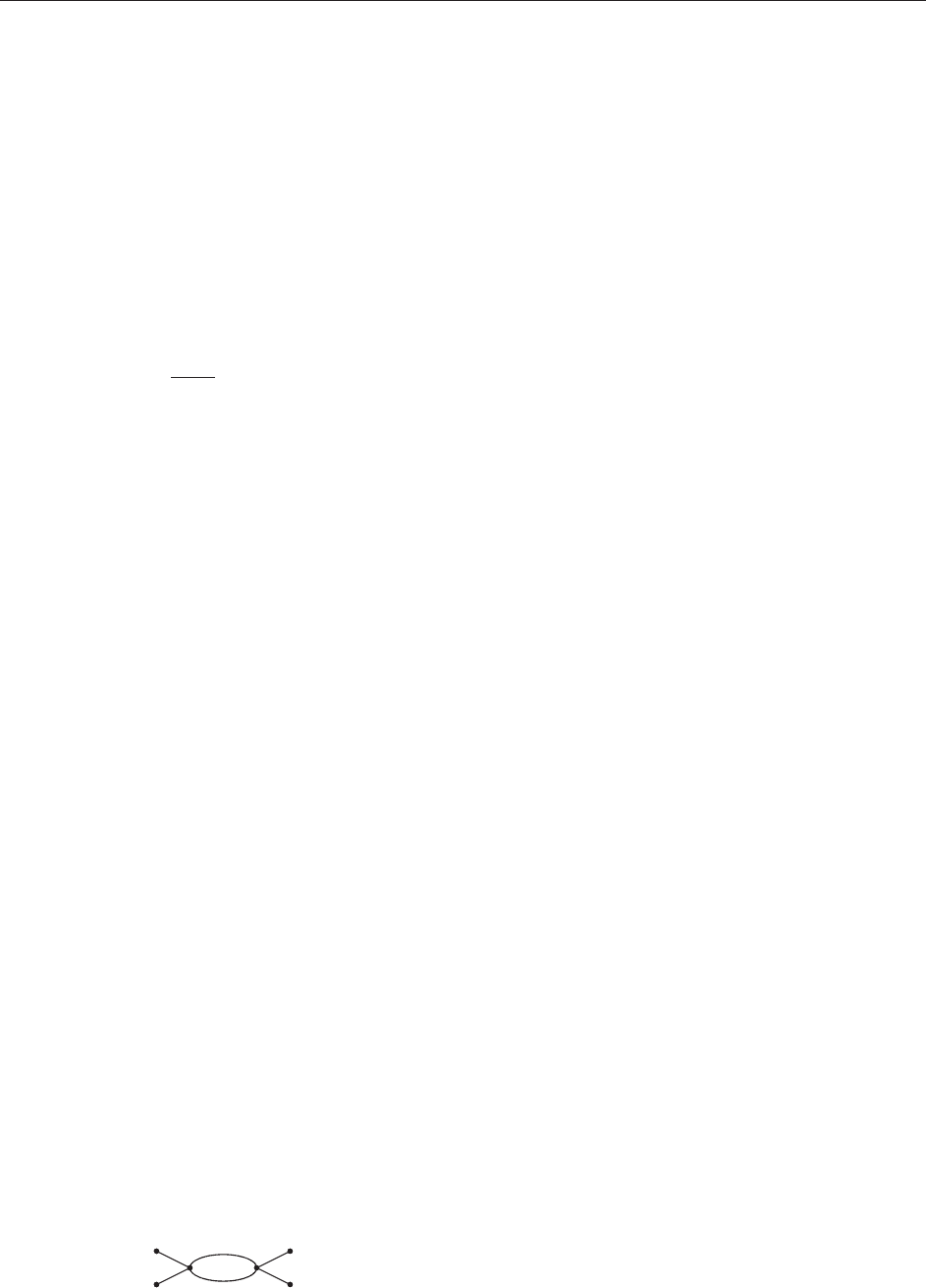
Suppose first that
N
=
N
= 0. Then if a graph G
contains subgraphs like in Figure 2, the correspond-
ing respective contribution to the integral in [12]
(considering only the integrals over h and suitably
taking care of the combinatorial factors) is a factor
obtained by integrating over x the quantities
6C
ðN Þ
ax
C
ðN Þ
xx
C
ðN Þ
xb
or
4
2
3!
2!
2
C
ðN Þ
ax
Z
C
ðN Þ3
xh
C
ðNÞ
hb
dh
½13
which if d = 3 diverge as N !1 as
N
or, respec-
tively, as N; the second factor does not diverge in
dimension d = 2 while the first still diverges as N. The
divergences arise from the fact that as x h !0 the
propagator behaves as jx hj
N
if d = 3oras
log jx hj if d = 2, all the way until saturation
occurs at distance jx hj’m
1
N
: for this reason
the latter divergences are called ‘‘ultraviolet
divergences.’’
However, if we set
N
6¼ 0, then for e very gr aph
containing a subgraph like those in Figure 2 there
is another one identical except that the points
a, b are connected via a mass vertex, see Figure 1,
with the vertex in x, by a line ax and a line xb ;
the new graph value receives a contribution from
the mass vertex insert ed in x between a and b
simply given by a factor
N
. T herefore if we fix,
for d = 3,
N
¼6C
ðN Þ
xx
þ
4
2
3!
2
2
Z
C
ðNÞ3
xh
dh ¼
def
6C
ðN Þ
xx
þ
N
½14
we can simply consider graphs which do not contain
any mass graph element and in which there are no
subgraphs like the first in Figure 2 while the subgraphs
like the second in Figure 2 do not contribute a factor
R
C
(N)
ax
C
(N)3
xh
C
(N)
hb
dh but a renormalized factor
R
C
(N)
ax
C
(N)3
xh
(C
(N)
hb
C
(N)
xb
)dh.Ifd = 2, we only
need to define
N
as the first term on the right-hand
side (RHS) of [14] and we can leave the subgraphs like
the second in Figure 2 as they are (without any
renormalization).
Graphs without external lines are called vacuum
graphs and there are a few such graphs which are
divergent. Namely, if d = 3, they are the first three
drawn in Figure 3; furthermore, if
N
is set to the
above nonzero value a new vacuum graph, the
fourth in Figure 3, can be formed. Such graphs
contribute to the graph value, respectively, the terms
in the sum
3C
ðN Þ2
x
1
;x
1
þ
4!
2
2
Z
C
ðN Þ4
x
1
x
2
dx
2
2
3
3!
3
3!
3
Z
C
ðN Þ2
x
1
x
2
C
ðN Þ2
x
2
x
3
C
ðNÞ2
x
3
x
1
dx
2
dx
3
N
C
ðN Þ
x
1
x
1
½15
and diverge, respectively, as
2N
,
N
, N,
2N
if d = 3
while, if d = 2, only the first and the last (see [14])
diverge, like N
2
.
Therefore, if we fix
N
as minus the quanti ty in
[15] we can disregard graphs like those in Figure 3;
if d = 2
N
can be defined to be the sum of the first
and last terms in [15].
The formal series in and f thus obtained is called
the ‘‘renormalized series’’ for the field ’
4
in
dimension d = 2 or, respectively, d = 3. Note that
with the given definitions and choices of
N
,
N
the
only graphs G that need to be considered to
construct the expansion in and f are formed by
the first and last graph elements in Figure 1, paying
attention that the graphs in Figure 3 do not
contribute and, if d = 3, the graphs with subgraphs
like the second in Figure 2 have to be computed with
the modification described.
In the next section, it will be shown that the
above are the only sources of divergences as N !1
and therefore the problem of studying [1] is solved
at the level of formal power series by the subtraction
in [14]. This also shows that giving a meaning to the
series thus obtained is likely to be much easier if
d = 2 than if d = 3.
The coefficie nts of order k of the expansion in
of (1=jj) log Z
N
(, f ) can be ordered by the number
2n of vertices representing external fields : and have
the form
R
S
(k)
2n
( x
1
, ..., x
2n
)
Q
2n
i = 1
(f
x
i
dx
i
): the kernels
S
(k)
2n
are the Schwinger functions of order 2n, see the
section ‘‘Euclide an quantum fields .’’
ξαβξ
η
αβ
Figure 2 Divergent subgraphs, if d = 3. If d = 2 only the first
diverges.
ξ
1
ξ
2
ξ
3
ξ
2
ξ
1
ξ
1
ξ
1
Figure 3 Divergent vacuum graphs.
620 Constructive Quantum Field Theory
Remark If d = 4, the regularization at cutoff N in
[2] is not sufficient as in the subtraction procedure
smoothness of the first derivatives of the field
’
(N)
is necessary, while the regularization [2] does
not even imply [6], that is, not even Ho¨ lder
continuity. A higher regularization (i.e., using a
N
like the square of the
N
in [3]). Furthermore,
the subtractions discussed in the case d = 3 are not
sufficient to generate a formal power series and
many more subtraction s are needed: for instance,
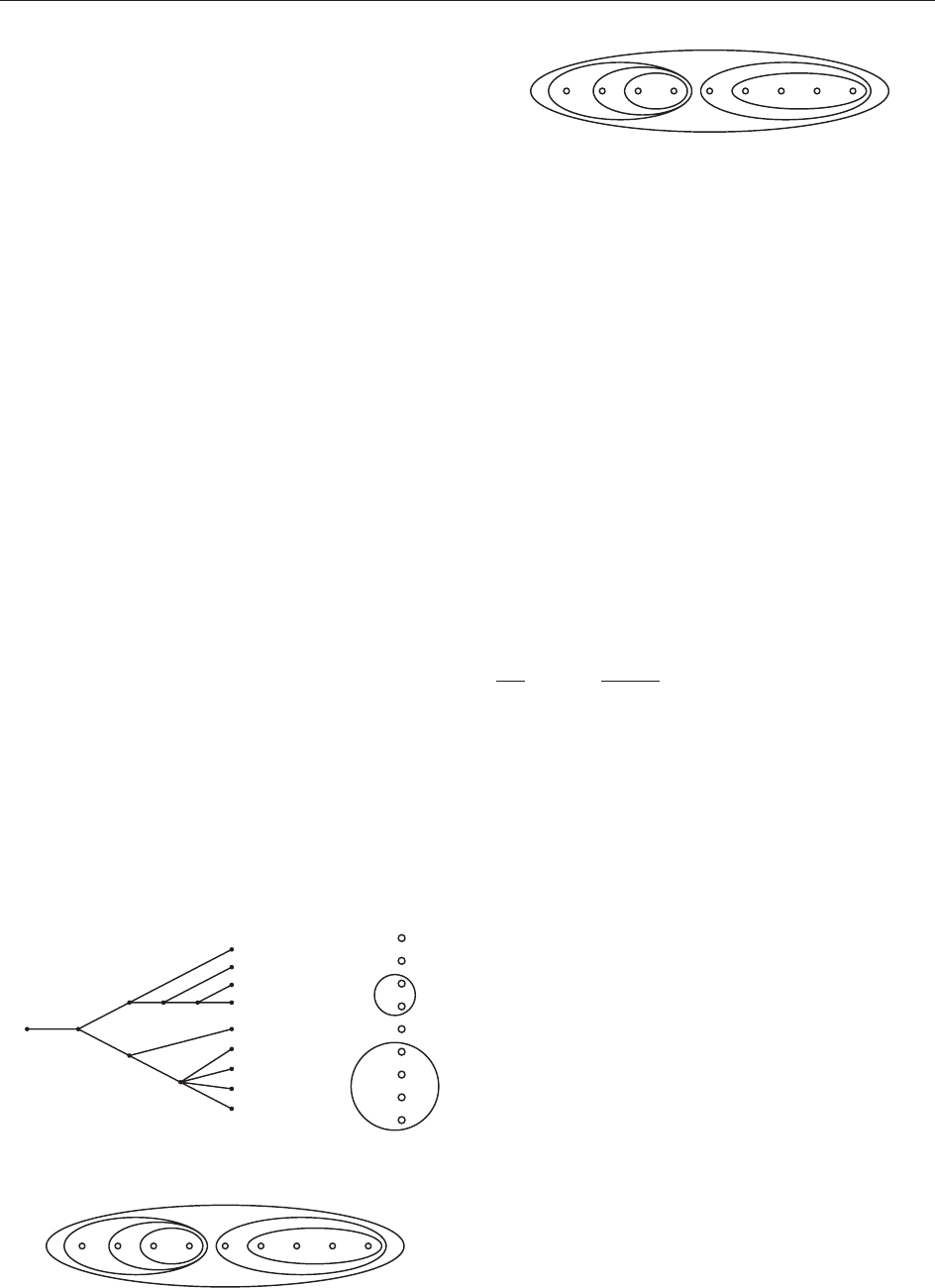
graphs with a subgraph like the one in Figure 4
would give a contribution to the graph value which
is a factor
2
‘
N
¼
def
2 6
2
2!
2
Z
C
ðN Þ2
xh
dh
also divergent as N !1 proportionally to N.
Although this divergence could be canceled by
changing into
N
= þ
2
‘
N
the previously dis-
cussed cancelations would be affected and a change
in the value of
N
would become necessary;
furthermore, the subtraction in [14] will not be
sufficient to make finite the graphs, not even to
second order in , unless a new term
N
R
(@
x
’
(N)
x
)
2
dx with
N
= (1=2)
2
R
@
h
C
(N)3
xh
(x h)
2
is added in the exponential in [1].
But all this will not be enough and still new
divergences, proportional to
3
, will appear.
And so on indefinitely, the consequence being that
it will be necessary to define
N
,
N
,
N
,
N
as
formal power series in (with coefficients diverging
as N !1) in order to obtain a formal power series
in for [1] in which all coefficients have a finite
limit as N !1. Thus, the interpretation of the
formal renormalized series in the case d = 4is
substantially differe nt and naturally harder than
the cases d = 2, 3. Beyo nd formal perturbation
expansions, the case d = 4 is still an open problem:
the most widespread conjecture is that the series
cannot be given a meaning other than setting to 0 all
coefficients of
j
, j > 0. In other words, the con-
jecture claims, there should be no nontrivial solution
to the ultraviolet problem for scalar ’
4
fields in
d = 4. But this is far from being proved, even at a
heuristic level. The situation is simpler if d 5: in
such cases, it is impossible to find formal power
series in for (1=jj) log Z
N
(, f ), even allowing
N
,
N
,
N
,
N
to be formal power series in with
divergent coefficients.
The distinctions between the cases d = 2, 3, 4, >4
explain the terminology given to the ’
4
-scalar field
theories calling them super-renormalizable if
d = 2, 3, renormalizable if d = 4 and nonrenormaliz-
able if d > 4. Since the (divergent) coefficients in the
formal power series defining
N
,
N
,
N
,
N
are
called counter-terms , the ’
4
-scalar fields require
finitely many counter-terms (see [14]) in the super-
renormalizable cases and infinitely many in the
renormalizable case. The nonrenormalizable cases
(d > 4) cannot be treated in a way analogous to the
renormalizable ones.
For more details, the reader is referred
to Gallavotti (1985), Aizenman (1982),and
Fro¨ hli ch (1982).
Finiteness of the Renormalized Series,
d = 2, 3: ‘‘Power Counting’’
Checking that the renormalized series is well defined
to all orders is a simple dimensional estimate
characteristic of many multiscale arguments that in
physics have become familiar with the name of
‘‘renormalization group arguments.’’
Consider a graph G with n þ r vertices built over n
graph elements with vertices x
1
, ..., x
n
each with four
half-lines and r graph elements with vertices
x
nþ1
, ..., x
nþr
representing the external fields: as
remarked in the previous section, these are the only
graphs to be considered to form the renormalized series.
Develop each propagator into a sum of propaga-
tors as in [7]. The graph G value will, as a
consequence, be represented as a sum of values of
new graphs obtained from G by adding scale labels
on its lines and the value of the graph will
be computed as a product of factors in which a
line joining xh and bearing a scale label h
will contribute with C
(h)
xh
replacing C
(N)
xh
. To avoid
proliferation of symbols, we shall call the
graphs obtained in this way, i.e., with the scale
labels attached to each line, still G: no confusion
should arise as we shall, henceforth, only consider
graphs G with each line carrying also a scale label.
The scale labels added on the lines of the graph G
allow us to organize the vertices of G into
‘‘clusters’’: a cluster of scale h consists in a maximal
set of vertices (of the graph elements in the graph)
connected by lines of scale h
0
h among which one
at least has scale h.
It is convenient to consider the vertices of the
graph elements as ‘‘trivial’’ clusters of highest scale:
conventionally call them clusters of scale N þ 1.
The clusters can be of ‘‘first generation’’ if they
contain only trivial clusters, of ‘‘second generation’’
ξ
α
δ
η
β
γ
Figure 4 The simplest new divergent subgraph on d = 4.
Constructive Quantum Field Theory 621
if they contain only clusters which are trivial or of
the first generation, and so on.
Imagine to enclose in a box the vert ices of graph
elements inside a cluster of the first generation and
then into a larger box the vertices of the clusters of
the second generation and so on: the set of boxes
ordered by inclusion can then be represented by a
rooted tree graph whose nodes correspond to the
clusters and whose ‘‘top points’’ are nodes represent-
ing the trivial clusters (i.e., the vertices of the graph).
If the maximum number of nodes that have to be
crossed to reach a top point of the tree starting from
a node v is n
v
(v included and the top nodes
included), then the node v represents a cluster of the
n
v
th generation. The first node before the root is a
cluster containing all vertices of G and the root of
the tree will not be considered a node and it can
conventionally bear the scale label 0: it represents
symbolically the value of the graph.
For instance, in Figure 5 a tree is drawn: its
nodes correspond to clusters whose scale is indicated
next to them; in the second part of the drawing, the
trivial clusters as well as the clusters of the first
generation are enclosed into boxes.
Then consider the next genera tion clusters, that is,
the clusters which only contain clusters of the first
generation or trivial ones, and draw boxes enclosing
all the graph vertices that can be reached from each
of them by descending the tree, etc. Figure 6
represents all boxes (of any generation) correspond-
ing to the nodes of the tree in Figure 5. The
representations of the clusters of a graph G by a tree
or by hierarchically ordered boxes (see Figures 5 and
6) are completely equivalent provided inside each
box not representing a top point of the tree the scale
h
v
of the corresponding cluster v is marked. For
instance, in the case of Figure 6 one gets Figure 7.
By construction, if two top points x and h are inside
the same box b
v
of scale h
v
but not in inner boxe s,
then there is a path of graph lines joining x and h
all of which have scales h
v
and one at least has
scale h
v
.
Given a graph G, fix one of its points x
1
(say) and
integrate the absolute value of the graph over the
positions of the remaining points. The exponential
decay of the propagators implies that if a point h is
linked to a point h
0
by a line of scale h the
integration over the position of h
0
is essentially
constrained to extend only over a distance
h
m
1
.
Furthermore, the maximum size of the propagator
associated with a line of scale h is bounded
proportionally to
(d2)h
. Therefore, recalling that
jf
x
j is suppose bounded by 1, the mentioned integral
can be immediately bounded by
n
n!r!
C
nþr
I ¼
def
n
C
nþr
n!r!
Y
‘
ðd2Þ=2h
‘
Y
v
dh
v
ðs
v
1Þ
½16
where, C being a suitable constant, the first product
is over the half-lines ‘ compos ing the graph lines and
the second is over the tree nodes (i.e., over the
clusters of the graph G), s
v
is the number of
subclusters contained in the cluster v but not in
inner clusters; and in [16] the scale of a half-line ‘ is
h
‘
if ‘ is paired with another half-line to form a line
‘ (in the graph G) of scale label h
‘
.
Denoting by v
0
the cluster immediately co ntaining
v in G,byn
inner
v
the number of half-lines in the
cluster v,byn
v
, r
v
the numbers of graph elements of
the first type or of the fourth type in Figure 1 with
vertices in the cluster v, and denoting by n
e
v
the
number of lines which are not in the cluster v but
have one extreme on a vertex in v (‘‘lines external to
v’’), the identities (k = 0)
X
v>root
ðh
v
kÞðs
v
1Þ
X
v>root
ðh
v
h
v
0
Þðn
v
þ r
v
1Þ
X
v>root
ðh
v
kÞn
inner
v
X
v>root
ðh
v
h
v
0
Þ
e
n
inner
v
with
e
n
inner
v
¼
def
4n
v
þ r
v
n
e
v
½17
123456789
Figure 6 All clusters of any generation for the tree in Figure 5.
k = 0 h
p
qm
f
t
ξ
9
ξ
8
ξ
7
ξ
6
ξ
5
ξ
4
ξ
3
ξ
2
ξ
1
leads to
1
2
3
4
5
6
7
8
9
Figure 5 A tree and its clusters of generation 1 and 2.
k = 0
m
qp
h
ft
123456789
Figure 7 The clusters in Figure 6 after affixing the scale labels.
622 Constructive Quantum Field Theory

hold, so that the estimate [16] can be elaborated into
I
Y
v>r
v
ðh
v
h
v
0
Þ
v
¼
def
d þð4 dÞn
v
þ r
v
d þ 2
2
þ
d 2
2
n
e
v
½18
where h
v
0
= k = 0ifv is the first nontrivial node (i.e.,
v
0
= ro ot), and an estimate of the integral of the
absolute value of the graphs G with given tree
structure but different scale labels is proportional to
{h
v
}
I < 1 if (and only if)
v
> 0, 8v.
But there may be clusters v with only two
external lines n
e
v
= 2 and two graph vertices inside:
for which
v
= 0. However, this can happen only if
d = 3 and in only one case: namely if the graph G
contains a subgraph of the second type in Figure 2
and the three intermediate lines form a cluster v of
scale h
v
while the other two lines are external to it:
hence on scale h
0
> h
v
. In this case, one has to
remember that the subtraction in the previous section
has led to a modification of the contribution of such a
subgraph to the value of the graph (integrated over
the position labels of the vertices). As discussed in the
previous section, the change amounts to replacing the
propagator C
(h
0
)
h, b
by C
(h
0
)
h, b
C
(h
0
)
x, b
.
This improves, in [18], the estimate of the contribu-
tion of the line joining h to b from being proportional
to
R
C
(h
v
)3
xh
C
(h
0
)
hb
dh to being proportional to
R
C
(h
v
)3
xh
(C
(h
0
)
hb
C
(h
0
)
xb
)dh; and this changes the con-
tribution of the line hb from
(d2)h
0
to
R
e
m
h
v
jxhj
(
h
0
jx hj)
1=2
dh because C
(h
0
)
is regular on scale
h
0
m
1
,see[10] with " = 1= 2.
Since x, h are in a cluster of higher scale h
v
this
means that the estimate is improved by
(1=2)(h
v
h
0
)
.
In terms of the final estimate, this means that
v
in
[18] can be improved to
v
=
v
þ 1=2 for the
clusters for which
v
= 0. Hence, the integrated
value of the graph G (after taking also into account
the integration over the initially selected vertex x
1
,
trivially giving a further factor jj by translation
invariance), and summed over the possible scale
labels is bounded proportionally to jj
{h
v
}
I < 1
once the estimate of I is improved as described.
Note that the graphs contributing to the perturbation
series for (1=j j)logZ
N
(, f ) to order
n
are finitely
many because the number r of external vertices is r
2n þ 2 (since graphs must be connected). Hence, the
perturbation series is finite to all orders in .
The above is the renormalizability proof of the
scalar ’
4
-fields in dimension d = 2, 3. The theory is
renormalizable even if d = 4 as mentione d in the
remark at the end of the previous section. The
analysis would be very similar to the above: it is just
a little more involved power-counting argument.
For more details, the reader is referred to Hepp
(1966), Gallavotti (1985), sections 8 and 16.
Asymptotic Freedom (d = 2, 3).
Heuristic Analysis
Finiteness to all orders of the perturbation expan-
sions is by no means sufficient to prove the existence
of the ultraviolet limit for Z
N
(, f ) or for (1=jj)
log Z
N
(, f ): and a priori it might not even be
necessary. For this purpose, the first step is to check
uniform (upper and lower) boundedness of Z
N
(, f )
as N !1.
The reason behind the validity of a bound
e
jjE
(, f )
Z
N
(, f ) e
jjE
þ
(, f )
with E
(, f ) cutoff
independent has been made very clear after the
introduction of the renormalization group met hods
in field theory. The approach studies the integral
Z
N
(, f ), recursively, decomposing the field ’
(N)
x
into its regular components z
(h)
x
, see [7],and
integrating first over z
(N)
, then over z
(N1)
and so on.
The idea emerges naturally if the potential V
N
in
[1] and [4] is written in terms of the ‘‘normalized’’
variables X
(N)
x
¼
def
N(d2)=2
’
(N)
x
,see[6];hereifd = 2
the factor
(d2)=2N
is interpreted as N
1=2
.
The key remark is that as far as the integration
over the small-scale component z
(N)
is concerned the
field X
(N)
x
is a sum of two fields of size of order 1
(statistically),
X
ðNÞ
x
z
ðNÞ
N
x
þ
ðd2Þ=2
X
ðN 1 Þ
x
if d = 2 this becomes
X
ðNÞ
x
1
N
1=2
z
ðNÞ
N
x
þ
ðN 1Þ
1=2
N
1=2
X
ðN1Þ
x
and it can be considered to be smooth on scale m
1
N
(also statistically). Hence, approximately constant
and of size of order O(1) on the small cubes of
volume
dN
m
d
of the pavement Q
N
introduced
before [7]; at the same time it can be considered to
take (statistically) independent values on different cubes
of Q
N
. This is suggested by the inequalities [8]–[10].
Therefore, it is natural to decompose the potential
V
N
,see[5], as a sum over the small cubes of volume
dN
m
d
of the pavement Q
N
as (see [14] for the
definition of
N
,
N
), taking henceforth m = 1,
V
N
ðz
ðNÞ
Þ¼
def
X
2Q
N
Nd
Z
2ðd2ÞN
X
ðNÞ4
x
þ
N
ðd2ÞN
X
ðNÞ2
x
þ
N
þ f
x
ðd2Þ=2N
X
ðNÞ
x
dx
jj
½19
Constructive Quantum Field Theory 623

where
(d2)N
is interpreted as N if d = 2. Hence, if
d = 3itis
V
N
ðz
ðNÞ
Þ
¼
def
X
2Q
N
N
Z
X
ðNÞ4
x
þ
N
X
ðNÞ2
x
þ
N
þ f
x
3
2
N
X
ðNÞ
x
dx
jj
½20
where
N
¼
def
ð6c
N
þ
2
N
N
c
0
N
Þ;
N
¼
def
3c
2
N
þ
2
N
b
N
þ
3
N
2N
b
0
N
and c
N
, c
0
N
, b
N
, b
0
N
, computable from [15] and [14],
admit a limit as N !1. While if d = 2itis
V
N
ðz
ðNÞ
Þ
¼
def
X
2Q
N
N
2
2N
Z
X
ðNÞ4
x
þ
N
X
ðNÞ2
x
þ
N
þ f
x
N
3
2
X
ðNÞ
x
dx
jj
½21
where
N
=
def
6c
N
and
N
= 3c
2
N
and c
N
, compu-
table from [13], admits a limit as N !1.
The fields z
(N)
and X
(N1)
can be considered
constant over boxes 2Q
N
: z
(N)
x
= s
, X
(N1)
x
= x
for x 2 and the s
can be considered statistically
independent on the scale of the lattice Q
N
.
Therefore, [20] and [21] show that integration over
z
(N)
in the integral defining Z
N
(, f ) is not too
different from the computation of a partition func-
tion of a lattice continuous spin model in which the
‘‘spins’’ are s
and, most important, interact extre-
mely weakly if N is large. In fact, the coupling
constants are of order of a power of jX
(N1)
j times
O(
N
)ifd = 3(O(N
2
2N
)ifd = 2), or of order
O(
N(dþ2)=2
max jf
x
j), no matter how large and f.
This says that the smallest scale fields are
extremely weakly coupled. The fields X
(N1)
can be
regarded as external fields of size that will be called
B
N 1
, of order 1 or even allowed to grow with a
power of N,see[6]. Their presence in V
N
does not
affect the size of the couplings, as far as the analysis
of the integral over z
(N)
is concerned, because the
couplings remain exponentially small in N,see[20]
and [21], being at worst multiplied by a power of
B
N 1
, i.e., changed by a factor which is a power of N.
The smallness of the coupling at small scale is a
property called ‘‘asymptotic freedom.’’ Once fields
and coordinates are ‘‘correctly scaled,’’ the real size
of the coupling becomes manifest, that is, it is
extremely small and the addends in V
N
proportional
to the ‘‘counter-terms’’
N
,
N
, which looked
divergent when the fields were not properly scaled,
are in fact of the same order or much smaller than
the main ’
4
-term.
Therefore, the integration over z
(N)
can be, heur-
istically, performed by techniques well established
in statistical mechanics (i.e., by straightforward
perturbation expansions): at least if the field
X
(N1)
x
is smooth and bounded, as prescribed
by [6], with B = B
N1
growing as a power of N.
In this case, denoting symbolically the integration
over z
(N)
by P or by h...i, it can be expected that it
should give
Z
e
V
N
dPz
ðNÞ
e
V
j;N1
þRðj;NÞjj
½22
where V
j; N 1
is the Taylor expansion of
log
R
e
V
N
dP(z
(N)
) in powers of (hence essentially
in the very small parameter
(4d)N
) truncated at
order j, that is,
V
1;N1
¼½hV
N
i
1
V
2;N1
¼hV
N
iþ
ðhV
2
N
ihV
N
i
2
Þ
2!
"#
2
V
3;N1
¼
"
hV
N
iþ
ðhV
2
N
ihV
N
i
2
Þ
2!
þ
hV
N
ðhV
2
N
ihV
N
i
2
ÞihV
N
ðhV
2
N
ihV
N
i
2
Þ
3!
#
3
; ...
½23
where []
j
denotes truncation to order j in ,
and
R(j, N) is a remainder (depending on ’
(N1)
x
)
which can be expected to be estimated, for d = 2, 3, by
j
Rðj; NÞj Rðj; NÞ
¼
def
C
j
B
4j
N
ð N
2
ð4dÞN
Þ
jþ1
dN
½24
for suitable constants C
j
, that is, a remainder
estimated by the (j þ 1)th power of the coupling
times the number of boxes of scale N in . The
relations [22]–[24] result from a naive Taylor
expansion (in of the log
R
e
V
N
dP(z
(N)
), taking into
account that, in V
N
as a function of z
(N)
, the z
(N)
’s
appear multiplied by quantities at most of size
4d
N
2
B
3
N
,by[20] and [21] if jX
(N1)
jB
N1
).
In a statistical mechanics model for a lattice spin
system, such a calculation of Z
N
would lead to a
mean-field equation of state once the remainder was
neglected.
The peculiarity of field theory is that a relation like
[22] and [24] has to be applied again to V
j; N1
to
perform the integration over z
(N1)
and define V
j; N2
and, then, again to V
j; N2
.... Therefore, it will be
essential to perform the integral in [22] to an order
(in ) high enough so that the bound R(j, N)canbe
624 Constructive Quantum Field Theory