
Francoise J.-P., Naber G.L., Tsun T.S. (editors) Encyclopedia of Mathematical Physics
Подождите немного. Документ загружается.


summed over N:thisrequires(see[24]) an explicit
calculation of [23] pushed at least to order j = 1if
d = 2 or to order j = 3ifd = 3; furthermore it is also
necessary to check that the resulting V
j; N1
can still
be interpreted as low-coupling spin model so that
[22] can be iterated with N 1 replacing N and then
with N 2replacingN 1, ....
The first necessary check towards a proof of the
discussed heuristic ‘‘expectations’’ is that, defining
recursively V
j; h
from V
j, hþ1
for h = N 1, ...,1,0
by [23] with V
N
replaced by V
j; hþ1
and V
j; N1
replaced by V
j; h
, the couplings between the vari ables
z
(h)
do not become ‘‘worse’’ than those discussed in
the case h = N. Furthermore, the field ’
(N1)
x
has a
high probability of satisfying [6], but fluctuations
are possible: hence the R-estimate has to be
combined with another one dealing with the large
fluctuations of X
(N1)
x
which has to be shown to be
‘‘not worse.’’
For more details, the reader is referred to Gallavotti
(1978, 1985) and Benfatto and Gallavotti (1995).
Effective Potentials and Their
Scale (In)Dependence
To analyze the first problem mentioned at the end of
the previous section, define V
j; h
by [23] with V
N
replaced by V
j; hþ1
for h = N 1, N 2, ..., 0. The
quantities V
j; h
, which are called ‘‘effective poten-
tials’’ on scale h (and order j), turn out to be in a
natural sense scale independent: this is a con se-
quence of reno rmalizability, realized by Wilson as a
much more general property which can be checked,
in the very special cases considered here with
d = 2, 3, at fixed j by induction, and in the super-
renormalizable models considered here it requires
only an ele mentary computation of a few Gaussian
integrals as the case j = 3 (or even j = 1ifd = 2) is
already sufficient for our purposes .
It can also be (more easily) proved for general j by
a dimensional argument parallel to the one pre-
sented earlier to check finiteness of the renormalized
series. The derivation is elementary but it should be
stressed that, again, it is possible only because of the
special choice of the counter-terms
N
,
N
.Ifd = 3,
the boundedness and smoothness of the fields ’
(h)
and z
(h)
expressed by the second of [6] and of [10] is
essential; while if d = 2 the smoothness is not
necessary.
The structure of V
j; h
is conveniently expressed
in terms of the fields X
(h)
x
, as a sum of three terms
V
(rel)
h
(standing for ‘‘relevant’’ part), V
(irr)
h
(standing
for ‘‘irrelevant’’ part), and a ‘‘field independent’’
part E(j, h)jj.
The relevant part in d = 2 is simply of the form
[21] with h replacing N: call it V
(rel, 1)
h
.Ifd = 3, it is
given by [20] with h replacing N plus, for h < N,a
second ‘‘nonlocal’’ term
V
ðrel;2Þ
h
¼
def
4
2
3!
2! 2!
2
Z
C
ðhÞ3
hh
0
C
ðN Þ3
hh
0
’
ðhÞ
h
’
ðhÞ
h
0
2
dhdh
0
which is conveniently expressed in terms of a
‘‘nonlocal’’ field
Y
ðhÞ
hh
0
¼
def
’
ðhÞ
h
’
ðhÞ
h
0
ð
h
jh h
0
jÞ
1
4
as V
ðrelÞ
h
¼ V
ðrel;1Þ
h
þ V
ðrel;2Þ
h
with
V
ðrel;2Þ
h
¼
def
2
2h
X
;
0
2Q
h
Z
0
Y
ðhÞ2
hh
0
A
ðhÞ
hh
0
e
c
0
h
jhh
0
j
dhdh
0
jjj
0
j
½25
where
0 < a
A
ðhÞ
hh
0
ð
h
jh h
0
jÞ
3ð1=2Þ
!
N
< a
0
with a, a
0
, c
0
> 0andthesubscriptN means that the
expression in parenthesis ‘‘saturates at scale N’’, i.e.,
its denoninator becomes
(3(1=2))(hN)
as jh h
0
j!0.
The expression [25] is not the full part of the
potential V
j; h
which is of second order in the fields:
there are several other contributions which are
collected below as ‘‘irrelevant.’’
It should be stressed that ‘‘irrelevant’’ is a
traditional technical term: by no means it should
suggest ‘‘negligibility.’’ On the contrary, it could be
maintained that the whole purpose of the theory is
to study the irrelevant terms. The irrelevant part of
the potential can be better designated as the ‘‘driven
part,’’ as its behavior is ‘‘controlled’’ by the relevant
part: although initially V
j; h
, h = N, contains
no irrelevant terms, it eventually contains them for
h < N and they keep getting generated as h
diminishes. Furthermore, the pa rt of the irrelevant
terms generated at scale h
0
N becomes very small
at scales h h
0
so that the irrelevant part of V
j; h
at
small h (e.g., at h = 0, i.e., on the ‘‘physical scale’’ of
the observer) only depend on the relevant terms in a
few scales near h.
It also turns out that the Schwinger functions are
simply related to the irrelevant terms.
The irrelevant part of the effective potential can
be expressed as a finite sum of integrals of
Constructive Quantum Field Theory 625

monomials in the fields X
(h)
x
if d = 2, or in the fields
X
(h)
x
and Y
(h)
hh
0
if d = 3, which can be written as V
(irr)
j; h
given by
Z
Y
p
k¼1
X
ðhÞn
k
x
k
Y
q
k
0
¼1
Y
ðhÞn
0
k
0
h
k
0
h
0
k
0
e
h
c
0
dðx
1
;...;h
0
q
Þ
n
ht
Wðx
1
; ...; h
0
q
Þ
Y
p
k¼1
dx
k
j
k
j
Y
q
k
0
¼1
dh
k
0
dh
0
k
0
j
1
k
0
jj
2
k
0
j
½26
with the integral extended to products
1
p
(
1
q
2
q
) of boxes 2Q
h
,and
d(x
1
, ..., h
0
q
) is the length of the shortest tree
graph that connects all the p þ 2q > 0 points, the
exponents n, t are 2, and t is 3ifq > 0;
the kernel W depends on all coordinates x
1
, ..., h
0
q
and it is bounded ab ove by C
j
Q
q
k
0
= 1
A
h
k
0
h
0
k
0
for some
C
j
; the sums
P
n
k
þ
P
n
0
k
0
cannot exceed 4j. The
test functions f do not appear in [26] because by
assumption they are bounded by 1: but W depends
on the f ’s as well.
The field-independent part is simply the value
of log Z
N
(, f ) computed by the perturbation
analys is in the sect ion ‘‘Per turbation theory ’’ up to
order j in but using as propagator (C
(N)
C
(h)
):
thus, E(j, h) is a constant depending on N but
unifor mly bounde d as N !1 (beca use of the
renorm alizability proved in the section ‘‘Perturba-
tion theory ’’).
If d = 2, there is no need to introduce the nonlocal
fields Y
(h)
and in [26] one can simply take q = 0,
and the relevant part also can be expressed by
omitting the term V
(rel, 2)
h
in [25]: unlike the d = 3
case, the estimate on the kernels W by an
N-independent C
j
holds uniformly in h without
having to introduce Y. For d = 2, it will there fore be
supposed that V
(rel, 2)
h
0in[25] and q = 0in[26].
It is not necessary to have more information on
the structure of V
j; h
even though one can find simple
graphical rules, closely related to the ones in the
section ‘‘Perturbat ion theory ,’’ to constr uct the
coefficients W in full detail. The W depend, of
course, on h but the uniformity of the bound on W
is the only relevant property and in this sense the
effective potentials are said to be (almost) ‘‘scale
independent.’’
The above bounds on the irrelevant part can
be checked by an elementary direct computation if
j 3: in spite of its ‘‘elementary character,’’ the
uniformity in h N is a result ultimately playing an
essential role in the theory together with the
dominance of the relevant part over the irrelevant
one which, once the fields are properly scaled, is
‘‘much smaller’’ (by a factor of order
h
, see [26]),
at least if h is large.
Remarks
(i) Checking scale independence for j = 1 is just
checking that
R
P(dz
(h)
)V
1; h
= V
1; h1
. Note that
V
1;h
¼
def
Z
’
ðhÞ4
x
6C
ðhÞ
00
’
ðhÞ2
x
þ 3C
ðhÞ2
00
dx
hence, calling :’
(h)4
x
: the polynomial in the integral
(Wick’s monomial of order 4), we have here an
elementary Gaussian integral (‘‘martingale property
of Wick monomials’’). Note the essential role of the
counter-terms. For j > 1, the computation is similar
but it involves higher-order polynomials (up to 4j)
and the distinction between d = 2andd = 3
becomes important.
(ii) V
j;0
contains only the field-independent part
E(j,0)jj (see above) which is just a number (as
there are no fields of scale 0): by the above
definitions, it is identical to the perturbative
expansion truncated to jth order in of
log Z
N
(, f ), well defined as discussed earlier.
Nonperturbative Renormalization:
Small Fields
Having introduced the notion of effective potential
V
j; h
, of order j and scale h, satisfying the bounds
(described after [26]) on the kernels W representing
it, the problem is to estimate the remainder in [22]
and find its relation with the value [24] given by the
heuristic Taylor expansion. Assume <1 to avoid
distinguishing this case from that with 1 which
would lead to very similar estimates but to different
-dependence on some constants.
Define
B
(z
(h)
) = 1ifkz
(h)
k
Bh
2
for all 2Q
h
,
see [8], and 0 otherwise; then the following lemma
holds:
Lemma 1 Let kX
(h)
k
be defined as [8] with z
replaced by X and suppose kX
(h)
k
Bh
4
for all
then, for all j 1, it is
Z
e
V
j;hþ1
B
ðz
ðhþ1Þ
ÞdPðz
ðhþ1Þ
Þ
¼ e
V
j;h
þR
0
ðj;hþ1Þjj
½27
with, for suitable constants c
, c
0
,
jR
0
ðj; h þ 1Þj R
ðj; h þ 1Þ
¼
def
Rðj; h þ 1Þþc
e
c
0
B
2
ðhþ1Þ
2
and R(j; h þ 1) given by [24] with h þ 1 in place
of N.
Since Z
N
(, f )
R
e
V
N
Q
N
h = 1
B
(z
(h)
)P(dz
(h)
) this
immediately gives a lower bound on E = (1=jj)
log Z
N
(, f ): in fact if
B
(kz
(h
0
)
k) = 1 for
626 Constructive Quantum Field Theory

h
0
= 1, ..., h, then kX
(h)
k
cBh
04
for some c so
that, by recursive application of Lemma 1,
Z
N
(, f ) e
V
j,0
P
N
h = 1
R
(j, h)jj
. By the remark at the
end of the previous section, given j the lower bound
on E just described agrees with the perturbation
expansion of E = (1=jj) log Z
N
(, f ) truncated to
order j (in ) up to an error bounded by
P
1
h = 1
R
(j, h).
Remark The prob lem solved by Lemma 1 is
usually referred to as the small-field problem, to
contrast it with the large-field problem discussed
later. The proof of the lemma is a simple Taylor
expansion in
h
if d = 3orinh
2
2h
if d = 2to
order j (in ). The constraint on z
(hþ1)
makes the
integrations over z
(hþ1)
, necessary to compute V
j; h
from V
j; hþ1
, not Gaussian. But the tail estimates [9],
together with the Markov property of the distribu-
tion of z
(h)
can be used to estimate the difference
with respect to the Gaussian unconstrained integra-
tions of z
(hþ1)
: and the result is the addition of the
small ‘‘tail error’’ changing R into R
in [27]. The
estimate of the main part of the remainder R would
be obvious if the fields z
(h)
were independent on
boxes of scale
h
: they are not independent but
they are Markovian and the estimate can be done by
taking into account the Markov property.
For more details, the reader is referred to Wilson
(1970, 1972), Gallavotti (1978, 1981, 1985), and
Benfatto et al. (1978).
Nonperturbative Renormalization: Large
Fields, Ultraviolet Stability
The small-field estimates are not sufficient to obtain
ultraviolet stability: to control the cases in which
jX
(h)
x
j> Bh
4
for some x or some h,orjY
(h)
xh
j> Bh
4
for
some jx hj <
h
, a further idea is necessary and it
rests on making use of the assumption that >0
which, in a sense to be determined, should suppress
the contribution to the integral defining Z
N
(, f )
coming from very large values of the field. Assume
also <1 for the same reasons advanced in the
section ‘‘Effective potentials and their scale
(in)dependence.’’
Consider first d = 2. Let D
N
be the ‘‘large-field
region’’ where jX
(N)
x
j> BN
4
and let V
N
(=D
N
)be
the integral defining the potential in [21] extended
to the regio n =D
N
, complement of D
N
. This regi on
is typically very irregular (and random as X itself is
random with distribution P
N
).
An upper bound on the integral defining Z
N
(, f )
is obtained by simply replacing e
V
N
by e
V
N
(=D
N
)
because in D
N
the first term in the integrand in [21]
is N
2
2N
(BN
4
) < 0 and it overwhelmingly
dominates on the remaining terms whose value is
bounded by a similar expression with a smaller
power of N. Then if E
c
=
def
=E denotes the comple-
ment in of a set E:
Lemma 2 Let d = 2. Define V
h
(D
c
h
) to be given by
the expression [22] with the integrals extending over
j
=D
h
and define R(j, h þ 1) by [24]. Then
Z
e
V
hþ1
ðD
c
hþ1
Þ
dP
z
ðhþ1Þ
¼ e
V
h
ðD
c
h
ÞþR
þ
ðj;hþ1Þjj
½28
where j
R
þ
(j, h þ 1jR
þ
(j, h þ 1 =
def
R(j; h þ 1) þ
c
þ
e
c
0
þ
B
2
(hþ1)
2
with suitable c
þ
, c
0
þ
.
Remark Lemma 2 is genuinely not perturbative
and making essential use of the positivity of .
Below the analysis of the proof of the lemma, which
consists essentially in its reduction to Lemma 1,is
described in detail. It is perhaps the most interesting
part and the core of the theory of the proof that
truncating the expansion in of (1=jj) log Z
N
(, f )
to order j gives as a result an estimate exact to order
jþ1
of (1=jj) log Z
N
(, f ).
Let R
N
be the cubes 2Q
N
in which there is at
least one point x where jz
(N)
x
jBN
2
. By definit ion,
the region D
N
=D
N1
is covered by R
N
.
Remark that in the region D
N1
=R
N
the field
X
(N1)
is large but z
N
is not large so that X
(N)
is still
very large: this is so because the bounds set to define
the regions D and R are quite different being BN
4
and BN
2
, respectively. Hence, if a point is in D
N1
and not in R
N
, then the field X
(N)
must be of the
order BN
3
. Therefore, by positivity of the ’
(N)4
x
term (which dominates all other terms so that
V
(N)
(’
(N)
x
) < 0 for x 2D
N
[ (D
N1
=R
N
)) we can
replace V
N
(D
c
N
)byV((D
N
[ (D
N1
=R
N
))
c
), for the
purpose of obtaining an upper bound.
Furthermore, modulo a suitable correction, it is
possible to replace V((D
N
[ (D
N 1
=R
N
))
c
)by
V((D
N1
[ R
N
)
c
): because the integrand in V
N
is
bounded below by
b
2N
N
2
if d = 2 (by b
N
if d = 3), for some b, so that the
points in R
N
can at most lower V(( D
N
[
(D
N1
=R
N
))
c
)bybN
2
(4d)N
#(R
N
)if#R
N
is
the number of boxes of Q
N
in R
N
and V(’
x
)is
bounded below by its minimum: thus,
VððD
N1
[ R
N
Þ
c
ÞþbN
2
ð4dÞN
#ðR
N
Þ
is an upper bound to V((D
N
[ (D
N1
=R
N
))
c
).
In the complem ent of D
N1
[ R
N
, all fields are
‘‘small’’; if X
(N1)
and R
N
are fixed this region is not
random (as a function of z
(N)
) any more. Therefore,
Constructive Quantum Field Theory 627

if X
(N1)
, R
N
are fixed the integration over z
(N)
,
conditioned to having z
(N)
fixed (and large) in the
region R
N
, is performed by means of the same
argument necessary to prove Lemma 1 (essentially a
Taylor expansion in
(4d)N
). The large size of
z
(N)
in R
N
does not affect too much the result
because on the boundary of R
N
the field z
(N)
is
BN
2
(recalling that z
(N)
is continuous) and since
the variable z
(N)
is Markovian, the boundary effect
decays exponentially from the boundary @R
N
:it
adds a quantity that can be shown to be bounded by
the number of boxes in R
N
on the boundary of R
N
,
hence by #R
N
, times b
0
(N 1)
2
(4d)
(B(N 1)
4
)
4
for some b
0
.
The result of the integration over z
(N)
of
e
V
N
((D
N
[(D
N1
=R
N
))
c
)
conditioned to the large-field
values of z
(N)
in R
N
leads to an upper bound on
R
e
V
N
P(dz
(N)
)as
X
R
N
e
V
j;N1
ðD
c
N1
ÞþRðj;NÞjj
Y
2R
N
c e
c
0
ðBN
2
Þ
2
e
þc
00
ð4dÞN
N
2
ðBN
4
Þ
4
#R
N
½29
where c, c
0
, c
00
are suitable constants: this is
explained as follows.
1. Taylor expansion (in ) of the integral
e
V
N
((D
N1
[R
N
)
c
)þbN
2
(4d )N
#(R
N
)
(which, by cons-
truction, is an upper bound on e
V
N
(D
c
N
)
)with
respect to the field z
(N)
, conditioned to be fixed
and large in R
N
, would lead to an upper bound as
e
V
j; N1
ððD
N1
[R
N
Þ
c
ÞþR
0
ðj;NÞjjþb
00
ðBN
4
Þ
4
ð4dÞN
#ðR
N
Þ
with R
0
equal to [24] possibly with some C
0
j
replacing C
j
. The second exponential on the RHS
of [29] arises partly from the above correction
b
00
(BN
4
)
4
(4d)N
#(R
N
) and partly from a
contribution of similar form explained in (3)
below.
2. Integration over the large conditioning fields
fixed in R
N
is controlled by the second estimate
in [9] (the tail estimate): the first factors in
parentheses in [29] is the tail estimate just
mentioned, i.e., the probability that z
(N)
is large
in the region R
N
. The second factor is only partly
explained in (1) above.
3. Without further estimates, the bound [29] would
contain V
j; N1
((D
N1
[ R
N
)
c
)ratherthan
V
j; N1
(D
c
N1
). Hence, there is the need to change
the potential V
j;N1
((D
N1
[ R
N
)
c
) by ‘ ‘reintrodu-
cing’ ’ the contribution due to the fields in
R
N
=D
N1
in order to reconstruct V
j; N1
(D
c
N1
).
Reintroducing this part of the potential costs a
quantity like b
0
N
2
(4d)N
(BN
4
)
4
#(R
N
) (because
the reintroduction occurs in the region R
N
=D
N1
which is covered by R
N
and in such points the field
X
(N1)
x
is not large, being bounded by B(N 1)
4
);
so that their contribution to the effective potential
is still dominated by the ’
4
-term and therefore by
(4d)N
times a power of BN
4
times the volume of
R
N
(in units
N
, i.e., #R
N
).Allthisistakencare
of by suitably fixing c
00
.
Note that the sum over R
N
of [29] is
ð1 þ c e
c
0
B
2
N
4
e
þc
00
ð4dÞN
N
2
ðBN
4
Þ
4
Þ
dN
jj
(because contains jj
dN
cubes of Q
N
); hence, it is
bounded above by e
c
þ
e
c
0
þ
B
2
N
2
for suitably defined
c
þ
, c
0
þ
.
The same argument can be repeated for V
j; h
(D
c
h
)
with any h if V
j; h
(D
c
h
) is defined by the sum over ’s
in Q
h
of the same integrals as those in [25] and [26]
with
j
=D
h
replacing
j
in the integration domains.
Applying Lemma 1 recursiv ely with j 1 (if
d = 3 it woul d become necessary to take j 3), it
follows that there exist N-indep endent upper and
lower bounds E
jj on log Z(, f ) of the form
V
j;0
P
1
h = 1
(R(j, h) þ c
e
c
0
B
2
h
2
)jj for c
, c
0
> 0
suitably chosen and -independent for <1.
By the remark at the end of Sec.6, given j, the
bounds just described agree with the perturbation
expansion E(j,0)jjV
j;0
of log Z(, f ) truncated
to order j (in ) up to the remainders
P
1
h = 1
R
(j, h). Hence, if B is chosen proportional
to log
þ
1
=
def
log (e þ
1
), the upper and lower
bounds coincide to order j in with the value
obtained by truncating to order j the perturbative
series.
The latter remark is important as it implies
not only that the bounds are finite (by the
section ‘‘Perturbat ion theory ’’) but also that the
function (1=j j) log Z(, f ) is not quadratic in f:
already to order 1 in it is quartic in f (containing a
term equal to (
R
C
x,0
f
x
dx)
4
).
The latter prop erty is important as it excludes
that the result is a ‘‘Gaussian’’ generating function.
Thus, the outline of the proof of Lemma 2, which
together with Lemma 1 forms the core of the
analysis of the ultraviolet stability for d = 2, is
completed.
If d = 3, more care is needed because (very mild)
smoothness, like the considered Ho¨ lder continuity
with exponent 1/4, of z, X is necessary to obtain the
key scale independence property discussed in earlier:
therefore, the natural measure of the size of z
(h)
and
X
(h)
in a box 2Q
h
is no longer the maximum of
jz
(h)
x
j or of jX
(h)
x
j. The region D
h
becomes more
628 Constructive Quantum Field Theory

involved as it has to consist of the points x
where jX
(h)
x
j> Bh
4
and of the pairs h, h
0
where
jY
h;h
0
j
X
ðhÞ
h
X
ðhÞ
h
0
ð
h
jh h
0
jÞ
1
4
> Bh
4
i.e., it is not just a subset of .
However, if d = 3, the relevant part also contains
the negative term V
(rel, 2)
, see [25] : and since it
dominates over all other terms which contain a
Y-field (because their couplings [25] are smaller by
about
h
), the argument given for d = 2 can be
adapted to the new situation. Two regions D
1
h
, D
2
h
will be defined: the first consists of all the points x
where jX
(h)
x
j> Bh
4
and the second of all the pairs
h, h
0
where jY
(h)
h, h
0
j> Bh
4
. The region R
h
will be
the collection of all 2Q
h
, where kz
(h)
k
> Bh
2
,
see [8] with = 0. Then V(D
c
h
) will be defined as the
sum of the integrals in [25] and [26] with the integrals
over x
i
further restricted to x
i
62D
1
h
and those over the
pairs h
i
, h
0
i
are further restricted to ( h
i
, h
0
i
) 62D
2
h
. With
the new settings, Lemma 2 can be proved also for
d = 3 along the same lines as in the d = 2 case.
For more details, the reader is referred to Wilson
(1970, 1972), Benfatto et al. (1978), and Gallavotti
(1981).
Ultraviolet Limit, Infrared Behavior, and
Other Applications
The results on the ultraviolet stability are nonper-
turbative, as no assumption is made on the size of
(the assumption <1 has been imposed in the last
two sections only to obtain simpler expressions for
the -dependence of various constants): nevertheless
the multiscale analysis has allowed us to use
perturbative techniques (i.e., the Taylor expansion
in Lemmata 1, 2) to find the solution. The latter
procedure is the essence of the renormalization
group methods: they aim at reducing a difficult
multiscale problem to a sequence of simple single-
scale problems. Of course, in most cases, it is
difficult to implement the approach and the scalar
quantum fields in dimensions 2, 3 are among the
simplest examples. The analysis of the beta function
and of the running couplings, which appear in
essentially all renormalization group applications,
does not play a role here (or, better, their role is so
inessential that it has even been possible to avoid
mentioning them). This makes the models somewhat
special from the renormalization group viewpoint:
the running couplings at length scale h, if intro-
duced, would tend exponentially to 0 as h !1;
unlike what happens in the most interesting
renormalization group applications in which they
either tend to zero only as powers of h or do not
tend to zero at all.
The multiscale analysis method, i.e., the renorma-
lization group method, in a form close to the one
discussed here has been appli ed very often since its
introduction in physics and it has led to the solution
of several important problems. The following is not
an exhaustive list and includes a few open questions.
1. The arguments just discussed imply, with minor
extra work that Z
N
(, f )asN !1not only admit
uniform upper and lower bounds but also that the
limit as N !1actually exists and it is a C
1
function
of , f . Its and f-derivatives at = 0andf = 0are
given by the formal perturbation calculation. In some
cases, it is even possible to show that the formal series
for Z
N
(, f )inpowersof is Borel summable.
2. The problem of removing the infrared cutof f (i.e.,
!1) is in a sense more a problem of statistical
mechanics. In fact, it can be solved for d = 2, 3 by a
typical technique used in statistical mechanics, the
‘‘cluster expansion.’’ This is not intended to mean
that it is technically an easy task: understanding its
connection with the low-density expansions and
the possibility of using such techniques has been a
major achievement that is not discussed here.
3. The third problem mentioned in the introduction,
that is, checking the axioms so that the theory could
be interpreted as a quantum field theory is a difficult
problem which required important efforts to con-
trol and which is not analyzed here. An introduction
to it can be its analysis in the d = 2case.
4. Also the problem of keeping the ultraviolet cutoff
and removing the infrared cutoff while the para-
meter m
2
in the propagator approaches 0 is a very
interesting problem related to many questions in
statistical mechanics at the critical point.
5. Field theory methods can be applied to various
statistical mechanics problems away from criti-
cality: particularly interes ting is the theory of the
neutral Coulomb gas and of the dipole gas in two
dimensions.
6. The methods can be applied to Fermi systems in
field theory as well as in equilibrium statistical
mechanics. The understanding of the ground state
in not exactly soluble models of spinless fermions
in one dimension at small coupling is one of the
results. And via the transfer matrix theory it has
led to the understanding of nontrivial critical
behavior in two-dimensional models that are not
exactly soluble (like Ising next-nearest-neighbor or
Ashkin–Teller model). Fermi systems are of
particular interest also because in their analysis
the large-fields problem is absent, but this great
Constructive Quantum Field Theory 629

technical advantage is somewhat offset by the
anticommutation properties of the fermionic
fields, which do not allow us to employ
probabilistic techniques in the estimates.
7. An outstanding open problem is whether the scalar
’
4
-theory is possible and nontrivial in dimension
d = 4: this is a case of a renormalizable not
asymptotically free theory. The conjecture that
many support is that the theory is necessarily trivial
(i.e., the function Z
N
(, f ) becomes necessarily a
Gaussian in the limit N !1). One of the main
problems is the choice of the ultraviolet cut-off;
unlike the d = 2, 3 cases in which the choice is a
matter of convenience it does not seem that the
issue of triviality can be settled without a careful
analysis of the choice and of the role of the
ultraviolet cut-off.
8. Very interesting problems can be found in the
study of highly symmetric quantum fields: gauge
invariance presents serious difficulties to be
studied (rigorously or even heuristically) because
in its naive forms it is incompatible with
regularizations. Rigorous treatments have been
in some cases possible and in few cases it has been
shown that the naive treatment is not only not
rigorous but it leads to incorrect results.
9. In connection with item (8) an outstanding problem
is to understand relativistic pure gauge Higgs fields
in dimension d = 4: the latter have been shown to be
ultraviolet stable but the result has not been
followed by the study of the infrared limit.
10. The classical gauge theory problem is quantum
electrodynamics, QED, in dimension 4: it is a
renormalizable theory (taking into account gauge
invariance) and its perturbative series truncated
after the first few orders give results that can be
directly confronted with experience, giving very
accurate predictions. Nevertheless, the model is
widely believed to be incomplete: in the sense that,
if treated rigorously, the result would be a field
describing free noninteracting assemblies of
photons and electrons. It is believed that QED
can make sense only if embedded in a model with
more fields, representing other particles (e.g., the
standard model), which would influence the
behavior of the electromagnetic field by providing
an effective ultraviolet cutoff high enough for not
altering the predictions on the observations on the
time and energy scales on which present (and,
possibly, future over a long time span) experi-
ments are performed. In dimension d = 3, QED is
super-renormalizable, once the gauge symmetry is
properly taken into account, and it can be studied
with the techniques described above for the scalar
fields in the corresponding dimension.
In general, constru ctive quantum field theory
seems to be in a deep crisis: the few solutions that
have been found concern very special problems and
are very demanding technically; the results obtained
have often not been considered to contribute
appreciably to any ‘‘progress.’’ And many consider
that the work dedicated to the subject is not worth
the results that one can even hope to obtain.
Therefore, in recent years, attempts have been
made to follow other paths: an attitude that in the
past usually did not lead, in general to great
achievements but that is always tempting and
worth pursuing because the rare major progresses
made in physics resulted precisely by such changes
of attitude, leaving aside developments requiring
work whi ch was too technical and possibly hopeless:
just to mention an important case, one can recall
quantum mechanics which disposed of all attempts
at understanding the observed atomic levels quanti-
zation on the basis of refined developments of
classical electromagnetism.
For more details, the reader is referred to Nelson
(1966), Guerra (1972), Glimm et al. (1973), Glimm
and Jaffe (1981), Simon (1974), Benfatto et al.
(1978, 2003), Aizenman (1982), Gawedzky and
Kupiainen (1983, 1985a, b), Balaban (1983), and
Giuliani and Mastropietro (2005).
See also: Algebraic Approach to Quantum Field Theory;
Axiomatic Quantum Field Theory; Euclidean Field
Theory; Integrability and Quantum Field Theory;
Perturbation Theory and its Techniques; Quantum Field
Theory: A Brief Introduction; Scattering, Asymptotic
Completeness and Bound States.
Further Reading
Aizenman M (1982) Geometric analysis of ’
4
-fields and Ising
models. Communications in Mathematical Physics 86: 1–48.
Balaban T (1983) (Higgs)
3, 2
quantum fields in a finite volume. III.
Renormalization. Communications in Mathematical Physics
88: 411–445.
Benfatto G, Cassandro M, Gallavotti G et al. (1978) Some
probabilistic techniques in field theory. Communications in
Mathematical Physics 59: 143–166.
Benfatto G, Cassandro M, Gallavotti G et al. (1980) Ultraviolet
stability in Euclidean scalar field theories. Communications in
Mathematical Physics 71: 95–130.
Benfatto G and Gallavotti G (1995) Renormalization Group,
pp. 1–143. Princeton: Princeton University Press .
Benfatto G, Giuliani A, and Mastropietro V (2003) Low
temperature analysis of two dimensional Fermi systems with
symmetric Fermi surface. Annales Henry Poincare´ 4: 137–193.
De Calan C and Rivasseau V (1981) Local existence of the Borel
transform in euclidean
4
4
. Communications in Mathematical
Physics 82: 69–100.
Fro¨ hlich J (1982) On the triviality of
4
d
theories and the
approach to the critical point in d 4 dimensions. Nuclear
Physics B 200: 281–296.
630 Constructive Quantum Field Theory

Gallavotti G (1978) Some aspects of renormalization problems in
statistical mechanics. Memorie dell’ Accademia dei Lincei
15: 23–59.
Gallavotti G (1981) Elliptic operators and Gaussian processes. In:
Aspects Statistiques et Aspects Physiques des Processus Gaus-
siens, pp. 349–360. Colloques Internat. C.N.R.S, St. Flour.
Publications du CNRS, Paris.
Gallavotti G (1985) Renormalization theory and ultraviolet
stability via renormalization group methods. Reviews of
Modern Physics 57: 471–569.
Gawedzky K and Kupiainen A (1983) Block spin renormalization
group for dipole gas and (@)
4
. Annals of Physics 147: 198–243.
Gawedzky K and Kupiainen A (1985a) Gross–Neveu model
through convergent perturbation expansion. Communications
in Mathematical Physics 102: 1–30.
Gawedzky K and Kupiainen A (1985b) Massless lattice
4
4
theory:
rigorous control of a renormalizable asymptotically free model.
Communications in Mathematical Physics 99: 197–252.
Giuliani A and Mastropietro V (2005) Anomalous universality in
the anisotropic Ashkin–Teller model. Communications in
Mathematical Physics 256: 681–735.
Glimm J, Jaffe A, and Spencer T (1973) Velo G and Wightman A
(eds.) Constructive Field theory, Lecture Notes in Physics,
vol. 25, pp. 132–242. New York: Springer.
Glimm J and Jaffe A (1981) Quantum Physics. Springer.
Guerra F (1972) Uniqueness of the vacuum energy density and Van
Hove phenomena in the infinite volume limit for two-dimensional
self-coupled Bose fields. Physical Review Letters 28: 1213–1215.
Hepp K (1966) The´orie de la re´normalization. Lecture Notes in
Physics, vol. 2. Heidelberg: Springer.
Nelson E (1966) A quartic interaction in two dimensions. In:
Goodman R and Segal I (eds.) Mathematical Theory of
Elementary Particles, pp. 69–73. Cambridge: M.I.T.
Osterwalder K and Schrader R (1973) Axioms for Euclidean
Green’s functions. Communications in Mathematical Physics
31: 83–112.
Simon B (1974) The P(’)
2
Euclidean (Quantum) Field Theory.
Princeton: Princeton University Press.
Streater RF and Wightman AS (1964) PCT, Spin, Statistics and
All That. Benjamin-Cummings (reprinted Princeton University
Press, 2000).
Wightman AS and Ga¨rding L (1965) Fields as operator-valued
distributions in relativistic quantum theory. Arkiv fo¨ r Fysik
28: 129–189.
Wilson KG (1970) Model of coupling constant renormalization.
Physical Review D 2: 1438–1472.
Wilson KG (1972) Renormalization of a scalar field in strong
coupling. Physical Review D 6: 419–426.
Contact Manifolds
J B Etnyre, University of Pennsylvania,
Philadelphia, PA, USA
ª 2006 Elsevier Ltd. All rights reserved.
Introduction
Contact geometry has been seen to underly many
physical phenomena and is related to many other
mathematical structures. Contact structures first
appeared in the work of Sophus Lie on partial
differential equations. They reappeared in Gibbs’
work on thermodynamics, Huygens’ work on
geometric optics, and in Hamiltonian dynamics.
More recently, contact structures have been seen to
have relations with fluid mechanics, Riemannian
geometry, and low-dimensional topology, and these
structures provide an interesting class of subelliptic
operators.
After summarizing the basic definitions, exam-
ples, and facts concerning contact geometry, this
article discusses the connections between contact
geometry and symplectic geometry, Riemannian
geometry, complex geometry, analysis, and
dynamics. The article ends by discussing two of
the most-studied connections with physics: Hamil-
tonian dynamics and geometric optics. References
for other important topics in contact geometry
(e.g., thermodynamics, fluid dynamics, holo-
morphic c urves, and open book decompositions)
are provided in the ‘‘Further reading’’ section.
Basic Definitions and Examples
A hyperplane field on a manifold M is a codimen-
sion-1 sub-bundle of the tangent bundle TM. Locally,
a hyperplane field can always be described as the
kernel of a 1-form. In other words, for every point in
M there is a neighborhood U and a 1-form defined
on U such that the kernel of the linear map
x
: T
x
M !R is
x
for all x in U.Theform is called
a local defining form for . A contact structure on a
(2n þ 1)-dimensional manifold M is a ‘‘maximally
nonintegrable hyperplane field’’ . The hyperplane
field is maximally nonintegrable if for any (and hence
every) locally defining 1-form for the following
equation holds:
^ðdÞ
n
6¼ 0 ½1
(this means that the form is, pointwise, never equal
to 0). Geometrically, the nonintegrability of means
that no hypersurface in M can be tangent to along
an open subset of the hypersurface. Intuitively, this
means that the hyperplanes ‘‘twist too much’’ to be
tangent to hypersurfaces (Figure 1). The pair (M, )
Contact Manifolds 631
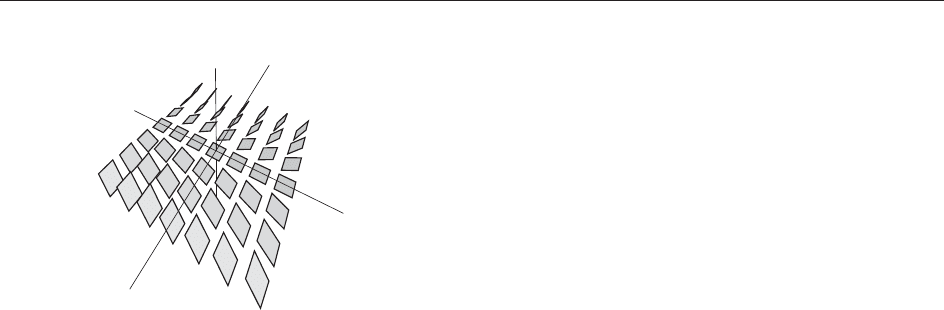
is called a contac t manifold and any locally defining
form for is called a contact form for .
Example 1 The most basic example of a contact
structure can be seen on R
2nþ1
as the kernel of the
1-form = dz
P
n
i = 1
y
i
dx
i
, where the coordinates
on R
2nþ1
are (x
1
, y
1
, ..., x
n
, y
n
, z). This example is
shown in Figure 1 when n = 1.
Example 2 Recall that on the cotangent space of
any n-manifold M, there is a canonical 1-form ,
called the Liouville form. If (q
1
, ..., q
n
) are local
coordinates on M, then any 1-form can be expressed
as
P
n
i¼1
p
i
dq
i
,so(q
1
, p
1
, ..., q
n
, p
n
) are local coor-
dinates on T
M. In these coordinates,
¼
X
n
i¼1
p
i
dq
i
½2
where : T
M !M is the natural projecti on
map. The 1-jet space of M is the manifold
J
1
(M) = T
M R and can be considered as a bundle
over M. The 1-jet space has a natural contact
structure given as the kernel of = dz , where z
is the coordinate on R. Note that if M = R
n
then we
recover the previous example.
Example 3 The (oriented) projectivized cotangent
space of a manifold M is the set P
M of nonzero
covectors in T
M where two covectors are identified
if they differ by a positive real number, that is,
P
M ¼ðT
M nf0gÞ=R
þ
½3
where {0} is the zero section of T
M and R
þ
denotes
the positive real numbers. If M has a metric then P
M
can be easily identified with the space of unit
covectors. Considering P
M as unit covectors, we can
restrict the canonical 1-form to P
M to get a 1-form
whose kernel defines a contact structure on P
M.
(Although there is no canonical contact form on P
M,
the contact structure is still well defined.) Note that if
M is compact then so is P
M; so this gives examples of
contact structures on compact manifolds.
If and
0
are two locally defining 1-forms for ,then
there is a nonzero function f such that
0
= f .Thus,
0
^ (d
0
)
n
= f
nþ1
^ (d)
n
is a nonzero top dimen-
sional form on M and if n is odd then the orientation
defined by the local defining form is independent of the
actual form. Hence, when n is odd, a contact structure
defines an orientation on M (this is independent of
whether or not is orientable!). If M had a preassigned
orientation (and n is odd), then the contact structure is
called ‘‘positive’’ if it induces the given orientation and
‘‘negative’’ oth erwise. One should be careful when
reading the literature, as some authors build
positive into their definition of contact structure,
especially when n = 1. If there is a globally defined
1-form whose kernel defines , then is called
transversally orientable or co-orientable. This is
equivalent to the bundle being orientable when n
is odd or when n is even and M is orientable. In
this article the discussion is restricted to transver-
sely orientable contact structures.
Suppose that is a contact form for ,theneqn [1]
implies that d j
is a symplectic form on .This
is one sense in which a contact structure is like an
odd-dimensional analog of a symplectic structure.
AsubmanifoldL of a contact manifold (M, )is
called Legendrian if dimM=2dimL þ1andT
p
L
p
.
Example 4 A fiber in the unit cotangent bundle
with the contact structure from Example 3 is a
Legendrian sphere.
Example 5 Let f : M !R be a function. Then
j
1
(f )(q) = (q,df
q
, f (q)) is a section of the 1-jet space
J
1
(M)ofM; it is called the 1-jet of f.Ifs is any
section of the 1-jet space, then it is Legendrian if and
only if it is the 1-jet of a function.
This observation is the basis for Lie’s study of
partial differential equations. More specifically, a
first-order partial differential equation on M can be
considered as giving an algebraic equation on J
1
(M).
Then, a section of J
1
(M) satisfying this algebraic
equation corresponds to the 1-jet of a solution to the
original partial differential equation if and only if it
is Legendrian.
Recently, Legendrian submanifolds have been
much studi ed. The re are various classification results
in three dimensions and several striking existence
results in higher dimensions.
Local Theory
The natural equivalence between contact structures
is contactomorphism. Two contact structures
0
and
x
y
z
Figure 1 The standard contact structure on R
3
given as the
kernel of dz y dx : Courtesy of Stephan Scho
¨
nenberger.
632 Contact Manifolds

1
on manifolds M
0
and M
1
, respectively, are
contactomorphic if there is a diffeomorphism
f : M
0
!M
1
such that f
(
0
) =
1
. All contact struc-
tures are locally contactomorphic. In particular, we
have the following theorem.
Theorem 1 (Darboux’s Theorem). Suppose
i
is a
contact structure on the manifold M
i
, i = 0, 1, and
M
0
and M
1
have the same dimension. Given any
points p
0
and p
1
in M
0
and M
1
, respectively, there
are neighborhoods N
i
of p
i
in M
i
and a contacto-
morphism from (N
0
,
0
j
N
0
) to (N
1
,
1
j
N
1
). Moreov er,
if
i
is a contact form for
i
near p
i
, then the
contactomorphism can be chosen to pull
1
back to
0
.
Thus, locally all contact structure s (and contact
forms!) look like the one given in Example 1 above.
Furthermore, contact structures are ‘‘local in
time.’’ That is, compact deformations of contact
structures do not produce new contact structures.
Theorem 2 (Gray’s theorem). Let M be an oriented
(2n þ 1)-dimensional manifold and
t
, t 2 (0, 1), a
family of contact structures on M that agree off of
some compact subset of M. Then there is a family of
diffeomorphisms
t
: M !M such that (
t
)
t
=
0
.
In particular, on a compact manifold, all
deformations of contact structures come from
diffeomorphisms of the underlying manifold. The
theorem is not true if the contac t structures do not
agree off of a compact set. For example, there is a
one-parameter family of nonco ntactomorphic
contact structures on S
1
R
2
.
Existence and Classification
The existence of contact structures on closed odd-
dimensional manifolds is quite difficult. However,
Gromov has shown that contact structures on
open manifolds obey an h-principle. To explain
this, w e note that if (M
2nþ1
, ) is a co-oriented
contact manifold then the tangent bundle of M can
be written as R and thus the structure group
of TM can be reduced to U(n)(since has
a conformal symplectic structure on it). Such
a reduction of the structure group is called an
almost contact structure on M.Clearly,acontact
structure on M induces an almost contact struc-
ture. If M is an open manifold, Gromov proved
that the inclusion of the space of co-oriented
contact structures o n M into the space of almost
contact structures on M is a weak homotopy
equivalence. In particular, if an open manifold
meets the necessary algebraic condition for the
existence of an almost contact structure, then the
manifold has a co-oriented contact structure.
Lutz and Martinet proved a similar, but weaker,
result for oriented closed 3-manifolds. More
specifically, every closed oriented 3-manifold admits
a co-oriented contact structure and in fact has at least
one for every homotopy class of plane field. There has
been much progress on classifying contact structures
on 3-manifolds and here an interesting dichotomy has
appeared. Contact structures break into one of two
types: tight or overtwisted. Overtwisted contact
structures obey an h-principle and are in general easy
to understand. Tight contact structures have a more
subtle, geometric nature. In higher dimensions there is
much less known about the existence (or classification)
of contact structures.
Relations with Symplectic Geometry
Let (X, !) be a symplectic manifold. A vector field v
satisfying
L
v
! ¼ ! ½4
(where L
v
! is the Lie derivative of ! in the direction
of v) is called a symplectic dilation. A compact
hypersurface M in (X, !) is said to have ‘‘contact
type’’ if there exists a symplectic dilation v in a
neighborhood of M that is transverse to M.Givena
hypersurface M in (X, !), the characteristic line field
LM in the tangent bundle of M is the symplectic
complement of TM in TX.(SinceM is codimension 1,
it is coisotropic; thus, the symplectic complement lies
in TM and is one dimensional.)
Theorem 3 Let M be a compact hy persurface in a
symplectic manifold (X, !) and denote the inclusion
map i : M !X. Then M has contact type if and only
if there exists a 1-form on M such that d = i
!
and the form is never zero on the characteristic
line field.
If M is a hypersurface of contact type, then the
1-form is obtained by contracting the symplectic
dilation v into the symplectic form: =
v
!.Itis
easy to verify that the 1-form is a contact form
on M. Thus, a hypersurface of contact type in a
symplectic m anifold inherits a co-oriented contact
structure.
Given a co-orientable contact manifold (M, ), its
symplectization Symp(M, ) = (X, !) is constructed
as follows. The manifold X = M (0, 1), and given
a global contact form for the symplectic
form is ! = d(t), where t is the coordinate on R.
(The symplec tization is also equivalently defined as
(M R, d(e
t
)).)
Example 6 The symplectization of the standard
contact structure on the unit cotangent bundle
Contact Manifolds 633

(see Example 3) is the standard symplectic structure
on the complement of the zero section in the
cotangent bundle.
The symplectization is independent of the choice
of contact from . To see this, fix a co-orientation
for and note the manifold X which can be
identified (in many ways) with the sub-bundle of
T
M whose fiber over x 2 M is
f 2 T
x
M : ð
x
Þ¼0and
>0 on vectors positively transverse to
x
g½5
and restricting d to this subspace yields a symplec-
tic form !, where is the Liouville form on T
M
defined in Example 2. A choice of contact form
fixes an identification of X with the sub-bundle of
T
M under which d(t) is taken to d.
The vector field v = @=@t on (X, !) is a symplectic
dilation that is transverse to M {1} X. Clearly,
v
!j
M{1}
= . Thus, we see that any co-orientable
contact manifold can be realized as a hypersurface
of contact type in a symplectic manifold. In
summary, we have the following theorem.
Theorem 4 If (M, ) is a co-oriented contact
manifold, then there is a symplectic manifold
Symp(M, ) in which M sits as a hypersurface of
contact type. Moreover, any contact form for
gives an embedding of M into Symp(M, ) that
realizes M as a hypersurface of contact type.
We also note that all the hypersurfaces of contact
type in (X, !) look locally, in X, like a contact
manifold sitting inside its symplec tification.
Theorem 5 Given a compact hypersurface M of
contact type in a symplectic manifold (X, !) with the
symplectic dilation given by v, there is a neighbor-
hood of M in X symplectomorphic to a neighbor-
hood of M {1} in Symp(M, ) where the
symplectization is identified with M (0, 1) using
the contact form =
v
!j
M
and = ker .
The Reeb Vector Field and Riemannian
Geometry
Let (M, ) be a contact manifold. Associated to a
contact form for is the Reeb vector field v
.
This is the unique vector field satisfying
v
¼ 1 and
v
d ¼ 0 ½6
One may readily check that v
is transverse to the
contact hyperplanes and the flow of v
preserves
(in fact, it preserves ). These two conditions
characterize Reeb vector fields; that is, a vector
field v is the Reeb vect or field for some contact form
for if and only if it is transverse to and its flow
preserves .
The fundamental question concerning Reeb vector
fields asks if its flow has a (contractible) periodic
orbit. A paraphrazing of the Weinstein conjecture
asserts a positive answer to this question. Most
progress on this conjecture has been made in
dimension 3 where H Hofer has proved the
existence of periodic orbits for all Reeb fields on S
3
and on 3-manifolds with essential spheres
(i.e., embedded S
2
’s that do not bound a 3-ball in
the manifol d). Relations with Hamiltonian dynamics
are discussed below.
Recall, from Example 3, that a Riemannian metric
g on a manifold M provides an identification of the
(oriented) projectivized cotangent bundle P
M with
the unit cotangent bundle. Considered as a subset of
T
M, P
M inherits not only a contact structure but
also a contact form (by restricting the Liouville
form). Let v
be the associated Reeb vector field.
The metric g also provides an identification of the
tangent and cotangent bundles of M. Thus, P
M
may be considered as the unit tangent bundle of M.
Let w
g
be the vector field on the unit tangent bundle
generating the geodesic flow on M.
Theorem 6 The Reeb vector field v
is identified
with geodesic flow field w
g
when P
M is identified
with the unit tangent space using the metric g.
Relations with Complex Geometry
and Analysis
Let X be a complex manifold with boundary and
denote the induced complex structure on TX by J.
The complex tangencies to M = @X are described
by the equation d J = 0, where is a function
defined in a neighborhood of the boundary such that
0 is a regular value and
1
(0) = M. The form
L(v, w) = d(d J)(v, Jw), for v, w 2 , is called
the Levi form, and when L(v, w) is positive
(negative) defi nite, then X is said to have strictly
pseudoconvex (pseudoconcave) boundary. The
hyperplane field will be a contact structure if and
only if d(d J) is a nondegenerate 2-form on (if
and only if L(v, w) is definite). A well-studied source
of examples comes from Stein manifolds.
Example 7 Let X be a complex manifold and
again let J denote the induced complex structure
on TX. From a function : X ! R, we can define a
2-form ! = d(d J) and a symmetric form
g(v, w) = !(v, Jw). If this symmetric form is positive
definite, the function is called ‘‘strictly plurisub-
harmonic.’’ The manifold X is a Stein manifold if X
634 Contact Manifolds