
Gates A.E., Ritchie D. Encyclopedia of Earthquakes and Volcanoes
Подождите немного. Документ загружается.

there is flood basalt volcanism from fissure eruptions.
These lava flows form the most voluminous volcanic depos-
its on the continental crust. Examples include the Columbia
Plateau of Washington, the Deccan traps of India, the
Piranha basin of South America, the Watchung basalts of
New Jersey, and the Karoo deposits of Africa. Some areas
also produce rhyolite volcanoes. Unlike the basalts that
simply spill out of cracks in the ground, the rhyolites form
well-developed cones. These volcanoes are highly explosive.
The Basin and Range Province of the western United
States, the Great Rift Valley system of Africa and the Rio
Grande Rift of Texas form good examples of these stages
of rifting. The next two stages involve the development of an
ocean basin. First is a restricted linear basin that contains a
mid-ocean ridge and is very active. Later, the basin becomes
wide and forms a full ocean basin. Volcanism is purely basal-
tic of the tholeiitic variety in these stages. Normal faults
continue to be active in both stages, but transform faults
dominate as the earthquake producers in the full ocean basin.
New oceanic crust is created in the mid-ocean ridge in both
stages. The youngest part of the ocean basin is therefore at
the mid-ocean ridge and becomes progressively older away
from and toward the continents. The new crust is largely lay-
ers of pillow lavas cross cut by feeder dikes to the under-
water volcanoes. The Red Sea is a good example of the early
stage of basin development, and the Atlantic Ocean is an
example of the later stages.
Dominica Lesser Antilles Dominica is situated in the
northern portion of the Lesser Antilles island arc and
has an unnamed caldera with a history of unrest dating
back to the late 17th century. The caldera is estimated to
be about six miles (10 km) wide. Several vents are present,
including Grande Soufrière Hills, Morne Macaque (Mico-
trin), Morne Trois Pitons, the Valley of Desolation, and
Watt Mountain. There is disagreement as to whether these
vents belong to a single volcano. Other vents on the island
include Foundland and Morne Anglais. Only one eruption
has occurred here within historical times, a minor steam
explosion in 1880.
There has been considerable earthquake activity at
Dominica over the past several centuries, however, starting
with the report of a moderately strong earthquake in 1673.
Emissions of gas and numerous strong earthquakes were
reported in 1765, and more strong quakes occurred in 1816
and 1838. In 1843 a very strong tectonic earthquake took
place near Dominica and was felt both there and on nearby
islands. Lesser earthquakes occurred at intervals of sev-
eral years through 1849. A moderately strong earthquake
in 1879 was accompanied by a minor phreatic eruption
and a black cloud rising from the area of solfataras. It is
uncertain whether the earthquake was linked with the erup-
tive activity. Seismic swarms have been recorded at Dominica
in 1967, 1971, 1974, and 1976. A moderately strong earth-
quake occurred approximately 100 miles (160 km) north of
Dominica in 1976 and was viewed as the result of magma
movements.
dormant volcano Literally, a sleeping volcano. This vol-
cano was active in the past and may well be active in the
future but under the current conditions is inactive. Volcanoes
may stay inactive for thousands of years and suddenly spring
back to life. Dormancy is really not measured in geological
terms but in historical terms. If the volcano has been active
in historical times but is currently inactive, it is termed dor-
mant. If the volcano has not been active in historical times, it
is deemed inactive. The problem, however, is that there really
is no distinction between active but not currently erupting
and dormant.
ductile Deformation of rock that does not produce earth-
quakes. Ductile deformation of rock means that instead of
breaking, it bends or flows. Ductile deformation depends
upon composition and other factors. Clay is ductile at surface
conditions. granite, on the other hand, cracks and frac-
tures under surface conditions. At depth, under high temper-
ature conditions, however, even granite is ductile. Because it
can’t rupture, no earthquakes can occur. This transition from
brittle rupturing rock to ductile deformation occurs at about
six to nine miles (10 to 15 km) depth for common continen-
tal crust. It is somewhat deeper for oceanic crust. This
transition means that there are few earthquakes deeper than
six to nine miles (10 to 15 km).
Duguna See Asawa.
Dukono volcanic complex, Halmahera, Indonesia The
Dukono volcanic complex is one of the most active volcanoes
in Indonesia. Its first recorded eruption was in 1550, and it
was later active in 1719, 1868, and 1901. Dukono has been
in nearly continuous eruption since 1933. The eruptions are
moderately explosive (VEI = 3) and produced lava flows
and lahars. Other volcanoes in the complex include Ibu (one
eruption in 1911), Todoko-ranu, and Jailolo. The only other
active volcano is Gamkonora. It erupted 12 times between
1564 and 1987. The 1673 eruption was very strong (VEI = 5)
and produced a large tsunami that devastated several nearby
coastal villages.
dust See volcanic dust.
72 Dominica
Earth, internal structure of Earthquakes and volcanoes
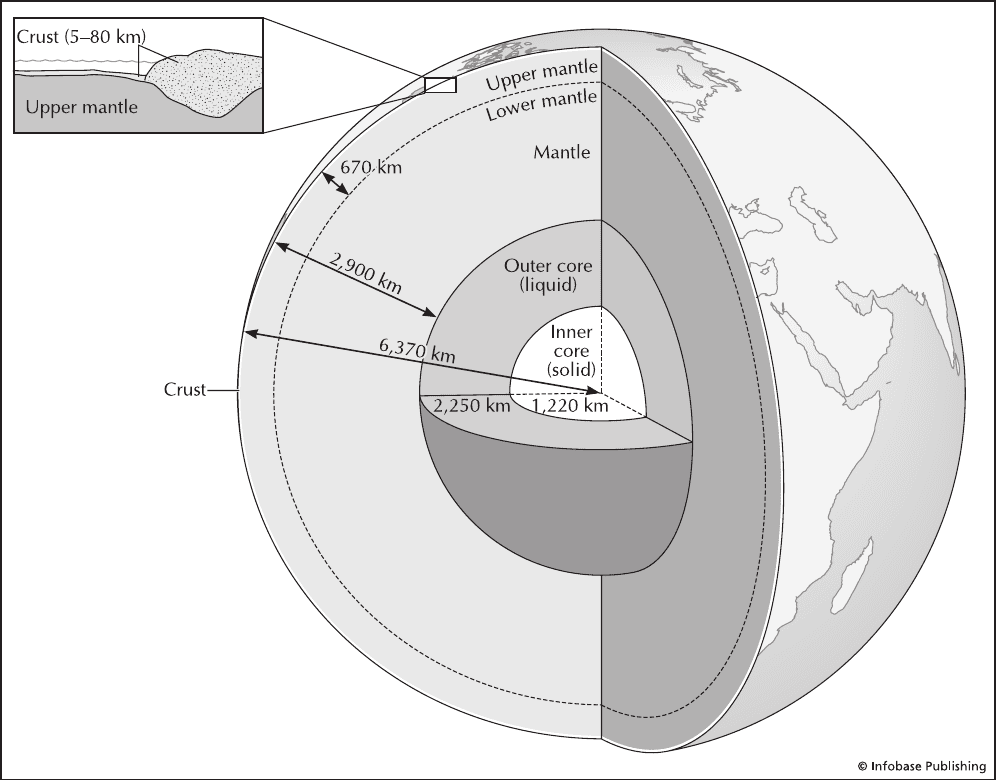
are manifestations of processes at work deep within Earth.
These processes in turn are evidence of Earth’s internal struc-
ture, models of which have undergone considerable evolution
in the 20th century. On a large scale, the internal features of
Earth may be categorized as follows:
1. Core. This is the innermost layer of Earth, a dense,
approximately spherical mass of very hot rock that
accounts for roughly one-third of the planet’s mass and
one-sixth of its volume. The core is divided into a solid
inner core and a liquid outer layer.
2. Mantle. The mantle, the thick layer of rock surrounding the
core, contains about two-thirds of Earth’s mass and more
than four-fifths of its volume. An outer layer of the mantle
is called the asthenosphere and is involved closely with
driving plate tectonics. There is also a division within
the upper and lower mantle based on mineral structure.
3. Crust. The crust, or surface layer, of Earth is very thin
compared to the mantle and core (five to 80 miles [8 to
129 km] thick) and accounts for only a tiny fraction of
Earth’s total mass and volume. The crust floats on the
asthenosphere by a process called isostasy, in which the
relatively lightweight rocks of the crust are supported by
the denser rocks below. The crust is divided into a number
of individual, rigid plates that interact with one another
through various processes, generating earthquakes and
volcanic activity. The crust contains many faults that
produce numerous earthquakes.
earthflow An earthflow is a type of mass movement. It is
a viscous flow of saturated, fine-grained materials that moves
downslope at speeds ranging from barely perceptible up to
about 10 miles per hour (about 0.1 m/sec). Materials suscep-
tible to earthflow include clay, fine sand and silt, and fine-
grained pyroclastic material (primarily ash). The velocity
and distance of the earthflow is controlled by water content,
with faster and longer movements through higher water con-
tents. Some earthflows may continue to move for years. Earth-
flows normally begin when water content increases either
through rain, melting (normal heating or volcanic erup-
tion), or liquefaction during an earthquake. Shaking from
an earthquake may also initiate flow in a saturated soil. The
flows tend to bulge in the middle as they move, which in turn
channels more fluid to the middle while the edges dry out.
Earthflows will stop moving when the water content drops.
earthquake See seismology.
earthquake hazard An earthquake hazard is considered
to be any of the damaging effects and processes of an earth-
quake that may affect the normal activities of people. Exam-
ples of earthquake hazards include surface faulting, ground
shaking, landslides, liquefaction, slumping, fissures, ava-
lanches, tsunamis, and seiches, among others.
earthquake light This phenomenon consists of a pecu-
liar glow that sometimes is reportedly seen in the sky during
earthquakes. What causes earthquake light is uncertain, but it
has been suggested that methane escaping from underground
during earthquakes is ignited somehow and burns near the
surface, giving off light.
earthquake risk Earthquake risk is the probable damage
to buildings, roads, services, and other infrastructure and the
number of people that are expected to be killed or injured
during an earthquake of a particular size in a particular loca-
tion. Earthquake risk is a probabilistic model for a specific
seismic event. It varies considerably with each area depending
upon population and emergency readiness.
earthquake swarm Many earthquakes preceding a volca-
nic eruption. As magma move upward in the crust, it pushes
rock out of the way. It forces open cracks in the rock. Each
E
73
break results in a small earthquake. These earthquakes are
typically of magnitudes of 4 or less, but some larger earth-
quakes are possible. There can be hundreds to thousands of
earthquakes in such swarms. volcanologists use this kind
of seismic activity to predict eruptions. The correlation is not
foolproof. Many earthquake swarms do not foretell a coming
eruption but rather just movement of magma.
East Pacific Rise A mid-ocean ridge 6,000 miles (9,700
km) long, the East Pacific Rise is the site of remarkable geo-
logical formations and ecological communities on the seabed.
An expedition to the East Pacific Rise in 1980 discovered that
superheated (more than 700°F), mineral-laden water flowing
from springs, or “hydrothermal vents,” on the seabed had
generated peculiar “chimneys” formed of minerals deposited
when the hot water met the cold ambient waters of the deep
ocean. Around the vents lived giant worms and large clams
and crabs in an ecosystem supported by bacteria feeding on
hydrogen sulfide, oxygen and carbon dioxide in the water
from the vents.
Eboshi-dake See Daisetsu-Tokachi.
economic effects of earthquakes and volcanoes The
economic effects of earthquakes and volcanic eruptions
can be tremendous. After witnessing the effects of a power-
ful earthquake in Chile, the 19th-century British naturalist
Charles Darwin wrote:
Earthquakes alone are sufficient to destroy the pros-
perity of any country. If beneath England the now
inert subterranean forces should exert those powers,
Diagram of Earth with a cutaway to show its internal structure. The center of Earth has an inner core (solid) surrounded by an outer core (liquid). The
mantle encases the core and is divided into a lower and an upper mantle based on the physical character of the rocks and minerals. The composition
is the same—peridotite. The crust is very thin in comparison with the rest of the planet so that the blowup inset is required to illustrate the difference
between ocean crust and continental crust.
74 East Pacific Rise
which most assuredly in former geological ages they
have exerted, how completely would the entire condi-
tion of the country be changed! What would become
of the lofty houses, thickly packed cities, great manu-
factories, the beautiful public and private edifices?
If the new period of disturbance were first to com-
mence by some great earthquake in the dead of the
night, how terrific would be the carnage! England
would at once be bankrupt; all papers, records, and
accounts would from that moment be lost. Govern-
ment being unable to collect the taxes, and failing to
maintain its authority, the hand of violence and rap-
ine would remain uncontrolled. In every large town
famine would go forth, pestilence and death follow-
ing in its train.
A single earthquake or volcanic eruption can cause prop-
erty damage in the hundreds of millions of dollars, and a
very powerful shock or eruption occurring in or near a heav-
ily populated area might cause damage into the billions of
dollars. Of particular concern in our time is the anticipated
earthquake in the Tokyo, Japan, metropolitan area. Tokyo
has undergone major earthquakes at intervals of approxi-
mately 75 years during the last few centuries, and the most
recent major earthquake there occurred in 1928. The cost
of rebuilding Tokyo after the next “superquake” has been
estimated at $1 trillion. In these days of an increasingly inte-
grated global economy, a highly destructive earthquake in
Tokyo might have drastic economic effects in many other
countries as well, including the United States.
Ecuador Ecuador is located on the western shore of
South America, where the westward-moving continen-
tal crustal plate encounters oceanic crust and generates
earthquakes where the two plates collide. Ecuador has a his-
tory of highly destructive seismic activity, notably the great
earthquake of August 5, 1949. This earthquake, of magni-
tude 7.5 on the Richter scale, was centered 25 miles (40
km) deep and affected an area of 1,500 square miles (3,885
km
2
) along the eastern side of the Andes, particularly
Ecuador’s highland plateau. The earthquake killed more
than 6,000, injured some 20,000, and left approximately
100,000 people homeless. More than 50 cities and towns
experienced severe damage, and total damage was estimated
at more than $60 million.
Ecuador has some very active volcanoes as well includ-
ing Altar, Antisana, Cayambe, Chimborazo, Cotopaxi,
Cusin, Guagua Pichincha, Ilinzia, Imbabura, Mojanda,
Ninahuilca, Pasochoa, Reventador, Ruminahui, Sangay,
Sumaco, and Tungurahua. Chimborazo is the largest of
the volcanoes, standing 20,700 feet (6,309 m). Sangay is
probably the most active of the volcanoes, erupting nearly
continuously since 1934. Guagua Pichincha is probably the
most dangerous volcano because it overlooks Quito, the
capital city of Ecuador. The city has been devastated sev-
eral times by the larger of its 25 historical eruptions. The
worst eruption was in 1660 when a foot of ash blanketed
the city.
Edo earthquake and tsunamis, Japan A submarine earth-
quake struck an area south of the Boso Peninsula just east
of Tokyo Bay on December 30, 1703. The estimated Rich-
ter magnitude for this event was 8.0. The quake destroyed
the city of Edo, one of the more prosperous settlements in the
area. Bathymetric studies along with drill coring in this area
indicated that the seafloor was uplifted about 17 feet (5.1
m) in several places. As a result, some previously outlying
reefs became dry land. Uplift also occurred along the coast
at various locations, producing tsunamis that struck the
entire coast. There was extensive damage in nine provinces.
The official reported death toll for this disaster was 5,233
people, but there are some data that indicate a death toll as
high as 37,000.
Egon volcano, Indonesia Egon is among a group of vol-
canoes in the Flores Islands. The other volcanoes include
Lewotobi, Ilimuda, and Lereboleng. Egon erupted in 1907
and likely in 1888–89. Lebwotobi had at least 19 eruptions
between 1675 and 1991. Most eruptions are moderate in size
with a VEI of 2–3. The largest eruptions were in 1869 and
1907.
Egypt Egypt’s position on the northern and northeastern
edge of the African plate make it subject to earthquakes,
though not directly associated with volcanoes. The Sinai
border is along the Red Sea, which is an active divergent
margin capable of sustaining active faults. It also faces the
Eastern Mediterranean Sea, which is highly active by virtue
of the north-dipping Hellenic Arc subduction zone and
impingement of Turkey, which is being forced westward
through extrusion tectonics. These complex interactions
yield complex faulting and earthquake activity.
Most of the historic activity is within the Nile valley and
Nile Delta, where soft sediments amplify the waves, causing
great destruction. Notable historic earthquakes include the
a.d. 365 Alexandria event that destroyed the historic light-
house and caused tens of thousands of deaths; the 1303 Alex-
andria earthquake that claimed 10,000 lives, and the 1754
Cairo earthquake that claimed 40,000 lives. In all, there
were 58 historical earthquakes between 2200 b.c. and a.d.
1900, with modified Mercalli intensities between V and
IX, 22 of which are well documented. Instrumental seismicity
(recorded on a seismograph) was from 1900 to the present.
Four distinct zones of activity were apparent from these data:
Northern Red Sea–Gulf of Suez–Alexandria trending north-
west-southeast, Gulf of Aqaba–Levant Fault trending north
northeast–south southwest, Eastern Mediterranean–Cairo–
Faiyum trending northeast-southwest, and Egypt–Mediter-
ranean Coast tending east-west. Most of the faults in these
zones experienced primarily strike-slip motion. The most
recent powerful earthquake was in Cairo in 1995 with a 7.0
magnitude.
ejecta Solid volcanic fragmental material is ejecta regardless
of composition or internal textural relations. The classification
is based purely on the size of the fragments. Fine ash or volca-
nic dust is less than 0.2 inch (0.5 cm); coarse ash is between 0–
.08 inch (0.01–0.2 cm). lapilli are 0.8–2.5 inches (0.2–6.4 cm)
ejecta 75
and along with ash is lithified into a tuff. bombs are 2.5–10
inches (6.4–25 cm), and blocks are larger than 10 inches (25
cm). Rocks of these ejecta are called agglomerate.
elastic rebound theory This is the basic accepted theory for
how earthquakes are generated. The idea is that faults will
remain locked with no slippage while tectonic forces slowly
build up stress within the rocks. When the stress exceeds
the strength of the rocks or locks on the fault, the fault slips,
releasing or converting all of the stored stress energy in the
form of heat and seismic waves in an earthquake.
elastic strain Elastic strain means that a material will
strain as a direct function of the stress applied and then
return to its original shape after the stress is released. This
deformation is referred to as recoverable because it is not per-
manent. Springs and rubber bands exhibit elastic behavior:
They stretch out as a function of how hard they are pulled
and then return to their original shape when they are let go.
Seismic waves cause elastic strain in rocks. The rocks deform
as the wave passes through but return to their original shape
afterward. The amount that rocks deform in this process is
minuscule, especially in comparison with springs and rubber
bands. Even if you could slow the wave down and watch it
pass through a small piece of rock, you still wouldn’t be able
to see the rock change its shape. Both the change in and the
return to shape are essentially instantaneous. For some sub-
stances, the return to original shape is not immediate. Cello-
phane behaves in this manner. It crushes immediately, but it
will slowly uncrush after it is let go. This kind of slow recov-
ery is referred to as anelastic.
Eldfell See Heimaey.
Eldgja See Katla.
embryonic volcano A volcanic pipe that is filled with
volcanic breccia but for which there is no surface expres-
sion. These features are considered to have formed through
phreatic explosions. They are precursors to full volcanoes if
activity continues in the area.
Emmons Lake caldera, Aleutian Islands, Alaska, United
States The Emmons Lake caldera is located near Pavlof
volcano in an area of frequent seismic and volcanic activity.
Emperor Seamounts northern Pacific Ocean A chain
of submerged volcanic mountains in the northern Pacific
Ocean, the Emperor Seamounts are part of a string of vol-
canic seamounts and islands reaching almost from Hawaii
to Russia’s Kamchatka Peninsula. The Emperor Seamounts
and the Hawaiian Islands are both part of this same chain,
which formed as the Pacific crustal plate moved over a
stationary hot spot of volcanic activity. A sharp bend in the
chain marks the division between the Emperor Seamounts
and the Hawaiian Islands and indicates that the Pacific
crustal plate changed its direction of motion abruptly, from
north to northwest.
See also plate tectonics.
emplacement The mechanical process by which magma
is intruded into rocks of an area to form a pluton. There
are several ways this can happen. The magma can eat into
the rock above it by breaking off fragments of rock and pull-
ing them into the magma. This pulling down of rock is called
stoping, and the fragments are called xenoliths. Alterna-
tively, magma can forcibly move the surrounding rock strata
out of the way as it pushes upward. The magma can also fil-
ter up along fractures as it intrudes into the Earth.
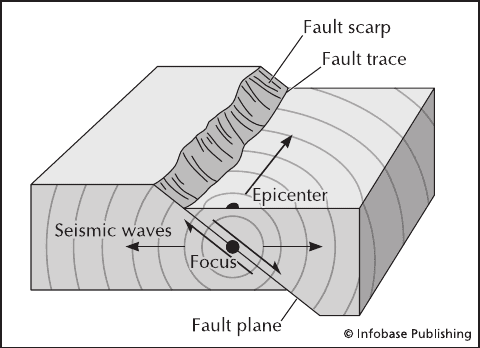
epicenter The location on Earth’s surface directly above
the hypocenter, or focus, of an earthquake. Typically, the
area where the potential for the greatest damage occurs.
See also seismology.
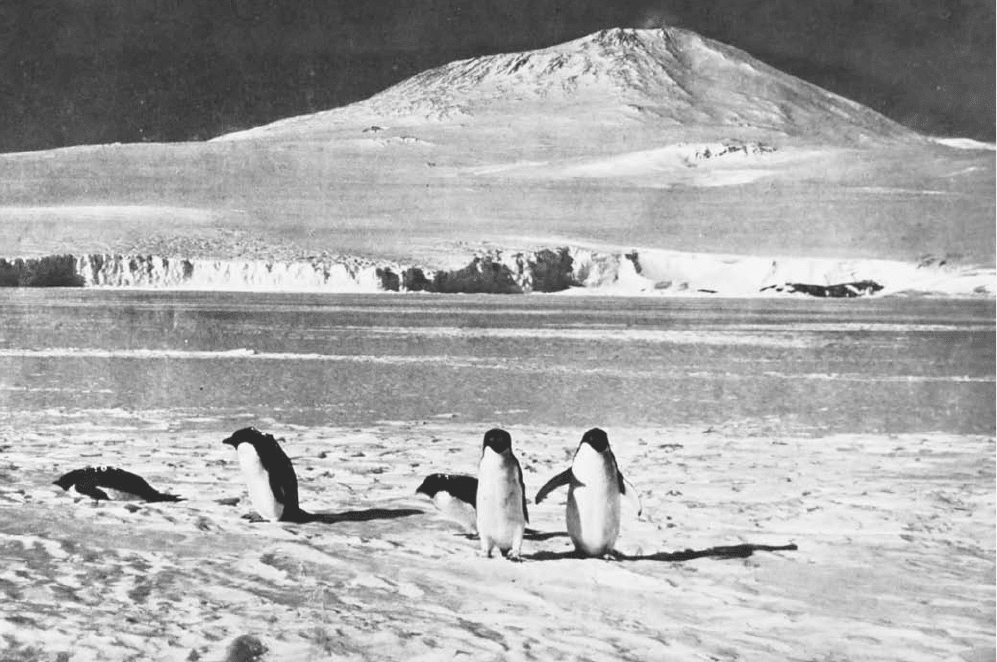
Erebus, Mount Antarctica Located on Ross Island,
Mount Erebus stands 12,448 feet (3,794 km) high and is the
most active volcano in Antarctica. The cone on the volcano’s
summit occupies a caldera. The main crater is approxi-
mately 450 feet (137 m) deep and has a diameter of 1,500 to
1,800 feet (457 to 549 m). An inner crater is about 600 feet
(183 m) wide and 300 feet (91 m) deep. The volcano was dis-
covered by the British explorer James Ross on an expedition
in 1841. Ross named it Mount Erebus after his flagship, and
he named the nearby volcano Mount Terror after another
ship on his expedition. Mount Erebus was evidently in erup-
tion when Ross saw it. Flashes of red light were visible from
the mountain by night, and by day black vapor surrounded
the summit. On another expedition in 1908, a British team
climbed successfully to the summit of Mount Erebus. The
volcano is characterized by eruptions of the Strombolian
variety, from pools of lava in the crater.
erosion caldera A caldera that forms from erosional pro-
cesses rather than a volcanic eruption. They are large depres-
sions with steep sides. Typically, they result from the erosion
of a preexisting volcanic caldera or a volcanic cone.
Block diagram showing a fault on which an earthquake is taking place.
The hemispheres centered on the focus are seismic wave fronts. This is a
normal fault.
76 elastic rebound theory
eruption Generally speaking, any volcanic activity that
releases lava, tephra, or gases. Eruptions may take many
forms, from explosive, highly destructive eruptions like that
of Mount Saint Helens in 1980 to comparatively harm-
less eruptions like those characteristic of volcanic activity in
the Hawaiian Islands. Volcanic eruptions fall into several
categories:
• Hawaiian eruptions are gentle by volcanic standards and
generate gently sloping volcanoes known as shield vol-
canoes. Volcanoes of this kind erupt frequently and may
form a lake of lava in the crater, from which fountains of
lava arise.
• Strombolian eruptions, named after the Stromboli
volcano and volcanic island off the Italian coast, are more
energetic than Hawaiian eruptions but do not cause wide-
spread damage. The volcano casts out some lava but little
ash.
• Icelandic eruptions do not involve the classic pattern of
ash and lava emerging from a mountain peak. Instead,
great quantities of highly fluid lava flow from fissures
in Earth. These voluminous lava flows may fill valleys and
form dams in river valleys, blocking the river’s flow and
causing flooding upstream. Icelandic eruptions are much
like Hawaiian eruptions, except that in Icelandic eruptions,
the layers of lava spread out horizontally and form great
sheets rather than pile up into domelike formations.
• Peléan eruptions, named for the devastating eruption of
Mount Pelée in 1902, involve such thick, viscous lava that
it plugs the throat of the volcano, so to speak, and forms
a dome of solid lava in the crater. Meanwhile, pressure
builds up inside the volcano until it explodes, sending a
NUÉE ARDENTE sweeping down the flanks of the mountain.
• Vulcanian eruptions are named for Vulcano, a mountain
near Stromboli, and resemble the classic picture of such
events, with a large cloud of ash, shot through with bolts
of lightning, arising from the volcano’s summit. Eruptions
of this kind are infrequent but strong.
• Vesuvian eruptions are much like the Vulcanian kind but
also involve release of lava. Exceptionally violent Vesuvi-
an eruptions are known as Plinian eruptions because they
resemble the famous eruption of Vesuvius in a.d. 79,
described by the Roman naturalist Pliny the Younger. In
a Plinian eruption, the volcano ejects vast quantities of ash
and may send tephra to an altitude of 30 miles (50 km) or
higher.
See also Iceland.
Penguins with Mount Erebus in the background. Mount Erebus is the most active volcano in Antarctica. (Courtesy of the USGS)
eruption 77
eruption cycle The sequence of events that happens dur-
ing an eruption episode. It depends on the volcano as to what
the cycle will include and in what order. Typically, an erup-
tion cycle begins with an earthquake swarm as the magma
moves into place. fumarole activity commonly follows
next as the groundwater is heated to the boiling point. The
first eruption commonly includes gas emissions and a fair
amount of ash. Explosions begin and bombs are hurled from
the volcano. lava flows from the main vent in the middle
stages of the eruption cycle. Later, lava may flow from other
vents. Some volcanoes pour lava out continuously through
the eruption. In this case, the volume tends to start out slow
and increase in the middle of the eruption and then decrease
again at the end. In others, eruptions are catastrophic with a
huge amount of lava and ejecta being emitted at once sepa-
rated at once, punctuating otherwise relatively quiet periods.
In subduction-related stratovolcanoes and rhyolite vol-
canoes, the middle of the cycle commonly involves an explo-
sion and loss of a significant portion of the volcanic cone.
Later, it may be rebuilt in a resurgent cone and significant
ash and ejecta emissions. In shield volcanoes as in hot spots
or divergent boundaries, there are no explosions and loss
of the cones. They produce far less ash than the subduction
related volcanoes.
Erzincan earthquake, Turkey On December 26, 1939, the
right-lateral strike-slip North Anatolian Fault produced
another of its catastrophic earthquakes—this one in the city
of Erzincan. The magnitude of the earthquake was 7.9 on
the Richter scale. It produced surface ruptures, landslides,
rockfalls, and liquefaction. It also produced significant
tsunamis on the Black Sea near Fasta Bay. There are reports
that these waves achieved heights of 50–60 feet (17–20 m)
locally. Strong aftershocks continued for several day
after the main shock, and minor aftershocks continued for
months.
Some 33,000 people lost their lives in this disaster, and
many tens of thousands were injured. Over 110,000 homes
were heavily damaged. A large winter storm exacerbated this
situation dropping snow on the ruins and bringing plummet-
ing temperatures and strong winds. Many people died from
exposure, and rescue efforts were hampered.
The Erzincan earthquake, although not the biggest, may
have been the most significant in the history of Turkey. As a
result, the first seismic design codes for buildings were estab-
lished in 1940, and the first earthquake zonation (hazard)
map for Turkey was produce in 1942.
escarpment Also known simply as a scarp, an escarpment
is a steep cliff located at the edge of a flat or nearly flat area.
An escarpment typically forms where there is vertical motion
along a dip-slip fault.
Etna, Mount Sicily, Italy One of the most famous volca-
noes, Etna stands some 10,750 feet (3,500 m) tall and has a
circumference greater than 90 miles (150 km). The volcano
has a gentle slope and resembles a shield volcano, such as
those of the Hawaiian Islands, more than a steeply sloping
volcano, such as Fuji or Vesuvius. Numerous lava flows
have occurred from the flanks of the volcano. Charles Mor-
ris, in his 1902 survey of volcanoes, The Volcano’s Deadly
Work, described the activity of Etna:
There is a great similarity in the character of the
eruptions of Etna. Earthquakes presage the out-
burst, loud explosions follow, rifts and bocche del
fuoco [“mouths of fire,” or small lava vents] open
in the sides of the mountain; smoke, sand, ashes
and scoriae are discharged, the action localizes itself
in one or more craters, cinders are thrown up and
accumulate around the crater and cone, ultimately
lava rises and frequently breaks down one side of
the cone where resistance is least; then the eruption
is at an end.
Etna has erupted at least 190 times from 1226 b.c. to the
present. Most of these eruptions are moderate (VEI = 1–2).
Virgil, Pindar, Seneca, Pythagoras, and Thucydides all men-
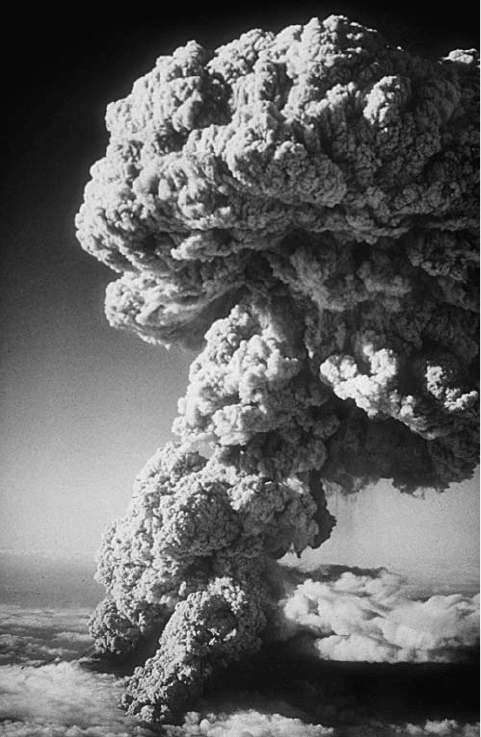
The eruption column above the 1980 eruption of Mount Saint Helens
(Courtesy of the USGS)
78 eruption cycle
tioned the volcano in their writings. Perhaps the most famous
eruption of Etna occurred in 1669, when powerful explo-
sions destroyed part of the volcano’s summit and lava from
a fissure on the volcano’s flank flowed some 10 miles to the
sea and damaged the town of Catania. The 1669 eruption is
notable for an attempt to divert a lava flow. About 50 towns-
people from Catania reportedly dug a passage that drained
away lava and apparently reduced the immediate threat to
Catania, but when the flow changed direction and menaced
the village of Paterno, inhabitants of that community drove
away the Catanians and ended their attempt to divert the
lava. This effort, though ultimately unsuccessful, showed that
engineering could alter the direction of lava flows.
An eruption in 1755 was accompanied not only by emis-
sions of lava but also by great flows of water, which resulted
when lava came in contact with snow and ice on the summit.
The water flowed down the flanks of the mountain, carry-
ing along with it great quantities of unconsolidated volcanic
material. The volume of water involved in this eruption was
estimated at approximately 16 million cubic feet (453,070
m
3
). It formed a channel two miles (3 km) wide and 34 feet
(10 m) deep in places and flowed at the rate of approximately
40 miles (64 km) per hour. Another great eruption occurred
in 1819. Although few deaths are attributed to Etna his-
torically, in 1843, 36 people were killed in a phreatic explo-
sion. An extremely violent eruption that lasted more than
nine months occurred in 1852. This eruption is thought to
have produced flows of lava more than 2 billion cubic feet
(56,633,694 m
3
) in volume over an area of some three square
miles (7.8 km
2
) More than three centuries after the attempt
to divert a lava flow during the eruption of 1669, volcanolo-
gists in Italy asked the United States military to help with
another such experiment during the eruption of 1992. The
attempt was called Operation Volcano Buster and involved
using explosives to blast a hole in a lava tunnel 6,000 feet
(1,830 m) up the flank of Mount Etna. Helicopters then
dropped large blocks of concrete into the hole in the hope of
stopping the lava flow. The experiment, however, was con-
sidered only a partial success at best.
Etna is still quite active. The 1991–93 eruption was the
largest in the last 300 years. In the 1995–96 eruption, explo-
sions and fire fountains were common. That eruption never
really ended; it has just increased and decreased in intensity
ever since. As of April 2000, air traffic routes are still being
diverted around the erupting volcano.
Eurasian crustal plate One of the major crustal plates
that are believed to occupy the surface of the earth, the Eur-
asian plate generally underlies the continents of Europe and
Asia, although portions of Asia also are found in the Ara-
bian crustal plate and Indo-Australian crustal plate.
The borders of the Eurasian plate are noted for intense earth-
quake and volcanic activity. On its western edge, the mid-
ocean ridge in the middle of the North Atlantic Ocean is
the site of volcanism, notably in areas such as Iceland. The
eastern edge of the Eurasian plate follows part of the trace of
the “Ring of Fire,” the belt of seismic activity and volcanism
that surrounds much of the Pacific Ocean basin. Volcanic
activity is especially pronounced along this border of the Eur-
asian plate in regions such as Japan and the Kamchatka Pen-
insula of Russia. The southeast edge of the Eurasian plate
displays abundant evidence of volcanic activity, both ancient
and recent. This is the region of the highly destructive volca-
noes of the Indonesian archipelago, such as Krakatoa, the
1883 eruption of which has become virtually a synonym for
a natural catastrophe. Along the southern border of the Eur-
asian plate, earthquakes are frequent and powerful where the
Eurasian plate adjoins the Indo-Australian and Arabian plates.
The ongoing collision between the Indian and Eurasian plates
is believed to have generated the Himalaya Mountains, among
other prominent features of southern Eurasia.
See also Indonesia; Iran; Philippine Islands; plate
tectonics.
explosive eruption An eruption that produces an energetic
ejection of pyroclastic material. andesitic, dacitic, and
rhyolitic volcanoes produce the most pyroclastic material
and the most explosive eruptions. There are two reasons for
the explosivity. These lavas and magmas are highly viscous
and sticky. They tend to clog up the volcanic pipe. Clogged-
up vents cause the pressure to increase in the volcano. The
other factor is that these types of magmas carry a lot of water
and other gasses. These components are referred to as vola-
tiles. Under pressure, these volatiles are held in the magma
as liquid. When the pressure is released, they can come out of
the magma. Because it is so hot, they immediately turn to gas.
Gas occupies 22.4 times as much space as the same amount
of liquid at room temperature. In other words, boil one gal-
lon of water and it will produce 22.4 gallons of steam. At
volcanic temperatures, the increase in volume is even greater.
This radical increase in volume is instantaneous and causes
the volcano to explode. As an analogy, shake a bottle of soda.
Nothing happens until you remove the cap and then it foams
over or explodes. When you remove the cap, you release the
pressure and the carbon dioxide, which was formerly held in
the liquid, instantaneously turns to gas, producing the foam.
extinct volcano A volcano that is inactive and for which
there is no chance of renewed activity. The transition from
dormant to inactive and extinct is just a matter of time.
If the volcano has not erupted in historic times and is not
expected to erupt in the future, then it is considered extinct.
The distinction between inactive and extinct is unclear.
extrusion tectonics Otherwise known as escape tecton-
ics, extrusion tectonics involve the lateral movement of
landmasses out of the way of an ongoing continental colli-
sion. If a person were to place a piece of clay or putty in his
or her hand and then smash the other fist into it. The clay
would squirt out of the sides as the fist made impact. con-
tinents do the same thing. As a continent moves toward
another through subduction, the oceanic crust eventu-
ally becomes exhausted, and the two continents impact. The
subducting continent, here termed the rigid indenter, will
attempt to drive beneath the other, and the margins of each
continent will crumple with massive amounts of deforma-
tion, both faulting and folding. As the collision proceeds, the
overriding continent develops a series of crossing strike-slip
extrusion tectonics 79
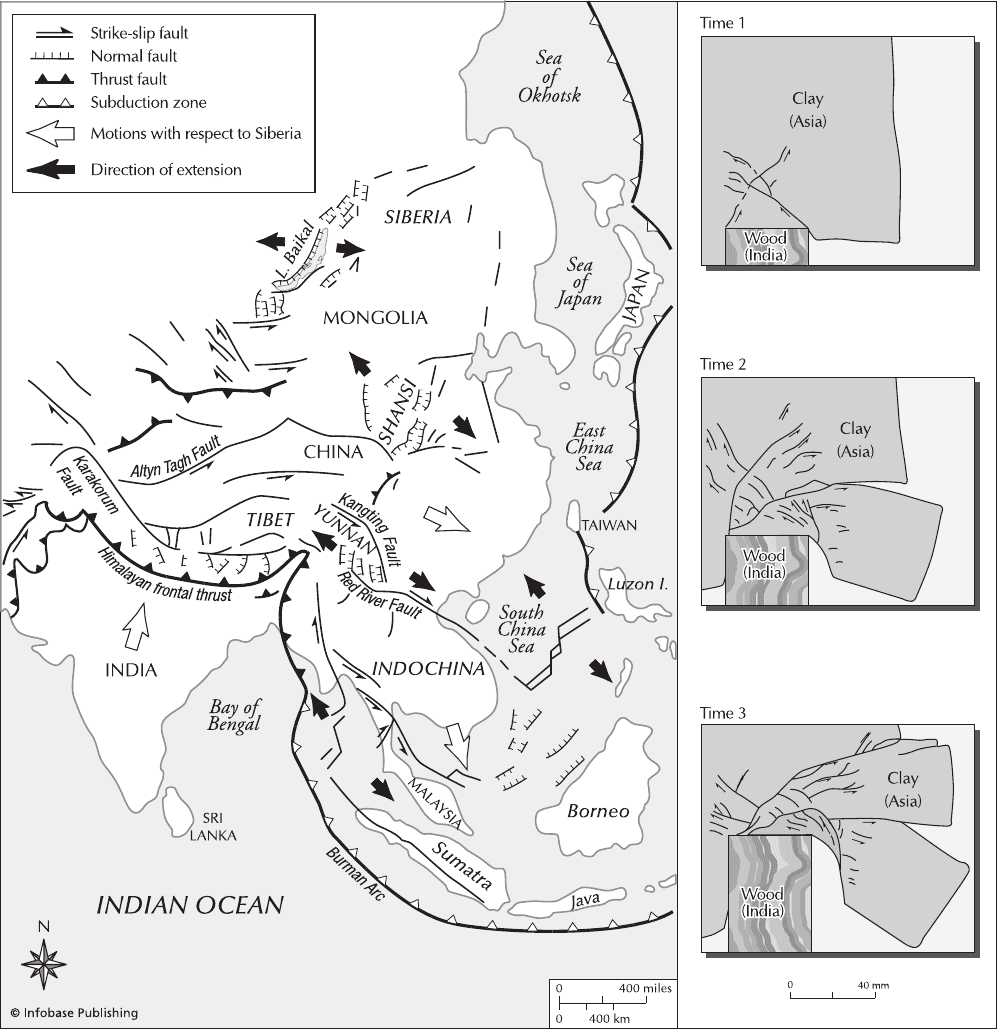
faults, one direction dextral and the other direction sinis-
tral, behind the collision zone. This zone of crossing strike-
slip faults is known as a syntaxis. If one side of the overriding
plate faces onto an ocean basin, this is called a “free face.”
the strike-slip faults that accommodate movement of land in
the direction of the free face will become very active, facili-
tating large-scale bulk movement of continent. The strike-slip
faults in the other direction will be less active. Once the first
Map showing the classic area for escape tectonics, the Himalayan orogeny. The Indochina block was forced out of the way of the impinging Indian plate
along the Red River Fault for about 25 million years and accommodating over 600 miles (1,000 km) of left-lateral strike-slip movement. When the Red River
Fault became inactive 20 million years ago, left-lateral movement shifted to the Altyn Tagh Fault which also underwent many hundreds of kilometers of
offset. A new fault connecting to Lake Baikal has initiated more recently. The three block diagrams show an analog model of escape tectonics. A wooden
block (rigid indenter) models India by being driven into a block of clay that models Asia. The left side of the clay is fixed, but the right side (free face) is
able to undergo tectonic escape. The sequence models the Himalayan collision.
80 extrusion tectonics
piece of continent escapes the collision, the old strike-slip
fault becomes inactive, and a new strike-slip fault begins to
extrude a second, deeper piece out of the way.
The best example of extrusion tectonics can be found
in the Himalayan orogeny. India is the rigid indenter, Asia
the overriding plate, and the Pacific Ocean the free face.
Upon impact of India with Asia, the huge Red River Fault
began sinistral strike-slip movement that continued for about
25 million years. It moved Indochina to the east and com-
pletely out of the way of the collision and rotated it from an
east-west orientation to a north-south orientation where it
presently lies. The Red River Fault became inactive, and the
Altyn Tagh Fault to the north then began sinistral strike-slip
movement and pushed central China, the second piece, east-
ward and out of the way. At present, the Altyn Tagh Fault is
becoming less active, and a new fault system that connects to
Lake Baikal and Kamchatka, far to the north is initiating.
Another example of escape tectonics is in the Zagros
orogeny. The Arabian crustal plate (rigid indenter) sepa-
rated from Africa and drove northward until it collided
with the margin of southern Asia. This collision produced the
Zagros Mountains of Iran and Iraq. As the two continents
pushed together, Turkey extruded westward and into the
eastern Mediterranean Sea (free face), into which it now
juts. Extrusion of Turkey westward is accommodated on the
North Anatolian Fault, which undergoes dextral strike-slip
movement and regularly produces some of the world’s dead-
liest earthquakes.
extrusive rock igneous rock that flows, or has flowed,
from a fissure or vent on Earth’s surface.
See also volcanic rock.
extrusive rock 81