
Gates A.E., Ritchie D. Encyclopedia of Earthquakes and Volcanoes
Подождите немного. Документ загружается.

103
Hakkoda volcano, Japan The Hakkoda volcano is com-
posed of stratocones and lava domes the highest of which is
Ootake. It is located 12.5 miles (20 km) southeast of Aomori
City in northeastern Japan. It has not been active in historic
times.
Hakone caldera, Japan The Hakone caldera is located
near Sagami Bay on the central island of Honsh¯u near
Tokyo. The caldera is thought to have formed through sev-
eral explosive eruptions. A large eruption, possibly phreatic,
is believed to have occurred perhaps 3,000 years ago, along
with a pyroclastic flow or landslide that created a natu-
ral dam and thus formed Lake Ashinoko. A lava plug formed
afterward. Apparently, no eruptions of lava have happened
here since approximately 950 b.c. Although no extremely
powerful eruptions have occurred at Hakone within historical
times, this caldera is interesting for its solfataric and seismic
activity. Minor earthquakes occurred in early 1917. Other
earthquakes in the 1950s and 1960s helped establish corre-
lations between seismic activity and very high hydrothermal
temperatures, as well as between earthquakes and intensified
activity of fumaroles. There are various explanations for
these correlations. One is that hot water or steam rising from
great depths causes earthquakes as it expands on the way to
the surface. In some areas, it has been suggestion, very hot
water underground weakens the rock so that strain is released
as earthquakes in these thermal areas. A worker was killed
Hakone in 1933 in an explosion at a solfatara.
Hakuun-dake See Daisetsu-Tokachi.
hanging wall The block of rock above the fault plane in a
dip-slip fault. See also footwall.
harmonic tremor (archaic) Also known as a volcanic
tremor, a harmonic tremor is a small earthquake, observed
in the vicinity of active volcanoes, that indicates molten rock
is flowing beneath the surface. Such a tremor has a frequency
of several cycles per second. Scientists are not certain how
harmonic tremors are generated, but the vibrations have been
linked tentatively to turbulence in magma flowing under-
ground and to the emergence of gas bubbles from the mol-
ten rock. Although eruptions do not necessarily follow the
occurrence of harmonic tremors, the 1980 eruption of Mount
Saint Helens in Washington State was preceded by har-
monic tremors that told geologists that magma appeared to
be forcing its way upward toward the surface.
See also seismology; volcanism.
Haroharo caldera, North Island, New Zealand The Haro-
haro caldera and the Okataina volcanic center are located
in the Taupo Volcanic Zone on New Zealand’s North
Island. The area is noted for abundant volcanic and geo-
thermal activity. Haroharo and Okataina have undergone
considerable seismic and volcanic activity in the past two cen-
turies. An eruption of Tarawera on the southern margin of
Haroharo in 1886 involved phreatic eruptions that were
generated when molten rock underground heated subter-
ranean water. There were apparently some early signs of an
approaching eruption, notably earthquakes, increased gey-
ser activity and rising temperatures at hot springs. The erup-
tion began an hour after a series of strong earthquakes on
June 10, 1886. It produced an estimated 0.3 cubic miles (1.3
km
3
) of ash in both summit and lateral explosions as well as
more than 0.5 cubic miles (2 km
3
) of basaltic lava. Two vil-
lages (Te Ariki and Te Wairoa) were buried, and more than
150 people were killed. A strong geyser, Waimangu, became
active in 1900, and very large hydrothermal explosions
occurred at the geyser in 1915 and 1917. This latter blast
occurred unexpectedly and hurled out rocks and mud, dam-
aging a government tourist department facility nearby. More
earthquakes took place in 1962, and in 1973 a small hydro-
thermal explosion at Waimangu followed an increase in
ground temperatures and in the activity of hot springs and
fumaroles. A fairly strong earthquake occurred about 100
miles (161 km) south-southeast of Waimungu approximately
H
a half-hour before the explosion, but the earthquake may
have been unrelated to the explosion. Earthquake activity
increased at Okataina in 1982 and 1983, and considerable
seismic activity continued through the late 1980s.
Hawaii See Hawaiian Islands.
Hawaiian Islands United States The Hawaiian Islands
constitute an archipelago in the midst of the Pacific
crustal plate and are the sites of some of the most inten-
sively studied volcanic activity. The relatively gentle char-
acter of eruptions of Hawaiian volcanoes, compared to the
more explosive and destructive activity of volcanoes such
as Bezymianny and Mount Saint Helens among many
others, makes them easy to observe. Hawaiian volcanoes
include Mauna Kea, the tallest volcano on Earth (from
its origin on the ocean floor); Mauna Loa, and Kilauea.
However, all Hawaiian Islands are of volcanic origin.
Unlike the magma that supplies volcanoes with histories of
explosive eruptions, Hawaiian magma tends to be low in
dissolved gases. It is also low in silica and rich in iron and
magnesium. lavas from Hawaiian volcanoes are generally
basaltic and extremely fluid. The Hawaiian chain includes
the Loihi Seamount, a volcano that represents the young-
est peak among the islands but that has not yet reached the
surface of the ocean.
Hawaii, the major island of the chain, is made up of
several volcanic structures: Kohala Mountains, at the
northern tip of the island; Mauna Kea, in the north cen-
tral sector; Mauna Loa, immediately to the south of Mauna
Kea; Kilauea, on the southeast shore; and Hualalai, on
the western shore near Kealakekua Bay. Mauna Kea is
the taller of the two principal volcanoes on the island (the
other principal volcano is Mauna Loa) and is thought to be
inactive. Mauna Loa is active and is situated atop two rift
zones trending northeast and southwest from the mountain.
These rift zones have emitted lava flows frequently in the
last two centuries, and in some cases, the flows from the
northeastern rift zone have come very close to the city of
Hilo, about 50 miles (80.5 km) northeast of the volcano’s
summit. The fast-flowing lava from Mauna Loa’s eruptions
may reach velocities of more than 30 miles (48 km) per
hour. In some locations where lava from Mauna Loa has
reached the sea, it cooled rapidly into dark volcanic glass
that has been fragmented by wave action and formed strik-
ing beaches of black sand. A spectacular eruption of Mauna
Loa in 1950 lasted two weeks and covered more than 30
square miles (78 km
2
) of the island with lava. Fountains
of molten rock shot several hundreds of feet into the air
from several miles of fissures along the southwestern rift
zone. The emissions of lava caused considerable property
damage and flowed across the coastal highway. Kilauea,
to the southeast of Mauna Loa, erupts more often than
Mauna Loa but is perhaps the safest active volcano on
Earth to approach because of its predictable and nonex-
plosive eruptions. On the floor of the Kilauea caldera is
a huge lava lake inside Halemaumaua Crater. The level of
the lava lake in the crater fluctuates. On several occasions
in the 20th century, lava has spilled out of the crater.
Most of the time, however, the lava remains at a safe level,
and sightseers may approach the rim of the crater in safety.
At night, visitors may see a dazzling display on the crater
floor as solidified lava on the surface cracks and allows the
glowing molten rock underneath to be seen, forming dra-
matic patterns of light. Two rift zones trending east and
southwest from Kilauea have been responsible for most
eruptive activity at the volcano in the recent past. A curi-
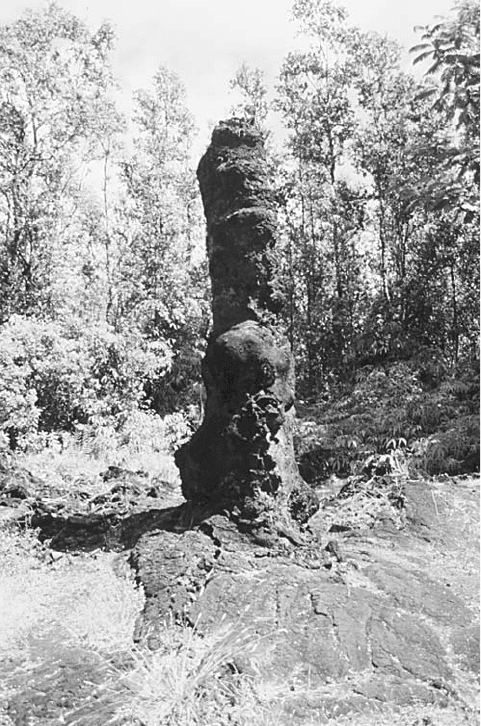
ous effect of the lava flows produced “lava fossil trees”
along the eastern rift zone where lava flowed around live
trees and sheathed their trunks. When the trees themselves
died and were carried away, the sheaths, or “lava trees,”
remained. These columnar formations may be seen at
Lava Tree State Monument. In 1790 along the southwest-
ern rift zone, toxic gas from an eruption caused numerous
deaths.
Oahu, site of the Japanese attack on the United States
naval base at Pearl Harbor in 1941, was formed by erup-
tions of two large volcanoes. One had its caldera where
the Waianae Range on the western side of the island stands
today. Mount Kaala, a flat-topped mountain approximately
4,000 feet (1,219 m) high at the northwest corner of the
island, comprises a portion of the original Waianae vol-
cano. The second major volcano caldera is thought to have
been located on the eastern side of the island at what is now
Kaneohe Bay along the Koolau Range. This latter volcano
is known for its great numbers of basalt dikes that may be
seen along roadsides in the eastern part of Oahu. The famous
Diamond Head appears to be the product of lesser and later
volcanism than that at Koo-Kohala Maunalau. Diamond
Head is part of a chain of volcanic formations that also
includes Sugarloaf and Round Top. Another chain of volca-
nic formations extends along the southeastern shore of Oahu
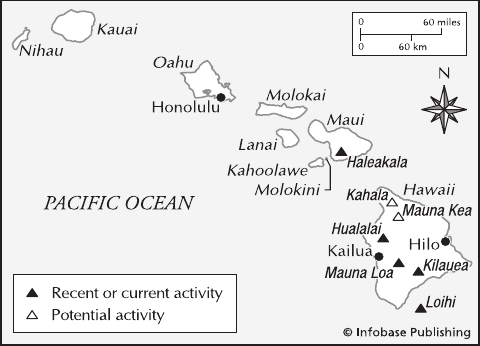
Map of the Hawaiian Islands showing the location of active and
potentially active volcanoes as well as several major cities
104 Hawaii
from Koko Head crater near Hanauma Bay to Makapuu
Head. Other craters on Oahu include Punchbowl (site of the
National Memorial Cemetery of the Pacific), Makalapa, and
Aliamanu.
The island of Kauai is the location of a single great vol-
cano called Waiualaele, more than 5,000 feet (1,524 m) high
and surmounted by a caldera some 10 miles (16 km) wide.
Rainfall has eroded the deep Waimea Canyon in the flank of
the volcano, exposing the layered evidences of past eruptions.
Erosion also has produced spectacular formations along
nearby Honopu Valley.
The island of Maui has two volcanoes. On the south-
eastern side of the island, Haleakala, the larger of the two
volcanoes at more than 10,000 feet (3,000 m) high, has an
exceptionally large crater and still emits steam from time to
time. A lava flow that passed through a breach in the crater,
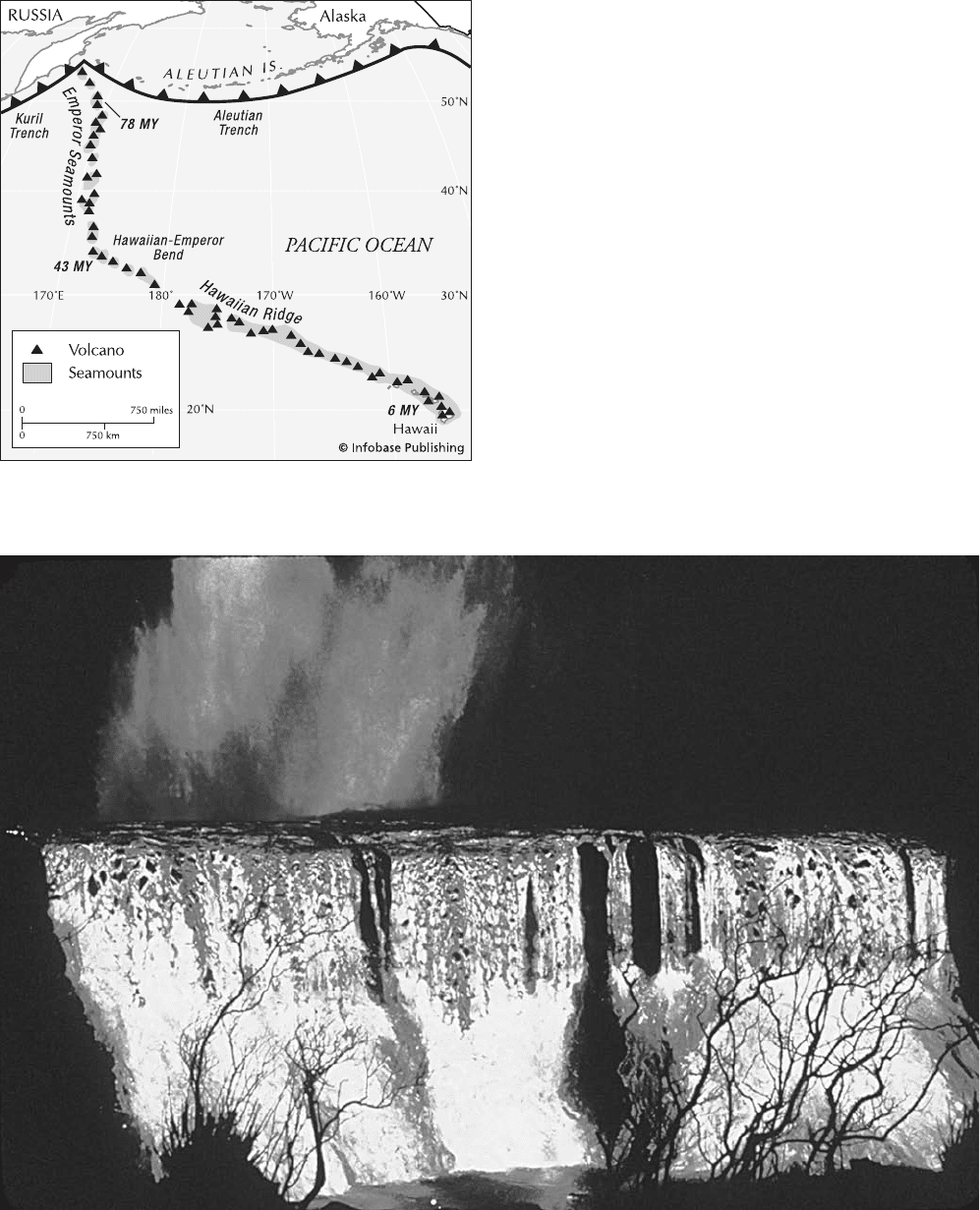
Map of the Hawaiian ridge and Emperor Seamounts in the Pacific
Ocean. As the Pacific plate moved over the Hawaiian hot spot, it left a
chain of seamounts. To the southeast, the volcanoes are progressively
younger.
A lava cascade (lava waterfall) at night in 1969. The lava flow is from Mauna Ulu, Phase 2, on Kilauea volcano, in Hawaii. The source of the lava is the
fountain in the background. (Courtesy of the USGS)
Hawaiian Islands 105
the Kaupo Valley gap, reached the sea. The other volcano
on Maui is West Maui, on the island’s northwestern side.
The summit of West Maui, Puu Kukui, is almost 6,000 feet
(1,830 m) high.
Molokai Island has two volcanoes and is remarkable for
its tall cliffs eroded by wave action along its shores. A com-
paratively recent addition to the island is the Kalaupapa Pen-
insula, formed by eruption of a small volcano.
tsunamis are an occasional hazard in the Hawai-
ian Islands, which stand exposed in mid-Pacific to seismic
sea waves accompanying earthquakes along the “Ring of
Fire” surrounding the Pacific Ocean basin. In 1946, a tsu-
nami resulting from an earthquake in the Aleutian Islands
caused extensive damage at Hilo; it attained great heights
at various points in the Hawaiian chain: 45 feet (14 m) on
the northern shore of Kauai, 55 feet (17 m) on the northern
coast of Hawaii and 35 feet (11 m) on the northwest coast
of Oahu. The islands were battered by another powerful tsu-
nami in 1960, this one approaching from the direction of the
Chilean
1960 earthquake. Waves reached heights of 35 feet
(11 m) on Hawaii, 13 feet (4 m) on Oahu, and 14 feet (4.3
m) on Kauai. Both waves among others caused significant
loss of life as well as property damage.
Most earthquake activity in Hawaii occurs in the vicin-
ity of the island of Hawaii. The documented history of earth-
quakes in Hawaii extends back to the early 19th century.
An earthquake on February 19, 1834, knocked down stone
walls on the island of Hawaii, stopped clocks, and made it
difficult for standing persons to remain upright. On Decem-
ber 12, 1838, another earthquake similar in its effects to the
1834 earthquake shook Hawaii. On April 2, 1868, one of the
strongest and most destructive earthquakes in the history of
Hawaii occurred near the southern coast of the island. The
earthquake caused heavy damage to wooden homes and straw
houses. Numerous walls were shaken down in Hilo, and
landslides occurred as well. Fissures formed in the ground,
and mud appeared in brooks. Effects of the earthquake were
especially remarkable at Kohala, where ground waves one
to two feet (0.3–0.6 m) in amplitude were reported, and the
shock stopped machinery at a sugar mill, including a big 75-
horsepower engine that was operating under a full head of
steam at the time of the earthquake. On Maui and Lanai,
more than 100 miles (161 km) from the epicenter, rumbling
noises were reported, and buildings shook. In Honolulu, the
shock was strong enough to stop clocks. The earthquake
was felt more than 300 miles (483 km) distant on Kauai and
Oahu.
On Hawaii, a tsunami estimated at 60 feet (18.3 m) high
or more came ashore along the south coast and reportedly
swept over the tops of palm trees; there were several fatali-
ties, and numerous houses were destroyed. This wave was 10
feet (3 m) high when it reached Hilo and eight feet (2.5 m)
high at Kealakekua. A fissure more than two miles (3 km)
long formed at Kohuku, and a volcanic eruption occurred
at this fissure on April 7. The earthquake was preceded by
foreshocks, one of which, on March 28, was sufficiently
powerful to knock down stone walls.
On April 26, 1973, an earthquake of magnitude 6.2,
centered near the northeastern shore of the island of Hawaii,
affected a large area and was felt as far away as Kauai. The
earthquake generated effects of Mercalli intensity VII and
caused an estimated $5.6 million in property damage in the
area of Hilo. There were 11 injuries, but no one was killed.
Two people died in the November 29, 1975, earthquake
(magnitude 7.2) that was felt all through the island of Hawaii
and also on Oahu, Molokai, and Lanai. Damage was esti-
mated at $4.1 million, including some $1.5 million in dam-
age from a tsunami that came ashore as a wave some 18 feet
(6 m) high near the epicenter of the earthquake. Numerous
foreshocks and aftershocks occurred, and a small erup-
tion was noted at Kilauea volcano less than an hour after the
earthquake.
See also plate tectonics.
Hayward Fault California The Hayward Fault extends
through the East Bay suburbs near San Francisco and was
responsible for powerful earthquakes in 1836 and 1868 that
destroyed buildings in San Francisco and Oakland. Although
less famous than the nearby San Andreas Fault, the Hay-
Lava from an eruption of Kilauea engulfed a tree and cooled around
it, leaving a fossilized lava tree when the rest of the lava flowed
away. (Courtesy of NOAA)
106 Hayward Fault
ward Fault has the potential to cause tremendous destruc-
tion in a future earthquake because the East Bay is so densely
populated. The fault underlies the University of California
campus at Berkeley and lies directly under the Memorial Sta-
dium. Also, many major highways in the San Francisco Bay
area either cross the Hayward Fault or may be affected by
damage from any strong earthquakes involving that fault
in the future. Among medical facilities in Contra Costa and
Alameda Counties, eight acute care hospitals, particularly
important in the aftermath of any major earthquake, are at
risk because they are located within a mile of the Hayward
Fault. These hospitals represent about 30% of such hospitals
available to the counties. One projection of the effects of an
earthquake of Richter magnitude 7.5 along the Hayward
Fault puts the possible number of fatalities as high as 7,000,
with the potential for more than 13,000 injuries requir-
ing hospitalization and lesser injuries affecting more than
130,000 individuals. This projection involves an earthquake
in early afternoon. Another projection for the hours just after
midnight puts fatalities lower, at perhaps 1,500, and injuries
at about 50,000, with more than 4,000 of those requiring
hospitalization. An earthquake of magnitude 7.5 on the Hay-
ward Fault is expected to cause the greatest damage on the
west side of the fault, within an area about five miles (8 km)
from the fault. This area encompasses such heavily settled
areas as San Leandro and San Lorenzo.
heat flow The flow of heat from Earth’s interior to the
surface varies greatly from one location on the surface
to another. The total heat release at the surface has been
expressed as the sum of the heat transmitted by conduction
(transmission of heat directly through stationary masses of
rock) and heat carried by mass transport (that is, the migra-
tion of magma from lower levels to the surface). Some areas,
such as active volcanoes, represent an unusually vigorous flow
of heat to the surface, whereas other parts of Earth’s surface
are relatively cool. The rate of heat flow to Earth’s surface is
measured in units called HFUs (heat flow units). One HFU
equals one-millionth (that is, 0.000001) calorie per square
centimeter per second. Depending on how it is estimated, the
mean global rate ranges between about 1.0 and 1.5 HFUs,
although in some areas of active volcanism and hydrother-
mal activity, measurements well above 200 and even 700
HFUs have been made. Various factors are believed to influ-
ence the rate of heat flow. For example, radioactivity and the
heat released by decay of radionuclides may vary from one
location to another. Spatial variations in temperature of the
mantle also may account for some differences in heat flow.
Heat Flow shows great variability in North America, with the
western half of the nation generally showing higher and more
variable HFU values than the east. The dividing line between
east and west has been drawn approximately at the east-
ern boundary of the Colorado Plateau. The higher heat
flow in the west is reflected in the relative abundance of hot
springs, geysers, and other hydrothermal activity there, as
well as the existence of numerous volcanoes, both active and
extinct. Eurasia likewise shows great geographical variations
in heat flow. hot spots are found, for example, in the Alps,
the Carpathian Mountains, and the Caucasus Mountains and
in Russia’s Kamchatka Peninsula, with its numerous volca-
noes. High heat flow shows up in areas of strong hydrother-
mal activity, such as Larderello in Italy.
Some highly radioactive rock units also have high heat
flow. Certain granites with high uranium content, such as the
Conway Granite, New Hampshire, have high enough heat
flow to be commercial.
Hebgen Lake Montana, United States On August 17, 1959,
an earthquake of magnitude 7.1 on the Richter scale and
locally intensity X on the Mercalli scale struck Montana. It
was the largest historical earthquake in Montana. Fortunately,
it was in a very sparsely populated camping area and only 28
people were killed. It caused dramatic changes in the shoreline
of the large recreational Hebgen Lake. The lake bed tilted and
displaced the lake toward the north, submerging docks and
other waterfront property along the northern shore and lifting
the southern shore out of the water. The earthquake caused
considerable disturbance in the waters of the lake creating a
seiche with waves up to 20 feet (6 m) high and a period of 17
minutes. The seiche was still detectable 11 hours later. Near the
lake, an escarpment some 10 feet (3 m) high formed along a
fault more than 10 miles (16 km) in length. This same earth-
quake caused a huge rockslide, 2,000 feet (610 m) by 1,300
feet (396 m) and containing almost 40 million cubic feet (1.17
million m
3
) of rock, along the south wall of the gorge of the
Madison River in the Madison Range. This rockslide dammed
the river and created a lake that was some 200 feet (61 m) deep,
named Earthquake Lake. The lake grew to such proportions as
to threaten to undermine the weakened dam of Hebgen Lake.
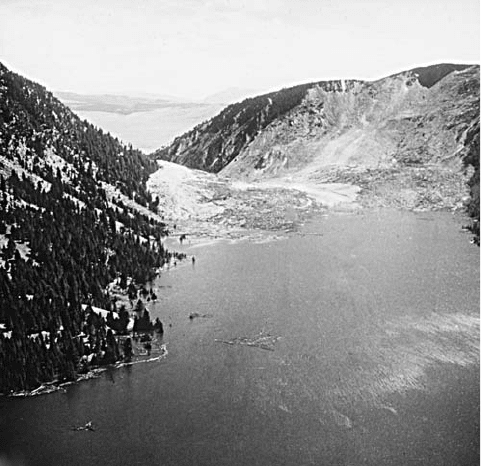
A landslide generated by an earthquake dammed the river to make a lake,
Hebgen Lake, Madison County, Montana, in 1959. The light-colored area
on the hillslope to the left is the landslide scar, and the light-colored area
that dams the lake is the landslide deposit. (Courtesy of the USGS)
Hebgen Lake 107
The Army Corps of Engineers cut a 250-foot (76-m) channel
across the slide to release the water from Earthquake Lake. If
the dam of Lake Hebgen had collapsed, damage would have
been far greater.
More than 20 feet (6 m) of vertical displacement was
seen near Red Canyon Creek. Part of State Highway 287
was lost into Hebgen Lake during the earthquake, and dam-
age to roads and timber alone was estimated at more than
$11 million. This same earthquake also shook Yellowstone
National Park severely, and fresh geysers started erupt-
ing there whereas others became inactive. A ranger station
at Yellowstone reported more than 150 aftershocks dur-
ing the first day following the main shock, and aftershocks
kept occurring for months thereafter. Some of the aftershocks
were themselves notable earthquakes.
Hector Mine earthquake, California On October 16,
1999, an earthquake of Richter magnitude 7.1 occurred.
The earthquake was on the Lavic Lake Fault in the southern
Mojave Desert where 2.8–4.7 feet (.85–1.4 m) of right lateral
strike-slip offset was observed. Damage to an Amtrak line
was reported.
Heimaey volcano, Iceland The 1973 eruption of the vol-
cano Heimaey near the port of Vestmannaeyjar in Iceland’s
Vestmannaeyjar archipelago is one of the most famous erup-
tions of modern times and one of a series of more than a
dozen eruptions in Iceland since midcentury. The island is
about five miles (8 km) long by three miles (4.8 km) wide and
is made of basalt only several thousand years old.
The eruption of Heimaey began in the early morning of
January 23, 1973, on the east side of the island along a fis-
sure roughly north-south and extending more than a mile in
length. fire fountains emanated from the fissure at first,
and volcanic activity occurred underwater at the north and
south ends of the fissure for the first several days. Later, the
eruption became concentrated in a relatively small portion
of the fissure near the community of Helgafell. In about two
days, a cinder cone more than 300 feet (91 m) high formed.
This cone was named Eldfell (fire mountain) and expelled
tephra at a rate of more than 100 cubic yards (79 m
3
) per
second. The tephra fell in large amounts on nearby Vestman-
naeyjar. Less than a month after the eruption began, the vol-
cano’s output of tephra diminished, and lava began to flow
from the volcano. A large lava flow encroached on Vest-
mannaeyjar, and it looked for a time as if the lava might fill
the harbor on the north side of the island. submarine volca-
nism continued during this period and broke a power cable
that carried electricity from the mainland as well as a fresh-
water pipeline that served the island.
In late February, Eldfell stood more than 600 feet (183
m) tall, and lava was flowing gradually along a front, ranging
from north to east of the volcano. Within several weeks, this
flow stood more than 60 feet (18.3 m) high at some locations
along its front. The average depth of the flow exceeded 100
feet (30 m), and at places the lava was more than 300 feet (91
m) deep. By April, the lava flow was about 1,000 yards (925
m) long and equally wide and moving at a speed of several
yards daily. Another lava flow originated from the volcano in
late March and began to move northwest. This flow destroyed
numerous homes and the town power facility. Portions of the
cone broke away and were carried away with the initial lava
flow, including one especially large block known as Flakkar-
inn (the wanderer). Submarine volcanism continued through
late May, and the eruption finally subsided in July.
The eruption produced an estimated 300 million cubic
yards (237 million m
3
) of lava and more than 25 million cubic
yards (20 million m
3
) of tephra. Among the other products of
the eruption were concentrations of poisonous gases, mostly
carbon dioxide, with some carbon monoxide and methane
that accumulated in low portions of eastern Vestmannaeyjar
and killed one person. The origin of the poisonous gases is
uncertain, although it appears likely that the gases migrated
from the conduit of the volcano through older volcanic rock
and into Vestmannaeyjar. Bulldozers pushed a wall of tephra
into place between the vent and the community to halt the
gas, and a lengthy trench was dug to carry away steam, but
neither of these measures worked with total effectiveness. A
rapid evacuation from the island saved almost all of the more
than 5,000 residents of the island from the harm. Property
damage was extensive. Residences near the volcano were
destroyed by tephra and lava. Flows of lava from the volcano
also destroyed a fish-freezing facility, caused damage to two
other such facilities and wrecked a large number of homes in
the eastern portion of the community.
The 1973 eruption on Heimaey was notable for efforts
to counteract and control the flows of lava. Experiments and
observations performed early in the eruption of Heimaey, and
also at the earlier eruption of the volcano Surtsey, indicated
that spraying seawater on the lava could cool and harden the
molten rock and thus impede its flow. Because the north-
ward- and eastward-moving lava posed the greatest threat
to property and activities on the island, including the opera-
tion of the harbor, lava-control efforts concentrated on that
front. One approach was to spray water on the advancing
lava. Another was to build a barrier of lava on the northwest
side of the lava flow to block its progress into Vestman-
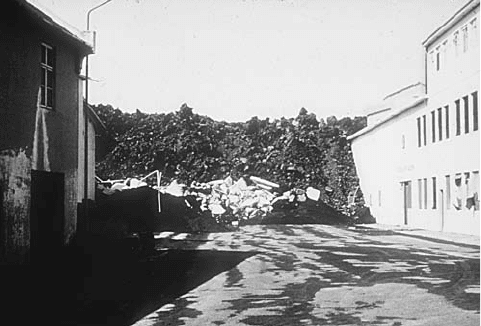
An aa flow advances through a town at Heimaey, Iceland, in 1973. Notice
the white rubble at the base of the black lava flow. It is a house that has
just been crushed. (Courtesy of the USGS)
108 Hector Mine
naeyjar. Early in February, about two weeks after the erup-
tion started, a water-spraying operation began. Results were
encouraging, and in March a ship capable of directing large
amounts of water onto the lava flow was moved into the har-
bor. Additional pumping equipment was brought in from the
United States. Water was pumped straight onto the lava near
the harbor and was carried to various portions of the flow
through a system of metal and plastic pipes almost 20 miles
(32 km) long. The lava-control effort used a combination of
water-spraying and earth-moving activities.
The cooling operation caused a dramatic change in the
appearance of the lava flow. When left to cool naturally, the
lava solidified into a reddish mass with a surface covered with
volcanic bombs and varying about three feet in relief. After
water cooling, the surface turned gray or black and displayed
much greater relief, as much as 15 feet (5 m). Cooling the
lava with water created peculiar difficulties, such as reduced
visibility caused by the large quantities of steam produced by
the water contacting the molten rock. Some 8 million cubic
yards (6.3 million m
3
) of water were directed onto the lava
flows at Heimaey and are through to have solidified some
5 million cubic yards (4 million m
3
) of lava. Water cooling
appears to have accelerated the solidification of the lava by as
much as 100 times. The cooling operation lasted until early
July and cost less than $2 million.
One beneficial result of the 1973 eruption of Heimaey
was a heating system for Vestmannaeyjar that utilized heat
from the still-cooling lava flows. Initial investigations indi-
cated that heat from lava and scoria deposits could be used
to supply space heating for the community. Early experi-
ments along these lines met with success, and houses began
to be connected with a heating system that exploited the heat
from the lava and tephra. Projects were under way by 1979
to exploit heat in several areas of the fresh lava flows. In each
area, a set of steam wells extending down into the tephra was
connected to a heat exchanger that circulated heated water
through the town central heating system. This system was
serving almost all the homes on Heimaey by the early 1980s.
The evacuated population of Heimaey returned gradually
to the island after the 1973 eruption. Approximately 80% of
the island residents returned by early 1975. Hundreds of new
homes were built to replace those destroyed by the eruption,
and tephra deposited by the volcano was used as landfill for
the building of many of those homes. Tephra also was used
to expand runway facilities on Heimaey’s airport, and lava
from the 1973 eruption now serves as a breakwater in the
harbor.
Hekla volcano, Iceland Hekla, or Gateway to Hell, as the
first Icelanders called it, is the most active volcano in Ice-
land. Since the settling of Iceland in a.d. 1104 it has erupted
167 times, including 15 major eruptions, in 1104, 1158,
1206, 1222, 1300, 1341, 1389, 1440, 1510, 1554, 1597,
1636, 1693, 1725, 1766, 1845, 1878, 1913, 1947, 1970,
1980, 1981, 1991, and others. The 1300 eruption lasted a full
year and is the second largest tephra eruption in Iceland’s
history. The 1510 eruption is reported to have shot rocks 25
miles (40 km) away killing one person in the process. The
1693 eruption produced some 75,000 cubic yards (60,000
m
3
) of tephra per second. The eruption lasted for seven
months. The 1766 eruption was the largest observed. bombs
as long as 18 inches (46 cm) were shot nine to 12 miles (14.5
to 19 km) away. Lava poured out in all directions and killed
much livestock and wildlife. The 1845 eruption of Hekla
began on September 2 and was preceded by strong earth-
quakes. Tephra was extruded at a rate of 25,000 cubic yards
(20,000 m
3
) per second at the initiation of the eruption. One
flow of lava from this eruption was measured at 22 miles
(35 km) long, one mile (1.61 km) wide at one point, and 40
to 50 feet (12 to 15 m) deep. No humans were reported killed
in this eruption, although numerous cattle died.
One remarkably large mass of pumice, its weight esti-
mated at almost a half-ton, was carried four to five miles
by this eruption. Ice and snow that melted in the eruption
flooded rivers. Perhaps the most destructive aspect of the
eruption was its effect on pastureland, much of which was
covered by volcanic ash and thus made unusable by animals.
Even where ash did not cover the land, herbage became toxic
and killed cattle that ate it.
After 100 years of inactivity, Hekla erupted in 1947. It
began with earthquakes and a 19-mile (31 km)-high eruption
column. fissures opened and basaltic lava poured out at
a rate of 4,400 cubic yards (3,500 m
3
) per second. Several
craters formed during this eruption. The ash from the 1970
eruption had such a high fluorine content that some 7,000
sheep in the area died of poisoning.
The most recent eruption of Hekla was in the winter of
2000. Earthquakes preceded 45,000-foot (13,716 m) steam
columns that preceded the fissure eruptions. Lava poured out
of the fissures and flowed about one meter per minute and
was three miles (5 km) long at the time of writing.
Helike See Corinth.
Herculaneum See Pompeii and Herculaneum.
Herdubreid volcano, Iceland A table mountain, Her-
dubreid is believed to have been formed by eruptions under-
neath a glacier, thus explaining its flattop.
Hibok-hibok volcano, Philippines This stratovolcano
is also called Catarman and has had four historic erup-
tions. The eruptions were in 1827, 1862, 1871–75, and
1948–53. The 1862 eruptions caused 326 fatalities from
NUÉE ARDENTEs. The 1871–75 eruption produced the lava
dome called Mount Vulcan. sulfur was mined from one
of the craters prior to the 1948–53 eruption.
Hilo volcanoes and tsunamis, Hawaii, United States The
city of Hilo has a history of trouble from volcanic eruptions
and tsunamis. For example, a lava flow from Mauna Loa
in 1933 posed such imminent danger to Hilo that the U.S.
Army Air Force attempted to halt or divert the flow by drop-
ping aerial bombs on selected locations. Whether as a result
of the bombardment or from other causes, or possibly both
reasons, the lava flow stopped. Another lava flow in 1881
also threatened Hilo but stopped near the edge of the city.
The tsunami that struck Hilo on April 1, 1946, did extensive
Hilo 109
damage in the downtown area and is believed to have killed
more than 175 people. Another tsunami, this one from the
Chilean
1960 earthquake, killed more than 60 people in
Hilo and came ashore as a wave estimated at 30 feet (9 m)
high.
Hobicha See Asawa.
Hokuchin-dake See Daisetsu-Tokachi.
holohaline The technical term for a glassy volcanic rock.
Hood, Mount Oregon, United States One of the most
beautiful volcanoes, Mount Hood stands more than 11,000
feet (3,353 m) tall and is located near Portland and other
major urban areas in the Pacific Northwest of the United
States Mount Hood had four major eruptive periods in
the past 15,000 years, and further activity is possible. Dur-
ing the last eruptive period in the late 18th and early 19th
centuries (250 to 180 years ago). Numerous
NUÉE ARDENTEs
and lahars were generated along the southwest flank of the
mountain. A small dome was formed during this eruption.
Eruptions about the time of the Civil War cast out pumice.
Because Mount Hood is located in such a populated area, it
is a potentially very dangerous volcano.
Hooke’s law A spring law. There is a straight line relation-
ship between stress and strain. In other words, the amount
that the spring is stretched is directly proportional how hard
the spring is pulled. This type of deformation is referred to
as elastic. Rock deforms in this manner as seismic wave pass
through it. It stretches or compresses as the wave is passing
through and then returns to its original shape after the wave
is through.
hornblende A common mineral of the amphibole group, this
iron- and magnesium-rich silicate mineral with a double-chain
structure is black and elongate and has a distinctive diamond
or rhombic shape. It is common in such intermediate igneous
rocks as diorite, andesite, dacite, granodiorite, and some
granite.
hornito A tall, thin spatter cone, hornito translates as
“small oven” from the Spanish. They typically resemble chim-
neys rather than the conical shape of most spatter cones.
horse A block of rock surrounded on all sides by related
faults. The term horse was defined for thrust-fault sys-
tems where slivers of rock are systematically stripped up
along a fault and stacked like shingles on a roof. The slivers
are the horses because they are bounded on all sides by thrust
faults. The stack is called a duplex structure. Later, the horse
and duplex terminology was applied to strike-slip systems as
well. The San Andreas Fault system has strike-slip horses
and duplexes.
horst A fault block left elevated while the land around
it drops down as the result of faulting. Normal faults form
the slopes on either sides of a ridge and drop the land surface
down to form the surrounding valleys. The classic examples
of horsts are the ranges in the Basin and Range Province.
The basins there are grabens. These normal faults produce
earthquakes, and an area characterized by horsts and grabens
is commonly associated with basalt and sometimes rhyo-
lite volcanoes.
hot, dry rock A plan to tap geothermal energy involves
pumping water underground into areas of hot, dry rock,
where temperature increases quickly with depth. The rocks are
fractured by pumping fluid into them down a well (hydro-
fracturing), and water is circulated through the fractured
rock. The heated water then is returned to the surface through
a separate conduit in the form of liquid water or steam and
used to generate electricity.
hot spot Otherwise known as a mantle plume, an area
of intense, localized igneous activity. Hot spots may occur
deep beneath the interior of crustal plates, far from the well-
defined belts of volcanic activity that commonly mark plate
boundaries. The Hawaiian Islands have been generated
by the movement of a crustal plate over an underlying hot
spot. There is a chain of islands that are smaller to the north-
west and connect to a chain of seamounts (both Hawaiian
and Emperor Seamounts) that extend across the Pacific
crustal plate. The islands and seamounts are progressively
older to the northwest. The trajectory of the seamounts and
age relations show that the Pacific plate is moving northwest
at about 4 inches (10 cm) per year. Although the origins of
hot spots are not entirely understood, it has been shown that
they are located above plumes of rock rising through the
mantle of Earth.
See also plate tectonics.
Huaraz earthquake, Peru On May 31, 1970, a devastat-
ing earthquake of magnitude 7.8 struck Huaraz, Peru. It
killed some 66,794 people and caused more than $250 mil-
lion in property damage. Several towns near the epicenter
were essentially destroyed. The earthquake triggered both
landslides and floods from backed-up rivers. This earth-
quake was one of the greatest disasters to strike the Southern
Hemisphere.
Huascarán avalanche, Peru Some say that it was a minor
earthquake that began a series of cataclysmic events that
devastated a coastal area of Peru, in 1962 but it may have
simply been a melting glacier. On January 10, 1962, at 6:13
p.m., 3 million tons of ice from Glacier 511 broke loose at
an elevation of 21,834 feet (6,550 m) and barreled down the
steep slopes of the Andes Mountains. The ice broke loose
a large amount of rock and soil and then dropped into the
gorge of Callejón de Huailas at speeds of hundreds of miles
per hour, becoming a true sturtzstrom. The wind gener-
ated by the mass reached hurricane-force and swept up trees,
sheep, and anything else not tied down. The avalanche col-
lected all varieties of debris, including houses from the town
of Yanamachico, where 800 residents were killed. As it
slowed to 60 miles per hour (100 km/hr) into a debris ava-
lanche, it demolished the town of Ranrahirca, with 2,700
110 Hobicha
residents, before coming to rest. The melting ice combined
with soil and rock dust generated by the enormous impacts
to form waist-deep mud. In all, more than 3,500 people lost
their lives in this catastrophe.
Hungary Hungary is a landlocked country in eastern
Europe in the southern part of the continent. It is gener-
ally flat with thinner than normal crust and pieces of both
Africa and Europe within its geology. It has no current vol-
canic activity and is considered to be of moderate seismic
risk. Seismicity is primarily in the northwestern part of the
country, along a border with the Alps (Balkans). Hungary
also has a lesser area of seismicity along its eastern margin
in the Carpathian (Transylvanian) Mountains. The oldest-
documented earthquake was in the Szombathely area on Sep-
tember 7, a.d. 456. It had an estimated modified Mercalli
intensity of IX and a Richter magnitude of 6.1. Many peo-
ple were reportedly killed. The city that has most commonly
been struck by earthquakes in Komaron (events occurred in
1599, 1763, 1783, 1806, and 1851). The strongest event was
on June 28, 1763, with a modified Mercalli intensity of X
and an estimated Richter magnitude of 6.3. Some 63 people
were killed in this earthquake, and 102 people were injured.
The strongest modern quake was in Pishkolt in 1834, with
an estimated Richter magnitude of 6.8. Most earthquakes in
Hungary, however, and 5.5 or less, and recurrence of these
larger earthquakes is typically one or two per century.
hydrofracturing Pumping water into the ground at high
pressure can cause the rock to fracture. If this fracturing is
large enough, it produces earthquakes. An example of earth-
quakes resulting from this process was inadvertently tested in
Denver, Colorado. At the Rocky Mountain Arsenal, deep
holes 11,800 feet (3,600 m) were drilled for waste disposal.
The waste was pumped down (injected) the wells at high pres-
sure. Soon thereafter, earthquakes began to occur regularly in
Denver. These earthquakes (up to 4.3 on the Richter scale)
were large enough to cause concern among the local residents.
The relation was suspected and injection was suspended after
almost three years of operation. When the injection stopped,
so did the earthquakes. A similar situation occurred in Cleve-
land, Ohio. The relationship was not quite as clear.
hydrothermal activity In general terms, hydrothermal
activity is any process involving extremely hot water under-
ground. Hydrothermal activity is involved in the deposition
of numerous minerals, including quartz, gold, and galena,
a widespread one of lead. Hydrothermal activity differs from
geothermal activity in that the latter involves the movement
of the waters and need not involve heating of water by con-
tact with a still-hot body of igneous rock. Hot spring activ-
ity is also related to hydrothermal activity.
See also geothermal energy; geyser.
hypabyssal Refers to a shallow pluton into volcanic field.
As magma feeds volcanoes, some does not make it out of the
volcano. Instead, it may intrude the surrounding volcanic
strata as a pluton. To be hypabyssal, it must be very shallow.
hypocenter Also known as the focus, the hypocenter is
the underground point of origin of an earthquake and where
the fault moved.
See also seismology.
hypocenter 111