
Gates A.E., Ritchie D. Encyclopedia of Earthquakes and Volcanoes
Подождите немного. Документ загружается.

Falcon Island Tonga Also known as Fonua Foo, Fal-
con Island has been emerging and disappearing beneath the
ocean surface for decades. HMS Falcon charted the island
in 1865 and described it as a shoal. Eruptions in 1885 pro-
duced a cone approximately 300 feet (91 m) tall, but erosion
destroyed much of the cone within months after eruptive
activity ceased, and nine years later the cone had been
reduced to a shoal again. Another eruption in 1896 raised a
small cone about 100 feet (30 m) above the sea, but this too
was destroyed in a matter of several years. Eruptions in 1927
and 1928 produced an island more than two miles (3 km)
long, but a quarter-century later, the island had vanished.
Fantale caldera, Ethiopia The Fantale caldera is located
in the main Ethiopian Rift near the point where the Great
Rift Valley joins the Afar Depression. Although Fantale
does not appear to have been an especially destructive vol-
cano in terms of fatalities and property damage, it appar-
ently has a notorious reputation in the surrounding area,
where parents are said to warn ill-behaved children that they
will melt like the volcano. An eruption in the 13th century
reportedly destroyed a village and a church. Several lava
flows occurred in the vicinity in 1820. Minor fumaroles
were observed at numerous places in the caldera in 1930,
and highly energetic fumarolic activity occurred in 1960, but
these observations are not thought to represent a great depar-
ture from normal activity.
Farallon crustal plate A lithospheric (tectonic) plate of
Earth that was believed to have occupied the space between
the Pacific crustal plate and the North American
crustal plate. It was located off what is now the coast of
California. The Farallon plate apparently was subducted
and consumed as North America advanced westward. The
subduction and destruction of the Farallon plate is thought
to have been responsible for widespread volcanic activity in
prehistoric California.
See also plate tectonics.
fault A break in Earth’s crust along which displacement of
rock occurs. Perhaps the world’s most famous fault is the San
Andreas Fault, which lies along California’s Pacific coast
for several hundred miles and is responsible for the earth-
quake that destroyed much of San Francisco and neighbor-
ing communities in 1906. faults are abundant in mountain
belts and deep basins, although they also may occur in some
flatlands. Some faults extend for hundreds of miles across
Earth’s surface and manifest themselves in dramatic ways.
Other faults may be comparatively small.
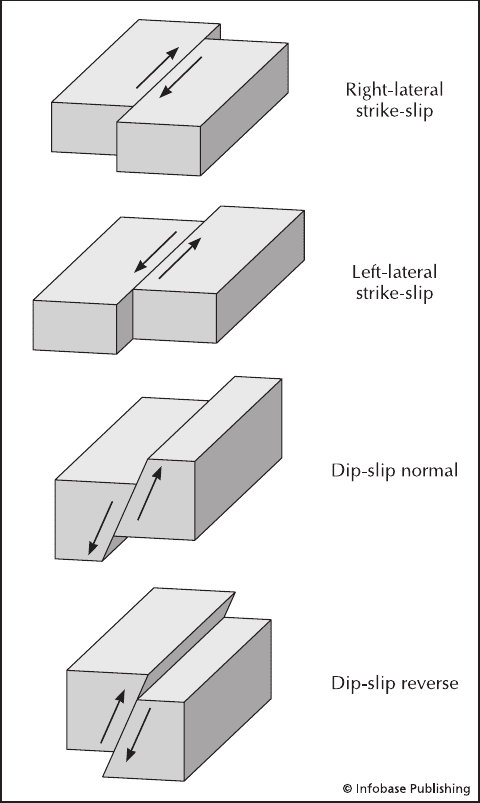
Faults are described as having strike (the compass direc-
tion relative to north) and dip (the angle of inclination or
slope relative to horizontal). Motion, or slip, can occur in
several directions along an active fault, and the various
kinds of fault are named accordingly. A strike-slip fault
exhibits horizontal or lateral movement (along strike direc-
tion), whereas a dip-slip fault displays vertical movement
(along dip direction). An oblique-slip fault shows characteris-
tics of both dip-slip and strike-slip faults. A normal fault is a
type of dip-slip fault characterized by the rocks moving nor-
mally with respect to gravity. If the fault is viewed as a hill,
the rock on it falls down the hill just as gravity requires. In a
reverse fault, rocks above the fault plane move up the hill
which is the reverse of gravity.
There are two types of strike-slip faults as well. The
faults are lines on a map or on the ground. The determina-
tion is made by standing on one side of the fault and looking
across to the other side. If the opposite side of the fault moves
to the left, it’s a left-lateral fault. If it moves to the right,
it’s a right-lateral fault. Oblique-slip faults can be named
by the components of movement.
Some faults are clearly visible on Earth’s surface. Evi-
dence of them may take such forms as displaced hills, offsets
in a shoreline across a fault, offsets in rivers, and elongated
lakes along faults (for example, Lake San Andreas near San
Francisco). Other faults are less evident, however, and in
many parts of the world—notably the eastern United States,
where bedrock lies buried under deep layers of sediment—
F
83
active faults may go unsuspected until movement along them
generates an earthquake. This was apparently the case with
the Charleston, South Carolina, earthquake of 1883,
which destroyed a large portion of the city, and the extremely
powerful earthquakes of 1811–12 in the New Madrid
Fault Zone in the Mississippi Valley.
There are various ways to identify an active fault and
estimate its potential for surface rupture in future earth-
quakes. One approach is to study the history of faulting and
movement. Another is to extreme ongoing earthquake activ-
ity and recurrence intervals (how often) for earthquakes.
Measurements of strain by geodetic surveys are also use-
ful. It is not always easy to differentiate between an active
and an inactive fault because a single fault may vary greatly
in its behavior over time. Whereas some faults are clearly
active because they display measurable creep or generate
frequent small earthquakes, not all faults are so consistently
active. A fault that has shown no activity for many centu-
ries may reactivate suddenly and slip 30 feet (9 m) or more
in a single event. The determination of a fault as active or
inactive may depend also, in part, on how much harm the
fault may cause if it should move significantly again. A fault
located near a nuclear power station, for example, may be
evaluated on a different basis than a fault that poses less of
a potential hazard to human activities. The evaluation of
faults as active or inactive is made harder by the fact that
not all active faults manifest themselves on the surface.
It is important to determine the slip rate along a fault in
projecting future activity. The slip rate is a measure of how
fast movement is occurring along a fault. It is also important
to know how often earthquakes occur along a fault and how
powerful the earthquakes are, as well how much slip occurs
per earthquake. The slip rate can be derived from a study of
recently formed features along a fault. The slip rate, however,
represents only an average over time of movement along the
fault and is not necessarily steady. Along a given fault, the
slip rate may represent steady activity over a certain period or
a few episodes of comparatively great and abrupt movement.
In other words, a fault may be very (even catastrophically)
active at some times and quiescent at others. As a rule, faults
along the boundaries of major plates of Earth’s crust exhibit
greater slip rates than faults elsewhere. In southern Califor-
nia, slip rates tend to be greatest along the San Andreas and
San Jacinto faults.
A fault’s potential for generating destructive earthquakes
may be judged partly on the basis of earthquake activity
recorded by instruments. If such activity is clearly associ-
ated with a fault on an ongoing seismological record, then
this information can help in associating the hypocenters of
earthquakes with a particular fault at depths of a few miles
or less below the surface. When numerous earthquakes can
be linked to a given fault in this way, with their hypocenters
on the fault at depth, then it can be concluded that the fault
is capable of generating more earthquakes in the future. This
approach cannot be used reliably to estimate a fault’s poten-
tial for destructive earthquakes in all cases, however, because
a fault can be quiescent but remain seismogenic, or capable
of earthquake activity. Moreover, even an active fault is not
necessarily dangerous to lives and property. A fault that gen-
erates many small earthquakes, for example, may pose lit-
tle or no danger to residents of the area. Even when a fault
exhibits surface rupture, its activity may be so gentle as to
pose no particular threat to the surrounding community.
Sometimes risk assessment for a seismogenic fault
requires estimating the maximum earthquake that the fault
could produce. Here, the historical record of seismic activ-
ity is important because the magnitudes of earlier earth-
quakes may provide guidance in estimating the possible
strength of other seismic events to come. (The strength of
the Fort Tejon earthquake, for example, has become a
benchmark to estimate the magnitude of future major earth-
Block models of the various types of faults. Strike-slip faults have
only lateral movement. Whether they are left- or right-lateral can be
determined by standing on one side of the fault and looking across to
the other. If the opposite side moves to the left, it is a left-lateral fault; if
it moves to the right, it is a right-lateral fault. Dip-slip faults only move
vertically and are classified based on gravity. It is normal for objects to
slide downhill and reverse for objects to slide uphill (the hill being the
fault plane).
84 fault
quakes in southern California.) Geologists also may find it
helpful to compare the history of seismic activity along a
particular fault with the history of another fault compara-
ble to it. The behavior of another fault under similar condi-
tions may provide clues to the behavior of the specific fault
concerned. The dimensions of a fault may provide some
clue to the magnitude of future major earthquakes because
big earthquakes are often associated with major faults. In
several studies, the length of a fault and especially its sur-
face rupture has been correlated with magnitude of earth-
quakes. A fault’s dimensions are not a completely reliable
guide to its seismogenic potential, however, because a fault
may not be traceable for its entire length at the surface
and because it is often difficult to foresee how far surface
rupture may extend along a fault in an earthquake. In that
event, the historical record may provide a better estimate of
how powerful an earthquake a given fault might deliver. (In
the Los Angeles area, a study of the history of earthquakes
and the geology of the region indicates that an earthquake
comparable in magnitude to the Fort Tejon earthquake of
1857 was about the most powerful seismic event that Los
Angeles may expect.) Because the maximum possible earth-
quake along a fault may occur only rarely, at intervals of a
century or longer on average, estimates of magnitude and
frequency may concentrate instead on the most powerful
earthquake that may be expected on a particular fault dur-
ing a shorter interval. Typical intervals are 50 to 60 years
because that is about the longest period many buildings are
expected to last.
One problem with using the historical record to esti-
mate the magnitude and frequency of potential earthquakes
is that the historical record does not always extend far
enough to make such estimates reliable. This is the case
in portions of western North America where records of
earthquake activity cover only a few decades. The histori-
cal record may be supplemented by studies of the geologic
record, which can reveal evidence of prehistoric earth-
quakes in the form of surface faulting and disturbance to
sediments. Such evidence may yield estimates of average slip
rate and the average interval between major earthquakes
along a specific fault. Studies of the San Andreas Fault in
southern California have indicated that major earthquakes
there have occurred at an average interval of approximately
50 years.
See also plate tectonics.
fault creep Motion that occurs gradually along a fault
without producing an earthquake.
See also seismology.
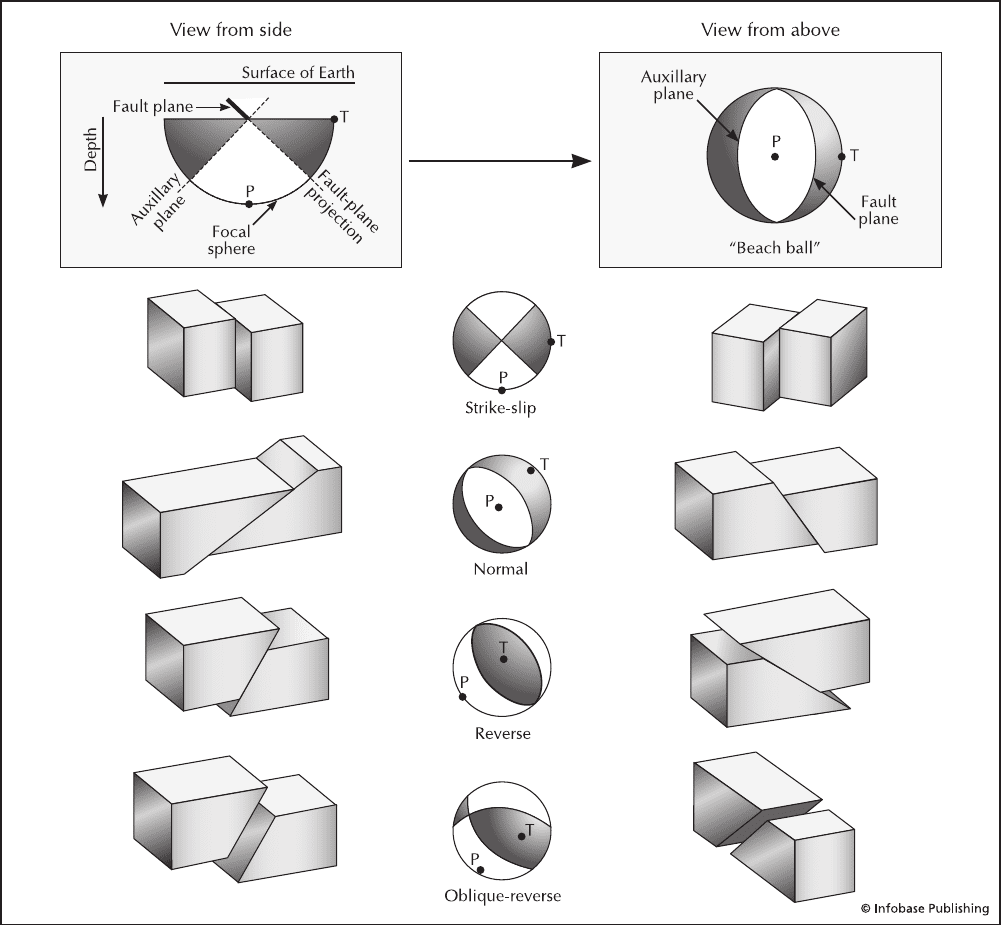
fault plane solution When an earthquake occurs, it is
recorded on seismographs worldwide. seismologists
study the seismograph records (seismogram). By comparing
the delay between the arrivals of the waves, they can deter-
mine the location of the focus and epicenter. By studying
whether the needle on the seismograph first went up or went
down for each seismogram, they can determine what kind of
fault it was (strike-slip, dip-slip, etc.). By combining these
two pieces of information, seismologists can determine the
fault plane solution or focal mechanism for the earthquake,
that is, where and how the fault moved.
fault rocks There is a full classification system for fault
rocks, just as if they were sedimentary or igneous rocks.
Under shallow conditions 0–1.2 miles (0–2 km), the rocks
in a fault are broken into large to small angular fragments
with large gaps between them. This type of deposit is called
fault gouge. If the gouge is cemented together with minerals
precipitated from the groundwater, it becomes fault breccia,
a rock. Deeper in the ground 1.2–9.3 miles (2–15 km), the
pressure is too high to leave gaps. Instead, the rock is pul-
verized and ground together like coffee grounds. It is fine-
grained with no gaps and called cataclasite. Depending on
the amount of leftover uncrushed rock within the cataclasite,
the rock can be a protocataclasite (mostly uncrushed rock),
cataclasite (about half and half), and ultracataclasite (all
crushed rock). Below about 9.3 miles (15 km), rocks behave
in a ductile manner. They flow like silly putty in the fault
zone rather than crushing like glass as with cataclasites.
These rocks are called mylonites. They have the same classi-
fication as cataclasites. Fault rocks with mostly original rock
and very little stretched-out grains is called a protomylonite.
Half and half is a mylonite, and all stretched-out grains is an
ultramylonite.
fault system In contrast to a single fault or several parallel
faults, a series of interlinking faults is called a fault system.
Many of the major faults in the world are really fault sys-
tems. The San Andreas Fault is not a single fault but is part
of a large system of faults that form a braided pattern. The
Callaveras Fault and the Hayward Fault among many
others are really part of the San Andreas fault system. All of
the faults have similar orientations, they are all related, and
all are active at the same time (geologically speaking). Any
one of them can produce an earthquake at any time. During
the next 25 years or so they all will.
fault trace The surface expression of a fault. A fault is a 3D
planar to curvi-planar structure. The fault trace is the inter-
section of the fault with the ground surface. In other words,
if you look at a fault on a map or from an airplane, you are
looking at the fault trace. For very steep faults, like the San
Andreas, the trace is a linear feature. For shallow faults, espe-
cially in areas of rugged topography, the fault trace can be as
winding as a mountain road.
Federal Emergency Management Agency (FEMA) FEMA
is the official U.S. government agency that handles all natural
disasters, including earthquakes and volcanic eruptions. When
a disaster occurs, FEMA moves in quickly to coordinate rescue
and relief operations where possible and to distribute federal
aid to the affected communities all the way through the repair
and rebuilding processes.
feldspar The most common mineral group in Earth’s crust.
All feldspars are silicates in which the atoms are arranged in
a framework structure. There are two basic type of feldspar,
plagioclase and potassium (K)-feldspar (see k-feldspar).
feldspar 85
The main ions in plagioclase are calcium and sodium. Plagio-
clase occurs in probably 99 percent of all igneous rocks. Potas-
sium feldspar primarily occurs in granite and rhyolite.
felsic An igneous rock that is high in feldspar and
silica (fel from feldspar and si from silica). These are light-
colored rocks that form at the lowest temperatures possible
for igneous rocks (750–800°C). The most common rock
types include rhyolite (volcanic) and granite (plutonic).
These rocks must contain quartz and k-feldspar but
commonly contain plagioclase as well. These three miner-
als are commonly referred to as the felsic minerals. Felsic
rocks may also contain muscovite (white mica), biotite
(black mica), hornblende, and many other minerals in
small quantity.
Fernandina caldera, Galápagos Islands, Ecuador The
shield volcano Fernandina has a summit caldera whose
floor collapsed following eruptions in 1968. Two days after
a moderately strong earthquake about 200 miles (322 km)
north of the island, Fernandina began to erupt on May 20,
1968. This eruption lasted several days. Further earthquakes
on June 11 immediately preceded an explosive eruption that
morning, followed by another explosion later in the day. The
eruption continued for about one more day, and then the cal-
dera floor started to collapse. The greatest subsidence (more
There are ball-like symbols on earthquake maps that show the fault plane solutions or focal mechanisms of the earthquakes. The symbols show which
way the fault moved during the earthquake as shown by the diagram. The white stripes show compression, and the gray stripes show extension.
86 felsic
than 1,000 feet [305 m]) occurred at the southeast end of
the caldera. Several hundred moderately powerful earth-
quakes occurred during the collapse, which apparently took
place steadily over a period of several days rather than all at
once. The volume of the collapse was as much as 10 times
greater than the small volume of magma that erupted. Fer-
nandina erupted again in 1978, an hour following an earth-
quake. Another eruption occurred between late 1980 and
early 1982 but was so small that it went unnoticed until
later. Activity resumed briefly in 1984, between March 30
and April 11. The most recent eruption of Fernandina was
in 1995. lava flowed 2.5 to three miles (4–5 km) to the
ocean where it killed many birds and fish by scalding them
to death.
ferromagnesian Minerals and rocks that are high in iron
and magnesium. The term refers to silicate minerals. For
igneous rocks, these minerals include pyroxene, olivine,
hornblende, other amphiboles, and biotite. They are all
related in structure and chemistry. They are also referred to
as mafic minerals because they are abundant in mafic igne-
ous rocks. In ultramafic rocks, there are essentially no
other minerals. There are also a different group of metamor-
phic ferromagnesian rocks and minerals.
fiamme Dark-colored, glassy lens-like structures in pyro-
clastic deposits that have a flame shape. They are thought to
be formed by the collapse of pumice fragments during the
formation of a welded tuff by overlapping pyroclastic
flows. (Fiamme is Italian for “flames.”)
fire fountain A prolonged and high spray of lava above a
volcano’s vent. Also known as lava fountains, fire fountains
can be as high as 1,000 feet (305 m) but are more commonly
100 feet (30 m). They can fill lava lakes or feed flows.
See also Hawaiian Islands.
first arrival The first part of the waves to reach seismo-
graph from a seismic source. These data are the main com-
ponents in determining fault plane solutions.
first motion The first motion is seen on a seismogram
during the first sign (record of ground motion—up or down)
of the p-wave arrival of a particular event. The direction of
the needle movement, up or down, gives information on the
fault motion that caused the earthquake. Conventionally,
upward motion indicates compression from the quadrant
of fault slip (rock is moving toward the seismograph), and
downward motion indicates dilation or rarefaction (rock is
moving away from the seismograph). First motion studies are
used to construct fault plane solutions to determine the
source mechanism of earthquakes.
Fisher caldera, Aleutian Islands, Alaska, United States
Fisher caldera is located on Unimak Island. A tremendous
eruption believed to have occurred here several thousand
years ago resulted in the formation of a caldera approxi-
mately 14 miles (8.5 km) long and eight miles (13 km) wide.
In historical times, the record of Fisher’s activity is uncertain.
There is a poorly documented eruption in 1826. An excep-
tionally noisy eruption in 1850 may have involved Fisher.
There is an active field of fumaroles in the caldera.
fissure In general terms, a crack in Earth’s crust. Fissures
commonly form during strong earthquakes. When lava
emerges in large quantities from a fissure, the phenomenon
is knows as a fissure eruption. The resulting flow of lava is
called a fissure flow.
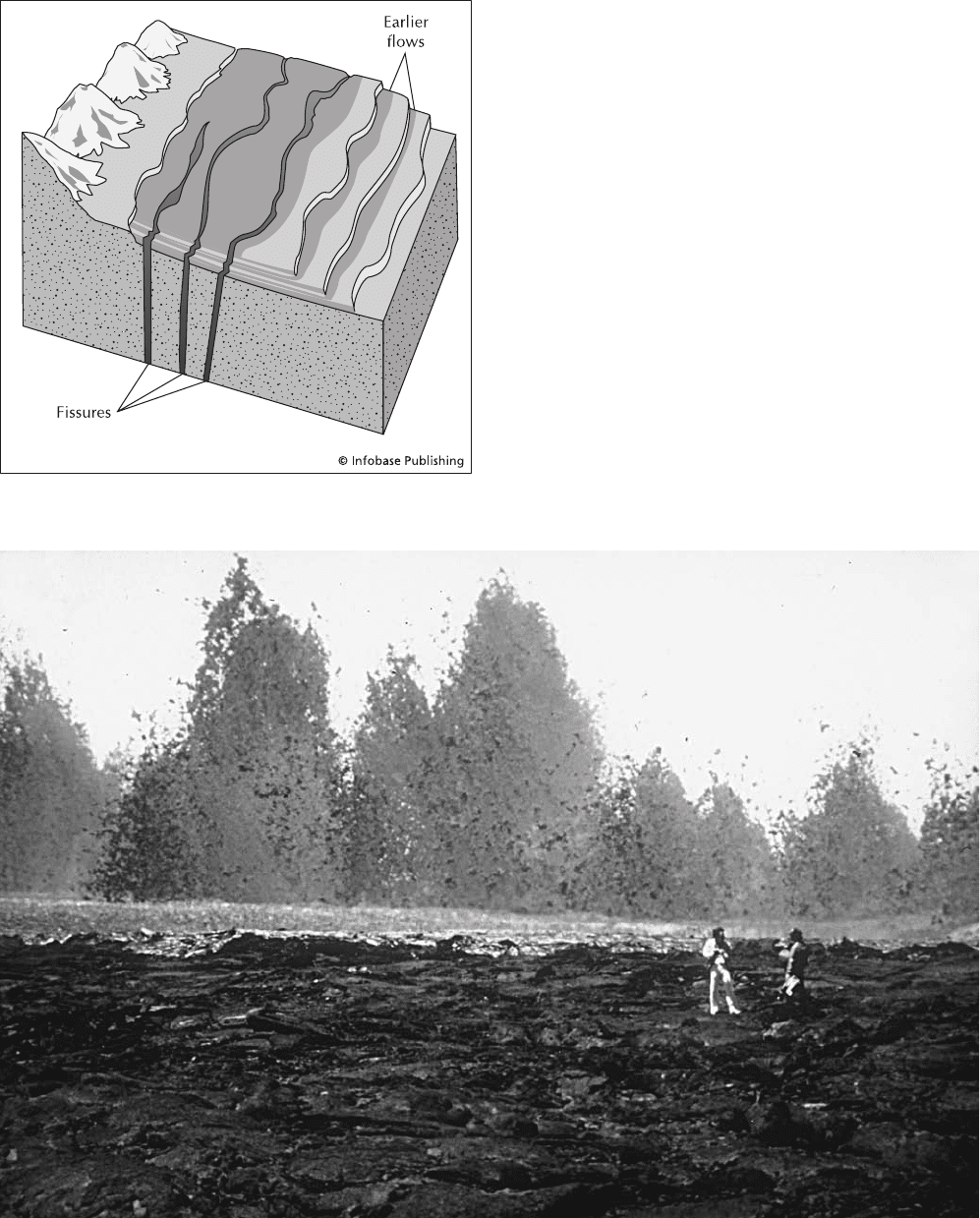
fissure eruption A volcanic eruption that emanates from a
fissure or set of fissures in Earth’s crust. They are typically
not explosive but can pour out vast quantities of lava at a
high rate. The lava is very fluid and tends to flood the sur-
rounding area. The composition is exclusively basaltic. Fis-
sure eruptions can occur in shield volcanoes as well.
flank eruption In contrast to a summit Eruption where
the explosion emits from the top of the volcano, a flank
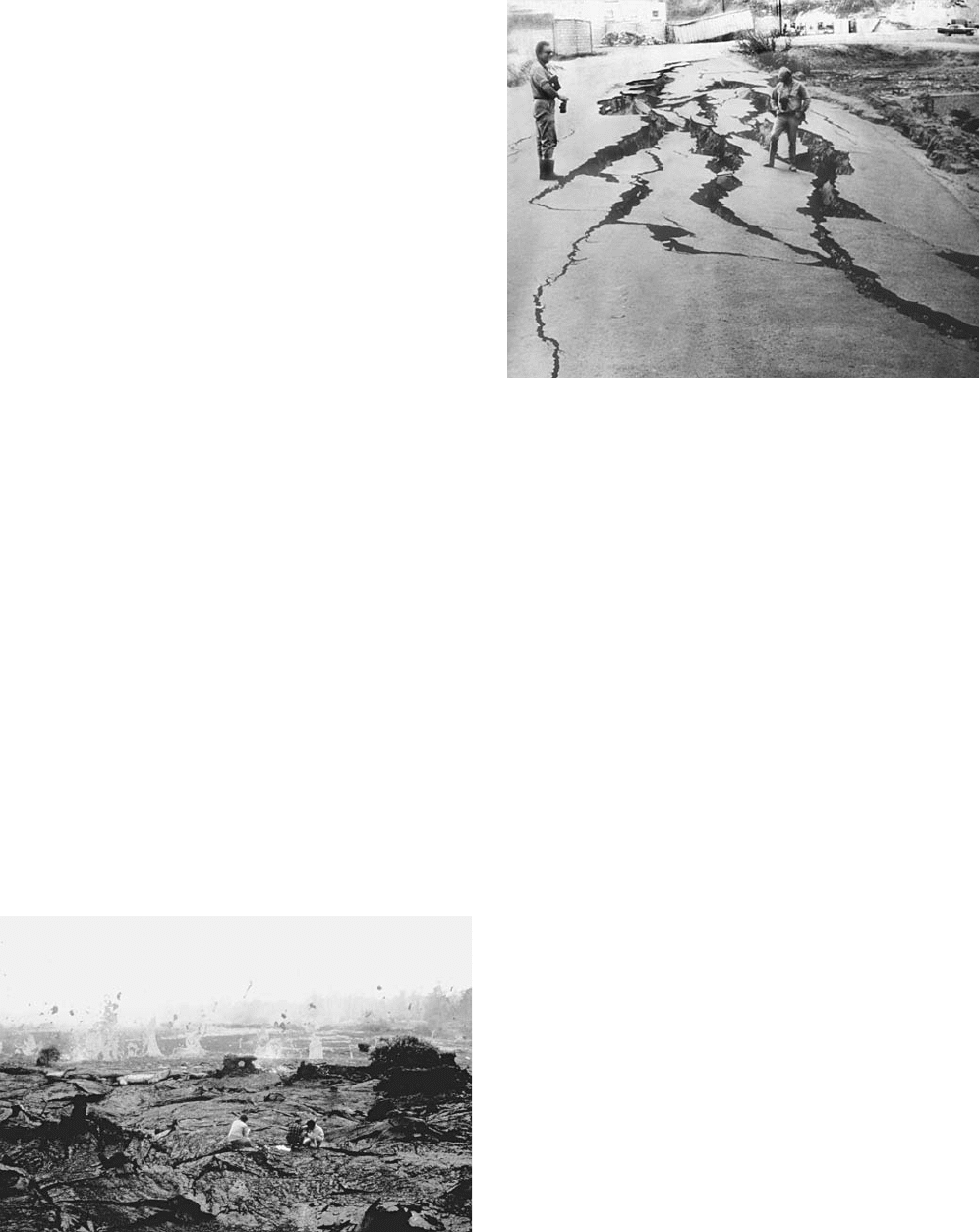
Fire fountains approximately 30 feet (9 m) high along a fissure at Kilauea
volcano, Hawaii, in 1979 (Courtesy of the USGS)
Fissures in a paved road at the head of a slump block generated by the
1970 Nevados Huascarán earthquake in Peru (Courtesy of the USGS)
flank eruption 87
eruption comes out of the side of the volcano. In volcanoes
with lava of high viscosity (sticky lava), the summit orifice
or feeder pipe to the summit can become clogged. If magma
continues to move into the magma chamber beneath the vol-
cano, the pressure will continue to increase. The pressure may
exceed the strength of the wall of the volcano, the inflating of
the volcano may cause a landslide that reduces the strength
of the wall, or there may be a fissure in the side of the cone
that can’t contain excessive pressure. In any of these cases,
the side of the volcano will blow out in an explosion that typ-
ically exceeds that of a summit eruption. Summit eruptions
can shoot ash and gases 10 miles (16 km) upward into the
atmosphere. Now an even greater explosion shoots down the
side of the volcano. The blast will knock everything down in
its path resulting in “blow-down” of trees and structures. The
advancing cloud is called a
NUÉE ARDENTE or a pyroclastic
flow. It is composed of ash, volcanic fragments, and toxic
gases. It is at least 800°C and travels at 60 miles (97 km) per
Diagram showing how fissure eruptions form. The fissures are cracks in
the ground from which basalt lava pours and spreads over the landscape,
forming flood basalts. Iceland has some good examples of fissure eruptions.
A lava curtain composed of joined lava fountains from Mauna Loa, Hawaii, on March 24, 1984. The curtain height averages about 80 feet (25 m). Curtains
are common in fissure eruptions, where they erupt in a long, thin series of cracks. (Courtesy of the USGS)
88 flank eruption
hour or more. Nothing survives it, and everything is immedi-
ately buried in ash and fragments.
flood basalt A wide, relatively thin sheet of basaltic lava
that flowed outward from a fissure in much the same man-
ner as a flood of water. Flood basalts cover much of the
Pacific Northwest of the United States as the Columbia Pla-
teau basalts. The Watchung Mountains of New Jersey is
also a flood basalt, as are the Deccan Traps, the Karoo, and
the Piranha traps. An individual flow may have a volume of
more than a hundred cubic miles.
Florida United States The state of Florida is generally free
from strong earthquakes, but a region of minor seismic risk
is found in the northern portion of the state along the border
with Georgia. One notable earthquake, of Mercalli inten-
sity VI, occurred in the vicinity of Saint Augustine on January
12, 1879, and affected an area of about 25,000 square miles
(64, 750 km
2
. The earthquake rattled windows and doors in
Daytona Beach and caused minor damage in Saint Augustine.
On October 31, 1900, Jacksonville experienced an earthquake
of Mercalli intensity V that included eight separate shocks.
focal mechanism See fault plane solution.
focus The underground point on a fault plane where an
earthquake originates. Also known as the hypocenter.
Where the fault moves is where the energy is released. Earth-
quake waves are sent out in all directions from the focus. The
epicenter sits on the ground surface directly above the focus.
See also fault; seismology.
Fogo See Cha.
footwall In a dip-slip fault, the fault plane is a sloping
surface. The block (rock) beneath the fault is called the foot-
wall. The block (rock) above the fault is the hanging wall.
The relative motion of the hanging wall compared to the foot-
wall determines what kind of fault it is, normal or reverse.
forearc All areas between the trench and an island arc are
considered to be part of the forearc. Primarily, there is a wedge-
shaped pile of sediment that is scraped off the subducting oce-
anic crust that is called a forearc prism. The movement on the
subduction zone in the forearc forms a megathrust that can
produce teletsunamis, such as in the case of Banda Aceh.
foreshock A small earthquake that foretells of a larger
earthquake. The terms foreshock and main shock can only
be distinguished in retrospect. When an earthquake occurs, it
could be a foreshock if another larger earthquake follows it.
Otherwise, if nothing follows it, then it was the main shock.
In areas of high earthquake activity, small earthquakes are
carefully monitored. This is because foreshocks commonly
foretell of major earthquakes.
Fort Tejon earthquake, California, United States The
Fort Tejon earthquake of January 9, 1857, is thought to be
the most powerful earthquake to have struck the Los Ange-
les area since Spanish exploration began. Although no instru-
ments were available to measure the earthquake’s magnitude,
comparisons with the more accurately measured 1906 San
Francisco earthquake indicate the Fort Tejon earthquake was
considerably more powerful. The epicenter appears to have
been located on the San Andreas Fault near Cholame, and
there is evidence of surface faulting for more than 216 miles
(360 km) associated with this earthquake. The earthquake was
felt for almost the entire width and length of California from
San Diego to the vicinity of Sacramento and was perceived as
a strong shock in Yuma, Arizona. The earthquake is named
for Fort Tejon, a U.S. Army installation built at Tejon Pass in
the Tehachapi Mountains. Fort Tejon, a collection of build-
ings constructed of adobe, was destroyed by the earthquake.
Although the earthquake caused no fatalities at the fort, the
soldiers stationed there were forced to spend the rest of the
winter in their tents because rebuilding was impossible during
the cold weather. One fatality was reported at lower altitudes:
An elderly woman was killed in a collapsing building. The
earthquake is said to have had dramatic effects on local rivers,
throwing the Mokelumne River out of its bed and making the
Kern River reverse its flow and spill over its banks.
fractional fusion Partial melting of rock as it is heated.
Imagine a mixture of marbles, nails, and wax. If heated to
the melting temperature of wax, the wax will become liquid
and flow out of the mix, leaving the solid marbles and nails
behind. The same thing happens with rocks. A rock is a mix-
ture of different kinds of minerals. As a solid rock is heated,
the minerals with the lowest melting temperature will melt
first. The liquid will flow away forming magma and leaving
the higher temperature minerals behind. The lowest tem-
perature minerals are those that form felsic rocks, gran-
ite, and rhyolite. The main minerals in these rocks are
quartz, k-feldspar, and Na-plagioclase (feldspar).
See also fractionation.
fractionation The minerals in magma and lava crystallize
as they cool. Different minerals have different temperatures
of crystallization. olivine crystallizes at a higher temperature
than pyroxene, which in turn is higher than hornblende and
biotite respectively. This sequence of mineral crystallization
is called Bowens Reaction Series. If the higher-temperature
minerals crystallize and are removed, the composition of the
liquid changes. mafic magma becomes more and more fel-
sic with this process because the felsic minerals are formed at
lower temperature. This process of driving the composition of
the remaining liquid toward more felsic compositions is called
fractionation.
fracture A break in rock. Under shallow conditions, rocks
behave in an elastic manner. They deform as a function of the
amount of stress that is applied to them. When the stress is
released, they recover to their original size and shape. They
behave like a rubber band or a spring. Just as with a rubber
band, if they are stressed past their strength, they break. By
breaking or fracturing, they release all of the stress that was
built up. When you pull on rubber band, it requires your
muscle power. That is the stress. When it breaks, the muscle
fracture 89
is no longer required because the stress is released. In a rock,
the energy that was involved in stressing the rock is abruptly
released when the rock breaks (fractures), just like the rubber
band. That is an earthquake. The released energy from stress is
converted to seismic waves which travel away in all directions.
fracture zone A type of transform fault on the ocean
floor that is characterized by densely spaced fractures.
Because the fractures result from earthquakes, these zones are
seismically active.
free oscillations An earthquake not only sends out waves
that damage the surface and arrive at seismographs, they
also cause the whole Earth to “ring” like a bell. The waves
constructively interfere at the natural frequency of Earth.
These oscillations cannot be heard and are barely detectable
on seismographs.
frequency Frequency is the number of times something
happens over a given period of time. In terms of an earth-
quake, it is the number of vibrations from seismic waves that
pass through an area with time. Earthquake frequency is
measured in cycles per second or hertz.
Friuli earthquake, Italy The Friuli region in northern Italy
was the site of highly destructive earthquakes beginning May
6, 1976. The first earthquake struck Friuli in the evening
and was estimated at 6.0 on the Richter scale. More than
900 people were killed, and some 50,000 were left homeless.
Another strong earthquake in September shook down recon-
structed buildings.
Fuego volcano, Guatemala Fuego is the historically most
active volcano in Central America. It has erupted at least
60 times since 1524. The eruptions are typically violent and
of vulcanian type with VEI of 2–3. All are summit erup-
tions. Eruptions typically occur in clusters lasting 20–70
years and spaced by 80–170 years. The most recent major
eruption was in 1974. It was active for 10 days and produced
numerous glowing avalanches that moved down the slopes
at 35 miles (56 km) per hour. In 1977–79, Fuego underwent
persistent low-level activity.
Fuji, Mount Japan Mount Fuji, known to the Japanese
as Fuji-san (not Fujiyama), is an andesitic volcano that is a
product of the subduction zone formed by the convergence
of the Pacific and Eurasian crustal plates. Mount Fuji
is revered as the most beautiful volcano in the world and
even appears on Japanese currency. It is perfectly symmetri-
cal. Mount Fuji has erupted at least 16 times since a.d. 781.
Although Mount Fuji has been less active in recent centuries
than some other volcanoes in Japan, some of the eruptions
were impressive. In 1707, the heat from the eruption resulted
in fractured and shattered rocks, and fallout from the erup-
tion covered the present location of Tokyo to a depth of
several inches. The two largest eruptions were in 1050 b.c.
and 930 b.c. with VEI = 5. Eruptions of Mount Fuji created
a naturally partitioned set of lakes at the foot of the volcano.
Once the lakes were one single large lake, but lava flows
divided the lake into five smaller lakes, named Kawaguchi,
Motosu, Sai, Shooji, and Yamanaka.
See also andesite.
Fukui earthquakes, Japan Just as the devastating effects
of World War II were being addressed in the city of Fukui,
Japan, a strong earthquake rocked the area. The quake
occurred on June 28, 1948, at 5:13 p.m. It registered a 7.3 on
the Richter scale. Large fissures opened to 1.5 feet (0.5 m)
in width in the center of town, and landslides dropped rub-
ble on the roads outside of town. The postwar makeshift com-
munication lines and water lines were severed by the quake,
leaving the city completely cut off. Probably the major hazards
from this event were the fires from overturned charcoal stoves
that stormed through town. In the end, some 5,390 people
lost their lives, and 21,750 were injured. More than 39,000
homes were destroyed at a cost of over $1 billion.
fumarole A hole in Earth’s surface through which hot
water, steam, and various hot gases escape from underground.
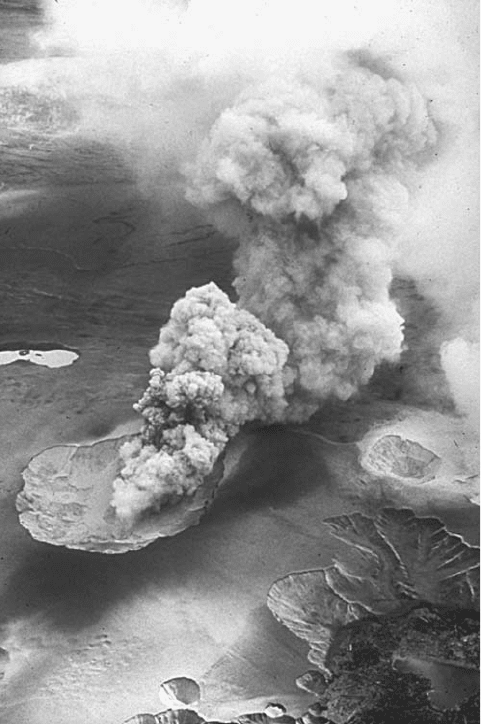
Fumaroles at Spirit Lake on Mount Saint Helens, Washington, after
the eruption in 1980. Steam rises almost continuously from these
vents. (Courtesy of the USGS)
90 fracture zone
The driving force for the steam is hot underground magma.
Groundwater seeps into contact or near-contact with the
magma and is heated into the steam. geysers form in much
the same way, but the geometry of the water reservoir is such
that it allows the water to flash boil.
See also hydrothermal activity; Valley of Ten
Thousand Smokes.
Fuppushi See Akan.
Furebetsu See Akan.
Furnas caldera, Azores The Furnas caldera is located on
San Miguel Island in the Azores and is noted for a violent
eruption in 1630 (VEI = 4). Earthquakes on September 2–3 of
that year were followed by the eruption of two fiery clouds.
Some 200 people are thought to have died in this eruption,
most of them killed by mudflows. Several other eruptions
appear to have occurred within the last 1,000 years.
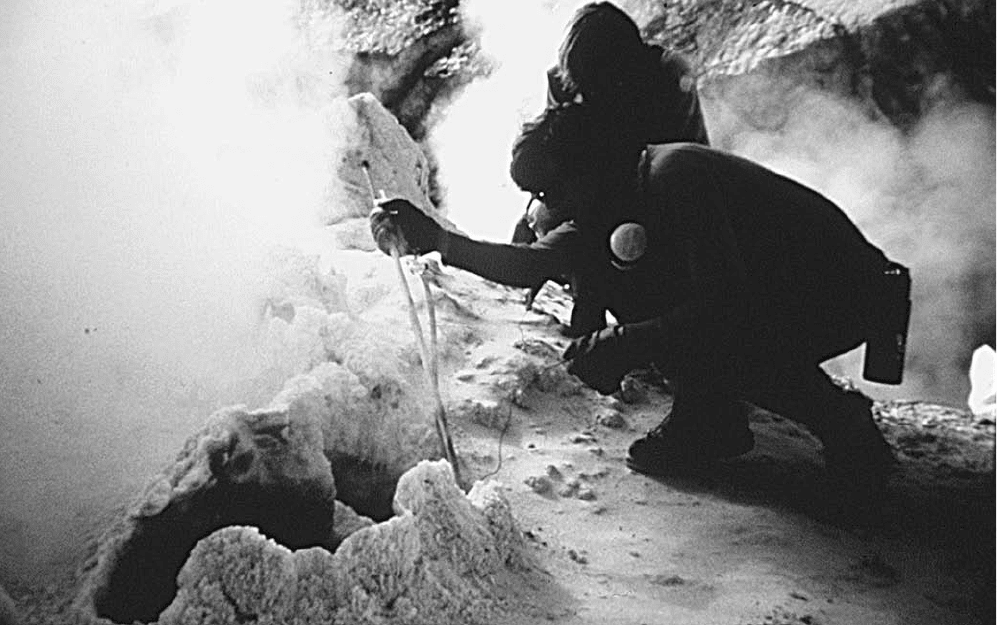
Volcanologists collecting data from active fumaroles in Alaska (Courtesy of the USGS)
Furnas 91