
Gates A.E., Ritchie D. Encyclopedia of Earthquakes and Volcanoes
Подождите немного. Документ загружается.

earthquake about 120 miles (193 km) east of Rabaul in 1983,
earthquake activity diminished in 1984 and 1985. Emissions
of carbon dioxide from a crater on Tavurvur killed birds in
1981, and fresh activity from fumaroles destroyed plants at
a site slightly more than one mile northwest of Tavurvur in
1983.
In view of the recent and historic unrest at Rabaul, there
is a chance that new eruptions will occur there in the near
future. Calderas apparently were formed by eruptions there
some 3,500 years and 1,400 years ago, and eruptions of
comparable magnitude were considered possibilities for the
years ahead. With such events in mind, scientists and public
officials prepared an emergency plan that would respond in
several stages, up to and including evacuation of the local
population, to a threatened eruption at Rabaul. On Sep-
tember 19, 1994, both Vulcan and Tavurvur began to erupt
simultaneously and without warning. The eruption was pow-
erful (VEI = 4) producing heavy amounts of ash (up to 30
inches [75 cm] deep) and forcing the evacuation of 50,000
people. Because of the plan, only one person was killed. The
eruption ended in 1995.
See also plate tectonics.
radioactivity The loss of particles and energy from the
nucleus of an atom, resulting in a more stable product. Unsta-
ble versions of elements undergo spontaneous decay to other
elements and give off radiation. The unstable (radioactive)
atoms are called isotopes, although only about 25% of iso-
topes are unstable. Isotopes differ from normal atoms in that
they have different numbers of neutrons in the nucleus (i.e.,
not equal to the number of protons). Decay occurs through
three kinds of radiation: alpha, beta, and gamma. Gamma is
like X-rays and does not change the element, but both alpha
and beta actually change one element into another. The radio-
active element is called the parent, and the element it changes
into is called the daughter. The daughter may also be radio-
active and in turn produce another daughter. There can be
many steps from an unstable parent to a final stable daughter
forming a decay series. One of the most commonly studied
decay series is from radioactive uranium to stable lead. There
are more than 30 steps from the starting parent to the final
daughter, including the decay to and from both radium and
radon, which are environmental concerns. The rate at which
the change from a parent to a daughter takes place is con-
stant. Geologists measure parent relative to daughter to cal-
culate the age of a rock.
radionuclides Radioactive atoms that generate heat during
their decay. Radionuclides are believed to be an important
source of internal heat for the Earth. They include isotopes
of such elements as uranium and thorium and are commonly
found in igneous rocks such as granite.
See also radioactivity.
Rahoum See Ambrim.
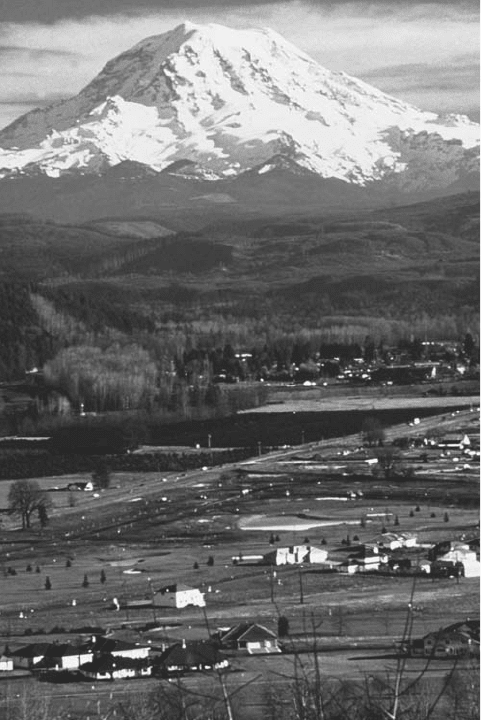
Rainier, Mount Washington, United States One of the
most famous volcanoes on Earth, Mount Rainier stands near
Seattle and is part of the Cascade Mountains, a volcanic
range associated with the Cascadia Subduction Zone off
the Pacific coast of northwest United States. Mount Rainier
is a stratovolcano and has been dormant since the mid-
1800s, when a minor eruption reportedly took place.
The most recent major eruption of Mount Rainier is
thought to have occurred approximately 2,000 years ago and
laid down a thick layer of tephra east of the mountain. This
eruption also is believed to have produced a lava cone at
the summit of the volcano, as well as large mudflows. One
mudflow, estimated to have occurred almost 3,000 years ago,
traveled down the South Puyallup River and Tahoma Creek
valleys as a mass of mud hundreds of feet thick; this same
flow is thought to have exposed the core of the volcano. In
any future eruptions, mudflows may recur on a large scale,
through melting of glacial ice on the peak, and may present
a threat to nearby communities. The potential for devastat-
ing avalanches from Mount Rainier is considerable because
internal heat is believed to have turned the mountain core into
soft material that might fail easily during a powerful earth-
quake (a distinct possibility in the seismically active Pacific
Northwest), releasing overlying material to fall downslope
The sleeping giant Mount Rainier overlooks an encroaching population
of western Washington. It poses one of the biggest volcanic threats in the
United States. (Courtesy of the CVO-USGS)
212 radioactivity
in vast amounts. Such an avalanche, in turn, might allow
an explosion comparable to the one that destroyed the area
around Mount Saint Helens during the eruptions of 1980.
The White River valley is believed to be especially vulnerable
to major avalanches from Mount Rainier, should conditions
ever permit them to occur. rockfalls said to have exceeded
10 million cubic yards (7.9 million m
3
) occurred in the White
River Valley in 1963.
Mount Rainier is noted for its steam caves, a network
of ice tunnels and chambers about 1.5 miles (2.4 km) long
altogether. The steam caves are produced by heat from the
volcano acting on firn, a moderately dense form of ice that
results when snow accumulating on the volcano is com-
pressed to a density not quite that of the crystalline ice found
in glaciers. Heat from the volcano melts spaces between the
ice and the rock of the mountain. Warm air circulating in
these spaces enlarges them. The result is a network of pas-
sageways within and beneath the ice. The steam caves rep-
resent a delicate equilibrium between fumarole activity
and the accumulation of snow and ice on the volcano. The
caves were discovered in 1870 when climbers took shelter in
them, although there is evidence that Native Americans knew
of the caves’ existence long before European-descended set-
tlers arrived in the Northwest. Most of the tunnel network
exists in the East Crater atop Mount Rainier, although the
steam caves extend also to the adjacent West Crater. Similar
systems of steam caves are found at nearby Mount Baker and
also at Wrangell in Alaska.
Ranau caldera, Sumatra, Indonesia Located on the
Semangko Fault Zone, the Ranau caldera is occupied in part
by Lake Ranau. The caldera has undergone some unrest but
no major eruptions during the late 19th and early 20th centu-
ries. On two occasions, in 1887 and 1888, large numbers of
dead fish were discovered on Lake Ranau and on its beaches.
The lake water was discolored and had an odor of sulfur.
The deaths of the fish were attributed to volcanic activity
in the lake. A powerful earthquake in 1895 reportedly pro-
duced seiches in Lake Ranau; dead fish were noted again on
the surface of the lake in December 1903. This fish kill was
accompanied by discoloration of the lake waters, as in 1887
and 1888, and a smell of sulfur was detected near the shore.
Rasshua volcano, Kuril Islands, Russia The Rasshua vol-
cano has been active on an intermittent basis since the early
19th century. There appears to have been some unrest at the
site in 1810, but details are unavailable. In 1846, there was
a moderate to large eruption (VEI = 3). Increased steaming
activity at Rasshua in 1946 preceded a similar increase in
activity at nearby Sarichev volcano, which erupted five days
later. fumaroles at Rasshua became considerably more
active in 1957, and small explosions were reported. Young
lava flows extend down the eastern, northwestern, and
southern flanks of the volcano.
Raung See Ijen.
Rayleigh waves These earthquake waves occur only along
Earth’s surface (i.e., surface waves). They make the ground
surface move like the waves on the ocean. This motion is
technically referred to as retrograde, which means that they
orbit in an elliptical pattern in the direction opposite to that
of vibrations from the earthquake epicenter. Such motion is
highly destructive but fortunately only in the area of the epi-
center. Energy of the waves decreases rapidly away from the
source. Throw a pebble in a lake, and watch the rings form.
They model Rayleigh waves. Rayleigh waves, also known as
ground roll, are named after John William Strutt, Lord Ray-
leigh (1842–1919), British mathematician and physicist.
Raymond Fault California, United States The Raymond
Fault is about five miles (8 km) long and is located several
miles southeast of Pasadena. The fault has exhibited surface
rupture within historical times and is suspected of being the
source of the Los Angeles earthquake of 1855.
Reaumur, Mount See Long Island.
recurrence interval A recurrence interval is the average
amount of time between earthquakes of a given magnitude
for a given area. There are different recurrence intervals
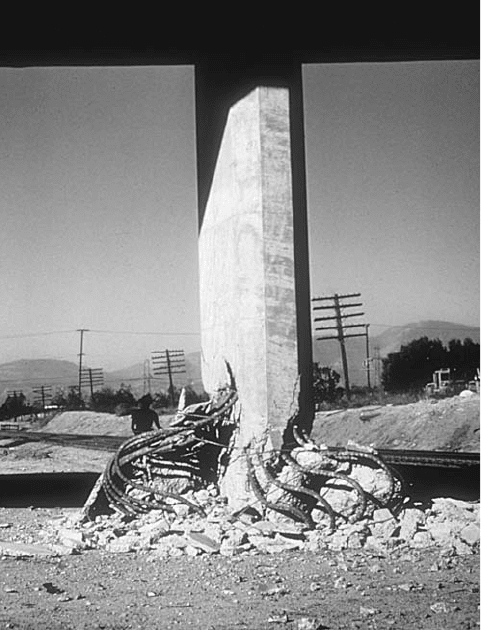
Crushing of the base of a column in an overpass during the 1971 San
Fernando earthquake. The damage done to the column is characteristic of
that done by a Rayleigh wave. The motion of the ground is like an ocean
wave. The return upward motion causes the crushing because it is held in
place by the overpass. (Courtesy of the USGS)
recurrence interval 213
for various-size earthquakes in an area and different recur-
rence intervals for the same-size earthquakes between areas.
A recurrence interval for a given city might be 50 years for
a magnitude 7.0 earthquake. Recurrence intervals can be
among the best tools for earthquake prediction because
the tectonic stress buildup for a fault is consistent and the
strength of the rocks does not vary. As long as the historical
records are old enough and complete, a recurrence interval
can be determined. The problem is that they are only accu-
rate to 15 or 20 years. This kind of uncertainty is usually not
acceptable to most people.
Redoubt volcano, Alaska, United States The stratovol-
cano Redoubt, located some 110 miles (173 km) southwest
of Anchorage, is one of the easternmost in the Aleutian
Islands. It underwent major eruptions several times in the
20th century including four moderate to large ones (VEI = 3)
since 1966. It has erupted at least 30 times in the last 10,000
years. Major explosive eruptions also have occurred in this
century at nearby Spurr and Augustine volcanoes. Redoubt’s
eruption of December 14–19, 1989, produced columns of
ash that rose to altitudes exceeding 40,000 feet (12,192 m)
and had serious effects on airline travel in the vicinity of the
volcano. The ashfalls from this series of explosive incidents
extended over the heavily populated Cook Inlet area and
inland to the vicinity of Fairbanks. A period of lava dome
building activity followed these ashfalls and produced more
than a dozen such domes over four months. Each of the
domes was destroyed by explosive eruptions that produced
ash clouds, although the clouds did less to disrupt air travel
than the clouds from the early phase of the volcano’s erup-
tion. More than 20 significant falls of tephra were observed
at Redoubt between December 14, 1989, and the end of
April 1990. A fall of tephra on December 15 included coarse-
grained deposits rich in pumice, but subsequent tephra falls
were generally characterized by ash-size material. Damage
and loss of revenue from ash and debris flows totaled some
$160 million, making this eruption second only to Mount
Saint Helens in cost in U.S. history.
Recent eruptions of Redoubt have allowed few direct
observations because of poor weather conditions and short
periods of sunlight in the winter. Studies of these erup-
tions have yielded considerable information, however, about
lightning in the clouds surrounding the volcano. Ordinar-
ily, lightning is rare in the vicinity of Redoubt, but lightning
discharges have been observed during most of the eruptions
of Redoubt that released ash. A commercial lightning detec-
tion system deployed by the Alaska Volcano Observatory
detected lightning in 11 of 12 eruptions and located the light-
ning strikes in nine of those eruptions, following the activa-
tion of the system early in 1990. Most of the strikes between
clouds and the ground occurred close to the mountain, and
the number of cloud-to-ground discharges was found to be
related to the amount of ash released. Lightning discharges in
the early stages of the eruption had a negative charge, whereas
discharges later in the eruption were positive. This pattern
indicates that coarse particles of ash, expelled early in the
eruption, carry a negative charge, and finer particles expelled
in later stages of the eruption carry a positive charge. “Intra-
cloud” strikes of lightning, within the volcanic cloud itself,
tend to be more numerous than cloud-to-ground strikes and
to occur even at great distances from the volcano. Intracloud
discharges during the February 15, 1990, eruption of Redoubt
occurred up to about 80 miles (128 km) from the mountain.
Intracloud lightning may prove useful in developing sys-
tems capable of tracking airborne volcanic clouds. Satellites
have been used to track ejecta from Redoubt in more than
20 eruptions since late 1989. Environmental observation
satellites in geostationary and polar orbits have monitored
emissions of ash and volcanic debris. Data provided by the
advanced very high resolution radiometer (AVHRR) on two
U.S. weather satellites in polar orbit were used to detect a
large mudflow along the Drift River near Redoubt as the
event occurred during the February 15, 1990, eruption, and
to provide warnings to Anchorage. Studies of AVHRR images
of eruptions of Redoubt and Augustine indicate that volca-
nic clouds can be detected under various weather conditions,
whether during day or night or over water or land. Multiple
infrared channels are useful here, but there is as yet no single
algorithm capable of detecting all eruption clouds.
See also aviation and volcanoes.
reef A reef is a barely submerged expanse of rock or coral,
often found in shallow water near a continent or island.
Coral reefs are often associated with volcanic islands and sea-
mounts, when a submarine volcano’s summit rises close
enough to the surface for light to penetrate and allow the
growth of coral. This scenario is only possible between 30°
north and south latitude because coral can only grow in the
tropics. When coral builds up to the surface from the sum-
mit of a seamount and forms a ring of dry land, the resulting
formation is called an atoll. The ocean water in these areas
becomes supersaturated with calcium carbonate. Limestone
is formed in these areas. Reefs can serve as useful indicators
of uplift or subsidence at a volcanic site. On some occasions,
reefs may be uplifted, dropped, and then lifted again very
rapidly. At Rabaul, for example, a reef on one occasion was
seen to appear and disappear and then reemerge from the
water, within only about 10 minutes.
reflected wave Earthquake waves that bounce off an inter-
face between different rock units. The reflected waves can
return to the surface and be picked up by seismographs.
These stray waves contribute to the noise registered on seis-
mograms. Generating synthetic seismic waves can be used for
exploration.
refracted wave Earthquake wave that bends at an interface
between different rock units. Just as light bends as it passes
from air to water, seismic waves bend as they pass from one
rock type to another. The waves bend sharply across each of
the major layers in the Earth. That is the way seismologists
can tell the internal architecture of Earth. There are sharp
seismic velocity contrasts across the inner and outer core,
the mantle, and the crust.
resonance Objects resonate when the proper sound or
vibration is imposed upon them. The same idea applies to
214 Redoubt
seismic waves passing through a material or object. Techni-
cally, resonance is the largest vibration of a geological system
(like a soil layer) due to energy enhancement at a certain fre-
quency that characterizes that system.
Réunion Island See Piton de la Fournaise.
Reventador volcano, Ecuador A stratovolcano, Reven-
tador has erupted at least 24 times since 1541. Its most recent
reported eruptions were in 1972, 1973, and 1976. Little is
known about the eruptions because of the remote location
and altitude.
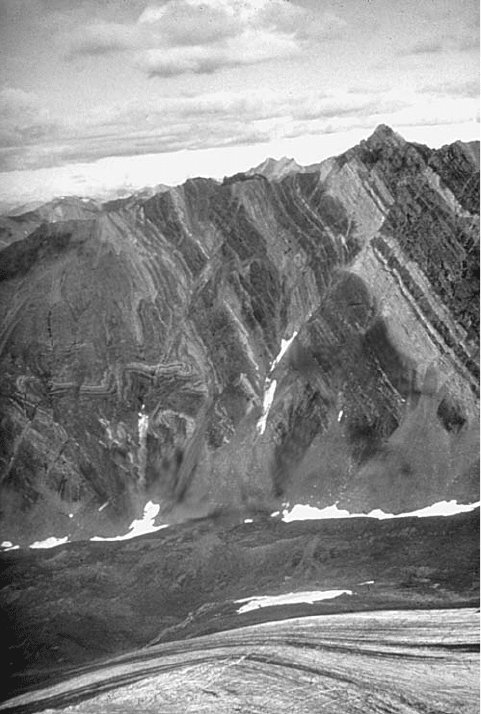
reverse fault A contractional fault. A dip-slip fault in
which the block on one side of the fault moves upward. The
fault forms a slope underground. The rock units on the top of
the fault move up the slope. The overall effect is one of short-
ening the strata in an area. They occur as the result of com-
pression. Shallow angle reverse faults are called thrust faults.
Rhode Island United States Rhode Island has not been
the site of numerous strong earthquakes. It belongs to seismi-
cally active New England, however, and has been affected on
occasion by earthquakes elsewhere in the region. Two nota-
ble earthquakes did occur in the Narragansett Bay area in the
1960s. The earthquake of December 7, 1965, rattled doors
and windows and caused widespread alarm in Warwick; this
earthquake was felt also in Massachusetts. The earthquake
of February 2, 1967, registered 2.4 on the Richter scale of
earthquake magnitude and frightened residents of communi-
ties including Newport and North Kingstown.
Rhodos earthquake, Greece A massive earthquake struck
the eastern Mediterranean region on August 8, 1303. The
epicenter was on Rhodos, which was completely destroyed,
but extensive damage also occurred on Crete and Cyprus
and even in Cairo and Alexandria in Egypt. The Richter
magnitude of this earthquake was estimated at 8.0, and the
intensity was X on the modified Mercalli scale on Rho-
dos. There were detailed descriptions of damage in the town
of Candia (Heraklio), Crete, where 26 churches in the area
were destroyed and some 4,000 people lost their lives. In
Alexandria and Cairo, walls, towers, houses, and government
buildings either collapsed due to the surface waves or were
washed away by a large tsunami that reached as far inland
as Bab al Bahr. In all, 10,000 people lost their lives in Egypt.
The death toll for the whole event is a matter of debate,
but it is likely to have exceeded 25,000 people.
rhyolite A category of felsic volcanic rock, rhyolites are
commonly tan or light gray in color. obsidian, or volcanic
glass, a widespread volcanic rock of rhyolitic composition,
is dark brown or black. Rhyolite is aphanitic (fine-grained)
rock with large grains of quartz and/or k-feldspar, if any.
Richter, Charles (1900–1985) A U.S. geologist and
physicist, Richter’s name is applied to a widely used scale
of earthquake magnitude, indicating energy released in
an earthquake. The logarithmic Richter scale was first pro-
posed in 1927, and Richter refined it with the help of Beno
Gutenberg. The formula for Richter magnitude is M = log
a + b, where a = amplitude, and b = attenuation factor
that depends upon the rock. The log scale means that each
number yields 10 times as much energy as the next lower. In
other words, a magnitude 5 is 10 times as powerful as a mag-
nitude 4 and 100 times as powerful as a magnitude 3. Richter
magnitude is expressed in Arabic numerals and decimal (for
example, 5.5). The Richter scale is different from but comple-
ments the Mercalli scale of earthquake intensity.
See also seismology.
rift A breach or “crack” between two masses of crustal
rock that once were joined together. The process by which
continental crust is pulled apart and a divergent margin
is created. Rifting includes normal faulting (horsts and gra-
bens as well) and resulting earthquakes. It can lead to basalt
volcanism (flood basalts) and rhyolitic volcanism in
some cases. Eventually, it will create an ocean basin with a
mid-ocean ridge.
A dip-slip fault in which the rock on top of the fault plane (hanging wall)
moves up relative to the rock under the fault (footwall). Movement is
shown by offset of the rock layers across the fault. (Courtesy of the
USGS)
rift 215
rift valley A long, linear crack in Earth’s crust that occurs
where magma rising from below reaches the surface as
flood basalts and rhyolitic cones. They are also areas of
intense seismic activity related to movement on normal faults.
These faults form scarps along the valley walls. Drainage
into the basin leads to thick sedimentary deposits that com-
monly contain petroleum deposits. The Great Rift Valley
of Africa is a good example of a rift valley and is the early
phase in the development of a divergent margin.
right-lateral fault A type of strike-slip fault in which
the rock on the opposite side of the fault from the observer
moves to the right. They are also called dextral strike-slip
faults. The San Andreas Fault is a right-lateral strike-slip
fault.
Rincón de la Vieja volcano, Costa Rica Rincón de la
Vieja, “Nook where the Old One lives,” is the biggest vol-
cano in the northern part of Costa Rica and appears to be
located inside nested calderas. The volcano is made up of
several volcanic centers arrayed along a ridge. It has erupted
at least 16 times since 1851, most of which are phreatic.
Explosive eruptions were recorded between 1860 and 1863,
but details are unavailable. Explosive activity was observed
again at the volcano in April 1922, together with evidence of
a very powerful recent eruption. A strong eruption occurred
on June 4, 1922, preceded by sulfur dioxide emissions
and loud noises from fumaroles. In 1963, the volcano was
reported to be steaming and giving off sulfur gases. Vapor
emissions from the volcano in 1965 preceded an eruption
of ash in 1966. On a single day (February 23, 1968), more
than 20 eruptions occurred in a half hour. These eruptions
required that villages in the area be evacuated. Steam blasts
from the volcano occurred in 1983 that affected locations
more than a mile from the crater. Another eruption took
place in 1984, and more eruptive activity is thought to have
occurred in the autumn of 1985. Minor explosions were
recorded in 1986–87, 1992, 1995, and 1998. The 1995 erup-
tion forced the evacuation of 300 families.
ring dikes Circular dikes around a volcano. If magma is
removed from the magma chamber beneath a volcano, it can
undergo caldera collapse. The volcano and the area around
it collapse because they are no longer being held up by the liq-
uid. A series of concentric faults and cracks develop around
the collapsing volcano. As they do, magma will squeeze up
along the cracks and faults forming ring dikes.
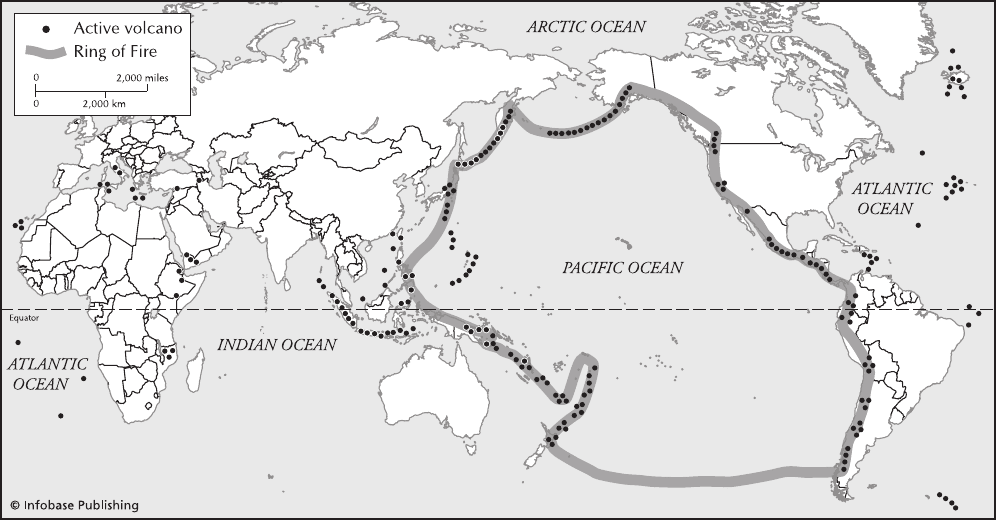
“Ring of Fire” This is the popular name for a narrow
belt of intense earthquake and volcanic activity that follows
approximately the borders of the Pacific Ocean basin and
includes most of the active volcanoes on Earth. The Ring of
Fire extends from Tierra del Fuego, at the southern extremity
of South America, northward along the Andes Mountains
of South America, through Central America, along the
Cascade Mountains in the Pacific Northwestern United
States and southwestern Canada, down the Aleutian
Islands in Alaska, westward to volcano-filled Kamchatka
Peninsula, and southward to Japan and eastern China, the
Philippine Islands, Indonesia, New Guinea, and New
Map of the world showing the “Ring of Fire” that encircles the Pacific Ocean basin as well as the distribution of volcanoes in the ring. Other major
volcanic areas of the world are also shown.
216 rift valley
Zealand. Altogether, the Ring of Fire measures some 30,000
miles (48,280 km) in length and encloses an area of approxi-
mately 70 million square miles (181,299,167 km
2
).
Because the Ring of Fire contains some of the largest cities
in the world, notably Los Angeles and Tokyo, it has been the
site of numerous fatalities from earthquakes and volcanic erup-
tions over the centuries, and the potential for loss of life in
future earthquakes and eruptions is great despite all precautions
that may be taken. Adding to the potential for damage from
earthquakes and eruptions around the Ring of Fire is the danger
of tsunamis, which can carry destruction all the way across the
Pacific Ocean and even farther. The following selected listings
of major earthquakes and volcanic eruptions along the Ring
of Fire for the past several centuries provide some idea of the
destructive potential of seismic and volcanic activity along it:
• China, 1556. Although little historical information is avail-
able about this earthquake, it is thought to have affected
three provinces and killed more than 800,000 people.
• Japan, 1596. An earthquake offshore reportedly generated
a tsunami that destroyed the island of Uryu-Jima complete-
ly and caused more than 4,000 deaths.
• Philippine Islands, 1616. An eruption of the volcano
Mayon buried numerous villages near the mountain under
ash, although casualty figures are unavailable. A later
eruption in 1766 is said to have killed some 2,000 people
and produced large flows of hot mud, possibly from lakes
that spilled out of the caldera of the volcano. An addi-
tional 2,000 people were reported killed in an 1814 erup-
tion of Mayon. The volcano has erupted frequently since
then, but casualty figures have been comparatively low.
• Japan, 1737. A tsunami said to have been more than 200
feet (61 m) high struck the north shores of Japan and also
Russia’s Kamchatka Peninsula.
• Chile, 1757. A major earthquake occurred at Concepción,
allegedly accompanied by a tsunami. Some 5,000 people
perished, and 10,000 were injured.
• Mexico, 1759. The emergence of Jorullo volcano is
thought to have killed some 200 people. Jorullo’s activity
continued for approximately 40 years.
• Java, Indonesia, 1772. Powerful earthquakes at Papanda-
jan generated a huge depression, approximately six miles
(10 km) wide and 15 miles (24 km) long. An entire town
was destroyed, and some 2,000 people were killed.
• Japan, 1793. The volcano Unzen exploded, killed some
50,000 people, and deposited pumice on the sea in layers
thick enough to support a person.
• Venezuela, 1812. An earthquake at Caracas killed about
10,000 people there and thousands more in nearby com-
munities.
• Indonesia, 1815. The eruption of Tambora is estimated to
have cast out more than 30 cubic miles of solid material in
a single week and killed 92,000 people both directly and
by resulting disease and famine.
• Java, Indonesia, 1822. The volcano Galung Gung erupt-
ed, killing some 4,000 people.
• Chile, 1822. An earthquake at Valparaiso killed some
10,000 people and uplifted the shoreline several feet,
exposing shipwrecks on the ocean floor.
• Chile, 1835. One of the most calamitous earthquakes in
history destroyed Concepción and Santiago on February
20 and was accompanied by a tsunami that caused wide-
spread destruction along the shore.
• New Zealand, 1855. A very strong earthquake in southeast
New Zealand uplifted the Rimutaka mountain range by
several feet.
• Japan, 1857. An earthquake and subsequent fire destroyed
Tokyo and killed an estimated 100,000 people.
• Ecuador, 1877. The most violent recorded eruption of the
volcano Cotopaxi killed some 1,000 people and destroyed
much of the mountain’s summit.
• Indonesia, 1883. The eruption of the volcanic island
Krakatoa in the Sunda Strait generated a huge (120-
foot [37-m]-high) tsunami that killed 36,000 people along
shorelines near the volcano. The tsunami circled the globe
several times before diminishing completely. Ash ejected
into the upper atmosphere from this eruption made sunsets
redder in the following year.
• Alaska, 1891. A series of extremely powerful earthquakes
near Yakutat Bay raised a nearby mountain range almost
50 feet (15 m) and affected an area of some 200,000
square miles (517,998 km
2
).
• Guatemala, 1902. An earthquake and subsequent fire
destroyed Guatemala City and killed more than 12,000
people.
• Formosa (Taiwan), 1906. An earthquake reportedly
destroyed more than 6,000 buildings and took some 1,300
lives.
• California, United States, 1906. The San Francisco earth-
quake of this year is perhaps the most famous seismic event
in United States history.
• Chile, 1906. An earthquake struck Valparaiso and killed
approximately 1,500 people.
• Java, Indonesia, 1919. Kelud volcano erupted and gener-
ated a vast flow of hot water and mud that is thought to
have killed more than 5,000 people.
• China, 1920. Gansu Province experienced a powerful
earthquake that reportedly killed about 200,000 people.
• Japan, 1923. The “great Kanto earthquake” destroyed
much of Tokyo, killing approximately 143,000 people and
leaving a half-million more homeless.
• Japan, 1927. An earthquake almost as powerful as the
Kanto earthquake struck the Tango Peninsula on Japan’s
western shore, killing some 3,000 people and destroying
approximately 14,000 buildings.
• Netherlands East Indies (now Indonesia), 1928. The vol-
cano Rokotinda erupted and killed more than 200 persons
with landslides and falling rocks.
• Java, Indonesia, 1931. Merapi volcano’s eruption lasted
three weeks and took more than 1,000 lives.
• California, United States, 1933. The Long Beach earth-
quake killed more than 100 people and caused extensive
damage.
• Chile, 1939. An earthquake destroyed Concepción, killing
some 50,000 people and leaving perhaps 750,000 more
without shelter.
• Japan, 1946. An undersea earthquake generated large tsuna-
mis in the Inland Sea that obliterated some 50 communities
“Ring of Fire” 217
along the shore. About 2,000 people are thought to have
died in the tsunami, and possibly 500,000 were left home-
less after the waves had passed.
• Ecuador, 1949. An earthquake in central Ecuador killed
some 6,000 people and injured perhaps 20,000 others.
• Japan, 1952. The eruption of a submarine volcano at
Myozin-Syo in the Bonin Islands destroyed a ship, leaving
no survivors, when the vessel passed over a vent during the
eruption.
• Hawaii, United States, 1960. A tsunami that accompa-
nied an earthquake in Chile caused extensive destruction
in Hawaii. Some 60 people died in Hilo City. More than
400 other people were killed when the wave reached Japan
and the Philippine Islands, in addition to the 2,000 people
killed in Chile.
• Alaska, United States, 1964. The Good Friday earth-
quake of 1964, with its accompanying tsunami, killed
more than 100 people and carried destruction down the
Pacific coast to Crescent City, California.
• Chile, 1968. Almost 500 people died in an earthquake that
struck central Chile. The earthquake itself was responsible
for only a few of these deaths. Most resulted from the fail-
ure of dams that released their impounded water and bur-
ied communities in mud.
• Peru, 1970. A huge earthquake set off a devastating ava-
lanche where house-size blocks traveled at speeds up to
270 miles (435 km) per hour. A total of 66,000 people
were killed in all.
• California, United States, 1971. The San Fernando earth-
quake was small by some standards (fewer than 100 persons
killed) but caused heavy damage to property and became
one of the most intensively studied earthquakes in history.
• China, 1976. The Tangshan earthquake by official reports
caused 250,000 fatalities. However, it is suspected that
more than 655,000 actually perished.
• Guatemala, 1976. A devastating earthquake on the
Motagua Fault killed more than 23,000 people.
• Mexico, 1985. The devastating Mexico City earthquake
demonstrated that city’s vulnerability to seismic events.
Much of the city is built on unconsolidated sediment,
which reacted to passing seismic waves in such a way that
numerous buildings collapsed. The earthquake originated
not in the Mexico City area but rather along the Pacific
coast of Mexico.
• California, United States, 1989. The Loma Prieta earth-
quake that hit San Francisco damaged the Bay Bridge
between San Francisco and Oakland and killed motorists
whose vehicles were crushed under a collapsing segment of
highway in the East Bay region.
• Philippines, 1991. The eruption of the long sleeping giant,
Mount Pinatubo killed more than 3,000 people and forced
the closure of Clark Air Force Base. It had a VEI of 5.
• California, United States, 1994. The North Ridge earth-
quake devastated the Los Angeles area, killing only 60 peo-
ple but causing more than $20 billion in property damage.
• Japan, 1995. The Kobe earthquake killed more than 5,500
people and reduced much of the city to rubble.
• Taiwan, 1999. The Tai-Ching earthquake killed some 2,400
people and caused $14 billion in property damage.
Rio Grande Rift New Mexico, United States The Rio
Grande Rift began its activity about 13 million years ago. It
borders the Colorado Plateau and extends through the San
Luis Valley between the Sangre de Cristo Mountains and the
San Juan Mountains. The northern part of the rift lies near
Taos and Albuquerque, New Mexico. The lower portion of
the rift is characterized by flat territory, such as the Plains of
Saint Augustin. Signs of volcanic activity are abundant along
the Rio Grande Rift. An example is the Valles caldera in the
Jemez Mountains near Los Alamos. This is one of the larg-
est calderas known and is believed to have formed through
the eruption and eventual collapse of a volcano whose out-
put of tephra filled in large portions of the rift in the vicin-
ity of Los Alamos about 1.12 million years ago. Cinder cones
in the Valles Caldera area indicate that volcanism was active
here only a few thousand years ago. Numerous lava flows
are visible along the rift, notably the Malpais lava beds near
Carriozo. This lava flow may be seen at Valley of Fires State
Park. Molten rock may still underlie the rift; there is evidence
of a pool of magma between 10 and 15 miles (16 and 24 km)
deep beneath the rift near Socorro. The Rio Grande Rift has
been investigated as a possible source of geothermal energy.
Riviera earthquake, France and Italy An earthquake took
the Riviera at the French-Italian border by surprise at 6 a.m.
on February 23, 1887. The seismic waves were felt strongly
in the cities of San Remo and Genoa, Italy; Monte Carlo,
Monaco; and Nice, France. Earthquakes are not common in
this part of the Mediterranean basin, so preparation was
poor. In addition, the quake struck on the morning of Ash
Wednesday in towns that were crowded with tourists there
to celebrate Mardi Gras. The earthquake was estimated at a
6–6.2 on the Richter scale and an X on the modified Mer-
calli scale. This earthquake marked the first use of the Cec-
chi instrument, an early seismograph. The sea level was said
to have dropped three feet (1 m) after the first shock and
then rose six feet (2 m), suggesting that a tsunami or seiche
accompanied the event. In all, about 2,000 people lost their
lives. Equally striking was the mass exodus of people—espe-
cially tourists—immediately after the event. Some 50,000
people choked the rail systems, boats, and other modes of
transportation in a mad attempt to escape.
Roccamonfina volcano, Italy The stratovolcano Roc-
camonfina is located some 30 miles (48 km) north of Vesu-
vius on the western shore of the Italian Peninsula. The
volcano is about 11 miles (17.6 km) in diameter and has two
calderas. The main caldera is approximately four miles (6.4
km) in diameter and occupies the summit of the mountain,
whereas a second, smaller caldera is located on the north side
of the volcano. Roccamonfina has many parasitic cones.
The volcano has generally been quiet within historical times
but has had one recorded period of unrest, around 270 b.c.,
when a flame reportedly rose up and burned for several days.
What exactly happened in this case is uncertain. It may or
may not have been an actual eruption.
rock avalanche A general term for rock masses moving
downhill at high speed. They include rock and debris falls and
218 Rio Grande Rift
debris flows. Rocks and debris can break loose as the result
of an earthquake among other causes and race downhill. In
rugged terrains and high elevation, these masses can attain
speeds of well over 200 miles (322 km) per hour. They will
devastate anything in their way and only stop at the bottom
of a valley. The most spectacular example of a rock or debris
flow avalanche was in Nevados Huascarán in 1970.
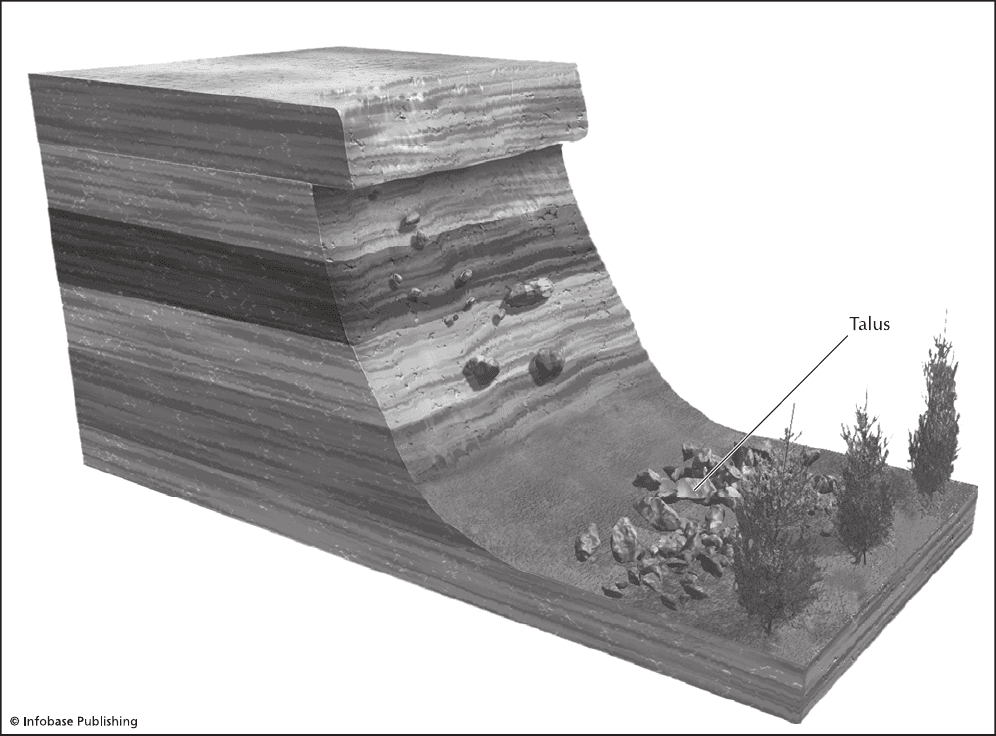
rockfall In contrast to a rockslide, which stays in contact
with the surface throughout its movement, a rockfall is a mass
of rocks that breaks loose from the bedrock and falls through
the air to the slope below. Most of the travel is a free fall, but it
may include bouncing as well. Rockfalls typically break away
from the bedrock along steeply inclined joints. Undercutting of
slopes by rivers, wind, or human activities also hastens rock-
falls. Toppling is a particular type of rockfall that involves the
rotation of the rock mass away from the exposure around a
fixed fulcrum. Whatever the mechanism, repeated rockfalls or
rockslides produce a pile of rock rubble at the foot of a cliff or
slope. This rubble is called talus. Earthquakes in mountain-
ous regions produce numerous rockfalls.
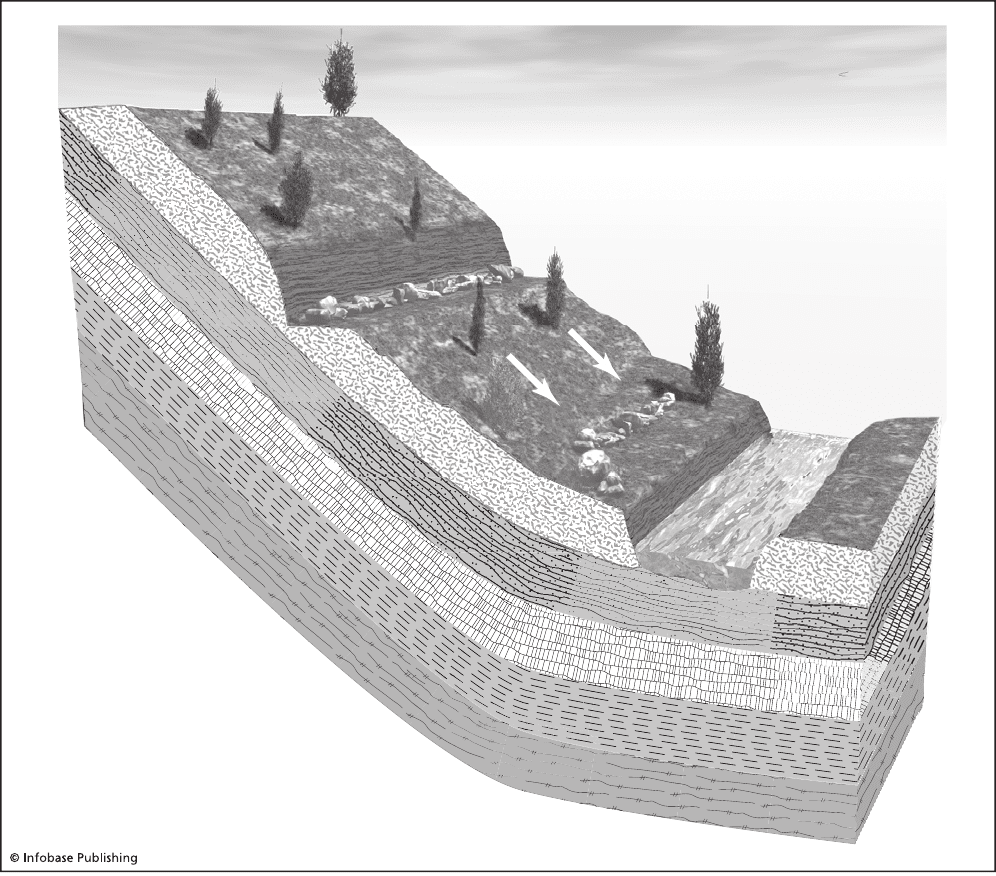
rockslide A mass of solid rock that slides quickly down
an inclined discontinuity. The most common discontinuities
are bedding and fractures. In sedimentary rocks, bedding is
usually the primary discontinuity. With bedding, a rigid layer
such as limestone or sandstone typically breaks free and slides
down an underlying, softer layer such as shale. In crystalline
rocks (igneous and metamorphic), the most common discon-
tinuities are joints and faults. The rock masses may break
loose along steeply inclined joints through frost-wedging pro-
cesses, but they slide along shallower joints and faults. Rock-
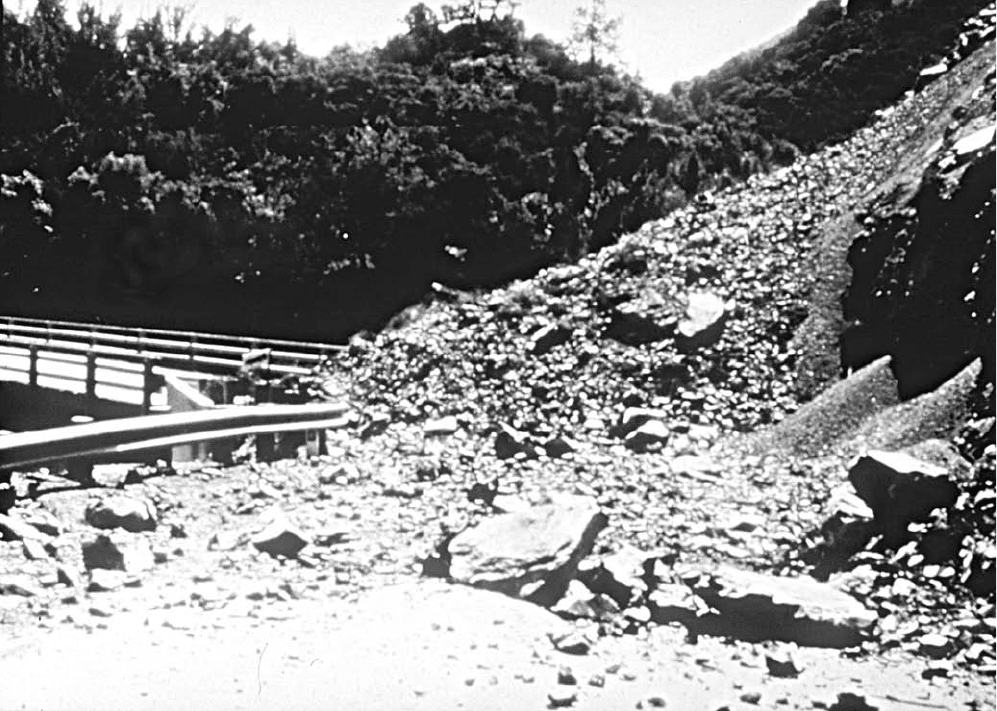
slides may be generated by a number of processes, but they
are especially common during earthquakes. The surface
waves shake loose otherwise stable rock masses, and they
slide into the valleys below with disastrous results.
Rodinia There was another supercontinent that preceded
Pangaea, and it has been named Rodinia. It was constructed
during the middle to late Proterozoic and was finally
assembled about 1 billion years ago. The continents were in
completely different positions and have been shuffled around
during later plate tectonic interactions. For example, the
Block diagram of a cliff showing a rockfall with talus slope at the base
Rodinia 219
east coast of the United States appears to have faced onto
South America. The building of this continent included signif-
icant earthquake and volcanic activity along active belts. The
Blue Ridge, New Jersey–Hudson Highlands, Adirondacks,
Green Mountains, and Long Mountains of eastern North
America contain such a mobile belt. However, evidence for
the building of this supercontinent is abundant worldwide.
Rodinia broke apart during the late Proterozoic and into the
Cambrian.
Rostaq earthquake, Afghanistan On February 4, 1998, an
earthquake of magnitude 5.9 occurred in the Afghanistan-
Tajikstan border region. At least 2,323 deaths were reported
as were 818 injuries. At least 8,094 houses were destroyed,
and 6,725 livestock were killed.
Rotorua caldera, North Island, New Zealand The Rotorua
caldera is located in the Taupo volcanic zone and is noted for
its variable hydrothermal activity. In 1886, there appar-
ently was a failure for several weeks in a hot-water supply
to baths at Rotorua, although this change may or may not
have been connected with activity at the caldera. In 1932 a
strong hydrothermal explosion took place in Lake Rotorua.
Ruapehu volcano, North Island, New Zealand Adjacent
to the volcanoes Ngauruhoe and Tongariro, Ruapehu has a
crater lake at its summit whose eruptions cause occasional
mudflows. It has erupted about 50 times since 1861. Most
of the eruptions are phreatic. A mudflow in 1953 destroyed
a railroad bridge and brought about the deaths of more than
150 people in a train wreck. According to studies of the vol-
Block diagram of tilted rock layers and a rockslide or debris slide along the layers
220 Rostaq
cano that span the last 75,000 years, Ruapehu has been in
a phase of low-emission-volume, low-magnitude eruptions. It
has been in this phase for the past 1,800 years. It erupted in
1997 and again in 1999. The 1997 eruption was the largest
in 400 years. It included explosions, a six-mile (10-km)-high
eruptive column, and a lahar.
Ruby Seamount Mariana Islands It is a submarine vol-
cano located about 25 miles (40 km) northwest of Saipan,
Guam. The last major eruption was in 1966, but there was a
minor eruption in 1995 as well. tsunami alerts were posted
during this eruption.
run-up The run-up height is the elevation of the water level
in feet or meters caused by the arrival of a tsunami that is
above sea level at the expected tidal elevation. The run-up
height is the added height of sea level caused by a tsunami. In
the vast majority of tsunamis, run-up heights are on the order
of centimeters. There are historical accounts of tsunamis that
claim run-ups of greater than 200 feet (60 m). These would
be extremely rare if they ever existed.
rupture Slippage along a fault plane that produces break-
age or rupturing of rock. After stress exceeds the strength of
the fault rock, rupture occurs, producing an earthquake. Sur-
face rupture does not necessarily coincide with the epicenter
of an earthquake. It can be related to slumping and shifting
of fault blocks in the subsurface.
See also seismology.
rupture front As a fault breaks to produce an earth-
quake, the broken area expands along the fault to produce
the full rupture. There is a boundary between this broken
zone in the fault and the unbroken but soon to be broken
zone. This is the rupture front, and it expands outward at the
focus at a very high velocity called the rupture velocity.
Ryon-dake See Daisetsu-Tokachi.
Rockslide blocks destroy a highway after the April 24, 1984, earthquake in Morgan Hill, California. The earthquake had a Richter magnitude of 6.2 and
caused $30 million in property damage. (Courtesy of NOAA)
Ryon-dake 221