
Griffiths D.F., Higham D.J. Numerical Methods for Ordinary Differential Equations: Initial Value Problems
Подождите немного. Документ загружается.


146 11. Adaptive Step Size Selection
have a certain accuracy—three correct decimal places or four correct signif-
icant figures, for example. This is not always possible, as the following example
illustrates.
Example 11.1
Using knowledge of the exact solution of the IVP
x
0
(t) = 2t, x(0) = 0,
show that it is not possible to choose the sequence of step sizes h
n
in Euler’s
method so that the solution is correct to precisely 0.01 at each step.
The method is given by
x
n+1
= x
n
+ 2h
n
t
n
,
t
n+1
= t
n
+ h
n
,
with x
0
= t
0
= 0. Thus, x
1
= 0, t
1
= h
0
, while the exact solution at this time
is x(t
1
) = h
2
0
. The GE x(t
1
) − x
1
is equal to 0.01 when h
2
0
= 0.01; that is,
h
0
= 0.1. For the second step,
x
2
= x
1
+ 2h
1
t
1
,
where t
1
= 0.1, so x
2
= 0.2h
1
while x(t
2
) = (0.1 + h
1
)
2
. The GE is
x(t
1
) − x
1
= 0.01 + h
2
1
and can equal 0.01 only if h
1
= 0. It is not possible to obtain a GE of 0.01 after
two steps unless the GE after one step is less than this amount.
Thus, in order to obtain a given accuracy at time t = t
f
, say, it may be neces-
sary in some problems to have much greater accuracy at earlier times; in others,
lower accuracy may b e sufficient. While it is possible to devise algorithms that
can cope with both scenarios (see, for instance, Eriksson et al. [19]), most cur-
rent software for solving ODEs is not based on controlling the GE. Rather, the
most common strategy is to require the user to specify a number tol, called the
tolerance, and the software is designed to adapt the step size so that the LTE
at each step does not exceed this value.
2
Our aim here is to present a brief
introduction to this type of adaptive step size selection. We shall address only
one step methods, in which case the calculations are based on the relationship
T
n+1
= H(t
n
)h
p+1
n
+ O(h
p+2
n
) (11.2)
2
The situation is a little more intricate in practice, since software is typically
designed to use a relative error tolerance in addition to an absolute error tolerance—
see, for instance, the book by Shampine et al. [63, Section 1.4]. We shall limit ourse lves
to just one tolerance.

11. Adaptive Step Si ze Selection 147
(for some function H(t)) between the step size h
n
and the leading term in the
LTE of a pth-order method
3
for the step from t = t
n
to t = t
n+1
.
The calculations are organized along the following lines. Suppose that the
pairs (t
0
, x
0
), (t
1
, x
1
), . . . , (t
n
, x
n
) have already bee n computed for some value
of n ≥ 0 along with a provisional value h
new
for h
n
, the le ngth of the next time
step. There are four main stages in the calculation of the next step.
(a) Set h
n
= h
new
and calculate provisional values of x
n+1
and t
n+1
= t
n
+ h
n
.
(b) Estimate a numerical value
b
T
n+1
for the LTE T
n+1
at t = t
n+1
based on
data currently available. (How this is done is method-specific and will be
described presently.)
(c) If
b
T
n+1
< tol we could have used a larger step size, while if
b
T
n+1
> tol the
step we have taken is unacceptable and it will have to be recalculated with
a smaller step size .
In both situations we ask: “Based on (11.2), what step size, h
new
, would
have given an LTE exactly equal to tol?” From step (b) we know that
b
T
n+1
≈ H(t
n
)h
p+1
n
, while to achieve |T
n+1
| = tol in (11.2) we require
tol ≈ |H(t
n
)|h
p+1
new
; (11.3)
so, after eliminating H(t
n
), we take h
new
to be
h
new
= h
n
tol
b
T
n+1
1/(p+1)
. (11.4)
This is used in two ways in the next stage.
(d) If the estimated value of LTE obtained in stage (b) is too large
4
—|T
n
+1
| >
tol—the current step is rejected. In this case we return to the previous
step—stage (a) on this list—with the value of h
new
given by (11.4) and
recalculate x
n+1
and t
n+1
.
Otherwise we pro ce ed to the next time step with the values of (t
n+1
, x
n+1
)
and h
new
.
This process is common to all the methods we will describe and its implemen-
tation requires a means of calculating an estimate
b
T
n+1
of the LTE (T
n+1
) and
a suitable initial step length (h
0
).
3
For instance, T
n+1
= L
h
x(t
n
) = C
p+2
h
p+1
n
x
(p+1)
(t
n
) + O(h
p+2
) for a pth-order
LMM (see Equation (4.18)) so H(t) = C
p+1
x
(p+1)
(t). The corresponding expression
for two-stage RK methods is given at the end of Section 9.4, but, as we shall see, the
function H(t) for RK methods is estimated indirectly.
4
In practice a little leeway is given and a step is rejected if, for example,
|
b
T
n+1
| > 1.1tol.

148 11. Adaptive Step Size Selection
Equation (11.4) implies that h
new
∝ tol
1/(p+1)
and, since the GE is of
order p, it follows that GE ∝ tol
p/(p+1)
. For this reason we conduct numerical
experiments in pairs with tolerances that differ by a ratio of 10
p+1
. The size of
computed time steps should then differ by a factor of about 10 and experiments
with the smaller tolerance should require about 10 times as many steps to
integrate over the same interval. Also, the GE in the two experiments should
differ by a factor of 10
p
, so the smaller tolerance should have p more correct
decimal digits than the larger tolerance. This is often made clearer graphically
by plotting the scaled GE, defined by
scaled GE =
GE
tol
p/(p+1)
,
as a function of time. The curves produced by the two experiments should lie
roughly on top of each other.
In the remainder of this chapter we will present a number of examples to
illustrate how methods of different types may be constructed and, via numerical
examples, give some indication of how they perform.
11.1 Taylor Series Methods
These are the most straightforward methods for which to design step size se-
lection, since the leading term in the LTE may be expressed in terms of x(t)
and t by forming successive derivatives of the ODE.
The TS(p) method is given by (see equation (3.5))
x
n+1
= x
n
+ h
n
x
0
n
+
1
2!
h
2
n
x
00
n
+ ··· +
1
p!
h
p
n
x
(p)
n
. (11.5)
The LTE for the step from t = t
n
to t = t
n+1
is given by
T
n+1
=
1
(p+1)!
h
p+1
n
x
(p+1)
(t
n
) + O(h
p+2
n
),
in which the leading term can be approximated by replacing x
(p+1)
(t
n
) by
x
(p+1)
n
. Thus,
b
T
n+1
=
1
(p+1)!
h
p+1
n
x
(p+1)
n
, (11.6)
whose right-hand side is a computable quantity since it can be expressed in
terms of the previously computed quantities h
n
, t
n
, and x
n
by differentiating
the ODE p times. With (11.4) and (11.6) the step size update is given by
h
new
=
(p + 1)! tol
x
(p+1)
n
1/(p+1)
; (11.7)

11.1 Taylor Series Methods 149
so, if the current step is accepted, we progress with h
n+1
= h
new
. Otherwise
the step is recomputed with h
n
= h
new
.
It remains to choose a suitable value for the first step length h
0
. This may
be done by setting |T
0
| = tol, from which we find
h
0
=
(p + 1)! tol
x
(p+1)
(t
0
)
1/(p+1)
. (11.8)
Example 11.2
Apply the TS(1) and TS(2) methods to solve the IVP (see Example 2.1)
x
0
(t) = (1 − 2t)x(t), t > 0
x(0) = 1
(11.9)
using adaptive step size selection.
The TS(1) method at the nth step is Euler’s method with a step size h
n
:
x
n+1
= x
n
+ h
n
x
0
n
, t
n+1
= t
n
+ h
n
, (11.10)
where x
0
n
= (1 −2t
n
)x
n
. By differentiating the ODE (see Example 2.1) we find
x
00
(t
n
) =
(1 − 2t
n
)
2
− 2
x(t
n
)
and this may be approximated by replacing the exact solution x(t
n
) by the
numerical solution x
n
at t = t
n
to give
x
00
n
=
(1 − 2t
n
)
2
− 2
x
n
. (11.11)
The step size update is then given by (11.4) with p = 1; that is,
5
h
new
= h
n
2 tol
x
00
n
1/2
. (11.12)
Finally, since t
0
= 0 and x
0
= 1 we find from (11.11) that x
00
0
= −1 and so
equation (11.8) gives h
0
=
√
2 tol.
5
The denominator in (11.12) vanishes when x
n+1
= 0, but this is easily accom-
mo dated since Equation (11.10) then implies that f
n+1
= 0 so that x
n+2
= x
n+1
= 0
at all subsequent steps.
A more significant problem would occur at t
n
=
1
2
(1 +
√
2), since it would lead
to x
00
n
= 0. When t
n
is close to this value the leading term in in T
n+1
may well be
much smaller than the remainder and our estimate of the LTE is likely to be too
small. Should this lead to h
new
being too large the check carried out at the end of
each step would reject the step and it would be recomputed with a smaller step size.
If it should happen that x
00
n
= 0, division by zero is avoided in our experiments by
choosing h
n+1
= h
n
.
150 11. Adaptive Step Size Selection
TS(1) TS(2)
tol No. steps Max. error tol No. steps Max. error
10
−2
21 8.3 × 10
−2
10
−2
11 2.3 × 10
−2
10
−4
207 8.4 × 10
−3
10
−5
101 1.8 × 10
−4
Table 11.1 Numerical results for TS(1) and TS(2) methods for solving the
IVP (11.9) in Example 11.2
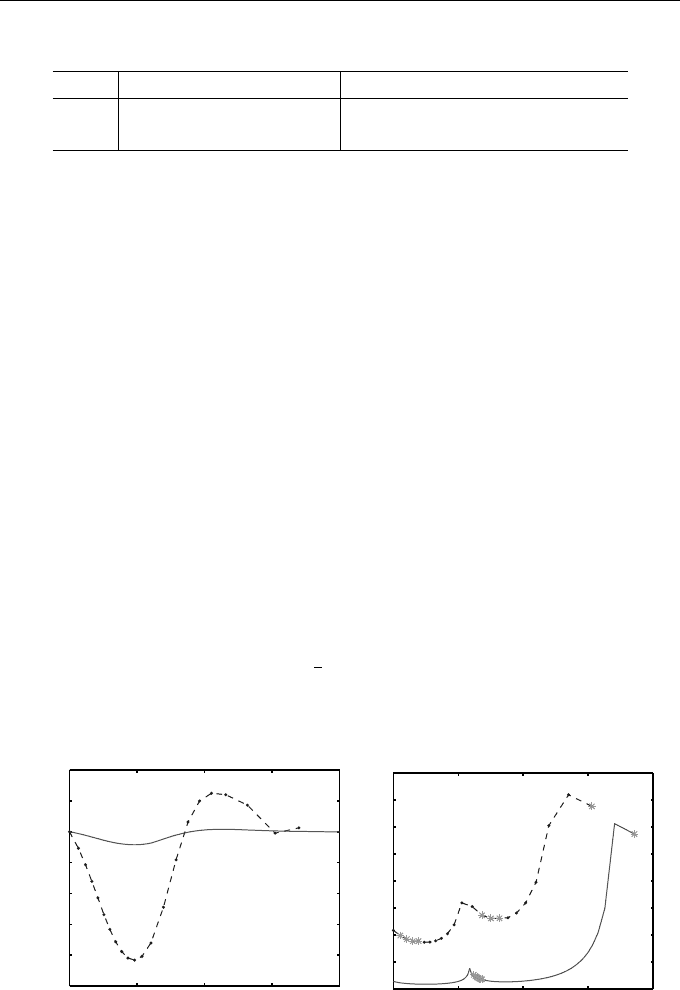
The results of numerical experiments with tol = 10
−2
and 10
−4
are reported
in Table 11.1 and Figure 11.1. The discussion on page 148, just before the start
of this section, suggests that h
new
∝ tol
1/2
; so, reducing tol by a factor of
100 should result in around 10 times as many time steps being required. This
is confirmed by the second column of the table, where the number of steps
increases from 21 to 207. The results in the third column of the table show
that the GE is reduced (almost exactly) by a factor of 10 when tol is reduced
by a factor of 100, confirming the expected relationship GE ∝ tol
1/2
.
In the time step history shown in Figure 11.1 (right) there is a local increase
in h
n
for t ≈ 1.2 corresponding to the zero in the denominator of (11.12) (see
footnote 5). It does not appear from the left-hand figure to have any significant
effect on the GE. The asterisks indicate rejected time steps (see stage (d) on
page 147). An explanation for the rejection of the final step in each of the
simulations is offered in Exercise 11.4.
For the second-order method TS(2) (see Example 3.1)
x
n+1
= x
n
+ h
n
x
0
n
+
1
2
h
2
n
x
00
n
, t
n+1
= t
n
+ h
n
, (11.13)
and the step size is updated using (11.7) with p = 2. The third derivative
0 1 2 3 4
−0.1
−0.08
−0.06
−0.04
−0.02
0
0.02
0.04
tol = 10
−2
tol = 10
−4
t
n
g e
0 1 2 3 4
0
0.05
0.1
0.15
0.2
0.25
0.3
0.35
0.4
tol = 10
−2
t
n
stepsize
tol = 10
−4
Fig. 11.1 Numerical res ults for Example 11.2 using TS(1). Shown are the
variation of GE (left) and time step h
n
(right) ve rsus time t
n
with tolerances
tol = 10
−2
, 10
−4
11.1 Taylor Series Methods 151
0 1 2 3 4
−0.1
0
0.1
0.2
0.3
0.4
0.5
0.6
tol = 10
−2
h = 1/3
t
n
g e
0 1 2 3 4
0
0.05
0.1
0.15
0.2
0.25
0.3
0.35
t
n
stepsize
tol = 10
−2
tol = 10
−5
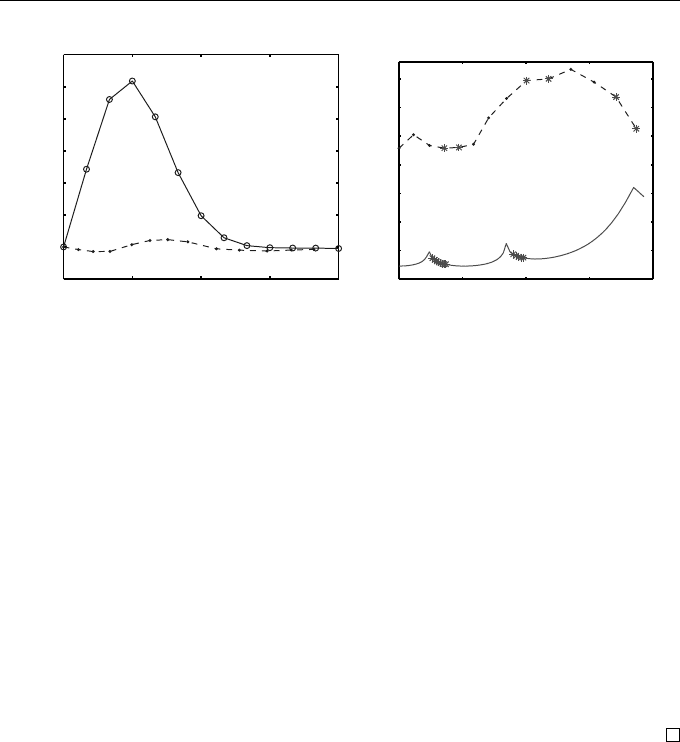
Fig. 11.2 Numerical results for Example 11.2 using TS(2). Left: the variation
of GE for the adaptive method with tol = 10
−2
(solid dots) and also the fixed
time step method with h = 1/3 (circles). Right: time step h
n
versus time t
n
with tolerances tol = 10
−2
, 10
−5
. Asterisks (∗) indicate rejected steps
required can be found by differentiating the expression given earlier for x
00
(t).
The res ults of numerical experiments with tol = 10
−2
and 10
−5
shown in
Table 11.1 are in accordance with the estimates h
n
∝ tol
1/3
and GE ∝ tol
2/3
.
It is also evident that TS(2) achieves much greater accuracy than TS(1) with
substantially fewer steps.
The GE as a function of time is shown in Figure 11.2 (left) for tol = 10
−2
.
Also shown is the GE of the fixed-step version of TS(2) described in Exam-
ple 3.2 that uses the same number of steps (12); thus, h = 1/3. The peak GE
of the fixed-step method is more than 20 times larger than the variable-step
equivalent, illustrating the significant gains in efficiency that can be achieve d
with the use of adaptive time steps.
Our final example of the TS method illustrates how the same ideas can be
applied to the solution of systems of ODEs. It also serves as a warning that time
steps have to conform to the absolute stability requirements of the method.
Example 11.3
Use the TS(1) method with automatic time step selection to solve the IVP (1.14)
introduced in Example 1.9 to describe a cooling c up of coffee.
The system (1.14) can be written in the matrix-vector form x
0
(t) = Ax(t) + g,
where
x(t) =
u(t)
v(t)
, A =
−8 8
0 −1/8
, g =
0
5/8
,
and, since g is constant, x
00
(t) = Ax
0
(t) = A
2
x(t) + Ag. The initial condi-
152 11. Adaptive Step Size Selection
tion is x(0) = [100, 20]
T
. The equations in (11.10) have their obvious vector
counterparts:
x
n+1
= x
n
+ h
n
x
0
n
, t
n+1
= t
n
+ h
n
; (11.14)
to interpret the vector form of (11.12), we need a means of measuring the
magnitude of the vector x
00
n
. We shall use the Euclidean length, defined by
kxk = (x
T
x)
1/2
for a real vector x. Hence , (11.12) becomes
h
new
= h
n
2 tol
kx
00
n
k
1/2
. (11.15)
The initial time step is given by the vector analogue of (11.8); that is,
h
0
=
2 tol
kx
00
0
k
1/2
,
which gives h
0
≈ 0.0198×tol
1/2
. This, together with (11.14) and (11.15), serves
to define the method.
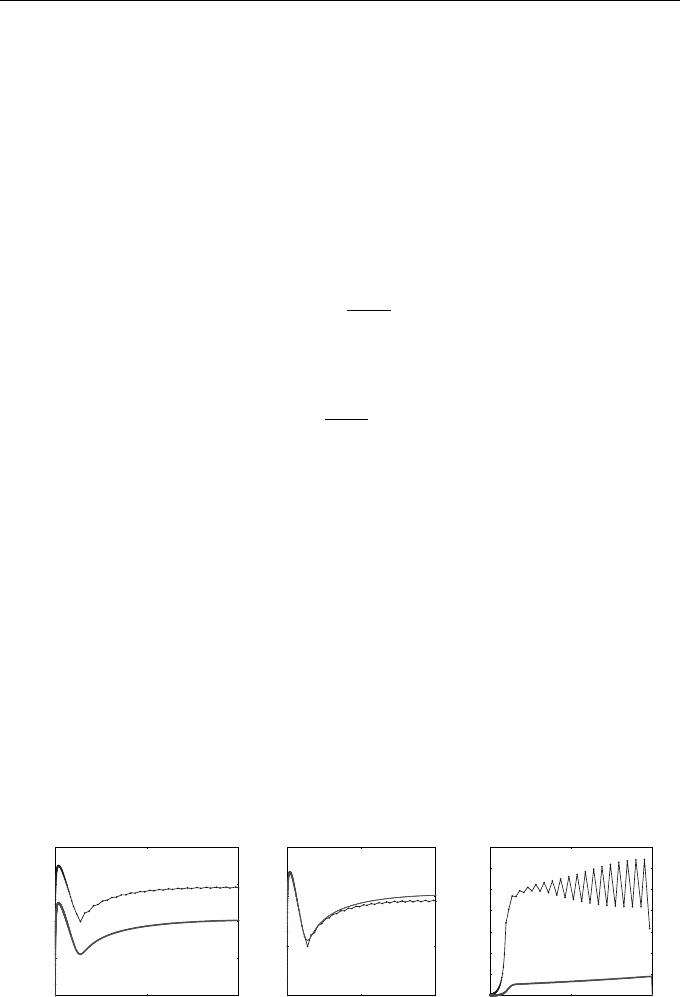
The numerical results obtained with this method for tol = 10
−2
and 10
−4
are shown in Figure 11.3. The GE shown on the left appears to behave as
expected—reducing tol by a factor of 100 reduces the GE by a factor of 10. To
check this more carefully we have plotted (middle) the GE scaled by tol
1/2
. The
two sets of results lie on top of each other for early times (up to about t = 2),
but there is evident divergence in the later stages, accompanied by perceptible
oscillations for tol = 10
−2
.
This departure from expected behaviour is due to the fairly violent oscilla-
tions in the time step, as se en in the rightmost plot. These, in turn, result from
the need to restrict the step sizes in order to achieve absolute stability (see
Chapter 6). To explain this, we first note that the eigenvalues of the matrix
0 5 10
10
−4
10
−3
10
−2
10
−1
10
0
tol = 10
−2
tol = 10
−4
t
n
ge
0 5 10
10
−2
10
−1
10
0
10
1
tol = 10
−2
tol = 10
−4
t
n
Scaled Error
0 5 10
0
0.05
0.1
0.15
0.2
0.25
0.3
tol = 10
−2
t
n
stepsize
tol = 10
−4
Fig. 11.3 Numerical res ults for Example 11.3 using TS(1). Shown are the
variation of GE (left), the scaled GE (that is, GE/tol
1/2
) (middle), and time
step h
n
(right) versus time t
n
. The tolerances used are tol = 10
−2
, 10
−4

11.2 One-Step Linear Multistep Methods 153
A—which govern the dynamics of the system—are λ = −8 and −1/8 and the
interval of absolute stability of Euler’s method (Example 6.7) is (−2, 0). It is
therefore necessary for
b
h ≡ λh ∈ (−2, 0) for each eigenvalue, that is, h ≤
1
4
.
Whenever formula (11.15) returns a value h
new
>
1
4
, instability causes an
increase in the local error. The step size is then reduced below this critical level
at the next step. The LTE is then smaller than tol, inducing an increase in step
size, and the oscillations therefore escalate with time.
Because the magnitude of the solution in this e xample is initially 100, com-
pared with 1 in previous examples, these tolerances are, relatively speaking,
100 times smaller than previously. Equivalent tolerances in this example would
need to be 100 times larger than those we have used, but these would have
led to even more severe oscillations in the time step. With tol = 10
−2
the level
of GE is roughly 0.1, which corresponds to a relative error of only 0.1%—so,
meeting the requirements of absolute stability leads to perhaps smaller GEs
than are strictly necessary for most applications.
The moral of this example is that methods with step size control can-
not overcome the requirements of absolute stability, and these requirements
may force smaller step sizes—and hence more computational effort and higher
accuracy—than the choice of tol would suggest.
11.2 One-Step Linear Multistep Methods
The general procedure for selecting time steps for LMMs is essentially the same
as that for TS m ethods described in the previous section. The main difference
is that repeated differentiation of the differential equation cannot be used to
estimate the LTE, as this would negate the benefits of using LMMs. Hence,
a new technique has to be devised for estimating higher derivatives x
00
(t
n
),
x
000
(t
n
), etc. of the exact solution.
The study of k-step LMMs with k > 1 becomes quite involved, so we will
restrict ourselves to the one-step case.
Example 11.4
Devise a strategy for selecting the step size in Euler’s me thod (TS(1)) that
does not require differentiation of the ODE. Illustrate by applying the method
to the IVP (11.9) used in Example 11.2.
The underlying method is the same as that in Example 11.2, namely
x
n+1
= x
n
+ h
n
x
0
n
, t
n+1
= t
n
+ h
n
,

154 11. Adaptive Step Size Selection
for which the LTE at the end of the current step is
T
n+1
=
1
2!
h
2
n
x
00
(t
n
) + O(h
2
n
).
The term x
00
(t
n+1
) is approximated using the Taylor expansion of x
0
(t
n+1
)
about the point t
n
:
x
0
(t
n+1
) = x
0
(t
n
) − h
n
x
00
(t
n
) + O(h
2
n
),
which can be rearranged to give
x
00
(t
n
) =
x
0
(t
n+1
) − x
0
(t
n
)
h
n
+ O(h
n
).
This can be estimated in terms of numerically computed quantities by
x
00
(t
n+1
) ≈
x
0
n+1
− x
0
n
h
n
.
Hence, T
n+1
is approximated by
b
T
n+1
=
1
2
h
n
(x
0
n+1
− x
0
n
), (11.16)
and this is used in (11.12)) to update the step size.
6
We choose a small initial
step size h
0
= 0.1tol and allow the adaptive mechanism to increase it automat-
ically during subsequent steps.
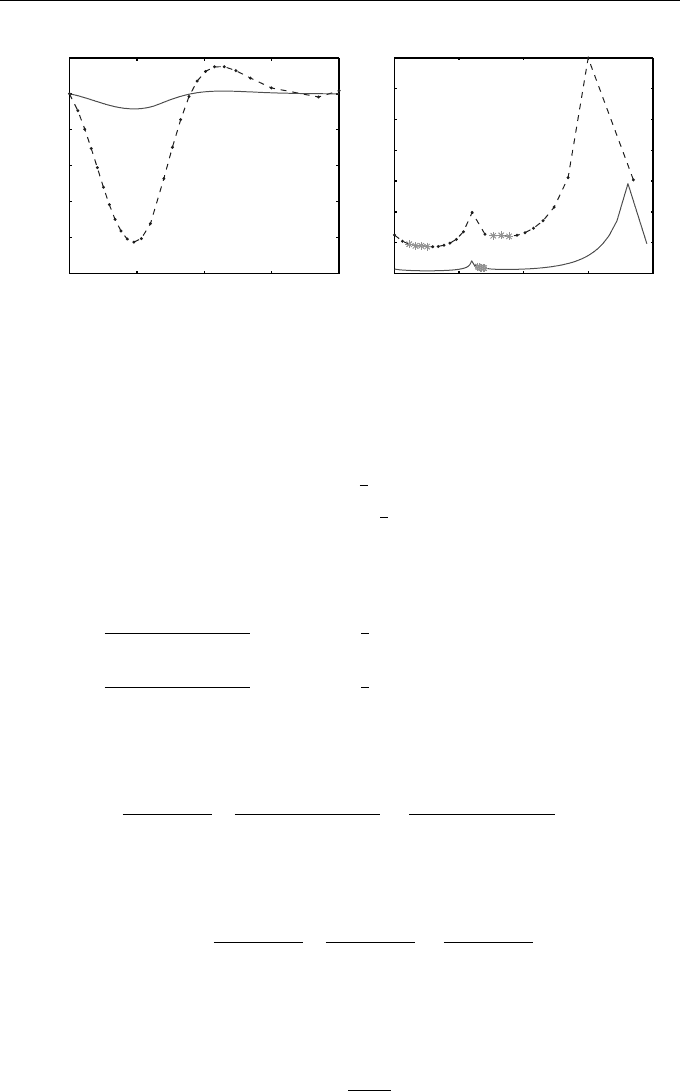
The results are shown in Figure 11.4 for tolerances tol = 10
−2
and 10
−4
.
It is not surprising that these show a strong resemblance to those for TS(1) in
Figure 11.1.
Example 11.5
Develop an algorithm based on the trapezoidal rule with automatic step size
selection and apply the result to the IVP of Example 11.2.
When h varies with n, the trapezoidal rule becomes
x
n+1
− x
n
=
1
2
h
n
(f
n+1
+ f
n
) (11.17)
and the LTE at t = t
n
is given by (see Example 4.9)
T
n+1
= −
1
12
h
3
n
x
000
(t
n
) + O(h
4
n
). (11.18)
The step-size-changing formula, (11.4) with p = 2, requires an estimate,
b
T
n+1
,
of T
n+1
. This will require us to estimate x
000
(t
n
).
6
Notice that the values of x
0
n
and x
0
n+1
are already available, since they are re-
quired to apply Euler’s method. The cost of calculating
b
T
n+1
is therefore negligible.
11.2 One-Step Linear Multistep Methods 155
0 1 2 3 4
−0.1
−0.08
−0.06
−0.04
−0.02
0
0.02
tol = 10
−2
tol = 10
−4
t
n
g e
0 1 2 3 4
0
0.1
0.2
0.3
0.4
0.5
0.6
0.7
tol = 10
−2
t
n
stepsize
tol = 10
−4
Fig. 11.4 Numerical results for Example 11.4 using Euler’s method. Shown
are the variation of GE (left) and time step h
n
(right) versus time t
n
with
tolerances tol = 10
−2
, 10
−4
This is done by using the Taylor expansions (see Appendix B)
x
0
(t
n+1
) = x
0
(t
n
) + h
n
x
00
(t
n
) +
1
2
h
2
n
x
000
(t
n
) + O(h
3
n
),
x
0
(t
n−1
) = x
0
(t
n
) − h
n−1
x
00
(t
n
) +
1
2
h
2
n−1
x
000
(t
n
) + O(h
3
n−1
),
which make use of t
n+1
= t
n
+ h
n
and t
n−1
= t
n
− h
n−1
. When they are
rearranged as
x
0
(t
n+1
) − x
0
(t
n
)
h
n
= x
00
(t
n
) +
1
2
h
n
x
000
(t
n
) + O(h
2
n
),
x
0
(t
n
) − x
0
(t
n−1
)
h
n−1
= x
00
(t
n
) −
1
2
h
n−1
x
000
(t
n
) + O(h
2
n−1
),
x
00
(t
n
) may b e eliminated by subtracting the second of these equations from
the first. The resulting expression, when solved for x
000
(t
n
), leads to
x
000
(t
n
) =
2
h
n
+ h
n−1
x
0
(t
n+1
) − x
0
(t
n
)
h
n
−
x
0
(t
n
) − x
0
(t
n−1
)
h
n−1
+ O(h),
where we have used h to denote the larger of h
n
and h
n−1
in the remainder
term. Thus, x
000
(t
n
) can be approximated by
x
000
(t
n
) ≈
2
h
n
+ h
n−1
x
0
n+1
− x
0
n
h
n
−
x
0
n
− x
0
n−1
h
n−1
,
since it is written in terms of previously computed quantities x
0
n−1
, x
0
n
, and
x
0
n+1
. By combining these approximations we find that the step size can be
updated via
h
new
= h
n
tol
b
T
n+1
1/3
, (11.19)