
Heidersbach R. Metallurgy and Corrosion Control in Oil and Gas Production
Подождите немного. Документ загружается.

CORROSION CONTROL 119
impermeable to moisture and oxygen migration. Zinc
pigments also provide a measure of cathodic protection
once the coating is breached. This cathodic protection
is greatly reduced if the primer is overcoated, but this is
often necessary for color coding or wear resistance
reasons. IOZ primers are not subject to ultraviolet (UV)
damage, so there is no need to overcoat them except for
the reasons above. Organic zinc primers are also widely
used, and they do benefi t from overcoats.
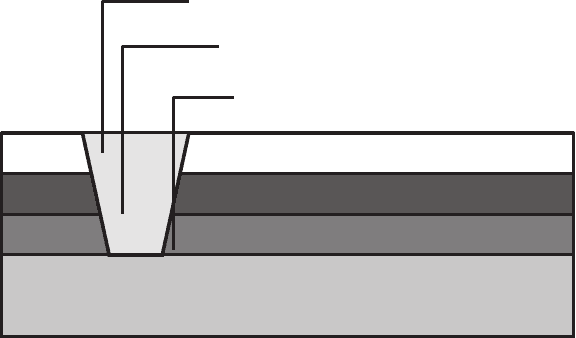
6
Figure 6.3
illustrates the idea of using zinc - rich primers for cathodic
protection at coating holidays.
Desirable Properties of Protective Coating Systems
In addition to providing corrosion protection, coating
systems should also have:
•
Strong, durable bonding to the substrate
•
Flexibility, because organic coatings have different
coeffi cients of thermal expansion than metals, and
coating fl exure is inevitable
•
Toughness, the ability to withstand mechanical
shock and loading
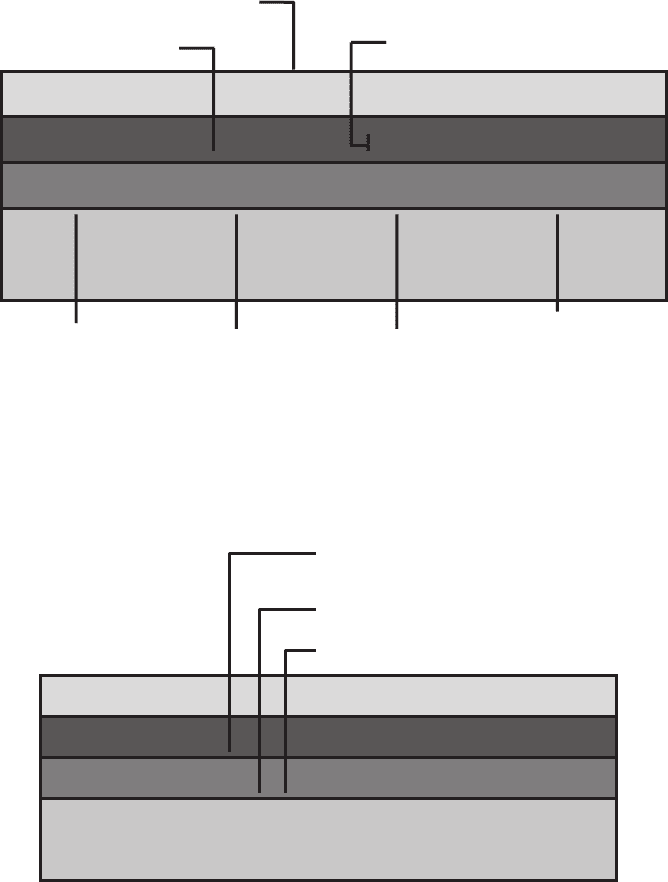
Figure 6.1 Protective coating system serving as a moisture and oxygen permeation barrier.
Drawing courtesy of NACE International, reproduced with permission .
Top Coat
Intermediate Coat
PRIMER
STEEL
Adhesion Strong
Coating Thoroughly
Wets Steel Surface
Physical as Well
as Chemical
Adhesion
No Voids at
Interface to
Accumulate Water
Surface Clean
No Salts to Create
Osmotic Blistering
Moisture Transmission Low
Impervious to Ions,
Oxygen, Carbon Dioxide
Moisture Absorption Static
and in Equilibrium
Figure 6.2 Protective coating system with slow - release corrosion inhibitors in the primer
coat. Drawing courtesy of NACE International, reproduced with permission.
Top Coat
Intermediate Coat
INHIBITIVE PRIMER
STEEL
Passive Layer
Ionization of Inhibitor
Reaction with Steel Surface
Moisture Absorption into Film
(Moisture Previous Coating)
c06.indd 119c06.indd 119 10/29/2010 10:35:41 AM10/29/2010 10:35:41 AM
120 METALLURGY AND CORROSION CONTROL IN OIL AND GAS PRODUCTION
Figure 6.3 Inorganic zinc primer serving as the source of cathodic protection of the steel
substrate at a coating holiday. Drawing courtesy of NACE International, reproduced with
permission.
ORGANIC TOP COAT
ORGANIC INTERMEDIATE COAT
INORGANIC ZINC PERMANENT PRIMER
STEEL
Tight Adhesion Prevents Coating Undercut
Moisture Allows Zinc to Ionize
Cathodically Protecting Steel
Break in Coating to Steel Surface
Zn
++
The choice of coating systems often requires compro-
mises between these characteristics. As one example,
very hard coatings such as are often used on pipeline
exteriors are often diffi cult to repair if damaged in ship-
ping and construction. The necessary bonding to undam-
aged coatings is hard to achieve. This problem is also
apparent at fi eld welds, where organic coatings must be
removed prior to welding.
Developments in Coatings Technology
Modern coating systems are generally longer lasting
than those that were available in the past. Worker safety
and environmental concerns have led to the develop-
ment of new coatings having higher solids and lower
VOC contents. The higher solids in modern coatings
frequently lead to the need for better surface prepara-
tion, as many of these coating systems are less tolerant
of surface contamination than the systems they are
replacing. Electrostatic spraying is an application that
was once confi ned to manufacturing of relatively small
items, but recent developments allow for the use of
electrostatic spraying in major new construction and
rehabilitation. This technique is especially useful on
complicated geometries where it is diffi cult to apply
even coatings with other techniques.
Useful Publications
The following publications provide guidance on coat-
ings selection and on preparing contracts for protective
coatings:
7,8
•
NORSOK M - CR - 501, “ Surface Preparation and
Protective Coating ”
•
NACE Publication 6J162, “ Guide to the Preparation
of Contracts and Specifi cations for the Application
of Protective Coatings ”
The Norwegian standard is directed toward offshore
platform construction, whereas the NACE standard also
covers less harsh environments.
Surface Preparation
Proper surface preparation is necessary for coatings to
bond properly to metallic and other substrates. Most
premature coatings failures can be attributed to
improper surface preparation or to allowing the prop-
erly prepared surface to degrade before coatings are
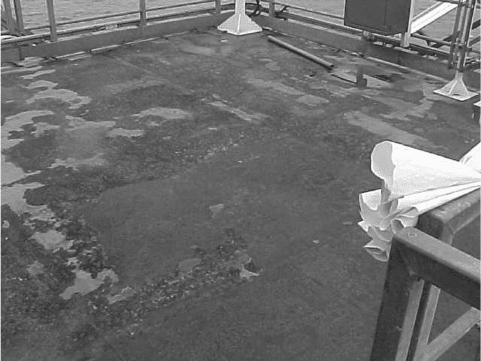
applied. Properly coated offshore platform deck coating
systems sometimes last 30 years before recoating
becomes necessary, but Figure 6.4 shows corrosion that
resulted from poor surface preparation on an offshore
platform deck after only 3 years. This failure could have
been easily avoided.
The principal surface condition factors that are
known to infl uence this performance are the presence
of rust and mill scale, surface contaminants including
salts, dust, oils and greases, and the surface profi le, which
must have enough roughness to allow mechanical adhe-
sion between the primer and the bare metal surface but
low enough so that paint covers the high spots with
adequate cover.
Abrasive blasting is usually the preferred means of
surface preparation, but high - pressure water jetting is
becoming more common due to environmental and
waste disposal concerns. Abrasive blasting leaves a
rough anchor pattern on the metal surface, while water
jetting usually does not. This has limited water jetting to
c06.indd 120c06.indd 120 10/29/2010 10:35:41 AM10/29/2010 10:35:41 AM
CORROSION CONTROL 121
Figure 6.4 Poor surface preparation led to a lack of coating
adhesion and corrosion on this offshore platform deck in only
3 years.
cleaning metal surfaces for recoating, but modern devel-
opments with high - pressure water jetting are overcom-
ing this lack of anchor pattern, and it is likely that the
use of water jetting will supplant abrasive blasting for
many projects in the future. Abrasive blasting to provide
an anchor pattern is sometimes used on bare metal
surfaces after they have been cleaned by water jetting.
This blasting also removes any “ fl ash rusting ” that may
have formed on the wet metal surface.
Neither of these techniques can remove grease and
other organic contaminants from the surface, and sol-
vents or other cleaning agents must be used prior to
either blasting or water jetting.
Surface preparation and other types of coatings
inspection are normally performed by third - party
inspection organizations. Surface preparation is the
most important part of any coatings application project,
and inspection by NACE or Norwegian FROSIO (the
Norwegian Professional Council for Education and
Certifi cation of Inspectors for Surface Treatment) -
certifi ed inspectors is often required. These third - party
inspectors are trained to insure that surface preparation
and coatings applications are conducted in accordance
with established international standards as specifi ed by
the coatings inspection and application contract.
Inspectors with this training are also involved with eval-
uation of existing coating systems to determine the
extent of coating damage and recommend remedial
measures.
Surface Cleaning Neither abrasive blasting nor water
jetting can remove grease and other organic surface
contaminants. These problems must be removed with
various commercial products suited to this purpose.
Soluble salts may also be present on the metal surface.
They are not removed by abrasive blasting, and can lead
to osmotic blistering of newly applied coatings.
9
Chloride
salts are normally removed by water washing or water
jetting, often with proprietary chemical additions sold
for this purpose added to the water. It is common to
check for the presence of soluble chlorides by various
methods, and most coatings contracts will specify a
maximum level of acceptable chloride contamination
on the surface. The amount of chlorides detected will
vary depending on the detection method, and the
method should be specifi ed in the coatings contract.
While chlorides are not the only soluble salt contami-
nation found on metal surfaces, washing that removes
chloride salts will normally remove any other salty con-
taminant that could cause coating degradation and lack
of adhesion.
Abrasive Blasting Abrasive blasting is the most com-
monly specifi ed method of preparing steel surfaces for
protective coatings.
10
Tables 6.1 and 6.2 provide comparisons on the rela-
tive costs of abrasive blasting and other surface prepara-
tion methods. While the best surface preparation
produces the longest - lasting coatings, the reduction in
costs associated with less thorough surface preparation
techniques can be signifi cant.
The choice of surface preparation techniques and
the necessary levels of cleanliness for new construction
depend on the generic type of primer (chemical nature
of the binder), severity of the environment, and the
desired coating service life. Coatings should be applied
in accordance with manufacturer ’ s recommendations,
and these recommendations should include surface
preparation guidelines listing minimally acceptable
surface preparation conditions. General guidelines for
selected generic coatings are shown in Table 6.3 . The
NACE/SSPC surface preparation standards are listed
in Table 6.4 . Note that while white metal blast cleaning,
NACE No. 1/SSPC - SP 5, is the cleanest possible sub-
strate for any of the coating systems, it is only required
for IOZ primers. Substantial cost savings can be
achieved if the surface preparation requirements for
these other coatings are relaxed, but these savings are
achieved at reduction in long - term performance of the
coating.
All of the NACE/SSPC standards contain the follow-
ing sections:
•
Procedure before blast cleaning
•
Blast cleaning methods and operations
•
Procedure following blast cleaning
•
Inspection
c06.indd 121c06.indd 121 10/29/2010 10:35:41 AM10/29/2010 10:35:41 AM

122 METALLURGY AND CORROSION CONTROL IN OIL AND GAS PRODUCTION
TABLE 6.1 Comparative Costs of Different Surface Preparation Techniques
9
Surface Preparation Cost Performance Dust Debris
White Metal 100% 100% 100% 100%
Near White 80% 90 – 95% 100% 80%
LP WC 10% 70 – 80% 0% 3 – 5%
UHP WJ 25% 90% 0% 5 – 10%
Wet abrasive to white metal 120 – 150% 95% 0% 110 – 125%
Low Pressure Water Cleaning (LP WC) is cleaning performed at pressures less than 5000 psi (34 MPa). Minimum pressure is 3500 psi; the use of
a rotating tip is mandatory. Hand scraping of blisters and other defect may be required. Chemical decontamination is mandatory.
Ultrahigh Pressure Water Jetting (UHP WJ is cleaning performed above 25,000 psi (170 MPa); the use of a rotating tip is mandatory. Chemical
decontamination is mandatory.
Wet Abrasive Blast Cleaning to White Metal: Cleaning to SSPC SP 5, White Metal Blast Cleaning, use of water ring for dust control is mandatory.
Chemical decontamination is mandatory.
TABLE 6.2 Comparison of Abrasive Blasting Costs for
General Construction
Blast Method Relative Cost
NACE #1 White Metal Blast 100%
NACE #2 Near White Metal Blast 70%
Commercial Blast, SSPC#6/NACE#3 40%
Brush Blast — loose rough previous coat 20%
TABLE 6.3 Minimally Acceptable Surface Preparation
Levels for Selected Generic Coatings
Generic Coating Type
Recommended Minimum
Surface Preparation
Alkyds and oil - based
coatings
NACE No. 3/SSPC - SP 6
Commercial Blast Cleaning
Water - borne acrylics NACE No. 3/SSPC - SP 6
Commercial Blast Cleaning
Epoxy NACE No. 3/SSPC - SP 6
Commercial Blast Cleaning
Zinc - rich epoxy NACE No. 3/SSPC - SP 6
Commercial Blast Cleaning
Inorganic zinc NACE No. 1/SSPC - SP 5
White Metal Blast Cleaning
TABLE 6.4 NACE / SSPC Joint Surface Preparation
Standards
NACE No. 1/SSPC - SP 5 White Metal Blast Cleaning
NACE No. 2/SSPC - SP 10 Near - White Metal Blast
Cleaning
NACE No. 3/SSPC - SP 6 Commercial Blast Cleaning
NACE No. 4/SSPC - SP 7 Brush - Off Blast Cleaning
NACE No. 5/SSPC - SP 12 Surface Preparation and
Cleaning of Metals by
Water Jetting Prior to
Recoating
NACE No. 6/SSPC - SP 13 Surface Preparation of
Concrete
NACE No. 8/SSPC - SP 14 Industrial Blast Cleaning
NACE No. 10/SSPC - PA 6 Fiberglass - Reinforced Plastic
(FRP) Linings Applied to
Bottoms of Carbon Steel
Storage Tanks
NACE VIS 7/SSPC - VIS 4 Guide and Visual Reference
Photographs for Steel
Cleaned by Water Jetting
NACE VIS 9/SSPC - VIS 5 Guide and Reference
Photographs for Steel
Surfaces Prepared by Wet
Abrasive Blast Cleaning
Inspections of blast - cleaned surfaces include mea-
surements of the surface profi le. If a surface is too
smooth, the primer will not develop adequate bonding
to the substrate. If it is too rough, the coating may be
too thin at high spots and pinpoint corrosion may occur.
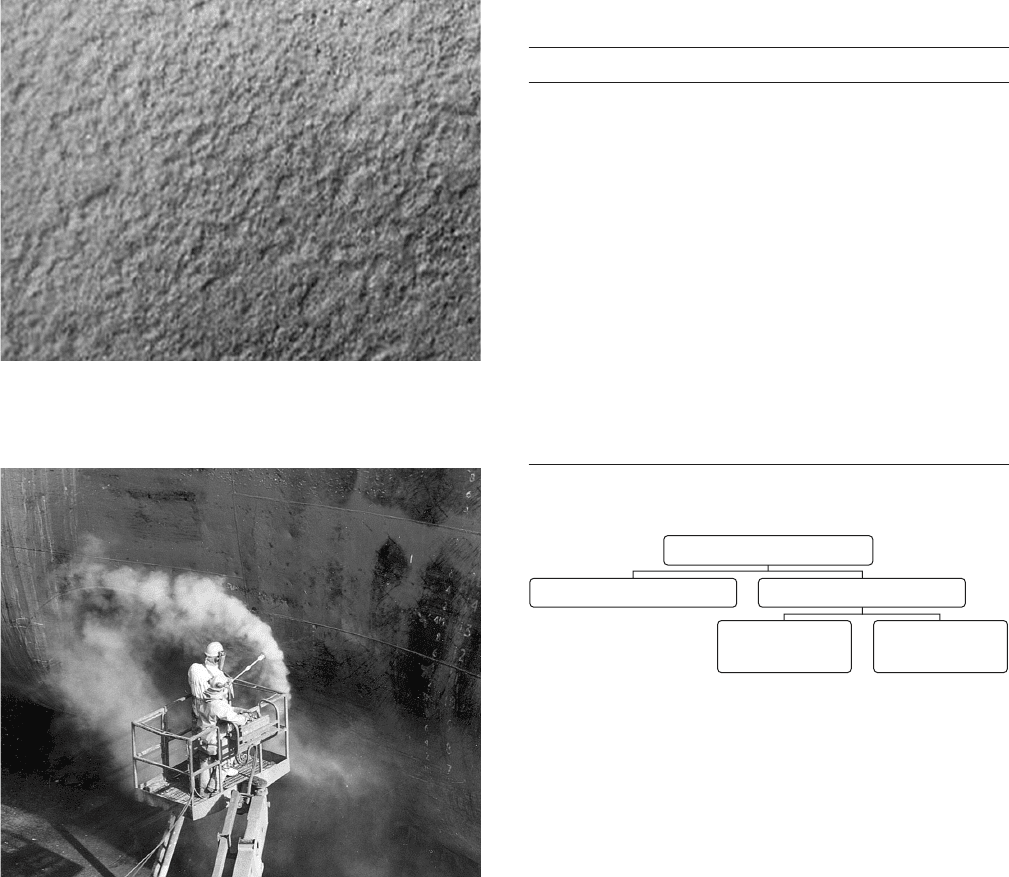
Figure 6.5 shows the rough surface and anchor pattern
of a blast - cleaned pipeline prepared for recoating.
Water Jetting Water jetting is currently used primarily
for preparing surfaces for recoating. The reason for this
limitation is because most water jetting systems cannot
produce an adequate surface profi le or anchor pattern.
This limitation has been largely overcome, but water
jetting is still used much less than abrasive blasting for
coatings surface preparation .
12
The NACE/SSPC surface
preparation standards listed in Table 6.4 describe water
jetting only for recoating purposes. This is shown in
Figure 6.6 , where water jetting is being used for surface
preparation on the outside of a large marine vessel prior
to recoating.
The advantages of water jetting, which uses high -
pressure water, are that it removes most contaminants,
c06.indd 122c06.indd 122 10/29/2010 10:35:42 AM10/29/2010 10:35:42 AM
CORROSION CONTROL 123
Figure 6.5 The surface of a pipeline ready for recoating in
the fi eld.
Figure 6.6 Water jetting surface preparation prior to recoat-
ing. Photo courtesy of Hammelmann Corp., Dayton, Ohio,
reproduced with permission.
TABLE 6.5 Comparison of Water Jetting and Abrasive
Blast Cleaning Standards and Surface Conditions
Surface Finish Grade ISO 8501 - 1 SSPC NACE
White metal Sa 3 Sp 5 No. 1
Near - white metal Sa 2½ SP 10 No. 2
Brush - off Sa 1 SP 7 No. 4
Solvent cleaning SP 1
Power tool cleaning St 2 or 3 SP 3
34
Power tool cleaning
to bare metal
S P 1 1
HPWJ and UHPWJ SP 12 No. 5
WJ - 1 clean to bare
substrate
WJ - 2 very thorough
or substantial
cleaning
WJ - 3 thorough
cleaning
WJ - 4 light cleaning
Wet abrasive blasting TR 2 6G198
Figure 6.7 Single and multicoat protective coating systems.
Photo courtesy of NACE International, reproduced with
permission.
Coating Systems
Single Coat
Multiple Coats
One Type
of Coating
Multiple Types
of Coatings
systems are intended to be single - layer coatings or mul-
tiple layers of the same type of coating. These choices
are shown in Figure 6.7 .
The various layers of a coating system must be com-
patible with each other, and this is normally done by
using the same coating manufacturer for all the layers,
typically primer, intermediate, and topcoat.
A single coat system is usually a relatively thin system
and usually provides minimal protection appropriate
for temporary protection during shipping and manufac-
turing. These single - fi lm coatings are often referred to
as “ shop coats ” and should be replaced before service
in any aggressive environment. Some single - fi lm systems
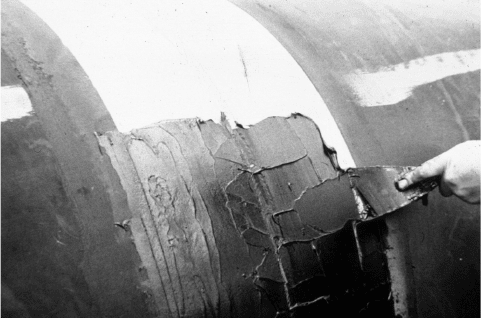
are much thicker, such as the trowel - applied coating
shown in Figure 6.8 , which is used for protection of girth
welds after welding in pipeline construction. Other
single - fi lm coatings are sometimes applied as mainte-
nance coatings in the splash zone where surface prepa-
ration is diffi cult and thick fi lms are necessary, and
interfi lm adhesion is diffi cult to achieve. Problems with
has no sparking or dust hazards, and removes soluble
salts. Corrosion inhibitors are sometimes added to the
water to prevent fl ash rusting, although opinions differ
on how deleterious these thin rust areas are to primer -
to - metal adhesion.
Table 6.5 provides approximate comparisons between
water jetting and abrasive blast cleaning standards.
Purposes of Various Coatings
Protective coating systems usually consist of multiple
layers of paint having different purposes, but some
c06.indd 123c06.indd 123 10/29/2010 10:35:42 AM10/29/2010 10:35:42 AM
124 METALLURGY AND CORROSION CONTROL IN OIL AND GAS PRODUCTION
single - coat systems include solvent entrapment in thick
systems, diffi culty maintaining desired coating thickness,
and potential holidays and misses.
Multiple - coat systems can be layers of the same
product or a variety of products that combine the
desired properties of each layer, for example, primer,
barrier intermediate coat, and topcoat.
Coatings are classifi ed in two different ways. Some
classifi cations specify coatings by binder chemistry, for
example, epoxy and polyurethane. The chemistry of
these binders is understood by coatings manufacturers
and many fi eld - oriented coatings professionals. Most
fi eld - oriented coatings professionals do not understand
the chemistry of coatings; they just know what works,
and what does not work. Coatings manufacturers list
their products by generic binder types or by appropriate
applications.
Generic Binder Classifi cations
Alkyd Paints These paints provide minimal protec-
tion and are seldom used in oilfi eld applications. Note
that many manufacturers will call these systems paints
to distinguish them from the more protective chemis-
tries listed as “ coatings ” — implying protective coatings.
Bituminous Coatings These asphalt or coal - tar - based
coatings are seldom used in oilfi eld applications on
metal substrates with the exception of fi eld - applied
repairs and girth - weld coatings on buried pipelines. At
one time, coal - tar coatings were standard coatings for
pipelines and other oilfi eld structures, but environmen-
tal and occupational health concerns have limited their
use in recent years.
Vinyl Coatings Vinyl coatings are widely used protec-
tive coatings for corrosion resistance in chemical service.
They are easy to apply and form tight homogeneous
fi lms over the substrate. Intercoat adhesion is also excel-
lent. They do soften slightly when covered with some
crude oils. Their fl exibility allows them to accommodate
the motion of the steel substrate, for example, during
ship or platform launching.
13
They are physically drying, one - component paints,
and usually cannot withstand temperatures greater than
75 – 80 ° C (165 – 175 ° F). They are relatively easy to apply
and quick drying, but they have low solids content and
have relatively high VOC contents.
Film thickness is typically only 50 μ m (2 mils), and
this, combined with their relative softness, means they
cannot withstand mechanical abuse. It also limits their
use on rough, previously coated surfaces.
Chlorinated Rubber Coatings Chlorinated rubbers
were once widely used for marine and other oilfi eld
applications,
13
but worker safety and environmental
concerns have limited their use in recent years.
Epoxy Coatings These coatings are the workhorses of
the marine coatings and oilfi eld industries. Most epoxies
require near - white blast coating surface preparation,
although some versions can be applied underwater as
repair coatings. With proper surface preparation, they
have excellent substrate adhesion combined with good
impact and abrasion resistance, and can achieve high
fi lm thicknesses.
Epoxies chemically cure. They are available in
systems where the reactants are mixed during applica-
tion as well as single - component products, which require
more careful shipping and storage control and careful
consideration of application and curing temperatures.
These chemical - curing - related considerations mean
that the use of epoxy coatings requires highly trained
and experienced coatings contractors.
A wide variety of end - product properties can be
achieved by varying the components, and epoxies are
sold as pure epoxies, phenolic epoxies, coal tar epoxies,
solvent - free epoxies, water - borne epoxies, and so on.
All epoxies are subject to UV degradation. This
means they must be topcoated for most atmospheric
exposures.
Epoxy Mastic Coatings These coatings have been
marketed in recent years as easy - to - apply, inexpensive
thick - fi lm coatings. They have relatively short service
performance compared with other coatings. Because of
this, and the fact that coating materials are minor costs
(approximately 10%) of coatings applications projects,
their reduced cost is not justifi ed for many applications.
Figure 6.8 Trowel application of thick - fi lm single coating of
coal - tar urethane for fi eld application at pipeline girth welds.
Photo courtesy of NACE International, reproduced with
permission.
c06.indd 124c06.indd 124 10/29/2010 10:35:42 AM10/29/2010 10:35:42 AM

CORROSION CONTROL 125
They are not generally recommended for atmospheric
or marine exposures, but they may be appropriate for
buried service, for example, as repair coatings on
pipelines.
Acrylic and Polyurethane Coatings These coatings
are usually used as colored topcoats over epoxy - based
primers and intermediate coatings. They have excellent
hardness and very good UV and chemical resistance.
They are two - component systems that require tempera-
ture and other application controls. The choice between
various topcoats is often determined by pot life, applica-
tion conditions, and curing time before they can be used.
Polyester Coatings Glass fl ake - reinforced polyester
high - build coatings are used for high wear and abrasion
applications such as walkways and the tidal and splash
zones of steel structures.
Vinyl Ester Coatings These coatings fi nd their best
uses as tank linings. They are often applied as thick
coatings (two coats of 750 μ m — 30 mils, total 1500 μ m –
60 mils ). Many linings are applied as sheet materials, but
these linings can be applied by airless spray as two -
component liquids that quickly cure. Glass fl ake rein-
forcement improves abrasion resistance. They should
only be applied over blast - cleaned steel (NACE No. 2/
SSPC - SP 10).
IOZ Coatings IOZ coatings have metallic zinc pig-
ments. They are widely used as primers for long - lasting
atmospheric exposure protection. They are not gener-
ally recommended for buried or submerged service.
The zinc pigments make mechanical contact with
each other and with the steel substrate. This allows them
to provide galvanic protection of exposed steel at holi-
days, and they usually have at least 75% by weight
metallic zinc in the dry fi lm.
5
The precise minimum zinc
content for effectiveness depends on which of several
commercially available inorganic binders is used.
IOZ primers will become dull gray upon weathering
and sometimes require topcoats for visibility or color
coding purposes. These topcoats reduce the effectiveness
of the cathodic protection provided by the underlying
IOZ primer. Unlike organic primers, IOZs are immune
to UV degradation, so sunlight exposure is never a
problem, and many IOZ primers with no topcoats have
been used for decades with minimal degradation.
Surface preparation for IOZ primers requires at least
a commercial blast cleaning (NACE No. 3/SSPC - SP5),
but white metal blasting (NACE No. 1/SSPC - SP 5)
is preferred and will result in better performance.
Topcoating of IOZ primers requires cleaning to remove
any reaction products that may have formed.
Table 6.6 compares the performance of IOZ and gal-
vanizing coatings.
For all but the most benign environments, for
example, onshore atmospheric exposures, galvanizing
is not practical, at least in part, because of the thin
coatings applied by standard commercial galvanizing
operations.
Zinc is an amphoteric metal, and it corrodes at unac-
ceptable rates in both acids and bases. This means that
no zinc - coating pigments can be used for direct expo-
sure to acids, for example, drilling muds and many other
completion and workover fl uids, or to bases. Topcoats
are necessary in these environments.
Organic Zinc Primers Organic zinc primers are used
for many of the same applications as IOZ primers. Their
organic binders mean that, unlike IOZ coatings, organic
zinc primers must be topcoated to protect them from
UV degradation. The organic binder also means that the
cathodic protection provided by the metallic zinc pig-
ments is less effective, because the intermetallic con-
tacts between the pigment particles and between the
pigments and the steel substrate are less effective due
to the resistivity of the organic binder.
IOZ primers are fast drying and their overcoating
interval is relatively short. They are compatible with all
of the topcoat systems used in oilfi eld applications.
Problems occur with alkyds, but they are seldom used
in oilfi eld applications due to their limited environmen-
tal resistance.
Organic zinc primers are used to recoat and spot
paint over IOZ and galvanizing.
The surface preparation for organic zinc primers
requires at least a near - white blast cleaning (NACE No.
2/SSPC - SP 10), and they are less tolerant of surface salts
than IOZ primers.
Polyurea Coatings Polyurea coatings show much
promise and will become more prevalent in the future.
The advantages of polyureas include their quick setting,
TABLE 6.6 Comparison of Inorganic Zinc and Galvanized
Coatings
Inorganic Zinc Galvanizing
Not a metallic coating Metallic coating
Excellent corrosion
resistance
Excellent corrosion resistant
Chemically bonded to steel
substrate
Chemically bonded to steel
substrate
Individual particles Continuous zinc
Medium abrasion resistance Limited abrasion resistance
Slower reaction with acids Faster reaction with acids
Long life span Shorter life span
c06.indd 125c06.indd 125 10/29/2010 10:35:42 AM10/29/2010 10:35:42 AM

126 METALLURGY AND CORROSION CONTROL IN OIL AND GAS PRODUCTION
TABLE 6.7 SSPC Environmental Zones
14
Zone Description
0 Dry interiors
1A Normally dry interiors
1B Normally dry exteriors
2A Frequent wetting by fresh water
2B Frequent wetting by salt water
2C Immersion in fresh water
2D Immersion in salt water
3A Acidic atmospheric exposure, pH 2 – 5
3B Neutral chemical atmospheric expsoreu, pH 5 – 10
3C Alkaline chemical atmospheric exposure, pH 10 – 12
3D Atmospheric exposure with solvents and
hydrocarbons
3E Severe chemical atmospheric exposure
TABLE 6.8 Selected Environmental Zones for which SSPC Systems Are Recommended
14
Painting System Environmental Zone
SSPC # Generic Type 0 1A 1B 2A 2B 2C 2D 3A 3B 3C 3D 3E
PS 11 Coal tar epoxy x x x x x x x
PS 12 Zinc rich (no topcoat) X X X X X X X X
PS 12 Zinc rich (with topcoat) X X X X X X X X X
PS 19 Ship bottoms
PS21 Ship topsides X X X X
CS 23 Metallic thermal spray X X X T X T T T T
T, recommended only with proper sealing or topcoating.
For zone 3E, use specifi c exposure data to select a coating.
insensitivity to ambient temperature and weather
changes during application, and good mechanical prop-
erties. Unfortunately, their quick - setting properties limit
their adhesion to metal substrates, and they are not cur-
rently used as protective coatings for large metal struc-
tures. It is likely that these limitations will be overcome,
and polyureas will become standard protective coatings
for many oilfi eld applications when that happens.
Coatings Suitable for Various Service Environments
or Applications
Several organizations suggest appropriate coatings
systems for various environments and applications.
Tables 6.7 and 6.8 show the SSPC classifi cation of
environments and suggested coatings systems for these
environments.
14
NORSOK, the Norwegian standards
organization, recommends the coating systems for off-
shore platform applications shown in Table 6.9 . The ref-
erenced publications also contain suggestions on surface
preparation methods and the necessary surface condi-
tions prior to coating application.
7,14
Many coatings manufacturers and suppliers list the
coatings by application instead of by generic type. These
listings generally follow terminology similar to that
shown in Tables 6.6 – 6.8 , and they often specify the
recommended operating temperatures (usually as
maximum acceptable sustained temperatures) that the
coating systems can withstand. Coating systems from
various manufacturers will perform differently, and it is
common to test new coatings systems for performance
in accordance with recommended accelerated exposure
testing procedures.
15
Coatings Inspection
Surface preparation and other types of coatings inspec-
tion are normally performed by third - party inspection
organizations. Surface preparation is the most impor-
tant part of any coatings application project, and inspec-
tion by NACE or Norwegian FROSIO (the Norwegian
Professional Council for Education and Certifi cation of
Inspectors for Surface Treatment) - certifi ed inspectors is
often required. These third - party inspectors are trained
to insure that surface preparation and coatings applica-
tions are conducted in accordance with established
international standards as specifi ed by the coatings
inspection and application contract. Inspectors with this
training are also involved with evaluation of existing
coating systems to determine the extent of coating
damage and recommend remedial measures.
16
Documentation of coatings inspection is very impor-
tant, because the third - party inspector must convince all
interested parties that the surface preparation, coatings
application, and inspections have all been conducted in
accordance with contract requirements and industry
standards.
17
Owners want perfect coatings and contrac-
tors want payment; these confl icting interests must be
resolved in accordance with pre - agreed procedures.
Written standards, for example, NACE, SSPC, and ISO
take preference.
c06.indd 126c06.indd 126 10/29/2010 10:35:42 AM10/29/2010 10:35:42 AM

CORROSION CONTROL 127
TABLE 6.9 Recommended Coating Systems for Various Locations on Offshore Platforms
7
Application Coating System NDFT ( μ m)
Carbon steel 1 coat zinc - rich epoxy 60
Operating temperature < 120 ° C
1 coat two - component epoxy 200
Structural steel 1 coat topcoat
75
Exteriors of equipment, vessels, piping,
and valves (not insulated)
MDFT ( μ m)
335
All carbon steel surfaces in
noncorrosive areas (e.g., living
quarters)
Deck areas
Carbon Steel Thermally sprayed aluminum
or alloys of aluminum
200 min
Operating temperature > 120 ° C
All insulated surfaces of tanks,
vessels,and piping
Flare booms Sealer
Underside of bottom deck, jacket
above splash zone, crane booms,
lifeboat stations are optional stations
Walkways, escape routes, and other deck areas as specifi ed Nonskid epoxy screed 3000
Under epoxy - based primer 1coat epoxy primer 50
o r
1 coat zinc - rich epoxy 60
1x epoxy tie coat
25
MDFT ( μ m)
85
Under cement - based fi re protection 1 coat zinc rich epoxy 60
1 coat two - component epoxy
200
MDFT ( μ m)
260
Application (if not specifi ed in others) 1 coat epoxy primer 50
Uninsulated stainless steel when
painting is required
1 coat two - component epoxy 100
1 coat topcoat
75
Aluminum when painting is required
MDFT ( μ m)
225
Galvanized steel
Insulated stainless steel piping and
vessels at temperatures < 120 ° C
2 coats immersion grade
expoxy phenolic
2 × 1 5 0
MDFT ( μ m)
300
Submerged carbon steel and carbon steel in the splash zone 1 coat epoxy primer
a
225
1 coat two component epoxy
225
Submerged stainless steel and stainless steel in the splash zone
MDFT ( μ m)
450
Internal seawater fi lled compartments, e.g., ballast tanks
a
NORSOK states “ two component epoxy for both layers. ”
Common inspection hold points or checkpoints
include:
•
Pre - surface inspection
•
Post - surface preparation
•
Pre - painting
•
During and after application
The initial surface inspection determines the condition
of the steel surfaces before operations begin. The ISO
standards for degree of rusting serve to indicate the
relative initial surface condition before surface prepara-
tion and coatings begin:
18
•
A — Steel surface largely covered with adhering
mill scale but little, if any rust
•
B — Steel surface has begun to rust and from which
the mill scale has begun to fl ake
•
C — Steel surface on which mill scale has rusted
away or from which it can be scraped, but with
slight pitting visible under normal vision
•
D — Steel surface on which mill scale has rusted
away and on which general pitting is visible under
normal vision
Each type of paint coating will have a specifi c surface
preparation requirement that must be followed.
c06.indd 127c06.indd 127 10/29/2010 10:35:43 AM10/29/2010 10:35:43 AM
128 METALLURGY AND CORROSION CONTROL IN OIL AND GAS PRODUCTION
Proper paint adhesion depends on the removal of all
greases and other organic contaminants prior to surface
preparation. Abrasive or water jetting cannot be relied
upon to do this, so solvent cleaning is usually necessary
to remove them. This contamination is normally detected
visually, but UV (black) lighting is sometimes used to
aid in organic contaminant detection.
12,19
The presence of soluble salts on metal surfaces has
been recognized for many years as leading to premature
coatings failures. These salts are normally chlorides and
sulfates, but other species may also be present. They are
usually removed by power washing. Proprietary com-
mercial products claim to aid in this salt removal.
Chloride contamination receives most of the soluble
salt attention, and any washing process that removes
chloride salts is likely to also remove other salts.
No internationally recognized standards on the
acceptable levels of salt contamination on a metal
surface are available, although efforts are underway
to develop them. Table 6.10 shows the limits suggested
by NACE for offshore structures. These levels are
to be measured using methods suggested by ISO
standards.
20,21
One of the problems with soluble salt detection and
measurement is the wide variability associated with
measuring the salt levels on rough surfaces. Replication
is diffi cult. One promising method of diminishing this
variability is the development of conductometric testing.
Instead of using colorimetric titrations or similar
methods of determining the salt content on a metal
surface, the surface can be exposed to a source of deion-
ized water, and the resulting conductivity can be mea-
sured as a direct indication of the soluble salts that are
present. This method has the added benefi t of measur-
ing all salts, not just chloride ions.
20 – 24
Steel surfaces must
have a profi le in order for the paint coatings to develop
adequate surface contact and adhesion. This is one of
the main results of abrasive blasting and is considered
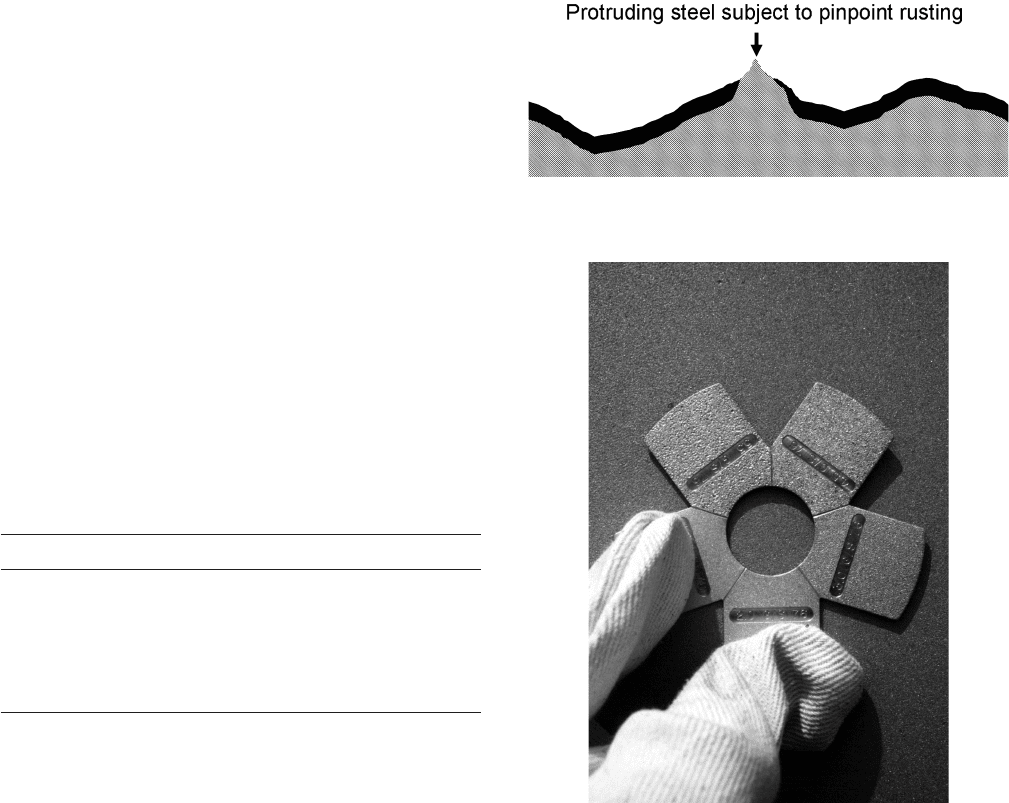
to be a limitation to many water - jetting operations. If
the surface profi le is too deep, paint fi lms will not ade-
quately cover the highest points, and pinpoint rusting
will occur. This idea is shown in Figure 6.9 . Pinpoint
rusting is unsightly, but it can also lead to eventual
undercutting and wider corrosion problems. The surface
profi le necessary to insure adequate bonding and to
avoid pinpoint rusting will depend on the type of coating
involved.
Anchor patterns and surface - profi le determinations
are usually evaluated visually by placing laboratory -
prepared optical comparators on the surface and
comparing the adjacent abrasive - blasted surfaces to the
comparator. Figure 6.10 shows one version of commer-
TABLE 6.10 Recommended Maximum Allowable Total
Soluble Chloride Ion Contents for Offshore Structures
12
Coating Category New Construction Maintenance
Splash zone, exterior
submerged zone,
and ballast water
tank
20 mg/m
2a
20 mg/m
2a
Atmospheric zone 20 mg/m
2
50 mg/m
2
Stainless steels 20 mg/m
2
20 mg/m
2
Nace RP 0108 - 2008 table 15, reproduced with permission.
a
The level of residual salt contamination on the surface has a very
signifi cant effect on the service life of the immersion - type coating
systems. A clean surface should be obtained prior to coating. However,
if the soluble chloride ion content is high and obtaining a clean surface
is too costly, the allowable soluble chloride ion content shall be agreed
to by the coating applicator and facility owner.
Figure 6.9 Protruding steel subject to pinpoint rusting.
Figure 6.10 Keane - Tator surface - profi le comparator disc.
Photo courtesy of KTA - Tator, Inc., reproduced with permission.
c06.indd 128c06.indd 128 10/29/2010 10:35:43 AM10/29/2010 10:35:43 AM