
Higgins M.D. Quantitative textural measurement in igneous and metamorphic petrology
Подождите немного. Документ загружается.

times of 10 seconds at the tips of the veins and up to 90 seconds within the
wider parts of the veins. Growth rates of hematite are about five orders of
magnitude faster than that of ilmenite in a lava lake.
3.4.5.5 Experimental studies
Although there has been much work in experimental petrology on the nature
of phases under different pressure and temperature conditions, there have been
few experimental studies that use the distribution of crystal sizes. Cabane et al.
(2001) examined the kinetics of coarsening (Ostwald ripening) of quartz in
simplified synthetic silicate melts. They did observe coarsening, but the kinetic
factors did not match that predicted by LSW theory (Lifshitz & Slyozov,
1961). They suggested that this may be caused by an initial transient regime
or that coarsening is not limited by diffusion, but by surface nucleation.
However, it may also be related to the ideal nature of the experimental
materials, or that the LSW model is not the best to apply to geological
materials (DeHoff, 1991, Higgins, 1998). Their work suggests that coarsening
may be very important just after nucleation, but that it is not important for
quartz crystals larger than 1 mm during geologically reasonable periods of
time. However, they admit that it may be a different story for other minerals
and magmas.
3.4.6 Undeformed metamorphic minerals
3.4.6.1 Garnet
Garnet is by far the most popular mineral for CSD studies in metamorphic
rocks, with the first study in 1963 by Galwey and Jones (1963). This may reflect
the ease with which it can be separated from other minerals. Most studies have
been on rock sections: the equant shape of most crystals minimises the stereo-
logical cut-section effect, but the intersection-probability effect must still be
considered (see Section 3.3.4.3). There have also been a number of studies in
three dimensions: these enable the spatial relations between grains to be
examined in detail. However, 3-D analysis is not always better than sectional
analysis as resolution problems with some X-ray methods may limit the size
range of crystals that can be examined.
Early studies established that garnets generally have a unimodal concave-
down size distribution (Galwey & Jones, 1963, Galwey & Jones, 1966, Kretz,
1966a), although Kretz (1966a) did find one bimodal distribution. The
precise shapes of the CSDs are not easy to establish from these studies, but
appear to be between normal (Kretz, 1993) and lognormal (Cashman & Ferry,
3.4 Typical applications 129
1988) by population density (¼ frequency, if the size intervals are constant).
X-ray tomographic studies have improved the quality of the CSDs by the
elimination of stereological effects (Carlson et al., 1995). In all studies there
appear to be no small crystals; however, the lower size limit of detection is
not generally well defined and hence this feature may be in some cases an
artefact.
There has been much debate on the interpretation of garnet CSDs. The
most popular theory is that garnet nucleated, grew and then became coar-
sened by Ostwald ripening following the LSW model (Cashman & Ferry,
1988, Miyazaki, 1996). Coarsening requires transport of material between
crystals and this is easy if there is a fluid present (silicate or water dominated),
or if the transport distance is short, as in monomineralic rocks. Carlson
(1999) has argued that Ostwald ripening is severely limited by diffusion
in polymineralic rocks under metamorphic conditions. He also points out
that the shape of the garnet CSDs is not that expected for LSW coarsening.
However, it has been pointed out that the LSW model may not be the
most appropriate for geological materials (DeHoff, 1991, Higgins, 1998). In
addition it is possible that deformation promotes circulation of fluids
by opening up channels. An interesting twist on the problem is suggested
by the data of Daniel and Spear (1999). They looked at Mn zoning patterns
in garnet crystals and concluded that they were formed by the nucleation
and growth of many crystals that subsequently rotated slightly and
coalescenced.
3.4.6.2 Accessory minerals
Accessory minerals are very important for geochemical modelling and geo-
chronology, but little quantitative work has been done on their textures, except
for zircon (see Section 3.4.3.3). Zeh ( 2004) examined the CSDs of apatite,
allanite and titanite in four gneiss samples that were metamorphosed to max-
imum temperatures of 550 8C to 680 8C. He used a variety of 3-D techniques to
determine the CSDs of these minerals over a large size range. All CSDs are
unimodal, concave down. On a classical CSD diagram the peak shifts to larger
sizes as the slope of the right side fans around to shallower slopes. Zeh (2004)
constructed a complicated growth history using the growth model of Eberl
et al.(1998) followed by coarsening. However, the CSD patterns closely
resemble the progression seen in other rocks that has been explained just
by coarsening (e.g. Cashman & Ferry, 1988, Higgins, 1998), especially that
following the ‘Communicating Neighbours’ equations of DeHoff (1991).
Coarsening in metamorphic rocks may be ubiquitous; hence the nature of
the original CSD is not observable.
130 Grain and crystal sizes
3.4.6.3 Crystals in migmatites
Migmatites are rocks produced during partial melting. There are a number of
aspects of interest here: the size-dependence of melting can be investigated, but
is usually concealed by later processes. Berger and Roselle (2001) instead
examined the CSD of cordierite produced by melt-producing reactions. They
found that it was straight and proposed a nucleation and growth model similar
to that for crystallisation of minerals from magma. Plagioclase in a leucosome
had a concave down CSD suggesting coarsening. K-feldspar had a bimodal
CSD that was not easy to explain. Berger and Roselle (2001) only examined
three samples in all: clearly this material has a lot of promise for further study.
3.4.6.4 Hydrothermally grown crystals
Study of crystal sizes in hydrothermal crystallisation experiments by Eberl
et al.(1998, 2002) led to their proposal that all CSDs are lognormal and that
this necessitates a new growth theory, which they entitled ‘the law of propor-
tionate effect’. However, as has been seen above, there are many processes that
can affect CSDs and it seems simplistic to force fit one model, especially when
it has no experimental basis. In addition, some of the studies of Eberl and his
coworkers have been hampered by incorrect conversion equations from inter-
section measurements to CSDs. Finally, the frequency diagram used in these
studies is not very sensitive to variations in CSD shape. Bindeman (2003) has
shown that some CSDs are indeed lognormal, but this is more likely produced
by coarsening or repeated cycles of growth and solution (see Section 3.4.3.2).
3.4.7 Deformed and broken crystals and blocks
3.4.7.1 Olivine in mantle lherzolites
Mantle samples fall between the simple classification of igneous and meta-
morphic rocks – they are clearly igneous in origin, but have been deformed.
There are few studies of the CSDs of minerals in mantle samples despite the
volumetric dominance of the mantle in the Earth, the enormous number of
fabric studies and the need for size data in geophysical modelling. Armienti
and Tarquini (2002) examined the CSDs of olivine in suites of spinel and
garnet lherzolites with a range of textures. They found that the CSDs followed
a power law distribution over two orders of magnitude of size. Granoblastic
textured samples had fractal dimensions around 2.4, which compares with
values of 2.6 for fragmentation models (see Section 3.3.7.1). Porphyroclastic
and cataclastic textured samples had fractal dimensions up to 3.8, but the
interpretation of this is not yet clear.
3.4 Typical applications 131
3.4.7.2 Dynamic recrystallisation
The fabric of naturally deformed minerals has been studied extensively gen-
erally by using the mean grain size. Stipp and Tullis (2003) examined experi-
mentally the relationship between mean grain size in quartzite and flow stress.
They ensured that deformation reached equilibrium and that stress was mea-
sured accurately, but unfortunately did not apply stereological corrections to
their grain sizes values. They found that mean grain size was well correlated
with flow stress within the dislocation creep regimes. A slightly different
correlation was observed at greater flow stresses.
Herwegh et al.(2005) have pointed out that the full grain size distribution is
important in controlling creep behaviour, although it is rarely measured. In
mylonites deformation of the rock reduces grain size at the same time as
recrystallisation repairs the damage. The result is an equilibrium grain size
distribution that depends on the temperature and the strain rate. Herwegh
et al.(2005) examined the CSDs of calcite from mylonites in the Helvetic Alps.
They found concave down frequency distributions, which they summarised
using mean, mode, skewness and kurtosis. They showed that deformation
follows grain-size-sensitive mechanisms, such as volume or grain boundary
diffusion and grain boundary sliding.
It seems logical that the presence of water should increase the growth rate of
minerals during deformation and recrystallisation. Experimental studies of
olivine proved this to be true (Jung & Karato, 2001). The size of olivine
subgrains was determined from their intersection lengths. These values were
multiplied by 1.5 to estimate the 3-D size, but no correction was made for the
intersection-probability effect. These modified intersection lengths had a log-
normal distribution. Olivine deformed under dry conditions had a mean
intersection size of 3 mm, whereas in the presence of water the mean intersec-
tion size was 15 mm.
3.4.7.3 Broken blocks and crystals
Rocks are fragmented during engineering and mining operations: hence, the size
distribution of fragments has economic implications, such as in the processing of
mining tailings. Turcotte (1992) has compiled a number of studies of the size
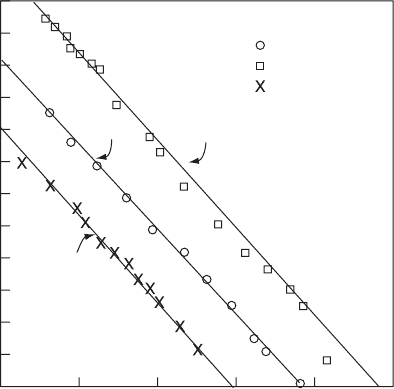
distribution of broken rock (Figure 3.56). The data covered an unusually wide
range of sizes – up to four orders of magnitude. He concluded that explosively
crushed rock had a fractal dimension of about 2.5. This compares closely to a
simple fragmentation model that produced a fractal dimension of 2.58.
A fractal model of fracturing has not been universally accepted: Suteanu
et al.(2000) mention that some authors have considered that fracturing
132 Grain and crystal sizes
produces multimodal distributions. Their experiments suggest that this may
reflect the way data have been presented, however, they also offer the possi-
bility that size distributions are multifractal – that is, the fractal dimension
changes with the size. Data quality must be very high to be able to prove
multifractal size distributions, but a change in fractal dimension is to be
expected around the typical grain size of the rock.
Engineering geologists commonly have to deal with heterogeneous rocks
that are comprised of hard blocks of variable size in a weaker matrix. Such
‘block-in-matrix rocks’ (bimrocks) would be described by geologists as con-
glomerates, breccias and fault gouges. However, an engineer is more interested
in the mechanical properties than in the origin of the rock. Hence, it is
important to be able to quantify the size distribution of the blocks in bimrocks.
Medley (2002) has shown that this can be done from measurements of blocks
intersected by drill holes or surface exposures using the same stereological
methods that are used for examining crystal sizes.
Kimberlites are magmatic rocks that are commonly loaded with xenoliths,
and their size distribution can be used to determine their mode of origin.
Kotov and Berendsen (2002) examined smaller xenoliths in a kimberlite pipe
from Kansas. They present few details of their results but conclude that
the sizes of xenoliths follow a fractal distribution, here transformed to the
Pareto distribution so that it could be tested statistically. This distribution is
Coal
Granite
Basalt
log (number of fragments < size)
lo
g
(size) (mm)
D
= 2.50
D
= 2.50
D
= 2.56
0.01 0.1 10 100 10001
Figure 3.56 Fragment sizes of artificially broken rock (after Turcotte,
1992). Size is cube root of fragment volume. D is the fractal dimension.
3.4 Typical applications 133
consistent with a model for the origin of the xenoliths by deep explosion
without further breakage during transport. In half of the samples minor
divergence from this distribution could be ascribed to Bagnold effect sorting.
Fault gouge is the powdery rock developed along faults during earthquakes.
Measurement of the particle size distribution (PSD) of gouges is not easy as
they are very fine grained and particles tend to aggregate. Wilson et al.(2005)
used a laser particle-size analyser to determine PSD and found that the PSD
varied over time as the aggregates broke down. However, at no time was the
distribution fractal as has been noted for larger size fractions. They concluded
that fault gouge did not form by wear and attrition of the fault surfaces, but by
dynamic rock pulverisation during each earthquake. In addition, creation of
the large surface area of the gouge particles could easily take a sizeable
proportion of the energy of an earthquake.
Some crystals in volcanic rocks are broken (Allen & McPhie, 2003). So far
study has been limited to the overall abundance of broken crystals, rather than
their size distribution. In one ignimbrite 67%–95% of crystals were broken,
but in intermediate and silicic lavas and tuffs a more typical value is 5%–10%
(Allen & McPhie, 2003).
Notes
1. There has been debate in petrology about the use of the terms solution and melting. We insist
that children are incorrect when they talk of sugar melting in water, but we commonly talk of
granite melting to a silicate liquid. To a chemist a liquid must be a pure substance; hence in
chemical terminology, both these examples are dissolution and silicate liquids are in fact
high-temperature solutions. Hence, rocks do not melt, they dissolve. However, we all know
what we mean by melt, even if we use different terms.
2. There is another terminology problem here. To a physicist a fluid is just a liquid, gas or super-
critical fluid. However, many geologists use the term fluid if the substance is dominated by
water, and melt if it is dominated by silicates (or carbonates, sulphides, etc.). In actual fact
there is a continuum of fluids with compositions from pure water to pure silicate. And, as
noted above, they are all actually solutions.
3. Also called the Schwartz–Saltykov method.
134 Grain and crystal sizes
4
Grain shape
4.1 Introduction
Grain shape is something that is easy to express qualitatively, but difficult to
quantify precisely (Costa & Cesar, 2001, Verrecchia, 2003). In earth sciences
we do not generally need extremely precise measures of shape, because the
objects we deal with are commonly not perfectly regular. However, quantifica-
tion of aspects of shape can help in understanding the petrogenesis of rocks.
The subject naturally falls into two domains. For crystalline rocks (igneous
and metamorphic rocks, chemical sediments and hydrothermal ore deposits)
we are concerned with the shape or habit
1
of crystals, whereas in clastic rocks
we want to quantify the shape of clasts and grains. The methodology of these
two fields is partly shared but could benefit from more exchange.
The overall shape of crystals reflects growth, solution and deformation.
Crystals that grew unimpeded from a fluid may have many different forms,
but all are ultimately controlled by the crystal structure. We usually think that
faces bounding such grains should be flat, but in some minerals growth faces
are curved. In thin section crystal outlines are qualitatively classified as euhe-
dral, subhedral or anhedral.
The habit of euhedral crystals has been studied for a long time (see the
introduction in Sunagawa, 1987a): in 1669 Nicolaus Steno proposed that the
interfacial angles of a crystal were constant and that the external form of a
crystal growing in a fluid depends on the relative growth rates of the different
faces. In many mineralogical and petrological studies the habit of crystals
has its own interest (e.g. Sunagawa, 1987b). For instance, it is commonly
observed that crystal habit varies with growth environment and size (see the
review in Kostov & Kostov, 1999): plagioclase crystals in the groundmass
of lava are tabular (commonly misnamed ‘lath-shaped’) whereas those in
more slowly cooled rocks are more equant. Rapid growth forms, such as
135
spherulites, dendrites and swallowtails, are not treated here as they are difficult
to quantify.
Crystal shapes can help in the quantification of other textural parameters:
an estimate of shape is needed to carry out some types of stereological correc-
tions (e.g. Higgins, 2000). For this purpose overall crystal shapes are simplified
and defined in terms of the aspect ratio and degree of rounding. This simplified
scheme can also be used to examine crystal shape variations between different
petrologic environments.
Grain boundaries and dihedral angles are other quantifiable aspects of
crystal shape: grain boundaries may be flat, curved or sutured, and all these
can be quantified. Dihedral angles are the angles at the corners of crystals
(Smith, 1948). It has been shown that the values of such angles are a measure
of the textural maturity of a rock (Elliott et al., 1997).
4.2 Brief review of theory
4.2.1 Shapes of isolated undeformed crystals
4.2.1.1 Equilibrium forms
Crystal growth and final habit are controlled by many factors (Baronnet, 1984,
Sunagawa, 1987a): a good point of departure is the equilibrium form of the
crystal. This form is purely theoretical and is that in which the surface energy
(or surface tension) of the crystal is minimised (Wulff, 1901, Herring, 1951a).
Unlike a liquid, the surface energy of a crystal varies with orientation; hence
the equilibrium form of a crystal is never a sphere. The energy associated with
a crystal face depends on the density of lattice points – the reticular density.
Lattice points are not necessarily atoms, but points in space that have the
identical environment in the same orientation. A crystal face is more developed
if it has a high reticular density; that is it intersects a large number of lattice
points (Bravais law). A more recent theory uses the concept of periodic bond
chains (PBC; Baronnet, 1984). A PBC is an uninterrupted chain of strong
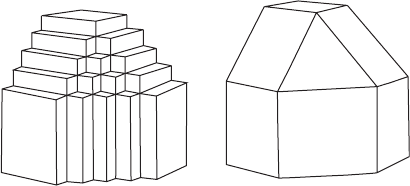
bonds between atoms. On this basis faces can be classified: F (flat) faces have
two or more PBCs, S (stepped) faces have one PBC, and K (kinked) faces have
no PBCs at all (Figure 4.1). It may seem counter-intuitive, but the largest faces
of a crystal have the lowest growth rates. The F faces grow by layer mechan-
isms and hence grow at the slowest rates. Therefore, the facets of a crystal are
generally the F faces.
The equilibrium form of a crystal is controlled by the crystalline structure
and hence does not depend on the environment in which the crystal grew.
However, it does depend on extensive variables, such as temperature. At
136 Grain shape
higher temperatures the energy difference between different faces becomes less
and it becomes energetically feasible to have curved faces. At the extreme this
tends to a sphere with minor facets. The equilibrium forms of common
minerals broadly resemble the observed forms in the expression of faces, but
the importance (relative size) of the faces does not always agree.
4.2.1.2 Growth forms
There are many different growth forms of crystals, even under identical
thermodynamic conditions (Sunagawa, 1987a). The broad classification of
crystals whose growth has not been impeded by the presence of other materials
is into spherulitic, dendritic, hopper and polygonal. The different faces of
polygonal crystals may be developed to different extents, giving different
polygonal habits. Where crystals are growing in the presence of a second
phase they may be incorporated into the second phase as chadocrysts, or
they may stop growth, leading to anhedral (irregular) forms. Some of the
latter may have curved faces formed by the simultaneous growth of two
crystals.
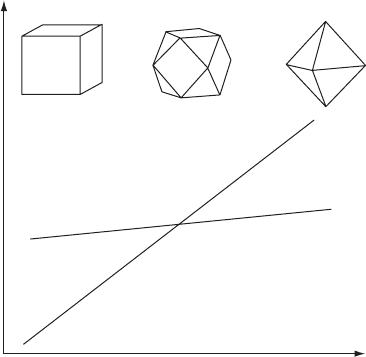
The growth habit of crystals is fundamentally controlled by growth rates of
the various faces or directions. Such growth rates are controlled by intensive
parameters such as temperature, pressure and chemical potential gradient
(Figure 4.2; Kouchi et al., 1986, Kostov & Kostov, 1999). Where crystals are
surrounded by other crystals, for instance in the sub-solidus, other parameters
are important, most significantly the interfacial energy (see dihedral angles
below; Hunter, 1987).
4.2.1.3 Solution forms
The solution forms of crystals have not been studied in as much detail as
growth forms. A common observation of solution forms is within crystals, as
revealed by zoning. For instance, the optical properties of plagioclase make
S
F
F
F
F
F
F
S
S
K
Figure 4.1 Periodic bond chains and crystal structure. F ¼ flat faces;
S ¼ stepped faces; K ¼ kinked faces.
4.2 Brief review of theory 137
it easy to observe minor variations in composition. Resorption surfaces that cut
across fine composition zones are commonly encountered, especially in volca-
nic rocks (e.g. Stamatelopoulou-Seymour et al., 1990). In all cases the solution
form is rounded. That is, the radius of the corner is increased progressively by
the consumption of the faces. The solution surface is frequently rough, reflect-
ing the effects of dislocations and impurities in the crystal. Other minerals,
such as quartz, pyroxene and olivine have resorbtion surface zones similar to
those of plagioclase, but they are not so easily seen, except with techniques like
Nomarski microscopy (see Section 2.5.3.3). Most natural diamond crystals
have suffered solution during transport from the mantle, which is expressed
by curved crystal surfaces. The process starts with loss of the sharpness of the
edges and proceeds to the faces, which become curved (Sunagawa, 1987b).
Extensive solution leads to rounded crystals.
4.2.2 Shapes of deformed crystals
The shape of deformed crystals, like their size, is a balance between the
processes that deform crystals (see Section 3.2.5), which give the crystal an
excess of energy, and the processes that will dissipate that energy by the
elimination of lattice defects (relaxation) and the reduction of surface area
g
rowth parameters
growth rate
a
o
Rate
a
Rate
o
Figure 4.2 A schematic example of the development of crystal forms related
to different growth rates under different growth parameters. The a and o faces
have growth rates that vary in a different way to grow th driving force
parameters, such as undercooling (supersaturation), chemical environment
or composition.
138 Grain shape