
Higgins M.D. Quantitative textural measurement in igneous and metamorphic petrology
Подождите немного. Документ загружается.

morphology went from tablets to hopper (skeletal) to swallowtail (dendritic).
The development of the different forms is a function of both cooling rate and
degree of undercooling.
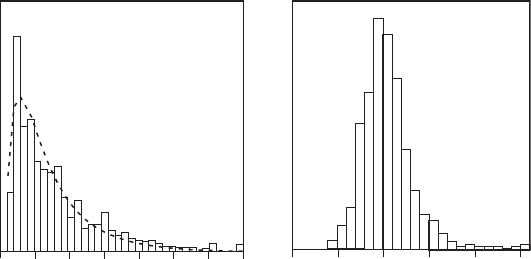
Castro et al.(2003) have examined pyroxene microlites in rhyolitic obsidian
using an innovative optical sectioning technique (see Section 2.2.2). They find
that the crystal lengths vary over a factor of ten (3–30 mm), but the widths only
vary by a factor of two (Figure 4.17). These pyroxene crystals initially develop
as stubby prisms, with a width of 1–2 mm, and then just grow along the
prismatic axis. Hence, the aspect ratio is proportional to the length. This
behaviour can be produced if the ratio of the growth rates of prismatic faces
over pyramidal faces decreases with undercooling.
Zeh (2004) investigated the shape of apatite grains in a series of meta-
morphic rocks. He found that the ratio of the length/diameter (l/d ) of the
crystals and mean crystal length varied systematically with temperature of
metamorphism. Those crystals from the lowest grade rocks had a mean l/d of
20 and a length of 1 mm and those from the highest grade had a mean l/d of 2
and a length of 100 mm. Allanite showed a similar change in shape, but it was
much less pronounced.
Pallasites are unusual meteorites that are mostly comprised of olivine crys-
tals set in a matrix of Fe–Ni alloys. In some pallasites the olivine crystals are
euhedral or angular fragments, whereas in others they are well rounded. Saiki
et al.(2003) showed experimentally that rounding of olivine could occur in
geologically reasonable periods of time at a temperature of 1400 8C, which is
sub-solidus for these compositions. Adjustments to the shape of the olivine
grains occurred by volume diffusion in the crystal lattice and not by surface
diffusion along the grain boundaries.
100
20
30
length
(μm)
frequency
frequency
width (μm)
0123
45
Figure 4.17 Shape of pyroxene microlites in rhyolitic obsidian (Castro et al.,
2003). The length of the crystals is much more variable then their width.
4.4 Typical applications 159
4.4.2 Deformed rocks
4.4.2.1 Sutured quartz grain boundaries
Sutured grain boundaries have been observed in many deformed rocks, but
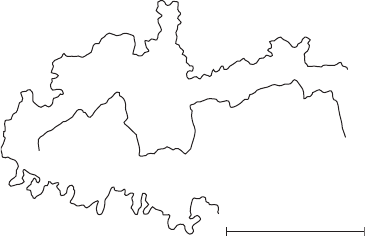
seem to be particularly evident on quartz–quartz boundaries (Figure 4.18).
Where examined in thin section such grain boundaries are scale invariant over
a length scale of one to two orders of magnitude (Kruhl & Nega, 1996). The
fractal dimension varies from 1.05 to 1.30, but it should be remembered that
this is the value for an intersection of the grain boundary with the plane of the
thin section. The 3-D fractal dimension is not known, but should be related to
these values.
During deformation at high temperatures there is equilibrium between the
production of additional undulations of the grain surface and their removal by
coarsening (ripening) processes as the texture approaches equilibrium. Hence
the degree of suturing can be related to the strain rate of the rocks and their
temperature. Kruhl and Nega (1996) analysed three disparate groups of rocks
and proposed that the fractal dimension (D) can be used as a geothermometer:
At a temperature of 350 8C D ¼ 1.28 and at 700 8C D ¼ 1.08. However, the
strain rate is also a controlling factor (Takahashi & Nagahama, 2000). In
addition, overprinting by subsequent events can produce scaling heterogene-
ities (Suteanu & Kruhl, 2002). Clearly, the application of this technique as a
geothermometer, although useful, requires careful observation of other
parameters.
Detailed examination of sutured quartz–quartz boundaries using a universal
stage has shown that they are curved, but are composed of multiple straight
segments (Kruhl & Peternell, 2002). The orientation of these crystal faces is
0.5 mm
350 °C D = 1.28
700
°C D = 1.08
Figure 4.18 Tr acing of two sutured quartz–quartz grain boundaries (Kr uhl
& Nega, 1996). The outer curve was developed at 350 8C and has a fractal
dimension of 1.28, whereas the inner curve developed at 700 8C and has a
fractal dimension of 1.08.
160 Grain shape
controlled by the lattice orientation of the crystal and its neighbour. At low
temperatures (350 8C) the faces conform to a wide variety of indices, but as
the temperature increases to 700 8C faces close to {10
11} are favoured. The
presence of the crystallographically controlled faces probably makes the tex-
ture more resistant to addition changes, until the rock is deformed again.
4.4.2.2 Calcite in mylonites
Amongst the vast number of articles on the orientation of crystals in deformed
rocks, there are only a few in which the shape of the crystals have been
determined. Clearly, this can give information on deformation, like the size
and orientation of the crystals. Herwegh et al.(2005) examined a series of
carbonate mylonites from the Alps that formed at temperatures from 250 to
380 8C. They found that crystals from the low-temperature mylonites had a
ratio of S/I of 0.8, which decreased to 0.45 for the highest temperatures. They
also used the Paris shape factor to determine the sinuosity of the crystal
outlines and found that it, too, increased with temperature. This seems to be
the inverse of what was found in quartz mylonites (see above).
4.4.3 Dihedral angles
Dihedral angles can be used to explore the flow transport properties of fluid-
bearing materials, hence there has been considerable experimental work in this
field, but this has not been balanced by study of natural materials. In addition,
there is a problem concerning the measurement methods: many early studies
used apparent dihedral angles measured in sections that are difficult to assess
in the light of the stereological studies of Elliott et al.(1997). Although 2-D
studies form the bulk of the published work, such methods should only be used
where 3-D methods cannot be applied, such as opaque minerals and small
samples. Finally, there is some ambiguity in the way that dihedral angles are
reported for polyphase rocks. Some authors record DAs as plagioclase–
plagioclase–clinopyroxene: it is clear here that the DA of the last phase,
clinopyroxene, is measured. However, others use terms like melt-solid-solid,
in which the DA of the first term, the melt, is measured. There is little
ambiguity for two phases, but for three phases the phase in which the DA is
measured must be specified. I use here the convention A(B-C) to indicate that
the DA was measured in A at a contact with B and C.
The earliest studies of dihedral angles in natural rocks were in granulites
(Kretz, 1966b, Vernon, 1968, Vernon, 1970). Clinopyroxene (olivine–olivine)
and clinopyroxene (plagioclase–plagioclase) intersections both have median
dihedral angles of 1158 178 (1 sigma). This indicates that there is little
4.4 Typical applications 161
contrast between the interfacial energies of these three minerals under these
conditions.
Many earlier DA studies were centred around three themes: basaltic melts
in peridotites, partial melting of crustal silicate rocks and H
2
O–CO
2
crustal
fluids. Commonly, these studies were experimental with relatively few studies
of actual rocks. The distribution of melt in peridotite is of interest for the origin
of basalt by partial melting (e.g. Faul, 1997) in addition to the geophysical
properties of the mantle, such as seismic attenuation and mechanical strength.
The DAs of basalt (olivine) and other minerals have been investigated in both
experimental and natural materials (e.g. Waff & Bulau, 1979, Cmiral et al.,
1998, Duyster & Stockhert, 2001). In general, olivine crystals surrounding melt
pockets are faceted, not curved, but the dihedral angles are low to zero (Cmiral
et al., 1998). Other minerals in mantle rocks have a significant effect on the
overall permeability: diopside and spinel increase permeability whereas ensta-
tite lowers it (Schafer & Foley, 2002). Hence, melts should flow more easily
through spinel lherzolites than harzburgites.
Many types of granite originate by partial fusion of the crust, followed by
aggregation and escape of the magma. Laporte and Watson (1995) have
examined the process using experimental and theoretical techniques, with
special emphasis on the role of biotite and amphibole. They concluded that
crustal rocks cannot be modelled as ideal systems because they are comprised
of many different minerals, mostly with medium to high degrees of anisotropy
of interfacial energy. The overall fabric (crystallographic preferred orienta-
tions) and heterogeneity of the rock also had an important effect. For rocks
with highly anisotropic minerals, such as biotite, and low degrees of melting,
the silicate liquid lies in isolated plane-faced pocket at grain junctions. The
shape of these pockets is controlled by the anisotropy of the minerals and the
texture of the rock. The low DA for liquid (solid–solid) junctions in crustal
rocks indicates that melts should be connected at very small degrees of melting
and hence should be continuously drained from a rock during melting.
Amphibolites may have a connectivity threshold of 3%. However, such
melts are very viscous and hence viscosity and not connectivity may limit the
separation of melt and restite. In contrast, well-foliated biotite rich rocks may
act as barriers to transverse liquid flow.
The role of fluids, particularly those rich in water, in geological processes is
pivotal. Holness (1993) examined experimentally the behaviour of H
2
O–CO
2
fluids in quartzites. Water-rich fluids have DAs close to or lower than the
critical value of 608 at both low and high temperatures, which was attributed to
the presence of a film of water on the quartz surface. This implies that there is
a window of permeability at both low and high temperatures for infiltration
162 Grain shape
of water. The behaviour of CO
2
was completely different: it had high DAs at
all temperatures suggesting that it was not absorbed onto the quartz. The presence
of solutes like NaCl appears to reduce further the DA of aqueous solutions and
hence enlarge the window of permeability (Watson & Brenan, 1987).
Although processes during the early stages of accumulation of crystals in
magma chambers are reasonably well understood, there is little information
on the later textural evolution of these rocks. On the basis of crystal size
distributions Higgins (2002b) and Boorman et al.(2004) both considered
that textural evidence for crystal accumulation is frequently overprinted by
coarsening. Holness et al.(2005) have attacked the problem by the analysis of
DAs. They pointed out that initial growth should generate impingement
textures with a median dihedral angle of about 608 (Figure 4.5). Analysis of
melt (clinopyroxene–clinopyroxene), melt (amphibole–amphibole) or melt
(plagioclase–plagioclase) DAs in glassy lavas established a range of median
DAs from the impingement values down to 288. For the Kula lavas DAs and
changes in crystal shape indicated that textural equilibration was achieved.
However, for the Kameni lava they favoured diffusion limited growth.
Cumulate plutonic rocks do not contain any melt, but some minerals may
pseudomorph former melt pockets. Hence, the next step was to examine the
DAs of such minerals in cumulate rocks.
The small layered intrusion on Rum, Scotland has received enormous
attention, but there are still major uncertainties in its petrogenesis: one such
problem is the origin of peridotite layers. These may have formed as accumu-
lations of olivine or by injections of olivine-rich picrite into the semi-solid
layered gabbros and troctolites. Holness (2005) has investigated the textures of
the rocks that host the peridotite layers to determine their thermal history and
hence resolve their origin. She considered that clinopyroxene pseudomorphs
the last melt and measured the clinopyroxene (plagioclase–plagioclase) (CPP)
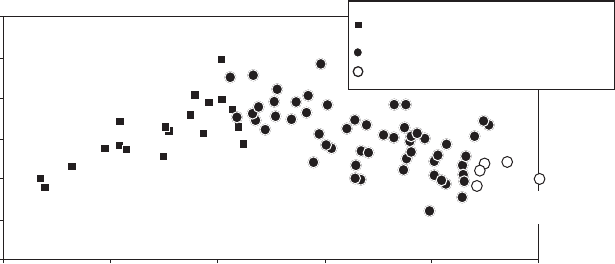
DAs along a section orthogonal to a peridotite layer. She found that all CPP
median DAs lay between the values for impingement textures (608) and the
values for complete equilibrium (115–1208, Figure 4.19). It is assumed that
higher median values reflect movement towards solid-state equilibration dur-
ing reheating by the injection of peridotite sills. In most of the traverses there
was no correlation between median DAs and proximity to peridotite layers,
except for one layer. Hence, both models for the origin of the peridotite layers
are validated, but for different layers.
Sulphide minerals commonly occur as globules in silicate rocks. Mungall
and Su (2005) showed experimentally that this was because of the high surface
energy between sulphide and silicate liquids, as compared to that between
silicate minerals and silicate liquids. They considered that at low degrees of
4.4 Typical applications 163
supersaturation sulphide droplets may nucleate at wide intervals leading to
kinetic control of composition. The high surface energy of sulphide droplets
will hinder their migration through a crystal mush, unless propelled by moving
silicate liquids. Clearly, this has important implications for the origin of
massive sulphide bodies.
Notes
1. The terms crystal habit, crystal shape and crystal morphology are considered to be
synonyms.
median angle (°)
standard deviation
100806040
20 120
5
10
15
20
25
30
35
Melt-present
equilibrium
Solid-state
equilibrium
Impingement
Kula, Santorini melt(cpx-cpx);
melt(amph-amph) and melt(plag-plag)
Rum, cpx(plag-plag)
Equilibrium, cpx(plag-plag)
Figure 4.19 Median against standard deviation of dihedral angles in melt-
present and solid materials (Holness et al., 2005). The Kula and Kameni data
(squares) are from partially melted crystalline enclaves. The data from Rum,
Scotland (filled circles) are from solid gabbro and troctolite (Holness, 2005).
Granulite samples (empty circles) provided data for solid-state equilibrium
(Kretz, 1966b, Vernon, 1968, Vernon, 1970).
164 Grain shape
5
Grain orientations: rock fabric
5.1 Introduction
The quantitative study of grain orientations (fabric)
1
is very important in
structural geology and materials science (Wenk, 1985, Kocks et al., 2000,
Randle & Engler, 2000, Wenk, 2002, Wenk & Van Houtte, 2004). It is less
established in igneous petrology (Nicolas, 1992, Smith, 2002), where fabric
has been used mainly to establish flow directions and mechanisms in lava
flows and dykes. Fabric studies find their way in geophysics as there is
considerable interest in the anisotropy of seismic velocities (e.g. Mainprice
& Nicolas, 1989, Xie et al., 2003). Fabric is also important in engineering
geology, as it affects the physical properties of rocks (e.g. Akesson et al.,
2003). It is also of interest in palaeontology and medicine for quantifying
the structure of bone (Ketcham & Ryan, 2004). Knowledge of grain
orientations is also necessary to calculate size distributions from the dimen-
sions of grain intersections in all the domains already mentioned (see
Section 3.3.4).
The grains that define the fabric of a material can be a variety of different
objects: commonly crystals, clasts and enclaves. One measure of fabric is based
on the orientations of the grain shapes (shape preferred orientations: SPO).
Here the nature of the material is unimportant for the measurement of the
fabric. However, the contrast in viscosity between the grain and matrix during
production of the fabric will define what parameter is recorded by the fabric.
For example, in magma originally spherical deformable enclaves will record
strain, whereas rigid crystals will rotate and just record indirectly aspects of the
deformation.
If the grains studied are crystals then another measure is possible: the fabric
can be defined by the orientation of the crystal lattices, here termed lattice
preferred orientations or LPO (also known as crystallographic preferred
165
orientations; macrotexture or texture in materials science literature). Of course,
if crystals are euhedral then these two orientations are parallel. This is generally
not the case in most metamorphic and many plutonic rocks, as crystals do not
grow in an unobstructed environment or they may have been partly dissolved.
In this situation orientations defined by crystal shape and lattice will not
necessarily be related.
5.2 Brief review of theory
5.2.1 Fabrics developed during growth of new crystals
5.2.1.1 Crystallisation from a magma
Isolated crystals in a homogeneous liquid nucleate with random orientations.
If there is no flow of the magma, then growth will conserve the orientation of
the nuclei and there will be no development of fabric. However, if the growth
of crystals is constrained by the presence of other crystals, or if there is a
significant concentration gradient in the magma then a fabric may develop
during crystallisation. Such fabrics are growth phenomena, hence they are
both shape and lattice preferred orientation fabrics.
The most common type of crystallisation fabric in plutonic rocks is comb-
layering (Lofgren & Donaldson, 1975). This texture is produced where
crystals initially nucleate on a rigid or semi-rigid plane. The orientation of
the nuclei is not important. If the crystals have an initial shape anisotropy
then competition between the crystals will eliminate those with maximum
growth rates parallel to the crystallisation plane. This leads to a strong linear
fabric, normal to any structures that define the original solidification front,
such as mineral layering. Crystals may become curved or branching if they
can grow fast enough to escape the zone depleted in nutrients close to the
solidification front. Similar fabrics can be developed in some volcanic rocks:
the most spectacular are the spinifex textures in komaiites (e.g. Shore &
Fowler, 1999).
Equilibration of magmas or rocks is the process by which the surface and
internal energy of the system is minimised. One process is by the coalescence of
mineral grains, which reduces the total surface energy. Energy is further
minimised if the differences between the orientations of the crystals is reduced
by rotation of grains. There is evidence for this in the commonly observed
phenomena of synneusis of igneous minerals such as olivine and plagioclase
(see Section 6.2.3; e.g. Schwindinger & Anderson, 1989). Recently evidence has
been found that some garnet porphyroblasts are also formed by coalescence
and rotation of many grains (Prior et al., 2002).
166 Grain orientations: rock fabric
5.2.1.2 Solid-state mineral crystallisation
When crystals nucleate and grow in a solid medium then the orientation of the
crystal will be organised so as to minimise the energy required for growth.
Hence, growth of crystals (or transformation of existing minerals) will gen-
erate fabrics that are defined by both the crystal lattice and shape. If deforma-
tion is coaxial then SPO and LPO will be parallel. Under non-coaxial
deformation the obliquity between the LPO and SPO can be used to determine
the sense of shear. Unless the deformation that lent the crystals their orienta-
tion ceases immediately afterwards the newly formed crystals will be deformed
in the solid state as they grow.
5.2.2 Fabrics produced during magmatic and solid-state deformation
of existing crystals
5.2.2.1 Property changes during solidification
The solidification of magma and the melting of rock, are not simple processes,
but involve a transition in properties from a liquid to a solid. Three stages are
usually recognised but the transition points appear to be different for solidifica-
tion and melting (e.g. Vigneresse et al., 1996,Arbaretet al., 2000). During
solidification from 0 to 30%–40% crystals the magma behaves as a suspension,
with pure Newtonian behaviour, especially at low crystal concentrations. Above
30%–40% crystals interact frequently and the magma acquires yield strength.
The magma can now be considered to behave as a Bingham fluid. A rigid
framework of crystal chains, or more accurately foam-like crystal surfaces,
may develop in some rocks at this stage, or even earlier (Philpotts et al., 1999).
Otherwise, the quantity of crystals must increase to 50%–65% crystals before a
continuous network of crystals forms and the yield strength increases drasti-
cally. The magma then has a plastic behaviour that is close to that of a solid. At
this point strain may be concentrated into discrete zones, crystals may fracture
or be divided into sub-grains and folding may occur. Clearly the first stage must
be considered to be in the igneous domain. The last stage is more metamorphic,
but the intermediate stage is difficult to classify. In many plutonic rocks defor-
mation continues through all these stages maintaining the same orientation.
During melting the rock becomes much weaker with as little as 5% melt
(95% crystals) as melt pockets become interconnected (Rosenberg & Handy,
2005). A second major rheological change occurs about 30% melt after which
the material resembles magma. The differences between solidification and
melting probably reflect textural changes: for instance during melting small
crystals will be removed first, leaving isolated larger crystals. Whereas during
5.2 Brief review of theory 167
solidification small crystal will nucleate and grow as long as significant under-
cooling is maintained.
Deformation can occur in both rocks and magmas. Plastic and solid-state
deformation of crystals not only changes the shape of crystals, but also their
size. The basic theory of these processes is discussed in Section 3.2.5. Magmatic
deformation will only change the orientation and position of crystals, but it
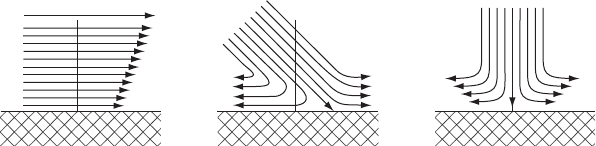
depends on the type of shear regime. Shear can be classified with reference to a
fixed plane (Figure 5.1). Simple shear is parallel to the plane, pure shear is
normal to it and hyperbolic, or mixed, is between the two extremes.
5.2.2.2 Magmatic deformation
Numerical models of magmatic deformation are based on the motions of rigid
particles in a fluid. There are a number of assumptions (Arbaret et al., 2000,
Iezzi & Ventura, 2002). (1) Particles are ellipsoids or parallelepipeds of varying
dimensions. (2) They do not interact with each other. (3) They do not change
shape during deformation. (4) The liquid is Newtonian and flows constantly
without turbulence. The most recent numerical modelling was done in three
dimensions using particles of different shapes and shear regimes (Iezzi &
Ventura, 2002). Under simple and hyperbolic shear, cubes and elongated
tablets never achieved a stable configuration: they just continued to roll
(Figure5.2a).Simple2-Danaloguemodellingshowsthatathighconcentra-
tions of particles interactions between adjacent grains prevents cyclical move-
ments and grains become imbricated (Ildefonse et al., 1992). Tablets and
prisms rotated towards the plane of shear and produced a strong fabric
(Iezzi & Ventura, 2002). For pure shear (compaction) all shapes rotated until
theywereparalleltotheshearplane(Figure5.2b).However,thisprocessisnot
very efficient and high degrees of deformation are necessary to produce a
visible fabric (Higgins, 1991, Ildefonse et al., 1992).
The lack of stability of fabrics for grains with equant or near-equant shapes
means that local fabrics may not indicate the direction of shear. Iezzi and
Simple shear flow Hyperbolic shear flow Pure shear flow
Figure 5.1 Flow lines for different shear flow types. Simple and hyperbolic
shear are non-coaxial shear; pure shear, or compaction, is coaxial shear.
168 Grain orientations: rock fabric