
Higgins M.D. Quantitative textural measurement in igneous and metamorphic petrology
Подождите немного. Документ загружается.

4.3.4 Extraction of grain boundary parameters
The grain boundaries of crystals with curved, complex or sutured surfaces can
be parametrised in a number of ways. Although grain boundaries are three-
dimensional structures, so far they have only been investigated in detail in 2-D
sections. The stereology of conversion of such 2-D measurements to 3-D
parameters has not generally been investigated. The simplest descriptor of
the shape of the grain is the ‘Haywood circular parameter’ which is the ratio of
the actual perimeter to that of a circle of equal area. This parameter is more
sensitive to the overall axial ratio of the grains (see Section 4.3.3) rather than
the irregularities in the outline, which we seek here. The shape of loose rock
particles is very important in sedimentology and hence the methodology is well
established, but outside the scope of this volume (e.g. Barrett, 1980, Lewis &
McConchie, 1994a, Lewis & McConchie, 1994b).
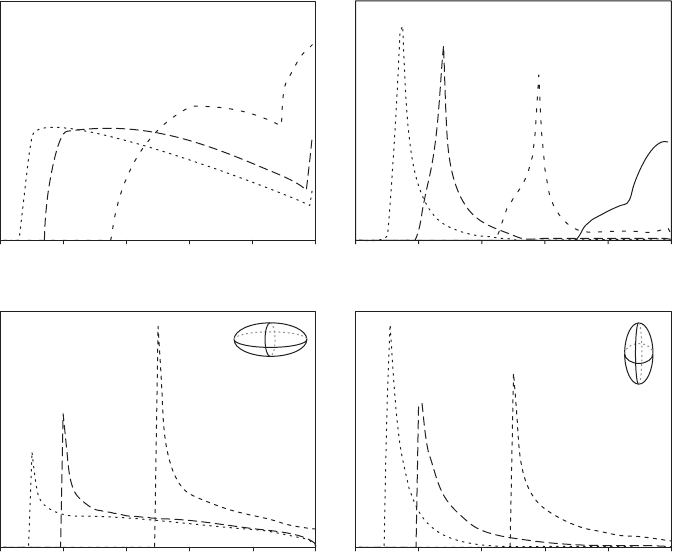
projected width / projected length
projected minor axis
/ projected major axis
0 0.2 0.4 0.6 0.8 1.0
(a) Projected tablets
frequency
1:2:2
1:5:5
1:10:10
0 0.2 0.4 0.6 0.8 1.0
(b) Projected prisms
1:1:1
1:1:2
1:1:5
1:1:10
(d) Projected
prolate ellipsoids
0 0.2 0.4 0.6 0.8 1.0
1:1:2
1:1:5
1:1:10
(c) Projected
oblate ellipsoids
frequency
0 0.2 0.4 0.6 0.8 1.0
1:2:2
1:5:5
1:10:10
Figure 4.9 (a, b) Parallelepiped model of randomly oriented grains in
projection (this study). The projected length and width are measured as the
dimensions of the smallest rectangle that can be placed around the outline.
(c, d) Ellipsoid model of randomly oriented grains in projection (this study).
4.3 Methodology 149
4.3.4.1 Fractal analysis of grain shapes
The shape of a grain boundary can be characterised by fractal methods
(Mandelbrot, 1982, Orford & Whalley, 1983, Kruhl & Nega, 1996, Carey
et al., 2000). So far such methods have only been applied to sections or
projections of clasts with the assumption that such measurements also char-
acterise the parent 3-D object. A smooth surface (in a section) will have a
fractal dimension of one, which will increase to a maximum of two for a plane-
filling line. Outlines of particles of geological interest tend to have more
restrained fractal dimensions from 1 to 1.36. However, it should be noted
that this fractal dimension is that of a section through a surface, which will
have a higher fractal dimension of between 2 and 3.
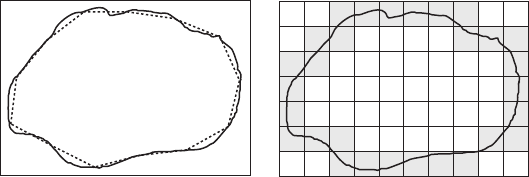
The fractal dimension of an outline is generally determined using the divider
or box counting methods (Figure 4.10) and the results presented on
Mandelbrot–Richardson (log–log) diagram. A single straight line on an M–R
diagram indicates monofractal behaviour. That is, the shape is self-similar at
all of the scales measured. Many objects of geological interest give multiple
straight-line segments on an M–R diagram, which is termed multifractal
behaviour. Some authors have distinguished two scales and others have
divided up the fractal into several size segments (e.g. 3–30 pixels; 31–60 pixels;
etc.), that were then analysed using multivariate statistics (Dellino & Liotino,
2002). Curved distributions on M–R diagrams indicate nonfractal behaviour
and should not be forced into line segments. Care must be taken when outlines
(a) Divider method (b) Box counting method
13 divider steps 29 boxes intersected
Figure 4.10 Methods for determining the fractal dimension of the outline of
a grain. (a) Divider method. A line of length l is walked around the outline
and the number of steps counted. This is repeated for different lengths and a
graph of log(n) against log(l) is plotted (Mandelbrot–Richardson diagram).
The slope is the fractal dimension of the line. (b) Box counting method. A box
size of lengt h l is defined and the fraction of boxes, n, that contain a part of the
outline are counted. This is repeated for different box sizes and a graph
plotted of log(n) against log(l). The slope is the fractal dimension.
150 Grain shape
are measured: the resolution, that is number of pixels, provides a lower size
limit for the method. Also in many outlines the undulations are sufficiently
infrequent that the starting position for the divider method affects the results.
Several different positions and directions can be averaged to improve the
resolution (Dellino & Liotino, 2002).
4.3.4.2 Gaussian diffusion–resample method
Saiki et al.(1997, 2003) have proposed a new rounding parameter that is not
dissimilar to fractal methods. A selection of grains of similar size is first
reduced to a single binary image (black and white) and the total area noted.
The image is then passed through a Gaussian diffusion filter with an aperture
of 0.5 pixels. The outlines are now blurred. The image is then rebinarised with a
threshold such that the area of the grains is unchanged. The original and final
images are subtracted so that the material eroded by the process can be
measured. The process is repeated with a wider Gaussian filter. The eroded
areas are normalised to the total area and plotted against the aperture: the
slope of the line is a measure of the irregularity of the outline.
4.3.4.3 Fourier analysis of grain shapes
The overall shape of a grain intersection or outline can be evaluated precisely
at all scales by the use of Fourier analysis (Ehrlich & Weinberg, 1970).
However, data analysis methods may restrict the scale of application: most
individual applications of a method cannot resolve the outline at a scale better
than 0.1 to 0.01 times the size of the outline. More detailed measurements
may be ‘stitched together’ from several analyses to overcome this problem.
It should be also remembered that Fourier analysis is generally applied to only
a single section through a three-dimensional object. Three-dimensional
Fourier analysis is possible, but has not yet been done on geological materials.
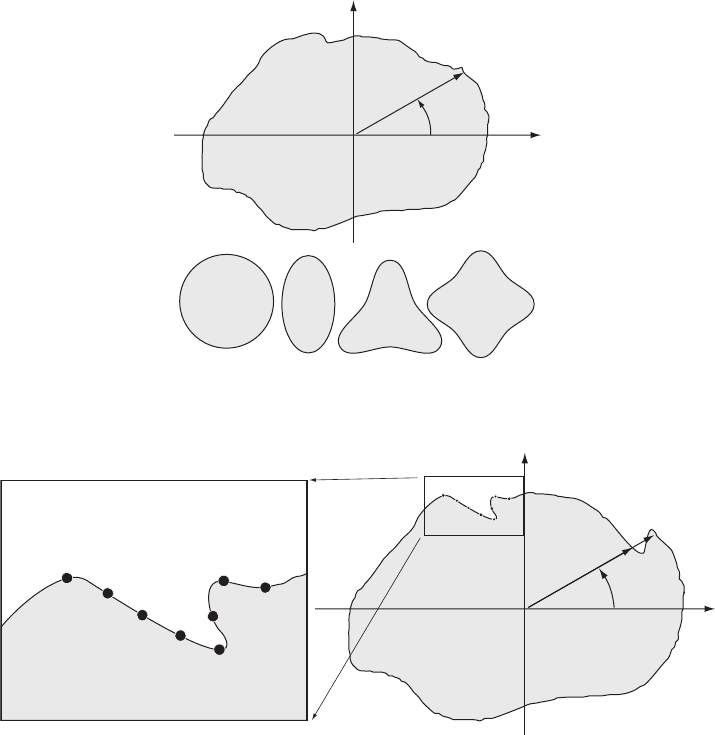
The radius of the grain outline at angle Y, RðYÞ is traced out. These data
are transformed by classical Fourier analysis into a series of harmonics
(Figure 4.11). The basic shape is a circle of equivalent area; the first harmonic
is an ellipse and gives the elongation. The second harmonic gives a measure of
triangularity and the third gives squareness. The harmonics continue up to the
number of data points. The shape can be reconstructed as:
RðYÞ¼a
0
þ
X
N
n¼1
ða
n
cos nY þ b
n
sin nYÞ
where N ¼ the total number of harmonics, n ¼ harmonic number, and a and b
are coefficients that give the magnitude and phase of each harmonic. The
4.3 Methodology 151
method is useful because it gives a measure of the shape of the profile at all
scales, covering the field of sphericity, roundness and grain boundary shape
(surface texture). There is, however, a problem for grains with re-entrants:
there can be two radiuses for certain angles (Figure 4.12). This is not usually a
problem for mature sediments, but occurs in volcanic fragments and grains in
plutonic or volcanic rocks.
An approach that avoids this problem is the Fourier Descriptors method
(Thomas et al., 1995, Bowman et al., 2001). In essence Fourier analysis is
applied to the x, y coordinates of the outline of the grain and not its radius
(Figure 4.12). The method uses complex numbers, with the x coordinate as the
real part of a number and the y coordinate as the imaginary part. The outline is
R
(Θ)
Θ
X
Y
1
2
3
0
Figure 4.11 In classical Fourier analysis the radius of the outline, R,is
decomposed into a basic circle (n ¼ 0) and a series of harmonics, 1, 2, 3, ..., n.
X
Y
Re
-entrant
R
1
(
Θ
)
R
2
(
Θ
)
Θ
x
8
,y
8
x
7
,y
7
x
6
,y
6
x
2
,y
2
x
1
,y
1
x
3
,y
3
x
4
,y
4
x
5
,y
5
x
8
,y
8
x
7
,y
7
x
6
,y
6
x
5
,y
5
x
2
,y
2
x
1
,y
1
x
3
,y
3
x
4
,y
4
Figure 4.12 Re-entrant problem in classical Fourier analysis.
152 Grain shape

sampled at regular intervals to give a series of points x
m
, y
m
. The outline can be
reconstructed from:
x
m
þ iy
m
¼
X
þN=2
n¼N=2þ1
ða
n
þ i b
n
Þ cos
2nm
M
þ i sin
2nm
M
where N is the total number of descriptors, n is the descriptor number, M is the
total number of points, m is the index number of each point and a and b are
coefficients for each descriptor (i denotes the imaginary part of a complex
number). The descriptors n ¼ 0, 1, 2, 3 give the radius (equivalent to
size), elongation, triangularity and squareness as in classical Fourier analysis.
The descriptors þ1, þ2, þ3 give asymmetry, second-order triangularity,
second-order squareness (Bowman et al., 2001). The descriptors give almost
too much information on shape. We are generally concerned more with the
distribution of roughness at different scales. Drolon et al.(2003) have pro-
posed that the Fourier descriptors are recast using wavelet techniques into a
series of multiscale roughness descriptors. These give a measure of the total
‘energy’ at each scale. They appear to offer a simpler way of looking at
roughness that is better at classifying sedimentary grains.
4.3.4.4 Shape parameters used in sedimentology
Some studies of crystalline rocks have used sedimentological shape para-
meters. One such measure is the circularity. This is defined by the perimeter
of the grain outline:
circularity ¼ 4ðA=P
2
Þ
where A is the area and P is the perimeter of the grain outline. It varies from
one for a perfect circle to zero for an infinitely elongated grain outline. The
elongation of a grain has several definitions: in 3-D it is the ratio of the longest
and shortest axes. In 2-D it is the aspect ratio of its outline: that is, intersection
length/width.
The grain shape can also be evaluated at a smaller scale by quantifying the
roundness. This is usually measured from grain intersections using the
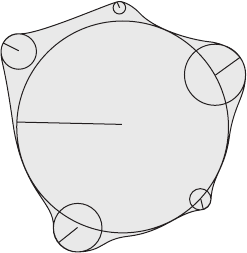
Waddell formula:
roundness ¼ ðr=RÞ=N
where r is the radius at the grain corners, R is the largest inscribed circle (circle
enclosed in the grain outline) and N is the number of corners (Figure 4.13).
This formula is rather difficult to apply to real grains; hence roundness is
estimated from silhouette diagrams.
4.3 Methodology 153
4.3.5 Determination of dihedral angles
Dihedral angles are a 3-D property and can be measured directly in transpar-
ent materials using a universal stage (see Section 5.5.1). The sample is rotated
so that all three grain boundaries are vertical and the dihedral angles measured
directly (Vernon, 1970) or using a stereographic plot (Vernon, 1970). It is also
possible to use the tilting capabilities of a transmission electron microscope to
examine true dihedral angles in thin films (Cmiral et al., 1998). However, in
most studies the apparent dihedral angles are measured in 2-D sections, such
as thin sections and plotted on cumulative frequency diagrams. If there is only
one true dihedral angle in a population then it is close to the median of
apparent dihedral angles (Riegger & van Vlack, 1960). However, if there are
a range of true dihedral angles, then this range cannot be determined uniquely
from the population of apparent (2-D) dihedral angles (Jurewicz & Jurewicz,
1986, Elliott et al ., 1997). The overall distribution of apparent dihedral angles
has been used to determine if a monomineralic rock is equilibrated or not
(Elliott et al., 1997). Impingement textures can clearly be distinguished from
equilibrium textures (Figure 4.5), but the method is not sensitive to small
variations in the degree of equilibration. Hence, it is better to use 3-D mea-
surements where possible.
4.4 Typical applications
4.4.1 Undeformed crystalline rocks
The development of crystal faces in minerals growing unconfined in silicate,
aqueous or other fluids has been of interest to mineralogists since the
R
r
4
r
1
r
5
r
3
r
2
Figure 4.13 The ‘roundness’ parameter of grains, as determined from a
section through the centre of a grain.
154 Grain shape
nineteenth century. The monumental work of Dana et al.(1944) compiled
the faces developed in a wide variety of minerals, with emphasis on the non-
silicates. A more recent and comprehensive survey is that of Kostov and
Kostov (1999). They give much more detail and applications of habit to
mineral exploration and other aspects of geology. However, apart from
plagioclase and diamond there are few quantitative studies of crystal shape.
4.4.1.1 Plagioclase
Plagioclase is the most abundant mineral in the crust; hence there is much
interest in any petrographic parameter that can reveal more of its petrogenesis.
In addition, plagioclase crystal size distribution has been studied in both
volcanic and plutonic rocks and crystal shape is commonly determined in
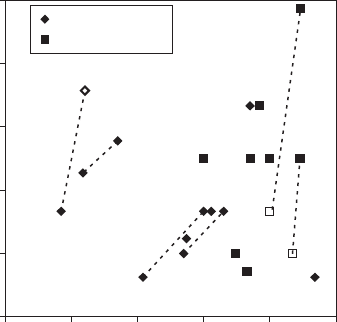
such projects (Figure 4.14). At first glance, controls on crystals shapes seem
to be rather different in the microlites of volcanic rocks, as opposed to volcanic
phenocrysts and plutonic crystals.
Crystallisation of microlites in volcanic rocks can increase gas pressure and
initiate eruptions (Sparks, 1997, Cashman & Blundy, 2000) Hence, there has
been much quantitative work on microlites. Experimental evidence suggests
that there is a progression from tabular crystals at low undercooling (30 8C)
through acicular habits and finally to skeletal crystals (Lofgren, 1974). The
0
0.2
0.4
0.6
0.8
1.0
0.0001 0.001 0.01 0.1 1 10
lo
g
(characteristic len
g
th) (mm)
short / intermediate axes
Volcanic rocks
Plutonic rocks
Figure 4.14 Short/intermediate axial ratios of plagioclase against
characteristic or typical crystal length in volcanic and plutonic rocks
(compilation of data cited here and in Section 3.4). Points from the same
unit are linked. All crystals are close to tabular in form except for the open
diamond, which is prismatic. The open squares are for foliated plutonic
rocks.
4.4 Typical applications 155
shape of natural plagioclase microlites has been recorded frequently and many
authors have noted that the shape of plagioclase microlites varies with their
size: Cashman (1992) noted changes from an aspect ratio of 1:8 in the 1980 Mt
St Helens blast dacite (typical length 10 mm) to 1:5 and finally 1:3 in the later
erupted rocks (typical length 100 mm). Examination of her thin section photo-
graphs shows that the crystals are tabular. Higgins (1996b) found that crystals
smaller than 200 mm in outline length have an aspect ratio of 1:5:6 whereas
phenocrysts had a ratio of 1:3:4 (Figure 4.14). In both these cases the crystals
are tabular: twin-plane orientations, where visible, indicate that the tabular
face is parallel to {010}. Hammer et al.(1999) observed that the smallest
microlites in a dacite are tabular (0.7 mm; 1:3:3), whereas the larger microlites
are prismatic (1.6 mm; 1:1:7). They ascribed this to a change from a nucleation
dominated crystallisation regime to one dominated by growth. These micro-
lites are much smaller than those measured in other studies, hence there may be
more complexity at this scale which is not seen in the larger microlites.
Compilation of plagioclase shapes from numerous sources reveals a broad
correlation between the characteristic size of plagioclase crystals in volcanic
rocks and their shape, as expressed by the short/intermediate ratios, with the
exception of the smallest microlites (Figure 4.14). However, not all rocks have
the same trend; hence it is possible that both size and shape track another
parameter and the most likely is undercooling. Initially, a high degree of
undercooling is required to initiate nucleation. Under such conditions the
growth rate of the tablet edge is much greater than that of the tablet side. As
crystal growth occurs, release of latent heat reduces the undercooling and the
ratio of growth rates is reduced, hence leading to more equant crystals.
Plagioclase in plutonic rocks, such as anorthosite, gabbro, diorite and
granodiorite does not generally have euhedral faces; however it commonly
has a distinctive habit that depends on rock type and conditions of crystal-
lisation (e.g. Higgins, 1991). Higgins (1991) examined plagioclase crystals from
both massive and well-foliated anorthosites from the Sept Iles mafic intrusion
and noted a significant difference in plagioclase shape. In the massive anortho-
site the plagioclase had an overall axial ratio of 1:2:4, whereas in the laminated
anorthosite the plagioclase was considerably more tabular with an axial ratio
of 1:5:8 (the shapes shown here were recalculated from the original data). This
suggests that growth under conditions of magma shear promotes the growth
rate of the tablet edges (Higgins, 1991). In another study of plagioclase in
anorthosite the crystal shape changed with coarsening from tabular crystals to
more equant forms (Higgins, 1998).
It is possible that the crystal shape in both volcanic and plutonic rocks just
reflects the chemical potential gradient around the growing crystal: where
156 Grain shape
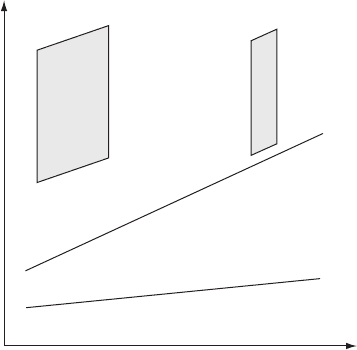
there is a high gradient the tablet edges are favoured, but under more equili-
brium conditions the effect is reduced and growth is more equal on the tablet
sides and faces (Figure 4.15).
4.4.1.2 Zircon
Zircon is a widespread, chemically resistant mineral that is used for geochro-
nology and stable isotope studies (Hanchar & Hoskin, 2003). Zircon is not
abundant in most rocks; hence crystals are generally extracted mechanically
before analysis. The problem of extracted crystals is that they lose their
petrographic context. However, zircons are tough and many retain their
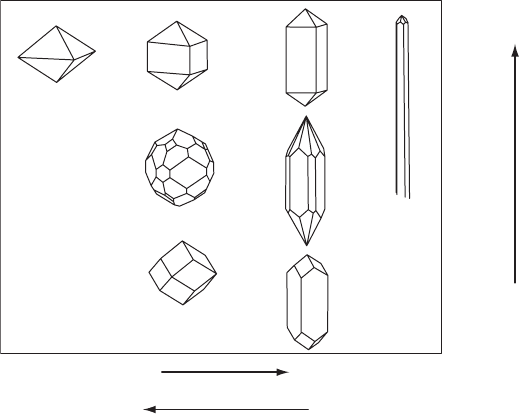
habit after extraction. Qualitative and quantitative studies of zircon habit
has therefore received much attention (Figure 4.16; Pupin, 1980, Kostov &
Kostov, 1999).
Zircons in rhyolite lavas and tuffs are prismatic and their length/breadth
ratio varies from 1.3–1.5 for crystals 50 mm long to 2.1–3.0 for crystals 250 mm
long (Bindeman & Valley, 2001, Bindeman, 2003). This may be an intrinsic
property of zircons (Larsen & Poldervaart, 1957). Vavra (1993) has examined
quantitatively the growth of individual zircons using both their overall shape
chemical potential
g
radient
growth rate
Rate
(010)
Rate
(001)
(010)
(001)
(010)
(001)
Figure 4.15 Possible response of plagioclase face growth rates to changes in
the chemical potential gradient around the growing crystal (this study). The
(001) face is taken to be typical of the tablet edge faces. The chemical potential
gradient will be high at high degrees of undercooling as diffusion will be
unable to supply nutrients to the crystal fast enough. The chemical potential
gradient will be lower at lower undercooling where the crystals are growing
more slowly or where shear advection removes depleted magma from around
the crystal faces.
4.4 Typical applications 157
and internal zoning patterns. He again finds that the pyramidal faces in general
grow faster than the prismatic faces as the undercooling (crystallisation driv-
ing force) increases, hence producing the same change in shape with crystal size
that was observed qualitatively by other authors.
4.4.1.3 Other minerals
Euhedral quartz crystals commonly grow in hydrothermal metamorphic
environments as prismatic crystals with pyramidal terminations. Ihinger and
Zink (2000) used infrared spectroscopy to show how such crystals develop.
They found that as the crystal grew the termination evolved from one domi-
nated by {11
11} faces to a final form with {10
11} faces. They showed that an
abundance of impurity phases such as HOH and AlOH can be used to measure
the relative growth rates of the faces. However, it is not clear if the change in
the relative growth rates of the faces was related to an increase in size or
changing crystallisation conditions, such as temperature.
Crystals with rapid growth textures are found in many rocks and the most
commonly described is olivine (Faure et al., 2003). Up to ten different types of
olivine morphology have been described (Donaldson, 1976) and these are
broadly related to undercooling (supersaturation). The experiments of Faure
et al.(2003) have shown that there are only three true morphologies and other
observed shapes are just special sections. With increasing undercooling olivine
Bipyramidal
Equant
Prismatic
Acicular
High supersaturationLow supersaturation
High alkalinity
High Th, U, REE
Low alkalinity
Low Th, U, REE
Low temperature
Hydrous magma
High temperature
Dry magma
Zircon crystal forms
110
100
101
110
100
101
100
101
101
Figure 4.16 Controls on zircon morphology (Kostov & Kostov, 1999).
158 Grain shape